Hubbry Logo
CaddisflyCaddisflyMain
Open search
Caddisfly
Community hub
Caddisfly
logo
8 pages, 0 posts
0 subscribers
Be the first to start a discussion here.
Caddisfly
Caddisfly
from Wikipedia

Caddisflies
Temporal range: Triassic–Recent
Scientific classification Edit this classification
Kingdom: Animalia
Phylum: Arthropoda
Class: Insecta
(unranked): Amphiesmenoptera
Order: Trichoptera
Kirby, 1813
Superfamilies

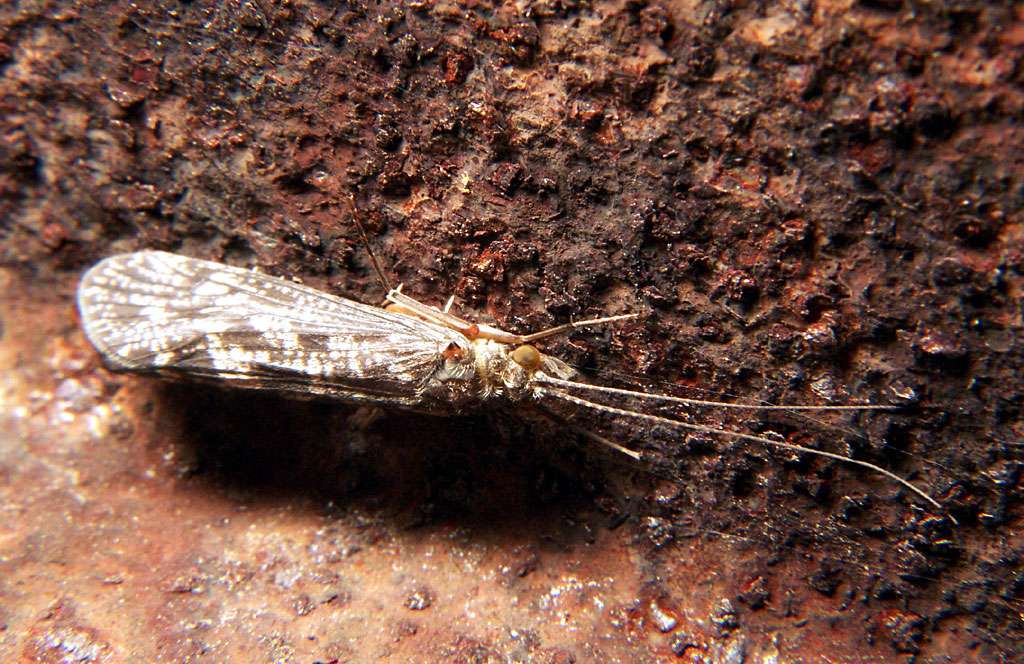
The caddisflies (order Trichoptera) are a group of insects with aquatic larvae and terrestrial adults. There are approximately 14,500 described species, most of which can be divided into the suborders Integripalpia and Annulipalpia on the basis of the adult mouthparts. Integripalpian larvae construct a portable casing to protect themselves as they move around looking for food, while annulipalpian larvae make themselves a fixed retreat in which they remain, waiting for food to come to them. The affinities of the small third suborder Spicipalpia are unclear, and molecular analysis suggests it may not be monophyletic. Also called sedge-flies or rail-flies, the adults are small moth-like insects with two pairs of hairy membranous wings. They are closely related to the Lepidoptera (moths and butterflies) which have scales on their wings; the two orders together form the superorder Amphiesmenoptera.

The aquatic larvae are found in a wide variety of habitats such as streams, rivers, lakes, ponds, spring seeps and temporary waters (vernal pools), and even the ocean.[1][2][3] The larvae of many species use silk to make protective cases, which are often strengthened with gravel, sand, twigs, bitten-off pieces of plants, or other debris. The larvae exhibit various feeding strategies, with different species being predators, leaf shredders, algal grazers, or collectors of particles from the water column and benthos. Most adults have short lives during which they do not feed.

In fly fishing, artificial flies called dry flies are tied to imitate adults, while larvae and pupae are imitated with artificial flies called wet flies or nymphs. It is also possible to use them as bait, though this is not as common as artificial flies and is known as bait fishing. Common and widespread genera such as Helicopsyche and Hydropsyche are important in the sport, where caddisflies are known as "sedges". Caddisflies are useful as bioindicators, as they are sensitive to water pollution and are large enough to be assessed in the field. In art, the French artist Hubert Duprat has created works by providing caddis larvae with small grains of gold and precious stones for them to build into decorative cases.

Etymology

[edit]

The name of the order "Trichoptera" derives from the Greek: θρίξ (thrix, "hair"), genitive trichos + πτερόν (pteron, "wing"), and refers to the fact that the wings of these insects are bristly. The origin of the word "caddis" is unclear, but it dates back to at least as far as Izaak Walton's 1653 book The Compleat Angler, where "cod-worms or caddis" were mentioned as being used as bait. The term cadyss was being used in the fifteenth century for silk or cotton cloth, and "cadice-men" were itinerant vendors of such materials, but a connection between these words and the insects has not been established.[4]

Evolution and phylogeny

[edit]
Eocene fossil in Baltic amber, Lithuania (44mya)

Fossil history

[edit]

Fossil caddisflies have been found in rocks dating back to the Triassic.[5] The largest numbers of fossilised remains are those of larval cases, which are made of durable materials that preserve well. Body fossils of caddisflies are extremely rare, the oldest being from the Early and Middle Triassic, some 230 million years ago, and wings are another source of fossils.[6] The evolution of the group to one with fully aquatic larvae seems to have taken place sometime during the Triassic.[7] The finding of fossils resembling caddisfly larval cases in marine deposits in Brazil may push back the origins of the order to the Early Permian period.[6]

Evolution

[edit]

Nearly all adult caddisflies are terrestrial, but their larvae and pupae are aquatic. They share this characteristic with several distantly-related groups, namely the dragonflies, mayflies, stoneflies, alderflies and lacewings.[7] The ancestors of all these groups were terrestrial, with open tracheal systems, convergently evolving different types of gills for their aquatic larvae as they took to the water to avoid predation.[7] Caddisflies was the only group of these insects to use silk as part of their lifestyle, which has been a contributing factor to their success and why they are the most species-rich order of aquatic insects.[8]

About 14,500 species of caddisfly in 45 families have been recognised worldwide,[9] but many more species remain to be described. Most can be divided into the suborders Integripalpia and Annulipalpia on the basis of the adult mouthparts. The characteristics of adults depend on the palps, wing venation and genitalia of both sexes. The latter two characters have undergone such extensive differentiation among the different superfamilies that the differences between the suborders is not clear-cut.[10] The larvae of Annulipalpians are campodeiform (free-living, well sclerotized, long legged predators with dorso-ventrally flattened bodies and protruding mouthparts). The larvae of Integripalpians are polypod (poorly sclerotized detritivores, with abdominal prolegs in addition to thoracic legs, living permanently in tight-fitting cases).[10] The affinities of the third suborder, Spicipalpia, are unclear; the larvae are free-living with no cases, instead creating net-like traps from silk.[4]

Phylogeny

[edit]

The cladogram of external relationships, based on molecular analysis, shows the order as a clade, sister to the Lepidoptera, and more distantly related to the Diptera (true flies) and Mecoptera (scorpionflies).[11]

Holometabola
Hymenopterida

Hymenoptera (sawflies, wasps)

Aparaglossata
Neuropteroidea
Coleopterida

Coleoptera (beetles)

Strepsiptera (twisted-wing parasites)

Neuropterida

Raphidioptera (snakeflies)

Megaloptera (alderflies and allies)

Neuroptera (Lacewings and allies)

Panorpida
Amphiesmenoptera

Lepidoptera (butterflies, moths)

Trichoptera (caddisflies)

Antliophora

Diptera

Mecoptera (scorpionflies)

Siphonaptera (fleas)

The cladogram of relationships within the order is based on a 2002 molecular phylogeny using ribosomal RNA, a nuclear elongation factor gene, and mitochondrial cytochrome oxidase. The Annulipalpia and Integripalpia are clades, but the relationships within the Spicipalpia are unclear.[12]

Trichoptera

Annulipalpia (fixed-retreat makers)

Integripalpia (portable-case makers)

"Spicipalpia" (paraphyletic?)

Distribution

[edit]

Caddisflies are found worldwide, with the greater diversity being in warmer regions. They are associated with bodies of freshwater, the larvae being found in lakes, ponds, rivers, streams and other water bodies.[13] The land caddis, Enoicyla pusilla (family: Limnephilidae), lives in the damp litter of the woodland floor. In the United Kingdom it is found in and around the county of Worcestershire in oakwoods.[14]

Ecology

[edit]
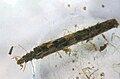
Larva in its underwater habitat

Caddisfly larvae can be found in all feeding guilds in freshwater habitats. Most early stage larvae and some late stage ones are collector-gatherers, picking up fragments of organic matter from the benthos. Other species are collector-filterers, sieving organic particles from the water using silken nets, or hairs on their legs. Some species are scrapers, feeding on the film of algae and other periphyton that grows on underwater objects in sunlight. Others are shredder-herbivores, chewing fragments off living plant material while others are shredder-detritivores, gnawing at rotting wood or chewing dead leaves that have been pre-processed by bacteria and fungi; most of the nutrients of the latter group come from consumption of the bacteria and fungi. The predatory species either actively hunt their prey, typically other insects, tiny crustaceans and worms, or lie in wait for unwary invertebrates to come too close. A few species feed opportunistically on dead animals or fish, and some Leptoceridae larvae feed on freshwater sponges.[15]

One such opportunistic species is Gumaga nigricula [vi; nl; sv] (family: Sericostomatidae) which has been observed scavenging fish carcasses and even bits of deer flesh.[16] This particular family of caddisflies is typically classified among the shredders, suggesting caution when classifying macroinvertebrates into strict ecological functional groups, as some may shift their diets opportunistically.[16]

Like mayflies, stoneflies and dragonflies, but to a somewhat lesser extent, caddisflies are an indicator of good water quality; they die out of streams with polluted waters.[17] They are an important part of the food web, both larvae and adults being eaten by many fish. The newly hatched adult is particularly vulnerable as it struggles to the surface after emerging from the submerged pupa, and as it dries its wings. The fish find these new adults easy pickings, and fishing flies resembling them can be successful for anglers at the right time of year.[18]

The adult stage of a caddisfly may only survive for a few weeks; many species do not feed as adults and die soon after breeding, but some species are known to feed on nectar.[19] The winged insects are nocturnal and provide food for night-flying birds, bats, small mammals, amphibians and arthropods. The larval stage lasts much longer, often for one or more years, and has a bigger impact on the environment.[20] They form an important part of the diet of fish such as the trout. The fish acquire them by two means, either plucking them off vegetation or the stream-bed as the larvae move about, or during the daily behavioural drift; this drift happens during the night for many species of aquatic larvae, or around midday for some cased caddisfly species, and may result from population pressures or be a dispersal device. The larvae may drift in great numbers either close to the bottom, in mid-water or just below the surface. The fish swallow them whole, case and all.[21]

Underwater structures

[edit]

Cases

[edit]

Caddisflies are best known for the portable cases created by their larvae. About thirty families of caddisfly, members of the suborder Integripalpia, adopt this stratagem. These larvae eat detritus, largely decaying vegetable material, and the dead leaf fragments on which they feed tend to accumulate in hollows, in slow-moving sections of streams and behind stones and tree roots. The cases provide protection to the larvae as they make their way between these resources.[22]

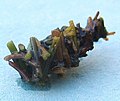
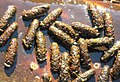
The case is a tubular structure made of silk, secreted from salivary glands near the mouth of the larva, and is started soon after the egg hatches. Various reinforcements may be incorporated into its structure, the nature of the materials and design depending on the larva's genetic makeup; this means that caddisfly larvae can be recognised by their cases down to family, and even genus level. The materials used include grains of sand, larger fragments of rock, bark, sticks, leaves, seeds and mollusc shells. These are neatly arranged and stuck onto the outer surface of the silken tube. As the larva grows, more material is added at the front, and the larva can turn round in the tube and trim the rear end so that it does not drag along the substrate.[22]

Caddisfly cases are open at both ends, the larvae drawing oxygenated water through the posterior end, over their gills, and pumping it out of the wider, anterior end. The larvae move around inside the tubes and this helps maintain the water current; the lower the oxygen content of the water, the more active the larvae need to be. This mechanism enables caddisfly larvae to live in waters too low in oxygen content to support stonefly and mayfly larvae.[19]

Fixed retreats

[edit]

In contrast to larvae that have portable cases, members of the Annulipalpia have a completely different feeding strategy. They make fixed retreats in which they remain stationary, waiting for food to come to them. Members of the Psychomyiidae, Ecnomidae and Xiphocentronidae families construct simple tubes of sand and other particles held together by silk and anchored to the bottom, and feed on the accumulations of silt formed when suspended material is deposited. The tube can be lengthened when the growing larva needs to feed in new areas.[23] More complex tubes, short and flattened, are built by Polycentropodidae larvae in hollows in rocks or other submerged objects, sometimes with strands of silk suspended across the nearby surface. These larvae are carnivorous, resembling spiders in their feeding habits and rushing out of their retreat to attack any unwary small prey crawling across the surface.[23]

Silk domes

[edit]

Larvae of members of the family Glossosomatidae in the suborder Spicipalpia create dome-shaped enclosures of silk which enables them to graze on the periphyton, the biological film that grows on stones and other objects, while carrying their enclosure around like turtles.[24] In the family Philopotamidae, the nets are sac-like, with intricate structure and tiny mesh. The larvae have specialised mouthparts to scrape off the microflora that get trapped in the net as water flows through.[25]

Nets

[edit]
Net made by a larva of the suborder Spicipalpia

The larvae of other species of caddisfly make nets rather than cases. These are silken webs stretching between aquatic vegetation and over stones. These net-making larvae usually live in running water, different species occupying different habitats with varying water speeds. There is a constant drift of invertebrates washed downstream by the current, and these animals, and bits of debris, accumulate in the nets which serve both as food traps and as retreats.[26]

Development and morphology

[edit]

Caddisfly larvae are aquatic, with six pairs of tracheal gills on the underside of the abdomen. The eggs are laid above water on emergent twigs or vegetation or on the water surface although females of some species enter water to choose sites. Although most species lay eggs, a few in the genus Triplectides are ovoviviparous. Some species lay eggs on land and although most are associated with freshwater, a few like Symphitoneuria are found in coastal saline water. Philanisus plebeius females lay their eggs into the coelomic cavity of intertidal starfish.[27] The larvae are long and roughly cylindrical, very similar to those of lepidoptera but lacking prolegs.[27] In case-bearing species, the heads are heavily sclerotised while the abdomen is soft; the antennae are short and the mouthparts adapted for biting. Each of the usually ten abdominal segments bears a pair of legs with a single tarsal joint. In case-bearing species, the first segment bears three papillae, one above and two at the sides, which anchor the larva centrally in the tube. The posterior segment bears a pair of hooks for grappling.[19] There are five to seven larval instars, followed by an aquatic pupa which has functional mandibles (to cut through the case), gills, and swimming legs.[9]

The pupal cocoon is spun from silk, but like the larval case, often has other materials attached. When pupating, species that build portable cases attach them to some underwater object, seal the front and back apertures against predators while still allowing water to flow through, and pupate within it. Once fully developed, most pupal caddisflies cut through their cases with a special pair of mandibles, swim up to the water surface, moult using the exuviae as a floating platform, and emerge as fully formed adults. They can often fly immediately after breaking from their pupal cuticle. Emergence is mainly univoltine (once per year) with all the adults of a species emerging at the same time. Development is within a year in warm places, but takes over a year in high latitudes and at high elevation in mountain lakes and streams.[9]

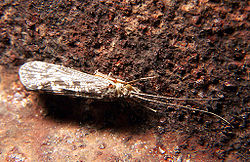
The adult caddisfly is a medium-sized insect with membranous, hairy wings, which are held in a tent-wise fashion when the insect is at rest. The antennae are fairly long and threadlike, the mouthparts are reduced in size and the legs have five tarsi (lower leg joints).[19] Adults are nocturnal and are attracted to light. Some species are strong fliers and can disperse to new localities,[26] but many fly only weakly.[19] Adults are usually short-lived, most being non-feeders and equipped only to breed. Once mated, the female caddisfly lays eggs in a gelatinous mass, attaching them above or below the water surface depending on species. The eggs hatch in a few weeks.[28]

Relationship with humans

[edit]
"Silver Sedge" fishing fly mimicking Lepidostoma caddisfly, from Trout fly-fishing in America
"Limnephilus elegans the Elegant Grannom", from British Entomology by John Curtis, c. 1840

In angling

[edit]

Adult caddisflies are called sedges by anglers. Individual species emerge en masse at different times, and are used one after the other, often for only a few days each year, as models for artificial fishing flies for fly fishing in trout streams.[14] A mass emergence is known as a hatch.[29] Each type has its own angling name, so for example Mystacides is the dancer; Sericostoma the caperer; Leptocerus the silverhorn; Phryganea the murragh or great red sedge; Brachycentrus subnubilis the grannom; Lepidostoma the silver sedge;[14] Oecetis the longhorn sedge; Cheumatopsyche the little sister sedge; Helicopsyche the speckled Peter, an important fishing fly in North America; and Hydropsyche the specked sedge, perhaps the most important caddisfly genus for anglers with over 50 species of net-makers.[29]

As bioindicators

[edit]

Caddisflies are useful as bioindicators (of good water quality), since they are sensitive to water pollution, and are large enough to be assessed conveniently in the field.[30] Some species indicate undisturbed habitat, and some indicate degraded habitat.[31] Although caddisflies may be found in waterbodies of varying qualities, species-rich caddisfly assemblages are generally thought to indicate clean water bodies, such as lakes, ponds, and marshes. Together with stoneflies and mayflies, caddisflies feature importantly in bioassessment surveys of streams and other water bodies.[32]

In art

[edit]

While caddisflies in the wild construct their cases out of twigs, sand, aquatic plants, and rocks, the French artist Hubert Duprat makes art by providing wild caddisflies with precious stones and other materials. He collected caddisfly larvae from the wild and put them in climate-controlled tanks. He removes the larvae from their original cases and adds precious and semi-precious items such as grains of gold into the tank. The larvae then build new cases out of precious items, creating a unique form of artwork. The resulting works are sold across the world.[33]

As food

[edit]

In Japan the larvae of Stenopsyche marmorata are eaten as a delicacy called Zazamushi.[34]

Taxonomy

[edit]

There are roughly 16,266 extant species in 618 genera and 51 families worldwide.[35]

References

[edit]

Further reading

[edit]
[edit]
Revisions and contributorsEdit on WikipediaRead on Wikipedia
from Grokipedia
Caddisflies, belonging to the order Trichoptera, are holometabolous distinguished by their aquatic larvae and terrestrial, moth-like adults with hairy wings and long antennae. With over 16,700 described species worldwide, they represent the seventh most speciose insect order, encompassing 51 families and 618 genera primarily distributed in freshwater habitats. The larvae, often resembling caterpillars, undergo complete through five instars, constructing portable protective cases or fixed retreats using secreted from specialized glands and materials like sand, twigs, or leaves scavenged from their environment. These cases serve as shelters and aids in locomotion, while larval feeding habits vary widely, including herbivory, predation, and filter-feeding on organic detritus, contributing significantly to nutrient cycling in aquatic ecosystems. Pupation occurs within silken cocoons inside these structures, lasting from days to weeks, after which adults emerge, typically univoltine, with short lifespans focused on and egg-laying (30–1,000 eggs per female). Ecologically, caddisflies are vital components of freshwater food webs, serving as prey for , amphibians, and birds, while their sensitivity to and alterations makes them key bioindicators for monitoring. Diversity is highest in the Oriental (over 5,800 as of 2019), with larvae thriving in , rivers, and lakes worldwide, though many populations face declines due to anthropogenic pressures like and . Their , noted for its strength and , has also garnered interest in biomaterial applications, highlighting their broader scientific significance.

Nomenclature

Etymology

The common name "caddisfly" derives from the Middle English word "caddice," which referred to a woolen braid, ribbon, or binding material, evoking the silk ribbons or threads used by workers handling such fabrics. This association arose because the aquatic larvae of these insects construct protective cases from silk and environmental materials, resembling the ribbon-like scraps sold by "caddice-men" in 17th-century England. The term "caddis" itself first appeared in the 1650s, possibly as a diminutive of "cad," and was applied to the larvae used as fishing bait, with the full name "caddisfly" linking the immature and adult stages. The scientific order name Trichoptera originates from Ancient Greek roots: "trichos," meaning "hair," and "pteron," meaning "wing," reflecting the dense covering of fine hairs on the adults' wings that distinguishes them from other insect orders. This nomenclature was established in the by entomologists recognizing the hairy wing venation as a key diagnostic trait. In addition to "caddisfly," various regional and contextual common names have evolved, particularly in traditions where adults are imitated as flies. For instance, "sedge fly" or simply "sedge" is widely used in fly-fishing, alluding to the ' prevalence near sedge in wetlands. In the , the larvae in their gravel cases are regionally known as "periwinkles," a term borrowed from the coiled shells of marine snails due to superficial resemblance. These variations highlight the 's cultural significance in local dialects and recreational pursuits.

Taxonomy

Caddisflies are classified in the order Trichoptera, which forms the to the order (butterflies and moths) within the holometabolous . This close relationship is supported by shared morphological features such as the presence of hair-like scales on the wings, reflected in the etymological roots of Trichoptera from the Greek words trichos (hair) and pteron (wing). As of , the order Trichoptera includes approximately 17,279 described organized into 630 genera and 51 families, though estimates suggest the total number of may exceed 20,000 due to ongoing discoveries in tropical regions. The families exhibiting the highest are Hydroptilidae (microcaddisflies, with nearly 2,700 ), Leptoceridae (long-horned caddisflies, exceeding 1,800 ), and Hydropsychidae (net-spinning caddisflies, around 1,800 ). Philopotamidae, another significant family with about 1,500 , contributes notably to diversity in certain Palearctic and Oriental regions. Recent taxonomic revisions between 2020 and 2025 have expanded the known distribution and diversity of Trichoptera, particularly in the Western Balkans. For example, a 2025 study identified 13 caddisfly species in Ecoregion 5 (Dinaric Western Balkans), including three new records for : Hydroptila angustata Mosely, 1941; Hydroptila forcipata Martynov, 1926; and Oxyethira falcata Ulmer, 1916. In , surveys of rivers such as the Ibër have revealed overlooked microcaddisflies, with the first record of Hydroptila martini Marshall, 1977, documented in 2025, underscoring the presence of underreported taxa in these freshwater systems. These updates reflect ongoing efforts to refine classifications using morphological and molecular data, addressing gaps in underrepresented areas. Trichoptera is divided into two monophyletic suborders: Annulipalpia and Integripalpia, which together encompass all extant families. The primary distinguishing trait is the structure of the adult maxillary palps: in Annulipalpia, the terminal segment is annulated (divided into rings), whereas in Integripalpia, it is entire and non-annulated. Annulipalpia, comprising about 20% of species, includes families such as Philopotamidae and Hydropsychidae, often associated with retreat-building behaviors. Integripalpia, the larger suborder with roughly 80% of species, encompasses diverse families like Hydroptilidae, Leptoceridae, and Limnephilidae, characterized by varied case-making strategies. This classification, established in the early 20th century and refined through phylogenetic analyses, provides the foundational framework for understanding caddisfly systematics.

Morphology

Adults

Adult caddisflies (order Trichoptera) are small to medium-sized, moth-like with body lengths ranging from 1 to 40 mm. They possess two pairs of membranous wings covered in fine hairs, with the forewings longer than the hindwings; at rest, the wings are held in a characteristic roof-like position over the . Antennae are long, filiform (thread-like), and often as long as or longer than the body length, serving primarily sensory functions. The head features large, well-developed compound eyes, which are often larger in males; ocelli are present in three simple eyes in some families but absent in others. Mouthparts are highly reduced and vestigial, including non-functional mandibles and prominent palps (maxillary palps with 3–5 segments and labial palps with 3 segments), reflecting the non-feeding habit of most adults, though a short haustellum may allow limited liquid intake in some species. The consists of a small bearing a sclerotized pronotum, with larger meso- and metathoraces supporting the wings and legs; legs are generally long and slender, suited for walking on , but in certain —particularly females of families like Hydropsychidae—they are fringed and adapted for to facilitate underwater oviposition. The is elongate and segmented, featuring glandular structures and, in males, highly complex genitalia involving segments 9 and 10, with structures such as superior appendages, inferior appendages, and a variable that are essential for -level identification. Females lack a true , instead having modified terminal segments for deposition. Coloration in adult caddisflies is typically subdued in , gray, or to provide among riparian vegetation, though a number of display brighter hues such as , , or orange, and some exhibit iridescent wings due to specialized hairs or scales.

Larvae

Caddisfly larvae possess a worm-like, elongated body typically ranging from 2 to 40 mm in length, adapted for an aquatic lifestyle. The body is divided into a distinct sclerotized head capsule, three thoracic segments equipped with paired legs, and a soft, membranous of 10 segments terminating in anal prolegs. The head capsule is fully hardened, featuring short, single-segmented antennae and prominent mouthparts suited to diverse feeding modes, such as scraping , collecting fine particles, or capturing prey. Mandibles vary in shape—broad and robust for shredding in herbivorous or detritivorous species, or slender and pointed for predatory forms—with associated maxillary and labial palps aiding in manipulation and sensing. Silk glands in the labium produce adhesive used in constructing protective cases or retreats. Each of the three thoracic segments bears a pair of segmented legs, ending in a single tarsal that facilitates crawling and securing to substrates; the prothorax includes sclerotized pronotal plates for added protection. The is largely soft but includes anal prolegs with claws for and attachment, as well as eversible lateral humps on the first segment in many species (suborder Integripalpia) that help anchor to cases. Respiration occurs through abdominal filaments functioning as gills in certain families, such as Hydropsychidae, while others rely on cutaneous exchange.

Life history

Development

Caddisflies (order Trichoptera) exhibit holometabolous development, characterized by distinct egg, larval, pupal, and stages. The life cycle begins with eggs laid in gelatinous masses underwater or on overhanging , hatching within days to weeks depending on . Larvae, the longest stage, typically undergo five to seven instars, molting as they grow and construct protective cases or retreats using and environmental materials; these adaptations, such as portable cases in Integripalpian families, support their aquatic lifestyle. The larval stage duration varies widely, lasting 1 to 3 years in cold-water habitats where growth is slowed, with some species entering —a dormant phase—to overwinter and resume development in spring. In warmer environments, completion may occur in months, often univoltine (one generation per year), though multivoltine patterns appear in tropical or lotic systems. Pupation follows the final , occurring inside sealed cases or silken cocoons within retreats, and lasts 1 to 4 weeks; during this time, larval tissues histolyze and reorganize into adult structures. The pupal stage features an active pharate — a fully formed but encased —within the pupal , equipped with temporary functional appendages including oar-like legs and developing wings for emergence. To eclose, the cuts through the cocoon using specialized mandibles, then swims or crawls to the surface before shedding the pupal to reveal the . Environmental factors significantly influence development: lower temperatures extend durations and overall larval growth rates, while adequate dissolved oxygen is essential for respiration in aquatic stages, with hypoxia potentially altering progression in some taxa.

Reproduction

Caddisflies engage in primarily during nocturnal periods, with peak activity at to facilitate mate location in their short lifespan. Males in many form swarms over aquatic habitats or , executing distinctive flight patterns or aerial dances to attract females, often in conjunction with chemical detected by sensitive antennae. In certain families, such as Hydropsychidae, individuals produce substrate through abdominal "hammering" or tapping, serving as acoustic signals for intersexual communication. These behaviors leverage the adults' morphology for sustained flight during swarming, enhancing visibility and pheromone dispersal in low-light conditions. Mating typically occurs on solid surfaces near , with males and females positioned in opposite orientations during copulation. Shortly thereafter, females oviposit by crawling or diving to attach gelatinous egg masses to substrates such as rocks, stones, or the bases of aquatic vegetation; in some , eggs are laid on overhanging riparian , relying on or rising levels to them into the aquatic environment. Females lay one or more clutches, each encased in a protective, cement-like matrix or sticky spumaline, containing 30 to 1,000 eggs, though masses can aggregate to hundreds or thousands in high-density sites. Parental investment in caddisflies is generally minimal, with adults providing no post-oviposition care such as egg guarding, as the gelatinous masses offer primary protection against and initial predation. Adult sex ratios are often near 1:1 across populations, though variations occur due to differential emergence or trapping biases in specific habitats. A 2025 USDA Forest Service study on Drummond Island, , found that caddisfly abundance and peak approximately one hour after sunset, while extended sampling up to two hours captures 80–95% of taxa.

Evolutionary history

Fossil record

The oldest known fossils of caddisflies (order Trichoptera) date back to the Early Permian period, approximately 299–272 million years ago, primarily from localities in , such as the Tyulkino site in the Perm Region. These early specimens, attributed to primitive families within the suborder Protomeropina like Microptysmatidae, include winged adults with venation patterns that closely resemble those of modern Rhyacophilidae in key aspects, such as the arrangement of longitudinal veins and reduced crossveins, suggesting the rapid establishment of core trichopteran wing morphology soon after the order's origin. The era (252–66 million years ago) marks a period of diversification for caddisflies, with fossil records spanning the to revealing the emergence of major subordinal lineages and early indications of case-building behaviors in larval precursors. deposits provide sparse but significant evidence of basal forms, while sediments, including lacustrine and amber-preserved material from sites like the Madongshan Formation in , document tubular larval cases constructed from and environmental debris, highlighting the evolution of protective retreats. Eocene amber inclusions, dating to around 50 million years ago from Baltic deposits, further preserve intact larvae within cases, offering exceptional detail on pre-Cenozoic aquatic adaptations and bridging Mesozoic forms to later radiations. In the era, caddisfly fossils exhibit marked abundance and diversity, particularly in Eocene to lake deposits (56–5 million years ago), such as the Green River Formation in the United States and the Enspel in , where numerous species are represented by adults, larvae, and elaborate cases reflecting varied ecological niches. These records underscore a proliferation of case-making strategies in freshwater environments. Recent 2020s examinations of preserved museum specimens have uncovered microplastic particles incorporated into caddisfly cases from the , demonstrating anthropogenic impacts on larval construction as early as the late . Caddisflies endured only minor setbacks during major extinction events, including the Permian-Triassic boundary crisis around 252 million years ago, from which their lineage recovered to diversify across the ; a notable followed the Cretaceous-Paleogene at 66 million years ago, contributing to their modern ecological dominance in aquatic systems.

Phylogeny

Cladistic analyses consistently position the order Trichoptera as the to within the superorder , a relationship bolstered by shared morphological traits such as scale-like setae on wings and antennae, as well as genetic similarities in silk-producing genes. This close affinity is further evidenced by mitochondrial genome studies that recover robust support for the Trichoptera- , highlighting conserved genomic architectures related to aquatic and terrestrial silk production. Within Trichoptera, phylogenomic reconstructions delineate two primary suborders: Annulipalpia, considered basal and characterized by fixed-retreat and net-spinning behaviors, and the more derived Integripalpia, encompassing diverse free-living and case-making lineages. A comprehensive 2025 review, integrating molecular data from over 200 species across 48 families, provides detailed family-level phylogenies that refine these subordinal relationships and underscore the of major clades through concatenated nuclear and mitochondrial markers. Molecular evolutionary studies reveal extensive in silk fibroin genes, particularly the heavy-chain fibroin (h-fibroin), enabling specialized underwater production adapted to diverse aquatic environments. from the early 2020s on h-fibroin in various caddisfly demonstrates variations in , such as tensile strength and elasticity, tailored to larval case and net-building. Recent phylogenomic advancements between 2023 and 2025 have incorporated transcriptomic data to resolve deep divergences and cryptic complexes within Trichoptera, enhancing taxonomic precision through multi-locus datasets from de novo sequencing and targeted enrichment. These studies, analyzing hundreds of , have clarified interfamilial relationships and identified hidden diversity via molecular delimitation, particularly in understudied tropical faunas.

Biogeography

Distribution

Caddisflies (order Trichoptera) exhibit a across all continents except , where their absence is attributed to the lack of suitable freshwater habitats and barriers posed by extensive ocean passages. They are also notably absent from many oceanic islands, such as those in the archipelago, due to isolation and limited permanent freshwater systems required for their aquatic larval stages. This freshwater dependency confines their global presence to regions with reliable aquatic environments, resulting in over 17,000 described worldwide. The highest species diversity occurs in tropical regions, particularly in the Neotropics and , where environmental conditions support elevated richness. In the Neotropics, encompassing and , 3,309 species have been documented across 171 genera. (Oriental region) harbors over 5,800 species, with significant concentrations in Southeast Asian river systems and islands like and , reflecting the order's affinity for warm, humid climates. In contrast, the shows substantial but lower diversity; supports approximately 1,400 species, predominantly in temperate streams and rivers north of . and adjacent areas host around 1,855 species in 132 genera, with concentrations in mountainous and forested watersheds. Recent surveys have documented range extensions in the , highlighting dynamic distributional shifts possibly driven by improved sampling and environmental changes. In 2025, records from the Zeta River in added three species—Hydroptila sparsa, Hydropsyche silesiaca, and Sylviobius montanus—to the national , extending known ranges within 5 of the Dinaric Western . Such findings underscore ongoing discoveries in understudied areas. Modeling efforts predict significant future declines in due to ; for instance, a 50% reduction in intact upstream is projected to cause a 30% drop in local caddisfly diversity, with broader implications for regional assemblages by 2050 under continued land-use pressures. Endemism is pronounced in isolated aquatic systems, such as ancient lakes, where unique evolutionary radiations have produced specialized lineages. in exemplifies this, hosting 14 endemic caddisfly across seven genera in the family Apataniidae, including the Baicalina with distinct adaptations to the lake's oligotrophic conditions. These endemic taxa contribute to the high observed in such freshwater ecosystems.

Habitats

Caddisfly larvae exhibit a strong preference for lotic habitats, such as and rivers, where they are particularly abundant and diverse due to the availability of flowing water that supports their filter-feeding and case-building behaviors. Families like Hydropsychidae, commonly known as net-spinners, dominate in these running-water environments, constructing silk retreats and nets anchored to substrates in moderate- to fast-flowing sections of and rivers. In contrast, species from the family Limnephilidae are more frequently associated with lentic habitats, including ponds, lakes, and other standing waters, where calmer conditions facilitate their diverse case-making strategies. Within lotic systems, caddisflies occupy specific microhabitats that align with their functional groups; net-spinning larvae, such as those in Hydropsychidae, preferentially inhabit riffles characterized by high current velocities and coarse substrates, which enhance the efficiency of their nets for capturing drifting particles. Case-making species, including many in Limnephilidae and related families, tend to favor pools and slower-flowing reaches with finer sediments, providing stable sites for building protective cases from organic and mineral materials. Caddisflies are distributed across a broad altitudinal gradient, from to elevations exceeding 4,000 m in high-mountain streams, where adaptations like reduced size help cope with lower oxygen availability at higher altitudes. These thrive in clean, well-oxygenated aquatic environments, requiring dissolved oxygen concentrations above 5 mg/L to support respiration, particularly for gill-bearing larvae in their silk cases or retreats. Preferred water ranges from 6 to 8, with neutral to slightly alkaline conditions optimal for most , while temperatures between 5°C and 25°C accommodate their life cycles, though extremes can limit growth and survival. Caddisflies show high sensitivity to , as excess fine particles can clog respiratory gills, smother eggs, and disrupt case construction, leading to reduced larval densities in impacted streams. Recent ecological models highlight ongoing threats from habitat loss, with a 2023 study predicting that a 50% reduction in intact upstream habitat—due to factors like land-use change and fragmentation—would result in approximately a 30% decline in caddisfly in northcentral streams, underscoring the importance of riparian integrity for maintaining these communities.

Ecology

Trophic roles

Caddisfly larvae occupy diverse trophic positions within aquatic food webs, primarily as primary consumers or secondary predators, depending on their feeding . Shredders, such as those in the family Lepidostomatidae, consume coarse like leaf litter, breaking down allochthonous inputs from riparian zones into finer particles that support downstream microbial communities. Scrapers, exemplified by in the family Glossosomatidae, graze on and attached to substrates, thereby regulating algal and promoting nutrient turnover in lotic systems. Filtering-collectors, including hydropsychid larvae, use silken nets to capture suspended fine and drifting in the , facilitating the retention of organic nutrients in habitats. Predatory larvae, such as those in the family Rhyacophilidae, actively hunt smaller aquatic like chironomid midges and nymphs, exerting top-down control on benthic invertebrate populations. Adult caddisflies generally exhibit minimal or no feeding activity, relying on lipid reserves accumulated during the larval stage to fuel reproduction and dispersal. Their mouthparts are often reduced or vestigial, limiting intake to occasional liquid nectar or sap in species that do feed, though many emerge solely to mate and oviposit before perishing. With lifespans typically ranging from days to a few weeks, adults contribute little to ongoing nutrient flux but serve as a brief link between aquatic and terrestrial ecosystems through emergence swarms. As prey, caddisfly larvae are a key food resource for higher trophic levels in freshwater habitats, supporting the growth of predatory fish such as (Oncorhynchus mykiss and Salmo trutta), (Salmo salar), and bass (Micropterus spp.), as well as birds like (Cinclus spp.) and amphibians including salamanders. Their cases provide some protection but do not deter consumption by bottom-feeding species or wading birds. Adult caddisflies, emerging en masse near water bodies, are targeted by aerial predators including insectivorous birds like (Hirundo rustica), bats such as the (Myotis lucifugus), and web-building spiders in riparian vegetation. Through their detritivorous activities, particularly as shredders and collectors, caddisfly larvae play a vital role in ecosystem services by accelerating nutrient cycling in streams and ponds, converting recalcitrant organic matter into bioavailable forms that enhance and support higher trophic levels. This process alleviates nutrient limitations, such as scarcity in communities associated with larval cases. Recent research has highlighted an emerging trophic concern: case-building larvae in the family Limnephilidae can incorporate into their constructions from contaminated sediments, facilitating transfer to benthic like the (Ameiurus nebulosus), where 90% of experimental preferentially consumed plastic-laden larvae, potentially amplifying contaminant in food webs.

Behavior

Caddisfly larvae exhibit limited locomotion, primarily crawling slowly along substrates while dragging their portable cases behind them, which allows them to and reposition without abandoning . This crawling is supplemented by passive drifting, where larvae release their hold on the substrate and float with the current, often in response to declining food resources or for downstream dispersal. During the pupal stage, larvae seal themselves within cocoons attached to their cases or retreats; upon maturation, the cuts an exit using specialized mandibles and rapidly swims to the surface for , aided by gas-filled structures or thrashing motions rather than dedicated rafts. Adult caddisflies are generally weak fliers with hairy, tent-like wings that limit long-distance travel, keeping them close to riparian zones and water bodies. They are predominantly nocturnal, with flight activity peaking shortly after sunset to minimize predation risk, and often form low-flying swarms over streams during for purposes. Recent surveys by the U.S. Forest Service documented this periodicity in 33 U.S. across 10 families, collecting over 7,000 specimens primarily within the first one to two hours post-sunset on Drummond Island, , confirming a consistent sunset-to-sunrise across seasons. Caddisflies are largely solitary throughout their life cycle, though larvae may form dense aggregations in high-density stream environments, such as during periods in temperate regions, where clusters of up to several hundred individuals per square meter enhance habitat complexity and facilitate colonization by other benthic . In response to predators like or nymphs, larvae employ anti-predator behaviors including rapid case abandonment to escape attacks, allowing them to flee on foot while leaving the case as a , though this increases vulnerability if recasing is delayed. Diel activity patterns in caddisfly larvae are predominantly nocturnal, with peak movement and occurring at night to avoid diurnal predators such as , while daytime is spent concealed in cases or retreats. This rhythm is endogenous and persists under constant conditions, reflecting an adaptive strategy to reduce encounter rates with visually hunting predators in well-lit streams.

Larval constructions

Cases

Caddisfly larvae in the suborder Integripalpia, particularly families such as Leptoceridae, construct portable cases as protective shelters during their aquatic larval stage. These cases are primarily built using secreted from specialized glands in the labial spinnerets, forming a flexible tubular framework that the larvae then reinforce and by incorporating environmental materials like grains, small sticks, or fragments. The primary functions of these cases include providing to blend with the substrate, thereby reducing visibility to predators, and offering physical against predation attempts and the mechanical forces of water currents. Additionally, the cases enhance mobility, allowing the larvae to crawl along streambeds using their abdominal prolegs while carrying the , which acts as a portable refuge without hindering locomotion. Variations in case design reflect adaptations to larval growth and environmental conditions; cases are typically straight or slightly curved tubes that increase in size with each as the larva molts and reconstructs or extends the structure to accommodate its larger body. Material selection also varies, with larvae in high-flow environments often choosing heavier particles like or to increase case stability and reduce dislodgement risk, while those in calmer waters may opt for lighter organic debris. Recent analyses of preserved caddisfly cases in collections have revealed the incorporation of into constructions dating back to the 1970s, indicating early anthropogenic in freshwater ecosystems and the unintended use of synthetic particles as building materials by larvae.

Fixed retreats

Some caddisfly larvae in the suborder Annulipalpia, often termed fixed-retreat makers, construct stationary silk-lined tubes anchored to stable substrates such as rocks or wood, distinguishing them from mobile case-builders. These retreats are prevalent in families like Polycentropodidae, where genera such as Polycentropus and Neureclipsis form tubular structures that serve as permanent shelters for feeding, predator avoidance, and eventual pupation. The construction process begins early in the , with the extruding from specialized labial glands to create a foundational tube, often embedding particles like sand grains, , or plant fragments for and reinforcement. In Polycentropodidae, these tubes may feature reddish -coated inner walls or branching designs, with associated strands extending outward to detect prey in the current. The resulting structures can form interconnected mazes up to several centimeters long on rock surfaces, providing a disguised and durable . Adaptations in fixed retreats include trumpet-shaped openings in some Polycentropodidae species, which deflect water flow to optimize particle capture for filter-feeding while minimizing dislodgement in fast currents. These retreats are commonly found in habitats of and rivers, where moderate to high flow rates support the sedentary lifestyle of the larvae. Ecologically, fixed retreats increase local complexity by creating microhabitats on substrates, fostering for smaller and contributing to overall structure through silk-mediated stabilization.

Nets

Caddisfly larvae in the Hydropsychidae construct nets as fixed devices to capture particles suspended in flowing . These nets are typically designed as - or funnel-shaped meshes, with the opening oriented upstream to align with the current, allowing to flow through and deposit particles on the silken strands. Mesh openings generally range from 0.1 to 1 mm, varying by and to target specific particle sizes while permitting excess to pass. The primary function of these nets is passive , where , , and other are trapped as currents carry them downstream. Larvae reside within an adjacent silk-lined retreat, emerging periodically to consume the accumulated material without leaving the protective structure, thereby minimizing exposure to predators and high flows. This mechanism enables efficient in lotic environments, contributing briefly to broader trophic roles by processing fine in ecosystems. Net maintenance involves the larvae secreting additional to repair damage from abrasion, , or flow fluctuations, ensuring structural integrity over time. These structures are particularly sensitive to changes in water velocity, as altered flows can clog meshes or dislodge nets, prompting larvae to rebuild or modify them for optimal performance. Diversity in net architecture reflects adaptations to hydraulic conditions, ranging from simple, flexible bag-like forms in moderate flows to more complex, rigid disc- or bowl-shaped designs in fast waters, where reinforced provides stability against turbulence.

Silk domes

domes are specialized hemispherical structures constructed by larvae of certain caddisfly families, primarily Glossosomatidae within the suborder Annulipalpia, and attached directly to rock surfaces in shallow, flowing streams. These enclosures, often described as saddle- or turtle shell-like in shape, provide shelter and a platform for feeding in environments with moderate to fast currents. Unlike more widespread portable cases or nets, domes are relatively uncommon and represent a distinct architectural among the approximately 1,200 in Glossosomatidae. Construction begins with the larva secreting adhesive from modified labial glands, which binds fine particles such as grains or small pebbles into a cohesive dome, typically 2-5 mm in height; in some instances, the structure consists primarily of pure for a more delicate form. The larva positions the dome on a stable substrate, with the flat ventral side allowing the head and legs to extend outward for mobility and feeding, while the curved dorsal side offers protection from predators and dislodgement. These domes are frequently rebuilt with each larval as the animal grows, emphasizing their role as temporary retreats in dynamic aquatic habitats. The primary functions of silk domes include shelter from hydraulic forces and predation, as well as facilitating grazing on periphyton; the relatively thin and semi-transparent silk components allow larvae to access and scrape algal films directly from the underlying rock without fully emerging. This grazing strategy positions Glossosomatidae larvae as important herbivores in lotic ecosystems, where they consume diatoms and other microalgae, contributing to nutrient cycling. Compared to the more prevalent tubular cases of Integripalpian families or silken nets of Hydropsychidae, domes are less versatile for particle capture but optimized for scraper lifestyles in exposed riffles. Evolutionarily, silk domes are considered a primitive construction type in Trichoptera, reflecting early adaptations for sessile protection and feeding that bridge the order's origins with ancestral silk-producing behaviors shared with sister group around 200-300 million years ago. This form predates more complex portable cases and highlights the role of silk modifications in the diversification of larval architectures. The underlying silk proteins, encoded by conserved genes, underscore these structures' foundational position in caddisfly phylogeny.

Human interactions

Angling

Caddisflies have been utilized in angling since the 15th century in Europe, where cased larvae were recommended as live bait by Dame Juliana Berners in her 1496 Treatyse on Fysshynge wyth an Angle. Modern fly fishing predominantly employs artificial imitations to mimic various life stages, including dry flies for adults and wet flies or nymphs for larvae and pupae. The Elk Hair Caddis, a popular dry fly pattern invented by Al Troth in 1957, uses elk hair for the wing to replicate the upright posture and silhouette of adult caddisflies, making it effective for surface-feeding trout. These imitations often draw from adult morphology, such as the tented wings and hairy bodies, to enhance realism during hatches. Larval forms, known as "caddis grubs," are fished in their natural case form as live bait, particularly for trout in streams where they dislodge from substrates and drift in currents. Anglers collect these cased larvae from rocks or vegetation and present them subsurface to target species like rainbow and brown trout, capitalizing on their high nutritional value as a staple prey item. Emergences of specific genera, such as Rhyacophila (free-living caddis) and Hydropsyche (net-spinners), often trigger significant hatches that concentrate feeding activity, especially in freestone rivers during late spring and summer. These events prompt anglers to select patterns matching the size and color of the emerging insects, with Hydropsyche hatches noted for their reliability in western U.S. waters. Effective techniques include upstream to imitate natural drifts, particularly during evening rises when adults are active on the surface. Anglers dry fly imitations at a 45-degree angle upstream, mending the line to achieve a drag-free float, or add subtle twitches to mimic struggling , increasing strike rates in riffles and seams. For subsurface presentations, high-rod-tip control during drifts targets feeding in deeper runs ahead of hatches.

Bioindicators

Caddisfly larvae, belonging to the order Trichoptera, are highly sensitive to environmental pollutants and are classified within the Ephemeroptera-Plecoptera-Trichoptera (EPT) group, which consists of macroinvertebrates intolerant to organic and chemical stressors in aquatic systems. This sensitivity makes them integral to biotic indices such as the Biological Monitoring Working Party (BMWP) score, where their presence and abundance help evaluate stream health by reflecting tolerance to pollution levels. In water quality assessments, are employed to monitor organic from sources like and agricultural runoff, as well as acidification driven by or industrial emissions, with larval populations declining sharply in pH levels below 6.0. Recent studies in 2025 have expanded their application to emerging contaminants, including a survey in northern Thai streams that detected in caddisfly larvae and their silk cases, correlating plastic ingestion with reduced and serving as indicators of localized hotspots. Additionally, analysis of preserved caddisfly casings from 1971 revealed embedded , demonstrating their utility as legacy indicators of historical contamination persisting in sediments. The sessile nature of caddisfly larvae, often fixed in protective cases or retreats, allows them to integrate exposure to conditions over extended periods, providing a cumulative assessment of stability rather than instantaneous snapshots. Their further correlates strongly with overall habitat health, where higher Trichoptera richness signals unimpacted, oxygen-rich environments supportive of diverse benthic communities. Globally, caddisflies feature prominently in standardized monitoring programs, such as the U.S. Environmental Protection Agency's (EPA) bioassessment protocols under the Clean Water Act, which incorporate EPT metrics to classify stream impairment and guide restoration efforts. In , the EU Water Framework Directive utilizes multimetric indices including Trichoptera abundance to achieve good ecological status for surface waters, emphasizing their role in transboundary pollution tracking.

Cultural aspects

Caddisflies have long captured the imagination in literature, particularly through their association with and natural observation. In Izaak Walton's seminal work (1653), the author praises the "Cod-worm or Caddis" as a vital for , noting how it makes the fish "bold and lustie" during the May fly season, and describes various types of "Cadis" or case-worms found in English brooks as effective lures for multiple species. This portrayal underscores the insect's practical and poetic significance in 17th-century English pastoral life, blending utility with contemplative recreation. In art, caddisflies have inspired innovative collaborations between nature and human creativity, especially in modern installations. French artist Hubert Duprat began experimenting in the 1980s by placing caddisfly larvae in controlled aquariums stocked with gold leaf, pearls, turquoise, and semi-precious stones, allowing the insects to incorporate these materials into their protective cases and producing intricate, jeweled sculptures that evoke the larvae's architectural ingenuity. These works, exhibited internationally, transform the insect's natural behavior into commentary on beauty, materiality, and environmental interaction, with pieces measuring around 2.5 cm in length and showcasing the larvae's silk-bound constructions. Symbolically, the caddisfly's life cycle—from sedentary, case-building to short-lived winged —has been interpreted across cultures as emblematic of transformation and . Scientific findings of in preserved caddisfly cases dating back to 1971 highlight long-term environmental contamination. Caddisflies also appear in media depictions of outdoor pursuits, reinforcing their cultural ties to rivers and reflection. In the 1992 film A River Runs Through It, directed by and based on Norman Maclean's , angling sequences evoke the Blackfoot River's caddis hatches, portraying the insects as central to the rhythmic, meditative practice of in early 20th-century . This representation has popularized the caddisfly's role in American literary and cinematic traditions of nature and family.

Culinary uses

Caddisfly larvae, particularly those of species in the family Stenopsychidae, are harvested in parts of for human consumption, serving as a protein-rich source in traditional diets. In , larvae known as zazamushi—primarily from Stenopsyche griseipennis and related species—are collected from fast-flowing rivers and prepared as a seasonal , often boiled and then sautéed in and sugar to create a preserved product called . While less documented, larvae including Trichoptera are incorporated into snacks and soups in broader Asian contexts, such as , where they contribute to local practices. Aquatic insects, including caddisfly larvae, offer high protein levels averaging around 59% dry weight, with substantial essential (45.93–62.01%) and polyunsaturated fatty acids like EPA that support human health. They are also rich in fats, minerals such as iron and , and , positioning them as a viable alternative protein in regions facing challenges. Recent trials have explored farming Trichoptera larvae in controlled freshwater systems, demonstrating sustainability due to their high larval densities and efficient conversion of into , with potential yields exceeding 1,000 individuals per square meter in optimized setups. Cultural practices surrounding caddisfly consumption emphasize seasonal harvesting and local traditions, particularly in rural Japanese communities where zazamushi has been a protein staple since historical times, often sold as souvenirs in bottled form. In the 2020s, research has advanced farmed Trichoptera as an eco-friendly protein source, with studies highlighting their role in reducing reliance on overfished through scalable rearing protocols. Regarding safety, caddisfly larvae from clean water sources pose low risk of toxins or pathogens, as cooking methods like eliminate potential zoonotic threats; however, those from polluted habitats may accumulate such as mercury and lead, necessitating avoidance or rigorous testing in contaminated areas. Standardized cultivation in monitored environments is recommended to mitigate these concerns and ensure consistent quality.

References

Add your contribution
Related Hubs
User Avatar
No comments yet.