Tricorne
Tricorne
Main page
2129458

Tricorne

logo
Community Hub0 subscribers
Read side by side
from Wikipedia
Tricorne
Italian tricorne hat, mid-18th century
TypeHat
MaterialAnimal fiber
Introduced17th century

The tricorne or tricorn is a style of hat in a triangular shape, which became popular in Europe during the 18th century, falling out of style by the early 1800s. The word "tricorne" was not widely used until the mid-19th century. During the 18th century, hats of this general style were referred to as "cocked hats".

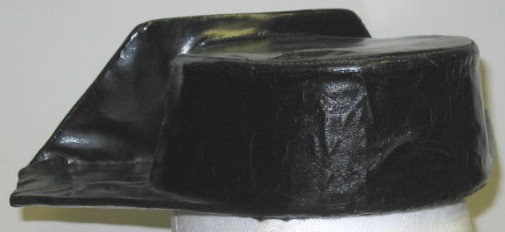
At the peak of its popularity, the tricorne varied greatly in style and size, and was worn not only by the aristocracy, but also as common civilian dress, and as part of military and naval uniforms.[1] Typically made from animal fiber, the more expensive being of beaver-hair felt and the less expensive of wool felt, the hat's most distinguishing characteristic was that three sides of the brim were turned up (cocked) and either pinned, laced, or buttoned in place to form a triangle around the crown. The style served two purposes: first, it allowed stylish gentlemen to show off the most current fashions of their wigs, and thus their social status; and secondly, the cocked hat, with its folded brim, was much smaller than other hats, and therefore could be more easily tucked under an arm when going inside a building, where social etiquette dictates that a gentleman should remove his hat. Tricornes with laced sides could have the laces loosened and the sides dropped down to provide better protection from the weather, sun, and rain.[2][3]

Tricornes had a rather broad brim, pinned up on either side of the head and at the back, producing a triangular shape. The hat was typically worn with one point facing forward, though it was not at all unusual for soldiers, who would often rest a rifle or musket on their right shoulder, to wear the tricorne pointed to the left to allow better clearance. The crown is low, unlike the steeple hats worn by the Puritans or the top hat of the 19th century.[4]

Tricornes ranged from the very simple and cheap to the extravagant, occasionally incorporating gold or silver lace trimming and feathers. In addition, military and naval versions usually bore a cockade or other national emblem at the front. This style of hat remains in use in several countries to the present day as an item of ceremonial dress.

History

[edit]
French Musketeers of the Guard wearing tricorne hats in 1688.

The tricorne appeared as a result of the evolution of the broad-brim round hat used by Spanish soldiers in Flanders during the 17th century.[5] By pledging (binding) the brims, a triangular shape was obtained. This shape was favored by Spanish soldiers, as when standing at arms, their muskets could be held at their shoulders right or left without hitting the hat brim. War broke out between France and Spain in 1667 over the Spanish Netherlands, and during the subsequent struggle, its use spread to the French armies. The style was brought back to France, where its usage spread to the French population and the royal court of King Louis XIV, who made it fashionable throughout Europe, both as civilian and military wear. By the end of the 17th century, the tricorne was popular in both civilian fashion and in military uniforms. It remained one of the predominant European styles of hat throughout the 18th century. In the United States, only the first five presidents, from George Washington to James Monroe, wore this style of hat according to the fashion of the 18th century.[6][7] James Monroe earned the nickname "The Last Cocked Hat"[8] because of this.

The tricorne quickly declined in use at the end of the 18th century. It evolved into the bicorne,[9] which was widely used by military officers in Europe from the 1790s until World War I, not completely fading out of style until World War II. For enlisted soldiers, the tricorne was replaced by the shako at the turn of the 19th century, which had become the new dominant style of military headgear from 1800 on.[10] Also at the turn of the 19th century, as the fashionable hat for civilian men, the tricorne was overtaken by the top hat.[11] In 1917, the Women's Royal Naval Service introduced a smaller, modernised version of the tricorne for female officers.[12]

Modern usage and legacy

[edit]

Tricornes survive today as part of the traditional dress of the Chelsea Pensioners (UK)[13] and the Old Guard Fife and Drum Corps of the United States Army,[14] and the distinctive hat[15] of the Spanish Guardia Civil, called a tricornio in Spanish, originates from the tricorne. In the UK, a black feathered tricorne hat is part of the ceremonial dress of most Lord Mayors; at the annual Lord Mayor's Show in November, the newly elected Lord Mayor of the City of London can usually be seen enthusiastically waving his tricorne at the crowds.[16] In the British Parliament until recently, both the Lord Chancellor and the Speaker of the House of Commons used to carry plain black tricornes as part of their formal dress each day when on duty; only on rare occasions was it worn (on top of the full bottomed wig): by the Lord Chancellor when acting as a Lord Commissioner of the Sovereign, and by the Speaker when rebuking a Member at the Bar of the House. During the Introduction Ceremony, new members of the House of Lords were required to doff (remove and replace) a tricorne hat three times before the Lord Chancellor; however, hats were removed from the ritual in 1998.[17]

The American Soldier: Set 1, U.S. Center of Military History. Note: The troops in this painting wear the uniforms prescribed in the regulations of 1779 and supplied at the time of the Yorktown campaign -- blue coats with distinctive facings for the infantry regiments from four groups of states: New England; New York and

In the United States, the tricorne is associated with the American Revolution and American Patriots of that era, especially Minutemen (militia members of the American Colonies),[18] as well as the Continental Army who wore black tricorne hats of black felt or leather with aa black cockade.[19] Participants in re-enactment events often don tricornes, and they also can be seen in sports culture as worn by fans of teams with Revolutionary names, such as the New England Patriots (an American football team),[20] the New England Revolution (a Major League Soccer team),[21] the United States men's national soccer team, the University of Massachusetts Amherst,[22] and the George Washington University. The Tea Party movement also uses the tricorne as an icon to associate itself with the American Revolution.[23]

In Spain, the traditional headdress of the Guardia Civil, the oldest law enforcement agency covering the whole country, is the tricornio hat, originally a tricorne. Its use now is reserved for parades or ceremonies. The Royal Corps of Halberdiers within the Spanish Royal Guard wear blue and white with a silver ribbon tricorne as part of their formal dress.[24]

In France, synagogue officiants (usually not rabbis) wear the tricorne on formal occasions. In the French Navy and Air Force, tricornes are still worn by women as a piece of uniform.

The tricorne is a key feature in the Portuguese University of Minho's academic dress. Its origins are as far as the 18th century, as being the academic dress of Colégio de Estudos Superiores de S. Paulo, as depicted by tile panels in the Archbishop's Palace of Braga (now Rectorate of the University of Minho). Designated by "Tricórnio" (Portuguese for "tricorne"), this academic dress was redesigned and officially set in 1989.

In Canada, the tricorne is part of the ceremonial wear of the Speakers, both in the federal Parliament and in some provincial legislatures. It is also part of the ceremonial dress for justices of the Supreme Court of Canada.

In 1981, the milliner John Boyd made a famous pink tricorne hat for Diana, Princess of Wales. This style became known as the "Lady Di" design and was copied worldwide.[25]

[edit]

See also

[edit]

References

[edit]
[edit]
Revisions and contributorsEdit on WikipediaRead on Wikipedia
from Grokipedia
The tricorne, or tricorn hat, is a style of headwear characterized by a low crown and a broad brim turned up and fastened on three sides to form distinct triangular points when viewed from above.[1] This design evolved from earlier broad-brimmed round hats, with the upturned brims serving practical functions such as shedding rainwater, preventing interference with weaponry, and allowing attachment of decorative elements like feathers or cockades.[2] Typically constructed from wool felt, beaver fur, or similar durable materials, the tricorne was worn perpendicular to the head with one point facing forward, distinguishing it from later cocked hat variations.[3] Emerging in the late 17th century among European military personnel, particularly Spanish soldiers in Flanders who bound up hat brims for utility during combat, the tricorne gained widespread civilian and aristocratic adoption across Europe by the early 18th century.[2] It became a hallmark of formal and military attire, emblematic of the Baroque and Rococo eras, and was sported by prominent figures including Louis XIV of France, Frederick the Great of Prussia, and George Washington during the American Revolutionary War.[4] The hat's prevalence reflected social norms requiring gentlemen to cover their heads outdoors, symbolizing status rather than mere protection from elements, though its military variants often featured regiment-specific colors and insignia for identification.[2] By the late 18th century, the tricorne began yielding to evolving fashions like the bicorne and top hat, influenced by neoclassical styles and wigless hairstyles, effectively phasing out for everyday use by the early 19th century.[1] Its legacy endures in ceremonial contexts, such as the tricornio worn by Spain's Guardia Civil or the stylized versions in British military traditions like the Chelsea Pensioners, underscoring its role as a enduring symbol of 18th-century European and colonial authority.[4]

Design and Construction

Materials and Manufacturing

Tricornes were primarily made from felted animal fibers, with wool felt employed for economical production and beaver fur felt reserved for premium variants prized for enhanced durability, water resistance, and shape retention properties arising from the dense interlocking of underfur barbs during felting.[5][6] Beaver felt's superiority stemmed from the pelt's underwool, which formed a tighter, more resilient matrix than wool, better withstanding environmental exposure central to the hat's practical military and outdoor utility.[7][8] The manufacturing process commenced with preparing raw materials: beaver pelts underwent guard hair removal, skinning, and chemical treatment—historically involving mercury nitrate—to separate and mat the underfur into sheets via agitation and moisture. Wool was similarly carded and felted, though less labor-intensive, yielding coarser results. The resulting felt cone was steamed, stretched over wooden blocks to mold the rounded crown and wide brim, then trimmed and stiffened.[9] Cocking the brim—folding it upward at three equidistant points to form the tricorne's signature triangular profile—involved precise hand-stitching with waxed linen thread in a reinforced spaced backstitch pattern piercing the felt layers, ensuring structural integrity under repeated handling.[10] Final steps included edging with braid or lace and lining with silk or linen for comfort, though these were omitted in basic military models.[11] Analysis of extant 18th-century specimens reveals marked quality disparities: military tricornes favored inexpensive wool felt for mass production, while civilian elite versions used beaver felt, commanding prices two to three times higher—fine beaver hats often equaling two guineas or more, comparable to weeks of an unskilled laborer's wages around 1 shilling daily.[12][13][14] This variance reflected not only material costs but also the intensive artisanal labor in beaver processing, underscoring the hat's role as a status marker alongside its functional design.[15]

Structural Features and Variations

The tricorne's core structure consists of a broad brim, typically 10 to 15 centimeters wide when extended, folded and secured upward along three sides to form a distinctive triangular silhouette around a low crown.[4] This configuration derived from earlier flat-brimmed hats, where the brims were pinned or buttoned up to deflect rain, reduce wind interference, and maintain clear peripheral vision essential for activities like musket aiming or horseback riding.[5][16] Essential features include a shallow crown height of approximately 10 to 12 centimeters, designed to accommodate the tall powdered wigs prevalent in the era without adding excessive bulk; reinforcement via bound or stitched edges to enhance durability against weathering; and fastening mechanisms such as buttons, loops, cords, or buckles to hold the cocked brims in position against daily use or gusts.[17][16][18] Variations arose in cocking orientation and proportions to balance utility and display, with the angle of elevation adjustable—steeper for ceremonial rigidity, shallower for everyday flexibility. Military and naval tricornes often featured asymmetrical cocking, such as a forward-pointing apex to optimize sightlines and minimize snag risks, differing from the more symmetrical civilian styles that emphasized formal symmetry.[2] Surviving artifacts indicate scaling by wearer status, with elite examples displaying wider brims averaging 12 centimeters versus compact 8 to 10 centimeter versions for rank-and-file troops, reflecting material economy and field practicality.[19][12]

Historical Development

Origins in Practical Utility

The tricorne emerged in the mid-17th century as a practical adaptation of broad-brimmed slouch hats worn by European soldiers, particularly to address battlefield challenges such as wind interference and weather exposure. Soldiers in conflicts like the Eighty Years' War pinned up the brims of their wide-brimmed felt hats to prevent flapping during movement, while also creating channels for rainwater runoff and providing shade for the eyes and neck without obstructing vision or helmet alternatives for cavalry. This innovation prioritized functionality over aesthetics, evolving from the need for lightweight head protection that maintained visibility and stability in adverse conditions, as opposed to rigid metal helmets.[2][16] Early instances of brim cocking are traced to Spanish troops fighting in Flanders around the 1640s–1660s, where the practice of folding up two or three sides of the brim—often secured with buttons, lace, or pins—began as an iterative solution to environmental demands during prolonged campaigns. By the 1650s–1670s, this technique spread through military exchanges to Dutch and French forces, influenced by shared tactical necessities in infantry and cavalry formations, marking the transition from uncocked slouch hats to the proto-tricorne form. Surviving artifacts from the 1660s, such as felt hats in museum collections, demonstrate this progression: initial bicorne-like pinning on two sides for basic wind resistance gradually incorporated a third fold for enhanced all-around utility, reflecting empirical refinements based on field use rather than centralized design mandates.[16][20] These developments were driven by causal necessities of 17th-century warfare, including the limitations of broad brims in gusty conditions and the desire for hats that could double as rudimentary sunshades or rain deflectors without sacrificing the protective crown height derived from earlier Puritan-era steeple hats. English Civil War participants (1642–1651) similarly employed pinned brims on slouch hats for comparable reasons, though full tricorne standardization awaited continental influences. The design's utility lay in its balance of protection and mobility, allowing soldiers to forgo heavier armor while mitigating risks from debris, sun glare, and precipitation—evident in period illustrations and hat remnants showing reinforced cocking points for durability.[2][5]

Peak Adoption in the 18th Century

The tricorne reached its zenith of popularity across Europe and its colonies during the first half of the 18th century, evolving from earlier cocked hats into a ubiquitous form of male headwear by the 1710s.[2] Historical fashion plates and portraits from the period depict it as standard attire for men of varying social strata, excluding only the very poorest, with its triangular shape formed by brims pinned up on three sides for practicality and style.[19] This proliferation aligned with broader shifts toward standardized dress, as evidenced by its integration into civilian wardrobes documented in European art and surviving artifacts from the 1700-1780 era.[21] In military applications, the tricorne became a fixture in uniforms, notably within the British Army, where black felt versions adorned with cockades denoted regiments and ranks following the standardization of attire in the early 18th century.[22] Officers varied cockade colors—pink for field officers, white for captains, and green for subalterns—highlighting hierarchical distinctions while maintaining the hat's core design.[4] Its adoption extended to colonial forces, achieving near-ubiquity in American contexts by the 1750s, as seen in portraits of figures like Colonel George Washington and in depictions of events such as the Yorktown surrender in 1781.[5] The hat's design facilitated compatibility with the powdered wigs that dominated elite fashion from the late 17th century onward, perching securely atop voluminous curls without interference and offering weather resistance through elevated brims.[23] This practicality, combined with its signaling of social status via materials like beaver felt, drove mass production by hatters' guilds in centers such as London, where demand spurred widespread availability as reflected in contemporary inventories and trade patterns.[16] By mid-century, the tricorne symbolized refined masculinity across Enlightenment societies, from royal courts to frontier militias.[4]

Decline and Replacement

The tricorne's prominence waned after the American Revolution (1775–1783), as neoclassical revival in fashion emphasized simplicity and drew from ancient Greco-Roman ideals, which often depicted male figures with uncovered heads or minimal caps rather than elaborate brims.[24] This shift favored flatter, less structured headwear aligned with emerging democratic sensibilities and reduced ostentation in attire.[25] The French Revolution (1789 onward) intensified this obsolescence, as tricornes became linked to aristocratic excess and were deliberately rejected in favor of plainer styles symbolizing equality; revolutionaries promoted attire that eschewed status-signaling garments, rendering cocked hats politically suspect and impractical amid widespread upheaval.[24][26] Caricatures from the period, such as those depicting outdated nobility, further mocked the tricorne's broad brims as relics of ancien régime frivolity, accelerating stylistic turnover.[16] In civilian contexts, the tricorne was effectively extinct by 1800, displaced by the bicorne—an adaptation pinning the front and rear brims upward for a sleeker profile—and the nascent top hat, whose elevated crown accommodated industrial-era needs like shielding from urban grime and factory smoke while suiting broader shoulders in tailored coats.[16][9] Economic factors, including wool supply disruptions from ongoing conflicts and preferences for streamlined brims in everyday wear, contributed to this rapid replacement, as hatmakers pivoted to taller, more versatile forms amid rising urbanization.[2] Military adoption lingered longer, with tricornes in use through the early 1790s, but the Napoleonic Wars (1799–1815) prompted widespread substitution; infantry transitioned to shakos for enhanced visibility, intimidation via height, and rudimentary saber deflection, while officers retained bicornes as a direct tricorne derivative before full standardization.[16][20] This evolution reflected tactical demands for headgear balancing tradition with battlefield utility, marking the tricorne's final supplantation in organized forces.[2]

Usage Contexts

Military and Naval Applications

The tricorne served as standard headgear for infantry in European armies during the early to mid-18th century, including British regiments where soldiers paired it with red coats to form the iconic Redcoat uniform. British line infantry commonly wore black felt tricornes featuring a black cockade affixed to signify regimental or national affiliation, as stipulated in period uniform practices. Officers distinguished their rank through embellishments such as gold lace edging on black wool tricornes, enhancing visibility and hierarchy on the battlefield. This design facilitated signaling commands amid smoke and formations, with the cocked brims elevating the wearer's line of sight over the hat's edge during maneuvers or combat. In naval contexts, the tricorne was mandated for Royal Navy officers and marines through the 1760s and 1770s, reflecting broader societal trends adapted for maritime service. The hat's three-cornered cocking prevented brims from flopping in high winds or accumulating seawater during storms, providing a tactical edge in shipboard operations where flat-brimmed alternatives would hinder functionality. Softer felt variations, often styled with a fore-and-aft orientation in later adaptations, allowed for greater flexibility at sea compared to rigid army versions, prioritizing comfort during extended voyages. Reinforced leather linings in surviving military examples underscore adaptations for durability against impacts from weapons or falls in close-quarters fighting. Tricornes featured prominently in major conflicts, including the Seven Years' War (1756–1763), where Prussian forces under Frederick the Great employed them alongside linear tactics emphasizing disciplined fire and bayonet charges. British and colonial troops retained the hat through the American Revolutionary War (1775–1783), with regulations prescribing specific cocking—typically point-forward—to maintain uniformity and intimidation value in line battles like those at Yorktown in 1781. Accounts from the era highlight how the hat's structure supported rapid reloading by keeping headgear stable under musket recoil, though vulnerabilities to sword strikes prompted occasional reinforcements. By the war's end, persistent use in these theaters affirmed the tricorne's role in projecting martial authority prior to the bicorne's emergence.[22][27][28][29]

Civilian and Social Wear

The tricorne hat served as standard headwear for men in civilian contexts across Europe during the 18th century, particularly among urban dwellers from around 1710 to 1770, when it complemented the justaucorps—a knee-length coat with fitted waist and flared skirts.[2][30] This combination reflected prevailing fashions in cities like London and Paris, where the hat's cocked brims allowed for under-arm carrying during formal occasions.[5] Socioeconomic differences influenced material choices and access: aristocratic wearers favored beaver felt tricornes for their superior waterproofing and longevity, often costing several times more than alternatives, while tradesmen and laborers used wool felt variants that were more affordable but prone to wear.[5][13] Beaver hats, prized for felting quality derived from North American pelts, symbolized status, with production records from hatters indicating higher expenditures by elites on seasonal replacements or upgrades.[31] Social conventions required men to doff tricornes indoors or in the presence of superiors, a gesture rooted in hat-honoring rituals that underscored deference in everyday interactions.[32] Early adopters, such as diarist Samuel Pepys in the 1660s, documented shifting preferences toward cocked hat styles as precursors to the tricorne's prominence. Maintenance practices, detailed in contemporary hatter guides, emphasized brushing with stiff bristles to dislodge dirt and steaming to restore shape, ensuring the hat's form persisted through urban rigors like rain and soot.[33] Shop inventories from the period reveal routine purchases, often biannual, to align with fashion cycles or repair wear from daily use.[34]

Regional and Class Differences

In Europe, the tricorne exhibited regional adaptations shaped by climate and material availability, with the style originating in Spain during the 17th century from practical round-brimmed hats cocked for utility against sun and weather.[5] Northern European variants, particularly in Britain, often featured adjustable laces on the brim folds to allow sides to drop for rain protection, reflecting the wetter conditions of the region.[5] In contrast, Mediterranean examples retained softer, more flexible cocking suited to milder, drier climates, as seen in early Spanish military influences that prioritized shade over water resistance.[5] In the American colonies, economic constraints and trade policies favored practical wool felt tricornes over costlier beaver fur felt imports, exacerbated by the British Hat Act of 1732, which curtailed local manufacturing and exports to protect metropolitan hatters.[35] This led to adaptations like simpler constructions for frontier use, where wider effective brim coverage via less rigid folding aided practicality amid import costs and local wool production.[5] British exports of felt hats, including tricornes, expanded dramatically, reaching over 500,000 beaver hats annually by 1760, with significant volumes routed to colonial markets via Atlantic trade.[31] Class distinctions manifested in tricorne ornamentation and quality, with nobility and officers donning elaborate versions trimmed in gold braid, silk ribbons, feathers, or cockades denoting rank or allegiance, while common laborers and lower military ranks opted for unadorned wool felt models in basic colors like black or grey.[5] Such variations underscored causal economic realities, as finer fur felts and embellishments signaled wealth inaccessible to the working strata.[5] Direct Ottoman or broader Asian influences remained negligible in tricorne design, though diplomatic art occasionally depicted hybrid headwear in European-Ottoman interactions.[36]

Cultural and Symbolic Impact

Representations in Art and Iconography

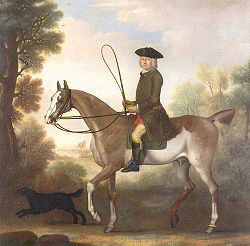
The tricorne hat is prominently featured in 18th-century portrait paintings, such as those by Thomas Gainsborough in the 1760s, where it is depicted with accurate brim cocking—typically one point forward—and decorative elements like silver lace edging, often held under the subject's arm.[37] These formal oil portraits prioritize realism, with details of felt texture and fold angles aligning with surviving artifacts from the period, as documented in fashion histories.[2] In contrast, satirical prints exaggerate the tricorne for comedic or critical effect; for instance, William Hogarth's "Taste in High Life" (1746) shows a monkey adorned with an oversized tricorne, lampooning aristocratic affectations through disproportionate scale and ironic context.[38] Such caricatures deviate from empirical accuracy to amplify social commentary, unlike the measured renderings in portraits. Group scenes in historical canvases, including depictions of revolutionary militias, portray the tricorne as a uniform element, with empirical comparisons to museum-held examples confirming fidelity in button placements and cocking styles over artistic license.[2] Post-1789 French engravings repurposed the hat in propaganda, associating it with ancien régime tyranny through caricatured noble figures wearing distorted tricornes to symbolize outdated oppression.[39]

Associations with Historical Figures and Events

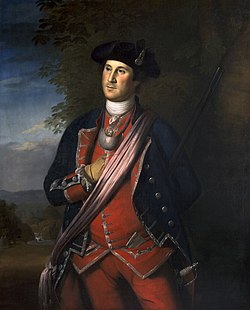
The tricorne hat is closely linked to George Washington, who wore it during his military service in the American Revolutionary War, as depicted in his 1772 portrait as colonel of the Virginia Regiment and in accounts of him reviewing French troops after the 1781 Yorktown victory.[5] [3] This headwear aligned with standard 18th-century military practice, where the tricorne's design allowed for practical visibility and rank signaling on the battlefield.[4] European monarchs and commanders, including Frederick II of Prussia (c. 1750) and Catherine II of Russia (c. 1760), adopted the tricorne in official portraits, reflecting its role in projecting authority during conflicts like the Seven Years' War (1756–1763).[40] Similarly, British General Thomas Gage wore one in his 1743 portrait, underscoring its prevalence among officer classes in colonial administration and warfare leading to the Revolution.[16] The hat's uniformity supported causal mechanisms of command cohesion, as its distinctive shape enabled rapid identification amid smoke and disorder, a functional advantage rooted in its evolution from broad-brimmed protective headgear.[2] In Revolutionary events, tricornes featured in Continental Army attire, contributing to group identity during operations like the 1776 Delaware crossing, where Washington's leadership relied on such standardized elements for morale and coordination.[3] However, associations with the 1773 Boston Tea Party are overstated; participants disguised themselves in blankets, frocks, and caps to mimic Mohawks, with no eyewitness accounts confirming tricornes, which were everyday colonial wear rather than protest-specific.[41] Pirate lore ties the tricorne to figures like Blackbeard (Edward Teach, d. 1718) through naval origins, as captured vessels often carried officer tricornes, but primary sources like ship manifests and contemporary descriptions indicate it was not universal pirate garb—more indicative of gentrified or prize-acquired attire than standard crew wear.[42] This exaggeration stems from 19th-century romanticizations rather than empirical evidence, such as lacking archaeological finds or period illustrations of common seadogs in tricornes.[43] The hat's practical brim for shade and rain protection suited maritime life, yet its prominence in rebellions and privateering derived from broader 18th-century utility, not inherent symbolism.[16]

Debates on Symbolism and Interpretation

Scholars dispute the tricorne's primary interpretive lens, contrasting its practical military roots—where brims were cocked to channel rainwater, avoid sword interference, and facilitate under-arm carrying—with its role as a status marker tailored to elite wig-wearing conventions. Empirical analyses of surviving artifacts emphasize utilitarian adaptations from 17th-century broad-brims, yet fashion histories highlight how the hat's geometric form enhanced visual hierarchy when paired with powdered wigs, signaling aristocratic refinement over battlefield necessity.[2][34] This tension underscores a shift from function to ornament, as civilian variants proliferated among the upper classes by the early 1700s, per inventory records from European courts.[44] Critiques of romanticized symbolism challenge its elevation as an Enlightenment emblem of rationality, given scant primary evidence linking the hat's triangular symmetry to philosophical ideals; instead, material culture studies reveal it as a pan-European norm worn across social strata, diluting claims of inherent progressive connotation. In U.S. historiography, the tricorne's portrayal as a revolutionary icon—evident in modern reenactments tying it to 1770s independence—overlooks its ubiquity among British forces and Loyalists, as documented in regimental orders and portraits from 1750–1783.[4] Such narratives, per military fashion analyses, impose anachronistic "freedom" motifs on standard attire, ignoring its origins in French courtly excess under Louis XIV circa 1680.[40] The persistent "pirate hat" trope exemplifies interpretive fiction, emerging in 19th-century novels like those by Robert Louis Stevenson rather than Golden Age piracy records (c. 1690–1730), where headwear varied from Monmouth caps to slouch hats per trial depositions and ship manifests. Post-1950s artifact-driven research, including naval archaeology, has refuted uniform tricorne attribution to outlaws, attributing the stereotype to Victorian-era illustrations that conflated sailor fashion with criminal exoticism for dramatic effect.[45] Alternative scholarly views note gendered exclusion, as tricornes reinforced male spheres of authority—female equivalents appeared sporadically in 18th-century masques but lacked widespread adoption, per costume ledgers—highlighting the hat's embedding in patriarchal dress codes over egalitarian symbolism.[9]

Modern Relevance

Reproductions and Reenactments

Handcrafted reproductions of tricorne hats, primarily from wool felt, have been essential for living history reenactments since the 1960s, when organized American Revolutionary War events proliferated in the United States. These replicas aim to replicate 18th-century construction, using materials like wool or fur felt to match the durability and appearance of originals made from beaver hair or sheep wool. Vendors specializing in historical attire produce unlined hats with sewn brims and leather sweatbands, often sized up to 7-3/4 inches for adult wear.[46][47][5] Reenactment standards emphasize fidelity to period patterns, with groups under the Continental Line requiring tricornes featuring authentic cockades, braid trim, and brim widths of around 14 cm, avoiding modern embellishments. Purists reject synthetic fur or straw variants employed for affordability, as wool felt better emulates the breathability, dirt-repelling qualities, and fire safety of historical felts—no synthetic blends are permitted in some units to mitigate burn risks during encampments. Beaver-felt equivalents, though rarer due to cost, are sought for superior stiffness and weather resistance.[48][49][50] Practical testing of replicas confirms their functional parity with antiques; wool felt versions resist light precipitation comparably to 18th-century beaver felts, maintaining shape after exposure due to inherent felting density and natural oils, without requiring modern waterproofing treatments. This equivalence supports their use in outdoor drills and battles, where hats endure rain and physical stress akin to original campaigns. No major material innovations have emerged in the 21st century, with production focusing on scalable hand-finishing for educational events and militia portrayals.[9][5][51]

Contemporary Fashion and Media Depictions

In contemporary fashion, tricornes appear sporadically as conceptual or utility-oriented revivals rather than mainstream staples. Designers have reimagined the style for spring-summer 2026 collections, crafting oversized or abstracted versions from modern materials to evoke historical military motifs while prioritizing aesthetic drama over functionality.[52] In the 2020s, tactical adaptations incorporate adjustable shock cords, snap buttons, and durable cotton-polyester blends, marketed for outdoor or morale-patch applications, though these modifications prioritize novelty attachments over the original hat's pragmatic brim-folding for weather resistance.[53] Such variants, while echoing the tricorne's historical utility in deflecting rain, often veer into gimmickry by adding incompatible modern hardware, diverging from the unadorned efficiency of 18th-century prototypes.[54] Media depictions frequently stylize tricornes for dramatic effect, amplifying tropes at the expense of proportion. The Pirates of the Caribbean film series, starting with The Curse of the Black Pearl on July 9, 2003, cemented the tricorne in popular culture through Captain Jack Sparrow's weathered, leather tricorne adorned with feathers and beads, which exaggerates brim width and weathering for cinematic flair rather than replicating naval practicality. This portrayal has influenced costume replicas, with faux-leather versions featuring dreadlock attachments surging in availability post-release, though the films' anachronistic scale—such as oversized brims—misleads on the hat's compact historical form.[55] In contrast, the 2015 Broadway musical Hamilton employs tricornes more accurately in ensemble military attire, such as black wool versions with gold epaulets and sashes for characters like George Washington, nodding to Revolutionary War officer uniforms without excessive embellishment.[56] These portrayals have spurred demand for replicas, particularly in cosplay and themed merchandise, with e-commerce listings for Pirates-inspired hats multiplying after 2003 and sustaining sales into the 2020s.[57] Hamilton's costuming, blending historical references with theatrical needs, similarly boosted interest in period-authentic variants among theater enthusiasts.[58] However, stylized exaggerations like elongated brims in film props distort public perception of the tricorne's modest dimensions, fostering replicas that prioritize visual impact over fidelity. Debates on cultural appropriation remain negligible, as the hat's European military origins limit such claims compared to more contested symbols.[59]

References

User Avatar
No comments yet.