


Community hub
Recent from talks
Contribute something
Nothing was collected or created yet.
Federal University of Rio de Janeiro
View on WikipediaThe Federal University of Rio de Janeiro (Portuguese: Universidade Federal do Rio de Janeiro, UFRJ)[a] is a public research university in Rio de Janeiro, Brazil. It is the largest federal university in the country and is one of the Brazilian centers of excellence in teaching and research.[6]
Key Information


.png)

The university is located mainly in Rio de Janeiro, with satellites spreading to ten other cities. It is Brazil's first official higher education institution,[7] and has operated continuously since 1792, when the "Real Academia de Artilharia, Fortificação e Desenho" (Royal Academy of Artillery, Fortification and Design, precursor to the university's current Polytechnic School) was founded,[8] and served as basis for the country's college system since its officialization in 1920.[9] Besides its 157 undergraduate and 580 postgraduate courses, the UFRJ is responsible for seven museums, most notably the National Museum of Brazil, nine hospitals, hundreds of laboratories and research facilities and forty-three libraries. Its history and identity are closely tied to the Brazilian ambitions of forging a modern, competitive and just society.[10]
Former alumni include renowned economists Carlos Lessa and Mário Henrique Simonsen; Minister Marco Aurélio Mello; the architect Oscar Niemeyer; the philosopher and politician Roberto Mangabeira Unger; the educator Anísio Teixeira; the engineer Benjamin Constant; writers Clarice Lispector, Jorge Amado and Vinicius de Moraes; politicians Francisco Pereira Passos, Oswaldo Aranha and Pedro Calmon, besides the great physicians Carlos Chagas, Oswaldo Cruz and Vital Brazil.
History
[edit]Creation
[edit]
The Federal University of Rio de Janeiro is a direct descendant of Brazil's first higher education courses. Created on September 7, 1920 (Brazilian Independence Day) by president Epitácio Pessoa through the Law Decree 14343, the institution was initially named "University of Rio de Janeiro".[11] Its history, however, is much vaster and parallel to that of the country's cultural, economic and social development (many of its courses trace back to the very foundations of Brazilian higher education system).[12]
In its inception, the university was composed by the "Escola Politécnica" (Polytechnic School, founded on December 17, 1792 as Royal Academy of Artillery, Fortification and Design, during the reign of Portuguese Queen Maria I),[13] the "Faculdade Nacional de Medicina" (National College of Medicine, founded on April 2, 1808, by Dom João VI under the name of Academy of Medicine and Surgery)[14] and by the "Faculdade Nacional de Direito" (National College of Law, which came to exist after the fusion between the College of Legal and Social Sciences and the Free College of Law - both recognized by the Law Decree 693 of October 1, 1891).[15][16]

To these initial units many others were progressively added, such as the "Escola Nacional de Belas Artes" (National School of Fine Arts) and the "Faculdade Nacional de Filosofia" (National College of Philosophy). Thanks to such achievements, the UFRJ toke crucial role in the implantation of Brazilian higher education,[17] which was in fact an aspiration from Brazilian intellectual elite since the country's colonial era.[18] Due to the longstanding tradition of its pioneering courses, the university functioned as the "scholar mill" upon which most of Brazil's subsequent higher education institutions were molded.[19]
Restructuring
[edit]
In 1937, Getúlio Vargas's minister of education, Gustavo Capanema, announced a reform of the education system, under which the institution changed its name to the "University of Brazil". The change reflected the government's aim of controlling the quality of the national higher education system - mainly by setting a standard by which all other universities would have to conform. Such decision was strongly influenced by the French concept of university - that in which component schools are isolated in order to assume a specific professionalizing teaching method under strong state control -, which contrasted to the German model seen, for example, in the University of São Paulo, founded in 1934.[20]
The early 1950s marked the institutionalization of research in the university, which consequentially led to the implementation of research institutes, full-time academic staff, instruction of highly specialized professors and the establishment of partnership with national and international financing agencies.
In 1958, occasion for the 150-year anniversary of the UFRJ's Medicine School, the university was faced by the urgent needs of a structural reform that stimulated deeper participation and cooperation among professors and students with college affairs and a more rational, efficiency-based use of public resources. After an ample sequence of debates and public consultations, the resulting plans for reforms in University of Brazil were quickly absorbed by the scientific community, set a new standard for national college planning and influenced even, among others, Brazilian communication industries and government's decisional spheres.[21]
In 1965, under the government of general Castelo Branco, the university would achieve plain financial, didactic and academic autonomy - a condition called, according to Brazilian legislature, "autarchy" - and acquire its current name, which followed the still-active standard for federal university naming (i.e.: Federal University of name of State or region).[22][23]
After the reformation process, the university was propelled into a deeper and riskier restructuring phase that aimed to make the institution fit for the recently approved Law Decree of March 13, 1967[24] - a situation widely regarded as too bold for a nation with recent history as an independent territory and a culture that, inheriting traits from the Portuguese colonial rule, heavily emphasized tradition and stability.[25]
Present day
[edit]_2.jpg)
The UFRJ keeps an "open-doors policy" regarding foreigners who arrive at it to disseminate or accumulate expertise; this also allows for internship or job opportunities for its teaching staff in different institutions and areas of research. International interexchange and partnerships are profuse, leading to reformist tendencies that most of times successfully coexist with the university's strong traditional ties.[26]
The UFRJ adopts the Roman goddess Minerva - patroness of the Arts and all professions; also associated with knowledge and intellectuality - as its mascot,[27] and many sculptures depicting the goddess are seem scattered throughout the institution.[28] In 2000, the rectory requested to the Federal Justice that the university's name was changed back to "University of Brazil", as the old name has been changed by an arbitrary decree during the country's years of military dictatorship. The request was deferred, so it is correct to address the university by either names.[5]
The university manages an ambitious program for extension courses, consisting mostly in providing full-time education to financially debilitated non-students of varying education backgrounds.[29] Besides, the UFRJ contributes heavily to Rio de Janeiro's public health with its nine college hospitals, providing for over one thousand vacancies, and its deep integration with the State's health treatment network.[30] In 2010, the institution achieved a "very good" evaluation and a maximum score in the Ministry of Education's General Index of College Courses ("Índice Geral de Cursos", or IGC in Portuguese).[31][32] Its clear emphasis on research alludes to the personal motto of one of its most famous and distinguished scientists:[33]
In a university, one teaches because one researches.
Organization
[edit]
Administration
[edit]The Federal University of Rio de Janeiro is an autarchy and a public institution linked to the Ministry of Education (MEC).[34] Its administration is commanded by the superior councils: the "Conselho Universitário" (University Council), the highest decisional authority, presided by the "reitor" (rector); the "Conselho de Curadores" (Curators Council), responsible for the financial books and budgetary matters, also under rectorship rule; the "Conselho de Ensino de Graduação" (Undergraduate Council), responsible for admission to undergraduate course and other undergraduate affairs, presided by the pro-rector of graduation; and the "Conselho de Ensino para Graduados" (Graduate Council), responsible for research activities and post-graduation courses, presided by the pro-rector of post-graduation and research.[35]
The institution is also directed by a vice-rector and six other pro-rectors. The rectors are nominated and chosen by the Ministry of Education (MEC) from a three-candidate list formed by a general election every four years. In general, the MEC respects the electoral decision, choosing the most voted candidate. The current rector (2014) is Carlos Antônio Levi da Conceição, with Antônio José Ledo Alves da Cunha as vice-rector.[36]
The academic pro-rectories are as follows: "Pró-reitoria de Graduação" (Pro-Rectory of Undergraduate Studies), "Pró-reitoria de Pós-Graduação e Pesquisa" (Pro-Rectory of Research and Post-Graduate Studies), "Pró-reitoria de Planejamento e Desenvolvimento" (Pro-Rectory of Planning and Development), "Pró-reitoria de Pessoal" (Pro-Rectory of Human Resources), "Pró-reitoria de Extensão" (Pro-Rectory of Extension) e a Pró-reitoria de Gestão e Governança" (Pro-Rectory of Management and Governance).[37]


Serving as executive institutions are a total of eleven superintendencies: "Superintendência Geral de Graduação" (General Superintendency of Undergraduate Studies), "Superintendência Geral de Pós-Graduação e Pesquisa" (General Superintendency of Research and Post-Graduate Studies), "Superintendência Geral de Planejamento e Desenvolvimento" (General Superintendency of Planning and Development), "Superintendência Geral de Finanças" (General Superintendency of Finances), "Superintendência Geral de Pessoal" (General Superintendency of Human Resources), "Superintendência Geral de Extensão" (General Superintendency of Extension), "Superintendência Geral de Gestão e Controle" (General Superintendency of Management and Control), "Superintendência Geral de Governança" (General Superintendency of Governance), "Superintendência Geral de Tecnologia da Informação e Comunicação Gerencial" (General Superintendency of Information Technology and Managerial Communication), "Superintendência Geral de Políticas Estudantis" (General Superintendency of Student Policies) e a "Superintendência Geral de Atividades Fora da Sede" (General Superintendency of Non-Campus Activities).[38]
Notable Rectors
[edit]
Some of the famous figures[39] that have held the post of rector in UFRJ are: Benjamin Franklin Ramiz Galvão, doctor, first-ever rector and former member of the Brazilian Academy of Literature(ABL);[40] Raul Leitão da Cunha, doctor;[41] Pedro Calmon, former minister of Education and Health;[42] Deolindo Couto, former member of the ABL;[43] Raymundo Augustto de Castro Moniz de Aragão, former minister of Education;[44] Carlos Lessa, economist and former president of "Banco Nacional de Desenvolvimento Econômico e Social" (National Bank of Economic and Social Development, BNDS).[45]
Statistics and heritage
[edit]According to its yearly statistical report (2013), the university controls 52 units and supplementary departments, each linked to one of six academic centers. It has a total of 48 454 active undergraduate students plus 7 333 students in undergraduate online courses, and a yearly graduation rate of 5 381 students. As of post-graduation studies, there are 5 389 individuals undergoing master's degree and 5 5382 candidates for doctor's degree.[46] Of its 3 821 professors, 3 068 hold a doctor degree, 618 are masters and 61 are specialists.[47] In addition, its high-school unit ("Colégio de Aplicação", or Application School) accounts for 760 enrolled students.[48]
The university's main buildings are located at "Cidade Universitária" (College City, with 5.2 million m2) in "Ilha do Fundão" (Backward Island), but the campus at "Praia Vermelha" (Red Beach, with 100 thousand m2) still gathers a plethora of units and supplementary departments. Additionally, there are the Institute of Philosophy and Social Sciences, the Institute of History, the College of Law Studies, the Valongo Observatory, the School of Music, the Residence of College Students and the National Museum (53 276 40 m2). Among the isolated health buildings there are the Maternity School, the São Francisco School-Hospital and the Anna Nery Nursery Schools. The UFRJ possesses additional campuses in Rio de Janeiro's Chile Avenue (8 550 m2), in the cities of Macaé and Duque de Caxias (149 869,18 m2), Jacarepaguá (10 000 m2), Arraial do Cabo and in Santa Teresa (a 1.5 million m2 research-only wildlife reserve).[49]

Structure
[edit]


the UFRJ can be divided into six university centers plus the "Escritório Técnico da Universidade" (University Technical Department), the "Fórum da Ciência e Cultura" (Forum of Science and Culture, FCC) and the University City Hall.[50] Each center is made of dozens of units and supplementary organs responsible for education, research and extension in their respective areas of knowledge.[51]
University Centers
[edit]- Center of Health Sciences (CCS): the university's largest, involved in activities and research related to biosciences. As a whole, it gathers ten units and fourteen supplementary organs: three hospitals, three "nuclei" (headquarters), two schools, three colleges and thirteen institutes. Activities are developed mostly at CCS's main building at College City, but there are also units at Praia Vermelha, in downtown Rio, in Macaé and in Xerém.[52]
- Center of Technology (CT): the university's second largest center, it manages two sprawling engineering schools and two high-tech research institutes, all located at College City. The CT also controls two business incubators and one foundation focused at technological studies. These units were all previous to the center's foundation, each with a unique history, and their performance is crucial to the national technological environment, given that together they form one of the country's most influential tech-poles.[53]
- Center of Mathematical and Natural Sciences (CCMN): originated from the traditional and influential National School of Philosophy, it is made of five institutes and one observatory. Its main infrastructure is located at College City. The Institute of Chemistry and the Institute of Physics are located at Center of Technology's Block A and the Institute of Mathematics, at its Block C, but both are units of CCMN. The Valongo Observatory is placed near the Mauá Park, at the top of Morro da Conceição, and it is the country's only federal institution to offer undergraduate course in Astronomy.[54]
- Center of Law and Economic Sciences (CCJE): responsible for activities concerning applied social sciences: administration, economics, law, library science and urban planning. It gathers three units (schools) and two supplementary organs (institutes) scattered throughout College CIty, Praia Vermelha and downtown Rio.[55]
- Center of Philosophy and Human Sciences (CFHC): encompasses interdisciplinary academic activities regarding social sciences, especially those with theoretical focus on society formation. The CFCH is made of six units (two schools, one college and three institutes) and two supplementary organs (one headquarter and the Application College, which supports professor-training courses). The CFHC is locates mainly at the campus of Praia Vermelha, though some minor buildings are found in the regions of Largo do São Francisco and Lagoa.[56]
- Center of Literature and Arts (CLA): similar to the other centers, it was founded in 1967. It currently comprises four traditional units of UFRJ: two schools and two colleges focused on the arts, language and architecture. Its main buildings are placed at College City, except for the School of Music, which is located at downtown Rio.[57]
- COPPEAD Graduate School of Business (COPPEAD): The UFRJ School of the Business founded in 1973, located in its own building on the campus of UFRJ Fundão Island is the only business school associated with a Brazilian public university that has international certification, whose is the only of Latin America listed among the 100 best in the world by the prestigious Financial Times ranking.
Units and supplementary organs
[edit]The so-called "units" and "supplementary organs" are institutions of basically two types: schools/colleges, destined to professional training, research and extension; and institutes, destined to basic research, extension and teaching of a specific area of knowledge. Generally, units deal with undergraduate and postgraduate courses while supplementary organs are charged with coordinating disciplines according to each specific line of research. Additionally, there are "research nuclei", which fall into the category of "supplementary organs". As in most Brazilian universities, these two institutional sets are subdivided into departments.[58][59]
Libraries and museums
[edit]
Keeping important historical documents of both national and international relevance, UFRJ's libraries and museums can be considered the primary source of inquiry for the country's most renowned researchers. In 1983, the university implanted the System of Libraries and Information (SiBI), through which students and staff enjoy easy and speedy access to the entire collection of its forty three libraries. General (i.e. non-affiliated to the institution) digital access to UFRJ's libraries is made through the Minerva Base, a database that, much like the SiBI, gathers all university libraries into a single website.[60]
Among the most noteworthy museums and cultural spaces are: the National Museum, Latin America's largest museum and anthropological of natural history as well as Brazil's oldest scientific institution.[61] Its building is a conversion from the Brazilian Imperial Family's old palace in "Paço de São Cristóvão" and it was founded by royal figure Dom João VI in 1818, but integrated to the university only much afterwards, in 1946.[62] Brazil's emperor Dom Pedro II himself, an enthusiast for scientific knowledge, contributed to the museum's collection with Egyptian art, fossils, botanic species and many other items obtained during his personal trips.[63] Laboratories occupy a great portion of the museum and spread to some buildings raised in "Horto Botânico" (Botanic Garden), in "Quinta da Boa Vista".[64]
In Botafogo, the university also manages the "Casa da Ciência" (House of Science), a cultural center of science and technology active since 1995 and dedicated to the exploration of languages and of popular forms of communication such as theater, music and audiovisual techniques. It performs periodical workshops and expositions opened to both students and the general public.[65]

Health complex
[edit]The university's medical-hospital network is composed of nine supplementary organs distributed throughout various campuses. Together, these units are responsible for 566 410 treatments, 8 293 surgeries and 18 555 hospitalizations every year.[30]
- Clementino Fraga Filho University Hospital (HUCFF): created in 1978, it is UFRJ's flagship medical institution. Sprawling through 110 000 meters squared, it is both national and international reference in high surgical procedures of high complexity.[66]
- São Francisco de Assis Institute of Health (HESFA): founded in the 19th century as School Hospital and reopened in 1988 by then-rector Luís Renato Caldas. Sustaining a profile of high-quality customer service clinic, it acts on medical procedures of low or medium complexity and focuses on patients requiring long-term care and hospitalization.[67]
- Institute of Psychiatry (IPUB): acts as Latin America's flagship research, post-graduation learning and knowledge-diffuser institution regarding multidisciplinary studies in psychiatry and mental health.[68]
- Martagão Gesteira Institute of Childcare and Pediatrics (IPPMG): institute of nationwide recognition in matters of childcare, it was incorporated to the university after formal proposal from professor Joaquim Martagão Gesteira. It undergoes research in the mother-child field and acts on assistance and teaching and training in pediatrics.[69]
- Institute of Chest Diseases (IDT): founded in 1957 by professor Antonio Ibiapina and, since 2000, adjunct to HUCFF's main structure. Promotes full-time assistance and undergoes research regarding respiratory illnesses.[70]
- Deolindo Couto Institute of Neurology (INDC): located at Praia Vermelha campus, is responsible for activities, research, teaching and assistance in the fields of neurology and neurosurgery.[71]
- Institute of Gynecology (IG): founded in 1947 and located at university hospital "Moncorvo Filho". Notable for providing radio-therapeutic services specifically for matters of gynecology ontology.[72]
- Edson Saad Institute of Heart (ICES): founded in 2003 to develop high-quality research in the fields of cardiology and vascular surgery. The institute initiated its activities in old departments from HUCFF and the School of Medicine.[73]
- Maternity School (ME): founded in 1904 to assist pregnant women and newly born children from unprivileged social backgrounds in the State of Rio de Janeiro. It was pioneer in the use of, among other methods, ultrasonography and dopplerfluxometry in Brazil.[73]

Campuses
[edit]Rio de Janeiro
[edit]
The Federal University of Rio de Janeiro's main infrastructure is the College City, located at and occupying almost all of Ilha do Fundão (Backyard Island), northern Rio de Janeiro.[74] The island was artificially created in 1950 by the union of various already existing islands through embankment techniques.[75] Academic activities in the campus, however, would only start in 1970, and the initial project stated that all active courses would be transferred to the city.[74] Architecture was hugely influenced by modernism and some designs were even awarded, such as the rectory building (designed by Jorge Machado Moreira and awarded at the "IV Bienal de São Paulo").[76]
The campus has a residence complex for undergraduate students (504 rooms),[77] three university restaurants (commonly called "bandejões", or "big trays"),[78] a sports center, and banking agencies.[79] In 2010, there was the opening of an integration station for the unified college transport system, aiming for more security and comfort to the college community. Dozens of 24/7 inter-campus bus lines, free for students, are connected to the College City,[80] plus regular urban and intercity lines[81] serving the population of Baixada Fluminense region and of metropolitan Rio de Janeiro.[82][83][84]
The campus at Praia Vermelha (Red Beach), locates at Urca, southern Rio, concentrates on courses related mainly to human sciences. Its largest and most historically notable building is the University Pallace, a neoclassical-style premise built between 1842 and 1852 to serve as a hospice, which was inaugurated by emperor Dom Pedro II only ten years later.[85] In 1949, the building was given to the University of Brazil, which then restored and expanded its facilities.[86]

In the downtown of Rio de Janeiro, one can find many isolated college units: the College of Law Studies, at Conde dos Arcos Palace, former headquarter of Brazilian senate;[87] the School of Music, planted in the old National Library building since 1913;[88] the Valongo Observatory at the top of "Morro da Conceição" (Conceição Hill);[89] the Institute of Philosophy and Social Sciences and the Institute of History, both situated in the old National School of Engineering building, at "Largo de São Francisco de Paula".[90]
In the 2010-2020 UFRJ Master Plan a project was set for conversion of the Praia Vermelha campus into a great cultural center, consequentially transferring almost all of the campus' academic activities, plus that of all of college units scattered throughout Rio, to the College City, thus redeeming the city's original intent of centering all university activities in Ilha do Fundão.[91] The decision has generated strong polemic with both students and staff, given the great distances between southern (Praia Vermelha) and northern (Ilha do Fundão) Rio and the chaotic traffic that plagues the Red Line of João Goulart Freeway - the "jugular" connecting the College City to Rio.[92]
Aloísio Teixeira, then rector and strong advocate for the integration, argued that the University Palace can bear a circulation of no more than two to three thousand people per day, and that the College City's major problems are not on its structure, but on its access points which are more easily fixable matters.[93] Aiming to solve part of the city's traffic problem, in mid-2010 Rio de Janeiro saw the building of its first cable-stayed bridge, named "Ponte do Saber" (Knowledge Bridge), which was inaugurated in 2012 to receive a daily average of 25,000 vehicles.[94]
Duque de Caxias
[edit]Through its biophysics undergraduate course, started in the second half of 2008, UFRJ initiated activities in Xerém, a region with large industrial and technological potential in the city of Duque de Caxias.[95] Aiming to cooperate with Inmetro (National Institute of Metrics, Normalization and Industrial Quality), the university forged a partnership with the government of Duque de Caxias and with the Foundation for Technological Development and Social Policies.[96][97] Currently, and additionally to biophysics, the Xerém campus offers undergraduate courses in biotechnology and nanotechnology, both added in the first half of 2010.[98] As of the following year, there was the addition of the professional master's in Scientific Formation for Biology Teachers, targeted at professors of the biosciences looking for skill improvement.[99] Students have Inmetro's infrastructure and laboratories at hand, but most students and staff whose main laboratories are at Ilha do Fundão still have to complete their academic internships at College City. In an attempt to fix this inconvenience, Inmetro agreed to concede its Xerém infrastructures to UFRJ, which was then reinaugurated as a full campus in 2012.[100]
Macaé
[edit]
UFRJ has operated in the city of Macaé since the 1980s, when researchers from its Institute of Biology performed studies in the lakes of "Região dos Lagos" (literally, Lake Regions). In partnership with the city, it instituted the Macaé Nucleus for Ecological Researches (NUPEM) in 1994.[101] The university's recognition in and importance to the city was so visible that, in 2012, the City Hall has donated to the institution a 29,000 m2 terrain, in which was raised a new university center.[102] In 2005, NUPEM was officialized as a supplementary organ of the Center of Health Sciences and,[103] in 2006, the university implemented its first course outside Rio de Janeiro, professor training in the biosciences, to be taken in NUPEM's headquarters. In 2007, Macaé inaugurated a full university complex with two buildings and seven more planned ones, for graduation, post-graduation and extension courses. During this solemnity there was also the signing of the "Protocolo de Intenções" (Intentions Protocol) between UFRJ and the city, promising the initiation of chemistry and pharmacy courses in 2008.[104]
Currently, the campus is physically distributed among four poles (University Pole, Barreto, Novo Cavaleiros and Ajuda), where the following undergraduate courses are offered: biological sciences, chemistry, nursing and obstetrics, engineering (production, civil and mechanical), pharmacy, medicine, and nutrition;[105] as of post-graduation courses, there are two: environmental and conservation sciences, and bioactive and biosciences products.[106] The main campus was named after former rector Aloísio Teixeira, incumbent from 2003 to 2011, in 2012 (Campus UFRJ–Macaé Professor Aloísio Teixeira), honoring his decisive contribution to the spreading of UFRJ through the State of Rio de Janeiro.
E-learning poles
[edit]
E-learning courses are offered by the CEDERJ (Rio de Janeiro Center of Higher-Education E-learning) consortium, signed between UFRJ and the following institutions: Universidade Federal do Estado do Rio de Janeiro (UNIRIO), Universidade Federal Fluminense (UFF), Universidade Federal Rural do Rio de Janeiro (UFRRJ), Universidade do Estado do Rio de Janeiro (UERJ), Universidade Estadual do Norte Fluminense Darcy Ribeiro (UENF) and Centro Federal de Educação Tecnológica Celso Suckow da Fonseca (CEFET/RJ).[107]
Taught in a mixed scheme where some activities require the students' physical presence, UFRJ offers professor training courses in the biosciences, physics, and chemistry.[108] At the course's conclusion, a student is awarded with a certificate equivalent to that of physically based courses offered by the institution, according to each student's chosen e-learning pole.[109] Admission are made by an independent "vestibular" organized by the consortium. UFRJ's e-learning poles in the State of Rio de Janeiro are: Angra dos Reis, Duque de Caxias, Itaperuna, Macaé, Nova Iguaçu, Paracambi, Piraí, Rio de Janeiro, São Gonçalo, Três Rios, and Volta Redonda.[110]
Academics
[edit]Undergraduate courses
[edit] | This section may require cleanup to meet Wikipedia's quality standards. The specific problem is: the chart is unreadable. (March 2020) |
There are 179 undergraduate courses covering all areas of human knowledge and distributed into four types: morning, afternoon, night and integral (all previous three combined) courses. Each courses is linked to one academic institution, but some share multiple institutions, like the nanotechnology course, which is offered by the Polytechnic School, the "Instituto de Biofísica Carlos Chagas Filho" (Institute of Biophysics Carlos Chagas Filho), the Institute of Physics and the "Instituto de Macromoléculas Professora Eloisa Mano" (Institute of Machomolecules Professor Eloisa Mano). Below are listed all offered courses and the respective specializations (including emphases, habilitations or modalities) for which students can opt during their graduation.
Postgraduate courses
[edit]There are 345 post-graduation courses, being 167 lato sensu (specialization) and 178 stricto sensu (master's and doctor's degrees).[46] Similarly to the undergraduate courses, each post-grad course is linked to a specific academic institution. As of 2010, there were 1 965 scholarship programs from Coordination of Higher-Education Personnel Improvement (CAPES) available to post-graduation candidates, 844 from the National Council of Technologic and Scientific Development (CNPq) and 800 from the university itself.[111]
Students
[edit]Admissions
[edit]Similarly to most Brazilian public universities, admissions to the Federal University of Rio de Janeiro are defined by highly competitive entrance exams held every year (commonly known in Brazil as "vestibular"). Anyone who was already graduated from high school is eligible to the undergraduate courses. Admission is also possible by transfer (known as "external transfer"), exemption from exams ("reentrance") or by international partnerships.[112]

Until the late 1980s, the admission exam was managed as a unified "vestibular" by Cesgranrio Foundation. Given the university's disagreement with the test's methodology - which consisted almost entirely in multiple-choice questions -, the institution quit the partnership and organized its own "vestibular", named "Concurso de Acesso aos Cursos de Graduação" (Undergraduate Courses Admission Exam).[113] The test was solely based on open-ended responses, and its elaborate questions eventually led it to be considered one of Brazil's toughest and most demanding higher education admission exams.[114]
Since 2012, the university responded favorably to the utilization of the "Exame Nacional do Ensino Médio" (High School National Exam, or ENEM; a yearly nationwide exam managed by the Ministry of Education) for student admission.[115] The exam's importance grew to the point that, in 2011, the UFRJ extinguished its "Concurso de Acesso" and made the ENEM its single admission exam; candidates' selection was delegated to the "Sistema de Seleção Unificada" (Unified Selection System, or SiSU; also under the Ministry of Education's rule).[116] UFRJ quickly became one of the most coveted institutions in the system: as of the second semester of 2012, it received 103 829 applications, the highest of any other university in SiSU.[117]
The institution also adheres to affirmative action policies since 2010:[118] currently, 30% of all vacancies are reserved by some form of affirmative action measure; the most common basis for selection under this system is through socioeconomic standards, favoring students with public schooling backgrounds and whose families earn less than one and a half minimum wage (R$1 086/month, or roughly US$15/day, as of January, 2014).[119]
Notable alumni
[edit]Given its academic excellence, the UFRJ was home to some of the countries brightest minds in all fields of knowledge. What follows is a list of some of them:
- Anthropologists: Eduardo Viveiros de Castro,[120] and Gilberto Velho[121]
- Architect: Oscar Niemeyer[122]
- Artists: Ary Barroso,[123] Vinícius de Moraes,[124] Mário Lago,[125] Ângela Leal,[126] and Ivan Lins[127]
- Billionaires: André Esteves,[128] Carlos Alberto Sicupira
- Biologists: Lúcia Mendonça Previato[129]
- Chemist: Otto Gottlieb[130]
- Doctors: Vital Brazil,[131] Carlos Chagas,[132] Osvaldo Cruz,[133] Carlos Chagas Filho,[134] Herman Lent,[135] and Mauricio Rocha e Silva[136]
- Economists: Carlos Lessa,[137] Joaquim Levy,[138] Jose A. Scheinkman,[139] and Mário Henrique Simonsen[140]
- Educator: Anísio Teixeira[141]
- Engineers: Luiz Bevilacqua,[142] Maurício Botelho, Fernando Lobo Carneiro,[143] Mauricio Carrasco ,[144] Benjamin Constant,[145] Heródoto Bento de Mello,[146] Aïda Espinola,[147] Maria das Graças Foster,[148] Giulio Massarani,[149] Tércio Pacitti e Paulo de Frontin,[150] Francisco Pereira Passos,[151] Luiz Pinguelli Rosa,[152] and Belkis Valdman[153]
- Entrepreneur: Maurício Botelho, and Fabio Coelho[154]
- Historians: Sérgio Buarque de Holanda,[155] Francisco Falcon,[156] and José Honório Rodrigues[157]
- Journalists: Fátima Bernardes,[158] and Ali Kamel[159]
- Mathematicians: Artur Ávila, Elon Lages Lima, Leopoldo Nachbin,[160] and Jacob Palis[161]
- Minister of Justice: Marco Aurélio Mello[162]
- Minister of Treasury: Nelson Barbosa, and Joaquim Levy
- Neuroscientist: Suzana Herculano-Houzel[163]
- Physicist: Carlos Bertulani,[164] Fernando de Souza Barros,[165] Marcelo Gleiser,[166] Belita Koiller,[167] José Leite Lopes,[168] and Herch Moysés Nussenzveig[169]
- Political commentator: Villas-Bôas Corrêa;
- Politicians: Osvaldo Aranha,[170] Índio da Costa,[171] Moreira Franco,[172] and Carlos Lacerda[173]
- Writers: Jorge Amado,[174] Evandro Lins e Silva,[175] Rubem Fonseca,[176] and Clarice Lispector,[177] Leandro Müller, Marques Rebelo,[178] and Mário Furley Schmidt,[179]
- Notable UFRJ Alumni
-
 Jorge Amado, writer
 -
 Oswaldo Aranha, politician, diplomat and statesman
 -
 Artur Ávila, Fields Medal-winning mathematician
 -
 Vital Brazil, physician, biomedical scientist and immunologist. Discoverer of the polyvalent anti-ophidic serum
 -
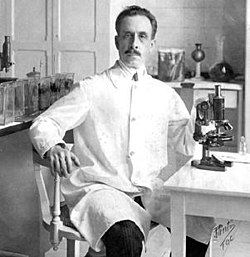 Carlos Chagas, doctor, discoverer of the Chagas disease
 -
 Oswaldo Cruz, physician, public health officer and the founder of the Oswaldo Cruz Institute. Former member of the Brazilian Academy of Literature
 -
 Joaquim Levy, Finance Minister of Brazil
 -
 Ivan Lins, Latin Grammy-winning musician
 -
 Clarice Lispector, writer
 -
 Leandro Müller, writer and editor.
 -
 Oscar Niemeyer, architect
 -

-
 Vinícius de Moraes, Diplomat, writer, and lyricist


Student unions
[edit]Students are formally represented by the "Diretório Central dos Estudantes Mário Prata" (Mário Prata Central Student Directory, or DCE), which was founded in 1930 - preceding even the National Student Union (UNE, 1937). The entity remained influential until its shutdown by the military regime of 1964–85, when dozens of union leaders, including student and then-president of DCE Mario de Souza Prata, were murdered.[180] In the late-1970s, given a gradual political opening, academic centers such as the DCE were given permission to function once again. Among the students that participated in the DCE's reactivation are Mário Furley Schimidt[181] and some member of popular Brazilian comedy show Casseta & Planeta, like Marcelo Madureira,[182] Beto Silva[183] and Hélio de la Peña.[184]

To the young students who, at dawn of September 23rd, 1968, in the National College of Medicine building, dared to resist the police forces of the military regime. The episode known as "Massacre da Praia Vermelha" is one of the most important events of the constant fight for academic autonomy. To them, our deepest admiration.
— "Conselho Universitário" (University Council), resolution of 08/24/2006.
Besides the DCE, minor academic centers (CAs) act as students representative organs for each course: the Carlos Chagas Academic Center for the College of Medicine,[185] the Polytechnic School Academic Center of Engineering,[186] the Cândido de Oliveira Academic Center for the College of Law Studies,[187] the Max Planck Academic Center for the Institute of Physics[188] and the Academic Directory for the School of Chemistry,[189] to cite the most notable.
The infamous episode known as "Massacre da Praia Vermelha" (Red Beach Massacre) was a hallmark the history of Brazilian student unions.[190] At dawn of September 23, 1968, squads from the military government invading the old facility of then-National College of Medicine and savagely beat all students sheltered there.[191] There was also massive depredation of public patrimony, as the action disenabled several of the college's laboratories and administrative sectors. Around 600 students were gathered to protest against the government's arbitrary and oppressive actions (ex.: the shutdown of DCE and UNE, the increase in meal prices) and to vindicate the release of Law student Rodrigo Lima, arrested for 35 days in the "Batalhão de Guardas do Exército" (Army Squad Battalion).[192]
Technological Park of Rio
[edit]
The Parque Tecnológico do Rio (Technological Park of Rio) is also located in College City. It is a technopole geared towards research in energy, oil, and gas.[193] In partnership with Petrobras, UFRJ intends to convert an area of 350 000 m2 into the world's largest oil-related technological research center, given that exploration and oil extraction from the recently discovered pre-salt layer fields is in urgent need of new, more affordable techniques. Intense private and state investments in the region, plus the high expectations it has generated, led it to be considered a Brazilian "Silicon Valley".[194] The park gathers, among its main facilities:
- Leopoldo Américo Miguez de Mello Research Center (CENPES): founded in 1962 and managed by Petrobras, it is responsible for research and development (R&D) and for the company's basic engineering matters; it is the largest oil research pole in the Southern Hemisphere.[195]
- Electric Energy Research Center (CEPEL): founded in 1974, it is part of group Eletrobrás and manages R&D related to the generation, transmission and distribution of electric energy. It is also the hemisphere's largest research center in the field.[196]
- Mineral Technology Center (CETEM): founded in 1978 and under direct command by the Ministry of Science, Technology and Innovation (MCTI), it acts on the technological development concerning to minerals.[197]
- General Electric Global Technological Center (GE): under construction, with inauguration planned to 2014. Until then, General Electric operates in the facilities of the Center of Excellence in Communication and Information Technology (CETIC).[198][199]
- Alberto Luiz Coimbra Institute of Post-Graduation and Research in Engineering (COPPE): UFRJ's supplementary organ, it is Latin America's largest research and learning center of engineering.[200] Also notable for owning the world's largest (volume terms) and deepest oceanic tank, which is used to simulate sea-life conditions.[201][202]
Additionally, there is the Center of Excellence in Natural Gas (CEGN),[203] the Institute of Nuclear Engineering (IEN),[204] the Nucleus of Ecosystem Recovery Technologies (NUTRE)[205] and a virtual reality center linked to the Laboratory of Computational Engineering Methods (LAMCE).[206] Among the corporations with research units established in the Technological Park or in other spots of College City are: L'Oréal,[207] Siemens AG,[208] Usiminas,[209] Schlumberger,[210] Baker Hughes,[211] FMC Technologies,[212] Repsol YPF,[213] Halliburton[214] and Tenaris Confab.[215] Public biddings for the construction of new research centers and commercial tower, all capable of supporting one hundred new more enterprises, are currently under request.[216] The Park project has also attracted over 200 small or medium-sized companies to its centers, resulting in higher stakes for its innovational potential.[217]
Projects
[edit]
UFRJ Newspaper
[edit]The "Jornal da UFRJ" (UFRJ Newspaper) is a monthly publication by the General Superintendence of Social Communication. It has been on circulation since 2003, covering subjects of academic interest and government affairs. It is available both on print and digitally, with 25 000 copies being distributed across the universities many campuses.[218]
UFRJ Sea
[edit]The "UFRJ Mar" (UFRJ Sea) was developed along Rio de Janeiro's coastline and comprehends several fields, from physical education and engineering to biological sciences and geosciences. The project relies on one of Brazil's most complex set of R&D laboratories in maritime and coastal studies.[219]
Getting to Know the UFRJ
[edit]The "Conhecendo a UFRJ" (Getting to Know the UFRJ) is a two-day yearly event that takes place at College City, when high-school students have lectures about the institution, tour through its main campus and get to know its academic routine and student life. As of 2010, on its eighth edition, approximately 14 000 students participated in the event.[220]
Plant Waves
[edit]Developed by COPPE with Government of Ceará supporting Pecém Wave Power Plant is the first in Latin America and places Brazil in a select group of countries with knowledge to extract electrical energy from sea waves. Factory with 100% Brazilian technology, is located 60 km from Fortaleza in the breakwater of the Port of Pecém. The project of researchers from COPPE underwater Technology Laboratory is designed in modules which allows the expansion of the capacity of the plant.[221]
MagLev Cobra
[edit]The Maglev Cobra is a levitation train developed at the UFRJ (Federal University of Rio de Janeiro) by Coppe (Alberto Luiz Coimbra Institute of Graduate Studies and Research in Engineering) and the Polytechnic School by LASUP (Superconducting Applications Laboratory). The Brazilian train, as well as the German maglev floats on the tracks, with only friction with air during their displacement. Maglev Cobra based on levitation, moving without friction with the ground by a linear motor primary short. The vehicle has been designed towards a revolution in public transportation through high-tech, non-polluting way, energy efficient and affordable to large urban centers.
The deployment cost of Maglev Cobra is significantly lower than the subway, getting to cost only one-third of this. Its operating normal speed will be within a range of 70 to 100 km/h, compatible to the subway and ideal for urban public transport.[222]
LabOceano
[edit]Able to reproduce the main features of the marine environment and simulate phenomena occurring in water depths greater than 2000 meters, LabOceano is a strategic technological support for Brazil, which has more than 90% of its oil reserves concentrated at sea, and for the oil and shipping industries. The ocean tank holds 23 million liters of water and its height corresponds to an eight-story building. Today, only two facilities in the world exist with similar characteristics to the tank designed by COPPE researchers: the Marintek, Norway, 10 meters, and Marin, Holland, 10.5 meters.[223]
Institutions
[edit]- Law School
- Museu Nacional (National Museum)
- Casa da Ciência (House of Science)
- CAp UFRJ (Laboratory School)

See also
[edit]
Notes
[edit]- ^ Alternatively known as University of Brazil (Portuguese: Universidade do Brasil).[5]
References
[edit]- ^ "Universidade Federal do Rio de Janeiro". Archived from the original on 4 December 2013. Retrieved 5 July 2015.
- ^ "Universidade Federal do Rio de Janeiro - UFRJ - Portal da transparência".
- ^ Emília. "Reitoria – Universidade Federal do Rio de Janeiro". Ufrj.br. Retrieved 2022-05-28.
- ^ a b c d e UFRJ (April 14, 2022). "Fatos e números" (in Portuguese). Retrieved October 1, 2022.
- ^ a b "Folha Online - Educação - UFRJ vai voltar a se chamar Universidade do Brasil - 01/12/2000 19h46". Retrieved 5 July 2015.
- ^ "Lista das maiores universidades brasileiras em número de matrículas" (PDF). Retrieved 9 January 2012.
- ^ "Conde De Resende, O Fundador Do Ensino Militar Academico Nas Americas E Do Ensino Superior Civil No Brasil Em 1792 E O Criador Da Cidade E Municipio De Resende Em 1801 : Claudio Moreira Bento". Ihp.org.br. Archived from the original on 24 September 2015. Retrieved 5 July 2015.
- ^ "UFRJ em números Ano 2012" (PDF). Historiamilitar. Archived from the original (PDF) on 2016-03-03. Retrieved 2016-03-31.
- ^ "Archived copy" (PDF). Archived from the original (PDF) on October 18, 2011. Retrieved January 24, 2014.
{{cite web}}: CS1 maint: archived copy as title (link) - ^ "SPE UFRJ Student Chapter". Archived from the original on December 15, 2011. Retrieved January 24, 2014.
- ^ "O Ensino, a Universidade e a Realidade" (PDF). Sociedades.cardiol.br. Retrieved 2016-03-31.
- ^ http://www.ufrj.br/pr/conteudo_pr.php?sigla=HISTORIA%7Ctitulo=História[permanent dead link] da Universidade Federal do Rio de Janeiro
- ^ "FERNANDA NASCIMENTO" (PDF). Archived from the original (PDF) on 2016-11-18. Retrieved 2016-11-17.
- ^ "Escola Anatômica, Cirúrgica e Médica do Rio de Janeiro". Archived from the original on March 23, 2013. Retrieved January 17, 2014.
- ^ Administrator. "Direito - Histórico". Retrieved 5 July 2015.
- ^ "A Universidade do Brasil" (PDF). Educa.fcc.org.br. Retrieved 2016-03-31.
- ^ "Archived copy" (PDF). Archived from the original (PDF) on January 13, 2014. Retrieved January 17, 2014.
{{cite web}}: CS1 maint: archived copy as title (link) - ^ "BRASIL: O ENSINO SUPERIOR ÀS PRIMEIRAS UNIVERSIDADES : COLÔNIA – IMPÉRIO – PRIMEIRA REPÚBLICA" (PDF). Cac-php.unioeste.br. Archived from the original (PDF) on 2013-06-19. Retrieved 2016-03-31.
- ^ "FORMAÇÃO DO MAGISTÉRIO DO ENSINO SECUNDÁRIO: INSTITUIÇÕES E PROJETOS DE HEGEMONIA (1931-1942)" (PDF). Snh2011.anpuh.org. Retrieved 2016-03-31.
- ^ Paula, Maria de Fátima Costa de (October 2002). "USP e UFRJ: a influência das concepções alemã e francesa em suas fundações". Tempo Social. 14 (2): 147–161. doi:10.1590/S0103-20702002000200008.
- ^ "Políticas de Modernização da Universidade no Brasil: a Reforma Universitária de 1968 e a LDB/96" (PDF). Egov.ufsc.br. Retrieved 2016-03-31.
- ^ "Cultura e Conhecimento: Memória". Retrieved 5 July 2015.
- ^ http://www.forumufrj.com.br/biblioteca/?page_id=289 [dead link]
- ^ "DECRETO-LEI Nº 53, DE 18 DE NOVEMBRO DE 1966. - DomTotal". Archived from the original on 29 October 2020. Retrieved 5 July 2015.
- ^ Fávero, Maria de Lourdes de Albuquerque (December 2006). "A universidade no Brasil: das origens à Reforma Universitária de 1968". Educar em Revista (28): 17–36. doi:10.1590/S0104-40602006000200003.
- ^ "Intercâmbio". Archived from the original on 2013-06-05. Retrieved 2014-01-17.
- ^ "Minerva, a deusa símbolo da UFRJ". UFRJ Para Estrangeiros. 26 June 2011. Retrieved 5 July 2015.
- ^ "Cultura e Conhecimento: Memória". Retrieved 5 July 2015.
- ^ "INDICADORES DE EXTENSÃO UNIVERSITÁRIA PROPOSTA PARA DEBATE" (PDF). Reuni.mec.gov.br. Retrieved 2016-03-31.
- ^ a b "Universidade Federal do Rio de Janeiro". Archived from the original on 3 July 2015. Retrieved 5 July 2015.
- ^ "Archived copy" (PDF). Archived from the original (PDF) on May 24, 2012. Retrieved January 17, 2014.
{{cite web}}: CS1 maint: archived copy as title (link) - ^ "University Comparisons" (XLS). Download.inep.gov.br. Retrieved 2016-03-31.
- ^ "Centro de Ciência da Saúde - Inicio". Archived from the original on 2013-07-04. Retrieved 5 July 2015.
- ^ "Autarquias e demais entidades da administração indireta - Administrativo - Âmbito Jurídico". Archived from the original on 23 June 2019. Retrieved 5 July 2015.
- ^ "Universidade Federal do Rio de Janeiro". Archived from the original on 15 January 2013. Retrieved 5 July 2015.
- ^ "Carlos Antônio Levi é eleito novo reitor da UFRJ pela comunidade acadêmica". O Globo. 27 April 2011. Retrieved 5 July 2015.
- ^ "Universidade Federal do Rio de Janeiro". Archived from the original on 3 January 2014. Retrieved 5 July 2015.
- ^ "Universidade Federal do Rio de Janeiro". Archived from the original on 3 January 2014. Retrieved 5 July 2015.
- ^ "Universidade Federal do Rio de Janeiro". Archived from the original on 17 January 2013. Retrieved 5 July 2015.
- ^ "Universidade Federal do Rio de Janeiro". Archived from the original on 21 February 2014. Retrieved 5 July 2015.
- ^ Assessoria de Comunicação Social. "Galeria de Ministros - Ministro Raul Leitão da Cunha". Archived from the original on 15 December 2010. Retrieved 5 July 2015.
- ^ "Universidade Federal do Rio de Janeiro". Archived from the original on 21 February 2014. Retrieved 5 July 2015.
- ^ "Deolindo Augusto Nunes Couto". Archived from the original on 2010-12-15. Retrieved 5 July 2015.
- ^ "Universidade Federal do Rio de Janeiro". Archived from the original on 21 February 2014. Retrieved 5 July 2015.
- ^ "Universidade Federal do Rio de Janeiro". Archived from the original on 21 February 2014. Retrieved 5 July 2015.
- ^ a b "UFRJ em numeros" (PDF). Archived from the original (PDF) on 2019-01-24. Retrieved 2016-08-01.
- ^ "UFRJ em números" (PDF). Archived from the original (PDF) on November 2, 2013. Retrieved January 23, 2014.
- ^ "UFRJ - Em números" (PDF). Archived from the original (PDF) on 24 January 2019. Retrieved 5 July 2015.
- ^ "PR3 - Patrimônio da UFRJ". Archived from the original on May 3, 2005. Retrieved January 23, 2014.
- ^ "Universidade Federal do Rio de Janeiro". Archived from the original on 10 January 2013. Retrieved 5 July 2015.
- ^ Administrator. "PR1 - Cursos de Graduação". Archived from the original on 10 April 2016. Retrieved 5 July 2015.
- ^ "Decania CCS - Início". Archived from the original on February 21, 2014. Retrieved January 25, 2014.
- ^ "Archived copy". Archived from the original on July 4, 2013. Retrieved January 25, 2014.
{{cite web}}: CS1 maint: archived copy as title (link) - ^ "Centro de Ciências Matemáticas e da Natureza - Sobre o CCMN - Histórico". Archived from the original on February 21, 2014. Retrieved January 25, 2014.
- ^ "CCJE". Archived from the original on 12 October 2018. Retrieved 5 July 2015.
- ^ "Centro de Filosofia e Ciências Humanas". Archived from the original on July 23, 2012. Retrieved January 25, 2014.
- ^ "Centro de Letras e Artes - Início". Retrieved 5 July 2015.
- ^ "Universidade Federal do Rio de Janeiro". Archived from the original on 17 January 2013. Retrieved 5 July 2015.
- ^ "Universidade Federal do Rio de Janeiro". Archived from the original on May 11, 2013. Retrieved January 25, 2014.
- ^ "Universidade Federal do Rio de Janeiro". Archived from the original on 25 August 2015. Retrieved 5 July 2015.
- ^ http://www.sumarios.org/sites/default/files/pdfs/52762_6187.PDF [dead link]
- ^ "Museu Nacional de História Natural". Retrieved 5 July 2015.
- ^ Antonio Carlos Sequeira Fernandes; Vera Maria Medina da Fonseca; Regina Maria Macedo Costa Dantas; Andrea Siqueira D’Alessandri Forti. "D. Pedro II, os fósseis da Bacia de Paris e o Museu Nacional". Retrieved 5 July 2015.
- ^ "Universidade Federal do Rio de Janeiro". Archived from the original on 18 January 2013. Retrieved 5 July 2015.
- ^ "Centros culturais Casa da Ciência da UFRJ - Rio de Janeiro - Guia da Semana". Guia da Semana. Retrieved 5 July 2015.
- ^ "Início - HUCFF - Hospital Universitário Clementino Fraga Filho". Retrieved 5 July 2015.
- ^ "Histórico do HESFA". Archived from the original on 4 March 2016. Retrieved 5 July 2015.
- ^ "História". Archived from the original on 2015-07-06. Retrieved 5 July 2015.
- ^ "INSTITUTO PUERICULTURA E PEDIATRIA MARTAGÃO GESTEIRA" (PDF). Portal.mec.gov.br. Retrieved 2016-03-31.
- ^ "História do IDT". Archived from the original on August 9, 2011. Retrieved January 26, 2014.
- ^ "INSTITUTO DE NEUROLOGIA DEOLINDO COUTO" (PDF). Portal.mec.gov.br. Retrieved 2016-03-31.
- ^ "Histórico - Instituto de Ginecologia UFRJ". Archived from the original on 2014-02-01. Retrieved 5 July 2015.
- ^ a b "UNIVERSIDADE FEDERAL DO RIO DE JANEIRO" (PDF). Portal.mec.gov.br. Retrieved 2016-03-31.
- ^ a b "História de Ilha do Fundão (Cidade Universitária)". UFRJ Para Estrangeiros. 3 July 2011. Retrieved 5 July 2015.
- ^ "A Ilha do Fundão, promessa de progresso e superação!". Blog do Insulano. 20 October 2011. Retrieved 5 July 2015.
- ^ "Faculdade de Arquitetura e Urbanismo - UFRJ". Nova.fau.ufrj.br. Archived from the original on 2016-03-04. Retrieved 2016-03-31.
- ^ "Universidade Federal do Rio de Janeiro". Archived from the original on 3 January 2014. Retrieved 5 July 2015.
- ^ "Futuros alunos da UFRJ terão novo restaurante". Retrieved 5 July 2015.
- ^ "Universidade Federal do Rio de Janeiro". Archived from the original on 6 July 2015. Retrieved 5 July 2015.
- ^ "UFRJ inaugura estação de integração no campus Cidade Universitária". O Globo. 23 August 2010. Retrieved 5 July 2015.
- ^ "Mapa UFRJ". www.scri.ufrj.br. Archived from the original on 1 January 2013. Retrieved 27 January 2022.
- ^ "Auto Viação 1001 - Sem título". Archived from the original on 6 July 2015. Retrieved 5 July 2015.
- ^ "Unica Fácil | Única Fácil : : Turismo". Unica-facil.com.br. Archived from the original on 2016-03-30. Retrieved 2016-03-31.
- ^ "Viação Teresópolis LTDA./VT Express". Retrieved 5 July 2015.
- ^ "A Psiquiatria e o Velho Hospício" (PDF). Abpbrasil.org.br. Retrieved 2016-03-31.
- ^ Carlos H. "Curiosidades Cariocas". Retrieved 5 July 2015.
- ^ "Jornal Do Senado" (PDF). Senado.gov.br. Retrieved 2016-03-31.
- ^ "Lapa Criativa". Archived from the original on February 1, 2014. Retrieved January 27, 2014.
- ^ "A Trajetória da formação da Coleção de Objetos de C&T do Observatório do Valongo" (PDF). Revistamuseologiaepatrimonio.mast.br. Retrieved 2016-03-31.
- ^ "Rio de Janeiro". Marcillio.com. Archived from the original on 2015-06-23. Retrieved 2016-03-31.
- ^ http://www.ufrj.br/docs/plano_diretor_2020/PD_2011janeiro [dead link]
- ^ "Archived copy" (PDF). Archived from the original (PDF) on November 13, 2010. Retrieved January 27, 2014.
{{cite web}}: CS1 maint: archived copy as title (link) - ^ "Archived copy" (PDF). Archived from the original (PDF) on June 12, 2009. Retrieved January 27, 2014.
{{cite web}}: CS1 maint: archived copy as title (link) - ^ Waleska Borges (17 February 2012). "Inaugurada a primeira ponte estaiada do Rio". O Globo. Retrieved 5 July 2015.
- ^ "UFRJ oferece 60 vagas em ciências biológicas no campus Xerém - 02/06/2008 - Vestibular". Retrieved 5 July 2015.
- ^ "Notícias e Eventos". Inmetro. Retrieved 2016-03-31.
- ^ "Jornal da Ciência". Archived from the original on 2012-12-03. Retrieved 2014-01-27.
- ^ "UFRJ terá mais um campus dedicado a graduação em novas tecnologias - Carreira - IDG Now!". Archived from the original on December 29, 2010. Retrieved January 27, 2014.
- ^ "Mestrado Profissional em Formação Científica para Professores de Biologia |". Archived from the original on August 13, 2012. Retrieved January 27, 2014.
- ^ "Universidade Federal do Rio de Janeiro". Archived from the original on 6 July 2015. Retrieved 5 July 2015.
- ^ "UFRJ em Macaé representa grandes inovações". Archived from the original on 15 July 2015. Retrieved 5 July 2015.
- ^ http://www.vejalagos.com/macae/noticia/ufrj-macae-tem-novo-campus-de-engenharia.html [dead link]
- ^ "Centro de Ciência da Saúde - Inicio". Archived from the original on 2013-07-04. Retrieved 5 July 2015.
- ^ "Prefeitura Municipal de Macaé". Archived from the original on 2012-11-27. Retrieved 2014-01-27.
- ^ Emerson Borges. "Apresentação". Retrieved 5 July 2015.
- ^ "PetróleoETC - O que acontece no mundo do petróleo e da tecnologia passa por aqui". Archived from the original on 4 March 2016. Retrieved 5 July 2015.
- ^ "G1 - Cederj abre inscrições para curso superior à distância - notícias em Rio de Janeiro". 7 October 2011. Retrieved 5 July 2015.
- ^ "PR1 - Educação a Distância". Retrieved 5 July 2015.
- ^ "CEDERJ-UFF 2001 - Apresentação". Coseac.uff.br. Archived from the original on 2016-03-03. Retrieved 2016-03-31.
- ^ "Fundação Cecierj / Consórcio CEDERJ - universidades Públicas a Distância (EAD)". Fundação Cecierj / Consórcio CEDERJ. Retrieved 5 July 2015.
- ^ "Archived copy" (PDF). Archived from the original (PDF) on August 13, 2012. Retrieved January 28, 2014.
{{cite web}}: CS1 maint: archived copy as title (link) - ^ "Universidade Federal do Rio de Janeiro". Archived from the original on 3 January 2014. Retrieved 5 July 2015.
- ^ "AS RAZÕES DE UMA RUPTURA: ELEMENTOS PARA UMA HISTÓRIA DA PROVA DE REDAÇÃO NOS EXAMES VESTIBULARES ISOLADOS DA UFRJ - 1987/88 - 2007/08" (PDF). Fe.ufrj.br. Archived from the original (PDF) on 2016-03-03. Retrieved 2016-03-31.
- ^ "Faculdade de Medicina - UFRJ". Archived from the original on 9 December 2006. Retrieved 5 July 2015.
- ^ "UFRJ e UFRRJ vão usar novo Enem no vestibular 2010". O Globo. 6 May 2009. Retrieved 5 July 2015.
- ^ "G1 - UFRJ decide acabar com vestibular e adotar o Enem - notícias em Educação". 30 June 2011. Retrieved 5 July 2015.
- ^ "UFRJ tem o maior número de inscrições do Sisu". VEJA.com. 23 June 2012. Retrieved 5 July 2015.
- ^ "Ações afirmativas, relações raciais e política de cotas nas universidades: Uma comparação entre os Estados Unidos e o Brasil os Estados Unidos e o Brasil" (PDF). Revistaseletronicas.pucrs.br. Retrieved 2016-03-31.
- ^ http://www.consuni.ufrj.br/resolucoes/2011/RES14-11.doc [dead link]
- ^ Currículo Lattes. Visitado em 21 de novembro de 2014.
- ^ Corpo do antropólogo Gilberto Velho é velado no Rio. Página visitada em 21 de abril de 2014.
- ^ "Oscar Niemeyer, 100 anos - Parte I". Archived from the original on 22 May 2009. Retrieved 5 July 2015.
- ^ "Ary Barroso". Archived from the original on 30 June 2015. Retrieved 5 July 2015.
- ^ "Vinicius de Moraes". Retrieved 5 July 2015.
- ^ "Centenário de Mário Lago é lembrado com festas no Rio e em São Paulo". Rede Brasil Atual. Archived from the original on 31 May 2012. Retrieved 5 July 2015.
- ^ "Folhas de Almanaque: Formação em Direito". Retrieved 5 July 2015.
- ^ "O internacional Ivan Lins completa 65 anos - Música - R7". Archived from the original on 15 July 2015. Retrieved 5 July 2015.
- ^ "André Esteves: "Xô, complexo de inferioridade!"". revistaepoca.globo.com. Archived from the original on 3 February 2014. Retrieved 5 July 2015.
- ^ "Glycobiologist Lucia Mendonça-Previato Receives Prestigious UNESCO-L'OREAL Award for Women in Science". Archived from the original on 19 July 2016. Retrieved 8 August 2023.
{{cite web}}: CS1 maint: bot: original URL status unknown (link) - ^ "Academia Brasileira de Ciências". Abc.org.br. Archived from the original on 28 June 2007. Retrieved 5 July 2015.
- ^ "Vital Brazil - Instituto Osvaldo Cruz - Saúde para a Saúde Pública Brasileira". Retrieved 2 March 2012.
- ^ "Carlos Chagas – O esquecido pelo Nobel e a saúde pública no Brasil". Archived from the original on 16 December 2013. Retrieved 20 February 2012.
- ^ "Biografia Osvaldo Cruz - Médico e sanitarista brasileiro". Retrieved 20 February 2012.
- ^ "Carlos C. F."
- ^ "Her Lent".
- ^ "M R S". Archived from the original on 2016-08-05.
- ^ "IHU UNISINOS - Carlos Lessa". Retrieved 4 March 2012.
- ^ Conheça o perfil do novo ministro da Fazenda Joaquim Levy. Visitado em 21 de novembro de 2014.
- ^ "Curriculum - Pagina pessoal".
- ^ "Projeto Biografias - Mário Henrique Simonsen". Archived from the original on 7 June 2013. Retrieved 4 March 2012.
- ^ http://www.cienciaeconhecimento.com.br/pdf/vol003_HiA1.pdf [dead link]
- ^ "[1]". abc.org.br. Archived from the original on 2002-05-03.
- ^ "Fernando Lobo Carneiro Canal Ciência - Ibict". www.canalciencia.ibict.br. Archived from the original on 2012-07-30. Retrieved 2014-01-24.
- ^ "Project Advisors International".
- ^ "Dados biográficos de Benjamin Constant". Retrieved 4 March 2012.
- ^ "ALERJ - Projeto de Resolução Nº 1073/2009". Archived from the original on 29 November 2014. Retrieved 4 March 2012.
- ^ Aïda Espinola: uma pioneira da área de química industrial. Archived 2014-11-29 at the Wayback Machine Página visitada em 11 de maio de 2014.
- ^ "CV".
- ^ "JICAC - Biografia Giulio Massarani". Archived from the original on 12 May 2012. Retrieved 4 March 2012.
- ^ "Nova exposição no Museu da Escola Politécnica celebra Paulo de Frontin e Real Academia Militar". Archived from the original on 25 August 2011. Retrieved 4 March 2012.
- ^ "A Reforma Pereira Passos". Retrieved 4 March 2012.
- ^ "Lattes".
- ^ Site ADUFRJ - Falecem os professores Joel Teodósio e Belkis Valdman[permanent dead link]. Página visitada em 2 de março de 2012.
- ^ "Fabio CEO Google". Archived from the original on 2016-03-09.
- ^ "Sérgio Buarque de Holanda - Biografia - UOL Educação". Retrieved 4 March 2012.
- ^ "Francisco José Calazans Falcon - Revista de História". Archived from the original on 2016-08-06. Retrieved 2016-08-01.
- ^ "UFCG - Biografia de José Honório Rodrigues". Archived from the original on 2013-06-14. Retrieved 4 March 2012.
- ^ "Pró-TV - Associação dos Pioneiros, Profissionais e Incentivadores da TV Brasileira". Museudatv.com.br. Archived from the original on 2013-12-03. Retrieved 2016-03-31.
- ^ "A polêmica em torno das cotas para negros - EntreLivros". Retrieved 5 July 2015.
- ^ "Leopoldo Nachbin - Departamento de Engenharia Civil". Archived from the original on 2013-06-14. Retrieved 4 March 2012.
- ^ "[3]". cnpq.br.
- ^ "Notícias STF :: STF - Supremo Tribunal Federal". Archived from the original on 24 September 2015. Retrieved 5 July 2015.
- ^ "Susana".
- ^ "Curriculum".
- ^ "Lattes".
- ^ "Curriculum".
- ^ "Curriculum".
- ^ "JOSÉ LEITE LOPES". ymy.blogs.sapo.pt.
- ^ "Lattes".
- ^ "Desaparece grande figura da revolução de 1930: morreu ontem Osvaldo Aranha". Retrieved 4 March 2012.
- ^ "O Deputado Antonio Pedro de Siqueira Índio da Costa". Retrieved 4 March 2012.
- ^ "Biografias". Alerj. Archived from the original on 2014-06-14. Retrieved 2015-04-13.
- ^ "Biografia de Carlos Lacerda para o Museu da Televisão Brasileira". Archived from the original on 2013-12-16. Retrieved 4 March 2012.
- ^ "Secretaria de Estado de Cultura - SEC". Archived from the original on 16 December 2013. Retrieved 5 July 2015.
- ^ http://www.ooutroladodamoeda.com/aconteceu-naquele-ano/6993-evandro-lins-e-silva-guardiao-da-honra-brasileira.html [dead link]
- ^ http://www.cartaforense.com.br/Materia.aspx?id=457 [dead link]
- ^ Pos-Graduação. "Direito - Histórico". Archived from the original on 2012-02-23. Retrieved 5 July 2015.
- ^ "Biblioteca Virtual - Literatura". Biblio.com.br. Retrieved 2016-03-31.
- ^ "Época - NOTÍCIAS - O mistério do professor Schimidt". Archived from the original on 19 July 2015. Retrieved 5 July 2015.
- ^ MEPR. "Mário de Souza Prata". Archived from the original on 2016-03-19. Retrieved 5 July 2015.
- ^ "Época - NOTÍCIAS - O mistério do professor Schimidt". Archived from the original on 15 January 2022. Retrieved 5 July 2015.
- ^ "Escola Politécnica UFRJ". Archived from the original on 25 August 2011. Retrieved 5 July 2015.
- ^ "Casseta e Planeta – Beto Silva » EU FIZ UM DISCURSO » Arquivo". Retrieved 5 July 2015.
- ^ "Revista Época". Archived from the original on September 22, 2008. Retrieved January 24, 2014.
- ^ "medicinaufrj". Retrieved 5 July 2015.
- ^ "Home". Archived from the original on 6 July 2015. Retrieved 5 July 2015.
- ^ "História". Archived from the original on February 3, 2014. Retrieved January 24, 2014.
- ^ "Centro Acadêmico de Física Max Planck - UFRJ". Archived from the original on August 30, 2010. Retrieved January 24, 2014.
- ^ Carlos Alberto Gomes da Silva. "Vestibular da EQ/UFRJ: Infraestrutura". Archived from the original on 24 September 2015. Retrieved 5 July 2015.
- ^ "O massacre da Praia Vermelha - MovE Brasil". Retrieved 5 July 2015.
- ^ [1][dead link]
- ^ "Para não esquecer: "Massacre da Praia Vermelha"". Archived from the original on May 3, 2013. Retrieved January 24, 2014.
- ^ Rodrigo Scrideli de Oliveira. "AGENDE Guarulhos - Agência de Desenvolvimento de Guarulhos". Retrieved 5 July 2015.
- ^ "Blog Leituras Favre". Archived from the original on February 2, 2014. Retrieved January 28, 2014.
- ^ "Universidade Federal do Rio de Janeiro". Archived from the original on 18 November 2013. Retrieved 5 July 2015.
- ^ "Universidade Federal do Rio de Janeiro". Archived from the original on 20 January 2013. Retrieved 5 July 2015.
- ^ "Universidade Federal do Rio de Janeiro". Archived from the original on 18 January 2013. Retrieved 5 July 2015.
- ^ "GE anuncia expansão de sua rede de pesquisa global e Brasil pode receber primeiro Centro de Tecnologia da empresa na América Latina – Produção Colaborativa Online". Retrieved 5 July 2015.
- ^ "GE JÁ ESTÁ COM CENTRO PROVISÓRIO NO FUNDÃO". PetroNotícias. Archived from the original on 3 March 2016. Retrieved 5 July 2015.
- ^ "COPPE - COPPETEC". Archived from the original on 8 July 2015. Retrieved 5 July 2015.
- ^ "Roberto Amaral inaugura maior tanque oceânico do mundo". Retrieved 5 July 2015.
- ^ "Archived copy". Archived from the original on July 4, 2013. Retrieved January 28, 2014.
{{cite web}}: CS1 maint: archived copy as title (link) - ^ "UFRJ vai precisar de técnicos, pesquisadores e engenheiros". O Globo. 6 December 2010. Retrieved 5 July 2015.
- ^ "Universidade Federal do Rio de Janeiro". Archived from the original on 18 January 2013. Retrieved 5 July 2015.
- ^ "Escola Politécnica UFRJ". Archived from the original on 25 August 2011. Retrieved 5 July 2015.
- ^ "Portal de Realidade Virtual - Quem Somos". Archived from the original on 6 July 2015. Retrieved 5 July 2015.
- ^ "Centro de pesquisa da L'Oréal no Rio fica pronto em 2013". Retrieved 5 July 2015.
- ^ "Chemtech – A Siemens Business". Archived from the original on 31 December 2012. Retrieved 5 July 2015.
- ^ "Usiminas vai construir centro de pesquisa de tecnologias para petróleo em universidade carioca - Rio de Janeiro - R7". Archived from the original on 2010-12-18. Retrieved 5 July 2015.
- ^ "Portal Fator Brasil". Retrieved 5 July 2015.
- ^ "Tecnologia - Projemar contrata sistema Foran". Archived from the original on February 2, 2014. Retrieved January 28, 2014.
- ^ http://www.ie.org.br/site/noticia.php?id_sessao=4&id_noticia=3890 [dead link]
- ^ "Unhandled Exception". Retrieved 5 July 2015.[permanent dead link]
- ^ "Halliburton Begins Work on Research Center at Rio's UFRJ Technology Park". Archived from the original on 30 April 2015. Retrieved 5 July 2015.
- ^ "UFRJ - Halliburton e Tenaris Confab investem R$ 42 milhões em centro …". linkedin.com. 29 November 2012. Archived from the original on 29 November 2012.
- ^ Alana Gandra (4 January 2012). "UFRJ quer construir torre para pequenas e médias empresas". Exame. Retrieved 5 July 2015.
- ^ "Expectativa de contratação nos próximos anos". O Globo. 6 December 2010. Retrieved 5 July 2015.
- ^ Virgilio Favero Neto. "Superintendência Geral de Comunicação Social da UFRJ - www.olharvirtual.ufrj.br". Retrieved 5 July 2015.
- ^ "Grupo Interdisciplinar". ufrj.br. Archived from the original on 2013-07-04. Retrieved 2014-01-28.
- ^ "Universidade Federal do Rio de Janeiro". Archived from the original on 6 July 2015. Retrieved 5 July 2015.
- ^ "Informações". Archived from the original on 2016-07-01.
- ^ "Maglev o Globo". 16 February 2016.
- ^ "Tanque". Archived from the original on 2016-06-06. Retrieved 2016-08-01.
External links
[edit]
- Official website

- UFRJ Official website (in Portuguese)

| Federal |
| ||||||
|---|---|---|---|---|---|---|---|
| State and municipal | |||||||
| Private and non-profit |
| ||||||
| Research centers | |||||||


| International | |
|---|---|
| National | |
| Geographic | |
| Other | |
Federal University of Rio de Janeiro
View on GrokipediaHistory
Founding and Early Institutions
The Federal University of Rio de Janeiro originated from the integration of longstanding educational institutions in colonial and imperial Brazil, culminating in its formal creation in 1920. The oldest precursor was the Real Academia de Artilharia, Fortificação e Desenho, established on January 11, 1792, to provide technical training in artillery, fortification, and drafting for military purposes amid Portugal's Enlightenment-era reforms and geopolitical pressures. This academy laid the groundwork for engineering education in Brazil, evolving through royal decrees and institutional restructurings.[8] In 1810, following the transfer of the Portuguese court to Rio de Janeiro, the institution was reformed as the Academia Real Militar, expanding its curriculum to include broader military sciences while maintaining a focus on practical engineering skills essential for colonial defense and infrastructure. By 1874, amid Brazil's transition to a republic and increasing demand for civilian engineers, it was reorganized as the Escola Politécnica do Rio de Janeiro, separating military and civil engineering tracks and emphasizing applied sciences such as civil engineering, mechanics, and mining—fields critical for national development projects like railroads and ports.[8][9] The university itself was officially founded on September 7, 1920—coinciding with Brazil's Independence Day—through Decree No. 14,343 signed by President Epitácio Pessoa, which unified pre-existing higher education entities under the name Universidade do Brasil (later renamed Universidade Federal do Rio de Janeiro). This merger incorporated the Escola Politécnica along with other venerable schools, such as the Faculdade de Medicina (dating to 1832) and the Escola de Belas Artes (from 1816), forming Brazil's inaugural comprehensive university and centralizing advanced instruction previously dispersed across specialized faculties. The structure preserved the autonomy of these early institutions, allowing them to operate as semi-independent units within the new federal framework, driven by republican efforts to modernize education and foster scientific self-sufficiency.[10][11]Formal Establishment and Expansion (1920-1960s)
The University of Rio de Janeiro was formally established on September 7, 1920, through Decree No. 14.343 issued by President Epitácio Pessoa, constituting Brazil's inaugural federal university via the federation of pre-existing higher education institutions. These included the School of Engineering (tracing origins to 1810), the Faculty of Medicine (founded in 1832), and the Faculty of Law (merged in 1891 from earlier private schools). This structure emphasized coordination among autonomous faculties rather than centralized governance, reflecting early 20th-century efforts to consolidate scattered professional training into a national framework amid Brazil's modernization push.[12] In 1937, under the Estado Novo regime, the institution was reorganized and renamed the University of Brazil by Law No. 452 on July 5, integrating additional federal units such as the Schools of Chemistry and Philosophy alongside the National Museum to foster a comprehensive model of research and teaching. This expansion addressed prior fragmentation, incorporating disciplines beyond core professional fields like medicine, law, and engineering, and aligned with broader educational reforms initiated in 1931 that sought to elevate university standards through federal oversight. The reorganization elevated the university's profile, positioning it as a flagship for scientific and cultural advancement in the capital.[12][13] From the 1940s through the 1960s, the University of Brazil underwent infrastructural and programmatic growth to meet rising demand, including adaptation of the former Hospício de Pedro II (built 1842) into the Palácio Universitário at Praia Vermelha as a central administrative hub by the mid-20th century. Enrollment expanded alongside new specialized courses and facilities, supported by federal investments that by the early 1960s encompassed diversified offerings in humanities, exact sciences, and applied fields, culminating in preparatory reforms for the 1965 restructuring into the Federal University of Rio de Janeiro. This period solidified the institution's federal dominance in higher education, with over a dozen integrated schools by decade's end.[12][11]Restructuring and Growth (1970s-Present)
Following the implementation of the 1968 University Reform, UFRJ underwent further organizational restructuring in the early 1970s, emphasizing the development of graduate programs and research centers amid the military regime's emphasis on technical education. The completion of major construction works on the Cidade Universitária campus at Ilha do Fundão in 1974 centralized many engineering, science, and technology units, enabling expanded laboratory facilities and administrative efficiency.[14] In 1970, the Núcleo de Computação Eletrônica (NCE) was established as part of UFRJ's push into computing and data processing, installing an IBM/360 model 40 system that handled records for 29,880 students, including 23,658 active enrollments, by the decade's end—reflecting early growth in student numbers during a period of national higher education expansion under federal investment.[15] Specialized units like the Fórum de Ciência e Cultura, created via Decree 60.455-A in 1967 but operationalized in the 1970s, further supported interdisciplinary research despite political constraints.[16] Post-redemocratization in the 1980s and 1990s, UFRJ focused on consolidating its role in postgraduate education, with centers such as the Instituto de Matemática originating from the 1967 restructuring plan and expanding departmental collaborations. Growth accelerated in the 2000s through the federal Programa de Apoio a Planos de Reestruturação e Expansão das Universidades Federais (REUNI), approved by UFRJ in 2007, which allocated resources for new undergraduate courses, infrastructure upgrades, and vacancy increases to promote broader access.[17][18] REUNI facilitated the creation and strengthening of satellite units, including the Macaé campus (focused on health and environmental sciences) and extensions in Duque de Caxias, extending UFRJ's presence to underserved regions and contributing to its status as Brazil's largest federal university by enrollment and research output. By the 2010s, these efforts had integrated advanced infrastructure like the Ponte do Saber bridge (inaugurated 2014), linking the Fundão campus to mainland access and symbolizing connectivity in physical and academic expansion.[19]Recent Developments and Challenges
In 2025, the UFRJ confronted acute budgetary shortfalls, receiving only R$311 million in discretionary funds against a need exceeding R$80 million more to cover essential operations, representing just 64% of required resources.[20] This led to emergency measures in May, including suspensions of expenditures on fuels, vehicle maintenance, travel per diems, airfare, and consumable materials to avert operational collapse.[21] [22] Broader federal contingencies risked a 40% reduction in university budgets, prompting warnings from rectors about threats to monthly payments and core functions.[23] Labor unrest intensified amid these fiscal pressures, with technical-administrative staff approving paralisations on October 29-30, 2025, alongside participation in national caravans to Brasília and local acts against social injustices.[24] Earlier, in September 2025, national paralisação days (10-11) began with protests at the university hospital, while May 2025 saw demonstrations demanding fulfillment of prior strike agreements.[25] [26] Students initiated a strike in May 2024 against education cuts, and in April 2025, they operated the cafeteria following third-party workers' stoppage over delayed wages.[27] [28] Professors protested in April 2024 for improved working conditions without halting classes, aligning with national actions at over 50 federal institutions.[29] The reconstruction of the National Museum, devastated by the 2018 fire, advanced in 2024 with focused efforts on restoring the Paço de São Cristóvão, overcoming technical hurdles through dedicated project teams.[30] A 2024 retrospective highlighted structural progress, while ongoing campaigns mobilized donations for rebuilding collections, targeting circuits in history, universe and life, human cultures, and geology/mineralogy.[31] [32] However, a planned partial reopening on June 6, 2025, was indefinitely postponed, underscoring persistent delays.[33] On a positive note, innovation initiatives gained momentum, with the second edition of InovAÇÃO UFRJ concluding in August 2025 via a Demoday at Rio Innovation Week, showcasing 10 finalist projects in areas like sustainability, health, and mobility, crowning Studio 42 Tech and Nanominds as top performers.[34] [35] The InovaSeed program launched its third edition in October 2025 in Macaé, supporting 15 entrepreneurial projects through ecosystem partnerships.[36] These efforts, housed in the UFRJ Science Park, foster university-industry collaboration amid fiscal strains.[37]Governance and Administration
Administrative Framework
The Federal University of Rio de Janeiro (UFRJ) functions as a federal autarchy under Brazilian law, endowed with autonomy in didactic-scientific, administrative, disciplinary, and financial-patrimonial matters, while remaining linked to the Ministry of Education for oversight and funding allocation.[38] This framework emphasizes democratic governance, with decision-making distributed across elected executive leadership and deliberative councils composed of representatives from faculty, staff, students, and administration.[39] The structure supports operational efficiency in a large institution serving over 65,000 students across multiple campuses, prioritizing institutional self-regulation over direct ministerial intervention.[40] At the apex of administration is the Reitoria, led by the Rector—who serves as the university's chief executive—and the Vice-Rector, elected indirectly via a "triple list" process approved by the superior councils and formally appointed by the President of Brazil for a four-year term, renewable once.[38] The Rector presides over the Conselho Universitário (Consuni), the paramount deliberative body responsible for strategic policies, including approval of academic programs, budget guidelines, and appointments of pro-rectors.[39] Supporting Consuni are specialized superior councils: the Conselho de Curadores, which handles financial and patrimonial administration; the Conselho de Ensino de Graduação (CEG) for undergraduate policies; the Conselho de Ensino para Graduados (CEPG) for postgraduate norms; the Conselho Superior de Coordenação Executiva (CSCE) for executive coordination; and the Conselho de Extensão Universitária (CEU) for community outreach regulation.[39] These councils ensure colegiated decision-making, with compositions reflecting proportional representation from the university community to mitigate centralized power risks.[38] Operational execution occurs through seven Pró-Reitorias, each overseeing domain-specific functions under the Reitoria's direction:- PR-1 (Graduação): Manages undergraduate admissions, curriculum standards, and student enrollment processes.[39]
- PR-2 (Pós-Graduação e Pesquisa): Coordinates graduate programs, research funding, and evaluation criteria.[39]
- PR-3 (Planejamento, Desenvolvimento e Finanças): Directs strategic planning, infrastructure development, and fiscal resource allocation.[39]
- PR-4 (Pessoal): Handles human resources, faculty recruitment, and professional development initiatives.[39]
- PR-5 (Extensão): Oversees extension activities linking academia to societal needs, established in 1985.[39]
- PR-6 (Gestão e Governança): Administers contracts, patrimonial management, and compliance with public procurement laws.[39]
- PR-7 (Políticas Estudantis): Addresses student welfare, affirmative action, and support services.[39]
Leadership and Notable Rectors
The rector serves as the chief executive officer of the Federal University of Rio de Janeiro (UFRJ), overseeing academic, administrative, and financial operations, with a vice-rector assisting in these duties.[41] The current rector is Roberto de Andrade Medronho, a professor in the Institute of Chemistry, who assumed office in July 2023 for a four-year term; the vice-rector is Cássia Curan Turci.[42][41] Notable former rectors include Benjamin Franklin Ramiz Galvão, the first rector from 1920 to 1925, a physician, philologist, and professor who managed the university's foundational organization following its formal establishment by presidential decree.[42][43] Pedro Calmon Moniz de Bittencourt, rector from 1951 to 1966 (with an interim term in 1948–1950), previously served as Brazil's Minister of Education and Minister of Health, contributing to expanded academic programs during his tenure.[42][44] Raul Leitão da Cunha, rector from 1934 to 1945, was a prominent physician who advanced medical education and research at UFRJ's predecessor institutions.[44] Afonso Celso de Assis Figueiredo (Conde Afonso Celso), rector from 1925 to 1926, was an immortal of the Brazilian Academy of Letters and influenced early administrative reforms.[42][44] Recent rectors have navigated challenges including budgetary constraints and political appointments; for instance, Denise Pires de Carvalho (2019–2023) publicly criticized federal government interference in university autonomy during her term amid national debates over presidential selections from electoral triples.[42][45]Funding and Budgetary Issues
The Federal University of Rio de Janeiro (UFRJ) has experienced chronic underfunding as a federal institution, with its operational budget declining significantly in real terms amid Brazil's fiscal austerity measures implemented since 2016, including the constitutional spending cap that limits discretionary expenditures without adjusting adequately for inflation or enrollment growth.[46] Over the past 12 years, UFRJ's budget has nearly halved, dropping from R$784 million in 2012 to R$423 million projected for 2025, despite a nominal slight increase from 2024 levels, reflecting stagnant federal allocations that fail to cover rising costs for expanded student services and infrastructure maintenance.[47] In 2025, UFRJ's proposed budget stands at R$471 million, with R$324 million in freely usable funds for central administration, representing only a 5% increase in basic operational revenues while personnel and utility expenses continue to outpace this growth, leading to projected deficits that necessitate strict prioritization of expenditures.[48] Approximately 54% of the budget is allocated to essential fixed costs such as water, energy, cleaning, and security, exacerbated by a 50% increase in student enrollment since the Reuni program and quota implementations, which have heightened demands for assistance like 177,000 monthly meals (35,000 free) costing R$31.8 million annually.[47] Recent government actions have intensified these pressures, including a R$60 million block in August 2024 as part of a broader R$15 billion federal contingency to meet fiscal targets, contributing to cumulative cuts of R$140 million that have delayed payments to outsourced workers and threatened service continuity. By May 2025, UFRJ implemented emergency spending freezes on fuels, vehicle maintenance, travel allowances, and consumables to preserve core operations, as monthly allocations depleted mid-period, resulting in accumulated unpaid bills and reports of canceled classes due to infrastructural deficits.[21][49] These budgetary constraints mirror systemic challenges across Brazilian federal universities, where federal transfers have been limited and partially contingenced to adhere to spending ceilings, prompting UFRJ's administration to pursue optimizations like energy audits and Ebserh hospital management (saving R$70 million in 2024), alongside advocacy for supplementary parliamentary amendments and partnerships to offset shortfalls.[47] Rector Roberto Medronho has emphasized the need for unified community efforts to lobby for restored funding levels, stating that current resources fall short of even 2012 benchmarks adjusted for expanded responsibilities.[47][48]Academic Structure and Programs
Faculties, Institutes, and University Centers
The Federal University of Rio de Janeiro (UFRJ) organizes its academic activities into university centers, each comprising faculties, institutes, schools, and supplementary units dedicated to teaching, research, and extension in specific disciplinary areas.[39] These centers facilitate interdisciplinary collaboration while maintaining specialized administrative oversight, with a total of 29 academic units distributed across campuses.[50] The six primary university centers are as follows:- Centro de Ciências Jurídicas e Econômicas (CCJE): Focuses on law, economics, administration, and urban planning; includes the Faculdade Nacional de Direito (FND), Instituto de Economia (IE), Instituto de Pesquisa e Planejamento Urbano e Regional (Ippur), and Faculdade de Administração e Ciências Contábeis (Facc).[39][51]
- Centro de Ciências Matemáticas e da Natureza (CCMN): Encompasses exact and natural sciences; units include Instituto de Química (IQ), Instituto de Física (IF), Instituto de Matemática (IM), Instituto de Biologia (IB), and Observatório do Valongo.[39][52]
- Centro de Ciências da Saúde (CCS): The largest center with 26 units in health sciences, including Faculdade de Medicina, Faculdade de Odontologia, Instituto de Psiquiatria, Escola de Enfermagem Anna Nery, and Faculdade de Farmácia, supporting comprehensive medical training and hospital complexes.[39][53]
- Centro de Filosofia e Ciências Humanas (CFCH): Covers philosophy, social sciences, history, psychology, education, and communication; comprises Instituto de Filosofia e Ciências Sociais (IFCS), Instituto de História, Instituto de Psicologia, Escola de Comunicação, Faculdade de Educação, Escola de Serviço Social, and Núcleo de Estudos de Políticas Públicas.[39][54]
- Centro de Letras e Artes (CLA): Dedicated to humanities, languages, music, and fine arts; includes Faculdade de Letras, Escola de Música, and Escola de Belas Artes.[39][55]
- Centro de Tecnologia (CT): Concentrates on engineering, chemistry, and applied technology; features Escola Politécnica, Escola de Química, and Instituto Alberto Luiz Coimbra de Pós-Graduação e Pesquisa de Engenharia (COPPE).[39][56]
Undergraduate Offerings
UFRJ maintains 175 undergraduate courses for the 2025 academic year, distributed across 29 academic units on its primary campuses in Rio de Janeiro.[58] These programs provide 9,211 admission vacancies, allocated via the national SiSU system based on ENEM examination scores.[58][59] The offerings span diverse fields, including health sciences (e.g., Medicine, Dentistry, Nursing), engineering disciplines (e.g., Civil Engineering, Environmental Engineering, Production Engineering), exact and earth sciences (e.g., Physics, Mathematics, Geology), biological sciences (e.g., Biology), humanities and social sciences (e.g., History, Anthropology, Social Sciences), applied social sciences (e.g., Law, Economics, Administration), arts (e.g., Fine Arts, Music), and letters (e.g., Letters in Portuguese, English).[60] Of these, 171 courses operate in presencial mode, with 4 distance learning options and 40 programs scheduled in vespertino or noturno shifts.[61] Undergraduate curricula emphasize integration of teaching, research, and extension activities, with opportunities for student involvement in scientific initiation and monitoring programs.[50] Admission prioritizes merit through standardized testing, though reserved quotas apply for public high school graduates, low-income students, and racial-ethnic groups per Brazilian federal law.[62]Graduate and Postgraduate Programs
The Federal University of Rio de Janeiro (UFRJ) offers an extensive array of stricto sensu postgraduate programs, encompassing academic and professional master's and doctoral degrees, which form the core of its advanced academic training. These programs total 225 courses, distributed as 102 academic master's, 96 academic doctorates, 24 professional master's, and 3 professional doctorates, with over 15,000 active students enrolled across them.[63] Organized into approximately 136 stricto sensu programs, they cover disciplines in exact sciences, biological sciences, engineering, health sciences, agronomy, social sciences, humanities, linguistics, arts, and applied social sciences, emphasizing research integration with undergraduate initiatives such as scientific initiation scholarships.[61] Program quality is assessed quadrennially by Brazil's Coordination for the Improvement of Higher Education Personnel (CAPES), with UFRJ achieving international-standard ratings (CAPES grade 7) in 10% of its stricto sensu offerings.[61] A prominent example is the Alberto Luiz Coimbra Institute for Graduate Studies and Research in Engineering (COPPE), UFRJ's flagship engineering postgraduate unit, which administers 13 stricto sensu programs enrolling 2,387 students as of 2023 and provides around 1,300 annual admission slots, with 10 programs attaining the highest CAPES evaluation for performance comparable to global benchmarks.[64][65] COPPE's focus areas include energy, health engineering, smart cities, artificial intelligence, and low-carbon technologies, underscoring UFRJ's contributions to applied research and technological advancement in Latin America.[64] Complementing stricto sensu options, UFRJ provides lato sensu postgraduate courses, primarily specializations for professional development, though exact counts fluctuate with demand and are managed separately through institutional directories.[63] Collectively, these programs yield approximately 3,000 master's and doctoral graduates per year, supporting UFRJ's role in national scientific output and faculty training.[4] Admission typically involves selective processes, including exams and interviews, with opportunities for international collaboration and funding via agencies like CNPq and CAPES.[66]Research, Innovation, and Projects
Key Research Centers and Laboratories
The Federal University of Rio de Janeiro (UFRJ) operates over 1,450 research laboratories across disciplines including engineering, health sciences, and basic research, supporting extensive scientific inquiry and technological development.[67][4] These facilities are distributed among various institutes and centers, with a strong emphasis on interdisciplinary collaboration and partnerships with national and international entities. The Instituto Alberto Luiz Coimbra de Pós-Graduação e Pesquisa de Engenharia (COPPE), founded in 1963, stands as Latin America's largest center for engineering education and research, hosting programs in 13 areas such as energy, ocean engineering, and chemical engineering.[68] COPPE has graduated over 12,000 master's and 5,000 doctoral students, conducting applied research in subsea technology, renewable energies, and signal processing through specialized laboratories like the Laboratório de Tecnologia Submarina (LTS) and Laboratório de Processamento de Sinais (LPS).[64][69][70] The Instituto de Biodiversidade e Sustentabilidade (NUPEM/UFRJ) in Macaé features 34 laboratories, including units for advanced microscopy, molecular biology, and biochemistry, focused on marine biodiversity, sustainability, and ecological studies in coastal and Atlantic Forest environments.[71][72] The Instituto Tércio Pacitti de Aplicações e Pesquisas Computacionais (NCE), within the Center for Exact and Natural Sciences, advances computational applications through laboratories such as the Hipátia Laboratory for the History of Sciences, Innovations, and Solutions, integrating teaching, research, and extension in computing and data sciences.[73] Other significant centers include the Instituto de Geociências (IGeo), with laboratories like the Sedimentology Laboratory (Lagesed) conducting geological research initiated in projects as recent as August 2025, and the Instituto de Física (IF), which pursues frontier physics research with international collaborations.[74][75]Notable Scientific and Technological Projects
The Submarine Technology Laboratory (LTS.PEnO) at COPPE/UFRJ, founded in 1989, specializes in subsea engineering for deep-water environments exceeding 1,000 meters, developing simulation tools, robotic systems, and pipeline integrity technologies essential for Brazil's offshore oil and gas sector.[69] These efforts have supported Petrobras' pre-salt layer production, which reached 3.6 million barrels per day by 2023, through collaborations yielding over 100 technical publications and industry consultancies.[76] In 2021, LTS received the Global Pipeline Award for innovations in subsea pipeline monitoring and repair, enhancing operational safety in extreme conditions.[77] COPPE/UFRJ leads projects integrating renewables into offshore operations, including a 2023 R$16 million partnership with CNOOC for hybrid wind-wave-floating solar installations at depths of 500–2,500 meters, aimed at reducing emissions from pre-salt activities.[78] Complementary initiatives, such as April 2025 research with Petrobras on pipeline obstruction mitigation using advanced modeling, target minimizing production losses estimated at billions annually in Brazil's energy sector.[79] The Group on Renewable Ocean Energy (GERO), established in 2001, advances wave and tidal converters, contributing to prototypes tested in Brazilian coastal simulations for scalable blue economy applications.[64] In June 2025, UFRJ initiated construction of a 10,000 m² Center for Physics and Technology Research with R$400 million from the Ministry of Science, Technology, and Innovation, focusing on quantum computing, nanomaterials, and fusion energy prototypes to bolster national technological sovereignty.[80] At the Institute of Chemistry, the I-Flora project catalogs over 5,000 Atlantic Forest plant species via genomic and ecological surveys since 2005, aiding conservation amid deforestation rates exceeding 1 million hectares annually in Brazil.[81] Parallel efforts mapped the genome of Triatoma infestans (barbeiro bug), the primary Chagas disease vector affecting 6–7 million people globally, enabling targeted vector control strategies.[81] COPPE's Southern Hemisphere climatic wind tunnel, operational since the 1990s, tests offshore structures under hurricane-force winds up to 250 km/h, informing resilient designs for Brazil's equatorial cyclone risks.[82]Achievements in Research Output
The Federal University of Rio de Janeiro (UFRJ) demonstrates substantial research output, with over 142,967 scientific papers published historically and accumulating 2,251,534 citations as of recent assessments.[3] This volume positions UFRJ among Brazil's leading institutions for scholarly productivity, particularly through its engineering and graduate programs. The university's COPPE (Instituto Alberto Luiz Coimbra de Pós-Graduação e Pesquisa de Engenharia), a flagship research entity, contributes approximately 2,000 peer-reviewed publications annually in national and international journals and conferences, spanning fields such as energy, ocean engineering, and materials science.[83] UFRJ's research impact is evidenced by its affiliation with more than 60 professors recognized as highly cited researchers in the 2023 Clarivate Analytics and Stanford University rankings, covering 22 scientific fields and 174 subfields based on career-long and recent citation influence.[84] In subject-specific metrics from Scimago Institutions Rankings, UFRJ ranks 10th in Brazil for medicine (928th globally) and 14th nationally in environmental science (807th worldwide), reflecting strong output in citation-normalized documents and H-index values across disciplines.[85] These indicators underscore UFRJ's role in advancing Brazilian science, with COPPE alone having produced over 12,000 master's and 5,000 doctoral theses, many leading to high-impact publications in areas like offshore technology and renewable energy.[64] Global benchmarks further highlight UFRJ's productivity, including a #533 position in U.S. News Best Global Universities, driven by bibliometric factors such as publications in top-cited journals and international collaboration rates.[86] While Brazilian federal universities collectively account for a significant share of national output— with select institutions like UFRJ contributing disproportionately to fields such as pharmacology and engineering—challenges in funding have not diminished its per-capita citation efficiency relative to peers.[87] This sustained performance stems from targeted investments in laboratories and interdisciplinary projects, yielding verifiable advancements in metrics over the past decade.Campuses and Facilities
Primary Campus in Rio de Janeiro
The primary campus of the Federal University of Rio de Janeiro, known as Cidade Universitária—a neighborhood in the North Zone of Rio de Janeiro—is situated on Ilha do Fundão, an artificial island in northern Rio de Janeiro.[88][89] This campus serves as the central hub for the majority of UFRJ's academic, research, and administrative activities, housing numerous faculties, institutes, and centers focused on sciences, engineering, and technology.[1] Ilha do Fundão was developed through extensive land reclamation efforts beginning in the early 20th century, with significant expansion via landfill that increased its area to approximately 5.96 million square meters by the mid-20th century. The site's selection for the university city occurred in October 1948, following the fixation of the island's boundaries in May 1945, transforming it from marshland into a dedicated academic enclave.[90] Construction accelerated post-1950, accommodating the relocation of key units like the Coordination of Postgraduate Programs in Engineering (COPPE), which moved to expanded facilities on the island in 1967.[91] Today, the campus spans over 5.2 million square meters and supports a dense concentration of infrastructure, including laboratories, lecture halls, and student housing, though it has faced challenges with informal settlements and urban integration. Access is primarily via the Red Line Expressway (Linha Vermelha) and the "Ponte do Saber" (Bridge of Knowledge), a cable-stayed bridge connecting the island to the mainland.[92] Key facilities include the Center of Technology (CT), which encompasses schools of engineering and related research labs; the Center of Mathematical and Natural Sciences (CCMN); and administrative buildings such as the rectorate.[88] The campus also hosts specialized units like COPPE's advanced engineering programs and the Technological Park of Rio (TecRio), fostering industry-academia partnerships.[91] Despite its role as a research powerhouse, the site contends with logistical issues, including limited public transport and security concerns in surrounding areas, as noted in student reports from 2025.Secondary Campuses and Outposts
The Federal University of Rio de Janeiro maintains two principal secondary campuses outside the capital city: the Macaé Campus and the Duque de Caxias Campus (formerly the Advanced Outpost in Xerém). These facilities extend UFRJ's presence into the interior and metropolitan periphery of Rio de Janeiro state, supporting regional development in education, research, and technology transfer, particularly in energy, biotechnology, and health sciences.[93][94] The Macaé Campus, officially designated the Multidisciplinary Center UFRJ-Macaé Professor Aloísio Teixeira, is located at Avenida Aluízio da Silva Gomes, 50, in the Glória neighborhood of Macaé, approximately 200 kilometers northeast of Rio de Janeiro city. Established to leverage the region's offshore oil and gas industry, it hosts the Nucleus of Multidisciplinary Studies in Petroleum, Environment, and Biotechnology (NUPEM), focusing on biodiversity, sustainability, and marine sciences since the early 2000s. Undergraduate programs include medicine (initiated in 2013 with 40 annual spots), pharmacy, nutrition, nursing, chemistry (bachelor's and licensure), civil engineering, and mechanical engineering, alongside graduate offerings in related fields. The campus features specialized laboratories for environmental monitoring and health research, contributing to local economic diversification beyond petroleum extraction.[72][57][95] The Duque de Caxias Campus, situated in the Xerém district at coordinates supporting biotechnology initiatives, originated as the Advanced Outpost of Xerém in the second semester of 2008 under Brazil's Reestruturação e Expansão das Universidades Federais (REUNI) program. It emphasizes nanoscience, bioengineering, and professional training, offering undergraduate degrees in biophysics, biotechnology, and nanotechnology, as well as a professional master's in science education for teachers. Facilities include research labs for bioprocesses and nanomaterials, fostering partnerships with regional industries in the Baixada Fluminense area. This outpost transitioned to full campus status to address metropolitan educational gaps, with enrollment supporting around 500 students in specialized STEM programs as of recent expansions.[96][97] Additional outposts exist in up to ten other municipalities across Rio de Janeiro state, primarily as extension units for distance learning, community outreach, and targeted research collaborations, though these lack dedicated physical campuses comparable to Macaé and Duque de Caxias. These efforts align with federal policies for university interiorization, enhancing access without diluting core academic standards.Libraries, Museums, and Health Infrastructure
The Sistema de Bibliotecas e Informação (SiBI) manages UFRJ's library network, consisting of 43 libraries and one documentation center distributed across the university's campuses. This system supports academic research and teaching through the unified online catalog Base Minerva, which provides access to physical and digital collections, including remote access for users. SiBI also maintains the institutional repository Pantheon for UFRJ's scholarly output.[98][99] UFRJ oversees seven museums dedicated to scientific, historical, and cultural collections, with the National Museum serving as the flagship institution. Established in 1818, the National Museum is Brazil's oldest scientific body and holds extensive holdings in natural history, anthropology, archaeology, and ethnology, though it suffered catastrophic losses in a 2018 fire that destroyed over 90% of its artifacts. Reconstruction efforts, including new exhibitions and digital initiatives like Google Arts & Culture partnerships, continue to preserve and disseminate remaining collections and knowledge. Other museums under UFRJ include specialized facilities in geology, zoology, and anatomy, contributing to public education and research.[100][101] Health infrastructure at UFRJ encompasses nine hospitals and related facilities integrated with its medical schools for teaching, research, and patient care. The Clementino Fraga Filho University Hospital (HUCFF), operational since 1978, functions as the primary referral center for high-complexity treatments in northern Rio de Janeiro, handling inpatient and outpatient services while training medical professionals. Additional units, such as the Instituto de Puericultura e Child Study, focus on pediatric care and maternal health, supporting UFRJ's emphasis on integrated health sciences education. These facilities emphasize evidence-based practices amid Brazil's public health system's resource constraints.[102][103]Students and Campus Life
Enrollment Statistics and Demographics
As of August 2025, the Federal University of Rio de Janeiro (UFRJ) enrolls approximately 69,775 students across its programs. This includes around 53,690 undergraduates in both presential and distance learning modalities, and 16,085 postgraduates encompassing specializations, medical residencies, master's, and doctoral degrees.[61] These figures reflect UFRJ's role as one of Brazil's largest federal universities, with annual undergraduate intake of about 9,000 vacancies filled primarily through the national Sisu system based on Enem scores.[61]| Category | Approximate Enrollment |
|---|---|
| Undergraduate | 53,690 |
| Postgraduate | 16,085 |
| Total | 69,775 |
Admissions Processes and Selectivity
Admission to undergraduate programs at the Federal University of Rio de Janeiro (UFRJ) is primarily conducted through the Sistema de Seleção Unificada (SiSU), which allocates spots based on scores from the Exame Nacional do Ensino Médio (ENEM), a nationwide standardized exam administered annually by Brazil's Ministry of Education.[106] Applicants must register via the SiSU portal, selecting up to two course options at UFRJ, with placements determined by ENEM performance rankings; eligibility requires a non-zero essay score and completion of high school, excluding those who took ENEM as treineiros (practice test-takers).[107] For courses demanding practical skills, such as architecture, fine arts, music, and certain design programs, candidates undergo an additional Teste de Habilitação Específica (THE), a skills assessment following initial ENEM/SiSU qualification.[106] Brazil's federal affirmative action policies shape UFRJ's admissions, reserving 50% of vacancies for graduates of public high schools, subdivided equally between low-income households (per capita income ≤1.5 minimum wage) and others, with 51.8% of each subgroup allocated to self-declared Black, Brown (Pardo), or Indigenous applicants proportional to the 2010 IBGE census demographics for Rio de Janeiro state.[106] The remaining 50% operates under ampla concorrência (broad competition), open to all eligible ENEM scorers without quota restrictions. These policies, implemented since 2012 via Lei de Cotas, aim to address historical educational disparities but have drawn scrutiny for potentially inflating competition in non-quota categories, as evidenced by studies on quota-admitted student performance showing varied academic outcomes relative to open-competition peers.[108] UFRJ exhibits high selectivity, with an estimated overall acceptance rate of approximately 10%, derived from admissions-to-applications ratios across its programs.[3] In recent cycles, such as SiSU 2025, the university offered 9,050 vacancies across 175 undergraduate courses, attracting tens of thousands of applicants nationally; candidate-to-vacancy ratios average around 13:1 institution-wide, though popular fields like medicine exceed 100:1 in some modalities, requiring ENEM cutoff scores above 800/1000 (e.g., 823.79 for medicine at the main campus).[109] [110] [111] Waitlists often feature 20 or more candidates per remaining spot, underscoring the competitive nature driven by UFRJ's status as Brazil's premier federal university.[112]Student Organizations, Unions, and Extracurriculars
The Diretório Central dos Estudantes (DCE) Mário Prata serves as the principal representative body for UFRJ students, coordinating university-wide advocacy, events, and mobilizations since its founding in 1930, predating the national União Nacional dos Estudantes by seven years.[113] Named after a prominent student leader, the DCE organizes activities such as freshman orientations (calouradas) and annual congresses, including a major student congress in September 2025 that gathered participants from multiple campuses to discuss university issues.[114] [115] In recent elections held in 2024, the Correnteza movement secured leadership, marking its first major victory in over two decades and emphasizing continued student mobilization.[116] Complementing the DCE are faculty-specific Centros Acadêmicos (CAs), which advocate for student interests within departments and hold seats on academic councils, such as the congregação at the Faculdade de Arquitetura e Urbanismo (FAU).[117] Examples include the Centro Acadêmico da Escola de Comunicação (CAECO), which focuses on representation and events for communication students, and various engineering CAs like CAEng and CAECA at the Escola Politécnica, which address curriculum and infrastructure concerns.[118] [119] These entities, present across schools like pharmacy and economics, facilitate academic support, protests, and policy input, with historical roles in campus movements dating back to events like the 1970s "Greve do Salomão."[120] [121] Athletic associations, known as Atléticas, promote extracurricular sports participation and inter-university competitions, fostering physical activity among students as recognized by UFRJ's policies on complementary hours.[122] Notable groups include the Associação Atlética Acadêmica Rio de Janeiro (AAARI), which fields teams in multiple disciplines and has won general championships in recent years, and school-specific Atléticas such as those in Politécnica (AAAEP, with over 150 athletes competing in events like the 2023 SuperCopa Universitária), Communication (Tubarões da Praia Vermelha ao Fundão), Nutrition, Pharmacy, and Education Física.[123] [124] [125] Additional extracurricular organizations encompass study groups, extension initiatives, and specialized clubs, such as the ASME chapter at Politécnica for mechanical engineering students and the AIEN Student Club focused on petroleum engineering outreach and education since 2024.[126] [127] UFRJ credits these toward curricular requirements via extracurricular hours, covering arts, sports, and community extension, though participation varies by campus and budget constraints.[128]Political Involvement and Controversies
Historical Role in Student Movements
The Federal University of Rio de Janeiro (UFRJ), formerly known as the University of Brazil, emerged as a significant center of student activism during Brazil's military dictatorship from 1964 to 1985, particularly in opposition to authoritarian policies and repression of civil liberties. Students at UFRJ organized protests against government interventions in university autonomy and the imprisonment of peers, contributing to broader national resistance efforts. This activism intensified amid the regime's escalating crackdowns, positioning the institution as a focal point for dissent in Rio de Janeiro.[129][91] A pivotal early incident occurred on March 1965, during President Humberto Castelo Branco's inaugural lecture at UFRJ, where students booed the leader in protest, resulting in immediate arrests by security forces. This event underscored growing tensions between the student body and the dictatorship, which viewed university environments as breeding grounds for subversion. By 1968, amid global waves of unrest, UFRJ students participated in escalated demonstrations, including gatherings of approximately 600 at the university's Medical School on September 23 to denounce the detention of fellow activists. These actions culminated in severe reprisals, such as the "Bloody Friday" on June 21, when police violently suppressed student rallies in Rio, marking a turning point in regime-student confrontations.[130][129][131] The dictatorship responded by invading UFRJ campuses and enacting Institutional Act No. 5 in December 1968, which suspended habeas corpus and further curtailed freedoms, directly targeting student-led opposition. UFRJ's role extended to mobilizing for larger events like the March of the One Hundred Thousand on June 26, 1968, where students joined intellectuals and workers in Rio to demand democratic reforms. Despite heavy surveillance and torture of detained activists, these movements at UFRJ helped sustain underground networks of resistance, influencing the gradual push toward redemocratization in the late 1970s and 1980s. Academic sources document this history primarily through survivor testimonies and institutional records, though regime-era reports often framed student actions as communist agitation, highlighting interpretive biases in official narratives.[91][132][133]Ideological Activism and Protests
Student activism at the Federal University of Rio de Janeiro (UFRJ) has historically featured prominently in ideological protests, often aligned with left-leaning causes against perceived authoritarianism or neoliberal policies. During Brazil's military dictatorship, UFRJ served as a hub for resistance; on September 23, 1968, police invaded the Praia Vermelha campus during a student gathering protesting the imprisonment of peers and the Suplicy de Lacerda Law, resulting in the "Massacre da Praia Vermelha" where hundreds of students were assaulted, including in the National Faculty of Medicine.[134] This event exemplified broader mobilizations from the 1940s to 1980s, where students resisted regime impositions through strikes and demonstrations.[135] In the democratic era, occupations emerged as a tactic for ideological demands. In 1998, approximately 200 students occupied the university's reitoria for weeks to protest the federal government's nomination of a rector they viewed as misaligned with institutional autonomy, leading to negotiations but highlighting tensions over governance.[136] Similarly, in November 2016, students seized the reitoria and expanded to multiple buildings across campuses in opposition to Constitutional Amendment Proposal 241/2015 (later PEC 55/2016), which capped public spending; the secondary education reform; and the "School Without Party" bill, perceived as restricting progressive curricula.[137] [138] These actions disrupted operations but garnered national solidarity among leftist groups. Contemporary protests continue this pattern, frequently targeting fiscal austerity and right-wing policies. In 2019, UFRJ students joined nationwide "Tsunami of Education" rallies against President Jair Bolsonaro's proposed 30% cuts to federal university budgets, framing them as attacks on public higher education.[139] More recently, in May 2025, students protested during the Conselho Universitário (Consuni) session against federal budget reductions under President Luiz Inácio Lula da Silva's administration, erecting banners and chanting against funding shortfalls exacerbating campus crises like delayed salaries for outsourced workers.[140] Incidents such as students assuming cafeteria operations in April 2025 amid a strike by third-party employees underscore ongoing labor-ideological intersections.[28] UFRJ's ideological landscape features institutionalized left-wing activism, with university facilities hosting groups focused on progressive causes, including anti-capitalist organizing and opposition to conservatism.[141] Events like pro-Palestine street blockades in October 2025 and congresses reaffirming anti-fascist commitments reflect this dominance, often excluding or confronting right-leaning figures, as seen in student expulsions of perceived conservatives from campus events.[142] [143] Such activities, while rooted in demands for public education preservation, have drawn external backlash, including 2022 threats against UFRJ students by pro-Bolsonaro demonstrators labeling them as partisan adversaries.[144]Criticisms of Bias, Disruptions, and Governance
The Federal University of Rio de Janeiro (UFRJ) has faced accusations of ideological bias, particularly from left-leaning political activism integrated into academic and administrative functions. In 2024, a laboratory at UFRJ received millions in funding from the Ministry of Justice, which reports indicated was used to support activities with explicit ideological and political orientations, raising concerns about the misuse of public resources for partisan ends.[145] Similarly, in 2016, public servant entrance exam questions at UFRJ incorporated content resembling Workers' Party (PT) propaganda, embedding partisan rhetoric into the evaluation process despite claims of neutrality.[146] Such incidents have fueled critiques that institutional practices favor progressive ideologies, potentially marginalizing alternative viewpoints in hiring, curricula, and resource allocation. Student-led disruptions have recurrently interrupted UFRJ's operations, often tied to broader labor and political demands. In May 2024, students approved a general strike starting June 11, involving assemblies, marches, and campus occupations to pressure for budget increases and hospital funding, halting classes and services across units.[147] Earlier, in April 2025, students seized control of the university cafeteria (bandejão) to sustain operations amid a third-party workers' strike over delayed wages, an action that extended service interruptions while amplifying solidarity protests.[28] These events echo historical patterns, such as 2012 student strikes in support of faculty demands for career restructuring, which delayed academic calendars and underscored how activist unions prioritize advocacy over continuity.[148] Governance challenges at UFRJ encompass chronic financial mismanagement and infrastructural decay, exacerbating operational inefficiencies. A 2013 federal audit revealed irregularities including unauthorized server role extensions, premature payments without bidding processes, and targeted contractor selections, pointing to lapses in procurement oversight.[149] By 2025, accumulated debts reached R$61 million, with 75% of buildings requiring urgent repairs due to deferred maintenance, forcing routine service cuts and reliance on emergency government aid.[150] The university council described the institution as "on life support" in May 2024, citing prolonged underfunding and administrative delays in securing partnerships, which have compounded deficits exceeding R$150 million annually.[151] These issues highlight systemic failures in fiscal planning and accountability within federal oversight structures.Rankings, Impact, and Heritage
National and International Rankings
In national assessments, the Federal University of Rio de Janeiro (UFRJ) consistently ranks among Brazil's top public institutions. The 2024 Ranking Universitário Folha (RUF), which evaluates universities based on research output, teaching quality, market evaluation, innovation, and internationalization, placed UFRJ in 4th position overall, behind only Unicamp, USP, and UFRGS.[152][153] The Ministry of Education's Índice Geral de Cursos (IGC), measuring undergraduate and graduate program performance on a 1-5 scale, awarded UFRJ the maximum score of 5 for the ninth consecutive evaluation cycle, reflecting strong student performance, infrastructure, and faculty qualifications as evaluated by the Instituto Nacional de Estudos e Pesquisas Educacionais Anísio Teixeira (Inep).[154] Internationally, UFRJ's standings vary by methodology, with strengths in research citations and academic reputation but challenges in global employer perception and funding relative to top-tier institutions. In the QS World University Rankings 2026, which weights indicators like academic reputation (40%), employer reputation (10%), and citations per faculty (20%), UFRJ ranked joint 317th worldwide and among the top 5 in Brazil.[155] The Times Higher Education (THE) World University Rankings 2025 positioned it in the 601-800 band, emphasizing teaching, research environment, and international outlook.[156] In the Academic Ranking of World Universities (ARWU/Shanghai) 2025, focused heavily on research productivity (e.g., Nobel laureates, highly cited papers, and publication volume), UFRJ fell in the 501-600 range globally, 4th among Brazilian universities.[157][156] U.S. News & World Report's Best Global Universities ranking, based on bibliometric data and global research reputation, listed UFRJ at 533rd worldwide, 4th in Brazil, and 8th in Latin America, with 56,160 students and 3,849 faculty contributing to its research metrics.[86]| Ranking System | Year | Global Position | National Position (Brazil) |
|---|---|---|---|
| QS World University Rankings | 2026 | =317 | Top 5 |
| THE World University Rankings | 2025 | 601-800 | Top 5 |
| ARWU (Shanghai) | 2025 | 501-600 | 4th |
| U.S. News Best Global Universities | Latest | 533 | 4th |
Societal and Economic Contributions
The Federal University of Rio de Janeiro (UFRJ), through its COPPE engineering institute, has significantly advanced technologies for pre-salt oil exploration and production, a discovery that expanded Brazil's offshore reserves and boosted national energy revenues since the mid-2000s. COPPE's Submarine Technology Laboratory, established in 1989, developed deep-water innovations essential for accessing these challenging reservoirs, including equipment to reduce extraction costs and partnerships with Petrobras for specialized research facilities funded at $10 million.[159][69][160] Recent collaborations include CO2 separation techniques for pre-salt platforms, enhancing environmental efficiency in operations that contribute to Brazil's oil exports and fiscal income.[161] UFRJ's Technology Park, founded in 2003, serves as a hub for innovation transfer, hosting startups and industry collaborations that drive economic growth by commercializing university research in sectors like energy and health. This ecosystem has supported technologies such as wire-arc additive manufacturing for industrial applications and business incubators focused on social and technological ventures, fostering job creation and regional development in Rio de Janeiro.[162][163] The park's initiatives, including the planned Blue Economy hub, aim to integrate sustainable innovations with economic strategies, amplifying UFRJ's role in converting academic knowledge into productive assets.[164] Societally, UFRJ alumni have influenced scientific and policy domains, exemplified by mathematician Artur Ávila, who earned his bachelor's degree there in 2001 and received the Fields Medal in 2014 for breakthroughs in dynamical systems theory, elevating Brazil's global research profile. Engineering graduates from COPPE have pioneered applications like organ-on-chip models for ethical biomedical testing, reducing reliance on animal trials and advancing public health research.[165][166] These outputs, alongside training thousands of professionals annually, underpin UFRJ's broader contributions to human capital formation and evidence-based policymaking in Brazil.[167]Heritage Sites and Cultural Significance
The Palácio Universitário, located on the Praia Vermelha campus, originated as the Hospício Dom Pedro II, a psychiatric hospital constructed between 1852 and 1861 in neoclassical style under Emperor Dom Pedro II's initiative to modernize mental health care.[168] Converted into the university's central administrative building in 1920 upon UFRJ's founding, it exemplifies 19th-century Brazilian architecture and imperial philanthropy, with its facade featuring ionic columns and a pediment symbolizing institutional continuity from monarchy to republic.[11] Designated a listed heritage site by Brazil's National Institute of Historic and Artistic Heritage (IPHAN), the structure houses the rectorate and ceremonial halls, preserving artifacts from UFRJ's early academic gatherings.[168] Adjacent to the Palácio, the Capela de São Pedro de Alcântara, built in the mid-19th century, served originally as the hospital's chapel and later university religious space, reflecting Portuguese colonial influences in its baroque elements and role in institutional rituals.[168] The Salão Dourado within the Palácio, adorned with gilded woodwork and murals from the 1920s, hosts academic ceremonies and embodies UFRJ's self-conception as a cultural custodian.[11] These sites collectively anchor UFRJ's Praia Vermelha campus as a repository of Brazil's transition from empire to federation, with 14 such protected buildings underscoring the university's architectural legacy amid ongoing maintenance challenges due to underfunding.[11] The Museu Nacional, integrated into UFRJ in 1946 and housed in the Paço de São Cristóvão palace constructed in 1776 as the viceregal residence, represented Latin America's premier natural history and anthropology collection, amassing over 20 million specimens including indigenous artifacts, fossils, and royal Portuguese holdings transferred in 1818 by King João VI.[101] Founded as Brazil's oldest scientific institution on June 6, 1818, it advanced empirical research in ethnology and paleontology, fostering generations of scholars until a 2018 fire destroyed 90% of its holdings due to chronic neglect and budget shortfalls.[169] Reconstruction efforts, supported by UNESCO and federal funds, aim to restore the facade and integrate digital archives, affirming its enduring role in documenting Brazil's biodiversity and indigenous heritage.[170] In 2025, the museum was designated immaterial cultural heritage by Rio de Janeiro state, recognizing its intangible legacy in scientific discourse despite material losses.[171] UFRJ's 13 museums, including the Museu Nacional, extend its cultural significance by curating Brazil's scientific patrimony, from archaeological relics to botanical specimens, thereby contributing to national identity formation through evidence-based preservation rather than ideological curation.[11] Other listed structures, such as the Escola de Música's 19th-century edifice and the Faculdade de Direito's colonial-era halls, host performances and legal scholarship, embedding the university in Rio's artistic and intellectual fabric since the 19th century.[168] This heritage portfolio, while vulnerable to fiscal constraints, underscores UFRJ's causal role in sustaining empirical knowledge amid Brazil's developmental priorities.[11]