Hubbry Logo
Physalis peruvianaPhysalis peruvianaMain
Open search
Physalis peruviana
Community hub
Physalis peruviana
logo
8 pages, 0 posts
0 subscribers
Be the first to start a discussion here.
Physalis peruviana
Physalis peruviana
from Wikipedia

Physalis peruviana
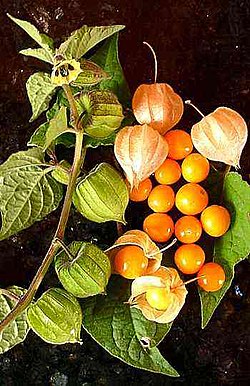
Ripe orange fruits
Scientific classification Edit this classification
Kingdom: Plantae
Clade: Tracheophytes
Clade: Angiosperms
Clade: Eudicots
Clade: Asterids
Order: Solanales
Family: Solanaceae
Genus: Physalis
Species:
P. peruviana
Binomial name
Physalis peruviana
Synonyms[1]
  • Boberella peruviana (L.) E.H.L. Krause
  • Herschelia edulis (Sims) Bowdich
  • Physalis edulis Sims
  • Physalis incana Desf.
  • Physalis incana Dunal
  • Physalis latifolia Lam.
  • Physalis tomentosa Medik.
  • Physalis tuberosa Cav

Physalis peruviana is a species of plant in the nightshade family (Solanaceae) native to Chile and Peru.[2] Within that region, it is called aguaymanto, uvilla or uchuva, in addition to numerous indigenous and regional names. In English, its common names include Cape gooseberry, goldenberry and Peruvian groundcherry.[2][3][4][5]

The history of Physalis peruviana cultivation in South America can be traced to the Inca Empire.[6][7] It has been cultivated in England since the late 18th century, and in South Africa in the Cape of Good Hope since at least the start of the 19th century.[2] Widely introduced in the 20th century, Physalis peruviana is now cultivated or grows wild across the world in temperate and tropical regions.[3]

Taxonomy and common names

[edit]

Physalis peruviana was given a botanical species description by Carl Linnaeus in 1763.[8] and given the genus name Physalis after the Greek: φυσαλλίς - physallís, “bladder, wind instrument” in reference to the calyx that surrounds the berry. The specific name peruviana refer to the country of Peru, one of the countries of the berry's origin.

In Peru, P. peruviana is known as aguaymanto in Spanish and topotopo in Quechua.[9] In neighboring Colombia, it is known by its Aymara name as uchuva,[10] and as uvilla (Spanish for 'little grape') in Ecuador.[11]

It was grown in England in 1774 and by early settlers of the Cape of Good Hope before 1807.[2] Whether it was grown there before its introduction to England is not known, but sources since the mid-19th century attribute the common English name "Cape gooseberry" to this fact.[12][13] An alternative suggestion is that name refers to the calyx surrounding the fruit like a cape, possibly an example of false etymology, because it does not appear in publications earlier than the mid-20th century. Not long after its introduction to South Africa, P. peruviana was introduced to Australia, New Zealand and various Pacific islands.[2] Despite its common name, it is not botanically related to the true gooseberries of the genus Ribes.

Description

[edit]

P. peruviana is closely related to the tomatillo.[2] As a member of the plant family Solanaceae, it is also more distantly related to a large number of edible plants, including tomatoes, eggplants, and potatoes.[2]

P. peruviana is an annual in temperate locations, but a perennial in the tropics.[2] As a perennial, it develops into a diffusely branched shrub reaching 1–1.6 m (3 ft 3 in – 5 ft 3 in) in height, with spreading branches and velvety, heart-shaped leaves.[3] The hermaphrodite flowers are bell-shaped and drooping, 15–20 mm (5834 in) across, yellow with purple-brown spots internally. After the flower falls, the calyx expands, ultimately forming a beige husk fully enclosing the fruit.[2][3]

The fruit is a round, smooth berry, resembling a miniature yellow tomato 1.25–2 cm (1234 in) wide.[3] Removed from its calyx, it is bright yellow to orange in color, and sweet when ripe, with a characteristic, mildly tart grape-like flavor.[2]

A prominent feature is the inflated, papery calyx enclosing each berry. The calyx is accrescent until the fruit is fully grown; at first, it is of normal size, but after the petals fall, it continues to grow until it forms a protective cover around the growing fruit. If the fruit is left inside the intact calyx husks, its shelf life at room temperature is about 30–45 days. The calyx is inedible.

Groundcherries (cape-gooseberries or poha), raw
Nutritional value per 100 g (3.5 oz)
Energy222 kJ (53 kcal)
11.2 g
0.7 g
1.9 g
Vitamins and minerals
VitaminsQuantity
%DV
Vitamin A equiv.
4%
36 μg
Thiamine (B1)
9%
0.11 mg
Riboflavin (B2)
3%
0.04 mg
Niacin (B3)
18%
2.8 mg
Vitamin C
12%
11 mg
MineralsQuantity
%DV
Calcium
1%
9 mg
Iron
6%
1 mg
Phosphorus
3%
40 mg
Other constituentsQuantity
Water85.4 g

Percentages estimated using US recommendations for adults.[14]

Nutrition

[edit]

Raw Cape gooseberries are 85% water, 11% carbohydrates, 2% protein, and 1% fat (table). In a reference amount of 100 grams (3.5 oz), raw Cape gooseberries supply 53 calories and provide moderate levels (10–19% of the Daily Value) of niacin and vitamin C.

Analyses of oil from different berry components, primarily its seeds, showed that linoleic acid and oleic acid were the main fatty acids, beta-sitosterol and campesterol were principal phytosterols, and the oil contained vitamin K and beta-carotene.[15]

Distribution and habitat

[edit]

The center of genetic diversity for Physalis peruviana is in the Andes Mountains of Ecuador, Chile, Colombia, and Peru.[2] It grows in forests, forest edges, and riparian areas.[3] It grows at high elevations of 500–3,000 m (1,600–9,800 ft) in its native region, but may also be found at sea level in Oceania and Pacific islands where it occurs widely in subtropical and warm, temperate conditions.[3] Its latitude range is about 45°S to 60°N, and its altitude range is generally from sea level to 3,000 m (9,800 ft).[3] The plant has become invasive in some natural habitats, forming thickets, particularly in Hawaii and on other Pacific islands.[3] There are believed to be dozens of ecotypes worldwide that differentiated by plant size, calyx shape, and the size, color, and flavor of the fruit. Wild forms are thought to be diploid with 2n = 24 chromosomes, while cultivated forms include varieties with increased ploidy and 32 or 48 chromosomes.[16]

Cultivation

[edit]

It has been widely introduced into cultivation in tropical, subtropical, and temperate areas such as Australia, China, India, Malaysia, and the Philippines.[2][3][17] P. peruviana thrives at an annual average temperature from 13 to 18 °C (55 to 64 °F), tolerating temperatures as high as 30 °C (86 °F).[3] It grows well in Mediterranean climates and is hardy to USDA hardiness zone 8, meaning it can be damaged by frost.[3] It grows well in rainfall amounts of 800–4,300 mm (31–169 in) if the soil is well drained, and prefers full sun or partial shade in well-drained soil, and grows vigorously in sandy loam.[2][3]

The plant is readily grown from seeds, which are abundant (100 to 300 in each fruit), but with low germination rates, requiring thousands of seeds to sow a hectare.[2] Plants grown from year-old stem cuttings will flower early and yield well, but are less vigorous than those grown from seed.[2]

Pests and diseases

[edit]

In South Africa, cutworms attack the Cape gooseberry in seedbeds, red spiders in the field, and potato tuber moths near potato fields. Hares damage young plants, and birds eat the fruits. Mites, whiteflies and flea beetles can also be problematic.[2] Powdery mildew, soft brown scale, root rot and viruses may affect plants.[2] In New Zealand, plants can be infected by Candidatus Liberibacter solanacearum.[18]

Uses

[edit]

Culinary

[edit]

P. peruviana is an economically useful crop as an exotic exported fruit, and is favored in breeding and cultivation programs of many countries.[3] P. peruviana fruits are marketed in the United States as goldenberry and sometimes Pichuberry, named after Machu Picchu in order to associate the fruit with its cultivation in Peru.[19]

Cape gooseberries are made into fruit-based sauces, pies, puddings, chutneys, jams and ice cream, or eaten fresh in salads and fruit salads.[2] In Latin America, it is often consumed as a batido or smoothie,[20] and because of its showy husk, it is used in restaurants as a decorative garnish for desserts. To enhance its food uses, hot air drying improves qualities of dietary fiber content, texture and appearance.[21]

In basic research on fruit maturation, the content of polyphenols and vitamin C varied by cultivar, harvest time, and ripening stage.[22]

Potential for toxicity

[edit]

Unripe raw fruits, flowers, leaves, and stems of the plant contain solanine and solanidine alkaloids that may cause poisoning if ingested by humans, cattle or horses.[23][24]

See also

[edit]

References

[edit]
Revisions and contributorsEdit on WikipediaRead on Wikipedia
from Grokipedia
Physalis peruviana is a herbaceous in the family, native to the Andean highlands of , including regions in , , , and . Known commonly as cape gooseberry, goldenberry, or Inca berry, it features sprawling, soft-wooded stems that reach 3–6 feet (1–2 meters) in height, with pubescent growth and heart-shaped leaves. The produces small, globose, golden-yellow berries approximately 1 inch (2–3 cm) in diameter, each enclosed in a distinctive papery, lantern-like formed from the five-sepal calyx, which aids in protection and ripening. These berries have a tangy-sweet flavor and contain numerous tiny seeds, along with bioactive compounds such as withanolides and phenolics. Originally from tropical and subtropical , P. peruviana was introduced to other regions in the early , spreading to , , the , and Pacific islands, where it has naturalized in many tropical areas. It is cultivated as a summer annual in temperate climates, requiring well-drained with medium to low fertility and full sun, with transplants set out after the last frost and fruiting typically occurring in 70–80 days. Commercially, it thrives in subtropical environments, yielding up to 20–30 tons per , with major production in countries like (approximately 20,000 metric tons as of 2023) and expanding cultivation in places like and ; exports from exceeded 8,500 tons in 2022, reflecting growing global demand. The fruit's relatively long shelf life—up to 62 days at 8°C—makes it suitable for export and processing. Nutritionally, the goldenberry is valued for its high content of vitamins A and C, , , and calcium, as well as antioxidants like polyphenols and , contributing to its classification as a with potential benefits for metabolic health. Culinary uses include eating fresh, in salads, jams, juices, wines, and desserts, while its historical role in combating highlights its richness. Medicinally, it exhibits potential , antidiabetic, anticancer, and hepatoprotective properties, attributed to its bioactive compounds, and has been used traditionally in and for treating ailments like and .

Taxonomy

Scientific classification

Physalis peruviana is classified within the kingdom Plantae, phylum Tracheophyta, class Magnoliopsida, order Solanales, family Solanaceae, genus Physalis, and species P. peruviana. This species has several synonyms, including Physalis edulis Sims and Physalis latifolia Lam., reflecting historical naming variations. Physalis peruviana belongs to the nightshade family , which encompasses diverse plants such as tomatoes (Solanum lycopersicum) and potatoes ( tuberosum). The genus includes over 75 species, mostly native to the , with P. peruviana distinguished by its inflated fruit-enclosing calyx that forms a characteristic . The specific epithet "peruviana" alludes to its perceived Peruvian origin.

Common names and etymology

Physalis peruviana is known by a variety of common names worldwide, reflecting its widespread cultivation and cultural significance. In English-speaking regions, it is commonly referred to as Cape gooseberry, while goldenberry is the preferred term in and commercial contexts. Other global names include poha in and ras bhari in . In its native Andean regions, the plant has distinct vernacular names tied to local languages and traditions. In and , it is called aguaymanto or uvilla, while in , names such as uchuva, uvilla, or topotopo are used, with uchuva derived from Aymara indigenous terminology. These names highlight regional variations, such as cape gooseberry in and , where the plant was introduced during colonial times. The scientific name Physalis peruviana originates from and early botanical observations. The genus name derives from the Greek word "physallis," meaning or bubble, alluding to the inflated, papery enclosing the . The specific peruviana indicates its association with , based on initial collections from that region, although the plant's native range extends across the broader from to . Cultural naming influences stem from both indigenous Andean traditions and European colonial introductions. Indigenous terms like aguaymanto and uchuva reflect pre-Columbian knowledge in Quechua and Aymara languages, emphasizing the fruit's juicy nature and local uses. The English name "Cape gooseberry" arose from its introduction to via the in in the , with "" added due to the fruit's superficial resemblance to European gooseberries in size and tart flavor, despite no botanical relation.

Description

Physical characteristics

Physalis peruviana is an or belonging to the family, typically reaching heights of 0.5 to 2 meters with an erect or ascending, often sprawling habit that may require support. It produces a cluster of branched stems from a stout, woody base or sometimes creeping rootstock, which can become semi-woody over time, especially in tropical conditions. The stems are angular, ribbed, densely pubescent, and frequently tinged purple or green, growing to 45-90 cm or more in length. In temperate regions, it behaves as an annual, while in frost-free areas, it persists as a with year-round growth potential. The leaves are , ovate to cordate in shape, with a heart-shaped base, pointed apex, and margins ranging from entire to coarsely dentate or sinuate. They measure 6-15 cm long and 4-10 cm wide, are densely hairy on both surfaces, and are arranged alternately or nearly oppositely along the stems. Each node on the stem gives rise to two buds—one vegetative supporting leaf growth and one flowering—contributing to the plant's dichotomous branching pattern. The root system is fibrous with a woody rootstock that anchors the plant effectively in various soils. Flowers are hermaphroditic, solitary, and axillary, emerging from the flowering buds at nodes. They feature a nodding, bell-shaped corolla that is yellow with prominent dark purple-brown spots in the throat, measuring 1-2 cm in diameter and 9-15 mm long, with five shallow lobes. The corolla is tubular at the base, surrounding five pale yellow to purple-blue anthers, and is subtended by a five-pointed, hairy, purplish-green calyx. Blooming occurs year-round in suitable climates, primarily from summer to autumn in temperate zones. The fruit develops from the fertilized flower as a small, globose to ovoid , 0.8-2 cm in diameter, with smooth, glossy, yellow-orange skin when ripe and juicy pulp containing numerous small, seeds. It is fully enclosed within the enlarged, inflated calyx that forms a papery, lantern-like , 2.5-5 cm long, pubescent, and turning brownish at maturity, which protects the and aids in .

Reproduction

Physalis peruviana exhibits a reproductive adapted to its native Andean and tropical environments, with flowering typically initiating 70-80 days after . In tropical climates, the plant displays continuous flowering throughout the due to its habit, allowing for prolonged fruit production. In contrast, temperate regions induce a more seasonal flowering pattern, limited by cooler temperatures and shorter daylight hours, often treating the plant as an . Flowers are hermaphroditic, featuring five stamens and a superior , which supports both self-compatibility and . Pollination in Physalis peruviana is primarily facilitated by insects, including bees and bumblebees, which are attracted to the nectar-rich, yellow bell-shaped flowers with purple-brown spots in the throat. While wind serves as a secondary pollination vector, the flowers' structure favors entomophilous pollination, promoting outcrossing despite self-compatibility. This mixed reproductive system enhances genetic diversity in natural populations. Controlled studies confirm that both self- and cross-pollination result in viable seed set, though cross-pollination often yields higher fruit quality and yield. Following successful , fruit development proceeds over 70-100 days, during which the enlarges within an expanding papery calyx husk. The mature , approximately 1.25-2 cm in , contains 100-200 small, reniform measuring 1.5-2 mm in . Seed maturation is influenced by flowering timing and age, with optimal and vigor achieved from fruits harvested at full ripeness. occurs mainly via , which germinate in 10-21 days at temperatures of 20-30°C, or vegetatively through stem cuttings in settings. The life cycle of Physalis peruviana varies by : it behaves as a subshrub in tropical regions, reaching 1-2 m in height with and persistent stems, while in temperate zones it completes its cycle as an , dying back after . This flexibility allows for sustained in suitable habitats. Genetically, the is diploid with a number of 2n=24, though polyploid variants (e.g., 2n=48) occur in some populations; hybrid varieties developed through breeding programs incorporate traits like improved fruit size and disease resistance for cultivation.

Nutritional profile

The fruit of Physalis peruviana consists primarily of , comprising 76.9–85.9% of its fresh weight, with macronutrient content including 0.3–1.9 g , 0–0.5 g , 11–19.6 g carbohydrates (of which 0.4–4.9 g is ), and an energy value of 49–76.8 kcal per 100 g. Specific analyses report values such as 78.95 g , 1.43 g , 0.20 g , 12.66 g carbohydrates, 4.69 g , and 2.09 g per 100 g fresh weight. These compositions vary by and growing conditions, contributing to the fruit's low-calorie profile suitable for dietary inclusion. Physalis peruviana is notable for its vitamin content, providing 20–40 mg ascorbic acid () per 100 g, alongside provitamin A from at 648–1,730 IU. are present, including thiamin (B1) at 0.10–0.18 mg, (B2) at 0.03–0.17 mg, and niacin (B3) at 0.8–2.80 mg per 100 g, with (tocopherols) reaching 2.34 mg in some samples. A one-cup serving can supply up to 50% of the daily requirement, supporting immune function. Minerals in the fruit include at 210–373 mg, at 27–55 mg, magnesium at 7–48.7 mg, calcium at 8–28 mg, and iron at 0.03–1.24 mg per 100 g, with trace elements such as (0.28–0.40 mg) and (0.09 mg). Detailed profiling from Chilean samples shows 256 mg , 94.75 mg , 20 mg magnesium, 17.8 mg calcium, and 0.54 mg iron per 100 g. These levels position the fruit as a modest source of essential minerals for bone health and metabolic processes. Bioactive compounds abound, including polyphenols (15.2–26.24 mg equivalents per 100 g), flavonoids ( equivalents), and , with steroidal lactones such as withanolides and physalins exhibiting properties. The fruit's ranges from 3.5–4.5, and soluble solids measure 10–16 °, reflecting its tart-sweet taste and potential for applications. These compounds contribute to the fruit's overall health-promoting potential beyond basic nutrition. In antioxidant assays, Physalis peruviana demonstrates higher capacity than or strawberries, attributed to its elevated and levels, with content surpassing that of , mangoes, and guavas in comparative studies.

Distribution and habitat

Native range

Physalis peruviana is native to the Andean region of , primarily occurring in , , , , and , with its range extending to northwest . The center of its genetic diversity lies in these Andean highlands, where it has evolved in diverse ecological conditions. Historical evidence suggests that the plant was cultivated by pre-Incan and Incan civilizations during the , integrating it into early agricultural practices in the region. In the wild, P. peruviana is distributed across a wide elevational gradient, from to 4,500 meters, though it is most commonly found between 1,300 and 3,700 meters in montane areas. It occupies natural habitats such as disturbed ground, forest edges, secondary , riverbanks, and coastal regions, favoring well-drained sandy-loam soils in subtropical to temperate zones. Ecologically, P. peruviana functions as a in disturbed habitats, rapidly colonizing open or degraded areas and contributing to . Its flowers attract a variety of pollinators, including bees and other , supporting local . Wild populations demonstrate high , which serves as a valuable resource for breeding improved varieties resistant to environmental stresses.

Introduced and cultivated regions

Physalis peruviana, originating from the Andean region of , has been dispersed globally through human cultivation and trade. It was introduced to in the early at the , from where it spread to other tropical and subtropical areas, including , with the first documented record in dating to 1774. In the , the plant reached —where it is locally known as poha—and , establishing itself as a cultivated species in these regions. Today, it exhibits a distribution, thriving in warm climates across multiple continents due to its adaptability and ornamental appeal. Major production zones include , the world's leading exporter of the fruit, alongside significant cultivation in , (particularly in ), , and . Smaller-scale farming occurs in the United States, notably in and , while in it is primarily grown in greenhouses to meet demand for fresh produce. These areas benefit from the plant's relatively low input requirements and its suitability for -oriented agriculture in subtropical environments. The species has naturalized in various parts of , , and , and is considered invasive in some regions, particularly in the Pacific, where it can form dense thickets, act as a in agricultural fields or roadsides, and displace native , though its impact is limited in many other introduced ranges. Global trade in Physalis peruviana focuses on fresh and dried fruits, with dominating exports to markets in and . Since the , its popularity has surged in the sector, driven by recognition of its nutritional profile, leading to increased economic value and expanded commercial cultivation in exporting countries.

Cultivation

Growing requirements

Physalis peruviana thrives in subtropical and tropical climates, with optimal growth occurring at mean annual temperatures between 16°C and 25°C, though it can tolerate ranges from 10°C to 32°C. The plant requires full sun exposure for maximum productivity but benefits from protection against strong winds. It prefers annual rainfall of 1,500 to 2,300 mm, evenly distributed during the growing season, or equivalent irrigation to support development; it can tolerate as low as 800 mm with supplemental water but performs poorly in excessively dry conditions. Brief exposure to temperatures as low as -10°C is possible in some cultivars, reflecting its native tolerance to high-elevation Andean conditions. The plant grows best in well-drained soils, such as sandy to gravelly loams, to prevent waterlogging, which can lead to root rot. It prefers soil pH from 5.5 to 7.5. Balanced NPK fertilization at planting, tailored to soil tests, supports vegetative growth and fruiting; for instance, applications promoting phosphorus and potassium during flowering enhance berry development without excessive nitrogen that could favor foliage over fruit. Once established, Physalis peruviana exhibits moderate , but consistent is essential during flowering and set to maintain yield and . Irregular watering can cause cracking, a common issue mitigated by calcium amendments, such as foliar sprays or applications, which strengthen cell walls and reduce splitting incidence. Post-2020 highlights the benefits of shade nets in optimizing under varying conditions; for example, colored shade nets influence physicochemical attributes like acidity and soluble solids ratio, with blue or red nets often improving flavor balance in subtropical settings.

Propagation and varieties

Physalis peruviana is primarily propagated through seeds, which are sown indoors 6-8 weeks before the last frost at temperatures of 20-25°C, with germination typically occurring in 10-20 days under moist conditions. Seeds should be planted 0.5-1 cm deep in a well-draining mix, and seedlings are transplanted outdoors after hardening off for 1-2 weeks. Vegetative propagation is also possible via stem cuttings of 10 cm length with 5-7 leaves, rooted in a moist medium. In field plantings, space plants 0.5-1 m apart within rows spaced 1-2 m to accommodate their spreading habit and promote air circulation. Key cultivars of Physalis peruviana have been developed to suit various growing conditions and markets, drawing from the species' native Andean . The 'Colombian' variety, often selected for commercial production, features large fruits and high yields, making it popular in export-oriented cultivation. In contrast, 'Peruvian' types tend to produce smaller, intensely flavorful berries suited to traditional uses. Dwarf cultivars like 'Dwarf Gold' offer ornamental value with compact growth, ideal for , while hybrids focus on vigor and adaptation to non-native climates. These varieties stem from programs emphasizing traits from wild populations in , , and . As of 2025, techniques are being used to develop compact varieties with improved yield and adaptation. Under optimal conditions, a single Physalis peruviana can yield approximately 750 g to 1 kg of , equivalent to 150-300 berries, with beginning 70-120 days after planting depending on and variety. Breeding efforts prioritize enlarging size, enhancing flavor consistency, and extending post shelf through selection from diverse native , which provides a broad genetic base for resistance and productivity improvements. These programs, often centered in Andean countries, utilize molecular markers to preserve variability while developing superior lines for global agriculture.

Pests and diseases

Physalis peruviana is susceptible to several insect pests that can damage leaves, stems, and fruits during cultivation. Common pests include aphids such as and , which feed on sap and transmit viruses, leading to curled leaves and stunted growth. (Bemisia tabaci) are prevalent in greenhouses and fields, causing yellowing and from honeydew excretion. Leafminers () tunnel into leaves and fruits, reducing photosynthetic capacity and yield. Fruit borers, also including larvae, bore into developing fruits, causing significant economic losses. Root-knot nematodes (Meloidogyne spp.) attack roots, leading to galls and impaired nutrient uptake. Certain beetles, such as those in the genus Epilachna, are deterred by withanolides, natural compounds in the plant acting as antifeedants. Diseases pose major threats to P. peruviana crops, particularly in humid environments. Fungal pathogens include Fusarium oxysporum f. sp. physali, causing vascular wilt that results in wilting, yellowing, and plant death, with losses up to 80-100% in affected fields. Powdery mildew (Leveillula taurica) forms white powdery growth on leaves, reducing vigor. Anthracnose, caused by Colletotrichum spp., affects fruits with sunken lesions and rot. Bacterial spot (Xanthomonas spp.) produces water-soaked spots on leaves and fruits, exacerbated in warm, wet conditions. Viral infections, such as tobacco mosaic virus (TMV), induce mosaic patterns, stunting, and fruit deformation. Integrated pest management (IPM) is recommended to control these threats, combining cultural, biological, and chemical strategies. with non-host plants reduces soil-borne pathogens like Fusarium and nematodes. Resistant varieties have been developed to combat wilt and other diseases. Organic controls, such as neem-based products (), effectively suppress , , and mites when applied at 7-day intervals. For severe outbreaks, chemical fungicides target fungal diseases, while insecticidal soaps or oils manage sucking pests. Recent studies highlight plant-derived withanolides as natural antifeedants that reduce larval damage from herbivores like by deterring feeding.

Uses

Culinary applications

Physalis peruviana, commonly known as Cape gooseberry or goldenberry, is valued in culinary contexts for its tangy-sweet flavor profile, which combines notes of , , and . The fresh fruits are often consumed raw, either on their own or incorporated into fruit salads, smoothies, and desserts for added tartness and visual appeal. They serve as an attractive garnish in both savory and sweet dishes, such as atop cheesecakes or in green salads. In processed forms, the berries are transformed into a variety of products that highlight their versatility. Jams, jellies, and preserves are popular, often paired with toast, cheese, or scones, while the fruits are baked into pies, tarts, and crumbles. Sauces and chutneys, including fresh salsas with tomatoes, onions, and chilies, accompany meats or in savory applications. The berries can be dried to a raisin-like texture for use in trail mixes, , or baking, and are also juiced for beverages or fermented into wines and liqueurs. Internationally, they feature in sorbets, ice creams, and chocolate-dipped treats. Within Andean cuisine, particularly in Peru where it is called aguaymanto, the fruit is integrated into traditional preparations such as compotes served with yogurt, cakes, and ice creams, or blended into juices and fermented drinks. It appears in modern Peruvian dishes like fruit-based cocktails or as an ingredient in quinoa salads, reflecting its role as a native superfood. Globally, dried goldenberries are exported and incorporated into health-focused items like energy bars and trail mixes. The fruit's papery provides natural protection against moisture and pests, enabling room-temperature storage for several weeks without significant quality loss. When refrigerated at around 8°C with the intact, the berries maintain freshness for up to 62 days, far longer than husked fruits which last about 33 days under similar conditions. For commercial purposes, drying extends indefinitely, facilitating export to international markets where they are rehydrated or used directly in recipes.

Medicinal properties

Physalis peruviana has been utilized in across various cultures, particularly in regions like the , , and , for treating a range of ailments. Leaf decoctions are commonly employed for gastrointestinal disorders such as and stomach ache, accounting for approximately 25% of reported traditional applications, as well as for managing worms and . The fruit is traditionally used to alleviate and bolster immunity, while the plant exhibits properties overall, with roots and stems applied for conditions like and . In Ayurvedic and systems, it is valued for gastrointestinal issues, aligning with broader ethnomedicinal practices where leaves represent the most frequently used part (49.3%). The medicinal potential of Physalis peruviana stems from its rich phytochemical profile, including withanolides, physalins, , and alkaloids. Withanolides, numbering over 76 identified compounds, contribute to and anticancer effects, such as inhibiting tumor growth through pathways like suppression. Physalins exhibit anticancer properties by targeting cell proliferation, while like , , , and provide benefits and inhibit enzymes such as α-amylase for antidiabetic action. Alkaloids and other phenolics, including and , further support and hepatoprotective roles. Pharmacological studies validate these traditional uses, demonstrating activity with high ORAC values (up to 3126 µmol TE/100 g fresh weight), which help reduce and enhance endogenous status . effects include reduced production of cytokines like IL-18 and MCP-1, as well as inhibition of COX-1/COX-2 enzymes. properties target both Gram-positive and , with minimum inhibitory concentrations as low as 0.313 mg/mL against certain pathogens. Hepatoprotective activity protects liver tissue by elevating antioxidant enzymes and lowering inflammatory markers, while anticancer studies show antiproliferative effects against lung, breast, colon, and cells (e.g., IC50 of 142 µg/mL for colon cells). is supported through skin applications that promote tissue regeneration. Post-2020 research has advanced understanding of its therapeutic applications, including a 2024 study showing daily consumption prevents and in rats by improving insulin signaling and lipid profiles. A 2025 investigation highlighted calyces extracts' role in ameliorating and boosting immunity against pesticide-induced damage. A 2024 study demonstrated that exosome-like nanoparticles derived from P. peruviana fruit promote human dermal regeneration and remodeling, with potential applications in health. A 2025 review further noted plant extracellular vesicles, including from Physalis peruviana, for anti-aging and protection effects. These findings underscore its integration into functional foods for immunomodulatory and dermatological benefits.

Other applications

Physalis peruviana is cultivated as an in gardens due to the attractive, lantern-like husks that enclose its fruits, providing a decorative element especially in autumn displays. Dwarf varieties, such as 'Dwarf Gold', are particularly suited for or small spaces, allowing the plant to thrive in pots while showcasing its compact growth and colorful husks. Dried husks and seed heads are also used in floral arrangements for their unique, papery texture and enduring form. In industrial applications, extracts from P. peruviana fruits are incorporated into for their properties, which help protect skin from and enhance moisture retention in formulations like skin creams. For instance, creams containing up to 66% fruit extract provide a moisturizing barrier and support skin health through bioactive compounds. The fruit's pigments are extracted as natural dyes, with methanol-based methods yielding compounds suitable for applications like sensitizers in conversion materials. Additionally, the plant's , including husks and by-products, shows potential for production due to its macronutrient content and yield in processing. Economically, P. peruviana serves as a valuable , particularly from , where it is promoted as a and generated export revenues of approximately USD 37.8 million from 7,125 tons in 2022. The industry has seen steady growth, with annual value increases averaging 8.8% from 2016 to 2022, benefiting small-scale producers through international markets in and beyond. Environmentally, the plant functions as a ground cover in suitable regions, aiding in by stabilizing soil with its spreading growth habit. Other uses include employing the leaves as animal to supplement diets with and nutrients. The husks are utilized in traditional crafts, such as creating stacked structures resembling pumpkins or other decorative items from their dried, skeletal forms.

Toxicity and safety

Toxic compounds

Physalis peruviana contains several toxic compounds, primarily such as and its aglycone solanidine, which are present in unripe fruits, leaves, and stems. These compounds contribute to the plant's , particularly in green tissues. Additionally, withanolides, a class of steroidal lactones, occur in higher concentrations in the green parts of the plant, including leaves, stems, and the calyx surrounding the fruit. Concentrations of like vary by plant part and maturity, with higher levels in foliage and lower amounts in ripe fruit. Ripe fruit is generally considered safe for consumption. For withanolides, concentrations in the calyx can reach approximately 640 ppm (0.064% fresh weight), decreasing in ripe fruit as a protective mechanism. These toxins, including and withanolides, are biosynthesized as chemical defenses against herbivores, with levels declining during fruit ripening to reduce in portions while maintaining protection in vegetative tissues. Ingestion of these compounds can cause symptoms such as , gastrointestinal distress, and neurological effects. indicate for α-solanine, with lethal doses around 75 mg/kg body weight in Syrian Golden hamsters, leading to rapid onset of symptoms and death within days. Overall extracts from P. peruviana show lower , with LD50 values exceeding 5000 mg/kg in .

Consumption guidelines

The ripe fruit of Physalis peruviana, commonly known as goldenberry or Cape gooseberry, is the only safe part for human consumption, while the papery husk, leaves, and stems should be avoided due to potential toxicity from solanine-like compounds. Unripe green fruits also contain higher levels of these alkaloids and are not recommended for eating. Before consumption, remove the and wash the ripe berries thoroughly under running to eliminate any surface contaminants or residues. Ripe fruits can be eaten fresh, but unripe ones should be avoided, as ripening is the primary method to minimize risks. Individuals sensitive to nightshade family plants, such as those with allergies, pregnant women, or people with gastrointestinal conditions, should limit intake to small amounts and consult a healthcare provider. Excessive consumption of ripe fruits may lead to gastrointestinal upset, such as cramping or , particularly at high doses exceeding typical dietary levels, while unripe fruits can cause more severe symptoms including headaches or in rare cases. Allergies are uncommon but possible, manifesting as rashes or digestive issues in susceptible individuals. For pets, the green parts, unripe fruits, leaves, and stems are toxic to dogs and cats, potentially causing , , or dilated pupils; ripe fruits may be tolerated in small quantities by dogs but should be kept inaccessible. Physalis peruviana fruits are widely imported and consumed as food in the United States and without specific GRAS designation from the FDA, but they fall under general regulations requiring post-harvest monitoring for residues and contaminants. Individuals with sensitivities to the family should exercise caution, and products should comply with local import standards for safe handling.

References

Add your contribution
Related Hubs
User Avatar
No comments yet.