Hubbry Logo
Duchy of LorraineDuchy of LorraineMain
Open search
Duchy of Lorraine
Community hub
Duchy of Lorraine
logo
8 pages, 0 posts
0 subscribers
Be the first to start a discussion here.
Duchy of Lorraine
Duchy of Lorraine
from Wikipedia

Key Information

The Duchy of Lorraine[2] was a principality of the Holy Roman Empire[3] which existed from the 10th century until 1766 when it was annexed by the Kingdom of France.[4] It gave its name to the larger present-day region of Lorraine in northeastern France. Its capital was Nancy.

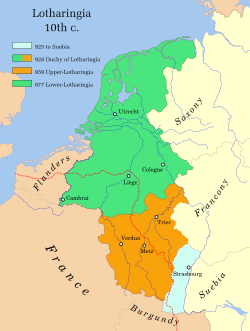
It was founded in 959 following the division of Lotharingia into two separate duchies: Upper and Lower Lorraine, the westernmost parts of the Holy Roman Empire. The Lower duchy was quickly dismantled, while Upper Lorraine came to be known as simply the Duchy of Lorraine. The Duchy of Lorraine was coveted and briefly occupied by the dukes of Burgundy and the kings of France, but was ruled by the dukes of the House of Lorraine after 1473.

In 1737, the duchy was given to Stanisław Leszczyński, the former king of Poland, who had lost his throne as a result of the War of the Polish Succession, with the understanding that it would fall to the French crown on his death. When Stanisław died on 23 February 1766, Lorraine was annexed by France and reorganized as the province of Lorraine and Barrois.

History

[edit]
Portrait of the last Duke of Lorraine Francis Stephen on silver coin 10 paoli as he inherited Grand Duchy of Tuscany

Lotharingia

[edit]

Lorraine's predecessor, Lotharingia, was an independent Carolingian kingdom under the rule of King Lothair II (855–869). Its territory had originally been a part of Middle Francia, created in 843 by the Treaty of Verdun, when the Carolingian empire was divided between the three sons of Louis the Pious. Middle Francia was allotted to Emperor Lothair I, therefore called Lotharii Regnum. On his death in 855, it was further divided into three parts, of which his son Lothair II took the northern one. His realm then comprised a larger territory stretching from the County of Burgundy in the south to the North Sea. In French, this area became known as Lorraine, while in German, it was eventually known as Lothringen. In the Alemannic language once spoken in Lorraine, the -ingen suffix signified a property;[citation needed] thus, in a figurative sense, "Lotharingen" can be translated as "Land belonging to Lothair", or more simplified *Lothair's realm*.

As Lothair II had died without heirs, his territory was divided by the 870 Treaty of Meerssen between East and West Francia and finally came under East Frankish rule as a whole by the 880 Treaty of Ribemont. After the East Frankish Carolingians became extinct with the death of Louis the Child in 911, Lotharingia once again attached itself to West Francia, but was conquered by the German king Henry the Fowler in 925. Stuck in the conflict with his rival Hugh the Great, in 942 King Louis IV of France renounced all claims to Lotharingia.

Duchy of Upper Lorraine

[edit]

In 953, the German king Otto I had appointed his brother Bruno the Great Duke of Lotharingia. In 959, Bruno divided the duchy into Upper and Lower Lorraine; this division became permanent following his death in 965. The Upper Duchy was further "up" the river system, that is, it was inland and to the south. Upper Lorraine was first denominated as the Duchy of Mosellane, both in charters and narrative sources, and its duke was the dux Mosellanorum.

Lower Lorraine disintegrated into several smaller territories and only the title of a "Duke of Lothier" remained, held by Brabant. By the time Upper Lorraine came into the possession of René of Anjou, several territories had already split off, such as the County of Luxembourg, the Electorate of Trier, the County of Bar and the "Three Bishoprics" of Verdun, Metz and Toul.

The border between the Empire and the Kingdom of France remained relatively stable throughout the Middle Ages. In 1301, Count Henry III of Bar had to receive the western part of his lands (Barrois mouvant) as a fief by King Philip IV of France. In 1475, the Burgundian duke Charles the Bold campaigned for the Duchy of Lorraine, but was finally defeated and killed at the 1477 Battle of Nancy. In the 1552 Treaty of Chambord, a number of insurgent Protestant Imperial princes around Maurice, Elector of Saxony ceded the Three Bishoprics to King Henry II of France in turn for his support.

Due to the weakening of Imperial authority during the 1618–1648 Thirty Years' War, France was able to occupy the duchy in 1634 and retained it until 1661 when Charles IV was restored. In 1670, the French invaded again, forcing Charles into exile; his nephew and heir Charles V (1643–1690) spent his life in the service of the Imperial House of Habsburg. France returned the Duchy in the 1697 Treaty of Ryswick ending the Nine Years' War and Charles' son Leopold (1679–1729), became duke and was known as 'Leopold the Good;' in the 1701–1714 War of the Spanish Succession, parts of Lorraine, including the capital Nancy, were again occupied by France, but Leopold continued to reign at the Château de Lunéville.

In 1737, after the War of the Polish Succession, an agreement between France, the Habsburgs and the Lorraine House of Vaudémont assigned the Duchy to Stanisław Leszczyński, former king of Poland. He was also father-in-law to King Louis XV of France, and had recently lost out to a candidate backed by Russia and Austria in the War of the Polish Succession. The duke of Lorraine, Francis Stephen, betrothed to the Emperor's daughter Archduchess Maria Theresa, was compensated with the Grand Duchy of Tuscany, where the last Medici ruler had recently died without issue. France also promised to support Maria Theresa as heir to the Habsburg possessions under the Pragmatic Sanction of 1713. Leszczyński received Lorraine with the understanding that it would fall to the French crown on his death. The title of Duke of Lorraine was given to Stanisław, but also retained by Francis Stephen, and it figures prominently in the titles of his successors (as a non-claimant family name), the House of Habsburg-Lorraine. When Stanisław died on 23 February 1766, Lorraine was annexed by France and reorganized as a province by the French government.

Culture

[edit]

Two regional languages survive in the region.

Lorraine Franconian, known as francique or platt (lorrain) in French, is a West Central German dialect spoken by a minority in the northern part of the region. This is distinct from the neighbouring Alsatian language, although the two are often confused. Neither has any form of official recognition.

Lorrain is a Romance dialect spoken by a minority in the southern part of the region.

The duchy produced a number of important painters, including Claude Lorrain, Georges de La Tour and Jean LeClerc.

Like most of France's regional languages (such as Breton, Franco-Provençal, Occitan, Alsatian, Catalan, Basque and Flemish), Lorrain and Lorraine Franconian were largely replaced by French with the advent of mandatory public schooling in the 19th and 20th centuries.

See also

[edit]

References

[edit]

Further reading

[edit]
[edit]
Revisions and contributorsEdit on WikipediaRead on Wikipedia
from Grokipedia
The Duchy of Lorraine was a principality of the located in the border region between present-day northeastern and western Germany, originating from the medieval kingdom of following its partition in the and persisting until its annexation by in 1766 upon the death of its final ruler, Stanisław Leszczyński. Ruled primarily by the from the onward, the duchy maintained a precarious independence as a strategic buffer amid recurrent conflicts between , the , and , suffering multiple occupations such as the French control from 1669 to 1697. With Nancy as its capital, Lorraine's dukes navigated alliances and warfare, notably defeating the Burgundian forces of at the in 1477, which preserved its autonomy temporarily against expansionist threats. Its cultural and political significance lay in bridging Germanic and Romance influences, though its sovereignty eroded through treaties and dynastic maneuvers, culminating in the 1738 Treaty of Vienna that transferred rule to Leszczyński as compensation for Polish losses.

Geography and Territory

Borders and Extent

The Duchy of Lorraine originated as Upper Lorraine following the 959 division of Lotharingia into upper and lower duchies by Emperor Otto I, encompassing the southern, French-speaking portions centered on the Moselle River valley and the city of Nancy. Its initial extent stretched from the Meuse River in the west, bordering the County of Champagne, to the Rhine River in the east adjacent to Alsace (part of the Duchy of Swabia), with the Free County of Burgundy to the south and Lower Lorraine to the north. Key urban centers included Nancy, Metz, Toul, Verdun, and Épinal, though the prince-bishoprics of Metz, Toul, and Verdun maintained ecclesiastical independence within ducal lands, fragmenting administrative control. By the 11th century, internal divisions altered the territory, such as Duke Thierry II's 1073 cession of the Saintois region to his brother Gérard, establishing the County of Vaudémont as a semi-autonomous . The duchy briefly fell under the suzerainty of the County of Bar in the early following Duke Ferry II's capture and the 1208 treaty, though it regained autonomy. To the west, it neighbored the and Champagne, while eastern and southern frontiers abutted imperial territories including and to the north. Over subsequent centuries, the duchy's borders stabilized around what approximated modern Lorraine's outline by the late medieval period, incorporating the Duchy of Bar after 1431 under René d'Anjou, who inherited both through marriage and imperial confirmation in 1434. Persistent conflicts with France led to gradual encroachments, particularly from the mid-17th century, culminating in full annexation by France in 1766 upon the death of Duke Stanisław Leszczyński, by which time the territory had contracted amid French gains in peripheral areas. Despite these shifts, the core remained a strategic buffer between French and imperial realms, with eastern extensions into regions now part of Saarland and Luxembourg.

Physical Features and Resources

The Duchy of Lorraine occupied a varied dominated by hills, plateaus, and dense forests, with elevations generally ranging from 200 to 500 meters in the central areas. To the southeast, the Mountains provided a , reaching heights over 1,000 meters and influencing local climate and drainage patterns. Rolling plains extended toward the northwest, interspersed with valleys conducive to settlement and farming. Major rivers, including the , , and Saar, crisscrossed the duchy, originating in the surrounding highlands and flowing northward or westward to support , , and . These waterways drained into the basin, fostering alluvial soils in their valleys that enhanced . Extensive woodlands, covering significant portions of the landscape, supplied timber for construction, fuel, and production essential to early industries. Natural resources included substantial deposits, particularly the minette ores in the northeastern sectors, exploited since antiquity and fueling medieval forges and later operations. seams underlay parts of the territory, though systematic extraction intensified only in the ; surface outcrops supported limited pre-industrial use. Salt springs and evaporation basins, notably around Nancy and in the Salins region, yielded brine for evaporation into salt, a vital for preservation and trade throughout the duchy's . Agriculture thrived on the loamy soils of river valleys, yielding grains such as and , alongside in sunnier slopes and rearing in uplands.

Origins and Early Formation

Lotharingia and the Carolingian Division

The , encompassing much of Western and under and his successors, faced fragmentation due to the practice of partible inheritance among the heirs of . The , concluded on 10 August 843, partitioned the empire among Louis's three surviving sons following a civil war: received the central portion known as , stretching from the to and including key imperial centers like and , along with the imperial title; obtained , precursor to ; and gained , the basis for . This division created a fragmented middle kingdom vulnerable to absorption by its flanking realms. Lothair I's death on 29 September 855 at prompted the , which subdivided among his three sons: Louis II inherited and the , Charles received , and was granted the northern territories, thereafter named in his honor. comprised lands between the and rivers, extending from southward to the , encompassing modern-day , , the , eastern , and western —a region strategically positioned but ethnically and linguistically diverse, with Romance-speaking areas in the west and Germanic in the east. This polity, lacking natural cohesion, became a contested . Lothair II died on 8 August 869 without legitimate male heirs, sparking rivalry between East and West Francia for control of Lotharingia. The Treaty of Meerssen in 870 divided it between Louis the German and Charles the Bald, with the east going to East Francia and the west to West Francia, though disputes persisted. Subsequent partitions, including the Treaty of Ribemont in 880, further delineated boundaries, setting the stage for the emergence of Upper Lotharingia as the core of the later Duchy of Lorraine by the late 10th century, when local counts consolidated power amid weakening Carolingian oversight. The region's dual linguistic divide foreshadowed its split into Upper (Germanic-influenced) and Lower (Romance-influenced) parts around 959 under Otto I.

Establishment of Upper Lorraine

In 959, , and effective regent of under his brother Emperor Otto I, divided the Duchy of Lotharingia into two administrative units: Upper Lorraine (southern portion) and Lower Lorraine (northern portion), in response to ongoing local rebellions and to facilitate greater ducal authority over disparate regions. This partition aimed to stabilize control within the by assigning semi-autonomous rulers to each half, marking the formal establishment of Upper Lorraine as a distinct duchy. Bruno appointed Frederick I, known as "Barbarossa" (c. 912–978), a noble from the House of Ardenne and Count of Bar, as the first Duke of Upper Lorraine. Frederick's investiture consolidated power in the area, encompassing key ecclesiastical territories including the bishoprics of , Toul, and , which formed the core of Upper Lorraine's domain. This region, stretching from the Vosges Mountains eastward to the tributaries, retained feudal ties to the imperial crown while developing hereditary ducal rule under the Ardenne lineage. The division proved enduring for Upper Lorraine, as its southern, more cohesive territories fostered continuity, unlike Lower Lorraine, which fragmented into counties like Brabant by the . By 978, upon Frederick I's death, the duchy had solidified its identity, with his son I succeeding and expanding influence through alliances and conquests in the region. This establishment laid the foundation for Upper Lorraine's evolution into the primary Duchy of Lorraine, independent in practice despite nominal imperial overlordship.

Dynasties and Rulers

House of Ardenne-Metz (10th-12th centuries)

The House of Ardenne-Metz, a branch of the broader Ardenne family originating in the 10th-century Lotharingian nobility, assumed ducal authority over Upper Lorraine following imperial appointments amid regional instability. This dynasty, also associated with the counts of , solidified control from the mid-11th century, emphasizing feudal consolidation and alliances through marriage to counterbalance episcopal powers in , Toul, and . Gerard I, previously count of Metz and Châtenois, received the ducal investiture in 1048 from Emperor Henry III after the short-lived tenure and death of Adalbert. Ruling until his death on 14 April 1070, Gerard married Hedwige of around 1050, producing heirs including Thierry II; he founded monasteries such as Moyenmoutier and , bolstering ecclesiastical ties, and fortified key sites like Châtel-sur-Moselle. Thierry II succeeded in 1070, reigning until 1115; twice married, first to Hedwig of Formbach and later Gertrude of , he supported Henry IV during the , leading troops against imperial rivals, and issued charters confirming familial holdings, such as one dated 19 March 1114. Simon I inherited the duchy in 1115, governing until 1139; wed to Adelaide of Louvain, he navigated succession disputes and territorial claims, including Vaudémont, while charters from 10 October 1091 document endowments to religious houses. His son Matthew I ruled from 1139 to 1176, marrying Bertha of Staufen; facing imperial pressures under Frederick I, Matthew engaged in conflicts with the counts of Champagne and the bishopric of , yet preserved core territories through diplomatic marriages and military defenses, as evidenced by a 1142 . The dynasty's persistence into the late under Simon II (1176–1205) reflected adaptive governance amid dynamics, though internal divisions, such as the Vaudémont cadet branch under Gerard's other son, began fragmenting influence.
DukeReignKey Relations and Events
Gerard I1048–1070Son-in-law of Albert II of Namur; founded abbeys, allied with Salians.
Thierry II1070–1115Investiture supporter; charters to Echternach abbey.
Simon I1115–1139Marriage to Louvain; endowments per 1091 charter.
Matthew I1139–1176Staufen alliance; resisted expansions by neighbors.

Later Houses and Key Figures (13th-18th centuries)

The direct male line of the House of Ardenne-Metz concluded with the death of Charles II in 1431, after which the duchy passed through his daughter Isabelle to her husband René I of Anjou, inaugurating a brief phase of Anjou-Lorraine rule until René's abdication in 1453. Control then reverted to the Vaudemont branch of the , a cadet line descending from earlier dukes, which dominated the duchy thereafter without interruption until its dissolution in 1766. This continuity preserved the duchy's nominal sovereignty within the amid pressures from and the Habsburgs, though frequent occupations and exiles marked ducal reigns from the 16th century onward. René II of Vaudemont (r. 1473–1508) emerged as a pivotal figure, inheriting the ducal title in 1473 and decisively defeating of Burgundy at the on 5 January 1477, with 12,000 Lorrainer-Swiss forces overcoming a Burgundian army of comparable size, resulting in Charles's death and the duchy's retention of independence. This victory, leveraging alliances with the Swiss cantons and Frederick III, halted Burgundian expansion and incorporated Nancy fully under ducal control by 1480. René's reign stabilized the duchy, fostering economic recovery through trade privileges and marriages tying Lorraine to the Habsburgs. Successors like Antoine (r. 1508–1544) oriented toward via Habsburg marital links, while (r. 1543–1608) navigated the by remaining Catholic, suppressing Protestant unrest in 1560s revolts involving 5,000 adherents, and maintaining neutrality in the despite territorial encroachments. In the 17th century, Charles IV (r. 1624–1675) faced repeated French invasions during the , losing Nancy in 1633 and ruling largely in exile, with the duchy under French administration until 1661. His nephew Charles V (r. 1675–1690) shifted to Habsburg service as an imperial , commanding 20,000 troops at the 1683 Siege of Vienna relief and contributing to victories at in 1687, which expelled Ottoman forces from and elevated Lorraine's military prestige. Leopold Joseph (r. 1697–1729) exemplified small-state diplomacy, recovering partial sovereignty post-1697 Ryswick Treaty but maneuvering amid the , where French occupations recurred from 1702; he hosted Jacobite pretender in from 1716 to 1719 to court British favor, though without territorial gains. His son Francis Stephen (r. 1729–1737) yielded Lorraine to France under the 1738 Treaty of Vienna, receiving Tuscany in compensation after marrying Habsburg heiress , effectively ending independent rule. The duchy was then awarded to (r. 1738–1766), deposed King of Poland and father-in-law to , whose administration modernized infrastructure but culminated in full French annexation upon his death on 23 February 1766, incorporating 20,000 square kilometers into .

Political and Administrative Structure

Ducal Governance

The Duchy of Lorraine's governance centered on the duke as the apex of a , functioning as an within the with authority over executive, judicial, and military affairs. Dukes issued charters granting lands and privileges, adjudicated disputes, and led military campaigns, as exemplified by Thierry II's support for Emperor Heinrich IV in the around 1076. This authority was hereditary within dynastic houses like Ardenne-Metz, but frequently interrupted by regencies during minorities, such as Marie de Blois's oversight for Duke Jean I from 1346 until his majority in 1361, reflecting the need for familial or noble consent in successions. Feudal , including counties like Vaudémont, swore oaths of allegiance to the duke, maintaining a decentralized structure where local lords retained significant autonomy over sub-territories. Central administration was anchored in Nancy, the ducal residence, with institutions including a chancery for drafting decrees, treaties, and , and a dedicated fiscal apparatus to manage revenues from domains, tolls, and feudal dues. The Chambre des Comptes, a key financial body, audited ducal accounts, oversaw tax collection, and ensured accountability for expenditures, operating as a specialized court for fiscal disputes from at least the medieval period onward. Legislative input came via the Estates General of Lorraine, assemblies of clergy, nobility, and third estate delegates convened irregularly—often under duress, as in 1670 when Louis XIV's forces prompted a gathering at Nancy to negotiate fiscal concessions—primarily to ratify taxes and loans amid wars or occupations. Governance evolved toward greater centralization in the 16th–18th centuries under dukes like Charles V (r. 1624–1670), who expanded bureaucratic oversight despite territorial patchwork and external pressures from France, which occupied Lorraine intermittently (e.g., 1661–1697). Dukes balanced absolutist aspirations with consultations from privy councils of advisors, drawn from nobility and clergy, to navigate imperial diets and Habsburg alliances, though real power often hinged on military capacity and diplomatic maneuvering rather than codified assemblies. By the 18th century, under Leopold I (r. 1697–1729), reforms emphasized efficient taxation and court patronage to bolster sovereignty, yet the duchy's semi-sovereign status limited independent policy, culminating in Stanisław Leszczyński's brief rule (1738–1766) before French annexation transformed it into a royal généralité under an intendant.

Feudal Obligations and Local Institutions

The Duke of Lorraine, holding the duchy as an imperial fief within the , was obligated to render homage to the emperor or king of Germany, provide military contingents for imperial campaigns, and contribute financially through taxes such as the Geld or extraordinary levies when summoned. This vassalage persisted from the duchy's establishment as Upper Lorraine in the , with dukes like Gérard (r. 1048–1070) receiving directly from Emperor Heinrich III, underscoring the emperor's suzerain authority over appointments and disputes. Conflicts, such as Thibaut I's (r. 1190–1220) capture by Emperor Friedrich II in 1218 amid succession claims in Champagne, illustrated the emperor's capacity to enforce obligations through judicial intervention or military coercion. Internally, the exercised feudal over a of , including counts and barons who owed , proportional to their holdings (typically for 40 days annually), and counsel in assemblies. Prominent examples include the counts of Vaudémont, whose lords like Hugues II swore homage to Thibaut I of Bar (a precursor overlord) in April 1216, and later to Lorraine's III in November 1268, binding them to provide troops and aid against external threats. Lesser nobles and ecclesiastical lords, such as bishops of Toul or (though semi-independent), similarly rendered auxilium et consilium, with charters often requiring ducal consent from family and key vassals for major grants, as in Mathieu I's 1142 donation. This structure fragmented over time due to , leading to disputes like the 1176–1179 between Simon II and his brother Ferry, where vassal loyalties tested ducal control. Local institutions complemented feudal ties, with administrative bailliages—districts governed by royal appointees or baillis—handling justice, tax collection, and enforcement of feudal dues from the 13th century onward. Judicial authority rested in ducal courts, supplemented by customary échevins (aldermen) in towns for civil matters, while serious crimes fell under the duke's high justice. The Estates of (États de Lorraine), an assembly of the three estates (, , and third estate representing towns), emerged as a consultative body by the late medieval period, convened irregularly to approve subsidies, deliberate on war finance, and petition the duke; for instance, they recognized ducal heirs like Francis II after his brother's death and, under pressure from subjects, compelled concessions on rights during the under dukes like (r. 1508–1544). These estates limited absolutist tendencies until the 17th-century wars decimated the nobility, enabling centralization under Leopold I (r. 1690–1729), who reduced their influence amid French occupations.

Economy and Society

Agricultural Base and Trade Routes

The Duchy of Lorraine's economy was predominantly agrarian, with the majority of its inhabitants engaged in subsistence farming centered on cereal production in the fertile alluvial plains along the and rivers. Large monastic estates, such as those in the region, generated agricultural surpluses that underpinned local exchange and supported emerging commercial activities from the onward. Livestock rearing, particularly cattle for draft power, meat, and dairy, complemented crop cultivation, while limited viticulture occurred in the Moselle valley, yielding wine for regional consumption. Salt extraction emerged as a key non-agricultural resource from the 10th century, with production sites in the Seille river valley operated by the Bishopric of Metz and monastic orders, providing a vital export good preserved through boiling saline springs. Trade routes leveraged the duchy's central location within the , with the navigable and rivers forming primary arteries linking to the corridor and ports. , situated on the , functioned as a longstanding commercial hub by the 9th-10th centuries, channeling goods including agricultural surpluses and slaves toward Mediterranean markets via overland and fluvial paths. East-west exchanges connected Lorraine to French and Burgundian domains, while north-south flows integrated it with the , facilitating the movement of salt, timber, and early glassware alongside foodstuffs. This fluvial network, augmented by overland paths through the foothills, sustained urban markets in Nancy and , though feudal tolls and political fragmentation often constrained volumes until the 16th century.

Social Hierarchy and Urban Development

The social hierarchy in the Duchy of Lorraine adhered to a feudal model prevalent in the , placing the duke and his immediate family at the pinnacle, overseeing a network of nobles, ecclesiastical lords, urban patricians, and the agrarian majority. Dukes, such as Gérard appointed in 1048, derived authority from imperial while managing internal feudal obligations from subordinate counts and seigneurs, exemplified by the Comtes de Vaudémont who held appanages within the duchy. The nobility encompassed ancient lineages of gentilshommes alongside those elevated through ducal patronage; from the fourteenth century, dukes ennobled meritorious officials, formalizing by the Custom of 1 March 1594 a tripartite lay distinction among gentilshommes, ennobled persons, and roturiers (commoners). Clerical estates wielded considerable influence through ownership of lands and control over episcopal sees like Toul, often intersecting with noble families via marriages and appointments. The peasantry, comprising the bulk of the population, included serfs bound to monastic and seigneurial domains—evidenced by donations such as those by Gérard and Alberada to Remiremont—and freeholders subject to corvées and tithes, sustaining the economy via cereal cultivation amid forested and mountainous terrain. Urban development reflected ducal initiatives to consolidate power and facilitate trade, with Nancy emerging as the primary residence from the fourteenth century under rulers like Raoul, fostering administrative and cultural hubs through fortified expansions and courtly infrastructure. , though a semi-autonomous prince-bishopric encircled by ducal lands, thrived as a commercial nexus along the , its privileges enabling guild-based crafts and markets that drew merchants from adjacent realms. Toul and similarly developed as ecclesiastical and defensive outposts, their growth tied to riverine routes and imperial protections until French encroachments in the seventeenth century curtailed Lorraine's urban autonomy.

Military Affairs

Defensive Strategies and Fortifications

The defensive strategies of the Duchy of Lorraine emphasized a decentralized network of fortified urban centers and hilltop castles, exploiting the rugged terrain of the Mountains and the River as natural barriers against incursions, particularly from to the west. This approach relied on feudal lords maintaining local strongholds for rapid response to threats, supplemented by ducal oversight of major cities like Nancy, which served as the primary bulwark due to its central location and strategic roads. developments in the late medieval period prompted investments in updated defenses, including the establishment of gunpowder stores and bastioned walls to counter cannon fire, as seen in Nancy under the dukes' administration. Nancy, established as a fortified settlement in the early , featured extensive city walls enclosing the Vieille Ville until the , when modern bastions were constructed to adapt to firearms. The Porte de la Craffe, erected in the with two massive towers and machicolations, functioned both as a defensive gateway and ceremonial entry until 1610, guarding access to the ducal palace and old town. These enhancements reflected broader ducal efforts to fortify the capital against Burgundian and French pressures, though much of the enceinte was later dismantled. Border fortresses like the Citadelle de exemplified perimeter defenses; originally a 12th-century stronghold mentioned as Bytis Castrum in 1172, it was significantly reinforced after the resolution of disputes between the Dukes of and the Counts of Hanau-Lichtenberg, becoming one of the duchy's most impregnable sites with angled walls for artillery resistance. Similarly, the 11th-century Château de Sierck overlooked the , serving as a ducal residence and watchpost to control river crossings and deter raids from the west. Such sites underscored a of layered defenses, where castles provided early warning and fallback positions amid the duchy's vulnerability as a frontier.

Major Conflicts and Alliances

The Duchy of Lorraine's military history was marked by its strategic position between and the , leading to frequent invasions and defensive alliances. A pivotal conflict occurred during the (1474–1477), when Duke of Burgundy sought to annex Lorraine. Duke René II of Lorraine (r. 1473–1508) formed an alliance with the Swiss Confederacy and received tacit support from King Louis XI of , mobilizing around 20,000 troops. In the decisive on January 5, 1477, René II's forces surprised and routed the Burgundian army in harsh winter conditions, resulting in Charles the Bold's death and the disintegration of the Burgundian state, thereby securing Lorraine's independence. Subsequent centuries saw recurring French encroachments, with Lorraine dukes aligning closely with the for protection. During the (1618–1648), Duke Charles IV (r. 1624–1675) initially supported the Habsburg Emperor Ferdinand II but faced invasions by French and Swedish forces, leading to the occupation of much of the duchy except Nancy by 1632. The in 1648 formalized French annexation of Metz, Toul, and , reducing Lorraine's territory while the dukes retained nominal sovereignty under imperial protection. In the late 17th century, Duke Charles V (r. 1675–1690) served as an imperial general, notably participating in the (1683) against the alongside Emperor Leopold I, exemplifying Lorraine's alliance with the Habsburgs. However, of occupied Lorraine from 1670 to 1697 during the and , restoring it only via the Treaty of Ryswick in 1697 after imperial pressure. The 18th century brought further strain through the (1733–1738), where Duke Francis Stephen (r. 1729–1737), aligned with the Habsburgs via his impending marriage to , ceded Lorraine to Stanisław Leszczyński, 's candidate for Poland, in exchange for ; upon Leszczyński's death in 1766, annexed the duchy outright. These conflicts underscored Lorraine's role as a contested buffer, with ducal alliances prioritizing imperial ties to counter French expansion, though repeated occupations eroded its autonomy.

Culture and Religion

Architectural and Artistic Achievements

The Duchy of Lorraine's architectural legacy reflects ducal patronage across Gothic, , and styles, centered primarily in Nancy, its capital from the onward. The Palace of the Dukes of Lorraine, initiated in the late 15th century under René II (r. 1473–1508), combines flamboyant Gothic elements with emerging influences in its facade and interiors, serving as a residence and symbol of ducal authority until the 18th century. Similarly, the of Saint-Nicolas-de-Port, constructed between 1481 and 1560 on René II's orders to commemorate his victory at Nancy in 1477, exemplifies late flamboyant Gothic design with intricate stone tracery and towering spires dedicated to the of . Renaissance-era developments included fortified gates in Nancy, such as the Porte de la Craffe, rebuilt by Duke Charles III (r. 1543–1608) in the to integrate defensive bastions with decorative motifs, enhancing urban security amid regional conflicts. The Cathedral of Toul, evolving from Romanesque origins into a late Gothic structure completed by the , featured ribbed vaults and flying buttresses typical of the style, underscoring ecclesiastical architecture's role in Lorraine's cultural landscape. In art, the Duchy produced notable figures whose works gained wider European recognition. Sculptor Ligier Richier (c. 1500–1567), active under ducal commissions, created expressive Mannerist ossuaries and tombs, such as those in Saint-Nicolas-de-Port, blending Gothic realism with Italianate influences derived from his travels. Baroque painters like (1593–1652), based in after resettling amid the , specialized in tenebrist lighting effects in religious and genre scenes, reflecting Lorraine's post-conflict introspection and courtly patronage. The 18th century marked a apogee under (r. 1738–1766), who orchestrated Nancy's , including (1752–1756), a cohesive ensemble of neoclassical facades, wrought-iron railings, and sculptural fountains that integrated with monarchical symbolism, later recognized for its exemplary town planning. This period's artistic output, including gilded ironwork by Jean Lamour, complemented architectural ensembles, though much was influenced by French and Polish exiles rather than indigenous Lorraine traditions.

Religious Institutions and Practices

The Duchy of Lorraine maintained a staunchly Catholic character throughout its existence, with religious institutions deeply intertwined with ducal authority and local governance. took root in the region during Roman times, facilitated by missionaries from , leading to early episcopal sees and monastic foundations that fostered a reputation for piety. By the , Benedictine monasteries proliferated, serving as centers of spiritual, intellectual, and economic life; Luxeuil Abbey, established around 590 by St. Columba of Luxeuil, exemplified this tradition as one of the oldest houses, influencing regional ascetic practices. Prominent among these was Gorze Abbey, founded in 749 by Bishop Chrodegang of near , which became a hub for liturgical reform in the under John of Gorze, standardizing monastic observance and life across and beyond. Other key foundations included Remiremont Abbey (ca. 620), an imperial for monks and canonesses that enjoyed ducal patronage and autonomy; Étival Abbey ( Benedictine); and later Premonstratensian and Augustinian houses like Sainte-Marie-au-Bois (12th century) and Saint-Pierremont. These institutions often held significant landholdings and privileges, contributing to the duchy's feudal structure while promoting and charity, though they occasionally clashed with secular lords over jurisdiction. Ecclesiastical principalities such as the Bishoprics of Metz, Toul, and Verdun—enclaves within or adjacent to ducal territory—exerted parallel spiritual authority, with bishops wielding temporal power as princes of the Holy Roman Empire until their annexation by France in 1552. Religious practices emphasized communal devotion, including rigorous fasting, processions, and veneration of local saints; the Gorze reform, for instance, emphasized strict enclosure and manual labor aligned with Benedictine ideals. Pilgrimages flourished, particularly to St. Nicholas-de-Port, where a relic of St. Nicholas, acquired in 1094, drew devotees; Duke René II attributed his 1477 victory at Nancy to the saint's intercession, prompting construction of a grand basilica and elevating the site as Lorraine's premier shrine. Ducal houses, notably the House of Lorraine and its Guise branch, actively patronized the Church, funding Franciscan establishments like the Nancy Cordeliers Church (built post-1477) and resisting Protestant incursions during the , thereby preserving Catholic orthodoxy amid neighboring upheavals. This patronage reinforced practices like relic cults and feast-day observances, embedding religion in civic identity without significant doctrinal deviation.

Foreign Relations

Ties to the Holy Roman Empire

The Duchy of Lorraine, originating from the Carolingian Middle Kingdom of established by the in 843, evolved into a distinct entity within the following the division of Lotharingia into Upper and Lower Lorraine around 959 under the regency of , . Upper Lorraine, centered on what became the Duchy of Lorraine with Nancy as its capital, retained its status as an imperial duchy, with its rulers holding the rank of princes of the Empire and owing feudal allegiance directly to the . From the onward, the duchy participated in the Empire's governance structures, including attendance at imperial diets and contribution to common defense against external threats, while its dukes navigated vassal obligations that included quotas and financial aids to the . In 1500, Lorraine was incorporated into the newly formed (Oberrheinischer Reichskreis), one of the Empire's administrative districts designed to facilitate taxation, defense, and judicial administration, underscoring its integral role in the Empire's decentralized federal system despite linguistic and cultural ties to French-speaking regions. This circle encompassed territories along the , including remnants of the former Duchy of Upper Lorraine, reinforcing imperial oversight through collective representation at the Reichstag. Despite persistent French expansionism—exemplified by the 1552 occupation of the (Metz, Toul, and ), which were imperial cities detached from ducal control—the core of the Duchy of Lorraine upheld its sovereignty as an HRE principality until the 18th century, with dukes like (r. 1543–1608) balancing imperial loyalty against Gallic pressures through diplomatic neutrality. The duchy's ties culminated in the of 1711 under Duke Leopold Joseph, affirming Habsburg influence, but eroded with the 1738 Treaty of Vienna, whereby Duke Francis Stephen exchanged Lorraine for the Grand Duchy of Tuscany to secure his marriage to and eventual election as in 1745, effectively transferring effective control to France via the installation of as duke. Full annexation followed Leszczyński's death in 1766, ending Lorraine's formal HRE membership after over eight centuries.

Interactions with France and Burgundy

The Duchy of Lorraine's strategic location between the Kingdom of France and the Duchy of Burgundy fostered alliances and conflicts shaped by territorial ambitions and dynastic rivalries. In the 14th century, Duke Raoul (r. 1324–1346) aligned with King Philippe VI of France through marital ties to French comital houses, committing Lorrainer forces to French campaigns, including the Battle of Crécy on August 26, 1346, where Raoul was killed fighting alongside French troops against England. This early pro-French orientation contrasted with emerging tensions from Burgundian expansionism, as the Valois Dukes of Burgundy consolidated power in adjacent territories. By the mid-15th century, under and his son pursued control over to forge a continuous corridor linking their holdings to the Franche-Comté. Duke René I (r. 1431–1453) faced invasion and capture of key areas, resolving initial hostilities with Burgundian-backed claimant Antoine de Vaudémont through the marriage of René's daughter to Antoine in 1433, though underlying claims persisted. René's successor, René II (r. 1473–1508), initially cooperated with but shifted alliances upon Burgundian occupation of in 1475, securing subsidies from King of and mercenaries from Swiss cantons. This coalition culminated in the on January 5, 1477, where Lorrainer-Swiss forces decisively defeated the Burgundians, killing and halting his expansionist designs. The victory fragmented the Burgundian state, enabling to annex the in 1477 while René II retained under suzerainty, though French influence via financial support underscored Lorraine's vulnerability as a contested buffer. French pressures mounted in subsequent centuries, transitioning from opportunistic alliances to direct territorial assertions. During the , French forces occupied parts of Lorraine from 1634, exploiting ducal weaknesses, though formal control was contested until mid-century treaties. Under , France invaded the duchy on August 26, 1670, during the , responding to Duke Charles V's (r. 1624–1675) anti-French pacts with the and ; 15,000 French troops entered Nancy, forcing Charles V's flight with 4,200 men. The occupation dismantled local institutions, imposed French administration, and extracted resources, persisting beyond the 1678–1679 Treaty of Nijmegen, which offered conditional restoration rejected by Duke Charles V's successor. Efforts at permanent integration faltered amid local resistance and ducal loyalty to Habsburg patrons, leading to partial French withdrawal under the 1697 Treaty of Ryswick, which restored sovereignty to Duke Leopold I (r. 1697–1729) but allowed France to retain fortresses like Sarrelouis and . Reoccupation followed in December 1702 during the , with French troops quartering in despite Leopold's neutrality declarations, exacerbating economic strain through requisitions and pillage, particularly during the harsh winter of 1709. Withdrawal occurred by November 1714 after the , though the 1718 Treaty of Paris exchanged disputed enclaves, reflecting France's persistent frontier-security rationale over outright annexation at that stage. These episodes highlighted Lorraine's role in French , balancing military utility against the duchy's imperial ties and internal opposition to Gallic overreach.

Decline and Dissolution

18th-Century Challenges

The Duchy of Lorraine faced profound geopolitical subordination following the Treaty of Vienna on November 18, 1738, which awarded the territory to , the deposed king of and father-in-law of , as compensation for his lost throne; however, the agreement explicitly stipulated that Lorraine and Bar would revert to France upon Leszczyński's death, effectively rendering the duchy a temporary fief under French strategic oversight. This arrangement, born from French diplomatic maneuvering to counter Habsburg influence after Duke Francis III's marriage to in 1736, compromised Lorraine's autonomy, with French garrisons occupying fortresses such as Nancy and to enforce compliance and secure borders against the . Leszczyński, ruling from 1738 to 1766, delegated much governance to a French-appointed chancellor, reflecting Paris's de facto control over fiscal and military policy despite nominal independence. Economically, the duchy grappled with recovery from 17th-century devastations, including the and subsequent French invasions, which had depleted and nascent industries like glassmaking and salt extraction; by mid-century, modest growth occurred through Leszczyński's promotion of and , yet persistent French customs barriers and monopolies hindered competitiveness, particularly for iron and textiles. The territory's fragmented communes, dispersed across modern French and German borders, exacerbated administrative inefficiencies, while the knowledge of impending annexation discouraged long-term investments in or manufacturing expansion. Military vulnerabilities intensified during European conflicts, as Lorraine's neutrality in the (1740–1748) proved illusory; French forces repeatedly marched through the duchy, imposing billeting and requisitions that strained local resources and fueled resentment among nobles and peasantry. Leszczyński's efforts to bolster defenses via a military college in Nancy were undermined by budget constraints and reliance on French subsidies, leaving the duchy exposed to imperial raids and unable to assert full sovereignty within the . These pressures culminated in the duchy's seamless incorporation into on February 23, 1766, following Leszczyński's death, marking the end of its independent existence without resistance due to entrenched French dominance.

Annexation and Partition

In the wake of the (1733–1738), the Treaty of Vienna signed on 18 November 1738 compelled Duke Francis Stephen of Lorraine to relinquish the duchy in exchange for the Grand Duchy of Tuscany, facilitating his marriage to Habsburg heiress . The duchy, along with the adjacent County of Bar, was granted as a hereditary possession to Stanisław Leszczyński, the deposed king of Poland and father-in-law of , but only for his lifetime, with explicit reversion to the French crown upon his death; this arrangement compensated for supporting Leszczyński's failed Polish claim while securing long-term territorial gains. Leszczyński administered Lorraine from Nancy, undertaking urban improvements such as the (completed 1755) and administrative reforms, yet French influence permeated governance through garrisons and economic ties. Leszczyński's death on 23 February 1766 triggered the duchy's immediate incorporation into , which reorganized it as the provinces of and Bar under a unified généralité headquartered in Nancy, effectively ending its semi-autonomous status within the . This annexation built on prior French encroachments, notably the 1648 Treaty of Westphalia's confirmation of control over the (, Toul, and ), seized militarily in 1552 and comprising about one-third of Lorraine's territory, leaving the remaining ducal lands fragmented and encircled by French holdings. By 1766, the duchy's estimated population exceeded 1 million, with integrating its 5,200 square kilometers of core territory through centralized taxation and legal uniformity, though eastern enclaves like remained under nominal imperial oversight until later adjustments. The French Revolution accelerated administrative partition, as the National Constituent Assembly's decree of 26 February 1790 formally abolished provincial distinctions and divided into three departments—Meurthe, , and (incorporating western remnants)—to align with revolutionary principles of rational governance and eliminate feudal remnants. This reconfiguration dispersed former ducal communes across modern Franco-German border regions, with approximately 52% of the territory falling into present-day department and the rest into and neighboring areas, reflecting the duchy's pre-existing patchwork of over 100 scattered lordships and the strategic imperatives of French consolidation. No territorial concessions occurred to other powers at this stage, preserving French dominance despite Habsburg familial ties to the displaced ducal house; subsequent 19th-century conflicts, such as the , would later contest peripheral zones like the but did not retroactively partition the 1766-1790 core.

Controversies and Historiographical Debates

Succession Disputes and Legitimacy

The succession disputes in the Duchy of Lorraine often hinged on tensions between female inheritance rights, male-line primogeniture preferences, and interventions by external powers, reflecting the duchy's precarious position within the Holy Roman Empire. A pivotal conflict arose in 1431 following the death of Duke Charles II on January 25 without male heirs; his daughter Isabella's husband, René of Anjou, asserted claim through marital right, but this was immediately challenged by Antoine, Count of Vaudemont, a collateral male descendant via Duke John I's line. Antoine, backed by Philip the Good of Burgundy, invaded and decisively defeated René at the Battle of Bulgnéville on July 2, 1431, capturing him and temporarily securing control. René was released in 1432 after concessions, and imperial arbitration partially confirmed his rights in 1434, though Antoine renounced his claims only on March 27, 1441, amid ongoing skirmishes; the underlying legitimacy issue—whether uxorial succession trumped agnatic descent—persisted until the death without issue of René's son Nicholas I in 1470, prompting René d'Anjou to cede the duchy in 1473 to his nephew René II of Vaudemont, whose parentage united the Anjou and Vaudemont lines. Another crisis unfolded in 1624 upon the death of Duke Henry II on July 31, leaving no sons but two daughters, with his will designating elder Nicole as and arranging her to a suitable consort to perpetuate the line. Male agnates, including Henry's brother Francis and members of the cadet branch, contested this, invoking customary preference for direct male succession and arguing that rule undermined the duchy's sovereignty amid Franco-Habsburg rivalries. French influence, favoring the pro-Bourbon faction, pressured Nicole to abdicate in early 1625; she wed a non-royal cousin but ceded claims, allowing Francis II—Henry's brother—to assume the ducal title, thus prioritizing fraternal over filial and sidelining rights despite the explicit testament. This resolution highlighted causal pressures from great-power diplomacy, as Lorraine's factions aligned variably with Bourbon or Imperial interests, eroding internal legitimacy norms. The 18th-century shift intensified legitimacy challenges through overt geopolitical override. Duke Leopold Joseph died on February 27, 1729, succeeded unopposed by his son Francis III, but the (1733–1738) exposed vulnerabilities; France occupied Lorraine, and the 1737 Treaty of Vienna compelled Francis III to renounce the duchy in exchange for , installing former Polish king Stanisław Leszczyński as duke-for-life as compensation for his throne loss. Leszczyński's tenure, while stabilizing administration until his death on February 23, 1766—after which the duchy reverted to France per treaty stipulations—lacked dynastic continuity with the , deriving authority from French fiat rather than hereditary or , prompting Habsburg-Lorraine protests over violated rights. Historiographical analysis underscores these disputes' roots in Lorraine's fragmented , where empirical precedents favored male lines absent explicit feudal overrides, yet causal realism reveals repeated subordination to neighboring empires' balance-of-power calculations over abstract legitimacy. Sources like compilations affirm agnatic biases in resolutions, while diplomatic expose how biased French narratives in contemporary accounts inflated their "protective" role, contrasting with Lorraine chroniclers' emphasis on eroded . Debates persist on whether such impositions invalidated subsequent or pragmatically reflected the duchy's median power status, with rigorous evidence privileging treaty enforcement's effects over dynastic purity.

National Identity and Modern Interpretations

The inhabitants of the Duchy of Lorraine during its medieval and early modern existence primarily identified through local feudal loyalties, ducal allegiance to the , and linguistic communities, with Romance dialects predominant in the west (around Nancy and ) and Germanic in the east, rather than a unified "national" consciousness akin to modern states. Historians debate the extent of a distinct identity originating from the 9th-century Middle Frankish kingdom, with terms like "" appearing by c. 959 in sources such as Liudprand of Cremona's writings, yet evidence suggests it was more a political construct lacking stable institutions or shared rituals, gradually absorbed into and by the 10th-11th centuries; the Duchy itself, formalized as Upper Lorraine by the mid-11th century, emphasized ducal independence within the but did not foster a cohesive ethnic or proto-national identity beyond elite circles. In 19th- and 20th-century , interpretations of Lorrainer identity became contested amid Franco-German rivalries, with French scholars portraying the Duchy as culturally aligned with through linguistic ties and historical claims (e.g., post-1766 ), while German perspectives highlighted its Imperial membership and eastern Germanic elements to justify territorial ambitions, as seen in during the 1870-71 of . Folklorists from 1860-1960 actively constructed a regional identity via collected songs, tales, and customs, drawing on the Duchy's of "combative independence" to advocate unity across the divided departments (, , Meurthe, ), though French-speaking collectors like Cosquin aligned it with national patriotism, whereas Germanophone ones like Pinck promoted ethnic autonomism within a federal , revealing biases in source selection that privileged linguistic majorities. Empirical studies of the 1871 Franco-Prussian War's quasi-exogenous division of Lorraine provide causal evidence that German occupation and repressive policies (e.g., language suppression) engendered a persistent strengthening of regional identity as a form of resistance, without diminishing French national attachment; regression discontinuity analyses show treated areas (e.g., Moselle) exhibited 10-13% higher support for regional autonomy in referenda (1969, 1992, 2005) and greater regionalist voting (1-2.5% higher shares), effects enduring across generations, contrasting with untreated areas and underscoring how state homogenization backfired to reinforce pre-existing local ties over imposed national ones. Modern interpretations thus frame the Duchy not as a cradle of French or German exclusivity but as a frontier buffer whose legacy informs ongoing regionalism in France, where symbols like the ducal arms evoke historical independence amid centralization debates, though historiographical caution notes that such identities were often "imagined communities" amplified for political ends rather than organic continuities from the pre-Revolutionary era.

Legacy and Impact

Influence on Regional Development

The Duchy of Lorraine's economy during its existence from the 10th to 18th centuries was predominantly agrarian, with grains, wine, and livestock forming the backbone of production across its fragmented territories, supporting a population estimated at around 500,000 by the mid-18th century. Dukes maintained feudal oversight of lands, promoting in the and arable farming in the plains, which generated revenues through tithes and seigneurial dues; for instance, in 1440, ducal income from such sources reached approximately 14,020 francs barrois amid efforts to stabilize finances post-wars. This agricultural base facilitated local self-sufficiency and surplus trade with neighboring regions, though yields were constrained by medieval techniques and frequent conflicts, limiting broader developmental impacts until the under René II, who encouraged reclamation of wastelands following the in 1477. Mining and proto-industrial activities provided critical diversification, with salt extraction from brine works at Marsal yielding monopolized revenues that funded ducal courts and fortifications; these operations, active since , exported salt via the River to markets in the and , underpinning fiscal stability. Iron forges emerged as early as 1704, when the Wendel family acquired operations at Hayange, exploiting local ore deposits to produce tools and armaments, marking an initial step toward metallurgical expertise that persisted post-annexation. Glass manufacturing, centered in forested areas for fuel, produced utilitarian and ornamental wares traded regionally, bolstered by ducal privileges to artisans. The duchy's strategic position as a buffer between and the fostered trade infrastructure, including roads and river ports along the , positioning locales like as economic crossroads from the late 14th to 16th centuries for commerce in salt, timber, and metals. Ducal policies, such as tax exemptions for merchants under (r. 1543–1608), stimulated urban growth in Nancy, which evolved from a fortified outpost into a administrative and craft hub with markets and guilds. These efforts, while modest compared to later French industrialization, established patterns of resource exploitation and cross-border exchange that influenced the region's resilience and eventual integration into in 1766, without which the localized forges and salt networks might have stagnated under imperial fragmentation.

Historical Significance in European Context

The Duchy of Lorraine emerged from the Carolingian middle kingdom of , established under I in 855 following the , which divided the Frankish Empire among Charlemagne's grandsons. This region, spanning areas between modern and , became a duchy after the partition of Lotharingia into Upper and Lower Lorraine in 975, with Upper Lorraine evolving into the core of the duchy centered on Nancy. Its geographic position along the corridor and as a crossroads facilitated trade but also exposed it to incessant rivalry between the Kingdom of and the , rendering it a vital that influenced continental power dynamics. In medieval Europe, Lorraine's dukes asserted semi-independence within the , leveraging alliances to counter expansionist threats. The in 1477, where Duke René II defeated and killed of , preserved Lorraine's autonomy and halted Burgundian consolidation, thereby maintaining the fragmented structure of the Empire and preventing a stronger rival to both and imperial authority. This event underscored Lorraine's role in checking feudal agglomerations that could disrupt the European balance, as Burgundy's potential dominance might have bridged French and imperial territories under one power. During the early modern period, Lorraine's buffer status intensified amid Habsburg-Valois conflicts and the (1618–1648), where French forces invaded in 1634, compelling Duke Charles IV to cede territories and accept occupation until 1697. The dukes, often aligned with the Habsburgs, served as imperial generals against French and Ottoman threats, exemplified by Charles V's participation in the 1683 Siege of Vienna relief. French occupations, including 1669–1697, highlighted causal pressures from absolutist expansion under , eroding Lorraine's sovereignty and foreshadowing border shifts formalized in the 1648 , which detached bishoprics like Metz, Toul, and to France. Lorraine's trajectory exemplified the vulnerabilities of mid-tier principalities in a dominated by great powers, contributing to the reconfiguration of central European frontiers. The 1738 Treaty of Vienna, following the , transferred the duchy to Stanisław Leszczyński as a French proxy, reverting it to France upon his 1766 death, thus eliminating the buffer and enabling French consolidation eastward. This annexation altered strategic depths, intensifying Franco-German antagonisms that persisted into the 19th and 20th centuries, as Lorraine's loss of independence mirrored the decline of imperial fragmentation in favor of nation-state consolidation.

References

Add your contribution
Related Hubs
User Avatar
No comments yet.