Hubbry Logo
search
logo

Vertex operator algebra

logo
Community Hub0 Subscribers
Read side by side
from Wikipedia

In mathematics, a vertex operator algebra (VOA) is an algebraic structure that plays an important role in two-dimensional conformal field theory and string theory. In addition to physical applications, vertex operator algebras have proven useful in purely mathematical contexts such as monstrous moonshine and the geometric Langlands correspondence.

The related notion of vertex algebra was introduced by Richard Borcherds in 1986, motivated by a construction of an infinite-dimensional Lie algebra due to Igor Frenkel. In the course of this construction, one employs a Fock space that admits an action of vertex operators attached to elements of a lattice. Borcherds formulated the notion of vertex algebra by axiomatizing the relations between the lattice vertex operators, producing an algebraic structure that allows one to construct new Lie algebras by following Frenkel's method.

The notion of vertex operator algebra was introduced as a modification of the notion of vertex algebra, by Frenkel, James Lepowsky, and Arne Meurman in 1988, as part of their project to construct the moonshine module. They observed that many vertex algebras that appear 'in nature' carry an action of the Virasoro algebra, and satisfy a bounded-below property with respect to an energy operator. Motivated by this observation, they added the Virasoro action and bounded-below property as axioms.

We now have post-hoc motivation for these notions from physics, together with several interpretations of the axioms that were not initially known. Physically, the vertex operators arising from holomorphic field insertions at points in two-dimensional conformal field theory admit operator product expansions when insertions collide, and these satisfy precisely the relations specified in the definition of vertex operator algebra. Indeed, the axioms of a vertex operator algebra are a formal algebraic interpretation of what physicists call chiral algebras (not to be confused with the more precise notion with the same name in mathematics) or "algebras of chiral symmetries", where these symmetries describe the Ward identities satisfied by a given conformal field theory, including conformal invariance. Other formulations of the vertex algebra axioms include Borcherds's later work on singular commutative rings, algebras over certain operads on curves introduced by Huang, Kriz, and others, D-module-theoretic objects called chiral algebras introduced by Alexander Beilinson and Vladimir Drinfeld and factorization algebras, also introduced by Beilinson and Drinfeld.

Important basic examples of vertex operator algebras include the lattice VOAs (modeling lattice conformal field theories), VOAs given by representations of affine Kac–Moody algebras (from the WZW model), the Virasoro VOAs, which are VOAs corresponding to representations of the Virasoro algebra, and the moonshine module V, which is distinguished by its monster symmetry. More sophisticated examples such as affine W-algebras and the chiral de Rham complex on a complex manifold arise in geometric representation theory and mathematical physics.

Formal definition

[edit]

Vertex algebra

[edit]

A vertex algebra is a collection of data that satisfy certain axioms.

Data

[edit]
  • a vector space , called the space of states. The underlying field is typically taken to be the complex numbers, although Borcherds's original formulation allowed for an arbitrary commutative ring.
  • an identity element , sometimes written or to indicate a vacuum state.
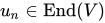
  • an endomorphism , called "translation". (Borcherds's original formulation included a system of divided powers of , because he did not assume the ground ring was divisible.)
  • a linear multiplication map , where is the space of all formal Laurent series with coefficients in . This structure has some alternative presentations:
    • as an infinite collection of bilinear products where and , so that for each , there is an such that for .
    • as a left-multiplication map . This is the 'state-to-field' map of the so-called state-field correspondence. For each , the endomorphism-valued formal distribution is called a vertex operator or a field, and the coefficient of is the operator . In the context of vertex algebras, a field is more precisely an element of , which can be written such that for any for sufficiently small (which may depend on ). The standard notation for the multiplication is

Axioms

[edit]

These data are required to satisfy the following axioms:

  • Identity. For any and .[a]
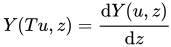
  • Translation. , and for any ,
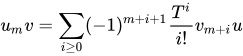
  • Locality (Jacobi identity, or Borcherds identity). For any , there exists a positive integer N such that:

Equivalent formulations of locality axiom
[edit]

The locality axiom has several equivalent formulations in the literature, e.g., Frenkel–Lepowsky–Meurman introduced the Jacobi identity: ,

where we define the formal delta series by:

Borcherds[1] initially used the following two identities: for any and integers we have

and

.

He later gave a more expansive version that is equivalent but easier to use: for any and integers we have


This identity is the same as the Jacobi identity by expanding both sides in all formal variables. Finally, there is a formal function version of locality: For any , there is an element

such that and are the corresponding expansions of in and .

Vertex operator algebra

[edit]

A vertex operator algebra is a vertex algebra equipped with a conformal element , such that the vertex operator is the weight two Virasoro field :

and satisfies the following properties:

  • , where is a constant called the central charge, or rank of . In particular, the coefficients of this vertex operator endow with an action of the Virasoro algebra with central charge .
  • acts semisimply on with integer eigenvalues that are bounded below.
  • Under the grading provided by the eigenvalues of , the multiplication on is homogeneous in the sense that if and are homogeneous, then is homogeneous of degree .
  • The identity has degree 0, and the conformal element has degree 2.
  • .

A homomorphism of vertex algebras is a map of the underlying vector spaces that respects the additional identity, translation, and multiplication structure. Homomorphisms of vertex operator algebras have "weak" and "strong" forms, depending on whether they respect conformal vectors.

Commutative vertex algebras

[edit]

A vertex algebra is commutative if all vertex operators commute with each other. This is equivalent to the property that all products lie in , or that . Thus, an alternative definition for a commutative vertex algebra is one in which all vertex operators are regular at .[2]

Given a commutative vertex algebra, the constant terms of multiplication endow the vector space with a commutative and associative ring structure, the vacuum vector is a unit and is a derivation. Hence the commutative vertex algebra equips with the structure of a commutative unital algebra with derivation. Conversely, any commutative ring with derivation has a canonical vertex algebra structure, where we set , so that restricts to a map which is the multiplication map with the algebra product. If the derivation vanishes, we may set to obtain a vertex operator algebra concentrated in degree zero.

Any finite-dimensional vertex algebra is commutative.

Thus even the smallest examples of noncommutative vertex algebras require significant introduction.

Basic properties

[edit]

The translation operator in a vertex algebra induces infinitesimal symmetries on the product structure, and satisfies the following properties:

  • , so is determined by .
  • (skew-symmetry)

For a vertex operator algebra, the other Virasoro operators satisfy similar properties:

  • (quasi-conformality) for all .
  • (Associativity, or Cousin property): For any , the element

given in the definition also expands to in .

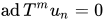
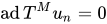
The associativity property of a vertex algebra follows from the fact that the commutator of and is annihilated by a finite power of , i.e., one can expand it as a finite linear combination of derivatives of the formal delta function in , with coefficients in .

Reconstruction: Let be a vertex algebra, and let be a set of vectors, with corresponding fields . If is spanned by monomials in the positive weight coefficients of the fields (i.e., finite products of operators applied to , where is negative), then we may write the operator product of such a monomial as a normally ordered product of divided power derivatives of fields (here, normal ordering means polar terms on the left are moved to the right). Specifically,

More generally, if one is given a vector space with an endomorphism and vector , and one assigns to a set of vectors a set of fields that are mutually local, whose positive weight coefficients generate , and that satisfy the identity and translation conditions, then the previous formula describes a vertex algebra structure.

Operator product expansion

[edit]

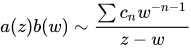
In vertex algebra theory, due to associativity, we can abuse notation to write, for This is the operator product expansion. Equivalently, Since the normal ordered part is regular in and , this can be written more in line with physics conventions as where the equivalence relation denotes equivalence up to regular terms.


Commonly used OPEs

[edit]

Here some OPEs frequently found in conformal field theory are recorded.[3]

OPEs
1st distribution 2nd distribution Commutation relations OPE Name Notes
Generic OPE
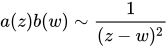
Free boson OPE Invariance under shows 'bosonic' nature of this OPE.
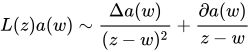
Primary field OPE Primary fields are defined to be fields a(z) satisfying this OPE when multiplied with the Virasoro field. These are important as they are the fields which transform 'like tensors' under coordinate transformations of the worldsheet in string theory.
TT OPE In physics, the Virasoro field is often identified with the stress-energy tensor and labelled T(z) rather than L(z).

Examples from Lie algebras

[edit]

The basic examples come from infinite-dimensional Lie algebras.

Heisenberg vertex operator algebra

[edit]

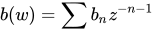
A basic example of a noncommutative vertex algebra is the rank 1 free boson, also called the Heisenberg vertex operator algebra. It is "generated" by a single vector b, in the sense that by applying the coefficients of the field b(z) := Y(b,z) to the vector 1, we obtain a spanning set. The underlying vector space is the infinite-variable polynomial ring , where for positive , acts obviously by multiplication, and acts as . The action of b0 is multiplication by zero, producing the "momentum zero" Fock representation V0 of the Heisenberg Lie algebra (generated by bn for integers n, with commutation relations [bn,bm]=n δn,–m), induced by the trivial representation of the subalgebra spanned by bn, n ≥ 0.

The Fock space V0 can be made into a vertex algebra by the following definition of the state-operator map on a basis with each ,

where denotes normal ordering of an operator . The vertex operators may also be written as a functional of a multivariable function f as:

if we understand that each term in the expansion of f is normal ordered.

The rank n free boson is given by taking an n-fold tensor product of the rank 1 free boson. For any vector b in n-dimensional space, one has a field b(z) whose coefficients are elements of the rank n Heisenberg algebra, whose commutation relations have an extra inner product term: [bn,cm]=n (b,c) δn,–m.

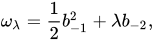
The Heisenberg vertex operator algebra has a one-parameter family of conformal vectors with parameter of conformal vectors given by

with central charge .[4]
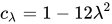
When , there is the following formula for the Virasoro character:

This is the generating function for partitions, and is also written as q1/24 times the weight −1/2 modular form 1/η (the reciprocal of the Dedekind eta function). The rank n free boson then has an n parameter family of Virasoro vectors, and when those parameters are zero, the character is qn/24 times the weight −n/2 modular form ηn.

Virasoro vertex operator algebra

[edit]

Virasoro vertex operator algebras are important for two reasons: First, the conformal element in a vertex operator algebra canonically induces a homomorphism from a Virasoro vertex operator algebra, so they play a universal role in the theory. Second, they are intimately connected to the theory of unitary representations of the Virasoro algebra, and these play a major role in conformal field theory. In particular, the unitary Virasoro minimal models are simple quotients of these vertex algebras, and their tensor products provide a way to combinatorially construct more complicated vertex operator algebras.

The Virasoro vertex operator algebra is defined as an induced representation of the Virasoro algebra: If we choose a central charge c, there is a unique one-dimensional module for the subalgebra C[z]∂z + K for which K acts by cId, and C[z]∂z acts trivially, and the corresponding induced module is spanned by polynomials in L–n = –z−n–1z as n ranges over integers greater than 1. The module then has partition function

.

This space has a vertex operator algebra structure, where the vertex operators are defined by:

and . The fact that the Virasoro field L(z) is local with respect to itself can be deduced from the formula for its self-commutator:

where c is the central charge.

Given a vertex algebra homomorphism from a Virasoro vertex algebra of central charge c to any other vertex algebra, the vertex operator attached to the image of ω automatically satisfies the Virasoro relations, i.e., the image of ω is a conformal vector. Conversely, any conformal vector in a vertex algebra induces a distinguished vertex algebra homomorphism from some Virasoro vertex operator algebra.

The Virasoro vertex operator algebras are simple, except when c has the form 1–6(pq)2/pq for coprime integers p,q strictly greater than 1 – this follows from Kac's determinant formula. In these exceptional cases, one has a unique maximal ideal, and the corresponding quotient is called a minimal model. When p = q+1, the vertex algebras are unitary representations of Virasoro, and their modules are known as discrete series representations. They play an important role in conformal field theory in part because they are unusually tractable, and for small p, they correspond to well-known statistical mechanics systems at criticality, e.g., the Ising model, the tri-critical Ising model, the three-state Potts model, etc. By work of Weiqang Wang[5] concerning fusion rules, we have a full description of the tensor categories of unitary minimal models. For example, when c=1/2 (Ising), there are three irreducible modules with lowest L0-weight 0, 1/2, and 1/16, and its fusion ring is Z[x,y]/(x2–1, y2x–1, xyy).

Affine vertex algebra

[edit]

By replacing the Heisenberg Lie algebra with an untwisted affine Kac–Moody Lie algebra (i.e., the universal central extension of the loop algebra on a finite-dimensional simple Lie algebra), one may construct the vacuum representation in much the same way as the free boson vertex algebra is constructed. This algebra arises as the current algebra of the Wess–Zumino–Witten model, which produces the anomaly that is interpreted as the central extension.

Concretely, pulling back the central extension

along the inclusion yields a split extension, and the vacuum module is induced from the one-dimensional representation of the latter on which a central basis element acts by some chosen constant called the "level". Since central elements can be identified with invariant inner products on the finite type Lie algebra , one typically normalizes the level so that the Killing form has level twice the dual Coxeter number. Equivalently, level one gives the inner product for which the longest root has norm 2. This matches the loop algebra convention, where levels are discretized by third cohomology of simply connected compact Lie groups.

By choosing a basis Ja of the finite type Lie algebra, one may form a basis of the affine Lie algebra using Jan = Ja tn together with a central element K. By reconstruction, we can describe the vertex operators by normal ordered products of derivatives of the fields

When the level is non-critical, i.e., the inner product is not minus one half of the Killing form, the vacuum representation has a conformal element, given by the Sugawara construction.[b] For any choice of dual bases Ja, Ja with respect to the level 1 inner product, the conformal element is
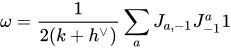
and yields a vertex operator algebra whose central charge is . At critical level, the conformal structure is destroyed, since the denominator is zero, but one may produce operators Ln for n ≥ –1 by taking a limit as k approaches criticality.

Modules

[edit]

Much like ordinary rings, vertex algebras admit a notion of module, or representation. Modules play an important role in conformal field theory, where they are often called sectors. A standard assumption in the physics literature is that the full Hilbert space of a conformal field theory decomposes into a sum of tensor products of left-moving and right-moving sectors:
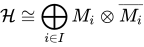
That is, a conformal field theory has a vertex operator algebra of left-moving chiral symmetries, a vertex operator algebra of right-moving chiral symmetries, and the sectors moving in a given direction are modules for the corresponding vertex operator algebra.

Definition

[edit]

Given a vertex algebra V with multiplication Y, a V-module is a vector space M equipped with an action YM: VMM((z)), satisfying the following conditions:

(Identity) YM(1,z) = IdM
(Associativity, or Jacobi identity) For any u, vV, wM, there is an element

such that YM(u,z)YM(v,x)w and YM(Y(u,zx)v,x)w are the corresponding expansions of in M((z))((x)) and M((x))((zx)). Equivalently, the following "Jacobi identity" holds:

The modules of a vertex algebra form an abelian category. When working with vertex operator algebras, the previous definition is sometimes given the name weak -module, and genuine V-modules must respect the conformal structure given by the conformal vector . More precisely, they are required to satisfy the additional condition that L0 acts semisimply with finite-dimensional eigenspaces and eigenvalues bounded below in each coset of Z. Work of Huang, Lepowsky, Miyamoto, and Zhang[citation needed] has shown at various levels of generality that modules of a vertex operator algebra admit a fusion tensor product operation, and form a braided tensor category.

When the category of V-modules is semisimple with finitely many irreducible objects, the vertex operator algebra V is called rational. Rational vertex operator algebras satisfying an additional finiteness hypothesis (known as Zhu's C2-cofiniteness condition) are known to be particularly well-behaved, and are called regular. For example, Zhu's 1996 modular invariance theorem asserts that the characters of modules of a regular VOA form a vector-valued representation of . In particular, if a VOA is holomorphic, that is, its representation category is equivalent to that of vector spaces, then its partition function is -invariant up to a constant. Huang showed that the category of modules of a regular VOA is a modular tensor category, and its fusion rules satisfy the Verlinde formula.

Heisenberg algebra modules

[edit]

Modules of the Heisenberg algebra can be constructed as Fock spaces for which are induced representations of the Heisenberg Lie algebra, given by a vacuum vector satisfying for , , and being acted on freely by the negative modes for . The space can be written as . Every irreducible, -graded Heisenberg algebra module with gradation bounded below is of this form.

These are used to construct lattice vertex algebras, which as vector spaces are direct sums of Heisenberg modules, when the image of is extended appropriately to module elements.

The module category is not semisimple, since one may induce a representation of the abelian Lie algebra where b0 acts by a nontrivial Jordan block. For the rank n free boson, one has an irreducible module Vλ for each vector λ in complex n-dimensional space. Each vector bCn yields the operator b0, and the Fock space Vλ is distinguished by the property that each such b0 acts as scalar multiplication by the inner product (b, λ).

Twisted modules

[edit]

Unlike ordinary rings, vertex algebras admit a notion of twisted module attached to an automorphism. For an automorphism σ of order N, the action has the form VMM((z1/N)), with the following monodromy condition: if uV satisfies σ u = exp(2πik/N)u, then un = 0 unless n satisfies n+k/NZ (there is some disagreement about signs among specialists). Geometrically, twisted modules can be attached to branch points on an algebraic curve with a ramified Galois cover. In the conformal field theory literature, twisted modules are called twisted sectors, and are intimately connected with string theory on orbifolds.

Additional examples

[edit]

Vertex operator algebra defined by an even lattice

[edit]

The lattice vertex algebra construction was the original motivation for defining vertex algebras. It is constructed by taking a sum of irreducible modules for the Heisenberg algebra corresponding to lattice vectors, and defining a multiplication operation by specifying intertwining operators between them. That is, if Λ is an even lattice (if the lattice is not even, the structure obtained is instead a vertex superalgebra), the lattice vertex algebra VΛ decomposes into free bosonic modules as:

Lattice vertex algebras are canonically attached to double covers of even integral lattices, rather than the lattices themselves. While each such lattice has a unique lattice vertex algebra up to isomorphism, the vertex algebra construction is not functorial, because lattice automorphisms have an ambiguity in lifting.[1]

The double covers in question are uniquely determined up to isomorphism by the following rule: elements have the form ±eα for lattice vectors α ∈ Λ (i.e., there is a map to Λ sending eα to α that forgets signs), and multiplication satisfies the relations eαeβ = (–1)(α,β)eβeα. Another way to describe this is that given an even lattice Λ, there is a unique (up to coboundary) normalised cocycle ε(α, β) with values ±1 such that (−1)(α,β) = ε(α, β) ε(β, α), where the normalization condition is that ε(α, 0) = ε(0, α) = 1 for all α ∈ Λ. This cocycle induces a central extension of Λ by a group of order 2, and we obtain a twisted group ring Cε[Λ] with basis eα (α ∈ Λ), and multiplication rule eαeβ = ε(α, β)eα+β – the cocycle condition on ε ensures associativity of the ring.[6]

The vertex operator attached to lowest weight vector vλ in the Fock space Vλ is

where zλ is a shorthand for the linear map that takes any element of the α-Fock space Vα to the monomial z(λ,α). The vertex operators for other elements of the Fock space are then determined by reconstruction.

As in the case of the free boson, one has a choice of conformal vector, given by an element s of the vector space Λ ⊗ C, but the condition that the extra Fock spaces have integer L0 eigenvalues constrains the choice of s: for an orthonormal basis xi, the vector 1/2 xi,12 + s2 must satisfy (s, λ) ∈ Z for all λ ∈ Λ, i.e., s lies in the dual lattice.

If the even lattice Λ is generated by its "root vectors" (those satisfying (α, α)=2), and any two root vectors are joined by a chain of root vectors with consecutive inner products non-zero then the vertex operator algebra is the unique simple quotient of the vacuum module of the affine Kac–Moody algebra of the corresponding simply laced simple Lie algebra at level one. This is known as the Frenkel–Kac (or FrenkelKacSegal) construction, and is based on the earlier construction by Sergio Fubini and Gabriele Veneziano of the tachyonic vertex operator in the dual resonance model. Among other features, the zero modes of the vertex operators corresponding to root vectors give a construction of the underlying simple Lie algebra, related to a presentation originally due to Jacques Tits. In particular, one obtains a construction of all ADE type Lie groups directly from their root lattices. And this is commonly considered the simplest way to construct the 248-dimensional group E8.[6][7]

Monster vertex algebra

[edit]

The monster vertex algebra (also called the "moonshine module") is the key to Borcherds's proof of the Monstrous moonshine conjectures. It was constructed by Frenkel, Lepowsky, and Meurman in 1988. It is notable because its character is the j-invariant with no constant term, , and its automorphism group is the monster group. It is constructed by orbifolding the lattice vertex algebra constructed from the Leech lattice by the order 2 automorphism induced by reflecting the Leech lattice in the origin. That is, one forms the direct sum of the Leech lattice VOA with the twisted module, and takes the fixed points under an induced involution. Frenkel, Lepowsky, and Meurman conjectured in 1988 that is the unique holomorphic vertex operator algebra with central charge 24, and partition function . This conjecture is still open.

Chiral de Rham complex

[edit]

Malikov, Schechtman, and Vaintrob showed that by a method of localization, one may canonically attach a bcβγ (boson–fermion superfield) system to a smooth complex manifold. This complex of sheaves has a distinguished differential, and the global cohomology is a vertex superalgebra. Ben-Zvi, Heluani, and Szczesny showed that a Riemannian metric on the manifold induces an N=1 superconformal structure, which is promoted to an N=2 structure if the metric is Kähler and Ricci-flat, and a hyperkähler structure induces an N=4 structure. Borisov and Libgober showed that one may obtain the two-variable elliptic genus of a compact complex manifold from the cohomology of the Chiral de Rham complex. If the manifold is Calabi–Yau, then this genus is a weak Jacobi form.[8]

Vertex algebra associated to a surface defect

[edit]

A vertex algebra can arise as a subsector of higher dimensional quantum field theory which localizes to a two real-dimensional submanifold of the space on which the higher dimensional theory is defined. A prototypical example is the construction of Beem, Leemos, Liendo, Peelaers, Rastelli, and van Rees which associates a vertex algebra to any 4d N=2 superconformal field theory. [9] This vertex algebra has the property that its character coincides with the Schur index of the 4d superconformal theory. When the theory admits a weak coupling limit, the vertex algebra has an explicit description as a BRST reduction of a bcβγ system.

Vertex operator superalgebras

[edit]

By allowing the underlying vector space to be a superspace (i.e., a Z/2Z-graded vector space ) one can define a vertex superalgebra by the same data as a vertex algebra, with 1 in V+ and T an even operator. The axioms are essentially the same, but one must incorporate suitable signs into the locality axiom, or one of the equivalent formulations. That is, if a and b are homogeneous, one compares Y(a,z)Y(b,w) with εY(b,w)Y(a,z), where ε is –1 if both a and b are odd and 1 otherwise. If in addition there is a Virasoro element ω in the even part of V2, and the usual grading restrictions are satisfied, then V is called a vertex operator superalgebra.

One of the simplest examples is the vertex operator superalgebra generated by a single free fermion ψ. As a Virasoro representation, it has central charge 1/2, and decomposes as a direct sum of Ising modules of lowest weight 0 and 1/2. One may also describe it as a spin representation of the Clifford algebra on the quadratic space t1/2C[t,t−1](dt)1/2 with residue pairing. The vertex operator superalgebra is holomorphic, in the sense that all modules are direct sums of itself, i.e., the module category is equivalent to the category of vector spaces.

The tensor square of the free fermion is called the free charged fermion, and by boson–fermion correspondence, it is isomorphic to the lattice vertex superalgebra attached to the odd lattice Z.[6] This correspondence has been used by Date–Jimbo–Kashiwara-Miwa to construct soliton solutions to the KP hierarchy of nonlinear PDEs.

Superconformal structures

[edit]

The Virasoro algebra has some supersymmetric extensions that naturally appear in superconformal field theory and superstring theory. The N=1, 2, and 4 superconformal algebras are of particular importance.

Infinitesimal holomorphic superconformal transformations of a supercurve (with one even local coordinate z and N odd local coordinates θ1,...,θN) are generated by the coefficients of a super-stress–energy tensor T(z, θ1, ..., θN).

When N=1, T has odd part given by a Virasoro field L(z), and even part given by a field
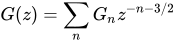
subject to commutation relations

By examining the symmetry of the operator products, one finds that there are two possibilities for the field G: the indices n are either all integers, yielding the Ramond algebra, or all half-integers, yielding the Neveu–Schwarz algebra. These algebras have unitary discrete series representations at central charge

and unitary representations for all c greater than 3/2, with lowest weight h only constrained by h≥ 0 for Neveu–Schwarz and hc/24 for Ramond.

An N=1 superconformal vector in a vertex operator algebra V of central charge c is an odd element τ ∈ V of weight 3/2, such that

G−1/2τ = ω, and the coefficients of G(z) yield an action of the N=1 Neveu–Schwarz algebra at central charge c.

For N=2 supersymmetry, one obtains even fields L(z) and J(z), and odd fields G+(z) and G(z). The field J(z) generates an action of the Heisenberg algebras (described by physicists as a U(1) current). There are both Ramond and Neveu–Schwarz N=2 superconformal algebras, depending on whether the indexing on the G fields is integral or half-integral. However, the U(1) current gives rise to a one-parameter family of isomorphic superconformal algebras interpolating between Ramond and Neveu–Schwartz, and this deformation of structure is known as spectral flow. The unitary representations are given by discrete series with central charge c = 3-6/m for integers m at least 3, and a continuum of lowest weights for c > 3.

An N=2 superconformal structure on a vertex operator algebra is a pair of odd elements τ+, τ of weight 3/2, and an even element μ of weight 1 such that τ± generate G±(z), and μ generates J(z).

For N=3 and 4, unitary representations only have central charges in a discrete family, with c=3k/2 and 6k, respectively, as k ranges over positive integers.

Additional constructions

[edit]
  • Fixed point subalgebras: Given an action of a symmetry group on a vertex operator algebra, the subalgebra of fixed vectors is also a vertex operator algebra. In 2013, Miyamoto proved that two important finiteness properties, namely Zhu's condition C2 and regularity, are preserved when taking fixed points under finite solvable group actions.
  • Current extensions: Given a vertex operator algebra and some modules of integral conformal weight, one may under favorable circumstances describe a vertex operator algebra structure on the direct sum. Lattice vertex algebras are a standard example of this. Another family of examples are framed VOAs, which start with tensor products of Ising models, and add modules that correspond to suitably even codes.
  • Orbifolds: Given a finite cyclic group acting on a holomorphic VOA, it is conjectured that one may construct a second holomorphic VOA by adjoining irreducible twisted modules and taking fixed points under an induced automorphism, as long as those twisted modules have suitable conformal weight. This is known to be true in special cases, e.g., groups of order at most 3 acting on lattice VOAs.
  • The coset construction (due to Goddard, Kent, and Olive): Given a vertex operator algebra V of central charge c and a set S of vectors, one may define the commutant C(V,S) to be the subspace of vectors v strictly commute with all fields coming from S, i.e., such that Y(s,z)v ∈ V[[z]] for all sS. This turns out to be a vertex subalgebra, with Y, T, and identity inherited from V. And if S is a VOA of central charge cS, the commutant is a VOA of central charge ccS. For example, the embedding of SU(2) at level k+1 into the tensor product of two SU(2) algebras at levels k and 1 yields the Virasoro discrete series with p=k+2, q=k+3, and this was used to prove their existence in the 1980s. Again with SU(2), the embedding of level k+2 into the tensor product of level k and level 2 yields the N=1 superconformal discrete series.
  • BRST reduction: For any degree 1 vector v satisfying v02=0, the cohomology of this operator has a graded vertex superalgebra structure. More generally, one may use any weight 1 field whose residue has square zero. The usual method is to tensor with fermions, as one then has a canonical differential. An important special case is quantum Drinfeld–Sokolov reduction applied to affine Kac–Moody algebras to obtain affine W-algebras as degree 0 cohomology. These W algebras also admit constructions as vertex subalgebras of free bosons given by kernels of screening operators.
[edit]
  • If one considers only the singular part of the OPE in a vertex algebra, one arrives at the definition of a Lie conformal algebra. Since one is often only concerned with the singular part of the OPE, this makes Lie conformal algebras a natural object to study. There is a functor from vertex algebras to Lie conformal algebras that forgets the regular part of OPEs, and it has a left adjoint, called the "universal vertex algebra" functor. Vacuum modules of affine Kac–Moody algebras and Virasoro vertex algebras are universal vertex algebras, and in particular, they can be described very concisely once the background theory is developed.
  • There are several generalizations of the notion of vertex algebra in the literature. Some mild generalizations involve a weakening of the locality axiom to allow monodromy, e.g., the abelian intertwining algebras of Dong and Lepowsky. One may view these roughly as vertex algebra objects in a braided tensor category of graded vector spaces, in much the same way that a vertex superalgebra is such an object in the category of super vector spaces. More complicated generalizations relate to q-deformations and representations of quantum groups, such as in work of Frenkel–Reshetikhin, Etingof–Kazhdan, and Li.
  • Beilinson and Drinfeld introduced a sheaf-theoretic notion of chiral algebra that is closely related to the notion of vertex algebra, but is defined without using any visible power series. Given an algebraic curve X, a chiral algebra on X is a DX-module A equipped with a multiplication operation on X×X that satisfies an associativity condition. They also introduced an equivalent notion of factorization algebra that is a system of quasicoherent sheaves on all finite products of the curve, together with a compatibility condition involving pullbacks to the complement of various diagonals. Any translation-equivariant chiral algebra on the affine line can be identified with a vertex algebra by taking the fiber at a point, and there is a natural way to attach a chiral algebra on a smooth algebraic curve to any vertex operator algebra.

See also

[edit]

Notes

[edit]

Sources

[edit]
Revisions and contributorsEdit on WikipediaRead on Wikipedia
from Grokipedia
A vertex operator algebra (VOA) is a Z\mathbb{Z}-graded vector space V=nZV(n)V = \bigoplus_{n \in \mathbb{Z}} V(n) equipped with a vacuum vector 1V(0)1 \in V(0), a translation operator TT, a linear map Y:VEnd(V)[z,z1](/page/z,z1)Y: V \to \mathrm{End}(V)[z, z^{-1}](/page/z,_z^{-1}), and a conformal vector ωV(1)\omega \in V(1), satisfying axioms of locality, translation covariance, the Jacobi identity (or Borcherds identity), and Virasoro algebra relations generated by Ln=ωnL_n = \omega_n for nZn \in \mathbb{Z}, where the central charge cCc \in \mathbb{C} characterizes the structure.[1][2][3] The concept originated from efforts to formalize vertex operators in the representation theory of affine Kac-Moody algebras and the Virasoro algebra, with Richard Borcherds providing the axiomatic definition of a vertex algebra in 1986 as a non-associative structure generalizing Lie algebras via infinite products anba_n b.[3] This was extended to VOAs by incorporating conformal symmetry through the Virasoro algebra, building on earlier work by Igor Frenkel, James Lepowsky, and Arne Meurman in their 1988 book on the moonshine module for the Monster group.[3][1] Equivalent formulations include Lie conformal algebras or operadic approaches, all capturing the same algebraic essence.[1] VOAs play a central role in two-dimensional conformal field theory (CFT), providing a rigorous framework for chiral algebras and correlation functions in string theory and statistical mechanics.[2] They are pivotal in monstrous moonshine, where the VOA associated to the Leech lattice yields modular functions linked to representations of the sporadic Monster group, as proven by Borcherds in 1992 using VOA techniques.[3][2] Additionally, VOAs underpin the study of modular tensor categories from their module categories, with applications in topological quantum field theory and integrable systems.[1]

Core Definitions

Vertex algebra

A vertex algebra is a complex vector space VV equipped with a distinguished nonzero vacuum vector 1V1 \in V and a linear vertex map Y:VEnd(V)[z,z1](/page/z,z1)Y: V \to \mathrm{End}(V)[z, z^{-1}](/page/z,_z^{-1}), where [z,z1](/page/z,z1)[z, z^{-1}](/page/z,_z^{-1}) denotes the ring of formal Laurent series in the indeterminate zz with coefficients in End(V)\mathrm{End}(V).[4] For each vVv \in V, the image Y(v,z)Y(v, z) is a formal series Y(v,z)=nZv(n)zn1Y(v, z) = \sum_{n \in \mathbb{Z}} v_{(n)} z^{-n-1}, where the v(n)v_{(n)} are linear endomorphisms of VV called the Fourier modes of vv.[4] The formal variable zz parametrizes the "position" of the operator in an abstract sense, enabling the algebraic encoding of iterated operator products through series expansions that do not rely on convergence in a topological sense.[4] The structure satisfies three fundamental axioms. The vacuum axiom requires that Y(1,z)=idVY(1, z) = \mathrm{id}_V, meaning the series acts as the identity endomorphism on VV, and that limz0Y(1,z)v=v\lim_{z \to 0} Y(1, z) v = v for all vVv \in V, ensuring the vacuum generates the identity action in the formal limit.[4] The creation axiom states that limz0Y(v,z)1=v\lim_{z \to 0} Y(v, z) 1 = v for all vVv \in V, which formally means that the constant term (non-negative powers) of the series Y(v,z)1Y(v, z) 1 is vv while negative powers vanish, capturing how elements are "created" from the vacuum.[4] The Jacobi identity, in its vertex algebra form, encodes the associativity of operator products and is given by
z01δ(z1z2z0)Y(u,z1)Y(v,z2)wz01δ(z2z1z0)Y(v,z2)Y(u,z1)w=z21δ(z1z0z2)Y(Y(u,z0)v,z2)w z_0^{-1} \delta\left( \frac{z_1 - z_2}{z_0} \right) Y(u, z_1) Y(v, z_2) w - z_0^{-1} \delta\left( \frac{z_2 - z_1}{-z_0} \right) Y(v, z_2) Y(u, z_1) w = z_2^{-1} \delta\left( \frac{z_1 - z_0}{z_2} \right) Y\left( Y(u, z_0) v, z_2 \right) w
for all u,v,wVu, v, w \in V, where δ(ζ)=mZζm\delta(\zeta) = \sum_{m \in \mathbb{Z}} \zeta^m is the formal delta distribution, and the identity holds in the sense of formal series with binomial expansions in non-negative powers of the second argument.[4] This axiom implies the locality of the vertex operators, meaning that for fixed u,vVu, v \in V, there exists an integer NN such that (zw)N[Y(u,z),Y(v,w)]=0(z - w)^N [Y(u, z), Y(v, w)] = 0.[2] The notion of vertex algebra was introduced by Richard Borcherds in 1986 as an algebraic formalization of vertex operators originating from physics and the representation theory of infinite-dimensional Lie algebras.[5]

Vertex operator algebra

A vertex operator algebra (VOA) is a vertex algebra endowed with a compatible representation of the Virasoro algebra, thereby incorporating conformal symmetry essential for applications in two-dimensional conformal field theory. This structure was originally introduced by Igor Frenkel, James Lepowsky, and Arne Meurman in 1988 to construct the unique vertex operator algebra whose automorphism group is the Monster sporadic simple group, resolving the moonshine conjectures.[6] Formally, a VOA consists of a Z0\mathbb{Z}_{\geq 0}-graded vector space V=n=0VnV = \bigoplus_{n=0}^\infty V_n with finite-dimensional components VnV_n, a vacuum vector 1V0\mathbf{1} \in V_0, a translation operator T:VVT: V \to V, and a linear map Y:VEnd(V)[z,z1](/page/z,z1)Y: V \to \mathrm{End}(V)[z,z^{-1}](/page/z,z^{-1}), satisfying the vertex algebra axioms of vacuum compatibility, Jacobi identity, and locality. Additionally, there is a conformal vector ωV2\omega \in V_2 such that the vertex operator Y(ω,z)=nZL(n)zn2Y(\omega, z) = \sum_{n \in \mathbb{Z}} L(n) z^{-n-2} defines operators L(n)L(n) for nZn \in \mathbb{Z} satisfying the Virasoro algebra relations
[L(m),L(n)]=(mn)L(m+n)+c12(m3m)δm,n, [L(m), L(n)] = (m - n) L(m + n) + \frac{c}{12} (m^3 - m) \delta_{m, -n},
where cCc \in \mathbb{C} is the central charge of the VOA, along with
  • L(0)v=wt(v)vL(0)v = \mathrm{wt}(v) v for vVv \in V, where wt(v)=n\mathrm{wt}(v) = n if vVnv \in V_n;
  • L(1)=TL(-1) = T.[6]
The grading structure ensures conformal weights align with the representation: for vVlv \in V_l and wVmw \in V_m, Y(v,z)wk0Hom(Vm,Vm+l+k)[z,z1](/page/z,z1)Y(v, z) w \in \bigoplus_{k \geq 0} \mathrm{Hom}(V_m, V_{m + l + k})[z, z^{-1}](/page/z,_z^{-1}), reflecting lower truncation where only non-positive powers of zz up to a finite number appear, and the leading term corresponds to the weight shift. This integrates the vertex algebra properties with conformal symmetry, as L(n)1=0L(n) \mathbf{1} = 0 for n1n \geq -1 and wt(1)=0\mathrm{wt}(\mathbf{1}) = 0.[6]

Fundamental Properties

Operator product expansion

In a vertex operator algebra VV, the vertex operator map Y:VEnd(V)[z,z1](/page/z,z1)Y: V \to \mathrm{End}(V)[z, z^{-1}](/page/z,_z^{-1}) associates to each uVu \in V a formal Laurent series Y(u,z)Y(u, z) acting on elements vVv \in V. This is expanded in modes as
Y(u,z)v=nZunvzn1, Y(u, z)v = \sum_{n \in \mathbb{Z}} u_n v \, z^{-n-1},
where the unu_n are linear endomorphisms of VV, and the singular terms correspond to negative powers with n<wt(u)n < -\mathrm{wt}(u), reflecting the conformal weight of uu. The operator product expansion (OPE) formalizes the singular behavior of the composition of two such vertex operators. For u,vVu, v \in V, the OPE is the singular part of Y(u,z)Y(v,w)Y(u, z) Y(v, w), given by
Y(u,z)Y(v,w)nZ(zw)n1Y(unv,w), Y(u, z) Y(v, w) \sim \sum_{n \in \mathbb{Z}} (z - w)^{-n-1} Y(u_n v, w),
where the sum includes terms with negative powers of zwz - w. The full expansion includes regular terms, but the OPE focuses on these poles, which encode algebraic relations among elements of VV. This form derives from the Jacobi identity axiom of the vertex algebra, which states that for u,v,wVu, v, w \in V,
z01δ(z1z2z0)Y(u,z1)Y(v,z2)wz01δ(z2z1z0)Y(v,z2)Y(u,z1)w=z21δ(z1z0z2)Y(Y(u,z0)v,z2)w. z_0^{-1} \delta\left(\frac{z_1 - z_2}{z_0}\right) Y(u, z_1) Y(v, z_2) w - z_0^{-1} \delta\left(\frac{z_2 - z_1}{-z_0}\right) Y(v, z_2) Y(u, z_1) w = z_2^{-1} \delta\left(\frac{z_1 - z_0}{z_2}\right) Y(Y(u, z_0) v, z_2) w.
Expanding the formal delta functions as Laurent series yields the locality relation, implying that Y(u,z)Y(v,w)Y(u, z) Y(v, w) and Y(v,w)Y(u,z)Y(v, w) Y(u, z) differ by regular terms, thus allowing the extraction of the singular OPE via residue calculus on the formal parameter zwz - w. This encodes the algebraic structure of VV through formal power series manipulations.[7] The OPE serves as a primary computational tool in vertex operator algebras, enabling the evaluation of correlation functions on the Riemann sphere by iteratively applying the expansion to products of fields, which reduces multi-point functions to lower-point ones. It also determines fusion rules, specifying how irreducible modules combine under tensor products, as the coefficients in the OPE expansion indicate the multiplicity of channels in module fusion. In the physical context of two-dimensional conformal field theory, the OPE corresponds to radial ordering of operators on the complex plane, where fields at distinct points are ordered by their distance from the origin; the singular terms arise from short-distance limits, mirroring point-splitting regularizations in quantum field theory.

Locality and Jacobi identity

The locality axiom is a fundamental property of vertex operator algebras that encodes the commuting behavior of vertex operators at spatially separated points. For elements u,vVu, v \in V, there exists a positive integer NN (depending on uu and vv) such that
(zw)NY(u,z)Y(v,w)=(zw)NY(v,w)Y(u,z) (z - w)^N Y(u, z) Y(v, w) = (z - w)^N Y(v, w) Y(u, z)
holds as formal power series in the ring End(V)[z,w,z1,w1](/page/z,w,z1,w1)\mathrm{End}(V)[z, w, z^{-1}, w^{-1}](/page/z,_w,_z^{-1},_w^{-1}).[7] This condition implies that the operators Y(u,z)Y(u, z) and Y(v,w)Y(v, w) commute when acting on elements of VV for zwz \neq w, reflecting the principle that interactions in the algebra are local in the formal variable sense.[4] The Jacobi identity provides the associative framework for vertex operators and is stated in its full form using delta-function distributions. For u,vVu, v \in V and mZm \in \mathbb{Z},
z01δ(z1z2z0)Y(u,z1)Y(v,z2)z01δ(z2z1z0)Y(v,z2)Y(u,z1)=z21δ(z1z0z2)Y(Y(u,z0)v,z2), z_0^{-1} \delta\left( \frac{z_1 - z_2}{z_0} \right) Y(u, z_1) Y(v, z_2) - z_0^{-1} \delta\left( \frac{z_2 - z_1}{-z_0} \right) Y(v, z_2) Y(u, z_1) = z_2^{-1} \delta\left( \frac{z_1 - z_0}{z_2} \right) Y(Y(u, z_0) v, z_2),
where the delta functions are formal series δ(z)=nZzn\delta(z) = \sum_{n \in \mathbb{Z}} z^n.[7] This identity admits a contour integral interpretation: the left-hand side represents the residue at z0=0z_0 = 0 of the difference of integrals over contours encircling z1z_1 and z2z_2, equating to the residue involving the composition Y(u,z0)vY(u, z_0) v.[4] As a consequence of locality, the operator product expansion arises, allowing formal series expansions of products Y(u,z)Y(v,w)Y(u, z) Y(v, w).[7] A proof of the Jacobi identity can be sketched using formal calculus in the ring of formal distributions. The identity is equivalent to the conjunction of the locality axiom and an associativity relation
(z0+z2)KY(Y(u,z0)v,z2)=(z0+z2)KY(u,z0+z2)Y(v,z2) (z_0 + z_2)^K Y(Y(u, z_0) v, z_2) = (z_0 + z_2)^K Y(u, z_0 + z_2) Y(v, z_2)
for sufficiently large K>0K > 0.[7] To derive it, expand the delta functions using their formal properties δ(z)=z1δ(z1)\delta(z) = z^{-1} \delta(z^{-1}) and apply residue extraction via the formal residue theorem, where Resz=0f(z)=coeffz1f(z)\mathrm{Res}_{z=0} f(z) = \mathrm{coeff}_{z^{-1}} f(z); substituting the locality condition into the left-hand side yields the right-hand side after binomial expansions and coefficient matching.[4] Unlike the Jacobi identity in Lie algebras, which is a finite cyclic relation [x,[y,z]]+[y,[z,x]]+[z,[x,y]]=0[x, [y, z]] + [y, [z, x]] + [z, [x, y]] = 0 among elements, the vertex operator algebra version incorporates formal Laurent series in multiple variables z0,z1,z2z_0, z_1, z_2, capturing infinite-dimensional operator compositions rather than bracketed triple products.[3] The locality and Jacobi identities together ensure that the category of modules over a vertex operator algebra admits a braided tensor category structure, where the braiding arises from the formal intertwining maps defined by vertex operators.[7] Borcherds reformulated these axioms categorically by viewing vertex algebras as commutative rings in suitable additive tensor categories equipped with derivations, where locality corresponds to commutativity in the braided sense and the Jacobi identity follows from categorical associators.[8]

Translation and conformal symmetry

In vertex operator algebras, the translation axiom is embodied by the operator L(1)L(-1), which serves as the infinitesimal generator of translations on the space VV. For any vector aVa \in V, the commutation relation [L(1),Y(a,z)]=zY(a,z)[L(-1), Y(a, z)] = \frac{\partial}{\partial z} Y(a, z) holds, ensuring that vertex operators transform covariantly under infinitesimal shifts in the complex plane.[2] This property aligns the algebraic structure with the translation invariance expected in two-dimensional conformal field theories, where L(1)L(-1) derives from the conformal vector and acts as a derivation on the vertex operators.[1] Conformal symmetry in a vertex operator algebra arises from the choice of a conformal vector ωV2\omega \in V_2, which generates the stress-energy tensor T(z)=Y(ω,z)=nZL(n)zn2T(z) = Y(\omega, z) = \sum_{n \in \mathbb{Z}} L(n) z^{-n-2}. The modes L(n)L(n) satisfy the Virasoro algebra relations [L(m),L(n)]=(mn)L(m+n)+c12(m3m)δm,n[L(m), L(n)] = (m - n) L(m + n) + \frac{c}{12} (m^3 - m) \delta_{m, -n}, where cCc \in \mathbb{C} is the central charge of the algebra, capturing the anomaly in the conformal transformations.[9] This stress-energy tensor encodes reparametrization invariance, with L(1)L(-1) specifically generating translations as a special case of the broader conformal group action on the vertex operators.[10] The full interaction between the Virasoro modes and vertex operators is governed by the commutation relations for m1m \geq -1:
[L(m),Y(a,z)]=zm+1zY(a,z)+(m+1)(wt(a))zmY(a,z), [L(m), Y(a, z)] = z^{m+1} \frac{\partial}{\partial z} Y(a, z) + (m + 1) (\mathrm{wt}(a)) z^m Y(a, z),
where wt(a)\mathrm{wt}(a) denotes the conformal weight of the homogeneous vector aVa \in V.[1] These relations generalize the translation axiom and reflect how conformal transformations act on fields, with L(0)L(0) determining the scaling dimension via [L(0),Y(a,z)]=Y(L(0)a,z)+zzY(a,z)[L(0), Y(a, z)] = Y(L(0) a, z) + z \frac{\partial}{\partial z} Y(a, z).[2] Within this framework, quasi-primary vectors are those aVa \in V annihilated by positive Virasoro modes, satisfying L(n)a=0L(n) a = 0 for all n>0n > 0, which implies in particular L(1)a=0L(1) a = 0. Primary vectors are quasi-primary elements of definite weight, where additionally L(0)a=wt(a)aL(0) a = \mathrm{wt}(a) \, a, though in the graded structure of VOAs, the eigenvalue condition follows from homogeneity.[9] These notions classify fields under conformal symmetry, with primary fields transforming simply under reparametrizations: for a primary aa of weight hh, [L(m),Y(a,z)]=zm+1zY(a,z)+(m+1)hzmY(a,z)[L(m), Y(a, z)] = z^{m+1} \partial_z Y(a, z) + (m + 1) h z^m Y(a, z).[10] The Virasoro action in vertex operator algebras provides precursors to modular invariance, as the characters of representations, traces involving qL(0)c/24q^{L(0) - c/24}, transform covariantly under the modular group SL(2, Z\mathbb{Z}) in rational cases, linking local conformal symmetry to global properties on the torus.[1]

Basic Examples

Heisenberg vertex operator algebra

The Heisenberg vertex operator algebra provides the simplest non-trivial example of a vertex operator algebra, arising from the canonical Heisenberg Lie algebra and serving as a foundational model in conformal field theory and string theory. It corresponds to the free boson theory at central charge c=1c=1, where the underlying structure is generated by a single bosonic field with modes satisfying specific commutation relations. This algebra is constructed algebraically without reference to geometric or lattice interpretations, emphasizing its role as a building block for more complex vertex operator algebras. The construction begins with the Heisenberg Lie algebra h^\hat{\mathfrak{h}}, defined on the vector space hC[t,t1]Cch \otimes \mathbb{C}[t, t^{-1}] \oplus \mathbb{C} c, where hh is a one-dimensional vector space with symmetric non-degenerate bilinear form ,\langle \cdot, \cdot \rangle normalized so that α,α=1\langle \alpha, \alpha \rangle = 1 for a basis vector αh\alpha \in h. The Lie bracket is given by [α(m),α(n)]=mδm+n,0Id[\alpha(m), \alpha(n)] = m \delta_{m+n,0} \mathrm{Id} for modes α(m)=αtm\alpha(m) = \alpha \otimes t^m, with the central element cc acting as the identity and commuting with all elements. The vertex operator algebra V=M(1)V = M(1) is then the quotient U(h^)/IU(\hat{\mathfrak{h}}) / I, where II is the ideal generated by h^+=htC[t]Cc\hat{\mathfrak{h}}_+ = h \otimes t \mathbb{C}[t] \oplus \mathbb{C} c and the relation c=Idc = \mathrm{Id}, yielding VS(h^)V \cong S(\hat{\mathfrak{h}}_-) as the symmetric algebra on the negative modes h^=ht1C[t1]\hat{\mathfrak{h}}_- = h \otimes t^{-1} \mathbb{C}[t^{-1}]. The vacuum vector is 1V01 \in V_0, satisfying α(n)1=0\alpha(n) \cdot 1 = 0 for n>0n > 0 and α(0)1=0\alpha(0) \cdot 1 = 0. The vertex operators are defined via normal-ordered products: for a vector v=α(n1)α(nk)1v = \alpha(-n_1) \cdots \alpha(-n_k) \cdot 1 with ni1n_i \geq 1, $Y(v, z) = \prod_{i=1}^k \frac{1}{(n_i-1)!} \left( \partial_z \right)^{n_i-1} \alpha(z) $ in normal-ordered form, where the Heisenberg field is α(z)=nZα(n)zn1\alpha(z) = \sum_{n \in \mathbb{Z}} \alpha(n) z^{-n-1}. More generally, the mode expansion for any generator is Y(α(k)1,z)=1(k1)!zk1α(z)Y(\alpha(-k) \cdot 1, z) = \frac{1}{(k-1)!} \partial_z^{k-1} \alpha(z) for k1k \geq 1, ensuring the translation property and locality. The conformal structure is provided by the Virasoro element ωV2\omega \in V_2, given explicitly by ω=12α(1)21=12:α(1)α(1):\omega = \frac{1}{2} \alpha(-1)^2 \cdot 1 = \frac{1}{2} : \alpha(-1) \alpha(-1) :, which generates the Virasoro algebra with central charge c=1c=1. The corresponding Virasoro field is Y(ω,z)=nZL(n)zn2Y(\omega, z) = \sum_{n \in \mathbb{Z}} L(n) z^{-n-2}, satisfying the commutation relations [L(m),L(n)]=(mn)L(m+n)+112(m3m)δm+n,0[L(m), L(n)] = (m-n) L(m+n) + \frac{1}{12} (m^3 - m) \delta_{m+n,0} and [L(m),α(n)]=nα(m+n)[L(m), \alpha(n)] = -n \alpha(m+n). Equivalently, ω\omega can be expressed as ω=12k=11k:α(k)α(k):1\omega = \frac{1}{2} \sum_{k=1}^\infty \frac{1}{k} : \alpha(-k) \alpha(k) : \cdot 1, accounting for the full normal ordering to incorporate the commutation relations. This ensures conformal symmetry with weight 2 for ω\omega.[2] The operator product expansion (OPE) for the Heisenberg fields captures the singular behavior: $\alpha(z) \alpha(w) \sim \frac{1}{(z-w)^2} + : \alpha(z) \alpha(w) : $, or in mode terms, the product $Y(\alpha(m), z) Y(\alpha(n), w) \sim \frac{m \delta_{m+n,0}}{(z-w)^2} + $ regular terms, reflecting the Lie algebra structure and locality. More precisely, the commutator form is [α(z),α(w)]=wδ(zw)[\alpha(z), \alpha(w)] = \partial_w \delta(z-w), derived from the mode expansions and Jacobi identity.[2] This algebraic construction admits a Fock space realization, where VV is realized as the Fock space F\mathcal{F} over the one-dimensional oscillator algebra, spanned by basis vectors α(n1)α(nk)1\alpha(-n_1) \cdots \alpha(-n_k) \cdot 1 for ni1n_i \geq 1, with grading by total mode number ni\sum n_i. The action of positive modes α(n)\alpha(n) for n>0n > 0 is by annihilation, satisfying α(n)1=0\alpha(n) \cdot 1 = 0, while negative modes create excitations. Normal ordering ::: \cdot : is essential for defining products and fields: for operators um,vnu_m, v_n, :umvn:=umvn: u_m v_n : = u_m v_n if m<0m < 0 and vnumv_n u_m if m0m \geq 0, extended multiplicatively and subtracting infinite contractions in field expansions to ensure convergence in the formal power series sense. This normal ordering preserves the vacuum and implements the Wick theorem analog for vertex operators.

Virasoro vertex operator algebra

The Virasoro vertex operator algebra at central charge cc is constructed as the unique simple quotient L(c,0)L(c,0) of the Verma module for the Virasoro Lie algebra with highest weight 0, endowed with the vertex operator algebra structure where the conformal vector ω\omega generates the modes LnL_n via the vertex operator Y(ω,z)=nZLnzn2Y(\omega, z) = \sum_{n \in \mathbb{Z}} L_n z^{-n-2}, satisfying the Virasoro relations [Lm,Ln]=(mn)Lm+n+c12(m3m)δm,n[L_m, L_n] = (m-n)L_{m+n} + \frac{c}{12} (m^3 - m) \delta_{m, -n}.[11] This VOA serves as the universal generator of conformal symmetry in two-dimensional conformal field theories, with its modules corresponding to highest weight representations L(c,h)L(c,h) labeled by conformal weights hh.[1] The minimal models arise for specific values of the central charge cp,q=16(pq)2/(pq)c_{p,q} = 1 - 6(p-q)^2/(p q), where p>q2p > q \geq 2 are coprime positive integers, yielding rational vertex operator algebras L(cp,q,0)L(c_{p,q}, 0) that are C2C_2-cofinite and unitary when c>0c > 0.[12] These VOAs have finitely many irreducible ordinary modules, namely the degenerate highest weight modules L(cp,q,hr,s)L(c_{p,q}, h_{r,s}) for 1r<p1 \leq r < p, 1s<q1 \leq s < q, with conformal weights given by
hr,s=(prqs)2(pq)24pq. h_{r,s} = \frac{(p r - q s)^2 - (p - q)^2}{4 p q}.
[13] The primary fields ϕr,s(z)\phi_{r,s}(z) associated to these modules satisfy operator product expansions (OPEs) governed by fusion rules
ϕr,s×ϕr,s=r=rr+1, step 2min(r+r1,2prr1)s=ss+1, step 2min(s+s1,2qss1)ϕr,s, \phi_{r,s} \times \phi_{r',s'} = \sum_{r'' = |r - r'| + 1, \ step\ 2}^{\min(r + r' - 1, 2p - r - r' - 1)} \sum_{s'' = |s - s'| + 1, \ step\ 2}^{\min(s + s' - 1, 2q - s - s' - 1)} \phi_{r'', s''},
ensuring the theory is modular invariant and rational.[12] Unitary minimal models, characterized by positive central charges and corresponding to physical systems like the Ising model (p=4,q=3,c=1/2p=4, q=3, c=1/2) and tricritical Ising model (p=5,q=4,c=7/10p=5, q=4, c=7/10), form an infinite series classified by the ADE Dynkin diagrams via modular invariant partition functions. Recent classifications post-2000 have extended this framework by characterizing all vertex operator algebras with minimal model central charges and low-dimensional character spaces as standard minimal models and certain simple current extensions, using modular linear differential equations.[14]

Affine Lie algebra vertex operator algebras

Affine vertex operator algebras associated to affine Kac-Moody Lie algebras provide a rich class of examples that incorporate current algebra symmetries into the vertex operator algebra framework. For a finite-dimensional simple Lie algebra g\mathfrak{g} with Killing form (,)(\cdot, \cdot), the affine Lie algebra g^\hat{\mathfrak{g}} at level kCk \in \mathbb{C} (with k0,hk \neq 0, -h^\vee, where hh^\vee is the dual Coxeter number) is realized through generating functions known as currents Ja(z)=nZJnazn1J^a(z) = \sum_{n \in \mathbb{Z}} J^a_n z^{-n-1}, where {ea}\{e_a\} is a basis of g\mathfrak{g}. These currents satisfy the operator product expansion (OPE)
Ja(z)Jb(w)kδab(zw)2+ifabcJc(w)zw+regular terms, J^a(z) J^b(w) \sim \frac{k \delta^{ab}}{(z-w)^2} + \frac{i f^{abc} J^c(w)}{z-w} + \text{regular terms},
where fabcf^{abc} are the structure constants of g\mathfrak{g}, capturing the level-kk central extension and the Lie bracket relations. The vertex operator algebra V(Lk,g^)V(L_k, \hat{\mathfrak{g}}) is constructed as the vacuum module, which is the quotient of the universal enveloping algebra U(g^)U(\hat{\mathfrak{g}}) by the maximal submodule containing vectors annihilated by the positive part g^0\hat{\mathfrak{g}}_{\geq 0} and acting on the trivial g\mathfrak{g}-module, with the central element acting as kk. For positive integer levels kk, this module decomposes into a direct sum of irreducible highest weight representations of g^\hat{\mathfrak{g}} at level kk, known as the integrable representations, each with integer conformal weights determined by the quadratic Casimir operators. The full structure endows V(Lk,g^)V(L_k, \hat{\mathfrak{g}}) with a vacuum vector and translation operators, satisfying the vertex operator algebra axioms. A key feature is the Sugawara construction, which embeds the Virasoro algebra into V(Lk,g^)V(L_k, \hat{\mathfrak{g}}) via the conformal vector
ω(z)=12(k+h)a:Ja(z)Ja(z):, \omega(z) = \frac{1}{2(k + h^\vee)} \sum_a :J^a(z) J_a(z):,
where :::\cdot: denotes normal ordering and the sum is over an orthonormal basis with respect to the Killing form normalized so that the longest root has squared length 2. This yields a Virasoro element with central charge
c=kdimgk+h, c = \frac{k \dim \mathfrak{g}}{k + h^\vee},
ensuring conformal symmetry at level kk. For example, at level 1 for g=\su(2)\mathfrak{g} = \su(2), c=1c = 1, corresponding to the \su(2)1\su(2)_1 Wess-Zumino-Witten model. For the specific case of sl(2)\mathfrak{sl}(2), the Wakimoto realization provides a free-field construction of the affine vertex operator algebra at admissible levels k=m+pqk = -m + \frac{p}{q} (with mZ0m \in \mathbb{Z}_{\geq 0}, p,qp, q coprime positive integers, qq odd), using a tensor product of a β\beta-γ\gamma ghost system and a free Heisenberg algebra. This realization facilitates the study of unitary representations and intertwining operators, crucial for understanding modular invariance in admissible-level theories. Parafermion vertex operator algebras arise as quotients of affine vertex operator algebras by the maximal graded subalgebra generated by the Cartan currents, first developed mathematically in the late 1980s and 1990s following physical insights into Zk\mathbb{Z}_k parafermion theories.[15] These structures, such as the parafermion VOA associated to sl(2)k\mathfrak{sl}(2)_k, yield rational conformal field theories with central charge c=2(k1)/(k+2)c = 2(k-1)/(k+2). Recent applications in the 2020s include their role in classifying logarithmic modules and tensor categories for rational chiral conformal field theories, enhancing connections to topological quantum computing and string theory compactifications.[16][17]

Modules and Representations

Ordinary modules

In vertex operator algebras, ordinary modules, also known as graded weak modules, provide the primary framework for representation theory. An ordinary module MM for a vertex operator algebra VV is a weak VV-module equipped with a Z0\mathbb{Z}_{\geq 0}-grading M=n=0M(n)M = \bigoplus_{n=0}^\infty M(n), where each graded subspace M(n)M(n) is finite-dimensional, and the vertex operators YM(a,z):MM[z,z1](/page/z,z1)Y_M(a, z): M \to M[z, z^{-1}](/page/z,_z^{-1}) satisfy the locality axiom and the truncated Jacobi identity. The conformal weight operator L(0)L(0) acts diagonally on M(n)M(n) by multiplication by n+hn + h for some lowest weight hCh \in \mathbb{C}, ensuring that the modes satisfy YM(a,n)M(m)M(m+wt(a)+n)Y_M(a, n) M(m) \subseteq M(m + \mathrm{wt}(a) + n) for aVka \in V_k and m,nZm, n \in \mathbb{Z}. Unlike the strong grading on VV itself, ordinary modules do not require C2C_2-cofiniteness, allowing for broader constructions, though many examples satisfy additional finiteness conditions.[11][18] Highest weight modules form a key class of ordinary modules, generated by a primary vector vMhv \in M_h of conformal weight hh, satisfying YM(a,n)v=0Y_M(a, n)v = 0 for all aVa \in V and n0n \geq 0, along with L(n)v=0L(n)v = 0 for n>0n > 0 and L(0)v=hvL(0)v = h v. Such a module MM is spanned by vectors of the form YM(a1,n1)YM(ar,nr)vY_M(a_1, n_1) \cdots Y_M(a_r, n_r) v with aiVa_i \in V and niZn_i \in \mathbb{Z}, subject to the relations imposed by the primary condition. These modules generalize highest weight representations of Lie algebras to the vertex setting, capturing the structure of representations under the Virasoro action.[2][19] The Verma module construction induces an ordinary highest weight module from a lowest weight representation of the Virasoro algebra. For a given hh, the Verma module M(h)M(h) is the quotient of the free VV-module generated by vv (with the primary relations) by the maximal submodule, often realized as an induced module U(V)U(V+)ChU(V) \otimes_{U(V_+)} \mathbb{C}_h, where V+=n>0VnV_+ = \bigoplus_{n>0} V_n and Ch\mathbb{C}_h is the one-dimensional Virasoro module of weight hh. The formal character of such a module, ch(M)=trMqL(0)\mathrm{ch}(M) = \mathrm{tr}_M q^{L(0)}, is given by
ch(M)=qhi=1(1qi)dimV(i), \mathrm{ch}(M) = \frac{q^h}{\prod_{i=1}^\infty (1 - q^i)^{\dim V(i)}},
reflecting the partition function weighted by the dimensions of the graded components of VV. This formula provides essential information for modular invariance and classification in conformal field theory applications.[11][20]
Irreducibility of highest weight modules is determined by the absence of singular vectors, which are nonzero primary vectors wM(h)w \in M(h) of weight hh (distinct from scalar multiples of vv) annihilated by all positive modes YM(a,n)Y_M(a, n) for n0n \geq 0 and aVa \in V. The submodule generated by such a ww is proper and invariant, yielding a composition series; the irreducible quotient is then the simple highest weight module L(h)L(h). Criteria for the existence of singular vectors often rely on determinant formulas or root systems in specific VOAs, such as those associated to affine Lie algebras.[19][21] For rational vertex operator algebras, admissible modules extend the notion of ordinary modules to ensure complete reducibility. An admissible module is an ordinary module MM that is Z\mathbb{Z}-graded with finite-dimensional components and L(0)L(0)-eigenvalues of the form h+nh + n for nZ0n \in \mathbb{Z}_{\geq 0} and hh in a discrete set, satisfying C1C_1-cofiniteness: the subspace n0(VnM)\bigcup_{n \geq 0} (V_n M) has finite codimension in MM. Rationality implies that every admissible module decomposes as a direct sum of irreducible ordinary modules, facilitating classification and fusion rules; this property was established in the context of affine VOAs at admissible levels by Dong and Li in the 1990s, proving crucial for understanding representation categories.[20][21]

Twisted modules

Twisted modules for a vertex operator algebra (VOA) VV arise in the context of automorphisms σ\sigma of finite order NN and extend the notion of ordinary modules by incorporating fractional powers in the vertex operators, which is essential for studying orbifold constructions and symmetry-breaking representations.[22] For an automorphism σ\Aut(V)\sigma \in \Aut(V) of order NN, a σ\sigma-twisted VV-module MσM^\sigma is a Q\mathbb{Q}-graded vector space equipped with a linear map Yσ:V\End(Mσ){z}Y^\sigma: V \to \End(M^\sigma)\{z\}, where Yσ(a,z)=nQanσzn1Y^\sigma(a, z) = \sum_{n \in \mathbb{Q}} a^\sigma_n z^{-n-1} for aVa \in V, and the series expands in powers zk/Nz^{k/N} for kZk \in \mathbb{Z}.[22] This map satisfies the twisted Jacobi identity, which replaces the standard locality condition: for uVru \in V_r, vVsv \in V_s,
z01δ(z1z2z0)Yσ(u,z1)Yσ(v,z2)z01δ(z2z1z0z0)Yσ(v,z2)Yσ(u,z1)=z21(z1z0z2)r/Nδ(z1z0z2)Yσ(Y(u,z0)v,z2), z_0^{-1} \delta\left( \frac{z_1 - z_2}{z_0} \right) Y^\sigma(u, z_1) Y^\sigma(v, z_2) - z_0^{-1} \delta\left( \frac{z_2 - z_1 - z_0}{z_0} \right) Y^\sigma(v, z_2) Y^\sigma(u, z_1) = z_2^{-1} (z_1 - z_0 z_2)^{-r/N} \delta\left( \frac{z_1 - z_0}{z_2} \right) Y^\sigma(Y(u, z_0) v, z_2),
ensuring compatibility with the twisted action.[22] Unlike ordinary modules, where expansions involve integer powers, twisted modules feature branch cuts due to the fractional modes, reflecting the cyclic action of σ\sigma.[23] Constructions of twisted modules are particularly developed for cyclic orbifolds, where σ\sigma generates a finite cyclic group acting on VV. In such cases, the twisted vertex operators Yσ(a,z)Y^\sigma(a, z) are built using σ\sigma-twisted fields that incorporate monodromy around branch points, often via formal calculus adapted to multi-valued functions.[24] For a cyclic orbifold VσV^\sigma, the module MσM^\sigma is realized as a space of coinvariants under the group action, with the vertex operators defined to satisfy the twisted locality for sufficiently large powers, such as (zw)NM(z - w)^{N M} commuting the operators as MM \to \infty.[22] These constructions rely on the algebraic structure of relative twisted vertex operators, ensuring the module inherits conformal symmetry from VV. A representative example is the twisted Heisenberg module for the Z2\mathbb{Z}_2 orbifold of the Heisenberg VOA HH, where σ\sigma acts by sign reversal on the generators. Here, the twisted module features half-integer modes αn/2\alpha_{n/2} for the creation and annihilation operators, leading to a Fock space generated by these fractional modes with vacuum satisfying αn/20=0\alpha_{n/2} |0\rangle = 0 for n/2>0n/2 > 0.[23] This structure captures the twisted sector of the orbifold, contributing to the partition function with states of half-integer conformal weights.[25] Intertwining operators provide connections between twisted and ordinary (untwisted) modules, facilitating fusion rules and modular invariance in orbifold theories. These are C\mathbb{C}-bilinear maps Y(w1,x1;w2,x2):(MσW1)×VW2C[z,z1]{x}\mathcal{Y}(w_1, x_1; w_2, x_2): (M^\sigma \otimes W_1) \times V \to W_2 \otimes \mathbb{C}[z, z^{-1}]\{x\}, satisfying compatibility with the actions on both sides and extending the standard intertwining operators to mixed sectors.[24] Such operators are crucial for resolving representations in orbifolds, as seen in the bijection between simple twisted modules and certain untwisted modules under functorial constructions.[22] In the context of moonshine modules, twisted modules for automorphisms of the Monster VOA VV^\natural have been constructed explicitly for elements of types 2A, 2B, and 4A, establishing uniqueness of the simple twisted sectors and their complete reducibility.[26] These results underpin the hauptmodul property of graded traces and have influenced recent extensions in modular-framed VOAs associated with moonshine phenomena.[27]

Module categories

The category of ordinary modules for a vertex operator algebra VV, denoted Mod(V)\mathrm{Mod}(V), is an abelian category whose objects are the admissible VV-modules and whose morphisms are the spaces HomV(M,N)\mathrm{Hom}_V(M,N) consisting of degree-zero VV-module homomorphisms.[28] These Hom-spaces capture the intertwining maps that preserve the module structure and grading. For a general VV, Mod(V)\mathrm{Mod}(V) may not be semisimple, but under rationality conditions, it acquires a rich tensor structure.[29] The vertex tensor product on Mod(V)\mathrm{Mod}(V), denoted MVNM \otimes_V N for modules MM and NN, is defined using P(z)P(z)-intertwining maps of type (WMN)\binom{W}{M\, N} for a third module WW, which formalize the fusion of representations via formal power series expansions.[28] This product is associative and unital when VV satisfies C2C_2-cofiniteness and rationality, yielding a braided tensor category structure on Mod(V)\mathrm{Mod}(V).[30] The fusion coefficients Nijk=dimHomV(MiVMj,Mk)N_{ij}^k = \dim \mathrm{Hom}_V(M_i \otimes_V M_j, M_k), arising from the dimensions of these Hom-spaces, determine the Grothendieck ring of the category.[30] A vertex operator algebra VV is rational if it admits only finitely many irreducible modules up to isomorphism and if every admissible module is a direct sum of irreducibles.[28] In this case, the category Mod(V)\mathrm{Mod}(V) is semisimple, and the vertex tensor product equips it with the structure of a ribbon fusion category, where the fusion ring encodes the Verlinde algebra of multiplicities.[30] Rationality was established through the intertwining operator algebra framework, ensuring the existence and uniqueness of tensor products for all modules.[30] Unitary vertex operator algebras are defined by the existence of a positive-definite, contravariant Hermitian form on VV that is compatible with the vertex operators via an anti-linear involution θ\theta, such that (Y(a,z)b,c)=(b,Y(θ(a),zˉ)c)(Y(a,z)b,c) = (b, Y(\theta(a),\bar{z})^\dagger c) for all a,b,cVa,b,c \in V.[31] Their representations are positive-energy, meaning the Virasoro operator L0L_0 has non-negative eigenvalues with finite-dimensional eigenspaces, and the operators are unitary with respect to the Hermitian form.[31] Criteria for strong unitarity, ensuring all irreducible modules are unitarizable, include energy bounds on vertex operators and compatibility with the involution, as developed in extensions of conformal net theory. For unitary rational vertex operator algebras arising in conformal field theory, the category Mod(V)\mathrm{Mod}(V) becomes a modular tensor category under the vertex tensor product, featuring a non-degenerate braiding and twist that encode modular invariance and S-matrix transformations.[29] This structure arises from the positive energy representations and ensures the category's ribbon property, with the modular data determining the chiral algebra's fusion rules.[29]

Advanced Examples and Constructions

Lattice vertex operator algebras

Lattice vertex operator algebras provide a fundamental class of examples in vertex operator algebra theory, constructed from even integral lattices and generalizing the Heisenberg vertex operator algebra, which serves as the bosonic component in this setup. Given a positive definite even lattice LL (a free abelian group equipped with an integral symmetric bilinear form ,\langle \cdot, \cdot \rangle such that α,α2Z\langle \alpha, \alpha \rangle \in 2\mathbb{Z} for all αL\alpha \in L), the associated vertex operator algebra VLV_L is defined on the vector space VL=U(π1(L))C[eβ]V_L = U(\pi^{-1}(L)) \otimes \mathbb{C}[e^\beta], where βL\beta \in L^* (the dual lattice), UU denotes the universal enveloping algebra, and π\pi is the projection from the underlying Lie algebra (the Heisenberg algebra associated to h=CZLh = \mathbb{C} \otimes_\mathbb{Z} L) onto the degree-zero subspace. This construction equips VLV_L with a vacuum vector 1e01 \otimes e^0 and a conformal vector derived from the lattice Sugawara construction, ω=12i=1rαi(1)αi(1)1\omega = \frac{1}{2} \sum_{i=1}^r \alpha_i(-1)\alpha_i(-1) \cdot 1, where {αi}i=1r\{\alpha_i\}_{i=1}^r is an orthonormal basis of hh and r=rank(L)r = \mathrm{rank}(L); the central charge is then c=rc = r. The vertex operators for lattice elements incorporate cocycle factors to ensure locality and associativity. Specifically, for αL\alpha \in L, the vertex operator is given by
Y(eα,z)=E(α,z)Y(π(α),z)eα, Y(e^\alpha, z) = E^-(\alpha, z) Y(\pi(\alpha), z) e^\alpha,
where E(α,z)=exp(n=1α(n)nzn)E^-(\alpha, z) = \exp\left( -\sum_{n=1}^\infty \frac{\alpha(n)}{n} z^{-n} \right) is the exponential cocycle factor, and Y(π(α),z)Y(\pi(\alpha), z) is the vertex operator from the Heisenberg component acting on the Fock space. These operators satisfy the vertex operator algebra axioms, with VLV_L being simple, Z\mathbb{Z}-graded, and positive energy. Extensions to fermionic lattices involve odd lattices, where the bilinear form takes odd integer values on some vectors, leading to vertex operator superalgebras VLV_L with a Z2\mathbb{Z}_2-grading: the even part remains bosonic, while the odd part, generated by vectors of odd norm, introduces fermionic operators satisfying anticommutation relations.[32] These structures are crucial for modeling fermionic degrees of freedom in conformal field theories. In the 2020s, significant progress has been made in classifying extremal lattice vertex operator algebras, particularly the holomorphic ones of central charge 24, via geometric methods linking them to deep holes in the Leech lattice and orbifold constructions, resulting in a complete bijection with the 70 such algebras having non-trivial weight-one space.[33]

Moonshine module and Monster vertex operator algebra

The moonshine module, denoted $ V^\natural $, is a holomorphic vertex operator algebra (VOA) of central charge $ c = 24 $ whose automorphism group is the Monster group $ M $, the largest sporadic finite simple group. It was first constructed by Frenkel, Lepowsky, and Meurman in 1985 as an orbifold of the lattice VOA associated to the Leech lattice $ \Lambda $, a unique even unimodular lattice of rank 24 without roots: specifically, $ V^\natural = V_\Lambda // \theta $, where $ \theta $ is an order-2 automorphism lifting the inversion on $ \Lambda $. This construction yields a self-dual, extremal VOA, meaning its graded components satisfy $ \dim V_n = 0 $ for $ n < 0 $, $ \dim V_0 = 1 $, and the dimensions for $ n > 0 $ match the coefficients of the modular $ j $-invariant minus its constant term. An alternative construction was provided by Borcherds in 1986 using vertex operator methods to build a generalized Kac-Moody algebra, which underlies the VOA structure and facilitates proofs of key properties.[5][34] The space $ V_2 $ of weight-2 vectors in $ V^\natural $ carries a commutative, associative bilinear product known as the Griess algebra, a real 196,884-dimensional structure preserved by the Monster group action; this algebra provided Griess's original 1982 construction of $ M $ as its full automorphism group before the VOA framework was applied. The extremal nature of $ V^\natural $ implies that the characters of its representations are determined by modular invariance, linking the VOA directly to moonshine phenomena. Monstrous moonshine, conjectured by McKay in 1978 and formalized by Conway and Norton in 1979, posits that the graded traces of Monster elements on $ V^\natural $ yield distinguished modular functions: for the identity element, the trace function is $ T_1(q) = j(\tau) - 744 = q^{-1} + 0 \cdot q + 196884 q^2 + \cdots $, where $ q = e^{2\pi i \tau} $ and the coefficient of $ q^2 $ matches $ \dim V_2 = 196884 $, establishing the scale of the Griess algebra. Borcherds proved this conjecture in 1992 using the no-ghost theorem from string theory and denominator identities for the associated monster Lie algebra, confirming that $ V^\natural $ realizes the full moonshine module.[35] Generalized monstrous moonshine extends this to all 194 conjugacy classes of the Monster, associating to each class representative $ g $ a McKay-Thompson series $ T_g(q) $, a genus-zero modular function (Hauptmodul) for a suitable congruence subgroup of $ \mathrm{SL}_2(\mathbb{R}) $, with leading term $ q^{-1} $ and integer coefficients matching traces $ \mathrm{Tr}(g | V_n) $. These series, explicitly constructed via recursive relations from the VOA's vertex operators, encode the representation theory of $ M $ on $ V^\natural $ and have been fully verified through Borcherds's framework. In the 2010s, umbral moonshine generalized these ideas to the 23 other Niemeier lattices (even unimodular rank-24 lattices with roots), conjecturing analogous mock modular forms and finite group representations; while not directly tied to the Monster, recent 2020s extensions, such as generalized umbral correspondences for additional groups, build on the moonshine module's structure to explore broader VOA classifications.[35]

Chiral de Rham complex

The chiral de Rham complex provides a geometric construction of a fermionic vertex operator algebra (VOA) associated to a smooth complex manifold XX, generalizing lattice VOAs to incorporate supersymmetric structures on differential forms.[36] Introduced by Malikov, Schechtman, and Vaintrob, it is defined as a sheaf ΩXch\Omega_X^{\mathrm{ch}} of vertex superalgebras on XX, where the global sections Γ(X;ΩXch)\Gamma(X; \Omega_X^{\mathrm{ch}}) form a vertex superalgebra. Specifically, ΩXch=kΓ(X,kTX[1])Fock(β,γ)\Omega_X^{\mathrm{ch}} = \bigoplus_k \Gamma(X, \wedge^k T_X[-1]) \otimes \mathrm{Fock}(\beta, \gamma), in which TX[1]\wedge^\bullet T_X[-1] denotes the exterior algebra on the degree-shifted tangent sheaf (shifting degrees by 1-1), and Fock(β,γ)\mathrm{Fock}(\beta, \gamma) is the Fock space of the β\beta-γ\gamma ghost system, with β\beta fermionic and γ\gamma bosonic fields satisfying OPE relations γ(z)β(w)1zw\gamma(z) \beta(w) \sim \frac{1}{z-w}.[36] This structure equips the complex with a Z\mathbb{Z}-grading by fermionic charge and a Z0\mathbb{Z}_{\geq 0}-grading by conformal weight, where the weight-zero component coincides with the ordinary de Rham sheaf ΩX\Omega_X^\bullet. Vertex operators in the chiral de Rham complex act on differential forms, embedding the classical de Rham complex (ΩX,dDR)(\Omega_X^\bullet, d_{\mathrm{DR}}) into (ΩXch,dch)(\Omega_X^{\mathrm{ch}}, d_{\mathrm{ch}}) as a quasi-isomorphism of sheaves of dg vertex superalgebras.[36] The differential dchd_{\mathrm{ch}} generates a superconformal symmetry, yielding an N=2\mathcal{N}=2 structure when XX is Calabi-Yau, with central charge c=dimXc = \dim X. This mirrors the superconformal symmetry of the nonlinear sigma model on XX, where the chiral de Rham complex captures the chiral algebra of local operators. The relation to the sigma model deepens through spectral flow automorphisms, which act on the complex and generate its cohomology, intertwining the N=2\mathcal{N}=2 module structures and linking to the A-model topological string on XX.[37] These automorphisms preserve the vertex superalgebra structure and facilitate computations of equivariant cohomology, connecting the chiral de Rham cohomology to formal loop spaces on XX. For the example X=CX = \mathbb{C}, the global sections Γ(C;ΩCch)\Gamma(\mathbb{C}; \Omega_\mathbb{C}^{\mathrm{ch}}) recover the β\beta-γ\gamma system as an irreducible vacuum module for the affine Lie algebra sl^(2)\widehat{\mathfrak{sl}}(2) at level k=1k = -1.[36] This illustrates how the construction embeds representations of affine algebras into geometric VOAs. Recent developments in the 2010s and 2020s extend the chiral de Rham complex to elliptic settings, where it computes orbifold elliptic genera via twisted sectors for group actions on Calabi-Yau varieties.[38] Monstrous extensions arise in connections to moonshine phenomena, incorporating the complex into vertex superalgebras with Monster group symmetries on toroidal geometries.

Extensions and Generalizations

Vertex operator superalgebras

A vertex operator superalgebra (VOSA) is a generalization of a vertex operator algebra (VOA) that incorporates a Z2\mathbb{Z}_2-grading to account for fermionic elements, arising naturally in the study of supersymmetric conformal field theories.[39] Specifically, a VOSA consists of a Z2\mathbb{Z}_2-graded vector space V=V0V1V = V_0 \oplus V_1 over C\mathbb{C}, equipped with a vacuum vector 1V01 \in V_0, a conformal element ωV0\omega \in V_0, and vertex operators Y(a,z):VEnd(V)[z,z1](/page/z,z1)Y(a, z): V \to \mathrm{End}(V)[z, z^{-1}](/page/z,_z^{-1}) for each aVa \in V, satisfying graded locality, translation invariance, and the Virasoro algebra relations with central charge cCc \in \mathbb{C}.[39] The grading introduces parity a{0,1}|a| \in \{0,1\}, where elements in V0V_0 are even and in V1V_1 are odd, leading to supercommutativity in the vertex operators: for a,bVa, b \in V, Y(a,z)b=(1)abY(b,z)aY(a, z)b = (-1)^{|a||b|} Y(b, z)a up to lower-order terms in the formal power series expansion.[39] The defining Jacobi identity for a VOSA is adjusted for the grading, known as the super Jacobi identity, which ensures associativity and consistency of operator products with appropriate signs:
z01δ(z1z0z0)Y(a,z1)Y(b,z2)c(1)abz01δ(z2z0z0)Y(b,z2)Y(a,z1)c=z21δ(z1z2z2)Y(Y(a,z0)b,z2)c, z_0^{-1} \delta\left(\frac{z_1 - z_0}{z_0}\right) Y(a, z_1) Y(b, z_2) c - (-1)^{|a||b|} z_0^{-1} \delta\left(\frac{z_2 - z_0}{z_0}\right) Y(b, z_2) Y(a, z_1) c = z_2^{-1} \delta\left(\frac{z_1 - z_2}{z_2}\right) Y(Y(a, z_0) b, z_2) c,
with sign adjustments for odd elements, where δ\delta is the formal delta function.[39] This structure reduces to a standard VOA when V1=0V_1 = 0, corresponding to the even subcase without odd elements.[39] Modules over a VOSA are similarly graded and divided into sectors based on the action of odd operators. The Neveu-Schwarz (NS) sector features modules where odd fields have half-integer modes, compatible with the untwisted representation, while the Ramond sector involves twisted modules with integer modes for odd fields, arising from a Z2\mathbb{Z}_2-twist by the parity operator.[39] These sectors classify representations, such as those of super affine Lie algebras, with rationality and fusion rules established via intertwining operator techniques.[39] A prominent example of a VOSA is the N=1 super Virasoro algebra, generated by an even Virasoro field T(z)T(z) of weight 2 and an odd supercurrent G(z)G(z) of weight 3/23/2, satisfying the operator product expansions (OPEs):
T(z)T(w)c/2(zw)4+2T(w)(zw)2+T(w)zw, T(z) T(w) \sim \frac{c/2}{(z-w)^4} + \frac{2 T(w)}{(z-w)^2} + \frac{\partial T(w)}{z-w},
T(z)G(w)(3/2)G(w)(zw)2+G(w)zw, T(z) G(w) \sim \frac{(3/2) G(w)}{(z-w)^2} + \frac{\partial G(w)}{z-w},
G(z)G(w)2c/3(zw)3+2T(w)zw, G(z) G(w) \sim \frac{2c/3}{(z-w)^3} + \frac{2 T(w)}{z-w},
where cc is the central charge, often constrained by unitarity or minimal model conditions, such as c=1523(t+t1)c = \frac{15}{2} - 3(t + t^{-1}) for parameter tC×t \in \mathbb{C}^\times in the NS sector.[40][41] Representative examples include the fermionic Fock space VOSA, constructed from a free Majorana-Weyl fermion field ψ(z)\psi(z) with NS sector generated by integer and half-integer modes, and the β\beta-γ\gamma ghost system, where β(z)\beta(z) is odd (weight 3/23/2) and γ(z)\gamma(z) is even (weight 1/2-1/2), forming a VOSA via the charged free fields construction.[39] These examples illustrate the role of odd elements in realizing supersymmetry within the VOSA framework.[39] N=2 superconformal vertex operator superalgebras extend the N=1 structure by incorporating two odd supercurrents G±(z)G^\pm(z) of weight 3/23/2 and an even U(1) current J(z)J(z) of weight 1, with OPEs closing under an su(2)_k \times u(1) Kac-Moody algebra, enabling applications to extended supersymmetry in two-dimensional theories.

Superconformal vertex operator algebras

Superconformal vertex operator superalgebras extend the framework of vertex operator superalgebras by incorporating additional supersymmetry generators that enhance the conformal symmetry to superconformal symmetry, typically realized through fermionic fields alongside the Virasoro stress-energy tensor. These structures arise naturally in the chiral half of two-dimensional superconformal field theories and are parameterized by the number N of supersymmetries, with N=1 and N=2 cases being the most studied due to their role in minimal models and string theory compactifications. The central charge c quantifies the anomaly in the conformal symmetry and plays a crucial role in determining the representation theory and unitarity bounds. The N=1 super Virasoro vertex operator superalgebra, often denoted S(c,0), is the simple quotient of the universal enveloping algebra generated by the holomorphic stress-energy tensor T(z) of conformal weight 2 and a fermionic primary field G(z) of weight 3/2, satisfying the defining operator product expansions (OPEs) of the N=1 super Virasoro algebra with central charge c.[42] This algebra features two primary sectors: the Neveu-Schwarz (NS) sector, where the modes G(r) with r ∈ ℤ + 1/2 act on NS-type modules, and the Ramond (R) sector, where G(r) with r ∈ ℤ act on twisted modules, reflecting the periodicity of boundary conditions for the supercurrent.[42] For admissible central charges c = 3/2 (1 - 2(p-p')^2/(p p')), where p, p' are coprime positive integers with p > p', the resulting minimal models are rational in both sectors, admitting finitely many irreducible modules with fusion rules determined by coset realizations or free field methods. The N=2 superconformal vertex operator superalgebra extends this by including an abelian U(1) current J(z) of weight 1 alongside T(z), and a pair of fermionic fields G^+(z) and G^-(z) of weight 3/2 with opposite U(1) charges ±1, governed by the N=2 superconformal algebra OPEs at central charge c and U(1) level k = c/3.[43] Unitarity requires c ≥ 3|k|, with equality achieved in the free fermion realization at k=1, c=3. Spectral flow provides a ℤ-graded family of automorphisms σ_η, η ∈ ℝ, that shifts the U(1) charge q by η and the conformal weight h by η q + η^2/2, while interchanging G^+ and G^- up to sign; integer flows η ∈ ℤ map the NS sector to itself or generate Ramond twisted sectors, enabling the construction of all irreducible representations from NS primaries.[44] The unitary minimal series of N=2 superconformal vertex operator superalgebras occurs at c = 3k/(k+2) for positive integers k ≥ 1, where the theory is rational with a finite number of primaries labeled by SU(2)k × U(1) quantum numbers, and fusion rules follow the coset SU(2){k+2}/U(1) structure.[43] These models possess a chiral ring generated by chiral primary fields of weight h = q/2, annihilated by half the supercurrents, forming a commutative subalgebra isomorphic to the cohomology of the topological twist. In the 2020s, significant progress has addressed logarithmic extensions, with classifications of indecomposable modules for N=1 super Virasoro at generic c and constructions of triplet-like superalgebras SW(p) for admissible p, revealing braided tensor categories and fusion categories beyond rationality.

Rationality and unitarity conditions

A vertex operator algebra (VOA) VV is said to be rational if the category of its ordinary modules is semisimple, meaning every ordinary VV-module is completely reducible into a direct sum of irreducible modules, there are only finitely many irreducible ordinary modules up to isomorphism, and the fusion product of any two irreducible modules decomposes into a finite direct sum of irreducibles with integer structure constants NijkN_{ij}^k satisfying the fusion rules MiMj=kNijkMkM_i \boxtimes M_j = \sum_k N_{ij}^k M_k.[45][46] Rationality ensures that the representation theory of VV behaves analogously to that of semisimple Lie algebras, facilitating the study of modular invariants and tensor categories of modules.[46] Unitarity for a VOA VV is defined via a contravariant functor that equips VV with a Hermitian inner product ,\langle \cdot, \cdot \rangle satisfying the invariance condition Y(a,z)b,c=b,Y(a,z)c\langle Y(a, z)b, c \rangle = \langle b, Y(a, z)^* c \rangle for all a,b,cVa, b, c \in V, where Y(a,z)Y(a, z)^* denotes the formal adjoint with respect to this form, and the form is positive definite on the graded subspaces V(n)V(n) for nZ0n \in \mathbb{Z}_{\geq 0}.[47][48] This structure extends to unitary modules, ensuring that the inner product restricts positively on each irreducible component, which is crucial for physical applications where unitarity preserves probabilities and positivity.[49] A key finiteness condition related to rationality is C2C_2-cofiniteness, which requires that the quotient space V/V2VV'/V_2 V' has finite dimension, where VV' is the graded subspace of VV excluding the vacuum, and V2VV_2 V' is the subspace generated by components of degree at least 2 acting on VV'.[50] Introduced in the study of weak modules, this condition, when combined with the VOA being of CFT-type (positive energy with finite-dimensional homogeneous spaces) and self-dual, implies rationality for simple VOAs.[51] Such implications were established in the 1990s, providing a practical criterion for verifying rationality in concrete constructions.[50] For vertex operator superalgebras (VOSAs), rationality extends the VOA notion by requiring complete reducibility of ordinary modules into finitely many irreducibles with finite fusion rules, accounting for the Z/2Z\mathbb{Z}/2\mathbb{Z}-grading.[52] Unitarity in VOSAs incorporates Ramond and Neveu-Schwarz sectors, with the Hermitian form positive definite on even and odd parts separately, and the adjoint satisfying the invariance relation adapted to super vertex operators.[53] Recent criteria (post-2022) for unitary rational VOSAs, particularly in physics-inspired contexts, emphasize strong graded locality and equivalence to unitary chiral conformal field theories on the circle, ensuring the category of modules admits a unitary tensor structure compatible with braiding and modular data.[52][49] These conditions apply directly to the module categories, confirming semisimplicity under C2C_2-cofiniteness for admissible affine or minimal series.[53]

Role in conformal field theory

Vertex operator algebras (VOAs) emerged in the 1980s as an algebraic framework motivated by the need to formalize two-dimensional conformal field theories (CFTs) within the broader context of axiomatic quantum field theory. The Wightman axioms, which axiomatize quantum fields as operator-valued distributions on Minkowski space, inspired the development of VOAs by providing a rigorous treatment of operator product expansions (OPEs) and singularities in field interactions, particularly for conformal theories on the circle.[54] This evolution addressed limitations in physics literature by translating analytic Wightman conditions into algebraic structures suitable for chiral sectors of CFTs.[55] In CFT, a VOA serves as the chiral algebra, encoding the algebraic structure of the left- or right-moving sector of a two-dimensional theory on the Riemann sphere. The state-operator correspondence maps each state vv in the VOA to a vertex operator Y(v,z)Y(v, z), which acts on other states and corresponds to inserting a local operator at point zz in the complex plane.[56] This correspondence underpins the chiral half of the full CFT, where the VOA captures the infinite-dimensional conformal symmetry generated by the Virasoro algebra, facilitating the study of local operator algebras without reference to the anti-chiral sector.[57] Correlation functions in chiral CFTs are computed using the VOA structure through vacuum expectation values of the form Y(a1,z1)Y(an,zn)1\langle Y(a_1, z_1) \cdots Y(a_n, z_n) \mathbf{1} \rangle, where 1\mathbf{1} is the vacuum state and aia_i are states in the VOA. These are evaluated by taking limits of OPEs, which expand products of vertex operators near coinciding points, and applying Ward identities derived from conformal invariance to ensure consistency.[56] In rational CFTs, where the VOA is rational (admitting finitely many irreducible modules with fusion rules forming a finite semisimple algebra), the Verlinde formula determines the dimensions of spaces of conformal blocks from the modular S-matrix, resolving the original conjecture via representation theory of VOAs and leading to modular tensor categories.[58] Logarithmic CFTs, arising in non-unitary models such as critical polymers or percolation, are described by non-unitary VOAs featuring indecomposable modules rather than semisimple ones, leading to logarithmic singularities in correlation functions. Developments in the 2000s extended VOA theory to these cases by constructing logarithmic intertwining operators and deriving associativity for operator algebras using multipoint functions under Möbius symmetry, enabling the study of indecomposable representations in theories like the c=0c=0 triplet model.[59]

Connections to Lie theory and representation theory

Vertex operator algebras (VOAs) exhibit deep connections to Lie theory through their structural analogies with affine Lie algebras and their generalizations. A fundamental link arises when an affine Lie algebra g^\hat{\mathfrak{g}} at positive integer level kk is realized as a subalgebra within a VOA VV, where the vertex operators encode the commutation relations of g^\hat{\mathfrak{g}}. This embedding g^V\hat{\mathfrak{g}} \subset V allows the VOA structure to provide a vertex operator realization of the integrable highest weight representations of g^\hat{\mathfrak{g}}. The Zhu algebra A(V)A(V) of such a VOA VV associated to g^\hat{\mathfrak{g}} at level kk is isomorphic to the quotient of the universal enveloping algebra U(g)U(\mathfrak{g}) by the maximal ideal corresponding to the level kk relations, thereby recovering the classical finite-dimensional representations of the simple Lie algebra g\mathfrak{g}. This association facilitates the study of representation theory by associating associative algebra structures to VOAs, enabling the classification of irreducible modules via ideals in A(V)A(V).[60] To bridge VOAs more directly to classical Lie algebras, the notion of a vertex-Lie algebra has been introduced, which modifies the vertex operator map to include only half-integral modes (starting from mode 1-1) while retaining the Lie bracket as the zero-mode operation. This structure generalizes Lie algebras by incorporating formal distributions and locality axioms, providing a Lie-theoretic foundation for the full VOA axioms when extended to integral modes. Vertex-Lie algebras thus serve as an intermediate framework, embedding finite-dimensional Lie algebras and their enveloping algebras into the broader VOA context. In representation theory, modules over a VOA VV associated to an affine Lie algebra generalize the highest weight modules of the corresponding Kac-Moody algebra. Specifically, the category of VOA-modules includes graded spaces with vertex operators satisfying intertwining properties, which parallel the Verma module constructions and Weyl character formulas for integrable representations at admissible levels. This generalization extends to twisted modules and fusion rules, enriching the representation theory beyond the classical setting. A striking generalization to infinite-dimensional settings is provided by Borcherds algebras, which extend Kac-Moody algebras to include imaginary roots with generalized Serre relations derived from a bilinear form. The Monster VOA yields the monster Lie algebra as its Borcherds algebra via the Zhu algebra construction, where the root multiplicities are determined by the graded dimensions of the VOA. This connection demonstrates how VOAs can construct novel infinite-dimensional Lie algebras with sporadic symmetry groups.[61] In the 2010s, further ties to categorification emerged, particularly through 2-representations of quantum affine algebras constructed using vertex operators, which lift the Grothendieck ring of representations to a higher categorical level generalizing Lie algebra modules.[62] Vertex operator algebras (VOAs) provide the algebraic framework for describing the chiral sectors of string theory worldsheet conformal field theories (CFTs). In bosonic string theory, the VOA is generated by the free scalar fields Xμ(z)X^\mu(z) for μ=0,,25\mu = 0, \dots, 25, which transform as primary fields of conformal dimension zero under the Virasoro algebra. These fields satisfy the OPE Xμ(z)Xν(w)ημνlog(zw)X^\mu(z) X^\nu(w) \sim -\eta^{\mu\nu} \log(z-w), enabling the construction of tachyon vertex operators V(k)=exp(ikX(z))V(k) = \exp(ik \cdot X(z)) with conformal weight k2/2k^2/2. To account for reparametrization invariance, the theory incorporates the bc ghost system, a fermionic pair of fields b(z) (dimension 2) and c(z) (dimension -1) satisfying c(z)b(w)1/(zw)c(z) b(w) \sim 1/(z-w), which contributes a central charge of -26 to cancel the matter central charge of 26, yielding a total central charge of 0.[63][64] In superstring theory, the Ramond-Neveu-Schwarz (RNS) formulation realizes an N=1\mathcal{N}=1 super VOA on the worldsheet, extending the bosonic sector with free Majorana-Weyl fermions ψμ(z)\psi^\mu(z) of dimension 1/21/2, satisfying ψμ(z)ψν(w)ημν/(zw)\psi^\mu(z) \psi^\nu(w) \sim \eta^{\mu\nu}/(z-w). The full super VOA includes the supercurrent G(z)=iXμψμ+G(z) = i \partial X^\mu \psi_\mu + \dots generating the N=1\mathcal{N}=1 superconformal algebra at central charge 15 for the matter sector, before ghosts. The bc ghost system for reparametrization (central charge -26) and the bosonic β\beta-γ\gamma superghost system with dimensions (3/2, -1/2) satisfying γ(z)β(w)1/(zw)\gamma(z) \beta(w) \sim 1/(z-w) (central charge +11) are added, yielding total ghost central charge -15 and overall central charge 0. The GSO projection, defined by the operator (1)F(-1)^F where FF counts worldsheet fermion number, removes tachyonic states and selects the Neveu-Schwarz (NS) and Ramond (R) sectors, ensuring spacetime supersymmetry in ten dimensions. Vertex operators in the NS sector, such as V(k,ϵ)=ϵψexp(ikX)V(k, \epsilon) = \epsilon \cdot \psi \exp(ik \cdot X), describe massless vectors, while R-sector operators involve spin fields for spacetime fermions.[65][66] VOAs are central to the moonshine phenomena, which reveal deep connections between finite simple groups, modular functions, and CFT partition functions. The original monstrous moonshine conjecture, proposed by Conway and Norton in 1979, observed that the coefficients of the jj-invariant modular function match the graded dimensions of irreducible representations of the Monster group MM, the largest sporadic finite simple group. This was rigorously proved in 1988 by Frenkel, Lepowsky, and Meurman through the explicit construction of the Monster VOA VV^\natural, a holomorphic CFT of central charge 24 with no degree-1 fields, whose characters coincide with the genus-zero McKay-Thompson series associated to MM-conjugacy classes. The VOA is realized as a Z2\mathbb{Z}_2-orbifold of the lattice VOA for the Leech lattice, with MM acting as an automorphism group. This framework generalized in the 2010s to umbral moonshine, initiated by Cheng, Duncan, and Harvey, linking the 23 Niemeier lattices (even self-dual lattices of dimension 24) to finite groups G+G^+ and vector-valued mock modular forms. For each lattice, an umbral VOA structure emerges, where the graded traces over twisted modules yield mock theta functions whose shadows are determined by the lattice root system, and the groups G+G^+ act faithfully. These phenomena extend monstrous moonshine to non-holomorphic settings and connect to K3 sigma models in string theory.[67] In string compactifications, VOAs facilitate the description of orbifold CFTs on tori or lattices, where twisted modules capture fixed-point sectors under discrete symmetries. For instance, in heterotic string theory on toroidal orbifolds, the lattice VOA extends to include twisted sectors via intertwining operators, ensuring modular-invariant partition functions with enhanced gauge symmetries from the orbifold group. These twisted modules, constructed using cocycle factors for lattice vectors, resolve orbifold singularities and yield consistent spectra, as seen in models with Conway subgroup symmetries preserving supersymmetry.[68] Recent work has examined topological defect lines in holomorphic vertex operator algebras in the context of moonshine.[69]

References

User Avatar
No comments yet.