Recent from talks
Nothing was collected or created yet.
Virola
View on Wikipedia
| Virola | |
|---|---|
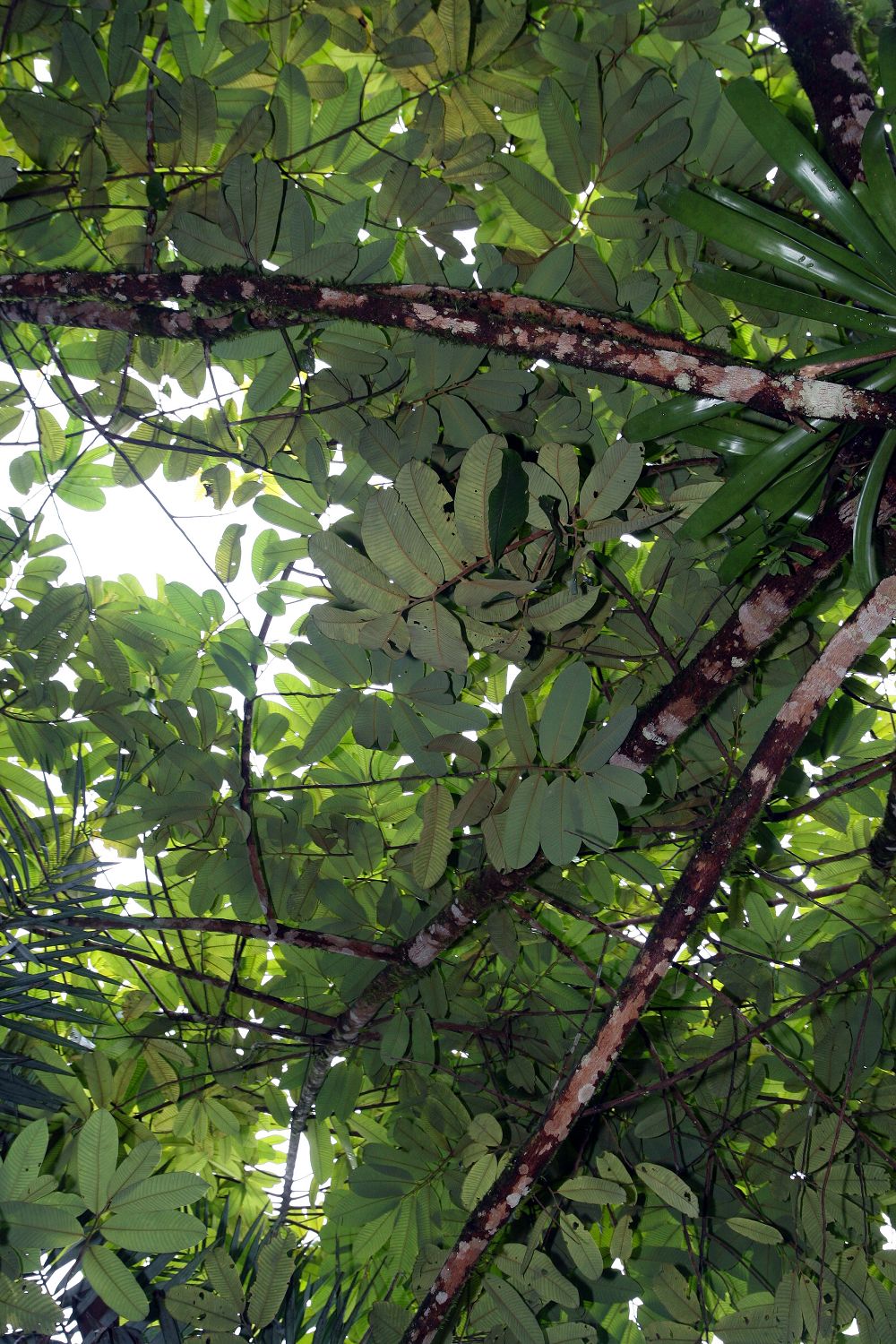
| Canopy of Virola koschnyi | |
| Scientific classification | |
| Kingdom: | Plantae |
| Clade: | Tracheophytes |
| Clade: | Angiosperms |
| Clade: | Magnoliids |
| Order: | Magnoliales |
| Family: | Myristicaceae |
| Genus: | Virola Aubl. (1775) |
| Species[1] | |
|
71; see text | |
Virola is a genus of flowering plants in the nutmeg family, Myristicaceae. It includes medium-sized trees native to rainforests of the tropical Americas, ranging from southern Mexico to Bolivia and southern Brazil.[1] Species are known commonly as epená, patricá, or cumala. They have glossy, dark green leaves and clusters of tiny yellow flowers, and may emit a pungent odor.
Traditional use
[edit]Several species of this genus have been used to create hallucinogenic snuff powders.[2]
Chemical constituents
[edit]The tops of Virola oleifera have been shown to produce lignan-7-ols and verrucosin that have antifungal action regarding Cladosporium sphaerospermum in doses as low as 25 micrograms. Lignan-7-ols oleiferin-B and oleiferin-G worked for Cladosporium cladosporioides starting as low as 10 micrograms.[3]
Species
[edit]71 species are accepted.[1]
- Virola aequatorialis Muriel & Balslev
- Virola aguarunana D.Santam.
- Virola albidiflora Ducke
- Virola allenii D.Santam. & Aguilar
- Virola alvaroperezii D.Santam.
- Virola amistadensis D.Santam.
- Virola bicuhyba (Schott) Warb.
- Virola bombuscaroensis D.Santam.
- Virola caducifolia W.A.Rodrigues
- Virola calimensis D.Santam.
- Virola calophylla (Spruce) Warb.[4]
- Virola calophylloidea Markgr.
- Virola carinata (Spruce ex Benth.) Warb.
- Virola chrysocarpa D.Santam. & Aguilar
- Virola coelhoi W.A.Rodrigues
- Virola cogolloi D.Santam.
- Virola crebrinervia Ducke
- Virola cumala D.Santam.
- Virola cuspidata (Benth.) Warb.
- Virola decorticans Ducke
- Virola divergens Ducke
- Virola dixonii Little
- Virola duckei A.C.Sm.
- Virola elongata (Benth.) Warb.
- Virola flexuosa A.C.Sm.
- Virola fosteri D.Santam.
- Virola gardneri (A.DC.) Warb.
- Virola guatemalensis (Hemsl.) Warb.
- Virola guggenheimii W.A.Rodrigues
- Virola koschnyi Warb.
- Virola kwatae Sabatier
- Virola laevigata Standl.
- Virola lieneana Paula & E.P.Heringer
- Virola loretensis A.C.Sm.
- Virola macrocarpa A.C.Sm.
- Virola malmei A.C.Sm.
- Virola marleneae W.A.Rodrigues
- Virola megacarpa A.H.Gentry
- Virola michelii Heckel
- Virola micrantha A.C.Sm.
- Virola minutiflora Ducke
- Virola mollissima (Poepp. ex A.DC.) Warb.
- Virola montana D.Santam.
- Virola multicostata Ducke
- Virola multiflora (Standl.) A.C.Sm.
- Virola multinervia Ducke
- Virola nobilis A.C.Sm.
- Virola obovata Ducke
- Virola officinalis Warb.
- Virola otobifolia D.Santam.
- Virola parkeri D.Santam. & Lagom.
- Virola parvifolia Ducke
- Virola pavonis (A.DC.) A.C.Sm.
- Virola peruviana (A.DC.) Warb.
- Virola polyneura W.A.Rodrigues
- Virola reidii Little
- Virola rugulosa (Spruce) Warb.
- Virola sanguinea D.Santam.
- Virola schultesii A.C.Sm.
- Virola sebifera Aubl.
- Virola sessilis (A.DC.) Warb.
- Virola steyermarkii W.A.Rodrigues
- Virola subsessilis (Benth.) Warb.
- Virola surinamensis (Rol. ex Rottb.) Warb.
- Virola theiodora (Spruce ex Benth.) Warb. (synonym Virola rufula Warb.)
- Virola tuckerae D.Santam. & Lagom.
- Virola urbaniana Warb.
- Virola venosa (Benth.) Warb.
- Virola villosa (Benth.) Warb.
- Virola weberbaueri Markgr.
- Virola yasuniana D.Santam.
Gallery
[edit]-
Virola elongata fruit
-
Virola elongata seeds
-
Virola carinata embryo
-
Virola sebifera
-
Virola surinamensis
Legal status
[edit]United States
[edit]Louisiana
[edit]Except for ornamental purposes, growing, selling or possessing Virola spp. is prohibited by Louisiana State Act 159.
See also
[edit]- Myristica — some species of this genus have been reclassified into Virola.
- Ayahuasca
- Entheogen
- Psychedelic plants
References
[edit]Notes
[edit]- ^ a b c Virola Aubl. Plants of the World Online. Retrieved 9 March 2024.
- ^ Torres, C. M., et al. (1991). "Snuff powders from pre-Hispanic San Pedro de Atacama: Chemical and contextual analysis". Current Anthropology, 640–649. Archived 2016-03-09 at the Wayback Machine
- ^ Sartorelli, P.; Young, M.C.M.; Kato, M.J., "Antifungal lignans from the arils of Virola oleifera". Phytochemistry-Oxford. Oxford : Elsevier Science Ltd. March 1998. v. 47 (6) p. 1003–1006.
- ^ "Virola calophylla". Germplasm Resources Information Network. Agricultural Research Service, United States Department of Agriculture. Retrieved 2008-04-29.
General references
[edit]- Jonathan Ott – Shamanic Snuffs or Entheogenic Errhines (2001) ISBN 1-888755-02-4
- Richard Evans Schultes – Plants of the Gods (1992) ISBN 0-89281-979-0
- Erowid Virola Vault
External links
[edit]
Media related to Virola at Wikimedia Commons- Sura.ots.ac.cr: Virola koschnyi — photos and info.
- Gardening.eu: Info on Growing Virola
Virola
View on GrokipediaTaxonomy and Description
Morphological Characteristics
Virola species are evergreen trees typically reaching heights of 20 to 40 meters, with straight, cylindrical boles that are often branch-free for the lower portion of the trunk and supported by buttresses or stilt roots in some species.[6] The bark is smooth and grayish, characterized by irregularly shaped lenticels, and exudes a profuse red latex or resin when cut or injured, a trait distinguishing the genus within Neotropical Myristicaceae.[2] [3] Leaves are simple, alternate, and spirally arranged, with blades ranging from oblong to ovate, measuring 7 to 47 cm in length and often featuring parallel margins or numerous lateral veins.[6] The adaxial surface is typically glabrous and lustrous, while the abaxial surface bears stellate or dendritic trichomes, contributing to a whitish or tomentose appearance.[6] [1] Virola plants are dioecious, with small, unisexual flowers borne in axillary or cauliflorous inflorescences that form panicles or spikes.[3] Flowers measure 1 to 4 mm in diameter, consisting of 3 to 4 tepals and lacking distinct petals or sepals; staminate flowers are often fragrant and yellow.[3] [1] Fruits are drupaceous, ovoid to subglobose, and dehiscent along one or two sutures, enclosing a single seed with a colorful aril that aids in animal dispersal.[6] Pericarp thickness varies, often glabrescent with thin walls, and fruits measure approximately 1.6 to 2.2 cm in length across species.[6] The resin production observed in bark likely serves a protective function, deterring herbivores through chemical repellence and sealing wounds against pathogens, as resins in Myristicaceae generally exhibit such properties.[2]Species Diversity and Recent Discoveries
The genus Virola Aubl., established in 1775 by Jean Baptiste Christophore Fusée Aublet in Histoire des plantes de la Guiane Françoise, is typified by V. sebifera Aublet, collected near Cayenne, French Guiana.[7] This neotropical genus within Myristicaceae now includes approximately 60 accepted species, classified primarily through morphological features such as leaf architecture, inflorescence structure, and perianth segmentation, given the scarcity of comprehensive molecular data.[8] Prominent species encompass V. sebifera, widespread in Mesoamerica and northern South America; V. surinamensis (Rolfe) Warb., distinguished by its elongated fruits; and V. theiodora (Spruce ex Benth.) Warb., recognized for resins containing tryptamine derivatives linked to psychoactive effects in indigenous preparations.[7] Other notable taxa include V. elongata Aubl. and V. calophylla Warb., often differentiated by subtle variations in androecium configuration and seed coat texture. Identifications emphasize empirical morphological traits over preliminary genetic markers, as phylogenetic studies remain incomplete for many lineages.[5] Recent fieldwork has expanded the genus's known diversity. In 2022, ten new species—V. frederici-arbelaezii, V. kavanayenensis, and others—were described from South American herbaria, relying on detailed morphological comparisons of type specimens to resolve prior misidentifications.[9] In 2025, V. williamii Farroñay & D.Santam. was formally named from Amazonian terra firme forests in Peru and Brazil, previously conflated with V. elongata; it features a unique combination of 3-lobed perianth and elongate anthers, with resins associated with hallucinogenic properties akin to V. theiodora. These additions underscore ongoing taxonomic refinements driven by herbarium revisions and targeted collections, prioritizing verifiable diagnostic characters amid the genus's morphological plasticity.[9]
