Hubbry Logo
Wess–Zumino–Witten modelWess–Zumino–Witten modelMain
Open search
Wess–Zumino–Witten model
Community hub
Wess–Zumino–Witten model
logo
7 pages, 0 posts
0 subscribers
Be the first to start a discussion here.
Wess–Zumino–Witten model
from Wikipedia

In theoretical physics and mathematics, a Wess–Zumino–Witten (WZW) model, also called a Wess–Zumino–Novikov–Witten model, is a type of two-dimensional conformal field theory named after Julius Wess, Bruno Zumino, Sergei Novikov and Edward Witten.[1][2][3][4] A WZW model is associated to a Lie group (or supergroup), and its symmetry algebra is the affine Lie algebra built from the corresponding Lie algebra (or Lie superalgebra). By extension, the name WZW model is sometimes used for any conformal field theory whose symmetry algebra is an affine Lie algebra.[5]

Action

[edit]

Definition

[edit]

For a Riemann surface, a Lie group, and a (generally complex) number, let us define the -WZW model on at the level . The model is a nonlinear sigma model whose action is a functional of a field :

Here, is equipped with a flat Euclidean metric, is the partial derivative, and is the Killing form on the Lie algebra of . The Wess–Zumino term of the action is

Here is the completely anti-symmetric tensor, and is the Lie bracket. The Wess–Zumino term is an integral over a three-dimensional manifold whose boundary is .

Topological properties of the Wess–Zumino term

[edit]

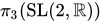
For the Wess–Zumino term to make sense, we need the field to have an extension to . This requires the homotopy group to be trivial, which is the case in particular for any compact Lie group .

The extension of a given to is in general not unique. For the WZW model to be well-defined, should not depend on the choice of the extension. The Wess–Zumino term is invariant under small deformations of , and only depends on its homotopy class. Possible homotopy classes are controlled by the homotopy group .

For any compact, connected simple Lie group , we have , and different extensions of lead to values of that differ by integers. Therefore, they lead to the same value of provided the level obeys

Integer values of the level also play an important role in the representation theory of the model's symmetry algebra, which is an affine Lie algebra. If the level is a positive integer, the affine Lie algebra has unitary highest weight representations with highest weights that are dominant integral. Such representations decompose into finite-dimensional subrepresentations with respect to the subalgebras spanned by each simple root, the corresponding negative root and their commutator, which is a Cartan generator.

In the case of the noncompact simple Lie group , the homotopy group is trivial, and the level is not constrained to be an integer.[6]

Geometrical interpretation of the Wess–Zumino term

[edit]

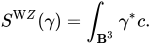
If ea are the basis vectors for the Lie algebra, then are the structure constants of the Lie algebra. The structure constants are completely anti-symmetric, and thus they define a 3-form on the group manifold of G. Thus, the integrand above is just the pullback of the harmonic 3-form to the ball Denoting the harmonic 3-form by c and the pullback by one then has

This form leads directly to a topological analysis of the WZ term.

Geometrically, this term describes the torsion of the respective manifold.[7] The presence of this torsion compels teleparallelism of the manifold, and thus trivialization of the torsionful curvature tensor; and hence arrest of the renormalization flow, an infrared fixed point of the renormalization group, a phenomenon termed geometrostasis.

Symmetry algebra

[edit]

Generalised group symmetry

[edit]

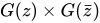
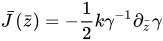
The Wess–Zumino–Witten model is not only symmetric under global transformations by a group element in , but also has a much richer symmetry. This symmetry is often called the symmetry.[8] Namely, given any holomorphic -valued function , and any other (completely independent of ) antiholomorphic -valued function , where we have identified and in terms of the Euclidean space coordinates , the following symmetry holds:
One way to prove the existence of this symmetry is through repeated application of the Polyakov–Wiegmann identity regarding products of -valued fields:

The holomorphic and anti-holomorphic currents and are the conserved currents associated with this symmetry. The singular behaviour of the products of these currents with other quantum fields determine how those fields transform under infinitesimal actions of the group.
Affine Lie algebra

[edit]

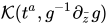
Let be a local complex coordinate on , an orthonormal basis (with respect to the Killing form) of the Lie algebra of , and the quantization of the field . We have the following operator product expansion:

where are the coefficients such that . Equivalently, if is expanded in modes

then the current algebra generated by is the affine Lie algebra associated to the Lie algebra of , with a level that coincides with the level of the WZW model.[5] If , the notation for the affine Lie algebra is . The commutation relations of the affine Lie algebra are

This affine Lie algebra is the chiral symmetry algebra associated to the left-moving currents . A second copy of the same affine Lie algebra is associated to the right-moving currents . The generators of that second copy are antiholomorphic. The full symmetry algebra of the WZW model is the product of the two copies of the affine Lie algebra.
Sugawara construction

[edit]

The Sugawara construction is an embedding of the Virasoro algebra into the universal enveloping algebra of the affine Lie algebra. The existence of the embedding shows that WZW models are conformal field theories. Moreover, it leads to Knizhnik–Zamolodchikov equations for correlation functions.

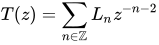
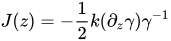
The Sugawara construction is most concisely written at the level of the currents: for the affine Lie algebra, and the energy-momentum tensor for the Virasoro algebra:


where the denotes normal ordering, and is the dual Coxeter number. By using the OPE of the currents and a version of Wick's theorem one may deduce that the OPE of with itself is given by[5]

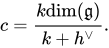
which is equivalent to the Virasoro algebra's commutation relations. The central charge of the Virasoro algebra is given in terms of the level of the affine Lie algebra by
At the level of the generators of the affine Lie algebra, the Sugawara construction reads


where the generators of the Virasoro algebra are the modes of the energy-momentum tensor, .

Spectrum

[edit]

WZW models with compact, simply connected groups

[edit]

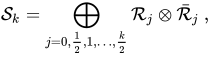
If the Lie group is compact and simply connected, then the WZW model is rational and diagonal: rational because the spectrum is built from a (level-dependent) finite set of irreducible representations of the affine Lie algebra called the integrable highest weight representations, and diagonal because a representation of the left-moving algebra is coupled with the same representation of the right-moving algebra.[5]

For example, the spectrum of the WZW model at level is

where is the affine highest weight representation of spin : a representation generated by a state such that

where is the current that corresponds to a generator of the Lie algebra of .

WZW models with other types of groups

[edit]

If the group is compact but not simply connected, the WZW model is rational but not necessarily diagonal. For example, the WZW model exists for even integer levels , and its spectrum is a non-diagonal combination of finitely many integrable highest weight representations.[5]

If the group is not compact, the WZW model is non-rational. Moreover, its spectrum may include non highest weight representations. For example, the spectrum of the WZW model is built from highest weight representations, plus their images under the spectral flow automorphisms of the affine Lie algebra.[6]

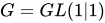
If is a supergroup, the spectrum may involve representations that do not factorize as tensor products of representations of the left- and right-moving symmetry algebras. This occurs for example in the case ,[9] and also in more complicated supergroups such as .[10] Non-factorizable representations are responsible for the fact that the corresponding WZW models are logarithmic conformal field theories.

Other theories based on affine Lie algebras

[edit]

The known conformal field theories based on affine Lie algebras are not limited to WZW models. For example, in the case of the affine Lie algebra of the WZW model, modular invariant torus partition functions obey an ADE classification, where the WZW model accounts for the A series only.[11] The D series corresponds to the WZW model, and the E series does not correspond to any WZW model.

Another example is the model. This model is based on the same symmetry algebra as the WZW model, to which it is related by Wick rotation. However, the is not strictly speaking a WZW model, as is not a group, but a coset.[12]


Fields and correlation functions

[edit]

Fields

[edit]

Given a simple representation of the Lie algebra of , an affine primary field is a field that takes values in the representation space of , such that

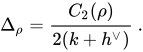
An affine primary field is also a primary field for the Virasoro algebra that results from the Sugawara construction. The conformal dimension of the affine primary field is given in terms of the quadratic Casimir of the representation (i.e. the eigenvalue of the quadratic Casimir element where is the inverse of the matrix of the Killing form) by

For example, in the WZW model, the conformal dimension of a primary field of spin is
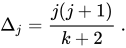
By the state-field correspondence, affine primary fields correspond to affine primary states, which are the highest weight states of highest weight representations of the affine Lie algebra.

Correlation functions

[edit]

If the group is compact, the spectrum of the WZW model is made of highest weight representations, and all correlation functions can be deduced from correlation functions of affine primary fields via Ward identities.

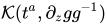
If the Riemann surface is the Riemann sphere, correlation functions of affine primary fields obey Knizhnik–Zamolodchikov equations. On Riemann surfaces of higher genus, correlation functions obey Knizhnik–Zamolodchikov–Bernard equations, which involve derivatives not only of the fields' positions, but also of the surface's moduli.[13]

Gauged WZW models

[edit]

Given a Lie subgroup , the gauged WZW model (or coset model) is a nonlinear sigma model whose target space is the quotient for the adjoint action of on . This gauged WZW model is a conformal field theory, whose symmetry algebra is a quotient of the two affine Lie algebras of the and WZW models, and whose central charge is the difference of their central charges.

Applications

[edit]

The WZW model whose Lie group is the universal cover of the group has been used by Juan Maldacena and Hirosi Ooguri to describe bosonic string theory on the three-dimensional anti-de Sitter space .[6] Superstrings on are described by the WZW model on the supergroup , or a deformation thereof if Ramond-Ramond flux is turned on.[14][10]

WZW models and their deformations have been proposed for describing the plateau transition in the integer quantum Hall effect.[15]

The gauged WZW model has an interpretation in string theory as Witten's two-dimensional Euclidean black hole.[16] The same model also describes certain two-dimensional statistical systems at criticality, such as the critical antiferromagnetic Potts model.[17]

References

[edit]
Revisions and contributorsEdit on WikipediaRead on Wikipedia
from Grokipedia
The Wess–Zumino–Witten (WZW) model is a two-dimensional (CFT) that describes a with fields taking values in a GG, augmented by a topological Wess–Zumino term in the action to ensure conformal invariance and yield an extended symmetry algebra combining the with an affine Kac-Moody algebra at integer level kk. The model was originally motivated by the need for a bosonic description equivalent to free fermions with non-Abelian symmetries, providing a prime example of a rational CFT where correlation functions and representations are exactly solvable. The foundational Wess–Zumino term was introduced in 1971 as a topological invariant addressing anomalies in nonlinear sigma models, allowing the action to be invariant under chiral transformations despite the presence of anomalies in Ward identities. In 1984, extended this to two dimensions by proposing the full WZW action as a non-Abelian generalization of bosonization, mapping fermionic current algebras to bosonic sigma models with the WZ term, which realizes the same symmetry structure. Concurrently, Knizhnik and Zamolodchikov derived the explicit form of correlation functions using the WZW model, establishing its conformal properties through the Knizhnik–Zamolodchikov equations and confirming its role as an integrable CFT. The action of the WZW model on the ΣS2\Sigma \cong S^2 is given by S=S0+kΓS = S_0 + k \Gamma, where S0=k8πΣTr(g1gg1ˉg)S_0 = -\frac{k}{8\pi} \int_\Sigma \mathrm{Tr}(g^{-1} \partial g \, g^{-1} \bar{\partial} g) is the principal chiral model term, and Γ=i12πBTr(g1dg)3\Gamma = \frac{i}{12\pi} \int_B \mathrm{Tr}(g^{-1} dg)^3 is the Wess–Zumino term integrated over a three-dimensional bulk BB with boundary B=Σ\partial B = \Sigma, ensuring the level kk is quantized to an for compact groups GG. This formulation generates left- and right-moving currents J(z)=kgg1J(z) = -k \partial g g^{-1} and Jˉ(zˉ)=kg1ˉg\bar{J}(\bar{z}) = k g^{-1} \bar{\partial} g, satisfying relations at level kk, with the stress-energy tensor constructed via the Sugawara formula to yield central charge c=kdimGk+hc = \frac{k \dim G}{k + h^\vee}, where hh^\vee is the dual Coxeter number of the . The model possesses a finite number of primary representations, labeled by integrable highest weights with λk/2\lambda \leq k/2 for unitary cases, and its modular invariant partition functions follow A-, D-, or E-type classifications. WZW models are notable for their exact solvability, serving as building blocks in on group manifold backgrounds and in constructions that reproduce minimal models and other rational CFTs, such as the G/HG/H at level kk yielding central charge c=kdimGk+hGkdimHk+hHc = \frac{k \dim G}{k + h^\vee_G} - \frac{k \dim H}{k + h^\vee_H}. They also underpin fusion rules via Verlinde's formula and have applications in for describing edge states in quantum Hall systems and in integrable systems through their connection to affine algebras.

Introduction

Overview

The Wess–Zumino–Witten (WZW) model is a two-dimensional formulated as a sigma model with target space given by a GG at a fixed level kk. It incorporates a standard kinetic term derived from the group's bi-invariant metric alongside a topological Wess-Zumino term, which ensures the theory's conformal invariance and introduces non-trivial topological properties. The central charge of the WZW model is c=kdimGk+gc = \frac{k \dim G}{k + g}, where dimG\dim G denotes the dimension of the group and gg is the dual Coxeter number of its . This parameter governs the theory's conformal anomaly and plays a crucial role in determining its spectrum and correlation functions. The model realizes symmetries at level kk, providing an infinite-dimensional extension of the global . Renowned as an exactly solvable quantum field theory, the WZW model exemplifies rational conformal field theories, allowing precise computations of observables through algebraic methods. It finds broad applications in as a building block for compactified descriptions and in for analyzing critical points in two-dimensional systems, such as integrable spin chains. Unitarity holds for positive integer values of kk and compact groups GG, ensuring positive norms in the .

Historical development

The Wess–Zumino term was originally introduced by Julius Wess and Bruno Zumino in 1971 to describe anomalous Ward identities in four-dimensional sigma models associated with chiral gauge theories, providing a topological contribution essential for maintaining gauge invariance in the presence of anomalies. This term captured the non-trivial structure underlying chiral anomalies, laying the groundwork for its later applications in lower dimensions. In 1983, extended the Wess–Zumino term to two dimensions within the framework of non-abelian bosonization, demonstrating how fermionic theories in 1+1 dimensions could be equivalently described by bosonic sigma models augmented by this topological term. This work generalized the abelian bosonization techniques, previously used for simpler models like the massive Thirring model, to non-abelian gauge groups, revealing deep connections between fermionic currents and bosonic fields. The full Wess–Zumino–Witten (WZW) model was formalized by in 1984, where the two-dimensional action combining a principal chiral model with the Wess–Zumino term was shown to define a (CFT) exhibiting affine Kac–Moody symmetry at the quantum level. Concurrently, Vladimir Knizhnik and derived the explicit form of correlation functions using the WZW model, establishing its conformal properties through the Knizhnik–Zamolodchikov equations. Building directly on the contributions of Wess and Zumino, this construction highlighted the model's role as a solvable example of a non-abelian CFT, with the level parameter quantifying the central extension of the symmetry algebra. Early developments of the WZW model were motivated by investigations into current algebras and bosonization in 1+1-dimensional (QCD), where exact solvability in two dimensions—pioneered by models like 't Hooft's large-N QCD2—provided insights into non-perturbative phenomena such as confinement and . During the , the WZW model gained prominence through its connections to , particularly in compactifications on manifolds that preserved conformal invariance and enabled the construction of realistic heterotic string models. In the , it played a central role in the classification of rational CFTs, with studies of its modular invariance properties elucidating the structure of fusion rules and operator content for various s. Post-2020 extensions have included the incorporation of fields into WZW interactions, deriving complete Lagrangians for axion-meson couplings in three-flavor QCD while ensuring gauge invariance through counterterms. Similarly, gauged WZW models have been used to construct non-relativistic quantum strings, leveraging bi-invariant metrics on groups to realize symmetries in stringy contexts.

Mathematical Foundations

Lie groups and current algebras

The Wess–Zumino–Witten (WZW) model is formulated with a compact simple Lie group GG serving as the target space, equipped with its associated Lie algebra g\mathfrak{g}. The Lie algebra g\mathfrak{g} admits a basis of generators TaT^a, a=1,,dimGa = 1, \dots, \dim G, satisfying the commutation relations [Ta,Tb]=ifabcTc,[T^a, T^b] = i f^{abc} T^c, where fabcf^{abc} are the real, totally antisymmetric structure constants. These relations encode the non-Abelian nature of the symmetry underlying the model. Central to the construction are the left- and right-invariant currents derived from the Maurer–Cartan form ω=g1dg=ieaTa\omega = g^{-1} dg = i e^a T^a, where gGg \in G parameterizes the field configuration and eae^a are Lie algebra-valued one-form components. The holomorphic and antiholomorphic currents are defined as \begin{align*} J &= -k \partial g g^{-1}, \ \bar{J} &= k g^{-1} \bar{\partial} g, \end{align*} with kk denoting the model's level and =z\partial = \partial_z, ˉ=zˉ\bar{\partial} = \partial_{\bar{z}} the complex derivatives on the two-dimensional . These currents generate the left- and right-moving G×GG \times G symmetries of the theory in the classical regime. Classically, the currents obey the {Ja(z),Jb(w)}=fabcJc(w)zw+kδabwδ(zw),\{ J^a(z), J^b(w) \} = \frac{f^{abc} J^c(w)}{z - w} + k \delta^{ab} \partial_w \delta(z - w), which realizes the structure of a classical affine current at level kk. A similar relation holds for the antiholomorphic sector. The of g\mathfrak{g} is non-degenerate, characterized by the Killing form Tr(TaTb)=δabψ\operatorname{Tr}(T^a T^b) = -\delta^{ab} \psi, where ψ>0\psi > 0 is a normalization factor proportional to the dual Coxeter number of g\mathfrak{g}, ensuring the invariance of the model's metric. The topology of GG plays a crucial role in quantization: for simply connected groups, the WZW action is well-defined on all maps, allowing integer levels kk and standard integrable representations; in contrast, non-simply connected groups introduce topological obstructions from the fundamental group, requiring kk to be a multiple of the group's covering denominator to ensure consistent quantization and unitarity.

Conformal field theory context

Two-dimensional conformal field theories (CFTs) provide the essential framework for the Wess–Zumino–Witten (WZW) model, defined primarily on the Riemann sphere or the cylinder, where the latter arises via the conformal mapping w=eizw = e^{iz} from the plane. These theories exhibit a factorization into holomorphic (z-dependent) and anti-holomorphic (zˉ\bar{z}-dependent) sectors, allowing correlation functions to separate into independent left- and right-moving parts, such as ϕ1(z1,zˉ1)ϕn(zn,zˉn)=mC12mCˉ1ˉ2ˉmˉFm(z1,,zn)Fˉm(zˉ1,,zˉn)\langle \phi_1(z_1, \bar{z}_1) \cdots \phi_n(z_n, \bar{z}_n) \rangle = \sum_m C_{12\cdots m} \bar{C}_{\bar{1}\bar{2}\cdots \bar{m}} F_m(z_1, \dots, z_n) \bar{F}_m(\bar{z}_1, \dots, \bar{z}_n). This structure underpins the chiral symmetry of WZW models, where Lie group-valued currents from the underlying group theory manifest in these sectors. The symmetry algebra of 2D CFTs is generated by the Virasoro algebra, with holomorphic generators LnL_n satisfying the commutation relations [Lm,Ln]=(mn)Lm+n+c12m(m21)δm+n,0,[L_m, L_n] = (m - n) L_{m+n} + \frac{c}{12} m (m^2 - 1) \delta_{m+n, 0}, where cc is the central charge quantifying quantum anomalies. Similarly, anti-holomorphic generators Lˉn\bar{L}_n obey the same algebra with central charge cˉ\bar{c}, often cˉ=c\bar{c} = c for unitary theories. Primary fields ϕ(w)\phi(w) of conformal weight (h,hˉ)(h, \bar{h}) transform covariantly under these symmetries, as captured by the operator product expansion (OPE) with the holomorphic stress-energy tensor T(z)T(z): T(z)ϕ(w)hϕ(w)(zw)2+ϕ(w)zw+.T(z) \phi(w) \sim \frac{h \phi(w)}{(z - w)^2} + \frac{\partial \phi(w)}{z - w} + \cdots. In the WZW context, the stress tensor is constructed from currents via the Sugawara construction, yielding a specific cc dependent on the group and level. Currents in 2D CFTs exhibit anomalous transformations under conformal maps due to quantum effects, such as the breaking of in the absence of compensating terms. For the principal chiral model without the –Zumino term, these anomalies disrupt holomorphicity and conformal invariance at the quantum level. The WZ term restores invariance by canceling the anomaly, ensuring the currents transform as Ja(z)gJa(z)g1+gg1J^a(z) \to g J^a(z) g^{-1} + \partial g \, g^{-1} under group actions while maintaining overall conformal . WZW models exemplify rational CFTs, characterized by a finite number of primary fields and modular-invariant partition functions on the torus. The partition function takes the form Z(τ,τˉ)=Tr[qL0c/24qˉLˉ0cˉ/24],Z(\tau, \bar{\tau}) = \mathrm{Tr} \left[ q^{L_0 - c/24} \bar{q}^{\bar{L}_0 - \bar{c}/24} \right], with q=e2πiτq = e^{2\pi i \tau}, and must be invariant under the modular group SL(2, ℤ) transformations ττ+1\tau \to \tau + 1 and τ1/τ\tau \to -1/\tau. This invariance, expressed via integer matrices MijM_{ij} in the character basis Z=i,jMijχi(τ)χˉj(τˉ)Z = \sum_{i,j} M_{ij} \chi_i(\tau) \bar{\chi}_j(\bar{\tau}), ensures consistency and unitarity. In contrast to unitary minimal models, which feature finite spectra and central charges c=16/(m(m+1))c = 1 - 6/(m(m+1)) for integer m3m \geq 3 (e.g., the at c=1/2c = 1/2), WZW models realize rational CFTs through representations on group manifolds. For abelian groups like Rn\mathbb{R}^n, the WZW model reduces to nn free bosons compactified on a flat , lacking interactions but sharing the rational structure when radii are rational. Minimal models, however, arise as coset constructions from WZW theories, such as su(2)ksu(2)1/su(2)k+1\mathfrak{su}(2)_k \oplus \mathfrak{su}(2)_1 / \mathfrak{su}(2)_{k+1}, highlighting the broader applicability of WZW in generating other rational CFTs.

Action and Lagrangian

Definition of the action

The Wess–Zumino–Witten (WZW) model is a two-dimensional sigma model whose action combines a kinetic term describing maps from the worldsheet into a Lie group manifold with a topological Wess–Zumino (WZ) term that ensures conformal invariance. The full action is S=Skin+SWZS = S_{\mathrm{kin}} + S_{\mathrm{WZ}}, where the kinetic term takes the form Skin=k4πd2σTr(g1μgg1μg).S_{\mathrm{kin}} = \frac{k}{4\pi} \int d^2 \sigma \, \mathrm{Tr} \left( g^{-1} \partial_\mu g \, g^{-1} \partial^\mu g \right). Here, g(σ)g(\sigma) is a field taking values in a Lie group GG, kk is the level parameter, μ\partial_\mu denotes spacetime derivatives on the two-dimensional worldsheet with coordinates σμ\sigma^\mu, and Tr\mathrm{Tr} is the trace in the fundamental representation (or a multiple thereof to normalize the Killing form). This term resembles the action of a principal chiral model but is normalized such that the level kk governs both the coupling strength and the quantization of the theory. The WZ term, which is essential for rendering the model conformally invariant, is defined as SWZ=k12πBTr(α3),S_{\mathrm{WZ}} = \frac{k}{12\pi} \int_B \mathrm{Tr} \left( \alpha^3 \right), where α=g1dg\alpha = g^{-1} dg is the Maurer–Cartan form and BB is a three-dimensional manifold whose boundary is the two-dimensional (extended off-shell to ensure the term is well-defined). This integral captures the topological winding of the field configuration in the group manifold and is invariant under deformations of BB up to 2π2\pi integers, reflecting the cohomology class of the invariant three-form on GG. The level kk must be an integer for the quantum theory to be consistent, as fractional values would lead to multivalued path integrals over topologically nontrivial s. Varying the action yields the ˉgg1=0\partial \bar{\partial} g \, g^{-1} = 0 (and its conjugate), implying that the left-invariant currents are holomorphic and the right-invariant currents are antiholomorphic in complex coordinates. For gauged versions of the model, where a of GL×GRG_L \times G_R is gauged, the Polyakov–Wiegmann identity relates the gauged action to the ungauged one via S[A,g]=S12πTr(AJˉ+AˉJ)+SCS[A,Aˉ]S[A, g] = S - \frac{1}{2\pi} \int \mathrm{Tr} \left( A \bar{J} + \bar{A} J \right) + S_{\mathrm{CS}}[A, \bar{A}], with A,AˉA, \bar{A} the gauge fields, J,JˉJ, \bar{J} the currents, and SCSS_{\mathrm{CS}} the Chern–Simons action on a three-dimensional extension. Classically, the model exhibits conformal invariance because the target space is equipped with the bi-invariant metric induced by the Killing form on the of GG, ensuring the vanishes at tree level. This classical structure underpins the quantum realization of affine current algebras in the model.

Properties of the Wess–Zumino term

The Wess–Zumino term in the Wess–Zumino–Witten model is fundamentally topological, contributing to the action in a manner that is invariant under continuous deformations of the field configuration, up to integer multiples of 2πi2\pi i when the level kk is an integer. This quantization condition arises from the requirement that the exponential of the action remains single-valued in the path integral, and it necessitates that the target Lie group GG is compact and simply connected to avoid inconsistencies with non-trivial homotopy groups. For non-simply connected groups, the term may not be well-defined without additional modifications, as the ambiguity in the phase cannot be consistently resolved across all field configurations. Geometrically, the Wess–Zumino term measures the "volume" swept out by the field map in the group manifold, equivalent to an integer multiple of the winding number associated with the third homotopy group π3(G)=Z\pi_3(G) = \mathbb{Z} for simple simply connected Lie groups. This winding number quantifies how many times the map wraps the three-sphere S3S^3 embedded in GG, providing a topological invariant that distinguishes non-contractible loops in the configuration space and ensures the term's non-triviality for topologically distinct sectors. In the quantum theory, the Wess–Zumino term facilitates anomaly inflow, whereby it generates a variation under chiral transformations that precisely cancels the arising from the integration out of fermionic in the current algebra. This mechanism restores the consistency of the affine Kac–Moody symmetry at the quantum level, with the level kk determining the strength of the inflow to match the anomaly coefficient. The term's non-triviality becomes manifest for non-contractible loops in the group, where it induces phases that cannot be removed by local counterterms, analogous to the θ\theta term in (QCD), which similarly encodes topological effects in the effective low-energy description of strong interactions.

Symmetry Structure

Infinite-dimensional symmetries

The Wess–Zumino–Witten (WZW) model possesses global symmetries under the left and right actions of the GG, parameterized by infinitesimal transformations δg=ϵLg\delta g = \epsilon_L g for left movers and δg=gϵR\delta g = g \epsilon_R for right movers, where ϵL,ϵRg\epsilon_L, \epsilon_R \in \mathfrak{g} are constant elements of the g\mathfrak{g}. These symmetries lead to conserved Noether currents J(z)J(z) and Jˉ(zˉ)\bar{J}(\bar{z}), respectively, which are holomorphic and anti-holomorphic fields on the . In the quantum theory, these global symmetries extend to infinite-dimensional Kac–Moody symmetries, where the transformation parameters become holomorphic functions ϵ(z)\epsilon(z) for the left sector and anti-holomorphic ϵˉ(zˉ)\bar{\epsilon}(\bar{z}) for the right, introducing infinitely many parameters. The currents satisfy conservation equations such as zˉJ=0\partial_{\bar{z}} J = 0 and zJˉ=0\partial_z \bar{J} = 0, ensuring their chiral nature. Under large gauge transformations, which are non-trivial mappings from the to the group GG, the path integral measure acquires a anomaly proportional to the , but this is precisely compensated by the variation of the Wess–Zumino term, restoring the invariance of the theory. The level kk of the affine Kac–Moody realized by the currents matches the integer coefficient appearing in the classical Wess–Zumino term of the action. This quantum level kk also governs the central charge of the and ensures quantization conditions for the model. Furthermore, the two-dimensional WZW model at level kk arises as the boundary theory of a three-dimensional with the same group GG and level kk, providing a bulk realization of the infinite-dimensional symmetries. Through non-abelian bosonization, the WZW model is equivalent to a free theory of fermions transforming in the fundamental representation of GG (with the number of fermion flavors equal to the level kk for groups like SU(NN)), where the bosonic fields gg emerge as bilinears in the fermionic operators, preserving the full symmetry structure.

Affine Lie algebra realization

In the Wess–Zumino–Witten (WZW) model, the quantum currents Ja(z)J^a(z), associated with the left-moving sector of the Lie algebra g\mathfrak{g}, satisfy operator product expansions (OPEs) that realize an affine Kac–Moody algebra at level kk. The fundamental OPE is given by Ja(z)Jb(w)kδab(zw)2+ifabcJc(w)zw,J^a(z) J^b(w) \sim \frac{k \delta^{ab}}{(z-w)^2} + \frac{i f^{abc} J^c(w)}{z-w}, where fabcf^{abc} are the structure constants of g\mathfrak{g}, and the singular terms encode both the finite-dimensional Lie algebra and a central extension parameterized by the integer level kk.90374-2) This OPE arises from the quantization of the WZW action and ensures the conservation of the currents as zˉJa(z)=0\partial \bar{z} J^a(z) = 0.90374-2) To obtain the , the currents are expanded in Laurent modes on the : Ja(z)=nZJnazn1,J^a(z) = \sum_{n \in \mathbb{Z}} J^a_n z^{-n-1}, where the modes JnaJ^a_n generate the g^k\hat{\mathfrak{g}}_k. The commutation relations follow from contour integral representations of the OPE and are [Jma,Jnb]=ifabcJm+nc+kmδabδm+n,0.[J^a_m, J^b_n] = i f^{abc} J^c_{m+n} + k m \delta^{ab} \delta_{m+n,0}. These relations define the quantum affine Kac–Moody algebra, extending the classical current algebra by the central term kmδabδm+n,0k m \delta^{ab} \delta_{m+n,0}, which originates from the regularization of the double pole in the OPE during quantization, either via the path integral measure on the group manifold or the operator formalism on the Hilbert space.90374-2) The zero modes J0aJ^a_0 realize the finite-dimensional algebra [g,g][\mathfrak{g}, \mathfrak{g}], while positive modes JnaJ^a_n (n > 0) act as raising operators and negative modes as lowering operators. The representations of g^k\hat{\mathfrak{g}}_k relevant to the WZW model are the integrable highest weight modules at level kk, where the highest weight vector λ|\lambda\rangle satisfies Jnaλ=0J^a_n |\lambda\rangle = 0 for all n>0n > 0 and aa, with the weight λ\lambda obeying λ,θk\langle \lambda, \theta \rangle \leq k. Here, θ\theta is the longest root of g\mathfrak{g}, restricting λ\lambda to the fundamental Weyl chamber scaled by kk, known as the alcove. This finiteness ensures a finite number of primary fields in the theory, with the spectrum labeled by integrable representations.90374-2) The energy-momentum tensor in the WZW model is constructed via the Sugawara form from bilinears in the currents: T(z)=12(k+h)a:Ja(z)Ja(z):,T(z) = \frac{1}{2(k + h^\vee)} \sum_a :J^a(z) J^a(z):, where hh^\vee is the dual Coxeter number of g\mathfrak{g} and the normal ordering subtracts divergences; this yields the Virasoro algebra with central charge c=kdimgk+hc = \frac{k \dim \mathfrak{g}}{k + h^\vee}.90374-2)

Sugawara construction

The Sugawara construction defines the energy-momentum tensor of the Wess–Zumino–Witten (WZW) model in terms of the bilinear in the affine Lie algebra currents, thereby generating the Virasoro algebra and establishing the model's status as a conformal field theory. The holomorphic component of the stress-energy tensor is given by T(z)=12(k+h):Ja(z)Ja(z):,T(z) = \frac{1}{2(k + h^\vee)} : J^a(z) J_a(z) : , where kk is the level of the affine , hh^\vee is the dual Coxeter number, the index aa runs over the of the g\mathfrak{g}, and the normal-ordered product subtracts the short-distance singularities to ensure finiteness. is achieved through point-splitting regularization: the product Ja(z)Ja(z)J^a(z) J_a(z) is replaced by limϵ0[Ja(z+ϵ)Ja(z)divergent terms from OPE]\lim_{\epsilon \to 0} [J^a(z + \epsilon) J_a(z) - \text{divergent terms from OPE}], or equivalently via contour integrals around zz to isolate the regular part. This tensor satisfies the OPE T(z)Jb(w)Jb(w)(zw)2+Jb(w)zw,T(z) J^b(w) \sim \frac{J^b(w)}{(z-w)^2} + \frac{\partial J^b(w)}{z-w} , confirming that the spin-1 currents JbJ^b are primary fields under the resulting . The central charge of the , computed from the T(z)T(w)T(z) T(w) OPE, is c=kdimGk+h,c = \frac{k \dim G}{k + h^\vee} , where dimG\dim G is the dimension of the underlying GG. In unitary WZW models at positive levels, the Sugawara construction yields the unique stress-energy tensor that is quadratic in the currents and commutes with the affine symmetry algebra. Furthermore, at level k=1k=1, the model realizes the theory of free scalar fields on the group manifold, with the currents bilinear in these free fields.

Spectrum and Representations

Compact simply connected groups

In the Wess–Zumino–Witten (WZW) model based on a compact simply connected GG at positive integer level kk, the spectrum consists of primary fields Φj\Phi^j associated with integrable highest-weight representations λ\lambda of the g^k\hat{\mathfrak{g}}_k, satisfying (λ,θ)k(\lambda, \theta) \leq k where θ\theta is the highest root of the finite-dimensional g\mathfrak{g}. These representations form a finite set, ensuring the theory is rational and unitary. The conformal dimension (weight) of each primary field Φj\Phi^j corresponding to representation λ\lambda is given by hj=C2(λ)k+g,h_j = \frac{C_2(\lambda)}{k + g}, where C2(λ)C_2(\lambda) is the quadratic Casimir eigenvalue in the representation λ\lambda, and gg is the dual Coxeter number of g\mathfrak{g}. This formula arises from the Sugawara construction of the stress-energy tensor in the affine algebra. The operator product expansions of primary fields are governed by fusion rules NijlN_{ij}^l, which count the multiplicity of the representation ll in the fusion of ii and jj. These are determined by the Verlinde formula Nijl=mSimSjmSlmS0m,N_{ij}^l = \sum_m \frac{S_{im} S_{jm} S_{lm}^*}{S_{0m}}, where SS is the modular S-matrix of the theory, with S0mS_{0m} its zeroth-row elements, and the matrix elements SijS_{ij} are expressed in terms of sums involving sines over the weights of the representations. The partition function on the torus is the diagonal modular-invariant combination Z(τ,τˉ)=j,lχj(τ)χl(τˉ),Z(\tau, \bar{\tau}) = \sum_{j,l} \chi^j(\tau) \overline{\chi^l(\bar{\tau})}, where χj(τ)\chi^j(\tau) are the affine characters transforming under the modular group via the S- and T-matrices. A representative example is the SU(2)kSU(2)_k WZW model, where the integrable representations are labeled by spins j=0,1/2,,k/2j = 0, 1/2, \dots, k/2, with conformal weights hj=j(j+1)/(k+2)h_j = j(j+1)/(k+2). At k=1k=1, the primaries are the identity (j=0, h=0) and the fundamental representation (j=1/2, h=1/4).

Non-compact and other groups

The spectrum of Wess–Zumino–Witten (WZW) models for non-compact groups differs significantly from the compact simply connected case, where integrable highest-weight representations lead to a finite number of primary fields. For non-compact groups like SL(2,ℝ), the admits continuous series representations in addition to discrete ones, complicating the unitarity and of the theory. A prototypical example is the SL(2,ℝ)_k WZW model, which describes bosonic strings on AdS₃ and features discrete series representations labeled by spin j > 1/2. The conformal weights for these primaries are given by h=j(j1)k2,h = -\frac{j(j-1)}{k-2}, where k > 2 is the level, derived from the quadratic of the representation normalized with the dual Coxeter number g^∨ = -2 for sl(2,ℝ). These weights are positive for 1/2 < j < 1 but become negative (tachyonic) for j > 1 when such representations are included (for k > 3), leading to instabilities unless restricted by spectral flow or other mechanisms to ensure physical consistency. Continuous representations also contribute, but their inclusion often requires careful regularization to maintain modular invariance. For non-simply connected groups, the topology introduces discrete θ-sectors parameterized by elements of the π₁(G), which impose twisted boundary conditions on the fields. These sectors correspond to different choices of flat connections or representations of π₁(G) into the structure group of the principal bundle, enriching the with twisted representations beyond the untwisted sector of the universal cover. For instance, in SU(2)/ℤ₂ ≈ SO(3), the θ-sectors label projective representations, affecting the fusion rules and partition function through discrete torsion. Supergroup WZW models extend the framework to include fermionic generators, with examples like PSU(1,1|2)_k relevant for superstrings on AdS₃ × S³. The features bosonic sl(2,ℝ) ⊕ su(2) subalgebras augmented by odd generators satisfying {Q, Q̄} relations, leading to representations where bosonic and fermionic states intertwine. The incorporates GSO projections to project onto supersymmetric sectors, eliminating tachyons and ensuring , often via spectral flow that mixes discrete and continuous series. Models based on orthosymplectic supergroups, such as OSP(1|2)_k, exhibit rationality and modularity for admissible levels, where the discrete series of representations form a finite set analogous to compact cases but with indecomposable modules due to the odd generators. These theories are modular invariant for fractional levels p/q, with Verlinde-like formulas for fusion coefficients derived from the S-matrix of the affine superalgebra. An example is the OSP(1|2) minimal models, which arise as cosets but retain WZW-like structure in their representation theory. Recent extensions include the gl(1|1) WZW model, a non-unitary logarithmic with central charge c=0, where the spectrum features indecomposable representations such as atypical (1D) and typical (2D) modules, alongside projective covers that lead to logarithmic partners in functions. The minisuperspace analysis reveals a structure in the Virasoro action, with L₀ non-diagonalizable, manifesting logarithms in the two-point functions of primaries. This model highlights generalizations to supergroups with ideals, yielding non-rational but modular theories.

Operators and Correlation Functions

Primary fields

In the Wess–Zumino–Witten (WZW) model, primary fields are the fundamental local operators that furnish the building blocks of the theory's Hilbert space, transforming in integrable representations of the underlying affine Lie algebra at level kk. These fields, denoted Φabi(z,zˉ)\Phi^i_{ab}(z,\bar{z}), where ii labels the representation and a,ba,b are matrix indices in that representation, serve as the lowest-weight vectors with respect to the affine algebra modes. They carry conformal weights hi=hˉi=Ci/(2(k+g))h_i = \bar{h}_i = C_i / (2(k + g)), with CiC_i the quadratic Casimir and gg the dual Coxeter number. The transformation properties of primary fields under the chiral currents Ja(z)J^a(z) and anti-chiral currents Jˉa(zˉ)\bar{J}^a(\bar{z}) are governed by the affine Kac-Moody algebra, with the singular part of the (OPE) given by Ja(z)Φbci(w,wˉ)(Ta)bdiΦdci(w,wˉ)zw,J^a(z) \Phi^i_{bc}(w,\bar{w}) \sim \frac{(T^a)^i_{bd} \Phi^i_{dc}(w,\bar{w})}{z-w}, and analogously for the anti-holomorphic sector with (Ta)cbi(T^a)^i_{cb} acting on the second index, where TaT^a are the representation matrices. This ensures that primary fields are annihilated by all positive modes JnaJ^a_n (n>0n > 0) and Jˉna\bar{J}^a_n (n>0n > 0), confirming their lowest-weight status. The (one-point function) of a primary field vanishes unless ii corresponds to the trivial (identity) representation, in which case Φabi=dimiδab\langle \Phi^i_{ab} \rangle = \sqrt{\dim i} \, \delta_{ab}
Add your contribution
Related Hubs
User Avatar
No comments yet.