Hubbry Logo
WheellockWheellockMain
Open search
Wheellock
Community hub
Wheellock
logo
8 pages, 0 posts
0 subscribers
Be the first to start a discussion here.
Wheellock
Wheellock
from Wikipedia
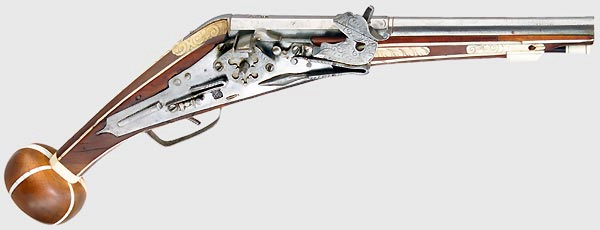
A wheellock pistol or puffer, Augsburg, c. 1580

A wheellock, wheel-lock, or wheel lock is a friction-wheel mechanism which creates a spark that causes a firearm to fire. It was the next major development in firearms technology after the matchlock, and the first self-igniting firearm. Its name is from its rotating steel wheel to provide ignition. Developed in Europe around 1500, it was used alongside the matchlock (c. 1410s), the snaplock (c. 1540s), the snaphance (c. 1560s), and the flintlock (c. 1610s).

Design

[edit]

The wheellock works by spinning a spring-loaded steel wheel against a piece of pyrite to generate intense sparks, which ignite gunpowder in a pan, which flashes through a small touchhole to ignite the main charge in the firearm's barrel. The pyrite is clamped in vise jaws on a spring-loaded arm (or 'dog'), which rests on the pan cover. When the trigger is pulled, the pan cover is opened, and the wheel is rotated, with the pyrite pressed into contact.[1]

A close modern analogy of the wheellock mechanism is the operation of a lighter, where a toothed steel wheel is spun in contact with a piece of sparking material to ignite the liquid or gaseous fuel.

A wheellock firearm had the advantage that it could be instantly readied and fired even with one hand, in contrast to common matchlock firearms, which required a burning cord of slow match ready if the gun might be needed and demanded the operator's full attention and two hands to operate. On the other hand, wheellock mechanisms were complex to make, making them relatively costly.

The "dog"

[edit]

The dog is a spring-loaded arm pivoted on the outside of the lock plate. A sparking material, usually a small piece of iron pyrite, is clamped and held by vise-like jaws at the swinging end of the arm. The dog has two possible positions to which it can be pivoted by hand: a "safe" position, in which the dog is pushed towards the muzzle of the firearm, and an "operating" position, where the dog is pulled towards the operator so that the pyrite in its jaws can engage either the top of the pan cover (see below), or (in the absence of the pan cover) the edge of a steel wheel bearing longitudinal grooves around its circumference. Flint is not suitable as a sparking material in the wheellock because it is too hard and would quickly wear away the wheel grooves.

The wheel

[edit]

The upper segment of the grooved wheel, made of hardened steel, projects through a slot cut to its precise dimensions in the base of the priming pan. The wheel is grooved on its outside circumference with three or more V-shaped grooves with transverse cuts at intervals to provide a friction surface for the iron pyrite. The wheel is fixed to a shaft, one end of which projects outside the lockplate. The outside projection is of square section to permit a spanner (wrench) to be engaged for subsequent tensioning of the lock. The other end of the shaft fits through a hole in the lockplate, and on this end is forged a cam, or eccentric. One end of a short, robust chain (made of three or four flat, parallel links like a short piece of bicycle chain) is fixed to the cam, while the other end of the chain is held in a groove at the end of the longer branch of a large heavy V-spring, which is generally retained by a screw and a headed bracket through upstands inside the lockplate.

The pan

[edit]

As in all muzzle-loading firearms (prior to the introduction of the percussion cap), the pan transmits the fire to the main charge of gunpowder inside the breech of the barrel, via a small hole (or "vent") in the side of the breech, that gives on to the pan. The priming pan of all wheellocks is provided with a sliding cover that has two purposes, the first of which is to contain the priming powder and afford it some protection from the elements (the second is examined below, under 'Operation'). The pan cover may be slid open and closed by hand, but it is also attached to an arm inside the lock plate, which is acted upon by the eccentric on the shaft of the wheel.

The sear or trigger mechanism

[edit]

The trigger engages one arm of a "z"-shaped sear pivoting in its centre between two upstanding brackets riveted or brazed to the inside of the lockplate. The other arm of the sear passes through a hole in the lockplate, and engages in a blind hole on the inner side of the wheel, thus effectively locking it and preventing any rotation but only because of a secondary sear or wedge that is pressed under the rear arm of the sear—that is between the lockplate and the sear—when the forward part of it engages into the recess in the wheel. When the trigger is pulled, the secondary lever is withdrawn from its position and the strong pull of the mainspring pushes the unsupported main sear back into the lock and the wheel is free to rotate. The mechanism may seem overconstructed, but it prevents the trigger mechanism from working against the very powerful mainspring as it is the case with all vertical acting sears in flint and percussion locks or even modern firearms that still have cocks (revolvers).

Preparing to fire

[edit]

First, the dog is rotated forward to the "safe" position, and the priming pan is pushed open (if it is not already so). After loading a powder charge and ball through the muzzle in the usual way, the operator takes his "spanner", slips it onto the square section of the wheel shaft, and turns it until a click is heard (about one-half to three-quarters of a revolution), and the wheel is felt to lock in place, whereupon the spanner is withdrawn. What occurs is that when the wheel is turned, the mainspring is tensioned via the chain, which is wound partially around the shaft. The click is the sound of one end of the sear engaging in the blind hole on the inside of the wheel, thus immobilising it.

The pan is then primed with powder, and the pan cover pulled shut. Finally the dog is pulled back so that the pyrite in its jaws is resting on the top of the pan cover, under some pressure from the spring at the toe of its arm.

Operation

[edit]
The exterior of a wheellock mechanism from a "puffer" or pistol made in Augsburg in about 1580. The photo has been reversed in order to facilitate comparison with the interior view below.
The interior of a wheellock mechanism from a "puffer" or pistol made in Augsburg in about 1580. The mechanism is shown at rest, with the long arm of the mainspring resting on the bottom of the wheel bracket. Invisible behind the wheel bracket is the chain linking the end of the mainspring with the eccentric on the wheel shaft. Also not visible are the sear spring (hidden behind the sear arm itself) and the secondary sear (the end can just be seen to the right of the end of the main sear arm). The "nose" of the main sear going through a hole in the lock plate where it engages with the wheel on the other side.

On pulling the trigger of a wheellock firearm, the sear effects a slight rotation as described above. The end of the sear arm (that has hitherto locked the wheel and prevented it from turning) is disengaged, leaving the wheel free to turn under the tension of the mainspring. There is a subtlety here that is of vital importance: the "hole" in the side of the wheel into which the sear engages, is not a parallel-sided shaft. If it were, then under the tremendous tension of the mainspring, it would require a huge force on the trigger to disengage the sear. Nor is the tip of the sear arm cylindrical, which would have a similar effect. Rather, the "hole" is a depression in the wheel (like a small crater), and the sear has a rounded end: the wheel is locked by reason of lateral force on the shaft of the wheel rather than vertical force on the sear.

As soon as the wheel is released by the sear, the longer arm of the mainspring pulls the chain engaged in it. The other end of the chain being fixed to the cam on the wheel shaft, the latter rotates at high speed, whilst the rotating cam pushes forward the arm to which the pan cover is attached, thus causing the pan cover to slide forward towards the muzzle of the piece, and the pyrites to fall (under tension of the dog spring) on to the now rotating wheel. That is the second purpose of a sliding pan cover: were the pyrites to engage a stationary wheel, it would almost certainly jam the mechanism: but the built-in delay allows the pyrites to slip off the sliding pan-cover on to an already rotating wheel. A more modern development has been the use of a ball bearing between the wheel and the sear. This design allows a smoother and lighter trigger pull, requiring less force to operate.

The fast rotation of the wheel against the pyrites produces white-hot sparks that ignite the powder in the pan, which is transferred to the main charge in the breech of the barrel via the vent, and the gun discharges.

The wheellock took around a minute to load, prepare and fire. Many contemporary illustrations of a wheellock pistol in action show the gun held slightly rotated (about 45 degree angle from the horizontal) rather than vertically as with a hand cannon, to ensure that the priming powder in the pan lay against the vent in the barrel, and avoid a 'flash in the pan' or misfire. This was not the case for the flintlock, where the sparks had to fall vertically a certain distance on to the pan.

History

[edit]
Wheellock of Leonardo da Vinci, 1500

Though not a firearm, a wheellock mechanism for a land mine is described in the Huolongjing, a 14th century Chinese military manual.[2] When stepped on, a pin is dislodged, causing a weight to fall, which spun a drum attached to two steel wheels. The wheels struck sparks against a flint, igniting the fuse.[2]

The invention of the wheellock in Europe can be placed at about 1500. There is a vocal group of scholars who believe Leonardo da Vinci was the inventor. Drawings made by Leonardo of a wheellock mechanism date (depending on the authority) from either the mid-1490s or the first decade of the 16th century. However, a drawing from a book of German inventions (dated 1505) and a 1507 reference to the purchase of a wheellock in Austria may indicate the inventor was an unknown German mechanic instead.[3][4][5]

In 1517 and 1518, the first gun control laws banning the wheellock were proclaimed by the Emperor Maximilian I, initially in Austria and later throughout the Holy Roman Empire. Several Italian states followed suit in the 1520s and 1530s, another argument used by the pro-German camp.[citation needed]

As Lisa Jardine[6] relates in her account of the assassination of William the Silent of the Netherlands, in 1584, the small size, ease of concealment and user-friendly loading aspect of the wheellock, compared to larger and more cumbersome hand-held weapons, meant that it was used for the killing of public figures, such as Francis, Duke of Guise and William himself. Jardine also argues that a stray wheellock pistol shot may have been responsible for the St. Bartholomew's Day massacre of French Huguenots in 1572.[citation needed]

Wheellock pistols were in common use during the Thirty Years' War (1618–1648) on both sides for cavalry and officers. Around 1650 the flintlock began to replace the wheellock as it was cheaper and easier to use than the wheellock.

Wheel-lock firearms were never mass-produced for military purposes, but the best preserved armoury collection at the Landeszeughaus in Graz, Austria, contains over 3,000 examples, many of which were produced in small batches for military units.[7]

Features

[edit]
Spanish wheellock pistol from the late 17th century

Among the advantages of the wheellock was a better resistance to rain or damp conditions than the matchlock and the absence of a telltale glow, or smell from the burning slow match, itself a hazard in proximity to gunpowder. A slow match could be next to impossible to light in rain, but the wheellock allowed sparks to be generated in any weather, and the priming pan was fitted with a cover that was not opened until the instant the gun was fired. That made it feasible for the first time to conceal a firearm under clothing. The high production cost and complexity of the mechanism, however, hindered the wheellock's widespread adoption. A highly skilled gunsmith was required to build the mechanism, and the variety of parts and complex design made it liable to malfunction if it was not carefully maintained. Early models also had trouble with unreliable springs, but the problem was quickly solved.[8]

The wheellock was used along with the matchlock until both were replaced by the simpler and less-costly flintlock, by the late 17th century. The wheellock mechanism however gave faster ignition than the flintlock, because the sparks were produced directly in the pan rather than having to fall a certain distance from the frizzen.

See also

[edit]

References

[edit]
[edit]
Revisions and contributorsEdit on WikipediaRead on Wikipedia
from Grokipedia
![Wheellock pistol or 'Puffer'][float-right] The wheellock is a friction-wheel ignition mechanism for firearms, invented in early 16th-century , that employs a spring-tensioned serrated rotated against a piece of to generate sparks igniting the priming powder in the flash pan. This self-igniting system marked a pivotal advancement over the preceding , which relied on a continuously burning vulnerable to weather and requiring manual ignition, thereby enabling more reliable firing and the emergence of compact, one-handed suitable for mounted or personal defense. Due to its intricate construction involving precision of gears and springs, the wheellock was prohibitively expensive and prone to mechanical failure from wear or dirt, limiting its use primarily to affluent , royal huntsmen, and select elite units such as German black riders or rather than widespread adoption. Despite early bans on civilian ownership by I in 1517–1518 to curb dueling and , it influenced subsequent lock designs and persisted in high-end sporting arms into the before being largely displaced by the simpler, cheaper, and more durable around the 1630s.

Design and Components

The Dog and Spring Mechanism

The , alternatively termed , consists of a pivoting arm affixed to the exterior of the lock plate, featuring vise-like jaws that securely clamp a fragment of . This component serves as the primary tension-holding element, positioning the pyrite for frictional contact with the wheellock's during ignition. Unlike later cocks that actively strike, the dog's design relies on passive positioning under spring force, highlighting a foundational mechanical approach in early self-igniting locks. Integral to the dog's function is its associated V-spring or feather spring, which exerts downward on the pivoting arm. Prior to firing, the is manually raised to a safe position away from the , where it is retained against the spring's tension by a catch linked to the trigger mechanism. Upon trigger pull, this catch disengages, allowing the spring to rapidly snap the dog downward, firmly pressing the against the now-spinning wheel to produce sparks. This spring-driven release ensures brief but intense contact, essential for reliable spark generation without prolonged abrasion. The dog's spring mechanism embodies relative simplicity in its direct application of elastic force via a bent , eschewing complex linkages found in some contemporary systems. However, as handmade components, the pivot screw and spring contact surfaces in early examples were prone to , potentially diminishing tension and requiring periodic manual resets to maintain alignment and efficacy. Analysis of preserved 16th-century locks, such as those from German armories circa 1520-1550, reveals polished on these areas, underscoring the need for meticulous to counteract material fatigue and ensure consistent performance.

The Wheel and Pyrite

The wheel in a wheellock mechanism consists of a hardened steel disc featuring a serrated edge for abrading the pyrite, mounted on an axle with a central square lug for tensioning. It is tensioned by a robust mainspring linked via a chain wrapped around a cam on the axle, storing rotational energy when the wheel is manually rotated and locked by a sear using a spanner tool. Trigger activation releases the sear, enabling the mainspring to unwind the chain and spin the wheel at high speed against the pyrite. Pyrite, or (FeS₂), serves as the spark-producing material, clamped in the dog's jaws and spring-pressed onto the rotating wheel's serrations. The friction from this contact grinds the brittle pyrite, shearing off fine particles that become incandescent through rapid oxidation, generating sparks hot enough to ignite black . This process relies on the mechanical abrasion creating a rugged contact surface, akin to modern friction lighters, where the pyrite's crystalline structure fractures to expose reactive fragments. Effectiveness hinged on pyrite quality, with variations in crystal form and purity influencing ignition consistency; radiating cubic nodules chipped readily to produce abundant small particles for sustained sparking, whereas compact or impure specimens often yielded insufficient heat due to poorer abrasion and oxidation properties. Metallurgical examinations of historical artifacts reveal that high-sulfur, brittle from specific deposits optimized spark volume, reducing misfires compared to lower-grade alternatives that resisted grinding.

The Powder Pan and Frizzen

The powder pan of the wheellock consists of a shallow, open receptacle positioned adjacent to the barrel's , calibrated to hold a minimal charge of fine-grained priming powder for rapid transmission of ignition to the main . This design minimizes the quantity of exposed powder required, enhancing efficiency over bulkier priming. A hinged or sliding cover, functioning analogously to a in later mechanisms, seals the pan during storage and transport, barring ingress of moisture, dust, or stray sparks that could cause premature ignition or render the charge inert. The cover is manually displaced by the operator prior to cocking, precisely exposing the powder to incoming sparks from the wheel-pyrite interaction at the moment of release. This controlled exposure mitigates risks inherent in perpetually open pans of predecessor systems, where environmental factors readily compromised reliability. By maintaining the priming charge in a protected state until activation, the frizzen cover conferred superior weather resistance relative to matchlocks, which depended on an exposed and often uncovered pan susceptible to by rain or humidity. Finer wheellock variants incorporated mechanisms to automate cover displacement, further streamlining the process while preserving causal integrity of .

Trigger and Sear System

The trigger and sear system of the wheellock constituted a critical by enabling the instantaneous release of the tensioned through a simple pull, facilitating reliable, hands-free spark generation without the need for manual holding of an ignition source. The sear, a pivoting or locking pin, engaged a dedicated notch or groove on the wheel's inner surface or , restraining the wheel against the counterforce exerted by its coiled , which had been tensioned during cocking. This engagement directly countered the rotational torque of the , typically calibrated to provide several turns of high-speed upon release. Pulling the trigger disengaged the sear via a mechanical linkage, allowing the mainspring to propel the wheel into rapid counterclockwise rotation—often exceeding several thousand RPM—while the stationary pyrite clamped by the dog generated sparks through friction. Early mechanisms featured either a direct sear bar trigger, akin to adaptations from crossbow or matchlock designs, or an articulated finger trigger connected by a perpendicular arm to the sear pivot, enhancing precision in release. In German variants from the circa 1510s, such as those attributed to Nürnberg gunsmiths, the linkage was predominantly a straightforward sear bar for simplicity and rapid production, whereas contemporaneous Italian examples around 1520 incorporated more articulated triggers with refined pivots for smoother operation in pistols. The system's reliability hinged on a precise balance of sear engagement depth and mainspring tension to avert premature discharge from vibration or minor impacts, a causal necessity rooted in the of resistance where insufficient sear contact area or hardness could lead to slippage under load. Gunsmiths achieved this through sears with angled engagement surfaces providing , ensuring the static exceeded the dynamic forces during non-firing states, as evidenced by the durable construction in preserved 16th-century artifacts. This design demanded meticulous fitting, often hand-filed to tolerances of fractions of a millimeter, to maintain amid the wheellock's inherent complexity compared to later evolutions.

Preparation for Firing

Preparation for firing a wheellock involved tensioning the by winding the with a spanner key, a process requiring several manual turns to store sufficient energy for rotation upon release. This step was essential to ensure the serrated could generate sparks against the but demanded precision to prevent damage to the spring mechanism. A suitable piece of iron pyrite was then clamped into the adjustable jaws of the dog, the pivoting arm analogous to a cock in later locks; the pyrite's brittle composition necessitated regular inspection and replacement to avoid diminished spark quality during operation. The dog was manually lowered to position the pyrite lightly against the pan cover, secured by a feather spring to maintain contact without premature grinding. The priming pan cover was opened, and fine black introduced to bridge the touch-hole, facilitating ignition transfer; care was taken to avoid excess powder that could spill or dampen reliability. These preparatory actions, repeatable before each potential , underscored the mechanism's dependence on user diligence, as the mainspring's repeated tensioning cycles induced material fatigue in the era's alloys, prompting frequent to sustain operational readiness.

Firing Sequence

Pulling the trigger disengages the sear from the 's notch, releasing the mainspring's stored to drive the downward. This action rotates the serrated at high speed via a and cam linkage, while the cam simultaneously slides the pan cover open to expose the priming . The clamped in the 's jaws grinds against the , producing a burst of incandescent sparks that fall into the pan and ignite the fine priming . The resulting generates a flash of hot gases that passes through the into the barrel, igniting the main charge and propelling the ball forward. Developed amid early 16th-century innovations in around 1510, this enclosed ignition sequence enabled near-instantaneous firing without an external , allowing mounted users to deliver rapid successive shots after reloading—contrasting with matchlocks, where extinguishing or relighting the match delayed repeats. Misfires arose from pyrite erosion or inadequate spark yield, with replica tests suggesting probabilities of 10-20% under repeated use.

Historical Development

Origins and Invention Disputes

The wheellock mechanism first appeared in and around 1500, with surviving artifacts indicating parallel development in gunsmithing centers such as and rather than a singular point of . Early examples, including pistols dated to circa 1530 from , demonstrate sophisticated integration of principles adapted from regional and horological technologies, where frictional sparking via rotating against or similar minerals enabled self-ignition without external flame sources. This evolution reflects incremental engineering advances in metalworking and spring mechanisms prevalent in these Alpine-adjacent areas, prioritizing practical firearm reliability over matchlock dependencies on lit fuses. Attributions to individual inventors remain unsubstantiated by primary artifacts. Sketches attributed to in the , dated variably to the mid-1490s or early 1500s, depict conceptual wheellock designs involving a spring-loaded wheel and striker, but no prototypes or evidence link them to functional firearms during his lifetime. Similarly, claims crediting Nuremberg gunsmith Johann Kiefus (or Kiefer) with invention in 1517 rely on secondary accounts without contemporary documentation, such as workshop records or tested weapons, rendering them speculative amid the era's undocumented artisanal secrecy. These narratives often stem from later historiographical , overlooking the distributed innovation typical in pre-industrial hubs where multiple smiths likely iterated on frictional ignition independently. Empirical priority favors Italian and German production records over anecdotal inventor lore. The earliest verifiable wheellock pistols hail from Brescia's workshops, with parallel output by the 1520s incorporating refined components like notched wheels and pan covers, as evidenced by marked barrels and locks in museum collections. This simultaneity underscores causal drivers like demand for cavalry-sidearms in fragmented and Holy Roman Empire conflicts, where mechanical precision from clockmaking—abundant in and —facilitated the leap from unreliable matchlocks without reliance on a lone genius. Disputes persist due to sparse pre-1520 archival survivals, but material evidence debunks unified origin myths in favor of regionally convergent engineering.

Early Adoption in Europe

The wheellock mechanism proliferated initially in the border regions of the and during the early , with origins traced to workshops in and around 1500, areas under Venetian influence and proximate to Habsburg territories. Early examples reflect elite uptake among and mounted elites, as the device's complexity and cost—requiring precision clockwork-like components—limited it to affluent patrons rather than mass issuance. Production remained artisanal and constrained by skilled guilds in emerging centers like and , enforcing monopolies on fabrication that prioritized quality over quantity, with output focused on bespoke commissions. By the 1520s, wheellocks integrated rapidly into sidearms within Imperial armories, evidenced by surviving pistols from this decade, such as a specimen dated circa 1520 originating from Pontebba in , featuring an exposed lock and belt hook suitable for mounted use. The Landeszeughaus in Graz, , preserves around 20 early 16th-century wheellock firearms, including long guns with evolving pan covers, indicating stockpiling for Habsburg border defenses against Ottoman and Hungarian threats. Three pistol-crossbow hybrids in Venice's Ducale, dated circa 1510, represent the earliest verified survivors, combining wheellock ignition with mechanical aiming aids for elite horsemen. Habsburg forces adopted wheellocks for mounted arquebusiers during the (1494–1559), with inventory records from Steiermark armories showing issuance to professional cavalry units by the 1510s–1520s, favoring the mechanism's self-contained ignition over matchlocks for reliable deployment in skirmishes. This elite focus persisted due to manufacturing bottlenecks; guild regulations and the need for specialized grinding and spring tempering restricted annual output to dozens in key workshops, as opposed to thousands of simpler matchlocks. Surviving dated examples from 1510–1530, primarily from Italian-Habsburg frontier smiths, underscore this phased rollout, with pan designs advancing from manual priming to semi-automatic covers by the mid-decade.

Peak Usage and Regional Variations

The wheellock mechanism reached its zenith of popularity during the , particularly from the 1550s to the early 1600s, when it became widely adopted in the German states of the and for elite applications such as noble hunting, cavalry armament, and guard duties. In these regions, armories and workshops in centers like , , and produced sophisticated variants tailored to users who valued reliable self-ignition over the matchlock's vulnerabilities in wet conditions or during stealthy pursuits. Historical records indicate its preference among mounted guards and hunters for enabling quick, hands-free firing, as evidenced by surviving examples from Saxon and Bavarian collections used in princely hunts. Regional adaptations reflected local craftsmanship and tactical needs, with German designs often featuring robust, heavier frames suited to dense forests and game pursuit, while Italian variants trended toward lighter, more ornate constructions for courtly or defensive roles. Innovations in German states included superimposed-load pistols, which stacked multiple charges in a single barrel for successive shots—a rarity documented in Suhl-made pieces signed by gunsmiths like Valentin Klett, dated to 1609. Saxony's armories further exemplified customization with double-barreled wheellocks around 1600, such as over-under configurations in and , allowing dual firing capacity for guards or officers, as preserved in museum exemplars measuring approximately 42 inches in length. These developments, praised in contemporary noble accounts for enhancing precision in expeditions, were nonetheless critiqued in military inventories for their intricate , which inflated costs and restricted widespread issuance beyond affluent or specialized units.

Decline and Transition to Flintlock

The wheellock's decline accelerated in the early as precursors to the true , including the and , emerged around the 1620s, offering markedly simpler mechanisms with fewer moving parts than the wheellock's intricate spring-driven wheel and sear system. These designs, initially popularized in the and , reduced manufacturing complexity by eliminating the need for precision-geared components akin to , which had been prohibitively expensive due to restrictions on such technology in the . By the 1630s, the French-developed true further streamlined production, enabling scalable output for standing armies at a fraction of the wheellock's cost, which remained confined to elite and officers owing to its labor-intensive assembly requiring specialized gunsmiths. Economic pressures during expanding conflicts, such as the (1618–1648), underscored the wheellock's unsuitability for mass issuance; its high per-unit cost—often several times that of matchlocks or early flint variants—limited adoption beyond affluent users, while mechanical vulnerabilities like spring fatigue and wheel slippage compounded field unreliability. inconsistencies, including variable spark quality from impure stones and the need for frequent replacement due to wear against the serrated wheel, contributed to misfires in adverse conditions, contrasting with flint's greater durability and ease of sourcing for consistent ignition. Battlefield accounts from the era highlight these issues, with wheellocks favored by mounted troops for rapid firing but increasingly supplemented by cheaper flint precursors as armies prioritized volume over individual precision. By the war's end around 1648, European forces had begun phasing out wheellocks in favor of flint systems, driven by causal imperatives for cost-effective reliability in prolonged engagements. The transition crystallized in regional conflicts like the (1642–1651), where wheellocks coexisted with doglocks and nascent flintlocks among Parliamentarian and , reflecting a hybrid phase amid ongoing lock experimentation from 1600 to 1670. Dutch armies completed their shift to true flintlocks by , setting a precedent for broader adoption, while English forces retained wheellocks into the 1650s before standardization under the simpler, more repairable flint mechanism. Full followed by 1700, as flintlocks dominated military inventories across Europe due to their manufacturability—requiring no winding or specialized pyrite—and lower failure propensity from reduced mechanical points, rendering the wheellock a relic of early self-igniting ignition primarily for civilian luxury pieces.

Advantages and Limitations

Innovations Over Matchlocks

The wheellock mechanism represented a significant advancement over the by eliminating the need for a continuously burning match cord, which required constant tending and limited the shooter's ability to use both hands for aiming and stability. In the system, one hand typically managed the lit match, compromising accuracy and readiness, whereas the wheellock's self-ignition via a spring-tensioned, serrated grinding against produced sparks directly into the priming pan upon trigger pull, enabling instantaneous firing without external flame management. This innovation enhanced weather resistance through a sliding cover over the priming pan, which protected the powder from rain and damp conditions that could extinguish a matchlock's exposed match or wet priming. Unlike matchlocks, which were highly susceptible to moisture extinguishing the slow-burning match, the enclosed wheellock pan maintained reliability in adverse environments, as evidenced by its preference in scenarios where quick, dependable ignition was critical for pursuing game. Empirically, the wheellock's ignition sequence—from trigger release to spark generation—occurred in fractions of a second in well-maintained replicas, far surpassing the preparatory time for lighting and sustaining a matchlock's match, which could take minutes initially and risked failure mid-action. This rapid, mechanical sparking allowed for sustained two-handed operation, proving particularly advantageous for mounted troops, where the wheellock facilitated the arming of specialized cavalry units like German Reiters with paired pistols for close-range charges in the 16th century.

Mechanical Reliability and Practical Drawbacks

The wheellock's mechanical complexity, featuring a spring-driven serrated grinding against to generate sparks, introduced vulnerabilities absent in simpler systems like the . This design incorporated numerous precision parts, including gears and the , which were prone to binding or failure from accumulated dirt, powder residue, or abrasive particles produced during firing. Extended use exacerbated wear, leading to inconsistent performance and misfires, as the mechanism demanded precise alignment for reliable operation. In practical terms, the wheellock's delicacy contrasted with the matchlock's robustness, requiring frequent disassembly, cleaning, and adjustment by trained gunsmiths rather than routine soldier maintenance. Vibrations from horseback riding, a primary application for early wheellock pistols, further compromised mechanical integrity, increasing the likelihood of jams or spring fatigue during combat. While capable of producing sparks in wet conditions where matchlocks faltered, the wheellock's field reliability diminished without specialized care, limiting its suitability for mass beyond or units. Contemporary assessments underscore that, despite innovations in self-ignition, the wheellock did not achieve consistent spark generation sufficient for revolutionary , as mechanical inconsistencies undermined dependability in sustained engagements. Gunsmith records and artifact examinations reveal patterns of spring breakage and wheel seizure, attributing these to the inherent friction and stress in the grinding action, which prioritized ignition speed over long-term durability.

Economic and Manufacturing Challenges

The intricate machining required for wheellock components, such as the finely serrated steel wheel and powerful V-shaped mainspring, necessitated precision techniques borrowed from clockmaking, driving production costs substantially higher than those for mechanisms, which relied on simpler levers and slow-match ignition. This elevated expense stemmed from the need for skilled artisans to file uniform teeth on the wheel—often by hand—to ensure reliable spark generation against , a process prone to defects without specialized tools. Manufacturing was concentrated in guild-dominated centers like and , where clockmakers' and gunsmiths' syndicates enforced apprenticeships and restricted , curbing output and maintaining high prices through monopolistic practices. Sixteenth-century armory inventories and royal commissions reveal wheellocks as acquisitions, with holster pistols fetching prices equivalent to several months' wages for common soldiers, in contrast to matchlocks costing a thereof—estimates indicate wheellocks commanded 5 to 10 times the cost of comparable arms due to these labor-intensive elements. By the early seventeenth century, regulated pricing in regions like set pairs of wheellock pistols at £3, versus £2 for simpler snaphaunce , underscoring persistent affordability barriers that confined wheellocks to and mounted s. These economics directly impeded , as mass issuance to proved unfeasible amid budget constraints, with armies retaining matchlocks for line troops while reserving wheellocks for officers' personal arms or sidearms. Period military treatises and procurement records, such as those from Habsburg arsenals, portray the wheellock as a costly indulgence unfit for universal equipping, with critics like tactical writers emphasizing its luxury status over practicality for levied forces, thereby highlighting how production hurdles preserved it as a status symbol rather than a transformative infantry tool. This exclusivity, rooted in verifiable supply chain limitations rather than mere preference, delayed broader dissemination until cheaper flintlock variants emerged in the late sixteenth century.

Applications and Impact

Military and Cavalry Employment

![Wheellock pistol used by cavalry][float-right] The wheellock became a hallmark for specialized units, notably the German Reiters, from the early through the 1630s. These mounted troops, armored in breastplates and equipped with up to three wheellock pistols, revolutionized cavalry tactics by emphasizing firepower over lances. The self-igniting mechanism enabled rapid, hands-free firing from horseback, allowing riders to execute the caracole maneuver: advancing in successive ranks to discharge pistols at enemy or cavalry at close range before wheeling away to reload, thus delivering sustained volleys without exposing the entire unit. During the Schmalkaldic War (1546–1547), wheellock-armed Reiters provided Imperial forces with a decisive edge in open-field charges, where the pistols' ability to fire instantly without lit matches offered superior mobility and surprise against Protestant levies reliant on slower matchlocks or weapons. German military chronicles praised this combination of speed and reliability in fluid engagements, crediting it with breaking pike squares and disrupting enemy advances. Double-barreled wheellock variants, exemplified by a 1540 pistol made for Emperor Charles V, extended this capability by permitting two shots per approach, enhancing potential in armies during maneuvers against foes. Despite these advantages, wheellocks proved less suitable for siege warfare, as the requirement to pre-wind the spring—taking up to a minute—hindered spontaneous defensive , and the intricate jammed easily in or after prolonged use. Contemporary accounts critiqued the mechanism's fragility under campaign rigors, with rates increasing in adverse conditions, though elite Reiter units mitigated this through skilled maintenance. By the 1630s, as flintlocks proliferated, wheellocks' role waned among broader , confined to officers valuing the instant ignition for or duels.

Civilian Hunting and Self-Defense

![Wheellock pistol or 'Puffer'][float-right] Wheellock mechanisms found application in civilian hunting, particularly among pursuing large game such as , where the served as a rapid backup to traditional spears. Combination weapons, including boar spears integrated with double-barrel wheellock pistols dating to circa 1575 in , allowed hunters to dispatch wounded animals at close range without relying on slower ignition. These devices emphasized the wheellock's advantage in quick, one-handed operation, enabling draws from holsters or scabbards during dynamic pursuits. Sporting rifles, like mid-16th-century French examples, provided enhanced accuracy over smoothbore for longer-range shots on game, transforming noble hunts from primarily affairs to hybrid engagements. In self-defense contexts, wheellock pistols appealed to affluent urban dwellers and elites for personal protection, offering reliable ignition independent of external . Early 16th-century designs, restricted initially to nobles and guards via imperial decrees like I's 1517 ban on broader possession, underscored their status as luxury arms suitable for concealed or holstered carry. Combination arms, such as rapiers paired with wheellock pistols from the late , facilitated defensive responses in duels or street encounters, though their complexity often rendered them more ceremonial than practical for . The mechanism's resistance and self-contained sparking supported deployment in varied conditions, yet its intricate steel-wheel construction—requiring skilled craftsmanship—confined ownership to the wealthy, as evidenced by probate inventories listing such items among high-value estates of merchants and rather than commoners. This exclusivity balanced the wheellock's tactical edges, like superior draw speed over matchlocks, against prohibitive costs that limited widespread adoption for personal security.

Cultural and Technological Influence

The wheellock mechanism advanced firearm technology by introducing the first practical self-igniting system, utilizing a spring-tensioned wheel to generate sparks against upon trigger release, thereby enabling rapid, match-independent firing suitable for use. This snap-action principle directly influenced subsequent designs, such as the lock developed in the late , which simplified the internal by employing an external hammer and for spark production while retaining the core concept of mechanical ignition. Wait, no wiki. From results, [web:51] but wiki. Use [web:53] for snaplock cheaper alternative to wheel-lock. In the cultural sphere of Germany, particularly in principalities like and , the wheellock symbolized technical mastery and elite status, its intricate construction demanding collaboration between gunsmiths and clockmakers, as evidenced by ornate examples produced for princely patrons such as the wheellock gun made for the of the of around 1580. Such firearms often served as diplomatic or courtly gifts, underscoring a shift toward viewing portable as an emblem of and , with surviving artifacts like the circa 1540 double-barreled attributed to imperial workshops highlighting their role in displays of power. Experimental breadth is illustrated by early wheellock variants featuring diverse sear configurations and release systems, many of which failed to achieve mechanical consistency under field conditions due to the design's inherent complexity, prompting iterative adaptations that ultimately favored simpler successors but underscored the era's inventive drive.

Legacy and Modern Perspectives

Role in Firearms Evolution

The wheellock, emerging around 1510 in the , marked a pivotal shift in ignition by introducing the first self-contained mechanical spark generation, eliminating the 's dependence on a continuously lit exposed to weather and accidental ignition. This innovation utilized a spring-tensioned pyrites stone pressed against a rotating serrated steel to produce sparks directly into the priming pan, enabling reliable firing without external flame sources. By reducing vulnerability to rain and wind—common causes of matchlock failure rates exceeding 20% in adverse conditions—the wheellock facilitated and rapid deployment in and scenarios, though its complexity limited mass adoption. This mechanism directly influenced subsequent designs, bridging pyrites-based sparking to flint-on-steel systems by the mid-16th century. The snaphaunce, patented in variants by the 1550s in the and , adapted wheellock principles with a separate external flint clamp and , simplifying production while retaining mechanical reliability; doglocks, appearing around as wheellock hybrids with a half-cock "dog" for safety, further refined trigger safety against premature discharge. These evolutions culminated in the true by the early 17th century, which integrated the pan cover and battery into a single piece, slashing manufacturing costs by up to 80% compared to wheellocks and achieving misfire rates below 10% in dry conditions—improvements empirically traced to wheellock's proof-of-concept for enclosed, user-initiated ignition. While some accounts overstate the wheellock as the "first reliable" ignition due to its speed advantage over matchlocks (firing in under 2 seconds versus 3-4 for match application), historical testing reveals incremental gains: wheellock misfires stemmed from wheel wear and pyrites degradation, often matching or exceeding early rates in prolonged use, per armorer records from 16th-century European arsenals. Its causal role extended to 19th-century percussion caps, patented in 1818 by Alexander Forsyth, by demonstrating viable internal priming that obviated open pans entirely, paving the way for weatherproof, near-zero-misfire systems that reduced failures from 15% in flintlocks to under 1%. Thus, the wheellock's legacy lies in catalyzing a toward fully mechanical and chemical ignitions, though its high failure potential under dirt accumulation underscores it as a transitional, not transformative, step.

Contemporary Replicas and Experimental Use

Modern gunsmiths and specialist firms produce functional wheellock replicas, replicating 16th- and 17th-century designs with period-accurate components such as spring-loaded wheels and igniters. The Rifle Shoppe supplies reproduction parts, including locks and hardware, for assembling operable wheellocks from kits or custom builds. Custom fabrications, like a 2019 reproduction of a 1640s German with a 32-inch barrel and transitional cheek stock, are documented in enthusiast forums, emphasizing fidelity to original dimensions and materials where feasible. European gunsmiths, as discussed in reenactor communities, craft bespoke pistols mimicking cavalry models from the era. These replicas see experimental use in historical shooting demonstrations and informal tests, validating operational principles through live fire. Firearms analysts like those at conduct loading and firing sequences with reproductions, illustrating the spanner-winding process and spark generation, though noting mechanical sensitivities. Polish-made faithful copies of 17th-century pistols have been tested for and accuracy, firing black powder loads to assess and impact at short ranges typical of mounted use. Such events occur in muzzleloading clubs and private ranges, where participants evaluate handling without modern safety modifications. Ignition experiments with replicas highlight practical limitations, with user-reported success rates varying from 10-50% in initial pyrite tests to higher with refined setups, demanding frequent disassembly for cleaning and adjustment to prevent misfires from powder residue or wheel slippage. These findings affirm the mechanism's dependence on precise , contrasting with simpler flintlocks, and underscore durability constraints from on components under repeated . No significant post-2000 archaeological recoveries have altered prior understandings, but replica —using modern for safety—mirrors original iron's limits under cyclic stress. Collectible replicas command auction values reflecting craftsmanship, with examples like engraved 17th-century-style pistols fetching hundreds to low thousands of dollars, depending on functionality and details. Non-firing decorative versions, often Victorian-era or tourist trade items, trade lower but illustrate broader interest in wheellock aesthetics for study and display.

References

Add your contribution
Related Hubs
User Avatar
No comments yet.