Hubbry Logo
Safari jacketSafari jacketMain
Open search
Safari jacket
Community hub
Safari jacket
logo
8 pages, 0 posts
0 subscribers
Be the first to start a discussion here.
Safari jacket
Safari jacket
from Wikipedia

Safari jacket

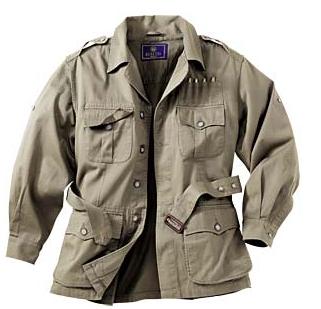
A safari jacket or bush jacket is a garment traditionally made of khaki color lightweight cotton (drill or poplin) with a self-belt, epaulets, and four expandable bellows pockets. Also known as a sahariana, it was originally designed for going on safari in the African bush. When paired with matching trousers or shorts, it is a safari suit.[1]

History

[edit]
M. 1943 safari jacket (sahariana) of the Spanish Army in Spanish Sahara

Lightweight, light-coloured uniforms were worn by European soldiers serving in warm climates from the 19th century and, little altered, throughout World War II.[2] They typically featured epaulettes, pleated pockets, belts and other features later found on safari jackets.

The earliest reference to a 'safari suit' listed in The Oxford English Dictionary[3] is from an American newspaper in 1935. In 1936, author and adventurer Ernest Hemingway designed a 'bush jacket' which was made by Willis & Geiger Outfitters. In 1939, Abercrombie & Fitch advertised safari jackets, shorts and trousers, of 'coat shirt style' for sports and leisure wear.[4]

Yves Saint Laurent Rive Gauche "Safari" jacket (1968)

In the 1960s and 1970s, safari suits became fashionable thanks to designer versions for men and women by, for example, French designers Ted Lapidus and Yves Saint Laurent, both of whom are among those credited with inventing and popularising the look.[5][6]

Australia

[edit]
Charles and Diana visit Ayers Rock (Uluru), Australia, March 1983

The safari suit is popularly associated with Australian fashion in the 1970s. It was sometimes worn by the former South Australian Premier Don Dunstan.[7]

On 7 March 1974, male politicians in the Northern Territory were given permission by the Speaker of the House Les MacFarlane to wear safari suits during sittings of the Northern Territory Legislative Assembly. It was granted at the request of the Leader of the Opposition, Mr Jon Isaacs. The Speaker of the House said:

Honourable members, I have received a further request that the standard of male dress be relaxed to include safari jackets. I have been in touch with the federal parliament and I find that the Speaker, Sir Billy Snedden, is allowing safari jackets with shirt and tie. He also allows one member to wear a safari jacket over an open-necked shirt. Therefore, I have decided to accept safari jackets as suitable dress in the Assembly. I must say that I do this very reluctantly because I feel that we have relaxed our standards too far. However, the precedent has been set. I might add that I will not allow T-shirts.

Charles, Prince of Wales famously wore a safari suit on his visit to Ayers Rock with Diana, Princess of Wales in 1983.[citation needed]

Decades after they had ceased being fashionable, then-father of the house Philip Ruddock wore a safari suit into the Australian House of Representatives during Question Time in 2015 as part of a charity drive.[8][9]

India

[edit]
Soviet Summer M1988 Afghanka field uniform (safari suit).

In India, the safari suit gained popularity through the 1970s influenced to a large degree by films (James Bond/Roger Moore) and some fashions trends from the west for warmer climates. The safari suit in India gained prominence when local synthetic fibre manufacture and supply was significantly increased in the later half of the 1970s.

Reliance Industries and other textile manufactures set up synthetic fibre plants in India significantly reducing the price of synthetic fibre and the Indian middle class jumped at the opportunity to be well dressed in a fabric which, though unsuited to India's climate was fairly cheap, easy to maintain and long-lasting.[10] The safari suit continued to be the de facto business attire, particularly in government/public sectors and the SMB arena in India, through the late-1990s. With India's growth over the 1990s, liberalization and with the middle class suddenly having more disposable income, the younger generations began to gravitate towards more modern western fashions such as suits and other business attire. Although it is still visible in some parts of India, the Safari suit is now indelibly associated with the so-called License Raj—the slow, inefficient Indian bureaucracy of the 1970s and the 1980s.

Revival

[edit]
Former Malaysian Prime Minister Mahathir Mohamad is known for his safari suits[11]

Beginning in the mid 2010s, a variant of the bush jacket, known as a shirt jacket or shacket, underwent a revival in the UK and Europe due to the popularisation of vintage workwear by the hipster subculture.[12] These were frequently made from blue denim, cambric, seersucker, heavy cotton in olive green or khaki, natural linen, or camouflage cloth, and featured patch pockets.[13] Some had the epaulets, belt, and pocket flaps of the traditional safari jacket, while others did not.[14]

A modern Teba jacket-style sahariana by Camisería Burgos

See also

[edit]

References

[edit]
Revisions and contributorsEdit on WikipediaRead on Wikipedia
from Grokipedia
The safari jacket, also known as the bush jacket or saharienne, is a lightweight, belted garment typically crafted from breathable drill in or neutral tones, characterized by four large bellows patch pockets, shoulder epaulettes, a wide revere collar, and a self-belted for adjustability and functionality in warm environments. Originating in the mid-19th century British colonial uniforms in the , where khaki-dyed was introduced in 1848 by Lieutenants Harry Lumsden and William Hodson for service in , particularly on the North-West Frontier, for and heat dissipation, the design evolved into practical hunting attire known as the Shikar jacket by the 1850s, featuring expansive pockets for ammunition and gear. By the turn of the , during the Second Boer War, British troops in adapted similar uniforms, which post-war influenced civilian bush clothing for explorers and hunters in the African savannah. The term "safari jacket" emerged in the mid-1930s, coinciding with its popularization among Western tourists on African expeditions, exemplified by Hemingway's endorsement of the bush jacket in 1936. In the mid-20th century, the safari jacket transitioned from utilitarian outerwear to a fashion icon, notably through Hollywood portrayals—such as Clark Gable in Mogambo (1953) and Roger Moore as James Bond in Octopussy (1983)—and its adoption by figures like Gregory Peck, Douglas Fairbanks Jr., and Prince Charles. A pivotal moment came in 1968 when Yves Saint Laurent introduced a women's ready-to-wear version in cotton gabardine for his Rive Gauche line, drawing from Afrika Korps uniforms and African colonial menswear to symbolize 1960s liberation and gender fluidity in fashion, as featured in a Vogue Paris photo-essay that year. Today, the safari jacket remains a versatile staple in menswear and womenswear, with modern iterations in linen, wool-cashmere blends, or even 15-pocket variants, blending practicality with timeless style across tailoring houses like Anderson & Sheppard and streetwear labels.

Design and Features

Key Elements

The safari jacket is characterized by its belted waist, which cinches the midsection for a tailored while allowing secure carriage of items during movement across varied terrain. This feature, often integrated with loops on the jacket body, provides adjustable fit and contributes to the garment's structured yet practical form. Complementing the belt are epaulettes on the shoulders, functional straps originally designed to secure or small items like compasses, enhancing utility for outdoor expeditions. The elements of the safari jacket draw briefly from historical influences, adapting components for civilian exploration needs. Central to its iconic appearance are the four bellows pockets—two positioned on the chest and two on the hips—featuring expandable box pleats and buttoned flaps that accommodate gear such as , maps, or without creating bulk, thereby maintaining a streamlined profile. These pleated pockets expand outward when filled, offering tenfold greater capacity compared to flat designs, which is essential for hunters or travelers requiring hands-free storage during prolonged activities. A stand-up or revere collar frames the , providing protection from sun and while promoting when spread open, paired with a full button-front closure using sturdy buttons for reliable fastening in rugged conditions. Functionally, the jacket often includes reinforced elbows, typically with articulated or padded construction, to withstand abrasion from brushing against foliage or carrying loads during outdoor pursuits. A vented back, achieved through inverted pleats or side slits, facilitates airflow and ease of motion, preventing overheating in warm environments and allowing unrestricted arm swings for activities like shooting or . Some variants feature half-length sleeves with roll-up tabs, offering versatility for temperature fluctuations by enabling quick conversion to shorter lengths without compromising protection. Variations in fit cater to diverse preferences and activities, including slim cuts that emphasize a modern, contoured shape for urban wear; regular fits that balance structure and comfort for everyday use; and relaxed or boxy silhouettes that prioritize mobility and layering in field conditions. These fit options stem from the jacket's origins in practical outdoor demands, ensuring adaptability whether for precise tasks requiring a fitted form or broader movements in expansive environments.

Materials and Construction

The traditional safari jacket is constructed primarily from , a durable fabric chosen for its in hot, arid environments and the dye's ability to provide natural against dry landscapes. This weave, often in weights around 7.5 ounces, allows air circulation while offering protection from brush and sun exposure during extended outdoor activities. blends complement these jackets by providing lightweight moisture-wicking properties, enhancing comfort in humid conditions through natural absorption and of sweat. In modern iterations, safari jackets incorporate sustainable materials such as for reduced environmental impact and breathability similar to traditional versions. Recycled appears in eco-friendly blends, offering durability and recyclability without depleting new resources. For cooler climates, provides a soft yet robust texture with natural insulation, while adds warmth and a tactile appeal suitable for transitional weather. Technical fabrics with built-in UV protection, such as UPF50+ treatments, shield against prolonged sun exposure, and water-resistant coatings ensure functionality in variable conditions. Key construction elements emphasize ruggedness and ventilation, including double-stitched seams along major stress points to withstand abrasion and repeated use in rough terrain. Self-fabric belts, woven from the same material as the body, cinch the for a tailored fit without adding bulk or restricting movement. Many designs remain unlined to promote airflow and reduce weight, ideal for warm settings, though partial linings—such as flat applied via hand-basting—offer subtle structure and seam reinforcement in structured variants. Manufacturing has evolved from hand-stitched colonial-era pieces, often and tailored by specialist firms using techniques like bias-cut sections and seam finishes for precision, to contemporary machine-produced versions that scale production while maintaining quality. Post-2020, ethical sourcing has gained prominence, with brands prioritizing certified sustainable fibers like bluesign-approved and traceable supply chains to minimize environmental harm and ensure fair labor practices.

History

Origins in the 19th Century

Precursors to the safari jacket emerged in the mid-19th century in British India as adaptations of uniforms originally developed for the , later tailored for use by British officers and explorers in East Africa's tropical climates during colonial expeditions. Introduced in 1846 by Lieutenant William Hodson and Sir Harry Lumsden for the Corps of Guides in , these lightweight, dust-colored garments were dyed from white using mud or tea to provide and comfort in arid, hot environments. As British expansion into Africa intensified, the uniform's design was refined for practicality, evolving from standard military attire into a versatile jacket suited for prolonged fieldwork, with features like reinforced pockets emerging from the need to carry essential items such as , maps, and instruments. Key influences on its development included the Anglo-Zulu War of 1879 and the broader Scramble for Africa, where British forces required protective yet breathable clothing for hunting, reconnaissance, and territorial campaigns in rugged terrains. During the Zulu War, khaki was reintroduced for British troops after earlier trials in India, offering superior mobility and concealment compared to traditional red coats, and its lightweight cotton drill fabric proved ideal for East Africa's humid conditions. In the context of the Scramble for Africa from the 1880s onward, such garments became standard for colonial expeditions, enabling officers to navigate dense bush and withstand intense heat while maintaining functionality for exploration and big-game pursuits. Early formal descriptions of these practical jackets appear in explorer accounts from the 1850s and s, predating widespread civilian adoption, with pockets and other utilitarian elements derived directly from uniform necessities to accommodate tools of trade. For instance, Captain Henry Shakespear's book The Wild Sports of detailed the "Shikar Jacket," a variant with capacious pockets for knives, telescopes, and cartridges, reflecting adaptations already in use by British personnel transitioning from to African theaters. Within the British Empire's exploratory efforts, such practical attire suited for tropical travel—often khaki-inspired for durability and ventilation—supported missionary and geographical surveys across southern and . These jackets thus symbolized imperial mobility, blending military utility with the demands of 19th-century African ventures.

20th Century Development

During the early 20th century, particularly amid World War I, the safari jacket evolved from its colonial origins into a practical military garment for British forces in arid environments, such as the Middle Eastern campaigns, where lightweight khaki drill versions with expandable pockets proved essential for carrying supplies in hot climates. By World War II, Allied forces, including the British Army in North African desert operations, widely adopted the khaki drill bush jacket—a close precursor to the modern safari jacket—for its breathability and functionality in extreme heat, with designs featuring four patch pockets for ammunition and gear. These military iterations standardized elements like bellows pockets, which allowed expansion for storage without bulk, and post-war surplus availability further disseminated the style to civilians through affordable outlets. In the 1930s and 1940s, the jacket gained cultural traction through literature and high-profile adventurers, exemplified by Ernest Hemingway's endorsement during his 1933–1934 African safari, where he commissioned custom versions from outfitter Willis & Geiger, praising their durability for in his writings like Green Hills of Africa (1935). This exposure romanticized the garment beyond utility, influencing explorers and writers who adopted it for African expeditions, solidifying its image as an emblem of adventure. By the 1960s, fashion designers elevated it further; Yves Saint Laurent introduced a women's safari jacket in his 1968 summer collection, adapting the utilitarian design with tailored silhouettes and tones to embody liberated, nomadic elegance for urban wardrobes. The 1970s marked a pivotal shift as the safari jacket transitioned from field gear to mainstream apparel, driven by mass-market brands that democratized its production. Founded in 1978, initially specialized in safari-inspired clothing, offering affordable cotton versions with epaulets and belted waists that appealed to a broad audience seeking casual, adventurous style, thus embedding the jacket in everyday global fashion. This era's popular media reinforced the trend; in the 1985 film , characters portrayed by and wore safari jackets during Kenyan plantation scenes, highlighting their timeless appeal and accelerating their adoption as a versatile wardrobe staple beyond colonial or military contexts.

Regional Variations

In Australia

The safari jacket was introduced to in the early 20th century through British colonial influences, as settlers and explorers adapted lightweight, practical garments from military origins for the harsh environment. Evolving into what is often called the "bush jacket," it became essential for ranching, cattle mustering, and inland exploration, where its breathable construction suited the extreme heat and dust. The garment reached peak popularity in during the 1970s and 1980s, emerging as a symbol of casual amid a push for climate-appropriate attire over formal European suits. South Australian Premier frequently wore safari suits, using them to advocate for relaxed parliamentary dress codes that reflected 's warmer conditions and laid-back ethos. This trend extended to high-profile visits, such as Prince Charles donning a safari suit during his 1983 tour of , further embedding the style in public perceptions of modern, approachable Australian culture. A notable revival occurred in 2015 when Liberal MP wore a suit to Parliament House in to raise funds for motor neurone disease research, drawing attention to the garment's enduring charitable and cultural resonance. Australian adaptations of the safari jacket emphasize durability for rugged terrain, often featuring reinforced pockets, bi-swing backs for mobility, and water-resistant cotton poplin fabrics to withstand conditions. In rural fashion, it is commonly paired with hats, forming a quintessential ensemble for stockmen and dwellers that blends functionality with iconic Australian heritage.

In India

The safari jacket, originally derived from 19th-century British military uniforms adapted for tropical climates during the colonial era in under the , was introduced as lightweight attire for officers on expeditions and administrative duties. This early form emphasized breathability and functionality in the subcontinent's heat, with features like epaulets and patch pockets evolving from practical needs in the field. Post-independence, the garment was localized as the "bush shirt," a short-sleeved variant suited to India's tropical conditions, gaining traction among urban professionals and bureaucrats in the and as a comfortable alternative to formal Western suits. Endorsed by public figures such as cricketer and politicians, it represented a blend of colonial utility and emerging national identity, often paired with for wear in sweltering summers. The 1970s marked a surge in popularity, propelled by Bollywood films like (1975), where characters such as the villain Gabbar Singh, played by Amjad Khan, sported an olive-green safari suit, glamorizing it as rugged yet stylish attire. This cinematic exposure, combined with the advent of affordable synthetic fibers like and produced by Indian companies such as , made the bush shirt accessible to middle-class urban professionals, costing around Rs 450 and available in vibrant colors. Stars like and further boosted its appeal by wearing customized versions in films, transforming it from utilitarian wear to a symbol of aspirational modernity. By the 1990s, the safari jacket experienced a decline amid India's , as Western casual trends and multinational corporate dress codes—favoring suits from brands in and —eclipsed its dominance in urban settings. Despite this, it persisted in safari tourism, where neutral-toned versions with multiple pockets remain standard for excursions in reserves like those in and , offering protection from dust and insects. It also endures in formal-informal hybrid outfits among traders and small businessmen in cities like , , and , produced by brands such as . Culturally, the safari jacket embodies post-independence practicality in , signifying a break from Gandhian toward efficient, heat-adapted clothing that aligned with the nation's bureaucratic and entrepreneurial ethos during the License Raj era. Variations, including shorter sleeves and unlined or constructions, underscore its adaptation for extreme heat, making it a enduring emblem of resilient, climate-responsive style.

Other Regions

In Africa, particularly in and , the safari jacket originated as practical attire for expeditions in the bush during the colonial era but persisted as a key garment post-independence in the . It was widely used by locals as game wardens and guides, as well as by international tourists visiting reserves like the and , for its durability and functionality in rugged terrains. Earth-tone dyes, such as , were commonly applied to provide by blending with the landscape, enhancing safety during interactions. In and the , the safari jacket transitioned from and exploratory roots to broader adventure wear by the mid-20th century, with renewed popularity in the amid a surge in outdoor enthusiasm and cinematic influences. This period saw its embrace in casual exploration styles, notably through the khaki cotton safari shirt sported by in films like (1981), symbolizing rugged adventurism and inspiring everyday utility apparel. Brands in the outdoor sector, such as , incorporated similar multi-pocketed, lightweight designs into gear, adapting the jacket's belted silhouette and epaulettes for trail use in temperate climates. The safari jacket's global dissemination accelerated through military surplus channels in the mid-20th century, following , when excess British and Allied uniforms flooded markets worldwide. This availability democratized the design, influencing casual menswear by integrating its practical elements—bellows pockets, cinched waist, and neutral palettes—into urban wardrobes for photographers, travelers, and style-conscious professionals across continents.

Revival and Modern Use

The safari jacket saw a notable revival beginning in the , reemerging as a versatile staple in menswear with updated silhouettes emphasizing functionality and casual elegance. Brands reinterpreted the classic design using materials like drill, , and , retaining signature elements such as wide collars, four patch pockets, epaulettes, and optional belts or half-belts. European labels, including the UK-based Private White V.C., contributed to this resurgence by offering lightweight versions suited to transitional wardrobes, often in neutral palettes and slimmer fits that aligned with contemporary utility aesthetics. Retailers like popularized accessible iterations, blending the style into everyday . In Resort 2020 collections, the safari jacket featured prominently as a nod to and practicality, with designers elevating the utilitarian form through luxurious fabrics. and presented versions in opulent brocades, while opted for supple butter leather, highlighting the jacket's multiple pockets as a clever alternative to mini-bags. Following the , the trend persisted into Spring/Summer 2021 as part of a broader "new utility" movement, reflecting a desire for adaptable, multi-purpose pieces amid shifting lifestyles and travel recovery. showcased moss canvas safari jackets paired with or tailored trousers, added a sumptuous finish, and Tod’s introduced ribbed leather variants for refined versatility. By 2024 and 2025, the safari jacket solidified as a must-have in menswear, appearing in runway shows and luxury collections with innovative textures for urban styling. At for Spring/Summer 2025, belted utility jackets in safari-inspired designs were integrated with kimonos and tailored pieces, emphasizing waist definition and earthy tones. offered elevated options like unlined models with horn buttons and water-resistant cashmere versions, alongside iterations for cooler layering. complemented this with safari jackets in white and green cotton-linen blends, as well as houndstooth blazers, often styled with for casual city looks. Runway integrations and celebrity endorsements further propelled the jacket's modern appeal, blending it seamlessly with contemporary tailoring. Designers at 2024 incorporated safari motifs into terry cloth and linen field jackets, pairing them with striped Breton shirts or blazers for effortless sophistication. exemplified its feminine yet bold revival by wearing a softer safari jacket iteration that transitioned from day to evening, underscoring the style's enduring versatility in high-profile settings.

Contemporary Applications

In contemporary applications, the safari jacket remains a staple for eco-tourism and expeditions, valued for its lightweight construction and multiple pockets that accommodate essentials like and water bottles during activities such as African game drives in the Masai Mara or Australian outback treks. Modern versions often incorporate UV-protective fabrics, such as neutral-toned or waxed canvas, to shield wearers from intense sun exposure while blending with natural environments for minimal disturbance to wildlife. The jacket's versatility extends to urban and professional settings, where it serves as a practical layer over t-shirts for casual office environments or as attire in and . For instance, in 2015, Australian Liberal MP wore a safari suit to Parliament House in to raise charity funds, highlighting its acceptance in formal yet relaxed political contexts. It pairs effectively with chinos for a polished look or for everyday errands, offering functionality without sacrificing style in city commutes. Adaptations for women and gender-neutral wear have gained prominence in the 2020s athleisure trend, featuring tailored fits with nipped waists and hip-length hemlines that suit city exploration and active lifestyles. Brands like Anatomie offer stretch-woven versions in slim silhouettes, allowing easy movement for urban walking tours or hybrid work-to-leisure transitions, while maintaining the jacket's signature utility pockets. Post-2020, sustainability has driven innovations in safari jacket production, with ethical travel brands using recycled materials like Ventile® Eco fabric derived from post-consumer cotton waste to reduce environmental impact. These versions support eco-conscious outings by minimizing resource use, and they integrate seamlessly into versatile outfits, such as layering over tees with chinos for sustainable daily wardrobes.

References

Add your contribution
Related Hubs
User Avatar
No comments yet.