


Community hub
Recent from talks
Contribute something
Nothing was collected or created yet.
Job's tears
View on Wikipedia
| Job's tears | |
|---|---|

| |
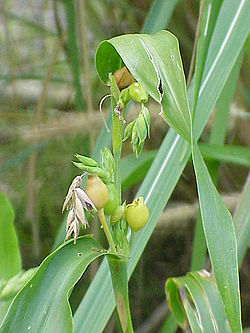
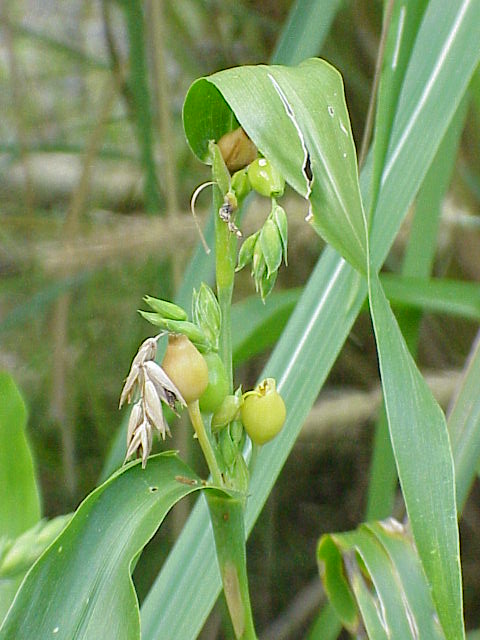
| Inflorescences | |
Scientific classification 
| |
| Kingdom: | Plantae |
| Clade: | Tracheophytes |
| Clade: | Angiosperms |
| Clade: | Monocots |
| Clade: | Commelinids |
| Order: | Poales |
| Family: | Poaceae |
| Subfamily: | Panicoideae |
| Genus: | Coix |
| Species: | C. lacryma-jobi
|
| Binomial name | |
| Coix lacryma-jobi | |
| Synonyms[1] | |
| |
Job's tears /dʒoʊbz/ (Coix lacryma-jobi), also known as adlay or adlay millet, is a tall grain-bearing perennial tropical plant of the family Poaceae (grass family). It is native to Southeast Asia and introduced to Northern China and India in remote antiquity, and elsewhere cultivated in gardens as an annual. It has been naturalized in the southern United States and the New World tropics. In its native environment it is grown at higher elevation areas where rice and corn do not grow well. Job's tears are also commonly sold as Chinese pearl barley, though true barley belongs to a completely different genus.
There are two main varieties of the species, one wild and one cultivated. The wild variety, Coix lacryma-jobi var. lacryma-jobi, has hard-shelled pseudocarps—very hard, pearly white, oval structures used as beads for making prayer beads or rosaries, necklaces, and other objects. The cultivated variety Coix lacryma-jobi var. ma-yuen is harvested as a cereal crop, has a soft shell, and is used in traditional medicine in parts of Asia.
Nomenclature
[edit]Job's tears may also be referred to under different spellings (Job's-tears,[2][3] Jobs-tears[4]). The crop is also known by other common names in English, such as adlay or adlay millet.[5][6] Other common names in English include coix seed,[5][7] gromwell grass,[5] and tear grass.[5]
The seeds are known in Chinese as yìyǐ rén (薏苡仁),[8][7] where rén means "kernel", and also described in Latin as semen coicis or semen coicis lachryma-jobi in pharmacopoeic literature.[7][9]
Taxonomy
[edit]The species, native to Southeast Asia,[10] was named by Carl Linnaeus in 1753 with the epithet as a Latin translation of the metaphorical tear of Job. As of February 2015[update], four varieties are accepted by the World Checklist of Selected Plant Families:[11]
- Coix lacryma-jobi var. lacryma-jobi
- Widely distributed throughout the Indian subcontinent to peninsular Malaysia and Taiwan; naturalized elsewhere. The involucres are ovoid, bony and glossy. It has hard shells and is used as beads in crafts.
- Coix lacryma-jobi var. ma-yuen (Rom.Caill.) Stapf
- South China to peninsular Malaysia and the Philippines.
- The varietal name is eponymous after General Ma Yuen or Ma Yuan (馬援) who according to legend learned of the plant's use when he was posted in Cochin China (or Tonkin, in what is now Vietnam), and brought the seeds back to China to be cultivated.[12][13][14] The involucres are elliptical, striate and soft.
- Assam to Yunnan (China) and Indochina. It is the smallest among the Indian species, with only 4mm in diameter of the seeds. It is used for ornament as well.
- Coix lacryma-jobi var. stenocarpa Oliv.
- Eastern Himalayas to Indochina.
Job's tears—along with Coix in —was formerly placed in the Maydeae, now known to be polyphyletic.[Sch 1] It has cylindrical, longer than broad involucres. It is widely used as beads for ornaments.[15]
Morphology
[edit]Job's tear is a monoecious grass which is broad-leaved, loose-growing, branched and robust. It can reach a height between 1.20 m to 1.80 m. Like all members of the genus, their inflorescences develop from a leaf sheath at the end of the stem and consist partly of hard, globular or oval, hollow, bead-like structures. Job's tear seeds differ in color, with the more soft-shelled seeds being light brown and the hard-shelled forms having a dark red pericarp.[16]
![[icon]](https://en.wikipedia.org/wiki/File:Wiki_letter_w_cropped.svg) | This section needs expansion. You can help by adding to it. (December 2020) |
The hardened "shells" covering the seeds are technically the fruit-case or involucre (hardened bract),[17] with the bract also referred to as "capsule-spathe"[18] or "sheathing bract" by some past botanical works.[2]
These shells cover the bases of the flowers (inflorescences) which are male and female racemes/panicles; the male racemes project upright and consist of overlapping scale-like spikelets, with yellow stamens that pop out in-between, and there are one or two yarn-like stigmas drooping from the base.[19][20]
Proteins
[edit]Job's tears – as with Coix in general – produces its own variety of α-zein prolamins. These prolamins have undergone unusually rapid evolutionary divergence from closely related grasses, by way of copy-number changes.[Sch 2]
History
[edit]Job's tears is native to Southeast Asian countries, namely India, Myanmar, China, and Malaysia.[21] Residue on pottery from a Neolithic (late Yangshao Culture) site in north-central China[a] shows that Job's tears, together with non-native barley and other plants were used to brew beer as early as ca. 3000 BC.[b][22]
Job's tears were already introduced to Japan (and probably cultivated alongside rice) in the Early Jōmon Period, corroborated by finds in Western Japan (Chūgoku region), e.g., from studies of phytoliths in the Asanebana Shell Midden (朝寝鼻貝塚) (ca. 4000 BC) in Okayama Prefecture.[24][25] And further east in Japan, the plant has been found at the Toro site, Shizuoka Prefecture dating to the Yayoi Period.[26]
Remains of Job's tears have been found in archaeological sites in northeastern India, dating to around 1000 BC. It was introduced to the subtropical area in India from the east Himalayan belt.[27] A number of scholars support the view it has been in cultivation in India in the 2000–1000 BC period.[28][29] The wild varieties have hard-coated seeds. Job's tear was one of the earliest domesticated crops. Domestication makes the seed coat become softer and easier to cook.
In China, the current cultivation of Job's tears mainly occurs in Fujian, Jiangsu, Hebei, and Liaoning provinces.[30] The cultivation of Job's tears spreads out to temperate areas in North and Northeast China.[citation needed] The shelled grains exported from China were erroneously declared through customs as "pearl barley",[31] and "Chinese pearl barley" remains an alternate common name so that the grains are sold under such label in Asian supermarkets, even though C. lacryma-jobi is not closely related to barley (Hordeum vulgare).[32][33]
The name "Job's tears" is a calque of Arabic دموع أيوب (dumūʿ ʾAyyūb), the name used by Arab merchants who introduced the plant to Europe in the Middle Ages. They used the pseudocarps for misbaha (prayer beads) and associated them with the account of the suffering of Job (Ayyub) in the Quran, which is derived from the portrayal of Job in the Hebrew Bible's Book of Job.[34][35]
Uses
[edit]Crafts
[edit]
The hard, white grains of Job's tears have historically been used as beads to make necklaces and other objects. The seeds are naturally bored with holes without the need to artificially puncture them.[18]
Strands of Job's tears are used as Buddhist prayer beads in parts of India, Myanmar, Laos, Taiwan, and Korea according to Japanese researcher Yukino Ochiai who has specialized on the ethnobotanic usage of the plant.[36] They are also made into rosaries in countries such as the Philippines and Bolivia.[36]
East Asia
[edit]Japan
[edit]In Japan, the grains growing wild are called juzudama (数珠玉) ‘Buddhist rosary beads’), and children have made playthings out of them by stringing them into necklaces.[37] However, juzu-dama was a corruption of zuzu-dama according to folklorist Kunio Yanagita.[37] A type of Buddhist rosary called irataka no juzu, which were hand-made by the yamabushi ascetics practicing shugendō training, purportedly used a large-grain type known as oni-juzudama (鬼数珠玉) ‘oni(ogre) rosary beads’.[38][39] Although this was published as a separate variety, C. lacryma jobi var. maxima Makino,[38] it is now regarded as synonymous to C. lacryma jobi var. lacryma-jobi according to taxonomical databases (World Checklist of Selected Plant Families).[40]
It was contended by Edo Period scholar Ono Ranzan that the soft-shelled edible type called shikoku-mugi was not introduced into Japan until the Kyōho era (1716–1736), as opposed to a hard-shelled edible type called chōsen-mugi (lit. ‘Korean wheat’) which needed to be beaten in order to crack and thresh them.[41][c] This type has been published as a separate species, C. agrestis in the past,[43] but this is now recognized also as a synonym of C. lacryma jobi var. lacryma-jobi.[44][d] Thus Japanese consumption of the crop attested in pre-Kyōho literature presumably used this hard-shelled type in the recipe.[45][e]
Yanagita contended that the use of the beads predated the introduction of Buddhism into Japan (552/538 CE).[f][37] And the plant has not only been found at sites dating to approximately this period at the Kuroimine Site,[46] but in Jomon period sites dating to several millennia BC.[24]
Ocean Road hypothesis
[edit]Yanagita in his Ocean Road hypothesis argues that the pearly glistening seeds were regarded as simulating or substituting for cowrie shells, which were used as ornaments and currency throughout Southern China and Southeast Asia in antiquity, and he argued both items to be part of cultural transmission into Japan from these areas.[47][g]
Later scholars have pursued the validity of the thesis. Yanagita had reproduced a distribution map of the usage of ornamental cowries throughout Asia (compiled by J. Wilfrid Jackson),[48] and Japanese ethnologist Keiji Iwata alluded to a need for a distribution map of ornamental Job's tears, for making comparison therewith.[49][50]
Mainland Southeast Asia
[edit]Thailand and Myanmar
[edit]The Akha people and the Karen people who live in the mountainous regions around the Thai-Myanmar border grow several varieties of the plant and use the beads to ornament various handicraft.[h][51] The beads are used strictly only on women's apparel among the Akha, sewn onto headwear, jackets, handbags, etc.; also, a variety of shapes of beads are used.[52][i] The beads are used only on the jackets of married women among the Karen, and the oblong seeds are exclusively selected,[54] some example has been shown from the Karen in Chiang Rai Province of Thailand.[52]
Strands of job's tears necklaces have also been collected from Chiang Rai Province, Thailand[55] and it is known the Karen people string the beads into necklaces,[53] such necklaces in use also in the former Karenni States (current Kayah State of Burma), with the crop being known by the name cheik (var. kyeik, kayeik, kyeit) in Burmese.[56][54] Job's tears necklace has been collected also from Yunnan Province, China,[55] which has a population of Akha-Hani people and other minorities, but the Wa people of Yunnan also used the plant seeds (tɛ kao; lit. ‘fruit-Coix’) sewn onto fabrics and bags, etc.[57]
The Wa people and other minorities like the Taungyo ethnic group use the beads in apparel in Shan State, Myanmar.[58]
Insular Southeast Asia
[edit]Borneo
[edit]Various indigenous Bornean tribes such as the Kelabit people of Sarawak state (and North Kalimantan, Indonesia), the Kadazandusun people and Murut people of Sabah state all use the plant beads as ornament.[53] In the Kadazandusun language, the plant is called dalai.[59] The Kayan of Borneo also use job's tears to decorate clothing and war dress.[60]
Philippines
[edit]Job's tears (Tagalog: tigbí) are otherwise known by many local names in the Philippines (e.g. Bikol: adlái in Visaya Islands).[61][62] The beads strung together have sometimes been used as rosaries,[61][36] or made into bead curtains[61] (e.g. the Tboli people on Mindanao[63]), or woven into baskets and other vessels.[61]
Americas
[edit]The plant was known as calandula in Spanish, and the hards seeds were strung together as beads or into rosaries in parts of New Spain, e.g., Puerto Rico.[64][65]
In both the Eastern Band of Cherokee Indians and the Cherokee Nation in Oklahoma, the beads of Job's tears are called "corn beads" or "Cherokee corn beads" and have been used for personal adornment.[citation needed]
Food
[edit]Throughout East Asia, Job's tears are available in dried form and cooked as a grain. Job's tears grains are widely eaten as a cereal.[66] The cultivated varieties are soft-shelled, and can be easily cooked into gruels, etc.[67] Among the Zomi in Southeast Asia, miim festival (Job's tears festival) was held annually to pay tribute to the departed souls.[68]
Some of the soft-shelled types are easily threshed, producing sweet kernels.[67] The threshed (and polished[69][70]) "kernels" or ren (Chinese: 薏苡仁; pinyin: yiyi ren; Wade–Giles: i i jen) are used in traditional Chinese Medicine[71] (see infra).[j]
The threshed grains are generally spherical, with a groove on one end, and polished white in color.[72] In Japan unpolished grains are also sold, and marketed as yūki hatomugi (‘organic job's tears’).[72]
In Cambodia, where it is known as skuay (ស្គួយ), the seeds are not much used as a grain,[73] but used as part of herbal medicine and as an ingredient in desserts. In Thailand, it is often consumed in teas and other drinks, such as soy milk.[citation needed]
It is also a minor cereal crop and fodder in Northeastern India.[74]
The grains of Job's tear can be used the same way as rice. It can be eaten cooked or even raw, as it has a slightly sweet taste. Further, the grains can be used for the production of flour. Job's tear grains can be processed in the same machine as rice. For the soft hulls, it is enough to press them over a sieve. The advantage of Job's tear over rice is that the grains do not need to be polished, as is the case with rice. Through this process, the rice loses its vitamins. This makes Job's tear a valuable food for undernourished populations in rural areas.[16]
Beverages and soups
[edit]In Korean cuisine, a thick drink called yulmu cha (율무차, literally "Job's tears tea") is made from powdered Job's tears.[72] A similar drink, called yi ren jiang (薏仁漿), also appears in Chinese cuisine, and is made by simmering whole polished Job's tears in water and sweetening the resulting thin, cloudy liquid with sugar. The grains are usually strained from the liquid but may also be consumed separately or together.[citation needed]
In Japan, the roasted kernels are brewed into hatomugi cha (ハトムギ茶), literally a "tea".[75] This is drunk for medicinal value and not for enjoyment, as it does not suit the average consumer's taste, but a more palatable brew is obtained by roasting seeds that have been germinated, which reduces the distinctive strong odor.[75][k]
In southern China, Job's tears are often used in tong sui (糖水), a sweet dessert soup. One variety is called ching bo leung in Cantonese (Chinese: 清補涼; pinyin: qing bu liang), and is also known as sâm bổ lượng in Vietnamese cuisine.[72][75] There is also a braised chicken dish yimidunji (Chinese: 薏米炖鸡=薏米燉鷄).[77]
Alcoholic beverages
[edit]In both Korea and China, distilled liquors are also made from the grain. One Korean liquor is called okroju (옥로주; hanja: 玉露酒), which is made from rice and Job's tears. The grains are also brewed into beers in northeast India and other parts of southeast Asia.[28]
Traditional medicine
[edit]Job's tears are used with other herbs in traditional Chinese medicine[78] or folk medicine.[79]
The plant is noted in an ancient medical text Huangdi Neijing (5th–2nd centuries BCE) attributed to the legendary Huangdi (Yellow Emperor), but fails to be noticed in the standard traditional materia medica reference Bencao Gangmu (本草綱目)(16c.).[9]
Cultivation requirements
[edit]Soil and climate requirement
[edit]It is generally grown in sunny, fertile, well-drained fields with sandy loam soil.[80] Adlay likes mild, cool and humid climate. It does not adapt to hot and muggy climate, has low cold tolerance, and is very intolerant of drought. Black-shelled adlay is suitable for planting in areas with altitudes of 800 to 1,000 m; dwarf adlay varieties are suitable for planting in low altitude areas.[80]
Seedbed requirements and sowing
[edit]Soaking seeds with disinfectant has a positive influence on germination rate.[81]
Planting can be done when the ground temperature is above 12 °C. And if it is not frost, sowing should be done as early as possible to lengthen the required days to emergence and days to anthesis.[82] Adlay sowing is divided into strip sowing and hole sowing. The strip sowing refers to the uniform sowing of seeds in trenches with a spacing of about 50 cm and a depth of 4–5 cm. Hole sowing refers to sowing seeds in holes 3–5 cm deep, with 3-4 seeds per hole.[83]
Cultivation management
[edit]Control the number of seedlings per hole when the seedlings have 3–4 true leaves, and leave 2–3 well-grown plants in each hole.
Tillage at least 3 times during the whole crop growth. The 1st tillage is to be done when the seedlings are 5–10 cm high and needs to be cleaned of weeds to promote tillering. The second tillage is done when the seedlings are 15–20 cm high. The third plowing is done when the seedlings are 30 cm high, combined with fertilizer and soil cultivation to promote root growth and prevent collapse.[83]
Production
[edit]Growth and development
[edit]It is an annual crop but it can be a perennial when allowed to develop ratoon. Adlay is propagated by seeds at the start of rain. The germination occurs as early as 7 days after sowing. It takes 5 to 5.5 months to flower and mature. The average height can reach over 90 cm at harvest.[84] The application of N fertilizer can significantly improve the yield of adlay.[85]
Drought is a major stress for adlay growth and development. The lack of moisture will cause impaired germination and poor establishment. During the growth and maturation stage, water deficits will reduce the leaf area index and lead to barrenness,[86] which negatively affects photosynthesis and dry matter production.
Harvest and post-harvest operations
[edit]When nearly 80% of adlay grains turn brown, the panicle will be harvested by cutting the stems and leaving three nodes above the ground. The harvest period varies with the different varieties and local environment.[87] Because of the uneven height and grain distribution, the use of machines for harvesting is limited and harvesting has been done by hand in many regions in Southeastern Asia.[88] Then the harvested panicles are threshed by hand or using a treadle thresher. For manual threshing, it is normally used when the harvested grains are at lower moisture content and easily shatter. Threshed grains are sun dried or placed in drying facilities where they utilize forced warm air to gradually reduce the moisture content to 14%[89] suited to storage before the adlay moves to the milling process. The adlay can be consumed as grains and flour after being milled through corn and rice mill. The milling recovery is about 60%[87] depending on the cultivars.
The yield is harvested in early October and is easily influenced by the weather. If there is dry and hot wind in the initial phase, the pollen loses its vitality, therefore can’t be pollinated. This leads to hollow seeds, which results in yield reduction in light cultivars and zero yield in heavy cultivars.[90] Early maturing varieties are sown in early March, middle maturing varieties are sown from late March to early April, and late maturing varieties are sown from late April to early May. Sowing should be early rather than late. If sowing is too late, it will affect the yield and even the seeds can not mature after autumn.[16]
Nutritional value
[edit]The seeds of Job's tears are protein-rich and nutrient-dense. High in dietary fibre, zinc and calcium.[21] They contain micronutrients like thiamine, riboflavin, vitamin E, and niacin.[citation needed] They cover 8 types of amino acids for human consumption.
| Nutrients | Percentage by mass |
|---|---|
| Carbohydrates | 65% |
| Protein | 14% |
| Fat | 5% |
| Crude fiber | 3% |
| Calcium | 0.07% |
| Phosphorus | 0.242% |
| Iron | 0.001% |
Starch and protein
Job's tears contain high amount of starch (58%).[91] The seeds are used as ingredients to make soup, porridge, flour and pastries. It is common to grind seeds into powder form to make pastries. Two major methods are used to isolate starch: alkaline steeping method and steeping with sodium metabisulfite (Na2S2O5), an antioxidant and antimicrobial agent. Job's tears also contain edible protein (14.8%), which can be extracted through an alkaline extraction method and a salt extraction method.[91]
Fatty acids
Job's tears contain mostly unsaturated fatty acids.[30] The four main fatty acids, (oleic acid, linoleic acid, palmitic acid, and stearic acid) are extracted via three methods: solvent processes, supercritical fluid extraction and ultrasonic-assisted extraction.[91]
Pests
[edit]Job's tear is less subject to attacks of locusts than rice and corn.[16] Insect pests include:[92]
- stem borers Sesamia inferens and Ostrinia furnacalis
- rice skipper Pelopidas mathias (leaf feeder)
- thrip Chaetanaphothrips orchidii
- aphid Rhopalosiphum maidis
- woolly aphid Ceratovacuna lanigera
It is susceptible to leaf blight.[93]
Gallery
[edit]-
 An unripened head of Job's Tears
 -
 C. lacryma-jobi plant with flowers and fruit in Nepal
 -
 Job's tears grains
 -
 Yulmu-cha (Job's tears tea) from Korea
 -
 Yulmu-bap (Job's tears rice) from Korea
 -
 Illustration of Coix lacryma-jobi from the Japanese encyclopedia Seikei Zusetsu (1804)
 -
 C. lacryma-jobi seeds in a necklace prepared in the Zulu tradition
 -
 Coix lacryma-jobi - MHNT


.jpg)


Explanatory notes
[edit]- ^ in Mijaya (米家崖) village, Shaanxi Province.
- ^ The finds occurred in a Banpo IV type stratum which was dated to 3400–2900 BC, which the scholars place in the late Yangshao period (Yangshao Period defined as 5000–2900 BC).
- ^ Ranzan actually gave this type under tōmugi alias chōsen-mugi, but this is confusing, since later writers such as Mizumasa Furukawa (1928–1977) wrote that shikoku-mugi and tōmugi were the same.[42]
- ^ Researcher Seiji Koyama identifies the chōsen-mugi (‘Korean wheat’) as C. lacryma jobi var. koreana,[9] but that variety name is not registered at the WCSPF.[11]
- ^ Koyama gives several examples, including the Nōgyō zensho (Genroku 10 or 1697), which states Job's tears (yokui) can be eaten as gruel, or as blended grain in cooked rice, or as dumplings (dango).[45] The recipe for the okoshi-gome snack in the Ryōri monogatari (Kaei 20, 1643) does not use rice but roasted cracked grains of job's tears (yokuinin) instead, mixed with sugar and molded into shape.[45]
- ^ §3: "後に東北のイタコの数珠や、アイヌの頸飾くびかざりなどを見るようになって、ジュズとは呼びながらも我々の真似ていたのは、もっと古風な、また国風なものだったことに心づいたことである。 Later [as an adult] I saw the bead-necklaces of the itako shamanesses and the Ainu necklaces, and realized that what we were pretend-playing with [as children] were, even though we called them juzu [like Buddhist rosaries], much older and more native to the land."
- ^ He posited that the name of the seeds (variant name tsushi-dama or tsushi-tama) was rooted in the ancient word tsushiya whose precise meaning he deduced to be 'cowries'. However this was guesswork "founded on really the faintest clue 誠に幽な暗示の上に築かれている", and he admitted there is no attestation to tsushiya or words similar used in the sense of ‘jewel shells’in any ancient texts.
- ^ The Akha people are also found in Yunnan Province in China, but Ochiai (2010) only speaks of usage in "the south side of China" (p. 6), and exhibits a photo of Yunnan Province bead necklace on the map (pp. 4–5) without identifying the ethnic group.
- ^ It has been noted that the Akha use cowries shells as ornaments also, even though they are a mountainous people. The shells from Bangkok were being obtained through Overseas Chinese middlemen.[53]
- ^ Although this stringent distinction may not be followed in literature, for example, yi yi ren may be used as the term for the fruit overall rather than the polished endosperm.[8]
- ^ It is unclear what is meant by the coffee-like drink brewed from roasted seeds that is distinguished from the "tea" which some sources describe but do not specify by any name.[76] The hatomugi kōhī ("jobs tears coffee") apparently refers to coffee dripped with hatomugi tea instead of plain hot water.
- ^ p. 331, "Maize and Tripsacum were previously grouped with a number of other grasses that have monoecious flowering patterns — the most widely known being Job's tears (Coix lacryma-jobi) — into the Maydeae (74); however, molecular data revealed that this grouping was polyphyletic (61)."
- ^ p. 335, "Clusters of locally duplicated genes can also expand and contract rapidly, as shown by investigation of the 22-kDa α zein gene families in maize, sorghum, and coix, which appear to have experienced independent copy-number amplifications since the divergence of these three species (107)."
References
[edit]- ^ The Plant List: A Working List of All Plant Species, retrieved 6 August 2017
- ^ a b Hitchcock, A. S. (20 March 1920). "The Genera of Grasses of the United States with Special Reference to the Economic Species". Bulletin of the U.S. Department of Agriculture (772): 22, 287–288.
- ^ BSBI List 2007 (xls). Botanical Society of Britain and Ireland. Archived from the original (xls) on 2015-06-26. Retrieved 2014-10-17.
- ^ Hitchcock, A. S. (February 1951) [May 1935]. Manual of the Grasses of the United States. Miscellaneous Publication, no. 200. Agnes Chase (rev.). Washington, D. C.: U.S. Department of Agriculture. pp. 789–790.
- ^ a b c d Lim (2013), p. 243.
- ^ "Coix lacryma-jobi". Germplasm Resources Information Network. Agricultural Research Service, United States Department of Agriculture.
- ^ a b c Hitchcock, A. S. (2003). Management of Cancer with Chinese Medicine. Agnes Chase (rev.). Donica Publishing. p. 364. ISBN 9781901149043.
- ^ a b Coyle, Meaghan; Liu, Junfeng (2019). Evidence-based Clinical Chinese Medicine - Volume 16: Atopic Dermatitis. World Scientific. p. 332. ISBN 9789811206139.
- ^ a b c Koyama (1996), p. 63.
- ^ Taylor, G.D. (Autumn 1953). "Some crop distributions by tribes in upland Southeast Asia". Southwestern Journal of Anthropology. 9 (3). University of New Mexico: 296–308. doi:10.1086/soutjanth.9.3.3628701. JSTOR 3628701. S2CID 129989677.
- ^ a b "Search for Coix lacryma-jobi". World Checklist of Selected Plant Families. Royal Botanic Gardens, Kew. Retrieved 2015-02-01.
- ^ Simoons (2014), p. 82.
- ^ Watt (1904), p. 194.
- ^ Namba, Tsuneo [in Japanese]; Fukuda (1980). Genshoku wakanyaku zukan 原色和漢薬図鑑 (in Japanese). Vol. 1. Hoikusha. p. 132. ISBN 978-4-586-30056-3.
- ^ Jain, S. K.; Banerjee, Deb Kumar (January 1974). "Preliminary observations on the ethnobotany of the genusCoix". Economic Botany. 28 (1): 38–42. Bibcode:1974EcBot..28...38J. doi:10.1007/BF02861377. ISSN 0013-0001. S2CID 32324938.
- ^ a b c d Schaaffhausen, Reimar v. (1 July 1952). "Adlay or job's tears—A cereal of potentially greater economic importance" (PDF). Economic Botany. 6 (3): 216–227. Bibcode:1952EcBot...6..216S. doi:10.1007/BF02985062. S2CID 33268153.
- ^ Christopher, J.; Mini, L.S.; Omanakumari, N. (1995). "Cytological evidence for the hybrid origin of Coix taxon (2n = 32)". Caryologia. 48 (2): 181. doi:10.1080/00087114.1995.10797328.
- ^ a b Watt (1904), p. 191.
- ^ Mudaliyar, C. Tadulinga; Rangachari, K. (2019). "16 Coix". A Handbook of Some South Indian Grasses. Good Press. pp. 178–179.
- ^ Ochiai (2010), p. 1.
- ^ a b Corke, H.; Huang, Y.; Li, J.S. (2016), "Coix: Overview", Encyclopedia of Food Grains, Elsevier, pp. 184–189, doi:10.1016/b978-0-12-394437-5.00008-5, ISBN 9780123947864, retrieved 2022-11-13
- ^ Wang, Jiajing; Liu, Li; Ball, Terry; Yu, Linjie; Li, Yuanqing; Xing, Fulai (2016). "Revealing a 5,000-y-old beer recipe in China". Proceedings of the National Academy of Sciences. 113 (23): 6444–6448. Bibcode:2016PNAS..113.6444W. doi:10.1073/pnas.1601465113. PMC 4988576. PMID 27217567.
- ^ "Bōsō ni okeru genshi kodai no nōkō--kaku jidai ni okeru shomondai 2" 房総における原始古代の農耕―各時代における諸問題2― [Farming in primeval antiquity in the Boso: Various issues for each period 2] (PDF), Research Bulletin of the Cultural Properties Center of Chiba Prefecture (in Japanese), 23, September 2002, archived from the original (PDF) on 2019-12-29, retrieved 2020-12-18
- ^ a b Takahashi, Mamoru 高橋護 (1999). "Kōkogaku to puranto-opāru bunseki no riyō 考古学とプラント・オパール分析の利用 [Archaeology and the use of phytolith analisis]", Sudien ato / hatake ato wo meguru shizen kagaku--sono kenshō to saibai shokubutsu 水田跡・畑跡をめぐる自然科学―その検証と栽培植物- [Natural sciences concerning rice paddy sites/field sites: assessment and planted flora]. The 9th Congress of the Higashi nihono no suiden ato wo kangaeru kai.年[23]
- ^ Takahashi, Mamoru (2003), "dai-2 setsu:Itaya III iseki ni okeru puranto opāu bunseki ni yoru saibai shokubutsu no kenshutsu kekka to sono kōsatsu" 第2節:板屋III遺跡におけるプラント・オパール分析による栽培植物の検出結果とその考察 [2: Itaya III site phytolith analysis and identification of cultivated flora, and observations theron] (PDF), in Shimane Board of Education Bureied Cultural Properties Center (ed.), Itaya III iseki 2 Jōmon jidai~kinsei no fukugō iseki no chōsa 板屋III遺跡 2 縄文時代~近世の複合遺跡の調査 (in Japanese), p. 227
- ^ Gotō, Shuichi [in Japanese] (1962), Izu sanboku iseki: Yayoi jidai mokuseihin no kenkyū 伊豆山木遺跡 : 弥生時代木製品の研究 [Izu's mountainous and woody sites: study of wood products in the Yayoi Period] (in Japanese), Tsukiji Shokan, p. 94, doi:10.11501/3025934
- ^ Arora, R. K. (July 1977). "Job's-tears (coix lacryma-jobi)—a minor food and fodder crop of northeastern India". Economic Botany. 31 (3): 358–366. Bibcode:1977EcBot..31..358A. doi:10.1007/bf02866887. ISSN 0013-0001. S2CID 34319145.
- ^ a b Nesbitt, Mark (2012) [2005]. "Grains". In Prance, Ghillean; Nesbitt, Mark (eds.). The Cultural History of Plants. Routledge. pp. 53, 343–344. ISBN 9781135958114.
- ^ Simoons (2014), p. 81.
- ^ a b Yu, Fei; Zhang, Jun; Li, Ya-zhuo; Zhao, Zhen-ying; Liu, Chang-xiao (April 2017). "Research and Application of Adlay in Medicinal Field". Chinese Herbal Medicines. 9 (2): 126–133. doi:10.1016/s1674-6384(17)60086-8. ISSN 1674-6384.
- ^ Bretschneider (1895), p. 385.
- ^ Chaudhary, Harinder K.; Kaila, Vineeta; Rather, Shoukat A.; Tayeng, Tisu (2013). "Ch. 6: Distant Hybridisation and Doubled-Haploidy Breeding". In Pratap, Aditya; Kumar, Jitendra (eds.). Alien Gene Transfer in Crop Plants, Volume 1: Innovations, Methods and Risk Assessment. Springer Science & Business Media. p. 154. ISBN 9781461485858.
- ^ Xu, Zhenghao; Zhou, Guoning (2017). Identification and Control of Common Weeds. Vol. 1. Springer. p. 353. ISBN 9789402409543.
- ^ "The Story of Prophet Job". www.islamreligion.com.
- ^ Wiart, C. (2006:668). Medicinal Plants Of The Asia-pacific: Drugs For The Future?. Singapore: World Scientific Publishing Company.
- ^ a b c Ochiai (2010), p. 11.
- ^ a b c Yanagita (1961b), [1953] §3.
- ^ a b Makino, T. (1906), "Observations on the Flora of Japan (cont.)", Botanical Magazine, 20: 11–10
- ^ Yanagita (1961b), [1953] §5.
- ^ "Coix lacryma-jobi var. maxima Makino, Bot. Mag. (Tokyo) 20: 10 (1906)". World Checklist of Selected Plant Families. Royal Botanic Gardens, Kew. Retrieved 2020-12-22.
- ^ Ranzan Ono sensei (1847). "Book 19, grains II, hie&awa I, 18 species (No. 16, yokui)" 巻之十九/穀之二稷粟一(十八種[の第16]). Jūtei honzō kōmoku keimō kan-48 [9] 重訂本草綱目啓蒙 48巻. [9] (in Japanese). Izumiya Zenbei. pp. 6–7.
- ^ Furukawa, Mizumasa (1963). Hatomugi no kōyō: gan to biyō to chōju ni kiku ハトムギの効用—ガンと美容と長寿にきく (in Japanese). Rokugatsusha. pp. 30–45. apud Koyama (1996), p. 67.
- ^ Matsumura, Jinzō (1905). Index plantarum japonicarum: sive, Enumeratio plantarum omnium ex insulis Kurile. Yezo, Nippon, Sikoku, Kiusiu, Liukiu, et Formosa hucusque cognitarum systematice et alphabetice disposita adjectis synonymis selectis, nominibus japonicis, locis natalibus. Vol. 2. Josefina Ramos (tr.). apud Maruzen. pp. 49–50.
- ^ "Search for Coix agrestis". World Checklist of Selected Plant Families. Royal Botanic Gardens, Kew. Retrieved 2020-12-23.
- ^ a b c Koyama (1996), p. 67.
- ^ Ochiai (2010), p. 14, citing Ishii & Umezawa (1994) ISBN 978-4643940824.
- ^ Yanagita (1961a) [1950] §2
- ^ Yanagita (1961a) [1950] §3. Map taken from Jackson (1917) Shells as Evidence of the Migrations of Early Culture.
- ^ Iwata (1991), pp. 17–18.
- ^ Cf. Ochiai (2010), pp. 4–5, visual map of necklaces, and references to Yanagita elsewhere in the Newsletter.
- ^ Ochiai (2002), p. 61; Ochiai (2010), pp. 8–9
- ^ a b Ochiai (2010), pp. 8–9.
- ^ a b c Iwata (1991), p. 16.
- ^ a b Ochiai (2010), p. 6.
- ^ a b Ochiai (2010), pp. 4–5
- ^ Watt (1904), pp. 192, 202, 212.
- ^ Formoso, Bernard (October–December 2001). "Coix spp. (Job's tears)" (PDF). L'Homme (in French) (160, Droit, Coutume, Mémoire): 48, 51. JSTOR 25133422.
- ^ Ochiai (2010), pp. 6–7.
- ^ "Dalai, the Pearls of the Borneo Jungle". 12 January 2024.
- ^ Beccari, Odoardo (1904). Wanderings in the Great Forests of Borneo: Travels and Researches of a Naturalist in Sarawak. London: Archibald Constable. p. 281.
- ^ a b c d Brown, William Henry (1919). Wanderings in the Great Forests of Borneo: Travels and Researches of a Naturalist in Sarawak. Manila: Bureau of printing. p. 281.
- ^ Guerrero, León María (1989). Notes on Philippine Medicinal Plants. Josefina Ramos (tr.). p. 191.
- ^ Ochiai (2010), p. 10.
- ^ Guzmán-Rivas, Pablo (1960). "Geographic Influences of the Galleon Trade on New Spain". Revista Geográfica. 27 (53): 19. JSTOR 41888470.
- ^ Cook, O. F.; Collins, G. N. (1960). "Economic Plants of Porto Rico". Contributions from the United States National Herbarium. 8 (2): 122. JSTOR 23490917.
- ^ Hill, A.F. (1952) [1937]. Economic Botany. McGraw-Hill. p. 332. ISBN 9780070287891.
{{cite book}}: ISBN / Date incompatibility (help) - ^ a b Corke, Huang & Li (2015), p. 186.
- ^ Neihsial; Tualchin (1993), History and Culture of the Zoumis, pp. 195–196
- ^ Kubo, Michinori; Fukuda, Shinzō; Katsuki, Tadahisa (1980). Yakusō nyūmon 薬草入門 (in Japanese). Hoikusha. p. 13. ISBN 4-586-50515-X.
- ^ Koishi, Sugawa-Katayama & Tsujino (1980), pp. 42–43.
- ^ Bretschneider (1895), p. 383.
- ^ a b c d Lim (2013), p. 245.
- ^ Tichit, Lucien (1981). L'agriculture au Cambodge (in French). Paris: Agence de Coopération Culturelle et Technique. p. 129. ISBN 9789290280316.
- ^ Arora, R.K. (1977). "Job's tears (Coix lacryma-jobi) - a minor food and fodder crop of northeastern India". Economic Botany. 31 (3): 358–366. Bibcode:1977EcBot..31..358A. doi:10.1007/bf02866887. S2CID 34319145.
- ^ a b c Koishi, Sugawa-Katayama & Tsujino (1980), pp. 43–44.
- ^ Lim (2013), p. 245 and Corke, Huang & Li (2015), p. 187
- ^ Koishi, Sugawa-Katayama & Tsujino (1980), p. 44.
- ^ Corke, Huang & Li (2015), p. 187.
- ^ Duke, J.A. (1983). "Coix lacryma-jobi L., Poaceae: Job's-tears, Adlay, Millet (updated 8 July 1996)". Source: James A. Duke, Handbook of Energy Crops (unpublished) by Purdue University Center for New Crops & Plants Products.
- ^ a b Li, Cuixia; Zhang, Xingchang (2015). "Cultivation technology of Adlay". Shanghai Agricultural Science and Technology: (2):95, 71.
- ^ Chang, Seog-Won; Jeon, Dae-Hoon; Kim, Hee-Dong; Yi, Eun-Sup; Park, Ki-Jun (2000). "Effects of Seed Disinfectant and Soaking Time on Germination and Disease Occurrence of Adlay, Coix lacryma-jobi L. var. ma-yuen Stapf". Korean Journal of Medicinal Crop Science. 8 (3): 259–265. ISSN 1225-9306.
- ^ Yi, Eun-Sub; Lee, Jun-Seok; Lee, Hyo-Sung (1997). "Effects of Sowing Times and Spacing on Growth and Yield of Coix lachryma-jobi L. var. ma-yuen STAPF". Korean Journal of Medicinal Crop Science. 5 (3): 225–231. ISSN 1225-9306.
- ^ a b Li, Tao (2014). "Exploration on the cultivation Technology of Adlay". Rural Science and Technology: (14):83–84.
- ^ Gorne, Nello (2020-06-23). "Growth, yield and forage quality influence of intecropping and fertilization schemes on adlay (Coix lacryma-jobi L.) ratoon". International Journal of Agriculture Forestry and Life Sciences. 4 (1): 124–130.
- ^ Planas, J. Y.; Minoza, M. M. R. (2019). "Growth, yield and nutrient requirement of adlay (Coix lacryma-jobi L.) applied with different levels of nitrogen". Philippine Journal of Crop Science (Philippines).
- ^ Luis Ramirez Ascheri, José (1987). ".: SophiA Biblioteca - Terminal Web :". acervus.unicamp.br. doi:10.47749/t/unicamp.1987.48605. Retrieved 2022-12-03.
- ^ a b Mendoza, A. J. A., Sabellano Jr, F. M., Baco, L. T., Nabua, W. C., & Pantallano, E. S. (2015). "VARIETAL PERFORMANCE OF ADLAI (Coix lacryma-jobi L.)". NMSCST Research Journal, 3(1).
- ^ Schaaffhausen, Reimar v. (1952). "Adlay or Job's Tears: A Cereal of Potentially Greater Economic Importance". Economic Botany. 6 (3): 216–227. Bibcode:1952EcBot...6..216S. doi:10.1007/BF02985062. ISSN 0013-0001. JSTOR 4252082. S2CID 33268153.
- ^ Gorne, Nello; Aradilla, Agripina (2020-05-04). "Adlay (Coix Iacryma-jobi L.) and Napier grass (Pennisetum purpureum Schum.) intercropping and fertilization schemes as climate smart strategy for food and feed production". Annals of Tropical Research: 56–71. doi:10.32945/atr4215.2020. ISSN 0116-0710. S2CID 218918929.
- ^ Arora, R. K. (1 July 1977). "Job's-tears (coix lacryma-jobi)—a minor food and fodder crop of northeastern India". Economic Botany. 31 (3): 358–366. Bibcode:1977EcBot..31..358A. doi:10.1007/BF02866887. ISSN 1874-9364. S2CID 34319145.
- ^ a b c Igbokwe, Chidimma Juliet; Wei, Ming; Feng, Yuqin; Duan, Yuqing; Ma, Haile; Zhang, Haihui (2021-03-17). "Coix Seed: A Review of Its Physicochemical Composition, Bioactivity, Processing, Application, Functionality, and Safety Aspects". Food Reviews International. 38: 921–939. doi:10.1080/87559129.2021.1892129. ISSN 8755-9129. S2CID 233668492.
- ^ Kalaisekar, A (2017). Insect pests of millets: systematics, bionomics, and management. London: Elsevier. ISBN 978-0-12-804243-4. OCLC 967265246.
- ^ Wrigley, Colin W.; Corke, Harold; Seetharaman, Koushik; Faubion, Jonathan (17 December 2015). Encyclopedia of Food Grains - 2nd Edition. Elsevier Science. ISBN 978-0-12-394437-5.
{{cite book}}:|website=ignored (help)
Bibliography
[edit]- Bretschneider, E. (1895). 228 i i jen 薏苡仁. Botanicon Sinicum (Part III). Shanghai: Kelly and Walsh. pp. 382–385.
- Corke, H; Huang, Y; Li, JS (2015). "Coix: overview". In Wrigley, Colin W (ed.). Encyclopedia of Food Grains (2 ed.). Academic Press. pp. 184–189. ISBN 9780123947864.
- Iwata, Keiji [in Japanese] (1991). Sōmokuchūgyo no jinruigaku 草木虫魚の人類学 [Anthropology of forbs, trees, bugs, fish] (in Japanese). Kodansha.
- Lim, Tong Kwee (2013). "Coix lacryma-jobi". Edible Medicinal And Non-Medicinal Plants: Volume 5. Springer Science & Business Media. pp. 243–261. ISBN 9789400756533.
- Koishi, Hideo; Sugawa-Katayama, Yohko; Tsujino, Motoko (1980). "A Review of Studies of Hatomugi (Yokuinin), Coix lachryma-jobi L. var. ma-yuen(Roman.) Otto Stapf (botanist)|Stapf" はとむぎ(惹鼓仁ヨクイニン)考 (PDF). 大阪市立大学生活科学部紀要 (in Japanese). 2 (19): 37–46.
- Koyama, Seiji (1996), "Yokuinin no chiyūshohō" 薏苡仁の治疣処方 [Kampo Formulas Containing Coicis Semen that are Effective in the Treatment of Verrucae] (PDF), 日本東洋医学雑誌 (in Japanese), 47 (1): 63–69[permanent dead link]
- Ochiai, Yukino (2002), "Domestication and cultivation of edible Job's tears (Coix lacryma-jobi subsp. ma-yuen) under the influence of vegeculture", in Yoshida, S; Mathews, P J (eds.), Vegeculture in Eastern Asia and Oceania, Suita City, Osaka: The Japan Center for Area Studies, National Museum of Ethnology, Senri Expo Park, pp. 59–75, ISBN 9784901838009
- —— (October 2010). "Living with Plants: Job's Tears Seed Beads Collection of the World" 植物のビーズ:「ジュズダマ」と暮らす (PDF). Newsletter of the Kagoshima University Museum (in Japanese).
- Simoons, Frederick J. (2014). Food in China: A Cultural and Historical Inquiry. CRC Press. pp. 81–83. ISBN 9781482259322.
- Watt, George (1904). "Coix spp. (Job's tears)". Agricultural Ledger. 11 (13): 189–194.
- Yanagita, Kunio (1950). "Takaragai no koto 宝貝のこと". Bunka Okinawa 2 (7) (in Japanese)
- —— (1953). "Hito to zuzudama 人とズズダマ". Shizen to bunka (3) (in Japanese)
- —— (1961a). "Takaragai no koto" 寶貝のこと [About cowrie shells]. Kaijō no michi 海上の道 [Ocean Road] (in Japanese). Chikuma Shobo. pp. 211–224.. plain text @ aozora
- —— (1961b). "Hito to zuzudama" 人とズズダマ [Humans and job's tears]. Kaijō no michi 海上の道 [Ocean Road] (in Japanese). Chikuma Shobo. pp. 225–248.. plain text @ aozora
External links
[edit]
