


Community hub
Recent from talks
Contribute something
Nothing was collected or created yet.
2-8-2
View on Wikipedia
 | |||||||||||||||||||
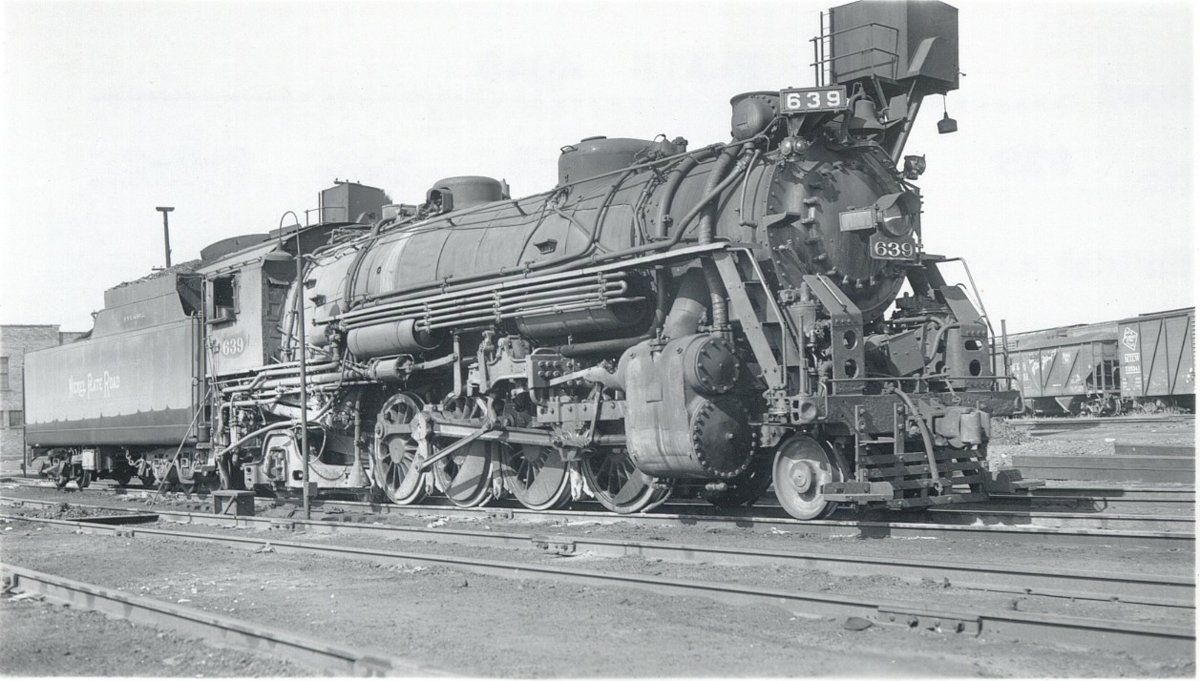
 USRA Light Mikado No. 639 from the Nickel Plate Road | |||||||||||||||||||
| |||||||||||||||||||
| |||||||||||||||||||
| |||||||||||||||||||
| |||||||||||||||||||
Under the Whyte notation for the classification of steam locomotives, 2-8-2 represents the wheel arrangement of two leading wheels on one axle, usually in a leading truck, eight powered and coupled driving wheels on four axles and two trailing wheels on one axle, usually in a trailing truck. This configuration of steam locomotive is most often referred to as a Mikado,[1] frequently shortened to Mike.[2]
It was also at times referred to on some railroads in the United States as the McAdoo Mikado[citation needed] and, during World War II, the MacArthur.[3]
The notation 2-8-2T indicates a tank locomotive of this wheel arrangement, the "T" suffix indicating a locomotive on which the water is carried in tanks mounted on the engine rather than in an attached tender.
Overview
[edit]The 2-8-2 wheel arrangement allowed the locomotive's firebox to be placed behind instead of above the driving wheels,[citation needed] thereby allowing a larger firebox that could be both wide and deep. This supported a greater rate of combustion and thus a greater capacity for steam generation, allowing for more power at higher speeds. Allied with the larger driving wheel diameter which was possible when they did not impinge on the firebox, it meant that the 2-8-2 was capable of higher speeds than a 2-8-0 with a heavy train. These locomotives did not suffer from the imbalance of reciprocating parts as much as did the 2-6-2 or the 2-10-2, because the center of gravity was between the second and third drivers instead of above the centre driver.
The first 2-8-2 locomotive was built in 1884. It was originally named Calumet by Angus Sinclair, in reference to the 2-8-2 engines built for the Chicago & Calumet Terminal Railway (C&CT). However, this name did not take hold.[4]
The wheel arrangement name "Mikado" originated from a group of Japanese type 9700 2-8-2 locomotives that were built by Baldwin Locomotive Works for the 3 ft 6 in (1,067 mm) gauge Nippon Railway of Japan in 1897. In the 19th century, the Emperor of Japan was often referred to as "the Mikado" in English. The Gilbert and Sullivan opera, The Mikado, set in Japan, had premiered in 1885 and achieved great popularity in both Britain and America.[5]
The 2-8-2 was one of the more common configurations in the first half of the 20th century, before dieselisation. Between 1917 and 1944, nearly 2,200 of this type were constructed by Baldwin, the American Locomotive Company (ALCO) and the Lima Locomotive Works, based on designs by the United States Railroad Administration (USRA). It was also known as the "McAdoo Mikado" in the United States, after William Gibbs McAdoo who was appointed as Director General of Railroads when the United States commenced hostilities during the latter part of the First World War and the USRA was established. Of all of the USRA designs, the Mikado proved to be the most popular. The total American production was about 14,000, of which 9,500 were for local customers and the rest exported.[6]
"Mikado" remained the type name until the attack on Pearl Harbor in 1941. Seeking a more American name, "MacArthur", after General Douglas MacArthur, came into use to describe the locomotive type in the United States. After the war, the type name "Mikado" again became the most common for that locomotive type.[7]
Usage
[edit]Locomotives of this wheel arrangement saw service on all six populated continents. The 2-8-2 type was particularly popular in North America, but was also used extensively in Continental Europe and elsewhere.
Argentina
[edit]1,676 mm (5 ft 6 in) broad gauge
[edit]The Buenos Aires and Pacific Railway bought eighteen 2-8-2T locomotives in three batches of six as their class 701 class. The first two batches came from North British Locomotive Company in 1908 and 1912, the third from Henschel & Son in 1913.[8]
The BA&P also bought eight 2-8-2 tender locomotives from Beyer, Peacock & Company in 1928 as their 3001 class.[9]
The Central Argentine Railway (FCCA) bought fifteen 2-8-2T locomotives as their class C7 in 1912; they were built by Robert Stephenson & Company with works numbers 3506 to 3520.[10]
The FCCA also bought sixty 2-8-2 locomotives: twenty class CS8A from Beyer, Peacock & Company in 1926, and another twenty in 1928 from Robert Stephenson & Company. The final twenty to class CS9A were supplied by Vulcan Foundry in 1930. Both classes were cross-compound locomotives with one high-pressure cylinder with a bore of 21 inches (533 millimetres) and one low-pressure cylinder with a bore of 31+1⁄2 inches (800 millimetres), with a stroke of 26 inches (660 millimetres). The earlier class had coupled wheels with a diameter of 62 inches (1,575 millimetres), whereas on the later class they were 55+1⁄2 inches (1,410 millimetres).[11]
Standard gauge
[edit]The East Argentine Railway bought four 2-8-2 locomotives from Baldwin Locomotive Works in 1924. As class X they were numbered 70 to 74; they became General Urquiza Railway 701 to 704 in the 1948 nationalisation.[12] Baldwin had classified them as 12-30-1⁄4-E.
1,000 mm (3 ft 3+3⁄8 in) gauge
[edit]The Province of Buenos Aires Railway bought a single 2-8-2 locomotive from Hanomag of Germany in 1910. Numbered 251 and classified as class E, it was the only 2-8-2 on that railway's system.[13]
The Central Northern Railway (FCCN) bought seven classes of 2-8-2 locomotives totalling 134 locomotives. The first 100 were all bought in 1911: Fifteen from Borsig (class C7, numbered 700–714), 25 from Henschel & Sohn (class C8, 715–739), 10 from Hanomag (class C9, 740–749) and 50 from North British Locomotive (class C10, 750–799).[14] The next 25 came from Baldwin Locomotive Works in 1920; they were Baldwin class 12-30-1⁄4-E, 55 to 79, FCCN class C11, numbered 7000–7024. The last nine new locomotives were built by Henschel between 1928 and 1930 (class C13, numbers 7025–7033, and class C13A, number 7034).[15] In addition the FCCN rebuilt 20 4-8-0 locomotives of classes C6 and C7 into 2-8-2s between 1938 and 1940.[16]
The Córdoba Central Railway (FCCC) bought 31 locomotives in four classes. The first was a solitary locomotive, numbered 800, class C6A built by Alco's Brooks Works in 1910.[17] It was nearly a decade before they bought any more with a dozen class C9A locomotives, numbered 1451 to 1462, coming from Montreal Locomotive Works, half in 1919 and half in 1920.[18] MLW delivered another 15 Mikados later that same year; as class C10A they were numbered 1463 to 1477.[19] FCCC's final three came from Baldwin Locomotive Works in 1925, they were Baldwin class 12-26-1⁄4-E; FCCC numbered them 1501 to 1503, class C11A.[19] When the FCCC was taken over by the FCCN in 1939, their new owner changed the classification by adding 20 to the FCCC's old classification; the locomotives kept their old numbers, except for FCCC 800 which became FCCN 1400.[20]
750 mm (2 ft 5+1⁄2 in) gauge
[edit]On the Ferrocarriles Patagónicos, 75 locomotives were bought in 1922. Fifty were built by Henschel & Sohn, numbered 101 to 150 and class 75H; 25 were built by Baldwin, numbered 1 to 25, class 75B with Baldwin classifying then as 12-18-1⁄4-E.[21]
Australia
[edit]
One of the world's first 2-8-2T designs was the South Maitland Railways 10 Class, first delivered in 1911, by Beyer, Peacock & Company, and spasmodically continuing delivery until 1925, then totaling 14 in the class.[22]
The requirement for locomotives that could be converted from 5 ft 3 in (1,600 mm) to 4 ft 8+1⁄2 in (1,435 mm) standard gauge without major re-engineering led to the introduction of Mikado locomotives by the Victorian Railways in the 1920s. Whereas previous 2-8-0 Consolidation type locomotives featured long, narrow fireboxes between the frames that made gauge conversion impractical, the N class light lines and X class heavy goods locomotives both featured wide fireboxes positioned behind the coupled wheels and above the frames.[23][24][25]
The South Australian Railways (SAR) employed four distinct classes of 2-8-2 locomotive, the locally designed 700 and 710 class, the 740 class that was originally built for China by Clyde Engineering and purchased by the SAR after the order was cancelled in the wake of the Chinese Communist Revolution.[26][27][28] The 750 class was a group of ten surplus VR N class locomotives.[29]
To assist with the postwar rebuilding of Australian railways, American-designed Mikado locomotives were also introduced after World War II, such as the Baldwin Locomotive Works built New South Wales Government Railways D59 class and the Queensland Rail AC16 class.[30][31]
A Mikado was also the last new class of mainline steam locomotive to be introduced in Australia, the Western Australian Government Railways V class heavy freight locomotives of 1955.[32]
Austria
[edit]The 4-cylinder compound class 470, developed in 1914 by Karl Gölsdorf, was built for express trains on mountain lines. From 1927, some of these locomotives were rebuilt to two-cylinder superheated steam locomotives and designated class 670. They were reclassified to class 39 from 1938 and remained in service until 1957.
Belgian Congo
[edit]
In 1917, 24 Mikado type steam locomotives were built for the Compagnie du chemin de fer du bas-Congo au Katanga (BCK), a new line from the Northern Rhodesian border to Port Francqui in the Belgian Congo. Since the line was just being completed at the time, the full complement of locomotives were not required immediately and four, possibly six, of them were temporarily leased to the South African Railways to alleviate a wartime shortage of locomotives. In South Africa, they were known as the Katanga Mikado. Six more of these engines were leased to the Beira and Mashonaland and Rhodesia Railways (BMR), which operated between Umtali in Southern Rhodesia and Beira in Mozambique. The locomotives were all forwarded to the Belgian Congo after the war, where they were numbered in the BCK range from 201 to 224.[33][34][35]
Canada
[edit]Canadian National (CN) operated a few Mikado locomotives:
- One locomotive in the R-1 class, number 3000.
- Thirty locomotives in the R-2 class, numbered 300 to 329.
- Several locomotives in the S-1 and S-4 classes, numbered in the range between 3200-3524 and 3198-3199 and 3525-3599 and 3700-3757 and 3800-3805 .
Canadian Pacific (CP) used Mikado locomotives for passenger and freight trains throughout Canada. Most worked in the Rocky Mountains, where the standard 4-6-2 Pacifics and 4-6-4 Hudsons could not provide enough traction to handle the steep mountain grades.
The Temiskaming & Northern Ontario (renamed Ontario Northland Railway in 1946) operated seventeen Mikados, all ordered from Canadian Locomotive Company in three batches, the first six in 1916, second batch of four in 1921, and the final seven in 1923 to 1925. They were scrapped between 1955 and 1957 when the Ontario Northland was completely dieselized, except for three wrecked and scrapped in the 1940s. The Temiskaming & Northern Ontario operated its Mikados on both freight and passenger service, and were fitted with smoke deflectors. In 1946 65 out of 199 Canadian Pacific N2 2-8-0's were rebuilt and converted to Class P1n 2-8-2's . However all were scrapped around 1955 and 1958 . No P1n 2-8-2's were preserved however CP no . 5468 is preserved
CP's no. 5468, on display in Revelstoke, British Columbia. And CP's 5361 a Class P2e is preserved Depew New York.
China
[edit]
Some local industries still actively use Mikados on freight service. The last regular Mikado passenger service was ended on 20 November 2015 in Baiyin. A few Chinese-made locomotives have found their way into the United States, including Class SY no. 3025, built in 1989, which operated as New Haven no. 3025, in honor of Class J1 no. 3001-3024, on the Valley Railroad in Connecticut. The locomotive now operates on the Belvidere & Delaware as no. 142. It is original to the New York, Susquehanna & Western Railway as no. 142. It and two other Chinese 2-8-2s are currently in the United States.
Finland
[edit]
Finland's sixteen 5 ft (1,524 mm) gauge Class Pr1 were 2-8-2T passenger locomotives for use on local trains. They were nicknamed Paikku, which means local. The Class Pr1 was operational from 1924 to 1972. Numbered 761 to 776, they were built by Hanomag in Germany and also by Finnish locomotive builders Tampella and Lokomo. The last one, no. 776, is preserved at the Finnish Railway Museum.
The Finnish Class Tr1 (or R1) tender locomotive was built by Tampella, Lokomo and German locomotive builders Arnold Jung from 1940 and remained in service until 1975. They were numbered from 1030 to 1096 and were nicknamed Risto, after Finnish President Risto Ryti. 1030, 1033, 1037, 1047, 1051, 1055, 1057, 1060, 1067, 1071, 1074, 1077, 1082, 1087, 1088, 1092, 1093, 1094, 1095 and 1096 are preserved
France
[edit]France used a fairly large number of 2-8-2s in both tender and tank configurations, designated 141 class from the French classification system of wheel arrangements.
Tender locomotives
[edit]Of the pre-nationalisation railway companies that existed before the formation of the SNCF, the Chemins de fer de Paris à Lyon et à la Méditerranée (PLM) had the most Mikados. Their first twelve were initially numbered from 1001 to 1012 and later renumbered to 141.A.1 to 141.A.12. The PLM's second series, numbered from 1013 to 1129 and later renumbered 141.B.1 to 141.B.117, were built by Baldwin Locomotive Works in the United States. Their third and largest class was numbered from 141.C.1 to 141.C.680. Of these latter locomotives, those fitted with feedwater heaters bore the class letter D. The PLM also rebuilt forty-four 141.C and 141.D class locomotives to 141.E class. The SNCF modified the PLM numbers by adding the regional prefix digit "5".
The PLM's 141.A class Mikados were copied by the Chemins de fer du Nord, who had fifty, numbered from 4.1101 to 4.1150, which became 2-141.A.1 to 2-141.A.50 on the SNCF.
The Chemins de fer de l'État also had a class of 250 Mikados, numbered from 141-001 to 141-250. These later became the 141.B class on the SNCF and were renumbered 3-141.B.1 to 3-141.B.250. After modifications, the 141.B class locomotives became the 141.C class, as well as one 141.D class (no. 141.D.136) and one 141.E class (no. 141.E.113). No. 3-141.C.100 has been preserved and designated a Monument historique.

The most powerful French Mikado was the SNCF 141.P class. At about 3,300 horsepower (2,500 kilowatts), these engines were among the most efficient steam locomotives in the world, thanks to their compound design.[36] They could burn 30% less fuel and use 40% less water than their 141.R class counterparts, but could not compete when it came to reliability. Every locomotive of this 318-strong class has been scrapped.

The most numerous steam locomotive class France had, was the American and Canadian-built 141.R class. Of the 1,340 locomotives ordered, however, only 1,323 entered service since sixteen engines were lost at sea during a storm off the coast of Newfoundland while being shipped to France, while one more was lost in Marseille harbour. They were praised for being easy to maintain and proved to be very reliable, which may account for the fact that they remained in service until the very end of the steam era in 1975. Twelve of these locomotives have been preserved.[37]
Tank locomotives
[edit]The Chemins de fer d'Alsace et de Lorraine had a class of forty 2-8-2T locomotives, the T 14 class, later numbered SNCF 1-141.TA.501 to 1-141.TA.540. They were identical to Germany's Prussian T 14 class locomotive and were built between 1914 and 1918. (Also see Germany)
The Chemins de fer de l'Est had two Mikado classes. The first was numbered from 4401 to 4512, later renumbered 141.401 to 141.512 and finally SNCF 1-141.TB.401 to 1-141.TB.512. The other was numbered from 141.701 to 141.742 and later SNCF 1-141.TC.701 to 1-141.TC.742.
The Chemin de Fer du Nord also had two 2-8-2T classes. The first, consisting of only two locomotives, was numbered 4.1201 and 4.1202, later renumbered 4.1701 and 4.1702 and finally SNCF 2-141.TB.1 and 2-141.TB.2. The second, with 72 locomotives, was numbered from 4.1201 to 4.1272 and later SNCF 2-141.TC.1 to 2-141.TC.72.
The Chemins de Fer de l'État also had two Mikado classes. The first, numbered from 42-001 to 42-020, later became the SNCF 141.TC class and were renumbered 3-141.TC.1 to 3-141.TC.20. The second, numbered from 42-101 to 42-140, later became the SNCF 141TD class and were renumbered 3-141.TD.1 to 3-141.TD.141. They were copies of the 141.700 series of the Chemins de fer de l'Est.
The Compagnie du chemin de fer de Paris à Orléans (PO) also had two classes. The first was numbered from 5301 to 5490 and later SNCF 4-141.TA.301 to 4-141.TA.490. The second was numbered from 5616 to 5740 and later 4-SNCF 141.TB.616 to 4-141.TB.740.
Germany
[edit]German 2-8-2 tender locomotives were built in both passenger and freight versions.
- An Express-service locomotive was the DRG Class 19 „Sachsenstolz“ (Pride of Saxony), developed by the Royal Saxon State Railways as type XX (Roman Numeral 20; superheated steam (H); compound (V)) to provide express service in the Saxonian Bohemian Massif.
- The passenger locomotive was the DRG Class 39, initially the Class P 10 of the Prussian state railways, which was built for hauling heavy express trains in the hilly and mountainous terrain of the Mittelgebirge. When they were assimilated into the Deutsche Reichsbahn-Gesellschaft (DRG), they were designated as DRG Class 39.


- Although going out of production when the DRB consolidated their production into 2-10-0 1'E DRB Class 52 Kriegslok designs, the DRB Class 41 „Ochsenlok“ (Oxen Loco) was a successful 1'D1 2-8-2 freight locomotive also used for commuter trains. They were operated by the Deutsche Reichsbahn (DRB) and were built from 1937 to 1941, gaining notoriety as the German steam locomotive with the highest efficiency η of 10%.
Both standard gauge and narrow gauge 1D1 2-8-2 tank locomotive classes were used in Germany.
- The DRG Class 93.0-4 was a German 2-8-2T goods train tank locomotive that was used by the Prussian state railways as well as the French Chemins de fer d'Alsace et de Lorraine, designated as Class T14 by both railways. The Prussian locomotives were later incorporated by the Deutsche Reichsbahn and designated Class 93.0-4 under the DRG renumbering plan. Altogether 457 locomotives of this class were built for the Prussian state railways between 1914 and 1918. (Also see France - Tank locomotives)
- The DRG Class 86 was a standard goods train tank locomotive of the DRG. It was intended for duties on branch lines and was manufactured by almost all the locomotive building firms producing for the DRG. From 1942, a simplified wartime version was built, on which the most obvious changes were the omission of the second side windows in the cab and the solid disc carrying wheels.
- The Molli railway (Mollibahn), a narrow-gauge steam-powered railway in Mecklenburg running on 900 mm (2 ft 11+7⁄16 in) gauge track, operates three 2-8-2T locomotives built by Orenstein & Koppel in 1932.[38]
India
[edit]Broad gauge
[edit]On the 5 ft 6 in (1,676 mm) gauge, the Class XD was the first 2-8-2 in India to be built in quantity. Introduced in 1927, 78 were built before the Second World War by Vulcan Foundry, North British Locomotive Company (NBL), Armstrong Whitworth and Škoda Works. Production resumed after the war, and 110 were built by NBL in 1945 and 1946, while Vulcan Foundry built the last six in 1948.[39]

There was also a Class XE that was built by William Beardmore & Company and Vulcan Foundry. Wartime designs included the Class AWD and Class AWE, built by American company Baldwin Locomotive Works, and the Class X-Dominion (later Class CWD) built as part of Canada's Mutual Aid program by two Canadian companies, the Canadian Locomotive Company and Montreal Locomotive Works.[39]

After the war, a new design was produced and placed in production in 1950. The Class WG was the main post-war broad gauge freight locomotive type of the Indian Railways (IR). The first order of 200 was split evenly between NBL and Chittaranjan Locomotive Works (CLW). Apart from Indian manufacture, examples were also built in England, Scotland, Germany, Austria, the United States, Japan and Italy. By the time production ceased in 1970, 2,450 Class WG locomotives had been built.[39]
Metre gauge
[edit]After World War I, an Indian Railway Standards (IRS) 2-8-2 class became the main heavy freight locomotive on the 1,000 mm (3 ft 3+3⁄8 in) metre gauge. While two versions were designed, the Class YD with a 10-ton axle load and the Class YE with a 12-ton axle load, none was built of the latter class.[40]
During World War II, many of the war-time United States Army Transportation Corps class S118 locomotives were sent to India and 33 more were ordered after the war.[39]
The post World War II Mikado design was the Class YG, of which 1,074 were built between 1949 and 1972, with nearly half of them being manufactured in India.[39]
Narrow gauges
[edit]Two narrow track gauges were in use in India. The 2 ft 6 in (762 mm) gauge was the more widely used while the 2 ft (610 mm) gauge was used by the Darjeeling Himalayan Railway and the Scindia State Railway. Mikado type locomotives were used by the following:
- The Bengal Nagpur Railway used a saturated steam B class, a superheated BS class, and a BC class comprising B class locomotives that had been converted from saturated to superheated.
- The Barsi Light Railway used an F class of thirteen locomotives, ten built by Nasmyth, Wilson & Company between 1926 and 1929, and three built by Hunslet Engine Company in 1949.
- The Great Indian Peninsula Railway used a B/1 class of seven locomotives, four built by NBL in 1917, one more by NBL in 1922, and two by Nasmyth, Wilson & Company in 1926.
- The Scindia State Railway used sixteen locomotives of five classes, the Classes NH/1 through NH/5, built between 1914 and 1959.[41]
The standard narrow gauge 2-8-2 locomotive was the ZE class, with 65 engines built by five companies between 1928 and 1954. Nasmyth, Wilson built ten in 1928, Hanomag built sixteen in 1931, Corpet-Louvet built twelve in 1950, KraussMaffei built fifteen in 1952 and another ten in 1954, and Kawasaki Heavy Industries built ten in 1954. In 1957 and 1958, six ZD class locomotives were also built by Nippon Sharyo in Japan.[41]
Indonesia
[edit].jpg)
Before 1945, the Dutch East Indies Railway Administration, Staatspoorwegen (SS), received two types of locomotives with a 2-8-2 wheel arrangement. First, they received 10 units of 1,050 mm gauge of SS Class 1500 tender engine of 1920 from Hartmann that was previously intended for the Hejaz Railway, but later diverted to Java prior to the First World War and the drive wheels were adjusted to 1,067 mm gauge. After delivered, they present a difficulty. Their axle weigh 13 tons which way much heavier than weight permitted on bridges and mountainous lines (11 tons). Hence for safety reason, the SS 1500s were only allowed to haul light freight trains on flat lines. Second, they received 24 units of 2-8-2T from Hanomag and Werkspoor later classified as SS Class 1400 in 1921-22 which were the tank version of the 2-8-0 SS Class 900 (DKA D50).[42] The SS Class 1400 initially was intended to be heavyweight shunter,[43] but due to Great Depression, the SS had to preserve some of their large locomotives. So, the SS 1400s were used to haul express trains on the Bogor–Sukabumi line.
,_gebaut_von_Hanomag_Hannover-Linden.jpg)
This decision was made by the top brass of SS that the SS 1400s were also tough, have power output to 1171 hp. In addition, SS Class 1400 also has compact characteristic, so it was suitable to work on mountainous line.[42] After Japanese occupation and Indonesian Independence both locomotives renumbered to D51 (SS 1500) and D14 (SS 1400) based on Japanese numberings.[44] During the 1970s report, one of D51 (D5101) was sighted at Klakah depot at Lumajang, East Java while most of her sisters were found normally worked on Surabaya–Kroya southern line.[45] Out of 10 units, only D51 06 preserved at Ambarawa Railway Museum. In 1970, the population of D14 locomotives continued to dwindle as they were replaced by the presence of diesel locomotives, and from 24 units only D14 10 of Hanomag is preserved. Previously, D14 10 was a static display at Taman Mini Indonesia Indah before it was brought to Pengok Workshop to conserved it and converted from oil to wood burner. Finally successfully restored in November 2019 and used today to haul excursion train in Surakarta, Central Java beside Rob's C12 18[46] named Sepur Kluthuk Jaladara.[47][48]

After Indonesian Independence in 1945, the government of Indonesia nationalized all of the Dutch-owned railway companies, including the SS whose name was later changed to Djawatan Kereta Api (DKA) or the Department Railway of the Republic of Indonesia. Shortly after, by 1951-1952 the DKA bought 100 brand new of Mikado steam locomotives from Krupp, Germany. These locomotives, designated the D52 type, were the most modern steam locomotive in Indonesia at that time, with a large physical appearance and equipped with electric lighting. It was similar to the Class 41 locomotive of the Deutsche Reichsbahn.
In Java, the D52 locomotives were placed in passenger service, but was occasionally also used as freight locomotives. Some people even idolized the D52 because of its loyalty in taking passengers anywhere, as happened on the Rapih Dhoho Train from Madiun to Kertosono. The D52 was a mainstay for this train until the end of steam operation in Indonesia.
In contrast to the Java-based units, Sumatra-based D52 locomotives were used for hauling freight trains, mainly coal trains from the Tanjung Enim coal mine, now owned by the PT Bukit Asam mining company, to the coal dumping sites at Kertapati and Tarahan.
The D52 locomotives were initially coal-fired but, from mid-1956, 28 locomotives, numbers D52002 to D52029, were converted to oil burners. The work was done in stages over five years by the locomotive repair shop at Madiun.
One locomotive from this class was written off from service near Linggapura station after a boiler explosion that killed its driver, as a result of steam pipe failure. The only one of the original 100 locomotives that survived into the 21st century is D52 number D52099, which is on display at the Transport Museum in Taman Mini Indonesia Indah. Later on, the D52099 was moved to Purwosari station along with D14 10 which was successfully restored to action, but the D52099 still remained at the station and awaiting for another restoration.
Italy
[edit]Italian railways relied primarily on 2-6-2s for fast passenger services, while heavy passenger service was assigned to 2-8-0s of the classes 744 and 745. Although Mikado types had little opportunity for development in Italy, Ferrovie dello Stato Italiane (FS) commissioned the 2-8-2 class 746 for heavy passenger service on the Adriatic route. To serve local branches and mountain lines where tank locomotives were more suitable, FS derived the new class 940 from the 2-8-0 class 740, with the same dimensions but adding a rear Bissel truck to support the coal bunker behind the cab to make it a 2-8-2.
Japan
[edit]
The Japanese Government Railways (JGR) built the Class D50, Class D51, and Class D52 Mikado tender locomotives for use on the 3 ft 6 in (1,067 mm) gauge lines on the Japanese mainland and in its former colonies. (Also see Soviet Union.) Among those, the D51 was the most popular with a total of 1,115 units produced, the most of any single class of locomotive in Japan.[49] A few of the D51s remain in operation for excursion services, with many preserved nationwide.
New Zealand
[edit]Only one 2-8-2 locomotive ever operated on New Zealand's national rail network, and it was not even ordered by the New Zealand Railways Department, who ran almost the entire network. The locomotive was ordered in 1901 from Baldwin Locomotive Works by the Wellington & Manawatu Railway Company (WMR) for use on their main line's steep section between Wellington and Paekakariki. It entered service on 10 June 1902 as the WMR's no. 17. At the time, it was the most powerful locomotive in New Zealand and successfully performed its intended tasks.
When the WMR was incorporated into the national network in 1908, the Railways Department reclassified no. 17 as the solitary member of the BC class, no. BC 463, and the locomotive continued to operate on the Wellington-Paekakariki line until it was withdrawn on 31 March 1927.
Philippines
[edit]
According to Iowa State University professor Jonathan Smith, the Mikado was the most popular wheel arrangement of freight-purpose tender locomotives on the Manila Railroad. 67 units of the wheel class were delivered between 1927 and 1951, distributed into 4 classes.[50]
The first 2-8-2 steam locomotive was the Baldwin-built Manila Railroad 250 class introduced in 1928. It was the freight version of the 4-6-2 Pacific-type 140 class built for passenger rail services in Luzon.[51] More classes were ordered after the war. The United States Army Transportation Corps class S118, locally referred to as the Manila Railroad 800 class USA in which 45 units were ordered in 1944. These were numbered 851 to 895, with three named locomotives have been named: No. 865 Huckleberry Finn, No. 866 Tom Sawyer and No. 867 Hanibella. Two more locomotives were ordered in 1948 from the War Assets Administration and were numbered the 630 class. These were locally assembled at the MRR workshop in Caloocan. Lastly, 10 JNR Class D51 locomotives were ordered from Nippon Sharyo in 1951 and were numbered the 300 class according to the Brotherhood of Locomotive Engineers and Trainmen.
All of these locomotives were decommissioned in 1956 and were scrapped afterwards.[52]
Poland
[edit]
.jpg)

Between 1932 and 1939, Polish industry supplied PKP with 98 Mikados of class Pt31 of own design (further 12 were built under German occupation).[53] After World War II additional 180 of improved class Pt47 were built until 1951. Both classes were used to run heavy (600 ton) long-distance passenger trains on main lines. They were the most powerful passenger locomotives in Poland. Their wheel diameter was 1.85 m, power output 2000 hp and speed 110 km/h.[53]
191 TKt48 2-8-2 tank locomotives were delivered to PKP between 1950 and 1957, with additional two built for the industry and six exported to Albania.[53] They were used on suburban passenger trains and on goods trains in lower mountain areas.
South Africa
[edit]Only six Mikado locomotive classes saw service in South Africa, five on Cape gauge and one on narrow gauge. The type was rare, with only two of these classes built in quantity.[54]
Cape gauge
[edit]
During 1887, designs for a 2-8-2 Mikado type tank-and-tender locomotive were prepared by the Natal Government Railways. The single locomotive was built in the Durban workshops and entered service in 1888, named Havelock, but was soon rebuilt to a 4-6-2 Pacific configuration. The engine Havelock was the first locomotive to be designed and built in South Africa and also the first to have eight-coupled wheels.[55]
In 1903, the Cape Government Railways (CGR) placed two Cape Class 9 2-8-2 locomotives in service, designed by H.M. Beatty, Locomotive Superintendent of the CGR from 1896 to 1910, and built by Kitson & Company. They had bar frames, Stephenson's link motion valve gear and used saturated steam. In comparison with the Cape Class 8 2-8-0 locomotive of 1901, however, it was found that their maintenance costs were much higher without any advantage in terms of efficiency. As a result, no more of the type were ordered. In 1912, when these locomotives were assimilated into the South African Railways (SAR), they were classified as Class Experimental 4.[55][56][57]
_CSAR_721.jpg)
In 1904, the Central South African Railways (CSAR) placed 36 Class 11 Mikados in service. Built by the North British Locomotive Company (NBL), it was designed by P.A. Hyde, Chief Locomotive Superintendent of the CSAR from 1902 to 1904, for goods train service on the Witwatersrand. It was superheated, with a Belpaire firebox, Walschaerts valve gear and plate frame. The Class 11 designation was retained when the CSAR was amalgamated into the SAR in 1912.[34][54][55][56][57]
_CGR_Class_9_840_Works_4341.jpg)
In 1906, the CGR placed a single experimental 2-8-2 in service, designed by H.M. Beatty and built by Kitson. It was a larger version of the Cape Class 9 in all respects, also with a bar frame, Stephenson's link motion valve gear and using saturated steam. The locomotive was not classified and was simply referred to as "the Mikado". On the CGR it was exceeded in size only by the Kitson-Meyer 0-6-0+0-6-0 of 1904. At the time, it was considered as a big advance in motive power, but the design was never repeated and the Cape Mikado remained unique. In 1912, it was classified as Class Experimental 5 on the SAR.[55][56][57]
In 1917, the South African Railways placed at least four, possibly six, Mikado type steam locomotives in service. They had been built for the Chemins de Fer du Bas Congo á Katanga in the Belgian Congo and were obtained on temporary lease, to alleviate the critical shortage of locomotives as a result of the First World War's disruption of locomotive production in Europe and the United Kingdom. The Katanga Mikados, as the locomotives were known on the SAR, were all forwarded to the Belgian Congo after the war.[34][35]
Narrow gauge
[edit].JPG)
Between 1931 and 1958, 21 2 ft (610 mm) narrow gauge Class NG15 Mikados, developed from the Class Hd and Class NG5 of South West Africa (SWA), were acquired for the Otavi Railway in SWA. Designed by the SAR, it was built by Henschel & Son and Société Franco-Belge. A major improvement on the earlier locomotives was the use of a Krauss-Helmholtz bogie, with the leading pair of driving wheels linked to the leading pony truck. The leading driving wheels had a limited amount of side play while the axle still remained parallel to the other three driving axles at all times, thus allowing the locomotive to negotiate sharper curves than its two predecessors. When the SWA narrow gauge line was regauged to Cape gauge in 1960, all these locomotives were transferred to the Eastern Cape for further service on the Langkloof narrow gauge line from Port Elizabeth to Avontuur. Here they were nicknamed the Kalahari.[56][58] Victorias Milling Co. 2H is a Henschel built 0-8-0T dated 1927.
South West Africa (Namibia)
[edit]Two very similar Mikado classes saw service on the 600 mm (1 ft 11+5⁄8 in) narrow gauge Otavi Railway in South West Africa (SWA).
.jpg)
In 1912, the German administration in Deutsch-Südwest-Afrika acquired three locomotives for use on the line from Swakopmund to Karibib. They were built by Henschel & Son and were designated Class Hd. The locomotives were superheated, with Heusinger valve gear, piston valves and outside plate frames. Since they did not have separate bogie trucks, the leading and trailing carrying wheels were arranged as radial axles to allow for sideways motion of the wheels with respect to the locomotive frame. After the First World War, they were taken onto the roster of the South African Railways (SAR) and later reclassified as Class NG5 along with the similar locomotives of 1922.[56][59]
In 1922, the SAR placed six Class NG5 locomotives in service on the Otavi branch in SWA, also built by Henschel. They were built to the same design as the Class Hd, but had a different coupled wheel suspension arrangement, different boilers and slide valves. In service, they were operated in a common pool with the Class Hd locomotives until they were all withdrawn from service when the SWA system was regauged to Cape gauge in 1960.[56][58][59]
Soviet Union
[edit]
At the end of the Second World War, several 3 ft 6 in (1,067 mm) gauge Japanese Class D51 2-8-2 locomotives were left behind on Russia's Sakhalin island, formerly Karafuto, by retreating Japanese forces. In addition, two Class D51 wrecks were abandoned to the north of the city. Until 1979, the serviceable Japanese locomotives were used on the island by the Soviet Railways.
One was then plinthed outside the Yuzhno-Sakhalinsk railway station, and another is still in running condition and is kept at the Yuzhno-Sakhalinsk railway station.[60]
The Sakhalin Railway has a connection with the mainland via a train ferry operating between Kholmsk on the island and Vanino on the mainland. The Japanese gauge still remains in use on the island, although in 2004 conversion began to the Russian 1,520 mm (4 ft 11+27⁄32 in) gauge.[60][61] (Also see Japan)
Spain
[edit]The 1,668 mm (5 ft 5+21⁄32 in) Iberian gauge network of Spain used one Mikado tank locomotive and two versions of tender locomotives.
The Spanish manufacturer MTM delivered six 2-8-2T locomotives to the Madrid-Caceres-Portugal line in 1925. A project at MTM in 1942 to build a big 2-8-2 never realised.
The first tender version was built by two American companies in 1917, fifteen by Brooks Locomotive Works and forty by Schenectady Locomotive Works. They were numbered from 4501 to 4555 and were a slightly smaller version of the USRA Light Mikado. The locomotives served well in the Norte system, where they were nicknamed Chalecos.

In 1953, RENFE (acronym of Red Nacional de los Ferrocarriles Españoles), the nationalised railway company, acquired twenty-five locomotives of the second tender version from North British Locomotive Company (NBL) of Glasgow. Spanish builders MTM, MACOSA and Euskalduna and the American Babcock & Wilcox built 213 more between 1953 and 1960, with only minor detail differences such as double chimneys, Llubera sanders, ACFI feedwater heaters and oil-burning. Their empty weight was 94 tonnes (92.5 long tons; 103.6 short tons) and they had 1,560 millimetres (61.42 inches) diameter coupled wheels. They performed well in both freight and passenger service and lasted until the official end of steam in common service in 1975.
One Norte and eighteen RENFE locomotives are preserved, three of them in good working condition.
Thailand (Siam)
[edit]
The first Mikado locomotives of the Royal State Railways of Siam (RSR), the predecessor of the State Railway of Thailand (SRT), were acquired from 1923 as standard locomotives for express and mixed trains, to supersede the E-Class locomotives which had been commissioned between 1915 and 1921. The first Siamese Mikado class was built by Baldwin Locomotive Works in 1923, Nasmyth, Wilson & Company in 1924 and Batignolles-Châtillon, France in 1925.
However, it was not until the first batch of eight of Thailand's second class of 2-8-2 locomotives, numbers 351 to 358, was imported from Japan in 1936 that Mikado locomotives really became successful in Thailand. The RSR imported more Mikado standard locomotives to meet railways as well as military demands between 1938 and 1945.
After the Second World War, in 1946, the RSR imported fifty used United States Army Transportation Corps class S118 locomotives, the so-called MacArthur Locomotives. Another eighteen new engines of the same Class were purchased around 1948-1949 to meet the post-war demand.
The last type of Mikado steam locomotives for Thailand were seventy engines imported by SRT from Japan between 1949 and 1951, numbered 901 to 970. Of these, only Mikado no. 953 is still serviceable, and runs passenger trains on special occasions.[62]
United Kingdom
[edit]The 2-8-2 wheel arrangement was rarely, but successfully, used on British rails. Nigel Gresley of the London & North Eastern Railway (LNER) designed two Mikado types of note:
- The Class P1 was a freight derivative of his famed Class A1 4-6-2, inspired by the Pennsylvania Railroad's twin K4s 4-6-2 and L1s 2-8-2 locomotives. Two were built, but there was never really much call for their ability and they remained under-utilised throughout their short existence.[63]
- Gresley's other class of Mikados was his Class P2. These were express passenger locomotives, rather more inspired by European influences than American. They were built to haul heavy express trains in hilly terrain north of Edinburgh, where Gresley thought the additional adhesion possible with a 2-8-2 might serve well. Unfortunately, poor self-centering on the leading truck meant that the leading driving wheels wore against the rails on tighter curves, being hard on both track and wheels. Gresley's successor Edward Thompson converted the Class P2s into 4-6-2 Pacifics.[64] In June 2014, a new Class P2 Mikado locomotive, 2007 The Prince of Wales, intended to work both on mainline and preserved railways, was under construction by the P2 Steam Locomotive Company.[65]

The Great Western Railway (GWR) operated a class of 54 2-8-2T engines that had been rebuilt from 2-8-0T locomotives by Charles Collett, chief mechanical engineer of the GWR. As early as 1906, the chief mechanical engineer at the time, George Churchward, planned a class of Mikado tank engines to handle heavy coal trains in South Wales. The plan was abandoned, however, as it was feared they would be unable to handle the sharp curves present on Welsh mineral branches. Instead, Churchward designed the 4200 Class of 2-8-0 tank engines, of which nearly 200 were built.
In the 1930s, coal traffic declined with the result that many of these engines stood idle, since their limited operating range prevented them from being allocated to other mainline duties. Collett, as Churchward's successor, decided to rebuild some of the 4200 Class engines as 2-8-2Ts. The addition of a trailing axle increased the engine's operating range by allowing an increased coal and water storage capacity. Altogether 54 locomotives were modified in this manner. The 7200 Class tank engines, as they were known, remained in service until the end of steam in Britain in the early 1960s.
The designer of the BR Standard Class 9F locomotive as well as the rest of the BR standard classes as Chief Mechanical Engineer of British Railways, Robert Riddles, originally designed the aforementioned locomotive to be a 2-8-2 using the boiler from one of the 4-6-2 passenger locomotive standard classes. However, he later decided to use a 2-10-0 wheel arrangement with a new boiler design, as it offered more tractive effort and better weight distribution.
United States
[edit]The first 2-8-2 type ever built was Lehigh Valley No. 82 "Bee" designed by Alexander Mitchell and built by the Norris Locomotive Works in 1867.[66]

The locomotive originally was built as a 2-10-0 "Decapod" type locomotive. The engines were troublesome around curves and were prone to instability. So the locomotives rearmost driver was removed and replaced with a pair of small wheels connected to a trailing truck slightly hanging behind the cab.

The 2-8-2 saw great success in the United States, mostly as a freight locomotive. In the 1910s it largely replaced the 2-8-0 Consolidation as the main heavy freight locomotive type. Its tractive effort was similar to that of the best 2-8-0s, but a developing requirement for higher speed freight trains drove the shift to the 2-8-2 wheel arrangement.

The Mikado type was, in turn, ousted from the top-flight trains by larger freight locomotive wheel arrangements such as the 2-8-4, 2-10-2, 2-10-4 and articulated locomotives, but no successor type became ubiquitous and the Mike remained the most common road freight locomotive with most railroads until the end of steam. More than 14,000 were built in the United States, about 9,500 of these for North American service, constituting about one-fifth of all locomotives in service there at the time. The heaviest Mikados were the Great Northern's class O-8, with an axle load of 81,250 pounds (36,854 kilograms).

Almost all North American railroads rostered the type, notable exceptions being the Richmond, Fredericksburg & Potomac, the Boston & Maine, the Delaware & Hudson, the Western Maryland, the Cotton Belt and the Norfolk & Western. The largest users included the New York Central with 715 locomotives, the Baltimore & Ohio with 610, the Pennsylvania Railroad with 579, the Illinois Central with 565, the Milwaukee Road with 500, the Southern with 435, and the Chicago, Burlington & Quincy with 388.[67]
A number of North American 2-8-2s have been preserved as either static display pieces, or steam excursion stars. These include Baltimore and Ohio 4500, Nickel Plate Road 587, Grand Trunk Western 4070, Southern Railway 4501, Grand Canyon Railway 4960, Spokane, Portland and Seattle 539, Southern Pacific 745, Tremont and Gulf 30, Duluth and Northern Minnesota 14, Soo Line 1003, McCloud Railway 18, McCloud Railway 19, Denver and Rio Grande Western 463, Pennsylvania Railroad 520, and California Western 45.
Yugoslavia
[edit]Borsig built 2-8-2s were delivered to the railway of the Kingdom of Yugoslavia in 1930. These became the JDZ class 06, of which a few remain in the former Yugoslav nations.
References
[edit]- ^ "2-8-2 "Mikado" Locomotives in the USA".The name comes the first locomotives of this wheel arrangement, made by Baldwin in 1893 for Nihon Tetsudo (Japan Railways), a private railway at the time.
- ^ "Steam Locomotive Glossary". Railway Technical Web Pages. 28 June 2007. Archived from the original on 17 May 2013. Retrieved 8 February 2008.
- ^ "Ask Trains for August 2006". Kalmbach Publishing. Retrieved 29 January 2008.
- ^ LeMassena, Robert. (1993). America's Workhorse Locomotive: the 2-8-2. Quadrant Press, Inc., p. 6. ISBN 0-915276-54-2
- ^ Japan Railway & Transport Review No. 29 - retrieved 26 October 2006. Archived 21 June 2013.
- ^ Bruce, Alfred. (1952). The Steam Locomotive in America: Its Development in the Twentieth Century. W.W. Norton, pp. 296–298.
- ^ Steam Locomotive dot com: 2-8-2 "Mikado" Type Locomotives - retrieved 26 October 2006. Archived 21 June 2013.
- ^ Carter (2006), p. 90.
- ^ Carter (2006), p. 101.
- ^ Carter (2006), p. 160.
- ^ Carter (2006), pp. 158–159.
- ^ Carter (2006), p. 285.
- ^ Carter (2006), p. 481.
- ^ Carter (2006), pp. 204–206.
- ^ Carter (2006), pp. 218–219.
- ^ Carter (2006), p. 219.
- ^ Carter (2006), p. 180.
- ^ Carter (2006), p. 181.
- ^ a b Carter (2006), p. 182.
- ^ Carter (2006), pp. 180–182.
- ^ Carter (2006), pp. 472–473.
- ^ Steam Operations on the SMR Australian Railway History issue 795 January 2004 pages 28-37
- ^ Mikado Type Locomotives Locomotive, Railway Carriage & Wagon Review issue 396 August 1925 page 236
- ^ 2-8-2 Freight Locomotives with Booster Locomotive, Railway Carriage & Wagon Review issue 441 May 1929 page 139
- ^ Pearce et al. (1980). Newport Railway Museum. Melbourne: ARHS, p. 14. ISBN 0-85849-018-8
- ^ New Locomotives for the South Australian Governments Rwys Locomotive, Railway Carriage & Wagon Review issue 391 March 1925 page 71
- ^ New Heavy Freight Engines for the South Australian Railways Railway Gazette 18 January 1929 page 74
- ^ Mikados and Australian Standard Garratt Locomotives for SAR Railway Transportation April 1952 page 41
- ^ Modern Australian Locomotives Australian Railway Historical Society Bulletin issue 162 April 1951 page 56
- ^ New South Wales Govt Railways Locomotive, Railway Carriage & Wagon Review issue 730 June 1953 page 80
- ^ American Austerity Locomotives in Queensland The Railway Magazine issue 565 September 1946 page 303
- ^ 2-8-2 Locomotives for Western Australia Locomotive, Railway Carriage & Wagon Review issue 759 November 1955 pages 199/200
- ^ C.F. du Bas Congo a Katanga 2-8-2 Locomotives of Congo - Class Details by Steve Llanso of Sweat House Media - Class 201 (Locobase 15020) (Accessed on 16 April 2016)
- ^ a b c Holland, D. F. (1972). Steam Locomotives of the South African Railways. Vol. 2: 1910-1955 (1st ed.). Newton Abbott, England: David & Charles. p. 32-33, 47. ISBN 978-0-7153-5427-8.
- ^ a b Espitalier, T.J.; Day, W.A.J. (1945). The Locomotive in South Africa - A Brief History of Railway Development. Chapter VII - South African Railways (Continued).South African Railways & Harbours Magazine September 1945. p. 673.
- ^ Westwood, J.N. (1977). Locomotive designers in the age of steam.
- ^ Hand, Victor (Fall 2023). "Mikados for France". Classic Trains. Vol. 27, no. 3. Kalmbach. pp. 55–59.
- ^ Garvin, Brian; Fox, Peter (2004). European Handbook No 2B GERMAN RAILWAYS part 2. Private Railways & Museums (1st ed.). Sheffield, UK: Platform 5. ISBN 1-902336-37-2.
- ^ a b c d e Hughes, Hugh. (1996). Indian Locomotives, Part 4 – 1941-1990. Harrow, Middlesex: Continental Railway Circle, pp. 19-20, 24. ISBN 0-9521655-1-1
- ^ Hughes, Hugh. (1992). Indian Locomotives, Part 2 – Metre Gauge 1872-1940. Harrow, Middlesex: Continental Railway Circle, p. 19. ISBN 0-9503469-9-3
- ^ a b Hughes, Hugh & Jux, Frank. (1980). Steam Locomotives in India, Part 1 – Narrow Gauge. Harrow, Middlesex: Continental Railway Circle, p. 29. ISBN 0-9503469-5-0
- ^ a b Oegema, J. J. G. (1982). De Stoomtractie op Java en Sumatra. Deventer-Antwerpen: Kluwer Technische Boeken, B. V. ISBN 9789020115208.
- ^ Reitsma, S. A. (1925). Gedenkboek de Staatspoor en Tramwegen in Nederlandsch Indie (1875-1925) (in Dutch). Batavia: Topografische Inrichting.
- ^ Durrant, A. E. (1972) PNKA Power Parade. Harrow, Middlesex: Railway Continental Circle. p. 44.
- ^ Durrant, A. E. (1974). PNKA Power Parade: Indonesian Steam Locomotives. Continental Railway Circle. ISBN 095034690X.
- ^ Dickinson, Rob. "C1218". The International Steam Pages.
- ^ Tri Sulistyo, Bayu (18 October 2019). "Lokomotif D1410 Bangkit dari Tidur Panjangnya". Railway Enthusiast Digest.
- ^ Juraid, Hadi M.; Utomo, Wahyu; Razif; Panca, Andi (2020). Sejarah Perkeretaapian Indonesia: Dulu, Kini, dan Mendatang (in Indonesian) (1st ed.). Balai Pustaka. ISBN 9786022602569.
- ^ Hirota, Naotaka (January 1972). Steam Locomotives of Japan. Kodansha America, Inc. p. 74 & 78. ISBN 978-0870111853.
- ^ Smith, Jonathan. "Manila Railroad steam locomotives". Iowa State University. Retrieved 22 January 2021.
- ^ Motive Power and Rolling Stock. Report of Survey of the Manila Railroad Company and the Preliminary Survey of Railroads for Mindanao (Report). De Leuw, Cather and Company; Manila Railroad Company. July 1952. Retrieved 13 April 2021.
- ^ "The Passing of the Steam Engine". This Week. 12 August 1956. Retrieved 22 January 2021.
- ^ a b c Bogdan Pokropiński (2007). Parowozy normalnotorowe produkcji polskiej [Normal gauge steam locomotives of Polish manufacture] (in Polish). Warsaw: Wydawnictwa Komunikacji i Łączności. pp. 98, 150–154, 254–255. ISBN 978-83-206-1617-0.
- ^ a b Durrant, AE (1989). Twilight of South African Steam (1st ed.). Newton Abbott: David & Charles. p. 58. ISBN 0715386387.
- ^ a b c d Holland, D.F. (1971). Steam Locomotives of the South African Railways. Vol. 1: 1859–1910 (1st ed.). Newton Abbott, England: David & Charles. pp. 68–69, 72, 90–91, 130–131. ISBN 978-0-7153-5382-0.
- ^ a b c d e f Paxton, Leith; Bourne, David (1985). Locomotives of the South African Railways (1st ed.). Cape Town: Struik. pp. 10–11, 54, 83, 102, 108, 110, 116–117. ISBN 0869772112.
- ^ a b c Classification of S.A.R. Engines with Renumbering Lists, issued by the Chief Mechanical Engineer's Office, Pretoria, January 1912, pp. 9, 12, 15, 36-37 (Reprinted in April 1987 by SATS Museum, R.3125-6/9/11-1000)
- ^ a b South African Railways and Harbours Locomotive Diagram Book, 2’0" & 3’6" Gauge Steam Locomotives, 15 August 1941, as amended
- ^ a b South African Railways and Harbours Narrow Gauge Locomotive Diagram Book, 2’0" Gauge, S.A.R. Mechanical Dept. Drawing Office, Pretoria, 28 November 1932
- ^ a b "The International Steam Pages - Steam and the Railways of Sakhalin Island". Archived from the original on 13 December 2013. Retrieved 18 June 2013.
- ^ "Sakhalin Railways". JSC Russian Railways. 2007. Archived from the original on 4 October 2011. Retrieved 17 June 2010.
- ^ The Railways of Thailand / R. Ramaer., White Lotus, 1993
- ^ LNER Encyclopedia - The Gresley P1 Mineral 2-8-2 (Mikado) Locomotives - retrieved 26 October 2006. Archived 21 June 2013.
- ^ LNER Encyclopedia - The Gresley P2 Passenger 2-8-2 (Mikado) Locomotives - retrieved 26 October 2006
- ^ Welcome to the project to build the new Gresley class P2 No. 2007 Prince of Wales (Accessed on 29 September 2016
- ^ "Motive Power of the Lehigh Valley Railroad". catskillarchive.com. Retrieved 2 April 2025.
- ^ "2-8-2 "Mikado" Locomotives in the USA". www.steamlocomotive.com. Retrieved 8 January 2021.

- Carter, Reg (2006). Railways and Motive Power of Argentina. Stamford, Lincs.: Amphion Press. ISBN 978-0-9530320-1-3.
| International | |
|---|---|
| National | |
| Other | |

2-8-2
View on GrokipediaWheel Arrangement
Notation and Configuration
The Whyte notation is a system for classifying steam locomotives based on the arrangement of their wheels, developed by Frederick Methvan Whyte in the early 20th century.[4] It uses numbers separated by hyphens to denote the number of leading wheels, driving wheels, and trailing wheels, respectively, with each number representing the count of unpowered or powered wheels on one side of the locomotive.[5] In the 2-8-2 configuration, the leading "2" indicates two unpowered wheels (one axle) that guide the front of the locomotive and provide stability, particularly on curved track by allowing the front end to align with the rails ahead of the main body.[4] The central "8" signifies eight powered driving wheels arranged in four coupled axles, which transmit the locomotive's tractive effort to propel it and haul loads through pistons, cylinders, and connecting rods.[5] The trailing "2" refers to two unpowered wheels (one axle) at the rear that support the weight of an extended firebox, enabling greater steam production without overloading the driving axles.[4] Visually, a 2-8-2 locomotive features a single-axle pony truck or two-wheel bogie for the leading wheels, which pivots to facilitate smooth entry into curves; a rigid frame connecting the four driving axles for power delivery; and a two-axle trailing truck that distributes rear weight evenly and maintains stability at speed.[4] This layout evolved from earlier designs like the 2-8-0 Consolidation by adding trailing wheels for better firebox support, enhancing overall balance.[1] Typical dimensions for 2-8-2 locomotives include a driver wheelbase of 15 to 17 feet, providing a stable powered section while keeping the rigid portion manageable for track curvature.[6] The distance from the leading truck to the driving axles often measures 10 to 12 feet, allowing the pony truck to swivel effectively and improve negotiation of curves up to 20-24 degrees without excessive flange wear or derailment risk.[7] For instance, the USRA Light Mikado had a total engine wheelbase of approximately 36 feet, balancing these elements for versatile operation on standard-gauge lines.[6]Equivalent Designations
The 2-8-2 wheel arrangement, known in the Whyte notation as having one leading axle, four coupled driving axles, and one trailing axle, corresponds to the UIC (International Union of Railways) classification of 1'D1'. In this system, the leading "1" denotes a single unpowered axle, "D" indicates four powered driving axles, and the trailing "1'" signifies a single unpowered axle on a bogie, providing stability for larger fireboxes.[8] This configuration earned the widespread nickname "Mikado," derived from the Japanese term for emperor, following the export of ten narrow-gauge 2-8-2 locomotives by Baldwin Locomotive Works to Japan's Nippon Railway in 1897, which popularized the design internationally.[4] The name was later shortened to "Mike" in common usage across North America and beyond. The earliest example of the arrangement was an experimental rebuild in 1883 by the Lehigh Valley Railroad, converting a 2-10-0 into a 2-8-2.[1] The rare designation "Calumet," applied by editor Angus Sinclair to describe the arrangement, originated from 2-8-2 engines built in 1893 for the Chicago & Calumet Terminal Railroad.[9] During World War II, amid anti-Japanese sentiment, some railroads adopted "MacArthur" as an alternative name, honoring General Douglas MacArthur; this was particularly noted in Australian contexts where United States Army Transportation Corps (USATC) 2-8-2 locomotives, supplied as wartime aid, were referred to as "MacArthurs" or "Yanks."[4][10] Variations in notation account for tank locomotives, denoted as 2-8-2T, where the "T" suffix indicates side or saddle water tanks integrated into the frame for self-contained operation without a tender.[4] Narrow-gauge adaptations retain the 2-8-2 designation but are specified by track width, such as 3 ft 6 in gauge examples used in Japan and Australia, allowing the arrangement's versatility across different rail systems.[1]History and Development
Origins in North America
The 2-8-2 wheel arrangement emerged in the late 19th century as an experimental solution to limitations in existing freight locomotive designs, particularly the need for improved stability and power on increasingly heavy trains amid the rapid industrial growth of North American railroads following the Civil War.[1] Railroads faced escalating demands for hauling larger loads of coal, timber, and manufactured goods over challenging terrains, prompting innovations to support larger fireboxes for better fuel efficiency without compromising traction or track stability.[11] The first known 2-8-2 appeared in 1883 on the Lehigh Valley Railroad, where shop forces rebuilt one of two center-cab 2-10-0 "Decapods"—specifically, locomotive No. 82, originally the "Bee" built in 1867 by Norris Locomotive Works—into a 2-8-2 configuration.[2] This modification involved removing the two rear drivers and adding a two-axle trailing truck to reduce flange wear on curves and enhance firebox support, addressing issues with the rigid wheelbase of earlier heavy freight types like the 2-8-0 Consolidation.[2] Although experimental and not widely adopted at the time, this rebuild marked the initial practical application of the arrangement on a major U.S. carrier.[1] The following year, 1884, saw the construction of the first purpose-built 2-8-2 by Baldwin Locomotive Works, named "Calumet" after the Chicago & Calumet Terminal Railway, for which it was intended to handle switching and short-haul freight in the industrial Chicago area.[2] This locomotive, with its Vauclain compound cylinders and trailing truck design, demonstrated the arrangement's potential for improved boiler capacity and stability under load, influencing later developments despite limited immediate production.[2] In Canada, the Grand Trunk Railway pioneered early adaptations of the 2-8-2 in the early 1900s to meet the demands of timber and mineral transport across rugged northern landscapes, ordering its first batch of 10 class S-1-f locomotives in 1913 from Alco's Schenectady works.[12] These engines, with 63-inch drivers and substantial tractive effort, were tailored for hauling heavy loads of lumber and ore over grades and in severe weather, providing a versatile upgrade over 2-8-0s for the railway's expanding network in Ontario and Quebec.[13]Global Adoption and Standardization
The 2-8-2 wheel arrangement, first developed in North America during the 1880s for improved stability and tractive effort in freight service, achieved global prominence through early exports that highlighted its adaptability to diverse operating conditions and fuel types. In 1897, Baldwin Locomotive Works delivered 20 narrow-gauge 2-8-2 locomotives to Japan's Nippon Railway, designed to burn low-quality coal prevalent in the region; this order coined the "Mikado" nickname, referencing the Japanese emperor, and initiated a significant export surge as the design proved effective for heavy freight on challenging grades.[2][1] Early adoption in the United States included the first standard-gauge Mikado built in 1901 for the Bismarck, Washburn & Great Northern Railway, paving the way for broader use. The design's standardization accelerated during World War I when the United States Railroad Administration (USRA) established the Light Mikado and Heavy Mikado as official freight locomotive types in 1917, prioritizing mass production to support war logistics. A total of 625 Light Mikados (with 69-inch drivers and 54,000-pound axle loading per driver) and 233 Heavy Mikados (with 63-inch drivers and 60,000-pound axle loading per driver) were constructed under USRA oversight by builders including Baldwin, ALCO, and Lima, with over 2,000 additional units of these standard configurations produced in the immediate postwar years by the same firms. This effort not only resolved acute shortages in the U.S. but also established the 2-8-2 as a blueprint for international freight power, influencing designs worldwide through shared specifications for boiler capacity and adhesion weight.[14][3] Following the war, European adoption of the 2-8-2 expanded via reparations from defeated powers and licensing of U.S. designs, enabling railroads in countries like France and Poland to integrate the type for reconstruction-era freight demands. By the 1940s, global production of 2-8-2 locomotives reached approximately 14,000 units, reflecting widespread standardization around axle loads of 50,000 to 60,000 pounds per driver to balance power output with infrastructure limits across continents.[1]Design Characteristics
Axle and Truck Arrangements
The leading axle of a 2-8-2 steam locomotive is supported by a two-wheel pony truck, which guides the locomotive through curves and contributes to overall stability by distributing weight forward of the driving wheels.[3] In American designs, this pony truck was often rigid or equipped with spring loading to mitigate track irregularities and improve ride quality on straight sections.[14] European variants frequently incorporated more articulated bogie-style pony trucks, enabling negotiation of sharper radius turns common in denser rail networks. The trailing truck in 2-8-2 locomotives evolved to accommodate expansive fireboxes for greater fuel efficiency and steam production, transitioning from basic two-wheel designs to advanced configurations in later models.[3] The Delta trailing truck, introduced in the early 20th century, featured a triangular frame and pivot mechanisms that allowed lateral flexibility, enhancing stability and load distribution under the rear overhang.[15] This design was notably standardized in the USRA Heavy Mikado during World War I, where over 200 units were built with the Delta truck to support increased boiler capacity without compromising curve performance.[14] Axle boxes in 2-8-2 locomotives predominantly utilized plain bearings, consisting of brass or bronze journals lubricated with oil or grease to reduce friction on the axles.[16] These required frequent maintenance, including shim adjustments and bearing renewals to prevent overheating and wear, with federal regulations mandating safe conditions and diameter stamping for traceability.[16] In high-speed passenger-oriented versions post-1930, roller bearings were occasionally adopted for lower rolling resistance and extended service intervals, though their higher initial cost and complexity limited widespread use.[17]Boiler and Power Systems
The 2-8-2 wheel arrangement facilitated an innovative firebox design by positioning it behind the driving wheels and extending it over the trailing truck, which provided structural support for larger dimensions and enhanced combustion capacity. This configuration typically allowed for grate areas typically ranging from 60 to 100 square feet, enabling sustained high steaming rates essential for heavy freight service.[18][19][20] In the United States, firebox variations included the wide Wootten type on locomotives burning low-grade anthracite culm coal, such as those on the Central Railroad of New Jersey, where the expansive design promoted a thin firebed and low draft to minimize fuel waste. Other examples featured the Belpaire firebox, characterized by its rectangular shape and flat crown for improved steam space and even heating, as seen in Great Northern Railway's O-8 class Mikados. These designs prioritized fuel efficiency and power output tailored to regional coal types.[21][14][22][23] Superheating systems were integral to 2-8-2 power generation, with U.S. models commonly fitted with Schmidt or Elesco superheaters that heated steam beyond saturation temperatures, reducing cylinder condensation and boosting thermal efficiency by 20-30 percent through lower fuel consumption and higher work output per unit of steam. These superheaters, often paired with Elesco feedwater heaters to preheat incoming water and further enhance boiler economy, were standard on post-World War I designs like the Soo Line's L-1 class. Valve gear typically employed Walschaerts mechanisms with piston valves to distribute superheated steam precisely, optimizing cutoff and exhaust for varied load conditions.[19][24][25][26] Cylinder arrangements in 2-8-2 locomotives featured two outside cylinders, generally 22 to 26 inches in diameter with strokes of 28 to 32 inches, driving the eight coupled wheels to convert steam pressure into mechanical force. Representative examples include 27-by-32-inch cylinders on USRA Heavy Mikados and 30-by-32-inch units on later variants like the Great Northern's O-8 class.[27][28] Tractive effort, a key measure of starting pull, is approximated by the formulawhere TE is tractive effort in pounds, is boiler pressure in psi, is cylinder diameter in inches, is piston stroke in inches, is the number of cylinders (typically 2), and is driving wheel diameter in inches. This equation derives from the product of boiler pressure and total piston area, adjusted by a 0.85 factor for mean effective pressure under saturated steam conditions, multiplied by the ratio of piston stroke to wheel diameter for mechanical leverage from the crank to the drawbar, yielding starting force; superheating effectively increases the coefficient to around 1.0 for higher outputs.[29]
Operational Role
Freight Applications
The 2-8-2 wheel arrangement excelled in freight service due to its eight driving wheels, which provided superior adhesion for accelerating and maintaining heavy loads like coal, ore, and lumber trains. This configuration typically delivered a starting tractive effort of 50,000 to 70,000 pounds, with many examples exceeding 60,000 pounds at normal adhesion levels, allowing the locomotive to start and pull trains weighing 3,000 to 5,000 tons without excessive slipping.[2][1] In drag freight operations, 2-8-2 locomotives sustained speeds of 40 to 60 mph, balancing power with reasonable efficiency for long-haul routes. U.S. coal railroads, such as the Chesapeake & Ohio and Virginian Railway, frequently employed them for substantial coal drags, often handling trains of 50 or more cars over demanding grades and distances.[1][3] The design's larger firebox, supported by the trailing truck, enhanced fuel efficiency by enabling greater steam production and reduced frequency of water stops, typically carrying 8,000 to 12,000 gallons in tenders for runs of 75 to 100 miles. This feature proved especially valuable for extended hauls in remote, undeveloped areas with limited servicing facilities, such as logging lines or mining districts.[2][1]Passenger and Versatile Uses
While the 2-8-2 wheel arrangement was predominantly associated with freight duties, certain variants were adapted for mixed-traffic roles, incorporating driving wheels in the 56- to 63-inch range to enable speeds of 70 to 80 mph on secondary passenger services. For instance, the Union Pacific Railroad's later Mikado classes featured 63-inch drivers and were employed in mountain passenger operations, achieving top speeds around 75 mph while maintaining versatility for both freight and lighter passenger trains.[30] In Europe, similar adaptations appeared on narrow-gauge lines for mixed passenger and freight tasks on branch lines.[31] Tank locomotive versions of the 2-8-2 further enhanced versatility by incorporating side or pannier tanks, eliminating the need for tenders and allowing operation in confined areas like branch lines and yards for both shunting and short-haul passenger services. A notable example is the French Eastern Railway's (Est) Class 141TB 2-8-2T, introduced in 1913 with 62.2-inch drivers, designed specifically for suburban passenger and local mixed-traffic duties around Paris, where the integrated water capacity supported efficient turns on tight layouts without refueling interruptions.[32] These adaptations proved particularly useful in regions with limited infrastructure, enabling the locomotive to switch seamlessly between light passenger runs and utility tasks.[33] Despite these applications, the 2-8-2 saw limited adoption for pure high-speed passenger service compared to the 4-8-2 Mountain type, primarily due to its longer rigid wheelbase across eight driving axles, which reduced flexibility on curves and contributed to instability at sustained speeds above 80 mph.[34] However, during World War II shortages of dedicated passenger locomotives, 2-8-2s were pressed into more frequent passenger roles, such as on the Baltimore & Ohio and Pennsylvania Railroad lines, where they powered or assisted mainline trains amid heightened demand.[2] This wartime expediency highlighted the arrangement's robustness but underscored its secondary status for premium express passenger work.[35]Usage
United States
The 2-8-2 wheel arrangement, dubbed the Mikado after early examples imported from Japan, saw its most widespread adoption in the United States as the premier freight locomotive design during the early 20th century.[3] The United States Railroad Administration (USRA) standardized the type in 1918 amid World War I demands for efficient freight haulage, producing the Light Mikado with 625 units featuring 63-inch drivers, 26-by-30-inch cylinders, 200 psi boiler pressure, and 54,724 pounds of tractive effort, alongside the Heavy Mikado with 233 units boasting 63-inch drivers, 27-by-32-inch cylinders, 190 psi boiler pressure, and 59,801 pounds of tractive effort.[14] These designs emphasized superheating, mechanical stokers, and extended combustion chambers for improved efficiency on heavy wartime loads, influencing subsequent production across dozens of railroads.[14] Major American railroads expanded on the USRA template with customized classes for regional needs. The Atchison, Topeka and Santa Fe Railway, for instance, acquired 187 2-8-2s in classes 3100 through 3160 between 1913 and 1920, including the class 3160 subgroup of 128 superheated locomotives with 63-inch drivers and 27-by-32-inch cylinders capable of sustaining 60 mph on freight runs across the Southwest.[36] Similarly, the Southern Railway deployed a substantial fleet of over 180 Ms-class 2-8-2s starting in 1911, equipped with 63-inch drivers and optimized for the steep grades and heavy coal traffic of the Appalachian region, where they hauled bituminous loads from mines to ports and industries.[37] These examples highlight the type's versatility, with adaptations like booster-equipped tenders for helper service on mountain divisions. By the mid-20th century, the 2-8-2 dominated American freight rosters, with approximately 9,500 units constructed for U.S. railroads by the 1940s, though production tapered as diesel-electrics proved more economical.[2] The last new 2-8-2s rolled out in 1944, and widespread retirement began in the late 1940s, culminating in near-total phaseout by the mid-1950s as diesels supplanted steam across the network.[14]Canada
In Canada, the 2-8-2 wheel arrangement was widely adopted for freight service across the expansive rail network, particularly suited to the country's diverse geography, including prairies, mountains, and northern cold climates. The Canadian National Railway (CN) relied heavily on its Class S locomotives, with over 320 units of the S-1 subclass built between 1913 and 1926 by builders such as the Canadian Locomotive Company, Montreal Locomotive Works, ALCO, and Baldwin. These engines featured 63-inch drivers and 27-by-30-inch cylinders, enabling efficient operation on mixed freight and passenger duties over long distances, drawing from the USRA standard design for reliability in resource-heavy routes like timber and mineral transport.[38] The CN's S-1 class exemplified adaptations for Canadian conditions, with thermic syphons increasing firebox heating surface to 295 square feet for better combustion in varying fuel qualities, and superheaters for improved efficiency on grades up to 2.5 percent common in the Rockies and Shield regions. While most axles used traditional journal bearings, later maintenance practices emphasized cold-weather durability through upgraded lubrication systems, though specific Timken roller bearing retrofits were limited to select units in the 1930s for enhanced performance in sub-zero temperatures. By the late 1920s, these locomotives hauled grain, lumber, and ore trains across 20,000 miles of track, retiring primarily in the 1950s as dieselization advanced.[12] Canadian Pacific Railway (CP) deployed its P-1 and P-2 classes for similar heavy-duty roles, with 111 P-1 units built starting in 1912 by Montreal Locomotive Works and CP's own shops, followed by 285 P-2 variants from 1919 to 1948 by CP Angus Shops, Montreal Locomotive Works, and Canadian Locomotive Company. The P-2 subclass, with 25-inch cylinders and boiler pressures up to 275 psi, was optimized for prairie grain hauls and mountain pusher service, such as on Field Hill where they managed 4,500-ton trains on 2.2 percent grades. Larger tenders carrying 10,000 to 14,400 gallons of water and up to 21 tons of coal supported extended remote operations in isolated areas like the Kootenays, reducing water stops in water-scarce terrains.[25] Most Canadian 2-8-2s operated on 4 ft 8½ in standard gauge, aligning with North American norms for interoperability, though a smaller number served on 3 ft 6 in narrow gauge branches, notably the Newfoundland Railway's six units built in 1949 by Montreal Locomotive Works—the last 2-8-2s produced in North America—for its rugged, isolated coastal and interior lines until diesel replacement in 1969. These narrow-gauge examples highlighted the arrangement's versatility for resource extraction in peripheral regions, hauling fish, pulpwood, and passengers over 906 miles of track.[39]United Kingdom
In the United Kingdom, the 2-8-2 wheel arrangement was rare among standard gauge (4 ft 8½ in) steam locomotives due to the dense rail network, tight curves, and restrictive loading gauge, which favored more compact designs like the 2-8-0 for heavy freight.[40] The London, Midland and Scottish Railway's influential Stanier 8F class 2-8-0 locomotives dominated heavy freight duties, but true 2-8-2 types were limited to innovative applications on specific routes, often drawing from European trends in adhesion and stability for challenging terrains.[41] The Great Western Railway's 7200 class represented the primary adoption of the 2-8-2 configuration in tank form, with 54 locomotives rebuilt from existing 4200 and 5205 class 2-8-0T engines between 1934 and 1945 at Swindon Works.[40] Designed for heavy coal traffic on extended hauls, these locomotives featured 4 ft 7½ in driving wheels, a tractive effort of 33,170 lbf, and enlarged bunkers holding up to 5 tons of coal and 2,700 gallons of water, enabling versatile freight operations despite some curve-handling limitations.[40] They remained in service until the early 1960s, with withdrawals accelerating post-World War II amid dieselization and electrification, though three examples were preserved.[40] On the London and North Eastern Railway, the 2-8-2 saw limited but notable use in both freight and passenger roles. The Class P1, with only two built at Doncaster Works in 1925 (Nos. 2393 and 2394), was engineered by Nigel Gresley for mineral traffic, particularly coal trains from Durham coalfields to London, boasting a divided drive for high tractive effort and a booster-equipped trailing truck; however, route restrictions and operational inefficiencies led to their withdrawal in 1945.[41] The Class P2, comprising six locomotives constructed between 1934 and 1936, was Gresley's ambitious design for heavy express passenger services on the gradient-heavy Edinburgh to Aberdeen line, featuring an A3-type boiler and initially Lentz poppet valves for 43,458 lbf tractive effort, but all were rebuilt as 4-6-2 Pacifics by 1944 due to handling issues and strategic shifts.[42] Tank versions beyond the GWR 7200 were rare, with only proposed LNER designs failing to materialize, and overall scrapping intensified after World War II as electrification and modernization rendered the type obsolete.[42]France
In France, the 2-8-2 wheel arrangement, known as the Mikado type, was extensively adopted by the major pre-nationalization railway companies and later by the Société Nationale des Chemins de fer Français (SNCF), primarily on standard 1,435 mm gauge lines, though a few examples operated on 1,000 mm meter gauge networks.[43] These locomotives were developed to handle the demands of France's varied terrain, including express freight and mixed traffic, often drawing from global Mikado standards adapted to local needs.[44] Tender locomotives formed the backbone of French 2-8-2 operations, with the Paris-Lyon-Méditerranée (PLM) PL class—specifically the 141C subclass—representing a key early design for express freight services. Built between 1918 and 1927, approximately 470 units were constructed by French manufacturers including Schneider, Fives-Lille, and SFCM, featuring a large grate area and high boiler pressure to achieve tractive efforts suitable for heavy hauls on main lines.[45] These engines, later reclassified under SNCF as 141C to 141F after modifications like added superheaters, excelled in reliability and power, hauling freight trains up to 1,000 tons at speeds over 70 km/h.[46] Post-World War II reconstruction emphasized the 141 series, particularly the SNCF 141R class, which incorporated advanced superheaters for improved efficiency and thermal performance. A total of 1,323 locomotives were built from 1945 to 1952 by North American firms like the Montreal Locomotive Works and Canadian Locomotive Company, as well as French builders, to replace war-damaged rolling stock and support economic recovery.[47] Designed for versatile freight duties with a tractive effort of around 210 kN and a top speed of 100 km/h, the 141R became the most numerous 2-8-2 class in France, operating until the mid-1970s across the national network.[48] Tank variants of the 2-8-2 were less common but served critical roles in shunting and short-haul operations, often influenced by earlier 0-6-0T designs like the 050 series for compact power delivery. The most notable example was the PT 14 class (later SNCF 1-141.TA), a 2-8-2T built for the Chemins de fer d'Alsace et de Lorraine in 1911–1914, with 40 units produced by Hanomag and others for goods and shunting on regional lines.[49] These locomotives, with side water tanks and a coal bunker, provided adhesive weight for switching yards while maintaining maneuverability, achieving tractive efforts of about 100 kN. Narrow-gauge adaptations, such as 1,000 mm versions derived from 0-6-0T and 0-10-0T classes like the 030 and 080 series, were employed on secondary meter-gauge lines for light freight, though production was limited to specialized industrial or regional services.[50]Germany
In Germany, the 2-8-2 wheel arrangement was employed primarily for freight and mixed-traffic services on standard-gauge (1,435 mm) lines, with some adaptations for narrow-gauge (1,000 mm) industrial operations, reflecting the country's emphasis on robust locomotives for heavy industry such as coal transport in the Ruhr region. The Deutsche Reichsbahn-Gesellschaft (DRG) developed several classes under its Einheitsdampflokomotive standardization program, drawing on earlier Prussian designs for efficient power output while addressing axle load limits for varied track conditions. These locomotives featured high-pressure boilers and trailing trucks to support larger fireboxes, enabling sustained performance on demanding routes.[51] The DRG Class 41, a key freight locomotive, was introduced in 1936 as part of wartime preparation efforts to standardize designs for rapid production, with 366 units built between 1936 and 1941 by builders including Henschel, Krupp, and Schwartzkopff. Equipped with 1,600 mm (63-inch) drivers and a boiler pressure of 20 bar, these 2-8-2 tender locomotives were optimized for hauling heavy coal trains in the Ruhr Valley, achieving a tractive effort of approximately 169 kN and speeds up to 90 km/h while maintaining an axle load under 20 tonnes to suit mixed infrastructure. Post-World War II, the class continued in service with the Deutsche Reichsbahn (DR) in East Germany, where 80 were rebuilt ("Reko" variants) starting in 1959 with upgraded boilers from retired Class 03 locomotives, extending their operational life into the 1980s for freight duties on lines with grades up to 0.5%.[52][51][53] Tank locomotive variants of the 2-8-2 arrangement were less common but served essential roles on branch lines and industrial sidings. The DRG Class 86 (Baureihe 86), a standard-gauge 2-8-2T design, entered production in 1928 with 775 units built by 1943, featuring a compact boiler and side water tanks for self-contained operations on secondary routes supporting heavy industry. These locomotives, with 1,400 mm drivers and a top speed of 60 km/h, were used for shunting and short-haul freight, including coal and ore, until the 1970s in both West and East Germany. Rebuilds of earlier classes, such as conversions from 0-8-0T designs to 2-8-2T configurations, were rare and typically limited to specific industrial needs, like enhancing stability for mining railways.[54][51] Narrow-gauge 2-8-2 locomotives, primarily tank types on 1,000 mm tracks, were deployed in mining regions for hauling ore and coal trains in confined environments. Builders like Orenstein & Koppel produced around 50 such units in the 1920s and 1930s for Ruhr Valley collieries, with features like low axle loads (under 10 tonnes) and short wheelbases for tight curves, enabling efficient transport of up to 200 tonnes per train on gradients exceeding 2%. The DRG Class 99 series included several 2-8-2T subclasses for these duties, such as the 99.11-19 group, which operated until the 1960s before dieselization, underscoring their role in sustaining wartime and post-war industrial output.[51][55]Other European Countries
In Austria, the BBÖ Class 378 (later ÖBB 93) consisted of 167 2-8-2T tank locomotives built primarily in 1927 by manufacturers including StEG, Wiener-Neustadt, and Krauss-Linz for use on secondary lines and freight services in the Alpine regions, where their light axle loads were advantageous for lighter rail infrastructure.[56] These locomotives were incorporated into the Deutsche Reichsbahn as Baureihe 93.13 following the 1938 Anschluss, with 128 retained by the BBÖ postwar and some fitted with Giesl ejectors for improved efficiency; losses during World War II totaled 11 units, and 28 were repatriated to Yugoslavia.[56] Finland employed several 2-8-2 classes on its standard-gauge network, with the VR Class Tr1 (Risto) being the most prominent, comprising 67 units built between 1937 and 1957 by Tampella, Lokomo, and Arnold Jung for general freight and passenger duties, including heavy regional hauls that persisted into the diesel era.[57] The earlier VR Class Pr1 (Paikku), a 2-8-2T with 16 examples produced from 1924 to 1926 by Hannoversche Maschinenbau, Tampella, and Lokomo, supported lighter freight operations on branch lines.[57] No 2-8-2 tank locomotives were identified for 750 mm gauge logging services, though narrow-gauge lines relied on smaller wheel arrangements for such tasks. Italy's Ferrovie dello Stato (FS) utilized the Class 746 (Gruppo 746) 2-8-2 locomotives, with 60 units constructed in 1921 by Breda and other builders, initially for fast passenger trains but adapted for goods traffic on key routes like Milan-Rome due to their compound engines and versatility.[58] Four of these were converted in 1931-1932 to simple-expansion variants (Gruppo 746.046) to enhance starting power for freight, proving effective for mixed services before electrification curtailed their role.[58] Yugoslavia imported and operated 28 Austrian BBÖ 378 locomotives postwar, alongside domestic Class 85 2-8-2s (45 built 1930-1940 by Budapest and Djuro Djakovic) for long-distance regional passenger and light freight hauls, such as Sarajevo to Dubrovnik lines.[56][59] In Poland, the PKP incorporated ex-German 2-8-2 locomotives from the prewar Pt31 class (originally 110 built in 1932 at Chrzanów), which the Deutsche Reichsbahn redesignated as BR 19 during occupation for heavy mountain drafts; postwar, surviving units returned for regional freight under PKP designation.[60] The later TKt48 class added 191 tank variants between 1950 and 1957 for suburban and freight pushing services, reflecting adaptations from wartime reparations. Spain's RENFE operated narrow-gauge 2-8-2s through inherited private lines, including ZE-class examples (65 built 1928-1954 by various firms) for meter-gauge freight on regional networks like those in northern Spain, emphasizing local adaptations for hilly terrain. On standard gauge, the RENFE Class 141 (242 units, 1952-1960) handled versatile freight hauls up to 800 tonnes on moderate grades.[61] Across these nations, 2-8-2 adoption often stemmed from post-World War I reparations and wartime displacements, with local modifications enabling efficient regional and freight operations on varied terrains, mirroring broader European trends in lighter, adaptable motive power.[60]India
In India, the 2-8-2 wheel arrangement was extensively employed on broad, metre, and narrow gauge networks, reflecting British colonial influences in standardizing designs for diverse terrains and freight demands under the Indian Railway Standards (IRS) program initiated in the 1920s.[62] These locomotives handled heavy freights, passenger services, and branch lines, with production spanning pre- and post-independence eras until dieselization and electrification rendered them obsolete by the 1980s.[63] On broad gauge (1,676 mm) lines, the XE class served heavy freight applications, with 22 units constructed between 1928 and 1930 by William Beardmore & Co. and Vulcan Foundry for the East Indian Railway, featuring a 22.3-ton axle load and 210 psi boiler pressure to tackle demanding hauls.[63] Complementing this, the XD class, built in nearly 200 examples from the 1920s to 1940s by various builders including Vulcan Foundry, focused on lighter freight duties across multiple railways, establishing the 2-8-2 as a versatile staple for broad gauge operations.[63] For metre gauge (1,000 mm) systems, which formed the backbone of much of India's rail network, the YD class emerged as a key freight design under IRS specifications, with at least 270 locomotives produced up to 1953 by manufacturers such as Nasmyth Wilson (starting in 1928), along with firms from Germany, Czechoslovakia, Japan, and India; these 10-ton axle load machines powered essential goods traffic from the 1930s onward.[64] Post-1947, Indian Railways adopted the YG class as the primary metre gauge freight locomotive, with over 1,000 units manufactured between 1952 and 1972 at Chittaranjan Locomotive Works and Tata Engineering & Locomotive Company, boasting a tractive effort of approximately 23,450 lbf and serving widespread branch and mainline duties until the network's conversion to diesel and electric traction.[63][62] Narrow gauge variants adapted the 2-8-2 for challenging hill and plantation routes. The ZE class operated on 2 ft 6 in (762 mm) gauge lines, particularly for freight on steep gradients like those of the Satpura Railway; 65 locomotives were built between 1928 and 1954 by companies in the UK, France, Germany, and Japan, including Kawasaki in 1955, emphasizing low axle loads around 8 tons for stability.[65] On 2 ft (610 mm) gauge plantation lines, Baldwin Locomotive Works supplied representative 2-8-2 examples, such as the NH/4 class for the Gwalior Central Railway (e.g., No. 758 built in 1948), supporting light industrial and agricultural transport in remote areas.[66] Overall, more than 1,000 2-8-2 locomotives operated across India's gauges, underscoring their role in economic development before systematic withdrawal in the 1970s–1980s amid electrification drives.[63]Japan
The 2-8-2 wheel arrangement, known as the "Mikado" type after the Japanese emperor, originated with an order placed by the Nippon Railway to the Baldwin Locomotive Works in the United States. In 1897, Baldwin delivered 20 narrow-gauge locomotives of this design, classified as Bt4/6 and later renumbered 9700–9719 by the Japanese Government Railways (JGR) following nationalization in 1906.[67][3] These 3 ft 6 in (1,067 mm) gauge machines, with 42-inch driving wheels, proved effective for freight service on Japan's rugged terrain and established the type's nomenclature worldwide.[67] Building on this foundation, the JGR and later Japanese National Railways (JNR) extensively adopted the 2-8-2 for heavy freight duties across the imperial rail network, particularly in the 1920s through 1940s. The Class D50 (initially designated 9900) consisted of 380 superheated locomotives built between 1923 and 1931 by various Japanese manufacturers, featuring 55-inch drivers and designed for efficient power output on mountainous lines.[68] The subsequent Class D51, the most numerous 2-8-2 class in Japan with 1,115 units produced from 1936 to 1945, incorporated wartime adaptations like increased boiler capacity for hauling heavy loads under resource constraints; these locomotives, also with 55-inch drivers, became iconic for their role in industrial and military logistics.[69][3] Tank variants of the 2-8-2 were rare in Japan, limited primarily to branch line and industrial applications where tender-equipped locomotives were impractical. Superheating was a standard feature in later classes like the D50 and D51, enhancing thermal efficiency and tractive effort suited to the country's steep gradients and narrow gauge of 1,067 mm.[68][69]China
Prior to 1949, China saw the introduction of several 2-8-2 locomotives through imports and local builds during the warlord era and Japanese occupation of Manchuria. The South Manchuria Railway (SMR) acquired its first 2-8-2s from the American Locomotive Company (ALCo) in 1918, with 25 units designated as the MiKa-i class for freight service on standard gauge lines.[70] These were followed by additional builds from Japanese manufacturers like Kawasaki and Hitachi, including the Pashiha class (over 100 units produced between 1938 and 1945), which drew design elements from Japanese National Railways (JNR) D51 locomotives and served mixed traffic duties in the region.[71] Some JNR D51 locomotives were also deployed to occupied Chinese territories, including Manchuria, for military and railway operations under Japanese control.[72] The ex-SMR fleet, reclassified post-war as the China Railways JF series (notably JF1 through JF6), formed the backbone of freight operations, with the SL-6 designation applied to select ex-Manchurian units adapted for continued use.[73] After the establishment of the People's Republic in 1949, Chinese locomotive production shifted toward self-sufficiency with Soviet technical assistance, leading to the development of the JS (Jianshe, or "Construction") class 2-8-2 at the Dalian Locomotive and Rolling Stock Factory (DFH). This design combined the proven JF-class running gear with a new boiler heavily influenced by Soviet engineering practices, including mechanical stokers and feedwater heaters to boost efficiency and power output for heavy freight.[74] Over 300 JS locomotives were built in the 1950s alone, primarily at Dalian starting in 1957, on standard gauge (1,435 mm) tracks, and were prioritized for coal-hauling lines in northern and central China where high tractive effort was essential.[75] Production expanded to other factories like Datong, totaling more than 2,300 units by 1988, making the JS one of China's most prolific steam classes.[74] To address operational challenges in arid and dusty coal regions, some JS locomotives were converted to oil-burning, reducing ash buildup and improving reliability in environments with poor coal quality or high dust levels.[76] These adaptations extended their versatility for industrial and mining services. By the 1990s, as diesel and electric traction dominated, the JS class was largely retired, with the last new builds completed in 1988 and remaining examples phased out from mainline duties amid China's rapid rail modernization.[74]Soviet Union
The Soviet Union relied heavily on 2-8-2 steam locomotives to power its vast rail network during the era of rapid industrialization and the immense logistical demands of World War II, though they were less dominant than 2-10-0 types, with production emphasizing robust freight-hauling capabilities for key routes like the Trans-Siberian Railway. The Er (Эр) class represented a primary 2-8-2 design in the Soviet fleet, with 563 units built between 1925 and 1942 at major works like Kolomna and Sormovo to handle freight loads across the expanding rail system. These locomotives featured a boiler pressure of 210 psi, 63-inch driving wheels, and a tractive effort of approximately 42,000 pounds, making them suitable for long hauls and varied terrain of Siberian routes. Amid the exigencies of World War II, the Soviet rail industry adapted various configurations for frontline service, producing armored variants of classes like the Ov (0-8-0) with reinforced cabs to shield operating crews from aerial bombardment and sabotage. Over 400 such examples were manufactured between 1942 and 1947 at plants such as Voroshilovgrad, primarily for the standard 1,520 mm gauge lines supporting military supply lines in the European theater. These variants incorporated steel plating up to 10 mm thick on the cab and tender, enabling sustained operations under combat conditions while maintaining a top speed of 50 mph for urgent troop and materiel movements. In the post-war period, 2-8-2 locomotives like the Er class were progressively supplanted by more powerful 2-10-0 Decapods, such as the Ye and L series, as the Soviet network prioritized higher tractive effort for heavier postwar freight volumes. Nonetheless, surviving units persisted in secondary and remote assignments, including branch lines in Siberia and the Urals, well into the 1970s until dieselization fully overtook steam operations.[77][78][79]Other Asian Countries
In Indonesia, 2-8-2 locomotives were employed on 1,067 mm gauge sugar plantation lines, with Orenstein & Koppel constructing several units during the 1920s and 1940s for freight transport of cane and processed sugar across Java's extensive mill networks.[80] During World War II, Japanese forces deployed D51 class 2-8-2 locomotives to the Dutch East Indies, some of which were captured and repurposed for post-war operations on mainlines and industrial lines before dieselization.[81] The Philippines saw the introduction of US-built 2-8-2 locomotives under colonial administration, notably the Manila Railroad's 250 class, comprising 10 Baldwin units delivered in 1928 for standard gauge freight duties, hauling goods like timber and agricultural products on lines radiating from Manila.[82] These engines featured interchangeable components with contemporary Pacific types, reflecting American engineering standards adapted for tropical conditions. In Thailand (then Siam), the Royal State Railways acquired 10 class 5 2-8-2 locomotives in 1923 from British and European builders, including Nasmyth, Wilson & Co., for metre gauge operations focused on rice export freights from the Chao Phraya plain to Bangkok and coastal ports.[83] Wood-fueled and optimized for mixed traffic, they supported economic expansion amid growing international trade. Across these nations, 2-8-2 types from Japanese and US exports facilitated post-colonial rail development but faced retirement by the 1970s as electrification and diesel traction advanced, with many scrapped amid infrastructure upgrades.[84]Argentina
Argentina's railway system, characterized by a mix of gauges reflecting its varied terrain and economic needs, employed 2-8-2 locomotives extensively for freight haulage in agricultural and mineral sectors. These engines, known for their balanced design with a leading truck for stability and eight driving wheels for traction, were adapted to broad, standard, metre, and narrow gauges to serve the pampas grain fields, northern sugar plantations, central agricultural lines, and remote Patagonian estancias. Their use highlighted the country's reliance on steam power for bulk transport until dieselization in the mid-20th century. On the broad gauge (1,676 mm) lines traversing the fertile pampas, the Buenos Aires Pacific Railway introduced eight 2-8-2 locomotives in 1928, built by Beyer, Peacock & Co. in Manchester, England. Numbered 3001–3008, these mixed-traffic engines featured 67-inch driving wheels, 24.5 × 30-inch cylinders, and a boiler pressure of 200 psi, generating 45,691 pounds of tractive effort to haul grain and other commodities across expansive flatlands.[85] Similarly, the Ferrocarril Central Argentino operated class C7 2-8-2s on broad gauge, with 15 units constructed by Robert Stephenson & Co. in 1912 for freight and heavy switching duties supporting pampas agriculture. These saturated and superheated variants delivered up to 33,296 pounds of tractive effort at 204.5 psi.[86] Standard gauge (1,435 mm) applications were less common but included imports for key trunk lines, such as the class 300 series on the Ferrocarril Buenos Aires al Pacífico, with units acquired from U.S. builders like Baldwin Locomotive Works around 1912 to handle growing export traffic. These engines supported mineral and grain shipments, emphasizing the 2-8-2's versatility in transitioning from British-dominated broad gauge networks to state-standardized lines.[87] Metre gauge (1,000 mm) networks in the north and center focused on sugar and other cash crops, where over 100 2-8-2s entered service in the 1920s. The Ferrocarril Córdoba Central's class C10, comprising 27 locomotives built by Montreal Locomotive Works in 1920, exemplified this, with 21.5 × 24-inch cylinders, 184.2 psi boiler pressure, and 36,187 pounds of tractive effort to pull 1,000-ton trains on 1.25% grades through agricultural heartlands. The Ferrocarril Central Argentino's YB class similarly served sugar transport in Tucumán province, aiding the industry's expansion.[88] Narrow gauge (750 mm) lines in Patagonia catered to remote estancias and mineral extraction, utilizing the Ferrocarril General Urquiza and related systems. The National Railways of Patagonia deployed class 75B 2-8-2s, including 25 built by Baldwin Locomotive Works and 50 by Henschel & Sohn in 1922, on light 35-pound rail over 150 miles of rugged terrain from Puerto Madryn to Esquel. These engines facilitated wool, livestock, and coal transport until retirement in the 1960s, marking the end of steam operations in isolated regions.[89]South Africa
In South Africa, the 2-8-2 wheel arrangement was employed primarily on Cape gauge (1,067 mm) lines for freight services supporting the mining industry, particularly in the Transvaal region during the early 20th century. The Central South African Railways (CSAR) introduced the Class 11 in 1904, with 36 locomotives built by the North British Locomotive Company in Glasgow for goods train operations on the Witwatersrand "Reef" lines, which were crucial for transporting gold and coal from mining areas.[90] These saturated-steam engines, designed by CSAR engineer P.A. Hyde and influenced by British imperial locomotive practices, featured 48-inch driving wheels and Belpaire fireboxes for improved efficiency on undulating terrain.[91] Upon the formation of the South African Railways (SAR) in 1912, the class was renumbered 912-947 and continued hauling heavy mineral trains, such as on the Witbank-Germiston line, where loads were later limited to 900 long tons to optimize performance.[90] By the 1920s and 1930s, as rail traffic grew with expanded mining output, the Class 11 locomotives were superheated to enhance power and fuel economy, allowing sustained operations in the demanding Witwatersrand hauls. Some units were sold to industrial operators, including the President Brand Gold Mine and ISCOR steelworks, where they supported internal mining rail networks until the diesel transition in the 1970s.[90] The class remained in SAR service for local freights and shunting in regions like Kimberley and Port Elizabeth until final withdrawal in 1975, marking the end of 2-8-2 dominance on Cape gauge amid electrification and dieselization.[90] On narrow-gauge (610 mm) lines, the SAR adopted the 2-8-2 for light freight duties in remote and mining-adjacent areas, contrasting with articulated Garratt types like the NGG 16 used for heavier loads. The Class NG15, comprising 21 locomotives built by Henschel & Sohn between 1931 and 1949, represented the primary narrow-gauge Mikado design, with initial batches of three units each in 1931 and 1938, followed by 15 postwar additions.[91] These superheated engines, with 21-inch leading wheels and 33-inch drivers, were deployed for general service on 2-foot lines, including branch freights that supplemented mining logistics in rural districts.[91] Their operations extended into the mid-20th century, aiding light-haul tasks until narrow-gauge networks declined with diesel adoption in the 1960s and 1970s.[91]Australia
In Australia, the 2-8-2 wheel arrangement proved versatile for freight operations across the continent's diverse rail gauges and terrains, particularly on the 4 ft 8½ in standard gauge networks of New South Wales and Victoria, as well as Queensland's 3 ft 6 in narrow gauge lines. These locomotives were often superheated to improve efficiency for long-haul coal, ore, and goods traffic in remote outback regions, with designs drawing inspiration from American USRA Mikado standards to handle heavy loads over extended distances.[92] New South Wales Government Railways employed several 2-8-2 classes for freight, including the D59 class tender locomotives, of which 20 were built by Baldwin-Lima-Hamilton in 1952 specifically for general goods service on main lines and branches. These superheated engines, weighing 236,000 lb and producing 54,000 lbf tractive effort, operated until the early 1970s, with many converted from oil to coal firing in the 1960s to adapt to local fuel availability. Industrial applications dominated narrow and standard gauge coal operations, notably the South Maitland Railways 10 class, comprising 14 tank locomotives constructed by Beyer, Peacock & Company from 1913 to 1925 for hauling coal from the Greta collieries; these 2-8-2T engines, with 4 ft 7 in driving wheels and a top speed of 35 mph, remained in service until 1986 on private lines. Similarly, the J&A Brown 9 class added six more 2-8-2T units built by Kitson & Company in 1908 and 1911, focused on heavy coal traffic in the Hunter Valley.[93][94] The Victorian Railways N class represented a cornerstone of branch line and mainline freight, with 83 superheated 2-8-2 tender locomotives built between 1925 and 1951—30 at Newport Workshops, 50 by North British Locomotive Company, and three more at Newport post-World War II. Designed as an evolution of the K class 2-8-0 with added trailing truck for better stability under load, these engines (20 in × 26 in cylinders, 175 psi boiler pressure) hauled iron ore, timber, and general goods across Victoria until 1966, with some transferred to South Australian Railways in the 1950s for continued ore service. Their adaptability to oil firing during fuel shortages enhanced performance on undulating routes.[95][96] Queensland Railways utilized 2-8-2 locomotives on its 3 ft 6 in gauge for demanding freight, including the AC16 class (also known as 218A subclass), with 15 units built by Baldwin Locomotive Works in 1943–1944 under wartime Lend-Lease for heavy goods over the Main Range and northern lines. These superheated engines, featuring 56 in drivers and 60,000 lbf tractive effort, supported post-war recovery efforts and were occasionally allocated to sugar district hauls near coastal mills, though primary sugar cane transport relied on smaller tank classes. The earlier 8D15 class, five 2-8-2s built by Dubs & Company in 1885, initially served mineral traffic but were rebuilt as 2-8-0s by 1903; most Queensland 2-8-2s, including the AC16, were retired by the mid-1970s as dieselization advanced.[97]Other Countries
In the Belgian Congo, the Chemin de Fer du Bas-Congo au Katanga (BCK) operated several 2-8-2 locomotives primarily for freight transport supporting copper mining operations along its Cape gauge (1,067 mm) lines. The inaugural class 201 consisted of 24 units built by H.K. Porter in the United States in 1917, with works numbers 5993 to 6016, each weighing approximately 152,000 pounds in service and delivering around 950 horsepower.[98] These were followed by 28 additional class 201 locomotives constructed by Haine-Saint-Pierre in Belgium between 1922 and 1930, enhancing the railway's capacity to haul ore from the Katanga region's mines to ports.[98] New Zealand's rail network featured only one 2-8-2 locomotive, the Wellington and Manawatu Railway (WMR) No. 17, a Vauclain compound design built by Baldwin Locomotive Works in 1901. This locomotive, with 43-inch driving wheels and a boiler pressure of 200 psi, was the largest and most powerful on New Zealand rails at the time, used for heavy freight on the challenging grades of the WMR's main line between Wellington and Longburn.[99] Upon the WMR's acquisition by the New Zealand Railways Department in 1908, it was reclassified as BC 463 and continued service until withdrawal in 1927, marking the sole example of the wheel arrangement in the country.[99] In South West Africa (now Namibia), the German colonial administration introduced three narrow-gauge (600 mm) 2-8-2 locomotives of Class Hd in 1912, built by Henschel und Sohn in Kassel, Germany, with works numbers 10718 to 10720. Numbered SW 40 to SW 42, these 58-ton tender engines were deployed on the Otavi Railway to support mining transport, including copper from the Tsumeb area, over routes with steep gradients and light rail.[100] After South African administration began in 1915, two survivors were reclassified as South African Railways NG5 and used until the 1960s, with one preserved as a monument in Otjiwarongo.[101] The Philippines received 2-8-2 locomotives through American influence, notably the Manila Railroad's 800 class USA, comprising 11 units of the United States Army Transportation Corps S118 type built during World War II. These were constructed by Vulcan Iron Works (71351–71356, 71365–71367) and American Locomotive Company (71368–71370) in 1944–1945 for wartime logistics but repurposed postwar for the Manila Railroad's 1,067 mm gauge lines, hauling freight and passengers until the 1950s.[102] Earlier imports included the 170 class, with 12 locomotives built by ALCO's Brooks Works in 1921–1922, featuring 54-inch drivers and superheaters for mainline service on the expanding network.[103]Preservation and Legacy
Surviving Locomotives
Several 2-8-2 steam locomotives have survived into preservation worldwide, with examples on both static display and in operational condition for heritage and tourist operations as of 2025. In the United States, the Southern Railway 4501, a heavy Mikado built in 1911 by the Baldwin Locomotive Works, is one of the most prominent survivors. Restored to operating condition in 2014, it hauls excursion trains at the Tennessee Valley Railroad Museum in Chattanooga, Tennessee, including long-distance trips such as the annual Summerville Steam Special.[104] Approximately 25 additional 2-8-2s are preserved on static display in parks and museums across the country, including examples like the Baltimore & Ohio 4500 at the B&O Railroad Museum in Baltimore, Maryland, and the Nickel Plate Road 639 in Miller Park, Bloomington, Illinois. In Japan, the Japanese National Railways (JNR) D51 class represents the largest group of preserved 2-8-2s, with more than 170 examples saved from scrapping after the end of mainline steam service in 1975. The D51 498, built in 1940 at the Takatori Works, was restored to operation by JR East and is based at the Takasaki Rolling Stock Center, where it powers special tourist trains on lines like the Joetsu Line.[105] India preserves several metre-gauge 2-8-2s from its extensive colonial-era fleet, primarily on static display at railway museums. The YB class No. 30084, built in 1935 by Nasmyth Wilson & Company, is exhibited at the National Rail Museum in New Delhi, showcasing the design's role in branchline freight service.[106] In South Africa, preserved 2-8-2s are fewer and mostly static, reflecting the country's shift to other wheel arrangements for heavy haulage; however, narrow-gauge examples like the South African Railways NG15 class continue to operate on heritage lines abroad, with NG15 123 restored and running excursions at the Bennett Brook Railway in Perth, Australia, following its relocation from South African service as of June 2025. Globally, over 250 2-8-2 locomotives survive in various states of preservation, with around 20 maintained in operational condition for public excursions, highlighting the type's enduring appeal in railway heritage efforts.Cultural and Historical Impact
The 2-8-2 wheel arrangement, known as the Mikado, emerged as a symbol of early 20th-century freight power, embodying the robust capabilities of steam locomotives during a period of rapid industrial expansion. Featured prominently in cinema, such as the 1930 film Danger Lights, where a Milwaukee Road 2-8-2 Mikado (No. 8624) demonstrated a dramatic tug-of-war pushing contest with a Pacific locomotive, the type captured public imagination as an icon of American railroading might.[107] In model railroading, the USRA Light Mikado remains one of the most sought-after prototypes, with HO scale kits from manufacturers like Bachmann praised for their historical accuracy and widespread appeal among hobbyists.[108] Economically, the 2-8-2 played a pivotal role in fueling resource booms, particularly in the United States where classes like the Louisville & Nashville J-1 were specifically engineered to haul heavy coal trains through the challenging terrain of eastern Kentucky.[109] During World War II, these locomotives were essential for transporting munitions, troops, and supplies across Allied rail networks, with USRA designs providing reliable heavy freight service under wartime demands.[1] In the Soviet Union, imported and domestically produced 2-8-2 variants supported industrial growth, including the movement of raw materials for steel production amid post-war reconstruction efforts.[110] As of 2025, the 2-8-2's legacy endures through heritage operations, inspiring excursions on preserved lines like the Tennessee Valley Railroad Museum's Southern Railway No. 630, a 1924-built Mikado that draws enthusiasts to celebrate steam-era railroading.[111] Similarly, restorations such as the East Broad Top No. 16 highlight ongoing efforts to maintain these machines for educational and tourist purposes.[112] Contemporary discussions on steam efficiency, drawing from historical 2-8-2 performance data, inform green technology explorations into low-emission power generation and sustainable transport alternatives.[113]References
- https://commons.wikimedia.org/wiki/File:MRR_Baldwin_Mikado.png