


Community hub
Recent from talks
Contribute something
Nothing was collected or created yet.
Alphonso Taft
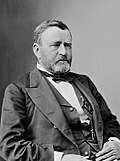
View on WikipediaAlphonso Taft (November 5, 1810 – May 21, 1891) was an American jurist, diplomat, and politician who served as United States Attorney General and Secretary of War under President Ulysses S. Grant. He was also the founder of the Taft political dynasty, and father of Congressman Charles Phelps Taft and President William Howard Taft.
Key Information


As Secretary of War, Taft's popular appointment by Grant did much to restore the integrity of the War Department. Taft reformed the War Department by allowing commanders at Indian forts to choose who could start and run post traderships, and by making reductions in wasteful military spending. While serving as Attorney General, he strongly held that African Americans must not be denied the right to vote through intimidation and violence.[1] Attorney General Taft coauthored a bill to Congress, signed into law by President Grant, that created the Elections Commission that settled the controversial Hayes-Tilden presidential election.[2]
Taft was appointed as minister to Austria-Hungary by Chester A. Arthur in 1882. He served until July 4, 1884, and was then transferred by President Arthur to Minister of Russia, and he served in St. Petersburg until August 1885. Taft had a reputation for serving political office with integrity and character. Taft was a rare and modern 19th century politician who supported black voting rights and who reduced government corruption while holding office.
Early life
[edit]Alphonso Taft was born in Townshend, Vermont, the only child of Peter Rawson Taft of the powerful Taft family, and Sylvia Howard, on November 5, 1810.[2] He was descended from Robert Taft Sr. who had migrated to America from County Louth, Ireland.[2] His mother Sylvia was either of Scottish or Irish descent.[2] While the Taft family was of substance and education, they were not considered wealthy.[2] Taft attended local schools until the age of sixteen. He then taught school to earn money to attend Amherst Academy. During his time at Amherst, he and Samuel Colt stole a cannon belonging to General Ebenezer Mattoon and shot it at their school.[2] Taft entered Yale College in 1829 and he graduated four years later in 1833. Taft helped create the secret society known as Skull and Bones in 1832 with William Huntington Russell.
Upon graduation, again to earn money, Taft was an instructor at Ellington, Connecticut, from 1835 to 1837.[2] He subsequently studied law at the Yale Law School and was admitted to the Connecticut bar in 1838. While studying law Taft held a tutorship at Yale. Taft had no desire to remain in New England, and he stated to his father Peter in a letter written on July 22, 1837, that Vermont was a "noble state to emigrate from." Taft did not want to practice law in New York because he believed people were under the corrupting influence of wealth.[2] In 1839 Taft migrated to Cincinnati where he was a member of the Cincinnati City Council, and became one of the most influential citizens of Ohio. He was a member of the boards of trustees of the University of Cincinnati, Antioch College, and Yale College.[3]
Marriages, family, and estate
[edit]Alphonso Taft was married twice. In 1841 he married Fanny Phelps (born 1823), daughter of Judge Charles Phelps, and they had five children, three of whom died in infancy:
- Charles Phelps Taft (December 21, 1843 – December 31, 1929)
- Peter Rawson Taft II (May 10, 1846 – June 3, 1889)
- Mary Taft (November 24, 1848 – November 29, 1848)
- Alphonso Taft (May 12, 1850 – March 2, 1851)
- Alphonso Taft (December 22, 1851 – June 22, 1852)
Fanny Taft died on June 2, 1852, twenty days before her last child's death. On December 26, 1853, Taft married Louisa Maria (née Torrey) (born 1827), his fourth cousin twice removed, and the daughter of Samuel Davenport Torrey, of Millbury, Massachusetts. They also had five children, one of whom died in infancy:[4]
- Samuel Davenport Taft (February 7, 1855 – April 8, 1856)
- William Howard Taft (September 15, 1857 – March 8, 1930)
- Henry Waters Taft (May 27, 1859 – August 11, 1945)
- Horace Dutton Taft (December 28, 1861 – January 28, 1943)
- Frances Louise "Fanny" Taft (July 18, 1865 – January 4, 1950)
The estate of Alphonso Taft and his family, in Mount Auburn, one mile north of downtown Cincinnati, has been restored to its original appearance. It is open to the public and is now called the William Howard Taft National Historic Site.[5]
Cincinnati attorney and career
[edit]In 1845, Taft is credited with drafting what is still considered, the world's longest lease, a 10,000 year lease to be exact for the Mercantile Library of Cincinnati. In 1845, the library burned down and its members raised $10,000 to contribute to the rebuilding effort. In exchange for the monetary contribution from its members, Alphonso Taft using his legal prowess, as well as his sense of humor negotiated the 10,000 year lease from which the library was able to lease their space, and it also included a stipulation that the lease could be renewed. [1] Alphonso Taft formed a law firm with Thomas Marshall Key and William M. Dickson in April 1854.[6] He was a delegate to the Republican National Convention in 1856, and also that year made an unsuccessful run for the United States House of Representatives against George H. Pendleton. Taft supported the Union during the Civil War. He was a judge of the Superior Court of Cincinnati from 1866 to 1872 when he resigned to practice law with two of his sons.[7] He was the first president of the Cincinnati Bar Association, serving in 1872.
In the court case Board of Education of Cincinnati vs. Minor (1872), Taft dissented against the decision made by the Superior Court of Cincinnati regarding the reading the Bible in public schools.[8] Taft asserted that the school board was within its rights to stop the practice of reading the Bible in public schools, arguing that religious liberty demands that "The government is neutral, and, while protecting all [religious sects], it prefers none, and it disparages none."[9][10][11] Taft's dissent helped to sway the Ohio Supreme Court, and they ruled in favor of the school board, overturning the Superior Court ruling. In his discourse, Taft specifically referenced Jewish groups opposed to the reading of the Bible in public schools. As taxpayers, Taft argued, Jews also had the right to take advantage of a public secular education.[12] In addition, religion was a matter of the home and protected by the Bill of Rights.[12] To suggest that the Bill of Rights only reflects Protestant values was inappropriate, according to Taft, as religious liberty was given to all religious denominations and Christianity "is not to be regarded as sectarian under our constitution."[9]
Many believe that Taft's opinion was the cause of much opposition to him, and contributed to his 1875 loss of the Republican nomination for Governor of Ohio to Rutherford B. Hayes. However, the opinion that defeated his nomination was unanimously affirmed by the Supreme Court of Ohio.[7] The independence of Taft's opinion commanded widespread respect, a sentiment freely expressed when President Ulysses S. Grant in March 1876 made him Secretary of War and three months later Attorney General of the United States.[7]
Taft was elected a member of the American Antiquarian Society in October 1876.[13]
Secretary of War
[edit]
When President Grant's Secretary of War William W. Belknap resigned in 1876 over receiving profit money from the Fort Sill Indian tradership, Grant needed to find a replacement. Initially, Grant had Secretary George M. Robeson run both the War Department and the Navy Department.[14] Robeson, however, had told Grant that the two Cabinet positions were difficult to manage by one person.[14] Grant then asked Taft to be Secretary of War. With Belknap resigning in the shadow of scandal, Grant was under great pressure to find a reformer to replace him as Secretary of War.[15] Taft had a good reputation as a lawyer and, importantly, was connected to business interests.[16] After consultation, Taft accepted the position and was quickly confirmed by the Senate without objection, taking office on March 8, 1876. In light of what had come before, the press celebrated his appointment and confirmation.[16]
Taft entered office with his "accustomed zeal and good judgment".[17] He made a series of reforms to the War Department to restore its reputation and entanglements caused by Belknap's humiliating resignation.[14] He reversed War Department policy by having commanders at U.S. military forts in the West, rather than the Secretary of War, choose who would run post trader ships.[18] Additionally, he worked with his friend, former general and sitting Ohio congressman Henry B. Banning, to make the army more efficient.[16] He likewise ordered his Bureau and Commandant Department heads to lower their military expenditures.[19] The old ways of letting things go under Belknap and Robeson, it seemed, were over under Taft.[20]
Like his predecessor Belknap, Taft was a large man, with a compact frame, who commanded military respect and admiration while he was Secretary of War.[18]
U.S. Attorney General
[edit]Grant appointed Taft U.S. Attorney General after he had made a Cabinet shift by appointing Edwards Pierrepont Minister to England. Taft was replaced by J. Donald Cameron as Secretary of War. In October 1876, after the highly contested Hayes-Tilden presidential election, Attorney General Taft supported President Grant's use of the military in South Carolina and Mississippi to suppress violence against African Americans in the South. Taft gave a lengthy speech in New York outlining the atrocities committed by Southerners against blacks in the South. In order to prevent the U.S. from fighting a second civil war, Taft supported a bill, signed into law by Grant, that peacefully settled the 1876 election with an Electoral Commission.
Bid for office
[edit]Taft was again an unsuccessful candidate for Governor of Ohio in 1879, this time against Charles Foster.
U.S. Minister
[edit]Taft was appointed by President Chester A. Arthur as U.S. Minister to Austria-Hungary (1882–1884) and to Imperial Russia (1884–1885).
Family dynasty
[edit]Taft was a member of the Taft family political dynasty. His son, William Howard Taft, was the 27th president of the United States and the 10th Chief Justice of the United States, and was a member of Yale's Skull and Bones like his founder father; another son, Charles Phelps Taft, supported the founding of Wolf's Head Society at Yale; both his grandson and great-grandson, Robert A. Taft I (also Skull and Bones) and Robert Taft Jr., were U.S. Senators; his great-great-grandson, Robert A. Taft II, was the Governor of Ohio from 1999 until 2007. William Howard Taft III was ambassador to Ireland; William Howard Taft IV worked in several Republican administrations, most recently that of George W. Bush.
Alphonso Taft and his family were members of Cincinnati's First Congregational-Unitarian Church; he served as one of the congregation's trustees for many years, and was for a time the chairman of the board of trustees. Although government business kept him out of town and thus frequently away from the church in his later years, he remained in contact with the church's minister on the occasions that he was able to return to Cincinnati.[21] At a famous 1874 Taft family reunion at Elmshade, at Uxbridge, Mass., Alphonso delivered an impassioned speech on his family history and his father's origins in this community, as recorded in his biography.[22]
References
[edit]- ^ New York Times (October 26, 1876)
- ^ a b c d e f g h Pringle 1936, p. 264.
- ^ Religion and the Law in America: An Encyclopedia of Personal Belief and Public Policy. Vol. 1. (Santa Barbara, CA: ABC-CLIO, 2007), 149.
- ^ Ancestry of William Howard Taft, Library of Congress (Archive.org)
- ^ "William Howard Taft - National Historic Site". National Park Service. February 23, 2010. Archived from the original on August 28, 2010.
- ^ Dickson, William. "William Dickson papers 1849-1912". quod.lib.umich.edu. Retrieved 2020-01-23.
- ^ a b c Wilson, J. G.; Fiske, J., eds. (1889). . Appletons' Cyclopædia of American Biography. New York: D. Appleton.
- ^ Mark A. Noll, A Documentary History of Religion in America since 1877, 3 ed. (Grand Rapids: William B. Eerdmans Publishing Company, 2003), 49.
- ^ a b Mark A. Noll, A Documentary History of Religion in America since 1877, 3 ed. (Grand Rapids: Wm. B. Eerdmans Publishing Company, 2003), 52.
- ^ Vile, Jon R. "Board of Education of the City of Cincinnati v. Minor (1872)". The First Amendment Encyclopedia. Middle Tennessee State University. Retrieved June 8, 2019.
- ^ Dierenfield, Bruce J. (2007). The Battle over School Prayer. Lawrence, Kansas: University Press of Kansas. p. 30. ISBN 9780700615261.
- ^ a b Mark A. Noll, A Documentary History of Religion in America since 1877, 3 ed. (Grand Rapids: Wm. B. Eerdmans Publishing Company, 2003), 51.
- ^ American Antiquarian Society Members Directory
- ^ a b c Leonard 1920, pp. 159–160.
- ^ Leonard 1920, p. 155-156.
- ^ a b c Leonard 1920, p. 156.
- ^ Leonard 1920, p. 158.
- ^ a b Leonard 1920, p. 159.
- ^ Leonard 1920, pp. 156, 158.
- ^ Leonard 1920, pp. 158–159, 161–162.
- ^ "Taft Once Unitarian Fairy", The New York Times (August 4, 1908; A3).
- ^ Leonard 1920
Sources
[edit]Books
[edit]- Leonard, Lewis Alexander (1920). Life of Alphonso Taft. New York: Hawke Publishing Company (Incorporated).
Biographical dictionaries
[edit]- Pringle, Henry F. (1936). Dumas Malone (ed.). Dictionary of American Biography Taft, Alphonso. New York: Charles Scribner's Sons. pp. 264–265.
Newspapers
[edit]- "The Rebel War Claims Speech of Hon. Alphonso Taft". The New York Times. October 26, 1876.
Further reading
[edit]- "Alphonso Taft". Secretaries of War and Secretaries of the Army. United States Army Center of Military History. 1992. CMH Pub 70-12. Archived from the original on 2007-12-14. Retrieved 2010-08-12.
External links
[edit]

- Works by or about Alphonso Taft at the Internet Archive
- . Encyclopedia Americana. 1920.






| International | |
|---|---|
| National | |
| Other | |

Alphonso Taft
View on GrokipediaAlphonso Taft (November 5, 1810 – May 21, 1891) was an American lawyer, judge, and Republican politician who served as the 35th United States Attorney General from 1876 to 1877 and briefly as United States Secretary of War in 1876 under President Ulysses S. Grant.[1] Born in Townshend, Vermont, he graduated third in his class from Yale College in 1833 before moving to Cincinnati, Ohio, where he built a prominent legal career, served on the city council from 1847 to 1849, and acted as assistant prosecuting attorney and judge.[1] As Secretary of War, Taft implemented measures to curb corruption and wasteful spending in the War Department, reflecting his commitment to administrative efficiency.[1] In his role as Attorney General, he championed civil service reform to diminish the patronage-based spoils system, advocating for merit-based appointments over political favoritism.[1] Later, Taft represented the United States as Minister to Austria-Hungary from 1882 to 1884, contributing to diplomatic relations during a period of European imperial tensions.[2] He was the father of William Howard Taft, the 27th President of the United States, and several other influential sons, establishing a notable political dynasty rooted in Ohio Republicanism.[3]
Early Life and Education
Birth and Upbringing
Alphonso Taft was born on November 5, 1810, in Townshend, Vermont.[1] He was the only child of Peter Rawson Taft, a lawyer, judge, and member of the Vermont House of Representatives, and Sylvia Howard Taft.[4][5] Taft's family traced its lineage to early New England settlers, with his paternal ancestors including several generations of Tafts who had established themselves in Massachusetts and Vermont as farmers, merchants, and public officials by the late 18th century.[6] His father, originally from Uxbridge, Massachusetts, had relocated to Townshend around 1800, where he pursued legal practice and local politics amid the pioneering conditions of rural Vermont.[4] The Taft household emphasized Unitarian principles, reflecting the religious environment of the region, though specific details of Alphonso's religious upbringing remain limited in primary accounts.[4] Taft received his early education in local schools in Townshend, completing basic studies by age sixteen.[7] To fund his preparation for college, he worked as a schoolteacher, demonstrating early self-reliance in a family that valued public service and intellectual pursuit.[7] This period laid the foundation for his later academic achievements, though records of his childhood activities or influences are sparse, focusing primarily on familial expectations of achievement.[4]Yale College and Founding of Skull and Bones
Taft entered Yale College in 1829 at the age of 18, having prepared through local schooling and brief teaching stints in Vermont.[8] He pursued a classical curriculum typical of the era, emphasizing Latin, Greek, mathematics, and moral philosophy, and distinguished himself academically, earning election to Phi Beta Kappa.[9] Taft graduated with the Class of 1833, delivering the valedictory oration at commencement, which reflected his rhetorical skill and engagement with campus intellectual life.[8] In his senior year, Taft co-founded Skull and Bones, a senior secret society, alongside William Huntington Russell in 1832.[9] The society originated as the Eulogian Club amid tensions between Yale's established literary societies—Linonia, Brothers in Unity, and others—over selections for Phi Beta Kappa honors, which some viewed as favoring popularity over merit.[10] Russell and Taft, initially with four other classmates, recruited eight additional seniors from varied regional and social backgrounds to form the inaugural group of fifteen, emphasizing confidentiality, mutual support, and elite camaraderie distinct from the public debating clubs.[9] The society's name derived from a skull-and-crossbones emblem used in an 1833 meeting notice, symbolizing mortality and exclusivity; its number "322" has been interpreted by members as referencing the death of Demosthenes in 322 BCE or a nod to its founding as the second chapter of a German precursor group Russell encountered abroad.[11] Early meetings occurred in rented rooms, facing faculty scrutiny for secrecy, but the group endured, establishing rituals focused on biographical confessions to foster lifelong bonds among future leaders.[9] Taft's role as a progenitor underscored his initiative in Yale's extracurricular hierarchy, though the society's opacity limited contemporary records, with details emerging later from member accounts.[12]Legal and Local Political Career
Establishment in Cincinnati
After admission to the Connecticut bar in 1838, Alphonso Taft conducted an exploratory journey to the western United States during 1838–1839 before relocating to Cincinnati, Ohio, where he apprenticed in a local law office.[4] [13] He was admitted to the Ohio bar in 1840 and promptly established a private law practice in the city, marking the foundation of his professional career in the region.[4] [1] Taft's early years in Cincinnati emphasized both legal work and civic contributions, reflecting the city's rapid growth as a commercial hub on the Ohio River.[14] His legal acumen quickly gained recognition, leading to public service on the Cincinnati City Council for five years in the 1850s, where he addressed municipal governance amid the community's expansion.[4] Concurrently, Taft played a role in developing Cincinnati's public school system and the University of Cincinnati, institutions that bolstered the city's educational infrastructure during its antebellum development.[1] These endeavors solidified Taft's position within Cincinnati's elite circles, blending professional success with community leadership and foreshadowing his later judicial and political roles.[15] By the mid-1850s, his practice had matured sufficiently to support political ambitions, including an unsuccessful congressional bid in 1856 as a Republican candidate.[16]Law Practice and Civic Involvement
Upon arriving in Cincinnati in 1839, Alphonso Taft established a successful private law practice, quickly gaining recognition as one of Ohio's most prominent attorneys.[15][4] In 1865, he was appointed to fill an unexpired term as a judge of the Superior Court of Cincinnati, a position with concurrent jurisdiction over civil and criminal matters alongside the Court of Common Pleas; he was elected to full terms in 1865 and 1869, serving until 1872.[1][4][6] During his tenure, Taft presided over notable cases, including a 1869 ruling on the definition of "bona fide whiskey" in a dispute involving imported spirits, which addressed adulteration standards under U.S. customs law.[17] Taft's legal prominence extended to leadership roles, as he became the first president of the Cincinnati Bar Association upon its founding in 1872, helping to organize the city's 75 initial members into a professional body focused on ethical standards and legal advocacy.[18][19] He also contributed to legal infrastructure by co-founding the Cincinnati Law Library Association in 1846, which provided resources for practitioners amid the city's growing commercial litigation demands.[1] In civic affairs, Taft served on the Cincinnati City Council from 1847 to 1849, advocating for municipal expansion including the annexation of surrounding areas to support the city's industrial growth.[1][4] He played a key role in cultural institutions, notably negotiating a 10,000-year lease for the Mercantile Library after its 1845 fire, securing its Walnut Street location through a perpetual arrangement with the city that ensured long-term stability for the subscription-based collection serving merchants and professionals.[20][21] Educationally, Taft led efforts on the city school board and served as a trustee of the University of Cincinnati, influencing its early development as a municipal institution amid debates over public funding and curriculum expansion in the post-Civil War era.[1]Federal Appointments under President Grant
Tenure as Secretary of War
President Ulysses S. Grant appointed Alphonso Taft as Secretary of War on March 8, 1876, following the resignation of William W. Belknap two days earlier amid a scandal involving kickbacks from military post traderships.[1][4] The Belknap affair had severely damaged the War Department's reputation, prompting Grant to select Taft, an Ohio judge with a record of judicial integrity, to rehabilitate its standing.[4][22] Taft's tenure, spanning less than three months, emphasized administrative efficiency and scandal mitigation. He directed a review of War Department estimates to identify opportunities for expense reductions without impairing operational readiness.[22] These efforts aligned with broader Republican pushes against graft in Grant's administration, though Taft's short time in office limited major overhauls.[4] On May 22, 1876, Grant shifted Taft to Attorney General to replace George H. Williams, who had resigned under pressure, and named J. Donald Cameron as Taft's successor at the War Department.[1] This transition reflected Grant's strategy to leverage Taft's legal expertise amid ongoing political challenges, including the approaching presidential election.[1]Service as Attorney General
Alphonso Taft was appointed United States Attorney General by President Ulysses S. Grant on May 22, 1876, succeeding Edwards Pierrepont, and served until March 11, 1877, coinciding with the final months of Grant's administration amid the contentious 1876 presidential election.[1] His tenure focused on upholding federal authority in the waning years of Reconstruction, particularly through enforcement of the Enforcement Acts of 1870 and 1871, which aimed to combat voter intimidation and violence against African Americans in the South.[23] Taft issued a circular to United States marshals directing them to protect voters in the "free exercise of the elective franchise" during the 1876 elections, commissioning posses comitatus where necessary to maintain order and suppress Ku Klux Klan activities or other disruptions.[23] [24] This reflected his view that African Americans' voting rights must be safeguarded against intimidation, aligning with the administration's efforts to sustain Republican influence in Southern states.[24] He also rendered opinions on departmental matters, such as upholding the Navy's policy of suspending pay for sailors jailed or removed from duty in November 1876, affirming the government's authority to enforce discipline without compensation during incapacity.[6] Taft's brief service emphasized legal rigor over innovation, with no major structural reforms to the Justice Department, as his priorities centered on immediate electoral integrity amid rising Democratic challenges to Reconstruction.[1] Upon Grant's departure from office, Taft resigned and returned to private law practice in Cincinnati, Ohio.[1]Political Campaigns and Diplomatic Appointment
Bids for Ohio Governorship
In 1875, Alphonso Taft emerged as a leading contender for the Republican nomination for governor of Ohio, positioning himself as a reform-minded candidate with experience in law and federal service. However, at the state convention, delegates selected Rutherford B. Hayes instead, who initially hesitated but accepted the nomination and went on to win the general election.[1][25] Taft's defeat was attributed in part to opposition stemming from a dissenting judicial opinion he issued as a superior court judge regarding the constitutionality of legislation establishing the Cincinnati Southern Railway, which alienated some party factions favoring business interests. Taft's advocacy for civil service reform and other progressive positions, including support for women's rights, further contributed to resistance from conservative elements within the Ohio Republican Party, who viewed such stances as diverging from orthodox party priorities during Reconstruction's aftermath.[26] Despite his prominence in Cincinnati legal circles and national visibility from prior federal roles, these factors limited his appeal at the convention, marking his first unsuccessful bid for statewide office.[4] Four years later, in 1879, Taft again sought the Republican gubernatorial nomination, leveraging his recent tenure as U.S. Attorney General to bolster his credentials amid ongoing party debates over corruption and patronage. Yet, he once more fell short at the convention, where Charles Foster secured the nod and subsequently defeated Democrat James Ewing in the general election by a margin of approximately 12,000 votes.[1][27] Taft's reformist leanings, particularly his push against the spoils system—a position he had emphasized during his time in the Grant administration—clashed with entrenched machine politics in Ohio, underscoring the challenges faced by independent-minded Republicans in securing nominations during this era. These bids highlighted Taft's commitment to principled governance but ultimately reinforced his role as a party elder rather than an elected executive.[4]Minister to Austria-Hungary
Alphonso Taft was nominated by President Chester A. Arthur and confirmed by the U.S. Senate as Envoy Extraordinary and Minister Plenipotentiary to Austria-Hungary on April 26, 1882.[2] This diplomatic post, based in Vienna, represented a continuation of Taft's public service following his roles in the Grant administration and unsuccessful campaigns for Ohio governor.[1] The appointment aligned with the era's practice of assigning such positions to experienced political figures to foster bilateral relations through personal representation rather than career diplomats. Taft presented his credentials to Austro-Hungarian authorities on June 30, 1882, formally assuming duties amid cordial U.S.-Austro-Hungarian ties focused on trade, consular protections, and mutual recognition of naturalization principles.[2] [28] His tenure involved standard diplomatic correspondence, including exchanges on foreign ministry matters such as extradition and commercial interests, as evidenced by official dispatches from Vienna in 1884.[29] No major crises disrupted relations during this period, reflecting the Dual Monarchy's internal stability under Emperor Franz Joseph I and the absence of direct conflicts with American interests. On August 25, 1884, Taft's service in Austria-Hungary concluded with his transfer to the U.S. ministry in Russia, a move initiated by President Arthur to address evolving diplomatic needs in Eastern Europe.[28] [2] Taft's wife, Louise Maria Torrey Taft, accompanied him to Vienna, where the family resided in the legation, providing a semblance of domestic continuity during his overseas assignment.[30] Health concerns later prompted his resignation from the Russian post in 1885, marking the end of his diplomatic career.[4]