Hubbry Logo
Barbary sheepBarbary sheepMain
Open search
Barbary sheep
Community hub
Barbary sheep
logo
8 pages, 0 posts
0 subscribers
Be the first to start a discussion here.
Barbary sheep
Barbary sheep
from Wikipedia

Barbary sheep
CITES Appendix II
Scientific classification Edit this classification
Kingdom: Animalia
Phylum: Chordata
Class: Mammalia
Order: Artiodactyla
Family: Bovidae
Subfamily: Caprinae
Tribe: Caprini
Genus: Ammotragus
(Blyth, 1840)
Species:
A. lervia
Binomial name
Ammotragus lervia
(Pallas, 1777)
Subspecies

A. l. angusi Rothschild, 1921
A. l. blainei Rothschild, 1913
A. l. lervia Pallas, 1777
A. l. fassini Lepri, 1930
A. l. ornatus I. Geoffroy Saint-Hilaire, 1827
A. l. sahariensis Rothschild, 1913

Range of Ammotragus lervia
  Extant (resident)
  Possibly extant (resident)
  Extant and reintroduced (resident)
  Possibly extinct
  Presence uncertain
Synonyms
  • Antilope lervia[3]
  • Capra lervia[4]
  • Ovis lervia

The Barbary sheep (Ammotragus lervia), also known as aoudad (pronounced [ˈɑʊdæd]), is a species of caprine native to rocky mountains in North Africa and parts of West Africa.[1] While this is the only species in genus Ammotragus, six subspecies have been described. Although it is rare in its native North Africa, it has been introduced to North America, southern Europe, and elsewhere. It is also known in the Berber language as waddan or arwi, and in former French territories as the mouflon.

Description

[edit]

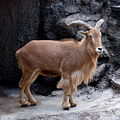
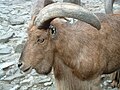
Barbary sheep stand 75 to 110 cm (2 ft 6 in to 3 ft 7 in) tall at the shoulder, with a length around 1.5 m (5 ft), and weigh 30 to 145 kg (66 to 320 lb).[5] They are sandy-brown, darkening with age, with a slightly lighter underbelly and a darker line along the back. Upper parts and the outer parts of the legs are a uniform reddish- or grayish-brown. Some shaggy hair is on the throat (extending down to the chest in males) with a sparse mane. Their horns have a triangular cross-section. The horns curve outward, backward, then inward, and can exceed 76 cm (30 in) in length. The horns are fairly smooth, with slight wrinkles evident at the base as the animal matures.[6]

Range

[edit]

Natural range

[edit]

Barbary sheep are endemic to regions of Northern Africa primarily surrounding the barren center of the Sahara Desert. Countries and territories where aoudad may be found include Algeria, Chad (north), Egypt, Libya, Mali (north), Mauritania, Morocco, Niger, Tunisia and Western Sahara. West of the Nile, they can be found in Sudan; east of the Nile, in the Red Sea Hills.[7] The now-extinct Ancient Egyptian corkscrew-horned sheep (Ovis longipes palaeoaegyptiacus) was also thought to be a subspecies of wild barbary sheep.[8]

Populations within its native range have been decreasing due to hunting, legal and otherwise, and destruction of habitat.[9][10]

Introduced populations

[edit]
Barbary sheep at London Zoo.

Barbary sheep have been introduced to southeastern Spain[11] and the Southwestern United States.[12]

They have become common in a limited region of southeastern Spain, since its introduction in 1970 to Sierra Espuña Regional Park as a game species. Its adaptability enabled it to colonize nearby areas quickly, and private game estates provided other centers of dispersion. The species is currently expanding, according to recent field surveys, now being found in the provinces of Alicante, Almería, Granada, and Murcia.[13] The species is a potential competitor to native ungulates inhabiting the Iberian Peninsula, and has also been introduced to La Palma (in the Canary Islands), and has spread throughout the northern and central parts of the island, where it is a serious threat to endemic vegetation.[14] The aoudad has also been introduced in Croatia several times, where a population exists in Mosor.[15]

During the winter of 1957-1958, 42 Barbary sheep were released in the Palo Duro Canyon of Texas for the purpose of attracting hunters to the region.[16]

Although the species has not yet been recorded in Australia, it is considered a pest species in Queensland, with the potential to establish in the wild.[17]

Taxonomy

[edit]
Juvenile

A. lervia is the only species in the genus Ammotragus, but some authors include this genus in the goat genus Capra, together with the sheep genus Ovis.[4]

The subspecies are found allopatrically in various parts of North Africa:[7]

  • A. l. lervia Pallas, 1777 (vulnerable)
  • A. l. ornata I. Geoffroy Saint-Hilaire, 1827 (Egyptian Barbary sheep, thought to be extinct in the wild, but still found in the eastern desert of Egypt)[18][19]
  • A. l. sahariensis Rothschild, 1913 (vulnerable)
  • A. l. blainei Rothschild, 1913 (vulnerable)
  • A. l. angusi Rothschild, 1921 (vulnerable)
  • A. l. fassini Lepri, 1930 (vulnerable)

Habitats

[edit]
Barbary sheep

Barbary sheep are found in arid mountainous areas where they graze and browse grasses, bushes, and lichens. They are able to obtain all their metabolic water from food, but if liquid water is available, they drink and wallow in it. Barbary sheep are crepuscular - active in the early morning and late afternoon and rest in the heat of the day. They are very agile and can achieve a standing jump over 2 m (7 ft). They are well adapted to their habitat, which consist of steep, rocky mountains and canyons. They often flee at the first sign of danger, typically running uphill. They are extremely nomadic and travel constantly via mountain ranges. Their main predators in North Africa were the Barbary leopard, Barbary lion, and caracal, but now humans, feral dogs, competition due to overgrazing by domestic animals, and drought[20] threaten their populations.

Names

[edit]

The binomial name Ammotragus lervia derives from the Greek ἄμμος ámmos ("sand", referring to the sand-coloured coat) and τράγος trágos ("goat").

Lervia derives from the wild sheep of northern Africa described as "lerwee" by Rev. T. Shaw in his "Travels and Observations" about parts of Barbary and Levant.

The Spanish named this sheep the arruis, from Berber arrwis, and the Spanish Legion even used it as a mascot for a time.

Aoudad ([ˈɑː.uːdæd]) is the name for this sheep used by the Berbers, a North African people, and it is also called arui and waddan (in Libya).

[edit]

References

[edit]

Further reading

[edit]
[edit]
Revisions and contributorsEdit on WikipediaRead on Wikipedia
from Grokipedia
The '''Barbary sheep''' (''Ammotragus lervia''), also known as '''aoudad''', is a species of (family ) native to the dry, rocky of . Despite its common name, it is more closely related to than to true sheep. It inhabits arid environments across countries including , , , , and , though populations in its native range are vulnerable due to habitat loss and hunting. The species has been introduced to other regions, such as the and , where it has established feral populations.

Taxonomy and nomenclature

Taxonomy

The Barbary sheep, scientifically classified as Ammotragus lervia (Pallas, 1777), belongs to the order Artiodactyla, family Bovidae, and subfamily Caprinae, which encompasses goat-antelopes. The genus Ammotragus Blyth, 1840, is monotypic, with A. lervia as its sole species, distinguishing it from related genera like Ovis (true sheep) and Capra (goats). This classification reflects its unique position within the Caprini tribe, characterized by adaptations bridging sheep-like and goat-like traits. Historically, the taxonomic placement of the Barbary sheep has been debated, with early proposals treating Ammotragus as a subgenus of Ovis due to superficial similarities in horn curvature and social behavior. Some classifications even subsumed it under Capra or suggested it as a hybrid form between sheep and goats, based on limited morphological comparisons. These uncertainties were resolved through detailed analyses of cranial morphology—such as the robust skull and specialized horn cores—and horn structure, which exhibit a distinctive scimitar shape unlike those of true sheep. Genetic studies, particularly mitochondrial DNA sequencing, have further confirmed its distinct lineage, revealing a divergence from the common ancestor shared with Ovis aries and Capra hircus approximately 11.4 million years ago in the late Miocene, with the Capra-Ammotragus split occurring around 8.9–9.9 million years ago. Earlier hypotheses positing it as an ancestral form to modern sheep or goats have been refuted by these phylogenetic data, establishing Ammotragus as a separate evolutionary branch. Up to six subspecies of A. lervia are currently recognized, reflecting geographic variation across its native range, though some authorities debate their validity due to clinal differences rather than discrete boundaries. Recent genetic analyses (as of 2023) indicate limited support for discrete subspecies boundaries, advocating for taxonomic revision. The nominate subspecies A. l. lervia (Atlas aoudad) inhabits the mountainous regions of Morocco, northern Algeria, and Tunisia, featuring relatively large body size, long sweeping horns in males (up to 80 cm), and a pale tawny pelage with a prominent chest mane. In contrast, A. l. angusi (Aïr aoudad) is found in the Aïr and Termit Massifs of Niger, characterized by smaller horns (typically 50–60 cm) and a darker, more reddish pelage adapted to semi-arid escarpments. Other subspecies include A. l. sahariensis (Saharan aoudad) in the central Sahara with intermediate horn lengths and sandy coloration, A. l. ornatus in the mountains of Egypt and northern Libya with ornate mane fringes, A. l. blainei (Kordofan aoudad) in Sudan with compact builds, and A. l. fassini (Libyan aoudad) restricted to southern Tunisia and Libya, showing subtle variations in horn curvature and pelage density linked to local arid conditions. These variations underscore the species' adaptability, though ongoing genetic research suggests potential hybridization in overlapping zones.

Common names and etymology

The Barbary sheep is most commonly known in English by that name, which originates from the historical European designation "Barbary" for the coastal and mountainous regions of , particularly those associated with the indigenous Berber peoples. This term reflects the animal's native habitat in the Berber-inhabited areas, such as the , where it has long been a part of local ecosystems. Among the Berber-speaking communities of , the species is referred to as aoudad (or audad), a name derived from the Tamazight language term awdad, highlighting its cultural significance in the region where it has been hunted and observed for millennia. Alternative Berber names include waddan and arwi, the latter of which influenced the Spanish term arruí (or arui), adopted during colonial interactions and used today in for introduced populations. In , it is known as wadan, a word denoting wild sheep and underscoring its status as a rugged, untamed caprid distinct from domestic breeds. The nomenclature also carries historical and cultural layers, with early European descriptions often confusing the Barbary sheep with wild goats due to its prominent beard-like mane on the throat and chest, leading to its classification as a "sheep" despite closer relation to goats. Early naturalists described North African caprids generally, but specific identification with the Barbary sheep remains uncertain.

Physical description

Morphology and size

The Barbary sheep (Ammotragus lervia) is a robust caprid with a body length ranging from 1.2 to 1.65 m and shoulder height of 75 to 110 cm. Adults typically weigh between 40 and 145 kg, with males averaging around 82 kg and females around 41 kg. Males are notably larger and heavier than females, exhibiting pronounced in overall body size. Sexual dimorphism is also evident in the horns, which are present in both sexes but more massive and elongated in . horns are scimitar-shaped, keeled, and can reach up to 88 cm in length along the curve, while female horns are shorter, typically 25 to 50 cm, and less robust. further display a prominent mane and formed by longer, shaggier hair on the throat, chest, and forelegs. The pelage is sandy brown to reddish-gray (tawny or ), with darker brown areas on the head and forequarters, and lighter whitish undersides, chin, and legs. The coat consists of a dense, bristly outer layer over a finer undercoat, with the ventral mane in males being particularly long and capable of extending toward the ground. The head features a long, elongated face with large, laterally and posteriorly positioned eyes that provide wide , adapted for detecting predators in open terrain. Barbary sheep lack preorbital, interdigital, and flank glands but possess subcaudal glands used for scent marking.

Adaptations

The Barbary sheep (Ammotragus lervia) possesses specialized physiological adaptations for in arid environments, primarily obtaining most of its moisture requirements from a xerophytic diet of such as grasses, forbs, and shrubs, supplemented by metabolic production from food oxidation. This allows the to endure extended periods without access to free-standing sources. Additionally, it relies on respiratory evaporative cooling through panting rather than sweating to regulate body , thereby minimizing cutaneous loss during heat stress. Anatomical features enhance locomotion across rugged, rocky terrain characteristic of its native North African mountains. The hooves provide strong grip on steep slopes and cliffs, facilitating agile climbing and descending. Powerful hind legs support vertical jumps exceeding 2 meters from a standing position, enabling escape from predators or access to sites. Sensory and defensive adaptations further promote survival in open, exposed landscapes. The species exhibits excellent eyesight as its primary detection mechanism for threats, aided by horizontal pupils that provide a wide . Dichromatic vision facilitates early identification of movement. Long, curved horns, measuring up to 88 cm in males, serve for intraspecific to establish dominance, while the sandy-brown pelage offers cryptic coloration that blends seamlessly with rocky substrates, reducing to predators. Physiological resilience supports endurance in fluctuating conditions, with tolerance to ambient temperatures ranging from 0°C to 30°C within its , though broader extremes are survivable through behavioral adjustments like shade-seeking. During periods of food scarcity, a reduced metabolic rate conserves energy. The , with a capacity of 19-38 liters, enables efficient of tough, fibrous , extracting maximal nutrients via microbial breakdown and regurgitation—a process that aligns with its diet of arid-adapted vegetation detailed elsewhere.

Distribution

Native range

The Barbary sheep (Ammotragus lervia) is native to the rugged mountainous and arid regions of , with its core range spanning from and in the west to and in the east. This distribution encompasses the in , , and ; the Saharan highlands of and ; and the semi-arid zones of , , , and . Subspecies such as A. l. lervia occupy northern Atlas populations, while A. l. sahariensis is associated with Saharan extensions. Historically, the species' extent was broader prior to the , including coastal plains and semi- alongside mountain ranges up to the Red Sea hills, before contracting into fragmented pockets due to human pressures. The native range is biogeographically confined to Saharo-Mediterranean ecoregions, where populations occur from near in lowlands to elevations of 4,000 m in highland areas. Genetic analyses indicate higher mitochondrial diversity in central North African populations, particularly in , compared to peripheral isolates in , which harbor unique haplotypes reflecting long-term isolation. These patterns underscore the evolutionary significance of core versus edge distributions within the ' indigenous range.

Introduced populations

The Barbary sheep, native to , was initially imported to the in the early 1900s for private collections and zoos, with subsequent releases and escapes from ranches in the establishing populations primarily for purposes. These introductions originated from North African stock, and the ' adaptability to arid, rocky environments facilitated rapid population growth in the southwestern U.S., where suitable climates mirrored their native habitats. In Texas, the first deliberate releases occurred in the 1950s, including 14 individuals in the in 1957–1958 and additional groups in the region, leading to established herds that have since expanded across . As of 2025, the Texas population is estimated at 30,000 to 100,000 individuals, concentrated in the , with herds showing due to high reproductive rates and low predation. Smaller feral herds persist in , stemming from 1950s releases in the Canadian River Canyon and 1960s introductions on private ranches near Roswell, numbering in the low thousands across southeastern units. In California, initial releases date to 1924 on private estates, resulting in limited, scattered populations estimated at a few hundred animals in remote mountainous areas. In , the species was introduced to southeastern in 1970 as a game animal, starting with 35 individuals released into Sierra Espuña Regional Park, from which populations spread to nearby ranges including the Sierra Nevada. By the 2020s, 's introduced population exceeded 10,000, with densities peaking at around 13 individuals per km² in core areas during the before stabilizing through natural regulation and hunting. Introductions to in northern regions have yielded limited groups, primarily near the U.S. border, while efforts in and other Middle Eastern sites have seen minimal establishment success due to unsuitable conditions or management challenges. These introduced populations are considered invasive in parts of their non-native ranges, such as Texas, where they compete with native desert bighorn sheep for resources, prompting management actions like unregulated hunting to curb expansion. In 2025, Texas passed legislation permitting the hunting of aoudad from helicopters to aid in population control, effective September 1, 2025. Population growth has been uneven, with Texas herds continuing to expand into new arid zones, while isolated groups in California and New Mexico remain stable but vulnerable to local extirpation. Genetic analyses of introduced populations reveal low founder diversity, as many stemmed from small numbers of captive individuals sourced from limited North African locales, resulting in reduced heterozygosity and elevated inbreeding coefficients in isolated herds. For instance, U.S. populations comprise primarily two —the Atlas aoudad in and , and the Saharan aoudad in —exhibiting genetic bottlenecks that heighten risks of over time. Similar patterns occur in Spanish populations, where initial releases from zoos led to moderate but declining , underscoring the need for monitoring to prevent long-term viability issues.

Habitat and ecology

Habitat preferences

The Barbary sheep (Ammotragus lervia) primarily inhabits arid to semi-arid rocky mountains, steep escarpments, and canyons, favoring terrains that provide ample cover and escape routes from predators. These environments are characterized by rugged, precipitous landscapes where the species can utilize its sure-footedness to navigate cliffs and slopes. In its native North African range, the species occupies elevations from near sea level to over 4,100 m, though it shows a particular affinity for intermediate altitudes around 500–2,500 m where conditions balance accessibility and resource availability. In introduced populations, such as in the southwestern United States, it occupies lower elevations, typically from about 300 m to 2,300 m. Vegetation associations in these habitats typically include sparse acacia savannas, dwarf shrublands, and lichen-covered rock surfaces, which offer limited but sufficient amid low . The species avoids dense forests, where mobility is restricted, and flat, open deserts lacking structural cover, preferring instead open rocky areas that support scattered grasses and browse. These preferences align with the sheep's adaptations to , enabling survival in environments with minimal and . At the microhabitat level, Barbary sheep seek shaded cliffs and overhangs during daylight hours for , particularly in hot conditions, to minimize heat stress and conserve energy. Populations may make small seasonal movements based on availability. Habitat fragmentation poses a significant challenge, as the species prefers connected rocky corridors that facilitate movement and between populations. Heavy by domestic exacerbates this by altering plant cover, reducing available browse, and compacting soil in key areas, leading to decreased suitability and population isolation.

Diet and foraging behavior

The Barbary sheep is herbivorous, consuming a diet primarily composed of grasses, forbs, and shrubs. Seasonal variations influence its choices; during winter, grasses form the bulk of the diet, while in other seasons, it shifts toward browsing on shrubs and forbs. Studies indicate an annual diet composition of approximately 67% grasses, 17% browse, and 16% forbs in some populations. As a generalist , it can adapt to available in arid environments, obtaining moisture from succulent plants to survive periods without free . occurs mainly on steep, rocky slopes where its allows access to otherwise unreachable plants.

Behavior and reproduction

Social structure and activity patterns

Barbary sheep (Ammotragus lervia) live in social groups that typically consist of matriarchal family units comprising 5 to 20 females and their young, reflecting a stable, near-linear among females that is often inherited matrilineally and influenced by factors such as age and maternal rank. Bachelor males form separate herds, while mixed groups including both sexes occur seasonally, particularly during rutting periods, with average group sizes around 5 to 12 individuals but occasional loose aggregations reaching up to 50 during movements across landscapes. In some populations, adult sex ratios lean toward more females, at approximately 40-55 males per 100 females. Activity patterns of Barbary sheep are primarily crepuscular in hot, arid environments, with bimodal peaks of activity centered around dawn (5:00–9:00 a.m.) and (5:00–7:00 p.m.), allowing them to avoid midday heat while and moving. Seasonal variations in activity timing are minimal. The species spends much of the day resting in shaded rocky areas to conserve energy and thermoregulate, with heightened vigilance during active periods. Communication among Barbary sheep involves a combination of vocalizations, including grunts, bleats, snorts, and screeches, which serve to maintain group cohesion and signal alarms or social interactions. Scent marking occurs via specialized , notably a subcaudal beneath the , used to delineate territories or convey reproductive status. Dominance displays are prominent among males, featuring postures with horns directed forward, followed by aggressive charges or horn clashes to establish hierarchy within groups. Anti-predator strategies in Barbary sheep rely on their exceptional and affinity for rugged , with individuals fleeing to steep cliffs or outcrops where their prowess provides escape from predators like leopards or dogs. enhances detection through synchronized vigilance, where members alternate scanning for threats, reducing individual risk during rest or ; this collective alertness, combined with rapid flight responses, contributes to low predation success rates on adults.

Reproduction and life cycle

The Barbary sheep (Ammotragus lervia) employs a polygynous , in which dominant males defend and mate with multiple females, typically forming temporary harems of 3 to 5 ewes during the breeding season. Competition among males is intense and involves ritualized displays, such as parallel walking and horn clashing, escalating to physical fights with head-on charges and horn wrestling to establish dominance and access to females. The rut peaks in late fall, from to November, though breeding can occur year-round in some populations, particularly in equatorial regions. Females are polyestrous, capable of re-entering estrus if a is lost, allowing for potential multiple breeding cycles per year under favorable conditions. lasts approximately 5 months (160 days), after which females give birth to 1-2 lambs, with twins occurring rarely (in about 1 in 6 to 7 births) and litters of up to 3 exceptional. Newborn lambs weigh 3 to 4 kg and are precocial, able to stand and follow the mother within hours of birth, often on rocky outcrops that provide immediate and protection from predators. This seasonal breeding pattern is synchronized with environmental cues in arid habitats, such that lambing predominantly occurs in spring (March to May), coinciding with periods of vegetation green-up and increased forage availability following winter rains. In some native populations, survival from birth to one year is approximately 35%, attributed to the ewes' strategy of hiding newborns in rocky crevices and the species' adaptations to rugged terrain that deter predators like leopards and caracals. In the life cycle, lambs are nursed for 4 to 6 months before , after which they become increasingly independent, foraging with the maternal group but fully self-sufficient by about 1 year of age. is reached at 18 to 24 months for both sexes, with females often breeding in their second year and males capable of producing viable by 11 months, though full reproductive competitiveness develops later. In the wild, Barbary sheep have a lifespan of 10 to 15 years, while individuals in captivity can live up to 20 years.

Conservation status

The Barbary sheep (Ammotragus lervia) is classified as Vulnerable on the since 2008, with native populations estimated at 5,000–10,000 mature individuals and an overall decreasing trend. This decline exceeds 10% projected over the next three generations, driven by ongoing pressures across its North African range. In native habitats, overhunting for meat and horns has severely reduced numbers, despite protective measures such as Morocco's hunting ban in 1968, where persists due to enforcement challenges. degradation from by domestic and direct with for in mountainous areas compound these losses, leading to range contraction and population fragmentation. The species is susceptible to diseases including , which affects cloven-hoofed ungulates like the Barbary sheep, and caused by pathogens such as ovipneumoniae. Outbreaks in small, isolated populations heighten vulnerability, as low limits resilience to such health threats. Introduced populations in the United States remain stable to growing, with approximately 100,000 individuals concentrated in (as of 2025) where they are hunted. monitoring in areas like reveals significant population increases in recent years, reflecting successful adaptation to arid environments.

Conservation measures and invasive impacts

In their native North African range, Barbary sheep (Ammotragus lervia) benefit from protection within several national parks, including Algeria's Ahaggar National Park, where populations remain stable due to the park's vast, rugged terrain that limits human access and poaching. Legal protections, such as Tunisia's 1966 ban on hunting the species, are enforced through anti-poaching patrols and regulated quotas in areas where sustainable harvest is permitted to prevent overexploitation. Captive breeding programs in European zoos, coordinated under initiatives like the European Endangered Species Programme, maintain over 500 individuals to support potential reintroductions and genetic preservation, with successful reproduction documented in facilities such as Vienna Zoo. Reintroduction efforts have focused on restoring populations in historically occupied habitats, notably in Tunisia's Djebel Chambi , where 11 individuals were released starting in 1987, leading to a current estimated population of 700–800 across protected areas. Habitat restoration complements these releases, including the use of livestock exclusion fences to reduce competition from domestic and allow native vegetation recovery, as implemented in fragmented mountain ranges to enhance forage availability. In introduced ranges, particularly the southwestern United States, management targets the invasive Barbary sheep to mitigate threats to native species like desert bighorn sheep (Ovis canadensis). In Texas, culling programs, including targeted removals in Big Bend National Park and widespread hunter harvests estimated in the thousands annually, aim to reduce aoudad densities and protect bighorn recovery efforts. Hybridization risks with native ungulates appear minimal due to genetic divergence between genera, but ongoing DNA monitoring in U.S. populations assesses introgression and population structure to inform control strategies. As an , Barbary sheep exert broader ecological pressures through resource competition, with dietary overlap of up to 30% with in shared arid habitats, leading to displacement of native grazers during seasonal forage shortages. They also facilitate disease transmission, serving as competent reservoirs for ovipneumoniae, a bacterium that causes fatal outbreaks in populations upon contact, as confirmed in experimental cohabitation studies.

References

Add your contribution
Related Hubs
User Avatar
No comments yet.