


Community hub
Recent from talks
Contribute something
Nothing was collected or created yet.
Assyrian independence movement
View on Wikipedia
.svg)
The Assyrian independence movement is a political movement and ethno-nationalist desire of ethnic Assyrians to live in their indigenous Assyrian homeland in northern Mesopotamia under the self-governance of an Assyrian State.
The tumultuous history of the traditional Assyrian homeland and surrounding regions, as well as the Partition of the Ottoman Empire, led to the emergence of modern Assyrian nationalism.[1] To this respect, Assyrian independence movement is a "catch-all" term of the collective efforts of proponents of Assyrian nationalism in the context of the modern nation state. As a result of genocide and war, the Assyrians were reduced to a minority population in their indigenous homeland, resulting in political autonomy being unattainable due to the security risks,[2] and the rise of the movement for Assyrian independence as it exists today.[3]
The territory that forms the Assyrian homeland is, similarly to the rest of Mesopotamia, currently divided between present-day Iraq, Turkey, Iran, and Syria.[4][5] The efforts are specifically in the regions where larger concentrations still exist, and not the Assyrian homeland in its entirety, those regions with large concentrations being Erbil, and the Duhok Governorate in Iraq, the latter two being located in the Iraqi Kurdistan region and the Al-Hasakah Governorate in Syria.[6][7] Mosul and the Nineveh Governorate had a sizable Assyrian presence prior to the takeover and forced expulsion of the Assyrian population by the Islamic State in 2014.[8]
In his 53 years as Patriarch of the Assyrian Church of the East, Mar Eshai Shimun XXIII petitioned the League of Nations,[9] and then the United Nations[10] for an Assyrian Homeland before stepping down as Patriarch in 1973.[11] The assassination of Mar Eshai Shimun XXIII in 1975[12] was a demoralizing moment to Assyrian freedom fighters, as he was a significant spiritual and temporal leader.[13]
The independence movement is active both within the homeland and throughout the global diaspora,[14] with much resistance from the local Middle Eastern states and regions,[15] as well as the Kurdish.[16] The movement has spanned centuries, with the initial conceptualization of modern Assyrian statehood occurring in the 19th century with the waning of the Ottoman Empire and rise of European control of the region, notably by the British and Russian Empires, as well as the French Republic.
There have been many hindrances to the movement, including events such as the Assyrian genocide, Simele massacre, internal conflicts over naming disputes and Assyrian churches, portrayals in media, and Arabization, Kurdification, and Turkification policies. Most recently, the primary problem for them has been ISIS, which took over and expelled a massive portion of the population from the Nineveh Plains in Northern Iraq. The Assyrian Aid Society of America has requested that the U.S. government designate these actions as a genocide against Assyrians in these regions.[17]
Austen Henry Layard, the British Empire's ambassador to the Ottoman Empire in the nineteenth century, stated that the Assyrians had survived the Arab, Mongol, and Kurdish conquests in the mountains of Hakkari and northern Mesopotamia, where they had fought to maintain their independence in the nineteenth century.[18]
In 2016, the Iraqi Parliament voted against a new Christian province in Nineveh Plains, which was a stated political objective of all major Assyrian political groups and institutions. Assyrians, including the leader of the Bet-Nahrain Democratic Party, Romeo Hakkari, protested the Iraqi parliament's decision and stated "We do not want to be part of the possible Sunni (Arab) autonomous region in Iraq".[19]
World War I
[edit]In Turkey
[edit]
• Towns where genocide occurred
• Towns that received refugees
• Other major cities
Assyrians primarily lived in the provinces of Hakkari, Şırnak, and Mardin in southeastern Turkey, These areas had sizable Kurdish and Armenian populations. Starting in the nineteenth century, the Armenians, Greeks and Assyrians of eastern Anatolia, including the Hakkari mountains in Van province, were the subject of forced relocations and executions, a possible cause being religious persecution.
The Hakkari region was the main center of Assyrian population in early 20th century. According to the Armenian Patriarch of Constantinople, there were 18,000 Assyrians in Van Vilayet, 15,000 in Bitlis Vilayet and 25,000 in Diyarbekir Vilayet in 1912/1913.[20] In 1914, Young Turks with the aid of the Kurds and other Muslim ethnic groups, began to systemically target the ancient indigenous Christian communities of Asia Minor, primarily composed of Armenians, Assyrians, Greeks and to a small degree Georgians. Events such as the Assyrian genocide, Greek genocide and Armenian genocide followed, as did the similarly motivated Great Famine of Mount Lebanon which targeted Maronite Christians. In the beginning, key Assyrian nationalist leaders and religious figures were wiped out of communities, followed by the systematic massacre and ethnic cleansing by the Turks, Arabs, Kurds, Chechens and Circassians of hundreds of thousands of unarmed men, women and children.[21][22][23][24][25]
At the outset of World War I, almost one half of the Assyrian population lived in what is today South eastern Turkey occupied assyria with the remainder living over the borders in what is now northern Iraq occupied assyria north east Syria and north west Iran. The Young Turks, an ultra-nationalist Turkish group, took control of the Ottoman Empire only five years before the beginning of World War I.[26] The Ottomans planned to join the side of the Central Powers (Germany, the Austro-Hungarian Empire and Bulgaria) and join them in dividing up the British, Russian and French empires in Asia.[26] In 1914, knowing that it was heading into the war, the Ottoman government passed a law that required the conscription of all young males into the Ottoman army to support the war effort. The Ottoman Empire entered World War I in October 1914 by bombarding Russian ports on the Black Sea.

In late 1914 and 1915, the Ottoman Empire under the Young Turk regime declared a holy war on the British, French and Russian Empires. Ottoman Turkish army and allied Kurdish, Turcoman, Circassian and Chechen militias proceeded to massacre tens of thousands of Assyrians in the Hakkari mountains of Kurdistan (upper Mesopotamia, present-day southeastern Turkey) due to Russia's massacres and hostilities towards Muslim populations in northern Iran (including but not limited to Azeris, Turkmen, and Iranians) in 1911 and onwards.[27]
Following the unprovoked massacres of tens of thousands of unarmed Assyrian civilians by the Ottoman Turkish Army and their allies, the Patriarch of the Assyrians, Mar Shimun XIX Benjamin, declared war on the Ottomans on behalf of the Assyrian nation. The Assyrian army under General Dawid, the patriarch's brother, led the Assyrians in a successful breaking of an encircling Ottoman army maneuver, and across the Persian border onto the plains of Urmia.

Assyrian volunteers
[edit]In April 1915 the Assyrian nation, led by its main tribal chiefs of Bit-Jilu, Bit-Bazi, Bit-Tyari, Bit-Tkhuma, Bit-Shamasha, Bit-Eshtazin, Bit-Nochiya and Bit-Diz "took arms against the Turks at the request of the Russians and British."[28] Over the summer of 1915 they successfully held off the far larger Ottoman army and 10,000 Turkish militia and tribal forces fighting with the Ottomans. The Ottomans, unable to break the Assyrians, then brought in heavy artillery and ammunition that, together with an overwhelming advantage in numbers and supplies, eventually overwhelmed the lightly armed and outnumbered Assyrians.[28]
The Russian Army Corps had promised reinforcements, which came too late, leading most of the population of the tribes and districts of Jilu, Baz, Tyari, Tkhuma, Tergawar, Mergawar, Bohtan, Barwari, Amadia and Seert to be massacred, including women, children and the elderly. Churches and monasteries were destroyed or converted into Mosques, livestock and possessions were stolen by the Turks and Turkmens, who then occupied the emptied Assyrian towns, villages and farmsteads.[28]
Survivors of fighting age joined the Assyrians of northwest Persia, northern Iraq and northeast Syria, including those from Salamas and Urmia to form an Assyrian army, and had a real prospect of fighting with the Russians to evict the Ottoman forces from Persia, and historic Assyria. The Assyrians, under such leaders as Agha Petros and Malik Khoshaba, scored a number of victories over the Ottoman and Turkmen forces despite overwhelming odds during this period, until the Russian Revolution of 1917 dissolved the Russian army.
Lacking allies except the British some miles away in Mesopotamia, the Assyrians planned to follow the Russian lines to the Caucasus, but the Allies (including British, French, and Russian diplomats) urged Mar Shimoun and the Assyrian army to defend the Allied-Ottoman front lines, and enjoy autonomy and independence in the post-war period as their reward.[28]
An Assyrian nation under British and Russian protection was promised the Assyrians first by Russian officers, and later confirmed by Captain Gracey of the British Intelligence Service over indigenous Kurdish land. Based on these representations, the Assyrians of Hakkari, under their Mar Shimun XIX Benjamin and the Assyrian tribal chiefs "decided to side with the Allies, first with Christian Russia, and next with the British, in the hope that they might secure after the victory, a self-government for the Assyrians."[29] The French also joined the alliance with the Assyrians, offering them 20,000 rifles. The Assyrian army grew to 20,000 men co-led by Agha Petrus Elia of the Bit-Bazi tribe, and Malik Khoshaba of the Bit-Tiyari tribe, according to Joseph Naayem, a key witness, whose account on the atrocities was prefaced by Lord James Bryce.[30][31]
Assyrian resistance in Tur Abdin
[edit]The Assyrian Syriac Christians of Diyarbekir Vilayet made significant resistance. Their strongest stand was at the villages of Azakh, Iwardo, and Basibrin. For month, Kurdish tribes and Turkish soldiers commanded by Ömer Naci Bey were unable to subdue the mostly Syriac Orthodox and Syriac Catholic Assyrian villagers, who were joined by Armenian and other Assyrian refugees from surrounding villages. The leaders of the Azakh fedayeen swore: "We all have to die sometime, do not die in shame and humiliation", and lived up to their fighting words.[32]
Also in April, Turkmen and Turkish troops surrounded the village of Tel Mozilt and imprisoned 475 men, among them, Reverend Gabrial, the famous red-bearded priest. The following morning, the prisoners were taken out in rows of four and shot. Arguments rose between the Arabs and the Ottoman officials on what to do with the women and orphans left behind. At about this time, in Seert the Turks and Arabs "assembled all the children of from six to fifteen years and carried them off to the headquarters of the police. There they carried out mass infanticide, leading the poor little things to the top of a mountain known as Ras-el Hadjar and cut their throats one by one, throwing their bodies into an abyss.[33]
In October 1914, 71 Assyrian rebels males of Gawar were arrested and taken to the local government centre in Bashkale and killed in cold blood.[34]
Also in April, Turkish troops surrounded the village of Tel Mozilt and imprisoned 475 men (among them, Reverend Gabrial, the famous red-bearded priest). The following morning, the prisoners were taken out in rows of four and shot. Arguments rose between the Arabs and the Ottoman officials on what to do with the women and orphans left behind. At about this time, in Seert the Turks and Arabs "assembled all the children of from six to fifteen years and carried them off to the headquarters of the police. There they led the poor little things to the top of a mountain known as Ras-el Hadjar and cut their throats one by one, throwing their bodies into an abyss, according to Joseph Naayem.[33]
In April 1915, Ottoman Troops invaded Gawar, a region of Hakkari, and massacred the entire population.[35]
In late 1915, Cevdet Bey, Military Governor of Van Province, upon entering Siirt (or Seert) with 8,000 soldiers whom he himself ordered the massacre of almost 20,000 Assyrian civilians in at least 30 villages. Cevdet is reported to have held a meeting in February 1915 at which he said, "We have cleansed the Armenian and Assyrian Christians from Azerbaijan, and we will do the same in Van".[36] The following is a list[37] documenting the villages that were attacked by Cevdet's soldiers and the estimated number of Assyrian deaths:[38]
- Ain-Dare – 200
- Archkanes – 500
- Artoull (Altahtanie) – 500
- Artoun (Alfokanie) – 1000
- Bekend – 500
- Benkof – 200
- Berke – 500
- Charnakh – 200
- Dehok – 500
- Der-Chemch – 200
- Der-Mar-Yacoub – 500
- Der-Maze-n – 300
- Derr-Rabban – 300
- Galwaye – 500
- Goredi – SW
- Guedianes – 500
- Hadide – 1000
- Hartevena – 200
- Ketmes – 1000
- Mar-Chmoune – 300
- Mar-Gourya – 1000
- Piros – 1000
- Redwan – 500
- Sadagh – 2000
- Sairt – 2000
- Tellimchar – 1500
- Teln,evro – 500
- Tentas – 500
The village of Sairt/Seert, was populated by Assyrians and Armenians. Seert was the seat of an Assyrian Archbishop of the Chaldean Catholic Church, the Assyrian orientalist Addai Scher who was helped by local Kurds to flee but was eventually murdered by Ottoman soldiers. On March 3, 1918, the Ottoman army led by Kurdish chieftain Simko Shikak, assassinated Mar Shimun XIX Benyamin, one of the Assyrians leaders at that time. The Assyrian leader Malik Khoshaba attacked Simko and sacked his citadel in revenge, however the Kurdish chieftain himself managed to flee.[39] The issue between the two in this case was a proxy war between Iran and Russia.
The Assyrian National Council stated in a December 4, 1922, memorandum that the total death toll was unknown, but it estimated that about 275,000 Assyrians died between 1914 and 1918.[40] The Times of London was perhaps the first widely respected publication to document the fact that 250,000 Assyrians eventually died in the Ottoman genocide of Christians, a figure which many journalists and scholars have subsequently accepted.... As the Earl of Listowel, speaking in the House of Lords on 28 November 1933, stated, the Assyrians fought on our side during the war, and made enormous sacrifices, having lost altogether by the end of the War about two-thirds of their total number..... About half of the Assyrian nation died of murder, disease, or exposure as refugees during the war, according to the head of the Anglican Church, which had a mission to the Assyrians.
Scholars have placed the number of Assyrian victims at 250,000 to 500,000.[41][42][43][44][45]
Contemporary sources usually speak of the events in terms of an Assyrian genocide, along with the Armenian genocide, Greek genocide and Great Famine of Mount Lebanon by the Ottoman Empire. For example, the International Association of Genocide Scholars reached a consensus that "the Ottoman campaign against Christian minorities of the Empire between 1914 and 1923 constituted a genocide against Armenians, Assyrians, Pontian and Anatolian Greeks and Maronites."[46] After this resolution, the Dictionary of Genocide co-authored by eminent genocide scholar Samuel Totten, an expert on Holocaust education and the genocide in Darfur, contained an entry on the "Assyrian genocide".[18] The president of Genocide Watch, Gregory Stanton, endorsed the "repudiation by the world's leading genocide scholars of the Turkish government's ninety year denial of the Ottoman Empire's genocides against its Christian populations, including Assyrians, Greeks, and Armenians."[46]
The death toll of the Assyrian genocide in Turkey alone was approximately 250,000, according to contemporary and more recent sources. "In 1918, according to the Los Angeles Times, Ambassador Morgenthau confirmed that the Ottoman Empire had 'massacred fully 2,000,000 men, women, and children – Greeks, Assyrians, Armenians; fully 1,500,000 Armenians.' "[41] With 250,000 Greeks among the dead, that makes Ambassador Morgenthau's estimate of Assyrian deaths about 250,000.[41] The Assyro-Chaldean National Council stated in a December 4, 1922, memorandum that the total death toll is unknown, but it estimates that about 275,000 Assyrians died between 1914 and 1918.[40]
Assyrian rebellion
[edit]The Assyrian rebellion was an uprising by the Assyrians in Hakkari that began on the 3rd of September 1924 and ended on the 28th of September. The Assyrians of Tyari and Tkhuma returned to their ancestral land in Hakkari in 1922, shortly after World War I without permission from the Turkish government. This led to clashes between the Assyrians and the Turkish army with their Arab allies that grew into a rebellion in 1924, it ended with the Assyrians being forced to retreat to Iraq.
In Persia
[edit]The Ottoman forces threatened Urmia and northwestern Persia after the Russian Revolution (1917) in October 1917. The Assyrians, led by Assyrian general Agha Petros held them off until June 1918, however their Armenian allies resistance broke and vastly outnumbered, out gunned and cut off from lines of supply, they were again encircled and had no choice but to break through the Ottoman forces to their British allies across the border in Mesopotamia. Up to 100,000 Assyrians left Persia in 1918, but around half died of Turkish, Kurdish and Arab massacres and related outbreaks of starvation and disease. About 80 percent of Assyrian clergy and spiritual leaders had perished, threatening the nation's ability to survive as a unit.[47]
Hannibal Travis, assistant professor of law at Florida International University, wrote in the peer-reviewed journal Genocide Studies and Prevention that[48] the Assyrian city of Urmia was "completely wiped out, the inhabitants massacred," with 200 surrounding villages ravaged, 200,000 of Assyrian dead, and hundreds of thousands more Assyrians starving to death in exile from their agricultural lands. The Associated Press reported that in the vicinity of Urmia, Turkish regular troops and Kurds are persecuting and massacring Assyrian Christians. The victims included 800 massacred near Urmia, and 2,000 dead from disease.[49]
Two hundred Assyrians were burned to death inside a church. The Russians discovered more than 700 bodies of massacre victims in the village of Hafdewan outside Urmia, mostly naked and mutilated, some with gunshot wounds, others decapitated, and still others carved to pieces. Other leading British and American newspapers corroborated these accounts of the Assyrian genocide. The New York Times reported on 11 October that 12,000 Assyrian Christians had died of massacre, hunger, or disease; thousands of girls as young as seven had been raped in sex attacks, or forcibly converted to Islam; Christian villages had been destroyed, and three-fourths of these Christian villages were burned to the ground.[50]
In Iraq
[edit]In Iraq, the Assyrians joined the Kurds and Arabs in celebrating the Ottoman defeat, and joining the levies of the British Mandate of Mesopotamia. Up to 1921 the Levies had consisted of Arabs, Kurds, Turkomans. Now that an Iraqi Army was to be formed, the Arabs would be required to join it rather than to go to Levies. It was decided to enlist Assyrians in the Levies.[51]
In July 1922, orders were issued in which no more Arabs were to be enlisted, as they were required to join the new Iraqi Army, those serving could not re-engage, A 1922 Treaty between Great Britain and Iraq allowed for the continued existence of the Levies as "local forces of the Imperial garrison" and that its members were "members of the British Forces who are inhabitants of Iraq".[52] By 1923 the ethnic composition of the Iraq Levies was half Assyrian and half Kurd, plus an attached battalion of Marsh Arabs and a few Turkomans. The original Levies were not Assyrians until 1928 when the Levies became entirely Assyrian.
As a high British official in Mesopotamia wrote in 1933: "As they became more disciplined they rendered excellent service; during the Arab rebellion of 1920 they displayed, under conditions of the greatest trial, steadfast loyalty to their British officers."[53]
In 1931 Assyrian Levies and Iraqi Army units were patrolling Barzan district. Government troops implied government control, which Shaykh Ahmad still wanted to avoid.[54]
On October 23, 1931, the Catholicos of the Church of the East, Mar Shimun XXI Eshai, and the maliks of the Jilu, Baz, Tkhuma, and Upper Tiyari tribes wrote to the Chairman of the Mandates Commission of the League of Nations to request resettlement out of Iraq, to French Syria or any other country in the League that would accept them as refugees. The Patriarch wrote that: "The Assyrian Nation which is temporarily living in Iraq, ... have unanimously held a Conference with me in Mosul on the 20th October 1931. At this Conference were present the temporal and spiritual leaders of the Assyrian Nation in its entirely as it will be observed from the document quoted above bearing the leaders' signatures." He goes on to say that at the conference, "it was unanimously decided by all those present that it is quite impossible for us to live in Iraq."[55]
He added that "together with the undermentioned signatories being the responsible leaders of the Assyrian Nation" wanted to inform the League that the Assyrians, "which in past centuries numbered millions but reduced to a very small number due to repeated persecutions and massacres that faced us, ... have been able to preserve our Language and Faith up to the present time." He concludes that "WE ARE POSITIVELY SURE THAT IF WE REMAIN IN IRAQ, we shall be exterminated in the course of few years."[56]
On June 1, 1932, the Assyrian Levies presented a signed memorial to their commanding officer stating that "all the men had decided to cease serving as from 1st July." The reason was Britain had "failed adequately to ensure the future of the Assyrian nation after the termination of their mandate over Iraq."[57]
They had dug trenches and were determined on destroying the Assyrians and taking their properties and possessions. Assyrians painfully remembered the massacre of 1933 in Simele and the surrounding villages and pledged "Never Again!". They remembered the raping and pillaging of defenseless Assyrian villagers.[58]
In early 1933, the American representative in Iraq, Paul Knabenshue, described public animosity towards the Assyrians as reaching a 'fever' pitch.[59][full citation needed] With Iraq's independence, the new Assyrian spiritual-temporal leader, Shimun XXI Eshai, demanded that the Assyrians be given autonomy within Iraq, seeking support from Britain. He pressed his case before the League of Nations in 1932. His followers planned to resign from the Assyrian Levies (a levy under the command of the British, serving British interests), and to re-group as a militia and concentrate in the north, creating a de facto Assyrian enclave. In June 1933, the Patriarch was invited to Baghdad for negotiations with Hikmat Sulayman's government and was detained there after refusing to relinquish temporal authority. Mar Shimun would eventually be exiled to Cyprus, thus forcing the head of the Assyrian Church of the East to be located in Chicago up until 2015, when it was moved to Erbil.[60]

In early August 1933, the chiefs of the Tkhuma Tribe and the Tiyari led more than 1,000 Assyrians who had been refused asylum in Syria in crossing the border to return to their villages in Northern Iraq, where their wives and children had remained. The French, who at the time were controlling Syria, had notified the Iraqis that the Assyrians were not armed; but while the Iraqi soldiers were disarming those whose arms had been returned, shots were fired resulting in 30 Iraqi and Assyrian casualties. Anti-Assyrian and Anti-British xenophobia, apparent throughout the crisis, accelerated.[59][full citation needed]
Reports circulated of Assyrian mutilation of Iraqi soldiers, later proven to be false. In Baghdad, the government panicked, fearing disaster as the Assyrians presented a formidable fighting force that could provoke a general uprising in the north. The government unleashed Kurdish irregulars who killed some 120 inhabitants of two Assyrian villages in the week of August 2 to August 9 (with most of the massacre occurring on August 7). Then on August 11, Kurdish general Bakr Sidqi (who had clashed with Assyrians before) led a march to what was then one of the most heavily inhabited Assyrian area in Iraq, the Simele district.
The Assyrian population of the district of Simele was indiscriminately massacred; men women, and children. In one room alone, eighty one Assyrians of Baz tribe were massacred.[61] Religious leaders were prime targets; eight Assyrian priests were killed during the massacre, including one beheaded and another burned alive.[62] Girls were raped and women violated and made to march naked before the Muslim army commanders.[61] Holy books were used as fuel for burning girls. Children were run over by military cars. Pregnant women were bayoneted. Children were flung in the air and pierced with bayonets.
Back in the city of Nohadra, 600 Assyrians were killed by Sidqi's men.[61]
In the end, around 65 Assyrian villages were targeted in the Mosul and Dohuk districts.[63][64]
The Semele or Simele massacre was the systematic targeting of Assyrians of Northern Iraq in August 1933. This included not only the massacre of Simele, but also the killing spree that continued among 63 Assyrian villages in the Dohuk and Mosul districts that led to the deaths of an estimated 3,000 innocent Assyrians.[65][66]
The Simele massacre of the Assyrian people is often regarded as a phase of the Assyrian genocide beginning in August 1914 in the early days of what became World War I.
| List of targeted villages[64] | |||||||||||||
| Ala Keena | Bameri | Betershy | Dairke | Gond Naze | Kaserezden | Korekavana | Majel Makhte | Sirchuri | |||||
| Aloka | Barcawra | Betafrey | Dair Kishnik | Harkonda | Kerry | Kowashey | Rabibyia | Shekhidra | |||||
| Badalliya | Baroshkey | Bidari | Derjendy | Idleb | Kitba | Lazga | Rekawa | Spendarook | |||||
| Baderden | Basorik | Biswaya | Fishkhabour | Kaberto | Khalata | Mansouriya | Sar Shorey | Tal Zet | |||||
| Bagerey | Bastikey | Carbeli | Garvaly | Karpel | Kharab Koli | Mawani | Sezary | Tel Khish | |||||
| Bakhitmey | Benaringee | Chem Jehaney | Gereban | Karshen | Kharsheniya | Qasr Yazdin | Sidzari | Zeniyat | |||||
Today, most of these villages are inhabited by Kurds. The main campaign lasted until August 16, but violent raids on Assyrians were being reported up to the end of the month. After the campaign, Badr Sidqi was invited to Baghdad for a victory rally.[67] The campaign resulted in one third of the Assyrian population of Iraq fleeing to Syria.[68]


Immediately after the massacre and the shutting down of the Assyrian uprising, the Iraqi government demanded a conscription bill. Non-Assyrian Iraqi tribesmen offered to serve in the Iraqi army, to counter the Assyrians. In late August, the government of Mosul demanded that the central government 'ruthlessly' stamp out the rebellion, and that it eliminate all foreign influence in Iraqi affairs, and that the government take immediate steps to enact a law for compulsory military service.[69]
The next week, 49 Kurdish tribal chieftains joined in a pro-conscription telegram to the government, expressing thanks for punishing the 'Assyrian insurgents',[59][full citation needed] stating that a "nation can be proud of itself only through its power, and since evidence of this power is the army,"[59][full citation needed] they requested compulsory military service. Rashid Ali presented the bill to the parliament. His government fell before it was legislated and Jamil Midfai's government enacted conscription in January 1934.[69]
The massacre would eventually lead to 15,000 Assyrians leaving the Nineveh Plains for neighboring French Mandate of Syria, and create 35 new villages on the banks of the Khabur River.[63]
Raphael Lemkin, who coined the term genocide, was directly influenced by the story of this massacre.[70] The Simele massacre inspired Lemkin to create the concept of "Genocide".[71] In 1933, Lemkin made a presentation to the Legal Council of the League of Nations conference on international criminal law in Madrid, for which he prepared an essay on the Crime of Barbarity as a crime against international law. The concept of the crime, which later evolved into the idea of genocide, was based the Simele massacre, the Armenian genocide and the Jewish Holocaust.[71][72]
Conferences and treaties
[edit]After siding with the Allies of World War I, the Assyrians were promised an independent state of their own. This promise was not kept.[73]
Paris Peace Conference, 1919
[edit]In 1919, the Syriac Orthodox Bishop Afram I Barsoum (later Patriarch of Antioch) wrote a letter on behalf of the Assyrians to the League of Nations. (See the original letter Archived 2015-09-23 at the Wayback Machine and a revised clearer version Archived 2015-09-23 at the Wayback Machine.)


In the letter the bishop wrote that 180,000 Assyrians had been massacred by the Turks. He also said that the Assyrian people were against the proposed autonomy of the Kurds. The letter convinced France to allow Assyrian representation during the upcoming peace conference.[74]
Three Assyrian groups were scheduled to participate in the Peace Conference: Assyrian delegates from the United States, Iraq and Iran.
The Assyrian group from Iran arrived in France first. The British, having no authority in Iran and fearing the presence of a group which it could not control, forced the Iranian Assyrian delegation to leave Paris and not participate.
Then the Assyrian delegates from the United States arrived. Their demands included the establishment of an Assyrian independent territory which would include Northern Beth Nahrain, beginning at the Little Zab Diyar Bakir and extending to the Armenian mountains, and that the territory would be under the protection of the great powers.
U.S. delegate Rev. Joel E. Werda in his petition concluded;
We have the most conclusive proofs to show that the Assyrians were urged by the official representatives of Great Britain, France and Russia, to enter into the war on the side of the Allies ... with the most solemn promises of being given a free state. The Assyrians, therefore, having risked the very existence of their nation, and having made such appalling sacrifices upon the altar of freedom, demand that these promises of the Allied governments now be honorably redeemed.[75]
Great Britain and the U.S. delegates denied this petition, explaining that the U.S. President Woodrow Wilson had strong reservations concerning any plans to divide Turkey. The American Assyrian delegation returned from the conference empty handed.
The Assyrian delegates from Iraq, after many delays by the British authorities, were approved to travel to Paris on July 21 on one condition: that they pass through London, England first. Surma Khanim, the head of the delegation was kept in London until the conference of France finished its deliberations. His demands had been to allow the Assyrians to return to Hakkâri, that they be accorded equal rights, that all Assyrian prisoners be released, and that the individuals responsible for the atrocities committed against the Assyrians be punished.
Treaty of Sèvres, 1920
[edit]The Treaty of Sèvres, signed on August 10, 1920, between the Allies and Turkey, laid the foundations for the new Turkish frontier after World War I.[76] Assyrians were not permitted by Great Britain to participate in these deliberations under the rule that the Assyrians were not an equal power with the rest of the participants. However, the Assyrian issue was discussed and the plan was to contain full safeguards for the protection of the Assyro-Chaldeans and other racial or religious minorities under articles 62, 63, 140, 141, 142, 147, 148, 149, and 150. As a result of this treaty, Mosul (Nineveh) was given to Iraq while France was guaranteed 25% of Mosul's oil production.
Article 62 of the Treaty states:[77]
... this plan must provide complete guarantees as to the protection of the Assyro-Chaldeans and other ethnic or religious minorities in this area. To this end, a commission made up of British, French, Italian, Persian and Kurdish representatives will visit the area so as to determine what adjustments, if any, should be made to the Turkish frontier wherever it coincides with [the] Persian frontier as laid down in this treaty.
Treaty of Lausanne, 1923
[edit]The Treaty of Lausanne, signed on July 24, 1923, between the Allied powers and Turkey, was composed after Turkey requested that the issue of Mosul (Nineveh) be re-examined. Assyrians once again were not allowed to participate as Great Britain interfered, but they were promised again that their rights would be protected. It is worth mentioning that Agha Petros, General of the Assyrian Army, attended the opening ceremonies. The United States stood with Great Britain in these deliberations, the latter promising 20% of the oil industry business be awarded to American companies. Turkey lost its appeal to win Mosul back based on Great Britain's claims that the region would be saved for the future settlement of the Kurdish and Assyrian people, but no final agreement was reached.[78]
Article 39 of the treaty states:[79]
There will be no official restriction on any Turkish citizen's right to use any language he wishes, whether in private, in commercial dealings, in matter of religion, in print or at a public gathering. Regardless of the existence of an official language, appropriate facilities will be provided for any non-Turkish-speaking citizen of Turkey to use his own language before the court.
Constantinople Conference, 1924
[edit]The Constantinople Conference was between Great Britain and Turkey, May 21, 1924. The Assyrians were told that Britain was "fighting" their case for them and that there was no need for them to attend. A letter on behalf of the Assyrians and their settlement was written under the direction of Sir Henry Conway Dobbs, the British High Commissioner in Iraq, under "Statement of Proposals for the Settlement of the Assyrian People in Iraq", in that regard.[80][better source needed]
The government of Turkey claimed Mosul as part of Turkey, and Fet'hi Beg declared that the Assyrians, whom he referred to as Nestorians, are welcome to live in their previous lands in Turkey where they would find freedom. Sir Percy Cox stated that Mosul belonged to Iraq and that the Christian Assyrians needed protection from Turkey.
This was part of his statement:
...His Majesty's Government has decided to endeavor to secure a good treaty frontier, which will at the same time admit of the establishment of the Assyrians in a compact community within the limits of the territory in respect of which His Majesty's Government hold a mandate under the authority of the League of Nations, if not in every case in their ancestral habitation, at all events in suitable adjacent districts. This policy for the settlement of the Assyrians has the full sympathy and support of the Iraqi Government, which is prepared for its part, to give the necessary cooperation for giving effect thereto.[81]
Ultimately, no agreement was reached. Turkey then massed its troops on the border to occupy the Mosul Province by force. The Assyrian Levy Force of 2,000 was sent north to protect Iraq since the Iraqi army at this time was unfit to undertake such a task. The Assyrian force was largely responsible for the annexation of Mosul to Iraq rather than to Turkey, as an official of the League of Nations stated.
Interwar period (1925–39)
[edit]Recommendation of the League of Nations
[edit]On June 16, 1925, the Commission presented its findings. It recommended that the Assyrian people receive full protection if they were to return to Turkey, that they be given their freedom, and that they receive reimbursements for all their losses during World War I.[82] The Commission further recommended the Patriarch, Mar Eshai Shimun XXIII, be given full authority over his people.
These recommendations were not approved. It was finally decided that the issue be referred to the Permanent Court of International Justice in The Hague, an integral part of the charter of the League of Nations. This court was later replaced by the International Court of Justice after the birth of the United Nations.
The Hague September
[edit]In 1925 the Permanent Court of International Justice took over the disputed border line issue and, in December 1925, adopted a resolution which refused the idea of the Assyrian's return to Hakkâri and gave that region to Turkey, while giving Mosul to Iraq and settling on a border line almost matching the same status quo line which was called the Brussels Line. Further, it recommended the continuation of the British mandate on Iraq for another 25 years to safeguard the Assyrian interests.[83]
Assyrian human rights
[edit]On November 11, 1927, the Assyrians continued to protest their mistreatment and sent letters to the League of Nations, requesting a report from both the governments of Britain and Iraq concerning the situation. The Permanent Court of International Justice in The Hague did not accept the reports of Britain and Iraq and requested that both countries fulfill their obligations towards the Assyrians.
British treaties and Assyrian petitions
[edit]Britain dropped the earlier established recommendations by the Mandate Commission on the grounds that those recommendations should be directed to the Turkish Government and not the Iraqi Government, Assyrians from the Hakkâri and Tur Abdin originally, escaped and have no intentions of returning to Turkey. Hence, they should occupy the land the Iraqi government has provided for them.
Several treaties were signed and ratified between Britain and Iraq in the next two years in what seemed to be Britain's preparations to clear the way for Iraq to enter the League of Nations.
Three petitions were received by the Mandate Commission stressing the fears of the Assyrians regarding the termination of the Mandate; they were dated in September 1931; October 20, 1931; and October 23, 1931. One was rejected by Sir Francis Humphrys on the grounds that it was submitted by a person not qualified to represent the Assyrians. Humphrys still pledged the moral responsibility of Great Britain to the future attitude of the Iraqi government.
The October 23, 1931, petition was submitted by Shimun XXI Eshai, in Mosul, asking for permission to allow the Assyrians to leave Iraq before the end of the Mandate, stating that it would be impossible for the Assyrians to live in Iraq. This decision was reached at with the agreement of all the Assyrian leaders and when responses to this petition were delayed, the Assyrians decided to take action and planned for a general 'cessation of service' by all the Levies.
The Mandate Commission reviewed the Assyrian petition and was still not satisfied with Britain's and Iraq's assurances of protection of minorities. Worth mentioning here that Sir Humphrys was accused by his own fellow British officials to fabricate lies in regards to the Iraqi government's sentiments about the Assyrians.
The Mandate Commission gave its recommendations, stating that they are concerned about the Christians, and accordingly, average people were given the right to submit any petitions to the League of Nations, directly, in the future.
In partial compliance with requests of the petition, the Iraqi government set up a further land-finding committee. It discovered but little land both cultivable and available. In fact, they found malaria-ridden, swampy lands, and recommended expenditure on an irrigation scheme to produce more. Hundreds upon hundreds of Assyrians died with malaria in those lands.
The Council of the League of Nations accepted the recommendations and Iraq issued a declaration guaranteeing the protection of minorities on May 30, 1932.
Accordingly, Iraq was accepted into the League of Nations on October 3, 1932.[84]
Massacre of Assyrians in Iraq
[edit]The Assyrian national question was taken to Geneva by the Assyrian Patriarch Shimun XXI Eshai again when he addressed the Permanent Mandate Commission meeting and urged the council to fulfill its obligations toward the Assyrian Nation. The League yet again granted the Assyrians their rights of homogenous community in Iraq with a local autonomy.
Mar Eshai Shimum was quoted in the meeting:
If the (British) mandate is lifted without effective guarantees for our protection in the future, our extermination would follow.
After the establishment of the Kingdom of Iraq in 1932, an Assyrian uprising followed through the following year, anyone refusing to sign a declaration of loyalty to King Faisal and agreeing not to thwart the scheme of the League of Nations for the settlement of the Assyrians, was deported by the order of the government on August 18, 1933, and deprived of Iraqi nationality.
The failed uprising led to the massacre of 3,000 Assyrians throughout northern Iraq, with the largest massacre taking place in the village of Simele. Eyewitnesses wrote numerous books about the events.[85]
The Levies, alarmed by this and the imminent withdrawal of British troops, decided upon a concentration of all Assyrians in the Amadia area for security. All Assyrian officers jointly presented a manifesto on July 16 to the commanding officer requesting discharge within 30 days. The other ranks also followed the lead of their officers. The British feared if this were allowed to happen they would lose all authority in Iraq. To buy time, they decided to allow discharge over a four-month period. A British battalion was flown in from Egypt when discharges commenced.
After negotiations with Assyrian leaders, the Levies withdrew their request and the British battalion was withdrawn. In all, 296 were discharged. No Iraqi was held responsible for the massacre. A large number of Assyrians began to flee Iraq and find safety in Syria, under French control at the time. The transport and machine gun Assyrian companies ceased to exist as separate units, both being divided between the two Assyrian battalions. Kirkuk was occupied by a platoon from the 2nd battalion to guard the wireless and other RAF stores.
Due to the events of 1933, Assyrians mark August 7 as their martyrs day.
…We're washed up as a race, we're through, it's all over, why should I learn to read the language? We have no writers, we have no news – well, there is a little news: once in a while the English encourage the Arabs to massacre us, that is all. It's an old story, we know all about it.[86][87]
Mar Eshai Shimun in Geneva with Yousuf Malik
[edit]After the Simele massacre, the Council of the League of Nations was absolutely sure that the Assyrian issue was still an unsolved problem. The Assyrian Patriarch requested the League to form an Assyrian and Kurdish enclave in the north of the province of Mosul under a special administration. The Patriarch reminded the Council about the plan originally suggested by Lord Curzon, the British Foreign Minister, on December 17, 1919.
In Iraq, Rashid Ali al-Kaylani, the Iraqi Prime Minister, announced that the Assyrians should find a new home outside Iraq and promised that the Iraqi government was willing to make very generous contributions to cover any expenses of such settlement. On October 13, 1933, the League of Nations appointed a committee of six of its members to look into this possibility.
On October 24, the Assyrians submitted another petition by Yousuf Malik, an Assyrian Nationalist from Iraq who was exiled to Lebanon and who moved between Cyprus, Beirut and Damascus exposing what was going on inside Iraq and the British games. This petition gives the details of many cases of oppression against the Assyrians in Iraq, details on hardships from government officials, and the facts about the Simele massacre.
From October 1933 to June 1935, the committee of six looked into many options. They covered Brazil, British Guiana, Niger, however, all failed. A further suggestion that the British Red Cross might send a relief party to Mosul was also objected to, apparently on the grounds that this would discourage the activities of the Iraqi Crescent, which has not carried out any relief work among the Assyrians. In September 1935, the plan of settling of some of the Assyrians in the Khabour and Ghab areas in Syria was approved. History shows that the plan was never followed up so it too has failed.
Things did not change for the Assyrians in Iraq until the outbreak of World War II, when the Iraqis revolted under Rashid Ali al-Kaylani who sided himself with Germany and wanted to force the British out of Iraq completely. The faith of the British existence in Iraq hanged in the hands of the 1500 Assyrian Levies' ability to hold the British Air Force Base in Habbaniya against the rebels of over 60,000 Arab tribesmen and regular troops who surrounded the base.
The Battle of Habbaniya is well described in the book, The Golden Carpet by Somerset de Chair, a British intelligence officer serving in Iraq during World War II.
Assyrian resistance during World War II
[edit]The British and Soviet Allies used the Iraq Levies, many of whom were Assyrians, to resist German efforts to gain a foothold in West Asia.[88] The Iraq Levies distinguished themselves in May 1941 during the Anglo-Iraqi War.
In the early days of World War II, Rashid Ali al-Gaylani came to power as Prime Minister of Iraq. As one of his first acts, he sent an Iraqi artillery force to confront the RAF base situated in Habbaniya, RAF Habbaniya. By the end of April, the Iraqi armed forces were situated in strong positions on the escarpment above the base and a siege began.
Amin al-Husseini (Arabic: محمد أمين الحسيني 1895/1897 – July 4, 1974), was the choice of the Nazis and Italian fascists to make inroads into the Middle East, including Iraq. A veteran of the Ottoman army, from 1921 to 1948 he was the Grand Mufti of Jerusalem.
As early as 1920, al-Husseini was active in both opposing the British in order to secure the independence of Palestine as an Arab state and opposing Jewish immigration and the establishment of a Jewish national home in Palestine. His oppositional role peaked during the 1936–39 Arab revolt in Palestine. In 1937, wanted by the British, he fled Palestine and took refuge successively in Lebanon, Iraq, Italy and finally Nazi Germany where he met Adolf Hitler in 1941.[89] He asked Germany to oppose, as part of the Arab struggle for independence, the establishment of a Jewish national home in Palestine.
al-Husseini was still in the Kingdom of Iraq when, on 1 April 1941, pro-German Rashid Ali and his pro-German "Golden Square" supporters staged a coup d'etat. The 1941 Iraqi coup d'état caused the pro-British Regent Abdul Ilah to flee and the pro-British Prime Minister Taha al-Hashimi to resign. From his base in Iraq, al-Husseini issued a fatwa for a holy war against Britain in May.[citation needed] Less than days later, the Rashid Ali government collapsed, Regent Abdul Ilah returned, and British troops occupied the country.
Iraq had been a major supplier of petroleum to the Allied war effort and represented an important landbridge between British forces in Egypt and India. To secure Iraq, Prime Minister Winston Churchill ordered General Archibald Wavell to protect the air base at Habbaniya.
During 1940/41 Iraq joined the Axis powers and the Battle of Habbaniya took place. At Habbaniya, the besieging Iraqis demanded the cessation of all training activities and of all flights in and out of the base.
The commander at RAF Habbaniya, Air Vice-Marshal Harry George Smart, responded to the Iraqi demands by launching a pre-emptive strike against the Iraqi forces overlooking the air base. During the Rashid Ali rebellion in 1941 the base was besieged by the Iraqi Army encamped on the overlooking plateau. The subsequent arrival of a relief column (Kingcol), part of Habforce sent from Palestine, then a British mandate, combined with the Habbaniya units to force the rebel forces to retreat to Baghdad. The Levies then recruited an additional 11,000 men, mostly Assyrians but also some Kurd and Yezidi.
The siege was lifted by the units based at Habbaniya, including pilots from the training school, a battalion of the King's Own Royal Regiment flown in at the last moment, Number 1 Armoured Car Company RAF, and the RAF's Iraq Levies. This action initiated the Anglo-Iraqi War. Within a week, the Iraqis abandoned the escarpment. By mid-May, British forces from Habbaniya had moved on to Fallujah and, after overcoming Iraqi resistance there, moved on to Baghdad. On 29 May, fearing a British onslaught, Gaylani fled to Persia. As a result, al-Husseini fled to Persia where he was granted legation asylum first by the Empire of Japan and then by Fascist Italy.
By 1942, the Iraq Levies consisted of a Headquarters, a Depot, Specialist Assyrian companies, 40 service companies and the 1st Parachute Company, which consisted of 75% Assyrian and 25% Kurd. The new Iraq Levies disciplinary code was based largely on the Indian Army Act. The Levies had 22 Assyrian companies, 5 Mixed Assyrian/Yizidi companies, 10 Kurdish companies, 4 Gulf Arab companies and 3 Baluchi companies. Eleven Assyrian companies served in World War II-era Palestine and another four served in Cyprus. The Parachute Company was attached to the Royal Marine Commando and were active in both Albania and Greece. The Iraq Levies was renamed the Royal Air Force Levies.
In 1945 after the Second World War 1945 – the Iraq Levies were reduced to 60 British officers and 1,900 other ranks and the RAF Regiment took over command of the Levies. In 1946 the Iraq Levies battalions were redesignated as Wings and Squadrons to conform to the RAF Regiment procedure.
After World War II
[edit]Mar Eshai Shimun at the United Nations
[edit] The United Nations was born in San Francisco (replacing the League of Nations).
The Assyrian Patriarch, Shimun XXI Eshai, was there to present the Assyrian petition to the new world body of peace and was accompanied by two members of the Assyrian National Federation. In this petition the Assyrian tragedy was explained from World War I until the end of World War II.
Several petitions from the Patriarch in 1945 and 1946 were sent to the Secretary-General of the United Nations to look into the Assyrian National Question. A letter from the UN Secretary-General # 1100-1-4/MEJ dated Oct. 7, 1946 was received by Mar Shimun stating that he had referred the Patriarch's petition to the Commission on Human Rights.
Petition to the UN Secretary-General about Assyrian Massacres in Iran
[edit]A petition concerning the Assyrian massacres in Iran was filed again by Shimun XXI Eshai, Patriarch of the Assyrian Church of the East. Mar Eshai struggled for over a half century at the League of Nations, then the United Nations. None of his petitions were taken seriously.[90]
Assyrians in the Republic of Iraq (1958–2003)
[edit],_1980s.jpg)
Inspired by Gamal Abdel Nasser, officers from the Nineteenth Brigade known as "Free Officers", under the leadership of Brigadier Abdul-Karim Qassem and Colonel Abdul Salam Arif, overthrew the Hashimite monarchy on July 14, 1958.
The overthrow of Iraq's monarchy instilled new hope for the Assyrian cause. However, this hope was short-lived. Qassem was assassinated in February 1963, throwing Iraq into a period of political uncertainty. Out of the chaos emerged the Ba'ath Party who promptly took control of Iraq's government.
The Ba'ath brought promise to Iraq and the Assyrian cause when the new government recognized the cultural rights of Syriac-speaking citizens (Assyrians, Chaldeans and members of the East Syrian Church) in 1972. Syriac was to be the language used at all primary schools where the majority of pupils spoke that language in addition to Arabic. Syriac was also to be taught at intermediate and secondary schools where the majority of students spoke that language in addition to Arabic. Special programs in Syriac were to be broadcast on public radio and television and three Syriac-language magazines were to be published. An association of Syriac-speaking authors and writers was also established.[91]
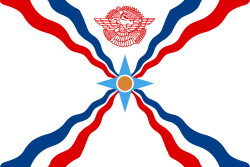
Still, no autonomy was granted to the Assyrians. However, movements towards autonomy and independence remained active. In 1968, a new Assyrian flag was introduced and adopted by the Assyrian Congress in Tehran. In 1977, the Assyrian Provisional Government, headquartered from the Assyrian diaspora in the United States in Chicago, chartered a constitution for an autonomous Assyrian state. The Assyrians now had their goal set and would maintain it.
When Saddam Hussein rose to power, things began to change for the Assyrians in Iraq. Assyrians were deprived of their cultural and national rights while at the same time the Ba'athist regime tried to co-opt their history. The 1972 proclamation was reversed and Hussein began a strict campaign of Arabization on any non-Arabs in Iraq, including Assyrians as well as other groups such as Kurds, Iraqi Turkmen, and Armenians. During the Iran–Iraq War, many Assyrians were recruited to the armies of both sides. This resulted in Assyrians in Iraq killing Assyrians in Iran. It was estimated that 60,000 Assyrians were killed during the conflict.
When Hussein first assumed power, the Assyrian population in Iraq numbered 2 million to 2.5 million. Due to both persecution by his regime and subsequent emigration to Jordan, Syria, and Lebanon, that number began to decline drastically.
Post-Ba'thist Iraq (2003–present)
[edit]With the fall of Saddam Hussein and the 2003 invasion of Iraq, no reliable census figures exist on the Assyrians in Iraq (as they do not for Kurds or Iraqi Turkmen), though the number of Assyrians is estimated to be approximately 800,000.
The Assyrian Democratic Movement (or ADM) was one of the smaller political parties that emerged in the social chaos of the occupation. Its officials say that while members of the ADM also took part in the liberation of the key oil cities of Kirkuk and Mosul in the north, the Assyrians were not invited to join the steering committee that was charged with defining Iraq's future. The ethnic make-up of the Iraq Interim Governing Council briefly (September 2003 – June 2004) guided Iraq after the invasion included a single Assyrian Christian, Younadem Kana, a leader of the Assyrian Democratic Movement and an opponent of Saddam Hussein since 1979.
Assyrian Convention Addresses Assyrian Autonomy
[edit]The panel discussion entitled "Focus on Iraq" on August 30 featured Assyrian politicians and activist from Iraq and the U.S., which was held in Chicago.
Mr. Willis Fautre's (from Human Rights Without Frontiers) model, two overlapping forms of federalism are envisioned. First, the nation would have separate administrative "regions", each with its own parliament; a form of territorial federalism. Each community (Assyrians, Turkmen, Arabs, and Kurds) would also have their own parliament representing their communities throughout the country; a form of community federalism. The community parliament would have full autonomy in religion, culture, schools, agriculture, energy, and protection of monuments.
The unity of the federal government would be guaranteed by a bicameral system with a House of Representatives elected directly by the people and a Senate appointed by the various communities. For legislation affecting linguistic, cultural, or religious rights, both houses of parliament would have to pass the bill. In addition, though, in the community-based Senate, a super-majority (e.g. 2/3) vote would be needed in addition to a simple majority of every represented community. In such a way, each community would enjoy virtual veto power in matters of language, culture, and religion.
The proposal for an Assyrian self-administered zone established in the environs of Mosul, extending to Dohuk in the north and Fesh Khabur to the northwest has gained increasing appeal among Assyrian activists, intellectuals, and political leaders. The current political challenges facing Assyrians in the newly developing Iraq include rising Islamic pressure, gross under representation of Assyrians, and a sometimes callous misrepresentation of Assyrians simply as a Christian minority without reference to the Assyrian political, cultural, and nationalist platform. As Mr. Jatou reflected, the increasing Islamic fervor as well as other challenges in Iraq necessitate the establishment of an administrative area for Assyrians and Yezidis.
Current situation
[edit]The first of the many church bombings that were to come occurred on the morning of August 4, 2003, that left 19 worshippers dead.
As the attacks on Assyrians continue to escalate, with the 20th church bombed and the death toll of the Assyrians climbing in 2004, demands by Assyrian politicians for an autonomous safe haven reached at an all-time high. A meeting took place in the British House of Commons to discuss the subject.
A meeting was organized by the Labour MP Stephen Pound, in conjunction with the Assyrian Democratic Movement and the Jubilee Campaign, a Christian human-rights group. Pound's demands were:
- Support an autonomous administrative region as a safe haven
- Support the infrastructure of the region
- Oppose "the active and passive ethnic cleansing" of "the only indigenous people of Iraq"
Pound argued "the fate of the Chaldo-Assyrians in Iraq will define the socio-political structure of the Middle East."
The then Prime Minister of Iraq, Iyad Allawi, said he was considering the plan, but nothing resulted as he lost his position in the January 2005 elections.
On November 30, 2005, Iraq's Foreign Minister, Hoshiyar Zebari, supported the idea of an Assyrian administrative region by saying "They (Assyrians) are free to organize a province or regional government. It should not be just because we have Kurdistan, but should be organized around an area. If they can do it in three provinces or even one it should and can be done."[92]
In the same weekend, a further five Assyrian churches were bombed in Iraq. By the end of 2004, an estimated 40,000 Assyrians and other Christians had fled Iraq since the beginning of the war.[93]
Australia's Labor Party member Chris Bowen spoke about the possibility of autonomy for the Assyrians numerous times in the Parliament during 2005.
On February 24, 2006, Minister of Human Rights in Kurdistan, Dr. Mohammad Ihsan, stated "We don't mind Iraqi Christians concentrating anywhere they wish, and establishing a new province for themselves in the Nineveh plain, and bringing together Iraqi Christians from all over the world and their return to their houses and towns."
On March 18, 2007, it was reported that Muslims were forcing the Christian Assyrians in the Dora Neighborhood of Baghdad to Pay the jizya,[94] the 'Protection Tax' demanded from Christians and Jews by the Qur'an and Islamic law.[95]
On May 9, 2007, Catholicos Patriarch of the Assyrian Church of the East, Mar Dinkha IV dispatched a letter to President George W. Bush pleading for immediate protection of the Christians of Iraq.[96]
The following week a group of armed Muslims set fire to St. George Assyrian Church in the Dora neighborhood of Baghdad. The group of men poured gasoline on the church and set it on fire. This is the same church that was bombed in the first of a wave of bombings of Assyrian churches. When St. George was bombed in 2004, the church Cross was not damaged; the bombers tore the cross down with their hands after the bombing.[97]
European support
[edit]The National Democrats in Sweden were supporters of ethnopluralism, and support the foundation of an Assyrian state.[98] After visiting the Assyrians in northern Iraq, Dutch Parliament member Joel Voordewind of the Christian Union party asked the Dutch Minister of Foreign Affairs Verhagen to increase the pressure on the Central Government of Baghdad through the European Union in order to execute a plan for an Assyrian police force for the protection of their towns and villages in the Nineveh plains.[99]
US Support
[edit]In September 2016, a bipartisan resolution was introduced into the US House of Representatives to support the creation of a permanent safe haven for persecuted minorities, including Christians, Yazidis, and Shiite Turkmen, that would be centered on the traditional Assyrian homeland in the Nineveh Plain.[100] The legislation was introduced by Rep. Jeff Fortenberry (R-NE), and it had 11 co-sponsors from Democrats and Republicans. It was referred to the House Foreign Affairs Committee.[101]
Assyrian Christian Police Force
[edit] | This section needs to be updated. (January 2024) |
During recent[when?] kidnappings and murders of Assyrian Bishops and priests in the North Iraqi region, Assyrians have demonstrated worldwide in the thousands in demanding protection for their villages and the Nineveh Plains region, which Assyrians hope will become an autonomous area under the control of the Assyrians and minorities in the North.
A $4 million measure will fund a 711-man local police force for the Nineveh Plain. It is part of a $30 million emergency relief package for the predominantly Christian region submitted to Congress last month[when?] by Rep. Mark Kirk, R-Ill., and Rep. Frank Wolf, R-Va.
In April 2008, the initial complement of 711 policemen were called up and began training. Another 4000 policemen will be needed to fully secure the region and establish checkpoints on all highways and roads leading into the villages.
See also
[edit]References
[edit]- ^ League of Nations; Secretariat; Information Section (1935). The settlement of the Assyrians, a work of humanity and appeasement. Geneva: Information section. OCLC 14164442.
- ^ Wigram, William (April 2010). Our Smallest Ally. Assyrian Academic Society. ISBN 978-0982712412.
Our Smallest Ally is now homeless, and dependent on our charity at Baqubah, for its lands and villages have been utterly destroyed, and it has the further mortification of seeing – from reasons beyond our control – that although it threw in its lot with the ultimately victorious side, Kurds, and others of the defeated enemy, are in practical possession of its ruined homesteads. Such a state of things is incomprehensible to the minds of this people, but it is due to the difficulties of the country, the entire absence of food in, and the inaccessibility of their home, for purposes of ordinary transport, coupled with the extremely disorderly political conditions of Kurdistan and North-Western Persia.
These circumstances combine to render their safe re-instalment in their former lands, at present impracticable.
H. H. Austin
(Late G.O.C. Refugee Camp, Baqubah)
February 6, 1920. - ^ League of Nations; Council (1937). Settlement of the Assyrians of Iraq. Geneva. OCLC 3822236.
{{cite book}}: CS1 maint: location missing publisher (link) - ^ Donabed, Sargon (2015). Reforging a Forgotten History: Iraq and the Assyrians in the Twentieth Century. Edinburgh University Press. ISBN 978-0-7486-8605-6. Archived from the original on 2023-01-15. Retrieved 2018-10-03.
- ^ Carl Skutsch (2013). Encyclopedia of the World's Minorities. Routledge. p. 149. ISBN 978-1-135-19388-1. Archived from the original on 2023-01-15. Retrieved 2018-10-03.
- ^ "Demographics". Heritage for Peace. 2013-10-16. Archived from the original on 2021-05-10. Retrieved 2016-06-03.
- ^ "27 maps that explain the crisis in Iraq". vox.com. Archived from the original on 2016-06-01. Retrieved 2016-06-03.
- ^ "'Leave, convert or die': Isis takes largest Christian town". The Independent. 2014-08-07. Archived from the original on 2020-07-13. Retrieved 2016-06-03.
- ^ Mar Eshai Shimun's letter to Permanent Mandates Commission, League of Nations, Geneva, 1928 Archived 2019-07-31 at the Wayback Machine
- ^ "assyrian%20petition.pdf". docs.google.com. Archived from the original on 2021-07-15. Retrieved 2020-10-11.
- ^ "Mar Eshai Shimun | Mar Shimun Memorial Foundation". Archived from the original on 2020-10-26. Retrieved 2019-10-10.
- ^ "1975: From The Public Records of The Trial Proceedings of The Assassination of His Holiness Mar Eshai Shimun XXIII". 2004-10-11. Archived from the original on 2004-10-11. Retrieved 2019-10-10.
- ^ "Friends of the Church of the East (Assyrian) (1940)". anglicanhistory.org. Archived from the original on 2018-06-25. Retrieved 2019-10-11.
- ^ Assyrian-Canadians – Wikipedia
- ^ "Assyrians – Minority Rights". Minority Rights. 19 June 2015. Archived from the original on 2021-05-26. Retrieved 2016-06-03.
- ^ "The Complex Relations Between Kurds and Christians in Northern Iraq". GeoCurrents. 6 November 2010. Archived from the original on 2017-05-18. Retrieved 2016-06-03.
- ^ "Press Release: ISIS Genocide in Iraq and Syria". Archived from the original on 2017-08-28. Retrieved 2017-03-02.
- ^ "Nineveh and Its Remains: With an Account of a Visit to the Chaldæan ..." John Murray. October 11, 1854 – via Internet Archive.
- ^ Macintyre, James (27 September 2016). "Iraqi Parliament Votes Against New Christian Province In Nineveh Plain". Christian Today. Archived from the original on 8 November 2020. Retrieved 12 October 2020.
- ^ "Bryce – The Treatment of Armenians..." Archived from the original on 11 May 2019. Retrieved 20 March 2015.
- ^ Travis, Hannibal. Genocide in the Middle East: The Ottoman Empire, Iraq, and Sudan. Durham, NC: Carolina Academic Press, 2010, 2007, pp. 237–77, 293–294.
- ^ Hovannisian, Richard G., 2007. The Armenian Genocide: Cultural and Ethical Legacies p. 271. Accessed on 11 November 2014.
- ^ R. S. Stafford (2006). The Tragedy of the Assyrians. Gorgias Press, LLC. pp. 24–25. ISBN 9781593334130.
- ^ Jordi Tejel (2008). Syria's Kurds: History, Politics and Society p. 147.
- ^ Jordi Tejel (2008). Syria's Kurds: History, Politics and Society (PDF). pp. 25–29. Archived from the original (PDF) on 2016-03-04.
- ^ a b Chisholm, Hugh, ed. (1922). . Encyclopædia Britannica. Vol. 31 (12th ed.). London & New York: The Encyclopædia Britannica Company. pp. 5–6.
- ^ Arnoux, Anthony (October 11, 1915). "The European War: August [1914] to March [1915". Priv. print. – via Google Books.
- ^ a b c d Naayem, Shall This Nation Die? (New York, 1921)
- ^ "British Betrayal of the Assyrians". www.aina.org. Archived from the original on 2021-06-13. Retrieved 2009-08-15.
- ^ Paul Bartrop, Encountering Genocide: Personal Accounts from Victims, Perpetrators, and Witnesses, ABC-CLIO, 2014 [ISBN missing][page needed]
- ^ Naayem, Joseph (October 11, 1921). "Shall this Nation Die?". Chaldean rescue – via Google Books.
- ^ Morris, Benny; Ze’evi, Dror (2019). The Thirty-Year Genocide: Turkey's Destruction of Its Christian Minorities, 1894–1924. Harvard University Press. ISBN 9780674916456.
- ^ a b Joseph Naayem, Shall This Nation Die? 147 (New York, 1921)
- ^ Lord James Bryce, British Government Report on the Armenian Massacres of April–December 1915
- ^ Baumer, The Church of the East, p. 263; David Gaunt, Massacres, Resistance, Protectors, 58–63, 73–75, 81, 98, 109, 121, 130, 141, 145, 148, 164, 192–96, 226–30, 244, 250–56, 265–66 (2006); Amill Gorgis, "Der Völkermord an den Syro-Aramäern", in Verfolgung, Vertreibung und Vernichtung der Christen im Osmanischen Reich 120-22 (Tessa Hoffman ed., London and Berlin: LIT Verlag 2004); Travis, "Native Christians Massacred", pp. 331–38, 342–43; Gabriele Yonan, Ein vergessener Holocaust: Die Vernichtung der christlichen Assyrer in der Türkei 269, 277, 279 (Göttingen: Gesellschaft für bedrohte Völker, 1989)
- ^ Akçam, Taner. A Shameful Act: The Armenian Genocide and the Question of Turkish Responsibility, p. 201. ISBN 0-8050-8665-X
- ^ "martyr". Archived from the original on 3 March 2016. Retrieved 20 March 2015.
- ^ Rev. Joseph Naayem, O.I. – Shall This Nation Die? Archived 2017-12-18 at the Wayback Machine, 1921
- ^ Donabed, Sargon (February 2015). "3". Reforging a Forgotten History: Iraq and the Assyrians in the Twentieth Century. Edinburgh University Press. ISBN 9780748686056.
- ^ a b Joseph Yacoub, La question assyro-chaldéenne, les Puissances européennes et la SDN (1908–1938), 4 vol., thèse Lyon, 1985, p. 156.
- ^ a b c Travis, Hannibal (December 8, 2006). "'Native Christians Massacred': The Ottoman Genocide of the Assyrians During World War I". SSRN 950428.
- ^ The Plight of Religious Minorities: Can Religious Pluralism Survive? – p. 51 by United States Congress
- ^ The Armenian Genocide: Wartime Radicalization Or Premeditated Continuum – p. 272 edited by Richard Hovannisian
- ^ Not Even My Name: A True Story – p. 131 by Thea Halo
- ^ The Political Dictionary of Modern Middle East by Agnes G. Korbani [ISBN missing][page needed]
- ^ a b "Genocide Scholars Association Officially Recognizes Assyrian, Greek Genocides" (PDF) (Press release). International Association of Genocide Scholars (IAGS). December 16, 2007. Archived from the original (PDF) on January 18, 2012.
- ^ Baumer, Church of the East, p. 263
- ^ Hannibal Travis (2006), "Native Christians Massacred": The Ottoman Genocide of the Assyrians During World War I, Genocide Studies and Prevention, vol. 1.3, pp. 334, 337–38. doi:10.3138/YV54-4142-P5RN-X055
- ^ "Turkish Horrors in Persia". New York Times. 1915-10-11. p. 4. Archived from the original on 2019-09-13. Retrieved 2008-08-19.
- ^ "Turkish Horrors in Persia". New York Times. 1915-10-11. p. 4. Archived from the original on 2019-09-13. Retrieved 2008-08-19.
- ^ "The Assyrian Levies (2008)". Archived from the original on 2009-04-24. Retrieved 2009-08-15.
- ^ "The Assyrian Levies (2008)". Archived from the original on 2009-04-24. Retrieved 2009-08-15.
- ^ The Tragedy of the Assyrians By R. S. Stafford – p. 59
- ^ A Modern History of the Kurds – p. 178 by David MacDowall – 2004
- ^ Malik, British Betrayal of the Assyrians, appendix 1.
- ^ Malik, British Betrayal of the Assyrians, appendix 1.
- ^ Britain, Iraq and the Assyrians: The Nine Demands By Stavros T. Stavridis
- ^ "From the Biography of Our Brave Assyrian Levies in Habaniea". Archived from the original on 25 March 2016. Retrieved 20 March 2015.
- ^ a b c d Iraq Between the Two World Wars: The Militarist Origins of Tyranny by Reeva Spector Simon
- ^ "Nestorian Patriarchs". www.nestorian.org. Archived from the original on October 9, 2009.
- ^ a b c "International Journal of Middle East Studies, "The Assyrian Affair of 1933", by Khaldun S. Husry, 1974".
- ^ "Genocides Against the Assyrian Nation". Archived from the original on 7 February 2018. Retrieved 20 March 2015.
- ^ a b "Modern Aramaic Dictionary & Phrasebook" By Nicholas Awde. Page 11.
- ^ a b "The Fate Of Assyrian Villages Annexed To Today's Dohuk Governorate In Iraq And The Conditions In These Villages Following The Establishment Of The Iraqi State In 1921". Archived from the original on 9 November 2011. Retrieved 20 March 2015.
- ^ International Federation for Human Rights – "Displaced persons in Iraqi Kurdistan and Iraqi refugees in Iran Archived 2015-10-01 at the Wayback Machine", 2003.
- ^ "The Origins and Developments of Assyrian Nationalism", Committee on International Relations Of the University of Chicago, by Robert DeKelaita (PDF) Archived 2016-03-03 at the Wayback Machine
- ^ Stafford, R. S. (1934). "Iraq and the Problem of the Assyrians". International Affairs. 13 (2): 159–185. doi:10.2307/2603135. JSTOR 2603135. Archived from the original on 2022-01-31. Retrieved 2020-10-11.
- ^ McCarthy, Justin (2001). The Ottoman Peoples and the End of Empire. Bloomsbury Academic. ISBN 9780340706572. Retrieved 20 March 2015.
- ^ a b Minorities in the Middle East: a history of struggle and self-expression By Mordechai Nisan
- ^ Raphael Lemkin Archived 2002-03-09 at the Wayback Machine – EuropeWorld, 22/6/2001
- ^ a b The Man Who Invented Genocide: The Public Career and Consequences of Raphael Lemkin, by James Joseph Martin. p. 166. 1984.
- ^ Raphael Lemkin Archived 2002-03-09 at the Wayback Machine – EuropeWorld, 22/6/2001.
- ^ Mary Kate Simmons (1996). Unrepresented Nations And Peoples Organization Yearbook. Martinus Nijhoff Publishers. pp. 43–45. ISBN 90-411-0223-X. OCLC 36779050.
- ^ The Paris Peace Conference, 1919: Peace Without Victory?
- ^ Balfour to FO, Paris, 31.7.1919
- ^ The Entente and the Associated Powers were the United Kingdom, France, Italy, Japan (Principal Allied Powers), Greece, Belgium, Armenia, the Hejaz, Poland, Portugal, Romania, the Kingdom of Serbs, Croats and Slovenes (Yugoslavia) and Czecho-Slovakia
- ^ "Treaty of Sevres, 1920". Archived from the original on 12 November 2017. Retrieved 20 March 2015.
- ^ The Legal Regime of the Turkish Straits By Nihan Unlu, Nihan Ünlü – p. 32
- ^ "Treaty of Peace with Turkey, 24 July 1923". Archived from the original on 6 January 2015. Retrieved 20 March 2015.
- ^ Islam and Dhimmitude: Where Civilizations Collide – p. 149 by Bat Yeor, Miriam Kochan, David Littman
- ^ "Who are the Assyrians". Archived from the original on 15 March 2015. Retrieved 20 March 2015.
- ^ League of Nations Documents and Serial Publications, 1919–1946 [microformguides.gale.com/Data/Download/3028000R.pdf]
- ^ Recueil des cours – p. 39 by Hague Academy of International Law
- ^ Manley O. Hudson, The Admission of Iraq to Membership in the League of Nations, The American Journal of International Law, Vol. 27, No. 1 (Jan., 1933), pp. 133–138 Archived 2019-02-12 at the Wayback Machine
- ^ Assyrians of Eastern Massachusetts – p. 66 by Sargon Donabed, Ninos Donabed
- ^ William Saroyan, "Seventy Thousand Assyrians," in William Saroyan, The Daring Young Man on the Flying Trapeze and Other Stories. New York: New Directions, 1934
- ^ Seventy Thousand Assyrians, William SAROYAN, WikiQuotes.
- ^ The Tragedy of the Assyrians By R. S. Stafford – p. 59
- ^ Newsreel Archived 2017-01-25 at the Wayback Machine Die Deutsche Wochenschau, December 10, 1941, Nr. 588, Excerpt in video images.
- ^ The League of Nations in Retrospect: Proceedings of the Symposium – p. 376 by United Nations Library – 1983
- ^ "Twelfth periodic reports of States parties due in 1993 : Iraq. 14/06/96, Committee on the Elimination of Racial Discrimination (the Iraqi government's point of view)". Archived from the original on 2012-02-06. Retrieved 2014-04-08.
- ^ "Zinda 30 November 2005". Archived from the original on 1 February 2016. Retrieved 20 March 2015.
- ^ "Iraq losing its best and brightest". The Christian Science Monitor. 2004-09-21. Archived from the original on 2015-06-13. Retrieved 20 March 2015.
- ^ "More on Muslims Forcing Christian Assyrians in Baghdad to Pay 'Protection Tax'". Archived from the original on 17 December 2014. Retrieved 20 March 2015.
- ^ "Cmje". Archived from the original on 2008-10-07. Retrieved 20 March 2015.
- ^ "Assyrian Patriarch Pleads Protection for Iraqi Christians". Archived from the original on 10 February 2012. Retrieved 20 March 2015.
- ^ "Muslims Burn Assyrian Church in Baghdad". Archived from the original on 26 March 2015. Retrieved 20 March 2015.
- ^ "Den nya nationalhögern" (in Swedish). Dagens Nyheter. Retrieved 2007-12-15.
Högt upp i Nd:s program står att verka för en återvandringspolitik. Södertäljes syrianer och assyrier ska uppmuntras att skaffa sig ett nytt land, gärna med hjälp av generösa bidrag.
[dead link] - ^ English version[permanent dead link]
- ^ "House Resolution Introduced-to-create Safe Haven for Persecuted Minorities In Iraq" algemeiner.com 9 2016 https://www.algemeiner.com/2016/09/15/house-resolution-introduced-to-create-safe-haven-for-persecuted-minorities-in-iraq/ Archived 2016-09-24 at the Wayback Machine
- ^ Patrick Goodenough "ISIS Genocide Brings Fresh Calls for a Semi-Autonomous Haven for Christians in Iraq" AINA.org http://www.aina.org/news/20160913143759.htm Archived 2016-09-24 at the Wayback Machine
Bibliography
[edit]Primary sources
[edit]- Naayem, Jean (1920). Les Assyro-Chaldeans et les Armeniens Massacres Par les Turcs, documents inédits recueillis par un témoin oculaire published in English as Shall This Nation Die?. Paris/New York: Bloud et Gay/Chaldean Rescue. Archived from the original on 2017-12-18. Retrieved 2009-08-15.
- Rhetore, Jacques. 'Les chrétiens aux bêtes'; Souvenirs de la guerre sainte proclamée par les Turcs contre les chrétiens en 1915. Paris: Les editions du Cerf (2004/2005).
- Toynbee, Arnold (1916). Treatment of Armenians and the Assyrian Christians by the Turks, 1915–1916, in the Ottoman Empire and North-West Persia, 3 Class 96, Series II, six files, FO 96*205–210. Foreign Office.
- Yonan, Gabrielle (1989). Ein vergassener Holocaust: Die Vernichtung der christlichen Assyrer in der Turkei. Gottingen: Gesellschaft für bedrohte Volker.
- Ismet Inönü, Cable sent from Ismet Inönü, head of the Turkish delegation in Lausanne, to the Turkish government. Cable No. 353, January 15, 1923. See the original Ottoman text in atour.com Archived 2017-07-24 at the Wayback Machine.
Secondary sources
[edit]- Baumer, Christoph (2006). The Church of the East: An Illustrated History of Assyrian Christianity. London and New York: I.B. Tauris..
- de Courtois, Sébastian (2004). The Forgotten Genocide: The Eastern Christians, the Last Arameans. Piscataway, NJ: Gorgias Press..
- Gaunt, David (2006). Massacres, resistance, protectors: Muslim-Christian relations in Eastern Anatolia During World War I. Gorgias Press. ISBN 1-59333-301-3..
- Griselle, Eugene (1918). Syriens et Chaldéens: Leur Martyre, Leurs Espérances. Paris: Bloud et Gay..
- Malek, Yusuf (1936). The British Betrayal of the Assyrians. Warren Point, NJ: Kimball Press..
- Nisan, Mordechai (1991). Minorities in the Middle East: A History of Struggle and Self-Expression. Jefferson, NC: McFarland & Co. ISBN 9780899505640..
- Shahbaz, Yonan (1918). The Rage of Islam: An Account of the Massacre of Christians by the Turks in Persia. Philadelphia, PA: Roger Williams Press..
- Yohannan, Abraham (1916). The Death of a Nation, or: The Ever Persecuted Nestorians or Assyrian Christians. New York: G.P. Putnam's Sons..
External links
[edit]- Atour: The State of Assyria – the oldest Christians in the Middle East and the national struggle for their Assyrian homeland and statehood.
- Assyria Council of Europe (ACE)
- Iraq Sustainable Democracy Project

Ethno-linguistic group(s) indigenous to the Middle East; also known as Syriac-Arameans or Chaldeans | |||||||||
| Identity | |||||||||
| Syriac Christianity |
| ||||||||
| Neo-Aramaic dialects | |||||||||
| Culture | |||||||||
| History (including related contexts) |
| ||||||||
| By country |
| ||||||||
| Politics | |||||||||


Assyrian independence movement
View on GrokipediaBackground and Origins
Assyrian Ethnic and National Identity
The Assyrians form an indigenous ethnic group native to northern Mesopotamia, encompassing the modern territories of northern Iraq, southeastern Turkey, northeastern Syria, and northwestern Iran, where they have maintained a continuous presence for millennia. Their ethnic identity centers on the Aramaic-speaking Christian communities, including adherents of the Assyrian Church of the East, the Chaldean Catholic Church, and the Syriac Orthodox Church, who speak various dialects of Neo-Aramaic, a direct descendant of the Aramaic language that supplanted Akkadian as the vernacular following the Assyrian Empire's adoption of it as an administrative tongue around the 8th century BC. This linguistic continuity, preserved through ecclesiastical texts and oral traditions, underpins claims of direct descent from the ancient Assyrians of the Neo-Assyrian Empire (911–612 BC), with modern self-designations such as Āṯōrāyē or Sūryōyē tracing back to historical usages among Aramaic-speakers in the region.[4][5] Scholars like Simo Parpola have argued that an Assyrian ethnic identity endured post-empire through self-identification among successor populations, evidenced by nisbe (gentilic) references in cuneiform texts and later Syriac literature where communities explicitly linked themselves to ancient Ashur. Genetic studies, including autosomal DNA analyses from 2017, indicate that modern Assyrians cluster closely with ancient Mesopotamian samples, supporting biological continuity amid cultural assimilation of Aramean, Hurrian, and other elements during the empire's multi-ethnic expansion. However, this narrative faces contestation from some historians who posit that pre-modern identities were primarily religious or tribal—Nestorian, Jacobite, or Chaldean—rather than national, with "Assyrian" as a revived ethnonym emerging in the 19th century via Western scholarly influence and missionary documentation.[6][7] The development of a cohesive national identity accelerated in the late Ottoman era, catalyzed by exposure to European nationalism and Orientalist rediscovery of Mesopotamian antiquities, which prompted Assyrian intellectuals to forge a unified ethno-national consciousness transcending denominational divides. This pan-Assyrianism, articulated in petitions and manifestos from the 1870s onward, emphasized a shared ancestral homeland centered on the Nineveh Plains and Hakkari Mountains, positing Assyrians as a distinct nation entitled to self-determination based on historical sovereignty and indigenous status predating Arab, Turkish, and Kurdish polities. Influenced by Armenian nationalist models and British consular reports, this identity framed Assyrians not as religious minorities but as a secular ethnic nation, a foundational ideology for subsequent independence claims despite internal debates over subgroup nomenclature.[1][8][5]Pre-World War I Aspirations and Early Nationalism
Assyrian nationalism began to coalesce in the late 19th century amid the Ottoman Empire's millet system, which organized non-Muslim communities along religious lines and fragmented Assyrian identity into separate sects such as Syriac Catholic (recognized 1829), Chaldean Catholic (1844), Syriac Orthodox (1882), and the Church of the East (1914).[9] This structure, while granting limited communal autonomy, exacerbated divisions among Syriac-speaking Christians and exposed them to periodic persecutions, prompting a shift toward ethnic unification influenced by mid-19th-century European nationalist ideas and Western missionary activities.[9] Missionaries, particularly American evangelicals in Persia and the Ottoman eastern provinces, introduced concepts of nationhood and self-determination, fostering literacy and cultural revival among Assyrians, who numbered around 500,000–600,000 in the Ottoman Empire alone by the early 20th century.[10][11] In Urmia, Persia—a major Assyrian center with significant Nestorian populations—nationalist sentiments flourished from the 1890s through 1914, driven by educational institutions like Euphrates College and periodicals that promoted a secular "Aturaya" (Assyrian) identity over purely religious "Suryaya" labels.[12] Key publications included Zahreera d'Bahra (Ray of Light, launched 1848 as the first Persian-language periodical in the region) and Kukhwa (The Star, 1906–1914), which advocated national unity and featured contributions from intellectuals like Benyamin Arsanis.[12] Prominent figures emerged, such as Ashur Yusuf (1858–1915), a Jacobite educated at Euphrates College who emphasized Assyrian heritage, and Naʿūm Fāʾiq (1868–1930), whose 1910 poem and founding of organizations like ʿIrūthā (Freedom) and the periodical Kawkāb Madenḥā (Star of the East) articulated demands for ethnic solidarity.[12][9] By the early 1900s, Urmia's schools had achieved literacy rates approaching 80% among Assyrians, enabling broader dissemination of these ideas via printing presses.[12] Early aspirations centered on communal autonomy and recognition as a distinct nation rather than outright independence, reflecting pragmatic responses to Ottoman and Persian governance.[12] In 1906–1907, Assyrians in Urmia formed a local council to manage internal affairs, marking an initial step toward self-administration, and dispatched a delegate to the Iranian legislature in 1907 to press for rights.[12] Figures like Catholic Bishop Mar Tuma Oddo reinforced these efforts by promoting cross-sectarian nationhood, while influences from neighboring Armenian nationalism encouraged visions of territorial cohesion in ancestral regions like Hakkārī.[12] These developments laid groundwork for later claims but remained limited by internal divisions and lack of unified military or political power before 1914.[12]World War I Era
Genocide and Resistance in Ottoman Territories
The Assyrian Genocide, known as Sayfo ("sword" in Syriac), comprised systematic massacres and deportations targeting Assyrian populations in the Ottoman Empire's eastern provinces from mid-1915 to 1918, concurrent with atrocities against Armenians and Greeks.[13] Orchestrated by the Committee of Union and Progress regime under figures like Talaat Pasha and Enver Pasha, the operations framed Assyrians as security threats due to perceived alliances with invading Russian forces, justifying their elimination as part of a broader homogenization policy.[14] On October 26, 1914, Talaat issued deportation orders for border Assyrians, initiating forced relocations that escalated into killings; massacres intensified in spring 1915 following the Ottoman declaration of jihad against Christian subjects.[13] Perpetrators included regular Ottoman troops, special organization death squads (Teşkilât-ı Mahsusa), gendarmes, and Kurdish tribal militias inflamed by state propaganda promising plunder.[14] Key events unfolded in Diyarbakır province under Vali Mehmet Reshid, where from May to June 1915, approximately 63,000 Assyrians—Syriac Orthodox, Chaldeans, and Nestorians—were slaughtered via encirclement of villages, summary executions of males by shooting or beheading, and death marches exposing survivors to starvation and exposure.[13] In Hakkari's mountainous districts, Ottoman-Kurdish forces launched ethnic cleansing drives in June 1915, depopulating Nestorian strongholds like those of the Tyari and Tkhuma tribes.[13] Comparable devastation hit Siirt (8,000 Chaldeans killed), Midyat, Tur Abdin, Van (80,000 deaths), and Bitlis, with methods including dumping bodies in rivers or wells to conceal evidence and incite terror.[13][14] Total casualties are estimated at 250,000–300,000, drawing from Assyrian church censuses, survivor testimonies, and delegations to the 1919 Paris Peace Conference, representing over half the pre-war Ottoman Assyrian population of around 500,000.[13] Assyrian resistance emphasized defensive guerrilla actions, particularly in Hakkari, where on May 10, 1915, Nestorian Patriarch Mar Benyamin Shimun XIX formally rallied tribes against Ottoman aggression, coordinating with limited Russian aid.[14] Fighters exploited terrain for ambushes, repelling initial Kurdish incursions and defending villages such as Azakh against army assaults, thereby delaying Ottoman advances and inflicting notable enemy losses.[13] In Diyarbakır's Midyat and Tur Abdin, Syriac militias clashed with death squads, holding out briefly before being overrun.[13] These efforts, though valiant, faltered amid superior Ottoman numbers, supply of modern arms to Kurds, and the 1917 Russian withdrawal, culminating in 20,000–35,000 Hakkari survivors fleeing to Russian lines by October 1915 and overall population losses exceeding two-thirds through combat, massacre, and exodus.[13][14] The resistance highlighted Assyrian martial traditions but underscored the genocide's overwhelming coordination, leaving Ottoman Assyrian territories largely voided of indigenous Christians by war's end.[13]Conflicts in Persia and Northern Iraq
During World War I, Assyrian communities in Persia faced Ottoman incursions starting in late 1914, as Ottoman forces, allied with Kurdish tribes, targeted Christian populations amid the broader campaign against Russian positions in the Caucasus and northern Persia.[14] Initial resistance occurred in the Hakkari mountains along the Ottoman-Persian border, where Nestorian Assyrians under tribal leaders repelled early attacks but suffered heavy losses, prompting mass flight to Urmia by mid-1915.[15] Russian forces provided temporary protection in Urmia, arming Assyrian irregulars and enabling limited counteroffensives against Ottoman advances.[15] The Russian withdrawal following the 1917 Bolshevik Revolution left Assyrians exposed, leading to intensified Ottoman and Kurdish assaults in early 1918. Agha Petros, an Assyrian military leader from the Baz tribe commissioned by Patriarch Mar Benyamin Shimun, organized volunteer forces to defend Urmia, achieving victories such as the Battle of Charah (March 12–17, 1918) against Shekak Kurds and the Battle of Suldouze (April 8–13, 1918) against Ottoman troops led by Kheiri Bey.[15] [16] Despite these successes, overwhelming Ottoman reinforcements forced the evacuation of Urmia on July 31, 1918, initiating the Second Urmia Exodus; approximately 70,000 Assyrians and Armenians retreated southward over 500 kilometers to British-held areas near Hamadan and Baqubah in Iraq, enduring attacks, disease, and starvation that halved their numbers en route.[14] In northern Iraq, British forces recruited surviving Assyrian refugees into auxiliary units known as the Assyrian Levies, beginning with formations like the Hinaidi Levy in 1916 and expanding to multiple companies by 1918 to supplement Indian and British troops in the Mesopotamian campaign.[16] These levies, totaling several thousand by late 1918, participated in the final offensive against Ottoman positions, including flank security during the advance on Kirkuk in May 1918 and support for the capture of Mosul in October–November 1918, where they engaged Turkish rearguards and local insurgents.[16] The levies' effectiveness stemmed from their knowledge of terrain and motivation against Ottoman forces, though high casualties and post-war resettlement issues strained relations with British command.[16]Post-War Diplomatic Efforts and Treaties
In the aftermath of World War I, Assyrian leaders dispatched delegations to the Paris Peace Conference (1919–1920) to advocate for independence or autonomy in their ancestral regions spanning eastern Anatolia, northern Mesopotamia, and northwestern Iran. The Assyro-Chaldean delegation, comprising representatives such as Syriac Orthodox Bishop Aphrem Barsoum and Dr. Abraham K. Yoosuf, lobbied Allied powers for recognition of Assyrian national rights, emphasizing the community's wartime sacrifices and vulnerability following massacres.[17] [18] In October 1919, they submitted a map delineating a proposed independent Assyria, encompassing areas with significant pre-war Assyrian populations in Ottoman vilayets like Van, Bitlis, and Mosul, as well as adjacent Persian territories.[19] The delegation garnered sympathy from some conferees, who acknowledged Assyrian contributions to Allied efforts against the Ottomans, but faced obstacles from rival claims by Armenian, Kurdish, and Arab nationalists, alongside Allied fatigue and shifting priorities toward stabilizing the post-war order. Efforts to secure a mandate under British or French administration for Assyrian areas yielded no binding commitments, as major powers prioritized broader imperial arrangements over minority self-determination.[18] The Treaty of Sèvres, signed August 10, 1920, between the Allies and the Ottoman Empire, incorporated limited provisions relevant to Assyrians in its sections on Kurdistan (Articles 62–64). Article 62 mandated a commission in Constantinople to draft a local autonomy scheme for Kurdish-majority districts in southeastern Anatolia within six months. Article 63 stipulated that this scheme must include "full safeguards for the protection of the Assyro-Chaldeans and other racial or religious minorities" in those areas, marking the first treaty-based international recognition of Assyro-Chaldeans as a distinct group requiring specific protections.[20] [21] However, these clauses offered no path to sovereignty or separate administration for Assyrians, subordinating their safeguards to a Kurdish autonomy framework amid ongoing ethnic tensions. Implementation faltered as Turkish nationalists under Mustafa Kemal Atatürk rejected Sèvres, launching military campaigns that reclaimed Anatolian territories. The resultant Treaty of Lausanne (1923), replacing Sèvres, excised Articles 62–64 entirely, eliminating minority protections for Assyro-Chaldeans and affirming Turkey's sovereignty without reference to Assyrian claims. This outcome reflected Allied concessions to Turkish revanchism and reluctance to enforce unpopular partitions, leaving Assyrian diplomatic initiatives unfulfilled and contributing to refugee crises in Iraq and Syria.[20][22]Interwar Period (1920s–1930s)
League of Nations Recommendations and Petitions
In 1925, the League of Nations Frontier Commission, investigating the Mosul dispute between Iraq and Turkey, recommended awarding the Mosul vilayet to Iraq under a 25-year mandate to safeguard minorities, with specific provisions for Assyrians including local autonomy, restoration of pre-war privileges such as the right to appoint their own officials, and channeling tribute payments through their Patriarch.[23] This recommendation was conditioned on ensuring Assyrian security and self-governance in designated areas, reflecting concerns over their vulnerability after wartime displacements and alliances with British forces.[24] The Commission's report emphasized settling Assyrians in a homogeneous bloc within Mosul to enable effective protection, influencing the eventual allocation of the territory to Iraq in 1926.[25] As Iraq approached independence under the 1930 Anglo-Iraqi Treaty, Assyrian leaders intensified petitions to the League amid fears of diminished minority safeguards post-mandate. On October 20 and 23, 1931, Catholicos-Patriarch Mar Eshai Shimun XXIII submitted requests for Assyrian resettlement in a Western nation or under French Mandate Syria, citing persecution risks and unfulfilled wartime promises of autonomy.[26] A subsequent petition from Mar Shimun sought formal recognition of Assyrians as a millet (distinct nation) within Iraq, establishment of an autonomous Assyrian region encompassing Amedia, Zakho, Dohuk, and Aqra districts, and vesting administrative authority in the Patriarch.[26] These demands drew opposition from Iraqi officials, who argued they exaggerated Assyrian cohesion and territorial claims.[26] Counter-petitions emerged among some Assyrian factions; on September 21, 1932, a group of 58 leaders representing 2,395 families, headed by Bishop Yawalaha, expressed loyalty to Iraq and disavowed Mar Shimun's leadership.[26] The following day, September 22, Mar Shimun petitioned anew for the return of the Hakkiari province or alternative resettlement, invoking Assyrian military contributions during World War I.[26] An earlier January 1932 Assyrian petition for a fully autonomous enclave was rejected by the League Council on advice from the Permanent Mandates Commission, which deemed it incompatible with Iraq's unitary structure.[27] The League's Mandates Commission reviewed the 1932 petitions on September 24 but, on December 3, declined intervention, stating it lacked jurisdiction over Iraq following the Mandate's end and its admission to the League on October 3, 1932.[26] This outcome left Assyrian autonomy aspirations unaddressed, despite prior commitments, as Iraq affirmed minority protections in its League accession declaration without implementing regional self-rule.[26]British Mandate Policies and the Simele Massacre
During the British Mandate for Mesopotamia (1921–1932), the United Kingdom recruited Assyrians into the Iraq Levies, a paramilitary force used to maintain order in northern Iraq, leveraging their wartime alliance against Ottoman forces.[28] This policy positioned Assyrians as perceived British proxies, fostering resentment among the Arab majority and Kurdish tribes, while British authorities encouraged Assyrian refugee resettlement from Turkey and Persia into the Mosul region without granting substantive autonomy.[29] Assyrian leaders, including Catholicos-Patriarch Mar Shimun XXIII, repeatedly petitioned British officials and the League of Nations for a national homeland or protected status, citing unfulfilled wartime assurances, but these demands were subordinated to Britain's strategic goal of fostering Iraqi unity to facilitate Mandate termination.[30][31] Iraq achieved formal independence on October 3, 1932, following the Anglo-Iraqi Treaty, which ended the Mandate but retained British influence; however, assurances for Assyrian minority protections proved illusory as the new government viewed their Levies service and separatism as threats to national cohesion.[32] In early 1933, Mar Shimun XXIII appealed to British High Commissioner Sir Francis Humphrys for intervention against Iraqi disarmament orders targeting Assyrian fighters, but British policy emphasized non-interference to uphold Iraqi sovereignty, advising direct negotiations with Baghdad.[33] Tensions escalated in June 1933 when approximately 200–800 armed Assyrian refugees from Syria, fearing persecution, crossed into Iraq's Dohuk district and clashed with local police at Dirabun on June 29, resulting in deaths on both sides and prompting Iraqi authorities to label the Assyrians as rebels.[34] The Iraqi government mobilized the army under General Bakr Sidqi, a Kurdish officer, initiating systematic attacks on Assyrian villages starting August 4, 1933, with the massacre peaking in Simele on August 7–11; forces looted, burned homes, and executed civilians, including women and children, while targeting religious leaders—eight priests were killed, one beheaded and another burned alive.[33] Estimates of casualties vary significantly due to conflicting reports: British and Iraqi figures cite around 500–600 deaths, while Assyrian accounts claim 3,000–6,000, reflecting potential underreporting by state-aligned sources to minimize international scrutiny.[33][35] British authorities, though condemning the excesses via diplomatic channels, provided no military aid to Assyrians and initially offered air support to Iraqi forces before withdrawing it, prioritizing alliance stability over minority defense.[36] The Simele events crushed immediate Assyrian aspirations for independence or autonomy within Iraq, leading to Mar Shimun XXIII's exile in July 1933 (pre-massacre deportation) and the mass flight of survivors to Syria and elsewhere, exacerbating diaspora formation.[31] Iraqi Prime Minister Jamil al-Midfa'i's government justified the operations as suppressing rebellion, but the massacres unified Arab and Kurdish elements against perceived foreign-backed minorities, while British inaction reinforced Assyrian perceptions of betrayal, stalling organized nationalist efforts until post-World War II revivals.[35][37]Assyrian Leadership Initiatives
During the early 1930s, Assyrian leadership coalesced around Patriarch Mar Eshai Shimun XXIII, who assumed temporal authority over the community following the death of his predecessor in 1918 and actively pursued autonomy amid Iraq's transition to independence. In May 1932, Mar Shimun convened a national assembly of Assyrian tribal chiefs and representatives from the Assyrian Levies, a British-recruited force predominantly composed of Assyrians, to formulate unified demands.[38] This gathering produced a formal petition submitted to the League of Nations Mandates Commission on June 17, 1932, outlining requirements for Assyrian self-governance, including administrative autonomy in ancestral territories such as the Hakkari mountains or designated regions within Iraq like Amedia, Zakho, Dohuk, and Aqra.[39] Mar Shimun's initiatives extended to multiple petitions directly to the League of Nations, emphasizing the Assyrians' distinct national identity and vulnerability as a minority in the impending sovereign Iraq. On October 20 and 23, 1931, he petitioned for mass relocation of Assyrians to a Western country or the French Mandate of Syria to establish a homeland, citing persecution risks post-Mandate.[26] A September 22, 1932, petition reiterated demands for repatriation to Hakkari or internal resettlement with safeguards, while broader "Nine Demands" articulated to British authorities included provisions for cultural preservation, land rights, and limited self-rule to avert assimilation or expulsion.[26][40] These efforts drew on the 1925 League recommendation for local Assyrian autonomy in Mosul province, which British and Iraqi officials had disregarded in favor of centralized control.[24] Internal divisions challenged these leadership endeavors, as some Assyrian clergy and factions aligned with the Iraqi government to undermine Mar Shimun's authority. For instance, Bishop Yawalaha of Barwar and Amedia submitted a September 21, 1932, petition praising Iraqi policies and rejecting Mar Shimun's leadership, which League investigators cited to question the patriarch's representativeness.[26] Despite such opposition, Mar Shimun's advocacy highlighted systemic Assyrian grievances, including British assurances of protection that evaporated with the Mandate's end on October 3, 1932. The League rejected the petitions, prioritizing Iraq's unity and admitting it to membership without enforceable minority autonomies, leading to Mar Shimun's exile to Cyprus in June 1933.[26][41] From exile, he continued pressing for Assyrian rights, though immediate interwar initiatives yielded no territorial concessions.[42]World War II and Immediate Post-War
Assyrian Military Contributions and Resistance
During World War II, Assyrians in Iraq contributed to Allied efforts primarily through service in the Iraq Levies, a British-raised auxiliary force established to guard Royal Air Force bases and relieve regular troops. Predominantly composed of Assyrian recruits due to their perceived loyalty and martial tradition, the Levies numbered several thousand by the war's outset, with Assyrian companies forming the majority.[43] Their role expanded amid regional instability, particularly in countering Axis sympathies within Iraq.[44] The Levies' most notable action occurred in the Anglo-Iraqi War of May–June 1941, when approximately 1,200 Assyrian and other local levies defended the strategic Habbaniya airbase against a siege by Iraqi forces under the pro-Axis government of Rashid Ali al-Gaylani. Supported by limited British armored cars and aircraft, the defenders repelled assaults from a numerically superior Iraqi army, inflicting heavy casualties and holding out until relief forces arrived via Basra. This resistance prevented Axis powers from seizing Iraq's oil fields, which supplied critical fuel for Allied operations in North Africa and beyond.[45] [46] British commanders praised the Levies' discipline and effectiveness, crediting their stand at Habbaniya with enabling the swift collapse of the Rashid Ali regime and the restoration of pro-Allied control in Baghdad. Assyrian participation underscored their alignment with Britain against Arab nationalist elements hostile to minority communities, though it deepened local resentments that later fueled anti-Assyrian policies. Post-war, these contributions were invoked in Assyrian petitions to the United Nations, arguing that their sacrifices warranted territorial autonomy in northern Iraq to safeguard against majority domination.[47] [48] In the Soviet Union, Assyrian communities also mobilized for the war effort, with thousands enlisting in the Red Army; many suffered as prisoners of war or returned disabled, contributing to the Soviet victory but with limited direct ties to independence aspirations in Mesopotamia. Immediate post-war resistance by Assyrians remained subdued, as the Levies persisted in garrison duties until disbandment in 1955 amid Iraq's push for full sovereignty, though underlying tensions presaged future suppressions under Arabist regimes.[49]United Nations Advocacy and Early Petitions
Following the failure of interwar petitions to the League of Nations, Assyrian leaders, particularly Mar Eshai Shimun XXIII, Catholicos-Patriarch of the Assyrian Church of the East, redirected advocacy efforts to the nascent United Nations, seeking recognition of Assyrian self-determination rights amid ongoing displacement and persecution. In exile in the United States since 1940 after the Simele massacre and Iraqi government pressures, Shimun positioned the Assyrian cause within the framework of emerging international norms on minority protections and national aspirations outlined in the Atlantic Charter and UN Charter drafts.[47][50] On May 7, 1945, during the United Nations Conference on International Organization in San Francisco—where delegates drafted the UN Charter—Shimun presented the Assyrian National Petition, a 20-page document signed by him and Assyrian representatives including Zaya d'Beth Mar Shimun. The petition chronicled Assyrian history from ancient Mesopotamia through Ottoman genocides (1914–1923, claiming over 250,000 deaths), unfulfilled post-World War I treaty promises for autonomy, the 1933 Simele massacre (killing 3,000–6,000 Assyrians), and forced assimilation under British and Iraqi rule. It demanded UN intervention to establish an autonomous Assyrian state in ancestral territories, primarily the Nineveh Plains, Hakkari mountains, and Urmia regions, encompassing roughly 10,000–15,000 square miles with an estimated 200,000–300,000 Assyrians, arguing this aligned with principles of self-determination for indigenous peoples displaced by modern state formations. The document emphasized Assyrians' distinct ethnic, linguistic, and religious identity as Aramaic-speaking Christians, rejecting minority status within Arab or Muslim-majority states as insufficient for survival.[47][50] Subsequent petitions in 1946 to UN Secretary-General Trygve Lie reiterated the national question, urging investigation into Assyrian statelessness and rights under the UN Charter's human rights provisions. These followed acute crises, including massacres of Assyrian refugees in Iran after the Soviet withdrawal from Azerbaijan in late 1946; Shimun's appeal detailed attacks in Urmia, Salmas, and Adda, where Iranian forces and local militias killed hundreds, looted villages, and displaced thousands, attributing over 1,000 deaths to reprisals against Assyrian neutrality during the Azerbaijan crisis. Demands included immediate UNRRA relief aid, Iranian guarantees for refugee safety, and repatriation or resettlement options, framing the violence as continuation of historical patterns denying Assyrian sovereignty.[51][52] The UN received these submissions but took no substantive action, as priorities centered on postwar reconstruction, great-power rivalries, and decolonization rather than carving autonomies from sovereign states like Iraq and Iran; internal records show petitions filed but not escalated to committees, reflecting limited influence of minority advocates without superpower backing. Shimun's efforts, while amplifying diaspora awareness, highlighted institutional constraints: UN mechanisms favored state-centric stability over ethno-religious irredentism, leaving Assyrians without formal protections and prompting further emigration.[53][54]Ba'athist Iraq (1958–2003)
Repression and Suppression under Saddam Hussein
Under Saddam Hussein's Ba'athist regime, which consolidated power from 1979 onward, Assyrians faced systematic Arabization policies aimed at eroding their ethnic identity and demographic presence in northern Iraq's strategic regions, including the Nineveh Plains and Kirkuk governorate. These policies, initiated in the 1970s and intensified through the 1980s, involved forced demographic engineering, where non-Arab populations, including Assyrians, were displaced southward while Arab settlers were incentivized to relocate to Assyrian-majority areas to secure oil resources and prevent minority consolidation.[55][56] By the late 1970s, census manipulations denied Assyrian ethnic self-identification, compelling registration as Arabs or Kurds, which suppressed cultural and political organization essential to independence aspirations.[57] The Anfal campaign of 1988, a genocidal operation primarily targeting Kurds but extending to other minorities in northern Iraq, disproportionately affected Assyrian communities in affected districts, resulting in executions, village destructions, and forced relocations that claimed thousands of lives and uprooted entire villages.[2] In the wake of the 1991 Shi'a and Kurdish uprisings, Saddam's forces retaliated with mass expulsions, deporting over 120,000 non-Arabs—including Assyrians—from Kirkuk and surrounding areas to southern desert regions, often under brutal conditions involving property confiscation and family separations.[55] These actions, documented as part of broader ethnic cleansing efforts, halved Assyrian populations in key ancestral territories by 2003, fostering widespread emigration and undermining any momentum for autonomy demands.[58] Cultural suppression complemented territorial policies, with prohibitions on Assyrian-language education, media, and public expression enforced to assimilate the community into Arab nationalist ideology.[58] Assyrian political figures advocating for recognition or self-rule were imprisoned or executed, while the regime's secular authoritarianism tolerated Christian practices privately but criminalized ethnic activism, leading to an estimated exodus of several hundred thousand Assyrians between 1991 and 2003.[59] This repression, rooted in Ba'athist pan-Arabism rather than religious persecution, effectively neutralized the independence movement by fragmenting communities and erasing historical claims to the homeland.[56]Limited Autonomy Demands and Diaspora Growth
The Assyrian Democratic Movement (ADM), founded on April 12, 1979, by Assyrian exiles in response to Ba'athist repression, articulated demands for equal citizenship rights, cultural preservation, and limited self-governance in ancestral regions like the Nineveh Plains to counter Arabization policies that included forced relocations and village demolitions.[60] These calls emphasized administrative autonomy for local Assyrian communities rather than secession, aiming to maintain ethnic cohesion amid state efforts to assimilate minorities through Ba'athification and demographic engineering.[61] The ADM's platform sought international backing for such arrangements, aligning sporadically with Kurdish opposition groups, including formal integration into the Iraqi Kurdistan Front in 1982 to bolster resistance against Saddam Hussein's regime.[62] Ba'athist authorities systematically rejected these overtures, responding with intensified persecution, such as the destruction of over 200 Assyrian villages between the 1960s and 1980s and participation in campaigns like the Anfal genocide (1986–1989), which displaced or killed thousands of Assyrians alongside Kurds.[63] Policies of forced deportation from historic settlements to southern Iraq further eroded community structures, rendering organized autonomy advocacy underground or exiled.[64] Assyrian leaders, aware of the Kurds' partial autonomy concessions in 1974 due to armed leverage, prioritized survival-oriented demands but lacked comparable military capacity, leading to muted domestic movements.[65] Repression during the Iran-Iraq War (1980–1988) and subsequent sanctions exacerbated emigration, with estimates indicating over 40,000 Assyrians fleeing northern villages during Anfal alone, joining earlier waves from the 1970s.[66] By the early 2000s, cumulative outflows due to conscription, economic collapse, and targeted violence had reduced Iraq's Assyrian population from around 1.5 million in the late 20th century, swelling diaspora hubs in Sweden (hosting tens of thousands by 1990s), the United States (e.g., Chicago and Detroit communities expanding post-1975), and Australia.[67] These expatriate networks formalized political exile groups, amplifying global advocacy for homeland rights while fostering cultural institutions that preserved Assyrian identity amid assimilation pressures in host countries.[61]Post-2003 Iraq
Constitutional Hopes and Initial Proposals
Following the 2003 U.S.-led invasion of Iraq and the overthrow of Saddam Hussein's regime, Assyrian leaders expressed optimism that the emerging federal structure would enable self-administration in their ancestral Nineveh Plains homeland, viewing it as a safeguard against historical marginalization. The Assyrian Democratic Movement (ADM), a key political organization, advocated for protected zones to preserve demographic majorities amid rising sectarian violence.[68] The Transitional Administrative Law (TAL), enacted on March 8, 2004, fueled these expectations by explicitly guaranteeing administrative, cultural, and political rights to ChaldoAssyrians alongside other minorities, including reserved parliamentary seats proportional to their population.[69] Article 26 of the TAL emphasized equality and non-discrimination, prompting Assyrian proposals for dedicated administrative units in areas of concentration like the Nineveh Plains to administer local security and education.[63] Iraq's permanent constitution, ratified on October 15, 2005, reinforced minority rights under Article 125, naming Assyrians explicitly among protected groups entitled to cultural and administrative safeguards.[70] Article 117 permitted the formation of federal regions through provincial referendums, which Assyrian advocates interpreted as a pathway to a self-governing Nineveh Plains entity, distinct from Kurdish regional expansions. ADM leader Yonadam Kanna, who secured a parliamentary seat, lobbied for this during drafting, though implementation stalled due to disputes over disputed territories.[71] Initial proposals crystallized in 2004, with the ADM renewing demands for a self-administered Assyrian sanctuary encompassing Mosul environs, Dohuk extensions, and Fesh Khabur, arguing it aligned with TAL provisions and international minority protections.[68] These efforts sought U.S. and Coalition Provisional Authority support for security forces and reconstruction funding, but faced resistance from Baghdad's centralizing tendencies and Kurdish claims on the plains. By 2005, petitions emphasized demographic preservation, projecting a viable region for 300,000-500,000 Assyrians displaced by post-invasion chaos.[71]ISIS Onslaught and Assyrian Self-Defense Forces
In June 2014, the Islamic State (ISIS) captured Mosul, Iraq's second-largest city, prompting the flight of approximately 100,000 Christians, including many Assyrians, from the Nineveh Plains region, which had been a historic Assyrian homeland.[72] By early August 2014, ISIS advanced further, seizing Qaraqosh (also known as Bakhdida), Iraq's largest Christian town with a pre-offensive population exceeding 50,000, mostly Assyrians, Chaldeans, and Syriacs; this led to the rapid exodus of over 100,000 residents to Erbil and other areas, as ISIS fighters looted homes, desecrated churches, and issued ultimatums demanding conversion to Islam, payment of jizya tax, or death.[73] [74] The offensive displaced an estimated 1.5 million people overall in northern Iraq, with Assyrians suffering targeted destruction of at least 30 churches and monasteries in the Nineveh Plains alone, actions later recognized by the U.S. Congress and European Parliament as elements of genocide against Christians and other minorities.[75] [76] The perceived failure of the Iraqi army and Kurdish Peshmerga forces to defend Assyrian areas—exemplified by Peshmerga withdrawals from villages like Alqosh in August 2014—spurred the formation of Assyrian-led self-defense militias to safeguard remaining communities and reclaim territory.[72] The Nineveh Plain Protection Units (NPU), established in late 2014 under the auspices of the Assyrian Democratic Movement, aimed to protect Assyrian lands from further ISIS incursions and participate in liberation operations, initially numbering a few hundred fighters equipped with light arms.[77] Similarly, Dwekh Nawsha ("Self-Sacrificers"), a Syriac Orthodox-affiliated militia formed around mid-2014, recruited Assyrian volunteers, including some Western fighters, to hold frontlines in the Nineveh Plains and conduct patrols against ISIS infiltrations.[78] [79] These forces played auxiliary roles in the 2016-2017 Mosul offensive, securing villages such as Tel Keppe and Bartella from ISIS holdouts, often coordinating with coalition airstrikes and Peshmerga units despite occasional tensions over territorial control post-liberation.[80] The NPU, for instance, cleared ISIS remnants from Assyrian-majority areas in Nineveh governorate, contributing to the territorial defeat of ISIS by December 2017, while Dwekh Nawsha focused on defensive operations along a 640-mile front in northern Iraq.[81] Their emergence highlighted Assyrian demands for localized security arrangements, as reliance on Baghdad or Erbil proved inadequate against existential threats, reinforcing calls within the independence movement for autonomous governance in the Nineveh Plains to enable sustained self-defense capabilities.[82]Stalled Autonomy Efforts in Nineveh Plains
Following the defeat of ISIS in 2017, Assyrian leaders advocated for the establishment of a semi-autonomous Nineveh Plains province under Article 125 of the Iraqi Constitution, which guarantees administrative, cultural, and educational rights to non-Arab communities.[83] This proposal aimed to consolidate Assyrian-majority areas like Alqosh, Tel Keppe, and Bartella into a unified entity with local governance and security forces, separate from both Baghdad's central authority and the Kurdistan Regional Government's (KRG) control.[72] In January 2014, the Iraqi Council of Ministers initially approved a governorate plan, but the ISIS offensive that summer displaced over 120,000 Assyrians and halted implementation.[84][85] The Nineveh Plains Protection Units (NPU), formed in 2015 as the Assyrian Democratic Movement's armed wing, sought to provide indigenous security for these efforts, numbering around 300 fighters initially but expanding modestly with U.S. training support.[86] However, autonomy stalled due to fragmented Assyrian political alignments: the Assyrian Democratic Movement oriented toward Baghdad, while the Chaldean-Syriac-Assyrian Popular Council leaned toward the KRG's Kurdistan Democratic Party (KDP), preventing a unified demand.[87] Identity disputes—over terms like "Assyrian" versus "Chaldean" or "Syriac"—and ecclesiastical divisions among churches such as the Chaldean Catholic and Syriac Orthodox further eroded cohesion.[87] External barriers compounded these issues. The KDP obstructed the plan through territorial expansion into disputed Nineveh areas post-2014, harassing minority leaders and claiming the plains as Kurdish land under Article 140's unresolved normalization process, which requires a census and referendum but has seen no progress since 2007.[84] Baghdad's response was marked by corruption, indifference, and failure to enforce minority quotas or fund reconstruction, leaving over 70% of Nineveh towns destroyed without adequate aid.[72][84] Competing ethnic claims from Turkmen (pushing for Tal Afar province) and Shabaks diluted support, while the 2017 KRG independence referendum's fallout intensified Baghdad-Erbil tensions, sidelining minority initiatives.[88] By 2025, despite renewed calls—such as a joint Assyrian parties' proposal for executive, legislative, and judicial powers in the plains—efforts remain stalled, with NPU confined to limited patrols amid persistent militia presence and demographic shifts favoring Arab and Kurdish settlement.[89][90] Low return rates among displaced Assyrians, exacerbated by unemployment and infrastructure decay, have reduced their proportion in the area, undermining viability claims.[84] U.S. policy prioritizing KRG stability over minority self-defense has further enabled this erosion, with no federal legislation passed for provincial status.[91]Broader Regional Contexts
Movements in Syria, Turkey, and Iran
In Syria, Assyrian political organizations such as the Assyrian Democratic Organization (ADO), founded in 1957 as the oldest Assyrian party in the country, and the Syriac Union Party (SUP) advocate for the preservation of Assyrian-Syriac identity, cultural rights, and political inclusion within the multiethnic Autonomous Administration of North and East Syria (AANES).[92] These groups participate in platforms like the Syrian Democratic Council, emphasizing indigenous status and demands for constitutional protections in post-Assad Syria, including equal representation and safeguards against marginalization in northeastern regions like Qamishli and Hasakah.[93][94][95] Joint statements from ADO and SUP in 2025 called for a non-sectarian transitional government to ensure Assyrian participation in governance, reflecting aspirations for decentralized autonomy rather than secession, amid ongoing coordination to counter ethnic dilution in AANES structures dominated by Kurdish-led forces.[96][97] In Turkey, Assyrian (often termed Syriac) communities, numbering around 25,000 primarily in the southeast, focus demands on formal recognition as a constituent non-Muslim minority under the 1923 Treaty of Lausanne, from which they were unlawfully excluded alongside other groups beyond Armenians, Greeks, and Jews.[98][99] Advocacy groups like the Assyrian Policy Institute urge protection of fundamental rights, including property restitution for lands seized post-1915 genocide and cultural preservation, amid reports of ongoing discrimination and church desecrations.[100] Recent government initiatives since 2023 have encouraged limited returns of diaspora Assyrians, citing improved security, but activists highlight persistent barriers like inadequate infrastructure and failure to address historical exclusions, with no organized push for territorial autonomy due to demographic dispersal and state centralization.[101][102] In Iran, the Assyrian community, reduced to approximately 20,000-30,000 since the 1979 Islamic Revolution due to emigration and persecution, exhibits minimal political activity oriented toward independence or autonomy, prioritizing survival and identity preservation amid restrictions on assembly and proselytism.[103][104] Divided primarily between the Ancient Church of the East and Chaldean Catholic Church, Assyrians hold one reserved parliamentary seat but face warnings from representatives and clergy against protest involvement, as seen in 2022 advisories following Mahsa Amini unrest.[105][106] Unlike counterparts in Iraq or Syria, Iranian Assyrians rarely agitate for self-rule, focusing instead on cultural activities like music and liturgy to maintain cohesion under theocratic oversight, with no documented separatist organizations or territorial claims in regions like Urmia.[107][108]Cross-Border Persecutions and Diaspora Linkages
The Assyrian genocide, occurring between 1915 and 1923 under Ottoman rule, targeted Syriac-speaking Christian communities across regions spanning modern-day Turkey, northern Iraq, northeastern Syria, and northwestern Iran, resulting in an estimated 250,000 to 300,000 deaths through massacres, forced marches, and starvation.[14] Survivors frequently crossed porous borders in search of refuge, with many fleeing from Turkish Anatolia into British-mandated Iraq or French-mandated Syria, only to encounter ongoing instability and further ethnic tensions in host areas.[14] This event established a pattern of cross-border displacement, as familial and communal networks spanning these territories facilitated initial escapes but exposed refugees to renewed risks from local militias and state policies.[109] In the interwar period, the 1933 Simele massacre in northern Iraq—where Iraqi forces and Kurdish tribes killed approximately 3,000 Assyrians—prompted mass flights across the Iraq-Syria border, with groups seeking asylum under French administration only to face expulsion or marginalization.[110] Similar dynamics persisted into the late 20th century, as Ba'athist regimes in Iraq and Syria enforced Arabization policies that displaced Assyrians, driving internal migrations and cross-border refugee movements into Turkey or Iran, where Assyrian communities in Urmia and surrounding areas endured parallel suppressions, including forced assimilation and property seizures.[111] These persecutions reinforced a shared sense of vulnerability, as threats from authoritarian states and ethnic majorities ignored national boundaries, with Assyrian leaders documenting interconnected atrocities to highlight the regional scope of minority endangerment.[105] The rise of ISIS in 2014 amplified cross-border perils, as the group seized Assyrian heartlands in Iraq's Nineveh Plains and Syria's Khabur River valley, displacing over 100,000 Christians through targeted killings, enslavements, and destruction of heritage sites like monasteries and churches.[112] Refugees from Iraqi villages such as Qaraqosh fled eastward into Kurdish-controlled areas or northward toward Turkey, while Syrian Assyrians crossed into Iraq or Lebanon, creating hybrid camps where returnees faced compounded risks from lingering ISIS cells and Turkish military operations in border zones.[113] Turkish incursions into northern Syria and Iraq since 2016, aimed at Kurdish forces, have indirectly endangered Assyrian enclaves by disrupting local security and enabling opportunistic attacks on minorities, with reports of Assyrian villages in the Nineveh Plains and Syrian Jazira suffering shelling and displacement.[114] These actions underscore how state-sponsored campaigns against one group spill over, exacerbating Assyrian precarity across frontiers.[115] Assyrian diaspora communities, swelled by these recurrent displacements to destinations like the United States, Sweden, and Australia—numbering over 500,000 by the early 21st century—have forged transnational linkages to sustain homeland advocacy.[116] Exiled organizations such as the Assyrian Policy Institute and the Assyrian Democratic Movement coordinate petitions and lobbying efforts, channeling funds for self-defense militias like the Nineveh Plain Protection Units and amplifying calls for autonomy through international forums.[117] Diaspora remittances supported Assyrian resistance during the ISIS campaign, while virtual networks preserved cultural continuity and mobilized global recognition of genocides, countering in-country isolation by linking persecuted kin across borders.[118] However, internal debates within diaspora groups over unification with Kurdish autonomy bids or pursuing standalone independence reflect tensions between immediate survival and long-term sovereignty goals.[119]Goals and Strategies
Core Demands: Autonomy versus Full Independence
The Assyrian independence movement's core demands center on self-determination in the Nineveh Plains and adjacent ancestral territories in northern Iraq, with a predominant emphasis on administrative autonomy rather than full sovereign independence. Autonomy proposals typically seek a federally recognized province or district granting Assyrians control over local governance, security, education, and cultural affairs, while remaining integrated within Iraq's constitutional framework to mitigate risks from hostile neighbors and demographic minorities. This approach is driven by pragmatic assessments of Assyrians' estimated population of 200,000–500,000 in Iraq, insufficient for viable statehood amid Arab and Kurdish majorities.[120][89] Key proposals, advanced by coalitions of Chaldean, Syriac, and Assyrian parties since 2005, envision the Nineveh Plains as a self-governing entity with executive, legislative, and judicial powers, including authority over militias for internal defense and veto rights on demographic-altering policies. These demands gained traction post-2003 Iraq constitution, which recognizes ethnic rights but has stalled implementation due to Kurdish territorial claims and Baghdad's centralization. Organizations such as the Assyrian Democratic Movement (Zowaa), founded in 1979, prioritize "national partnership" through autonomy in the Kurdistan Region or Iraq proper, rejecting subordination to the Kurdistan Regional Government while endorsing federalism to preserve Assyrian demography and prevent displacement.[89][121] In contrast, full independence—envisioning a sovereign Assyria spanning parts of Iraq, Syria, Turkey, and Iran—remains a minority ethno-nationalist aspiration rooted in historical claims to ancient Assyrian heartlands, but is critiqued as unrealistic due to fragmented diaspora support, military infeasibility, and opposition from Turkey, Iran, and Arab states fearing separatism precedents. The Assyrian Democratic Organization, active since the 1920s, has historically leaned toward cultural autonomy over irredentist statehood, focusing on constitutional protections amid regional instability. Pro-independence voices, often diaspora-based, argue autonomy perpetuates vulnerability to host-state repression, yet lack unified platforms or territorial control to advance beyond rhetoric.[120][122] This autonomy-independence divide reflects causal realities: autonomy leverages Iraq's federal model for incremental gains in security and reconstruction, as seen in limited self-defense initiatives post-ISIS, whereas independence invites escalation without allied backing. Internal ecclesiastical splits—Chaldeans favoring Vatican-aligned moderation versus Syriac-Orthodox nationalists—further temper demands toward feasible governance reforms over maximalist sovereignty.[87]Key Organizations and Political Platforms
The Assyrian Democratic Movement (ADM), established on April 12, 1979, in Baghdad, operates primarily in Iraq and advocates for Assyrian national partnership within a federal framework, including administrative autonomy for Chaldean-Syriac-Assyrians to protect identity, language, and culture.[60][121] Its platform demands fair representation in regional presidencies, parliaments, and security forces, alongside recognition as an indigenous group entitled to power-sharing based on national identity rather than mere religious quotas.[121] The ADM supports federalism in Iraq and has maintained relations with Kurdish authorities while pushing for independent administrative units, such as one in Ankawa modeled after existing Kurdish districts.[121][123] The Bet-Nahrain Democratic Party (BNDP), founded in the early 1970s, focuses on securing autonomy for Assyrians in their historic Mesopotamian homeland, known as Bet-Nahrain, and has actively participated in Iraqi politics since 2003.[124] At its eighth congress in Duhok on December 7, 2023, the party reiterated demands for Christian autonomy—a right not yet realized—and greater representation in the parliaments and governments of Iraq and the Kurdistan Region to address failures in minority protections.[125] The BNDP's platform emphasizes territorial rights in northern Iraq, critiquing demographic shifts and external influences that undermine Assyrian control over ancestral areas.[125] The Assyrian Democratic Organization (ADO), a transnational democratic movement, prioritizes safeguarding Assyrian existence and fulfilling political, cultural, and administrative aspirations in the indigenous homeland of Mesopotamia.[126] Its ideology promotes national unity across historical denominations (Sumerian through Syriac) as facets of a continuous Assyrian civilization, rejecting fragmentation while pursuing self-determination through democratic means.[126] The ADO operates in multiple countries, including Syria via alliances, and views unity, language preservation, and homeland defense as foundational to achieving these goals.[122][126] The Assyrian Universal Alliance (AUA), formed on April 13, 1968, functions as a non-partisan umbrella body uniting Assyrian institutions to advance national, political, and indigenous rights globally, with a focus on regaining territorial entitlements in ancestral lands.[127] Its platform embraces diverse ideologies that support the Assyrian cause, fosters institutional harmony, and rejects sectarian divisions, aiming to establish democratic structures for self-governance amid ongoing displacement.[127] The AUA emphasizes cooperation with host nations while prioritizing advocacy for homeland security and cultural preservation.[127] These organizations often collaborate on shared aims like Nineveh Plains autonomy but differ in emphasis—pragmatic federal integration versus stricter territorial self-rule—reflecting demographic realities where Assyrians comprise minorities amid larger Arab and Kurdish populations.[23] Full independence remains a fringe aspiration, subordinated to viable autonomy amid geopolitical constraints.[23]Challenges and Criticisms
Geopolitical and Demographic Obstacles
The Assyrian population in their ancestral homeland across northern Iraq, southeastern Turkey, northeastern Syria, and northwestern Iran numbers fewer than 500,000 as of recent estimates, rendering them a minuscule minority amid Muslim Arab, Kurdish, Turkish, and Persian majorities that exceed tens of millions in those regions.[61] In Iraq alone, where the core of contemporary independence aspirations lies in the Nineveh Plains, the Assyrian share has plummeted from approximately 1.4 million in 2003 to around 200,000–300,000 by 2023, driven by targeted violence, economic marginalization, and mass exodus following events like the 2014 ISIS invasion.[91] This demographic erosion—exacerbated by low birth rates, intermarriage, and assimilation pressures—leaves proposed autonomous zones like the Nineveh Plains with Assyrian majorities only in isolated villages, outnumbered overall by returning Arab IDPs, Kurdish settlers, and other minorities such as Shabaks and Yazidis, complicating territorial consolidation.[117] Geopolitically, Assyrian ambitions clash with entrenched state sovereignty claims and regional power dynamics that prioritize stability over minority self-determination. Iraq's central government in Baghdad, dominated by Shiite Arab factions allied with Iran, views any Nineveh Plains autonomy as a prelude to balkanization, echoing fears of Kurdish secessionism, and has repeatedly blocked legislative recognition of Assyrian self-administration since proposals surfaced post-2003.[72] The Kurdistan Regional Government (KRG) exerts de facto control over much of the Plains through Peshmerga forces and administrative integration into Erbil's governance, treating Assyrian militias as subordinates while expanding Kurdish settlements and resource extraction, which dilutes local Assyrian influence and fosters dependency rather than empowerment.[128] Neighboring Turkey suppresses Assyrian cultural expression under its unitary state doctrine, criminalizing references to a distinct Assyrian identity as threats to national cohesion, while Iran's theocratic regime enforces assimilation on its Assyrian minority, viewing separatism as Western-inspired subversion.[61] Compounding these barriers is the absence of robust international backing, with major powers like the United States providing rhetorical nods to minority protection but prioritizing alliances with Kurds and Arabs over endorsing Assyrian independence, as evidenced by U.S. military coordination favoring KRG forces during anti-ISIS operations.[91] Syria's ongoing civil war fragments Assyrian communities across regime, rebel, and Kurdish-held zones, where autonomy pleas yield to survival amid Turkish incursions against Kurdish forces that indirectly endanger Assyrian enclaves. This convergence of demographic fragility and geopolitical encirclement—without viable alliances or defensible borders—has historically thwarted similar bids, as seen in the unratified 1919 Paris Peace Conference proposals for an Assyrian mandate, underscoring the causal primacy of raw power imbalances over normative appeals.[129]Internal Divisions and Opposition from Neighbors
The Assyrian independence movement has been hampered by longstanding internal divisions, primarily stemming from competing ethnic self-identifications and ecclesiastical affiliations among communities sharing Aramaic linguistic and cultural roots. Groups identifying as Chaldeans, often aligned with the Chaldean Catholic Church, frequently reject the pan-Assyrian label in favor of a distinct Chaldean identity tied to historical ties with the Roman Catholic Church and geographic concentrations in Iraq, viewing broader Assyrian nationalism as overly Nestorian-centric or politically extreme.[130] Similarly, Syriac Orthodox adherents, who self-identify as Syriacs or Arameans, emphasize their Jacobite heritage and sometimes deny Assyrian ethnicity altogether, prioritizing religious over ethnic unity and resisting unification efforts that subordinate their denominational distinctions.[8] These identity fractures, exacerbated by historical Vatican encouragements of Chaldean separatism and Ottoman-era millet systems that institutionalized church-based divisions, have fragmented political mobilization, with surveys in diaspora communities showing persistent splits where only a minority endorse a unified "Assyrian" ethnonym encompassing all subgroups.[131] Political organizations reflect these rifts, with entities like the Assyrian Democratic Movement (ADM, or Zowaa), founded in 1979, advocating autonomy within Iraq but often aligning pragmatically with Kurdish parties for security, drawing criticism from more independence-oriented groups such as the Bet-Nahrain Democratic Party for compromising on territorial claims.[60] Rivalries extend to strategy debates, including whether to prioritize Nineveh Plains autonomy over full sovereignty or to integrate with federal structures, leading to accusations of betrayal among factions; for instance, ADM's participation in Iraqi elections has been decried by harder-line nationalists as diluting separatist goals.[1] These divisions, compounded by diaspora influences where church loyalties influence voting blocs, have prevented cohesive advocacy, as evidenced by failed attempts at unified platforms during post-2003 constitutional negotiations in Iraq.[132] Opposition from neighboring states and regional actors further undermines the movement, rooted in fears of territorial fragmentation and precedent-setting separatism. In Iraq, the central government has historically suppressed Assyrian aspirations, as seen in the 1933 Simele massacre where Iraqi forces and tribal militias killed thousands of Assyrians in response to perceived disloyalty and autonomy demands, framing them as a threat to national unity.[33] Contemporary Baghdad resists dedicated Assyrian administrative zones, viewing them as divisive amid Shia-dominated politics, while prioritizing Arab-Kurd balances over minority self-rule.[61] The Kurdistan Regional Government (KRG) poses a direct challenge in the Nineveh Plains, claiming the area—including oil-rich fields like those near Qaraqosh—for expansion into a ninth Iraqi province, leading to systematic demographic shifts through village annexations, land seizures, and preferential policies favoring Kurds since the 1960s.[91] KRG forces occupied Assyrian-majority towns during the 2014 ISIS advance without local consent, rejecting autonomy proposals that would exclude Kurdish control, as these conflict with Erbil's resource and strategic interests; Assyrian leaders report over 100 villages affected, with Peshmerga withdrawals in 2017 exposing unprotected communities to renewed threats.[72] Turkey maintains policies suppressing Assyrian cultural and political expression to enforce ethnic homogeneity, criminalizing references to historical events like the 1915 Seyfo genocide and restricting Aramaic-language education or associations that could foster irredentism.[133] Iranian authorities, enforcing Persian-centric nationalism, monitor and limit Assyrian communal activities in Urmia and surrounding areas, viewing any autonomy discourse as aligned with Western-backed separatism akin to Kurdish efforts.[134] In Syria, the Assad regime integrated Assyrians into Baathist structures while quashing independent organizing, with post-2011 civil war dynamics forcing factions into alliances that dilute nationalist aims amid broader opposition fragmentation.[87] These external pressures, often leveraging internal Assyrian disunity, reinforce a cycle where neighboring states portray the movement as destabilizing, citing precedents like Kurdish autonomy to justify containment.[135]Assessments of Viability and Historical Failures
The Assyrian delegation's efforts at the 1919 Paris Peace Conference to secure an autonomous homeland or independent state in historic Assyrian territories, including parts of modern Iraq, Turkey, Syria, and Iran, ultimately failed due to disunity among the representatives and the overriding priorities of the great powers, who prioritized stabilizing the post-World War I order over minority national aspirations.[18] [136] The British, who had initially supported Assyrian levies during the war, actively blocked the delegation's full participation to avoid complicating negotiations with emerging Arab states under figures like Faisal.[137] This outcome left Assyrians without territorial guarantees, leading to their resettlement in northern Iraq under British mandate, where they faced increasing marginalization as Iraq moved toward independence in 1932.[2] The 1933 Simele massacre marked another critical failure, as Iraqi forces, under King Faisal's government, systematically killed between 600 and 3,000 Assyrians in response to tribal clashes and perceived threats to national unity following Iraq's independence.[33] The massacres, which targeted Assyrian villages in the Dohuk and Mosul regions, dismantled any residual hopes for autonomy by decimating leadership and population centers, exacerbated by the withdrawal of British protection that had previously shielded Assyrian refugees.[35] This event solidified Assyrian integration into Iraq as a vulnerable minority, with subsequent policies dispersing communities and suppressing nationalist sentiments.[2] Post-2003 efforts for Nineveh Plains autonomy, proposed as a self-governing Christian-majority province, have similarly faltered amid Iraq's sectarian instability and lack of sustained international backing.[72] The 2014-2017 ISIS occupation further eroded demographic viability by displacing over 100,000 Assyrians from ancestral lands, reducing their share in Nineveh from around 40% pre-invasion to fragmented returns under Kurdish administrative control.[67] Ongoing internal divisions—spanning ecclesiastical splits between Chaldean, Syriac Orthodox, and Church of the East adherents, alongside competing political factions—undermine unified action, while regional powers like Turkey, Iran, and Syria actively oppose any separatist entity due to territorial claims and security concerns.[87] [138] Assyrian population estimates of 3-5 million globally, with fewer than 500,000 in Iraq's contested areas, highlight the challenges of sustaining statehood without contiguous, defensible territory or military capacity, as emigration and low birth rates continue to hollow out homeland demographics.[139] Historical patterns of great power abandonment—evident from post-World War I mandates to unfulfilled U.S. promises after 2003—suggest low prospects for independence absent a radical reconfiguration of Middle Eastern geopolitics, such as the collapse of host states.[140] Viability assessments thus emphasize that autonomy within federal structures, if achievable, remains more realistic than full sovereignty, contingent on verifiable security guarantees and demographic stabilization.[138]References
- https://commons.wikimedia.org/wiki/File:Map_of_Assyria_Paris_Peace_Conference_1919.jpg