


Community hub
Recent from talks
Contribute something
Nothing was collected or created yet.
Sharecropping
View on Wikipedia
| Agriculture |
|---|
 |
 Agriculture portal Agriculture portal |
Sharecropping is a legal arrangement in which a landowner allows a tenant (sharecropper) to use the land in return for a share of the crops produced on that land. Sharecropping is different from tenant farming, which provides the tenant greater autonomy, and higher economic and social status.
Sharecropping may be a traditional arrangement of land governed by law. The French métayage, the Catalan masoveria, the Castilian mediero, the Slavic połownictwo and izdolshchina, the Italian mezzadria, and the Islamic system of muzara‘a (المزارعة), are examples of legal systems that have supported sharecropping.
Overview
[edit]Under a sharecropping agreement, landowners provide land and other necessities such as housing, tools, seed, or working animals.[1] Local merchants provide food and other supplies to the sharecropper on credit. In exchange for the land and supplies, the cropper pays the owner a share of the crop at the end of the season, typically one-half to two-thirds. The cropper uses his share to pay off his debt to the merchant.[2] If there is any cash left over, the cropper keeps it—but if it comes to less than what they owe, he remains in debt.
A new system of credit, the crop lien, became closely associated with sharecropping. Under this system, a planter or merchant extended a line of credit to the sharecropper while taking the year's crop as collateral. The sharecropper could then draw food and supplies all year long. When the crop was harvested, the planter or merchants who held the lien sold the harvest for the sharecropper and settled the debt.
Sociologist Jeffery M. Paige made a distinction between centralized sharecropping found on cotton plantations and the decentralized sharecropping with other crops. The former is characterized by long lasting tenure. Tenants are tied to the landlord through the plantation store. This form of tenure tends to be replaced by paid salaries as markets penetrate. Decentralized sharecropping involves virtually no role for the landlord: plots are scattered, peasants manage their own labor and the landowners do not manufacture the crops. This form of tenure becomes more common when markets penetrate.[3]
Farmers who farmed land belonging to others but owned their own mule and plow were called tenant farmers; they owed the landowner a smaller share of their crops, as the landowner did not have to provide them with as much in the way of supplies.
Application by region
[edit]Historically, sharecropping occurred extensively in Scotland, Ireland and colonial Africa. Use of the sharecropper system has also been identified in England (as the practice of "farming to halves").[4] It was widely used in the Southern United States during the Reconstruction era (1865–1877) that followed the American Civil War, which was economically devastating to the Southern states.[5] It is still used in many rural poor areas of the world today, notably in Pakistan, India, and Bangladesh.[6][7][8]
Africa
[edit]In settler colonies of colonial Africa, sharecropping was a feature of the agricultural life. White farmers, who owned most of the land, were frequently unable to work the whole of their farm for lack of capital. Therefore, they had African farmers to work the excess on a sharecropping basis.
In South Africa the 1913 Natives' Land Act[9] outlawed the ownership of land by Africans in areas designated for white ownership and effectively reduced the status of most sharecroppers to tenant farmers and then to farm laborers. In the 1960s, generous subsidies to white farmers meant that most farmers could afford to work their entire farms, and sharecropping faded out.
The arrangement has reappeared in other African countries in modern times, including Ghana[10] and Zimbabwe.[11]
Economic historian Pius S. Nyambara argued that Eurocentric historiographical devices such as "feudalism" or "slavery" often qualified by weak prefixes like "semi-" or "quasi-" are not helpful in understanding the antecedents and functions of sharecropping in Africa.[11]
Scotland
[edit]Half-foot (Scottish Gaelic: leth-chois, Scots: hauf-fit) was a kind of sharecropping peculiar to northern and western Scotland. The possessor, generally impoverished, or without facilities for working the land, often furnished the land and seed corn, and the tenant cultivated it, the produce being equally divided between them. There have been instances of it in the 20th century.[12][13]
United States
[edit]
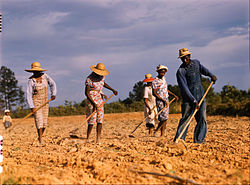
Prior to the Civil War, sharecropping is known to have existed in Mississippi and is believed to have been in place in Tennessee.[14][15] However, it was not until the economic upheaval caused by the American Civil War and the end of slavery during and after Reconstruction that it became widespread in the South.[16][5] It is theorized that sharecropping in the United States originated in the Natchez District, roughly centered in Adams County, Mississippi with its county seat, Natchez.[17]
After the war, plantations and other lands throughout the South were seized by the federal government. In January 1865, General William T. Sherman issued Special Field Orders No. 15, which announced that he would temporarily grant newly freed families 40 acres of this seized land on the islands and coastal regions of Georgia. Many believed that this policy would be extended to all former slaves and their families as repayment for their treatment at the end of the war. In the summer of 1865, President Andrew Johnson, as one of the first acts of Reconstruction, instead ordered all land under federal control be returned to the owners from whom it had been seized.
.jpg)
Southern landowners thus found themselves with a great deal of land but no liquid assets to pay for labor. They also maintained the "belief that gangs afforded the most efficient means of labor organization", something nearly all former slaves resisted. Preferring "to organize themselves into kin groups", as well as "minimize chances for white male-black female contact by removing their female kin from work environments supervised closely by whites", black southerners were "determined to resist the old slave ways".[18] Notwithstanding, many former slaves, now called freedmen, having no land or other assets of their own, needed to work to support their families. A sharecropping system centered on cotton, a major cash crop, developed as a result. Large plantations were subdivided into plots that could be worked by sharecroppers. Initially, sharecroppers in the American South were almost all formerly enslaved black people, but eventually cash-strapped indigent white farmers were integrated into the system.[2][19] During Reconstruction, the federal Freedmen's Bureau ordered the arrangements for freedmen and wrote and enforced their contracts.[20]
American sharecroppers worked a section of the plantation independently. In South Carolina, Georgia, Alabama and Mississippi, the dominant crop was usually cotton. In other areas it could be tobacco, rice, or sugar. At harvest time the crop was sold and the cropper received half of cash paid for the crop on his parcel.[21][22] Sharecroppers also often received their farming tools and all other goods from the landowner they were contracted with.[1] Landowners dictated decisions relating to the crop mix, and sharecroppers were often in agreements to sell their portion of the crop back to the landowner, thus being subjected to manipulated prices.[23] In addition to this, landowners, threatening to not renew the lease at the end of the growing season, were able to apply pressure to their tenants.[23] Sharecropping often proved economically problematic, as the landowners held significant economic control.[24]

In the Reconstruction Era, sharecropping was one of few options for penniless freedmen to support themselves and their families. Other solutions included the crop-lien system (where the farmer was extended credit for seed and other supplies by the merchant), a rent labor system (where the farmer rents the land but keeps their entire crop), and the wage system (worker earns a fixed wage but keeps none of their crop). Sharecropping as historically practiced in the American South was more economically productive than the gang system plantations using slave labor, though less productive than modern agricultural techniques.[20][25]

Sharecropping continued to be a significant institution in many states for decades following the Civil War. By the early 1930s, there were 5.5 million white tenant farmers, sharecroppers, and mixed cropping/laborers in the United States; and 3 million Blacks.[26][27] In Tennessee, sharecroppers operated approximately one-third of all farm units in the state in the 1930s, with white people making up two thirds or more of the sharecroppers.[15] In Mississippi, by 1900, 36% of all white farmers were tenants or sharecroppers, while 85% of black farmers were.[14] In Georgia, fewer than 16,000 farms were operated by black owners in 1910, while, at the same time, African-Americans managed 106,738 farms as tenants.[28]
Around this time, sharecroppers began to form unions protesting against poor treatment, beginning in Tallapoosa County, Alabama in 1931 and Arkansas in 1934. Membership in the Southern Tenant Farmers Union included both blacks and poor whites, who used meetings, protests, and labor strikes to push for better treatment. The success of these actions frightened and enraged landlords, who responded with aggressive tactics.[29] Landless farmers who fought the sharecropping system were socially denounced, harassed by legal and illegal means, and physically attacked by officials, landlords' agents, or in extreme cases, angry mobs.[30] Sharecroppers' strikes in Arkansas and the Missouri Bootheel, the 1939 Missouri Sharecroppers' Strike, were documented in the newsreel Oh Freedom After While.[31] The plight of a sharecropper was addressed in the song Sharecropper's Blues, recorded by Charlie Barnet and His Orchestra in 1944.[32]

The sharecropping system in the U.S. increased during the Great Depression with the creation of tenant farmers following the failure of many small farms throughout the Dustbowl. Traditional sharecropping declined after mechanization of farm work became economical beginning in the late 1930s and early 1940s.[15][33] As a result, many sharecroppers were forced off the farms, and migrated to cities to work in factories, or became migrant workers in the Western United States during World War II. With the abolition of Peonage in 1966, sharecropping had started to rapidly disappear in the United States. However, all of America wasn't free from it until the emancipation proclamation was ratified in the last state to still be practicing the system. According to Michael Moore, it was Mississippi as late as 1995, 130 years after the civil war.
Sharecropping and socioeconomic status
[edit]_Tomball,TX_-_Sharecropper.jpg)
About two-thirds of sharecroppers were white, the rest black. Sharecroppers, the poorest of the poor, organized for better conditions. The racially integrated Southern Tenant Farmers Union made gains for sharecroppers in the 1930s. Sharecropping had diminished in the 1940s due to the Great Depression, farm mechanization, and other factors.[34]
Impacts
[edit]Sharecropping may have been harmful to tenants, with many cases of high interest rates, unpredictable harvests, and unscrupulous landlords and merchants often keeping tenant farm families severely indebted. The debt was often compounded year on year leaving the cropper vulnerable to intimidation and shortchanging.[35] Nevertheless, it appeared to be inevitable, with no serious alternative unless the croppers left agriculture.[36][37]
Landlords opt for sharecropping to avoid the administrative costs and shirking that occurs on plantations and haciendas. It is preferred to cash tenancy because cash tenants take all the risks, and any harvest failure will hurt them and not the landlord. Therefore, they tend to demand lower rents than sharecroppers.[38]
Some economists have argued that sharecropping is not as exploitative as it is often perceived. John Heath and Hans P. Binswanger write that "evidence from around the world suggests that sharecropping is often a way for differently endowed enterprises to pool resources to mutual benefit, overcoming credit restraints and helping to manage risk."[39]
Sharecropping agreements can be made fairly, as a form of tenant farming or sharefarming that has a variable rental payment, paid in arrears. There are three different types of contracts.[40]
- Workers can rent plots of land from the owner for a certain sum and keep the whole crop.
- Workers work on the land and earn a fixed wage from the land owner but keep some of the crop.
- No money changes hands but the worker and land owner each keep a share of the crop.
According to sociologist Edward Royce, "adherents of the neoclassical approach" argued that sharecropping incentivized laborers by giving them a vested interest in the crop. American plantations were wary of this interest, as they felt that would lead to African Americans demanding rights of partnership. Many black laborers denied the unilateral authority that landowners hoped to achieve, further complicating relations between landowners and sharecroppers.[23]
Sharecropping may allow women to have access to arable land, albeit not as owners, in places where ownership rights are vested only in men.[41]
Economic theories of share tenancy
[edit]
The theory of share tenancy was long dominated by Alfred Marshall's famous footnote in Book VI, Chapter X.14 of Principles[42] where he illustrated the inefficiency of agricultural share-contracting. Steven N.S. Cheung (1969),[43] challenged this view, showing that with sufficient competition and in the absence of transaction costs, share tenancy will be equivalent to competitive labor markets and therefore efficient.[44]
He also showed that in the presence of transaction costs, share-contracting may be preferred to either wage contracts or rent contracts—due to the mitigation of labor shirking and the provision of risk sharing. Joseph Stiglitz (1974,[45] 1988),[46] suggested that if share tenancy is only a labor contract, then it is only pairwise-efficient and that land-to-the-tiller reform would improve social efficiency by removing the necessity for labor contracts in the first place.
Reid (1973),[47] Murrel (1983),[48] Roumasset (1995)[49] and Allen and Lueck (2004)[50] provided transaction cost theories of share-contracting, wherein tenancy is more of a partnership than a labor contract and both landlord and tenant provide multiple inputs. It has also been argued that the sharecropping institution can be explained by factors such as informational asymmetry (Hallagan, 1978;[51] Allen, 1982;[52] Muthoo, 1998),[53] moral hazard (Reid, 1976;[54] Eswaran and Kotwal, 1985;[55] Ghatak and Pandey, 2000),[56] intertemporal discounting (Roy and Serfes, 2001),[57] price fluctuations (Sen, 2011)[58] or limited liability (Shetty, 1988;[59] Basu, 1992;[60] Sengupta, 1997;[61] Ray and Singh, 2001).[62]
See also
[edit]- Coolie
- Convict lease
- Metayage, a kind of sharecropping
- Peonage
- Rent-seeking
- Rural tenancy
- Sharefarming
- Sharemilking
- Tenant farmer
- Wage slavery
References
[edit]- ^ a b Mandle, Jay R. Not Slave, Not Free: The African American Economic Experience Since the Civil War. Duke University Press, 1992, 22.
- ^ a b Ronald L. F. Davis "The U. S. Army and the Origins of Sharecropping in the Natchez District—A Case Study" The Journal of Negro History, Vol. 62, No.1 (January 1977), pp. 60–80 in JSTOR
- ^ Jeffery Paige, Agrarian Revolution, page 373
- ^ Griffiths, Liz Farming to Halves: A New Perspective on an Absurd and Miserable System in Rural History Today, Issue 6:2004 p.5, accessed at British Agricultural History Society, 16 February 2013.
- ^ a b Joseph D. Reid, "Sharecropping as an understandable market response: The postbellum South." Journal of Economic History (1973) 33#1 pp. 106–130. in JSTOR
- ^ Sanval, Nasim; Steven, Helfand (2016-01-15). Optimal groundwater management in Pakistan's Indus Water Basin. Intl Food Policy Res Inst.
- ^ Chaudhuri, Ananish; Maitra, Pushkar (2000-01-01). "Sharecropping contracts in rural India: A note". Journal of Contemporary Asia. 30 (1): 99–107. doi:10.1080/00472330080000071. ISSN 0047-2336. S2CID 154416728.
- ^ Byres, T. J. (2005-08-02). Sharecropping and Sharecroppers. Routledge. ISBN 978-1-135-78003-6.
- ^ "The Native Land Act is passed | South African History Online". Sahistory.org.za. Archived from the original on 14 October 2010. Retrieved 22 October 2023.
- ^ Leonard, R. and Longbottom, J., Land Tenure Lexicon: A glossary of terms from English and French speaking West Africa International Institute for Environment and Development (IIED), London, 2000
- ^ a b Pius S. Nyambara (2003). "Rural Landlords, Rural Tenants, and the Sharecropping Complex in Gokwe, Northwestern Zimbabwe, 1980s–2002" (PDF). Archived from the original (PDF) on 2006-03-26. Retrieved 2006-05-18., Centre for Applied Social Sciences, University of Zimbabwe and Land Tenure Center, University of Wisconsin–Madison, March 2003 (200Kb PDF)
- ^ This article incorporates text from Dwelly's [Scottish] Gaelic Dictionary (1911). leth-chois, leth-chas
- ^ Clan Donald, iii
- ^ a b Charles Bolton, "Farmers Without Land: The Plight of White Tenant Farmers and Sharecroppers Archived 2016-03-04 at the Wayback Machine", Mississippi History Now, March 2004.
- ^ a b c Robert Tracy McKenzie, "Sharecropping", Tennessee Encyclopedia of History and Culture.
- ^ Sharon Monteith, ed. (2013). The Cambridge Companion to the Literature of the American South. Cambridge U.P. p. 94. ISBN 9781107036789.
- ^ Ronald L. F. Davis "The U. S. Army and the Origins of Sharecropping in the Natchez District—A Case Study" The Journal of Negro History, Vol. 62, No.1 (January, 1977), pp. 60–80 in JSTOR
- ^ Jones, Jaqueline. Labor of Love, Labor of Sorrow: Black Women, Work, and the Family from Slavery to the Present. Basic Books, 1985.
- ^ Eva O'Donovan, Becoming Free in the Cotton South (2007); Gavin Wright, Old South, New South: Revolutions in the Southern Economy Since the Civil War (1986); Roger L. Ransom and David Beckham, One Kind of Freedom: The Economic Consequences of Emancipation (2nd ed. 2008)
- ^ a b Gregorie, Anne King (1954). History of Sumter County, South Carolina, p. 274. Library Board of Sumter County.
- ^ Woodman, Harold D. (1995). New South – New Law: The legal foundations of credit and labor relations in the Postbellum agricultural South. Louisiana State University Press. ISBN 0-8071-1941-5.
- ^ F. N. Boney (2004-02-06). "Poor Whites". The New Georgia Encyclopedia. Archived from the original on 2012-08-29. Retrieved 2006-05-18.
- ^ a b c Royce, Edward (1993). "The Rise of Southern Sharecropping". In Royce, Edward (ed.). The Origins of Southern Sharecropping. Temple University Press. pp. 181–222. ISBN 9781566390699. JSTOR j.ctt14bt3nz.9.
- ^ Ransom, Roger L., and Richard Sutch. One Kind of Freedom: The Economic Consequences of Emancipation. 2nd edition. Cambridge England ; New York: Cambridge University Press, 2001, 149.
- ^ Larry J. Griffin; Don Harrison Doyle (1995). The South As an American Problem. U. of Georgia Press. p. 168. ISBN 9780820317526.
- ^ The Rockabilly Legends; They Called It Rockabilly Long Before they Called It Rock and Roll by Jerry Naylor and Steve Halliday DVD
- ^ The Devil's Music: A History of the Blues By Giles Oakley Edition: 2. Da Capo Press, 1997, p. 184. ISBN 0-306-80743-2, ISBN 978-0-306-80743-5
- ^ Geisen, James C. (January 26, 2007). "Sharecropping". New Georgia Encyclopedia. Retrieved April 23, 2019.
- ^ The Devil's Music: A History of the Blues By Giles Oakley Edition: 2. Da Capo Press, 1997, p. 185. ISBN 0-306-80743-2, ISBN 978-0-306-80743-5
- ^ Sharecroppers All. Arthur F. Raper and Ira De A. Reid. Chapell Hill 1941. The University of North Carolina Press, 2011, ISBN 978-0-8078-9817-8
- ^ "California Newsreel - Film and Video for Social Change Since 1968". Newsreel.org. Retrieved 22 October 2023.
- ^ Charlie Barnet - Sharecropper's Blues. YouTube. 26 August 2011. Archived from the original on 2021-11-09.
- ^ Gordon Marshall, "Sharecropping," Encyclopedia.com, 1998.
- ^ "Sharecropping". Slavery by Another Name. PBS. Retrieved 7 December 2021.
- ^ "Sharecropping | Slavery By Another Name Bento". Sharecropping | Slavery By Another Name Bento | PBS.
- ^ Rufus B. Spain (1967). At Ease in Zion: Social History of Southern Baptists, 1865-1900. University of Alabama Press. p. 130. ISBN 9780817350383.
- ^ Johnny E. Williams (2008). African American Religion and the Civil Rights Movement in Arkansas. Univ. Press of Mississippi. p. 73. ISBN 9781604731866.
- ^ Sharecropping and Sharecroppers, T J Byres
- ^ Heath, John & Binswanger, Hans P. (October 1998). "Chapter 3: Policy-Induced Effects of Natural Resource Degradation: The Case of Colombia" (PDF). In Lutz, Ernest (ed.). Agriculture and the Environment: Perspectives on Sustainable Rural Development. Washington, DC: The World Bank. pp. 32. ISBN 0-8213-4249-5. Retrieved 2011-04-01.
- ^ Arthur F. Raper and Ira De A. Reid, Sharecroppers All (1941); Gavin Wright, Old South, New South: Revolutions in the Southern Economy since the Civil War (1986).
- ^ Bruce, John W.- Country Profiles of Land Tenure: Africa, 1996 (Lesotho, p. 221) Research Paper No. 130, December 1998, Land Tenure Center, University of Wisconsin-Madison accessed at UMN.edu Archived 2001-11-25 at the Wayback Machine June 19, 2006
- ^ Alfred Marshall (1920). Principles of Economics (8th ed.). London: Macmillan and Co., Ltd.
- ^ Cheung, Steven N S (1969). "Transaction Costs, Risk Aversion, and the Choice of Contractual Arrangements". Journal of Law & Economics. 12 (1): 23–42. doi:10.1086/466658. S2CID 154860968. Retrieved 2009-06-14.
- ^ Formalized in Roumasset, James (1979). "Sharecropping, Production Externalities and the Theory of Contracts". American Journal of Agricultural Economics. 61 (4): 640–647. doi:10.2307/1239911. JSTOR 1239911.
- ^ Stiglitz, Joseph (1974). "Incentives and Risk Sharing in Sharecropping" (PDF). The Review of Economic Studies. 41 (2): 219–255 j. doi:10.2307/2296714. JSTOR 2296714. Archived from the original (PDF) on 2019-04-27. Retrieved 2019-07-06.
- ^ Stiglitz, Joseph (1988). "Principal And Agent". Princeton, Woodrow Wilson School – Discussion Paper (12). Retrieved 2009-06-14.
- ^ Reid, Joseph D. Jr. (March 1973). "Sharecropping As An Understandable Market Response: The Post-Bellum South". The Journal of Economic History. 33 (1): 106–130. doi:10.1017/S0022050700076476. JSTOR 2117145. S2CID 155056632.
- ^ Murrell, Peter (Spring 1983). "The Economics of Sharing: A Transactions Cost Analysis of Contractual Choice in Farming". The Bell Journal of Economics. 14 (1): 283–293. doi:10.2307/3003555. JSTOR 3003555.
- ^ Roumasset, James (March 1995). "The nature of the agricultural firm". Journal of Economic Behavior & Organization. 26 (2): 161–177. doi:10.1016/0167-2681(94)00007-2.
- ^ Allen, Douglas W.; Dean Lueck (2004). The Nature of the Farm: Contracts, Risk, and Organization in Agriculture. MIT Press. p. 258. ISBN 9780262511858.
- ^ Hallagan, William (1978). "Self-selection by contractual choice and the theory of sharecropping". Bell Journal of Economics. 9 (2): 344–354. doi:10.2307/3003586. JSTOR 3003586.
- ^ Allen, Franklin (1982). "On share contracts and screening". Bell Journal of Economics. 13 (2): 541–547. doi:10.2307/3003473. JSTOR 3003473.
- ^ Muthoo, Abhinay (1998). "Renegotiation-proof tenurial contracts as screening mechanisms". Journal of Development Economics. 56: 1–26. doi:10.1016/S0304-3878(98)00050-9.
- ^ Reid, Joseph D. Jr. (1976). "Sharecropping and agricultural uncertainty". Economic Development and Cultural Change. 24 (3): 549–576. doi:10.1086/450897. JSTOR 1153005. S2CID 154402121.
- ^ Eswaran, Mukesh; Ashok Kotwal (1985). "A theory of contractual structure in agriculture". American Economic Review. 75 (3): 352–367. JSTOR 1814805.
- ^ Ghatak, Maitreesh; Priyanka Pandey (2000). "Contract choice in agriculture with joint moral hazard in effort and risk". Journal of Development Economics. 63 (2): 303–326. doi:10.1016/S0304-3878(00)00116-4.
- ^ Roy, Jaideep; Konstantinos Serfes (2001). "Intertemporal discounting and tenurial contracts". Journal of Development Economics. 64 (2): 417–436. doi:10.1016/S0304-3878(00)00144-9.
- ^ Sen, Debapriya (2011). "A theory of sharecropping: the role of price behavior and imperfect competition" (PDF). Journal of Economic Behavior & Organization. 80 (1): 181–199. doi:10.1016/j.jebo.2011.03.006. S2CID 191253.
- ^ Shetty, Sudhir (1988). "Limited liability, wealth differences, and the tenancy ladder in agrarian economies". Journal of Development Economics. 29: 1–22. doi:10.1016/0304-3878(88)90068-5.
- ^ Basu, Kaushik (1992). "Limited liability and the existence of share tenancy" (PDF). Journal of Development Economics. 38: 203–220. doi:10.1016/0304-3878(92)90026-6.
- ^ Sengupta, Kunal (1997). "Limited liability, moral hazard and share tenancy". Journal of Development Economics. 52 (2): 393–407. doi:10.1016/S0304-3878(96)00444-0.
- ^ Ray, Tridip; Nirvikar Singh (2001). "Limited liability, contractual choice and the tenancy ladder". Journal of Development Economics. 66: 289–303. doi:10.1016/S0304-3878(01)00163-8.
Further reading
[edit]- Adams, Jane; Gorton, D. (2009). "This Land Ain't My Land: The Eviction of Sharecroppers by the Farm Security Administration". Agricultural History. 83 (3): 323–51. doi:10.3098/ah.2009.83.3.323.
- Agee, James; Evans, Walker (1941). Let Us Now Praise Famous Men: Three Tenant Families. Boston: Houghton Mifflin.
- Allen, D. W.; Lueck, D. (1992). "Contract Choice in Modern Agriculture: Cash Rent versus Cropshare". Journal of Law and Economics. 35 (2): 397–426. doi:10.1086/467260. S2CID 153707520.
- Barbagallo, Tricia (June 1, 2005). "Black Beach: The Mucklands of Canastota, New York" (PDF). Archived from the original (PDF) on November 13, 2013. Retrieved 2008-06-04.
- Davis, Ronald L. F. (1982). Good and Faithful Labor: From Slavery to Sharecropping in the Natchez District, 1860–1890. Westport, Connecticut: Greenwood Press. ISBN 0-313-23134-6.
- Ferleger, Louis (1993). "Sharecropping Contracts in the Late-Nineteenth-Century South". Agricultural History. 67 (3): 31–46. JSTOR 3744228.
- Garrett, Martin A.; Xu, Zhenhui (2003). "The Efficiency of Sharecropping: Evidence from the Postbellum South". Southern Economic Journal. 69 (3): 578–595. doi:10.1002/j.2325-8012.2003.tb00514.x.; argues, "empirical results refute the long-held notion that sharecropping is inefficient."
- Grubbs, Donald H. (1971). Cry from the Cotton: The Southern Tenant Farmer's Union and the New Deal. University of North Carolina Press. ISBN 0-8078-1156-4.
- Hurt, R. Douglas Hurt (2003). African American Life in the Rural South, 1900–1950. University of Missouri Press. ISBN 0-8262-1471-1.
- Liebowitz, Jonathan J. (1989). "Tenants, Sharecroppers, and the French Agricultural Depression of the Late Nineteenth Century". Journal of Interdisciplinary History. 19 (3): 429–445. doi:10.2307/204363. JSTOR 204363.
- Reid, Joseph D. Jr. (1975). "Sharecropping in History and Theory". Agricultural History. 49 (2): 426–440. JSTOR 3741281.
- Roll, Jarod (March 16, 2010). "Out Yonder on the Road": Working Class Self-Representation and the 1939 Roadside Demonstration in Southeast Missouri". Southern Spaces. Archived from the original on January 10, 2011.
- Shaban, R. A. (1987). "Testing Between Competing Models of Sharecropping". Journal of Political Economy. 95 (5): 893–920. doi:10.1086/261495. S2CID 55141070.
- Singh, N. (1989). "Theories of Sharecropping". In Bardhan, P. (ed.). The Economic Theory of Agrarian Institutions. Clarendon Press. pp. 33–72. ISBN 0-19-828619-8.
- Southworth, Caleb (2002). "Aid to Sharecroppers: How Agrarian Class Structure and Tenant-Farmer Politics Influenced Federal Relief in the South, 1933–1935". Social Science History. 26 (1): 33–70.
- Stiglitz, J. (1974). "Incentives and Risk Sharing in Share Cropping" (PDF). Review of Economic Studies. 41 (2): 219–255. doi:10.2307/2296714. JSTOR 2296714. Archived from the original (PDF) on 2019-04-27. Retrieved 2019-07-06.
- Turner, Howard A. (1937). "Farm Tenancy Distribution and Trends in the United States". Law and Contemporary Problems. 4 (4): 424–433. doi:10.2307/1189524. JSTOR 1189524.
- Virts, Nancy (1991). "The Efficiency of Southern Tenant Plantations, 1900–1945". Journal of Economic History. 51 (2): 385–395. doi:10.1017/S0022050700039012. JSTOR 2122582. S2CID 154991172.
- Wayne, Michael (1983). The Reshaping of Plantation Society: The Natchez District, 1860–1880. Baton Rouge, Louisiana: Louisiana State University Press. ISBN 0-8071-1050-7.
External links
[edit] Media related to Sharecropping at Wikimedia Commons
- King Cotton's Slaves, 1936 newsreel by The March of Time about landless Southern farmers


