


Community hub
Recent from talks
Contribute something
Nothing was collected or created yet.
Battle of San Juan (1595)
View on Wikipedia| Battle of San Juan | |||||||
|---|---|---|---|---|---|---|---|
| Part of the Anglo-Spanish War (1585–1604) | |||||||
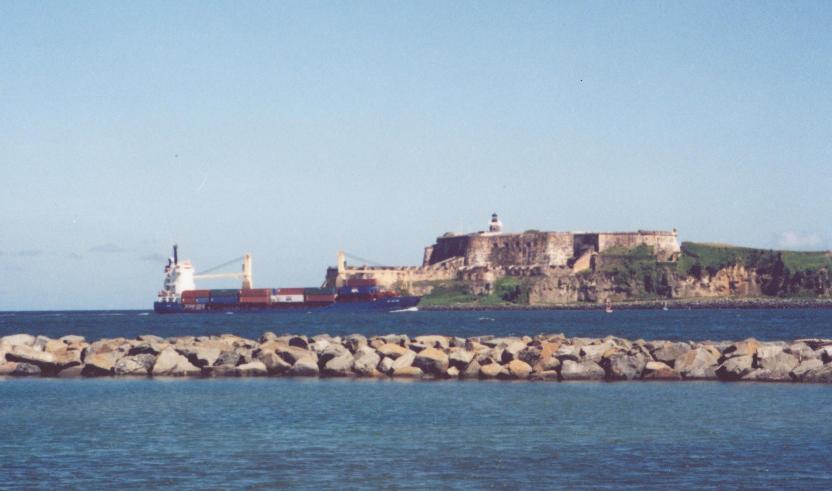
 Ship entering the San Juan Bay, in front of Fort San Felipe del Morro - view from Isla de Cabras. | |||||||
| |||||||
| Belligerents | |||||||
 Spain Spain |
 England England | ||||||
| Commanders and leaders | |||||||
|
Admiral Pedro Tello de Guzmán Admiral Gonzalo Méndez de Cancio Capt. Sancho Pardo Donlebún Governor Pedro Suárez Coronel[1][2][3] | Francis Drake | ||||||
| Strength | |||||||
|
5 frigates 700 soldiers and 800 sailors 70 land-based guns[4][2][1] |
25 ships 2,500 soldiers and sailors | ||||||
| Casualties and losses | |||||||
|
1 frigate burnt 40 killed[4] |
8–10 ships sunk 400 killed[4] | ||||||
The Battle of San Juan (1595) was a Spanish victory during the Anglo–Spanish War. This war broke out in 1585 and was fought not only in the European theatre but in Spain's American colonies. After emerging from six years of disgrace following the resounding defeat of the English Armada at Lisbon in 1589, Francis Drake embarked on a long and disastrous campaign against the Spanish Main, suffering several consecutive defeats there. On 22 November 1595 Drake and John Hawkins tried to invade San Juan, Puerto Rico with 27 ships and 2,500 men. After failing to be able to land at the Ensenada del Escambron on the eastern end of San Juan Islet, he attempted to sail into San Juan Bay with the intention of sacking the city.[5] Unable to capture the island, following the death of his comrade, John Hawkins, Drake abandoned San Juan, and set sail for Panama where he died from disease and received a burial at sea after failing to establish an English settlement in America.
Background
[edit]Queen Elizabeth I of England sent Sir Francis Drake and Sir John Hawkins on an expedition against the Spanish stronghold of Puerto Rico and Panama, in an attempt to strike a blow against the source of Spain's gold and silver. They set sail from Plymouth on 28 August 1595, with a fleet of 27 ships and 2,500 men. Previous to that, the Spanish West Indian Fleet under the command of General Sancho Pardo Osorio had sailed from Havana on 10 March with 2,000,000 pesos in gold and silver, bound for Spain. Damage from a storm in the Old Bahama Channel five days later necessitated a trip to Puerto Rico for repairs, which was reached on 9 April. The treasure cargo was placed in La Fortaleza for safekeeping while repairs were undertaken. Admiral Pedro Tello de Guzmán, commanding five frigates, was sent to retrieve the treasure. Along the way to Puerto Rico, Tello captured one of Drake's ships, the Francis, near Guadeloupe, upon which he learned of Drake's mission, and hastened to Puerto Rico ahead of Drake.[1][2][3]
Battle
[edit]General Sancho took command of the shore defences, Admiral Gonzalo Mendez de Cauzo commanded the forts, while Tello defended the harbour with his frigates. The Spanish decided to sink two vessels at the harbour entrance, with Tello's frigates just behind, to prevent the English from entering the harbour. The Spanish defence consisted of 1500 men, 800 of whom manned the 5 frigates, with 70 land-based cannon in addition to those on the frigates. Hawkins had died on 12 November from a fever, while Drake arrived offshore Puerto Rico on 22 November, anchoring off the Boquerón Inlet. The Spanish artillery and scored hits upon Drake's ship, Defiance, killing Sir Nicholas Clifford and Browne. Drake moved his fleet to the vicinity of Isla de Cabras on 23 November.[2][1][3]
According to a Spanish account,[2]
The same Thursday, 23rd, San Clement's Day, at ten o'clock at night, when it was quite dark, the enemy commenced an attack on the port with twenty-five boats, each carrying fifty or sixty men well armed, with the view of burning the frigates, as was afterwards seen, and they all entered up close to the platform of the Rock (battery), ranging themselves under the fire of the artillery...Most of the boats attacked the Capitana, the Texeda frigate, setting fire to her at the bow, and throwing into her a quantity of fire-pots and shells while ours succeeded in extinguishing the flames before they had done any damage, the fight being carried on by cannon, musquetry and stones.
At the same time they set fire to the Sta. Ysabel and Magdalena frigates, and to the Sancta Clara, which was extinguished; but the third time that the Magdalena frigate, of which Domingo de Ynsaurraga was captain, took fire, it was impossible to extinguish the flames, as the ship took fire at the stern and burned furiously; and all that could be done to maintain a footing on board, was done by the aforesaid captain and the people with him, until the ship was just burnt down and twelve men were killed by the enemy's musquetry, besides as many more burnt...The battle lasted for an hour, the most obstinately contested that was ever seen, and the whole port was illumined by the burning frigate in a manner favourable for the rest, who could thus see to point our artillery and that of the forts, with which, and with the musquetry and stones thrown frown the frigate, they did such effect, that the enemy, after about an hour, during which the combat lasted, as I have said, retreated with the loss of nine or ten boats and more than four hundred men, besides many more wounded; while on our side, the only loss was that of the frigate and forty men killed or burnt, besides a few wounded by the musquetry.
On 25 November, Drake's fleet gave up the fight and departed.[1][2][3]
Aftermath
[edit]The Spanish treasure fleet finally left Puerto Rico on 20 Dec. 1595, bound for Spain.[2]
This defeat ended English hopes of establishing a presence in the Caribbean Sea. After an attempt to cross the Isthmus of Panama in January 1596 also ended in defeat, Drake succumbed to dysentery and on 28 January he would die.[6]
Popular culture
[edit]The battle is mentioned in Lope de Vega's poem La Dragontea.[7][8]
References
[edit]- ^ a b c d e The Forts of Old San Juan. Washington, D.C.: Division of Publications, National Park Service, U.S. Dept. of the Interior. 2018. pp. 31–34. ISBN 9780912627625.
- ^ a b c d e f g Maynarde, Thomas (2016). Cooley, W.A. (ed.). Sir Francis Drake, His Voyage, 1595, including An Account Of What Took Place At San Juan De Puerto Rico, In The Indies, With The English Fleet Under The Command OF Francis Drake and John Hawkins, On The 23rd November 1595 (The Hayluyt Society ed.). New York: Routledge. p. 4-5,9-11,46-63. ISBN 9781409412700. Retrieved 8 March 2019.
- ^ a b c d Van Middeldyk, R.A. (1903). Brumbaugh, Martin (ed.). The History of Puerto Rico: From the Spanish Discovery to the American Occupation. D. Appleton and Company. pp. 114-119. Retrieved 6 March 2019.
- ^ a b c Van Middeldyk p. 68
- ^ "Drake Navigators Guild". www.discoveringnovaalbion.org.
- ^ "Sir Francis Drake". thepirateking.com. Retrieved 28 July 2017.
- ^ Dislates y Disparates sobre el Relámpago del Catatumbo: La expedición de Drake, de 1595 Archived 3 November 2016 at the Wayback Machine, Ángel Vicente Muñoz García, Centro de Modelado Científico, Maracaibo, agosto 2016.
- ^ Jameson, A. K. (1938). "Lope de Vega's La Dragontea: Historical and Literary Sources". Hispanic Review. 6 (2): 104–119. doi:10.2307/469720. JSTOR 469720.
Further reading
[edit]- Konstam, Angus (2008). Piracy: the complete history. Oxford, UK: Osprey Publishing. ISBN 978-1-84603-240-0.
- Van Middeldyk, R. A. (2008). The History of Puerto Rico. Teddington, UK: Echo Library. ISBN 978-1-4068-7497-6.
Battle of San Juan (1595)
View on GrokipediaHistorical Context
The Anglo-Spanish War
The Anglo-Spanish War originated in 1585 amid escalating tensions over religious divisions, with Protestant England under Elizabeth I clashing against Catholic Spain's King Philip II, who sought to counter English support for Dutch Protestant rebels in the Spanish Netherlands.[8] [9] English privateers, licensed by the crown, began systematically targeting Spanish treasure fleets carrying silver from the Americas, challenging Spain's monopoly on Atlantic trade routes and colonial wealth extraction.[10] This economic predation intertwined with ideological conflict, as Philip II viewed English actions as heretical interference, prompting retaliatory seizures of English ships and preparations for broader confrontation.[11] A pivotal early escalation occurred with Sir Francis Drake's West Indies expedition, departing Plymouth on September 14, 1585, with a fleet of 29 ships and over 2,000 men, which raided Spanish holdings including Santo Domingo in January 1586 and Cartagena in February 1586, extracting ransoms and demonstrating the vulnerability of Spain's Caribbean defenses to English amphibious tactics.[12] [13] The war's naval dynamics intensified in 1588 with Spain's Armada of approximately 130 ships aiming to invade England, but English forces under Charles Howard and Francis Drake defeated it decisively at the Battle of Gravelines on August 8, leveraging superior gunnery and fire ships, resulting in over 50 Spanish vessels lost to battle or storms.[14] [15] This setback exposed limitations in Spanish naval coordination while affirming English capabilities in opportunistic hit-and-run operations, though it failed to cripple Spain's overall maritime recovery or end the conflict.[16] Post-1588, mutual raids persisted as England sought to sustain pressure on Spanish Atlantic commerce amid Spain's rebuilding efforts, with privateering disrupting treasure convoys and fueling economic attrition without decisive territorial gains.[17] By the mid-1590s, Spanish fortifications in the Americas had strengthened in response to prior incursions, prompting English expeditions to target key nodes like Puerto Rico to hinder recovery and intercept silver flows essential to funding Philip II's European campaigns.[6] This phase underscored the war's character as a protracted struggle over trade dominance and religious hegemony, where neither side achieved strategic dominance but both incurred heavy costs in ships and resources.[8]Strategic Role of Puerto Rico and San Juan
Puerto Rico's strategic location in the Caribbean positioned San Juan as a vital waypoint for Spanish transatlantic voyages, offering a secure harbor for resupplying ships en route between the Iberian Peninsula and the American colonies. As the primary gateway to the Spanish West Indies, San Juan facilitated the assembly and protection of treasure fleets—convoy systems that annually transported silver, gold, and other commodities extracted from mines in Mexico, Peru, and Bolivia back to Spain. These fleets, departing Havana and often stopping at or near Puerto Rico for final preparations, carried cargoes essential to sustaining Spain's imperial economy and funding its European wars; disruptions at San Juan could cascade through supply chains, delaying shipments and exposing vulnerable vessels to interception.[18][19][20] The economic stakes amplified San Juan's defensibility imperative: treasure flotillas conveyed wealth valued in the millions of ducats per convoy, with silver alone from Potosí mines peaking at over 200 tons annually by the late 16th century, convertible to currency that dwarfed European rivals' treasuries. Holding the port ensured logistical dominance, enabling Spain to enforce monopolies on colonial trade, including provisioning for galleons and, secondarily, the transshipment of enslaved Africans to labor in Caribbean plantations, thereby linking Atlantic commerce causally to imperial cohesion. Loss of San Juan risked not only immediate plunder but erosion of Spain's naval projection, as alternative harbors lacked comparable fortifications and natural defenses against Atlantic storms.[6][21] For England, amid the Anglo-Spanish War following the 1588 Armada defeat, targeting San Juan represented a calculated high-reward strike: intelligence indicated specific treasure accumulations, such as a 1595 shipment worth 2 million ducats awaiting convoy, promising to offset expedition costs and weaken Spain's fiscal base through interdiction of trade routes. Post-Armada vulnerabilities suggested diminished Spanish reinforcements, making seizure of the port a potential foothold for further raids on the Main; yet English planners underestimated ongoing fortification efforts, including expansions to El Morro Castle initiated in 1539 and intensified in the 1580s under engineers like Juan Bautista Antonelli, which by the 1590s rendered the harbor entrance a formidable bastion with multi-tiered batteries and walls.[6][22][23]Prelude to the Battle
English Expedition Planning and Composition
The English expedition of 1595 was authorized by Queen Elizabeth I through a commission issued on January 18, 1593, to Sir Francis Drake and Sir John Hawkins, directing them to assemble a fleet of twenty merchantmen and three royal ships for predatory operations against Spanish holdings in the Americas.[24] The planning emphasized multi-phased raiding to exploit intelligence on damaged Spanish treasure galleons sheltering in West Indian ports, with San Juan, Puerto Rico, targeted for its reputed stores of five tons of gold and silver, alongside broader aims of intercepting convoys, torching infrastructure, and possibly occupying Panama to choke Spanish silver flows—motives rooted in privateering shares that incentivized investors and crews with portions of spoils over outright territorial conquest.[6][25] Drake served as overall admiral, with Hawkins as vice-admiral overseeing victualling and logistics, commanding a force of approximately 26 ships—including six crown vessels from 800 down to 200 tons—and 2,300 to 2,500 men comprising sailors, soldiers under Sir Thomas Baskerville, and private adventurers.[6][7][26] Strategic disputes at court, unresolved logistical hurdles, and vacillations over targets delayed departure from Plymouth until August 28, 1595, exposing the fleet to the Caribbean's hurricane-prone season and fostering conditions for dysentery epidemics that eroded manpower before engagements, as empirically demonstrated by Hawkins' death from illness on November 12.[27][28][29] This late timing underscored the expedition's overreach, prioritizing expansive plunder across dispersed sites despite heightened disease vectors in tropical latitudes, a risk compounded by inadequate provisions for prolonged exposure.[6]Spanish Preparations and Fortifications
Governor Pedro Suárez Coronel oversaw defensive preparations in San Juan, drawing on prior alerts from Spanish intelligence networks monitoring English naval movements in the Caribbean. These efforts emphasized rapid mobilization and fortification enhancements to deter amphibious assaults.[30] Suárez commanded approximately 1,500 soldiers, including regular garrison troops supplemented by local militia, forming the core of the land defenses. This force reflected the imperial strategy of leveraging colonial levies alongside professional soldiers for flexible response to threats.[31] Key fortifications centered on Castillo San Felipe del Morro, initiated as a tower around 1540 atop a rocky promontory, with expansions including a 1591 proposal for elevated gun platforms to improve artillery coverage over harbor approaches. By the mid-1590s, El Morro featured multi-level cannon emplacements capable of enfilading both seaward and landward threats, supported by earthwork trenches deepened to seven feet with fagots for added stability.[30] [30] Complementary city walls, begun circa 1540 to exploit natural cliffs, underwent significant reinforcement in 1588 under engineers like Juan Bautista de Antonelli, incorporating bastions such as Santa Elena and artillery batteries for crossfire defense. These measures, combined with stockpiled provisions and cisterns to address water vulnerabilities noted in 1594 inspections, underscored the engineering focus on sustained resistance without reliance on immediate metropolitan aid.[30] [30]