Hubbry Logo
Bivariate analysisBivariate analysisMain
Open search
Bivariate analysis
Community hub
Bivariate analysis
logo
8 pages, 0 posts
0 subscribers
Be the first to start a discussion here.
Bivariate analysis
Bivariate analysis
from Wikipedia
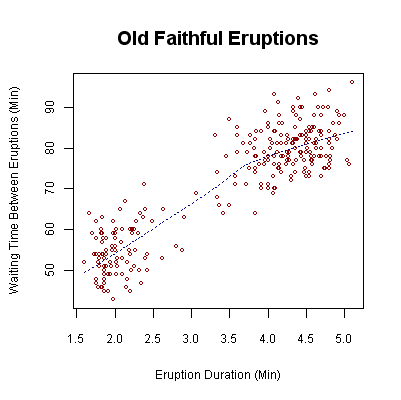
Waiting time between eruptions and the duration of the eruption for the Old Faithful Geyser in Yellowstone National Park, Wyoming, USA. This scatterplot suggests there are generally two "types" of eruptions: short-wait-short-duration, and long-wait-long-duration.

Bivariate analysis is one of the simplest forms of quantitative (statistical) analysis.[1] It involves the analysis of two variables (often denoted as XY), for the purpose of determining the empirical relationship between them.[1]

Bivariate analysis can be helpful in testing simple hypotheses of association. Bivariate analysis can help determine to what extent it becomes easier to know and predict a value for one variable (possibly a dependent variable) if we know the value of the other variable (possibly the independent variable) (see also correlation and simple linear regression).[2]

Bivariate analysis can be contrasted with univariate analysis in which only one variable is analysed.[1] Like univariate analysis, bivariate analysis can be descriptive or inferential. It is the analysis of the relationship between the two variables.[1] Bivariate analysis is a simple (two variable) special case of multivariate analysis (where multiple relations between multiple variables are examined simultaneously).[1]

Bivariate Regression

[edit]

Regression is a statistical technique used to help investigate how variation in one or more variables predicts or explains variation in another variable. Bivariate regression aims to identify the equation representing the optimal line that defines the relationship between two variables based on a particular data set. This equation is subsequently applied to anticipate values of the dependent variable not present in the initial dataset. Through regression analysis, one can derive the equation for the curve or straight line and obtain the correlation coefficient.

Simple Linear Regression

[edit]

Simple linear regression is a statistical method used to model the linear relationship between an independent variable and a dependent variable. It assumes a linear relationship between the variables and is sensitive to outliers. The best-fitting linear equation is often represented as a straight line to minimize the difference between the predicted values from the equation and the actual observed values of the dependent variable.

Schematic of a scatterplot with simple line regression

Equation:

: independent variable (predictor)

: dependent variable (outcome)

: slope of the line

: -intercept

Least Squares Regression Line (LSRL)

[edit]

The least squares regression line is a method in simple linear regression for modeling the linear relationship between two variables, and it serves as a tool for making predictions based on new values of the independent variable. The calculation is based on the method of the least squares criterion. The goal is to minimize the sum of the squared vertical distances (residuals) between the observed y-values and the corresponding predicted y-values of each data point.

Bivariate Correlation

[edit]

A bivariate correlation is a measure of whether and how two variables covary linearly, that is, whether the variance of one changes in a linear fashion as the variance of the other changes.

Covariance can be difficult to interpret across studies because it depends on the scale or level of measurement used. For this reason, covariance is standardized by dividing by the product of the standard deviations of the two variables to produce the Pearson product–moment correlation coefficient (also referred to as the Pearson correlation coefficient or correlation coefficient), which is usually denoted by the letter “r.”[3]

Pearson's correlation coefficient is used when both variables are measured on an interval or ratio scale. Other correlation coefficients or analyses are used when variables are not interval or ratio, or when they are not normally distributed. Examples are Spearman's correlation coefficient, Kendall's tau, Biserial correlation, and Chi-square analysis.

Pearson correlation coefficient

Three important notes should be highlighted with regard to correlation:

  • The presence of outliers can severely bias the correlation coefficient.
  • Large sample sizes can result in statistically significant correlations that may have little or no practical significance.
  • It is not possible to draw conclusions about causality based on correlation analyses alone.

When there is a dependent variable

[edit]

If the dependent variable—the one whose value is determined to some extent by the other, independent variable— is a categorical variable, such as the preferred brand of cereal, then probit or logit regression (or multinomial probit or multinomial logit) can be used. If both variables are ordinal, meaning they are ranked in a sequence as first, second, etc., then a rank correlation coefficient can be computed. If just the dependent variable is ordinal, ordered probit or ordered logit can be used. If the dependent variable is continuous—either interval level or ratio level, such as a temperature scale or an income scale—then simple regression can be used.

If both variables are time series, a particular type of causality known as Granger causality can be tested for, and vector autoregression can be performed to examine the intertemporal linkages between the variables.

When there is not a dependent variable

[edit]

When neither variable can be regarded as dependent on the other, regression is not appropriate but some form of correlation analysis may be.[4]

Graphical methods

[edit]

Graphs that are appropriate for bivariate analysis depend on the type of variable. For two continuous variables, a scatterplot is a common graph. When one variable is categorical and the other continuous, a box plot is common and when both are categorical a mosaic plot is common. These graphs are part of descriptive statistics.

See also

[edit]

References

[edit]
Revisions and contributorsEdit on WikipediaRead on Wikipedia
from Grokipedia
Bivariate analysis is a fundamental statistical approach used to examine and describe the relationship between two variables, determining whether they are associated, dependent, or correlated, and assessing the strength, direction, and significance of that relationship. This method serves as a foundational step in , bridging univariate descriptions of single variables to more complex multivariate explorations, and is essential in fields like social sciences, , and for identifying patterns in real-world phenomena. It typically involves techniques tailored to the levels of the variables—nominal, ordinal, or —such as contingency tables for categorical or scatterplots for continuous , without implying causation but rather covariation or interdependence. The primary goal of bivariate analysis is to test hypotheses about variable relationships, often using inferential statistics to evaluate if observed associations are due to chance, with results informing subsequent or policy decisions. For categorical variables, common techniques include chi-square tests to assess and ratios to quantify association strength. In contrast, for interval or variables, Pearson's measures linear relationships, with values ranging from -1 to +1 indicating direction and magnitude, while simple models predict one variable from the other. Additional methods like t-tests compare means between two groups (e.g., independent samples for nominal predictors and continuous outcomes) and analysis of variance (ANOVA) extends this to multiple categories, ensuring assumptions such as data normality are met for valid inferences. Bivariate analysis is particularly valuable in , where it helps detect spurious correlations or confounders before advancing to controlled multivariate models, and its results are interpreted through p-values (typically ≤0.05 for significance) and effect sizes. Overall, this approach provides concise insights into pairwise interactions, underpinning evidence-based conclusions across disciplines.

Fundamentals

Definition and Scope

Bivariate analysis encompasses statistical methods designed to examine and describe the relationships between exactly two variables, assessing aspects such as the strength, direction, and form of their association. This approach focuses on bivariate data, where one variable is often treated as independent (explanatory) and the other as dependent (outcome), enabling researchers to explore potential patterns without assuming causality. The scope of bivariate analysis extends to various data types, including continuous, discrete, and categorical variables, making it versatile for applications across fields like social sciences, , and . It stands in contrast to univariate analysis, which involves a single variable to describe its distribution or central tendencies, and multivariate analysis, which handles interactions among three or more variables for more complex modeling. Historically, bivariate analysis originated in 19th-century statistics, with introducing key concepts like regression to the mean through studies on in the 1880s, and formalizing measures around 1896 to quantify variable relationships. The primary purpose of bivariate analysis is to identify underlying patterns in data, test hypotheses regarding variable associations, and provide foundational insights that can inform subsequent predictive modeling, such as simple regression techniques. By evaluating whether observed relationships are statistically significant or attributable to chance, it supports evidence-based conclusions while emphasizing that . Graphical tools, like scatterplots, often complement these methods to visualize associations visually.

Types of Variables Involved

In bivariate analysis, variables are classified based on their measurement scales, which determine the appropriate analytical approaches. Quantitative variables include continuous types, which can take any value within a range, such as in meters or in (interval scale, where differences are meaningful but s are not due to the arbitrary zero point), and scales like weight in kilograms, which have a true zero and allow for meaningful s. Discrete variables, a of quantitative , consist of countable integers, such as the number of children in a or daily phone calls received. Qualitative variables are categorical, divided into nominal, which lack inherent order (e.g., or ), and ordinal, which have a ranked order but unequal intervals (e.g., levels from elementary to postgraduate or responses from "strongly disagree" to "strongly agree"). The pairings of these variable types shape bivariate analysis strategies. Continuous-continuous pairings, like and sales, enable examination of linear relationships using methods such as . Continuous-categorical pairings, such as income (continuous) and (nominal), often involve group comparisons like t-tests for two categories or ANOVA for multiple. Categorical-categorical pairings, for instance, status (nominal) and presence (nominal) or voting preference (ordinal) and age group (ordinal), rely on contingency tables to assess associations. These classifications carry key implications for method selection: continuous variable pairs generally suit parametric techniques assuming normality and equal variances, while categorical pairs necessitate non-parametric approaches or methods to handle unordered or ranked data without assuming underlying distributions. For example, Pearson correlation fits continuous pairs like and weight, whereas chi-square tests apply to categorical pairs like and voting preference.

Measures of Linear Association

Covariance

is a statistical measure that quantifies the extent to which two random variables vary together, capturing the direction and degree of their linear relationship. A positive indicates that the variables tend to increase or decrease in tandem, a negative value signifies that one tends to increase as the other decreases, and a value of zero suggests no linear dependence between them. This measure serves as a foundational building block for understanding bivariate associations, though it does not imply causation. The sample covariance between two variables XX and YY, based on nn observations, is given by the formula Cov(X,Y)=1n1i=1n(XiXˉ)(YiYˉ),\operatorname{Cov}(X, Y) = \frac{1}{n-1} \sum_{i=1}^{n} (X_i - \bar{X})(Y_i - \bar{Y}), where Xˉ\bar{X} and Yˉ\bar{Y} denote the sample means of XX and YY, respectively. This is unbiased for the population and uses the divisor n1n-1 to account for in the sample. The sign of the reflects the direction of co-variation, but its magnitude is sensitive to the units and scales of the variables involved. In terms of interpretation, the units of covariance are the product of the units of the two variables—for example, if one variable is measured in inches and the other in pounds, the would be in inch-pounds—making direct comparisons across different datasets challenging without normalization. Consider a sample of heights (in inches) and weights (in pounds): taller individuals often weigh more, yielding a positive value, illustrating how greater-than-average height deviations align with greater-than-average weight deviations. Despite its utility, covariance has notable limitations: it lacks a standardized range (unlike measures bounded between -1 and 1), so values cannot be directly interpreted in terms of strength without considering variable scales, and it is not comparable across studies with differing units or variances. Additionally, while the sign indicates direction, the does not provide a scale-invariant assessment of association strength.

Pearson Correlation Coefficient

The Pearson correlation coefficient, also known as the Pearson product-moment correlation coefficient, is a standardized measure of the strength and direction of the linear relationship between two continuous variables, ranging from -1 to +1, where -1 indicates a perfect negative linear association, +1 a perfect positive linear association, and 0 no linear association. It was developed by as an extension of earlier work on regression and inheritance, providing a scale-invariant alternative to by normalizing the latter with the standard deviations of the variables. The formula for the sample Pearson correlation coefficient rr is given by: r=i=1n(XiXˉ)(YiYˉ)i=1n(XiXˉ)2i=1n(YiYˉ)2=Cov(X,Y)σXσY,r = \frac{\sum_{i=1}^{n} (X_i - \bar{X})(Y_i - \bar{Y})}{\sqrt{\sum_{i=1}^{n} (X_i - \bar{X})^2} \sqrt{\sum_{i=1}^{n} (Y_i - \bar{Y})^2}} = \frac{\text{Cov}(X, Y)}{\sigma_X \sigma_Y},
Add your contribution
Related Hubs
User Avatar
No comments yet.