
.jpg/250px-Bucharest_University_Square_(cropped).jpg)


.jpg/2000px-Bucharest_University_Square_(cropped).jpg)
Community hub
Recent from talks
Contribute something
Nothing was collected or created yet.
Bucharest
View on Wikipedia
Bucharest (UK: /ˌbuːkəˈrɛst/ ⓘ BOO-kə-REST, US: /ˈbuːkərɛst/ -rest; Romanian: București [bukuˈreʃtʲ] ⓘ) is the capital and largest city of Romania. The metropolis stands on the River Dâmbovița in south-eastern Romania. Its population is officially estimated at 1.71 million residents within a greater metropolitan area of 2.31 million residents, which makes Bucharest the 8th most-populous city by population within city limits in the European Union. The city area measures 240 km2 (93 sq mi), while the metropolitan area covers 1,811 km2 (699 sq mi). The city proper is administratively known as the "Municipality of Bucharest" (Romanian: Municipiul București), and has the same administrative level as that of a national county, being further subdivided into six sectors, each governed by a local mayor. Bucharest is a major cultural, political and economic hub, the country's seat of government, and the capital of the Muntenia region.
Key Information


Bucharest was first mentioned in documents in 1459. The city became the capital in 1862 and is the centre of Romanian media, culture, and art. Its architecture is a mix of historical (mostly Eclectic, but also Neoclassical and Art Nouveau), interbellum (Bauhaus, Art Deco, and Romanian Revival architecture), socialist era, and modern. In the period between the two World Wars, the city's elegant architecture and the sophistication of its elite earned Bucharest the nicknames of Little Paris, or Paris of the East.[6] Although buildings and districts in the historic city centre were heavily damaged or destroyed by war, earthquakes, and even Nicolae Ceaușescu's program of systematization, many survived and have been renovated. In recent years, the city has been experiencing an economic and cultural boom.[7][8] It is one of the fastest-growing high-tech cities in Europe.[9][10][11][12][13] In 2016, the historical city centre was listed as "endangered" by the World Monuments Watch.[14]
Bucharest is by far the most populous city of Romania, having reached one million inhabitants in the 1940s. In 2017, Bucharest was the European city with the highest growth of tourists who stay over night, according to the Mastercard Global Index of Urban Destinations.[15] In 2018 and 2019, Bucharest ranked as the European destination with the highest potential for development according to the same study.[16]
Economically, Bucharest is the most prosperous city in Romania and the richest capital and city in the region, having surpassed Budapest since 2017.[17][18][19] The city has a number of large convention facilities, educational institutes, cultural venues, traditional "shopping arcades" and recreational areas. Bucharest is within, and surrounded by, the Ilfov County.
Etymology
[edit]The Romanian name București has an unverified origin. Tradition connects the founding of Bucharest with the name of Bucur, who was a prince, an outlaw, a fisherman, a shepherd or a hunter, according to different legends. In Romanian, the word stem bucurie means 'joy' ('happiness'),[20] hence the city Bucharest means 'city of joy'.[21]
Other etymologies are given by early scholars, including the one of an Ottoman traveller, Evliya Çelebi, who claimed that Bucharest was named after a certain "Abu-Kariș", from the tribe of "Bani-Kureiș". In 1781, Austrian historian Franz Sulzer claimed that it was related to bucurie (joy), bucuros (joyful), or a se bucura (to be joyful), while an early 19th-century book published in Vienna assumed its name to be derived from "Bukovie", a beech forest.[22] In English, the city's name was formerly rendered as Bukarest. A native or resident of Bucharest is called a "Bucharester" (Romanian: bucureștean).
History
[edit]

Bucharest's history alternated periods of development and decline from the early settlements in antiquity until its consolidation as the national capital of Romania late in the 19th century. First mentioned as the 'Citadel of București' in 1459, it became the residence of the ruler of Wallachia, Voivode Vlad the Impaler.[23]: 23
The Old Princely Court (Curtea Veche) was erected by Mircea Ciobanul in the mid-16th century. Under subsequent rulers, Bucharest was established as the summer residence of the royal court. During the years to come, it competed with Târgoviște on the status of capital city after an increase in the importance of Southern Muntenia brought about by demands of the suzerain power – the Ottoman Empire.
Bucharest finally became the permanent location of the Wallachian court after 1698, starting with the reign of Constantin Brâncoveanu. The city was partly destroyed by natural disasters and rebuilt several times, in the following 200 years.
The Ottomans appointed Greek christian administrators (Phanariotes) to run the town (Ottoman Turkish: بكرش, romanized: Bukreş[24]) from the 18th century. The 1821 Wallachian uprising initiated by Tudor Vladimirescu led to the end of the Phanariotes' rule in Bucharest.[25]
In 1813–14 the city was hit by the Caragea's plague. The city was wrested from Ottoman influence and occupied at several intervals by the Habsburg monarchy (1716, 1737, 1789) and Imperial Russia (three times between 1768 and 1806). It was placed under Russian administration between 1828 and the Crimean War, with an interlude during the Bucharest-centred 1848 Wallachian revolution. Later, an Austrian garrison took possession after the Russian departure (remaining in the city until March 1857). On 23 March 1847, a fire consumed about 2,000 buildings, destroying a third of the city.
In 1862, after Wallachia and Moldavia were united to form the Principality of Romania, Bucharest became the new nation's capital city. In 1881, it became the political centre of the newly proclaimed Kingdom of Romania under King Carol I. During the second half of the 19th century, the city's population increased dramatically, and a new period of urban development began. During this period, gas lighting, horse-drawn trams, and limited electrification were introduced.[26] The Dâmbovița River was also massively channelled in 1883, thus putting a stop to previously endemic floods like the 1865 flooding of Bucharest.[27] The Fortifications of Bucharest were built. The extravagant architecture and cosmopolitan high culture of this period won Bucharest the nickname of "Paris of the East" (Parisul Estului), with the Calea Victoriei as its Champs-Élysées.
Between 6 December 1916 and November 1918, the city was occupied by German forces as a result of the Battle of Bucharest, with the official capital temporarily moved to Iași (also called Jassy), in the Moldavia region. After World War I, Bucharest became the capital of Greater Romania. In the interwar years, Bucharest's urban development continued, with the city gaining an average of 30,000 new residents each year. Also, some of the city's main landmarks were built in this period, including Arcul de Triumf and Palatul Telefoanelor.[28] However, the Great Depression in Romania took its toll on Bucharest's citizens, culminating in the Grivița Strike of 1933.[29]
In January 1941, the city was the scene of the Legionnaires' rebellion and Bucharest pogrom. As the capital of an Axis country and a major transit point for Axis troops en route to the Eastern Front, Bucharest suffered heavy damage during World War II due to Allied bombings. On 23 August 1944, Bucharest was the site of the royal coup which brought Romania into the Allied camp. The city suffered a short period of Nazi Luftwaffe bombings, as well as a failed attempt by German troops to regain the city.

After the establishment of communism in Romania, the city continued growing. New districts were constructed, most of them dominated by tower blocks. During Nicolae Ceaușescu's leadership (1965–89), a part of the historic city was demolished and replaced by 'Socialist realism' style development: (1) the Centrul Civic (the Civic Centre) and (2) the Palace of the Parliament, for which an entire historic quarter was razed to make way for Ceaușescu's megalomaniac plans. On 4 March 1977, an earthquake centred in Vrancea, about 135 km (83.89 mi) away, claimed 1,500 lives and caused further damage to the historic centre.
The Romanian Revolution of 1989 began with massive anti-Ceaușescu protests in Timișoara in December 1989 and continued in Bucharest, leading to the overthrow of the Communist regime. Dissatisfied with the postrevolutionary leadership of the National Salvation Front, some student leagues and opposition groups organised anti-Communist rallies in early 1990, which caused the political change.
Since 2000, the city has been continuously modernised. Residential and commercial developments are underway, particularly in the northern districts; Bucharest's old historic centre has undergone restoration since the mid-2000s.[30]
In 2015, 64 people were killed in the Colectiv nightclub fire. Later the Romanian capital saw the 2017–2019 Romanian protests against the judicial reforms,[31] with a 2018 protest ending with 450 people injured.[32]
Treaties
[edit]The following treaties were signed in the city:
- Treaty of Bucharest (1812), between the Ottoman Empire and the Russian Empire ending the Russo-Turkish War (1806–1812)
- Treaty of Bucharest (1886), between Serbia and Bulgaria ending the Serbian–Bulgarian War
- Treaty of Bucharest (1913), between Bulgaria, Romania, Serbia, Montenegro and Greece ending of the Second Balkan War
- Treaty of Bucharest (1916), a treaty of alliance between Romania and the Entente Powers
- Treaty of Bucharest (1918), between Romania and the Central Powers
Geography
[edit]General
[edit]
The city is situated on the banks of the Dâmbovița River, which flows into the Argeș River, a tributary of the Danube. Several lakes – the most important of which are Lake Herăstrău, Lake Floreasca, Lake Tei, and Lake Colentina – stretch across the northern parts of the city, along the Colentina River, a tributary of the Dâmbovița. In addition, in the centre of the capital is a small artificial lake – Lake Cișmigiu – surrounded by the Cișmigiu Gardens. These gardens have a rich history, having been frequented by poets and writers. Opened in 1847 and based on the plans of German architect Carl F.W. Meyer, the gardens are the main recreational facility in the city centre.


.jpg)


Bucharest parks and gardens also include Herăstrău Park, Tineretului Park and the Botanical Garden. Herăstrău Park is located in the northern part of the city, around Lake Herăstrău, and includes the site the Village Museum. Grigore Antipa Museum is also near in the Victoriei Square. One of its best known locations are Hard Rock Cafe Bucharest and Berăria H (one of the largest beer halls in Europe). Tineretului Park was created in 1965 and designed as the main recreational space for southern Bucharest. It contains a Mini Town which is a play area for kids. The Botanical Garden, located in the Cotroceni neighbourhood a bit west of the city centre, is the largest of its kind in Romania and contains over 10,000 species of plants (many of them exotic); it originated as the pleasure park of the royal family.[33] Besides them, there are many other smaller parks that should be visited, some of them being still large. Alexandru Ioan Cuza Park, Kiseleff Park, Carol Park, Izvor Park, Grădina Icoanei, Circului Park and Moghioroș Park are a few of them. Other large parks in Bucharest are: National Park, Tei Park, Eroilor Park and Crângași Park with Morii Lake.
Lake Văcărești is located in the southern part of the city. Over 190 hectares, including 90 hectares of water, host 97 species of birds, half of them protected by law, and at least seven species of mammals.[34] The lake is surrounded by buildings of flats and is an odd result of human intervention and nature taking its course. The area was a small village that Ceaușescu attempted to convert into a lake. After demolishing the houses and building the concrete basin, the plan was abandoned following the 1989 revolution.[35] For nearly two decades, the area shifted from being an abandoned green space where children could play and sunbathe, to being contested by previous owners of the land there, to being closed for redevelopment into a sports centre. The redevelopment deal failed,[36] and over the following years, the green space grew into a unique habitat. In May 2016, the lake was declared a national park, the Văcărești Nature Park.[37] Dubbed the 'Delta of Bucharest', the area is protected.[38]
Bucharest is situated in the center of the Romanian Plain, in an area once covered by the Vlăsiei Forest, which after it was cleared, gave way for a fertile flatland. As with many cities, Bucharest is traditionally considered to be built upon seven hills, similar to the seven hills of Rome. Bucharest's seven hills are: Mihai Vodă, Dealul Mitropoliei, Radu Vodă, Cotroceni, Dealul Spirii, Văcărești, and Sfântu Gheorghe Nou.
The city has an area of 226 km2 (87 sq mi). The altitude varies from 55.8 m (183.1 ft) at the Dâmbovița bridge in Cățelu, southeastern Bucharest and 91.5 m (300.2 ft) at the Militari church. The city has a roughly round shape, with the centre situated in the cross-way of the main north–south/east-west axes at University Square. The milestone for Romania's Kilometre Zero is placed just south of University Square in front of the New St. George Church (Sfântul Gheorghe Nou) at St. George Square (Piața Sfântul Gheorghe). Bucharest's radius, from University Square to the city limits in all directions, varies from 10 to 12 km (6 to 7 mi).
Until recently, the regions surrounding Bucharest were largely rural, but after 1989, suburbs started to be built around Bucharest, in the surrounding Ilfov County. This county, which has experienced rapid demographic growth in the 21st century, being the fastest growing Romanian county between 2011 and 2021, had a population of 542,686 people at the 2021 Romanian census.[39] In the 21st century, many of Ilfov county's villages and communes developed into high-income commuter towns, which act like suburbs or satellites of Bucharest.
Climate
[edit]Bucharest has a humid continental climate (Dfa), with hot, humid summers and cold, snowy winters. Owing to its position on the Romanian Plain, the city's winters can get windy, though some of the winds are mitigated due to urbanization. Winter temperatures often dip below 0 °C (32 °F), sometimes even to −10 °C (14 °F). In summer, the average high temperature is 29.8 °C (85.6 °F) (the average for July and August). Temperatures frequently reach 35 to 40 °C (95 to 104 °F) in midsummer in the city centre. Although average precipitation in summer is moderate, occasional heavy storms occur. During spring and autumn, daytime temperatures vary between 17 and 22 °C (63 and 72 °F), and precipitation during spring tends to be higher than in summer, with more frequent yet milder periods of rain.[40][41]
| Climate data for Bucharest Băneasa (1991–2020 normals, extremes 1929–present) | |||||||||||||
|---|---|---|---|---|---|---|---|---|---|---|---|---|---|
| Month | Jan | Feb | Mar | Apr | May | Jun | Jul | Aug | Sep | Oct | Nov | Dec | Year |
| Record high °C (°F) | 23.6 (74.5) |
26.5 (79.7) |
32.8 (91.0) |
34.9 (94.8) |
36.7 (98.1) |
39.8 (103.6) |
45.4 (113.7) |
43.7 (110.7) |
39.9 (103.8) |
36.4 (97.5) |
25.9 (78.6) |
19.5 (67.1) |
45.4 (113.7) |
| Mean daily maximum °C (°F) | 3.0 (37.4) |
6.3 (43.3) |
12.3 (54.1) |
18.5 (65.3) |
24.1 (75.4) |
28.1 (82.6) |
30.4 (86.7) |
30.6 (87.1) |
25.0 (77.0) |
18.0 (64.4) |
10.5 (50.9) |
4.2 (39.6) |
17.6 (63.7) |
| Daily mean °C (°F) | −1.5 (29.3) |
0.6 (33.1) |
5.6 (42.1) |
11.4 (52.5) |
16.8 (62.2) |
21.1 (70.0) |
23.0 (73.4) |
22.4 (72.3) |
16.8 (62.2) |
10.7 (51.3) |
5.3 (41.5) |
0.0 (32.0) |
11.0 (51.8) |
| Mean daily minimum °C (°F) | −5.0 (23.0) |
−3.5 (25.7) |
0.3 (32.5) |
4.9 (40.8) |
9.7 (49.5) |
13.9 (57.0) |
15.6 (60.1) |
15.2 (59.4) |
10.7 (51.3) |
5.7 (42.3) |
1.4 (34.5) |
−3.3 (26.1) |
5.5 (41.9) |
| Record low °C (°F) | −32.2 (−26.0) |
−29.0 (−20.2) |
−21.7 (−7.1) |
−9.5 (14.9) |
−5.0 (23.0) |
4.5 (40.1) |
7.4 (45.3) |
5.2 (41.4) |
−3.1 (26.4) |
−8.0 (17.6) |
−19.4 (−2.9) |
−25.6 (−14.1) |
−32.2 (−26.0) |
| Average precipitation mm (inches) | 40.1 (1.58) |
33.0 (1.30) |
42.4 (1.67) |
50.2 (1.98) |
70.4 (2.77) |
82.7 (3.26) |
68.6 (2.70) |
48.9 (1.93) |
60.5 (2.38) |
60.7 (2.39) |
43.6 (1.72) |
47.0 (1.85) |
648.1 (25.52) |
| Average snowfall cm (inches) | 13.7 (5.4) |
11.0 (4.3) |
10.5 (4.1) |
1.5 (0.6) |
0.0 (0.0) |
0.0 (0.0) |
0.0 (0.0) |
0.0 (0.0) |
0.0 (0.0) |
0.0 (0.0) |
8.8 (3.5) |
10.5 (4.1) |
56.0 (22.0) |
| Average precipitation days (≥ 1.0 mm) | 6.1 | 5.4 | 6.3 | 6.2 | 8.4 | 8.3 | 7.1 | 5.2 | 4.9 | 5.6 | 5.4 | 6.7 | 75.6 |
| Average relative humidity (%) | 86 | 82 | 71 | 63 | 62 | 61 | 58 | 57 | 61 | 73 | 84 | 87 | 70 |
| Average dew point °C (°F) | −4.2 (24.4) |
−2.7 (27.1) |
0.9 (33.6) |
5.4 (41.7) |
10.2 (50.4) |
13.9 (57.0) |
15.3 (59.5) |
14.7 (58.5) |
11.6 (52.9) |
6.8 (44.2) |
2.5 (36.5) |
−1.3 (29.7) |
6.1 (43.0) |
| Mean monthly sunshine hours | 78.8 | 107.1 | 156.7 | 195.3 | 245.4 | 259.4 | 293.4 | 283.0 | 208.7 | 149.6 | 84.8 | 63.9 | 2,126.1 |
| Average ultraviolet index | 1 | 2 | 3 | 5 | 7 | 8 | 8 | 7 | 5 | 3 | 2 | 1 | 4 |
| Source 1: NOAA (dew point and snowfall 1961–1990)[42][43] | |||||||||||||
| Source 2: Administrația Națională de Meteorologie (extremes),[44] Danish Meteorological Institute (humidity, 1931–1960)[45] and Weather Atlas[46] | |||||||||||||
Government
[edit]
Administration
[edit]Bucharest has a unique status in Romanian administration, since it is the only municipal area that is not part of a county. Its population, however, is larger than that of any other Romanian county, hence the power of the Bucharest General Municipality (Primăria Generală), which is the capital's local government body, is the same as any other Romanian county council.
The Municipality of Bucharest, along with the surrounding Ilfov County, is part of the București – Ilfov development region project, which is equivalent to NUTS-II regions in the European Union and is used both by the EU and the Romanian government for statistical analysis, and to co-ordinate regional development projects and manage funds from the EU. The Bucharest-Ilfov development region is not, however, an administrative entity yet.

The city government is headed by a general mayor (Primar General). Since 29 October 2020 onwards, it is Nicușor Dan, currently an independent politician previously backed by the PNL-USR PLUS centre-right alliance at the 2020 Romanian local elections. Decisions are approved and discussed by the capital's General Council (Consiliu General) made up of 55 elected councilors. Furthermore, the city is divided into six administrative sectors (sectoare), each of which has its own 27-seat sectoral council, town hall, and mayor. The powers of the local government over a certain area are, therefore, shared both by the Bucharest municipality and the local sectoral councils with little or no overlapping of authority. The general rule is that the main capital municipality is responsible for citywide utilities such as the water and sewage system, the overall transport system, and the main boulevards, while sectoral town halls manage the contact between individuals and the local government, secondary streets and parks maintenance, schools administration, and cleaning services.
The six sectors are numbered from one to six and are disposed radially so that each one has under its administration a certain area of the city centre. They are numbered clockwise and are further divided into sectoral quarters (cartiere) which are not part of the official administrative division:
- Sector 1 (population 227,717): Dorobanți, Băneasa, Aviației, Pipera, Aviatorilor, Primăverii, Romană, Victoriei, Herăstrău Park, Bucureștii Noi, Dămăroaia, Străulești, Grivița, 1 Mai, Băneasa Forest, Pajura, Domenii, Chibrit
- Sector 2 (population 357,338): Pantelimon, Colentina, Iancului, Tei, Floreasca, Moșilor, Obor, Vatra Luminoasă, Fundeni, Plumbuita, Ștefan cel Mare, Baicului
- Sector 3 (population 399,231): Vitan, Dudești, Titan, Centrul Civic, Dristor, Lipscani, Muncii, Unirii
- Sector 4 (population 300,331): Berceni, Olteniței, Giurgiului, Progresul, Văcărești, Timpuri Noi, Tineretului
- Sector 5 (population 288,690): Rahova, Ferentari, Giurgiului, Cotroceni, 13 Septembrie, Dealul Spirii
- Sector 6 (population 371,060): Giulești, Crângași, Drumul Taberei, Militari, Grozăvești (also known as Regie), Ghencea
.jpg)
Each sector is governed by a local mayor, as follows: Sector 1 – Clotilde Armand (USR, since 2020), Sector 2 – Radu Mihaiu (USR, since 2020), Sector 3 – Robert Negoiță (PRO B, since 2012), Sector 4 – Daniel Băluță (PSD, since 2016), Sector 5 – Vlad Popescu Piedone (former mayor Cristian Popescu Piedone's son) (PUSL, since 2024),[47] Sector 6 – Ciprian Ciucu (PNL, since 2020).
Like all other local councils in Romania, the Bucharest sectoral councils, the capital's general council, and the mayors are elected every four years by the population. Additionally, Bucharest has a prefect, who is appointed by Romania's national government. The prefect is not allowed to be a member of a political party and his role is to represent the national government at the municipal level. The prefect is acting as a liaison official facilitating the implementation of national development plans and governing programs at local level. The prefect of Bucharest (as of 2024) is Mihai Mugur Toader.[48]
City general council
[edit]The city's general council has the following political composition, based on the results of the 2024 local elections:
| Party | Seats | Current Council | ||||||||||||||||||||||||
|---|---|---|---|---|---|---|---|---|---|---|---|---|---|---|---|---|---|---|---|---|---|---|---|---|---|---|
| USR + PMP + FD (ADU) | 17 | |||||||||||||||||||||||||
| Social Democratic Party (PSD) | 16 | |||||||||||||||||||||||||
| National Liberal Party (PNL) | 7 | |||||||||||||||||||||||||
| Social Liberal Humanist Party (PUSL) | 6 | |||||||||||||||||||||||||
| Alliance for the Union of Romania (AUR) | 5 | |||||||||||||||||||||||||
| Renewing Romania's European Project (REPER) | 4 | |||||||||||||||||||||||||
Justice system
[edit]_-_no_filter_(29340923631).jpg)
Bucharest's judicial system is similar to that of the Romanian counties. Each of the six sectors has its own local first-instance court (judecătorie), while more serious cases are directed to the Bucharest Tribunal (Tribunalul Bucureşti), the city's municipal court. The Bucharest Court of Appeal (Curtea de Apel Bucureşti) judges appeals against decisions taken by first-instance courts and tribunals in Bucharest and in five surrounding counties (Teleorman, Ialomița, Giurgiu, Călărași, and Ilfov). Bucharest is also home to Romania's supreme court, the High Court of Cassation and Justice, as well as to the Constitutional Court of Romania.
Bucharest has a municipal police force, the Bucharest Police (Poliția București), which is responsible for policing crime within the whole city, and operates a number of divisions. The Bucharest Police are headquartered on Ștefan cel Mare Blvd. in the city centre, and at precincts throughout the city. From 2004 onwards, each sector city hall also has under its administration a community police force (Poliția Comunitară), dealing with local community issues. Bucharest also houses the general inspectorates of the Gendarmerie and the national police.
Crime
[edit].jpg)

Bucharest's crime rate is rather low in comparison to other European capital cities, with the number of total offences declining by 51% between 2000 and 2004,[49] and by 7% between 2012 and 2013.[50] Bucharest, along with Cluj-Napoca, Timișoara, Brașov and Iași, was ranked among the top 100 safest cities in the world in a list compiled by Numbeo.[51] The study found Bucharest to be very safe with regard to aspects such walking alone, home invasions, muggings, cars being stolen, assault, insults, assault due to skin color, ethnic origin, or gender, drug dealing, and armed robberies, with the only crimes in the high category being corruption and bribery.[51] In 2015, the homicide rate of Bucharest was 0,8 per 100,000 people.[52]
Crime in Bucharest is combated by national forces, such as the Romanian Police and Romanian Gendarmerie, and by local forces, such as the Local Police of Bucharest.

Although in the 2000s, a number of police crackdowns on organised crime gangs occurred, such as the Cămătaru clan, organised crime generally has little impact on public life. Petty crime, however, is more common, particularly in the form of pickpocketing, which occurs mainly on the city's public transport network. Confidence tricks were common in the 1990s, especially in regards to tourists, but the frequency of these incidents has since declined. Theft was reduced by 13.6% in 2013 compared to 2012.[50] Levels of crime are higher in the southern districts of the city, particularly in Ferentari, a socially disadvantaged area.
Although the presence of street children was a problem in Bucharest in the 1990s, their numbers have declined in recent years, now lying at or below the average of major European capital cities.[53]
Quality of life
[edit]As stated by the Mercer international surveys for quality of life in cities around the world, Bucharest occupied the 94th place in 2001[54] and slipped lower, to the 108th place in 2009 and the 107th place in 2010. Compared to it, Vienna occupied number one worldwide in 2011 and 2009.[55] Warsaw ranked 84th, Istanbul 112th, and neighbours Sofia 114th and Belgrade 136th (in the 2010 rankings).[56]
Mercer Human Resource Consulting issues yearly a global ranking of the world's most livable cities based on 39 key quality-of-life issues. Among them: political stability, currency-exchange regulations, political and media censorship, school quality, housing, the environment, and public safety. Mercer collects data worldwide, in 215 cities. The difficult situation of the quality of life in Bucharest is confirmed also by a vast urbanism study, done by the Ion Mincu University of Architecture and Urbanism.[57]
In 2016, Bucharest's urban situation was described as 'critical' by a Romanian Order of Architects (OAR) report that criticised the city's weak, incoherent and arbitrary public management policies, its elected officials' lack of transparency and public engagement, as well as its inadequate and unsustainable use of essential urban resources.[58] Bucharest's historical city centre is listed as 'endangered' by the World Monuments Watch (as of 2016).[14]
Although many neighbourhoods, particularly in the southern part of the city, lack sufficient green space, being formed of cramped, high-density blocks of flats, Bucharest also has many parks.[59]
In 2024, Bucharest was ranked by the digital publication Freaking Nomads as the 9th best city in the world for digital nomads, due to its elaborate and diverse architecture, an arts scene featuring some of the world's best galleries, museums, and theatres, and its tranquil parks.[60][61]
Demographics
[edit]
| Year | Pop. | ±% |
|---|---|---|
| 1595 | 10,000 | — |
| 1650 | 20,000 | +100.0% |
| 1789 | 30,030 | +50.2% |
| 1831 | 60,587 | +101.8% |
| 1851 | 60,000 | −1.0% |
| 1859 | 121,734 | +102.9% |
| 1877 | 177,646 | +45.9% |
| 1900 | 282,071 | +58.8% |
| 1912 | 341,321 | +21.0% |
| 1930 | 639,040 | +87.2% |
| 1941 | 992,536 | +55.3% |
| 1948 | 1,041,807 | +5.0% |
| 1956 | 1,177,661 | +13.0% |
| 1966 | 1,366,684 | +16.1% |
| 1972 | 1,511,239 | +10.6% |
| 1977 | 1,807,239 | +19.6% |
| 1982 | 1,898,323 | +5.0% |
| 1987 | 1,985,393 | +4.6% |
| 1992 | 2,064,474 | +4.0% |
| 2002 | 1,926,334 | −6.7% |
| 2011 | 1,883,425 | −2.2% |
| 2021 | 1,716,961 | −8.8% |
| 1851 data: Chambers's Encyclopaedia,[62] 1900: Encyclopædia Britannica,[63] 1941, 1948,[64] other data:[65][66][67] Population size may be affected by changes in administrative divisions. | ||
As per the 2021 census, 1,716,961 inhabitants lived within the city limits, a decrease from the figure recorded at the 2011 census.[2] This decrease is due to low natural increase, but also to a shift in population from the city itself to its smaller satellite towns such as Popești-Leordeni, Voluntari, Chiajna, Bragadiru, Pantelimon, Buftea and Otopeni. In a study published by the United Nations, Bucharest placed 19th among 28 cities that recorded sharp declines in population from 1990 to the mid-2010s. In particular, the population fell by 3.77%.[68]
The city's population, according to the 2002 census, was 1,926,334 inhabitants,[69] or 8.9% of the total population of Romania. A significant number of people commute to the city every day, mostly from the surrounding Ilfov County, but official statistics regarding their numbers do not exist.[70]
Bucharest's population experienced two phases of rapid growth, the first beginning in the late 19th century when the city was consolidated as the national capital and lasting until the Second World War, and the second during the Ceaușescu years (1965–1989), when a massive urbanization campaign was launched and many people migrated from rural areas to the capital. At this time, due to Ceaușescu's decision to ban abortion and contraception, natural increase was also significant.
Bucharest is a city of high population density: 8,260/km2 (21,400/sq mi),[71] as most of the population lives in high-density communist era apartment blocks (blocuri). However, this also depends on the part of the city: the southern boroughs have a higher density than the northern ones. Of the European Union country capital-cities, only Paris and Athens have a higher population density (see List of European Union cities proper by population density). In addition to blocks of flats built during the communist era, there are also older interwar ones, as well as newer ones built in the 1990s and in the 21st century. Although apartment buildings are strongly associated with the communist era, such housing schemes were first introduced in Bucharest in the 1920s.[72]
About 97.3% of the population of Bucharest for whom data are available is Romanian.[73] Other significant ethnic groups are Romani, Hungarians, Turks, Jews, Germans (mostly Regat Germans), Chinese, Russians, Ukrainians, and Italians. A relatively small number of Bucharesters are also Greeks, Armenians, Kurds, Bulgarians, Albanians, Poles, French, Arabs, Africans (including the Afro-Romanians), Iranians, Vietnamese, Filipinos, Nepalis, Afghans, Sri Lankans, Bangladeshis, Pakistanis, and Indians.[74][75][76][77][78][79][80] 226,943 people did not declare their ethnicity.[81][82]
In terms of religious affiliation, 96.1% of the population for whom data are available is Romanian Orthodox, 1.2% is Roman Catholic, 0.5% is Muslim, and 0.4% is Romanian Greek Catholic. Despite this, only 18% of the population, of any religion, attends a place of worship once a week or more.[83] The life expectancy of residents of Bucharest in 2015 was 77.8 years old, which is 2.4 years above the national average.[84]
Economy
[edit]Bucharest is the centre of the Romanian economy and industry, accounting for around 24% (2017) of the country's GDP and about one-quarter of its industrial production, while being inhabited by 9% of the country's population.[85] Almost one-third of national taxes is paid by Bucharest's citizens and companies.[citation needed] The living standard in the Bucharest–Ilfov region was 145% of the EU average in 2017, according to GDP per capita at the purchasing power parity standard (adjusted to the national price level).
The Bucharest area surpassed, on comparable terms, European metropolitan areas such as Budapest (139%), Madrid (125%), Berlin (118%), Rome (110%), Lisbon (102%), and Sofia (79%), and more than twice the Romanian average.[86][clarification needed] After relative stagnation in the 1990s, the city's strong economic growth has revitalised infrastructure and led to the development of shopping malls, residential estates, and high-rise office buildings. In January 2013, Bucharest had an unemployment rate of 2.1%, significantly lower than the national unemployment rate of 5.8%.[87][88]

Bucharest's economy is centred on industry and services, with services particularly growing in importance in the past 10 years. The headquarters of 186,000 firms, including nearly all large Romanian companies, are located in Bucharest.[89] An important source of growth since 2000 has been the city's rapidly expanding property and construction sector. Bucharest is also Romania's largest centre for information technology and communications and is home to several software companies operating offshore delivery centres. Romania's largest stock exchange, the Bucharest Stock Exchange, which was merged in December 2005 with the Bucharest-based electronic stock exchange Rasdaq, plays a major role in the city's economy.
Malls and large shopping centres have been built since the late 1990s, such as Băneasa Shopping City, AFI Palace Cotroceni, Mega Mall, București Mall, ParkLake Shopping Centre, Sun Plaza, Promenada Mall and longest Unirea Shopping Centre. Bucharest has over 20 malls as of 2019.[90][91]
The corporations Amazon, Microsoft, Ubisoft, Oracle Corporation, or IBM are all present in the Romanian capital. The top ten is also dominated by companies operating in automotive, oil & gas (such as Petrom), as well as companies in telecommunication and FMCG.[92][93] The Speedtest Global Index ranks Bucharest the 6th city in the world (after Beijing, Shanghai, Abu Dhabi, Valparaíso, and Lyon) in terms of fixed broadband speed, at 250Mbps as of 2023.[94]
-
 IBM Bucharest
 -
 Floreasca City Center (including SkyTower and Oracle headquarters)
 -
 Amazon operates office space in the Globalworth Tower.
 -
 Petrom City
 -
-


.jpg)
Transport
[edit]
Bucharest is crossed by two major international routes: Pan-European transport corridor IV and IX.
Public transport
[edit]

Bucharest's public transport system is the largest in Romania and one of the largest in Europe. It is made up of the Bucharest Metro, run by Metrorex, as well as a surface transport system run by STB (Societatea de Transport București, previously known as the RATB), which consists of buses, trams, trolleybuses, and light rail. In addition, a private minibus system operates there. As of 2007[update], a limit of 10,000 taxicab licences was imposed.[95]
The Bucharest Metro consists of five lines (M1, M2, M3, M4, and M5) ran by Metrorex, and is one of the fastest ways to get around the city. The oldest metro line is M1, which was opened in 1979.[96] The newest metro line is M5, which was opened in 2020.[97] A sixth metro line, M6 line, is currently under construction.
Railways
[edit].jpg)
It is the hub of Romania's national railway network, run by Căile Ferate Române. The main railway station is Gara de Nord ('North Station'), which provides connections to all major cities in Romania, as well as international destinations: Belgrade, Sofia, Varna, Chișinău, Kyiv, Chernivtsi, Lviv, Thessaloniki, Vienna, Budapest, Istanbul, etc.
The city has five other railway stations run by CFR, of which the most important are Basarab (adjacent to North Station), Obor, Băneasa, and Progresul. These are in the process of being integrated into a commuter railway serving Bucharest and the surrounding Ilfov County. Seven main lines radiate out of Bucharest.
The oldest railway station in Bucharest is Filaret, inaugurated in 1869. In 1960, the communist government turned it into a bus terminal.[98]

Air
[edit]- Henri Coandă International Airport (IATA: OTP, ICAO: LROP), located 16.5 km (10.3 mi) north of the Bucharest city centre, in the town of Otopeni, Ilfov. It is the busiest airport in Romania, in terms of passenger traffic: 12,807,032 in 2017.[99]
- Aurel Vlaicu International Airport (IATA: BBU, ICAO: LRBS) is Bucharest's business and VIP airport. It is situated only 8 km (5.0 mi) north of the Bucharest city centre, within city limits.
Roads
[edit]Bucharest is a major intersection of Romania's national road network. A few of the busiest national roads and motorways link the city to all of Romania's major cities, as well as to neighbouring countries such as Hungary, Bulgaria and Ukraine. The A1 to Pitești, and from Sibiu to the Hungarian border, the A2 Sun Motorway to the Dobrogea region and Constanța, and the A3 to Ploiești all start from Bucharest.
By road, Bucharest is located 182.5 km from Brașov, 202.9 km from Constanța, 407.6 km from Iași, 451.2 km from Cluj-Napoca, and 544.1 km from Timișoara.[100]
A series of high-capacity boulevards, which generally radiate out from the city centre to the outskirts, provides a framework for the municipal road system. The main axes, which run north–south, east–west and northwest–southeast, as well as one internal and one external ring road, support the bulk of the traffic.
The city's roads are usually very crowded during rush hours, due to an increase in car ownership in recent years. In 2013, the number of cars registered in Bucharest amounted to 1,125,591.[101] This results in wear and potholes appearing on busy roads, particularly secondary roads, this being identified as one of Bucharest's main infrastructural problems. A comprehensive effort on behalf of the City Hall to boost road infrastructure was made, and according to the general development plan, 2,000 roads have been repaired by 2008.[102] The huge number of cars registered in the city forced the Romanian Auto Registry to switch to 3-digit numbers on registration plates in 2010.
On 17 June 2011, the Basarab Overpass was inaugurated and opened to traffic, thus completing the inner city traffic ring. The overpass took five years to build and is the longest cable-stayed bridge in Romania and the widest such bridge in Europe;[103] upon completion, traffic on the Grant Bridge and in the Gara de Nord area became noticeably more fluid.[104]
-
-

-
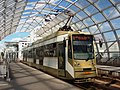 Bucur LF tram on Basarab Overpass
 -

-

-

-
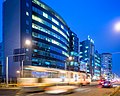 Buzești Street

_-_Exterior,_Fa%C8%9B%C4%83.jpg)
-1-_Bucur_LF-CH_(27411159710).jpg)


Water
[edit]
Although it is situated on the banks of a river, Bucharest has never functioned as a port city. Other Romanian cities such as Constanța and Galați serve as the country's main ports. The unfinished Danube-Bucharest Canal, which is 73 km (45 mi) long and around 70% completed, could link Bucharest to the Danube River, and via the Danube-Black Sea Canal, to the Black Sea. Works on the canal were suspended in 1989, but proposals have been made to resume construction as part of the European Strategy for the Danube Region.[105]
Culture
[edit]Bucharest has a growing cultural scene, in fields including the visual arts, performing arts, and nightlife. Unlike other parts of Romania, such as the Black Sea coast or Transylvania, Bucharest's cultural scene has no defined style, and instead incorporates elements of Romanian and international culture.
Landmarks
[edit]Bucharest has landmark buildings and monuments. Perhaps the most prominent of these is the Palace of the Parliament, built in the 1980s during the rule of Communist dictator Nicolae Ceaușescu. The largest Parliament building in the world, the palace houses the Romanian Parliament (the Chamber of Deputies, and the Senate), as well as the National Museum of Contemporary Art. The building boasts one of the largest convention centres in the world.
Another landmark in Bucharest is Arcul de Triumf ("The Triumphal Arch"), built in its current form in 1935 and modelled after the Arc de Triomphe in Paris. A newer landmark of the city is the Memorial of Rebirth, a stylised marble pillar unveiled in 2005 to commemorate the victims of the Romanian Revolution of 1989, which overthrew Communism. The abstract monument sparked controversy when it was unveiled, being dubbed with names such as 'the olive on the toothpick' (măslina-n scobitoare), as many argued that it does not fit in its surroundings and believed that its choice was political.[106]
The Romanian Athenaeum building is considered a symbol of Romanian culture and since 2007 has been on the list of the Label of European Heritage sites. It was built between 1886 and 1888 by the architect Paul Louis Albert Galeron, through public funding.[107][108]
InterContinental Bucharest is a high-rise five-star hotel near University Square and is also a landmark of the city. The building is designed so that each room has a unique panorama of the city.[109]
House of the Spark (Casa Scânteii) is a replica of the Lomonosov Moscow State University. This edifice, built in the characteristic style of the large-scale Soviet projects, was intended to be representative of the new political regime and to assert the superiority of the Communist doctrine. Construction started in 1952 and was completed in 1957, a few years after Stalin's death in 1953. Popularly known as Casa Scânteii ('House of the Spark') after the name of the official gazette of the Central Committee of the Romanian Communist Party, Scânteia, it was made for the purpose of bringing together under one roof all of Bucharest's official press and publishing houses. It is the only building in Bucharest featuring the Hammer and Sickle, the Red Star and other communist insignia carved into medallions adorning the façade.
Other cultural venues include the National Museum of Art of Romania, Grigore Antipa National Museum of Natural History, Museum of the Romanian Peasant, National History Museum and the Military Museum.
-
 The Triumphal Arch was inaugurated in 1936.
 -
![With a price tag of $250 million, Floreasca City Center opened in 2012.[110]](//upload.wikimedia.org/wikipedia/en/thumb/b/b1/Sky_Tower_Bucharest_-_panoramio.jpg/120px-Sky_Tower_Bucharest_-_panoramio.jpg) With a price tag of $250 million, Floreasca City Center opened in 2012.[110]
With a price tag of $250 million, Floreasca City Center opened in 2012.[110] -
 Downtown Bucharest fountains in the Unirii Square
 -
 Interior of the Cărturești Carusel Bookstore
 -
![The New National Library of Romania, with a price of €110 million.[111]](//upload.wikimedia.org/wikipedia/en/thumb/d/d2/Biblioteca_Na%C8%9Bional%C4%83_a_Rom%C3%A2niei.jpeg/120px-Biblioteca_Na%C8%9Bional%C4%83_a_Rom%C3%A2niei.jpeg) The New National Library of Romania, with a price of €110 million.[111]
The New National Library of Romania, with a price of €110 million.[111] -
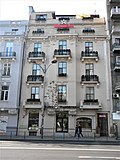
-
 Therme Bucharest spa is Europe's biggest urban beach.[114]

![With a price tag of $250 million, Floreasca City Center opened in 2012.[110]](https://en.wikipedia.org/wiki/File:Sky_Tower_Bucharest_-_panoramio.jpg)


![The New National Library of Romania, with a price of €110 million.[111]](https://en.wikipedia.org/wiki/File:Biblioteca_Na%C8%9Bional%C4%83_a_Rom%C3%A2niei.jpeg)


Visual arts
[edit]_(29291577856).jpg)
.JPG)
In terms of visual arts, the city has museums featuring both classical and contemporary Romanian art, as well as selected international works. The National Museum of Art of Romania is perhaps the best-known of Bucharest museums. It is located in the royal palace and features collections of medieval and modern Romanian art, including works by sculptor Constantin Brâncuși, as well as an international collection assembled by the Romanian royal family.
Other, smaller, museums contain specialised collections. The Zambaccian Museum, which is situated in the former home of art collector Krikor H. Zambaccian, contains works by well-known Romanian artists and international artists such as Paul Cézanne, Eugène Delacroix, Henri Matisse, Camille Pissarro, and Pablo Picasso.
The Gheorghe Tattarescu Museum contains portraits of Romanian revolutionaries in exile such as Gheorghe Magheru, ștefan Golescu, and Nicolae Bălcescu, and allegorical compositions with revolutionary (Romania's rebirth, 1849) and patriotic (The Principalities' Unification, 1857) themes. Another impressive art collection gathering important Romanian painters, can be found at the Ligia and Pompiliu Macovei residence, which is open to visitors as it is now part of the Bucharest Museum patrimony.
The Theodor Pallady Museum is situated in one of the oldest surviving merchant houses in Bucharest and includes works by Romanian painter Theodor Pallady, as well as European and oriental furniture pieces. The Museum of Art Collections contains the collections of Romanian art aficionados, including Krikor Zambaccian and Theodor Pallady.
Despite the classical art galleries and museums in the city, a contemporary arts scene also exists. The National Museum of Contemporary Art (MNAC), situated in a wing of the Palace of the Parliament, was opened in 2004 and contains Romanian and international contemporary art. The MNAC also manages the Kalinderu MediaLab, which caters to multimedia and experimental art. Private art galleries are scattered throughout the city centre.
The palace of the National Bank of Romania houses the national numismatic collection. Exhibits include banknotes, coins, documents, photographs, maps, silver and gold bullion bars, bullion coins, and dies and moulds. The building was constructed between 1884 and 1890. The thesaurus room contains notable marble decorations.
Performing arts
[edit].jpg)
Performing arts are some of the strongest cultural elements of Bucharest. The most famous symphony orchestra is National Radio Orchestra of Romania. One of the most prominent buildings is the neoclassical Romanian Athenaeum, which was founded in 1852, and hosts classical music concerts, the George Enescu Festival, and is home to the George Enescu Philharmonic Orchestra.
Bucharest is home to the Romanian National Opera and the I.L. Caragiale National Theatre. Another well-known theatre in Bucharest is the State Jewish Theatre, which features plays starring world-renowned Romanian-Jewish actress Maia Morgenstern. Smaller theatres throughout the city cater to specific genres, such as the Comedy Theatre, the Nottara Theatre, the Bulandra Theatre, the Odeon Theatre, and the revue theatre of Constantin Tănase.
Music and nightlife
[edit]
Bucharest is home to Romania's largest recording labels, and is often the residence of Romanian musicians. Romanian rock bands of the 1970s and 1980s, such as Iris and Holograf, continue to be popular, particularly with the middle-aged, while since the beginning of the 1990s, the hip hop/rap scene has developed. Hip-hop bands and artists from Bucharest such as B.U.G. Mafia, Paraziții, and La Familia enjoy national and international recognition.
The pop-rock band Taxi have been gaining international respect, as has Spitalul de Urgență's raucous updating of traditional Romanian music. While many neighbourhood discos play manele, an Oriental- and Roma-influenced genre of music that is particularly popular in Bucharest's working-class districts, the city has a rich jazz and blues scene, and to an even larger extent, house music/trance and heavy metal/punk scenes. Bucharest's jazz profile has especially risen since 2002, with the presence of two venues, Green Hours and Art Jazz, as well as an American presence alongside established Romanians.
With no central nightlife strip, entertainment venues are dispersed throughout the city, with clusters in Lipscani and Regie.
Cultural events and festivals
[edit]A number of cultural festivals are held in Bucharest throughout the year, but most festivals take place in June, July, and August. The National Opera organises the International Opera Festival every year in May and June, which includes ensembles and orchestras from all over the world.
The Romanian Athaeneum Society hosts the George Enescu Festival at locations throughout the city in September every two years (odd years). The Museum of the Romanian Peasant and the Village Museum organise events throughout the year, showcasing Romanian folk arts and crafts.
In the 2000s, due to the growing prominence of the Chinese community in Bucharest, Chinese cultural events took place. The first officially organised Chinese festival was the Chinese New Year's Eve Festival of February 2005, which took place in Nichita Stănescu Park and was organised by the Bucharest City Hall.[115]
In 2005, Bucharest was the first city in Southeastern Europe to host the international CowParade, which resulted in dozens of decorated cow sculptures being placed across the city.
In 2004, Bucharest imposed in the circle of important festivals in Eastern Europe with the Bucharest International Film Festival, an event widely acknowledged in Europe, having as guests of honour famous names from the world cinema: Andrei Konchalovsky, Danis Tanović, Nikita Mikhalkov, Rutger Hauer, Jerzy Skolimowski, Jan Harlan, Radu Mihăileanu, and many others.[116]
Since 2005, Bucharest has its own contemporary art biennale, the Bucharest Biennale.


Traditional culture
[edit]
Traditional Romanian culture continues to have a major influence in arts such as theatre, film, and music. Bucharest has two internationally renowned ethnographic museums, the Museum of the Romanian Peasant and the open-air Dimitrie Gusti National Village Museum, in King Michael I Park. It contains 272 authentic buildings and peasant farms from all over Romania.[117]
The Museum of the Romanian Peasant was declared the European Museum of the Year in 1996. Patronised by the Ministry of Culture, the museum preserves and exhibits numerous collections of objects and monuments of material and spiritual culture. The Museum of the Romanian Peasant holds one of the richest collections of peasant objects in Romania, its heritage being nearly 90,000 pieces, those being divided into several collections: ceramics, costumes, textiles, wooden objects, religious objects, customs, etc.[118]
The Museum of Romanian History is another important museum in Bucharest, containing a collection of artefacts detailing Romanian history and culture from the prehistoric times, Dacian era, medieval times, and the modern era.
Religion
[edit]Bucharest is the seat of the Patriarch of the Romanian Orthodox Church, one of the Eastern Orthodox churches in communion with the Patriarch of Constantinople, and also of its subdivisions, the Metropolis of Muntenia and Dobrudja and the Archbishopric of Bucharest. Orthodox believers consider Demetrius of Basarabov to be the patron saint of the city.
The city is a centre for other Christian organizations in Romania, including the Roman Catholic Archdiocese of Bucharest, established in 1883, and the Romanian Greek-Catholic Eparchy of Saint Basil the Great, founded in 2014.
Bucharest also hosts six synagogues, including the Choral Temple of Bucharest, the Great Synagogue of Bucharest and the Holy Union Temple. The latter was converted into the Museum of the History of the Romanian Jewish Community, while the Great Synagogue and the Choral Temple are both active and hold regular services.[119]
A mosque with a capacity for 2,000 people[120] was in the planning stages at 22–30 Expoziției Boulevard. The project was later abandoned due to financial problems and public protests.[121] However, there are several smaller Sunni and Shia mosques active in Bucharest.[122]


.jpg)


Architecture
[edit]The city centre is a mixture of medieval, neoclassical, Art Deco, and Art Nouveau buildings, as well as 'neo-Romanian' buildings dating from the beginning of the 20th century and a collection of modern buildings from the 1920s and 1930s.[citation needed] The mostly utilitarian Communist-era architecture dominates most southern boroughs. Recently built contemporary structures such as skyscrapers and office buildings complete the landscape.
Historical architecture
[edit].jpg)
Of the city's medieval architecture, most of what survived into modern times was destroyed by communist systematization, fire, and military incursions. Some medieval and renaissance edifices remain, the most notable are in the Lipscani area. This precinct contains notable buildings such as Manuc's Inn (Hanul lui Manuc) and the ruins of the Old Court (Curtea Veche); during the late Middle Ages, this area was the heart of commerce in Bucharest. From the 1970s onwards, the area went through urban decline, and many historical buildings fell into disrepair. In 2005, the Lipscani area was restored.[123]
To execute a massive redevelopment project during the rule of Nicolae Ceaușescu, the government conducted extensive demolition of churches and many other historic structures in Romania. According to Alexandru Budișteanu, former chief architect of Bucharest, "The sight of a church bothered Ceaușescu. It didn't matter if they demolished or moved it, as long as it was no longer in sight". Nevertheless, a project organised by Romanian engineer Eugeniu Iordăchescu was able to move many historic structures to less-prominent sites and save them.[124]
The city centre has retained architecture from the late 19th and early 20th centuries, particularly the interwar period, which is often seen as the 'golden age' of Bucharest architecture. During this time, the city grew in size and wealth, therefore seeking to emulate other large European capitals such as Paris. Much of the architecture of the time belongs to a Modern (rationalist) Architecture current, led by Horia Creangă and Marcel Iancu.
In Romania, the tendencies of innovation in the architectural language met the need of valorisation and affirmation of the national cultural identity. The Art Nouveau movement found expression through new architectural style initiated by Ion Mincu and taken over by other prestigious architects who capitalised important references of Romanian laic and medieval ecclesiastical architecture (for example the Mogoșoaia Palace, the Stavropoleos Church or the disappeared church of Văcărești Monastery) and Romanian folk motifs.[125] The Romanian Revival architecture, which was born as the result of the attempts of finding a specific Romanian architectural style, is exemplified though buildings such as Nicolae Minovici Folk Art Museum and the Romanian Peasant Museum.
Another style of the 1930s is the Moorish-Florentine or Mediterranean Picturesque, which eclectically uses Romanesque, Gothic and Renaissance elements in civic architecture, with a Mediterranean vibe, giving rise to Mediterranean Revival architecture.
Some buildings from the interwar era have a modernist brutalist look, such as the Tehnoimport Building, which was built in 1935,[126] and may be mistaken as communist architecture. Modernist styles during the interwar period include Art Deco, Stripped Classicism, Bauhaus and Rationalism.
Two buildings from this time are the Crețulescu Palace, housing cultural institutions including UNESCO's European Centre for Higher Education, and the Cotroceni Palace, the residence of the Romanian President. Many large-scale constructions such as the Gara de Nord, the busiest railway station in the city, National Bank of Romania's headquarters, and the Telephones Company Building date from these times. In the 2000s, some historic buildings in the city centre underwent restoration. In some residential areas of the city, particularly in high-income central and northern districts, turn-of-the-20th-century villas were mostly restored beginning in the late 1990s.
-

-

-

-

-
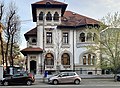 Romanian Revival architecture (C.N. Câmpeanu/Alfred E. Gheorghiu House on Bulevardul Dacia)
 -
 Window design on George Enescu street no. 14, an example of Mediterranean Revival architecture
 -
 The Telephones Company Building, an example of the Art Deco style

.jpg)

.JPG)
.jpg)
.jpg)
.jpg)
Communist era architecture
[edit]A major part of Bucharest's architecture is made up of buildings constructed during the Communist era replacing the historical architecture with high-density apartment blocks – significant portions of the historic centre of Bucharest were demolished to construct one of the largest buildings in the world, the Palace of the Parliament (then officially called the House of the Republic). In Nicolae Ceaușescu's project of systematization, new buildings were built in previously historical areas, which were razed and then built upon.
Communist architecture broadly includes three stages: architecture that was built in the early years of communism, in the late 1940s and 1950s, which followed the Soviet Stalinist trend of Socialist Realism, an example being the House of the Free Press (which was named Casa Scînteii during communism); postwar Modernism in the 1960s and the 1970s; and the systematization program of the late 1970s and 1980s, which included mass demolitions of historical buildings and their replacement with North Korean influenced buildings after Nicolae Ceaușescu visited East Asia in 1971, and was impressed by its Juche ideology.
The Communist regime installed after World War II took control over all aspects of life, including architecture, dictating a uniform bureaucratic vision of urbanism and architectural design. Gheorghe Gheorghiu-Dej, who was premier of the Socialist Republic of Romania from 1947 until 1965, began the country's policies of industrialization, with infrastructure development for heavy industry, and construction for mass resettlement to new industrial and agricultural centers away from Bucharest and other principal cities. The architecture from this period is more or less easy to spot, by its use of Neoclassical elements and proportions, but in a simplified way. There are also some small 3–4 floors "Russian blocks" from this era, some of them built of red bricks.
Communist-era architecture from the 1960s and 1970s can be found especially in Bucharest's residential districts, mainly in blocuri, which are high-density apartment blocks that house the majority of the city's population. Initially, these apartment blocks started to be constructed in the 1960s, on relatively empty areas and fields (good examples include Pajura, Drumul Taberei, Berceni and Titan), however with the 1970s, they mostly targeted peripheral neighbourhoods such as Colentina, Pantelimon, Militari and Rahova. Construction of these apartment blocks were also often randomised, for instance some small streets were demolished and later widened with the blocks being built next to them, but other neighbouring streets were left intact (like in the example of Calea Moșilor from 1978 to 1982), or built in various patterns such as the Piața Iancului-Lizeanu apartment buildings from 1962 to 1963.
The last years of communism were marked by major urban redevelopment schemes which changed dramatically the face of many cities, including Bucharest. One of the most singular examples of late stage communist architecture of the 1980s is Centrul Civic, a development that replaced a major part of Bucharest's historic city centre with giant utilitarian buildings, mainly with marble or travertine façades, inspired by North Korean architecture. The mass demolitions that occurred in the 1980s, under which an overall area of eight square kilometres of the historic centre of Bucharest were levelled, including monasteries, churches, synagogues, a hospital, and a noted Art Deco sports stadium, changed drastically the appearance of the city.
-
 The Palace of the Parliament (Romanian: Palatul Parlamentului, formerly and alternatively still known as Casa Poporului) is one of the largest buildings in the world
 -
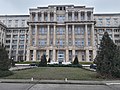 Romanian Academy's building
 -
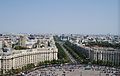 Centrul Civic
 -
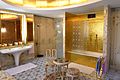 Nicolae Ceaușescu's residence is available to visitors.
 -
 The House of the Free Press, formerly Casa Scînteii "I. V. Stalin". It was built in the 1950s and it is an example of Stalinist architecture from the early communist period.


Contemporary architecture
[edit]Since the fall of communism in 1989, several communist-era buildings have been refurbished, modernised, and used for other purposes.[127] Perhaps the best example of this is the conversion of obsolete retail complexes into shopping malls and commercial centres. These giant, circular halls, which were unofficially called hunger circuses due to the food shortages experienced in the 1980s, were constructed during the Ceaușescu era to act as produce markets and refectories, although most were left unfinished at the time of the revolution.
Modern shopping malls such as the Unirea Shopping Centre, Bucharest Mall, Plaza Romania, and City Mall emerged on pre-existent structures of former hunger circuses. Another example is the conversion of a large utilitarian construction in Centrul Civic into a Marriott Hotel. This process was accelerated after 2000, when the city underwent a property boom, and many communist-era buildings in the city centre became prime real estate due to their location. Many communist-era apartment blocks have also been refurbished to improve urban appearance.
The newest contribution to Bucharest's architecture took place after the fall of communism, particularly after 2000, when the city went through a period of urban renewal – and architectural revitalization – on the back of Romania's economic growth. Buildings from this time are mostly made of glass and steel, and often have more than 10 stories. Examples include shopping malls (particularly the Bucharest Mall, a conversion and extension of an abandoned building), office buildings, bank headquarters, etc.[citation needed]
During the 21st century, several high rise office buildings were built, particularly in the northern and eastern parts of the city. Additionally, a trend to add modern wings and façades to historic buildings has occurred, the most prominent example of which is the Bucharest Architects' Association Building, which is a modern glass-and-steel construction built inside a historic stone façade. In 2013, the Bucharest skyline enriched with a 137-m-high office building (SkyTower of Floreasca City Centre), the tallest building in Romania. Examples of modern skyscrapers built in the 21st century include Bucharest Tower Centre, Euro Tower, Nusco Tower, Cathedral Plaza, City Gate Towers, Rin Grand Hotel, Premium Plaza, Bucharest Corporate Centre, Millennium Business Centre, PGV Tower, Charles de Gaulle Plaza, Business Development Centre Bucharest, BRD Tower, and Bucharest Financial Plaza. Despite this vertical development, Romanian architects avoid designing very tall buildings due to vulnerability to earthquakes.[128]
Aside from buildings used for business and institutions, residential developments have also been built, many of which consist of high-rise office buildings and suburban residential communities. An example of a new high rise residential complex is Asmita Gardens. These developments are increasingly prominent in northern Bucharest, which is less densely populated and is home to middle- and upper-class Bucharesters due to the process of gentrification.
-
 Pipera Sky Tower
 -
 BRD Tower and Bucharest Tower Center in Victory Square
 -
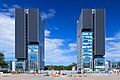 City Gate Towers office buildings
 -

-
 The World Trade Center in Bucharest
 -

.jpg)


.jpg)


Education
[edit]Overall, 159 faculties are in 34 universities. Sixteen public universities are in Bucharest, the largest of which are the University of Bucharest, the Politehnica University of Bucharest, the Bucharest University of Economic Studies, the Carol Davila University of Medicine and Pharmacy, Technical University of Civil Engineering, the National University of Political Studies and Public Administration, and the University of Agronomic Sciences and Veterinary Medicine of Bucharest.
These are supplemented by nineteen private universities, such as the Romanian-American University.[129] Private universities, however, have a mixed reputation due to irregularities.[130][131]
In the 2020 QS World University Rankings, from Bucharest, only the University of Bucharest was included in the top universities of the world. The Politehnica University disappeared from the ranking.[132] Also, in recent years, the city has had increasing numbers of foreign students enrolling in its universities.[133]
The first modern educational institution was the Princely Academy from Bucharest, founded in 1694 and divided in 1864 to form the present-day University of Bucharest and the Saint Sava National College, both of which are among the most prestigious of their kind in Romania.[134][135]
Over 450 public primary and secondary schools are in the city, all of which are administered by the Bucharest Municipal Schooling Inspectorate. Each sector also has its own Schooling Inspectorate, subordinated to the municipal one.


Media
[edit]The city is well-served by a modern landline and mobile network. Offices of Poșta Română, the national postal operator, are spread throughout the city, with the central post office (Romanian: Oficiul Poștal București 1) located at 12 Matei Millo Street. Public telephones are located in many places and are operated by Telekom Romania, a subsidiary of Deutsche Telekom and successor of the former monopoly Romtelecom.
Bucharest is the headquarters of most national television networks and national newspapers, radio stations and online news websites. The largest daily newspapers in Bucharest include Evenimentul Zilei, Jurnalul Național, Cotidianul, România Liberă, and Adevărul, while the biggest news websites are HotNews (with English and Spanish versions), Ziare.com, and Gândul. During the rush hours, tabloid newspapers Click!, Libertatea, and Cancan are popular for commuters.
Several newspapers and media publications are based in House of the Free Press (Casa Presei Libere), a landmark of northern Bucharest, originally named Casa Scânteii after the Communist Romania-era official newspaper Scînteia. The House of the Free Press is not the only Bucharest landmark that grew out of the media and communications industry. Palatul Telefoanelor ("The Telephone Palace") was the first major modernist building on Calea Victoriei in the city's centre, and the massive, unfinished communist-era Casa Radio looms over a park a block away from the Opera.
English-language newspapers became available in the early 1930s and reappeared in the 1990s. The two daily English-language newspapers are the Bucharest Daily News and Nine O' Clock; several magazines and publications in other languages are available, such as the Hungarian-language daily Új Magyar Szó.
Observator Cultural covers the city's arts, and the free weekly magazines Șapte Seri ("Seven Evenings") and B24FUN, list entertainment events. The city is home to the intellectual journal Dilema veche and the satire magazine Academia Cațavencu.
Visit Bucharest Today is another online platform promoting Bucharest as a tourist destination. It serves as a comprehensive resource for local and international travelers seeking to learn about the capital city of Romania. The online platform showcases Bucharest's rich history, cultural landmarks, hidden gems, and exciting experiences.
Healthcare
[edit].jpg)
One of the most modern hospitals in the capital is Colțea that has been re-equipped after a 90-million-euro investment in 2011. It specialises in oncological and cardiac disorders. It was built by Mihai Cantacuzino between 1701 and 1703, composed of many buildings, each with 12 to 30 beds, a church, three chapels, a school, and doctors' and teachers' houses.[136]
Another conventional hospital is Pantelimon, which was established in 1733 by Grigore II Ghica. The surface area of the hospital land property was 400,000 m2 (4,305,564 sq ft). The hospital had in its inventory a house for infectious diseases and a house for persons with disabilities.
Other hospitals or clinics are Bucharest Emergency Hospital, Floreasca Emergency Clinic Hospital, Bucharest University Emergency Hospital, and Fundeni Clinical Institute or Biomedica International and Euroclinic, which are private.
Sports
[edit]Football is the most widely followed sport in Bucharest, with the city having numerous club teams, including, most notably, Steaua București, Dinamo București, Rapid București and FCSB.
Arena Națională, a new stadium inaugurated on 6 September 2011, hosted the 2012 Europa League Final[137] and has a 55,600-seat capacity, making it one of the largest stadiums in Southeastern Europe and one of the few with a roof.[138]

Sport clubs have formed for handball, water polo, volleyball, rugby union, basketball and ice hockey. The majority of Romanian track and field athletes and most gymnasts are affiliated with clubs in Bucharest. The largest indoor arena in Bucharest is the Romexpo Dome with a seating capacity of 40,000. It can be used for boxing, kickboxing, handball and tennis.
Bucharest hosted annual races along a temporary urban track surrounding the Palace of the Parliament, called Bucharest Ring. The Bucharest City Challenge race hosted FIA GT, FIA GT3, British F3, and Logan Cup races.[139] Since 2009, Bucharest has the largest Ferrari Shop in Eastern Europe and the 2nd largest in Europe after Milan shop.[140][141]
The capital also hosted the international tennis tournaments WTA Bucharest Open and ATP Romanian Open. Ice hockey games are held at the Mihai Flamaropol Arena, which holds 8,000 spectators. Rugby games are held in different locations, but the most modern stadium is Arcul de Triumf Stadium, which is also home to the Romanian national rugby team.
Bucharest hosted the UEFA Euro 2020 championship at the Arena Națională or Bucharest National Arena.[142] The championship took place in 2021, being postponed due to the outbreak of the COVID-19 pandemic.
Twin towns – sister cities
[edit]


See also
[edit]
References
[edit]- ^ "Romanian Statistical Yearbook (2023) – 1.8 Administrative organisation of Romanian territory, on December 31, 2022 (pg.17)" (PDF). www.insse.ro. National Institute of Statistics (Romania) - INSSE. 19 February 2024.
- ^ a b "Populaţia rezidentă după grupa de vârstă, pe județe și municipii, orașe, comune, la 1 decembrie 2021" (in Romanian). INSSE. 31 May 2023.
- ^ a b "POP105A - Usually resident population by age group and ages, sex, urban-rural area, macroregions, development regions and counties at January 1st". www.insse.ro/cms/en (in Romanian). National Institute of Statistics (Romania) - INSSE (TEMPO - statiscal data). 2 September 2025. Retrieved 19 September 2025.
- ^
- August 2025. "1.1 Gross domestic product by counties in RON (pg.3) / 1.2 Gross domestic product per capita by counties in Euro (pg.5)" (PDF). www.cnp.ro (in Romanian). National Commission for Strategy and Prognosis - Romanian Government. Retrieved 26 August 2025.
{{cite web}}: CS1 maint: numeric names: authors list (link) - May 2025. "Main macroeconomic indicators → Exchange rate €/RON (pg.2)" (PDF). www.cnp.ro (in Romanian). National Commission for Strategy and Prognosis - Romanian Government. Retrieved 26 August 2025.
{{cite web}}: CS1 maint: numeric names: authors list (link)
- August 2025. "1.1 Gross domestic product by counties in RON (pg.3) / 1.2 Gross domestic product per capita by counties in Euro (pg.5)" (PDF). www.cnp.ro (in Romanian). National Commission for Strategy and Prognosis - Romanian Government. Retrieved 26 August 2025.
- ^ "Sub-national HDI – Subnational HDI – Global Data Lab". Archived from the original on 23 September 2018. Retrieved 1 November 2018.
- ^ Bucharest, the small Paris of the East Archived 21 February 2006 at the Wayback Machine, on the Museums from Romania web site.
- ^ Bucica, 2000, p. 6.
- ^ "Bucharest is Booming". qualitestgroup.com. 23 April 2019. Archived from the original on 5 August 2020. Retrieved 22 November 2019.
- ^ "High-Tech Cities: Have You Ever Tried Coffee in Bucharest?". Pentalog. 17 April 2019. Archived from the original on 20 May 2019. Retrieved 22 November 2019.
- ^ "How Romania became a popular tech destination". Financial Times. 19 September 2019. Archived from the original on 27 September 2019. Retrieved 22 November 2019.
- ^ "Bucharest, In The Top Of Cities With The Most Experts In High-Tech Industry". Romania Journal. 11 February 2019. Archived from the original on 29 May 2021. Retrieved 22 November 2019.
- ^ "10 Romanian startups to look out for in 2019 and beyond". eu-startups.com. 29 May 2019. Archived from the original on 13 November 2019. Retrieved 22 November 2019.
- ^ Martin, Bryan (6 April 2016). "The Silicon Valley of Transylvania". TechCrunch. Archived from the original on 13 April 2019. Retrieved 22 November 2019.
- ^ a b "- World Monuments Fund". Wmf.org. Archived from the original on 2 October 2017. Retrieved 1 October 2017.
- ^ "Mastercard study: Bucharest is the European city with the highest growth of tourists' number". business-review.eu. 29 September 2017. Archived from the original on 26 July 2019. Retrieved 22 November 2019.
- ^ "Bucharest has highest potential for development in Europe". travelandtourworld.com. 15 October 2015. Archived from the original on 5 August 2020. Retrieved 22 November 2019.
- ^ PriceWaterhouseCoopers Global Regional Attractiveness Report Romania Archived 13 March 2006 at the Wayback Machine
- ^ "Do people in Bucharest really live better than people in Budapest?". Daily News Hungary. 2 January 2022.
- ^ "Romania's regions. Bucharest is now richer than Budapest, Banat and Transylvania are more developed than most of Hungary, EU data show". Business Review. 27 February 2019.
- ^ Rosetti, II. p.110
- ^ Cutler, Nellie (2011). "Southeastern Europe". Time for Kids World Atlas (Rev. and updated ed.). New York, NY: Time for Kids Books. p. 68. ISBN 978-1-60320-884-0.
- ^ Georgescu et al., p.76-77
- ^ Giurescu, Constantin C. (1976). History of Bucharest. Bucharest: The Publishing House for Sports and Tourism.
- ^ Semseddin, Sâmî (1898). "بكرش". Kamus'ul Alam. Vol. 2. Istanbul. p. 533.
{{cite book}}: CS1 maint: location missing publisher (link) - ^ Djuvara, Neagu (2013). Între Orient și Occident. Țările române la începutul epocii moderne (1800–1848). Humanitas. ISBN 978-973-50-4083-3.
- ^ Giurescu, p.154-161, 169–171
- ^ Giurescu, p.157, 161, 163
- ^ Giurescu, p.191-195
- ^ "Data". geocities.com. Archived from the original on 25 October 2009.
- ^ Grama, Emanuela (1 September 2021). "The Tenants of the Old Town". Los Angeles Review of Books. Retrieved 21 April 2022.
- ^ "Thousands of Romanians rally against ruling party's judicial overhaul". Reuters. 26 November 2017. Archived from the original on 16 August 2018. Retrieved 15 August 2018.
- ^ "Romania: Tens of thousands protest for second night running | DW | 12 August 2018". Deutsche Welle. Archived from the original on 12 August 2018. Retrieved 15 August 2018.
- ^ Botanical Garden Archived 29 September 2006 at the Wayback Machine, onlinegallery.ro. Retrieved 13 October 2006.
- ^ "Fotogalerie – Cum e afectata fauna din Delta Vacaresti de incendii si distrugeri si de ce dureaza atat de mult protejarea zonei". HotNews. 3 March 2016. Archived from the original on 12 May 2016. Retrieved 20 May 2016.
- ^ "Delta Văcăreşti, privită de la etajul 17. Cum s-a transformat lacul lui Ceauşescu în parcul natural urban de astăzi". adevarul.ro. 8 June 2014. Archived from the original on 1 May 2016. Retrieved 20 May 2016.
- ^ "Delta dintre blocuri | Parcul Natural Văcărești | "delta" dintre blocuri". parcnaturalvacaresti.ro. Archived from the original on 8 May 2016. Retrieved 20 May 2016.
- ^ "Parcul Natural Văcărești a fost aprobat oficial | Parcul Natural Văcărești | "delta" dintre blocuri". parcnaturalvacaresti.ro. Archived from the original on 24 June 2016. Retrieved 20 May 2016.
- ^ Andrei Dumitrescu (28 May 2015). "CGMB a avizat declararea lacului Văcăreşti arie naturală protejată". Mediafax. Archived from the original on 10 June 2016. Retrieved 19 March 2016.
- ^ "Recensământ 2022: Singurele judeţe în care a crescut populaţia rezidentă în 2021 faţă de nivelul din 2011 sunt Ilfov, Bistriţa-Năsăud şi Suceava". 30 December 2022.
- ^ Sfetcu, Nicolae (14 November 2015). Bucharest Tourist Guide (Ghid turistic București): Pocket Edition (Ediția de buzunar). Nicolae Sfetcu. Archived from the original on 29 May 2021. Retrieved 29 May 2021.
- ^ "Bucharest, Romania Köppen Climate Classification (Weatherbase)". Weatherbase. Archived from the original on 2 December 2020. Retrieved 24 March 2020.
- ^ "București Băneasa Climate Normals 1991-2020". National Oceanic and Atmospheric Administration. Archived from the original on 29 August 2023. Retrieved 29 August 2023.
- ^ "București Băneasa Climate Normals 1961–1990". National Oceanic and Atmospheric Administration. Archived from the original on 29 August 2023. Retrieved 21 March 2015.
- ^ "București Băneasa: Record mensili dal 1929" (in Italian). Administrația Națională de Meteorologie. Archived from the original on 1 April 2016. Retrieved 14 February 2016.
- ^ Cappelen, John; Jensen, Jens. "RUMÆNIEN - BUCURESTI/IMH" (PDF). Climate Data for Selected Stations (1931-1960) (in Danish). Danish Meteorological Institute. p. 216. Archived from the original (PDF) on 27 April 2013. Retrieved 29 August 2023.
- ^ "Bucharest, Romania – Detailed climate information and monthly weather forecast". Weather Atlas. Yu Media Group. Archived from the original on 3 July 2019. Retrieved 3 July 2019.
- ^ "Marian Vanghelie, suspendat din funcția de primar al sectorului 5. Cine îi va prelua atribuțiile". Jurnalul Național (in Romanian). 6 April 2015. Archived from the original on 17 June 2015. Retrieved 17 June 2015.
- ^ "Conducere" (in Romanian). Prefectul Municipiului București. 2020. Archived from the original on 31 October 2020. Retrieved 9 October 2021.
- ^ Bucharest Crime Statistics 2000–2004 Archived 16 July 2011 at the Wayback Machine, Bucharest Directorate-General of Police
- ^ a b "DGPMB – Poliția Română" (PDF). b.politiaromana.ro. Archived (PDF) from the original on 2 October 2017. Retrieved 1 October 2017.
- ^ a b "Five Romanian cities ranked in top 100 safest in the world". 3 April 2023.
- ^ "Homicide in cities | dataUNODC". dataunodc.un.org.
- ^ "Worldwide Street Children statistics" (PDF). Archived from the original (PDF) on 8 December 2011. (20.5 KB), Conrad N. Hilton Humanitarian Prize/Council of Europe
- ^ "Worldwide Quality of Living Survey". Expat.or.id. 11 March 2002. Archived from the original on 15 April 2011. Retrieved 14 April 2011.
- ^ "Bucharest keeps 108 in the Mercer top dedicated to life quality". Actmedia.eu. 30 April 2009. Archived from the original on 6 October 2010. Retrieved 14 April 2011.
- ^ "2010 Quality of Living global city rankings – Mercer survey" (PDF). Archived from the original (PDF) on 28 January 2012.
- ^ "Conceptul Strategic București 2035 ETAPA I – see page 44 ref. to quality of life in Bucharest" (PDF). Archived from the original (PDF) on 25 November 2011. Retrieved 19 December 2018.
- ^ De ce e nevoie de Legea Bucureștiului. Arhitecții au lansat Raportul pentru București 2016 Romania Curata, 3 August 2016 Archived 18 October 2016 at the Wayback Machine
- ^ Marica, Irina (22 June 2015). "Green is good: Ten large parks in Bucharest – Romania Insider". Romania-insider.com. Archived from the original on 2 October 2017. Retrieved 1 October 2017.
- ^ "The best cities for digital nomads worldwide". en.travel2latam.com. 10 May 2024. Retrieved 10 May 2024.
- ^ "Bucharest, Included Again Among The Best Cities For Digital Nomads Worldwide". Romania Journal. 10 May 2024. Retrieved 10 May 2024.
- ^ Chambers's Encyclopaedia Archived 25 March 2016 at the Wayback Machine Vol. II, 1861 based on Brockhaus Enzyklopädie, 10th Edition
- ^ Encyclopædia Britannica Eleventh Edition
- ^ "Populatia RPR la 25 ianuarie 1948" (PDF). Archived (PDF) from the original on 10 April 2020. Retrieved 11 April 2020.
- ^ George Milea, Contribuții la demografia Municipiului București. Volumul 1 : Populația după recensăminte. Natalitatea. Mortalitatea, 1933, Tipografia Curții Regale F. Göbl Fii
- ^ Laurențiu Rădvan, At Europe's Borders: Medieval Towns in the Romanian Principalities, Brill, 2010, p.260
- ^ Florian Georgescu et al. Istoria Orașului București, Muzeul de Istorie a Orașului București, 1965, p. 121
- ^ "Orașele care își pierd locuitorii. Bucureștiul, în topul localitatilor lumii cu cea mai mare rată de scădere a populației". inCont.ro. 9 February 2014. Archived from the original on 25 December 2014. Retrieved 25 December 2014.
- ^ INS. "Romanian Statistical Yearbook" (PDF). Archived from the original (PDF) on 16 November 2013. Retrieved 12 February 2009.
- ^ "One out of three Bucharest employees is a commuter". 25 August 2008. Archived from the original on 29 June 2012.
- ^ "Evaluation of the performance of urban public transport connectivity" (PDF). Archived from the original (PDF) on 20 December 2016. Retrieved 26 October 2016.
- ^ "Când a fost construit primul bloc de proprietari și unde se află. Primii împroprietăriți nu au fost bogații". 8 November 2018.
- ^ "Rezultate recensamant 2011 pe Bucuresti – Infografic". Metropotam. Archived from the original on 16 February 2020. Retrieved 8 June 2020.
- ^ "Semnele vitale în București și Iași. Localnici în acte și în suflet?". Archived from the original on 8 December 2019. Retrieved 7 December 2019.
- ^ "România e în plin boom de muncitori asiatici. Dar cine sunt ei?". 30 October 2019. Archived from the original on 8 December 2019. Retrieved 7 December 2019.
- ^ "Copii refugiați afgani bucuroși să meargă la școală în România". UNHCR România. Archived from the original on 6 August 2020. Retrieved 30 July 2020.
- ^ "Cele mai populare localuri din București cu specific indian, libanez, pakistanez, persan". ialoc.ro. Archived from the original on 25 May 2021. Retrieved 30 July 2020.
- ^ "B1TV.ro - Erdogan, contestat în România: Protest al rezidenţilor kurzi în centrul Capitalei (VIDEO) - B1TV.ro".
- ^ "Protest al comunității iraniene din România, în fața Ambasadei: "Mulțumim lui Trump că l-a asasinat pe Soleimani!"". 11 January 2020.
- ^ "Iranienii din București au ieșit în stradă. Moartea lui Mahsa Amini a generat proteste în toată lumea".
- ^ "Recensământul populatiei şi al locuințelor" (PDF). Archived from the original (PDF) on 19 July 2012. Retrieved 17 February 2012.
- ^ "Bucharest Virtual Museums Tours [Part 1] -". Archived from the original on 9 December 2020. Retrieved 18 October 2020.
- ^ "Open Society Institute's Survey into Religiosity in Romania". Archived from the original on 23 June 2006. Retrieved 23 June 2006. (Microsoft Word document)
- ^ "Where is the highest life expectancy in Romania?". 5 May 2017. Archived from the original on 8 September 2017. Retrieved 19 January 2020.
- ^ "Joint Inclusion Memorandum of Romania". Archived from the original on 1 November 2013. Retrieved 14 April 2011.
- ^ "Regional GDP per capita ranged from 29% to 611% of the EU average in 2016". Archived from the original on 3 March 2018. Retrieved 6 March 2018.
- ^ (in Romanian) "AMOFM: Rata șomajului în București a fost de 2,05%, la sfârșitul lunii ianuarie", capital.ro, 8 February 2013; accessed 22 April 2013
- ^ (in Romanian) Situația statistică a șomajului înregistrat la 31 ianuarie 2013 Archived 8 July 2018 at the Wayback Machine, Agenția Națională Pentru Ocuparea Forței de Muncă; accessed 22 April 2013
- ^ "Toți bucureștenii vor avea dosar fiscal din 2006". Retrieved 1 June 2016.[dead link], Averea, 15 December 2005
- ^ "Analiză Infografic – Topul mallurilor cu cele mai mari afaceri din România" (in Romanian). Profit TV. 24 June 2019. Archived from the original on 25 August 2019. Retrieved 25 August 2019.
- ^ "Top 5 Malls to Visit in Bucharest". Profit TV. 23 October 2017. Archived from the original on 25 August 2019. Retrieved 25 August 2019.
- ^ "Oracle, Microsoft, IBM, among most wanted employers in Romania". www.romania-insider.com. 18 July 2017. Archived from the original on 25 August 2019. Retrieved 25 August 2019.
- ^ "Amazon a deschis centrul din București și pregătește angajări" (in Romanian). Profit TV. 9 May 2019. Archived from the original on 25 August 2019. Retrieved 25 August 2019.
- ^ "Median City Speeds December 2023". Speedtest.net. Retrieved 12 February 2024.
- ^ "Săptămâna Financiară | Anchete | Atacul clonelor în taximetria bucureșteană". Sfin.ro. Archived from the original on 16 February 2009. Retrieved 7 July 2009.
- ^ "16 noiembrie, Ziua Metroului. Ce amintiri au Octavian Udriște și alți foști directori". 16 November 2020.
- ^ "Linia M5 Râul Doamnei - Eroilor".
- ^ Răduță, Cristina (8 March 2014). "Poveștile gărilor din Bucureşti. Cum a vrut Ceauşescu să demoleze Gara de Nord, ridicată din ordinul Regelui Carol I. Filaret, prima gară din București". Adevărul (in Romanian). Archived from the original on 17 June 2015. Retrieved 17 June 2015.
- ^ "CNAB" (PDF). bucharestairports.ro. Archived (PDF) from the original on 29 May 2021. Retrieved 1 October 2018.
- ^ "Distance from Bucharest to Brașov". Distantarutiera.ro. Retrieved 10 March 2025.
- ^ "O mașină, la doi bucureșteni. Cum arată parcul auto din Capitală". Adevărul. Archived from the original on 14 February 2014. Retrieved 11 February 2014.
- ^ "Rehabilitation of Urban Roads, Phase II". Archived from the original on 11 January 2008. Retrieved 11 January 2008., from the site of the General Mayor of Bucharest, Adriean Videanu
- ^ Noutati (28 April 2007). "Bucureștenii beneficiază de cel mai mare punct intermodal din România! " Pasajul Basarab". Pasajulbasarab.ro. Archived from the original on 25 August 2011. Retrieved 15 September 2011.
- ^ "Video – Primele efecte ale Pasajului Basarab: Cum s-a degrevat traficul de pe Podul Grant și din zona Gării de Nord – Esențial". HotNews. July 2011. Archived from the original on 2 September 2011. Retrieved 15 September 2011.
- ^ "Danube-Bucharest Canal vs. the Global Crisis". 13 December 2010. Archived from the original on 11 September 2011. Retrieved 5 September 2011.
- ^ "Memorialul Renasterii", ce oribilitate! Archived 17 February 2006 at the Wayback Machine ("The Monument of Rebirth – how horrible!"), Săptămâna Financiară, August 2005 (in Romanian)
- ^ Romanian Athenaeum awarded Label of European Heritage Archived 15 April 2008 at the Wayback Machine, Romania's Permanent Delegation to NATO
- ^ "Istoric Ateneu". FGEB. Archived from the original on 27 January 2021. Retrieved 1 April 2021.
- ^ Hotel Intercontinental Bucharest Archived 12 March 2015 at the Wayback Machine (" 5 star hotel "), Hotel-bucuresti.com,(in Romanian)
- ^ "Despre Sky Tower". skytower.ro (in Romanian). Archived from the original on 31 July 2019. Retrieved 24 August 2019.
- ^ "Vă vine să credeţi? Biblioteca Naţională va arăta ca un mall". 30 September 2011. Archived from the original on 29 May 2021. Retrieved 11 May 2021.
- ^ Magheru - locul 35 in topul celor mai scumpe bulevarde
- ^ Magheru Boulevard Is World's 46th Most Expensive Retail Location
- ^ Steamy scenes at low prices: Bucharest's affordable luxury spa
- ^ Chinese New Year's Eve celebrated in Bucharest Archived 19 February 2006 at the Wayback Machine, Bucharest Daily News, 7 February 2005
- ^ "Poveste". BIFF. Archived from the original on 20 May 2014.
- ^ "Vizitează muzeul". Muzeul Național al Satului "Dimitrie Gusti". Archived from the original on 21 May 2014.
- ^ "Prezentare muzeu". Muzeul Național al Țăranului Român. Archived from the original on 20 May 2014. Retrieved 20 May 2014.
- ^ Stanciulescu, Anda (1–31 March 2014). "La Pas Prin Sinagogile Bucureștene" (PDF). Realitatea Evreiască. Archived (PDF) from the original on 16 August 2016. Retrieved 27 June 2016.
- ^ Ebru Şengül (24 June 2015). "Turkey to build mosque in Romania in exchange for land for a church". Daily Sabah. Archived from the original on 2 October 2017. Retrieved 30 May 2017.
- ^ "Moscheea de la București nu se mai construiește. Proiectul a fost abandonat din motive financiare". TVR. 12 July 2018. Archived from the original on 4 October 2018. Retrieved 3 October 2018.
- ^ Arhiva, de (19 December 2017). "Moscheea din fundul curții (II). DEfiniția "musulmanului din România" convenită stabilimentul din str.Logofătul Tăutu 66". evz.ro. Retrieved 4 April 2023.
- ^ "Lipscani, zonă protejată" (PDF). Archived from the original (PDF) on 31 August 2015.
- ^ Smith, Harrison (8 January 2019). "Eugeniu Iordachescu, Romanian engineer who saved condemned churches under communist rule, dies at 89". Washington Post. ISSN 0190-8286. Archived from the original on 10 January 2019. Retrieved 1 January 2024.
- ^ "Stilul arhitectural național romantic și Art Nouveau în București". Unknown Bucharest. 20 June 2010. Archived from the original on 4 September 2015. Retrieved 20 May 2014.
- ^ "Blocul Tehnoimport". 12 April 2012.
- ^ Economy, Redactia Great (14 September 2015). "Fabrici comuniste, transformate in mall-uri sau apartamente". Greateconomy.ro. Archived from the original on 27 October 2016. Retrieved 1 October 2017.
- ^ "Bucureștiul nu este un oraș pentru zgârie-nori, e mai degrabă un oraș pe orizontală". Știrile TVR. 7 May 2014. Archived from the original on 20 May 2014. Retrieved 20 May 2014.
- ^ "Cum a ajuns "Spiru Haret" cea mai mare universitate din lume | Financiarul". Financiarul.ro. 13 July 2009. Archived from the original on 3 September 2011. Retrieved 15 September 2011.
- ^ "Exclusiv – Universitățile "Spiru Haret" și "Petre Andrei" au fost scoase în afara legii. 56.000 de absolvenți, în aer. Andronescu, pentru Gândul: "Aceste diplome nu respectă legea" – Gandul". Gandul.info. 11 July 2009. Archived from the original on 24 September 2009. Retrieved 31 January 2010.
- ^ "Andrei Marga: "Universitățile din țară, cele mai corupte din UE"". Adevarul.ro. Archived from the original on 19 January 2010. Retrieved 31 January 2010.
- ^ "Trei universități din România dispar din Clasamentul internațional al universităților QS. Babeș-Bolyai și Universitatea din București rămân în categoria 801+" (in Romanian). G4Media. 21 June 2019. Archived from the original on 24 August 2019. Retrieved 24 August 2019.
- ^ "Numărul studenților străini din România s-a dublat – Cotidianul". Cotidianul.ro. 28 April 2008. Archived from the original on 3 May 2008. Retrieved 31 January 2010.
- ^ "Cele mai bune universități și specializări din România". Realitatea.Net. Archived from the original on 20 September 2011. Retrieved 15 September 2011.
- ^ ""Sf. Sava" din București, cel mai bun liceu din țară / 9.93 ultima medie de intrare la liceu". Adevarul.ro. 1 July 2010. Archived from the original on 11 September 2011. Retrieved 15 September 2011.
- ^ "Coltea H." Archived from the original on 20 January 2012.
- ^ Adi Dobre (29 October 2010). "Mircea Sandu: "Facem inaugurarea stadionului Național cu Franța" – Naționala". EVZ.ro. Archived from the original on 18 May 2012. Retrieved 15 September 2011.
- ^ "Oprescu: "Stadionul Național va fi gata în decembrie 2010!"". Prosport.ro. Archived from the original on 31 May 2013. Retrieved 15 September 2011.
- ^ "Bucharest GP în iulie 2011". Motorsportnews.ro. 28 September 2010. Archived from the original on 8 December 2010. Retrieved 14 April 2011.
- ^ "Ferrari Store Opened in Bucharest, Romania". autoevolution.com. 7 December 2009. Archived from the original on 24 August 2019. Retrieved 24 August 2019.
- ^ "Cel mai mare magazin Ferrari pe Calea Victoriei" (in Romanian). bucuresti.tourneo.ro. 25 November 2009. Archived from the original on 24 August 2019. Retrieved 24 August 2019.
- ^ "Bucharest | UEFA Euro 2020 Hospitality". UEFA. Archived from the original on 17 March 2020. Retrieved 28 April 2020.
- ^ "Care-i cel mai... înfrățit oraș din România? Care-i cu americanii, care-i cu rușii? Și care-i înfrățit cu Timișoara..." banatulazi.ro (in Romanian). Banatul Azi. 6 August 2016. Retrieved 11 July 2022.
- ^ "Nicuşor Dan: Am hotărât să aprobăm înfrăţirea dintre Bucureşti şi Kiev". mediafax.ro (in Romanian). Mediafax. 7 March 2022. Retrieved 11 July 2022.
- ^ "Tbilisi, Bucharest become twin cities". 1tv.ge. First Channel. 30 May 2022. Retrieved 11 July 2022.
- ^ "Yerevan.am: Partner Cities". Yerevan Municipal Government. Archived from the original on 5 November 2013. Retrieved 18 April 2018.
Works cited
[edit]- Celac, Mariana; Carabela, Octavian; Marcu-Lapadat, Marius (2017). Bucharest Architecture – an annotated guide. Order of Architects of Romania. ISBN 978-973-0-23884-6.
Further reading
[edit]- Modern history of Bucharest, City Hall of Bucharest
- Șerban Cantacuzino, Două Orașe Distincte. Revista Secolul XX 4/6 (1997): 11–40
- Ernie Schoffham, Luminița MacHedon, Șerban Cantacuzino, Romanian Modernism: The Architecture of Bucharest, 1920–1940
- Romania: Arts & Architecture, Romanian Tourist Office
- Tatiana Murzin, Romanian Education Archived 21 February 2018 at the Wayback Machine, 2005
- Romanian Education Portal, Site for the Ministry of Education containing lists of all educational establishments.
- Bucharest, the small Paris of the East, on the Museums from Romania web site.
- Bucica, Cristina. "Legitimating Power in Capital Cities: Bucharest – Continuity Through Radical Change?" (PDF). Archived from the original (PDF) on 28 October 2005. (39.0 KB), 2000.
External links
[edit] Definitions from Wiktionary
 Media from Commons
 News from Wikinews
 Quotations from Wikiquote
 Texts from Wikisource
 Resources from Wikiversity
 Travel information from Wikivoyage


Bucharest
View on GrokipediaBucharest is the capital and largest city of Romania, situated in the southeastern part of the country on the banks of the Dâmbovița River, a tributary of the Argeș that originates in the Făgăraș Mountains.[1][2] The city was first documented in 1459 and selected as the capital of Wallachia in 1659 due to strategic considerations including Ottoman influence, evolving into Romania's national capital by 1862.[3][4][5] Its population within city limits is estimated at approximately 1.76 million as of 2025, with the metropolitan area exceeding 2 million, making it the economic, administrative, and cultural center of the nation, home to key industries, financial hubs, and educational institutions.[6][7][8] Bucharest features an eclectic architectural landscape shaped by periods of neoclassical development, interwar modernization, and extensive communist-era reconstruction, including megaprojects that altered its historic fabric, underscoring its role as a dynamic urban hub in Eastern Europe.[9][8]
Etymology
Origins and historical names
The earliest documented reference to Bucharest appears in a charter issued on September 20, 1459, by Vlad III, Prince of Wallachia (commonly known as Vlad the Impaler), which confirms the city's status as a princely residence and orders the construction of fortifications along the Dâmbovița River.[3] This document, preserved in historical archives, marks the first verifiable written attestation of the settlement under the name "Bucureshti," reflecting its role as a strategic administrative center in medieval Wallachia rather than a legendary founding event.[10] The Romanian name București, in its genitive plural form, likely derives from a personal name or toponymic root, with linguistic evidence pointing to Slavic influences prevalent in the region's medieval nomenclature. One substantiated hypothesis traces it to the Slavic word buk ("beech tree"), suggesting an origin in bukŭ-rešti or a similar compound denoting a beech forest or grove, consistent with the area's wooded terrain documented in 14th- and 15th-century records.[11] Another theory links it to bukura ("beautiful" or "lamb"), but these remain etymological proposals grounded in comparative linguistics rather than direct attestation, avoiding unsubstantiated ties to Dacian or Thracian roots lacking epigraphic support.[11] Popular folklore attributes the name to a shepherd named Bucur ("joyful" from Romanian bucurie), purportedly the city's founder, but this narrative first emerges in 18th-century accounts without contemporary evidence and is dismissed by historians as romantic invention rather than historical fact.[11] In foreign languages, the name evolved as Bucarest (French), Bukarest (German), and Bucarest (Turkish), incorporating Latin and Ottoman phonetic adaptations while retaining the core Slavic-Romanian structure, as seen in diplomatic correspondence from the 16th century onward.[3] These variations underscore the city's position at the crossroads of linguistic influences, including limited Turkish elements from Wallachia's vassalage under the Ottoman Empire, though without altering the primary Romanian form.History
Prehistory and early settlements
Archaeological investigations in Bucharest have uncovered evidence of Neolithic and Chalcolithic habitation, with settlements linked to the Dudești culture dating to the fifth and fourth millennia BCE. These include dwelling remains and artifacts from sites in the Dudești neighborhood—after which the culture is named—as well as Pantelimon and Giulești areas.[12] Later Chalcolithic influences from the Gumelnița culture appear in the broader southeastern Romanian plain encompassing Bucharest, characterized by advanced pottery and metallurgical techniques in tell settlements.[13] During the Early Bronze Age, the Glina culture occupied parts of southern Romania, including the Bucharest vicinity, as indicated by flanged axes and settlement layers at sites like Odaia Turcului near the Dâmbovița region.[14] In the late Iron Age, Dacian communities were present, evidenced by the Herăstrău hoard unearthed in 1938 from Bucharest's Herăstrău Park, comprising 58 Thasian tetradrachms and 10 imported metal items from Hellenistic-Roman workshops, dated to the first half of the first century BCE.[15] This find reflects Dacian elite access to Mediterranean trade networks prior to Roman expansion. Trajan's Dacian Wars (101–106 CE) resulted in Roman conquest of the core Dacian kingdom north of the Danube, exerting cultural and economic influence southward into the Wallachian plain around Bucharest through military outposts, trade routes, and Daco-Roman syncretism, though no fortified Roman castra or major villas have been identified directly in the modern city core.[16] Post-conquest, the area remained peripheral to Roman Dacia province, with sparse Daco-Roman continuity amid migrations, setting the stage for Romanian ethnogenesis by the 13th–14th centuries under emerging Wallachian voivodeships.[17]Medieval development and Ottoman influence
Bucharest's development as a regional center began in the late 14th century under Wallachian voivodes, with early fortifications attributed to Mircea the Elder (r. 1386–1418), who strengthened defenses amid Ottoman expansion.[4] The city's strategic location along trade routes connecting the Carpathians to the Danube facilitated commerce in agricultural goods like grain and livestock, drawing merchants and fostering urban growth beyond subsistence farming.[18] Following Wallachia's acceptance of Ottoman suzerainty in 1417, Bucharest served as a secondary princely residence to Târgoviște, hosting courts that centralized administration and taxation from surrounding fertile plains.[19] Despite tribute payments to the Sublime Porte, local rulers retained autonomy, using the city as a base for intermittent resistance, as seen in Mircea's victories against Ottoman raids between 1394 and 1408.[20] The 16th century saw expanded princely courts, including structures like the Old Princely Court built under rulers such as Mircea Ciobanul (r. 1545–1552, 1553–1554), which symbolized growing political importance amid economic prosperity from transit trade.[4] However, this era was marked by recurrent destruction from wars; during Michael the Brave's 1595 uprising against Ottoman vassalage, Ottoman retaliatory expeditions systematically ravaged Wallachian settlements, including Bucharest, necessitating repeated rebuilding.[21] These cycles of conflict and reconstruction underscored the causal role of geopolitical pressures and trade viability in the city's medieval trajectory, rather than isolated heroic acts.Phanariote era and path to independence
The Phanariote era in Wallachia, spanning from 1716 to 1821, saw the Ottoman Empire appoint rulers from elite Greek Orthodox families of the Phanar district in Constantinople to govern the principality, with Bucharest serving as the fixed residence of these hospodars.[22] Nicholas Mavrocordatos, the first such appointee in Wallachia following the execution of native prince Constantine Brâncoveanu in 1714, introduced a centralized Byzantine-influenced bureaucracy that prioritized revenue extraction for the sultan and personal enrichment.[23] Hospodars typically purchased their short-term offices (often lasting 2–5 years) through bribes exceeding 100,000–200,000 gold coins, incentivizing aggressive taxation on agriculture, trade, and customs—rates that doubled or tripled prior levels—while neglecting public welfare and fostering administrative inefficiency rooted in transient loyalty to Istanbul rather than local stability.[24] In Bucharest, this manifested in sporadic infrastructure projects, such as bridges and aqueducts funded by taxes, alongside opulent princely courts that contrasted with the city's predominantly wooden, fire-prone structures and impoverished populace, exacerbating social stratification between Greek administrators and native boyars.[25] Systemic corruption arose causally from the auction-like appointment process, where rulers recouped investments via monopolies on salt, tobacco, and alcohol, often delegating tax farming to intermediaries who inflated burdens on peasants, leading to documented revolts and economic stagnation despite nominal cultural imports like printing presses and academies.[23] [24] Native elites, sidelined from power, increasingly resented the Hellenized court language and exclusionary practices, though some boyars profited as intermediaries. The era's inefficiencies peaked amid the Greek War of Independence, when Phanariote hospodar Scarlat Callimachi's regime in 1820–1821 imposed emergency levies, alienating even conservative landowners. Discontent culminated in the 1821 uprising led by Tudor Vladimirescu, a former pandur captain from Oltenia, who on January 23 proclaimed a revolt against Phanariote "tyranny" in a manifesto demanding abolition of Greek rule, tax reforms, and boyar privileges.[26] Mobilizing 65,000 irregulars, Vladimirescu captured Bucharest by late March, establishing a provisional government that curtailed Phanariote influence and negotiated with Ottoman forces, though internal conflicts with Greek revolutionary Alexander Ypsilantis led to his betrayal and execution on May 8.[26] The Ottoman suppression restored native boyar administrations by mid-1821, effectively terminating Phanariote dominance and signaling a shift toward indigenous governance.[23] Following the Russo-Turkish War of 1828–1829, Russian oversight imposed the Organic Regulations on July 13, 1831, in Wallachia—a proto-constitutional framework ratified by the Ottomans that created an elected Divan assembly of 94 boyars, mandated native hospodars elected for seven-year terms, and centralized taxation while abolishing certain abuses like arbitrary serfdom remnants.[25] In Bucharest, this facilitated administrative reforms, including codified laws and early police forces, empowering local elites and fostering proto-nationalist sentiments that propelled the 1848 revolution, where revolutionaries proclaimed union with Moldavia and constitutional demands, laying institutional groundwork for autonomy from Ottoman suzerainty.[27] These changes marked a causal pivot from extractive foreign rule to self-governing structures, though persistent Ottoman tribute delayed full independence.19th-century modernization and unification
Following the double election of Alexandru Ioan Cuza as prince of both Moldavia and Wallachia in January 1859, Bucharest was established as the capital of the United Principalities in 1861, shifting administrative focus from Iași and marking a step toward centralized governance amid ongoing Ottoman suzerainty. Cuza's administration pursued modernization through key reforms, including the secularization of monastic estates in December 1863, which transferred vast lands to state control and funded infrastructure, and rural land reform enacted on August 26, 1864, redistributing property from large boyar holdings to peasants, thereby stabilizing the rural economy and enabling urban investment in Bucharest. These measures, enacted via decrees overriding conservative legislative opposition, laid empirical foundations for state capacity building, though Cuza's authoritarian style—exemplified by dissolving the assembly in 1864 to pass reforms—led to his forced abdication in February 1866 amid princely instability.[28][29][30] The accession of Carol of Hohenzollern-Sigmaringen as prince in May 1866 introduced dynastic stability and Western-oriented policies, fostering Bucharest's transformation into a modern capital. Rail infrastructure advanced rapidly, with the Bucharest-Giurgiu line inaugurating operations on October 31, 1869, linking the city to the Danube and facilitating trade, while subsequent extensions connected it to Ploiești by 1873. Urban planning emphasized wide boulevards, such as expansions along Calea Victoriei, and public institutions; the University of Bucharest, formalized in 1864 under Cuza, received sustained support, graduating its first cohorts by the 1870s and symbolizing intellectual reform. These developments, driven by foreign engineers and loans, empirically boosted connectivity and administrative efficiency, though fiscal strains from debt highlighted limits of rapid emulation of Parisian models.[31][32] The Russo-Turkish War of 1877–1878 catalyzed unification and independence, with Bucharest hosting the April 4, 1877, treaty permitting Russian troop transit through Romanian territory in exchange for recognizing Romania's sovereignty. Romanian armies, mobilizing over 50,000 troops, secured victories at Grivitsa and Plevna, contributing causally to Ottoman defeat and prompting international recognition of independence at the Congress of Berlin in July 1878; Carol I was proclaimed king in March 1881, elevating Bucharest to royal capital. These events spurred demographic expansion, with the city's population rising from 121,734 in 1859 to 177,646 by 1877 and 282,000 by 1900, driven by rural migration and economic opportunities, though unchecked growth strained sanitation and housing until later regulations.[33][34]Interwar period and World War II
Following the formation of Greater Romania in 1918, Bucharest experienced economic prosperity and cultural flourishing during the interwar period, driven by agricultural exports and foreign investment that expanded the city's infrastructure and population. The period saw a construction boom featuring Art Nouveau and Art Deco buildings, contributing to Bucharest's reputation as the "Little Paris of the East" due to its elegant boulevards, cafes, and sophisticated elite.[35][36] By the 1930s, however, political instability mounted amid the Great Depression, rising fascist movements like the Iron Guard, and King Carol II's personal rule, which culminated in his establishment of a royal dictatorship on February 10, 1938, suspending the 1923 constitution, dissolving political parties, and centralizing power in Bucharest.[37][38] Romania's alignment with the Axis powers under Prime Minister Ion Antonescu, who seized control in September 1940 after forcing Carol II's abdication, led Bucharest to serve as the administrative hub for policies including the persecution of Jews, with the Iron Guard's January 1941 rebellion in the capital resulting in pogroms that killed around 120 Jews. Antonescu's regime, formalized by Romania's Tripartite Pact signing on November 23, 1940, facilitated the deportation and murder of approximately 280,000 Jews and 11,000 Roma from Romanian territories, though some sources note relative sparing of Jews within core Romania proper compared to occupied areas. Allied bombings targeted Bucharest's rail yards and oil infrastructure starting April 4, 1944, causing over 4,000 civilian deaths and widespread destruction of historic districts by May 1944.[39][40][41] On August 23, 1944, King Michael I orchestrated a coup in Bucharest, arresting Antonescu and his government, declaring war on Germany, and signing an armistice with the Allies on September 12, 1944, which nonetheless allowed Soviet forces to occupy the city and much of Romania. This occupation, involving over 1 million Red Army troops by late 1944, suppressed opposition and enabled communist infiltration of institutions, setting the stage for the 1947 abdication and one-party rule despite initial Allied recognition of the royal government.[42][43]Communist dictatorship and urban transformation
Following the forced abdication of King Michael I on December 30, 1947, Romania established a communist dictatorship characterized by central economic planning, initially under Gheorghe Gheorghiu-Dej until his death in 1965 and then under Nicolae Ceaușescu through 1989.[44] This regime prioritized rapid industrialization, which involved collectivizing agriculture and systematically displacing rural populations to urban centers like Bucharest to provide labor for factories and infrastructure projects.[45] Bucharest's population doubled from approximately 1 million in 1948 to over 2 million by 1989, driven by these migrations and state-directed housing in prefabricated concrete blocks.[46] Ceaușescu's systematization policies in the 1970s and 1980s inflicted severe destruction on Bucharest's historic fabric, demolishing roughly one-fifth of the old city's built area—spanning about 8 square kilometers—to clear space for the Centrul Civic district and the Palace of the People (later renamed the Palace of Parliament).[47][48] Over 40,000 residents were evicted, and thousands of structures, including historic buildings, churches, and synagogues, were razed, with only a few landmarks hydraulically elevated and relocated to preserve them amid the bulldozing.[49] These actions prioritized monumental socialist realist architecture over existing urban heritage, resulting in the irreversible loss of much of Bucharest's pre-communist architectural identity without delivering promised modern efficiency.[46] The regime's economic strategy fueled a foreign debt crisis in the late 1970s, with borrowings exceeding $10 billion by 1981 to finance industrialization and imports; Ceaușescu responded with draconian austerity from 1982, exporting nearly all agricultural and industrial output to repay debts ahead of schedule by 1989, which caused widespread shortages of food, energy, and consumer goods in Bucharest and beyond.[50][51] Repression underpinned these transformations, enforced by the Securitate secret police, which by the 1980s employed around 11,000 to 15,000 full-time agents supported by 500,000 civilian informants to surveil and control a population of 22 million, stifling dissent against urban disruptions and economic hardships.[52][53]1989 Revolution and immediate aftermath
The Romanian Revolution reached Bucharest on December 21, 1989, when protests erupted during Nicolae Ceaușescu's public speech in Palace Square, turning into widespread riots against the regime. Demonstrators clashed with security forces, resulting in intense street fighting; the army eventually defected to the protesters' side on December 22, leading Ceaușescu and his wife Elena to flee the capital by helicopter. Over the following days, chaotic violence persisted, with Securitate agents reportedly firing on crowds from rooftops and unmarked vehicles, contributing to an estimated 1,000 deaths nationwide, many occurring in Bucharest amid the power vacuum. The National Salvation Front (NSF), a coalition of dissident communists and military figures including Ion Iliescu—a former high-ranking Communist Party official—emerged on December 22 to claim authority, broadcasting appeals for calm while denouncing the Ceaușescu regime. Ceaușescu and his wife were captured near Târgoviște on December 22, subjected to a hasty military tribunal on December 25, and executed by firing squad that afternoon, marking the abrupt end of the dictatorship but not a seamless transition to liberal democracy, as the NSF retained significant elements of the old nomenklatura.[54][55] In the immediate aftermath, the NSF established the National Salvation Council as a provisional government, with Iliescu assuming the role of interim president and promising multiparty elections. However, this shift masked continuities with the communist era; Iliescu, sidelined by Ceaușescu in the 1970s but never a committed anti-communist, leveraged NSF control to sideline genuine reformers and consolidate power, winning the presidency in May 1990 with 85% of the vote amid allegations of electoral irregularities. Opposition to the NSF's perceived authoritarianism crystallized in April 1990 protests in Bucharest's University Square, where students and intellectuals demanded faster democratization and the trial of former officials; these were met with the June 1990 Mineriad, in which Iliescu appealed for "support" from Jiu Valley coal miners, who arrived in Bucharest by the thousands, armed with clubs and axes, to assault demonstrators, journalists, and bystanders. The violence resulted in at least four deaths, over 1,300 injuries, and widespread property damage, effectively crushing the protests and signaling the new regime's willingness to deploy mob tactics reminiscent of the old Securitate against dissent.[56][57][58] Economic turmoil compounded the political instability, as the NSF's initial policies avoided rapid liberalization, opting instead for gradualism that perpetuated inefficiencies. Price controls were lifted haphazardly in 1990, sparking hyperinflation that peaked at over 300% annually by 1993, eroding savings and fueling black-market activity in Bucharest's streets. Privatization efforts, formalized by Law 15/1990, began transforming state enterprises into joint-stock companies but devolved into corruption and insider deals, with vouchers distributed to workers often yielding minimal value amid asset-stripping and delayed reforms; this chaos delayed genuine market transition, contrasting with more decisive "shock therapy" in neighboring Poland and entrenching NSF-linked elites.[59][60]Post-communist transition and EU integration
Following the 1996 elections, a center-right coalition government initiated market-oriented reforms in Romania, including large-scale privatizations, elimination of consumer subsidies, price liberalization, and exchange rate floating, marking a shift from the slower reforms of the early 1990s.[61] [62] These changes alternated with periods of social-democratic governance through 2004, fostering gradual economic restructuring amid political instability, with Bucharest experiencing a sectoral pivot from heavy industry to commerce and services, evidenced by extensive new housing and retail developments.[63] Foreign direct investment (FDI) remained limited until after these initial reforms, accelerating post-2000 as Romania aligned with Western standards, concentrating inflows in Bucharest due to its urban infrastructure and skilled labor pool.[64] [65] Romania's accession to NATO in March 2004 and the European Union on January 1, 2007, anchored its post-communist trajectory, imposing institutional reforms that boosted investor confidence and FDI, with Bucharest benefiting as the primary recipient of capital for commercial real estate and services.[66] [67] Pre-2008 annual GDP growth averaged over 7 percent nationally, driven by credit expansion and FDI, though Bucharest's economy grew faster, reflecting private enterprise dynamism in trade and finance against lingering state inefficiencies.[68] The 2008 global financial crisis induced a sharp contraction, but remittances from Romanian emigrants—peaking at around 5 percent of GDP—provided resilience, cushioning urban households in Bucharest where consumption patterns were less export-reliant than industrial regions.[69] [70] Post-2010, Bucharest emerged as a regional IT hub, with the sector expanding from a €1.2 billion low in 2009 to contribute significantly to GDP, attracting multinationals through tax incentives and a young workforce, exemplifying private sector gains in high-value services amid broader market liberalization.[71] [72] EU structural funds financed key infrastructure upgrades in Bucharest, such as road networks and public transport, yet persistent corruption—manifest in scandals involving over €231 million in suspected fraud by 2016—led to suspensions of billions in aid, highlighting state capture that undermined reform efficacy despite private-led growth spurts.[73] [74] [75] This duality—vibrant entrepreneurial clusters versus entrenched rent-seeking—characterized Bucharest's transition, where empirical data show FDI and IT exports driving per capita income rises, tempered by governance failures evident in repeated EU fund recoveries.[76]Contemporary era (2000s–2025)
In the 2019–2025 period, Bucharest, as Romania's political center, experienced ongoing governance through coalitions between the Social Democratic Party (PSD) and National Liberal Party (PNL), including a grand coalition formed in 2025 under Prime Minister Ilie Bolojan to address fiscal challenges and secure EU funds.[77][78] These arrangements followed the annulment of the 2024 presidential election, where far-right candidate Călin Georgescu unexpectedly led the first round amid allegations of irregularities and foreign interference, prompting a constitutional court ruling to void results and mandate a rerun.[79] In March 2025, Romania's electoral authorities rejected Georgescu's candidacy for the redo, citing procedural issues, which ignited protests in Bucharest involving thousands of supporters clashing with police and decrying institutional overreach.[80][81][82] The COVID-19 pandemic strained Bucharest's urban infrastructure, with recovery efforts channeled through Romania's EU-funded resilience plan emphasizing digitalization and green initiatives, though local sectors like hospitality lagged until 2022.[83][84] Russia's 2022 invasion of Ukraine exacerbated pressures on the city, driving up energy prices and inflation—74% of Romanians reported significant national impacts by 2025—while refugee inflows, numbering over 100,000 initially, intensified housing shortages amid existing supply constraints.[85][86][87] Demographic outflows compounded these urban strains, with net emigration since 2000 equating to roughly 10% of Romania's population, including skilled workers from Bucharest, contributing to a national decline of about 130,000 residents annually and hollowing out the city's working-age demographics.[88][89] Paradoxically, real estate demand surged, with Bucharest apartment prices rising 70% from 2019 to 2025 and averaging €1,862 per square meter by early 2025, fueled by investor speculation and limited supply, raising concerns over affordability bubbles amid depopulation trends.[90][91]Geography
Location, topography, and physical features
Bucharest is located in southeastern Romania, in the central portion of the Romanian Plain, a flat expanse formed by sedimentary deposits from ancient river systems. The city occupies the banks of the Dâmbovița River, a tributary of the Argeș that has been extensively canalized since the 19th century to mitigate flooding in this floodplain setting.[92][93] The municipality spans 228 km², with elevations ranging from 55.8 meters at the southeastern Dâmbovița bridge to 91.5 meters in the west, averaging around 82 meters above sea level, contributing to its generally level topography interrupted only by minor undulations and artificial features.[94][95] Geologically, Bucharest rests on Quaternary alluvial and loess deposits overlying Neogene sediments, creating compressible soils susceptible to subsidence from natural consolidation and anthropogenic factors like groundwater overexploitation and heavy building loads. These soft sediments exacerbate seismic risks, as the city lies approximately 150 km from the Vrancea seismic zone in the Carpathians, where intermediate-depth earthquakes generate long-period waves amplified by the sedimentary basin. The March 4, 1977, Vrancea earthquake (Mw 7.4) demonstrated this vulnerability, collapsing numerous mid-rise buildings and causing about 1,500 deaths in Bucharest alone due to poor construction and soil liquefaction effects.[96][97][98] The Dâmbovița's historical meandering through marshy lowlands posed recurrent flood threats, prompting 17th- and 18th-century embankment projects that reduced but did not eliminate risks, particularly during extreme precipitation when upstream runoff overwhelms the channelized sections. Physical features include scattered natural lakes and wetlands, such as the 1.1 km² Herăstrău Lake in the northern Herăstrău Park, which contrasts the dense built environment and provides limited green corridors amid the predominantly paved urban expanse.[93][99]Administrative divisions and urban layout
Bucharest is administratively divided into six sectors (Sectoarele 1–6), a structure formalized in 1968 through reforms that reorganized prior districts into numbered administrative units for decentralized governance.[100] Each sector operates with its own elected council of 27 members and a mayor, handling localized services including sanitation, maintenance of secondary roads, public lighting, and green space management, while the general city mayor coordinates overarching policies like major infrastructure.[101] This radial division allocates portions of the central historic area to each sector, extending outward to encompass diverse neighborhoods from affluent districts in Sector 1 to more industrial zones in Sector 3, enabling tailored responses to local needs but occasionally complicating unified city-wide initiatives.[102] The urban layout contrasts a compact, high-density core—shaped by pre-communist organic growth and mid-20th-century planned blocks—with expansive peripheral zones featuring lower-density sprawl. Communist-era zoning prioritized systematic high-rise residential complexes and segregated industrial areas, enforcing uniform block typologies across sectors to support centralized resource allocation.[103] Following 1989, the shift to market-driven development relaxed these controls, spurring unregulated villa-style housing and commercial expansions, particularly northward and westward, which fragmented zoning coherence and amplified reliance on individual sector enforcement amid limited regulatory capacity.[104] Integration with the surrounding Ilfov County forms the Bucharest-Ilfov metropolitan framework, incorporating over 100 peripheral communes into a functional conurbation, yet practical coordination lags in joint planning for transport networks and utilities, often yielding disjointed infrastructure like mismatched road standards and delayed regional waste processing.[105] Decentralization has streamlined sector-level services, such as Sector 6's focus on affordable housing maintenance versus Sector 1's emphasis on upscale amenities, but it exacerbates disparities in urban upkeep and zoning enforcement, with peripheral communes resisting centralized oversight due to competing local priorities.[106]Climate and Environment
Climatic characteristics and seasonal variations
Bucharest exhibits a humid continental climate classified as Dfb under the Köppen-Geiger system, marked by pronounced seasonal contrasts driven by its position in the Romanian Plain, which exposes it to cold continental air masses from the northeast in winter and warmer influences from the Black Sea and Mediterranean in summer.[107] The annual mean temperature stands at 10.6°C, with precipitation totaling approximately 595 mm, fairly evenly distributed but peaking slightly in early summer due to convective thunderstorms.[108] Extreme temperature records include a high of 42°C on July 5, 2000, and a low of -32.2°C on January 25, 1942, underscoring the potential for both heatwaves and severe frosts.[109][107] Winter months (December–February) feature average temperatures of -1°C in January, rising to about 1–2°C in December and February, with frequent subzero nights and around 30 snowfall days annually in lowland areas. In February, the mean temperature is approximately 1°C, with typical highs around 5°C and lows ranging from -3°C to 0°C; for comparison, coastal Constanța experiences milder conditions at a mean of ~3°C (highs ~6°C, lows ~0°C), illustrating the Black Sea's moderating effect absent in inland Bucharest.[110][111] Dense fog often persists due to radiative cooling and weak winds fostering temperature inversions, reducing visibility and contributing to a damp, overcast atmosphere.[112] Urban heat island effects, however, can mitigate some winter cold in densely built areas by trapping heat, though this is less pronounced than in summer. Since the 1990s, winters have trended milder, evidenced by up to 70 fewer snow cover days compared to long-term averages in surrounding regions, reflecting broader warming patterns.[113][114] March transitions to a mean of ~7°C (highs 11–14°C, lows ~1°C) in Bucharest, while Constanța maintains a similar mean but with warmer lows around 3°C; April averages ~12°C (highs ~18°C, lows 6–7°C) inland versus 11–12°C (highs ~16°C, lows 7–8°C) on the coast. These represent long-term climatological averages, as reliable long-range forecasts for specific future periods like 2026 remain limited.[110][111] Summers (June–August) bring warm to hot conditions, with July averaging 23°C and daytime highs frequently reaching 29–30°C; precipitation concentrates here from intense, localized storms.[110] The urban heat island intensifies these peaks, elevating city-center temperatures by 2–5°C over rural surroundings, particularly at night, and exacerbating thermal stress during heatwaves.[115] Spring (March–May) and autumn (September–November) serve as transitional periods, with mild averages of 6–18°C and variable rainfall, though autumn often sees more persistent cloud cover and early frosts by November.[107]| Month | Average Temperature (°C) | Average Precipitation (mm) |
|---|---|---|
| January | -0.9 | 40 |
| February | 1.5 | 35 |
| March | 6.5 | 35 |
| April | 12.5 | 45 |
| May | 17.5 | 60 |
| June | 21.5 | 70 |
| July | 23.0 | 60 |
| August | 22.5 | 50 |
| September | 18.0 | 40 |
| October | 12.0 | 35 |
| November | 6.0 | 40 |
| December | 1.0 | 45 |