Hubbry Logo
search
logo
2265790

Capacitance

logo
Community Hub0 Subscribers
Read side by side
from Wikipedia

Common symbols
C
SI unitfarad
Other units
μF, nF, pF
In SI base unitsF = A2 s4 kg−1 m−2
Derivations from
other quantities
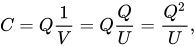
C = charge / voltage
Dimension

Capacitance is the ability of an object to store electric charge. It is measured by the change in charge in response to a difference in electric potential, expressed as the ratio of those quantities. Commonly recognized are two closely related notions of capacitance: self capacitance and mutual capacitance.[1]: 237–238  An object that can be electrically charged exhibits self capacitance, for which the electric potential is measured between the object and ground. Mutual capacitance is measured between two components, and is particularly important in the operation of the capacitor, an elementary linear electronic component designed to add capacitance to an electric circuit.

The capacitance between two conductors depends only on the geometry; the opposing surface area of the conductors and the distance between them; and the permittivity of any dielectric material between them. For many dielectric materials, the permittivity, and thus the capacitance, is independent of the potential difference between the conductors and the total charge on them.

The SI unit of capacitance is the farad (symbol: F), named after the English physicist Michael Faraday.[2] A 1 farad capacitor, when charged with 1 coulomb of electrical charge, has a potential difference of 1 volt between its plates.[3] The reciprocal of capacitance is called elastance.

Self capacitance

[edit]

In discussing electrical circuits, the term capacitance is usually a shorthand for the mutual capacitance between two adjacent conductors, such as the two plates of a capacitor. However, every isolated conductor also exhibits capacitance, here called self capacitance. It is measured by the amount of electric charge that must be added to an isolated conductor to raise its electric potential by one unit of measurement, e.g., one volt.[4] The reference point for this potential is a theoretical hollow conducting sphere, of infinite radius, with the conductor centered inside this sphere.

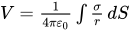
Self capacitance of a conductor is defined by the ratio of charge and electric potential: where

  • is the charge held,
  • is the electric potential,
  • is the surface charge density,
  • is an infinitesimal element of area on the surface of the conductor, over which the surface charge density is integrated,
  • is the length from to a fixed point M on the conductor,
  • is the vacuum permittivity.

Using this method, the self capacitance of a conducting sphere of radius in free space (i.e. far away from any other charge distributions) is:[2]

Example values of self capacitance are:

The inter-winding capacitance of a coil is sometimes called self capacitance,[6] but this is a different phenomenon. It is actually mutual capacitance between the individual turns of the coil and is a form of stray or parasitic capacitance. This self capacitance is an important consideration at high frequencies: it changes the impedance of the coil and gives rise to parallel resonance. In many applications this is an undesirable effect and sets an upper frequency limit for the correct operation of the circuit.[citation needed]

Mutual capacitance

[edit]

A common form is a parallel-plate capacitor, which consists of two conductive plates insulated from each other, usually sandwiching a dielectric material. In a parallel plate capacitor, capacitance is very nearly proportional to the surface area of the conductor plates and inversely proportional to the separation distance between the plates.

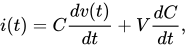
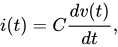
If the charges on the plates are and , and gives the voltage between the plates, then the capacitance is given by which gives the voltage/current relationship where is the instantaneous rate of change of voltage, and is the instantaneous rate of change of the capacitance. For most applications, the change in capacitance over time is negligible, so the formula reduces to:

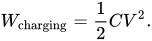
The energy stored in a capacitor is found by integrating the work :

Capacitance matrix

[edit]

The discussion above is limited to the case of two conducting plates, although of arbitrary size and shape. The definition does not apply when there are more than two charged plates, or when the net charge on the two plates is non-zero. To handle this case, James Clerk Maxwell introduced his coefficients of potential. If three (nearly ideal) conductors are given charges , then the voltage at conductor 1 is given by and similarly for the other voltages. Hermann von Helmholtz and Sir William Thomson showed that the coefficients of potential are symmetric, so that , etc. Thus the system can be described by a collection of coefficients known as the elastance matrix or reciprocal capacitance matrix, which is defined as:

From this, the mutual capacitance between two objects can be defined[7] by solving for the total charge and using .

Since no actual device holds perfectly equal and opposite charges on each of the two "plates", it is the mutual capacitance that is reported on capacitors.

The collection of coefficients is known as the capacitance matrix,[8][9][10] and is the inverse of the elastance matrix.

Capacitors

[edit]

The capacitance of the majority of capacitors used in electronic circuits is generally several orders of magnitude smaller than the farad. The most common units of capacitance are the microfarad (μF), nanofarad (nF), picofarad (pF), and, in microcircuits, femtofarad (fF). Some applications also use supercapacitors that can be much larger, as much as hundreds of farads, and parasitic capacitive elements can be less than a femtofarad. Historical texts use other, obsolete submultiples of the farad, such as "mf" and "mfd" for microfarad (μF); "mmf", "mmfd", "pfd", "μμF" for picofarad (pF).[11][12]

The capacitance can be calculated if the geometry of the conductors and the dielectric properties of the insulator between the conductors are known. Capacitance is proportional to the area of overlap and inversely proportional to the separation between conducting sheets. The closer the sheets are to each other, the greater the capacitance.

An example is the capacitance of a capacitor constructed of two parallel plates both of area separated by a distance . If is sufficiently small with respect to the smallest chord of , there holds, to a high level of accuracy:

where

  • is the capacitance, in farads;
  • is the area of overlap of the two plates, in square meters;
  • is the electric constant ();
  • is the relative permittivity (also dielectric constant) of the material in between the plates ( for air); and
  • is the separation between the plates, in meters.

The equation is a good approximation if d is small compared to the other dimensions of the plates so that the electric field in the capacitor area is uniform, and the so-called fringing field around the periphery provides only a small contribution to the capacitance.

Combining the equation for capacitance with the above equation for the energy stored in a capacitor, for a flat-plate capacitor the energy stored is: where is the energy, in joules; is the capacitance, in farads; and is the voltage, in volts.

Stray capacitance

[edit]

Any two adjacent conductors can function as a capacitor, though the capacitance is small unless the conductors are close together for long distances or over a large area. This (often unwanted) capacitance is called parasitic or stray capacitance. Stray capacitance can allow signals to leak between otherwise isolated circuits (an effect called crosstalk), and it can be a limiting factor for proper functioning of circuits at high frequency.

Stray capacitance between the input and output in amplifier circuits can be troublesome because it can form a path for feedback, which can cause instability and parasitic oscillation in the amplifier. It is often convenient for analytical purposes to replace this capacitance with a combination of one input-to-ground capacitance and one output-to-ground capacitance; the original configuration – including the input-to-output capacitance – is often referred to as a pi-configuration. Miller's theorem can be used to effect this replacement: it states that, if the gain ratio of two nodes is 1/K, then an impedance of Z connecting the two nodes can be replaced with a Z/1 − K impedance between the first node and ground and a KZ/K − 1 impedance between the second node and ground. Since impedance varies inversely with capacitance, the internode capacitance, C, is replaced by a capacitance of KC from input to ground and a capacitance of (K − 1)C/K from output to ground. When the input-to-output gain is very large, the equivalent input-to-ground impedance is very small while the output-to-ground impedance is essentially equal to the original (input-to-output) impedance.

Capacitance of conductors with simple shapes

[edit]

Calculating the capacitance of a system amounts to solving the Laplace equation with a constant potential on the 2-dimensional surface of the conductors embedded in 3-space. This is simplified by symmetries. There is no solution in terms of elementary functions in more complicated cases.

For plane situations, analytic functions may be used to map different geometries to each other. See also Schwarz–Christoffel mapping.

Capacitance of simple systems
Type Capacitance Diagram and definitions
Parallel-plate capacitor
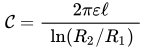
Concentric cylinders
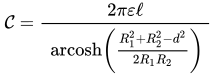
Eccentric cylinders[13]
  • : Permittivity
  • : Outer radius
  • : Inner radius
  • : Distance between center
  • : Wire length
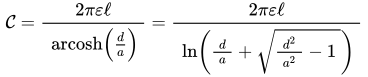
Pair of parallel wires[14]
Wire parallel to wall[14]
  • : Wire radius
  • : Distance,
  • : Wire length
Two parallel
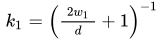
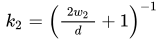
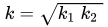
coplanar strips[15]
  • : Distance
  • : Length
  • : Strip width

  • : Complete elliptic integral of the first kind
Concentric spheres
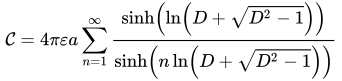
Two spheres,
equal radius[16][17]
  • : Radius
  • : Distance,
  • : Euler's constant
  • : the q-digamma function
  • : the q-gamma function[18]

See also Basic hypergeometric series.

Sphere in front of wall[16]
  • : Radius
  • : Distance,
Sphere
  • : Radius
Circular disc[19]
  • : Radius
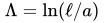
Thin straight wire,
finite length[20][21][22]
  • : Wire radius
  • : Length

Energy storage

[edit]

The energy (measured in joules) stored in a capacitor is equal to the work required to push the charges into the capacitor, i.e. to charge it. Consider a capacitor of capacitance C, holding a charge +q on one plate and −q on the other. Moving a small element of charge dq from one plate to the other against the potential difference V = q/C requires the work dW: where W is the work measured in joules, q is the charge measured in coulombs and C is the capacitance, measured in farads.
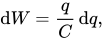
The energy stored in a capacitor is found by integrating this equation. Starting with an uncharged capacitance (q = 0) and moving charge from one plate to the other until the plates have charge +Q and −Q requires the work W:

Nanoscale systems

[edit]

The capacitance of nanoscale dielectric capacitors such as quantum dots may differ from conventional formulations of larger capacitors. In particular, the electrostatic potential difference experienced by electrons in conventional capacitors is spatially well-defined and fixed by the shape and size of metallic electrodes in addition to the statistically large number of electrons present in conventional capacitors. In nanoscale capacitors, however, the electrostatic potentials experienced by electrons are determined by the number and locations of all electrons that contribute to the electronic properties of the device. In such devices, the number of electrons may be very small, so the resulting spatial distribution of equipotential surfaces within the device is exceedingly complex.

Single-electron devices

[edit]

The capacitance of a connected, or "closed", single-electron device is twice the capacitance of an unconnected, or "open", single-electron device.[23] This fact may be traced more fundamentally to the energy stored in the single-electron device whose "direct polarization" interaction energy may be equally divided into the interaction of the electron with the polarized charge on the device itself due to the presence of the electron and the amount of potential energy required to form the polarized charge on the device (the interaction of charges in the device's dielectric material with the potential due to the electron).[24]

Few-electron devices

[edit]

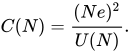
The derivation of a "quantum capacitance" of a few-electron device involves the thermodynamic chemical potential of an N-particle system given by

whose energy terms may be obtained as solutions of the Schrödinger equation. The definition of capacitance, with the potential difference


may be applied to the device with the addition or removal of individual electrons, and

The "quantum capacitance" of the device is then[25]

This expression of "quantum capacitance" may be written as which differs from the conventional expression described in the introduction where , the stored electrostatic potential energy, by a factor of 1/2 with .

However, within the framework of purely classical electrostatic interactions, the appearance of the factor of 1/2 is the result of integration in the conventional formulation involving the work done when charging a capacitor,
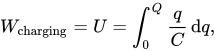
which is appropriate since for systems involving either many electrons or metallic electrodes, but in few-electron systems, . The integral generally becomes a summation. One may trivially combine the expressions of capacitance and electrostatic interaction energy, to obtain


which is similar to the quantum capacitance. A more rigorous derivation is reported in the literature.[26] In particular, to circumvent the mathematical challenges of spatially complex equipotential surfaces within the device, an average electrostatic potential experienced by each electron is utilized in the derivation.

Apparent mathematical differences may be understood more fundamentally. The potential energy, , of an isolated device (self-capacitance) is twice that stored in a "connected" device in the lower limit . As grows large, .[24] Thus, the general expression of capacitance is

In nanoscale devices such as quantum dots, the "capacitor" is often an isolated or partially isolated component within the device. The primary differences between nanoscale capacitors and macroscopic (conventional) capacitors are the number of excess electrons (charge carriers, or electrons, that contribute to the device's electronic behavior) and the shape and size of metallic electrodes. In nanoscale devices, nanowires consisting of metal atoms typically do not exhibit the same conductive properties as their macroscopic, or bulk material, counterparts.

Capacitance in electronic and semiconductor devices

[edit]

In electronic and semiconductor devices, transient or frequency-dependent current between terminals contains both conduction and displacement components. Conduction current is related to moving charge carriers (electrons, holes, ions, etc.), while displacement current is caused by a time-varying electric field. Carrier transport is affected by electric fields and by a number of physical phenomena - such as carrier drift and diffusion, trapping, injection, contact-related effects, impact ionization, etc. As a result, device admittance is frequency-dependent, and a simple electrostatic formula for capacitance is not applicable. A more general definition of capacitance, encompassing electrostatic formula, is:[27] where is the device admittance, and is the angular frequency.

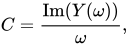
In general, capacitance is a function of frequency. At high frequencies, capacitance approaches a constant value, equal to "geometric" capacitance, determined by the terminals' geometry and dielectric content in the device. A paper by Steven Laux[27] presents a review of numerical techniques for capacitance calculation. In particular, capacitance can be calculated by a Fourier transform of a transient current in response to a step-like voltage excitation:

Negative capacitance in semiconductor devices

[edit]

Usually, capacitance in semiconductor devices is positive. However, in some devices and under certain conditions (temperature, applied voltages, frequency, etc.), capacitance can become negative. Non-monotonic behavior of the transient current in response to a step-like excitation has been proposed as the mechanism of negative capacitance.[28] Negative capacitance has been demonstrated and explored in many different types of semiconductor devices.[29]

Measuring capacitance

[edit]

A capacitance meter is a piece of electronic test equipment used to measure capacitance, mainly of discrete capacitors. For most purposes and in most cases the capacitor must be disconnected from circuit.

Many DVMs (digital volt meters) have a capacitance-measuring function. These usually operate by charging and discharging the capacitor under test with a known current and measuring the rate of rise of the resulting voltage; the slower the rate of rise, the larger the capacitance. DVMs can usually measure capacitance from nanofarads to a few hundred microfarads, but wider ranges are not unusual. It is also possible to measure capacitance by passing a known high-frequency alternating current through the device under test and measuring the resulting voltage across it (does not work for polarised capacitors).

An Andeen-Hagerling 2700A capacitance bridge

More sophisticated instruments use other techniques such as inserting the capacitor-under-test into a bridge circuit. By varying the values of the other legs in the bridge (so as to bring the bridge into balance), the value of the unknown capacitor is determined. This method of indirect use of measuring capacitance ensures greater precision. Through the use of Kelvin connections and other careful design techniques, these instruments can usually measure capacitors over a range from picofarads to farads.

See also

[edit]

References

[edit]

Further reading

[edit]
[edit]
Revisions and contributorsEdit on WikipediaRead on Wikipedia
from Grokipedia
Capacitance is the measure of an object's or device's ability to store electric charge in relation to an applied electric potential difference across it. It is quantitatively defined as the ratio of the stored charge $ Q $ to the potential difference $ V $, expressed by the formula $ C = \frac{Q}{V} $, where the SI unit of capacitance is the farad (F), equivalent to one coulomb per volt (C/V).[1] A capacitor, the device embodying this property, consists of two conductive plates separated by an insulating material known as a dielectric, which enables the storage of energy in an electric field between the plates.[2] In practical terms, the capacitance of a simple parallel-plate capacitor is given by $ C = \epsilon_0 \frac{A}{d} $, where $ \epsilon_0 $ is the permittivity of free space ($ 8.85 \times 10^{-12} $ F/m), $ A $ is the surface area of each plate, and $ d $ is the separation distance between them; inserting a dielectric material with relative permittivity $ \kappa > 1 $ increases the effective capacitance to $ C = \kappa \epsilon_0 \frac{A}{d} $.[3] The energy stored in a charged capacitor is $ U = \frac{1}{2} C V^2 $ or equivalently $ U = \frac{1}{2} \frac{Q^2}{C} $, highlighting its role in temporarily holding electrical energy.[4] Commercial capacitors exhibit capacitances ranging from picofarads (pF) to thousands of farads (F) for supercapacitors, with conventional types typically from pF to microfarads (μF) or millifarads (mF) due to size constraints, and are constructed from materials like ceramics, tantalum, or electrolytes depending on the application.[2][5] Capacitors play a crucial role in electronic circuits, where they function for signal filtering to remove noise, energy storage in devices like defibrillators, voltage smoothing in power supplies, and timing in oscillators and memory elements.[3] In series and parallel configurations, equivalent capacitances follow rules analogous to resistors but inverted: for series, $ \frac{1}{C_{eq}} = \sum \frac{1}{C_i} $, and for parallel, $ C_{eq} = \sum C_i $, allowing complex circuit designs.[6] Beyond electronics, capacitance principles underpin phenomena like the behavior of biological membranes and the design of sensors for measuring displacement or humidity.[7]

History

Early Concepts

The early concepts of capacitance emerged in the mid-18th century through experiments demonstrating the storage of electric charge, predating formal mathematical definitions. In 1745, Ewald Georg von Kleist in Germany accidentally discovered a method to store electricity by connecting a static electricity generator to a nail inserted into a medicine bottle filled with alcohol, which retained the charge until discharged. Independently in the same year, Pieter van Musschenbroek at the University of Leiden in the Netherlands developed a similar device using a glass jar filled with water and coated externally with metal foil, connected via a brass rod through a cork stopper; this apparatus, known as the Leyden jar, could store significant charges produced by friction machines and deliver powerful shocks upon discharge.[8] The Leyden jar revolutionized electrical experimentation by providing a reliable means to accumulate and control static electricity, shifting observations from fleeting sparks to sustained phenomena. Researchers found that the jar's glass walls acted as an insulator between inner and outer conductors (initially water and foil), with charge separation occurring across the dielectric material; multiple jars could be connected in parallel to increase storage capacity or in series to heighten voltage. This setup enabled studies of electrical conduction, insulation, and discharge, influencing theories of electricity as a fluid-like substance. By the late 1740s, the device spread across Europe, facilitating demonstrations and quantitative comparisons of electrical effects.[8] Benjamin Franklin advanced these concepts in the 1750s through systematic investigations using Leyden jars, integrating them into his broader theory of electricity. In his 1751 publication Experiments and Observations on Electricity, Franklin described dissectible capacitors—jars that could be assembled and disassembled to reveal charge distribution—and used them to explore conservation of charge, proposing that electricity involved the redistribution of a single fluid rather than creation or destruction. His 1752 kite experiment employed a Leyden jar to capture atmospheric electricity from lightning, confirming its identity with laboratory-generated charge and underscoring the jar's role in safe, portable storage. Franklin's work emphasized practical applications, such as lightning rods, while highlighting the jar's capacity to hold "electrical fire" proportional to its size and materials.[9][10] Further theoretical progress came from Henry Cavendish's private experiments between 1771 and 1781, where he quantified the ability of conductors to store charge relative to their potential difference, effectively inventing the concept of capacitance. Cavendish measured the "quantity of electricity" (charge) and "degree of electrification" (potential) using torsion balances and self-induced shocks from charged objects like plates and spheres, determining that capacitance depended on geometry, such as the area and separation of parallel plates. He also explored dielectric effects, noting how insulators like glass increased storage capacity compared to air. Although unpublished during his lifetime, these findings were edited and released by James Clerk Maxwell in 1879 as The Electrical Researches of the Honourable Henry Cavendish, providing an early mathematical framework for what Maxwell later termed capacitance: $ C = \frac{Q}{V} $, where $ Q $ is charge and $ V $ is potential.[11][12]

Development of Capacitors

The development of capacitors originated in 1745 with the independent invention of the Leyden jar by Ewald Georg von Kleist in Germany and Pieter van Musschenbroek in the Netherlands.[13] This device, consisting of a glass jar coated internally and externally with metal foil and containing an electrolyte like water, was the first to store substantial electrical charge, enabling sustained electrical experiments beyond the limitations of electrostatic generators.[13] The Leyden jar's design demonstrated the principles of capacitance through separated conductive plates and an insulating dielectric, laying the foundation for all subsequent capacitor technologies.[14] In the late 18th and early 19th centuries, advancements focused on improving form factors and materials for practical use. Benjamin Franklin constructed flat-plate capacitors using glass sheets separated by metal foil in the 1740s, offering a more compact alternative to jars for demonstrations and early applications.[14] Michael Faraday's work in the 1830s introduced the dielectric constant, quantifying how materials like glass or mica enhance charge storage, which facilitated the creation of fixed and variable capacitors for emerging electrical instruments.[14] The early 20th century saw specialization in capacitor types to meet growing electrical demands. In 1897, Charles Pollak patented the aluminum electrolytic capacitor, exploiting the anodization of valve metals to form a thin oxide dielectric, though initial designs suffered from instability and were limited to power applications.[15] Samuel Ruben's 1925 patent refined this into the modern aluminum electrolytic structure, enabling compact, high-capacitance devices for radio and amplification circuits, with commercialization following in 1936 by Cornell-Dubilier.[16] Mica capacitors, invented by William Dubilier in 1909, offered stability for high-frequency radio transmission due to mica's low loss and temperature resilience.[14] Innovations from the 1920s onward diversified capacitor performance for electronics and power systems. The 1926 introduction of titanium dioxide (rutile) capacitors provided higher permittivity than mica, while the 1941 discovery of barium titanate revolutionized ceramics, leading to multilayer ceramic capacitors (MLCCs) via tape-casting and cofiring processes in the 1970s–1980s, achieving annual production exceeding 10¹² units for consumer devices.[14] Film capacitors advanced with metalized polymer dielectrics, starting from polyethylene terephthalate (PET, patented 1941) and polystyrene (1949), enabling self-healing metallization by Bell Labs in 1954 for reliable, high-voltage applications in audio and power filtering.[14] Electrochemical advancements culminated in double-layer capacitors, patented by General Electric in 1957 using porous carbon electrodes to exploit electric double-layer capacitance, though commercialization waited until 1978 by Nippon Electric with capacities up to 9 kF as of 2025 for energy storage in hybrids and renewables.[14] These developments transformed capacitors from experimental curiosities into indispensable components, scaling capacitance from microfarads in Leyden jars to kilofarads in modern supercapacitors while prioritizing stability, miniaturization, and application-specific dielectrics.[14]

Fundamentals

Definition

Capacitance is the property of a system of conductors that determines the amount of electric charge it can store for a given electric potential difference between the conductors. In electrostatics, it arises from the separation of charges on conductors, leading to an electric field that stores energy. This property is intrinsic to the geometry and materials of the system, independent of the specific charges placed on it./University_Physics_II_-Thermodynamics_Electricity_and_Magnetism(OpenStax)/08%3A_Capacitance/8.02%3A_Capacitors_and_Capacitance) For a simple capacitor consisting of two conductors with charges $ +Q $ and $ -Q $, the capacitance $ C $ is defined as the ratio of the charge magnitude to the potential difference $ V $ across the conductors:
C=QV C = \frac{Q}{V}
This relation holds when the conductors are isolated and the potential is measured relative to each other.[17] The definition extends to a single isolated conductor by considering its potential relative to infinity, where $ V $ is the potential of the conductor with respect to a distant reference point./02%3A_Charges_and_Conductors/2.05%3A_Capacitance) The SI unit of capacitance is the farad (F), such that a capacitance of 1 F stores 1 coulomb of charge per volt of potential difference. This unit is named after Michael Faraday and is equivalent to $ 1 , \mathrm{F} = 1 , \mathrm{C/V} $. In practice, most capacitors have capacitances in the picofarad to microfarad range due to the large scale of the farad.[18] The capacitance value depends solely on the physical configuration of the conductors and the dielectric medium between them, not on the applied voltage or stored charge./University_Physics_II_-Thermodynamics_Electricity_and_Magnetism(OpenStax)/08%3A_Capacitance/8.02%3A_Capacitors_and_Capacitance) In broader terms, capacitance characterizes the electrostatic energy storage in the electric field between charged bodies, with the stored energy given by $ \frac{1}{2} C V^2 $. This energy perspective underscores capacitance as a measure of the system's response to charge separation, fundamental to applications in electronics and electromagnetism./University_Physics_II_-Thermodynamics_Electricity_and_Magnetism(OpenStax)/08%3A_Capacitance/8.02%3A_Capacitors_and_Capacitance)

Units

The SI unit of capacitance is the farad, symbolized as F. It is a derived unit in the International System of Units (SI), named after the English physicist and chemist Michael Faraday (1791–1867), who contributed significantly to the understanding of electromagnetism.[19][17] The farad is defined as the capacitance of a capacitor between the plates of which there appears a potential difference of 1 volt when it is charged by a quantity of electricity equal to 1 coulomb. This corresponds to the relation $ C = \frac{Q}{V} $, where $ C $ is capacitance in farads, $ Q $ is electric charge in coulombs, and $ V $ is electric potential difference in volts. In terms of SI base units, the farad has the dimensions $ \mathrm{kg}^{-1} \mathrm{m}^{-2} \mathrm{s}^{4} \mathrm{A}^{2} $, reflecting its derivation from the base units of mass, length, time, and electric current.[20][19] One farad represents a substantial capacitance value impractical for most electronic applications, as it implies storing 1 coulomb of charge at only 1 volt—a scenario requiring enormous plate areas or specialized materials. Consequently, decimal submultiples defined by SI prefixes are standard: the microfarad (μF, $ 10^{-6} $ F), nanofarad (nF, $ 10^{-9} $ F), and picofarad (pF, $ 10^{-12} $ F) are commonly employed in circuits, while even smaller values like the femtofarad (fF, $ 10^{-15} $ F) appear in high-frequency or nanoscale contexts.[19]

Types of Capacitance

Self-Capacitance

Self-capacitance, also referred to as isolated capacitance, describes the ability of a single conductor to store electric charge when isolated from other conductors, with the reference potential taken at infinity or ground. It is defined as the ratio of the charge $ Q $ placed on the conductor to the resulting electric potential $ V $ relative to infinity, expressed as $ C = \frac{Q}{V} $. The self-capacitance depends on the geometry of the conductor and the permittivity of the surrounding medium. This quantity measures how much charge can be accumulated on the conductor before it reaches a specified potential, and it arises naturally in electrostatics for any isolated conducting body.[21][22] In electrostatic equilibrium, the electric field inside a conductor is zero, excess charge resides on the surface, the electric potential is constant throughout the conductor, and the electric field just outside the surface is perpendicular to the surface with magnitude $ E = \frac{\sigma}{\epsilon_0} $, where $ \sigma $ is the surface charge density. The potential $ V $ relative to infinity is the line integral of the electric field from the surface to infinity, linking capacitance to the field configuration.[23] For simple geometries, self-capacitance can be derived analytically using Gauss's law and the uniqueness theorem of electrostatics. Consider an isolated conducting sphere of radius $ R $ in vacuum. The electric field outside the sphere is equivalent to that of a point charge $ Q $ at the center, leading to the potential $ V = \frac{Q}{4\pi\epsilon_0 R} $. Thus, the self-capacitance is $ C = 4\pi\epsilon_0 R $, independent of the charge magnitude but proportional to the sphere's size. This result highlights that larger conductors exhibit greater self-capacitance, as they distribute charge over a larger surface area, reducing the potential for a given charge.[24] In contrast to mutual capacitance, which involves the interaction between two or more conductors, self-capacitance pertains solely to one conductor's interaction with the surrounding space, treating the "second plate" as an imaginary surface at infinity. For non-spherical shapes, such as cylinders or arbitrary objects, exact formulas are more complex and often require solving Laplace's equation numerically, but the spherical case serves as a fundamental benchmark. For instance, the self-capacitance of a conducting disk or ellipsoid can be approximated using series expansions or variational methods, typically yielding values on the order of the linear dimensions times $ \epsilon_0 $. Self-capacitance plays a key role in analyzing parasitic effects in high-voltage systems and isolated components, where unintended charge accumulation can influence performance.[23][25]

Mutual Capacitance

Mutual capacitance refers to the electrostatic interaction between two distinct conductors in a system, quantifying the amount of charge induced on one conductor by a potential difference applied to the other. For a simple system consisting of two isolated conductors carrying equal and opposite charges $ Q $ and $ -Q $, the mutual capacitance $ C_m $ is defined as $ C_m = \frac{|Q|}{|\Delta V|} $, where $ \Delta V $ is the potential difference between the conductors. This parameter depends solely on the geometry of the conductors and the properties of the medium between them, such as the permittivity $ \epsilon $./02%3A_Charges_and_Conductors/2.05%3A_Capacitance) In contrast to self-capacitance, which measures a single conductor's ability to hold charge relative to infinity or ground, mutual capacitance emphasizes the coupling between pairs of conductors. For example, in a parallel-plate configuration, the mutual capacitance approximates $ C_m = \epsilon_0 \frac{A}{d} $, where $ A $ is the plate area and $ d $ is the separation distance, illustrating how closer proximity increases capacitive coupling. This concept is fundamental to devices like capacitors, where mutual capacitance determines the device's charge storage capacity.[3] For systems with more than two conductors, mutual capacitance is incorporated into the capacitance matrix $ \mathbf{C} $, where the charge on the $ i $-th conductor is given by $ Q_i = \sum_j C_{ij} V_j $. Here, the off-diagonal elements $ C_{ij} $ (for $ i \neq j )representmutualcapacitances,whicharetypicallynegative,indicatinginducedchargesofoppositesign.Thematrixissymmetric() represent mutual capacitances, which are typically negative, indicating induced charges of opposite sign. The matrix is symmetric ( C_{ij} = C_{ji} $), a consequence of the reciprocity theorem in electrostatics, ensuring that the effect of potential on one conductor is symmetric with respect to charge induction on another. This formalism allows for accurate modeling of complex systems, such as transmission lines or integrated circuits, where mutual effects influence overall performance.[26][21] Mutual capacitance plays a critical role in applications involving parasitic effects, such as crosstalk in electronic circuits, where unintended coupling between adjacent wires can degrade signal integrity. In capacitive sensors, like those in touchscreens, mutual capacitance sensing detects changes in the electric field between transmit and receive electrodes caused by a nearby object, enabling precise position detection. These phenomena underscore the importance of geometric design in minimizing or exploiting mutual interactions.[27]

Capacitance Matrix

In electrostatics, the capacitance matrix provides a complete description of the electrostatic interactions among a system of multiple isolated conductors. For a system consisting of NN conductors, the charge QiQ_i on the ii-th conductor is related to the electric potentials VjV_j of all conductors by the linear relation Q=CV\mathbf{Q} = \mathbf{C} \mathbf{V}, where Q\mathbf{Q} and V\mathbf{V} are NN-dimensional vectors, and C\mathbf{C} is the N×NN \times N capacitance matrix.[26] This matrix encapsulates both self-capacitance effects, where a conductor's own potential induces charge on itself, and mutual capacitance effects, where the potential on one conductor induces charge on others.[28] The diagonal elements CiiC_{ii} of the matrix represent the self-capacitances of each conductor, defined as the charge induced on the ii-th conductor when it is held at unit potential while all other conductors are grounded (Vi=1V_i = 1, Vji=0V_{j \neq i} = 0).[29] The off-diagonal elements CijC_{ij} (for iji \neq j) are the mutual capacitances, which quantify the charge induced on conductor ii due to unit potential on conductor jj with ii grounded; these elements are typically negative, reflecting the opposite sign of induced charges on neighboring conductors.[30] The capacitance matrix is symmetric, satisfying Cij=CjiC_{ij} = C_{ji} for all i,ji, j, a property derived from the reciprocity theorem in electrostatics, which ensures that the response of the system to interchanged charge and potential excitations is identical.[31] This symmetry can also be demonstrated through the invariance of the system's electrostatic energy under potential swaps.[21] Furthermore, the capacitance matrix is positive semi-definite, guaranteeing that the electrostatic energy stored in the system, W=12VTCV=12QTC1QW = \frac{1}{2} \mathbf{V}^T \mathbf{C} \mathbf{V} = \frac{1}{2} \mathbf{Q}^T \mathbf{C}^{-1} \mathbf{Q}, is always non-negative for physically admissible charge or potential distributions.[26] The inverse matrix C1\mathbf{C}^{-1}, known as the elastance matrix or matrix of potential coefficients, relates potentials to charges via V=C1Q\mathbf{V} = \mathbf{C}^{-1} \mathbf{Q}, with its elements PijP_{ij} representing the potential at conductor ii due to unit charge on conductor jj while others are grounded.[32] In practice, computing the capacitance matrix for complex geometries often requires numerical methods, such as the method of moments or finite element analysis, as analytical solutions are limited to simple configurations like parallel plates or spherical conductors.[29] For a two-conductor system, the matrix takes the form
C=(C11C12C12C22), \mathbf{C} = \begin{pmatrix} C_{11} & C_{12} \\ C_{12} & C_{22} \end{pmatrix},
where the mutual capacitance between the conductors is C12-C_{12}, and the effective capacitance when the conductors are connected in parallel or series can be derived from the eigenvalues or submatrices of C\mathbf{C}.[33] This formalism extends naturally to larger systems, such as in integrated circuits where parasitic capacitances form a full matrix describing crosstalk and signal integrity.[31]

Components and Phenomena

Capacitors

A capacitor is a passive electronic component designed to store electrical energy in an electric field, consisting of at least two conductive electrodes or plates separated by an insulating dielectric material.[34] When a voltage is applied across the plates, positive charge accumulates on one plate and negative charge on the other, creating a potential difference and enabling the device to hold charge Q according to the relation $ C = \frac{Q}{V} $, where C is the capacitance and V is the voltage.[3] In its simplest form, a capacitor exploits the principle of capacitance between conductors, blocking direct current while allowing alternating current to pass through by repeatedly charging and discharging.[35] The basic construction of a capacitor typically involves two metal plates (such as aluminum or copper foil) with a dielectric interposed between them to prevent conduction while permitting electrostatic influence.[35] For a parallel-plate configuration, the capacitance is calculated as $ C = \frac{\epsilon_0 A}{d} $, where $ \epsilon_0 = 8.85 \times 10^{-12} $ F/m is the permittivity of free space, A is the plate area, and d is the separation distance; this value increases if a dielectric with relative permittivity $ \kappa > 1 $ is used, yielding $ C = \kappa \frac{\epsilon_0 A}{d} .[](https://web.mit.edu/8.02t/www/802TEAL3D/visualizations/coursenotes/modules/guide05.pdf)[Dielectrics](/page/Dielectric),suchasair(.[](https://web.mit.edu/8.02t/www/802TEAL3D/visualizations/coursenotes/modules/guide05.pdf) [Dielectrics](/page/Dielectric), such as air ( \kappa = 1 ),paper(), paper ( \kappa \approx 3.7 ),orglass(), or glass ( \kappa = 4-6 $), reduce the electric field strength by a factor of $ \kappa $ through dipole polarization, allowing greater charge storage without increasing plate size or reducing separation.[3] Common construction techniques include stacking or rolling plates with dielectric sheets to achieve compact, high-capacitance designs suitable for integration into circuits.[36] Capacitors are classified primarily by their dielectric material and construction method, each offering trade-offs in capacitance value, voltage rating, stability, and size.[37] Ceramic capacitors, the most common type, use a ceramic material like barium titanate as the dielectric, often in multilayer configurations for capacitances from picofarads to microfarads, prized for their small size, low cost, and high stability across temperatures but limited by lower voltage ratings.[37] Electrolytic capacitors employ an oxide layer formed on a metal (aluminum or tantalum) anode via electrolysis, with a liquid or gel electrolyte as the cathode, enabling high capacitance (up to tens of thousands of microfarads) in compact volumes for power supply filtering, though they are polarized and degrade over time.[36] Film capacitors feature thin plastic films (e.g., polyester, polypropylene) as dielectrics wound or stacked with metal foil electrodes, providing excellent stability, low losses, and self-healing properties for audio and timing applications, albeit at higher cost and larger size.[36] Other variants include mica capacitors, using mineral mica sheets for precision and high-voltage use in resonant circuits, and air or vacuum capacitors, which rely on gas or vacuum dielectrics for tunable, low-loss performance in radio frequency tuning.[37]

Stray Capacitance

Stray capacitance, often referred to as parasitic capacitance, is the unintended and unwanted capacitance that exists between adjacent conductors or components in an electronic circuit due to their physical proximity and the presence of a dielectric medium, such as air or insulating materials.[38] This capacitance arises from the electric field coupling between elements that are not intentionally designed to form a capacitor, including traces on printed circuit boards (PCBs), wire leads, and even between windings in inductors or transformers.[39] In practical terms, it can be modeled as an equivalent capacitor in parallel with the intended circuit path, with values typically ranging from picofarads to nanofarads depending on geometry and materials.[40] The primary sources of stray capacitance include the overlap area between parallel conductors and the fringing fields at their edges, which follow the fundamental capacitance formula $ C = \epsilon \frac{A}{d} $, where $ \epsilon $ is the permittivity, $ A $ is the effective area, and $ d $ is the separation distance.[41] In high-frequency circuits, such as those operating above 1 MHz, stray capacitance becomes particularly problematic because it introduces low-impedance paths that bypass intended signals, leading to effects like crosstalk, electromagnetic interference (EMI), and signal attenuation.[42] For instance, in power electronics and RF amplifiers, it can cause voltage spikes, ringing, and reduced efficiency by coupling noise between adjacent traces or layers.[43] Experimental studies on high-frequency transformers have shown that unaccounted stray capacitances can alter dynamic models.[44] To mitigate stray capacitance, designers employ techniques such as increasing the physical separation between conductors to reduce $ A $ and increase $ d $, which directly lowers capacitance values.[39] Other strategies include using grounded guard traces or shielding to divert electric fields, minimizing trace widths and lengths, and incorporating multilayer PCB layouts with dedicated ground planes to confine fringing fields.[45] In inductor designs for high-frequency applications, optimizing winding geometry—such as employing single-layer air-core structures—has been shown to predict and reduce stray capacitance compared to multilayer coils, improving self-resonant frequency.[46] These methods are essential in precision applications like sensor interfaces, where stray capacitance can introduce measurement errors if not addressed.[47]

Theory and Calculations

Capacitance of Simple Shapes

The capacitance of simple geometric shapes is derived from fundamental principles of electrostatics, particularly Gauss's law and the relationship between electric field, potential difference, and charge. These calculations assume vacuum or air as the dielectric (permittivity ϵ0=8.85×10¹²F/m\epsilon_0 = 8.85 \times 10^{-12} \, \mathrm{F/m}) and ideal conductors, providing baseline values that can be adjusted for other materials by replacing ϵ0\epsilon_0 with ϵ=κϵ0\epsilon = \kappa \epsilon_0, where κ\kappa is the dielectric constant.[2]

Parallel-Plate Capacitor

The most straightforward geometry is the parallel-plate capacitor, consisting of two large, flat conducting plates of area AA separated by a small distance dd (with dAd \ll \sqrt{A}). The electric field EE between the plates is uniform and given by E=σ/ϵ0E = \sigma / \epsilon_0, where σ=Q/A\sigma = Q/A is the surface charge density, assuming the fringing fields at the edges are negligible. The potential difference VV is then V=Ed=(Qd)/(ϵ0A)V = E d = (Q d) / (\epsilon_0 A). Thus, the capacitance C=Q/VC = Q/V simplifies to:
C=ϵ0Ad. C = \frac{\epsilon_0 A}{d}.
This formula highlights the direct proportionality to plate area and inverse proportionality to separation, making parallel-plate designs common in practical capacitors. For example, increasing AA or decreasing dd boosts capacitance, though practical limits arise from dielectric breakdown.[2][48]

Cylindrical (Coaxial) Capacitor

A cylindrical capacitor features two concentric conducting cylinders: an inner one of radius aa and length LL, surrounded by an outer one of radius b>ab > a. To find the capacitance, apply Gauss's law to a Gaussian surface (a cylinder of radius rr, a<r<ba < r < b), yielding a radial electric field E(r)=(λ)/(2πϵ0r)E(r) = (\lambda)/(2\pi \epsilon_0 r), where λ=Q/L\lambda = Q/L is the charge per unit length. The potential difference VV is obtained by integrating EE from aa to bb:
V=abE(r)dr=λ2πϵ0ln(ba)=Qln(b/a)2πϵ0L. V = \int_a^b E(r) \, dr = \frac{\lambda}{2\pi \epsilon_0} \ln\left(\frac{b}{a}\right) = \frac{Q \ln(b/a)}{2\pi \epsilon_0 L}.
Therefore, the capacitance per unit length (or total for length LL) is:
C=2πϵ0Lln(b/a). C = \frac{2\pi \epsilon_0 L}{\ln(b/a)}.
This configuration is useful for high-voltage applications, such as cables, where the logarithmic dependence allows capacitance to remain finite even as bb approaches aa.[48][49]

Spherical (Concentric) Capacitor

For a spherical capacitor, two concentric conducting spheres have inner radius aa and outer radius b>ab > a. Using Gauss's law on a spherical Gaussian surface of radius rr (a<r<ba < r < b), the electric field is E(r)=Q/(4πϵ0r2)E(r) = Q / (4\pi \epsilon_0 r^2). Integrating from aa to bb gives the potential difference:
V=abE(r)dr=Q4πϵ0(1a1b)=Q(ba)4πϵ0ab. V = \int_a^b E(r) \, dr = \frac{Q}{4\pi \epsilon_0} \left( \frac{1}{a} - \frac{1}{b} \right) = \frac{Q (b - a)}{4\pi \epsilon_0 a b}.
The capacitance is thus:
C=4πϵ0abba. C = \frac{4\pi \epsilon_0 a b}{b - a}.
In the limit bb \to \infty, this reduces to the self-capacitance of an isolated sphere, C=4πϵ0aC = 4\pi \epsilon_0 a, representing the ability of a single sphere to store charge relative to infinity. Spherical geometries are less common in devices but illustrate radial field effects in theoretical models.[2][49] These derivations rely on symmetry to simplify the electric field calculation, enabling exact solutions for ideal cases. Real-world deviations, such as edge effects or non-vacuum dielectrics, require numerical methods or approximations, but these formulas provide essential benchmarks for design and analysis.[3]

Energy Storage

Capacitors store electrical energy by accumulating opposite charges on two conductors separated by an insulator, creating an electric field that holds the potential energy.[50] This energy arises from the work done to separate the charges against the attractive electrostatic force.[51] To derive the stored energy, consider charging a capacitor from an initial uncharged state. The work dWdW required to add an infinitesimal charge dqdq when the existing charge is qq is dW=VdqdW = V \, dq, where V=q/CV = q / C is the potential difference and CC is the capacitance.[52] Integrating from 0 to the final charge QQ,
W=0QqCdq=12Q2C. W = \int_0^Q \frac{q}{C} \, dq = \frac{1}{2} \frac{Q^2}{C}.
This work equals the stored energy UU, yielding U=12Q2CU = \frac{1}{2} \frac{Q^2}{C}.[50] Substituting Q=CVQ = C V, where VV is the final voltage, gives equivalent forms: U=12QV=12CV2U = \frac{1}{2} Q V = \frac{1}{2} C V^2.[53] These expressions hold for any capacitor geometry, as the derivation relies only on the definition of capacitance.[52] The energy is fundamentally stored in the electric field within the capacitor. The energy density uu (energy per unit volume) in vacuum is u=12ϵ0E2u = \frac{1}{2} \epsilon_0 E^2, where ϵ0\epsilon_0 is the permittivity of free space and EE is the electric field strength. For a parallel-plate capacitor, E=V/dE = V / d (with plate separation dd) is uniform between the plates, so the total energy is U=u×U = u \times (volume) =12ϵ0E2(Ad)=12CV2= \frac{1}{2} \epsilon_0 E^2 \cdot (A d) = \frac{1}{2} C V^2, matching the earlier result since C=ϵ0A/dC = \epsilon_0 A / d.[50] In dielectrics, the energy density becomes 12ϵE2\frac{1}{2} \epsilon E^2, where ϵ=κϵ0\epsilon = \kappa \epsilon_0 and κ\kappa is the dielectric constant, accounting for reduced field strength due to polarization.[52] This field-based perspective generalizes to arbitrary charge distributions, where the total electrostatic energy is the volume integral of 12ϵ0E2\frac{1}{2} \epsilon_0 E^2 over all space. In practice, capacitors enable rapid energy discharge in applications like power supplies, but energy loss occurs during charging due to resistance in the circuit, though ideal models assume reversible storage.[50]

Applications in Devices

Electronic Devices

Capacitors provide the primary means of implementing capacitance in electronic devices, enabling the storage of electrical energy and the control of signal flow in circuits. They are fundamental components in a wide range of consumer and industrial electronics, including cell phones, computers, and pacemakers, where they store charge for brief power needs and filter signals to ensure reliable operation. In these devices, capacitance allows for rapid charge and discharge, distinguishing it from slower battery-based storage.[54][55] One key application is in power supply conditioning, where capacitors smooth voltage ripples from rectified AC sources, converting them to stable DC for device operation. Decoupling capacitors, often ceramic types with values around 0.1 μF, are placed close to integrated circuits to absorb high-frequency noise from switching transients, providing a low-impedance path to ground and preventing interference with sensitive logic. This is critical in digital devices like microprocessors, where voltage stability directly impacts performance and reliability. Electrolytic capacitors, with higher capacitance up to thousands of μF, handle bulk energy storage for low-frequency filtering in power rails.[56][57] In signal processing, capacitors facilitate coupling and filtering functions essential for audio, radio frequency (RF), and communication circuits. As coupling elements, they block DC bias between amplifier stages while passing AC signals, maintaining signal integrity in multi-stage designs like audio preamplifiers. In filter networks, capacitors combine with resistors or inductors to form high-pass, low-pass, or band-pass configurations; for instance, in RF tuners, variable capacitors adjust resonance to select frequencies, enabling radio reception. The capacitive reactance, given by $ X_C = \frac{1}{2\pi f C} $, decreases with frequency, making capacitors ideal for attenuating low frequencies in high-pass filters used in speaker crossovers.[58][59][60] Capacitance also underpins timing and oscillation in electronic devices, forming RC networks that determine pulse widths or frequencies. In relaxation oscillators, such as those in simple timers or flashing LEDs, the time constant $ \tau = RC $ governs charge-discharge cycles, producing periodic outputs for applications like metronomes or warning lights. Supercapacitors, with capacitances exceeding 1 F, extend this to energy backup in portable gadgets, bridging short power interruptions during battery swaps without data loss in devices like digital cameras. These roles highlight capacitance's versatility in enhancing device efficiency and functionality across electronics.[61][62]

Semiconductor Devices

In semiconductor devices, capacitance arises primarily from the charge separation in depletion regions of p-n junctions and from the insulating oxide layers in metal-oxide-semiconductor (MOS) structures. These capacitances influence device performance, including switching speeds, frequency response, and power consumption, and are characterized through capacitance-voltage (C-V) measurements that reveal doping profiles, oxide thicknesses, and interface properties.[63] The MOS capacitor, a foundational structure in integrated circuits, consists of a metal gate, a thin oxide insulator, and a semiconductor substrate, typically p-type silicon. Its capacitance varies with applied gate voltage, exhibiting three operational regimes: accumulation, depletion, and inversion. In accumulation (negative gate voltage for p-type substrate), majority carriers (holes) accumulate at the oxide-semiconductor interface, yielding the maximum oxide capacitance $ C_{ox} = \frac{\epsilon_{ox} A}{t_{ox}} $, where $ \epsilon_{ox} $ is the oxide permittivity, $ A $ is the area, and $ t_{ox} $ is the oxide thickness. In depletion, a space-charge layer forms, reducing capacitance to the series combination $ C = \left( \frac{1}{C_{ox}} + \frac{1}{C_{dep}} \right)^{-1} $, with depletion capacitance $ C_{dep} = \frac{\epsilon_s A}{W} $ and depletion width $ W = \sqrt{\frac{2\epsilon_s \phi_s}{q N_A}} $, where $ \epsilon_s $ is semiconductor permittivity, $ \phi_s $ is surface potential, $ q $ is electron charge, and $ N_A $ is acceptor doping. In strong inversion (positive gate voltage), minority carriers (electrons) form an inversion layer, restoring capacitance near $ C_{ox} $ at low frequencies but showing frequency dependence at high frequencies due to minority carrier response time. The C-V curve thus provides critical data for threshold voltage and interface trap density.[64] In p-n junction devices, such as diodes and transistors, capacitance includes depletion (junction) and diffusion components. The depletion capacitance, dominant under reverse bias, stems from the varying width of the charge-depleted region, modeled as $ C_j = \frac{\epsilon_s A}{W} $, where $ W = \sqrt{\frac{2\epsilon_s (V_{bi} - V)}{q} \left( \frac{1}{N_A} + \frac{1}{N_D} \right)} $ for an abrupt junction, with built-in voltage $ V_{bi} $, applied voltage $ V $, and donor doping $ N_D $; thus, $ C_j \propto (V_{bi} - V)^{-m} $ where $ m = 1/2 $ for abrupt junctions. Diffusion capacitance, prominent in forward bias, arises from stored minority carriers and is given by $ C_d = \tau g_m $, where $ \tau $ is carrier lifetime and $ g_m $ is transconductance, scaling with forward current. These capacitances limit high-frequency operation in bipolar junction transistors (BJTs), where base-emitter diffusion capacitance and collector-base junction capacitance contribute to the cutoff frequency $ f_T = \frac{g_m}{2\pi (C_{\pi} + C_{\mu})} $, with $ C_{\pi} $ and $ C_{\mu} $ as base-emitter and base-collector capacitances, respectively. In MOSFETs, gate capacitance dominates, comprising oxide, overlap, and fringing components, with gate-drain capacitance introducing the Miller effect that amplifies effective input capacitance during switching.[65][66][67] Variable capacitance is exploited in varactor (varicap) diodes, specialized p-n junctions designed for tunable capacitance in RF applications like voltage-controlled oscillators. Reverse bias modulates the depletion width, yielding $ C \propto V^{-1/2} $ for abrupt junctions or steeper tuning (e.g., $ V^{-1/3} $ for hyperabrupt profiles), with typical ranges from 1 pF to 100 pF depending on doping gradients. C-V profiling techniques, using quasi-static or high-frequency measurements, further enable non-destructive characterization of doping profiles via $ N_d(w) = -\frac{C^3}{q \epsilon_s A^2} \frac{d(1/C^2)}{dV} $, essential for quality control in semiconductor fabrication.[68][63]

Nanoscale and Advanced Topics

Nanoscale Systems

At the nanoscale, capacitance deviates from classical descriptions due to quantum mechanical effects, particularly in low-dimensional systems where the density of states (DOS) is quantized. Quantum capacitance, defined as $ C_q = e^2 \frac{dn}{d\mu} $ where $ e $ is the electron charge, $ n $ is the carrier density, and $ \mu $ is the chemical potential, arises from the finite DOS and acts in series with the geometric capacitance. This effect becomes prominent in structures like graphene or carbon nanotubes, where the low DOS limits charge accumulation, reducing the total effective capacitance. In nanoscale transistors, quantum capacitance influences device performance by modulating the gate-channel coupling, especially when the oxide thickness approaches atomic scales.[69][70] In electronic devices such as metal-oxide-semiconductor (MOS) structures and field-effect transistors, size quantization and quantum capacitance lead to shifts in threshold voltage and altered carrier injection. For instance, in ultrathin silicon-on-insulator (SOI) transistors gated by single-walled carbon nanotubes, room-temperature quantization features manifest in the transfer characteristics due to Van Hove singularities in the nanotube's one-dimensional DOS, limiting gate charge and impacting drain current. These effects are critical for sub-10 nm devices, where they can reduce the total gate capacitance by up to 20-30% in low-DOS materials, necessitating DOS engineering for optimized performance. Nanoscale capacitor designs exploit two-dimensional materials; for example, dielectric nanocapacitors using metallic borophene electrodes separated by monolayer hexagonal boron nitride (h-BN) achieve high capacitance densities through atomic-scale control of the dielectric thickness.[71][72] In energy storage applications, nanoscale systems enhance capacitance via increased surface area and quantum-enhanced charge screening at interfaces. Nanoporous electrodes, such as graphene with surface areas up to 3100 m²/g, enable specific capacitances exceeding 100 F/g in supercapacitors by maximizing ion adsorption sites. Super-capacitance phenomena originate from mesoscale (0.3-1.8 nm) electrochemical processes, where quantum mechanical Hamiltonians describe charge accumulation, unifying non-faradaic double-layer and faradaic pseudocapacitive mechanisms; examples include graphene and nanostructured titanium oxide, which exhibit enhanced screening due to quantized energy levels. Composites like MnO₂ nanowires on carbon nanotubes deliver 279 F/g at 1 A/g with excellent cycling stability, highlighting the role of nanoscale architecture in boosting energy and power densities.[73][74] Measuring capacitance at the nanoscale poses challenges from stray fields and quantum fluctuations, addressed by advanced techniques like scanning microwave microscopy (SMM). SMM, using modified short-open-load calibration on reference SiO₂ samples, achieves traceable measurements from 0.2 fF to 10 fF with 3% uncertainty, mitigating errors from dimensional variations and environmental factors like humidity. For spatially resolved spectroscopy, multifrequency heterodyne electrostatic force microscopy (MFH-EFM) enables high-resolution capacitance mapping at arbitrary frequencies, distinguishing local dielectric properties in nanostructures with sub-10 nm precision. These methods are essential for validating models in devices like nanoscale MOS capacitors used in photonics.[75][76]

Single-Electron Devices

Single-electron devices operate by exploiting the quantization of electric charge, enabling the precise control and detection of individual electrons through nanoscale structures where capacitance plays a central role in the Coulomb blockade phenomenon. In these devices, a small conducting island, such as a metallic nanoparticle or quantum dot, is isolated by tunnel junctions with capacitances typically in the femtofarad (fF) range, ensuring that the energy required to add or remove a single electron—known as the charging energy—dominates thermal fluctuations. The charging energy is given by $ E_c = \frac{e^2}{2C} $, where $ e $ is the elementary charge and $ C $ is the total capacitance of the island, including contributions from the tunnel junctions and gate.[77] When $ E_c \gg k_B T $ (with $ k_B $ Boltzmann's constant and $ T $ temperature), electron tunneling is suppressed unless the applied bias or gate voltage compensates the electrostatic energy, leading to quantized charge states observable at low temperatures below 1 K.[78] This orthodox theory of single-electron tunneling, developed in the late 1980s, provides the foundational framework for device operation, emphasizing capacitive coupling as the mechanism for charge control.[79] The single-electron transistor (SET), a cornerstone of this field, consists of two tunnel junctions in series forming source, island, and drain electrodes, with a third gate electrode capacitively coupled to the island via a gate capacitance $ C_g $. The total island capacitance $ C_\Sigma = C_1 + C_2 + C_g $ (where $ C_1 $ and $ C_2 $ are junction capacitances) determines the voltage periodicity of the device's Coulomb staircase characteristics, with the gate voltage step $ \Delta V_g = e / C_g $ setting the scale for charge quantization.[80] In operation, varying the gate voltage tunes the island's electrochemical potential, allowing sequential single-electron tunneling at specific points where conductance exhibits sharp peaks, enabling amplification of tiny charge signals with charge sensitivity approaching $ 10^{-5} e / \sqrt{\mathrm{Hz}} $.[81] Stray capacitances, often comparable to junction capacitances in fabricated devices, can shift operating thresholds and reduce gain, necessitating careful design to minimize them for high-fidelity single-electron control. Beyond basic transistors, single-electron devices enable metrological applications by leveraging precise capacitive control for standards of capacitance and current. For instance, single-electron pumps use cyclic gate voltage modulation to transfer exactly one electron per cycle, generating a quantized current $ I = n e f $ (with $ n $ cycles and $ f $ frequency), accurate to parts in $ 10^{10} $ at cryogenic temperatures, directly linking to capacitance through the pump's junction and gate capacitances.[82] In capacitance metrology, arrays of SETs or single-electron boxes measure absolute capacitance values by monitoring charge-induced shifts in blockade voltage, achieving uncertainties below 0.1 fF.[82] Fabrication advances, such as silicon-based quantum dots in foundry processes, have demonstrated stable single-electron occupancy in multi-dot arrays, paving the way for scalable quantum computing elements where inter-dot capacitances dictate coupling strengths.[83] Challenges persist in room-temperature operation due to the need for sub-atttofarad capacitances, though hybrid designs integrating SETs with CMOS circuits mitigate this by using the SET's effective input capacitance for charge sensing.[84]

Few-Electron Devices

Few-electron devices encompass nanoscale structures, such as quantum dots and double quantum dots fabricated in semiconductor heterostructures like GaAs/AlGaAs or Si/SiGe, where the number of confined electrons is deliberately limited to 1–10 to exploit quantum mechanical effects. In these systems, the capacitance of the confining island (the quantum dot) is typically on the order of 1–10 aF, resulting in a charging energy $ E_C = \frac{e^2}{2C} $ of approximately 8–80 meV, which dominates over thermal energy $ k_B T $ at cryogenic temperatures below 1 K, enabling discrete charge quantization and Coulomb blockade phenomena essential for device functionality.[85] This small capacitance arises from the tiny effective area of the dot (∼10–100 nm²) and thin barriers, making gate-induced charge control highly sensitive, with lever arms (gate-to-dot coupling) often exceeding 0.1e/V.[86] A critical aspect of capacitance in few-electron devices is the distinction between geometric (electrostatic) capacitance $ C_g $, which stores charge classically between the dot and surrounding electrodes, and quantum capacitance $ C_q = e^2 \frac{dN}{d\mu} $, which reflects the compressibility of the electron gas due to its discrete density of states. In the few-electron regime, $ C_q $ becomes prominent near charge addition lines, where the chemical potential $ \mu $ jumps between discrete levels, leading to negative or divergent quantum capacitance that modulates the total effective capacitance through the series combination 1Ctot=1Cg+1Cq\frac{1}{C_\text{tot}} = \frac{1}{C_g} + \frac{1}{C_q}. This effect is pivotal for dispersive charge sensing, where a nearby rf sensor (e.g., a gate electrode) detects shifts in its resonance frequency proportional to changes in $ C_q $ during interdot charge transitions, such as from (0,2) to (1,1) states in double dots, with sensitivities down to single-electron changes.[87] For instance, in InAs nanowire quantum dots, quantum capacitance variations have enabled millimeter-wave detection of few-electron states with sub-μs readout times.[88] Capacitance spectroscopy techniques, such as rf reflectometry or direct admittance measurements, are employed to map the energy landscape of few-electron devices by scanning gate voltages and observing capacitance peaks at degeneracy points between charge states. These peaks correspond to the addition energy $ E_A = E_C + E_\text{orb} $, where $ E_\text{orb} $ includes orbital level spacing, allowing extraction of parameters like mutual capacitance $ C_m $ between coupled dots (typically 0.01–0.1 aF) and tunnel coupling $ t $ via peak splitting.[89] In silicon-based few-electron double dots, such measurements have quantified interdot capacitances to precision better than 1%, facilitating coherent control for quantum information processing.[83] In applications to quantum computing, few-electron quantum dots serve as spin qubits, with capacitive gates tuning the detuning energy $ \epsilon = \alpha (V_L - V_R) $, where $ \alpha $ is the lever arm ratio influenced by dot-lead and interdot capacitances. Precise capacitance engineering suppresses charge noise while enabling fast (ns) swap operations via electric dipole spin resonance, with charging energies ensuring stability against thermal decoherence. Multidimensional quantum capacitance, generalizing $ C_q $ to spin and valley degrees of freedom, further allows discrimination of qubit states in arrays, as demonstrated in Hubbard-model simulations of two-site dots where $ C_q $ matrices reveal singlet-triplet splittings.[90] These devices highlight capacitance as a foundational parameter bridging classical electrostatics and quantum transport in nanoscale electronics.[91]

Negative Capacitance

Negative capacitance refers to a phenomenon in certain materials, particularly ferroelectrics, where the incremental change in voltage across the material is negative for a positive change in charge, resulting in dV/dQ < 0.[92] This counterintuitive behavior arises from the thermodynamic properties of ferroelectric materials and has been predicted by Landau's mean-field theory of phase transitions since the 1940s.[93] In the Landau-Devonshire framework, the free energy density $ F $ of a ferroelectric as a function of polarization $ P $ is expanded as a power series:
F(P)=F0+12αP2+14βP4+16γP6EP, F(P) = F_0 + \frac{1}{2} \alpha P^2 + \frac{1}{4} \beta P^4 + \frac{1}{6} \gamma P^6 - E P,
where $ \alpha, \beta, \gamma $ are temperature-dependent coefficients, $ E $ is the electric field, and higher-order terms account for anharmonic effects.[93] Near the phase transition, $ \alpha < 0 $, leading to a double-well potential. The differential capacitance $ C = \frac{dQ}{dV} = \left( \frac{d^2 F}{dP^2} \right)^{-1} $ becomes negative in regions where $ \frac{d^2 F}{dP^2} < 0 $, corresponding to the unstable branches of the polarization-electric field (P-E) hysteresis loop.[93] However, a standalone ferroelectric cannot sustain a stable negative capacitance state due to thermodynamic instability; it requires coupling with a positive capacitor, such as a dielectric, to stabilize the effect through internal voltage amplification.[92] The concept gained renewed interest for nanoscale electronics in 2008, when it was proposed to exploit negative capacitance in ferroelectric-insulator stacks to overcome the fundamental 60 mV/decade limit on the subthreshold swing (S) in field-effect transistors (FETs) at room temperature.[92] In such a configuration, the ferroelectric layer provides a negative capacitance that amplifies the gate voltage, effectively boosting the transistor's gate control and enabling steeper switching for lower power dissipation.[92] Experimental evidence of transient negative capacitance was first reported in 2014 using epitaxial ferroelectric thin films, where voltage pulses showed a temporary decrease in voltage across the capacitor, consistent with inductance-like behavior during polarization switching.[94] This was followed by direct observation of stabilized negative capacitance in 2015 in a thin-film ferroelectric capacitor, demonstrating voltage amplification and capacitance enhancement beyond conventional limits.[95] In nanoscale devices, negative capacitance has been integrated into negative capacitance FETs (NCFETs), where ferroelectric materials like doped HfO₂ are used due to their compatibility with silicon processes and room-temperature operation.[96] These devices achieve sub-60 mV/decade swings, with reported values as low as 10-30 mV/decade in prototypes, potentially reducing energy consumption in logic and memory applications by factors of 10 or more compared to standard CMOS transistors.[96] Challenges include hysteresis mitigation and scalability, addressed through strain engineering and heterostructure designs that stabilize the negative capacitance region without domain wall pinning.[97] Ongoing research focuses on integrating negative capacitance into beyond-CMOS architectures, such as tunnel FETs and steep-slope switches, to enable energy-efficient computing at the 1-5 nm scale. In July 2025, Terra Quantum reported the successful fabrication and validation of the first foundry-grade NC-FET, advancing toward integration in AI and edge computing applications.[98][96]

Measurement

Basic Methods

Basic methods for measuring capacitance rely on fundamental principles of charge storage and impedance, typically categorized into direct current (DC) and alternating current (AC) techniques. These approaches are suitable for laboratory settings and educational purposes, providing accurate results for capacitors in the picofarad to microfarad range without requiring specialized high-frequency equipment. DC methods determine capacitance by quantifying the charge accumulated for a known voltage, while AC methods exploit the reactive impedance of the capacitor at a specific frequency.[99] In DC measurement, one common technique involves charging the capacitor through a known resistor and observing the voltage-time response using an oscilloscope. The capacitor is charged from a voltage source V0V_0 in series with a resistor RR, and the time constant τ\tau is measured as the time for the voltage across the capacitor to reach approximately 63% of V0V_0 during charging. The capacitance is then calculated as C=τ/RC = \tau / R. This method assumes an ideal RC circuit and is effective for values above 0.1 μ\muF, with errors minimized by using low-leakage components. For smaller capacitances, the ballistic galvanometer method discharges the charged capacitor through a galvanometer, where the charge QQ is found from the area under the current-time curve, yielding C=Q/VC = Q / V with VV being the charging voltage.[100][101] AC bridge methods, such as the De Sauty bridge, offer precise measurements for ideal capacitors by balancing a Wheatstone-like circuit at a low audio frequency (typically 1 kHz). The bridge consists of two resistive arms (R1R_1 and R2R_2) and two capacitive arms (known standard CsC_s and unknown CxC_x). Balance occurs when the voltage drop is null, satisfying R1/R2=Cx/CsR_1 / R_2 = C_x / C_s, so Cx=Cs(R1/R2)C_x = C_s \cdot (R_1 / R_2). A detector like a null galvanometer or headphones confirms balance by adjusting the variable resistor ratio. This technique achieves accuracies of 0.1-1% for capacitances from 10 pF to 10 μ\muF but assumes negligible losses; for lossy capacitors, the Schering bridge variant incorporates additional components to account for equivalent series resistance.[102][103] Another basic AC approach measures the current through the capacitor driven by a known sinusoidal voltage V=V0sin(ωt)V = V_0 \sin(\omega t), where the capacitive reactance XC=1/(ωC)X_C = 1 / (\omega C) determines the current magnitude I=ωCV0I = \omega C V_0. Using an AC voltmeter and ammeter, CC is computed as C=I/(ωV0)C = I / (\omega V_0), with frequency ω=2πf\omega = 2\pi f set by a signal generator. This method is straightforward for moderate capacitances but requires phase correction for non-ideal behavior and is limited to frequencies below 10 kHz to avoid parasitic effects.[99]

Advanced Techniques

Advanced techniques for capacitance measurement extend the capabilities of basic methods to handle challenges such as ultra-small values (down to femtofarads), high frequencies, significant dielectric losses, high-voltage biases, and complex impedance behaviors in materials and devices. These methods often incorporate digital signal processing, frequency-domain analysis, and specialized circuitry to achieve resolutions better than 0.1% and sensitivities in the attofarad range, enabling applications in nanotechnology, high-precision sensors, and electrochemical systems.[104][105] Impedance spectroscopy is a widely adopted frequency-domain technique that applies a small sinusoidal perturbation voltage across a range of frequencies and analyzes the resulting current response to determine capacitance from the imaginary component of the complex impedance $ Z(\omega) = R + jX $, where capacitance $ C $ is extracted as $ C = \frac{\text{Im}(1/Z)}{\omega} $ and $ \omega = 2\pi f $ is the angular frequency. This method excels in distinguishing capacitive contributions from resistive and inductive effects, particularly in lossy dielectrics or electrochemical interfaces, with commercial analyzers achieving measurements from millihertz to megahertz. A dual-frequency variant enhances accuracy by simultaneously exciting at two frequencies and using phase-sensitive detection to isolate permittivity components, reducing noise in permittivity measurements by up to 50% compared to single-frequency approaches.[106] For small capacitances in the 1 pF to 1 nF range, capacitance-to-digital converters (CDCs) represent a modern integrated approach, where the unknown capacitance $ C_x $ is charged from a reference voltage and the accumulated charge is converted to a digital count via sigma-delta modulation or successive approximation. These devices offer high resolution (e.g., 20-bit, corresponding to ~1 aF) and immunity to parasitic capacitances through differential configurations, making them ideal for MEMS sensors and IoT applications. Resonance-based methods complement CDCs by embedding $ C_x $ in an LC oscillator and measuring the shift in resonant frequency $ f_r = \frac{1}{2\pi \sqrt{LC_x}} $, providing sub-picofarad precision with phase-locked loops for frequency tracking. Capacitance-to-relaxation oscillators further advance this by timing the discharge of $ C_x $ through a constant current, yielding linear digital outputs with minimal analog components.[104][107] In high-voltage or lossy environments, specialized techniques address limitations of standard bridges. A digital correlation method correlates the test signal with a reference under DC biases up to 3 kV, measuring capacitance with 0.1% accuracy by suppressing harmonic distortions. For capacitors exhibiting large losses (high dissipation factor), externally modulated bridges amplify the quadrature signal, improving sensitivity by factors of 10–100 through lock-in amplification and achieving measurements down to 0.01 pF. Quadrature phase-sensitive detection (PSD) directly demodulates the charge signal into orthogonal components, enabling absolute capacitance readout with signal-to-noise ratios exceeding 100 dB for sensor capacitances below 1 pF. Time-encoded ballistic techniques, meanwhile, quantify $ C_x $ by the timing of discrete charge packets in a switched-capacitor chain, suitable for ultra-low-power scenarios with resolutions approaching 0.01 fF.[108][109][110] These techniques often integrate with automated systems for real-time monitoring, such as in pulsed magnetic fields where fast-sampling ADCs capture transient responses to derive capacitance from voltage decay curves, achieving 0.5% accuracy under extreme conditions. Overall, advancements prioritize low excitation amplitudes to minimize device perturbation, with cryogenic-compatible variants extending usability to millikelvin temperatures for quantum device characterization.[111][105]

References

User Avatar
No comments yet.