


Community hub
Recent from talks
Contribute something
Nothing was collected or created yet.
Dianthus caryophyllus
View on Wikipedia |
| Dianthus caryophyllus | |
|---|---|

| |
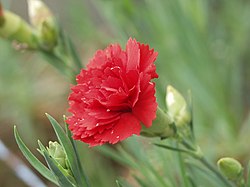
| Red carnations | |
Scientific classification 
| |
| Kingdom: | Plantae |
| Clade: | Tracheophytes |
| Clade: | Angiosperms |
| Clade: | Eudicots |
| Order: | Caryophyllales |
| Family: | Caryophyllaceae |
| Genus: | Dianthus |
| Species: | D. caryophyllus
|
| Binomial name | |
| Dianthus caryophyllus | |
Dianthus caryophyllus (/daɪˈænθəs ˌkɛəriəˈfɪləs/ dy-AN-thəs KAIR-ee-ə-FIL-əs),[1][2] commonly known as carnation or clove pink, is a species of Dianthus native to the Mediterranean region.[3] While its exact natural range is uncertain due to extensive cultivation over the last 2,000 years, wild carnations are most common in the Mediterranean region. Carnations are prized for their wide variety of colors, delicate fringed petals, and fragrance, often described as spicy, clove-like, or reminiscent of a combination of cinnamon and nutmeg, hence the common name "clove pink". This aroma has made carnations a popular choice for use in perfumes, potpourri, and scented products. Culturally, carnations are associated with affection, distinction, and maternal love, with variations depending on color and area within its wide geographical range.[4][5][6]
Taxonomy
[edit]
Carnations were mentioned in Greek literature 2,000 years ago.[7] The term dianthus was coined by Greek botanist Theophrastus,[7] and is derived from the Ancient Greek words for divine ("dios") and flower ("anthos").[8] The name "carnation" is believed to come from the Latin corona, a "wreath, garland, chaplet, crown",[9] as it was one of the flowers used in Greek and Roman ceremonial crowns, or possibly from the Latin caro (genitive carnis), "flesh",[9] which refers to the natural colour of the flower, or in Christian iconography incarnatio, "incarnation", God made flesh in the form of Jesus.
Carl Linnaeus described the carnation in volume one of his Species Plantarum in 1753, giving it the name Dianthus caryophyllus.[10] Although originally applied to the species Dianthus caryophyllus, the name carnation is also often applied to some of the other species of Dianthus, and more particularly to garden hybrids between D. caryophyllus and other species in the genus.
Description
[edit]Dianthus caryophyllus is a herbaceous perennial plant growing up to 80 cm (32 in) tall. The leaves are glaucous greyish green to blue-green, slender, and up to 15 cm (6 in) long. The flowers are produced singly or up to five together in a cyme; they are around 3–5 cm (1¼–2 in) in diameter, and sweetly scented. The original natural flower color is bright pinkish-purple, but cultivars of other colors, including red, pink, yellow, white, and green, have been developed. While sometimes dyed blue for cut bouquets, there are no known carnation cultivars that produce a true blue flower. The fragrant, hermaphrodite flowers have a radial symmetry. The four to six egg-shaped, sting-pointed scale leaves surrounding the calyx are only ¼ as long as the calyx tube.[6][11]
Distribution and habitat
[edit]The wild carnation is found in the Mediterranean countries of Portugal, Spain, Italy, Croatia, Albania, Greece and Turkey.[12][13]
Cultivation and uses
[edit]
Carnations require well-drained,[14] neutral to slightly alkaline soil, and full sun. Numerous cultivars have been selected for garden planting.[6] Typical examples include 'Gina Porto', 'Helen', 'Laced Romeo', and 'Red Rocket'. They are used for medical purposes, such as for upset stomach and fever. Their fragrance was historically used for vinegar, beer, wine, sauces and salads.[15]
Crossbreeding D. caryophyllus with D. capitatus results in a hybrid that is resistant to bacterial wilt from Paraburkholderia caryophylli. However, the flower is less attractive and so more breeding and backcrossing is needed to improve the flower.[16] Carnation cultivars with no fragrance are often used by men as boutonnières or "buttonholes".
Diseases
[edit]Symbolism
[edit]

Traditional meanings
[edit]For the most part, carnations express love, fascination, and distinction, though there are many variations dependent on color.
- Along with the red rose, the red carnation can be used as a symbol of socialism, social democracy, and the labour movement, and historically has often been used in demonstrations on International Workers' Day (May Day).
- In China, the carnation flower is the most frequently used flower in weddings.[17]
- In Portugal, bright red carnations were used when in 1974 the authoritarian Estado Novo regime was overthrown; therefore, this transition (brought about by a combination of a coup d'état with civil resistance) is known as the Carnation Revolution.
- Light red carnations represent admiration, while dark red denote deep love and affection.
- White carnations represent pure love and good luck, while striped (variegated) carnations symbolise regret that a love cannot be shared.
- In the Netherlands, white carnations are associated with Prince Bernhard. He wore one during World War II and in a gesture of defiance some of the Dutch population took up this gesture. After the war the white carnation became a sign of the Prince, veterans and remembrance of the resistance.
- Purple carnations indicate capriciousness. In France, it is a traditional funeral flower, given in condolence for the death of a loved one.[18][19]
- Carnation is the birth flower for those born in the month of January.[20]
- Since Ottoman times, red carnations and tulips are used in the interior wall paintings of mosques in Turkey. It is often said that while tulips represent God, carnations is the symbol for Muhammad. However these flower designs are not unique to mosques but also used in many other Ottoman traditional art forms.
- In Azerbaijan, red carnations has turned into a symbol of mourning after the usage of the flower during Black January events of 1990, a violent crackdown on the civilian population of the country by USSR troops.
- In the United States, former U.S. President William McKinley considered the red carnation to be his lucky flower and often wore one on his lapel. Following his assassination in 1901, the State of Ohio adopted the red carnation as its state flower to honor McKinley.[21]
The formal name for carnation, dianthus, comes from Greek for "heavenly flower",[22] or the flower of Jove.[23]

Holidays and events
[edit]Carnations are often worn on special occasions, especially Mother's Day and weddings. In 1907, Anna Jarvis chose a carnation as the emblem of Mother's Day because it was her mother's favourite flower.[24] This tradition is now observed in the United States and Canada on the second Sunday in May. Jarvis chose the white carnation because she wanted to represent the purity of a mother's love.[25][26] This meaning has evolved over time, and now a red carnation may be worn if one's mother is alive, and a white one if she has died.[27]
In Slovenia, red carnations are sometimes also given to women on Women's Day, the 8th of March; however, nowadays orchids or roses are often given as well.[28] In Korea, carnations express admiration, love, and gratitude. Red and pink carnations are worn on Parents Day (Korea does not separate Mother's Day or Father's Day, but has Parents Day on 8 May). Sometimes, parents wear a corsage of carnation(s) on their left chest on Parents Day. Carnations are also worn on Teachers Day (15 May).[29]
Red carnations are worn on May Day as a symbol of socialism and the labour movement in some countries, such as Austria, Italy,[30] and successor countries of the former Yugoslavia. The red carnation is also the symbol of the Carnation Revolution in Portugal thanks to Celeste Caeiro. Green carnations are for St. Patrick's Day and were famously worn by the gay Irish writer Oscar Wilde. The green carnation thence became a symbol of homosexuality in the early 20th century, especially through the book The Green Carnation and Noël Coward's song, "We All Wear a Green Carnation" in his operetta, Bitter Sweet.[31] In communist Czechoslovakia and in Poland in times of the People's Republic of Poland, carnations were traditionally given to women on the widely celebrated Women's Day, together with commodities that were difficult to obtain due to the countries' communist system, such as tights, towels, soap, and coffee.[citation needed]
After the 1990 uprisings against Soviets in Azerbaijan in which 147 Azerbaijani civilians were killed, 800 people were injured, and five people went missing, the carnation has become a symbol of the Black January tragedy associated with the carnations thrown into the puddles of blood shed in the streets of Azerbaijan subsequent to the massacre.[32]
At the University of Oxford, carnations are traditionally worn to all examinations; white for the first exam, pink for exams in between, and red for the last exam. One story explaining this tradition relates that initially a white carnation was kept in a red inkpot between exams, so by the last exam it was fully red; the story is thought to originate in the late 1990s.[citation needed]

Carnations are the traditional first wedding anniversary flower.[33] Carnations are also known as the "Flower of God". The Greek name for carnation is a fusion of "dios" and "anthos". Dios is used to describe Zeus while Anthos means flower; thus the name "flower of God" is attached to it.[citation needed]
Symbols of territorial entities and organizations
[edit]The carnation is the national flower of Spain, Monaco, and Slovenia, and the provincial flower of the autonomous community of the Balearic Islands. The state flower of Ohio is a scarlet carnation, which was introduced to the state by Levi L. Lamborn. The choice was made to honor William McKinley, Ohio governor and U.S. president, who was assassinated in 1901, and regularly wore a scarlet carnation on his lapel.[34]
Colors
[edit]
Carnations do not naturally produce the pigment delphinidin, and thus a blue carnation cannot occur by natural selection or be created by traditional plant breeding. It shares this characteristic with other widely sold flowers like roses, lilies, tulips, chrysanthemums, and gerberas.
Around 1996, a company, Florigene, used genetic engineering to extract certain genes from petunia and snapdragon flowers to produce a blue-mauve carnation, which was commercialized as Moondust. In 1998, a violet carnation called Moonshade was commercialized.[35] As of 2004, three additional blue-violet/purple varieties have been commercialized.[36]
See also
[edit]References
[edit]- ^ "dianthus". Merriam-Webster.com Dictionary. Merriam-Webster. OCLC 1032680871.
- ^ "Caryophyllus". Merriam-Webster.com Dictionary. Merriam-Webster. OCLC 1032680871.
- ^ "Dianthus caryophyllus Carnation, Clove Pink, Border Carnation PFAF Plant Database". pfaf.org. Retrieved 9 April 2025.
- ^ "Flora Europaea Search Results". websites.rbge.org.uk. Retrieved 9 April 2025.
- ^ Blamey, M. & Grey-Wilson, C. (1989). Flora of Britain and Northern Europe. ISBN 0-340-40170-2
- ^ a b c Huxley, A., ed. (1992). New RHS Dictionary of Gardening. Macmillan ISBN 0-333-47494-5.
- ^ a b Teague, Lettie (22 October 2010). "The Carnation Makes a Comeback". Wall Street Journal. ISSN 0099-9660. Retrieved 9 April 2025.
- ^ "What in Carnation?", Wall Street Journal, Off Duty Section, 23–24 October 2010, p.D1
- ^ a b Cassell's Latin Dictionary, Marchant, J.R.V, & Charles, Joseph F., (Eds.), Revised Edition, 1928
- ^ Linnaeus, Carl (1753). "Tomus I". Species Plantarum (in Latin). Vol. 1. Stockholm: Laurentii Salvii. p. 410.
- ^ Flora of NW Europe: Dianthus caryophyllus Archived 8 December 2007 at the Wayback Machine
- ^ "The Euro+Med Plantbase Project". ww2.bgbm.org. Retrieved 9 April 2025.
- ^ Hall, Heather (10 February 2023). "Discover The National Flower of Spain: Red Carnation". A-Z Animals. Retrieved 9 April 2025.
- ^ "How to grow and care for carnations at home". ews.laodong.vn. 31 July 2023. Retrieved 9 April 2025.
- ^ Hans Wolfgang Behm: The flora around us. The colored book of flowers and flowers in gardens and house. Berlin 1966.
- ^ Onozaki, T., Ikeda, H., Yamaguchi, T., and Himeno, M. (1998). introduction of Bacterial Wilt (pseudomonas caryophylli) resistance in Dianthus wild species to carnation. In "ISHS Acta Horticulturae III: New Floricultural Crops", Considine, J. eds, Acta Horticulturae, Perth, Western Australia. pp. 127–132
- ^ "Carnation Flower Meaning". Flower Meaning. Retrieved 9 April 2025.
- ^ Anthony S. Mercatante (1976), The magic garden: the myth and folklore of flowers, plants, trees, and herbs, Harper & Row, p. 9, ISBN 0-06-065562-3
- ^ "The legend of the carnation", Library notes, Alabama Public Library Service, 1965, p. 6
- ^ "Symbolic Meaning of Carnation | Teleflora". www.teleflora.com. Retrieved 9 April 2025.
- ^ "Statehouse to Commemorate Anniversary of President William McKinley's Death; Red Carnation Day, September 14 | Ohio Statehouse". www.ohiostatehouse.org. Retrieved 29 July 2022.
- ^ "dianthus". Merriam-Webster Online Dictionary. Merriam-Webster Online. 2010. Retrieved 4 March 2010.
- ^ "Care Information for Standard Carnation". Calyx Flowers Floral Library. Calyx & Corolla, Inc. 2010. Retrieved 4 March 2010.
- ^ Leigh Eric Schmidt (1997). Princeton University Press (ed.). Consumer Rites: The Buying and Selling of American Holidays (reprint, illustrated ed.). Princeton University Press. p. 260. ISBN 0-691-01721-2.
- ^ Louisa Taylor, Canwest News Service (11 May 2008). "Mother's Day creator likely 'spinning in her grave'". Vancouver Sun. Archived from the original on 27 June 2008. Retrieved 7 July 2008.
- ^ "Mother's Day reaches 100th anniversary, The woman who lobbied for this day would berate you for buying a card". NBC News. Associated Press. 11 May 2008. Retrieved 7 July 2008.
- ^ "Annie's "Mother's Day" History Page". Retrieved 26 June 2008.
- ^ Blatnik, Tanja Kozorog. "Rože ob dnevu žena: nekoč "rožni stereotip" nagelj, danes vrtnice in orhideje". rtvslo.si (in Slovenian). Retrieved 3 January 2024.
- ^ Eaves, Gregory (13 May 2016). "Teacher's Day". korea.net. Retrieved 2 February 2017.
- ^ Keith Flett (2002). "May Day". Socialist Review. Archived from the original on 16 June 2021. Retrieved 4 March 2010.
- ^ Oanh, Tú (15 March 2025). "Dạy cắm hoa". shophoatuoanh.com (in Vietnamese). Retrieved 9 April 2025.
- ^ "The night on which even the carnation shed tears". Hürriyet Daily News. 18 January 2017. Retrieved 26 February 2020.
- ^ Wedding anniversary#Flower gifts
- ^ "Lawriter – ORC – 5.02 State flower". Codes.ohio.gov. Retrieved 8 December 2015.
- ^ Phys.Org website. 4 April 2005 Plant gene replacement results in the world's only blue rose
- ^ "GM Carnations in Australia. A Resource Guide" (PDF). Agrifood Awareness Australia. November 2004. Archived from the original (PDF) on 8 May 2012.
External links
[edit]


Dianthus caryophyllus
View on GrokipediaTaxonomy and Nomenclature
Classification and Phylogeny
Dianthus caryophyllus is classified within the kingdom Plantae, clade Tracheophytes, clade Angiosperms, clade Eudicots, order Caryophyllales, family Caryophyllaceae, genus Dianthus, and species caryophyllus.[6][7] The binomial nomenclature was established by Carl Linnaeus in Species Plantarum in 1753, with the species serving as the lectotype for the genus Dianthus.[7] Phylogenetic studies place Dianthus caryophyllus as the type species of Dianthus, a genus estimated to include around 300-340 species primarily distributed across Eurasia.[8] Molecular analyses using plastid markers (matK-trnK-psbA, rpl32-trnL, trnQ-rps16) and nuclear ITS sequences resolve Dianthus into multiple clades, with D. caryophyllus embedded in Clade A, which encompasses Eurasian taxa including subspecies of D. fruticosus.[8][9] This positioning reflects the genus's evolutionary diversification within the Mediterranean basin, its native region, though cultivation has obscured wild phylogenetic signals.[8] Within Caryophyllaceae, Dianthus aligns with tribe Caryophylleae, part of the broader Caryophyllales order, which diverged from other eudicot lineages prior to the Cretaceous-Paleogene boundary.[9] Genome-scale phylogenies estimate the divergence between D. caryophyllus and related genera like Gypsophila (also in Caryophyllaceae) at approximately 54 million years ago, supporting a Paleogene radiation consistent with fossil evidence of early caryophyllaceous pollen.[10] These reconstructions underscore Dianthus' monophyly and its basal role in clade definitions, despite historical taxonomic challenges from hybridization and morphological convergence.[8]Etymology and Synonyms
The genus name Dianthus derives from the Greek words dios (of Zeus or divine) and anthos (flower), signifying "flower of Zeus" or "divine flower," a designation reflecting the plant's esteemed ornamental value in ancient Mediterranean cultures.[11] The specific epithet caryophyllus stems from the Greek karyophyllon (nut leaf), originally applied to the clove tree (Syzygium aromaticum) due to its bud morphology, but adopted here for the flower's analogous spicy, clove-like fragrance produced by eugenol compounds in its petals.[12] The common English name "carnation" has two primary etymological theories: one linking it to Latin corōna (crown or garland), based on the flower's use in ancient Greek and Roman wreaths for athletes and ceremonies, potentially evolving into "coronation" or "gilliflower" forms; the other tracing it to carnis (flesh), referencing the species' natural pale pink coloration akin to skin tones in early cultivated varieties.[13][14] "Clove pink" serves as a descriptive synonym emphasizing the clove scent, while "gillyflower" (from French girofle, clove) was a historical English term for scented pinks before specialization to D. caryophyllus.[14] No widely accepted scientific synonyms exist for the species Dianthus caryophyllus L., as established in Linnaean taxonomy since 1753, though older regional vernaculars like "sops-in-wine" alluded to its use in flavoring drinks.[12]Botanical Characteristics
Morphology and Growth Habit
Dianthus caryophyllus is a herbaceous perennial with an upright growth habit, typically forming a tuft or clump from a woody base, producing 10-15 side shoots. Plants grow to heights of 30-100 cm, with young specimens developing 1-5 stems, each capable of bearing up to 6 flowers. Cultivated forms exhibit variation: border types are hardy and compact, perpetual-flowering cultivars are taller with thicker stems, while annual hybrids behave as short-lived due to exhaustive flowering.[15][3][16] Stems arise erect from the base, becoming woody at the lower portion while remaining herbaceous and branched above, often featuring swollen, brittle nodes where leaves attach. Leaves are arranged oppositely along the stems, linear to lanceolate in shape, 5-15 cm long and 0.3-0.8 cm wide, with a glaucous grey-green to blue-green hue, flat and soft texture, and conspicuous sheathing bases. These adaptations support efficient photosynthesis and structural integrity in Mediterranean climates.[15][3][13] The root system is fibrous, enabling establishment in well-drained soils and contributing to drought tolerance once mature, though shallow in some container-grown varieties. Overall, the morphology reflects adaptation for ornamental cultivation, with selections emphasizing long, sturdy stems for cut-flower production over wild forms' more compact stature.[17][18]Reproductive Biology
Dianthus caryophyllus produces hermaphroditic flowers characterized by five petals in the wild type, though cultivated varieties often exhibit up to 40 petals that may partially enclose the reproductive organs; each flower features 10 stamens and two fused carpels with two styles, along with nectaries at the base that attract pollinators.[15] The inflorescence typically forms simple or branched clusters, with flowers displaying protandry, where anther dehiscence precedes stigma receptivity, promoting outcrossing.[15] As an obligate outcrosser, the species exhibits self-incompatibility primarily through this temporal mechanism, rendering self-pollination ineffective and maintaining high heterozygosity; concealed genetic factors for self-incompatibility further reinforce this gametophytic system in the Caryophyllaceae family.[15][19] Pollination occurs via insects, particularly Lepidoptera such as moths and butterflies, which access nectar and transfer pollen between flowers; in natural settings, this entomophilous process ensures cross-fertilization, though cultivated varieties often show reduced fertility with pollen viability below 10% in some lines and rare seed set due to selective breeding for ornamental traits.[15][20] Following successful pollination, fertilization leads to capsule development containing up to 100 seeds, averaging 40, which ripen in approximately six weeks; seeds are wind-dispersed upon capsule dehiscence, lacking specialized animal-mediated mechanisms.[15] While sexual reproduction via seeds is the primary natural mode, commercial propagation favors vegetative methods like cuttings to preserve desirable traits, as seed production in cultivars remains low and genetically variable.[15] The species is diploid with 2n=30 chromosomes, though tetraploid forms exist, influencing reproductive compatibility in interspecific hybrids.[15]Natural Occurrence and Ecology
Native Range and Habitat
Dianthus caryophyllus, commonly known as the carnation or clove pink, originates from the Mediterranean Basin, with confirmed wild populations in Albania, Greece, and the Balkan region encompassing the former Yugoslavia.[13] Its precise native distribution is difficult to delineate due to extensive cultivation spanning over 2,000 years, which has led to widespread feral escapes and hybridization, complicating distinctions between truly wild and derived populations.[21] Limited records indicate an extremely restricted natural occurrence in northern Mediterranean coastal areas of southern Europe.[15] The species inhabits rugged, well-drained terrains such as dry stony slopes, rock crevices, cliffs, and old masonry walls, preferentially on calcareous limestone substrates.[21][16] These environments provide the full sunlight and low humidity conditions essential for its perennial herbaceous growth habit, adapted to Mediterranean climates featuring mild winters with precipitation and hot, arid summers.[13][22]Ecological Interactions
In its native Mediterranean habitats, Dianthus caryophyllus engages in mutualistic interactions with insect pollinators, primarily lepidopterans such as moths and butterflies, which facilitate pollen transfer while accessing nectar and pollen rewards.[3] These relationships can exhibit antagonism, as certain moth species oviposit eggs into flowers, leading to larval herbivory that damages reproductive structures.[23] Visitation by hymenopterans like bees has also been observed in wild populations, contributing to cross-pollination, though lepidopteran efficiency dominates due to floral morphology adapted for long-proboscid visitors.[24] Herbivorous interactions involve various arthropods, including lepidopteran larvae that feed on foliage and flowers, exerting selective pressure on plant defenses.[23] Volatile methyl ketones, such as 2-pentadecanone, produced by D. caryophyllus tissues, deter generalist herbivores and fungal pathogens, enhancing survival in natural settings.[25] The plant's clove-like scent and floral flavonoids further mediate indirect defenses by attracting parasitoids of herbivores, balancing attraction to pollinators with repellence to browsers.[26] Symbiotic associations with arbuscular mycorrhizal fungi (AMF), including isolates of Glomus intraradices, form in root systems, improving phosphorus uptake and drought tolerance in nutrient-poor soils typical of Mediterranean scrublands.[27] This mutualism extends extraradical hyphal networks, enhancing water and mineral acquisition while the plant provides carbohydrates, with colonization rates varying by soil conditions and AMF inoculum.[28] Such interactions underscore D. caryophyllus' role in soil microbial communities, though extensive cultivation has obscured native dynamics.[23]Historical Development
Origins and Early Cultivation
Dianthus caryophyllus is native to the Mediterranean region of southern Europe, encompassing areas from France to Greece, where wild populations persist in rocky, calcareous soils.[2] [29] The species likely originated from these wild progenitors, characterized by smaller, pinkish flowers with serrated petals, distinguishing them from later cultivated varieties.[2] Cultivation of D. caryophyllus dates back over 2,000 years, with the earliest records attributing its ornamental use to the Ancient Greeks, who valued it for its fragrance and clove-like scent derived from eugenol compounds.[13] [2] By circa 50 B.C., Roman naturalist Pliny the Elder documented its long-established presence in the Roman Empire, indicating centuries of selective propagation for garden and possibly medicinal purposes, though specific horticultural techniques from this era remain sparsely evidenced.[30] During the Middle Ages, awareness of the plant extended to Turkey, the Middle East, and parts of western Europe via trade routes, but archaeological and textual evidence suggests limited widespread cultivation, primarily confined to monastic or elite gardens rather than commercial scales.[15] Early breeding focused on enhancing flower size, color variation (initially pinks and whites), and stem length through vegetative propagation, laying foundations for its later economic significance.[4]Expansion and Regional Importance
Carnation cultivation expanded beyond its Mediterranean origins through European trade and ornamental gardening interests, reaching northern Europe by the 16th century and gaining prominence in Dutch and French greenhouses by the 18th century, where selective breeding enhanced flower size and color diversity.[2] Large-scale commercial production for cut flowers began in Europe during the mid-1800s, driven by rising demand in urban markets and advancements in greenhouse technology that allowed controlled environments for year-round blooming.[15] This period marked a shift from garden ornamentals to export-oriented crops, with Italy, Spain, and the Netherlands emerging as early centers of varietal development and distribution.[31] In the 20th century, production relocated to equatorial highland regions to capitalize on natural climatic advantages—mild days, cool nights, and high light intensity—reducing energy costs compared to heated European facilities. Colombia pioneered this expansion, with initial carnation plantings near Bogotá in the mid-1960s, leveraging altitudes of 2,500–3,000 meters for optimal growth; by the 1980s, it had become the world's top exporter, with carnations comprising approximately 40% of national flower shipments, primarily to the United States.[32] [33] Kenya followed suit in the 1970s, establishing farms in the Rift Valley highlands, where similar conditions support disease-resistant yields and contribute significantly to export revenues, alongside roses as key floricultural commodities.[2] These regions now dominate global supply, producing over 70% of traded carnations, underscoring the economic pivot toward low-cost, high-volume output in developing economies.[34] The Netherlands retains regional importance as a breeding and innovation hub, hosting annual events like the Keukenhof Carnation Show and developing spray and standard varieties for premium markets, though domestic production has declined in favor of imports.[35] In Asia, China has expanded cultivation in temperate highlands since the late 20th century, focusing on domestic consumption and emerging exports, while countries like Australia initiated commercial grows in 1954, yielding around 140 million stems annually by the early 2000s for local and Pacific markets.[2] [15] This global dispersal reflects causal factors like climate suitability, labor availability, and proximity to consumer bases, transforming carnations into a staple of the international cut-flower trade valued at billions annually.[36]Breeding and Genetic Improvement
Traditional Selection and Hybridization
Traditional breeding of Dianthus caryophyllus relies on controlled hybridization and rigorous selection to enhance ornamental traits such as flower size, petal form, color range (primarily pinks, reds, and whites), fragrance, stem length, and vase life. Originating from wild Mediterranean populations, cultivated forms emerged through centuries of selective propagation, with systematic hybridization intensifying in Europe from the 16th century onward, producing diverse types including border carnations and perpetual-flowering varieties.[23][2] The hybridization process entails selecting parent plants with complementary traits—such as one for robust stems and another for vibrant coloration—followed by manual cross-pollination. Flower buds on the maternal parent are emasculated by removing anthers one day prior to natural opening to preclude self-pollination, given the species' gametophytic self-incompatibility system that typically prevents viable self-seed. Pollen from the paternal parent is then transferred to the stigma, with seeds harvested after maturation, germinated, and seedlings grown out for evaluation.[37][15] Selection occurs across multiple generations, often spanning 5–7 years per cycle, involving assessment of thousands of seedlings for phenotypic uniformity, bloom quality, and vigor under field conditions. Superior genotypes are cloned via cuttings for propagation, as D. caryophyllus rarely produces seeds true to type without intervention, while inferior plants are culled. This iterative approach has yielded intraspecific hybrids with enhanced diversity, though interspecific crosses with other Dianthus species occasionally introduce traits like novel scents or disease tolerance.[15][2] Historical records indicate that seedling variation in size, form, and color—driven by accumulated mutations and recombinations—underpins much of the progress, with early breeders exploiting open-pollinated populations before controlled methods prevailed. By the 19th and early 20th centuries, American and European programs emphasized perpetual bloomers for greenhouse production, selecting for non-vernalization-dependent flowering and resistance to fungal pathogens through backcrossing.[37] Limitations persist, as traditional methods cannot readily achieve non-native colors like true blue without genetic modification, due to the absence of requisite pigments in the germplasm.[2]Biotechnology and Genetic Modification
Genetic transformation systems for Dianthus caryophyllus were developed in the early 1990s, primarily using Agrobacterium tumefaciens-mediated gene transfer into explants such as leaf segments, stem internodes, and petals, followed by regeneration via tissue culture on media with hormones like cytokinins and auxins.[38][39] These protocols enabled stable integration of transgenes, confirmed by selection on antibiotics like kanamycin and molecular analyses such as Southern blotting.[38] The foremost genetic modifications target flower color, addressing the species' natural limitation in producing delphinidin-derived anthocyanins, which precludes true blue or purple hues. Transgenic lines incorporate the flavonoid 3',5'-hydroxylase (F3'5'H) gene from sources like pansy (Viola spp.) or petunia, often combined with petunia dihydroflavonol 4-reductase (DFR) and tobacco suppressor (suRB) genes, to redirect the flavonoid pathway toward delphinidin accumulation.[40][23] This resulted in the Florigene Moon series, including varieties like Moondust (lavender) and Moonlite (mauve), first approved for commercial release in Australia in 1995 and marketed from 1997, with subsequent approvals for import and cultivation in the EU, USA, and Japan.[41][42] Safety evaluations by regulatory bodies, including Australia's Office of the Gene Technology Regulator (OGTR) and the European Food Safety Authority (EFSA), have concluded no increased risks to human health, allergenicity, or the environment compared to conventional carnations, based on compositional analyses, toxicity tests in rodents, and ecological modeling showing limited feral persistence due to the species' ornamental traits and sterility in many cultivars.[23][43] Additional modifications enhance vase life by suppressing ethylene signaling, a key senescence trigger in cut flowers. Antisense or RNAi constructs targeting ACC oxidase (ACO), a rate-limiting enzyme in ethylene biosynthesis, reduce endogenous ethylene levels, extending post-harvest longevity from 7-8 days in standard varieties to 14-16 days or more.[23][44] Florigene commercialized such long-vase-life GM carnations alongside color-modified lines, with Australian production reaching 4.5 million stems between 1995 and 2006, primarily for export markets accepting GM ornamentals.[23][45] As of 2020, nine GM carnation cultivars were available globally, all focused on these traits, though adoption remains limited outside approving jurisdictions due to consumer and regulatory preferences for non-GM labeling in some regions.[41] Biotechnology has also supported marker-assisted selection and protoplast fusion for trait introgression, but direct genetic engineering predominates for novel phenotypes unattainable via conventional breeding.[2]Cultivation and Production
Agronomic Practices
Carnations (Dianthus caryophyllus) are primarily propagated vegetatively through stem cuttings or suckers to maintain desirable traits in commercial production, as seed propagation often leads to variability in flower quality and uniformity. Cuttings are typically taken from healthy mother plants, rooted under mist propagation systems with high humidity and bottom heat around 20-22°C, achieving rooting in 15-20 days before transplanting. While commercial propagation typically uses mist systems and bottom heat for faster rooting (15-20 days), home gardeners can successfully root fresh stem cuttings from cut flowers or bouquets in plain water. Place the cuttings in a jar of water on a windowsill, changing the water regularly to prevent rot; roots may form in 3-4 weeks or longer, though this method is slower and less reliable than soil-based or mist propagation techniques.[46][47][48] Soil preparation emphasizes well-drained media to prevent root rot, with sandy loam or red loamy soils preferred, amended with organic matter for fertility and a pH range of 5.5-6.5. In greenhouse settings, soil sterilization via steam or fumigation is standard prior to planting to eliminate pathogens. Raised beds, 45 cm high and 90 cm wide with 45 cm paths, facilitate drainage and access, with planting densities of 15 × 15 cm for standard types or 20 × 20 cm for sprays, equating to approximately 44,000-50,000 plants per hectare.[46][49][50] Optimal climate involves day temperatures of 10-20°C and nights of 5-10°C, with relative humidity at 50-60% to minimize fungal issues; commercial cultivation occurs year-round in controlled environments like polyhouses or greenhouses, often in highland regions for natural cooling. Full sun exposure (at least 4-6 hours daily) promotes vigorous growth, though light shading nets reduce stress in intense light. Pinching the growing tip 10-15 days post-planting encourages branching, while disbudding removes side buds to focus energy on terminal flowers for standard cultivars.[51][46][52] Irrigation maintains consistent soil moisture without waterlogging, using drip systems to deliver 3-5 mm daily adjusted for evapotranspiration, avoiding overhead watering that spreads diseases. Fertilization follows a balanced program with nitrogen at 150-200 kg/ha, phosphorus at 100 kg/ha, and potassium at 200-250 kg/ha split over growth stages, supplemented by micronutrients like calcium and magnesium to prevent deficiencies. Plant support via horizontal wires or clips at 20-30 cm intervals prevents lodging as stems elongate to 60-100 cm.[49][51][53]Commercial Scale and Economics
The commercial production of Dianthus caryophyllus, commonly known as carnations, centers on cut flower markets, with greenhouse-based cultivation enabling year-round output in temperate and tropical regions. Major producers include Turkey, which accounts for approximately 80% of global supply, primarily from Antalya province where over 1,000 hectares are dedicated to the crop, though growers have reported persistently low prices amid high volumes. Other key exporters are the Netherlands, Colombia, Ecuador, and Kenya, leveraging favorable climates and proximity to ports for air freight to Europe and North America.[54][55][56] Export trade underscores the crop's economic scale, with the Netherlands shipping carnations valued at 141 million euros in 2021, while Colombia's broader cut flower exports, including significant carnation volumes, reached $1.73 billion that year. Global carnation market valuations vary across reports but indicate steady growth; for instance, one estimate places the sector at USD 7.3 billion in 2023, projecting expansion to USD 10.8 billion by 2032 at a compound annual growth rate (CAGR) of around 4-6%, driven by demand for ornamental uses in events, gifting, and floristry.[57][58][59] Economically, carnation cultivation under protected structures yields high returns in suitable environments, with plants productive for up to three years and net profits reported at 2-3 times initial investment in regions like India and Turkey, contingent on yield (150-250 stems per square meter annually) and wholesale prices of $0.10-0.30 per stem. Challenges include volatile input costs for energy and labor, disease pressures necessitating integrated management, and market saturation leading to price depressions, as evidenced by Turkish producers' complaints despite dominance.[60][54][61]| Major Carnation Exporting Countries | Key Export Value (Recent Data) | Primary Markets |
|---|---|---|
| Netherlands | €141 million (2021) | Europe, North America |
| Colombia | Included in $1.73 billion total cut flowers (2021) | U.S., Europe |
| Kenya | Included in $663 million total cut flowers (2023) | Europe |