


Community hub
Recent from talks
Contribute something
Nothing was collected or created yet.
Capri pants
View on Wikipedia | |
| Designer | Sonja de Lennart,[citation needed] Bunny Roger |
|---|---|
| Type | pants |
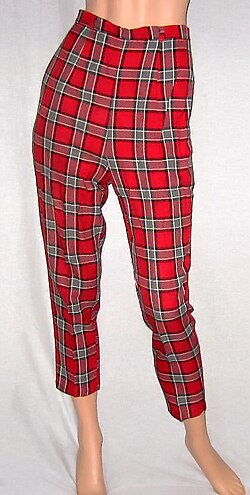
Capri pants (also known as three quarter legs, or capris, crop pants, man-pris, clam-diggers,[1] flood pants, ankle pants, jams, highwaters, or toreador pants[2]) are pants that are longer than shorts, but are not as long as trousers. Capri pants can be a generic term for any cropped slim pants, and used as a specific term to refer to pants that end on the ankle bone.[3]
History
[edit]Capri pants were introduced by fashion designer Sonja de Lennart in 1948,[4] and were popularized by her[citation needed] and English couturier Bunny Roger.[5] The name of the pants is derived from the Italian isle of Capri, where they rose to popularity in the late 1950s and early 1960s.[6] The actress Audrey Hepburn was among the first movie stars who wore capris, and the pants quickly became synonymous with her classic style. The French actress Brigitte Bardot famously wore capri pants at a time when trousers were still a new fashion for women.[7] Marilyn Monroe always traveled with capri pants.[8]
Capri pants were popularized in the United States in the 1960s television series The Dick Van Dyke Show. The character Laura Petrie, the young housewife played by Mary Tyler Moore, caused a fashion sensation – and some mild controversy – by wearing close-fitting capri pants throughout the show's run[9][10][11] (capris that were later referred to as 1950s hausfrau[12]).
By the mid 1960s, capri-style tight-fitting cargo pants became popular among teenage boys; a good example was the superstar teen actor of that era, Luke Halpin, who wore them in some episodes of the popular Flipper.[citation needed] After a drop in popularity during the 1970s through the 1990s, capri pants returned to favor in the mid 2000s.[13] Spanish tennis player Rafael Nadal wore capri pants in the majority of his matches before 2009 following a deal with Nike to wear sponsored capris, a deal that Roger Federer had turned down before him.[14][15]
In 2017, the superintendent of the Douglas County School District in Georgia, United States, sent out an email qualifying capri pants as inappropriate garments for the school environment, thus raising the question of what pants length remain acceptable.[16]
Gallery
[edit]-
 Model Erni Mangold wearing Sonja de Lennart Capris, 1949
 -
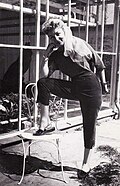 Model Mady Rahl wearing Sonja de Lennart Capris, 1949
 -
 Female in capris (2007)
 -
 Male in cropped jeans (man-pris) (Stevenage, 2009)
 -
 Loose-fit, black, bike capris


.jpg)

See also
[edit]References
[edit]- ^ "clam-diggers" Collins English Dictionary. Retrieved 24 September 2013.
- ^ "toreador pants" Collins English Dictionary. Retrieved 24 September 2013.
- ^ Tribune, Anne Marie O'Connor (16 June 1999). "Tips for the Body-Conscious On Capri Pants, Saggy Chins, Spider Veins". Chicago Tribune. Retrieved 2020-08-14.
- ^ Reitter-Welter, Barbara (28 June 2015). "Fur Klosterschulerinnen verboten". Welt am Sonntag; Berlin.
- ^ Fisher, Clive (29 April 1997). "Obituary: Bunny Roger". The Independent. Archived from the original on 7 April 2011. Retrieved March 12, 2016.
- ^ "Ancient Capri Still Casts Its Powerful Spell". (29 June 2008). The Boston Globe.
- ^ "Who's wearing the trousers?". BBC News. Retrieved 2020-08-15.
- ^ Doonan, Simon (2013-12-18). "The Horrifying Thing I Learned About Marilyn Monroe by Folding Her Capri Pants". Slate. Retrieved 2020-08-15.
- ^ Vince Waldron (2001). The Official Dick Van Dyke Show Book: The Definitive History and Ultimate Viewer's Guide to Television's Most Enduring Comedy. Applause. pp. 128–130. ISBN 978-1-55783-453-9.
- ^ "Why Mary Tyler Moore's Capri Pants May Have Been The Most Important Costume On TV". Bustle. 25 January 2017. Retrieved 2020-08-14.
- ^ Desta, Yohana. "How Mary Tyler Moore Subverted TV Sexism with a Pair of Capris". Vanity Fair. Retrieved 2020-08-15.
- ^ Spindler, Amy M. (1995-03-07). "Review/Fashion; A Retreat From Retro Glamour". The New York Times. ISSN 0362-4331. Retrieved 2020-08-15.
- ^ From Abba to Zoom: A Pop Culture Encyclopedia of the Late 20th Century. Andrews McMeel Publishing. 2005. pp. 68–. ISBN 978-0-7407-9307-3.
- ^ "Ueda's Commentary on Modern Tennis Champions" (30 November 2010). A. Ueda.
- ^ Murali, Mahalakshmi (2020-04-05). "Roger Federer Reveals Why He Doesn't Wear Sleeve-less and Capri Pants". EssentiallySports. Retrieved 2020-08-14.
- ^ "Are capri pants appropriate work attire for teachers?". Today.com. 3 August 2017. Retrieved 2020-08-14.
External links
[edit] Media related to Capri pants at Wikimedia Commons

| Headwear | |||||||||
|---|---|---|---|---|---|---|---|---|---|
| Neckwear | |||||||||
| Underwear and lingerie |
| ||||||||
| Tops | |||||||||
| Bottoms |
| ||||||||
| Full-Body Wear |
| ||||||||
| Coats and outerwear |
| ||||||||
| Nightwear | |||||||||
| Swimwear | |||||||||
| Legwear | |||||||||
| Footwear | |||||||||
| Accessories |
| ||||||||
| Dress codes |
| ||||||||
| Related | |||||||||

Capri pants
View on GrokipediaDefinition and Characteristics
Description and Terminology
Capri pants, commonly referred to as capris, consist of close-fitting women's trousers that terminate above the ankle, generally at mid-calf length. [1] This style features a tapered leg design, narrowing toward the hem, which accentuates the lower leg while providing a streamlined silhouette.[7] A distinctive element often includes a vertical slit at the outer bottom edge of each leg, facilitating movement and adding a functional detail to the garment.[7] [8] The terminology "capri pants" emerged in the mid-20th century, with "capris" serving as a shorthand plural form frequently used interchangeably in casual and fashion contexts. This distinguishes them from broader categories like cropped pants, which encompass any shortened trousers but lack the specific mid-calf endpoint and tapered fit characteristic of capris.[9] Pedal pushers, a related style, differ by ending higher—typically just below the knee or at the upper calf—and often adopting a looser, less form-fitting cut, evoking mid-20th-century casual wear associated with cycling or leisure activities.[10] [11] Variations in capri pants include adjustments in length ranging from below the knee to just above the ankle, alongside diverse fits such as straight-leg or relaxed profiles, though the classic iteration remains snug and calf-exposing.[12] These adaptations maintain the core cropped aesthetic while accommodating seasonal or stylistic preferences.Design Elements and Variations
Capri pants feature a cropped inseam typically measuring 21 to 24 inches, ending between the mid-calf and ankle to expose the lower leg while maintaining a tailored appearance.[13] Their core silhouette consists of a fitted or tapered leg from hip to hem, often with a straight or slim cut that emphasizes leg contours without excess volume.[2] Classic iterations include a mid- to high-rise waistline for structure, sometimes secured with a drawstring or elastic for adjustability.[14] Fabrics vary by intended use, with lightweight cotton or linen blends predominant for casual summer styles due to breathability, while wool or heavier weaves appeared in early winter adaptations.[11] Denim and synthetic blends like poly-spandex provide stretch and durability in modern versions.[15] Variations encompass length adjustments, such as shorter "pedal pushers" terminating just below the knee or at the upper calf, differing from standard capris by avoiding the mid-calf widening that can visually shorten legs.[10] Broader cropped pants, often interchangeable in terminology, may end above the ankle for a less restrictive fit, while athletic capris incorporate moisture-wicking materials and elastic cuffs for functionality in cycling or hiking.[16] Men's adaptations, termed "man-pris" or cropped jeans, mirror the tapered form but in looser proportions, gaining niche traction in casual wear since the 2000s.[17]Historical Development
Invention by Sonja de Lennart
Sonja de Lennart, born on May 21, 1920, in Breslau, Prussia (now Wrocław, Poland), emerged as a fashion designer amid the post-World War II era in Germany.[3] Her invention of Capri pants in 1948 stemmed from a practical improvisation during a beach walk on the Italian island of Capri, where she wore long trousers and sought relief from the heat by cropping them to mid-calf length, resulting in a fitted, three-quarter-length style with a short slit at the hem.[18] [11] This design challenged prevailing norms that confined women primarily to skirts and full-length attire, reflecting de Lennart's rebellion against gender-specific clothing restrictions rooted in Prussian societal expectations.[19] [4] The Capri pants, initially termed "Capri-Hose" in German, featured a close-fitting cut that accentuated the leg while allowing greater mobility than traditional dresses, marking a shift toward practical women's sportswear influenced by wartime fabric shortages and reconstruction efforts.[2] De Lennart's background in a war-devastated region underscored the garment's utilitarian origins, prioritizing functionality over ornamentation in an era of material scarcity.[19] In 1949, German actresses Erni Mangold and Mady Rahl modeled the pants, demonstrating both winter and summer variants that highlighted their versatility for European climates.[3] De Lennart's creation gained initial traction through her Hamburg-based atelier, where she produced the pants as part of a broader line challenging conservative fashion dictates, though widespread adoption awaited later international endorsements.[19] The design's empirical appeal lay in its causal adaptation to environmental needs—shorter length for warmth regulation—and anatomical fit, enabling unencumbered movement without the exposure of shorts, thus bridging modesty and modernity in mid-20th-century women's attire.[11] Sources attributing the invention to de Lennart, including her own brand archives and contemporary fashion histories, consistently date the prototype to 1948, predating similar cropped styles in other regions.[2] [3]Rise to Popularity in Post-War Europe and America
Following World War II, Sonja de Lennart opened her first boutique, Salon Sonja, in Munich in 1945 and began producing innovative fashion wear amid Europe's recovering textile industry. By 1948, she designed and launched the cropped capri pants, initially as a fitted, three-quarter-length style suited to her petite frame, adapting them from longer trousers observed during a trip to the Italian island of Capri where she rolled up pant legs to avoid seawater on the beach.[19][2] These pants, modeled in winter and summer variants by figures like Erni Mangold and Mady Rahl in 1949, gained initial traction in Germany as a practical yet elegant alternative to full-length trousers or skirts, reflecting post-war desires for mobility and femininity in a time of material shortages and rationing.[11] The style's name derived from Capri, where de Lennart's visit post-war helped cement its association with leisurely Mediterranean aesthetics, spreading across Europe through her designs and boutique expansions as women embraced the cropped silhouette for its versatility in casual and semi-formal settings.[18] In Italy and broader continental Europe, capris symbolized emerging fashion autonomy, with de Lennart's innovations positioning her as a key post-WWII designer challenging traditional skirt-dominated wardrobes.[4] By the early 1950s, the pants had permeated European ready-to-wear markets, bolstered by growing textile production and a shift toward relaxed silhouettes amid economic recovery. In America, capri pants arrived via transatlantic fashion influences and Hollywood, achieving widespread popularity in the 1950s as "pedal pushers" or "clam diggers," fitting snugly to mid-calf and paired with blouses or sweaters for suburban and urban casual wear.[20] Their breakthrough came with Audrey Hepburn's portrayal in the 1953 film Roman Holiday, where costume designer Edith Head selected capris for Hepburn's character, Princess Ann, during Roman scooter scenes, projecting an image of youthful sophistication that resonated with American audiences and propelled the style into mainstream catalogs and department stores.[2][11] Sales surged as manufacturers like those in New York's garment district adapted European cuts for mass production, with the pants becoming a staple by the late 1950s, worn by celebrities such as Marilyn Monroe and everyday women for their comfort in hot climates and alignment with post-war leisure trends.[21] This adoption marked a causal shift from wartime austerity to consumer-driven fashion, evidenced by their prevalence in 1950s pattern books and advertisements emphasizing slim fits ending just above the ankle.[22]Revivals from the 1990s to the 2020s
Capri pants experienced a resurgence in the late 1990s, transitioning into widespread popularity during the early 2000s, particularly among celebrities and mainstream fashion.[23] Figures such as Beyoncé, Rihanna, Christina Aguilera, and Jennifer Lopez frequently wore low-rise capri styles, often in denim or fitted fabrics, which dominated streetwear and red carpet appearances.[24] [25] This era saw capris as a staple for casual yet styled looks, paired with crop tops or fitted shirts, reflecting the low-rise jean trend's influence.[26] Following their peak in the mid-2000s, capri pants largely faded from favor through the late 2000s and 2010s, supplanted by fuller-length trousers and skinnier silhouettes.[27] Sporadic appearances occurred on runways, such as those from Jacquemus, Acne Studios, and Chanel, but without broad consumer adoption.[28] A renewed interest emerged in the early 2020s, accelerating by 2023 with increased runway presence in collections like spring/summer 2025 lines from brands including Chloé, The Row, Arket, COS, and Totême.[29] [30] Celebrities such as Bella Hadid, Meghan Markle, and Emma Stone adopted updated versions, often in leather or minimalist designs, signaling a shift toward more refined, less low-rise iterations suitable for transitional weather.[31] This revival, while divisive—evoking nostalgia for some and criticism for proportions from others—aligns with cyclical returns to early 2000s aesthetics.[26] [32]Cultural and Social Significance
Impact on Women's Fashion Autonomy
Capri pants, debuted by German designer Sonja de Lennart in 1945, marked a significant evolution in women's attire by providing a cropped, form-fitting trouser that balanced practicality with femininity, diverging from the era's predominant skirts and full-length dresses. This design facilitated greater physical mobility for everyday activities, such as leisure pursuits and household tasks, in a post-World War II context where women increasingly valued functional clothing amid economic recovery and shifting social roles. Fashion historian Stephanie Kramer observed that "the capri pant symbolized a shift in the acceptance of pants as a fashionable style for women," reflecting a broader emancipation from restrictive dress codes that had long confined female wardrobes.[3] By offering an alternative that emphasized natural body shapes and comfort over cumbersome hemlines, capri pants empowered women to prioritize personal comfort and activity over traditional modesty norms, particularly in post-war Europe where reconstruction demanded versatile garments. De Lennart's 1948 launch in Munich, amid Germany's economic hardships, introduced vibrancy and ease to wardrobes, encouraging a move toward individualized style choices rather than uniform skirt-based ensembles. As articulated by actress Mary Tyler Moore in 2004 regarding similar practical wear, "Women don’t wear full-skirted dresses to vacuum in," underscoring how such innovations aligned fashion with real-world demands, thereby expanding women's agency in selecting attire suited to their lifestyles.[2][3] The normalization of capri pants through early adoption in Europe and subsequent celebrity endorsements further entrenched their role in fostering fashion autonomy, as women adopted trousers without fully embracing the more controversial full-length pant styles of the time. This gradual acceptance contributed to a cultural pivot where women's clothing choices reflected emerging independence, prioritizing utility and self-expression over prescriptive femininity, though initial resistance from conservative sectors highlighted the contentious nature of such shifts.[3][2]