Hubbry Logo
search
logo
Convent
Convent
current hub
2271663

Convent

logo
Community Hub0 Subscribers
Read side by side
from Wikipedia
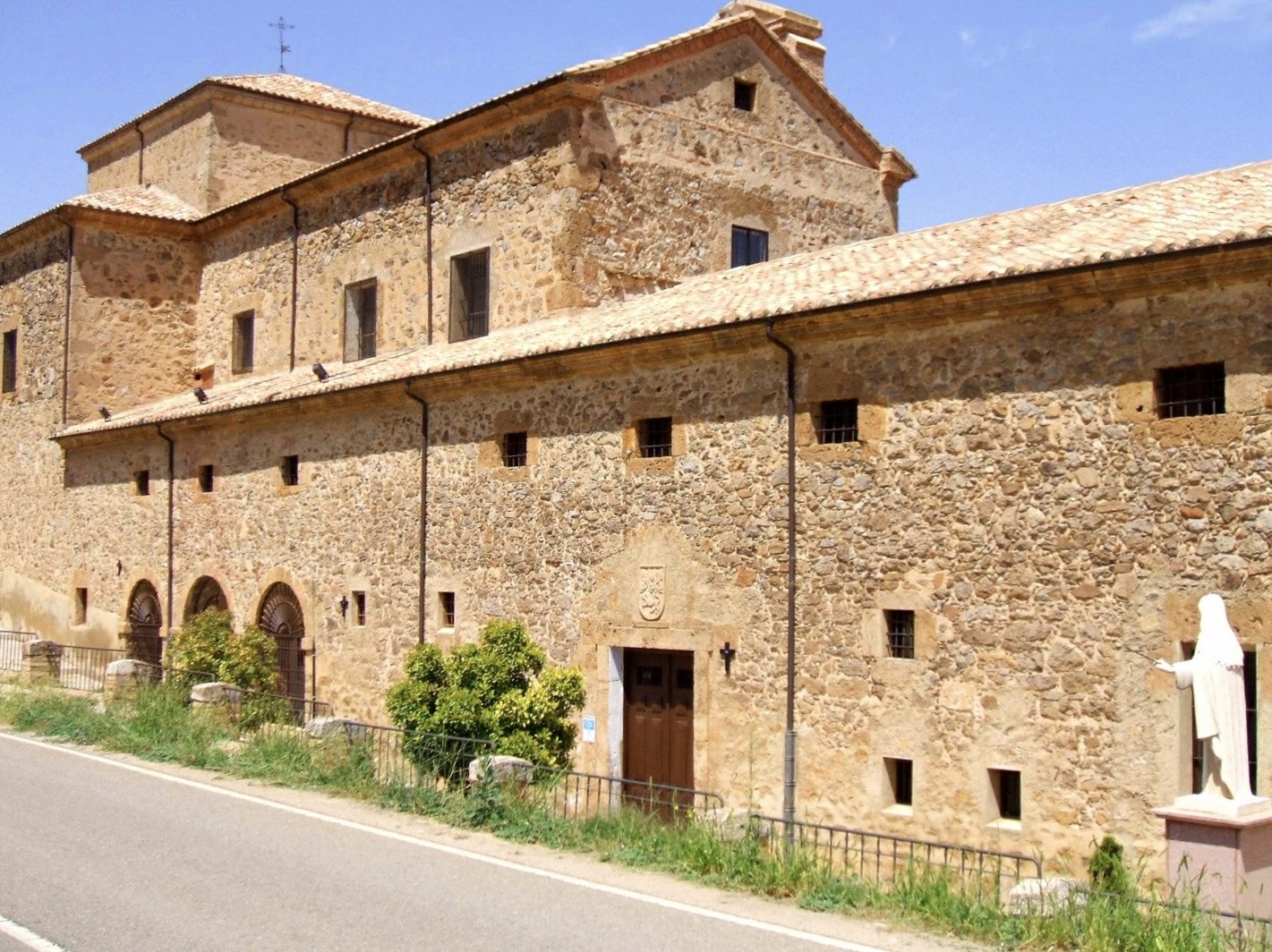
Convent of the Conceptionists in Ágreda, Spain (Roman Catholic)
Neuenwalde Convent in Germany belongs to the Evangelical Lutheran tradition of Christianity[1]

A convent is an enclosed community of monks, nuns, friars or religious sisters. Those residing in a convent are known as conventuals. Alternatively, convent means the building used by the community. The term is particularly used in the Catholic Church, Lutheran churches, and the Anglican Communion.[2]

Etymology and usage

[edit]

The term convent derives via Old French from Latin conventus, perfect participle of the verb convenio, meaning "to convene, to come together". It was first used in this sense when the eremitical life began to be combined with the cenobitical. The original reference was to the gathering of mendicants who spent much of their time travelling. Technically, a monastery is a secluded community of monastics, whereas a friary or convent is a community of mendicants (which, by contrast, might be located in a city), and a canonry is a community of canons regular. The terms abbey and priory can be applied to both monasteries and canonries; an abbey is headed by an abbot, and a priory is a lesser dependent house headed by a prior. In the Middle Ages, convents often provided to women a way to excel, as they were considered inferior to men.[3] In convents, women were educated and were able to write books and publish works on gardening or musicology[3] or on religion and philosophy. The abbess of a convent was often also involved in decisions of secular life and interacted with politicians and businessmen.[3] Unlike an abbey, a convent is not placed under the responsibility of an abbot or an abbess, but of a superior or prior.

In modern English usage, since about the 19th century, the term convent almost invariably refers to a community of women,[4] while monastery and friary are used for communities of men. In historical usage they are often interchangeable, with convent especially likely to be used for a friary. When applied to religious houses in Eastern Orthodoxy and Buddhism, English refers to all houses of male religious as monasteries and of female religious as convents.

History

[edit]

The mendicant orders appeared at the beginning of the 13th century with the growth of cities; they include in particular the Dominicans, the Franciscans, the Carmelites, and the Augustinians. While the Benedictine monks and their various variants devoted themselves to their agricultural properties, the mendicant friars settled from the start in the cities, or in the suburbs thereof, preferably in the poorer and more densely populated districts. They therefore had to adapt their buildings to these new constraints.

See also

[edit]

References

[edit]
[edit]
Revisions and contributorsEdit on WikipediaRead on Wikipedia
from Grokipedia
A convent is a religious house inhabited by a community of women, typically nuns, who profess public vows of poverty, chastity, and obedience and live a communal life dedicated to prayer, contemplation, or apostolic work under the authority of a superior and in accordance with canon law.[1] While most commonly associated with the Catholic Church, similar communities exist in other Christian denominations such as Eastern Orthodox, Anglican, and Lutheran traditions. These communities, often enclosed or cloistered to varying degrees, form part of religious institutes within the Catholic Church, where members provide a public witness to the Gospel through their consecrated life.[1] The term "convent" derives from the Latin convenire, meaning "to come together," reflecting the gathering of women religious in a shared dwelling for spiritual purposes.[2] The origins of convents trace back to the early Christian era, with the first organized women's monastic community established around 320 AD in the Egyptian desert by Pachomius the Great and his sister, who led a segregated group of women on the opposite bank of the Nile from the men's monastery.[3] This development paralleled the rise of male monasticism and was influenced by the ascetic traditions of the desert fathers and mothers, allowing women to pursue a dedicated religious life amid the growing institutionalization of Christianity after the Edict of Milan in 313 AD.[4] By the fourth and fifth centuries, prominent figures such as St. Paula, who founded a convent in Bethlehem, and St. Melania the Younger, who established one near the Mount of Olives in Jerusalem, created models of communal living, education, and charitable service that spread across the Roman Empire and into medieval Europe. Throughout history, convents have served multifaceted roles in society, including the preservation of learning during the Middle Ages, where nuns copied manuscripts, taught literacy to girls, and provided healthcare in an era before formal hospitals.[5] In the post-Reformation period, particularly after the Catholic Emancipation in England in 1829, new convents proliferated, often designed in Gothic Revival styles by architects like A.W.N. Pugin, and adapted for "active" congregations engaged in teaching, nursing, and social outreach rather than strict enclosure.[6] Today, convents distinguish between contemplative orders, which emphasize seclusion and prayer within cloistered settings requiring papal approval for establishment, and active orders, whose members reside in convents but minister externally in schools, hospitals, and communities worldwide.[1][2] Despite declining numbers in some regions due to secularization, convents continue to embody the Church's call to consecrated life, fostering spiritual depth and service.[7]

Definition and Terminology

Core Definition

A convent is a community of women religious, known as nuns or sisters, who profess public vows of poverty, chastity, and obedience, living a consecrated life in common within a dedicated residence or complex. In Catholic usage, nuns are women religious in contemplative orders living in enclosure, while sisters belong to active orders engaged in external ministries; both reside in convents.[1] These vows, pronounced either perpetually or temporarily and renewed as required, bind members to follow Christ radically through the evangelical counsels, fostering a life of prayer, community, and service.[1] In common English usage, particularly in the United States, convents often refer to the residences of active women's religious communities (sisters) involved in apostolates like education and healthcare, while contemplative women's communities are more commonly termed monasteries; however, "convent" is used more broadly for women's religious houses in general.[2] Unlike priories, which are smaller religious houses governed by a prior or prioress and often dependent on a larger abbey, convents function as autonomous or semi-autonomous units within their orders.[8] Essential components of a convent include the cloister or enclosure, providing physical and spiritual separation from the outside world; a chapel or oratory for liturgical worship and the reservation of the Eucharist; individual or communal living quarters such as cells or dormitories; and shared spaces like the refectory for meals and a chapter house for community meetings.[1][9] Under Catholic canon law, convents hold canonical status as lawfully erected houses of religious institutes, approved by the Apostolic See or local bishop, ensuring governance by a superior and adherence to the order's constitutions.[1] Similar structures exist in other Christian denominations, such as the Anglican Communion, where convents serve as residences for women religious communities living under vows in alignment with their traditions.[10]

Etymology

The term "convent" derives from the Latin conventus, the past participle of convenire, meaning "to come together" or "assembly," originally referring to a gathering of Roman citizens for administrative or judicial purposes.[11] This root entered Old French as covent around the 12th century, denoting a religious assembly or community, before evolving into Middle English convent by the early 13th century, where it began to specify a house of religious women.[12][13] In early Christian usage from the 4th century onward, conventus described general religious gatherings or communal living arrangements, influenced by the Vulgate Bible's translations of assemblies, such as in Acts 19:32, and writings of Church Fathers like Augustine, who used it for Christian congregations living in shared devotion.[11] By the 13th century, the term shifted in Western Europe to primarily denote enclosed communities of nuns, reflecting the growth of female monasticism and distinguishing them from male monasteries, though it retained broader connotations of religious assembly in some contexts.[12][14] Linguistic variations in other languages highlight regional differences in terminology for such communities. In German, Kloster stems from Latin claustrum via Middle Low German, emphasizing an "enclosed place" and applying to both male and female religious houses without gender specificity.[15] Similarly, the French monastère derives from Late Latin monasterium, itself from Greek monastērion meaning "place of solitude" or "monks' dwelling," often used interchangeably with couvent but underscoring a focus on monastic seclusion rather than assembly.[16] These terms reflect how local languages adapted classical roots to align with cultural and ecclesiastical practices, influencing the specialized use of "convent" in English for women's communities.[11] "Nunnery" serves as a colloquial or archaic synonym for convent, particularly referring to communities of women religious, though it carries negative connotations in some literary contexts. For instance, in William Shakespeare's Hamlet, the phrase "Get thee to a nunnery" spoken by Hamlet to Ophelia implies both a place of seclusion for women and a brothel, reflecting Elizabethan slang where "nunnery" could denote a house of prostitution.[17] Historically, the term has been used interchangeably with "convent" to describe enclosed communities of nuns, but modern usage favors "convent" to avoid such associations.[18] The term "monastery" typically denotes a community of monks or sometimes mixed religious, emphasizing a contemplative life of solitude and prayer, in contrast to a convent, which more commonly applies to women's communities, often active ones focused on communal gathering without strict enclosure. Derived from the Greek "monazein" meaning "to live alone," monasteries highlight isolation from the world, while convents stem from the Latin "convenire," signifying assembly.[2] An "abbey" refers to a larger, autonomous convent or monastery governed by an abbess (for women) or abbot (for men), requiring at least twelve members and enjoying independence from external ecclesiastical oversight.[19] "Claustration" describes the enclosed lifestyle of religious women in convents, mandating separation from the outside world to foster prayer and contemplation, as formalized by Pope Boniface VIII's 1298 decree Periculoso, which required strict enclosure for all nuns.[20] In opposition, "apostolic" convents involve active engagement in external ministries, such as teaching or healthcare, without full enclosure, distinguishing them from cloistered communities dedicated solely to interior spiritual life.[21] Denominational variations affect terminology: in Anglicanism, "convent" applies to women's religious communities similar to Catholic ones but under episcopal authority without papal enclosure, as seen in orders affiliated with the Conference of Anglican Religious Orders in the Americas.[22] Eastern Orthodox women's communities are generally termed "monasteries" led by an abbess (hegoumeni), with "skete" denoting smaller, semi-eremitic groups that may include nuns focused on ascetic solitude.[23] Protestant traditions, particularly Lutheran and Anglican, use "sisterhood" for women's religious groups emphasizing service, such as deaconess communities, without vows of enclosure.[24]

Historical Development

Origins in Early Christianity

The origins of convents in early Christianity trace back to the ascetic movements of the third and fourth centuries, deeply influenced by the Desert Fathers and Mothers who withdrew to the deserts of Egypt, Palestine, and Syria seeking spiritual purification and communal living. These early ascetics, including prominent women known as Ammas, modeled a life of prayer, manual labor, and renunciation of worldly attachments, laying the groundwork for organized female communities. For instance, Amma Syncletica of Alexandria (c. 270–350 CE), often regarded as a foundational figure for women's monasticism, established a community of women ascetics in the Egyptian desert after distributing her inheritance, emphasizing humility and mutual support in the face of trials.[25][26] Similarly, St. Paula of Rome (347–404 CE), inspired by these desert traditions, founded a women's monastery in Bethlehem around 386 CE alongside her daughter Eustochium, creating a space for scriptural study and ascetic practice that integrated women into the burgeoning monastic framework.[27][28] In the Eastern Church, the Rule of St. Basil the Great (c. 330–379 CE) played a pivotal role in formalizing communal female asceticism during the fourth century. Basil's ascetic writings and regulations, compiled in his Longer and Shorter Rules, promoted cenobitic (communal) life over solitary eremitism, advocating shared prayer, obedience to a superior, and economic self-sufficiency through labor—principles that extended to women's communities. Eastern convents readily adopted these guidelines, which emphasized the ecclesial dimension of monasticism and provided a structured alternative to the informal gatherings of the Desert Mothers.[29][30] These traditions continued in the Byzantine Empire, where women's monasteries in Constantinople and other centers flourished under imperial patronage, influencing Orthodox monasticism in the East. The Edict of Milan in 313 CE, issued by Emperors Constantine and Licinius, marked a critical transition by legalizing Christianity and ending persecution, enabling the shift from clandestine ascetic groups in private homes to dedicated communal spaces across the Roman Empire. This imperial tolerance facilitated the open establishment of monasteries, including those for women, as Christians could now reclaim properties and construct facilities without fear of reprisal. The shrine of St. Thecla in Maaloula, Syria, with traditions dating to the fourth century as a site of pilgrimage and ascetic refuge, exemplifies early integration of female devotion in Eastern monastic contexts, though the current convent structure was built in the 20th century around ancient remains.[31][32] These developments intertwined convents with broader monastic evolution, fostering theological roots in apostolic imitation and eschatological hope.[33]

Medieval Expansion

The expansion of convents during the Middle Ages was closely linked to adaptations of the Benedictine Rule for women's communities, which provided a structured framework for monastic life from the 6th century onward and saw significant refinements between the 10th and 12th centuries to address gender-specific needs, such as oversight by abbesses and pastoral care by male clergy.[34] These adaptations facilitated the institutionalization of female religious life, enabling convents to proliferate across Europe as centers of spiritual discipline and communal support amid feudal societal shifts. By the 13th century, England hosted over 100 nunneries, reflecting a marked increase from earlier centuries driven by this regulatory evolution and the endorsement of monastic ideals by church reformers.[35][36] Noblewomen played a pivotal role in this proliferation, often founding or endowing convents as refuges from political marriages, sites for educating elite daughters, and means to secure spiritual legacy within a patriarchal society. For instance, Fontevraud Abbey in France, established in 1101 by the preacher Robert d'Arbrissel under the patronage of noble families like the Counts of Anjou, became a model double monastery governed by an abbess and serving as a sanctuary for highborn women seeking enclosure.[37] Such initiatives by noblewomen not only expanded the network of convents but also intertwined female monasticism with aristocratic power dynamics, allowing patrons to exert influence over religious institutions.[38] The Investiture Controversy of the 11th century further catalyzed convent growth by strengthening papal authority over ecclesiastical appointments, including those in female orders, as part of broader Gregorian reforms that curbed lay interference and mandated Rome's approval for new foundations. This shift empowered the papacy to oversee and legitimize women's communities, promoting standardization and expansion while resolving disputes over abbess selections that had previously involved secular lords.[39] Consequently, convents benefited from heightened central church control, which encouraged their establishment as stable entities under direct papal protection during a period of political upheaval. The Crusades from the late 11th to 12th centuries integrated convents with emerging military orders, as women joined or supported these groups in roles that blended religious devotion with defensive duties, leading to the creation of female branches that provided hospitality, care, and spiritual support.[40][41] This connection highlighted convents' evolving role in wartime, where noble and common women contributed to crusade efforts through affiliated houses that provided medical aid and spiritual succor to pilgrims and soldiers.

Post-Reformation Changes

The Protestant Reformation, initiated in 1517 by Martin Luther, profoundly disrupted convent life across Europe, particularly in regions adopting Protestantism. In England, King Henry VIII's break with Rome led to the Dissolution of the Monasteries between 1536 and 1541, resulting in the closure of approximately 800 religious houses, including around 140 nunneries.[42][43] Under the Act of Suppression in 1536, smaller houses with incomes under £200 were targeted first, followed by larger ones; nuns were typically offered pensions or dispersal, though many faced poverty and social upheaval as convents were seized for royal and noble gain.[44] This policy not only eliminated monastic institutions but also symbolized the shift toward Protestant doctrines, suppressing Catholic practices like enclosure and communal prayer.[45] In response, the Catholic Church's Counter-Reformation sought to reform and strengthen religious orders, with the Council of Trent (1545–1563) imposing stricter regulations on women's convents to combat perceived laxity. The council's decrees mandated strict enclosure (clausura) for all nuns, confining them to their convents except under exceptional circumstances approved by bishops, to protect chastity and prevent scandals.[46] This reform, formalized in the 1563 session, required voluntary vows and prohibited external activities, distinguishing nuns' lives from those of active orders and emphasizing contemplative seclusion over medieval flexibilities.[47][48] Enforcement varied, but it reshaped convent architecture with grilles and walls, reinforcing gender-specific reforms absent for male monasteries.[49] The 19th century witnessed significant revivals amid political upheavals, as suppressions gave way to new foundations adapting convents to social needs. The French Revolution's dechristianization campaign in the 1790s dismantled religious orders; on February 13, 1790, the National Assembly suppressed all convents with solemn vows, expelling nuns and repurposing buildings for secular use, affecting thousands of women who dispersed into lay society.[50][51][52] Post-Napoleonic restoration in 1801 allowed gradual reestablishment, spurring expansions of active congregations like the Daughters of Charity, originally founded in 1633 by St. Vincent de Paul and St. Louise de Marillac for works of mercy among the poor.[53] By the mid-19th century, inspired by this model, numerous Sisters of Charity branches proliferated globally, focusing on education, healthcare, and orphanages, with over 20 independent congregations emerging to meet industrial-era demands.[54] Colonial expansions during this period extended convents into the Americas, blending enclosure with missionary imperatives. In New Spain (modern Mexico), the Convent of Nuestra Señora de la Concepción, established in Mexico City around 1540–1554, exemplified early adaptations, providing refuge for indigenous and Spanish women while supporting evangelization through semi-cloistered roles in catechesis and community aid.[55][56] These institutions, often funded by colonial authorities, facilitated the spread of Catholicism amid conquest, with nuns contributing to cultural assimilation and education, though under Trent's enclosure guidelines that limited direct fieldwork.[57] By the late 16th century, such convents numbered over a dozen in Mexico, aiding the church's consolidation in frontier regions.[58]

Types and Variations

By Religious Order

Benedictine convents, governed by the Rule of St. Benedict established in the early 6th century, emphasize the principle of ora et labora—prayer and work—as the foundation of communal life, integrating manual labor with liturgical worship to foster spiritual and practical balance.[59] These communities also uphold the vow of stability, binding nuns to a single monastery for life to cultivate deep-rooted communal bonds and contemplative stability.[60] Adopted by women's communities since the 7th century, Benedictine convents adapted monastic practices for nuns, as seen in early English foundations that mirrored male abbeys in structure while prioritizing women's enclosure and self-sufficiency.[61] Franciscan convents of the Poor Clares, the second branch of the Franciscan Order, were founded in 1212 by St. Clare of Assisi under the guidance of St. Francis, committing to radical poverty, strict enclosure, and a life of penance and prayer.[62] This order's rule, approved by Pope Innocent IV in 1253, mandates collective poverty—owning no property individually or communally—and perpetual seclusion from the world to emulate Christ's humility.[63] Poor Clare convents thus prioritize contemplative adoration of the Eucharist, with daily routines centered on manual work to sustain simplicity, distinguishing them as one of the most austere enclosed communities in Catholicism.[64] Dominican convents for sisters trace their origins to 1206, when St. Dominic de Guzmán established the first women's community in Prouille, France, as part of the Order of Preachers to support evangelization through prayerful backing of the friars' missions.[65] Governed by constitutions blending Dominican preaching charism with enclosure, these convents focus on intellectual formation, study of scripture and theology, and education as extensions of the order's apostolic zeal.[66] Since their inception, Dominican sisters have engaged in active apostolates like teaching and catechesis, while cloistered branches sustain the order through intercessory prayer, embodying the motto veritas in pursuit of truth for societal benefit.[67] Carmelite convents, rooted in the 12th-century hermitic tradition on Mount Carmel, evolved into contemplative communities emphasizing mystical union with God through silence, asceticism, and interior prayer.[68] Reformed in 1562 by St. Teresa of Ávila, who founded the Discalced branch with the Convent of St. Joseph in Ávila, these convents restored primitive austerity—discarding shoes, limiting possessions, and enforcing strict enclosure—to deepen mystical spirituality amid Counter-Reformation fervor.[69] Discalced Carmelites, now distinct from the Calced branch, prioritize Teresian teachings on mental prayer and detachment, with over 800 convents worldwide fostering vocations to hidden apostolic fruitfulness.[70]

By Geographic and Cultural Context

In Europe, convents during the Italian Renaissance often served as vibrant cultural and intellectual hubs, particularly in cities like Florence and Venice, where elite women from noble families entered monastic life and patronized the arts as expressions of piety and social status.[71] These institutions fostered literary and artistic production, with nuns composing music, poetry, and visual works that reflected humanist ideals while navigating enclosure rules, as seen in the convent of San Domenico in Pisa, where Dominican sisters commissioned artworks blending religious devotion with Renaissance aesthetics.[72] In contrast, Spanish convents in the era of the Inquisition (late 15th to 17th centuries) emphasized strict isolation and enclosure to enforce orthodoxy and suppress perceived heretical influences, such as converso practices, transforming these spaces into sites of rigorous seclusion that limited external interactions and heightened internal discipline.[73] This enforced isolation, rooted in Counter-Reformation policies, positioned convents as bastions of purity amid inquisitorial scrutiny, differing markedly from the more open cultural roles in Italy.[74] In Asia, Jesuit missions in 17th-century Japan influenced the formation of women's Christian communities amid persecution, where local women adapted Catholic teachings to indigenous customs, creating hybrid devotional practices before the 1614 edict banning Christianity drove these groups underground.[75] Figures like Hosokawa Gracia exemplified this blending, hosting Jesuit priests and incorporating elements of Japanese tea culture and familial piety into Christian households that functioned as de facto monastic enclaves, sustaining faith through oral traditions and secret gatherings despite isolation from formal convents.[76] These communities highlighted Jesuit strategies of cultural accommodation, such as using Japanese honorifics in religious texts and allowing women to lead household catechism, which temporarily bridged European monastic ideals with samurai-era social structures until suppression intensified.[77] In Latin America, post-1500s colonial convents integrated indigenous elements through the entry of native women, who brought artisanal skills and languages into monastic life, creating syncretic expressions of devotion in regions like Mexico and Peru.[78] For instance, indigenous nuns in New Spain's convents produced featherwork altarpieces and embroidered textiles incorporating Nahuatl motifs and iconography, blending Catholic iconography with pre-Hispanic symbolism to navigate colonial hierarchies.[79] These adaptations extended to linguistic practices, where nuns transcribed prayers in indigenous languages like Nahuatl for devotional use, facilitating evangelization while preserving cultural memory within enclosed spaces.[80] Such integrations, often under Franciscan or Dominican oversight, highlighted convents as sites of cultural negotiation during the colonial era.

Cloistered vs. Active Convents

Convents in the Catholic Church are broadly categorized into cloistered and active types based on their primary charism and level of engagement with the external world. Cloistered convents emphasize a contemplative life of prayer and seclusion, while active convents focus on apostolic works such as education and healthcare. These distinctions are rooted in canonical regulations that balance interior dedication to God with external mission.[81][82] Cloistered convents, also known as contemplative or enclosed monasteries, require strict papal enclosure to foster undivided focus on prayer and union with God. In 1298, Pope Boniface VIII issued the decretal Periculoso, mandating complete claustration for all nuns to protect chastity and enable separation from worldly distractions.[83] This enclosure limits nuns' physical contact with the outside, confining them to designated monastery areas except for grave reasons like medical needs. The Carmelite nuns exemplify this model, living in small communities dedicated to contemplative prayer, silence, and ascetic practices within fully enclosed spaces.[84] Under the 1983 Code of Canon Law (Can. 667), monasteries entirely ordered to contemplation must observe strict papal cloister, ensuring nuns remain within the enclosure to serve the Church through intercession.[1] In contrast, active convents, often termed apostolic congregations, prioritize external ministries while maintaining a conventual life. These communities engage in corporal works of mercy, such as teaching and nursing, conducted outside the convent to directly serve society. The Ursulines, founded in 1535 by St. Angela Merici in Brescia, Italy, represent this type, establishing schools to educate girls and promote Christian formation.[85] Unlike cloistered nuns who take solemn vows in enclosed settings, active sisters typically profess simple vows and operate under less rigid enclosure norms, allowing mobility for their apostolate.[82] Hybrid forms, including semi-cloistered convents, emerged as adaptations balancing contemplation and limited outreach, particularly following Vatican II reforms. The Second Vatican Council's decree Perfectae Caritatis (1965) encouraged renewal in religious life, leading to moderated enclosure rules that permit brief absences for apostolic needs while preserving contemplative elements.[86] The 1999 instruction Verbi Sponsa further clarifies that monasteries incorporating apostolic activities define their own constitutional cloister, distinct from strict papal enclosure, allowing nuns to undertake works like hospitality within monastery grounds.[87] Examples include semi-contemplative communities, such as certain Visitation Sisters, which conduct limited external ministries while observing partial enclosure. The 1983 Code of Canon Law (Can. 667 §3) supports this by requiring enclosure adapted to each institute's character, thus harmonizing contemplation with mission.[1]

Architecture and Physical Layout

Key Architectural Features

Convents are typically organized around a central cloister, a quadrangle designed to facilitate contemplative walking and meditation while providing sheltered access to surrounding buildings. This open courtyard, often surrounded by arcaded walkways, allows natural light to filter into the enclosed space and connects essential communal areas such as the church, refectory, and dormitory. The arcades, supported by columns or pillars, create a rhythmic progression of arches that emphasize the contemplative rhythm of monastic life.[88] The chapel, integral to the convent's sacred core, serves as the primary space for worship and is frequently divided by grilles or screens to maintain enclosure, separating the nuns' choir from public areas and visitors. These grilles, often wrought iron or wooden lattices, ensure visual and physical separation while permitting auditory participation in services. Adjacent to the chapel, the refectory functions as the communal dining hall, typically located along one side of the cloister, where meals are taken in silence accompanied by spiritual readings; it may also incorporate grilles in visiting areas to allow limited interaction with outsiders without breaching seclusion.[88][89] Sleeping quarters in convents balance communal solidarity with personal solitude, featuring either large dormitories or individual cells to promote simplicity and reflection. Early designs often included a long communal dormitory on an upper floor above the chapter house, accessible via stairs from the cloister, where nuns slept on shared pallets to foster equality. Over time, many convents incorporated private cells—small, sparsely furnished rooms off a corridor—for individual prayer and rest, underscoring the vow of poverty through minimalistic design with basic furnishings like a bed, crucifix, and washbasin.[88] Enclosure is physically manifested through high surrounding walls that delineate the sacred interior from the secular world, typically constructed of stone or brick to a height sufficient to block external views and access. These walls, mandated by post-Tridentine reforms, include features like closely spaced window grilles—bars no wider than a finger's breadth—to prevent passage of objects or undue visibility. Entry and communication with the outside are controlled via turnstiles or revolving gates at pedestrian entrances, attended by designated nuns to enforce strict seclusion while allowing essential exchanges like supplies.[89][88]

Evolution Across Eras

The architecture of convents evolved significantly from the medieval period onward, reflecting broader historical, doctrinal, and technological changes within religious communities. In the 12th century, French Cistercian convents contributed to the broader Cistercian transition from Romanesque solidity to early Gothic lightness in religious architecture, incorporating ribbed vaults that enabled larger, more illuminated chapels while adhering to the order's emphasis on simplicity and functionality. This shift allowed for expansive vaults supported by pointed arches, reducing wall thickness and admitting more natural light through expanded windows, aligning with Cistercian ideals of contemplative austerity amid growing communal needs.[90][91] By the 17th century, Baroque influences transformed convent interiors in Italy, particularly following the Counter-Reformation's push for visual splendor to reaffirm Catholic devotion. Ornate decorations—such as gilded stucco, frescoed vaults, and marble altars—adorned public church spaces within convents, creating dramatic, theatrical environments that emphasized enclosure (clausura) while allowing nuns veiled participation in liturgy. Examples include the Convent of Santa Lucia in Selci in Rome, where 17th-century additions featured richly painted Annunciation scenes and communion grilles, and Santa Marta al Collegio Romano, with its vault frescoes by Giovanni Maria Morandi (1671) and high altar by Giuseppe Ghezzi (1672–73), blending opulence with spatial separation for spiritual focus. These designs responded to Tridentine decrees enforcing strict seclusion, using architecture to heighten emotional piety without compromising isolation.[92] The 19th-century Gothic Revival revived neo-medieval forms for new convent foundations in England and the United States, driven by Catholic emancipation and a romantic return to pre-Reformation aesthetics. In England, Augustus Welby Northmore Pugin pioneered this style, designing fortress-like complexes with pointed arches, ribbed vaults, and cloistered courtyards, as seen in the Mercy Convent at Bermondsey (1838) and St. Mary's Convent at Wantage (1855, by George Edmund Street), which integrated chapels, refectories, and cells to evoke medieval monastic life amid post-Reformation revival. In the U.S., similar neo-Gothic designs emerged for women's religious communities, adapting European traditions to local contexts with lancet windows and vertical emphasis to inspire discipline and evangelization.[93][94] In the 20th century, modernist principles simplified convent architecture, emphasizing functional layouts with integrated modern amenities like electricity and plumbing, yet preserving symbolic elements such as cloisters to maintain spiritual enclosure. Architects like Dom Paul Bellot at Quarr Abbey (1907–14, Isle of Wight) employed reinforced concrete and brick for clean, geometric forms that housed utilities discreetly, while retaining courtyard plans for contemplation; similar adaptations appeared in nuns' convents, blending minimalism with traditional spatial hierarchies. By mid-century, designs like West Malling Abbey (1962, by Maguire & Murray) incorporated open-plan refectories and modern sanitation within cloistered frameworks, responding to post-Vatican II shifts toward accessibility without abandoning contemplative symbolism. This evolution balanced practicality with doctrinal continuity, using materials like steel and glass for efficient, light-filled spaces.[93][95]

Notable Examples

The Poor Clares' Convent in Assisi, established in the 13th century, exemplifies early Franciscan simplicity in its architectural design, closely tied to the spiritual legacy of St. Francis of Assisi and St. Clare. Founded by St. Clare in 1212 at the site of San Damiano, where St. Francis had received his calling to rebuild the church in 1205, the convent features a modest single-nave structure with pointed barrel vaults and 14th-century frescoes depicting Franciscan scenes.[96] Its later basilica, the Basilica of Santa Chiara begun in 1257, incorporates simple Gothic elements such as massive lateral buttresses, a rose window, and an austere interior that reflects the order's emphasis on poverty and contemplation.[97] The Convent of Las Descalzas Reales in Madrid, founded in 1559 by Joanna of Austria, represents a grand royal Spanish Baroque complex that served as both a religious retreat and an extension of Habsburg court life. Originally a 16th-century palace transformed into a Poor Clares monastery, its architecture blends Renaissance and emerging Baroque styles, with construction overseen by architects Antonio Sillero and Juan Bautista de Toledo between 1559 and 1564, featuring ornate chapels and cloisters that accommodated noble women.[98] The convent houses an exceptional art collection, including Rubens-designed tapestries from the early 17th century depicting the Triumph of the Eucharist, alongside paintings by Titian and El Greco, underscoring its role as a repository of Habsburg patronage.[98] The women's branch associated with New Clairvaux Abbey in the United States, established in 1956 as Valley of Our Lady Monastery in Prairie du Sac, Wisconsin, illustrates a modern adaptation of medieval Cistercian layouts emphasizing austerity and contemplation. Founded by nuns from the Cistercian Order of the Strict Observance, the monastery draws on traditional designs researched from French and Spanish Cistercian sites, incorporating a simple, functional plan with cloisters, chapels, and communal spaces that echo 12th-century precedents while meeting contemporary needs for a community of up to 25 sisters.[99] This post-World War II foundation reflects the order's expansion in America, prioritizing unadorned stone and wood elements to foster monastic discipline without ornate decoration.[100] The Santa Catalina Convent in Arequipa, Peru, founded in 1579, stands as a prime colonial example of mestizo architecture, utilizing local sillar volcanic stone in an expansive complex with over 200 individual cells. Built as a Dominican Second Order enclosure following Viceroy Francisco de Toledo's visit, the monastery spans 20,000 square meters across four cloistered neighborhoods mimicking Arequipa's urban layout, with private cells added after earthquakes damaged shared dormitories, blending Spanish colonial facades with Andean decorative motifs like sculpted portals and arched galleries.[101] Its adobe-like sillar construction, resilient yet modified over centuries due to seismic activity, highlights adaptive engineering in a high-altitude Andean setting.[102] For broader geographic context, Eastern Orthodox convents, such as the Convent of St. Stephen in Meteora, Greece (founded 14th century, with expansions), integrate Byzantine architectural elements like frescoed katholikons and rock-hewn enclosures, adapting monastic layouts to dramatic cliffside terrains while maintaining strict seclusion traditions.[103]

Daily Life and Practices

Daily Routine and Schedule

The daily routine in a convent, known as the horarium, is structured around the Liturgy of the Hours, also called the canonical hours, which form the backbone of communal prayer and sanctify the passage of time.[104] This timetable typically includes seven or eight prayer offices—Office of Readings (or Vigils/Matins), Lauds, Prime (in some traditions), Terce, Sext, None, Vespers, and Compline—spread throughout the day and night, totaling approximately four to six hours of communal recitation.[105] For instance, in cloistered communities like the Poor Clares, the day often begins at 12:30 a.m. with Matins and meditation, followed by Lauds at 5:30 a.m., Terce at 9:30 a.m., Sext at 11:40 a.m., None at 2:00 p.m., Vespers at 4:30 p.m., and Compline at 7:30 p.m., with periods of private meditation and examen interspersed.[106] Work periods are integrated between prayer times, emphasizing manual labor as a form of prayer and self-sufficiency, in line with the Benedictine motto "ora et labora" (pray and work). These activities might include gardening, crafting religious items, cleaning, or kitchen duties, often lasting two to four hours in the morning and afternoon; meals are typically taken in silence, with breakfast after Lauds or Mass, a main dinner around noon, and a light supper in the evening.[107] In the Passionist Nuns' horarium, for example, midmorning and afternoon slots are dedicated to spiritual reading, study, or work after prayers like Midmorning Prayer and Midafternoon Prayer, with recreation and dishes following meals.[107] Silence is observed during meals and specific times, such as a one-hour "silence time" after lunch for rest or exercise, culminating in the "Great Silence" from Night Prayer until morning.[107] Variations exist based on the convent's charism, with contemplative orders prioritizing extended silence and prayer, while active ones incorporate apostolates like teaching or outreach in the afternoon. Cloistered contemplative nuns, such as those in Poor Clare monasteries, maintain strict enclosure with prayer dominating the schedule and minimal external engagement, starting as early as midnight.[106] In contrast, active-contemplative communities like the Franciscan Sisters TOR follow a rhythm beginning at 6:00 a.m. with individual Morning Prayer, including communal Mass, adoration, and intercession, but allowing for more flexible work or ministry periods post-lunch.[108] Seasonal adjustments enhance the routine, such as additional prayers or fasting during Lent—extending midafternoon prayer on certain days—and festive celebrations on Sundays or holy days with extra recreation and solemn Vespers.[107]

Vows, Discipline, and Community Structure

Nuns in convents profess the three evangelical counsels of poverty, chastity, and obedience as public vows, which form the foundation of their consecrated life and bind them to follow Christ more closely. The vow of poverty entails the renunciation of personal possessions and the adoption of shared ownership within the community, fostering detachment from material goods and dependence on divine providence. Chastity commits nuns to celibacy for the sake of the Kingdom of Heaven, dedicating their lives entirely to spiritual love and service without the bonds of marriage or family. Obedience requires submission to the authority of superiors and the community's rule, imitating Christ's own obedience to the Father.[109][1] Discipline in convents emphasizes spiritual growth through practices such as penance and rules of silence, alongside a structured formation process for entrants. Penance involves voluntary acts of mortification, fasting, and reparation to cultivate humility and union with Christ's suffering, integrated into daily life to support contemplation. Silence is observed particularly during meals, prayer, and certain hours to foster interior recollection and attentiveness to God's word, creating an environment conducive to the contemplative vocation. The formation process begins with postulancy, a preparatory period of immersion in community life lasting typically six to twelve months, followed by the novitiate of at least twelve months focused on deepening spiritual discernment. Temporary profession follows for three to six years, culminating in perpetual vows after five to seven years total, ensuring mature commitment.[86][110][111][1][112] Community structure is hierarchical yet incorporates democratic elements, centered on the leadership of a prioress or abbess. The prioress or abbess, as the superior, is elected by the community chapter according to the order's constitutions, often for life in contemplative monasteries, and governs with the aid of an elected council to ensure collaborative decision-making. This structure promotes obedience to authority while allowing input from professed members in key matters, balancing unity and shared responsibility.[1][113] Enclosure discipline regulates separation from the world to safeguard contemplation, with two primary types under Vatican norms. Papal enclosure, applicable to fully contemplative convents, imposes strict boundaries confirmed by the Holy See, limiting exits to grave reasons and restricting access to essential personnel, thereby ensuring physical and spiritual isolation. Constitutional enclosure, for communities balancing contemplation with limited external works, allows greater flexibility as defined in the institute's proper law, adapting to specific charisms while maintaining core separation.[87]

Education and Work Roles

In medieval Europe, convents served as vital centers for education and manuscript production, where nuns operated scriptoria dedicated to copying and illuminating texts. These scriptoria preserved classical and religious knowledge, with nuns transcribing works by hand in dedicated rooms, often contributing to the survival of thousands of manuscripts. A recent study estimates that women, including nuns, copied over 110,000 medieval manuscripts, far exceeding previous assessments based on colophons in collections like the Benedictines' catalog.[114][115] During the Renaissance, many convents evolved into educational institutions for girls, providing literacy, music, and religious instruction in an era when formal schooling for women was limited outside monastic settings. In places like Florence, Italy, convents such as those run by the Benedictines or Poor Clares admitted young women from various social classes, offering boarding schools that emphasized moral and intellectual formation. Active religious orders of nuns have historically engaged in diverse work roles, particularly in healthcare and education, extending convents' reach into society. For instance, the Little Sisters of the Poor, founded in 1839 by Jeanne Jugan in France, focus on nursing and caring for the elderly poor through residential homes that provide medical and daily support.[116] Similarly, the Sisters of Mercy, established in 1831 by Catherine McAuley in Ireland, prioritize teaching in schools and hospitals, operating educational institutions worldwide to serve underserved communities.[117] In contrast, cloistered convents emphasize contemplative work, where nuns dedicate their lives to prayer and intercession, offering spiritual support for the world's intentions through structured liturgical and personal prayer.[118] In modern convents, vocational training often includes artisan crafts that align with spiritual and communal life. Nuns in Orthodox convents, such as St. Elisabeth Convent in Minsk, Belarus, maintain icon-painting studios where they learn and practice traditional techniques, producing religious art for liturgical use and sale.[119] Other communities provide hospitality, hosting retreats and guest houses to welcome visitors for spiritual renewal, as seen in Benedictine convents like Kylemore Abbey in Ireland.[120] To achieve economic self-sufficiency, many convents manage agricultural enterprises, including farms and vineyards, which fund community needs and charitable works. For example, Trappistine nuns at St. Mary's Abbey in Glencairn, Ireland, manage 200 acres of land to produce food for self-sufficiency.[121] Some convents produce and sell delicacies such as baked goods and sweets from their kitchens, supporting both self-reliance and outreach to the needy.[122]

Modern Convents and Contemporary Issues

Current Role in Society

In the 21st century, convents continue to serve as vital centers for charitable activities, addressing contemporary social needs through direct service to vulnerable populations. Many convents operate hospices for the elderly and terminally ill, schools for underprivileged children, and aid programs for refugees and migrants, integrating these efforts with broader societal demands for humanitarian support. For instance, the Missionaries of Charity, founded in 1950, maintain a global network of 754 houses across 138 countries, where approximately 5,076 sisters provide care in slums, orphanages, and disaster relief operations, emphasizing holistic support for the "poorest of the poor" regardless of faith.[123] These initiatives reflect a commitment to social justice, often partnering with secular organizations to amplify impact in areas like healthcare and education.[124] Post-Vatican II reforms have fostered greater openness in convents, enabling them to offer spiritual retreats and hospitality to laypeople seeking renewal outside traditional cloistered settings. Influenced by the Council's emphasis on the laity's role in the Church, many convents now host directed retreats, silent prayer sessions, and formation programs that accommodate individuals, families, and groups from diverse backgrounds. Examples include the Sisters of Life in New York, who organize retreats featuring Eucharistic adoration, Mass, and conferences to guide participants in contemplative prayer, and the Dominican Sisters of Hope in New York, which provide faith-formation retreats overlooking the Hudson River for personal and communal spiritual growth.[125][126] These programs preserve monastic traditions while making them accessible, promoting deeper engagement with Catholic spirituality in a secular age.[127] Convents also contribute to ecumenical and interfaith efforts, facilitating dialogues and collaborations that build bridges across Christian denominations and religions. Nuns participate in joint initiatives, such as shared pastoral work and ecumenical prayer services, drawing on Vatican II's call for unity among separated brethren. In Bosnia, Franciscan sisters exemplify this by accompanying Muslim, Orthodox, and Catholic communities through interfaith accompaniment and dialogue, fostering peace in post-conflict settings. Similarly, sisters in ecumenical monastic communities, like those in Germany, collaborate with Protestant and Orthodox women religious on joint worship and social projects, enriching spiritual lives through mutual exchange.[128][129] Demographically, Catholic convents house around 589,423 women religious worldwide as of 2023 (per Vatican statistics published in 2025), with many serving as custodians of liturgical traditions, artisanal crafts, and communal prayer practices amid modern challenges.[130] These communities sustain ancient rituals like Gregorian chant and iconography, offering them as resources for broader Church renewal and cultural heritage preservation.[124]

Declines and Adaptations

In the United States and Europe, convents have faced significant demographic challenges in the 2020s, characterized by aging populations and sharp declines in membership. The average age of nuns in the U.S. exceeds 80 years, with fewer than 1% under 40, contributing to widespread closures as communities struggle to sustain operations without new entrants.[131][132] Similarly, European religious orders report average ages around 70-75, with global numbers of women religious dropping from approximately 722,000 in 2010 to 589,423 as of 2023 (per 2025 Vatican data), reflecting a sustained contraction.[133][130] These trends have led to about a 50% reduction in U.S. nuns since 2000, from 79,814 to approximately 40,000 as of 2024, prompting the shuttering of numerous convents.[134][135] Secularization has accelerated the scarcity of vocations, as broader societal shifts toward materialism and individualism deter young women from entering religious life. The rise of feminism in the late 20th century offered expanded professional opportunities for women, reducing the appeal of convent vows amid perceptions of institutional rigidity.[136][137] The Second Vatican Council (1962-1965) further influenced this trajectory through reforms like Perfectae Caritatis, which encouraged adaptation to modern needs and permitted secular dress over traditional habits, leading some nuns to depart while others sought renewed relevance.[138][139] To counter these declines, many convents have pursued mergers, consolidating smaller communities into larger, more viable ones to pool resources and maintain ministries.[140] Others have embraced digital adaptations, such as online evangelization and virtual discernment sessions, with groups like the "Media Nuns" leveraging social media for outreach and the A Nun's Life Ministry providing podcasts and forums to engage potential vocants remotely.[141][142] Additionally, surplus convent buildings have been repurposed as retreat centers, exemplified by the conversion of the Our Mother of Sorrows Monastery in Massachusetts into a senior living facility with retreat elements, and the Benedictine nuns' establishment of a dedicated retreat and education center at Kylemore Abbey in Ireland.[143] Legal challenges compound these issues in secular states, where property ownership remains contested under frameworks like France's 1905 Law on the Separation of Churches and the State, which nationalized ecclesiastical assets and imposed ongoing restrictions on religious congregations. This legislation, while historically expelling orders and confiscating convents, continues to foster disputes through a derogatory regime that subjects religious properties to strict state oversight and potential discrimination, complicating adaptations in a laïcité-enforcing environment.[144][145]

Global Perspectives

In recent decades, convents in Asia and Africa have experienced significant growth in vocations, contrasting with trends elsewhere. India hosts the largest population of Catholic nuns worldwide, with over 103,000 women religious serving in various congregations as of 2025.[146] This expansion is driven by rising interest among young women, particularly in development-oriented ministries such as education, healthcare, and poverty alleviation. In sub-Saharan Africa, the number of women religious has shown net growth from 2010 to 2023 amid global declines, fueled by the region's rapid Christianization and the appeal of communal life amid socioeconomic challenges.[130] Convents there often focus on community development, including establishing schools and clinics to address local needs like HIV/AIDS care and women's empowerment.[147] In Latin America, convents have been profoundly shaped by liberation theology since the 1960s, emphasizing solidarity with the marginalized and advocacy for structural change. This theological framework, which integrates Christian faith with social analysis of poverty and oppression, has inspired nuns to engage in grassroots activism, including human rights defense and community organizing.[148] In Brazil, for instance, convents contribute to social justice efforts in urban favelas, where nuns participate in pastoral ministries addressing housing insecurity, violence, and inequality through programs like the nationwide Housing and Slums Pastoral.[149] These initiatives reflect a commitment to preferential option for the poor, with sisters often collaborating with local communities to promote dignity and equity amid rapid urbanization. Europe and North America, by contrast, face ongoing declines in convent populations, prompting a shift toward preservation and cultural roles. The global number of women religious dropped by over 9,700 between 2021 and 2022, with further declines to 589,423 by 2023, and Europe accounting for the majority of losses due to aging communities and fewer new entrants.[130] In the United States, the nun population has fallen from about 180,000 in 1965 to approximately 40,000 as of 2024, reflecting broader secularization trends.[135] Amid these challenges, many historic convents have gained recognition for their architectural and cultural value, such as the Benedictine Convent of St. John at Müstair in Switzerland and the Convent of Christ in Tomar, Portugal, both UNESCO World Heritage sites that attract heritage tourism while supporting limited monastic life.[150][151] To sustain aging Western convents, intercontinental migrations have become common, with nuns from the Global South—particularly Asia and Africa—relocating to staff communities in Europe and North America. Over 4,000 foreign-born nuns currently serve in the United States, often filling roles in education, healthcare, and parish ministry as local vocations wane, though 2025 visa backlogs pose new challenges to this movement.[152][153] This transnational movement, part of a broader pattern of Catholic missionary exchange, helps maintain convent operations and introduces diverse perspectives, though it raises questions about cultural adaptation and long-term sustainability.[154]

References

User Avatar
No comments yet.