Hubbry Logo
Sea of CreteSea of CreteMain
Open search
Sea of Crete
Community hub
Sea of Crete
logo
8 pages, 0 posts
0 subscribers
Be the first to start a discussion here.
Sea of Crete
Sea of Crete
from Wikipedia
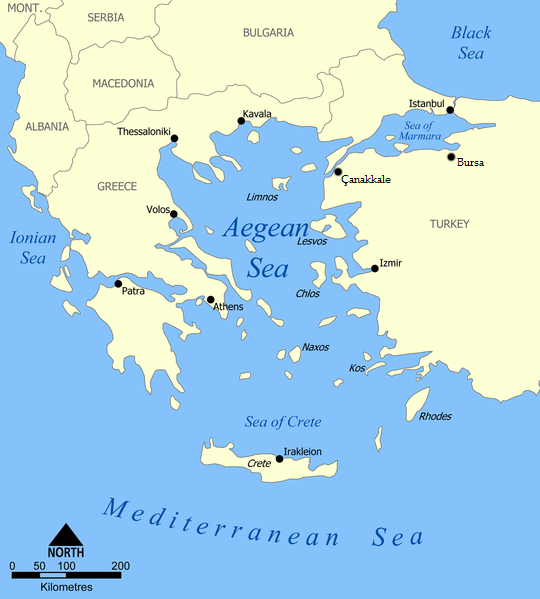
Map of the Sea of Crete

The Sea of Crete (Greek: Κρητικό Πέλαγος, Kritiko Pelagos), or Cretan Sea, is a sea, part of the Aegean Sea, located in its southern extremity, with a total surface area of 45,000 km2 (17,000 sq mi). The sea stretches to the north of the island of Crete, east of the islands of Kythera and Antikythera, south of the Cyclades, and west of the Dodecanese islands of Rhodes, Karpathos and Kassos. The bounding sea to the west is the Ionian Sea. To the northwest is the Myrtoan Sea, a subdivision of the Mediterranean Sea that lies between the Cyclades and Peloponnese. To the east-southeast is the rest of the Mediterranean Sea, sometimes credited as the Levantine Sea. Across the island of Crete, to the opposite shore of it begins the Libyan Sea. Ferry routes to and from Piraeus and Heraklion, as well as the southern islands of the Aegean and the Dodecanese, run in this area.

Just off the coastline of Northeastern Crete, the sea reaches a maximum depth of near 3,293 m (10,000 ft).[citation needed] Other sources (maps) show a maximum depth of 2,591 m (8,500 ft).

Port towns and cities

[edit]

Bays

[edit]

References

[edit]
Revisions and contributorsEdit on WikipediaRead on Wikipedia
from Grokipedia
The Sea of Crete, also known as the Cretan Sea, is a semi-enclosed basin forming the southernmost part of the Aegean Sea within the eastern Mediterranean, with a surface area of approximately 45,000 square kilometers, situated between the large island of Crete to the south and the Cyclades island group to the north. It is delimited to the west by the islands of Kythira and Antikythira, and to the east by the Dodecanese islands including Karpathos, Kasos, and Rhodes, connecting westward to the Ionian Sea via the Kythira Strait and eastward to the broader Mediterranean. With a maximum depth of 3,294 meters near the northeastern coast of Crete, it constitutes the deepest sector of the Aegean Sea, featuring rugged bathymetry that includes submarine basins and seamounts. The Sea of Crete is vital to the of the , serving as a primary site for the formation of warm, saline Cretan Deep Water (), which forms a thick bottom layer and influences water mass exchange through straits like those of Antikithira, , and . This process contributes to the renewal of deep waters across a broader area exceeding square kilometers, underscoring its role in regional ocean dynamics and climate regulation. Ecologically, the sea is oligotrophic—characterized by low nutrient levels and a dominance of small phytoplankton in a microbial food web—yet it sustains significant marine biodiversity, including habitats for species like the Mediterranean monk seal and various fish populations, while supporting coastal ecosystems along Crete's northern shores. Human activities in the Sea of Crete center on maritime transport, fishing, and tourism, with key ports such as Heraklion, Chania, and Agios Nikolaos facilitating connections to mainland Greece and other islands, while bays like Souda Bay and Mirabello Bay provide sheltered anchorages. The region's tectonic activity, linked to the Hellenic Arc subduction zone, results in frequent seismicity and occasional volcanic influences, shaping its geomorphology and posing hazards to coastal communities. Conservation efforts highlight its importance as part of protected marine areas under EU directives, balancing economic use with the preservation of its unique hydrological and biological features.

Geography

Location and Boundaries

The , also known as the (Greek: Κρητικό Πέλαγος), constitutes the southernmost portion of the within the basin. It lies approximately between 34° and 36° N latitude and 22° and 28° E , functioning as a critical transitional zone that facilitates the exchange of water masses between the and regions. This positioning underscores its role in regional oceanographic dynamics, where it receives inflows from the central and contributes to the formation and outflow of deep waters. The sea is bounded to the south by the island of Crete, which serves as its primary southern landmass and separates it from the Libyan Sea. To the north, it is delimited by the Cyclades island group and the Hellenic volcanic arc. In the west, the boundaries are marked by the islands of Kythira (Cerigo) and Antikythera, while to the east, it extends up to the Dodecanese islands, including Karpathos, Kassos, and Rhodes. These island chains define a semi-enclosed basin characterized by narrow straits and passages that influence navigational and hydrological connectivity. Adjacent seas include the to the west, connected via the Kythira Strait and Antikythera Strait; the Myrtoan Sea to the northwest, between and the western ; the to the east-southeast, linked through the straits between , Kassos, and ; and the directly south of . These borders highlight the Sea of Crete's integration into the broader Aegean-Mediterranean system, governed by the limits established for the in international hydrographic standards.

Extent and Bathymetry

The Sea of Crete, also known as the , encompasses a total surface area of approximately 45,000 km² (17,000 sq mi), making it a significant basin within the southern . Its approximate dimensions extend roughly km from east to west and 180 km from north to , bounded by the shallow Plateau to the north and the northern coastline of to the . These dimensions highlight its elongated shape, aligned with the east-west orientation of itself. Bathymetrically, the features a complex underwater topography with average depths ranging from 1,000 to 2,000 , reflecting its role as one of the deeper sections of the Aegean. The maximum depth reaches 3,293 (10,800 ft) in the central basin, particularly near the northeastern offshore areas of . Key features include steep continental shelves along 's northern coast, where depths increase rapidly from coastal shallows to the deeper basin floor, and shallower sills—typically under 250 —that connect the to the broader Aegean via the Plateau. Additionally, deep trenches and depressions, especially in the eastern portion exceeding 2,500 , are shaped by ongoing tectonic influences. Geologically, the Sea of Crete's bathymetry is profoundly shaped by the subduction zones and fault lines associated with the collision between the African and Eurasian plates along the Hellenic Arc. This active convergent margin drives extensional faulting and lithospheric stretching within the basin, contributing to its subsidence and the formation of normal faults that mirror patterns observed on surrounding landmasses. The resulting structure includes cylindrical opening of the basin without significant bending of Crete, while underplating from subduction supports uplift in the outer arc regions. These processes underscore the sea's dynamic geological setting, with sharp deepenings toward the south linking to the deeper Hellenic Trench beyond Crete.

Islands

The Sea of Crete features a diverse array of islands and islets that contribute to its fragmented geography, ranging from the expansive main to small, rocky outcrops. These landforms are primarily clustered along the coasts of , with sparser distributions extending northward toward the and eastward toward the , influencing the sea's irregular boundaries. dominates as the largest , spanning 8,336 km² and serving as the central southern boundary of the sea, its elongated form stretching over 260 km east to west. To the south lies , the southernmost Greek and point of , covering approximately 32 km² and characterized by rugged terrain with limited human presence beyond a small settlement. North of 's central is the uninhabited of Dia, measuring about 12 km², which functions as a protected under the EU's network due to its ecological value. Among the smaller islands and islets, Chrissi stands out southeast of as a low-lying sandy formation, while Koufonisi, located further east, remains uninhabited and renowned for its coastal features. In to the northeast, rises as a fortified with historical fortifications. Pseira, off the northeastern , covers roughly 1.75 km² and holds significance for ancient archaeological remains. To the west, Imeri forms part of a lagoon complex near Balos, its compact rocky profile enhancing the region's dramatic seascape.

Bays and Inlets

The bays and inlets of the Sea of Crete are prominent coastal features primarily along the northern and southern shores of Crete, shaped by the island's dynamic . These indentations provide varied marine environments, ranging from expansive gulfs to shallow lagoons, and are integral to the sea's coastal morphology. Major bays include Bay in western Crete, a deep harbor that supports sheltered to its protective configuration against prevailing winds. , located southeast of , measures approximately 15 km in length and 2 to 4 km in width, forming a narrow, deep inlet between the Akrotiri Peninsula and Cape Drapano, which enhances its role as a secure anchorage. Mirabello Bay, the largest enclosed bay in eastern Crete, spans about 17 km east-west and 10 km north-south, encompassing a semicircular expanse that influences local sediment distribution from nearby rivers. Almyros Bay in south-central Crete features a river delta outlet, creating a gently sloping coastal indentation near Heraklion with sandy substrates that transition into the open sea. Notable inlets and lagoons add to the diversity, such as Balos Lagoon in northwest , characterized by its turquoise waters and white sand barriers that separate it from the broader bay, forming a shallow, enclosed aquatic zone. Elafonissi Bay in the southwest exhibits unique pink-tinted sands derived from shell fragments, with calm, shallow waters enclosed by low dunes. Vai Bay in the east is distinguished by its backdrop of native palm groves, creating a sheltered with fine sand and pebble mixes along a narrow inlet. These features have formed through a of tectonic subsidence along fault lines and long-term , influenced by the Hellenic Zone's activity that has uplifted and fractured Crete's margins over periods. Depths vary significantly, with shallow lagoons like Balos typically less than 1 m deep and channels up to 2 m, and deeper bays such as reaching approximately 200 m. Their significance lies in providing natural sheltered anchorages that mitigate wave exposure, while contributing to coastal hotspots through protected microhabitats that foster in the Mediterranean context.

Oceanography and Climate

Water Characteristics and Currents

The waters of the Sea of Crete exhibit typical eastern Mediterranean characteristics, with average surface salinity ranging from 38.9 to 39.1 practical salinity units (psu), higher than the broader Mediterranean's average of approximately 38 psu due to intense evaporation and limited freshwater input. Surface temperatures vary seasonally between about 15°C in winter and 25°C in summer, reflecting the region's subtropical climate and strong thermal stratification in warmer months. These properties contribute to a stable water column, with intermediate waters like the dense Cretan Intermediate Water (dCIW) maintaining salinities around 38.99 psu and temperatures near 14.6°C at depths of 580–650 m. Nutrient levels in the Sea of Crete are generally low, characteristic of an ultra-oligotrophic environment, with surface nitrates often below 1 µM and phosphates under 0.1 µM, limiting primary productivity except during episodic events. Moderate upwelling from deep basins, particularly in late winter at the center of cyclonic eddies (20–600 m depths), brings nutrients such as nitrates (up to 2.5 µM increase) and phosphates (0.05 µM) into the euphotic zone, fostering localized phytoplankton blooms. This upwelling is indirectly influenced by low-nutrient inflows from the northern Aegean, which carry traces of Black Sea water (via the Dardanelles), though the Cretan Sea's southern position results in lower nutrient enrichment compared to the north (e.g., phosphates ~0.08 µM vs. 0.16 µM). Surface waters are well-oxygenated, with dissolved oxygen concentrations reaching up to 5.08 ml/L near saturation levels around 700–800 m, decreasing slightly in deeper layers to about 4.9 ml/L in intermediate waters. pH averages around 8.1 on the total scale (pH_T), with surface values fluctuating between 8.00 and 8.15 seasonally due to temperature-driven variability and . However, the region shows vulnerability to , with a long-term surface pH decline of -0.0024 units per year since 2001, driven by anthropogenic CO2 absorption. Circulation in the Sea of Crete is predominantly cyclonic, forming a with an anticyclone in the central-west and a in the east, persistent year-round but intensifying in winter. The main flow enters from the west via the through the Antikithira Strait, progressing eastward and branching into gyres around , with Levantine waters entering via the eastern Kassos Strait. Current speeds typically range from 0.1 to 0.5 m/s, with maxima up to 0.27 m/s in the Asia Minor Current branches, modulated by seasonal winds and weak tides (range <0.5 m). This pattern interacts briefly with bathymetric features like the Cretan deep basins, enhancing local upwelling.

Climate Patterns

The Sea of Crete exhibits a typical characterized by hot, dry summers and mild, wet winters, influenced by its position in the basin. Average air temperatures in reach 25-28°C during the summer months, with typically below 10 per month, contributing to arid conditions. In contrast, winter months like see average temperatures of 12-15°C and higher rainfall of 100-150 , fostering a more temperate environment. across the ranges from 400-600 , predominantly concentrated between and . Dominant wind patterns shape the region's weather dynamics, with the Meltemi—strong northerly winds originating from the Aegean—prevailing during summer, often blowing at 5-10 m/s and occasionally intensifying to 15 m/s, enhancing dryness and visibility. These winds, also known as Etesians, peak from June to September and drive surface currents in the sea. In winter, occasional southerly Sirocco winds from the Sahara introduce warmer, dust-laden air, though they are less frequent and typically milder than the Meltemi. Evaporation rates significantly exceed precipitation, leading to a pronounced water deficit that defines the hydrological balance over the Sea of Crete. Annual evaporation estimates range from 1,200-1,500 mm, driven by high solar radiation and sea surface temperatures, compared to the lower rainfall input. This imbalance results in net water loss, influencing salinity and circulation patterns. Winter storms, though rare (occurring 10-14 times per year across the broader Mediterranean, mostly in this season), can be intense, with strong frontal systems affecting sea surface conditions through enhanced air-sea heat exchange. Recent observations indicate intensifying climate variability, with the summer of 2024 marking the warmest on record for sea surface temperatures in the Cretan Sea, associated with prolonged marine heatwaves that could impact local ecosystems and circulation.

History

Ancient and Minoan Period

The , flourishing on from approximately 3500 to 1100 BCE, represented Europe's earliest advanced society and established a centered on the Sea of Crete, leveraging advanced naval capabilities for dominance over regional trade routes. This sea power, as described by the ancient historian , involved organizing the first known navy to control much of the Aegean, clearing pirates and securing maritime passages. Minoans developed sophisticated techniques, constructing oared galleys from local timber that facilitated extensive commerce with , , and the , exchanging Cretan , , and textiles for metals and . Their emphasized economic influence rather than territorial conquest, with the sheltered bays of the Sea of Crete serving as natural hubs for these operations. Key aspects of Minoan maritime expansion included the establishment of colonies on nearby islands such as Thera (modern Santorini) and Kythera, which acted as outposts for trade and cultural dissemination starting around 2000 BCE. Frescoes from Akrotiri on Thera, such as the Flotilla Fresco dating to the 17th century BCE, vividly depict organized sea voyages with large ships and smaller vessels navigating coastal routes, underscoring the ceremonial and practical dimensions of Minoan seafaring. Major ports like Kommos on Crete's southern coast, active from the Middle Minoan period (c. 2000–1700 BCE), handled exports of olive oil in amphorae and fine pottery, with archaeological analysis of ceramics revealing imports from Egypt and the Levant that confirm its role in international exchange across the Sea of Crete. Following the Minoan peak, Mycenaean influence from mainland Greece emerged around 1450 BCE, marking a shift as Mycenaean elites assumed control at sites like , blending cultures while maintaining Crete's maritime prominence. This period is associated with the in Homeric epics, where Cretan king Idomeneus leads 80 ships from Crete's harbors, highlighting the island's enduring sea routes in legendary narratives of Aegean conflict. Archaeological evidence, including the first confirmed Minoan shipwreck off Pseira in the Gulf of Mirabello (sunk c. 1800–1675 BCE), yields over 200 ceramic vessels likely carrying wine and , providing direct proof of coastal trade networks integral to Minoan prosperity. Such finds, alongside scatters and harbor remains, affirm the Sea of Crete's centrality to this thalassocratic system without evidence of expansive military campaigns.

Classical to Modern Era

During the Classical and Hellenistic periods (c. 500 BCE–67 BCE), the Sea of Crete functioned as a critical maritime corridor for Greek city-states, supporting naval operations and trade amid inter-polis conflicts. Crete's independent poleis, such as and , engaged in frequent warfare that extended to sea routes, where the waters around the island served as strategic passages for fleets during broader Hellenic struggles, including movements linked to the . The region's agricultural and mercantile economy relied on these seas for connectivity, fostering a pattern of combative among city-states until external pressures mounted. The Roman conquest in 67 BCE, led by Caecilius Metellus during the Third Mithridatic War, marked the integration of into the Roman sphere, with the Sea of Crete becoming a key asset for imperial naval control in the . Following the defeat of Cretan forces, the island was combined with to form the senatorial province of , administered from , which enhanced Rome's dominance over Aegean shipping lanes and suppressed piracy that had plagued the region. This provincial structure persisted through the early centuries CE, stabilizing the sea's role in Roman logistics until the empire's division in 395 CE. Under Byzantine rule from 395 CE, the Sea of Crete held paramount strategic value for defending the empire against invasions, serving as a natural barrier and naval outpost across the Aegean. Positioned at the entrance to the Aegean Sea, it enabled Byzantine fleets to monitor and counter threats from the west and south, with Crete functioning as a forward base for imperial defenses until the Arab incursions of the 7th century. The establishment of the Arab Emirate of Crete in the 820s CE, founded by Andalusian exiles who seized the island, transformed the sea into a hub for piracy and raids that terrorized Byzantine commerce and coastal territories for over a century. From their capital at Chandax (modern Heraklion), the emirs launched devastating expeditions, occupying Cycladic islands and disrupting shipping routes until the Byzantine reconquest in 961 CE under Nikephoros Phokas. Crete remained under Byzantine control until the in 1204 CE, after which it was sold to and established as the Kingdom of Candia, enduring Venetian rule until 1669 CE. During this era, the Sea of Crete was essential to 's commercial and naval empire in the , supporting vital trade routes to the , protecting shipping lanes, and featuring extensive coastal fortifications in ports like and Candia () to counter Ottoman threats. The Ottoman conquest of , completed in 1669 after the prolonged , brought the Sea of Crete under the empire's naval dominance, with the Ottoman fleet enforcing control over Aegean trade and suppressing Venetian remnants through blockades and engagements. During the subsequent Ottoman era (1669–1898), the sea became a theater for Cretan revolts, where Greek insurgents utilized coastal access for arms and evading blockades imposed by Ottoman squadrons to quell uprisings, such as the major revolt of 1866–1869. The 1897–1898 revolt further highlighted the sea's role, as international naval interventions, including British and Russian fleets, enforced agreements that weakened Ottoman grip. In the , Crete's formal union with on December 1, 1913, following the and the Treaty of London, solidified the Sea of Crete within Greek , ending centuries of contested sovereignty. During , the in May 1941 exemplified the sea's continued military significance, as German airborne forces, supported by convoys, attempted an invasion across the waters, only to face fierce interdiction by the Royal Navy, which sank numerous troop transports and inflicted heavy losses on the Axis fleet. Today, the Sea of Crete delineates key maritime borders as part of Greece's , while serving as a primary migration corridor from , with irregular arrivals from surging to 7,336 in the first half of 2025 and over 13,000 by late September 2025, prompting enhanced patrols and humanitarian responses.

Ecology

Marine Biodiversity

The Sea of Crete, as part of the eastern Mediterranean's Aegean sub-basin, supports a rich array of influenced by its semi-enclosed and seasonal , which enhances nutrient availability and . This includes a variety of , marine mammals, reptiles, , and plant communities adapted to depths ranging from shallow coastal zones to the deeper . The ichthyofauna of the Sea of Crete encompasses over 200 fish species typical of the Mediterranean, with representatives from families such as Clupeidae and Scombridae dominating pelagic habitats. Common examples include sardines (Sardina pilchardus) and anchovies (Engraulis encrasicolus), which form dense schools in surface waters, as well as demersal species like groupers (Epinephelus marginatus) that inhabit rocky reefs and caves. Commercially significant pelagic predators, such as bluefin tuna (Thunnus thynnus), migrate through the region seasonally, contributing to the trophic dynamics. Marine mammals in the Sea of Crete include the endangered (Monachus monachus), with an estimated global population of approximately 800-1,000 individuals as of 2025, some of which utilize remote coastal caves along Crete's southern shores for resting and pupping. Cetaceans are also present, featuring striped dolphins (Stenella coeruleoalba) and common bottlenose dolphins (Tursiops truncatus) that frequent coastal and shelf areas in pods, alongside deeper-water species like sperm whales (Physeter macrocephalus) and Cuvier's beaked whales (Ziphius cavirostris) associated with the . Reptilian fauna is represented by the (Caretta caretta), which nests on Crete's sandy beaches, particularly along the northern and southern coasts, where females emerge nocturnally to deposit clutches during summer months. Invertebrate diversity includes cephalopods such as octopuses (Octopus vulgaris) and squids (Loligo vulgaris), which thrive in benthic and mid-water environments, as well as crustaceans like spiny lobsters () and various rays (e.g., stingrays from the family Dasyatidae) that patrol sandy and bottoms. Corals, including endemic Mediterranean species like Cladocora caespitosa, form patchy reefs in shallower, sheltered areas, while seagrasses provide structural habitat. Vegetation in the Sea of Crete is dominated by extensive meadows of the endemic seagrass Posidonia oceanica, which form in suitable shallow depths (up to 40 meters) and serves as a foundational supporting epiphytic and communities. These meadows, interspersed with macroalgae like Cystoseira , form the base of the , fostering and populations. Endemism in the Sea of Crete mirrors broader Mediterranean patterns, with 20-30% of marine unique to the basin, particularly in mollusks, crustaceans, and fishes concentrated in hotspots that promote . This high rate underscores the region's status as a global marine , where evolutionary isolation has led to distinct assemblages.

Conservation Efforts

The Sea of Crete benefits from the European Union's network, which designates numerous marine sites across waters, covering approximately 20% of territorial seas up to 12 nautical miles, including areas around to safeguard hotspots such as coastal caves and meadows. Key protected zones include NATURA 2000 sites near Island, recognized for their role in supporting the endangered (Monachus monachus), with underwater caves serving as vital habitats for pupping and resting. In July 2025, established the National Marine Park in the Southern region, which encompasses parts of the Sea of Crete and integrates existing Natura 2000 sites to enhance protection for marine . These designations function as de facto marine protected areas, emphasizing habitat preservation for seals and other species. Major threats to the Sea of Crete's ecosystems include , which has led to unsustainable exploitation of , with approximately 60% of assessed Mediterranean stocks, including those in Cretan waters, fished unsustainably as of 2023. exacerbates marine degradation, with entanglement and ingestion affecting wildlife, while tourism-related activities contribute to beach , wastewater discharge, and habitat disturbance in coastal areas. compounds these pressures through sea surface temperature increases of about 1°C since the in the , alongside rising sea levels that threaten low-lying coastal ecosystems. Conservation initiatives in the region are guided by the EU's Marine Strategy Framework Directive (MSFD), which Greece implements to achieve good environmental status in marine waters, including monitoring programs for Cretan sites to address pollution and biodiversity loss. Non-governmental organizations like WWF Greece conduct ongoing monitoring of sea turtles and monk seals in Cretan coastal areas, collaborating with local groups to track populations and mitigate human impacts. Fisheries management under the EU enforces quotas for species like and establishes no-take zones in select Cretan waters to allow stock recovery and reduce . These efforts have yielded notable successes, including the stabilization and gradual recovery of the population in Greek waters, with sightings and breeding records increasing around due to enhanced protections and reduced disturbances. Restoration projects for meadows, such as those initiated in eastern near , involve replanting efforts to rehabilitate degraded habitats, improving and fish nursery functions.

Human Settlement and Economy

Port Towns and Cities

The Sea of Crete is served by several major ports, strategically located along its northern and southern coasts, facilitating passenger ferries, yachting, and local maritime traffic with depths generally ranging from 5 to 12 meters to accommodate various vessel sizes. These ports reflect Venetian and Ottoman architectural influences in their layouts, particularly in harbor designs featuring breakwaters and lighthouses built during those eras. , the largest and busiest, handles over two million ferry passengers annually as the main hub connecting to () and the , with facilities including two modern passenger terminals capable of processing more than 10,000 individuals daily and piers accommodating up to five cruise vessels simultaneously. In 2024, it also welcomed over 500,000 cruise passengers, underscoring its role as a key entry point. Chania's primary at , located 7 kilometers east of the city center, emphasizes with its Venetian-style old harbor in town complementing the modern facilities; the pier supports ferry services and recorded 279,754 cruise passengers in 2024, with expansions planned for a new 2,000-square-meter terminal to enhance passenger services. , a mid-sized facility in the central north, features a historic Venetian harbor integrated with a yacht offering 640 berths; its infrastructure includes 810 meters of pier length and sailing depths of 6 to 8 meters, supporting both passenger ferries and recreational boating. To the east, Agios Nikolaos port in Mirabello Bay serves yachting and ferries to the , with a 200-meter harbor suitable for cruise liners and a nearby providing 255 berths equipped with fuel services and ; its T-shaped pier can host up to four ships at once. , the easternmost major port, acts as a terminus for small ferries linking to the and , featuring a compact harbor for passenger and commercial vessels amid a scenic waterfront. In the west, port operates dual facilities—an old fishing harbor and a newer for ferries to Kythera and the —with depths supporting local and inter-island routes. Further south, Ierapetra's smaller port, the southernmost in , primarily handles short ferries to Chrissi Island, with a layout including a and basic docking for passenger boats.

Economic Activities

The Sea of Crete serves as a vital maritime corridor for shipping and ferry services connecting to mainland and the surrounding islands. Ferry routes from major ports like and to , the , and the transport millions of passengers annually, with domestic sea traffic in reaching approximately 19.4 million passengers in 2024, a significant portion of which involves Cretan routes. Port alone handles over 2 million passengers each year, facilitating and local travel. Cargo shipping through these routes includes key Cretan exports such as and wine, with 's seaports managing substantial volumes of these agricultural products destined for international markets. Fishing remains a cornerstone of the local economy in the Sea of Crete, where the waters contribute notably to Greece's overall marine capture production of around 80,000 tonnes per year. The region supports catches of small pelagic species like sardines and anchovies, which account for about one-third of national production, alongside fisheries in the Aegean basin. These activities represent an estimated 10-15% of Greece's total fish catch, sustaining coastal communities through small-scale operations. Complementing wild fishing, aquaculture farms in sheltered bays such as near cultivate sea bream and , with Greece's sector producing approximately 115,000 tonnes in 2024, bolstering export revenues and local supply. Tourism thrives on the Sea of Crete's clear waters and coastal features, drawing visitors for beach activities, diving, and yachting. Iconic sites like Balos Lagoon attract hundreds of thousands of tourists yearly; scientists have proposed a daily limit of around 2,230 visitors during peak season to manage environmental impact. Diving hotspots around Dia Island offer access to diverse marine life and underwater formations, suitable for various skill levels with depths from 7 to 30 meters. Yacht charters are popular for exploring the sea's bays and islands, with numerous operators providing luxury rentals that enhance high-end tourism. Emerging economic opportunities include exploratory offshore wind development and desalination initiatives. The region holds potential for offshore wind farms, with a planned 600 MW project in the Aegean near Crete aimed at harnessing steady winds to power coastal areas; the Crete-Attica electrical interconnector, operational since May 2025, supports integration of such renewables. Desalination plants, such as those using reverse osmosis, supply fresh water to coastal cities amid seasonal shortages, with Greece's national capacity producing approximately 250,000 cubic meters daily as of 2025 and Crete hosting facilities integrated with renewable energy sources.

References

Add your contribution
Related Hubs
User Avatar
No comments yet.