Hubbry Logo
Korean tea ceremonyKorean tea ceremonyMain
Open search
Korean tea ceremony
Community hub
Korean tea ceremony
logo
8 pages, 0 posts
0 subscribers
Be the first to start a discussion here.
Korean tea ceremony
Korean tea ceremony
from Wikipedia

Korean tea ceremony
Korean name
Hangul
다례
Hanja
茶禮
RRdarye
MRtarye
IPA[ta.ɾje]

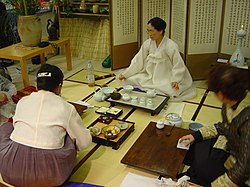
The Korean tea ceremonies (Korean: 다례; RR: darye; pronounced [ta.ɾje]) are variants of tea ceremonies practiced in Korea. Darye literally refers to "etiquette for tea" or "tea rite", and has been kept among Korean people for over a thousand years.[1] Although records exist of court tea ceremonies during the Goryeo and early Joseon dynasties, by the time of Seonjo (1590s), it had ceased to be practiced. Korean tea is mostly herbal, and is consumed without a Japanese-style ceremony.[2]

History

[edit]

Early history

[edit]

The first historical record documenting the offering of tea to an ancestral god describes a rite in the year 661 in which a tea offering was made to the spirit of King Suro, the founder of the Geumgwan Gaya Kingdom (42–562). Records from the Goryeo dynasty (918–1392) show that tea offerings were made in Buddhist temples to the spirits of revered monks.[3]

Important national rituals involving tea drinking were being presided over by the government officials of the "Tabang" department.[4] There is at least one ritual recorded in the Goryeosa Yaeji, or The Official History of Goryeo, mentioned as part of receiving a Chinese messenger to the court.[5]

Joseon dynasty

[edit]

During the Joseon period (1392–1910), the ritualistic drinking of tea continued and was further refined. "Tabang" sustained and organized the main royal ceremony. The royal Yi family and the aristocracy used tea for simple rites, the "Day Tea Rite" was a common daytime ceremony, whereas the "Special Tea Rite" was reserved for specific occasions. They were codified in the 1474 "National Five Rites" (Gukjo Oryeui, 國朝五禮儀, 국조오례의).[6] These terms are not found in other countries.

But plantation problems changed many ways Korean tea was governed. Unlike tea plantation areas in China or Japan, the climate of the Korean Peninsula is much colder and Tea harvesting season occurs just before the spring. So at that period, the tea tree forested areas in the mountains were still so cold and also dangerous because of wildlife. The old Korean name of tea, 설록("Seollok", 雪綠), means the first flush tea leaf was harvested on the snow field of a mountain. This situation brought much trouble during the Goryeo dynasty and Joseon dynasty.

The tea tree forested area is also the traditional Breadbasket of Korea and the tea leaf harvesting season and cereal seeding season overlap each other. Because of its value, farmers who lived around tea tree forested regions paid a steep tea tax to the king. So harvesting and treating tea leaves is pointed out as the major cause of the decrease in annual tea crop harvest. In the Goryeo dynasty, there were hundreds of appeals by many lieges and scholars such as Lee Je-hyun [ko] or Lee Gyu-bo [ko]. And finally at the end of the Goryeo dynasty, recorded in the "Yuduryurok(유두류록; 遊頭流錄)", farmers burnt or chopped their tea trees to protest against the tea tax. In the case of the Joseon dynasty, governed based on Confucianism, Tabang was sustained for tea ceremony but reduced the scale of tea production in order to protect the agricultural balance. Because of this, the development of the tea industry was prevented for a very long time. And except for Yangban and the royal family, Korean original tea drinking culture and ceremony remained in a limited area around tea tree forested regions.[7]

However, by the middle of the Joseon dynasty, there appears to have been a decline in tea drinking except for the anniversary ceremonies. It is said, that when the Ming Commander, Yang Hao, told King Seonjo (r.1567–1601) during the Japanese invasion that he had discovered high-quality tea plants in Korea, and that "if you were to sell the tea in Liaodong, you could get a silver coin for every ten pounds of tea. Altogether, that would be enough silver to buy ten thousand horses." King Seonjo, however, replied "We do not have a tea drinking custom in our country."[8]

Late-Joseon dynasty- Japanese Occupation to 1980s

[edit]

Tea was reintroduced to Korea by the Japanese in 1890s, the same time coffee was introduced. Early Korean teahouses, called dabang, developed. An early one was established in the Sontag Hotel in Seoul, in 1902. The dabang culture grew, spreading throughout Korea during the Japanese colonial period. From 1930s to 1980s, ssanghwacha was the most popular item in the dabang culture. Not actually containing any tea extracts, it was a sweetned herbal tea. The second most popular tea served was hongcha: Western-style black tea. There was no ceremonial aspect in drinking these teas in dabang.[citation needed]

Kinds of tea

[edit]

The earliest kinds of tea used in tea ceremonies were heavily pressed cakes of black tea, the equivalent of aged pu-erh tea still popular in China. Vintages of tea were respected, and tea of great age imported from China had a certain popularity at court. However, modern Korean tea is primarily grain and herbal, not containing actual tea leaves.

See also

[edit]

References

[edit]
[edit]
Revisions and contributorsEdit on WikipediaRead on Wikipedia
from Grokipedia
The Korean tea ceremony, known as darye (茶禮, meaning "etiquette for tea" or "tea rite"), is a traditional centered on the mindful preparation, serving, and consumption of tea, engaging the five senses through simplicity, harmony, and respect for nature. It primarily features , brewed in a sequence of steps that highlight the quality of ingredients and utensils like teapots, cups, and bowls, often performed in serene settings to foster and . Distinct from more formalized Japanese or Chinese counterparts, darye integrates Buddhist principles with Korean cultural values of humility and communal etiquette, evolving into variations such as royal ceremonies for nobility, scholarly gatherings, and modern revivals. Tea culture arrived in Korea from China around the 7th century CE during the period, becoming established through Buddhist who valued its meditative properties. During the Dynasty (918–1392), tea flourished under Buddhist influence, inspiring poetry, elaborate court rituals, and widespread cultivation. In the subsequent Joseon Dynasty (1392–1910), despite the rise of suppressing overt Buddhist practices, tea persisted through "hermit tea art" among monks and "bureaucratic tea art" for official etiquette, though production declined sharply after the Japanese invasions of the 1590s, which devastated farms and led to the export of Korean potters who influenced Japanese tea traditions. A key figure in preserving these traditions was the monk Cho Ui (1786–1866), who documented tea cultivation and philosophy in the early 19th century amid cultural suppression. Japanese colonial rule (1910–1945) further marginalized practices, but a emerged post-World War II and the (1950–1953), leading to contemporary institutions like the Tea Museum of Korea in Boseong-gun and annual events such as National Tea Day in May. Today, darye encompasses diverse teas from fruits, grains, and herbs—such as yujacha (citron tea for colds) and ssanghwacha (medicinal herbal blend)—reflecting health benefits and seasonal adaptations, while reinforcing Korea's cultural identity through festivals and educational programs in regions like Hadong-gun, home to over 1,200-year-old plantations.

History

Ancient origins and Three Kingdoms period

The earliest legendary account of tea's introduction to Korea dates to around 48 CE, when Queen , a from the Indian kingdom of (also known as Ayuta), arrived in the (an early name for ) as the bride of King Suro. According to this legend, recorded in historical texts such as the Garakgukgi and Bulgyotongsa, she brought seeds as part of her , which were planted on Baegwol Mountain in present-day , symbolizing one of the first instances of foreign cultural influence on Korean practices. This narrative underscores tea's symbolic role in royal unions and early agrarian integration, though it remains a foundational rather than a verified historical event. The first documented historical use of tea in Korea occurred in 661 CE during a ritual offering to the spirit of King Suro, the founder of (42–562 CE), as described in the , a 13th-century compilation of ancient records. This funerary rite highlighted tea's emerging significance in ancestral veneration and spiritual ceremonies, where it served as a sacred offering alongside other tributes like and fruits, establishing its place in pre-Buddhist ritual traditions. During the period (57 BCE–668 CE), 's spread accelerated through Buddhist monks who encountered it in and incorporated it into Korean temple life. Introduced alongside from the late 4th century onward, was valued by monks for aiding and as an offering in rituals, with early temples like Bulgapsa and Hwaeomsa associating it with spiritual discipline. This monastic adoption laid the groundwork for 's ritualistic use, distinct from later courtly developments. In the dynasty (57 BCE–935 CE), systematic tea cultivation began in 828 CE, when envoy Kim Dae-ryeom returned from Tang China with seeds planted on the slopes of Jirisan Mountain, as noted in the . These early efforts focused on producing pressed tea bricks, which were compressed for easy transport and storage, reflecting practical adaptations to Korea's mountainous terrain and trade needs.

Goryeo dynasty

During the dynasty (918–1392), reached its zenith, becoming deeply integrated into state administration and religious life. The royal court established a special bureau to oversee tea production, tribute payments, and ceremonial rituals, underscoring tea's importance as a valuable state resource used in diplomatic exchanges and official functions. This institutional framework, known as the Tabang, managed all aspects of tea affairs, from cultivation and to distribution and consumption, reflecting the government's recognition of tea's medicinal and cultural value. Tea flourished within Buddhist temples, where it served as an essential aid for by helping monks maintain alertness during long sessions of Seon () practice. Temples maintained their own tea gardens to supply the needs of monastic communities, and tea offerings were made to deities and deceased masters as part of daily rituals. Historical records indicate widespread cultivation in temple settings, contributing to the dynasty's robust tea economy and spiritual traditions. Innovations in tea processing emerged to support long-distance trade and elaborate rituals, including the production of pressed formed into round medallions known as byeongcha, which resembled compressed forms like pu-erh but used fresh green leaves. These compressed teas were ideal for storage and transport along trade routes to and beyond, while precursors to powdered were whisked for consumption in ceremonial contexts, enhancing the aesthetic and social dimensions of tea drinking. Cultural texts from the period further documented tea's integral role in Seon practices and royal ceremonies. The Chinese envoy Xu Jing's 1123 memoir, Xuanhe Fengshi Gaoli Tujing, provides detailed accounts of tea customs, wares, and their use in both elite and everyday settings. Similarly, Kim Busik's Samguksagi (1145) references the historical foundations of tea cultivation, linking it to earlier introductions while highlighting its prominence in society. The Seonmun Bojo Jip from the 1340s compiles insights into 's application in meditation and courtly rites, preserving its philosophical and ritualistic significance.

Joseon dynasty

During the dynasty (1392–1910), tea rites underwent formalization under Confucian principles, shifting from the Buddhist emphasis of the preceding period to structured ceremonies that reinforced social hierarchy and moral cultivation. In 1474, the "Day Tea Rite" (a daily palace ceremony) and "Special Tea Rite" (for ancestral offerings and royal occasions, such as welcoming envoys or honoring the deceased) were codified in the Gukjo Oryeui (National Code of the Five Rites), specifying detailed procedures including the preparation of offerings, the arrangement of utensils on ritual tables, and the sequence of bows and presentations to ensure propriety in ancestral and royal contexts. These rites integrated tea into state s, such as those at the Royal Ancestral Shrine, where it symbolized and harmony, though practice remained limited to court settings by the early . In the late Joseon period, (practical learning) scholars revived interest in as a scholarly and healthful pursuit, contrasting with the earlier dominance of Buddhist monastic traditions suppressed by Confucian policies. Prominent figures like Jeong Yagyong (Dasan, 1762–1836), a key thinker, advocated for tea's cultivation and consumption in writings such as his 1809 treatise on caked tea preparation and a 1830 letter emphasizing its role in daily rituals for moral refinement. Similarly, monk Hyewol Cho-ui (1786–1866), influenced by Dasan, composed the Dongcha Song (Song of Eastern Tea, 1837), promoting native Korean teas like those from Jiri Mountain as superior for and health, thereby fostering a scholarly among elites despite official disfavor toward . Tea cultivation and consumption declined significantly by the mid-16th century due to a of environmental, economic, and political factors. The dynasty's harsher northern , particularly colder periods in the 17th and 18th centuries, challenged the subtropical plant, limiting viable growth to southern regions like Jiri Mountain and reducing overall yields. Heavy taxation on tribute tea fields, such as the burdensome Jakseol-cha quotas imposed on local producers, incentivized farmers to convert these lands to more profitable rice paddies, which better suited wet-field agriculture and state revenue needs. Concurrent anti-Buddhist policies, including restrictions on temple land ownership and monastic activities, curtailed institutional cultivation and ritual use, further eroding tea's cultural prominence outside elite circles. By the , tea rituals became increasingly restricted to the aristocracy and scholar-officials, serving as markers of hierarchical and ethical discipline rather than widespread . These ceremonies emphasized Confucian values like and , with tea offerings reinforcing status distinctions during family ancestral rites or scholarly gatherings, while commoners largely abandoned the beverage due to scarcity and inaccessibility.

Late Joseon to contemporary revival

During the late Joseon dynasty, traditional tea practices continued to decline due to the enduring influence of Neo-Confucianism, which suppressed Buddhist institutions, coupled with economic hardships from foreign incursions like the Imjin War, leading to the abandonment of many tea fields and a shift toward herbal infusions over ritualistic darye. The Japanese occupation from 1910 to 1945 further marginalized Korean tea culture, as colonial authorities promoted the Japanese chanoyu ceremony, particularly among youth, to assimilate Korean society, while reintroducing tea cultivation primarily for export through imported Japanese varieties and establishing plantations focused on black tea production starting in 1939. This period saw the rise of casual dabang teahouses, influenced by Japanese kissaten coffee shops, where ssanghwacha—a non-caffeinated herbal grain tea—became a staple beverage served without ceremonial elements, reflecting a broader casualization of tea consumption amid cultural suppression. The (1950–1953) exacerbated the near-extinction of darye, as widespread destruction and postwar poverty dismantled remaining secular practices, confining preservation to isolated Buddhist monasteries where Seon monks maintained meditative rituals as part of spiritual discipline. Elite circles sporadically upheld limited formal gatherings into the , but widespread revival only gained momentum during the 1980s economic boom, when growing national prosperity and spurred interest in reclaiming traditional arts. A pivotal institution in this resurgence was the Panyaro Institute, founded on July 2, 1983, in Seoul's by tea master Chae Won-Hwa to perpetuate the legacy of Venerable Hyodang (Choi Beom-sul), a who had revived Korean tea traditions after in 1945 and developed Panyaro as a symbol of enlightened simplicity. The institute promotes "Tea Zen"—a meditative approach blending Seon Buddhist principles with darye —and trains practitioners in traditional houses, emphasizing natural movements, awareness of surroundings, and the use of hand-processed green teas to foster spiritual harmony without rigid formalism. Through public lectures, performances integrating tea with Korean music, and educational programs, Panyaro has trained thousands, helping standardize and disseminate authentic darye nationwide. From the 1990s onward, global interest in Korean tea culture has surged, driven by international expositions and scholarly exchanges that highlight darye as a unique East Asian tradition emphasizing relaxation and , distinct from more codified Japanese or Chinese practices. Efforts to secure recognition for Korean tea heritage intensified in the 2010s, including nominations under the framework and hosting events like the 2023 World Tea Culture Industry Conference in , which underscored tea's role in Silk Roads . Paralleling this, organic tea production expanded rapidly from the late 2000s, motivated by heightened consumer concerns over pesticide residues in conventional ; by 2011, certified organic tea acreage reached 15,726 hectares, reflecting a twenty-fold increase over the prior decade through farmer cooperatives adopting eco-friendly methods like natural .

Philosophy and significance

Core principles

The Korean tea ceremony, known as darye, is deeply rooted in Seon Buddhism, the Korean variant of , which emphasizes , impermanence (musang), and harmony with nature as pathways to enlightenment. Tea serves as a meditative tool, allowing participants to cultivate present-moment awareness and contemplate the transient nature of existence through deliberate, unhurried actions amid natural surroundings. This philosophical foundation draws from historical practices in Buddhist temples during the dynasty, where tea facilitated spiritual reflection and communal meditation. Confucian influences integrate ritual propriety (ye), filial piety expressed through ancestral offerings of tea in rites, and the reflection of social hierarchy in the serving order, where elders and guests receive priority to uphold in relationships. These elements promote moral conduct and social cohesion, blending formality with genuine interpersonal connection. Central to darye are the principles of , which favors modest and unadorned procedures; , manifested in reverent gestures toward participants and the itself; and tranquility, fostering a serene mindset that eases formality without rigidity. These concepts encourage a balanced state of ease amid , prioritizing over performative display. Unlike the Chinese gongfu cha, which involves elaborate techniques and multiple infusions for aesthetic precision, darye emphasizes communal relaxation and shared enjoyment, allowing natural conversation and accessibility in everyday settings to nurture collective well-being.

Cultural and social roles

The Korean tea ceremony, known as darye, plays a central role in ancestral rites such as charye, a tea offering performed during family memorials like those on , where is presented to honor departed ancestors and express for their legacy. In these rituals, symbolizes , continuity of family bonds, and the enduring connection between the living and the deceased, reinforcing communal reverence and . Similarly, in wedding traditions like the paebaek ceremony, the and groom serve to their parents and elders, signifying deep , , and the unification of families, while integrating the into the groom's household as a symbol of shared and . Beyond familial rites, darye facilitates social harmony in gatherings and community events by promoting , mutual , and equality among participants, often through shared rituals that encourage relaxation amid daily pressures. Historically associated with scholarly and diplomatic contexts, the ceremony has been used to build interpersonal bonds and foster consensus, as seen in its emphasis on that transcends social hierarchies during informal or formal assemblies. Gender dynamics in darye have evolved significantly; traditionally dominated by men in seonbi (scholarly) circles, where ceremonies emphasized Confucian propriety in male-dominated intellectual pursuits, modern practice has become more inclusive, particularly through institutions like the Panyaro Institute. Founded to revive authentic Korean tea ways, Panyaro, led by Great Tea Master Chae Won-Hwa since 1983, welcomes participants of all genders, enabling women to lead and engage in tea training and ceremonies, thus broadening access to this cultural practice. As an element of Korea's , darye preserves national identity by embodying elegance, naturalness, and traditional values amid the rise of Western-influenced , which dominates urban social scenes but contrasts with tea's ritualistic depth in maintaining historical continuity and communal mindfulness.

Types of tea used

Green teas

Green teas derived from form the foundation of traditional Korean tea ceremonies known as darye, valued for their fresh, vegetal qualities that enhance meditative contemplation. These teas underwent a significant evolution in form and preparation during Korea's dynastic history. In the dynasty (918–1392), tea was primarily consumed as compressed bricks, influenced by Chinese Buddhist practices where leaves were steamed, pounded, and molded for storage and transport before boiling. By the dynasty (1392–1910), cultural shifts toward and secularization led to the adoption of loose-leaf green teas, which were pan-fried or lightly steamed to preserve natural flavors, aligning with simpler infusion methods in everyday and ceremonial settings. A notable example is panyaro, a premium steamed symbolizing the "dew of enlightening wisdom," produced through the precise jeungcha method of steaming and rolling to retain vibrant flavors and aromas. Associated with Buddhist traditions and the Panyaro Institute, it is hand-processed from high-altitude plantations near mountains like , offering a clean, sweet infusion ideal for formal darye to promote . Among these, woojeon (literally "before the rain") represents the premium first-flush , hand-picked exclusively from tender buds and young leaves in early spring, before the Grain Rain around April 20, during a brief 5–7 day window as tender buds emerge. Grown in shaded conditions to enhance sweetness, woojeon undergoes a hybrid processing method combining brief steaming to halt oxidation and subsequent roasting in woks, resulting in a nutty aroma, toasty savoriness, and subtle notes. Its rarity and delicate profile make it ideal for formal darye, where it symbolizes purity and seasonal renewal. Following woojeon, sejak and jungjak comprise mid-flush greens suited for more frequent ceremonial use. Sejak ("thin sparrow's tongue"), harvested from young leaf buds between the Grain Rain (Gogu, around ) and the Start of Summer (Ipha, early May), features lighter pan-firing to yield a fresh, vegetal taste with mild astringency, making it a staple for daily darye among scholars and families. Jungjak ("medium sparrow's tongue"), plucked later in May from slightly larger leaves during the third flush, undergoes similar minimal processing but produces a more robust, grassy infusion suitable for communal gatherings, balancing accessibility with ritual elegance. Both grades emphasize hand-picking in regions like Hadong and Boseong to maintain quality for ceremonial infusion. Jeoncha, a steamed originating from the Boseong region in Jeollanam-do province, distinguishes itself through its production akin to Japanese , where leaves are steamed without roasting to retain vibrant color and needle-like shapes. Developed in Boseong's expansive plantations, which span over 600 hectares and benefit from the area's misty climate, jeoncha offers a clean, oceanic flavor with herbaceous undertones, providing a lighter alternative in darye for its refreshing clarity. In contemporary practice, organic green tea cultivation has flourished on Jeju Island's volcanic soil, which provides rich minerals and natural drainage that impart unique minerality to the leaves. Farms like OSULLOC, established in 1979 and covering 15% of Korea's tea acreage, employ regenerative organic methods, including natural shading from Mountain's fog to boost levels and flavor complexity, ensuring sustainable supply for modern darye adaptations. This volcanic enhances the teas' purity, aligning with Joseon-era preferences for unadulterated loose leaves.

Herbal infusions

In Korean tea culture, herbal infusions are integrated into darye practices, particularly in adapted or seasonal ceremonies, alongside formal rituals, to promote health and well-being through principles. These non-Camellia sinensis-based beverages, derived from roots, berries, grains, and other plants, emphasize therapeutic properties and are prepared by steeping or boiling ingredients in hot water, sometimes sweetened with honey, and consumed hot or cold. Yujacha, made from dried citron fruit (yuja), is a popular citrusy infusion valued for its vitamin C content and use in relieving colds, sore throats, and aiding . Prepared by mixing yuja preserve with hot water, it offers a sweet-tart flavor and is commonly enjoyed in winter darye adaptations for its warming and immune-boosting effects. Ssanghwacha, a traditional medicinal blend of over 10 ingredients like , ginger, licorice, and roots, is simmered to create a dark, aromatic renowned for enhancing stamina, blood circulation, and women's health. Often consumed during ancestral rites or as a postpartum tonic, it reflects communal and restorative aspects of darye. Omija-cha, crafted from the dried berries of , embodies the concept of balanced flavors with its unique profile of sweet, sour, salty, bitter, and pungent tastes, symbolizing harmony in Korean traditions. Prepared by 10-15 dried berries in 500 ml of hot water for 5-10 minutes, optionally with added for sweetness, it is particularly valued for aiding and boosting energy, making it suitable for post-meal consumption during casual gatherings. Its detoxifying effects, including support for respiratory health and regulation, have cemented its role in everyday wellness practices, especially in summer to refresh and invigorate. Insam-cha, or , utilizes the root of , often in its red-processed form (hongsam), ground and brewed with hot water, sometimes garnished with pine nuts and for a milder taste. Renowned for symbolizing and , it enhances immunity, improves circulation, and reduces stress, positioning it as a staple in health-focused routines and as a thoughtful in social exchanges. In ancestral rites and family observances, ginseng infusions underscore themes of endurance and prosperity, reflecting their deep integration into cultural expressions of respect and continuity. Yulmu-cha, a grain-based from roasted Job's tears (Coix lacryma-jobi) seeds, blended with nuts and slices, yields a thick, soup-like consistency when boiled, offering a nutty, hearty alternative to lighter teas. It supports and cholesterol reduction while providing gluten-free protein and immune-boosting nutrients, rendering it ideal for post-meal relief in informal settings like teahouses, where it fosters relaxed social interactions. This tea's accessibility and comforting texture have made it a popular choice in contemporary Korean daily life. Modern varieties such as saenggang-cha, made by simmering fresh ginger root in water with honey, have gained prominence since the late Joseon period as affordable, warming alternatives amid occasional scarcities of imported or cultivated leaf teas. Known for promoting blood circulation, alleviating coughs, and providing digestive comfort, it serves as an everyday tonic, particularly in colder seasons, bridging traditional herbal wisdom with practical, widespread use in households and casual teahouses.

Utensils and materials

Essential tools

The core implements for the Korean tea ceremony, known as darye, emphasize simplicity and functionality to facilitate the mindful preparation and serving of tea for small groups, typically 2-4 participants. These tools are often crafted from natural materials like , , and metal, allowing for even heating, precise measurement, and appreciation of the tea's aroma and flavor without unnecessary ornamentation. The tagwan, or , is a fundamental vessel resembling a kyusu-style with a side handle, commonly made of such as or to promote even . It typically holds enough capacity for 2-4 cups, where hot water is added to loose leaves, allowing them to infuse gently over 1-2 minutes before pouring. The side handle enables steady pouring with minimal disturbance to the leaves, ensuring a balanced extraction. Dawan refers to the handleless teacups, which are low and wide-mouthed to enhance the release and appreciation of the tea's aroma during sipping. These cups, often and holding about 50-100 ml, are preheated with hot water to maintain the tea's temperature and are served without saucers in traditional settings to keep focus on the beverage itself. Their simple, rounded form allows guests to cradle them comfortably in both hands, promoting a tactile connection to the . The chachik, a scoop, is used for accurately measuring and transferring leaves from a to the tagwan, typically portioning 5-7 grams per serving depending on the type and group size. Crafted from a single piece of for lightness and natural grip, it features a shallow spoon-like end to avoid bruising delicate leaves, embodying the ceremony's emphasis on precision and respect for the ingredients. A , often constructed from or , serves to heat water to the optimal range of 80-90°C for green teas used in darye, preventing bitterness from over-boiling. variants conduct heat evenly for quick adjustments, while provides subtle and retains warmth steadily; both are placed on a low heat source like a during the setup. Complementing this is the waste water bowl, a wide basin that collects excess or cooling water from rinsing tools and cups, maintaining cleanliness and flow in the preparation process. Variations in bowl shapes may align with seasonal themes, such as wider forms in summer for quicker cooling.

Aesthetic and symbolic elements

The aesthetic and symbolic elements of utensils in the Korean tea ceremony, known as darye, emphasize harmony with nature, philosophical ideals, and cultural evolution, transforming everyday objects into vessels of contemplation and ritual significance. ware, prominent during the dynasty (918–1392), embodies Buddhist notions of naturalness and impermanence through its signature crackled glaze, which evokes the simplicity and transience of life, often featuring inlaid motifs like lotuses and cranes that symbolize spiritual purity and enlightenment in tea rituals. This jade-green bisaek finish, achieved via a firing, reflects the era's aristocratic Buddhist culture, where ceramics served as elite tableware to enhance meditative practices. In contrast, white porcelain (baekja) from the dynasty (1392–1910) aligns with Confucian principles of purity and moral restraint, its undecorated, moon-like forms representing scholarly austerity and the unadorned essence of propriety in tea rites among the literati class. Produced at official kilns near from the , these vessels underscore neo-Confucian values of and harmony, briefly echoing the core emphasis on propriety in darye's philosophical framework. The material's crisp whiteness, free of elaborate decoration, symbolizes nobility and ritual cleanliness, making it ideal for ceremonies that foster social respect and introspection. Seasonal adaptations in bowl design further integrate environmental mindfulness, with wider, shallower forms used in summer to allow to cool quickly and promote refreshment, while narrower, deeper winter retain heat for comforting warmth, reflecting the ceremony's attunement to nature's cycles. These variations, often crafted in or , prioritize functional elegance that aligns with the ritual's goal of balanced living. The tea tray, or dasi, typically fashioned from bamboo or wood, symbolizes humility and impermanence, its unpretentious grain and lightweight structure evoking a grounded connection to the earth and avoidance of ostentation in line with Buddhist and Confucian . Adorned with subtle natural motifs such as leaves or flowing lines, these trays promote a of universal harmony, serving as a modest stage for the ceremony's utensils without drawing attention from the tea itself. Symbolically, the progression of tea ceramics mirrors Korea's cultural refinement, evolving from rough, utilitarian in ancient times—such as earthenware with comb patterns—to the sophisticated celadons of and the minimalist porcelains of , paralleling shifts from shamanistic roots to refined Buddhist and Confucian societies. This trajectory highlights a deepening appreciation for aesthetic subtlety, where materials transitioned from practical durability to evocative artistry that embodies philosophical depth in darye.

Performing the ceremony

Preparation and setup

The preparation and setup for the Korean tea ceremony, known as darye, emphasizes creating a serene and harmonious environment that fosters mindfulness and connection among participants. The venue is typically a quiet room within a traditional hanok house or a tranquil garden setting, designed to minimize distractions and promote inner peace. Participants kneel on floor cushions around a low table, often covered with a simple linen cloth, allowing for comfortable proximity and focus on the ritual ahead. This arrangement reflects the ceremony's roots in Confucian and Buddhist principles of simplicity and respect. A key element of the setup is the water ritual, which begins with selecting high-quality spring or filtered to ensure purity and optimal flavor extraction. The is brought to a gentle boil—just below full to preserve the tea's delicate qualities—and then used to warm and cleanse the utensils. Hot is poured over the , cups, and other tools, equalizing their temperature and removing any impurities, a step that prepares the vessels for the tea without altering its essence. This not only maintains consistency in brewing but also symbolizes purification and attentiveness. Tea selection follows, with the host carefully measuring loose green tea leaves—such as nokcha or panyaro varieties—into the , portioned according to the number of guests to promote balance and in the gathering. Fresh, high-quality leaves are essential, as they represent the ceremony's emphasis on naturalness and seasonal appreciation. Finally, the atmosphere is refined by incorporating subtle elements like fresh flowers or light to evoke tranquility, while ensuring soft, even lighting that encourages a meditative state without harsh contrasts. These touches complete the preparatory phase, transitioning smoothly into the ritual's core expressions of and shared presence.

Steps and etiquette

The Korean tea ceremony, known as darye, unfolds through a deliberate sequence of actions that emphasize and respect once the utensils are prepared. The host begins the infusion by adding loose leaves to the warmed , then pours hot water—typically cooled to 60–75°C depending on the tea's harvest season—over the leaves, allowing them to steep for 1–2 minutes to extract optimal flavor without bitterness. The host gently stirs if needed to ensure even , then pours the tea from a slight height into a decanting or directly into cups, starting from the bottom and moving upward in short streams to aerate the liquid and distribute strength evenly across servings. Serving follows a hierarchical order reflecting social harmony, with the host offering the first cup to the eldest guest using both hands to hold , a of utmost respect that prevents hanbok sleeves from dipping and symbolizes attentiveness. Guests receive the cup with both hands as well, cradling it to observe the tea's color and aroma before sipping mindfully three times—each sip about one-third of the cup—to fully appreciate the taste, flavor, and lingering aftertaste. The host continues pouring in a among participants, ensuring no cup overflows, and avoids clinking utensils to preserve the serene atmosphere. The ceremony typically involves 2–3 infusions from the same leaves, with subsequent brews poured more quickly as the weakens, and any dilute remnants discarded to maintain quality; this progression allows participants to experience the tea's evolving nuances. demands silence during the pouring and initial sipping to foster inner calm, with guests bowing slightly to the host in thanks upon receiving or finishing their cup, underscoring gratitude and mutual harmony. The ritual concludes with a shared moment of reflection, often accompanied by quiet conversation or recitation of , allowing the group to contemplate the experience's philosophical depth.

Modern practice

Revival efforts

The revival of the Korean tea ceremony, known as darye, gained momentum in the late through dedicated institutions and cultural initiatives that built on post-war monastic preservation efforts in Buddhist temples. The Panyaro Institute for the Promotion of the Way of Tea, founded in 1983 by tea master Chae Won-Hwa, has played a pivotal role in this resurgence by perpetuating the teachings of Hyodang, a key figure in modernizing Korean tea practices influenced by Seon () Buddhism and classical texts such as those by 19th-century monk Ch'o-ui. The institute emphasizes naturalness, simplicity, and the integration of meditative principles with traditional rituals, offering structured training programs that have helped restore darye as a mindful practice. Government involvement has further supported these efforts, with the Cultural Heritage Administration recognizing elements of royal court tea ceremonies, such as Gungjung Darye, as to promote preservation and transmission. Educational initiatives expanded post-1990s, including university courses like Kookmin University's "Tea Ceremony" class, established in 1982 and continuing to introduce students to darye alongside contemporary practices in tea cultivation and consumption. Buddhist temples have complemented this through workshops integrated into temple stay programs, fostering hands-on learning of tea rituals while highlighting ecological harmony in tea production. International promotion has amplified darye's global visibility, particularly via annual events like the Tea World Festival, launched in 2003 and now the largest tea exhibition in Korea, which showcases darye demonstrations and fosters cross-cultural exchanges. These expos, including the Hadong World Tea Expo, highlight Korea's tea heritage and encourage worldwide appreciation. As of 2025, the Tea World Festival continues at COEX in , and the Hadong Wild Tea Cultural Festival is held annually in May.

Contemporary adaptations

In the 21st century, the Korean tea ceremony, or darye, has evolved significantly in urban environments, particularly through teahouses in Seoul's district, which cater to tourists seeking authentic cultural experiences. These establishments, often housed in traditional architecture, began offering structured darye sessions dressed in attire as early as the 2000s, transforming the ritual into an accessible tourist activity that emphasizes serenity and hospitality. For instance, venues like Traditional Tea House provide guided ceremonies where participants learn basic while enjoying teas and infusions, drawing millions of visitors annually to Insadong's cultural alleyways. Fusion practices have integrated darye elements into modern , blending traditional brewing methods with Western influences such as iced preparations and coffee-tea hybrids. Among younger Koreans, cafes in and popularize chilled nokcha () lattes and matcha-infused drinks, adapting the meditative aspects of darye to fast-paced lifestyles while preserving the emphasis on mindful sipping. This trend reflects a broader shift where becomes a social beverage in trendy spots, appealing to Gen Z consumers who value both heritage and innovation. The rise of health and wellness movements has further adapted darye for contemporary settings, incorporating it into spa treatments and corporate mindfulness programs across . Spas in Jeju and now offer darye sessions as part of relaxation therapies, promoting the ritual's calming effects on stress reduction, often paired with herbal teas for detoxification. This integration has been amplified by the global Hallyu wave, with Korean dramas and portraying tea ceremonies in wellness contexts, inspiring international interest and domestic corporate workshops focused on mental . Post-COVID-19, darye has expanded globally through exported Korean tea festivals and online classes, with Jeju-sourced teas leading export growth to markets in the United States and . Platforms such as Zoom host virtual sessions teaching ceremony basics, sustaining cultural exchange during travel restrictions. Jeju green teas, known for their organic production, have seen increased exports since 2020.

References

Add your contribution
Related Hubs
User Avatar
No comments yet.