Respect all members: no insults, harassment, or hate speech.
Be tolerant of different viewpoints, cultures, and beliefs. If you do not agree with others, just create separate note, article or collection.
Clearly distinguish between personal opinion and fact.
Verify facts before posting, especially when writing about history, science, or statistics.
Promotional content must be published on the “Related Services and Products” page—no more than one paragraph per service. You can also create subpages under the “Related Services and Products” page and publish longer promotional text there.
Do not post materials that infringe on copyright without permission.
Always credit sources when sharing information, quotes, or media.
Be respectful of the work of others when making changes.
Discuss major edits instead of removing others' contributions without reason.
If you notice rule-breaking, notify community about it in talks.
Do not share personal data of others without their consent.
Force on objects moving within a reference frame that rotates with respect to an inertial frame
This article's lead sectionmay be too short to adequately summarize the key points. Please consider expanding the lead to provide an accessible overview of all important aspects of the article.(February 2025)
The Coriolis force is an example of a fictitious force. The camera on the right is rotating, so it represents a non-inertial reference frame. This is why the marble seems to be moved by a force.
A fictitious force, also known as an inertial force or pseudo-force, is a force that appears to act on an object when its motion is described or experienced from a non-inertial frame of reference. Unlike real forces, which result from physical interactions between objects, fictitious forces occur due to the acceleration of the observer’s frame of reference rather than any actual force acting on a body. These forces are necessary for describing motion correctly within an accelerating frame, ensuring that Newton's second law of motion remains applicable.[1][2]
Common examples of fictitious forces include the centrifugal force, which appears to push objects outward in a rotating system; the Coriolis force, which affects objects moving relative to the rotating frame, such as a wind parcel on Earth; and the Euler force, which arises when a rotating system changes its angular velocity (i.e., due to angular acceleration).
While these forces are not real in the sense of being caused by physical interactions, they are essential for accurately analyzing motion within accelerating reference frames, particularly in disciplines such as classical mechanics, meteorology, and astrophysics.
Fictitious forces play a crucial role in understanding everyday phenomena, such as weather patterns influenced by the Coriolis effect and the perceived weightlessness experienced by astronauts in free-fall orbits. They are also fundamental in engineering applications, including navigation systems and rotating machinery.
Passengers in a vehicle accelerating in the forward direction may perceive they are acted upon by a force moving them into the direction of the backrest of their seats for instance. An example in a rotating reference frame may be the impression that it is a force which seems to move objects outward toward the rim of a centrifuge or carousel.
The fictitious force called a pseudo force might also be referred to as a body force. It is due to an object's inertia when the reference frame does not move inertially any more but begins to accelerate relative to the free object. In terms of the example of the passenger vehicle, a pseudo force seems to be active just before the body touches the backrest of the seat in the car. A person in the car leaning forward first moves a bit backward in relation to the already accelerating car before touching the backrest. The motion in this short period seems to be the result of a force on the person; i.e., it is a pseudo force. A pseudo force does not arise from any physical interaction between two objects, such as electromagnetism or contact forces. It is only a consequence of the acceleration of the physical object the non-inertial reference frame is connected to, i.e. the vehicle in this case. From the viewpoint of the respective accelerating frame, an acceleration of the inert object appears to be present, apparently requiring a "force" for this to have happened.
Such an additional force due to nonuniform relative motion of two reference frames is called a pseudo-force.
— Harald Iro in A Modern Approach to Classical Mechanics p. 180
The pseudo force on an object arises as an imaginary influence when the frame of reference used to describe the object's motion is accelerating compared to a non-accelerating frame. The pseudo force "explains", using Newton's second law mechanics, why an object does not follow Newton's second law and "floats freely" as if weightless. As a frame may accelerate in any arbitrary way, so may pseudo forces also be as arbitrary (but only in direct response to the acceleration of the frame). An example of a pseudo force as defined by Iro is the Coriolis force, maybe better to be called: the Coriolis effect.[4][5][6] The gravitational force would also be a fictitious force (pseudo force) in a field model in which particles distort spacetime due to their mass, such as in the theory of general relativity.
Assuming Newton's second law in the form F = ma, fictitious forces are always proportional to the mass m.
The fictitious force that has been called an inertial force[7][8][9] is also referred to as a d'Alembert force,[10][11] or sometimes as a pseudo force.[12] D'Alembert's principle is just another way of formulating Newton's second law of motion. It defines an inertial force as the negative of the product of mass times acceleration, just for the sake of easier calculations.
(A d'Alembert force is not to be confused with a contact force arising from the physical interaction between two objects, which is the subject of Newton's third law – 'action is reaction'.[13][14] In terms of the example of the passenger vehicle above, a contact force emerges when the body of the passenger touches the backrest of the seat in the car. It is present for as long as the car is accelerated.)
Four fictitious forces have been defined for frames accelerated in commonly occurring ways:
one caused by any acceleration relative to the origin in a straight line (rectilinear acceleration);[15]
The role of fictitious forces in Newtonian mechanics is described by Tonnelat:[16]
For Newton, the appearance of acceleration always indicates the existence of absolute motion – absolute motion of matter where real forces are concerned; absolute motion of the reference system, where so-called fictitious forces, such as inertial forces or those of Coriolis, are concerned.
— Marie-Antoinette Tonnelat in The Principles of Electromagnetic Theory and Relativity, p.113
Fictitious forces arise in classical mechanics and special relativity in all non-inertial frames.
Inertial frames are privileged over non-inertial frames because they do not have physics whose causes are outside of the system, while non-inertial frames do. Fictitious forces, or physics whose cause is outside of the system, are no longer necessary in general relativity, since these physics are explained with the geodesics of spacetime: "The field of all possible space-time null geodesics or photon paths unifies the absolute local non-rotation standard throughout space-time.".[17]
The surface of the Earth is a rotating reference frame. To solve classical mechanics problems exactly in an Earthbound reference frame, three fictitious forces must be introduced: the Coriolis force, the centrifugal force (described below) and the Euler force. The Euler force is typically ignored because the variations in the angular velocity of the rotating surface of the Earth are usually insignificant. Both of the other fictitious forces are weak compared to most typical forces in everyday life, but they can be detected under careful conditions.
For example, Léon Foucault used his Foucault pendulum to show that the Coriolis force results from the Earth's rotation. If the Earth were to rotate twenty times faster (making each day only ~72 minutes long), people could easily get the impression that such fictitious forces were pulling on them, as on a spinning carousel. People in temperate and tropical latitudes would, in fact, need to hold on, in order to avoid being launched into orbit by the centrifugal force.
When moving along the equator in a ship heading in an easterly direction, objects appear to be slightly lighter than on the way back. This phenomenon has been observed and is called the Eötvös effect.
Observers inside a closed box that is moving with a constant velocity cannot detect their own motion; however, observers within an accelerating reference frame can detect that they are in a non-inertial reference frame from the fictitious forces that arise. For example, for straight-line acceleration Vladimir Arnold presents the following theorem:[18]
In a coordinate system K which moves by translation relative to an inertial system k, the motion of a mechanical system takes place as if the coordinate system were inertial, but on every point of mass m an additional "inertial force" acted: F = −ma, where a is the acceleration of the system K.
Other accelerations also give rise to fictitious forces, as described mathematically below. The physical explanation of motions in an inertial frame is the simplest possible, requiring no fictitious forces: fictitious forces are zero, providing a means to distinguish inertial frames from others.[19]
An example of the detection of a non-inertial, rotating reference frame is the precession of a Foucault pendulum. In the non-inertial frame of the Earth, the fictitious Coriolis force is necessary to explain observations. In an inertial frame outside the Earth, no such fictitious force is necessary.
In the inertial frame of reference (upper part of the picture), the black ball moves in a straight line. However, the observer (brown dot) who is standing in the rotating/non-inertial frame of reference (lower part of the picture) sees the object as following a curved path due to the Coriolis or centrifugal forces present in this frame.
The effect of a fictitious force also occurs when a car takes the bend. Observed from a non-inertial frame of reference attached to the car, the fictitious force called the centrifugal force appears. As the car enters a left turn, a suitcase first on the left rear seat slides to the right rear seat and then continues until it comes into contact with the closed door on the right. This motion marks the phase of the fictitious centrifugal force as it is the inertia of the suitcase which plays a role in this piece of movement. It may seem that there must be a force responsible for this movement, but actually, this movement arises because of the inertia of the suitcase, which is (still) a 'free object' within an already accelerating frame of reference.
After the suitcase has come into contact with the closed door of the car, the situation with the emergence of contact forces becomes current. The centripetal force on the car is now also transferred to the suitcase and the situation of Newton's third law comes into play, with the centripetal force as the action part and with the so-called reactive centrifugal force as the reaction part. The reactive centrifugal force is also due to the inertia of the suitcase. Now however the inertia appears in the form of a manifesting resistance to a change in its state of motion.
[20]
Suppose a few miles further the car is moving at constant speed travelling a roundabout, again and again, then the occupants will feel as if they are being pushed to the outside of the vehicle by the (reactive) centrifugal force, away from the centre of the turn.
The situation can be viewed from inertial as well as from non-inertial frames.
From the viewpoint of an inertial reference frame stationary with respect to the road, the car is accelerating toward the centre of the circle. It is accelerating, because the direction of the velocity is changing, despite the car having constant speed. This inward acceleration is called centripetal acceleration, it requires a centripetal force to maintain the circular motion. This force is exerted by the ground upon the wheels, in this case, from the friction between the wheels and the road.[21] The car is accelerating, due to the unbalanced force, which causes it to move in a circle. (See also banked turn.)
From the viewpoint of a rotating frame, moving with the car, a fictitious centrifugal force appears to be present pushing the car toward the outside of the road (and pushing the occupants toward the outside of the car). The centrifugal force balances the friction between wheels and the road, making the car stationary in this non-inertial frame.
A classic example of a fictitious force in circular motion is the experiment of rotating spheres tied by a cord and spinning around their centre of mass. In this case, the identification of a rotating, non-inertial frame of reference can be based upon the vanishing of fictitious forces. In an inertial frame, fictitious forces are not necessary to explain the tension in the string joining the spheres. In a rotating frame, Coriolis and centrifugal forces must be introduced to predict the observed tension.
In the rotating reference frame perceived on the surface of the Earth, a centrifugal force reduces the apparent force of gravity by about one part in a thousand, depending on latitude. This reduction is zero at the poles, maximum at the equator.
Animation: object released from a carousel
Map and spin frame perspectives of physical (red) and fictitious (blue) forces for an object released from a carousel
For someone in the map perspective only one force is sufficient to explain the motion: the red arrow: centripetal force. After release, the number of forces is zero. For someone in the spinning frame the object moves in a complicated way that needs a centrifugal force: the blue arrow.Note: With some browsers, hitting [Esc] will freeze the motion for more detailed analysis. However, the page may have to be reloaded to restart.
The fictitious Coriolis force, which is observed in rotational frames, is ordinarily visible only in very large-scale motion like the projectile motion of long-range guns or the circulation of the Earth's atmosphere (see Rossby number). Neglecting air resistance, an object dropped from a 50-meter-high tower at the equator will fall 7.7 millimetres eastward of the spot below where it is dropped because of the Coriolis force.[22]
Fictitious forces can be considered to do work, provided that they move an object on a trajectory that changes its energy from potential to kinetic. For example, consider some persons in rotating chairs holding a weight in their outstretched hands. If they pull their hand inward toward their body, from the perspective of the rotating reference frame, they have done work against the centrifugal force. When the weight is let go, it spontaneously flies outward relative to the rotating reference frame, because the centrifugal force does work on the object, converting its potential energy into kinetic. From an inertial viewpoint, of course, the object flies away from them because it is suddenly allowed to move in a straight line. This illustrates that the work done, like the total potential and kinetic energy of an object, can be different in a non-inertial frame than in an inertial one.
The notion of "fictitious force" also arises in Einstein's general theory of relativity.[23][24] All fictitious forces are proportional to the mass of the object upon which they act, which is also true for gravity.[25][26] This led Albert Einstein to wonder whether gravity could be modeled as a fictitious force. He noted that a freefalling observer in a closed box would not be able to detect the force of gravity; hence, freefalling reference frames are equivalent to inertial reference frames (the equivalence principle). Developing this insight, Einstein formulated a theory with gravity as a fictitious force, and attributed the apparent acceleration due to gravity to the curvature of spacetime. This idea underlies Einstein's theory of general relativity. See the Eötvös experiment.
Animation: ball that rolls off a cliff
Rain and shell frame perspectives of physical (red) and fictitious (blue) forces for an object that rolls off a cliff.Note: The rain frame perspective here, rather than being that of a raindrop, is more like that of a trampoline jumper whose trajectory tops out just as the ball reaches the edge of the cliff. The shell frame perspective[27] may be familiar to planet dwellers who rely minute by minute on upward physical forces from their environment, to protect them from the geometric acceleration due to curved spacetime.
Figure 2: An object located at xA in inertial frame A is located at location xB in accelerating frame B. The origin of frame B is located at XAB in frame A. The orientation of frame B is determined by the unit vectors along its coordinate directions, uj with j = 1, 2, 3. Using these axes, the coordinates of the object according to frame B are xB = ( x1, x2, x3).
Many problems require use of noninertial reference frames, for example, those involving satellites[28][29] and particle accelerators.[30] Figure 2 shows a particle with massm and positionvectorxA(t) in a particular inertial frame A. Consider a non-inertial frame B whose origin relative to the inertial one is given by XAB(t). Let the position of the particle in frame B be xB(t). What is the force on the particle as expressed in the coordinate system of frame B?[31][32]
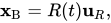
To answer this question, let the coordinate axis in B be represented by unit vectors uj with j any of { 1, 2, 3 } for the three coordinate axes. Then
The interpretation of this equation is that xB is the vector displacement of the particle as expressed in terms of the coordinates in frame B at the time t. From frame A the particle is located at:
As an aside, the unit vectors { uj } cannot change magnitude, so derivatives of these vectors express only rotation of the coordinate system B. On the other hand, vector XAB simply locates the origin of frame B relative to frame A, and so cannot include rotation of frame B.
Taking a time derivative, the velocity of the particle is:
The second term summation is the velocity of the particle, say vB as measured in frame B. That is:
The interpretation of this equation is that the velocity of the particle seen by observers in frame A consists of what observers in frame B call the velocity, namely vB, plus two extra terms related to the rate of change of the frame-B coordinate axes. One of these is simply the velocity of the moving origin vAB. The other is a contribution to velocity due to the fact that different locations in the non-inertial frame have different apparent velocities due to the rotation of the frame; a point seen from a rotating frame has a rotational component of velocity that is greater the further the point is from the origin.
To find the acceleration, another time differentiation provides:
Using the same formula already used for the time derivative of xB, the velocity derivative on the right is:
Consequently,
1
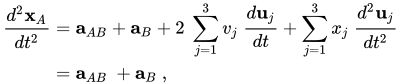
The interpretation of this equation is as follows: the acceleration of the particle in frame A consists of what observers in frame B call the particle acceleration aB, but in addition, there are three acceleration terms related to the movement of the frame-B coordinate axes: one term related to the acceleration of the origin of frame B, namely aAB, and two terms related to the rotation of frame B. Consequently, observers in B will see the particle motion as possessing "extra" acceleration, which they will attribute to "forces" acting on the particle, but which observers in A say are "fictitious" forces arising simply because observers in B do not recognize the non-inertial nature of frame B.
The factor of two in the Coriolis force arises from two equal contributions: (i) the apparent change of an inertially constant velocity with time because rotation makes the direction of the velocity seem to change (a dvB/dt term) and (ii) an apparent change in the velocity of an object when its position changes, putting it nearer to or further from the axis of rotation (the change in due to change in x j ).
To put matters in terms of forces, the accelerations are multiplied by the particle mass:
The force observed in frame B, FB = maB is related to the actual force on the particle, FA, by
where:
Thus, problems may be solved in frame B by assuming that Newton's second law holds (with respect to quantities in that frame) and treating Ffictitious as an additional force.[18][33][34]
Below are a number of examples applying this result for fictitious forces. More examples can be found in the article on centrifugal force.
A common situation in which noninertial reference frames are useful is when the reference frame is rotating. Because such rotational motion is non-inertial, due to the acceleration present in any rotational motion, a fictitious force can always be invoked by using a rotational frame of reference. Despite this complication, the use of fictitious forces often simplifies the calculations involved.
To derive expressions for the fictitious forces, derivatives are needed for the apparent time rate of change of vectors that take into account time-variation of the coordinate axes. If the rotation of frame 'B' is represented by a vector Ω pointed along the axis of rotation with the orientation given by the right-hand rule, and with magnitude given by
then the time derivative of any of the three unit vectors describing frame B is[33][35]
and
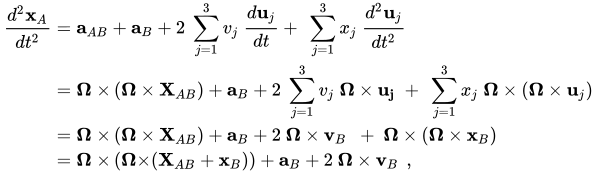
as is verified using the properties of the vector cross product. These derivative formulas now are applied to the relationship between acceleration in an inertial frame, and that in a coordinate frame rotating with time-varying angular velocity ω(t). From the previous section, where subscript A refers to the inertial frame and B to the rotating frame, setting aAB = 0 to remove any translational acceleration, and focusing on only rotational properties (see Eq. 1):
Collecting terms, the result is the so-called acceleration transformation formula:[36]
The physical accelerationaA due to what observers in the inertial frame A call real external forces on the object is, therefore, not simply the acceleration aB seen by observers in the rotational frame B, but has several additional geometric acceleration terms associated with the rotation of B. As seen in the rotational frame, the acceleration aB of the particle is given by rearrangement of the above equation as:
The net force upon the object according to observers in the rotating frame is FB = maB. If their observations are to result in the correct force on the object when using Newton's laws, they must consider that the additional force Ffict is present, so the end result is FB = FA + Ffict. Thus, the fictitious force used by observers in B to get the correct behaviour of the object from Newton's laws equals:
Figure 3: An orbiting but fixed orientation coordinate system B, shown at three different times. The unit vectors uj, j = 1, 2, 3 do not rotate, but maintain a fixed orientation, while the origin of the coordinate system B moves at constant angular rate ω about the fixed axis Ω. Axis Ω passes through the origin of inertial frame A, so the origin of frame B is a fixed distance R from the origin of inertial frame A.
As a related example, suppose the moving coordinate system B rotates with a constant angular speed ω in a circle of radius R about the fixed origin of inertial frame A, but maintains its coordinate axes fixed in orientation, as in Figure 3. The acceleration of an observed body is now (see Eq. 1):
where the summations are zero inasmuch as the unit vectors have no time dependence. The origin of the system B is located according to frame A at:
leading to a velocity of the origin of frame B as:
leading to an acceleration of the origin of B given by:
Because the first term, which is
is of the same form as the normal centrifugal force expression:
it is a natural extension of standard terminology (although there is no standard terminology for this case) to call this term a "centrifugal force". Whatever terminology is adopted, the observers in frame B must introduce a fictitious force, this time due to the acceleration from the orbital motion of their entire coordinate frame, that is radially outward away from the centre of rotation of the origin of their coordinate system:
and of magnitude:
This "centrifugal force" has differences from the case of a rotating frame. In the rotating frame the centrifugal force is related to the distance of the object from the origin of frame B, while in the case of an orbiting frame, the centrifugal force is independent of the distance of the object from the origin of frame B, but instead depends upon the distance of the origin of frame B from its centre of rotation, resulting in the same centrifugal fictitious force for all objects observed in frame B.
Figure 4: An orbiting coordinate system B similar to Figure 3, but in which unit vectors uj, j = 1, 2, 3 rotate to face the rotational axis, while the origin of the coordinate system B moves at constant angular rate ω about the fixed axis Ω.
As a combination example, Figure 4 shows a coordinate system B that orbits inertial frame A as in Figure 3, but the coordinate axes in frame B turn so unit vector u1 always points toward the centre of rotation. This example might apply to a test tube in a centrifuge, where vector u1 points along the axis of the tube toward its opening at its top. It also resembles the Earth–Moon system, where the Moon always presents the same face to the Earth.[41] In this example, unit vector u3 retains a fixed orientation, while vectors u1, u2 rotate at the same rate as the origin of coordinates. That is,
Hence, the acceleration of a moving object is expressed as (see Eq. 1):
where the angular acceleration term is zero for the constant rate of rotation.
Because the first term, which is
is of the same form as the normal centrifugal force expression:
it is a natural extension of standard terminology (although there is no standard terminology for this case) to call this term the "centrifugal force". Applying this terminology to the example of a tube in a centrifuge, if the tube is far enough from the center of rotation, |XAB| = R ≫ |xB|, all the matter in the test tube sees the same acceleration (the same centrifugal force). Thus, in this case, the fictitious force is primarily a uniform centrifugal force along the axis of the tube, away from the centre of rotation, with a value |Ffict| = ω2R, where R is the distance of the matter in the tube from the centre of the centrifuge. It is the standard specification of a centrifuge to use the "effective" radius of the centrifuge to estimate its ability to provide centrifugal force. Thus, the first estimate of centrifugal force in a centrifuge can be based upon the distance of the tubes from the centre of rotation, and corrections applied if needed.[42][43]
Also, the test tube confines motion to the direction down the length of the tube, so vB is opposite to u1 and the Coriolis force is opposite to u2, that is, against the wall of the tube. If the tube is spun for a long enough time, the velocity vB drops to zero as the matter comes to an equilibrium distribution. For more details, see the articles on sedimentation and the Lamm equation.
A related problem is that of centrifugal forces for the Earth–Moon–Sun system, where three rotations appear: the daily rotation of the Earth about its axis, the lunar-month rotation of the Earth–Moon system about its centre of mass, and the annual revolution of the Earth–Moon system about the Sun. These three motions influence the tides.[44]
Figure 5: Crossing a rotating carousel walking at a constant speed from the centre of the carousel to its edge, a spiral is traced out in the inertial frame, while a simple straight radial path is seen in the frame of the carousel.
Figure 5 shows another example comparing the observations of an inertial observer with those of an observer on a rotating carousel.[45] The carousel rotates at a constant angular velocity represented by the vector Ω with magnitude ω, pointing upward according to the right-hand rule. A rider on the carousel walks radially across it at a constant speed, in what appears to the walker to be the straight line path inclined at 45° in Figure 5. To the stationary observer, however, the walker travels a spiral path. The points identified on both paths in Figure 5 correspond to the same times spaced at equal time intervals. We ask how two observers, one on the carousel and one in an inertial frame, formulate what they see using Newton's laws.
The observer at rest describes the path followed by the walker as a spiral. Adopting the coordinate system shown in Figure 5, the trajectory is described by r(t):
where the added π/4 sets the path angle at 45° to start with (just an arbitrary choice of direction), uR is a unit vector in the radial direction pointing from the centre of the carousel to the walker at the time t. The radial distance R(t) increases steadily with time according to:
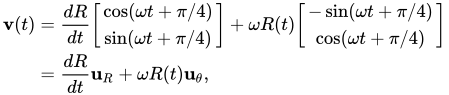
with s the speed of walking. According to simple kinematics, the velocity is then the first derivative of the trajectory:
with uθ a unit vector perpendicular to uR at time t (as can be verified by noticing that the vector dot product with the radial vector is zero) and pointing in the direction of travel.
The acceleration is the first derivative of the velocity:
The last term in the acceleration is radially inward of magnitude ω2R, which is therefore the instantaneous centripetal acceleration of circular motion.[46] The first term is perpendicular to the radial direction, and pointing in the direction of travel. Its magnitude is 2sω, and it represents the acceleration of the walker as the edge of the carousel is neared, and the arc of the circle travelled in a fixed time increases, as can be seen by the increased spacing between points for equal time steps on the spiral in Figure 5 as the outer edge of the carousel is approached.
Applying Newton's laws, multiplying the acceleration by the mass of the walker, the inertial observer concludes that the walker is subject to two forces: the inward radially directed centripetal force and another force perpendicular to the radial direction that is proportional to the speed of the walker.
The rotating observer sees the walker travel a straight line from the centre of the carousel to the periphery, as shown in Figure 5. Moreover, the rotating observer sees that the walker moves at a constant speed in the same direction, so applying Newton's law of inertia, there is zero force upon the walker. These conclusions do not agree with the inertial observer. To obtain agreement, the rotating observer has to introduce fictitious forces that appear to exist in the rotating world, even though there is no apparent reason for them, no apparent gravitational mass, electric charge or what have you, that could account for these fictitious forces.
To agree with the inertial observer, the forces applied to the walker must be exactly those found above. They can be related to the general formulas already derived, namely:
In this example, the velocity seen in the rotating frame is:
with uR a unit vector in the radial direction. The position of the walker as seen on the carousel is:
and the time derivative of Ω is zero for uniform angular rotation. Noticing that
and
we find:
To obtain a straight-line motion in the rotating world, a force exactly opposite in sign to the fictitious force must be applied to reduce the net force on the walker to zero, so Newton's law of inertia will predict a straight line motion, in agreement with what the rotating observer sees. The fictitious forces that must be combated are the Coriolis force (first term) and the centrifugal force (second term). (These terms are approximate.[47]) By applying forces to counter these two fictitious forces, the rotating observer ends up applying exactly the same forces upon the walker that the inertial observer predicted were needed.
Because they differ only by the constant walking velocity, the walker and the rotational observer see the same accelerations. From the walker's perspective, the fictitious force is experienced as real, and combating this force is necessary to stay on a straight line radial path holding a constant speed. It is like battling a crosswind while being thrown to the edge of the carousel.
[48]
Notice that this kinematical discussion does not delve into the mechanism by which the required forces are generated. That is the subject of kinetics. In the case of the carousel, the kinetic discussion would involve perhaps a study of the walker's shoes and the friction they need to generate against the floor of the carousel, or perhaps the dynamics of skateboarding if the walker switched to travel by skateboard. Whatever the means of travel across the carousel, the forces calculated above must be realized. A very rough analogy is heating your house: you must have a certain temperature to be comfortable, but whether you heat by burning gas or by burning coal is another problem. Kinematics sets the thermostat, kinetics fires the furnace.
^As part of the requirement of simplicity, to be an inertial frame, in all other frames that differ only by a uniform rate of translation, the description should be of the same form. However, in the Newtonian system the Galilean transformation connects these frames and in the special theory of relativity the Lorentz transformation connects them. The two transformations agree for speeds of translation much less than the speed of light.
^The force in this example is known as ground reaction, and it could exist even without friction, for example, a sledge running down a curve of a bobsled track.
^Shuh-Jing Ying (1997). Advanced Dynamics. Reston VA: American Institute of Aeronautics, and Astronautics. p. 172. ISBN1-56347-224-4. orbit coordinate system.
^Note: There is a subtlety here: the distance R is the instantaneous distance from the rotational axis of the carousel. However, it is not the radius of curvatureof the walker's trajectory as seen by the inertial observer, and the unit vector uR is not perpendicular to the path. Thus, the designation "centripetal acceleration" is an approximate use of this term. See, for example, Howard D. Curtis (2005). Orbital Mechanics for Engineering Students. Butterworth-Heinemann. p. 5. ISBN0-7506-6169-0. and S. Y. Lee (2004). Accelerator physics (2nd ed.). Hackensack NJ: World Scientific. p. 37. ISBN981-256-182-X.
^A circle about the axis of rotation is not the osculating circle of the walker's trajectory, so "centrifugal" and "Coriolis" are approximate uses for these terms. See note.
^In this connection, it may be noted that a change in the coordinate system, for example, from Cartesian to polar, if implemented without any change in relative motion, does not cause the appearance of rotational fictitious forces, despite the fact that the form of the laws of motion varies from one type of curvilinear coordinate system to another, depending from the (purely spatial) delta-curvature: , where are the contravariant components of the force per unit mass, and are the Christoffel symbols of the second kind, see, for instance: David, Kay, Tensor Calculus (1988) McGraw-Hill Book Company ISBN0-07-033484-6, Section 11.4; or: Adler, R., Bazin, M., & Schiffer, M. Introduction to General Relativity (New York, 1965). This could be the first hint of the crisis of the non-relativistic physics: in "non-inertial" frames using non-Euclidean and not flat metrics, fictitious forces transform into force exchanged with "objects" that do not follow the geodesic trajectory (simply with a relative speed respect it). In any case this generalized "Newton's second law" must wait for the general relativity to obtain curvature in spacetime according to stress–energy tensor by Einstein field equations and a spacetime form that uses the four-force density tensor that is derived from the covariant divergence of the energy-momentum tensor.
Motion over a flat surface Java physlet by Brian Fiedler illustrating fictitious forces. The physlet shows both the perspective as seen from a rotating and from a non-rotating point of view.
Motion over a parabolic surface Java physlet by Brian Fiedler illustrating fictitious forces. The physlet shows both the perspective as seen from a rotating and as seen from a non-rotating point of view.
A fictitious force, also known as a pseudo-force or inertial force, is an apparent force that seems to act upon an object in a non-inertial reference frame—such as one that is accelerating or rotating—but originates solely from the motion of the observer's frame rather than any physical interaction between the object and its environment.[1][2] These forces are introduced to make Newton's laws of motion applicable in such frames, where they would otherwise appear violated, and they always act in proportion to the object's mass and the frame's acceleration.[3]In classical mechanics, fictitious forces distinguish themselves from real forces, which have identifiable physical sources like gravity or electromagnetism and corresponding reaction forces as per Newton's third law.[2] A key criterion for identifying a fictitious force is the absence of a reaction force; for instance, in a linearly accelerating car, a passenger feels pushed backward, but no external agent pushes them— the effect stems from the frame's acceleration.[2] Prominent examples include the centrifugal force, which appears to push objects outward in a rotating frame like a merry-go-round, actually resulting from the object's inertia resisting the curved path.[1][3] Another is the Coriolis force, which causes moving objects in a rotating frame—such as a ball thrown on a spinning platform—to deflect perpendicular to their velocity, influencing phenomena like the rotation of hurricanes (counterclockwise in the Northern Hemisphere and clockwise in the Southern).[1]Fictitious forces play a crucial role in practical applications and geophysical contexts, where Earth's slight rotation introduces subtle effects despite its near-inertial nature.[2] For example, centrifuges exploit the centrifugal force to separate substances by density, while the Coriolis effect guides long-range ballistics and ocean current patterns.[1] In non-inertial frames, the effective force on an object is the vector sum of real forces and fictitious ones, allowing consistent predictions of motion; however, transforming to an inertial frame eliminates these artifacts, revealing only genuine interactions.[1][3]
Introduction and Background
Definition and Historical Context
Fictitious forces, also known as pseudo-forces or inertial forces, are apparent forces that emerge when analyzing the motion of objects within a non-inertial reference frame. These forces lack a tangible physical source, such as the interactions underlying gravity or electromagnetism, and instead arise due to the acceleration or rotation of the observer's frame relative to an inertial one. In such frames, the observed deviations from straight-line motion at constant speed—contrary to Newton's first law—necessitate the introduction of these fictitious terms to restore consistency with Newtonian mechanics.[4][5]Newton's laws of motion hold strictly only in inertial reference frames, where no net external forces act on objects at rest or in uniform motion, and acceleration is proportional to applied forces. Non-inertial frames violate this by introducing extraneous accelerations, requiring fictitious forces to account for the apparent motion without altering the underlying physics. This distinction underscores that fictitious forces are mathematical artifacts, not real interactions, enabling the extension of Newtonian analysis to accelerated or rotating systems.[6][7]The origins of concepts related to fictitious forces trace back to the 17th century, with Christiaan Huygens introducing the term "centrifugal force" in 1659 to describe the apparent outward tendency of rotating bodies, deriving its mathematical form for uniform circular motion.[8]Isaac Newton built on this in his Philosophiæ Naturalis Principia Mathematica (1687), incorporating centrifugal effects into his theory of absolute space and motion; he used the rotating bucket experiment to demonstrate absolute rotation, treating such effects as real manifestations relative to absolute space rather than frame-dependent artifacts.[7] Newton's framework established the equivalence of inertial frames moving uniformly relative to one another and laid essential groundwork for later analyses of apparent forces in accelerated systems. The explicit recognition of fictitious (or inertial) forces as corrections for non-inertial frames emerged in the 18th century, notably with Jean le Rond d'Alembert's 1743 principle, which introduced inertial forces to reformulate Newton's second law for constrained or accelerating motions.[9]Leonhard Euler further developed these ideas in the context of rotating systems, systematically incorporating centrifugal effects into the dynamics of rigid bodies and fluids, as seen in his contributions to the equations of motion for rotating machinery.[10]By the late 19th century, Ernst Mach critiqued Newtonian absolute space, proposing that inertia and rotational effects arise from interactions with distant matter in the universe, influencing Albert Einstein's development of general relativity. Einstein, drawing on Mach's principle, reinterpreted rotation—and the associated fictitious forces—as relative to the cosmic distribution of mass, integrating them into a spacetime geometry where such forces reflect geodesic deviations rather than isolated frame artifacts. This perspective marked a profound shift, linking fictitious forces to broader gravitational phenomena.[11][12][13]
Inertial vs. Non-Inertial Frames
In physics, an inertial reference frame is defined as one that moves with constant velocity relative to the distant stars, often referred to as the "fixed stars," where Newton's laws of motion hold exactly without the need for additional modifications.[14] In such frames, the acceleration of an object is directly proportional to the net real force acting on it, as described by Newton's second law, F=ma, with no extraneous terms required to explain observed motions.[6] This uniformity ensures that all frames moving at constant velocity relative to one inertial frame are themselves inertial, forming a class of equivalent reference systems under Galilean relativity.[14]In contrast, a non-inertial reference frame undergoes acceleration, either linear or rotational, relative to an inertial frame, necessitating the introduction of fictitious forces—also known as pseudo-forces—to reconcile the observed motions with Newton's laws.[6] These additional terms, such as those arising from linear acceleration or angular velocity, appear as effective forces in the equations of motion within the non-inertial frame but have no physical origin in terms of interactions between objects.[15] For instance, in a linearly accelerating frame, a pseudo-force proportional to the frame's acceleration and opposite in direction must be added to each object's mass to maintain the form of Newton's second law.[15] Rotational non-inertial frames similarly require terms accounting for the frame's angular acceleration and velocity to describe dynamics accurately.[6]The key distinction between inertial and non-inertial frames lies in the absence or presence of these pseudo-components: in inertial frames, all forces contributing to acceleration are genuine interactions, whereas in non-inertial frames, every apparent force includes contributions from the frame's motion, which must be explicitly subtracted or accounted for to recover true physical forces.[6] This criterion allows physicists to identify the frame type by checking whether Newton's laws apply without amendments; deviations indicate non-inertial conditions.[15] A brief example illustrating local inertial behavior is a free-falling elevator in a uniform gravitational field, where the frame accelerates downward at g, making it equivalent to an inertial frame for observers inside, as the pseudo-force cancels the gravitational effect.[15]
Observable Examples
Centrifugal Force in Rotation
In a rotating reference frame, the centrifugal force manifests as an apparent outward force acting on objects, directing them away from the axis of rotation. For instance, passengers in a car navigating a sharp curve experience this force as a sensation of being pushed toward the outside of the turn, where loose objects like a coffee cup may slide across the dashboard if friction is insufficient to counteract it.[16] This effect arises because the rotating frame accelerates relative to an inertial observer, altering the perceived motion of objects within it.[17]Physically, the centrifugal force is a fictitious or inertial force, meaning it has no counterpart as a real interaction in an inertial reference frame; instead, it accounts for the tendency of objects to continue in straight-line motion due to inertia, as described by Newton's first law. In the rotating frame, this apparent force enables the application of Newton's second law in a modified form, but from an external inertial perspective—such as that of a stationary observer watching the car turn—the outward motion is simply the result of unopposed inertia without any additional force acting.[18] The force's existence is thus frame-dependent, real and measurable only to those within the non-inertial system.[6]One measurable effect of the centrifugal force is its role in simulating gravity through rotation, as seen in proposed designs for space stations where a cylindrical habitat spins to produce an outward acceleration that mimics Earth's gravitational pull, allowing astronauts to walk on the inner surface without experiencing weightlessness. In such systems, the force helps maintain physiological health by providing the necessary loading on bones and muscles during long-duration missions. Similarly, in amusement park rides like the rotor—a vertical spinning cylinder where riders are pressed against the wall after the floor drops—the centrifugal force balances the riders' weight, creating the illusion of defying gravity through the apparent outward push.[19][20]The magnitude of the centrifugal force is proportional to the square of the angular velocity of the rotation and the distance of the object from the axis, increasing with faster spin rates or greater radial separation, which directly influences the intensity of effects in applications like these.[17]
Coriolis Effect in Motion
The Coriolis effect manifests as a fictitious force that causes a perpendicular deflection of the path of any object moving within a rotating reference frame, such as Earth's surface. This deflection arises because the rotating frame imparts an apparent accelerationperpendicular to both the object's velocity and the axis of rotation, altering the observed trajectory relative to the frame. For instance, in the case of a projectile launched horizontally, such as an artillery shell, the path appears to curve due to this effect rather than following a straight line in the rotating frame. Similarly, the motion of air masses, like those forming trade winds, experiences this deflection on a planetary scale.[6][21][22]The direction of this deflection depends on the sense of rotation and the hemisphere in which the motion occurs. In the Northern Hemisphere, where Earth's rotation is counterclockwise when viewed from above the North Pole, the Coriolis effect deflects moving objects to the right of their velocity vector for horizontal motion. In the Southern Hemisphere, the deflection is to the left due to the opposite perspective of the rotation. This rightward or leftward bias is consistent for all directions of motion and is independent of the object's orientation, provided it has a component of velocityperpendicular to the rotation axis.[6][21][23]The Coriolis effect is negligible on small spatial and temporal scales, such as in everyday activities like tossing a ball indoors, where the deflection is on the order of micrometers and overwhelmed by other forces like friction. However, it becomes significant for large-scale motions, such as long-range projectiles traveling tens of kilometers or atmospheric flows spanning continents, where deflections can amount to several kilometers. Notably, the effect is zero for objects stationary relative to the rotating frame, as there is no velocity to deflect, and also vanishes for purely radial motion aligned with the rotation axis, where the velocity is parallel to the frame's angular velocity vector.[22][6][21]
Applications on Earth
Weather Patterns and Ocean Currents
In the Earth's atmosphere, the Coriolis force deflects moving air masses to the right in the Northern Hemisphere and to the left in the Southern Hemisphere, influencing large-scale wind patterns. This deflection is crucial for the formation of cyclones, where winds rotate counterclockwise around low-pressure centers in the Northern Hemisphere and clockwise in the Southern Hemisphere, and anticyclones, which exhibit the opposite rotations: clockwise in the North and counterclockwise in the South. These rotational patterns arise from the balance between the Coriolis force and pressure gradient forces, shaping global weather systems.[24][25]Similarly, in the oceans, the Coriolis force drives the circulation of major current systems, such as gyres, which are large-scale loops of circulating water. In the Northern Hemisphere, it deflects surface currents to the right, resulting in clockwise gyres like the North Atlantic Gyre that includes the warm Gulf Stream, which flows northward along the U.S. East Coast before curving eastward toward Europe. In the Southern Hemisphere, deflection to the left produces counterclockwise gyres, such as the South Pacific Gyre. A key aspect of this influence is Ekman transport, where wind-driven surface currents interact with friction and the Coriolis force, causing water layers to spiral downward: the surface layer moves nearly in the wind direction but at a 45-degree angle due to Coriolis deflection, with deeper layers rotating further until the net transport is 90 degrees to the right of the wind in the Northern Hemisphere and to the left in the Southern Hemisphere. This spiral effect, extending to about 100 meters depth, contributes to the piling of water in gyre centers and sustains their overall circulation.[26][27][28]The magnitude of the Coriolis deflection is determined by Earth's angular velocity of approximately 7.29×10⁻⁵ rad/s, which provides the scale for these effects in both atmosphere and oceans; however, the force vanishes at the equator, where no deflection occurs, explaining the absence of gyres or cyclone formation there. In practice, these fictitious forces interact with real forces, particularly pressure gradients, to achieve geostrophic balance, where the Coriolis force counters the pressure gradient force, resulting in steady flows parallel to isobars or sea surface contours in large-scale systems. This balance dominates mid-latitude circulations, enabling winds and currents to flow without significant acceleration.[29][26][30]
Engineering and Transportation Examples
In engineering and transportation systems, fictitious forces such as the centrifugal force play a critical role in designing safe and efficient structures for curved paths. For vehicles navigating banked curves or roundabouts, the centrifugal force appears to push the vehicle outward, requiring the banking angle to provide a component of the normal force that counters this effect and supplies the necessary centripetal acceleration. This design minimizes reliance on friction, allowing higher speeds without skidding; for instance, seatbelts and vehicle suspension systems are engineered to withstand the resulting lateral loads, preventing passenger displacement.[31]Trains on curved tracks experience a similar centrifugal load, which engineers address through superelevation, or canting the outer rail higher to balance the outward fictitious force with a gravitational component, thereby reducing lateral wheel-rail forces and enhancing stability. This adjustment ensures that the net force aligns with the track's curveradius, with typical superelevation values ranging from 0 to 6 inches depending on speed and radius, resulting in experienced g-forces of up to 0.1g laterally for passengers at design speeds. Measurable in accelerometers, these forces inform track maintenance to prevent derailments.[32][33]In aircraft, particularly during long-haul navigation, the Coriolis effect introduces a fictitious deflection that can accumulate over time, altering the perceived inertial path relative to Earth's rotation; this is compensated in inertial navigation systems using gyroscopes that account for the Coriolis acceleration to maintain accurate heading and trajectory. Such corrections are essential for transoceanic flights, where uncompensated errors could lead to positional drifts of several kilometers.[34][35]Amusement park roller coasters incorporate fictitious forces into their design to create thrilling yet safe experiences, with engineers calculating the apparent centrifugal and gravitational forces in loops and curves to limit passenger g-forces to between -1g and 5g. For example, in vertical loops, the track is shaped so the fictitious outward force at the top combines with gravity to keep riders seated without excessive restraint loads, verified through dynamic simulations that ensure structural integrity under these apparent accelerations.[36][37]
Detection Methods
Identifying Non-Inertial Frames
A reference frame is considered non-inertial if it undergoes acceleration relative to an inertial frame, where acceleration encompasses both linear changes in velocity and rotational motion. In such frames, Newton's laws of motion do not hold in their standard form without the introduction of fictitious forces to account for the observed deviations.[38]A primary theoretical criterion for identifying a non-inertial frame involves observing the trajectory of a free particle, which experiences no real forces. In an inertial frame, this particle moves in a straight line at constant velocity, adhering to the principle of inertia.[39] Conversely, in a non-inertial frame, the same particle's path appears curved or accelerated, necessitating fictitious forces to explain the motion within that frame.Indicators of a non-inertial frame include the presence of apparent forces acting on objects that are stationary relative to the frame. For instance, in an elevator accelerating upward, a plumb line suspended inside deviates from the true vertical direction, as if pulled by an additional force opposite to the acceleration.[40] This deviation arises because the frame's acceleration imparts a fictitious force on the bob, mimicking the behavior of a real force.All reference frames fixed to the Earth's surface are approximately non-inertial due to the planet's rotation about its axis and its orbital motion around the Sun, both of which introduce small but measurable accelerations.[41] These effects require fictitious forces, such as the centrifugal and Coriolis forces, to describe motion accurately in terrestrial coordinates.[38]The equivalence principle provides a deeper connection, stating that locally, the uniform acceleration of a non-inertial frame is indistinguishable from a homogeneous gravitational field.[40] In this sense, the apparent forces in an accelerating frame, like that of the elevator, replicate the effects of gravity, underscoring why non-inertial frames demand fictitious forces to reconcile observations with inertial physics.[42]
Experimental Verification
One of the earliest and most direct experimental verifications of fictitious forces, particularly the Coriolis effect arising from Earth's rotation, was provided by Léon Foucault's pendulum demonstration in 1851. In this setup, a long pendulum with a heavy bob is suspended to swing freely in a plane, but due to the Coriolis force in the rotating Earth frame, the plane of oscillation precesses over time. At the latitude of Paris (approximately 48.8° N), the precession period is about 32 hours, corresponding to a rotation rate of roughly 11.25° per hour, confirming the Earth's diurnal rotation without relying on astronomical observations.[43][44]Building on this, Foucault extended his work in 1852 with a gyroscope experiment, which further illustrated the effects of non-inertial frames. A gyroscope, consisting of a rapidly spinning rotor with high angular momentum, maintains its axis of rotation fixed in inertial space due to conservation of angular momentum. When placed on Earth, the gyroscope's axis appears to precess relative to the ground, directly revealing the planet's rotation and the absence of true forces causing such motion in an inertial frame. This device provided simpler, more portable evidence of fictitious forces compared to the pendulum, as frictional losses could be minimized to observe the effect over shorter times.[45][46]Modern iterations of these experiments employ laser gyroscopes for enhanced precision, detecting minute variations in Earth's rotation influenced by Coriolis and centrifugal effects in non-inertial frames. Ring laser gyroscopes, for instance, measure rotational rates by comparing counter-propagating laser beams in a closed loop, achieving sensitivities that track Earth's spin to within 10^{-9} radians per second and even diurnal fluctuations. These instruments confirm the fictitious nature of forces like the centrifugal term, as they align with inertial predictions without additional real forces.[47][48]Space-based observations offer compelling verification by contrasting non-inertial and inertial frames. Satellites in orbit, analyzed in an inertial frame centered on Earth's mass, follow geodesic paths under gravity alone, with no observable centrifugal force acting outward to balance gravity; instead, the orbital motion provides the necessary centripetal acceleration. This absence of fictitious forces in free-fall inertial frames, as seen in missions like GPS satellites maintaining stable orbits without rotational corrections beyond tidal effects, underscores that such forces are artifacts of the observer's accelerating reference frame on Earth./04%3A_Rigid_Body_Rotation/4.09%3A_Centrifugal_and_Coriolis_Forces)
Mathematical Derivation
General Coordinate Transformation
In classical mechanics, the analysis of motion in non-inertial reference frames requires accounting for the frame's motion relative to an inertial frame, where Newton's laws hold without modification.[49] The general coordinate transformation begins with the position vector of a particle, expressed as rin=R(t)+rnon(t), where rin is the position in the inertial frame, R(t) is the position of the non-inertial frame's origin relative to the inertial origin, and rnon(t) is the position relative to the non-inertial origin.[50] This relation assumes the use of vector calculus to handle relative motion, including differentiation in rotating systems.[49]To derive the acceleration, one first obtains the velocity transformation by differentiating the position relation, yielding vin=R˙+r˙non+ω×rnon, where ω is the angular velocity vector of the non-inertial frame relative to the inertial frame, and dots denote time derivatives in the inertial frame.[50] Differentiating again provides the acceleration in the non-inertial frame:anon=ain−R¨−2ω×vrel−ω×(ω×rnon)−ω˙×rnon,where ain is the acceleration measured in the inertial frame, vrel=r˙non is the relative velocity in the non-inertial frame, R¨ is the acceleration of the non-inertial origin, and ω˙ is the time derivative of the angular velocity.[49] This transformation encapsulates the effects of both translational and rotational motion of the frame.[50]In the non-inertial frame, Newton's second law is modified by introducing fictitious forces to restore the form Ftotal=manon. The fictitious force is thusFfict=−m(R¨+2ω×vrel+ω×(ω×rnon)+ε×rnon),where ε=ω˙ denotes the angular acceleration of the frame.[49] The term −mR¨ represents the translational fictitious force arising from the linear acceleration of the frame's origin, while the term involving ε gives the Euler force, which manifests in cases of non-uniform rotation.[50] These components ensure that observed accelerations in the non-inertial frame can be interpreted using real forces plus these apparent ones.[49]
Forces in Linearly Accelerating Frames
In a reference frame undergoing constant linear acceleration af relative to an inertial frame, Newton's second law must be modified to account for the apparent forces acting on objects at rest in the accelerated frame. The fictitious force Ffict experienced by an object of mass m is given by Ffict=−maf, which acts opposite to the direction of the frame's acceleration. This force arises because the accelerated frame is non-inertial, and the term compensates for the lack of a true external force in the inertial frame. For instance, a passenger in a car accelerating forward at af feels a backward fictitious force, causing them to lean rearward as if pushed by an invisible agent.[4]This fictitious force directly influences the apparent weight of objects in the accelerated frame. In an elevator accelerating upward with acceleration af, the effective gravitational acceleration becomes geff=g+af, where g is the true gravitational acceleration downward; thus, the normal force on a passenger's feet increases, making them feel heavier. Conversely, if the elevator accelerates downward, geff decreases, reducing apparent weight until, at af=−g, weightlessness occurs. These effects explain variations in measured weight during acceleration in vehicles like cars or aircraft, and notably, the fictitious force depends only on the frame's acceleration, not its velocity.[51][52]The introduction of this fictitious force in linearly accelerating frames underpins the equivalence principle in general relativity, where local acceleration is indistinguishable from a uniform gravitational field. An observer in a small, sealed elevator cannot differentiate between upward acceleration in free space and exposure to enhanced gravity, as both produce identical inertial effects on test masses. This local equivalence highlights how fictitious forces can mimic gravitational influences without invoking true spacetime curvature.[53]
Forces in Rotating Frames
In a uniformly rotating reference frame with constant angular velocity ω, the laws of Newtonian mechanics must be modified by the inclusion of fictitious forces to account for the frame's rotation relative to an inertial frame.[4] The position vector r is the same in both frames, but the observed velocity and acceleration differ due to the rotation.[54]The acceleration in the inertial frame ain relates to that in the rotating frame arot by the equationain=arot+ω×(ω×r)+2ω×vrel,where vrel is the velocity relative to the rotating frame and ω is directed along the axis of rotation.[55] For constant ω, there is no additional Euler term arising from changes in angular velocity.[4] Rearranging for the rotating frame givesarot=ain−ω×(ω×r)−2ω×vrel.Newton's second law in the rotating frame then becomes marot=Freal+Ffict, where the fictitious forces Ffict compensate for the frame's motion.[54]The centrifugal force is the term Fcent=−mω×(ω×r), which simplifies to mω2r⊥ directed outward perpendicular to the rotation axis, where r⊥ is the perpendicular distance from the axis.[55] This force appears to push objects away from the rotation axis, even though no real interaction causes it in the inertial frame.[4]The Coriolis force is Fcor=−2mω×vrel, acting perpendicular to both ω and vrel with no component along the velocity.[54] It deflects moving objects sideways in the rotating frame, with magnitude 2mωvrelsinθ, where θ is the angle between ω and vrel.[55] These forces enable the analysis of motion as if the rotating frame were inertial, provided the real forces plus fictitious ones yield the observed acceleration.[4]
Specific Motion Scenarios
Uniform Circular Motion
In uniform circular motion, an object moves at constant speed along a circular path. From an inertial frame of reference, such as one fixed to the ground, the object's velocity changes direction continuously, requiring a net centripetal force directed toward the center of the circle to produce the necessary centripetal acceleration ac=rv2, where v is the tangential speed and r is the radius of the path.[56] This centripetal force is real and provided by identifiable physical interactions, such as tension in a string or the gravitational attraction in certain setups.[20]In a frame rotating with the object at angular velocityω, the motion appears stationary, and the dynamics are analyzed using fictitious forces derived from the coordinate transformation between inertial and rotating frames.[4] Here, a centrifugal force of magnitude mω2r acts radially outward on the object of massm, balancing the inward centripetal force to yield apparent equilibrium.[57] The angular velocityω relates to the linear speed by ω=rv, ensuring consistency between the two perspectives.[58]A classic example is the conical pendulum, where a mass attached to a string swings in a horizontal circle, with the string at an angle to the vertical. In the inertial frame, the horizontal component of tension supplies the centripetal forcermv2, while the vertical component balances gravity.[58] In the co-rotating frame, the mass is at rest, and the centrifugal forcemω2r outward is balanced by the horizontal tension component, maintaining equilibrium.[59] Similarly, a satellite in uniform circular orbit around Earth experiences gravitational force as the centripetal force in an inertial frame; in a frame co-rotating with the satellite's orbital motion, the centrifugal force opposes gravity, resulting in the satellite appearing stationary relative to the frame.[60]
Orbital Mechanics
In the co-orbiting reference frame of a satellite in circular orbit around a central body such as Earth, the satellite and its occupants appear stationary relative to the frame, which rotates with angular velocityω matching the orbital angular velocity. In this non-inertial rotating frame, the gravitational force pulling the satellite toward the central body is precisely balanced by the outward centrifugal fictitious force, resulting in zero net force and the sensation of weightlessness for objects inside the satellite.[60]This balance can be illustrated hypothetically for a circular orbit at the surface of a non-rotating spherical body, where the gravitational accelerationg equals the centrifugal accelerationω2r, or mg=mω2r, with r as the radius of the body; however, such a low-altitude orbit is impractical due to atmospheric drag and structural constraints.[4] In actual orbital mechanics, the orbital velocity for a circular orbit is given by v=GM/r, where G is the gravitational constant and M is the mass of the central body, ensuring the required ω=v/r to achieve the centrifugal-gravitational balance in the co-orbiting frame.[60]In contrast, from an inertial frame fixed relative to distant stars, no fictitious forces are needed; the satellite follows a curved trajectory solely under the influence of the central gravitational force, continuously "falling" around the body without any balancing outward force.[5]For non-circular orbits that precess, such as those perturbed by oblateness or other effects, analyzing motion in a co-rotating frame aligned with the orbit introduces additional fictitious torques arising from the time-varying rotation of the frame, which must be accounted for in the dynamics of angular momentum conservation.[61]
Combined Rotation and Orbiting
In reference frames undergoing both self-rotation (spin) and orbital motion around a central body, the fictitious forces are governed by the composite angular velocity ωtotal=ωspin+ωorbit, where ωspin is the angular velocity due to the body's rotation about its own axis and ωorbit is the angular velocity of the orbital motion around the central body. This total angular velocity determines the centrifugal and Coriolis terms in the equations of motion, with the centrifugal potential given by Vcent=−21m(ωtotal×r)2, incorporating contributions from both spin and orbital components. If ωtotal varies with time (e.g., due to precession or changes in orbital parameters), an additional Euler force term −mdtdωtotal×r appears, though this is often negligible over short timescales.The Earth's surface reference frame exemplifies this combined motion, with ωspin≈7.292×10⁻⁵ rad/s directed along the polar axis and ωorbit≈1.991×10⁻⁷ rad/s directed normal to the ecliptic plane (calculated from Earth's mean orbital speed of 29.78 km/s at 1 AU).[29] The two vectors are tilted by approximately 23.44° relative to each other, resulting in a total ωtotal whose magnitude is dominated by the spin component (with the orbital addition contributing about 0.27%), but whose direction modulates slightly over the year. This composite rotation introduces fictitious forces that, while primarily driven by spin, include subtle orbital influences affecting high-precision applications. For instance, in the Global Positioning System (GPS), the non-inertial nature of the Earth-fixed frame necessitates corrections for both rotational (Coriolis and centrifugal from ωspin) and orbital accelerations when transforming satellite positions from the inertial Earth-Centered Inertial (ECI) frame to the rotating Earth-Centered Earth-Fixed (ECEF) frame, ensuring sub-meter accuracy in user positioning.[63]A representative example is the Foucault pendulum, where the primary precession arises from Earth's spin, causing the plane of oscillation to rotate at a rate Ω=ωspinsinϕ (with ϕ the latitude). The orbital motion introduces a small additional precession on the order of ωorbit—negligible compared to the spin-induced rate of up to 15° per hour at the poles—but theoretically present as a constant shift in the effective rotation rate. This correction, while insignificant for typical demonstrations, highlights the hybrid non-inertial character of the frame.In such frames, the effective potential for particle motion combines gravitational and centrifugal terms from ωtotal, yielding Veff(r)=Vgrav(r)−21m(ωtotal×r)2, where the centrifugal contribution modifies bound orbits and stability, particularly near the equator where the orbital component aligns more closely with spin projections. For Earth, this enhances the equatorial bulge and influences geoid models used in geodesy, with the orbital term providing a minor but consistent outward force averaging about 0.003% of the spin centrifugal effect at the surface.
Theoretical Implications
Fictitious Forces and Mechanical Work
In non-inertial reference frames, fictitious forces perform work on objects, which must be accounted for to maintain the validity of the work-energy theorem. Unlike real forces in inertial frames, these apparent forces arise due to the frame's acceleration or rotation, leading to non-zero work contributions that alter the mechanical energy balance. For instance, in a rotating frame, the centrifugal force acts radially outward and does positive work on an object moving away from the axis of rotation, increasing its kinetic energy as observed in that frame.[64]The total mechanical energy is not conserved in non-inertial frames unless an effective potential is introduced to incorporate the effects of fictitious forces. This effective potential is defined as Veff=−∫Ffict⋅dr, where Ffict represents the fictitious force, allowing the system's dynamics to be described analogously to conservative systems in inertial frames. In rotating frames specifically, the centrifugal component contributes to this potential as Vcent=−21mω2r2, while the Coriolis force, being perpendicular to the velocity, performs no work and thus does not affect the energy directly.[64]A key theorem in rotating frames states that the work-energy relation includes contributions from both real and fictitious forces, with the Coriolis term integrating to zero over any path due to its velocity dependence and orthogonality, but the centrifugal force providing a non-zero term proportional to the change in radial distance. This ensures the theorem ΔK=Wreal+Wfict holds, where Wfict captures the frame's influence.[64] As a result, dynamics in such frames require a modified Lagrangian that incorporates these fictitious effects, often through velocity-dependent terms or the effective potential, to derive correct equations of motion without explicitly adding forces.[65]
Gravity as a Fictitious Force
In general relativity, gravity is interpreted as a fictitious force arising from the curvature of spacetime, rather than a fundamental interaction acting at a distance. This perspective stems from the equivalence principle, which posits that the effects of gravity are locally indistinguishable from those produced by acceleration in a non-inertial frame. Specifically, an observer in a small, freely falling elevator experiences no gravitational force, as it serves as a local inertial frame where objects follow straight-line paths; this equivalence implies that gravity can be eliminated by choosing an appropriate accelerated coordinate system.[40][66]Albert Einstein formalized this idea in his 1915 theory of general relativity, where the motion of objects in a gravitational field is described as geodesic paths— the "straight lines" of curved spacetime—rather than deviations caused by a force. In this framework, the apparent gravitational force emerges as a pseudo-force in coordinate systems that are not freely falling, analogous to centrifugal or Coriolis forces in rotating frames; mathematically, this pseudo-force is encoded in the Christoffel symbols of the metric tensor, which quantify the spacetime curvature and appear in the geodesicequation as additional acceleration terms.[67]The Newtonian limit of general relativity recovers the familiar gravitational accelerationg as a fictitious force in an accelerated frame, where weak fields and slow speeds approximate the classical description, but the full theory extends this to all reference frames by treating gravity as geometry rather than a force vector. For instance, tidal forces illustrate this varying fictitious acceleration: in the vicinity of a massive body, the differential curvature of spacetime causes nearby geodesics to converge or diverge, manifesting as stretching or squeezing effects on falling objects, distinct from uniformacceleration.[68]
Advanced Considerations
Fictitious Forces in Relativity
In special relativity, fictitious forces arise in accelerated reference frames, incorporating relativistic corrections to the classical expressions. For instance, in uniformly accelerated frames, the relativistic fictitious force modifies the Newtonian form to account for Lorentz transformations, ensuring consistency with the invariance of physical laws.[69] In rotating frames, Thomas precession emerges as a kinematic effect, where a spinning object experiences an additional rotation due to the composition of non-collinear Lorentz boosts, interpreted as a fictitious torque in the rotating frame.[70] This precession, first derived by Llewellyn Thomas in 1926, arises purely from the geometry of spacetime and has no electromagnetic origin, distinguishing it from related phenomena like Larmor precession.[71]In general relativity, fictitious forces extend to all non-inertial observers, where motion deviates from geodesics— the straightest paths in curved spacetime. Any apparent force in such frames is pseudo, arising from the observer's acceleration relative to free-falling paths, with the metric tensor encoding these effects through the Christoffel symbols in the geodesic equation.[72] For rotating observers, the spacetime metric includes terms that manifest as generalized centrifugal and Coriolis forces, integrated into the gravitational field description. This framework unifies all inertial effects as geometric, eliminating the need for separate force laws beyond the curvature induced by mass-energy.A foundational insight is the absence of absolute inertial frames in relativity; instead, local inertial frames are determined relative to the global distribution of matter. Mach's principle posits that rotational inertia is defined relative to the fixed stars or the average motion of the universe, suggesting that absolute rotation would be detectable only against the cosmic background.[11] This idea influenced Einstein's development of general relativity, though its full implementation remains debated, as standard solutions like the Schwarzschild metric do not fully embody it.[73]In modern applications, fictitious forces appear in the Kerr metric, which describes spacetime around rotating black holes and predicts frame-dragging, where the black hole's rotation twists nearby spacetime, imparting a fictitious azimuthal force on orbiting objects.[74] This Lense-Thirring effect, a relativistic generalization of classical rotation-induced forces, has been observationally confirmed near Earth and is crucial for understanding accretion disks and jets in astrophysical contexts.[75]
Limitations and Misconceptions
One common misconception is that fictitious forces, such as the centrifugal force, represent genuine physical interactions, often interpreted as a reactive outward push in rotating systems. In reality, these forces are not real but emerge solely as mathematical artifacts within non-inertial reference frames, lacking any physical origin like those of true forces (e.g., electromagnetic or gravitational interactions). This confusion arises from intuitive sensations in accelerating frames, but in inertial frames, motion adheres strictly to Newton's laws without such additions.[76]Fictitious forces have inherent limitations in their applicability, particularly outside classical mechanics. In quantum mechanics, classical formulations of these forces do not hold directly and require significant modifications to account for wave-particle duality, leading to the emergence of quantum fictitious forces that depend on dimensionality and exhibit behaviors like attraction in two dimensions or repulsion in higher dimensions.[77] For instance, in low-precision models or everyday engineering contexts, small fictitious effects—such as the Coriolis force in short-range ballistics—are routinely ignored because they are negligible compared to dominant real forces, simplifying calculations without loss of accuracy.[78]Overreliance on fictitious forces can introduce errors, as seen when the Coriolis effect is erroneously applied to scenarios like short-range projectile motion where its influence is vanishingly small; experts emphasize preferring inertial frames, where Newton's laws apply unmodified, to maintain conceptual clarity and avoid unnecessary complications. Pedagogically, while fictitious forces aid intuition for phenomena in rotating frames, they are not fundamental entities and can perpetuate student misconceptions if overemphasized, underscoring the need for explicit framing as frame-dependent corrections rather than core physical principles.[79]


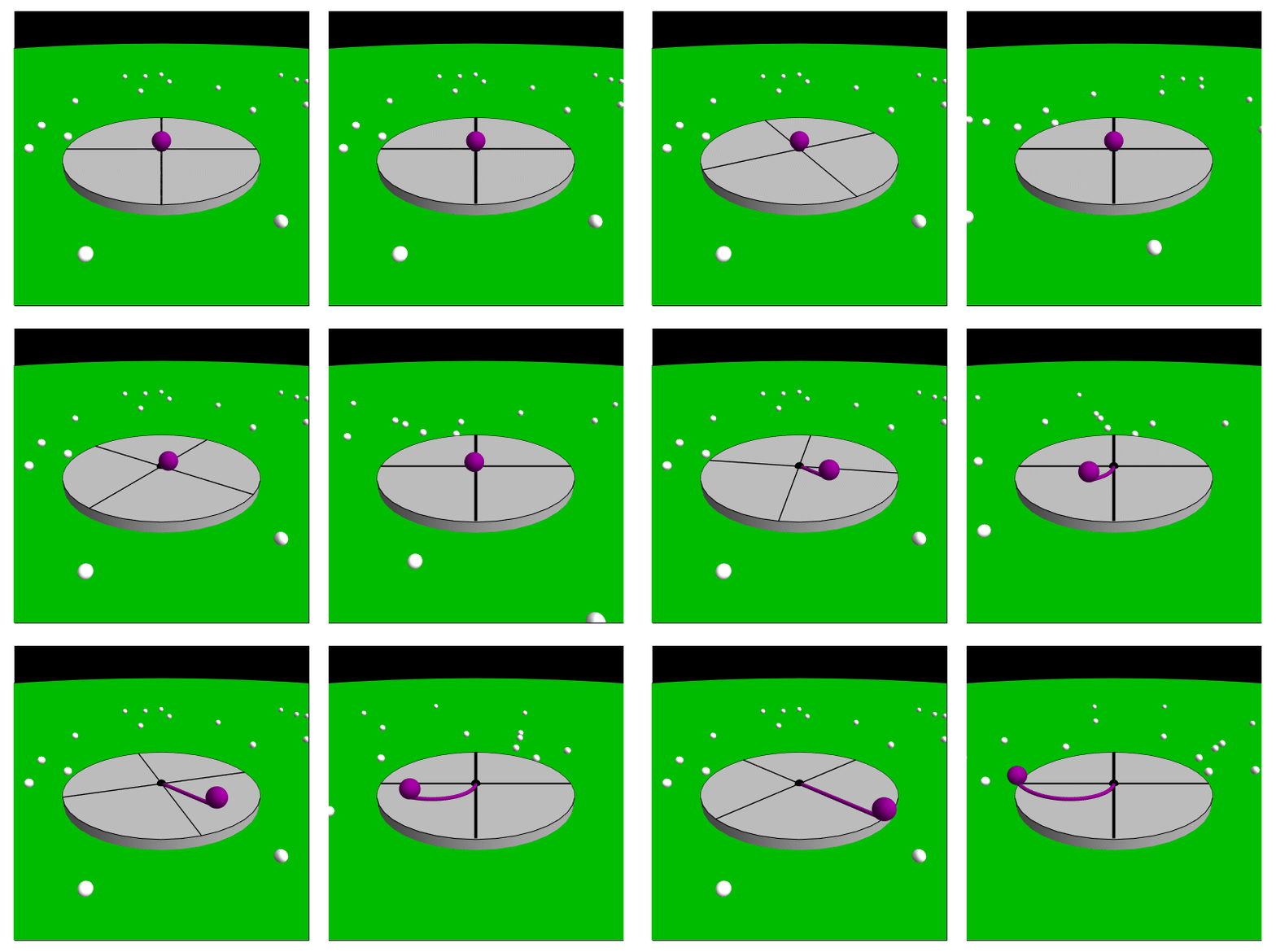


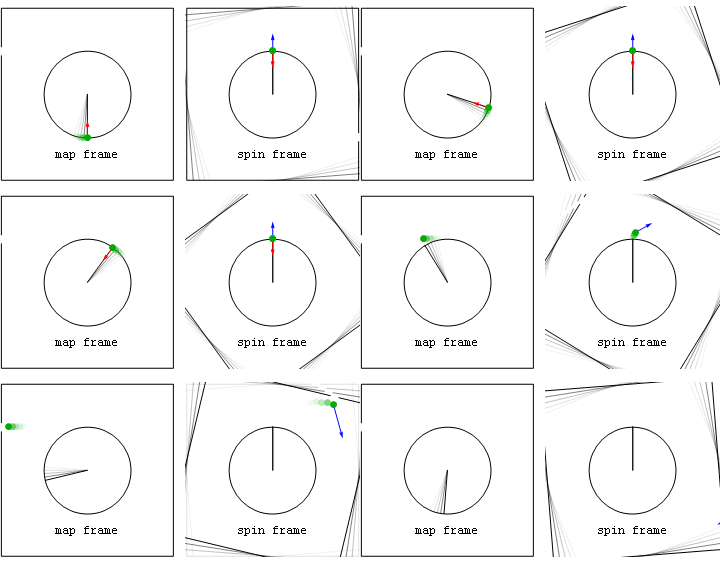


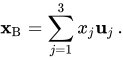
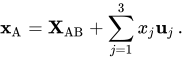

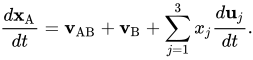







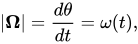
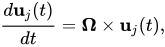
![{\displaystyle {\frac {d^{2}\mathbf {u} _{j}(t)}{dt^{2}}}={\frac {d{\boldsymbol {\Omega }}}{dt}}\times \mathbf {u} _{j}+{\boldsymbol {\Omega }}\times {\frac {d\mathbf {u} _{j}(t)}{dt}}={\frac {d{\boldsymbol {\Omega }}}{dt}}\times \mathbf {u} _{j}+{\boldsymbol {\Omega }}\times \left[{\boldsymbol {\Omega }}\times \mathbf {u} _{j}(t)\right],}](https://wikimedia.org/api/rest_v1/media/math/render/svg/93ac7b3e470c0383095d8dffe9386d7380009443)

![{\displaystyle {\begin{aligned}\mathbf {a} _{\mathrm {A} }&=\mathbf {a} _{\mathrm {B} }+\ 2\sum _{j=1}^{3}v_{j}{\boldsymbol {\Omega }}\times \mathbf {u} _{j}(t)+\sum _{j=1}^{3}x_{j}{\frac {d{\boldsymbol {\Omega }}}{dt}}\times \mathbf {u} _{j}\ +\sum _{j=1}^{3}x_{j}{\boldsymbol {\Omega }}\times \left[{\boldsymbol {\Omega }}\times \mathbf {u} _{j}(t)\right]\\&=\mathbf {a} _{\mathrm {B} }+2{\boldsymbol {\Omega }}\times \sum _{j=1}^{3}v_{j}\mathbf {u} _{j}(t)+{\frac {d{\boldsymbol {\Omega }}}{dt}}\times \sum _{j=1}^{3}x_{j}\mathbf {u} _{j}+{\boldsymbol {\Omega }}\times \left[{\boldsymbol {\Omega }}\times \sum _{j=1}^{3}x_{j}\mathbf {u} _{j}(t)\right].\end{aligned}}}](https://wikimedia.org/api/rest_v1/media/math/render/svg/c303530979f3a1bb3807c4d0426fd4fb1c0c110b)