Hubbry Logo
Function spaceFunction spaceMain
Open search
Function space
Community hub
Function space
logo
7 pages, 0 posts
0 subscribers
Be the first to start a discussion here.
Function space
Function space
from Wikipedia

In mathematics, a function space is a set of functions between two fixed sets. Often, the domain and/or codomain will have additional structure which is inherited by the function space. For example, the set of functions from any set X into a vector space has a natural vector space structure given by pointwise addition and scalar multiplication. In other scenarios, the function space might inherit a topological or metric structure, hence the name function space. Often in mathematical jargon, especially in analysis or geometry, a function could refer to a map of the form or where is the space in question. Whilst other maps of the form between any two spaces are simply referred to as maps. Example of this can be the space of compactly supported functions on a topological space. However in a larger context a function space could just consist of a set of functions (set theoretically) equipped with possibly some extra structure.

In linear algebra

[edit]

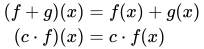
Let F be a field and let X be any set. The functions XF can be given the structure of a vector space over F where the operations are defined pointwise, that is, for any f, g : XF, any x in X, and any c in F, define When the domain X has additional structure, one might consider instead the subset (or subspace) of all such functions which respect that structure. For example, if V and also X itself are vector spaces over F, the set of linear maps XV form a vector space over F with pointwise operations (often denoted Hom(X,V)). One such space is the dual space of X: the set of linear functionals XF with addition and scalar multiplication defined pointwise.
The cardinal dimension of a function space with no extra structure can be found by the Erdős–Kaplansky theorem.

Examples

[edit]

Function spaces appear in various areas of mathematics:

Functional analysis

[edit]

Functional analysis is organized around adequate techniques to bring function spaces as topological vector spaces within reach of the ideas that would apply to normed spaces of finite dimension. Here we use the real line as an example domain, but the spaces below exist on suitable open subsets

  • continuous functions endowed with the uniform norm topology
  • continuous functions with compact support
  • bounded functions
  • continuous bounded functions
  • continuous functions which vanish at infinity; a closed subspace of [2]
  • continuous functions that have r continuous derivatives.
  • smooth functions
  • smooth functions with compact support (i.e. the set of bump functions)
  • real analytic functions
  • , for , is the Lp space of measurable functions whose p-norm is finite
  • , the Schwartz space of rapidly decreasing smooth functions and its continuous dual, tempered distributions
  • compact support in limit topology
  • Sobolev space of functions whose weak derivatives up to order k are in
  • holomorphic functions
  • linear functions
  • piecewise linear functions
  • continuous functions, compact open topology
  • all functions, space of pointwise convergence
  • Hardy space
  • Hölder space
  • Càdlàg functions, also known as the Skorokhod space
  • , the space of all Lipschitz functions on that vanish at zero.

Uniform norm

[edit]

If y is an element of the function space of all continuous functions that are defined on a closed interval [a, b], the norm defined on is the maximum absolute value of y (x) for axb,[3]

is called the uniform norm or supremum norm ('sup norm').

Bibliography

[edit]

See also

[edit]

References

[edit]
Revisions and contributorsEdit on WikipediaRead on Wikipedia
from Grokipedia
In mathematics, a function space is a set of functions between two fixed sets, often equipped with additional structure such as that of a vector space or topological vector space, where the elements (or "points") are the functions themselves and operations like addition and scalar multiplication are defined pointwise. These spaces generalize finite-dimensional vector spaces to infinite dimensions, enabling the application of linear algebra techniques to continuous objects like functions. Function spaces are foundational in , a branch of that studies the properties and behavior of such spaces, including norms, completeness, and duality. Common examples include the space C(X)C(X) of continuous real-valued functions on a XX, equipped with the sup-norm topology for , and the space C(X)C^\infty(X) of smooth functions with infinitely many continuous derivatives. More advanced types, such as the Lebesgue spaces Lp(Ω)L^p(\Omega) for 1p1 \leq p \leq \infty, consist of equivalence classes of measurable functions whose pp-th powers are integrable over a Ω\Omega, forming Banach spaces for 1p1 \leq p \leq \infty and crucial for integration theory and approximation. Sobolev spaces Wk,p(Ω)W^{k,p}(\Omega), which incorporate weak derivatives up to order kk, extend these ideas to functions with controlled and are essential for the study of partial differential equations (PDEs). The topologies on function spaces, such as the (inducing ), uniform topology (for ), and , determine convergence properties and , with the product topology being the coarsest and most commonly used for infinite products of spaces. These structures facilitate the of operators on function spaces, like differential or integral operators, and underpin applications in physics (e.g., via Hilbert spaces like L2L^2), , and , where functions are modeled within specific spaces for optimization and regularization.

Definition and Algebraic Structure

General Definition

In mathematics, a function space is a set consisting of all functions from a domain set XX to a codomain set YY, or a specified subset thereof, where functions may be restricted by certain properties such as continuity, differentiability, or integrability to ensure desirable structural features. This concept assumes familiarity with basic set theory and the notion of functions as mappings between sets, providing a foundational framework for studying collections of functions without initially imposing norms, topologies, or other analytic structures. The term "function space" gained prominence in early 20th-century , particularly through the development of , building on Bernhard Riemann's foundational ideas about classes or "totality" of functions introduced in his 1851 doctoral thesis and elaborated in works from the , such as his investigations into complex functions and geometric hypotheses. Riemann conceptualized the collection of functions satisfying specific conditions as a coherent "domain closed in itself," laying groundwork for treating such sets as structured entities amenable to algebraic and analytic operations. Fundamental operations on a function space include addition, defined by (f+g)(x)=f(x)+g(x)(f + g)(x) = f(x) + g(x) for all xXx \in X, and , defined by (αf)(x)=αf(x)(\alpha f)(x) = \alpha f(x) for scalars α\alpha in the appropriate field, assuming YY admits such operations (e.g., as an or ). These operations render the function space an under addition, with the zero function serving as the , establishing an algebraic foundation that extends familiar structures from finite-dimensional spaces to infinite collections of functions.

Vector Space Operations

Function spaces are equipped with a vector space structure over a field, typically the real numbers R\mathbb{R} or complex numbers C\mathbb{C}, through algebraic operations that preserve the field's structure. For functions f,g:XFf, g: X \to \mathbb{F} where F\mathbb{F} is the field and XX is the domain, is defined as (f+g)(x)=f(x)+g(x)(f + g)(x) = f(x) + g(x) for all xXx \in X, and scalar by αF\alpha \in \mathbb{F} as (αf)(x)=αf(x)(\alpha f)(x) = \alpha f(x) for all xXx \in X. These operations ensure compatibility with the field, as the application mirrors the field's and , maintaining associativity, commutativity, and distributivity inherent to F\mathbb{F}. The vector space axioms are satisfied through these pointwise definitions. The additive identity is the zero function 0:XF0: X \to \mathbb{F} given by 0(x)=00(x) = 0 for all xXx \in X, since (f+0)(x)=f(x)+0=f(x)(f + 0)(x) = f(x) + 0 = f(x). The additive inverse of ff is the function f-f where (f)(x)=f(x)(-f)(x) = -f(x), satisfying (f+(f))(x)=f(x)f(x)=0(f + (-f))(x) = f(x) - f(x) = 0. Distributivity of scalar multiplication over vector addition holds pointwise: (α(f+g))(x)=α((f+g)(x))=α(f(x)+g(x))=αf(x)+αg(x)=(αf+αg)(x)(\alpha (f + g))(x) = \alpha ((f + g)(x)) = \alpha (f(x) + g(x)) = \alpha f(x) + \alpha g(x) = (\alpha f + \alpha g)(x), and over scalar addition: ((α+β)f)(x)=(α+β)f(x)=αf(x)+βf(x)=(αf+βf)(x)((\alpha + \beta) f)(x) = (\alpha + \beta) f(x) = \alpha f(x) + \beta f(x) = (\alpha f + \beta f)(x). Other axioms, such as associativity of addition and compatibility of scalar multiplication with field multiplication, follow analogously from the pointwise nature and the field's properties. Subspaces of a function space are subsets closed under these addition and operations. For instance, the set of even functions f:RRf: \mathbb{R} \to \mathbb{R} satisfying f(x)=f(x)f(-x) = f(x) for all xRx \in \mathbb{R} forms a subspace, as the sum of even functions is even—(f+g)(x)=f(x)+g(x)=f(x)+g(x)=(f+g)(x)(f + g)(-x) = f(-x) + g(-x) = f(x) + g(x) = (f + g)(x)—and scalar multiples preserve evenness: (αf)(x)=αf(x)=αf(x)=(αf)(x)(\alpha f)(-x) = \alpha f(-x) = \alpha f(x) = (\alpha f)(x). This closure ensures the subset inherits the full structure from the ambient space.

Properties in Linear Algebra

Dimension and Basis

In finite-dimensional function spaces, the dimension corresponds directly to the number of independent functions needed to span the space. For instance, the vector space of polynomials of degree at most nn over the real numbers, denoted PnP_n, has dimension n+1n+1. A standard basis for this space is the set of monomials {1,x,x2,,xn}\{1, x, x^2, \dots, x^n\}, where any polynomial in PnP_n can be uniquely expressed as a linear combination of these basis elements with coefficients corresponding to the polynomial's coefficients. This finite dimensionality aligns with classical vector spaces like Rm\mathbb{R}^m, where the dimension mm determines the size of any basis, and every element is a finite linear combination of basis vectors. In contrast, many function spaces, such as the space C[0,1]C[0,1] of continuous real-valued functions on the interval [0,1][0,1], are infinite-dimensional, meaning no finite set of functions can span the entire space. Unlike Rn\mathbb{R}^n, which admits a countable basis of size nn, infinite-dimensional function spaces like C[0,1]C[0,1] require bases of uncountable cardinality, often involving transfinite constructions to achieve full spanning. To establish a basis in such infinite-dimensional spaces, the concept of a Hamel basis is employed, which is a linearly independent set B={ϕi}iIB = \{\phi_i\}_{i \in I} such that every element ff in the space can be written as a finite linear combination f=iFciϕif = \sum_{i \in F} c_i \phi_i, where FIF \subset I is a finite subset and the cic_i are scalars. The existence of a Hamel basis for any vector space, including function spaces like C[0,1]C[0,1], relies on the axiom of choice, which ensures the construction of such a basis despite its non-constructive nature and the uncountable index set II. In these bases, the finite support condition—requiring only finitely many nonzero coefficients—distinguishes Hamel bases from other spanning systems that might allow infinite sums.

Linear Independence

In the context of function spaces viewed as vector spaces over the real or complex numbers, a set of functions {fi}iI\{f_i\}_{i \in I} is linearly independent if the only scalars αiR\alpha_i \in \mathbb{R} (or C\mathbb{C}) satisfying iIαifi=0\sum_{i \in I} \alpha_i f_i = 0, where 0 denotes the zero function, are αi=0\alpha_i = 0 for all ii. Equality of functions holds pointwise on the domain, so the condition requires iIαifi(x)=0\sum_{i \in I} \alpha_i f_i(x) = 0 for all xx in the domain to imply all coefficients vanish. This definition mirrors that in finite-dimensional vector spaces but applies to potentially infinite collections of functions, ensuring no function in the set is a linear combination of the others. The nature of the condition can be emphasized as follows: if a finite k=1nαkfk(x)=0\sum_{k=1}^n \alpha_k f_k(x) = 0 for all xx in the domain, then each αk=0\alpha_k = 0. For infinite sets, typically requires every finite subset to satisfy this property. This algebraic structure prevents redundancy, allowing sets of functions to serve as building blocks for spanning subspaces without overlap. A classic example of in function spaces occurs with the {sin(nx),cos(mx)}n,m=1\{ \sin(nx), \cos(mx) \}_{n,m=1}^\infty on the interval [0,2π][0, 2\pi], which form a linearly independent set alongside the constant function 1. To verify this, suppose α0+n=1Nαnsin(nx)+m=1Mβmcos(mx)=0\alpha_0 + \sum_{n=1}^N \alpha_n \sin(nx) + \sum_{m=1}^M \beta_m \cos(mx) = 0 for all x[0,2π]x \in [0, 2\pi]. Integrating the equation against sin(kx)\sin(kx) over [0,2π][0, 2\pi] yields παk=0\pi \alpha_k = 0 for k=1,,Nk = 1, \dots, N due to the of these functions (i.e., integrals of products like 02πsin(nx)cos(mx)dx=0\int_0^{2\pi} \sin(nx) \cos(mx) \, dx = 0 and 02πsin(nx)sin(kx)dx=0\int_0^{2\pi} \sin(nx) \sin(kx) \, dx = 0 for nkn \neq k, with the nonzero case giving π\pi); similarly for cosines, leading to all coefficients zero. This algebraic verification relies on the distinct frequency behaviors without invoking inner product spaces. Linear independence plays a crucial role in applications such as the setup for , where it guarantees the uniqueness of coefficients in expansions of periodic functions as trigonometric polynomials, ensuring non-redundant approximations. For instance, in representing a function fL2[0,2π]f \in L^2[0, 2\pi] via cneinx\sum c_n e^{inx}, the independence of the basis functions implies that if two series equal ff almost everywhere, their coefficients match, facilitating efficient decomposition in signal analysis and beyond.

Key Examples

Spaces of Continuous Functions

In the context of function spaces, the space C(X)C(X) consists of all continuous real-valued functions defined on a compact XX, equipped with the standard operations of addition and scalar multiplication. Specifically, for f,gC(X)f, g \in C(X) and αR\alpha \in \mathbb{R}, the sum (f+g)(x)=f(x)+g(x)(f + g)(x) = f(x) + g(x) and scalar multiple (αf)(x)=αf(x)(\alpha f)(x) = \alpha f(x) for all xXx \in X, ensuring C(X)C(X) forms a over R\mathbb{R}. This space is a subspace of the larger set of all real-valued functions on XX, as the set of continuous functions is closed under these operations. A prominent example is C[a,b]C[a, b], the space of continuous real-valued functions on the closed interval [a,b]R[a, b] \subset \mathbb{R}, where compactness of [a,b][a, b] implies that every function in C[a,b]C[a, b] is uniformly continuous. Here, C[a,b]C[a, b] inherits the vector space structure from C(X)C(X) with X=[a,b]X = [a, b], and pointwise operations preserve continuity due to the algebraic closure properties of continuous functions. Additionally, C[a,b]C[a, b] is closed under pointwise multiplication, forming a commutative algebra with the constant function 1 as the multiplicative identity. The of C(X)C(X) highlights its role in , as exemplified by the Weierstrass , which states that polynomials are dense in C[a,b]C[a, b] under , underscoring the richness of this space despite its purely algebraic definition here. This density property, without delving into topological details, illustrates the generative power of simple algebraic elements like polynomials within C[a,b]C[a, b].

Sequence and L^p Spaces

Sequence spaces, such as the p\ell^p spaces for 1p<1 \leq p < \infty, consist of all sequences a=(an)n=1a = (a_n)_{n=1}^\infty of complex (or real) numbers satisfying n=1anp<\sum_{n=1}^\infty |a_n|^p < \infty. These spaces form vector spaces under componentwise addition and scalar multiplication, where for sequences aa and bb, and scalar α\alpha, the operations are (a+b)n=an+bn(a + b)_n = a_n + b_n and (αa)n=αan(\alpha a)_n = \alpha a_n. Every sequence in p\ell^p is measurable with respect to the discrete σ\sigma-algebra on N\mathbb{N}, as singletons are measurable sets. The LpL^p spaces generalize this construction to functions on arbitrary measure spaces. For a measure space (Ω,F,μ)(\Omega, \mathcal{F}, \mu) and 1p<1 \leq p < \infty, Lp(Ω,μ)L^p(\Omega, \mu) comprises equivalence classes of measurable functions f:ΩCf: \Omega \to \mathbb{C} (or R\mathbb{R}) such that Ωfpdμ<\int_\Omega |f|^p \, d\mu < \infty, where two functions are equivalent if they agree μ\mu-almost everywhere. Vector space operations are defined pointwise almost everywhere: (f+g)(ω)=f(ω)+g(ω)(f + g)(\omega) = f(\omega) + g(\omega) and (αf)(ω)=αf(ω)(\alpha f)(\omega) = \alpha f(\omega) for ωΩ\omega \in \Omega, with the understanding that representatives from equivalence classes are used. Measurability ensures that these functions are elements of the broader space of measurable functions, enabling the integral condition to be well-defined. The p\ell^p spaces arise as a special instance of LpL^p spaces when (Ω,F,μ)=(N,2N,#)(\Omega, \mathcal{F}, \mu) = (\mathbb{N}, 2^\mathbb{N}, \#) is equipped with the counting measure #\#, under which integrals reduce to sums: Nfpd#=n=1f(n)p<\int_\mathbb{N} |f|^p \, d\# = \sum_{n=1}^\infty |f(n)|^p < \infty. This embedding highlights how sequence spaces capture discrete analogs of integrable functions, differing from spaces of continuous functions by allowing discontinuous and non-smooth elements as long as the pp-th power summability holds.

Role in Functional Analysis

Normed and Topological Vector Spaces

In functional analysis, function spaces are often equipped with additional structure to study convergence and continuity, beginning with norms that quantify the size of functions. A normed space is a vector space VV over the real or complex numbers, together with a norm :V[0,)\|\cdot\|: V \to [0, \infty) satisfying three axioms: positivity, which requires f=0\|f\| = 0 if and only if f=0f = 0; absolute homogeneity, αf=αf\|\alpha f\| = |\alpha| \|f\| for scalars α\alpha; and the triangle inequality, f+gf+g\|f + g\| \leq \|f\| + \|g\|. These properties ensure the norm behaves like a generalized length function, allowing the space to support notions of distance and boundedness essential for analyzing operators on function spaces. The norm induces a metric d(f,g)=fgd(f, g) = \|f - g\| on VV, turning it into a metric space where sequences can converge pointwise or uniformly, depending on the norm's choice. This metric structure is particularly useful in function spaces, where it facilitates the study of approximations, such as how polynomials can approximate continuous functions. For instance, the space C[0,1]C[0,1] of continuous real-valued functions on the interval [0,1][0,1], equipped with a suitable norm, forms a normed space that captures uniform convergence of function sequences. More generally, topological vector spaces (TVS) extend this framework by imposing a topology on a vector space that makes the vector addition and scalar multiplication operations continuous. Formally, a TVS is a vector space EE over a topological field (typically R\mathbb{R} or C\mathbb{C} with the standard topology) endowed with a topology such that for every xEx \in E and scalar λ\lambda, the maps yx+yy \mapsto x + y and yλyy \mapsto \lambda y are continuous. Normed spaces are special cases of TVS where the topology arises from the metric induced by the norm, but TVS allow for broader topologies, including those not generated by a single norm. This generality is crucial for function spaces, where multiple notions of convergence (e.g., pointwise or distributional) may be relevant. In function spaces, weak topologies provide finer control over convergence by using families of seminorms rather than a single norm. A seminorm p:V[0,)p: V \to [0, \infty) satisfies the homogeneity and triangle inequality but may allow p(f)=0p(f) = 0 for nonzero ff. The weak topology on a normed space VV is the coarsest TVS topology generated by the seminorms pϕ(f)=ϕ(f)p_\phi(f) = |\phi(f)| for all continuous linear functionals ϕ\phi in the dual space VV^*. For example, in spaces like C[0,1]C[0,1], this weak topology ensures that bounded sequences have weakly convergent subsequences under certain conditions, aiding the study of integral operators and distributions. Similar structures appear in LpL^p spaces, where weak topologies refine the norm topology for convergence analysis.

Completeness and Banach Spaces

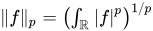
In normed vector spaces, completeness refers to the property that every Cauchy sequence converges to an element within the space. A sequence {fn}\{f_n\} in a normed space (X,)(X, \|\cdot\|) is Cauchy if for every ϵ>0\epsilon > 0, there exists NNN \in \mathbb{N} such that for all m,n>Nm, n > N, fmfn<ϵ\|f_m - f_n\| < \epsilon. The metric induced by the norm d(f,g)=fgd(f, g) = \|f - g\| ensures that completeness aligns with the Cauchy criterion in metric spaces. A Banach space is a complete normed vector space, providing a foundational framework for functional analysis where limits of approximating sequences remain in the space. Stefan Banach formalized this concept in his 1920 doctoral thesis, introducing abstract linear operations and their applications to integral equations, which established the theory of . In the context of function spaces, this completeness is crucial for ensuring that sequences of functions behaving "nicely" at infinity converge to actual functions in the space. Prominent examples of Banach function spaces include the Lp(R)L^p(\mathbb{R}) spaces for 1p1 \leq p \leq \infty, where the LpL^p norm (Rfpdx)1/p\left( \int_{\mathbb{R}} |f|^p \, dx \right)^{1/p} (or essential supremum for p=p=\infty) renders them complete, as established by the Riesz-Fischer theorem. Specifically, for 1<p<1 < p < \infty, this theorem guarantees that Cauchy sequences in LpL^p converge in the LpL^p norm to an equivalence class of functions. The space C[0,1]C[0,1] of continuous functions on [0,1][0,1] equipped with the supremum norm f=supx[0,1]f(x)\|f\|_\infty = \sup_{x \in [0,1]} |f(x)| is also a Banach space. Uniform convergence of Cauchy sequences in this norm preserves continuity, ensuring the limit lies in C[0,1]C[0,1]. In contrast, the subspace of polynomials on [0,1][0,1] under the same norm is not complete, as it is dense in C[0,1]C[0,1] by the Weierstrass approximation theorem but fails to contain all limits of its Cauchy sequences. The Cauchy criterion can be expressed formally as: ϵ>0, NN s.t. m,n>N    fmfn<ϵ.\forall \epsilon > 0, \ \exists N \in \mathbb{N} \ \text{s.t.} \ m,n > N \implies \|f_m - f_n\| < \epsilon. This property underpins the stability of solutions in function spaces, distinguishing from incomplete ones like the polynomials.

Topological Aspects

Uniform and Supremum Norm

The uniform norm, also known as the supremum norm, on a space of functions from a set XX to R\mathbb{R} or C\mathbb{C} is defined for a function ff by f=supxXf(x).\|f\|_\infty = \sup_{x \in X} |f(x)|. This norm is finite if and only if ff is bounded on XX. Equivalently, f=inf{M0:f(x)M xX}.\|f\|_\infty = \inf \{ M \geq 0 : |f(x)| \leq M \ \forall x \in X \}. The uniform norm satisfies the standard norm axioms, including the triangle inequality: for functions f,gf, g, f+gf+g.\|f + g\|_\infty \leq \|f\|_\infty + \|g\|_\infty. On the space Cb(X)C_b(X) of bounded continuous functions on a topological space XX, equipped with this norm, the resulting normed vector space is complete and thus a Banach space. Moreover, when XX is compact, Cb(X)C_b(X) coincides with the space C(X)C(X) of all continuous functions on XX, which forms a unital commutative Banach algebra under pointwise multiplication, where the norm is submultiplicative: fgfg.\|f g\|_\infty \leq \|f\|_\infty \|g\|_\infty. This submultiplicativity extends to the algebra structure, facilitating analysis of multiplicative properties in function spaces. The uniform norm plays a key role in controlling boundedness, which is essential for uniform continuity of functions on non-compact domains; for instance, bounded continuous functions on compact subsets are uniformly continuous by the Heine-Cantor theorem. It is particularly vital in approximation theory, as seen in the Stone-Weierstrass theorem, which states that if AA is a subalgebra of C(X)C(X) (for compact Hausdorff XX) that contains constants and separates points, then AA is dense in C(X)C(X) with respect to the uniform norm—meaning any continuous function can be uniformly approximated by elements of AA to arbitrary precision in the sup norm.

Convergence in Function Spaces

In function spaces, convergence of sequences of functions can be defined in various ways, depending on the topology or norm imposed on the space. Pointwise convergence occurs when, for a sequence of functions {fn}\{f_n\} in a function space over a domain XX, fn(x)f(x)f_n(x) \to f(x) as nn \to \infty for every xXx \in X. This mode of convergence does not require uniformity across the domain and may fail to preserve key properties like continuity of the limit function. Uniform convergence provides a stronger notion, where the sequence {fn}\{f_n\} converges uniformly to ff if, for every ϵ>0\epsilon > 0, there exists NNN \in \mathbb{N} such that fn(x)f(x)<ϵ|f_n(x) - f(x)| < \epsilon for all xXx \in X and all n>Nn > N. Equivalently, in spaces equipped with the supremum norm \| \cdot \|_\infty, this corresponds to fnf0\|f_n - f\|_\infty \to 0, where g=supxXg(x).\|g\|_\infty = \sup_{x \in X} |g(x)|. Uniform convergence implies pointwise convergence but not vice versa. A fundamental implication is that if each fnf_n is continuous and the convergence is uniform, then the limit ff is continuous. Beyond these, other modes of convergence arise in specific contexts, such as measure-theoretic settings. Almost uniform convergence, which arises from almost everywhere convergence on finite measure spaces via Egorov's theorem, guarantees that for every ϵ>0\epsilon > 0, there exists a measurable EXE \subset X with μ(XE)<ϵ\mu(X \setminus E) < \epsilon such that fnff_n \to f uniformly on EE. In LpL^p spaces for 1p<1 \leq p < \infty, convergence is defined via the LpL^p-norm: fnff_n \to f in LpL^p if Xfnfpdμ0\int_X |f_n - f|^p \, d\mu \to 0, which strengthens convergence in measure but does not imply uniform or without additional conditions. These interrelations highlight how ensures the strongest preservation of analytic properties among common topologies on function spaces.

References

Add your contribution
Related Hubs
User Avatar
No comments yet.