Hubbry Logo
FunicularFunicularMain
Open search
Funicular
Community hub
Funicular
logo
8 pages, 0 posts
0 subscribers
Be the first to start a discussion here.
Funicular
Funicular
from Wikipedia

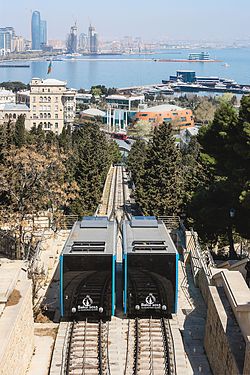
Funicular in Baku, Azerbaijan

A funicular (/fjuːˈnɪkjʊlər, f(j)ʊ-, f(j)ə-/ few-NIK-yoo-lər, f(y)uu-, f(j)ə-)[1], or funicular railway, is a type of cable railway system that connects points along a railway track laid on a steep slope. The system is characterized by two counterbalanced carriages (also called cars or trains) permanently attached to opposite ends of a haulage cable, which is looped over a pulley at the upper end of the track.[2][3] The result of such a configuration is that the two carriages move synchronously: as one ascends, the other descends at an equal speed. This feature distinguishes funiculars from inclined elevators, which have a single car that is hauled uphill.[2][3][4]

The term funicular derives from the Latin word funiculus, the diminutive of funis, meaning 'rope'.[5]

Operation

[edit]

In a funicular, both cars are permanently connected to the opposite ends of the same cable, known as a haul rope; this haul rope runs through a system of pulleys at the upper end of the line. If the railway track is not perfectly straight, the cable is guided along the track using sheaves – unpowered pulleys that simply allow the cable to change direction. While one car is pulled upwards by one end of the haul rope, the other car descends the slope at the other end. Since the weight of the two cars is counterbalanced (except for the difference in the weight of passengers), the engine only has to provide energy to pull the excess passengers in the uphill car and the cable itself, plus the energy lost to friction by the cars' wheels and the pulleys.[2][6]

For passenger comfort, funicular carriages are often, although not always, constructed so that the floor of the passenger deck is horizontal rather than parallel to the sloped track.

bottom towrope

In some installations, the cars may also be attached to a second cable – bottom towrope – which runs through a pulley at the bottom of the incline. In these designs, one of the pulleys must be designed as a tensioning wheel to avoid slack in the ropes. One advantage of such an installation is that the weight of the rope is balanced between the carriages; therefore, the engine no longer needs to use any power to lift the cable itself. This practice is used on funiculars with slopes below 6%, funiculars using sledges instead of carriages, or any other case where it is not ensured that the descending car is always able to pull out the cable from the pulley in the station on the top of the incline.[7] It is also used in systems where the engine room is located at the lower end of the track (such as the upper half of the Great Orme Tramway) – in such systems, the cable that runs through the top of the incline is still necessary to prevent the carriages from coasting down the incline.[8]

Types of power systems

[edit]

Cable drive

[edit]
Funicular drive train
Petřín funicular wheelset with Abt rack and pinion brake

In most modern funiculars, neither of the two carriages is equipped with an engine of its own; propulsion is provided by an electric motor in the engine room (typically at the upper end of the track), linked via a speed-reducing gearbox to a large pulley – a drive bullwheel – which then controls the movement of the haul rope using friction. Some early funiculars were powered in the same way, but using steam engines or other types of motors. The bullwheel has two grooves: after the first half turn around it the cable returns via an auxiliary pulley. This arrangement has the advantage of having twice the amount of contact area between the cable and the groove, and returning the downward-moving cable in the same plane as the upward-moving one. Modern installations use high-friction liners to increase the friction between the bullwheel grooves and the cable.[6][9][10]

There are two sets of brakes in the engine room: an emergency brake which directly grips the bullwheel, and a service brake mounted at the high speed shaft of the gear. The cars are also equipped with spring-applied, hydraulically opened rail brakes for emergency use.[10]

The first funicular caliper brakes which clamp each side of the crown of the rail were invented by the Swiss entrepreneurs Franz Josef Bucher and Josef Durrer and implemented at the Stanserhorn funicular [de], opened in 1893.[11][12] The Abt rack and pinion system was also used on some funiculars for speed control or emergency braking.[2][6]

Water counterbalancing

[edit]
The wastewater-powered Fribourg funicular featuring an Abt switch

Many early funiculars were built using water tanks under the floor of each car, which were filled or emptied until just sufficient imbalance was achieved to allow movement, and a few funiculars still operate that way. The car at the top of the hill is loaded with water until it is heavier than the car at the bottom, causing it to descend the hill and pull up the other car. The water is drained at the bottom, and the process repeats with the cars exchanging roles. The movement is controlled by a brakeman using the brake handle of the rack and pinion system engaged with the rack mounted between the rails.[2][6]

The Bom Jesus funicular built in 1882 near Braga, Portugal, is an extant system of this type. Another example, the Fribourg funicular in Fribourg, Switzerland, built in 1899,[13] is of particular interest as it utilizes waste water, coming from a sewage plant at the upper part of the city.[14]

Some funiculars of this type were later converted to electrical power. For example, the Giessbachbahn in the Swiss canton of Bern, opened in 1879, was originally powered by water ballast. In 1912 its energy provision was replaced by a hydraulic engine powered by a Pelton turbine, which in 1948 was replaced by an electric motor.[2]

Track layout

[edit]
Track layouts used in funiculars – in the SVG file, click to move the cars
East Hill Cliff Railway in Hastings, UK – a four-rail funicular
Angels Flight in Los Angeles, California – a three-rail funicular
Nazaré Funicular in Nazaré, Portugal – a two-rail funicular

Three main rail layouts are used on funiculars; depending on the system, the track bed can consist of four, three, or two rails.

  • Early funiculars were built to the four-rail layout, with two separate parallel tracks and separate station platforms at both ends for each vehicle. The two tracks are laid with sufficient space between them for the two carriages to pass at the midpoint. While this layout requires the most land area, it is also the only layout that allows both tracks to be perfectly straight, requiring no sheaves on the tracks to keep the cable in place. Examples of four-rail funiculars are the Duquesne Incline in Pittsburgh, Pennsylvania, and most cliff railways in the United Kingdom.
  • In three-rail layouts, the middle rail is shared by both carriages, while each car runs on a different outer rail. To allow the two cars to pass at the halfway point, the middle rail must briefly split into two, forming a passing loop. Such systems are narrower and require less rail to construct than four-rail systems; however, they still require separate station platforms for each vehicle.[2]
  • In a two-rail layout, both cars share the entire track except at the passing loop in the middle. This layout is the narrowest of all and needs only a single platform at each station (though sometimes two platforms are built: one for boarding, one for alighting). However, the required passing loop is more complex and costly to build, since special turnout systems must be in place to ensure that each car always enters the correct track at the loop. Furthermore, if a rack for braking is used, that rack can be mounted higher in three-rail and four-rail layouts, making it less sensitive to choking than the two-rail layout in snowy conditions.[7]

Some funicular systems use a mix of different track layouts. An example of this arrangement is the lower half of the Great Orme Tramway, where the section "above" the passing loop has a three-rail layout (with each pair of adjacent rails having its own conduit which the cable runs through), while the section "below" the passing loop has a two-rail layout (with a single conduit shared by both cars). Another example is the Peak Tram in Hong Kong, which is mostly of a two-rail layout except for a short three-rail section immediately uphill of the passing loop.

Some four-rail funiculars have their tracks interlaced above and below the passing loop; this allows the system to be nearly as narrow as a two-rail system, with a single platform at each station, while also eliminating the need for the costly junctions either side of the passing loop. The Hill Train at the Legoland Windsor Resort is an example of this configuration.

Turnout systems for two-rail funiculars

[edit]

In the case of two-rail funiculars, various solutions exist for ensuring that a carriage always enters the same track at the passing loop.

One such solution involves installing switches at each end of the passing loop. These switches are moved into their desired position by the carriage's wheels during trailing movements (i.e. away from the passing loop); this procedure also sets the route for the next trip in the opposite direction. The Great Orme Tramway is an example of a funicular that utilizes this system.

Another turnout system, known as the Abt switch, involves no moving parts on the track at all. Instead, the carriages are built with an unconventional wheelset design: the outboard wheels have flanges on both sides, whereas the inboard wheels are unflanged (and usually wider to allow them to roll over the turnouts more easily). The double-flanged wheels keep the carriages bound to one specific rail at all times. One car has the flanged wheels on the left-hand side, so it follows the leftmost rail, forcing it to run via the left branch of the passing loop; similarly, the other car has them on the right-hand side, meaning it follows the rightmost rail and runs on the right branch of the loop. This system was invented by Carl Roman Abt and first implemented on the Lugano Città–Stazione funicular in Switzerland in 1886;[2] since then, the Abt turnout has gained popularity, becoming a standard for modern funiculars.[9] The lack of moving parts on the track makes this system cost-effective and reliable compared to other systems.

Stations

[edit]
The two cars of the Petřín funicular—they both stop when one of them is at Nebozízek station (foreground), and the other is between stations.

The majority of funiculars have two stations, one at the top and one at the bottom of the track. However, some systems have been built with additional intermediate stations. Because of the nature of a funicular system, intermediate stations are usually built symmetrically about the mid-point; this allows both cars to call simultaneously at a station. Examples of funiculars with more than two stations include the Wellington Cable Car in New Zealand with five stations, including one at the passing loop,[15] and the Carmelit in Haifa, Israel with six stations, three on each side of the passing loop.[16]

There are a few funiculars with asymmetrically placed stations. For example, the Petřín funicular in Prague has three stations: one at each end, and a third (Nebozízek) a short way up from the passing loop.[17] Because of this arrangement, when a car on one side stops at Nebozízek the car on the other side stops without a station access.

History

[edit]
Tünel in Istanbul, launched in 1875, Karaköy station as of 2006

A number of cable railway systems which pull their cars on inclined slopes were built since the 1820s. In the second half of the 19th century the design of a funicular as a transit system emerged. It was especially attractive in comparison with the other systems of the time as counterbalancing of the cars was deemed to be a cost-cutting solution.[2]

The first line of the Funiculars of Lyon (Funiculaires de Lyon) opened in 1862, followed by other lines in 1878, 1891 and 1900. The Budapest Castle Hill Funicular was built in 1868–69, with the first test run on 23 October 1869. The oldest funicular railway operating in Britain dates from 1875 and is in Scarborough, North Yorkshire.[18] In Istanbul, Turkey, the Tünel has been in continuous operation since 1875 and is both the first underground funicular and the second-oldest underground railway. It remained powered by a steam engine up until it was taken for renovation in 1968.[19]

Until the end of the 1870s, the four-rail parallel-track funicular was the normal configuration. Carl Roman Abt developed the Abt Switch allowing the two-rail layout, which was used for the first time in 1879 when the Giessbach Funicular opened in Switzerland.[7]

In the United States, the first funicular to use a two-rail layout was the Telegraph Hill Railroad in San Francisco, which was in operation from 1884 until 1886.[20] The Mount Lowe Railway in Altadena, California, was the first mountain railway in the United States to use the three-rail layout. Three- and two-rail layouts considerably reduced the space required for building a funicular, reducing grading costs on mountain slopes and property costs for urban funiculars. These layouts enabled a funicular boom in the latter half of the 19th century.

Currently, the United States' oldest and steepest funicular in continuous use is the Monongahela Incline located in Pittsburgh, Pennsylvania. Construction began in 1869 and officially opened 28 May 1870 for passenger use. The Monongahela incline also has the distinction of being the first funicular in the United States for strictly passenger use and not freight.[21]

In 1880 the funicular of Mount Vesuvius inspired the Italian popular song Funiculì, Funiculà. This funicular was destroyed repeatedly by volcanic eruptions and abandoned after the eruption of 1944.[22]

Exceptional examples

[edit]

According to the Guinness World Records, the smallest public funicular in the world is the Fisherman's Walk Cliff Railway in Bournemouth, England, which is 39 metres (128 ft) long.[23][24]

Stoosbahn in Switzerland, with a maximum slope of 110% (47.7°), is the steepest funicular in the world.[25]

The Lynton and Lynmouth Cliff Railway, built in 1888, is the steepest and longest water-powered funicular in the world. It climbs 152 metres (499 ft) vertically on a 58% gradient.[26]

The city of Valparaíso in Chile used to have up to 30 funicular elevators (Spanish: ascensores). The oldest of them dates from 1883. 15 remain with almost half in operation,[when?] and others in various stages of restoration.

The Carmelit in Haifa, Israel, with six stations and a tunnel 1.8 km (1.1 mi) long, is claimed by the Guinness World Records as the "least extensive metro" in the world.[16] Technically, it is an underground funicular.

The Dresden Suspension Railway (Dresden Schwebebahn), which hangs from an elevated rail, is the only suspended funicular in the world.[27]

The Fribourg funicular is the only funicular in the world powered by wastewater.[14]

Standseilbahn Linth-Limmern, capable of moving 215 t, is said to have the highest capacity.[28]

Comparison with inclined elevators

[edit]
Despite their names, neither system is a true funicular.

Some inclined elevators are incorrectly called funiculars. On an inclined elevator the cars operate independently rather than in interconnected pairs, and are lifted uphill.[3]

A notable example is Paris' Montmartre Funicular. Its formal title is a relic of its original configuration, when its two cars operated as a counterbalanced, interconnected pair, always moving in opposite directions, thus meeting the definition of a funicular. However, the system has since been redesigned, and now uses two independently-operating cars that can each ascend or descend on demand, qualifying as a double inclined elevator; the term "funicular" in its title is retained as a historical reference.[4][29][30]

See also

[edit]

References

[edit]
[edit]
Revisions and contributorsEdit on WikipediaRead on Wikipedia
from Grokipedia
A funicular, also known as an or funicular railway, is a cable-driven transport system that connects two points along a steep slope using rail tracks, where two counterbalanced cars connected by a cable move in opposite directions, with the descending car assisting in pulling the ascending one via a mechanism. Funiculars originated in the late , with the oldest preserved example being the cable system at in , , constructed around 1495 and initially powered by human or animal labor on wooden tracks. Their development accelerated during the in the , as and later enabled more efficient operations for urban and mountainous , with notable early examples including the Monongahela Incline in , opened in 1870 as the oldest continuously operating funicular in the United States. By the late 1800s, funiculars proliferated worldwide for , , and city access, such as Hong Kong's , Asia's oldest, which began service in 1888. These systems typically feature two parallel tracks or a single track with passing sidings, where cars run on rails and are propelled by electric motors, , or alone, achieving gradients as steep as 110%—far steeper than standard railways. The design minimizes energy use, as the weight of the descending car offsets much of the power needed for ascent, making funiculars highly efficient and sustainable for short, vertical distances. Modern funiculars often incorporate safety features like emergency brakes and automatic controls, serving as vital links in cities with hilly terrain, such as the in , opened in 1901, or the Sierre-Montana-Crans in , one of the longest at 2.6 miles. Today, over 100 funiculars operate globally, blending historical engineering with contemporary urban mobility.

Fundamentals

Definition and Purpose

A funicular is a type of system that connects two points along a steep incline using two counterbalanced to a shared cable, where the descent of one assists in powering the ascent of the other through gravitational forces. This design integrates elements of both elevators and traditional railways, with the running on fixed tracks to ensure stability on gradients that would be impractical for conventional rail systems. The term "funicular" derives from the Latin funiculus, a diminutive of funis meaning "" or "cord," reflecting the system's reliance on cabling; it entered English as a referring to such railways in 1874. Funiculars serve primarily as efficient solutions in challenging topographies, facilitating the movement of passengers or in urban hillside settings, tourist attractions at scenic elevations, operations, and industrial sites requiring access to elevated or sloped areas. In urban contexts, such as Lisbon's historic funiculars, they provide vertical mobility for commuters navigating hilly neighborhoods. For , they enable access to viewpoints like those at in , enhancing visitor experiences without extensive walking. In and industrial applications, funiculars transport materials and personnel up steep mine inclines or faces, as seen in cave exploration systems that reach deep underground sites. Typical funicular cars accommodate 20 to 100 passengers, depending on the scale—for instance, some urban models carry around 38 passengers per vehicle—while inclines commonly range from 20° to 50°, with examples like Pittsburgh's at 30°. Compared to alternatives like winding roads or extensive stair systems, funiculars offer superior energy efficiency by leveraging the counterbalancing mechanism, which minimizes the need for external power as the descending car's weight offsets much of the ascending effort. This gravitational balance reduces overall energy consumption, making them particularly suitable for operations in remote or power-limited environments. Additionally, their compact track footprint results in lower environmental disruption in space-constrained areas, avoiding the land clearance and emissions associated with road construction while providing low-emission transport in urban or natural settings.

Basic Operating Principles

A funicular operates on the core principle of leveraging through counterweighting, where the descending provides to pull the ascending up the incline, thereby minimizing the need for external power input. This balanced motion arises from the approximate equilibrium of forces along the track, given by the equation m1gsinθm2gsinθm_1 g \sin \theta \approx m_2 g \sin \theta, where m1m_1 and m2m_2 are the masses of the descending and ascending cars, respectively, gg is the acceleration due to gravity, and θ\theta is the angle of the incline; adjustments for , safety margins, and minor imbalances are typically handled by auxiliary drive mechanisms. Key components enable this operation, including a connecting the two cars in a continuous loop, a drive sheave or at the upper station that redirects the cable's tension, grip mechanisms on the cars to secure them to the cable, and braking systems—such as rail brakes or dynamic brakes—for precise speed control, with typical operating speeds ranging from 5 to 36 km/h to ensure passenger safety and comfort. The motion cycle involves simultaneous bidirectional travel of the two cars, often on a single track with passing loops to allow them to cross midway, or in shuttling configurations on dedicated tracks; interlocks, including limit switches and automatic stop systems, prevent collisions and ensure synchronized operation. Load balancing is maintained by equalizing car weights, either through passenger distribution or, in some designs, water added to the lighter car to restore equilibrium and optimize energy efficiency.

Drive Systems and Mechanisms

Cable-Driven Systems

Cable-driven systems represent the predominant propulsion method for funicular railways, leveraging electric motors to haul counterbalanced passenger cars along steep inclines. In this configuration, an electric motor powers a central sheave or drive drum located at the upper station, which winds and unwinds a continuous steel haulage rope connecting the two cars. As one car ascends, the descending car provides counterbalance, minimizing energy input while the rope—typically constructed from high-strength steel strands—transmits the motion. These ropes generally have diameters of 20 to 40 mm and tensile strengths reaching up to 1,800 MPa to withstand operational tensions and environmental stresses. Funiculars predominantly use fixed-grip attachments, where the cars remain permanently clamped to the rope throughout operation, ensuring synchronized movement without the detachable grips found in some aerial transport systems. Power demands for these systems vary with incline length (often up to 1,000 m), total load capacity, gradient, and desired speed, typically requiring electric motors rated from 50 kW for smaller installations to 500 kW for larger ones. For instance, the Moléson funicular employs a 600 kW motor to handle its demands. The fundamental power calculation accounts for the mass imbalance and inefficiencies, approximated by P=Δmgsinθv+PfrictionηP = \frac{\Delta m \, g \, \sin \theta \, v + P_{\text{friction}}}{\eta} where Δm\Delta m is the mass difference between cars (due to load or water), gg is (9.81 m/s²), θ\theta is the incline angle, vv is the operating , PfrictionP_{\text{friction}} is the power to overcome , and η\eta is the drive efficiency, usually 70–90% due to friction in sheaves and ropes. The evolution of cable-driven funiculars saw a pivotal shift from engines to electric motors in the early , enhancing reliability by reducing mechanical complexity and enabling precise speed control through systems like Ward-Leonard DC drives. This transition, accelerating post-1900, aligned with broader electrification trends in and addressed 's limitations in maintenance and emissions. Contemporary systems incorporate recuperative braking, where descent energy is converted to heat; the in exemplifies this with its 2.3 MW ABB-powered setup, using braking energy to heat water for the Lodge, contributing to over 30% of its energy needs when combined with solar PV. Ongoing is critical for and longevity, with haulage ropes subjected to rigorous protocols to detect , , or . Standards mandate weekly visual examinations during operation and annual comprehensive surveys using non-destructive testing like defectographs, while detailed checks often occur every six months; with non-corrosive, rope-compatible compounds is applied periodically to minimize internal and extend . Sheave diameters must be at least 80 times the rope to reduce stresses, further supporting .

Water and Counterbalance Systems

In water and counterbalance systems, funicular cars are equipped with integrated water tanks that serve as adjustable ballast to facilitate movement along the incline. Typically, the car at the upper station is filled with water from a reservoir, aqueduct, or natural source, increasing its mass by 3 to 20 tons depending on the system's design and capacity, which generates the gravitational force needed to descend and pull the lighter ascending car via the connecting cable. At the lower station, valves allow the water to drain by gravity into a collection tank or directly to a water body, reducing the car's weight for the return cycle, while the opposite car is simultaneously filled at the top. This passive hydraulic counterbalancing relies on the natural flow of water where possible, as seen in systems like the Lynton and Lynmouth Cliff Railway, where 700 gallons (approximately 3 tons) of river water is added per car. The operational balance in these systems can be expressed by the equation Δmwatergsinθ=Fimbalance\Delta m_{\text{water}} \cdot g \cdot \sin \theta = F_{\text{imbalance}}, where Δmwater\Delta m_{\text{water}} is the differential mass of between the cars, gg is the acceleration due to gravity, θ\theta is the incline , and FimbalanceF_{\text{imbalance}} represents the required to overcome , passenger load variations, or track resistance. In closed-loop variants, such as the Folkestone Leas Lift, discharged water is collected in lower storage tanks (up to 30,000 gallons) and pumped back to upper reservoirs using electric motors, enabling water recycling to minimize consumption and environmental impact; these pumps typically operate intermittently, with historical conversions to electric systems rated in the range of several kilowatts for efficient transfer. Such designs harness hydroelectric potential through alone for , requiring no external for the cars' motion, making them inherently eco-friendly with zero direct emissions during operation. These systems were predominant in 19th-century , exemplified by the Bom Jesus do Monte Funicular in (opened 1882) and the Fribourg Funicular in (opened 1899), which uniquely uses filtered flowing naturally from upper to lower levels in a 3,000-liter tank per car. Modern revivals emphasize sustainability, such as the Railway in (opened 1992), which draws from a hilltop lake and discharges at the base while incorporating features to reduce overall resource use. However, limitations include extended cycle times of 2-5 minutes due to the filling and draining processes, which slow throughput compared to electric alternatives, and susceptibility to operational halts in cold climates where water tanks risk freezing, necessitating measures or seasonal closures.

Hydraulic Systems

Some funiculars employ hydraulic drive systems, where hydraulic or propel the cars, often integrated with cable mechanisms for precise control on steep gradients. These systems use pressurized to drive pistons or motors, offering advantages in for heavy loads and smooth operation. Examples include certain residential and custom installations, as well as hybrid setups in and , providing an alternative to full electric drives for specific terrains. Hydraulic systems can achieve similar efficiencies to electric ones but may require more for systems.

Infrastructure and Design

Track Configurations

Funicular tracks are primarily configured as single tracks equipped with passing sidings to facilitate the bidirectional movement of counterbalanced cars, optimizing space and cost on steep inclines. The Abt passing loop, developed in 1879 in , represents a key innovation in this layout, allowing cars to pass each other on a single track through a specialized section where one car uses guide wheels and the other flat wheels to navigate the divergence without complex switches. Double-track setups, featuring parallel rails for independent car paths, are rarer and typically reserved for shorter routes due to elevated construction expenses and material demands. Rail arrangements in funiculars commonly utilize two parallel rails for guiding the cars along the incline, transitioning to four rails at passing sidings where the track splits to accommodate both vehicles simultaneously. Three-rail configurations, incorporating a central rail shared by both cars, are employed in select systems for efficient single-track passing loops. Gradients can reach up to 110%, as demonstrated by the Stoosbahn in Switzerland, with such steepness managed via high-friction rail adhesion and rotating cabins that adjust to the slope for passenger comfort. Turnout mechanisms at passing sections often rely on guide wheel systems or pivoting rail segments to direct cars smoothly, minimizing wear and ensuring operational reliability. Engineering considerations for funicular tracks emphasize stability on uneven terrain, with curvatures incorporated using clothoidal transitions to ease entry and exit from bends, maintaining passenger comfort and structural integrity. Foundations are anchored via beds, slabs, or girders tailored to the slope, providing secure support against gravitational forces and environmental loads. In water-ballast funiculars, track designs include integrated drainage channels to handle ballast water runoff and prevent or slippage. Lengths vary significantly by application, with urban installations typically spanning 100 to 500 meters—such as the 121-meter funicular—while extended mountain routes can exceed 4 kilometers, exemplified by the 4-kilometer Sierre-Crans-Montana line.

Stations and Safety Features

Funicular stations typically consist of upper and lower terminals equipped with platforms for boarding and alighting, integrated ticketing facilities, and waiting areas to facilitate smooth operations. These terminals often incorporate dedicated spaces for machinery, such as drive sheaves, gearboxes, and control systems, ensuring that the supports both flow and technical requirements. In hydraulic funicular systems, the upper station includes water filling mechanisms for the vehicle's underfloor tanks to enable counterbalancing, while the lower station features drainage systems to empty the tanks after descent, allowing for efficient weight adjustments without external power. Safety features in funicular stations and vehicles prioritize mechanisms to protect passengers during operations. Emergency brakes, either hydraulic or electric, are standard and activate automatically in cases of , slack haul , or power failure, gripping the rails to halt the vehicles securely. Anti-rollback devices prevent unintended backward movement on inclines, functioning as automatic clamps or ratchets that engage on the tracks, particularly essential for maintaining stability in counterbalanced systems. Speed governors limit operational velocities, typically to under 20 km/h in urban or tourist applications to minimize risks, with rail brakes providing additional oversight. Evacuation protocols involve accessible steps or platforms along the track for exits, coordinated from station control rooms. These elements comply with international standards such as EN 12929-1, which mandates comprehensive requirements for cableway installations including funiculars, covering mechanical and electrical safeguards. Accessibility enhancements in funicular stations ensure inclusive use for all passengers. Ramps provide level access to platforms at both terminals, with widths accommodating s, and dedicated elevators or lifts are integrated in multi-level stations to bridge elevation changes. Automatic vehicle leveling systems maintain even floors with platforms, facilitating entry for users, strollers, and bicycles without assistance. Adequate lighting illuminates waiting areas and pathways for visibility, while enclosed stations may include , such as sprinklers, to mitigate risks in confined spaces. These features align with broader access guidelines, promoting equitable transport on steep terrains. Capacity management at funicular stations focuses on maintaining operational balance and preventing overloads through structured procedures and . Boarding sequences direct passengers to distribute weight evenly between ascending and descending vehicles, preserving the counterbalance principle for energy efficiency. Load sensors, often mounted on bogies or undercarriages, detect overloads exceeding rated capacities—typically several hundred passengers per —and trigger alarms or halt boarding to ensure . These systems integrate with station controls for real-time monitoring, optimizing throughput while adhering to safety limits outlined in standards like EN 12929-1.

Historical Development

Origins and Early Innovations

The origins of funicular systems lie in ancient practices that utilized inclined planes and ropes to facilitate the transport of heavy loads in and quarrying operations. During the Roman era, techniques including ramps and ropes were employed to haul materials, leveraging and manual or animal power, though these primitive methods were not mechanized inclines and did not directly prefigure modern funicular designs. Sites in regions like and Britain provide evidence of such early gravity-assisted haulage in resource extraction, reducing effort on steep gradients. In the medieval period, similar principles were applied to maritime infrastructure, with rope-based hoists emerging to lift ships over barriers in harbors. These hoists relied on counterweights and human or animal labor, foreshadowing more sophisticated cable-driven mechanisms. The pivotal invention of the first dedicated funicular occurred in 1495 at Hohensalzburg Castle in , where the —a counterbalanced system with wooden rails and horse-drawn cables—was constructed to transport supplies up the steep hillside to the fortress. Initially designed for freight, this horse-powered incline spanned approximately 30 meters in height and operated on a single track with passing loops, establishing the core principles of balanced cable propulsion that defined future funiculars. By the early , it began carrying passengers as well, transitioning from utilitarian to accessible transport and influencing castle logistics across . Advancements accelerated in the with the integration of power into incline systems, particularly in European . engines enabled powered haulage on steep gradients, as seen in early installations like those in German collieries around the 1780s, where fixed winches pulled counterbalanced cars loaded with , improving efficiency over animal or gravity methods. This shift marked the transition from manual to mechanized operations, with counterbalanced designs minimizing energy loss by using the descending load to assist the ascent. Early 19th-century patents further refined these innovations, with designs for fixed cable systems promoting safer and more reliable inclines. In , British engineers W. and E. Chapman patented a method using stationary cables or chains along roads and inclines to propel vehicles, eliminating the need for moving ropes in certain configurations and paving the way for widespread adoption in both industrial and passenger applications. This fixed-cable approach enhanced stability on variable terrains and influenced global funicular development by standardizing mechanical components.

Expansion in the 19th and 20th Centuries

The proliferation of funicular railways accelerated during the amid rapid industrialization and , particularly in where steep terrain posed challenges for . The first urban funicular opened in , , in 1862, connecting the lower city to the hilly Croix-Rousse district and setting a precedent for integrating these systems into city . Similar developments followed in other European cities, such as Lisbon, Portugal, where the Glória Funicular began operations in 1885 to link the Baixa district with the higher neighborhoods. By the late , funiculars had become a common solution for vertical mobility in hilly locales, with dozens constructed across the continent to serve growing populations. Following advancements in technology, many systems transitioned from water ballast or steam power to electric drives starting in the , enhancing reliability and efficiency. This expansion extended globally, reaching where funiculars addressed similar topographical issues in industrializing cities. , construction boomed in the latter half of the , with hundreds built nationwide to connect elevated neighborhoods to urban centers. exemplified this trend, opening 17 passenger funiculars, including the Monongahela Incline in 1870, which quickly became vital for workers commuting across the city's steep ravines. Funiculars also spread to , notably in colonial , where the commenced service in 1888, providing access to and boosting tourism in Victorian-era seaside and hill resorts. In the , funicular networks faced significant challenges from the rise of automobiles, leading to widespread closures, especially in after as personal vehicles offered greater flexibility. Of Pittsburgh's original 17 inclines, for instance, only two remain operational today. Despite this decline, some European systems, particularly in , saw continued development and preservation into the interwar and postwar periods, with and upgrades sustaining mountain funiculars amid a broader boom in alpine transport from 1880 to 1920. Innovations during this era included improved safety mechanisms, such as automatic speed controls and supervision systems, which addressed vulnerabilities exposed by earlier incidents like cable breaks in the late .

Notable Installations

Iconic Historical Examples

The Clifton Incline in , , operated from 1895 to 1905 and represented an early innovation in American urban transportation for hilly terrain. This funicular employed a two-car system, with one car transporting passengers and the other acting as a counterbalance loaded with stones, enabling efficient movement in the Perry Hilltop neighborhood. Though demolished after a decade of service, it contributed to the network of over 20 inclines that shaped 's transit landscape by linking isolated hilltop communities to the city center. The Funicular de in , , opened on July 13, 1900, and quickly became integral to accessing the bohemian artists' quarter surrounding the Sacré-Cœur Basilica. Spanning 108 meters with a 36 percent incline, it initially operated on a water counterweight system before being electrified in 1935 and fully modernized in 1991 to handle increased ridership. Its role in easing the climb up the 130-meter-high made it a cultural lifeline for 's creative community during the early . In , , the Bom Jesus do Monte Funicular, inaugurated on March 25, 1882, stands as the world's oldest funicular still using its original water counterbalance mechanism. Covering 274 meters and rising 116 meters, this pioneering system draws water from a nearby spring to power the cars, providing access to the hilltop sanctuary known for its monumental and religious significance. Classified as a , it exemplified 19th-century ingenuity tailored to routes. The Fløibanen funicular in , —first proposed in 1895 and operational since January 15, 1918—serves as a landmark of Scandinavian transport history by connecting the city center to Mount Fløyen. This 844-meter line climbs 302 meters at a maximum gradient of 26 degrees, powered originally by a 95-horsepower , and facilitated public access to scenic viewpoints amid Bergen's UNESCO-listed historic district. Its enduring design highlights early 20th-century efforts to integrate nature and urban mobility in a fjord-side setting.

Contemporary and Exceptional Cases

In contemporary times, funiculars continue to serve as vital transportation solutions in urban and hilly environments, with several notable revivals and restorations enhancing accessibility and tourism. The in , , originally opened in 1877, was revived in 1963 through community efforts by the Society for the Preservation of the Duquesne Heights Incline, transitioning from steam to electric power while preserving its historic cars for passenger service. In , Chile, restorations beginning in 2014 have revitalized several of the city's 16 historic ascensores, including the Cordillera funicular (built in 1887), as part of a government-led heritage preservation plan; the Cordillera specifically underwent restoration from 2016 to 2018. Exceptional engineering feats highlight modern innovations in funicular design. The in , opened in December 2017, holds the Guinness World Record as the world's steepest funicular with a maximum of 110% (47.7 degrees), spanning 1,740 meters in length and ascending 744 meters via fully automated, rotating cabins that carry up to 34 passengers each, ensuring level footing throughout the ride. Similarly, Angel's Flight in , —the world's shortest funicular at 91 meters—underwent major modernization in 2017, including enhanced safety features like evacuation systems and upgraded cars, allowing it to resume operations after a 2013 closure. Global outliers demonstrate funiculars' adaptability to extreme conditions, including high altitudes. In , the Shanan Funicular near , , operational since the 1930s, reaches an elevation of 2,530 meters, serving as one of the highest funiculars worldwide for transporting equipment to the , though primarily cargo-focused with limited passenger use. Funiculars reflect a 21st-century shift toward and post-COVID recovery. Examples include the Koyasan Cable Line in , which since 2021 operates entirely on sources, reducing its while serving pilgrims to Mount Koya. The sector has seen increased ridership as global rebounds, with market analyses projecting growth in eco-friendly installations driven by urban integration and scenic appeal.

Comparisons with Similar Systems

Inclined Elevators

Inclined elevators, also known as inclined lifts, are or systems consisting of a single cabin that travels along inclined guide rails, powered by a traction mechanism such as a cable-driven hoist, to overcome steep height differences in a straight path. Unlike funiculars, which rely on a pair of counterbalanced cars connected by a cable for bidirectional operation, inclined elevators typically feature independent, unidirectional or reversible single-car operation without a second for gravitational assistance. This design allows for simpler track configurations, often using enclosed guide rails similar to vertical elevators, but requires more electrical power to propel the cabin against , as there is no descending car to provide balancing force. Key structural and functional differences from funiculars include the inclined elevator's capacity for steeper gradients—up to 90 degrees in some installations—compared to the typical 15-45 degrees of funicular tracks, though this comes at the cost of lower passenger capacity, usually limited to 10-20 people per cabin. Funiculars, by contrast, support higher throughput through paired cars moving simultaneously in opposite directions, enabling efficient mass transit over longer distances. Engineering standards for inclined elevators, such as ASME A17.1, emphasize safety features like emergency brakes, overspeed governors, and slack-cable detection, treating them as variants of conventional elevators adapted for inclines rather than systems. These systems prioritize and integration into urban or architectural settings, with cabins often featuring doors at variable angles to match the incline. Notable examples illustrate their application in both historical and modern contexts, primarily for short-haul vertical transport within buildings or along building-adjacent slopes, unlike the outdoor, transport-oriented role of funiculars. The inclined elevator installed on the in the 1890s, for instance, used a cable-hoist system to carry visitors up a 30-degree slope within the structure, exemplifying early integration into monumental . In contemporary settings, Tokyo's Akasaka-mitsuke Station introduced Japan's first urban inclined elevator in 2021, a 24-meter, 30-degree installation providing barrier-free access between platforms and concourses for up to 15 passengers, highlighting their role in enhancements over funicular-style public transit.

Cable Cars and Aerial Systems

Cable cars and aerial systems encompass a range of suspended transport mechanisms where passenger cabins are supported by overhead cables, eliminating the need for ground-based rails. In contrast to funiculars, which operate on fixed inclined tracks, these systems utilize continuously circulating or reversible wire ropes to propel cabins through the air, enabling navigation over varied terrain without track infrastructure. Ground-based cable cars, such as the grip cars in , grip an underground moving cable while running on rails, but aerial variants like gondolas and tramways fully suspend vehicles above the ground. Key differences lie in operational paths and capabilities: aerial systems traverse open air, often spanning valleys, rivers, or urban gaps of 1-5 km, whereas funiculars adhere to a single, fixed incline along rails for stability on slopes. Typical speeds for aerial tramways range from 20-30 km/h, allowing efficient crossings but exposing them to weather disruptions like high winds, unlike the more sheltered, rail-guided motion of funiculars. Notable examples include the in , operational since 1976 as the first commuter in the United States, spanning 960 m across the at speeds up to 28 km/h to connect and . Similarly, the , inaugurated in 1974, functions as a primarily for tourism, covering 1.75 km from to Sentosa Island over harbor waters at approximately 18 km/h. Trade-offs highlight complementary roles: funiculars deliver smoother, weather-resistant rides on prepared inclines with inherent track stability, but they cannot bridge horizontal or irregular gaps; aerial systems, while costlier per kilometer due to cable and support tower requirements, provide versatile access over obstacles at lower disruption to . Funiculars may briefly reference track stability for smoother rides compared to aerial sway.

References

Add your contribution
Related Hubs
User Avatar
No comments yet.