
Hubbry Logo
Book of HaggaiBook of HaggaiMain
Open search
Book of Haggai
Community hub
Book of Haggai
logo
7 pages, 0 posts
0 subscribers
Be the first to start a discussion here.
Book of Haggai
Book of Haggai
from Wikipedia

The Book of Haggai (/ˈhæɡ/; Hebrew: ספר חגי, romanizedSefer Ḥaggay) is a book of the Hebrew Bible or Tanakh, and is the third-to-last of the Twelve Minor Prophets.[1][2] It is a short book, consisting of only two chapters.[3] The historical setting dates around 520 BC, before the Temple had been rebuilt.[4] The original text was written in Biblical Hebrew.

Authorship

[edit]

The Book of Haggai is named after the prophet Haggai whose prophecies are recorded in the book. The authorship of the book is uncertain. Some presume that Haggai wrote the book himself but he is repeatedly referred to in the third person which makes it unlikely that he wrote the text: it is more probable that the book was written by a disciple of Haggai who sought to preserve the content of Haggai's spoken prophecies.[5]

There is no biographical information given about the prophet in the Book of Haggai. Haggai's name is derived from the Hebrew verbal root hgg, which means "to make a pilgrimage". W. Sibley Towner suggests that Haggai's name might come "from his single-minded effort to bring about the reconstruction of that destination of ancient Judean pilgrims, the Temple in Jerusalem".[6]

Date

[edit]

The Book of Haggai records events in 520 BC, some 18 years after Cyrus had conquered Babylon and issued a decree in 538 BC, allowing the captive Judahites to return to Judea. Cyrus saw the restoration of the temple as necessary for the restoration of religious practices and a sense of peoplehood, after the long exile.[7] The precise date of the written text is uncertain but most likely dates to within a generation of Haggai himself.[7] A traditional consensus dates the completion of the text to c. 515 BC.[8] Other scholars consider the book to be completed around 417 BC, arguing that it did not refer to Darius the Great (Darius I), but to Darius II (424-405 BC).[9]

Early surviving manuscripts

[edit]

Some early manuscripts containing the text of this book in Biblical Hebrew are of the Masoretic Text, which includes the Codex Cairensis (895), the Petersburg Codex of the Prophets (916), and Codex Leningradensis (1008).[10][a] Fragments of the Hebrew text of this book were found among the Dead Sea Scrolls, including 4Q77 (4QXIIb; 150–125 BCE)[12][13][14] 4Q80 (4QXIIe; 75–50 BCE);[15][13][16] and Wadi Murabba'at Minor Prophets (Mur88; MurXIIProph; 75-100 CE).[13][17]

There is also a translation into Koine Greek known as the Septuagint, made in the last few centuries BCE. Extant ancient manuscripts of the Septuagint version include Codex Vaticanus (B; B; 4th century), Codex Sinaiticus (S; BHK: S; 4th century), Codex Alexandrinus (A; A; 5th century) and Codex Marchalianus (Q; Q; 6th century).[18]

Synopsis

[edit]
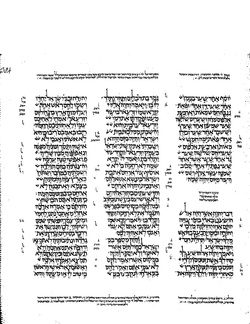
The Leningrad Codex (AD. 1008) contains the complete Hebrew text of the Book of Haggai.
The whole Book of Haggai in Latin as a part of Codex Gigas, made around 13th century.

Haggai's message is filled with an urgency for the people to proceed with the rebuilding of the second Jerusalem temple. Haggai attributes a recent drought to the people's refusal to rebuild the temple, which he sees as key to Jerusalem’s glory. The book ends with the prediction of the downfall of kingdoms, with one Zerubbabel, governor of Judah, as the Lord's chosen leader.

The first chapter contains the first address (2–11) and its effects (12–15). The second chapter contains the second prophecy (1–9), delivered a month after the first; the third prophecy (10–19), delivered two months and three days after the second; and the fourth prophecy (20–23), delivered on the same day as the third.

These discourses are referred to in Ezra 5:1 and 6:14. (Compare Haggai 2:7, 8 and 22)

Text from Haggai 2:9 on a synagogue in Alkmaar: "The glory of this present house will be greater than the glory of the former house."

Haggai reports that three weeks after his first prophecy the rebuilding of the Temple began on September 7 521 BC. "They came and began to work on the house of the LORD Almighty, their God, on the twenty-fourth day of the sixth month in the second year of Darius the King." (Haggai 1:14–15) and the Book of Ezra indicates that it was finished on February 25 516 BC "The Temple was completed on the third day of the month Adar, in the sixth year of the reign of King Darius." (Ezra 6:15)

Outline

[edit]
  1. Divine Announcement: The Command to Rebuild the Temple (1:1–15 )
    1. Introduction: Reluctant Rebuilders (1:1–2 )
    2. Consider your ways: fruitless prosperity (1:3–12 )
    3. Promise and Progress (1:13–15 )
  2. Divine Announcement: The Coming Glory of the Temple (2:1–2.9 )
    1. God will fulfill his promise (2:1–5 ) [19]
    2. Future Splendor of the temple (2:6–9 )[19]
  3. Divine Announcement: Blessings for a Defiled People (2.10–19 )
    1. Former Misery (2.10–17 )[19]
    2. Future Blessing (2.18–19 )[19]
  4. Divine Announcement: Zerubbabel Chosen as a Signet (2.20–23 )

Musical usage

[edit]

The King James Version of Haggai 2:6–7 is used in the libretto of the English-language oratorio "Messiah" by George Frideric Handel (HWV 56).[20]

See also

[edit]

Notes

[edit]

References

[edit]
[edit]
Revisions and contributorsEdit on WikipediaRead on Wikipedia
from Grokipedia
The Book of Haggai is the tenth book of the in the and the , comprising just two chapters and 38 verses, and is attributed to the prophet , whose name derives from Hebrew words meaning "festal" or "feast of ." It records four brief oracles delivered in the second year of Persian king Darius I (520 BCE), urging the returned Jewish exiles in Yehud (post-exilic Judah) to resume and complete the rebuilding of the Temple, which had been destroyed by the Babylonians in 586 BCE. This work stands as one of the shortest in the canon, emphasizing immediate obedience to divine priorities amid communal apathy and economic hardship. Set in the early Persian period following the Great's conquest of in 539 BCE, the book addresses a time when a remnant of Judeans had returned from under leaders like and , initially starting temple reconstruction around 537 BCE but halting it for about 16 years due to local opposition and personal distractions. The oracles, dated precisely from the first day of the sixth month to the twenty-fourth day of the ninth month in 520 BCE, coincide with renewed efforts that led to the temple's dedication in 516 BCE, as corroborated in the . 's prophecies overlap with those of Zechariah, another post-exilic , forming a collaborative call to restore worship and under Persian rule. The book's structure unfolds through its four dated messages, each building on the theme of divine initiative and human response:
  • Haggai 1:1–15: Delivered on the first day of the sixth month, this initial oracle rebukes the people for prioritizing their own paneled houses over God's neglected house, attributing droughts and crop failures to their disobedience as covenant curses from Deuteronomy.
  • Haggai 2:1–9: On the twenty-first day of the seventh month, it offers encouragement to discouraged workers, promising that the future glory of this modest will surpass Solomon's, with God's presence shaking the nations to fill it with treasures and peace.
  • Haggai 2:10–19: Issued on the twenty-fourth day of the ninth month, this uses a priestly from Leviticus about ritual purity to illustrate how the people's past unfaithfulness has contaminated their efforts, but now will bring blessings like abundant harvests.
  • Haggai 2:20–23: Also on the twenty-fourth day of the ninth month, it shifts to an apocalyptic promise, declaring as God's chosen signet ring and foretelling the overthrow of kingdoms to establish a Davidic messianic hope.
Central themes include the urgency of rebuilding the temple as a symbol of God's dwelling and covenant renewal, the consequences of misplaced priorities leading to divine , and eschatological for greater future restoration, including global and a renewed . Haggai's employs sharp contrasts—such as clean vs. unclean and current despair vs. ultimate glory—to motivate action, reflecting a theocentric where obedience unlocks blessings. As a post-exilic text, the Book of Haggai holds significance for understanding the transition from prophetic rebuke to communal rebuilding in , influencing later Jewish and by linking temple worship to God's kingdom plans. Its concise, dated format provides a rare chronological anchor for biblical history, highlighting themes of amid adversity that resonate in scholarly studies of Persian-period Yehud and theology.

Historical Context

Authorship

The Book of Haggai is traditionally attributed to the as its sole author, a view held in both Jewish and early Christian traditions that identifies him as the direct source of the s contained within. This attribution stems from the text's self-identification, where is named as the recipient of divine messages, such as in the superscription of the first : "the word of the came by the " (Haggai 1:1). Traditional interpretations emphasize 's role as a post-exilic whose words were recorded contemporaneously without significant alteration, aligning with the book's focus on his prophetic vocation to exhort temple reconstruction. Scholarly consensus, however, posits a more complex composition process involving post- redaction by anonymous editors who compiled and framed the prophet's oracles around 520 BCE. While is regarded as the primary author of the core prophetic material, analyses indicate that only about two-thirds of the book may originate directly from him, with the remainder consisting of additions or interpolations to enhance theological coherence and . This al layer is seen as minimal but essential, preserving Haggai's urgent calls while adapting them for broader circulation. Evidence for this dual authorship emerges from the book's narrative style, which mixes first-person prophetic speeches—where Haggai directly conveys God's words, as in "the word of Yahweh to me" (Haggai 2:10)—with third-person introductory formulas that report his activities, such as "the word of the Lord came by Haggai the prophet" (Haggai 1:3). This shift suggests Haggai as the originating voice for the oracles, supplemented by framing elements from disciples or scribes to date and contextualize them. Biographical details about Haggai are sparse within the text itself, portraying him solely as a prophet divinely called to rebuke complacency and rally leaders like Zerubbabel the governor and Joshua the high priest toward temple restoration (Haggai 1:1, 2:2). His name, possibly deriving from Hebrew roots meaning "festal" or "my festival," implies no familial lineage, though traditions speculate he was an elderly figure, perhaps born in exile and old enough to recall Solomon's temple.

Date and Setting

The Book of Haggai is precisely dated through internal references to the second year of the Persian king Darius I (r. 522–486 BCE), corresponding to 520 BCE. The four oracles are dated as follows: the first on the first day of the sixth month (August 29, 520 BCE; Hag 1:1), the second on the twenty-first day of the seventh month (October 17, 520 BCE; Hag 2:1), the third on the twenty-fourth day of the ninth month (December 18, 520 BCE; Hag 2:10), and the fourth also on the twenty-fourth day of the ninth month (December 18, 520 BCE; Hag 2:20). These dates place the prophecies within a brief four-month period, during which urged the resumption of temple reconstruction in . The prophecies occur in the post-exilic period following the Babylonian exile (586–538 BCE), after a remnant of Judeans returned to Judah under the decree of in 538 BCE, which permitted the rebuilding of the temple ( 1:1–4). Initial work on the temple foundation began in 536 BCE under leaders and but halted due to opposition from local adversaries, including who sought to infiltrate the project and later petitioned Persian authorities to stop it ( 4:1–5, 24). This delay persisted for about 16 years amid political instability in the Persian Empire until Darius I's accession stabilized the region and prompted renewed efforts. Socio-economic hardships plagued Judah at this time, including , crop failures, and widespread , which attributed to for neglecting the temple in favor of personal homes ( 1:6, 9–11). These conditions exacerbated the community's discouragement and economic strain, with meager harvests and scarcity motivating 's call to prioritize communal worship. Key figures included Governor , a Davidic descendant who led the returnees; (Jeshua), who oversaw religious restoration; and King Darius I, whose confirmation of Cyrus's decree in 520 BCE authorized and funded the temple's completion ( 6:1–12).

Textual History

Early Manuscripts

The earliest physical evidence for the Book of comes from fragments among the Dead Sea Scrolls, discovered in Cave 4 near the Dead Sea. These include 4Q77 (designated 4QXIIb), dated paleographically to approximately 150–125 BCE, which preserves portions of 1:1–2 and 2:2–4 as part of a scroll containing excerpts from several Minor Prophets. Another fragment, 4Q80 (4QXIIe), dated to around 75–50 BCE, contains 2:18–21. These Hebrew fragments demonstrate a textual tradition closely aligned with later versions, with no significant deviations in the preserved sections. Additionally, a more substantial Hebrew scroll of the Minor Prophets from Wadi Murabba'at, dated to the early CE during the Bar Kokhba period, includes extensive parts of 1:1–15 and 2:1–23, offering further early attestation. An important early Greek witness is the Minor Prophets scroll from Nahal Hever (8HevXIIgr), dated ca. 50 BCE–50 CE, which preserves fragments of 1–2 and aligns closely with the tradition. The forms the foundational Hebrew edition of , standardized by Jewish scribes between the 7th and 10th centuries CE with vowel points, accents, and marginal notes (masorah). The oldest surviving complete Masoretic codices preserving the full book are the , produced in around 930 CE under the direction of Aaron ben Asher, and the (also known as Codex Leningradensis), completed in in 1008 CE by Samuel ben Jacob. Both codices transmit without major alterations from the fragments, underscoring the stability of the consonantal text over centuries. The (LXX), the ancient Greek translation of the Hebrew Scriptures originating in during the 3rd–2nd centuries BCE, provides one of the earliest non-Hebrew witnesses to as part of the . While generally faithful to the proto-Masoretic Hebrew, the LXX exhibits minor variations, such as slight differences in phrasing for the oracle dates (e.g., 1:1 and 2:1, where temporal expressions are rendered more fluidly in Greek). These discrepancies likely stem from translational choices or a slightly Hebrew Vorlage, but they do not affect core content. Other ancient versions further illustrate the book's textual transmission and relative uniformity. The , Jerome's Latin translation commissioned in the late CE and completed by the early , closely follows the Hebrew Masoretic tradition for , with occasional interpretive renderings in prophetic imagery but no substantial omissions. Similarly, the , the Syriac translation used by early Christian communities and dated to the 2nd–5th centuries CE (with portions possibly earlier), aligns with the Hebrew in structure and wording, showing minor lexical variants (e.g., in terms for "glory" in 2:7) but overall stability comparable to other Minor Prophets, without major textual losses. This consistency across versions highlights Haggai's preserved integrity from antiquity.

Canonical Status

The Book of Haggai holds the position as the third book in the within the (Tanakh), following and preceding Zechariah, as part of the section. This arrangement treats the Twelve as a unified collection, emphasizing their prophetic continuity. Evidence for its early canonization appears in the , the Greek translation of the Hebrew Scriptures completed by the BCE, where is included among the Minor Prophets. Similarly, fragments of , such as those in manuscripts 4Q77 (4QXIIb, dated 150–125 BCE) and 4Q80 (4QXIIe, 75–50 BCE), were discovered among the Dead Sea Scrolls, confirming its established status within Jewish scriptural traditions by the BCE. In the Christian , the Book of Haggai is consistently placed in the Minor Prophets section across Protestant, Catholic, and Orthodox canons, forming part of the 39 undisputed proto-canonical books with no involvement in deuterocanonical debates. Its brevity—spanning just two chapters—and emphasis on temple restoration contribute to its uncontroversial acceptance. The book features in liturgical readings for both Jewish and Christian traditions, underscoring its role in themes of renewal. In , portions of Haggai serve as haftarah selections, linking to motifs of and rebuilding. In Christian lectionaries, like the Revised Common Lectionary, passages such as Haggai 1:15b–2:9 are appointed for (e.g., Proper 27 in Year C), highlighting God's promise of glory amid restoration efforts.

Content and Structure

Synopsis

The Book of Haggai records four prophetic messages delivered by the prophet in the second year of Persian king Darius I (520 BCE), calling the returned Jewish exiles in Judah to prioritize the rebuilding of the temple, which had lain in ruins since its destruction by the Babylonians in 586 BCE. Amid the community's neglect due to personal concerns and economic struggles, Haggai's initial oracle rebukes the people for saying "the time has not yet come" to reconstruct God's house while they dwell in paneled homes, linking their droughts and poor harvests to divine displeasure over this delay. This message prompts an immediate response from the leaders the governor and , along with the remnant of the people, who obey and resume temple work just twenty-three days later, on the twenty-fourth day of the sixth month. In the subsequent messages, addresses discouragement among the builders who lament the new temple's inferior appearance compared to Solomon's. The second , delivered on the twenty-first day of the seventh month, encourages perseverance by promising 's enduring presence—"I am with you"—and foretelling a future shaking of the heavens and earth to bring the treasures of nations, filling the with glory greater than before. The third , posed as a query to priests on the twenty-fourth day of the ninth month, clarifies that impurity spreads easily but holiness does not, underscoring that the people's prior neglect rendered their sacrifices ineffective until they recommitted to the work; from that day forward, pledges to bless their efforts with agricultural abundance. The final oracle, given the same day, shifts to a personal assurance for , declaring him God's chosen signet ring—symbolizing authority—and promising divine intervention to overthrow kingdoms, establishing Zerubbabel as a messianic figure in the restored order. This culmination reinforces the narrative arc of rebuke, obedience, encouragement, and divine commitment, culminating in renewed communal efforts that lead to the temple's completion in 516 BCE.

Detailed Outline

The Book of Haggai is divided into two chapters, with Chapter 1 encompassing the first oracle on rebuke and the community's response to the call for temple rebuilding, and Chapter 2 containing the remaining three oracles centered on encouragement and promises of future hope. This two-part organization reflects a progression from confrontation to assurance, structured around four dated oracles delivered within a four-month period in 520 BCE. The first oracle, spanning Haggai 1:1-15, begins with a superscription identifying the prophet Haggai, the date (the second year of King Darius, on the first day of the sixth month), and the recipients (governor Zerubbabel, high priest Joshua, and the remnant of the people). It delivers a rebuke, quoting the people's claim that "the time has not come" to rebuild the temple (1:2), and contrasts their efforts in paneling their own houses while God's house remains in ruins (1:4). The oracle explains the community's economic woes—such as failed harvests and scarcity—as consequences of divine displeasure due to neglect (1:5-11), employing rhetorical questions like "Why do you live in your houses of cedar, while my house lies in ruins?" (1:4) and imperatives such as "Consider your ways" (1:5, 7) to urge reflection and action. Divine speech is marked by formulas like "says the Lord of hosts" (1:2, 5, 7, 9), emphasizing the message's authority. The section reports the people's obedience, as they listen to Haggai's words and fear the Lord (1:12), prompting God to stir the spirits of Zerubbabel, Joshua, and the people to begin temple work on the twenty-fourth day of the sixth month (1:14-15), with a reaffirmation of divine presence through the formula "declares the Lord" (1:13). The second oracle, covering Haggai 2:1-9, is dated to the seventh month, twenty-first day, and addresses the , , and all the people, acknowledging their discouragement by asking, "Who is left among you that saw this in its former glory? How do you ?" (2:3). It uses imperatives like "Be strong... and work, for I am with you" (2:4) to encourage the workers, promising that the new temple's glory will surpass the former one, with divine formulas such as "says the Lord of hosts" (2:4, 6, 7, 9) underscoring assurances of stability and (2:6-9). This oracle employs prophetic of shaking the nations to fill the with glory, maintaining the rhetorical of question and command. The third oracle, dated to the ninth month, twenty-fourth day, and extending from Haggai 2:10-19, begins by posing questions to the priests about ritual purity: whether holiness transfers through contact (2:12, answered no) and whether impurity does (2:13, answered yes), illustrating that the people's prior neglect has rendered their efforts unclean (2:14). It then rebukes past economic curses from disobedience (2:15-17) and promises removal of the curse with renewed blessings from the temple's foundation day onward (2:18-19), using imperatives like "Consider from this day onward" (2:15, 18). Throughout, the oracle integrates priestly ruling, rebuke, and promise, with rhetorical questions and divine declarations reinforcing the shift to hope. The fourth oracle, also dated to the ninth month, twenty-fourth day, and found in Haggai 2:20-23, is addressed specifically to Zerubbabel and reiterates divine shaking of kingdoms (2:21-22) and declares him as God's chosen signet ring (2:23), framed by the formula "says the Lord of hosts" (2:23). Overall, the book's rhetorical structure relies on dated superscriptions to frame each , interspersed questions to provoke thought, imperatives to , and repeated divine speech formulas like "declares/says the Lord of hosts" (appearing over 20 times) to authenticate the prophecies, creating a cohesive amid restoration efforts.

Themes and Interpretation

Theological Messages

The Book of Haggai underscores the central theological theme of prioritizing the temple's reconstruction as essential for restoring God's presence among the people, portraying of as the root cause of . In this view, the temple serves as the focal point of covenant relationship, where God's dwelling ensures communal stability and ; its , in contrast, invites withholding of blessings such as bountiful harvests and . Specifically, 1:6-11 depicts the people's self-focused building efforts as provoking and , framing these hardships as Yahweh's deliberate response to their spiritual . A key doctrinal element involves the concepts of purity and holiness, illustrated through an inquiry to the priests that highlights the asymmetry between impurity and holiness. In Haggai 2:10-14, the prophet poses hypothetical scenarios drawn from Levitical law, showing that defilement spreads easily through contact—such as from a corpse or unclean garment—while holiness does not transfer in the same manner, even to sacred objects like meat from a holy sacrifice. This principle is then applied to the post-exilic community, declaring the people themselves "like this people, like this nation before me" in their contagious uncleanness, due to their earlier disobedience in delaying the temple work. The implication is that ritual and moral purity cannot be superficial; only wholehearted recommitment to God's priorities can cleanse the collective spiritual state and enable true worship. Eschatological promises form another core message, envisioning a transformative divine intervention that elevates the modest beyond its initial appearance. Haggai 2:6-7 foretells shaking the heavens and earth, along with the nations, to dislodge their treasures and bring them as offerings to the temple, fulfilling of global convergence on . This cosmic upheaval leads to the temple becoming a source of unparalleled , as affirmed in Haggai 2:9: "The latter glory of this house will be greater than the former," signaling not mere restoration but an ultimate era of radiating from God's presence. Such promises integrate this-worldly hope with prophetic expectations, urging faithfulness amid present discouragement. Messianic undertones emerge prominently in the oracle to , the Davidic descendant and governor, who is designated as Yahweh's "signet" in Haggai 2:23—a symbol of royal authority and divine endorsement, evoking the of a seal used to authenticate covenants and decrees. This election positions Zerubbabel as a figure of restoration for the Davidic hopes, hinting at a future anointed leader who will secure Israel's against imperial threats. Scholars interpret this as bridging immediate with long-term messianic fulfillment, renewing the of an enduring throne from 2 Samuel 7. Finally, the book weaves a motif of obedience directly correlating with divine blessing, emphasizing that responsive action to prophetic calls yields immediate and tangible favor from God. In Haggai 2:15-19, the people are exhorted to reflect on their pre-obedience poverty—"before a stone was placed upon a stone in the temple of the Lord"—contrasted with the post-foundation prosperity to come, culminating in the declaration, "From this day on I will bless you." This pattern echoes Deuteronomic covenant theology, where fidelity to Yahweh's commands reverses curses and unlocks abundance, reinforcing the temple project as a paradigm for faithful living.

Historical and Prophetic Significance

The prophecies of Haggai served as a pivotal catalyst for the resumption and completion of the Second Temple in Jerusalem, directly influencing the events narrated in Ezra 5–6, where the prophet's exhortations alongside those of Zechariah prompted the community to overcome internal apathy and rebuild the structure by 516 BCE. Haggai's messages in 520 BCE addressed the Yehudites' neglect of the temple, attributing their economic hardships to this failure and urging immediate action under leaders Zerubbabel and Joshua, which aligned with the Persian-era restoration efforts described in Ezra. This prophetic intervention marked a turning point, transforming communal discouragement into purposeful labor and corroborating the historical record of temple dedication in Darius I's sixth year. Haggai's work exhibits strong connections to the contemporary prophecies of Zechariah, both active in 520 BCE, sharing themes of divine restoration and the leadership of as a Davidic descendant tasked with temple reconstruction. While Zechariah expanded on visionary hopes for a messianic kingdom and spiritual renewal, Haggai emphasized practical, immediate steps toward rebuilding, such as prioritizing the temple over personal dwellings to invoke God's presence. Together, their overlapping messages reinforced a unified call to action, motivating the post-exilic community to resume work after an 18-year hiatus since the initial return in 538 BCE. Within the broader prophetic corpus, Haggai echoes earlier traditions, particularly Isaiah's visions of the temple's future glory filling with divine presence and Jeremiah's warnings of judgment for covenant neglect, repositioning these motifs in a post-exilic context of hope amid recovery. By invoking God's unshakeable kingdom and promises of prosperity through obedience, Haggai shifts the prophetic emphasis from pre-exilic lament over destruction to encouragement for renewal, framing the temple as a symbol of enduring covenant fidelity. This intertextual linkage underscores Haggai's role in bridging the classical prophets' oracles with the realities of Persian-era Yehud, promoting a trajectory from exile's despair to communal revitalization. Archaeological evidence aligns closely with Haggai's temporal setting, including Persian-period stamp impressions bearing "Yehud" inscriptions from the City of David excavations, indicative of administrative oversight in the province around 520 BCE. Pottery sherds and structural remains from the southeastern hill of , dated to the early Persian era, support ongoing settlement and construction activity tied to temple foundations, reflecting continuity in Yahwistic practice despite Babylonian disruption. These artifacts, including lion-stamped seals, corroborate the biblical accounts of renewed building under Persian tolerance, without evidence of widespread depopulation in Yehud. Haggai's emphasis on temple rebuilding and covenant obedience profoundly shaped post-exilic Jewish identity, reinforcing communal ties to ancestral promises like amid subjugation to Persian rule. By linking prosperity and divine favor to faithful action, the prophecies fostered resilience and a redefined sense of purpose, portraying the temple as central to Yahweh's kingdom and the people's role in its unfolding. This focus on renewal under foreign dominion helped solidify Jewish distinctiveness, prioritizing spiritual priorities over material concerns and evoking hope through figures like as harbingers of restoration.

Reception and Influence

Liturgical and Musical Use

In Jewish liturgy, selected verses from the Book of Haggai serve as alternative haftarot during synagogue services, particularly Haggai 2:2–23, which may replace the standard reading on (when Shabbat falls on the 24th or 25th of ) to emphasize themes of temple rebuilding and divine encouragement. This usage aligns with the book's historical focus on post-exilic restoration, recited aloud after the portion to connect ancient with contemporary observance. Within Christian traditions, the Book of appears in readings, notably Haggai 1:15b–2:9 in the Revised Common for Proper 27 (Twenty-second Sunday after ) in Year C, during . This passage, proclaimed in worship services across Protestant denominations such as Presbyterian and Episcopal churches, underscores messages of communal renewal and God's abiding presence amid hardship, often paired with 145 or 98 for thematic depth. The texts of have influenced musical compositions across eras, including choral works and hymns that draw on its prophetic imagery. For instance, verses from 2, such as the promise of "the latter glory of this house" ( 2:9), appear in numerous hymn settings compiled in denominational collections like The United Methodist Hymnal and The Hymnal 1982, fostering congregational singing on themes of divine restoration. In the twentieth century, Protestant revival music incorporated 's motifs, with examples like the song "Build My House" adapting 1 to inspire worship on prioritizing sacred priorities over personal gain. Historically, Haggai's scriptures were integrated into broader liturgical chants in Eastern and Western Christian practices, though specific adaptations are less documented than for major . Byzantine chant traditions, which emphasize monophonic vocalization of biblical texts, occasionally feature prophetic readings like those from the Minor Prophets during or , reflecting the book's role in Orthodox temple liturgies focused on renewal. Similarly, medieval included adaptations of prophecies in monastic offices, where Haggai's calls to rebuilding could resonate in antiphons for feasts of dedication, evoking the temple's glory in communal prayer. In Jewish cultural adaptations following the Second Temple's destruction in 70 CE, themes from —particularly the urgency of sacred reconstruction—have informed ceremonial practices, such as dedications that echo the original temple rededication narratives, symbolizing continuity amid loss. These uses highlight Haggai's enduring influence in rituals of hope and rebuilding, often invoked in post-temple era observances like those tied to Hanukkah's themes of restoration.

Modern Scholarship

Modern scholarship on the Book of Haggai has increasingly employed form-critical approaches, identifying its oracles as speeches that engage the community in dialogue to address neglect of the temple reconstruction. Carol L. Meyers and Eric M. Meyers, in their seminal 1987 commentary, highlight the communal in , portraying the prophet's messages as collective appeals that integrate social and economic motivations to foster in post-exilic Yehud. This analysis underscores how 's structure—short, dated oracles—functions to dispute and reframe temple-building as a shared covenantal . Archaeological investigations in the have corroborated the economic distress depicted in , particularly the drought and agricultural failures referenced in 1:10-11. Excavations in Yehud, such as those at Ramat Rahel and En-Gedi, reveal sparse settlement patterns and limited agricultural output during the early Persian period, aligning with the province's heavy taxation and environmental challenges under Achaemenid rule. Similarly, findings from indicate disrupted trade and resource scarcity in coastal Yehud, supporting interpretations of 's prophecies as responses to real socio-economic hardships rather than mere theological rhetoric. Feminist interpretations of note the limited explicit representation of women, yet emphasize the book's community-wide calls to action as inclusive of women's roles in the rebuilding efforts. Tamara Cohn Eskenazi's analyses of postexilic texts highlight how prophetic appeals like those in Haggai 1:12-14 encompass the entire "remnant of the people," implying women's participation in temple labor and communal restoration as integral to Yehud's revival. These readings reframe the absence of named female figures as an opportunity to explore implicit gender dynamics in economic and religious recovery. Debates on in center on reassessing Zerubbabel's portrayal in 2:20-23 as a signet ring, amid the unfulfilled Davidic hopes following his disappearance from historical records. Scholars argue this reflects tempered messianic expectations in early Persian Yehud, where royal aspirations yielded to priestly leadership under . Recent studies influenced by texts, such as updated analyses of dual messiah figures in the Dead Sea Scrolls, suggest 's imagery anticipates a composite blending Davidic and priestly elements, rather than a singular royal . This perspective illuminates Zerubbabel's role as a transitional figure in evolving messianic thought. Contemporary scholarship identifies gaps in earlier coverage, particularly the underemphasis on intertextuality between Haggai and Persian imperial theology, where concepts of covenant and divine favor echo Achaemenid royal ideology. Christine K. Mitchell's work demonstrates how Haggai's promises of prosperity (e.g., 2:6-9) parallel Persian notions of imperial benevolence and cosmic order, suggesting the prophet adapted Achaemenid motifs to legitimize temple reconstruction within Yehud's provincial context. Additionally, recent digital textual analyses confirm the Septuagint's high fidelity to the Masoretic Text for Haggai, with minimal variants (e.g., only minor lexical differences in 1:9 and 2:7), indicating a stable transmission history that preserves the Hebrew's rhetorical force. These tools, including computational alignments of manuscript traditions, reveal the LXX's role in early dissemination without significant interpretive alterations.

References

Add your contribution
Related Hubs
User Avatar
No comments yet.