


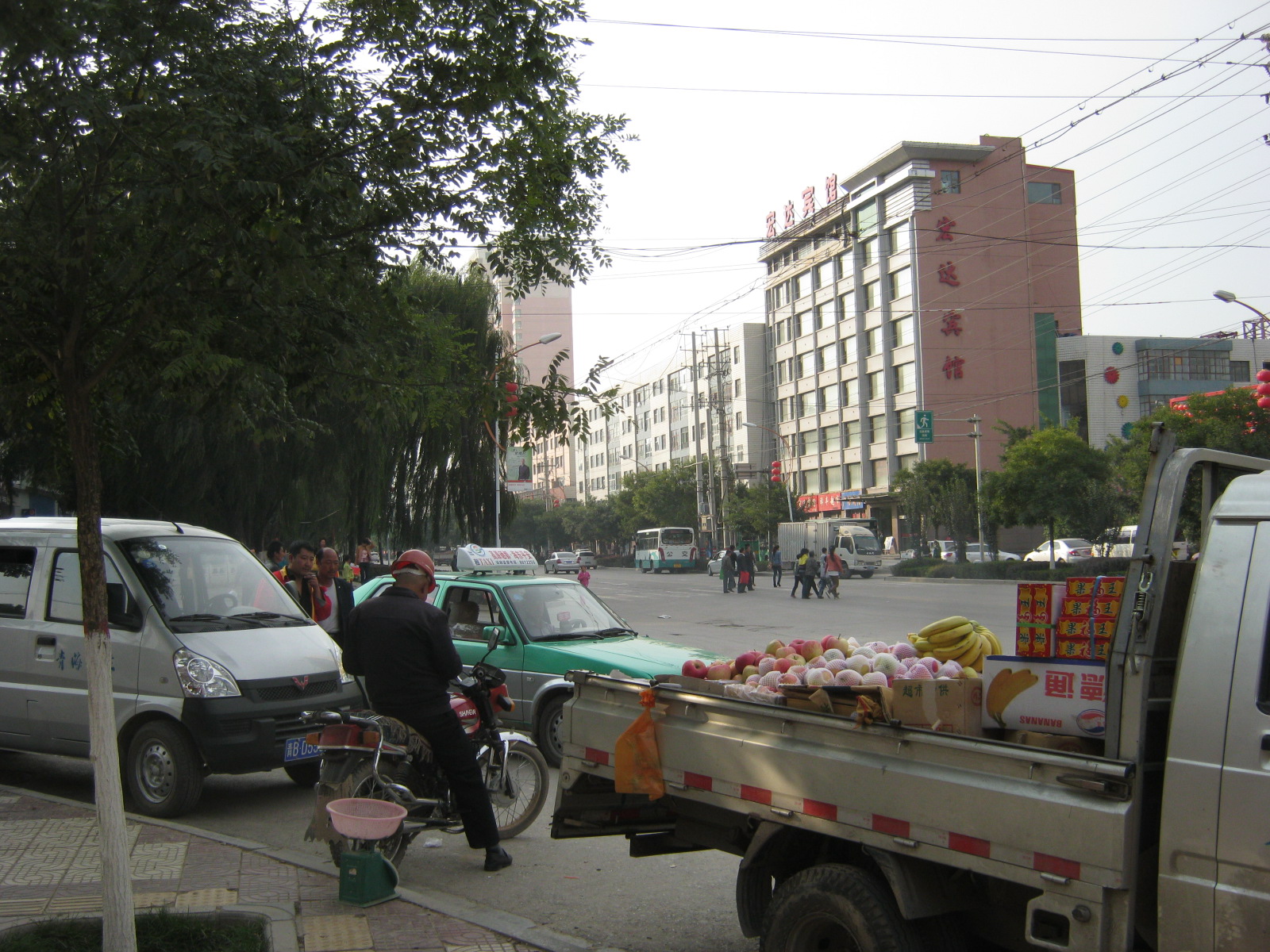
Community hub
Recent from talks
Contribute something
Nothing was collected or created yet.
Haidong
View on Wikipedia36°28′24″N 102°24′38″E / 36.4734°N 102.4106°E
Key Information


| Haidong | |||||||
|---|---|---|---|---|---|---|---|
| Chinese name | |||||||
| Simplified Chinese | 海东市 | ||||||
| Traditional Chinese | 海東市 | ||||||
| |||||||
| Tibetan name | |||||||
| Tibetan | མཚོ་ཤར་གྲོང་ཁྱེར། | ||||||
| |||||||
Haidong (Chinese: 海东市; pinyin: Hǎidōng shì) is a prefecture-level city of Qinghai province in Western China. Its name literally means "east of the (Qinghai) Lake." On 8 February 2013 Haidong was upgraded from a prefecture (海东地区) into a prefecture-level city.[3] Haidong is the third most populous administrative division in Qinghai after Xining and Golmud.
Haidong was historically populated by the Qiang people, although the area has been inhabited as early as 6000 years ago. In 121 BC the area was captured by Huo Qubing, defeating the Xiongnu. In 399 AD the Xianbei founded the state of Nanliang, with its capital in Ledu District.[4]
Geography
[edit]Haidong is the easternmost division of Qinghai province. It is bounded by Xining, the provincial capital, to the West, the Datong River Valley to the north, Gansu to the east, and the Yellow River to the south. Mountain ranges tower above the district of which the main valley is that of the Huang Shui (Tib. Tsong Chu), a major tributary of the Yellow River. This valley stretches from west to east and makes up - together with the area around Xining, the landscape which is called Tsongkha ("Onion Valley") by Tibetans. It has a total area of 13,100 square kilometres (5,100 sq mi).
Climate
[edit]Haidong has a cool semi-arid climate (Köppen BSk) characterised by warm to very warm summers, freezing but extremely dry winters, and large diurnal temperature ranges. Temperatures are warmer than anywhere else in Qinghai due to the relatively low altitude, although minima in winter still typically fall below −10 °C or 14 °F. Precipitation is low and mostly confined to the summer months: less than 45 millimetres or 1.8 inches of water equivalent typically falls between October and April inclusive, and less than 12 millimetres or 0.5 inches between November and March.
| Climate data for Haidong (Ping'an District), elevation 2,125 m (6,972 ft), (1991–2020 normals, extremes 1981–2010) | |||||||||||||
|---|---|---|---|---|---|---|---|---|---|---|---|---|---|
| Month | Jan | Feb | Mar | Apr | May | Jun | Jul | Aug | Sep | Oct | Nov | Dec | Year |
| Record high °C (°F) | 14.5 (58.1) |
22.4 (72.3) |
27.6 (81.7) |
30.1 (86.2) |
30.5 (86.9) |
32.2 (90.0) |
37.6 (99.7) |
35.1 (95.2) |
29.3 (84.7) |
24.7 (76.5) |
20.5 (68.9) |
13.8 (56.8) |
37.6 (99.7) |
| Mean daily maximum °C (°F) | 2.4 (36.3) |
6.3 (43.3) |
11.6 (52.9) |
17.6 (63.7) |
21.2 (70.2) |
24.4 (75.9) |
26.2 (79.2) |
25.2 (77.4) |
20.3 (68.5) |
15.2 (59.4) |
9.4 (48.9) |
3.9 (39.0) |
15.3 (59.6) |
| Daily mean °C (°F) | −6.1 (21.0) |
−2.1 (28.2) |
3.6 (38.5) |
9.6 (49.3) |
13.6 (56.5) |
17.1 (62.8) |
19.0 (66.2) |
18.1 (64.6) |
13.6 (56.5) |
7.7 (45.9) |
1.1 (34.0) |
−4.7 (23.5) |
7.5 (45.6) |
| Mean daily minimum °C (°F) | −12.1 (10.2) |
−8.4 (16.9) |
−2.5 (27.5) |
3.1 (37.6) |
7.3 (45.1) |
11.1 (52.0) |
13.3 (55.9) |
12.9 (55.2) |
9.0 (48.2) |
2.6 (36.7) |
−4.6 (23.7) |
−10.6 (12.9) |
1.8 (35.2) |
| Record low °C (°F) | −21.9 (−7.4) |
−18.9 (−2.0) |
−14.6 (5.7) |
−7.9 (17.8) |
−1.2 (29.8) |
3.9 (39.0) |
6.5 (43.7) |
5.9 (42.6) |
0.1 (32.2) |
−7.5 (18.5) |
−15.6 (3.9) |
−21.1 (−6.0) |
−21.9 (−7.4) |
| Average precipitation mm (inches) | 1.1 (0.04) |
1.3 (0.05) |
5.2 (0.20) |
15.1 (0.59) |
42.9 (1.69) |
52.4 (2.06) |
72.8 (2.87) |
68.3 (2.69) |
53.6 (2.11) |
20.6 (0.81) |
2.9 (0.11) |
0.7 (0.03) |
336.9 (13.25) |
| Average precipitation days (≥ 0.1 mm) | 2.1 | 2.3 | 3.8 | 5.5 | 10.2 | 13.1 | 13.5 | 12.4 | 12.4 | 7.2 | 2.5 | 1.6 | 86.6 |
| Average snowy days | 4.0 | 4.6 | 5.4 | 2.3 | 0.3 | 0 | 0 | 0 | 0.1 | 1.2 | 3.9 | 3.0 | 24.8 |
| Average relative humidity (%) | 45 | 43 | 42 | 42 | 50 | 56 | 61 | 63 | 67 | 62 | 52 | 48 | 53 |
| Mean monthly sunshine hours | 202.4 | 208.5 | 236.1 | 245.7 | 252.1 | 234.4 | 240.4 | 231.4 | 192.8 | 209.2 | 207.2 | 202.1 | 2,662.3 |
| Percentage possible sunshine | 65 | 67 | 63 | 62 | 58 | 54 | 54 | 56 | 53 | 61 | 68 | 68 | 61 |
| Source: China Meteorological Administration[5][6] | |||||||||||||
| Climate data for Haidong (Ledu District), elevation 2,021 m (6,631 ft), (1991–2020 normals) | |||||||||||||
|---|---|---|---|---|---|---|---|---|---|---|---|---|---|
| Month | Jan | Feb | Mar | Apr | May | Jun | Jul | Aug | Sep | Oct | Nov | Dec | Year |
| Mean daily maximum °C (°F) | 2.7 (36.9) |
6.6 (43.9) |
12.2 (54.0) |
18.3 (64.9) |
22.0 (71.6) |
25.3 (77.5) |
27.1 (80.8) |
25.9 (78.6) |
21.0 (69.8) |
15.9 (60.6) |
9.9 (49.8) |
4.0 (39.2) |
15.9 (60.6) |
| Daily mean °C (°F) | −5.5 (22.1) |
−1.4 (29.5) |
4.4 (39.9) |
10.4 (50.7) |
14.4 (57.9) |
18.0 (64.4) |
19.9 (67.8) |
18.9 (66.0) |
14.4 (57.9) |
8.4 (47.1) |
1.8 (35.2) |
−4.1 (24.6) |
8.3 (46.9) |
| Mean daily minimum °C (°F) | −11.6 (11.1) |
−7.8 (18.0) |
−1.8 (28.8) |
3.6 (38.5) |
7.9 (46.2) |
11.8 (53.2) |
14.1 (57.4) |
13.7 (56.7) |
9.6 (49.3) |
3.1 (37.6) |
−3.8 (25.2) |
−9.9 (14.2) |
2.4 (36.4) |
| Average precipitation mm (inches) | 1.2 (0.05) |
1.8 (0.07) |
7.1 (0.28) |
15.0 (0.59) |
42.3 (1.67) |
50.3 (1.98) |
69.5 (2.74) |
71.2 (2.80) |
52.1 (2.05) |
20.7 (0.81) |
2.9 (0.11) |
0.8 (0.03) |
334.9 (13.18) |
| Average precipitation days (≥ 0.1 mm) | 2.4 | 2.9 | 4.8 | 5.7 | 9.8 | 13.0 | 13.2 | 12.3 | 12.6 | 7.0 | 2.6 | 1.8 | 88.1 |
| Average snowy days | 4.1 | 5.0 | 5.7 | 1.9 | 0.2 | 0 | 0 | 0 | 0 | 1.1 | 3.8 | 3.2 | 25 |
| Average relative humidity (%) | 47 | 45 | 44 | 44 | 52 | 57 | 61 | 64 | 69 | 64 | 55 | 51 | 54 |
| Mean monthly sunshine hours | 190.5 | 194.9 | 225.8 | 236.8 | 242.7 | 228.7 | 231.7 | 221.3 | 185.6 | 195.3 | 195.7 | 194.2 | 2,543.2 |
| Percentage possible sunshine | 61 | 63 | 60 | 60 | 55 | 52 | 52 | 54 | 51 | 57 | 65 | 65 | 58 |
| Source: China Meteorological Administration[5][6] | |||||||||||||
Administrative divisions
[edit]| Map | |||||
|---|---|---|---|---|---|
| Name | Simplified Chinese | Hanyu Pinyin | Population (2010 Census) |
Area (km2) | Density (/km2) |
| Ping'an District | 平安区 | Píng'ān Qū | 102,975 | 750 | 137 |
| Ledu District | 乐都区 | Lèdū Qū | 260,185 | 2,821 | 92 |
| Minhe Hui and Tu Autonomous County | 民和回族土族自治县 | Mínhé Huízú Tǔzú Zìzhìxiàn |
350,118 | 1,780 | 197 |
| Huzhu Tu Autonomous County | 互助土族自治县 | Hùzhù Tǔzú Zìzhìxiàn |
356,437 | 3,321 | 107 |
| Hualong Hui Autonomous County | 化隆回族自治县 | Huàlóng Huízú Zìzhìxiàn |
203,317 | 2,740 | 74 |
| Xunhua Salar Autonomous County | 循化撒拉族自治县 | Xúnhuà Sǎlāzú Zìzhìxiàn |
123,814 | 1,749 | 70 |

Demographics
[edit]As of 2005, the total population of Haidong is approximately 1,480,000. It is the most densely populated area[clarification needed] of Qinghai, with almost a third of the province's population (its surface makes up only two percent of Qinghai).
 | You can help expand this section with text translated from the corresponding article in Chinese. (November 2021) Click [show] for important translation instructions.
|
References
[edit]- ^ "2021年海东市人口常住户籍总人数口和第七次人口普查结果-红黑人口库2021年".
- ^ 青海省统计局、国家统计局青海调查总队 (August 2016). 《青海统计年鉴-2016》. China Statistics Press. ISBN 978-7-5037-7834-6. Archived from the original on 2017-12-28. Retrieved 2017-06-05.
- ^ 2013年县级以上行政区划变更情况. XZQH (行政区划网). Retrieved 28 February 2013.
- ^ "海 东 市 市 情". www.haidong.gov.cn. Archived from the original on April 24, 2022. Retrieved 2021-02-23.
- ^ a b 中国气象数据网 – WeatherBk Data (in Simplified Chinese). China Meteorological Administration. Retrieved 27 August 2023.
- ^ a b 中国气象数据网 (in Simplified Chinese). China Meteorological Administration. Retrieved 27 August 2023.
Further reading
[edit]- A. Gruschke: The Cultural Monuments of Tibet's Outer Provinces: Amdo - Volume 1. The Qinghai Part of Amdo, White Lotus Press, Bangkok 2001. ISBN 974-480-049-6
- Tsering Shakya: The Dragon in the Land of Snows. A History of Modern Tibet Since 1947, London 1999, ISBN 0-14-019615-3

Haidong
View on GrokipediaHistory
Ancient and medieval periods
The Haidong region exhibits evidence of human occupation dating back approximately 6,000 years to the Neolithic period, with settlements linked to the Majiayao culture in the upper Yellow River valley. Archaeological findings from sites in eastern Qinghai, such as pottery shards, ground stone tools, and faunal remains, reveal early mixed economies of millet farming and animal herding, including domesticated pigs, sheep, goats, and dogs. These communities are associated with proto-Qiang populations, who developed semi-sedentary lifestyles adapted to the plateau's riverine environments.[9][10] During the ancient period, the area faced influences from nomadic confederations, notably the Xiongnu, who subjugated Qiang tribes around the early Han era (circa 200 BCE), compelling tribute and fostering alliances or conflicts that shaped regional power dynamics. By the 7th-8th centuries CE, Haidong—then known as Shanzhou—became a strategic frontier under Tang Dynasty oversight, integrated through military garrisons and diplomatic ties with the Tibetan Empire (Tubo). The 641 CE marriage of Tang Princess Wencheng to Tibetan King Songtsen Gampo symbolized this integration, promoting tea-horse trade along Yellow River routes, though control oscillated amid wars, culminating in Tubo's temporary conquest of Shanzhou in 757 CE during the An Lushan Rebellion.[10][11] In the medieval era, the Yuan Dynasty (1271–1368 CE) incorporated the region into its vast empire following Mongol conquests, establishing administrative units to oversee pastoral economies and Silk Road extensions along the Yellow River, blending Mongol, Han, and Tibetan governance. The subsequent Ming Dynasty (1368–1644 CE) reinforced these routes with fortifications and guard posts (wei-so) to counter Oirat Mongol threats, while formalizing local administration amid ethnic diversity. Notable sites include the Lajia Ruins in Minhe County, a Qijia culture settlement (circa 2000 BCE) preserving Qiang-linked artifacts like millet stores and skeletal remains from a catastrophic flood, offering insights into prehistoric disaster resilience; and the Chiling Stele at Sun-Moon Mountain, erected in 729 CE to commemorate Tang-Tibetan peace accords and trade pacts, underscoring Haidong's role in cross-cultural exchanges.[12][11]Modern establishment and development
During the Republican era (1912–1949), the Haidong region, located in the fertile Huangshui River valley of eastern Qinghai, fell under the control of the Ma clique, a group of Hui Muslim warlords who dominated the province through military governance from Xining. Ma Qi initially seized power in 1912 following the fall of the Qing dynasty, establishing a base in the region and using it as a hub for agricultural production and trade, with annual pastoral product exchanges valued at around 800,000 silver liang by the 1920s. His nephew, Ma Bufang, who became governor in 1938, intensified control over eastern Qinghai, promoting agricultural intensification in lowland valleys like those around Ledu and Minhe counties through irrigation improvements and colonization efforts, though these were limited compared to western Qinghai initiatives. Land reforms under the Ma regime focused on reclaiming "wastelands" for farming, but they often prioritized Hui and Han settlers, exacerbating tensions with local Tibetan pastoralists. Conflicts with Tibetan forces were frequent, culminating in the 1932–1933 Yushu Borderland War, where Ma Bufang's troops repelled a Tibetan invasion of 5,000–6,000 soldiers, reclaiming southern territories and reinforcing Qinghai's borders through a peace treaty in June 1933. These military campaigns, including earlier expeditions in 1917, 1921, and 1925, secured the Ma clique's hold on Haidong as an economic and strategic core, while fostering Hui-dominated administration and education systems, such as the expansion of Muslim schools from 56 in 1931 to over 90 by 1934 under the Qinghai Islam Progressive Council.[13] Following the establishment of the People's Republic of China in 1949, Haidong was integrated into Qinghai Province as part of broader administrative reforms, with the Qinghai Provincial People's Government formed in 1950 to oversee the region's incorporation. In the 1950s, several key counties were established or reorganized to consolidate control and promote socialist development: Ledu County in 1954, Ping'an County in 1958, and Huzhu Tu Autonomous County in 1954, among others, reflecting national efforts to delineate ethnic autonomous units for Hui and Tu populations while integrating Tibetan areas. These divisions emphasized land redistribution through democratic reforms, redistributing estates from former warlord holdings to peasants and cooperatives, which boosted agricultural output in the Huangshui valley. The Cultural Revolution (1966–1976) severely disrupted local governance in Haidong, a multi-ethnic area with significant Hui and Tibetan communities; mosques were destroyed or repurposed, Hui Muslims faced forced assimilation including pig-raising mandates and public humiliations, and Tibetan religious sites were ransacked, leading to social upheaval and economic stagnation as Red Guards targeted "feudal" elements in minority customs. Recovery began in the reform era after 1978, with Deng Xiaoping's policies enabling the reopening of mosques and restoration of ethnic autonomy, alongside initial market-oriented agricultural adjustments that stabilized rural economies in Haidong by the 1980s. Development accelerated in the 2000s through national infrastructure initiatives, particularly the launch of the Western Development Strategy in 2000, which funneled investments into eastern Qinghai's transport networks. The Qinghai–Tibet Railway, operational from 2006, significantly enhanced connectivity for Haidong, reducing travel times to Xining and facilitating trade in agricultural goods, with regional accessibility improving markedly and supporting urbanization in counties like Ledu. This infrastructure boom, including road expansions and irrigation upgrades, laid the groundwork for economic diversification beyond subsistence farming.[14] In 2013, Haidong was upgraded from a prefecture-level region to a full prefecture-level city on February 8, marking its emergence as an independent administrative entity and accelerating urban planning; this status shift detached several suburban districts from Xining's direct influence, enabling focused growth with a population of about 1.7 million and emphasizing eco-development projects funded by institutions like the Asian Development Bank. Post-2013 economic policies centered on targeted poverty alleviation under China's national campaign, which lifted over 80 million rural poor nationwide by 2020; in Haidong, initiatives included photovoltaic installations in villages like Yangjiashan in Ledu District to generate income through clean energy subsidies.[15] These efforts promoted sustainable livelihoods in ethnic minority areas, fostering Haidong's transition to a hub for agriculture, tourism, and renewable energy.Geography
Location and topography
Haidong City is situated in the eastern part of Qinghai Province, northwestern China, at geographic coordinates of approximately 36°30′N 102°00′E. It serves as a key transitional region, bordering Xining City to the west, Gansu Province (including Gannan and Linxia Prefectures) to the east, and Hainan Tibetan Autonomous Prefecture to the south, while Haibei Tibetan Autonomous Prefecture lies to the north. This positioning makes Haidong a vital link between the Loess Plateau and the Qinghai-Tibet Plateau, spanning a total area of 13,200 km².[16][8][17] The topography of Haidong features a diverse landscape dominated by loess plateaus in the central and eastern areas, transitioning to the foothills of the Qilian Mountains in the north. Elevations vary significantly, ranging from around 1,800 meters in the lower river valleys to over 4,000 meters in the higher mountainous zones, creating a stepped terrain that descends westward toward the provincial capital. This varied elevation profile influences local land use, with lower areas supporting denser settlement and higher slopes remaining more rugged and sparsely vegetated.[1][5][8] Geologically, Haidong is underlain by loess soils in the plateaus and alluvial deposits in the valleys, which facilitate agriculture through fertile sediments but also heighten risks of soil erosion and landslides due to the region's steep gradients. The area lies within a seismically active tectonic setting on the northeastern margin of the Tibetan Plateau, intersected by active fault lines such as extensions of the Haiyuan fault system, contributing to elevated seismic hazards that necessitate ongoing monitoring and mitigation efforts. As the eastern gateway to Qinghai Province, Haidong's topography offers a relatively accessible entry to the province's broader high-altitude terrain, contrasting with the more extreme elevations found further west.[17][18]Hydrology and natural features
Haidong's hydrology is dominated by the Yellow River (Huang He), which forms the southern boundary of the region and serves as its primary waterway, supporting irrigation, transportation, and ecosystem services across the prefecture-level city. The river's main stem in Qinghai Province spans 1,694 km overall, with a significant portion traversing Haidong's southern counties such as Minhe and Hualong, where it receives major tributaries like the Huangshui River and the Datong River. The Huangshui River, the largest tributary in the area, measures 374 km in total length, with 226 km within Qinghai and 139.2 km specifically in Haidong, contributing an average annual runoff of 2.15 billion cubic meters and an average flow of 61.68 m³/s at the Ledu hydrological station. These waterways harness substantial hydropower potential in the upper Yellow River basin, where projects like the nearby Yangqu Hydropower Station exemplify the region's capacity for renewable energy generation, with installed capacities reaching into the gigawatt scale across Qinghai's segments.[19][20][21] Lakes and wetlands further enrich Haidong's aquatic systems, with the Liujiaxia Reservoir on the Yellow River—straddling the Qinghai-Gansu border near Hualong County—providing critical water storage, flood regulation, and sediment control over an area exceeding 130 km². Smaller saline lakes and riverine wetlands, totaling about 268 km² in the Huangshui River basin as of 2009, play vital ecological roles, including serving as stopover sites for migratory birds such as waterfowl and shorebirds during seasonal passages along the Yellow River flyway. These wetlands support diverse aquatic flora like reeds (Phragmites spp.) and cattails (Typha spp.), while also mitigating nutrient pollution and enhancing water quality in the basin.[20] The region's natural features include forests concentrated in mountainous uplands, covering approximately 6% of Haidong's land area as natural forest (76,500 ha in 2020), alongside broader green coverage rates up to 38% in districts like Ledu and Ping'an through integrated vegetation belts. Expansive grasslands dominate the plateaus and valleys, facilitating traditional herding practices and sustaining pastoral economies, while biodiversity hotspots harbor endemic species such as indigenous fish from the Cyprinidae family (e.g., Schizothorax spp.) and common avifauna. Environmental challenges persist, particularly soil erosion in the loess hilly terrains, where agricultural and dry lands account for over 50% of eroded areas, with annual soil loss rates exacerbated by slope gradients of 55-80° in cliff zones. Conservation initiatives, including reforestation under China's Grain-for-Green Program since 1999 and riparian greening projects, have stabilized slopes across thousands of hectares, reducing erosion by up to 1,119 tons per year in targeted areas and bolstering ecosystem resilience.[22][23][20]Climate
Climate classification and data
Haidong experiences a cold semi-arid climate (Köppen BSk), characterized by low precipitation and significant temperature fluctuations due to its high-altitude continental plateau location. The annual average precipitation ranges from 300 to 500 mm, mostly concentrated in the summer months, primarily influenced by the East Asian monsoon. Data from the Ledu District meteorological station, a key monitoring site in the region, indicate an annual average temperature of approximately 7°C over the period 1991-2020, with monthly averages showing January lows around -10°C and July highs reaching 25°C.[24][25] Historical records reveal extreme temperatures in the region, including a record low of -25.1°C and a high of 33.5°C. For Ledu specifically, the recorded low is -20.9°C (2016) and high 38.4°C (2000).[17][24] Since the 1980s, observations show a warming trend, with annual mean temperatures increasing by approximately 0.3-0.4°C per decade, consistent with broader patterns across the Qinghai-Tibet Plateau driven by global climate change.[26] Recent observations up to 2023 indicate continued warming and slight precipitation increases (about 4.3 mm per decade since 1961), exacerbating drought risks in semi-arid zones.[27] This data, derived from long-term meteorological observations at Ledu and surrounding stations, provides a baseline for assessing environmental conditions in Haidong.[28] Microclimatic variations are pronounced across Haidong's topography, with valleys along the Huangshui River exhibiting milder temperatures (up to 8.6°C annually) and slightly higher precipitation due to orographic effects, while higher plateaus and northern mountains are cooler (down to 3.2°C) and drier.[17] These differences influence local agriculture, where semi-arid conditions limit crop yields in highlands but support valley-based farming with irrigation.[17]Seasonal patterns and extremes
Haidong, situated in a semi-arid continental climate zone, exhibits pronounced seasonal variations influenced by its plateau location and proximity to river valleys.[1] In spring from March to May, the region experiences dry winds and occasional dust storms as temperatures rise from around -4°C to 10°C, melting snow and leading to early seasonal floods in lower valleys. These conditions challenge early agricultural activities, with dust events reducing visibility and depositing fine particles on croplands.[29] Summer, spanning June to August, brings the East Asian monsoon, accounting for approximately 70% of Haidong's annual precipitation through intense rains that can total 61-70 mm monthly in areas like Xining. Temperatures range from 9°C to 25°C, fostering growth but posing risks of landslides in the mountainous terrain, particularly along the Huangshui River basin where heavy downpours erode slopes and disrupt infrastructure.[29] Autumn from September to November offers cooler and more stable weather, with temperatures dropping to 1°C-19°C and precipitation varying from 1-99 mm, making it ideal for harvests of crops like wheat and barley. However, early frosts can occur in higher elevations, potentially damaging late-season yields.[29] Winter, December to February, features harsh cold with temperatures as low as -14°C to 5°C and minimal precipitation of 2-7 mm, often as snow covering highlands and impacting herding practices by limiting livestock access to forage. Historical extremes include severe blizzards on the Qinghai-Tibet Plateau during this period, such as those in the late 2000s that caused significant livestock losses across the region.[29][30] To mitigate these seasonal challenges, local adaptations include expanded irrigation systems along the Huangshui River to combat spring droughts and summer variability, as well as the promotion of drought-resistant crop varieties like highland barley and potatoes to enhance resilience in semi-arid conditions.[31][32]Administrative divisions
Structure and counties
Haidong was established as a prefecture-level city on February 8, 2013, through a State Council approval that revoked the former Haidong Region, created Ledu District from Ledu County, and retained five counties: Ping'an County, Minhe Hui and Tu Autonomous County, Huzhu Tu Autonomous County, Hualong Hui Autonomous County, and Xunhua Salar Autonomous County.[33] On February 16, 2015, the State Council further approved the revocation of Ping'an County to establish Ping'an District, resulting in the current structure of two districts and four autonomous counties.[34] As a prefecture-level division, Haidong operates under the direct administration of the Qinghai provincial government, managing local governance, public services, and development initiatives across its subdivisions.[35] The administrative divisions are detailed below, reflecting their ethnic autonomous status where applicable to promote cultural preservation and equitable representation for minority groups such as the Hui, Tu, and Salar peoples.| Division | Type | Area (km²) | Government Seat |
|---|---|---|---|
| Ledu District (乐都区) | District | 3,050 | Nianbo Town (碾伯镇)[36][37] |
| Ping'an District (平安区) | District | 769 | Ping'an Town (平安镇)[38] [Note: Area derived from official descriptions; seat confirmed via district government site http://www.pinganqu.gov.cn/] |
| Minhe Hui and Tu Autonomous County (民和回族土族自治县) | Autonomous County | 1,890 | Chuankou Town (川口镇) |
| Huzhu Tu Autonomous County (互助土族自治县) | Autonomous County | 3,424 | Weiyuan Town (威远镇)[39] |
| Hualong Hui Autonomous County (化隆回族自治县) | Autonomous County | 2,740 | Bayan Town (巴燕镇)[38] |
| Xunhua Salar Autonomous County (循化撒拉族自治县) | Autonomous County | 1,814 | Jishi Town (积石镇)[40] [Area from 2024 official update] |