Recent from talks
Contribute something
Nothing was collected or created yet.
Baoding
View on WikipediaKey Information
| Baoding | |||||||||||||||||||
|---|---|---|---|---|---|---|---|---|---|---|---|---|---|---|---|---|---|---|---|
| Chinese | 保定 | ||||||||||||||||||
| Literal meaning | "protect (the capital) and stabilize (the territory)" | ||||||||||||||||||
| |||||||||||||||||||
Baoding is a prefecture-level city in central Hebei province, approximately 150 kilometres (93 mi) southwest of Beijing. As of the 2020 census, Baoding City had 11,544,036 inhabitants, of which 2,549,787 lived in the metropolitan area made of 4 out of 5 urban districts: Lianchi, Jingxiu, Qingyuan, and Mancheng all of which are largely conurbated.[1] Accounting for about one-sixth of the population of Hebei Province.[5] Baoding is among 13 Chinese cities with a population of over 10 million, ranking seventh.[6] Zhuozhou City in the northern part has now grown into part of the Beijing metro area.[7][citation needed]
Baoding was the capital of Zhili Province and the residence of the Viceroy of Zhili in the Qing dynasty. The city was also the capital of Hebei province until 1968, and is now a national historical and cultural city and one of the central cities in the Jing-Jin-Ji cluster,[8] with the Xiong'an new area located within its jurisdiction.
Name
[edit]Baoding was known as Shanggu, Baozhou, Shoocheng and Baofu in ancient times.[9] The city's name, Baoding (Chinese: 保定),[10][11] dates back to the Song and Yuan dynasties, In 1239, the Yuan Dynasty changed the name of Shuntian Army to Shuntian Road, which means "complying with the destiny of heaven", and Baozhou was renamed Luzhi (路治). Because Baozhou was the southern gate of the capital in the Yuan Dynasty, Shuntian Road was changed to Baoding Road in 1275, which means "defend the capital and stabilize the world".[12][13] The name is roughly interpreted as "protecting the capital", referring to the city's proximity to Beijing.
History
[edit]Baoding has a history dating back to the Western Han Dynasty.
Prehistory
[edit]The Nanzhuangtou site near Baiyang Lake is one of the earliest Neolithic site discovered in North China, dating back approximately 10,500–9,700 years.[14] Other Neolithic sites in Baoding include Diaoyutai and Beifudi.[15]
Early history
[edit]During the Warring States period, what is now Baoding was along the dividing line between the Yan and Zhao states.
One of the capitals of Yan during this period, Xiadu, is located in what is now Yi County, and from 400 to 300 BC may have been the largest cities in the world, with an estimated population of over 300,000.[16]
Imperial era
[edit]In 960 the Song dynasty established the Bao prefecture ("Baozhou") with the administrative office in Baosai County (modern Baoding).[17] This lasted until 1241, when the Mongol Empire (who conquered the Jin dynasty in 1234) abolished it, incorporating Baozhou into the Central Region.
In the year 1213 the Mongol army invaded and destroyed Baozhou, leaving it in ruins until it was reconstructed in 1227 during the Yuan dynasty. The region acquired the name "Baoding" in 1275.
In 1669, Baoding became the capital of Zhili, ruled over by a Viceroy until the fall of the Qing dynasty in 1912.
In 1902, Yuan Shikai, then Viceroy, established the Baoding Military Academy. Birthplace of many famous ROC and Communist generals in the early 20th century.
Contemporary history
[edit]On August 1, 1949, the People's Government of Hebei province was established, Baoding was the capital of the province, and the city of Baoding was a provincial municipality. On August 9, the administrative inspector's office of the Baoding district was established, and it was established as the administrative inspector's office of the county district.[18]
In May 1958, the capital of Hebei was moved to Tianjin, then back to Baoding in January 1966, to Shijiazhuang in February 1968. In December 1994, the Baoding area merged with Baoding to become a provincial city.[19]
In April 2017, the Central Committee of the Chinese Communist Party and the State Council announced the decision to transform Baoding's Xiong, Rongcheng, and Anxin counties into Xiong'an New Area, a new development area of national significance, with a focus on innovation, sustainability and quality of life, following the successes of Shenzhen Special Economic Zone and Shanghai's Pudong New Area.[20]
Geography
[edit]Baoding is located in the west-central portion of Hebei province and lies on the North China Plain, with the Taihang Mountains to the west. Bordering prefecture-level cities in the province are Zhangjiakou to the north, Langfang and Cangzhou to the east, and Shijiazhuang and Hengshui to the south. Baoding also borders Beijing to the northeast and Shanxi to the west.[21]
The geographical coordinates of Baoding are between 113°40'-116°20' east longitude and 38°10'-40°00' north latitude.[5]
Elevations in Baoding's administrative area decrease from northwest to southeast. The western parts are dominated by mountains and hills that are generally more than 1,000 metres (3,300 ft) tall; this area includes parts of Laishui, Yi, Mancheng, Shunping, Tang, and Fuping Counties as well as the entirety of Laiyuan County, occupying 30.6% of the prefecture's area.[1] The highest peak is Mount Waitou (歪头山), with an elevation of 2,286 metres (7,500 ft).[1] Moving southeast from this area, one encounters low-lying mountains and hills, taking up 18.9% of the prefecture's area.[1] Further to the east lies generally flat terrain of 30 to 100 metres (98 to 330 ft) elevation. Here the primary rivers are the Xiaoyi River (孝义河), Fu River (府河), Bao River (瀑河), Ping River (萍河), Juma River (拒马河), Yishui River (易水河), Tang River (唐河), Cao River (漕河), Zhulong River (潴龙河), Qingshui River (清水河), and Sha River (沙河).[22] Baiyangdian Lake, the largest natural lake in northern China, can be found nearby.
Climate
[edit]Baoding has a continental, monsoon-influenced humid continental climate/semi-arid climate (Köppen Dwa/BSk),[23] characterised by hot, humid summers due to the East Asian monsoon, and generally cold, windy, very dry winters that reflect the influence of the vast Siberian anticyclone. Spring can bear witness to sandstorms blowing in from the Mongolian steppe, accompanied by rapidly warming, but generally dry, conditions. Autumn is similar to spring in temperature and lack of rainfall. The annual rainfall, about 60% of which falls in July and August alone, is highly variable and not reliable. The average annual runoff is 2.45 billion cubic meters.[5] In the city itself, this amount has averaged to a meagre 496.1 millimetres (19.5 in) per annum. The monthly 24-hour average temperature ranges from −2.7 °C (27.1 °F) in January to 27.1 °C (80.8 °F) in July, and the annual mean is 13.3 °C (55.9 °F). There are 2,500 to 2,900 hours of bright sunshine annually, and the frost-free period lasts 165−210 days.
| Climate data for Baoding, elevation 17 m (56 ft), (1991–2020 normals, extremes 1971–present) | |||||||||||||
|---|---|---|---|---|---|---|---|---|---|---|---|---|---|
| Month | Jan | Feb | Mar | Apr | May | Jun | Jul | Aug | Sep | Oct | Nov | Dec | Year |
| Record high °C (°F) | 17.5 (63.5) |
23.1 (73.6) |
30.7 (87.3) |
33.8 (92.8) |
38.1 (100.6) |
41.9 (107.4) |
41.6 (106.9) |
37.7 (99.9) |
34.3 (93.7) |
31.1 (88.0) |
23.9 (75.0) |
17.4 (63.3) |
41.9 (107.4) |
| Mean daily maximum °C (°F) | 2.7 (36.9) |
6.9 (44.4) |
14.1 (57.4) |
21.5 (70.7) |
27.4 (81.3) |
31.7 (89.1) |
32.2 (90.0) |
30.6 (87.1) |
26.7 (80.1) |
20.0 (68.0) |
10.7 (51.3) |
4.1 (39.4) |
19.0 (66.3) |
| Daily mean °C (°F) | −2.8 (27.0) |
0.9 (33.6) |
7.8 (46.0) |
15.1 (59.2) |
21.1 (70.0) |
25.7 (78.3) |
27.3 (81.1) |
25.8 (78.4) |
20.9 (69.6) |
13.8 (56.8) |
5.2 (41.4) |
−1.0 (30.2) |
13.3 (56.0) |
| Mean daily minimum °C (°F) | −7.2 (19.0) |
−3.8 (25.2) |
2.2 (36.0) |
9.2 (48.6) |
15.0 (59.0) |
20.2 (68.4) |
23.0 (73.4) |
21.8 (71.2) |
16.1 (61.0) |
8.9 (48.0) |
1.0 (33.8) |
−4.9 (23.2) |
8.5 (47.2) |
| Record low °C (°F) | −22.0 (−7.6) |
−15.7 (3.7) |
−14.8 (5.4) |
−3.2 (26.2) |
5.5 (41.9) |
10.7 (51.3) |
13.4 (56.1) |
12.6 (54.7) |
5.7 (42.3) |
−2.3 (27.9) |
−11.6 (11.1) |
−23.3 (−9.9) |
−23.3 (−9.9) |
| Average precipitation mm (inches) | 2.2 (0.09) |
5.0 (0.20) |
8.9 (0.35) |
24.1 (0.95) |
33.8 (1.33) |
68.1 (2.68) |
153.0 (6.02) |
108.5 (4.27) |
54.5 (2.15) |
24.2 (0.95) |
12.2 (0.48) |
2.0 (0.08) |
496.5 (19.55) |
| Average precipitation days (≥ 0.1 mm) | 1.5 | 2.2 | 2.9 | 4.7 | 6.2 | 8.4 | 11.8 | 11.0 | 6.7 | 4.8 | 3.3 | 1.3 | 64.8 |
| Average snowy days | 3.0 | 2.3 | 0.9 | 0.2 | 0 | 0 | 0 | 0 | 0 | 0 | 1.6 | 2.9 | 10.9 |
| Average relative humidity (%) | 55 | 50 | 47 | 51 | 55 | 59 | 72 | 77 | 71 | 66 | 65 | 59 | 61 |
| Mean monthly sunshine hours | 143.9 | 156.4 | 206.7 | 225.9 | 251.7 | 209.8 | 174.7 | 179.9 | 183.4 | 171.4 | 140.0 | 137.3 | 2,181.1 |
| Percentage possible sunshine | 47 | 51 | 55 | 57 | 57 | 47 | 39 | 43 | 50 | 50 | 47 | 47 | 49 |
| Source 1: China Meteorological Administration[24][25] all-time extreme temperature[26] | |||||||||||||
| Source 2: Weather China[27] | |||||||||||||
Administrative divisions
[edit]Bǎodìng prefecture-level city consists of 5 municipal districts, 4 county-level cities, 15 counties:
| Map | |||||||||||||
|---|---|---|---|---|---|---|---|---|---|---|---|---|---|
| Division code[28] | English name | Simp. Chinese | Pinyin | Area in km2[29] | Seat | Postal code | Divisions[30] | ||||||
| Subdistricts | Towns | Townships | Ethnic townships | Residential communities (居委会) | Villages (村委会) | ||||||||
| 130600 | Baoding | 保定市 | Bǎodìng Shì | 22185 | Jingxiu District | 071000 | 31 | 207 | 105 | 2 | 514 | 6184 | |
| 130602 | Jingxiu District | 竞秀区 | Jìngxiù Qū | 149 | Xianfeng Subdistrict (先锋街道) | 071000 | 5 | 2 | 4 | 81 | 71 | ||
| 130603 | Lianchi District | 莲池区 | Liánchí Qū | 82 | Wusi Road Subdistrict (五四路街道) | 071000 | 10 | 2 | 5 | 151 | 120 | ||
| 130605 | Mancheng District | 满城区 | Mǎnchéng Qū | 658 | Mancheng Town (满城镇) | 072100 | 1 | 6 | 6 | 16 | 183 | ||
| 130606 | Qingyuan District | 清苑区 | Qīngyuàn Qū | 856 | Qingyuan (清苑镇) | 071100 | 13 | 5 | 14 | 266 | |||
| 130607 | Xushui District | 徐水区 | Xúshuǐ Qū | 723 | Ansu (安肃镇) | 072500 | 10 | 4 | 28 | 304 | |||
| 130633 | Yi County | 易县 | Yì Xiàn | 2535 | Yizhou (易州镇) | 074200 | 11 | 16 | 1 | 10 | 469 | ||
| 130630 | Laiyuan County | 涞源县 | Láiyuán Xiàn | 2431 | Laiyuan (涞源镇) | 074300 | 10 | 7 | 8 | 283 | |||
| 130626 | Dingxing County | 定兴县 | Dìngxīng Xiàn | 714 | Dingxing (定兴镇) | 072600 | 9 | 7 | 23 | 274 | |||
| 130636 | Shunping County | 顺平县 | Shùnpíng Xiàn | 712 | Puyang (蒲阳镇) | 072200 | 6 | 4 | 4 | 237 | |||
| 130627 | Tang County | 唐县 | Táng Xiàn | 1414 | Renhou (仁厚镇) | 072300 | 11 | 9 | 8 | 345 | |||
| 130631 | Wangdu County | 望都县 | Wàngdū Xiàn | 358 | Wangdu (望都镇) | 072400 | 7 | 1 | 10 | 142 | |||
| 130623 | Laishui County | 涞水县 | Láishuǐ Xiàn | 1662 | Laishui (涞水镇) | 074100 | 12 | 3 | 6 | 284 | |||
| 130628 | Gaoyang County | 高阳县 | Gāoyáng Xiàn | 496 | Gaoyang (高阳镇) | 071500 | 1 | 7 | 11 | 149 | |||
| 130632 | Anxin County | 安新县 | Ānxīn Xiàn | 728 | Anxin (安新镇) | 071600 | 9 | 4 | 5 | 223 | |||
| 130638 | Xiong County | 雄县 | Xióng Xiàn | 513 | Xiongzhou (雄州镇) | 071800 | 8 | 4 | 7 | 287 | |||
| 130629 | Rongcheng County | 容城县 | Róngchéng Xiàn | 311 | Rongcheng (容城镇) | 071700 | 5 | 3 | 4 | 127 | |||
| 130634 | Quyang County | 曲阳县 | Qūyáng Xiàn | 1076 | Hengzhou (恒州镇) | 073100 | 11 | 16 | 10 | 367 | |||
| 130624 | Fuping County | 阜平县 | Fùpíng Xiàn | 2494 | Fuping (阜平镇) | 073200 | 8 | 5 | 5 | 209 | |||
| 130637 | Boye County | 博野县 | Bóyě Xiàn | 331 | Boye (博野镇) | 071300 | 7 | 11 | 133 | ||||
| 130635 | Li County | 蠡县 | Lǐ Xiàn | 653 | Liwu (蠡吾镇) | 071400 | 11 | 2 | 7 | 232 | |||
| 130682 | Dingzhou City | 定州市 | Dìngzhōu Shì | 1284 | Nanchengqu Subdistrict (南城区街道) | 073000 | 4 | 16 | 5 | 1 | 31 | 470 | |
| 130681 | Zhuozhou City | 涿州市 | Zhuōzhōu Shì | 751 | Shuangta Subdistrict (双塔街道) | 072700 | 3 | 10 | 1 | 39 | 402 | ||
| 130683 | Anguo City | 安国市 | Ānguó Shì | 485 | Qizhouyaoshi Subdistrict (祁州药市街道) | 071200 | 2 | 6 | 3 | 6 | 198 | ||
| 130684 | Gaobeidian City | 高碑店市 | Gāobēidiàn Shì | 674 | Xinghua Road Subdistrict (兴华路街道) | 074000 | 5 | 10 | 19 | 409 | |||
| Xiong'an New Area | 雄安新区 | Xióng'ān Xīnqū | 106.46 | Rongcheng (容城镇) | |||||||||
| Note: Baoding New High Technology Product Development Zone (保定高新技术产业开发区) includes Damafang Township (大马坊乡) of Jingxiu District and Jiantai Township (贤台乡) of Mancheng District; the Baigou New City (白沟新城) includes Baigou Town (白沟镇) of Gaobeidian City. | |||||||||||||
- Dissolved districts: Beishi District and Nanshi District

Demographics
[edit]| Division name | ||||
|---|---|---|---|---|
| Residence population[31] (November 2010) | Hukou population[32] (end of 2010) | |||
| Total | Ratio (%) | Population density (persons/km2) | ||
| Baoding City | 11,194,379 | 100 | 504.55 | 11610199 |
| Xinshi District | 482,768 | 4.31 | 2540.88 | 459038 |
| Beishi District | 387,339 | 3.46 | 5164.52 | 322205 |
| Nanshi District | 287,784 | 2.57 | 2877.84 | 279725 |
| Mancheng District | 387,307 | 3.46 | 615.75 | 411417 |
| Qingyuan District | 631,659 | 5.64 | 728.56 | 648645 |
| Laishui County | 339,063 | 3.03 | 204.50 | 352993 |
| Fuping County | 205,299 | 1.83 | 82.28 | 223846 |
| Xushui County | 563,030 | 5.03 | 778.74 | 586104 |
| Dingxing County | 517,873 | 4.63 | 725.31 | 585913 |
| Tang County | 529,066 | 4.73 | 373.37 | 590575 |
| Gaoyang County | 345,160 | 3.08 | 695.89 | 340163 |
| Rongcheng County | 258,179 | 2.31 | 822.23 | 265389 |
| Laiyuan County | 260,678 | 2.33 | 106.49 | 283537 |
| Wangdu County | 250,014 | 2.23 | 781.29 | 265525 |
| Anxin County | 437,378 | 3.91 | 604.11 | 440817 |
| Yi County | 537,564 | 4.80 | 212.14 | 570806 |
| Quyang County | 588,559 | 5.26 | 542.95 | 610065 |
| Li County | 505,574 | 4.52 | 775.42 | 532322 |
| Shunping County | 295,764 | 2.64 | 417.75 | 317484 |
| Boye County | 245,504 | 2.19 | 741.70 | 268941 |
| Xiong County | 359,506 | 3.21 | 686.08 | 375470 |
| Zhuozhou City | 603,535 | 5.39 | 813.39 | 645542 |
| Dingzhou City | 1,165,182 | 10.41 | 914.59 | 1214852 |
| Anguo City | 370,314 | 3.31 | 761.96 | 409834 |
| Gaobeidian City | 640,280 | 5.72 | 938.83 | 608991 |
| Note: The 58,709 people residing in Baoding High Technology Product Development Zone and the 124,274 in the Baigou New City are not listed separately. | ||||
According to the 2010 Census, the residence population stood at 11,194,382, an increase of 605,100 (5.71%) from 2000. The male-female ratio was 101.94:100. Children aged up to 14 numbered 1,915,800 (17.11% of the population), citizens 15 to 64 numbered 8,370,600 (74.78%), and 65+ numbered 908,000 (8.11%). The urban area of Baoding made of 5 urban Districts had a population of around 2,739,887 (2010 census). The overwhelming majority of the population is Han Chinese. The language of Baoding is Mandarin Chinese — specifically, the Baoding dialect of Ji-Lu Mandarin. Despite Baoding's proximity to Beijing, the Chinese spoken in Baoding is not particularly close to the Beijing dialect — rather, it is more closely related to Tianjin dialect.
Economy
[edit]Baoding is located in the centre of the Bohai Rim economic area which includes Beijing, Tianjin, and Shijiazhuang. One of the largest employers in Baoding is China Lucky Film, the largest photosensitive materials and magnetic recording media manufacturer in China.[33] And, Yingli group, 2010 World Cup sponsor, has its headquarters in Baoding, who is the Global Top 10 solar panel manufacturer. More renowned companies include ZhongHang HuiTeng Windpower Equipment Co., Ltd (Wind Turbine), Baoding Tianwei Group Co., Ltd (Transformer), and Great Wall Motor.
In April 2017, an area in Baoding was designated as a Xiong'an New Area, a development zone of initially 100 km2 and up to 2000 km2, the site of what will eventually be a new city and the hub of the Beijing-Tinajin-Hebei development area.
- Baoding High-tech Industrial Development Zone[34]
Great Wall Motors Company Limited is a Chinese automobile manufacturer headquartered in Baoding, Hebei, China. The company is named after the Great Wall of China and was formed in 1984. It is China's largest sport utility vehicle (SUV) and pick-up truck producer. It sells passenger cars and trucks under the Great Wall brand and SUVs under the Haval and WEY brands.
In 2016, Great Wall Motors set a historical sales record of 1,074,471 cars worldwide, increased by 26% compared to 2015.
Renewable energy
[edit]Baoding City has one of China's biggest plants which manufactures blades used in wind turbine generators, catering mainly to the domestic market. Tianwei Wind Power Technology is one of the three main plants in Baoding that produces wind turbine generators. It wheeled out its first 20 turbines in 2008, and it will produce 150 units in 2009 and another 500 in 2010. Nevertheless, Baoding is currently listed as the most polluted city in China.[35]
Transport
[edit]
Baoding has good connections to other cities, being located on one of the main routes in and out of Beijing. The Jingshi Expressway connects the two cities, and Baoding is also the western terminus of the Baojin Expressway linking Baoding with Tianjin, which is one out of two nearest ports (Huanghua is the other one). The Jingguang Railway provides frequent services to Beijing West railway station. On 30 December 2012, a new Baoding station was opened, while the old train station was closed for passengers.[36] Baoding East railway station lies 9.5 km (5.9 mi)to the east on the Beijing–Guangzhou–Shenzhen–Hong Kong high-speed railway. On October 1, 2018, the east square of Baoding Railway Station was officially put into use, and the east station building of the railway station was also opened at the same time.[37]
Military
[edit]Baoding is headquarters of the 38th Mechanized Group Army of the People's Liberation Army, one of the three group armies that comprise the Beijing Military Region responsible for defending the PRC capital.[38][citation needed]
Culture
[edit]
Perhaps the best-known item to supposedly originate in Baoding are Baoding balls, which can be used to relax one's keyboard hand and strengthen one's wrist.[39]
The most famous local specialty food is the donkey burger.[40] (Chinese: 驴肉火烧)
Anxin County is home to the Quantou Village Music Association (圈头村音乐会), a well-known traditional music group performing on guan (oboes), sheng (mouth organs), and percussion. The village of Quantou is located on an island in Lake Baiyangdian.
[41] The city's streets follow a rough grid pattern, although this is less obvious in the older part of the city. The traditional main street of old Baoding is Yuhua Road, running from the city's centre to its eastern edge. Most of Baoding's historic buildings are located in this area, along with some of its larger shopping centres.[42] Other major streets include Dongfeng Road and Chaoyang Avenue. There is a ring road around the city.
Baoding is home to Hebei University, North China Electric Power University, three other universities and twelve colleges.[43]
Historic sites
[edit]
Baoding contains a number of notable historic sites. In the city proper, there can be found a historic provincial governor's mansion and an ancient lotus garden. In the hills to the northwest of the city, near the suburb of Mancheng, there are the Mancheng Han Tombs, where Prince Liu Sheng and his wife Dou Wan were buried.
The greater Baoding administrative area has 16 designated state-level cultural relics:
- Yan State Capital Relics (475BC-221BC, Yixian County)
- Great Wall at Zijinguan Pass (1368–1644, Yixian County and Laiyuan County)
- Stele of Lao Tzu's Tao Te Ching (618-907, Yixian County)
- Western Qing Tombs (1730–1915, Yixian County)
- Geyuan Temple (916-1125, Laiyuan County)
- Ciyun Pavilion (1306, Dingxing County)
- Yicihui Stone Pillar (550-577, Dingxing County)
- Kaiyuan Temple (960-1127, Dingzhou County)
- Kaishan Temple (618-907, Gaobeidian County)
- Dingzhou Porcelain Kiln Relic (960-1127, Quyang County)
- Beiyue Temple (386-543, Quyang County)
- Jin-cha-ji Border Region Headquarters Ruins (1938, Fuping County)
- Ranzhuang Underground Tunnel (1937–1945, Qingyuan County)
- Mancheng Han Tombs (154BC-113BC, Mancheng County)
- Zhili Provincial Governor Office (1730–1911, Baoding)
- Historical Site of the Baoding Military Academy (1902–1923)
Notable people
[edit]- Abbie Goodrich Chapin (1868–1956), American missionary teacher based in Baoding
- Chen Xu, Director of the Overseas Chinese Affairs Office
- Fan Hongbin—gymnast, Olympic silver medalist in 1996 Summer Olympics
- Fan Ye—gymnast, 2003 World Artistic Gymnastics Championships balance beam gold medalist
- Guo Jingjing—diver and Olympic gold medalist in 2004 and 2008 Summer Olympics
- Qian Hong—swimmer and Olympic gold medalist in 1992 Summer Olympics
- Shi Changxu—materials scientist, recipient of the 2010 State Preeminent Science and Technology Award
- Tie Ning—author, president of the China Writers Association
- Wei Jianjun—billionaire, chairman of Great Wall Motors[44]
- Yan Su—Chinese playwright and lyricist
- Xie Jun—chess grandmaster and Women's World Chess Champion 1991–1996, 1999–2001
- Zhang Shangwu–gymnast, 2001 Summer Universiade still rings gold medalist
Sister cities
[edit]
United States, Charlotte, North Carolina, 1987-09-29[46]
Japan, Yonago, Tottori, 1991-10-13[47]
Japan, Saijō, Ehime, 1994-9-21[48]
Iceland, Hafnarfjörður, 1994-10-09[49]
Japan, Kushima, Miyazaki, 2000-11-20[50]
South Korea, Dongdaemun District, Seoul, 2001-02-19[51]
Canada, Gravenhurst, Ontario, 2002-12-5[52]
Panama, Santiago de Veraguas, 2006-12-15[53]
Denmark, Sønderborg Municipality, 2012-04-23[54][55]
Gallery
[edit]- Images from Baoding
-
Temple in the centre of old Baoding
-
Dongfeng Road, Baoding
-
Part of Yuhua Road, the main street of old Baoding
-
Arch on Yuhua Road, old Baoding
-
An intersection in Yuhua Road's shopping district
-
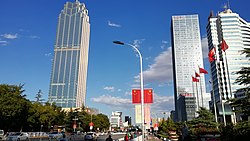
The Wanbo Tower in a sunny afternoon, Baoding CBD
-
A civic monument
-
A public park
-
A public park
-
Baoding Cathedral
-
Baoding Railway Station
-
Baoding East Railway Station for High-Speed Rail Trains
-
Baoding city buses before 2007
-
Baoding in the evening
-
Old Baoding railway station
-
Old Baoding railway station
-
Baoding Old Quarter
-
Skylines in Baoding CBD
-
Closer look at the Wanbo Tower in a sunny day
-
Closer look at the Maoye Tower in a sunny day, Baoding CBD
-
The Wanbo Plaza at night, Baoding CBD
-
The Wanbo Plaza at night, Baoding CBD
-
The Wanbo Plaza at night, Baoding CBD
See also
[edit]References
[edit]- ^ a b c d e 概况 (in Chinese). Baoding People's Government. Archived from the original on 27 April 2011. Retrieved 20 May 2011.
- ^ a b Ministry of Housing and Urban-Rural Development, ed. (2019). China Urban Construction Statistical Yearbook 2017. Beijing: China Statistics Press. p. 46. Archived from the original on 18 June 2019. Retrieved 11 January 2020.
- ^ "China: Hébĕi (Prefectures, Cities, Districts and Counties) - Population Statistics, Charts and Map". www.citypopulation.de.
- ^ 河北省统计局、国家统计局河北调查总队 (2016). 《河北经济年鉴-2018》. China Statistics Press. ISBN 978-7-5356-7824-9. Archived from the original on 2020-03-26. Retrieved 2019-07-11.
- ^ a b c "保定简介-保定市戴维软件科技有限公司". baoding.daiwei.com. Retrieved 2024-12-14.
- ^ 最新中国城市人口数量排名(根据2010年第六次人口普查). www.elivecity.cn. 2012. Archived from the original on 2015-03-03. Retrieved 2014-05-28.
- ^ "城变:京津冀这十年-报纸网络-北京市发展和改革委员会". fgw.beijing.gov.cn. Retrieved 2024-11-16.
- ^ "《保定市城市总体规划(2011-2020年)》". 保定市人民政府. Archived from the original on 2018-08-14. Retrieved 2017-07-02.
- ^ "保定两县,以州为名且均为千年古县,其一曾被誉为"天下第一州"". www.visitbeijing.com.cn. Retrieved 2024-12-14.
- ^ Leon E. Seltzer, ed. (1952). "Paoting". The Columbia Lippincott Gazetteer of the World. Morningside Heights, NY: Columbia University Press. p. 1425. OCLC 802473294.
- ^ "Pao-ting or Pao·ting". The International Geographic Encyclopedia and Atlas. Boston: Houghton Mifflin Company. 1979. p. 591. ISBN 0-395-27170-3. LCCN 79-2721. OCLC 5171913.
- ^ "保定_央广网". news.cnr.cn. Retrieved 2024-11-16.
- ^ "涨知识|保定为什么叫"保定"". The Paper. 2019-08-16. Retrieved 2025-04-20.
- ^ Liu, Li (2005). The Chinese Neolithic: Trajectories to Early States. Cambridge University Press. p. 24. ISBN 9781139441704.
- ^ "文物资源_河北省文物局". wenwu.hebei.gov.cn. Retrieved 2024-11-16.
- ^ George Modelski, World Cities: –3000 to 2000, Washington DC: FAROS 2000, 2003. ISBN 0-9676230-1-4.
- ^ Shi Weile, ed. (2005). Zhongguo Lishi Diming Da Cidian (中国历史地名大词典) [Large Dictionary of Chinese Historical Place Names] (in Chinese). China Social Sciences Press. p. 1917. ISBN 7-5004-4929-1.
- ^ "四处流浪的河北省会 | 中国国家地理网". www.dili360.com. Retrieved 2024-11-16.
- ^ "方舆 - 北部 - 关于我国县市最密集的河北省行政区划调整研究:增地级市并小县 - Powered by phpwind". xzqh.info. Retrieved 2024-11-16.
- ^ "中共中央、国务院决定设立河北雄安新区_图片新闻_中国政府网". www.gov.cn. Retrieved 2024-11-16.
- ^ "河北概况". www.hebei.gov.cn. Retrieved 2024-11-16.
- ^ "List of municipal river and lake chiefs in Baoding City" 保定市市级河湖长名单 (in Chinese (China)). 2022. Retrieved 2023-02-21.[permanent dead link]
- ^ Peel, M. C. and Finlayson, B. L. and McMahon, T. A. (2007). "Updated world map of the Köppen-Geiger climate classification". Hydrol. Earth Syst. Sci. 11: 1633-1644. ISSN 1027-5606.
- ^ 中国气象数据网 – WeatherBk Data (in Simplified Chinese). China Meteorological Administration. Retrieved 26 August 2023.
- ^ "Experience Template" 中国气象数据网 (in Simplified Chinese). China Meteorological Administration. Retrieved 26 August 2023.
- ^ "Extreme Temperatures Around the World". Retrieved 2024-09-22.
- ^ 保定 - 气象数据 -中国天气网 (in Chinese). Weather China. Retrieved 29 November 2022.
- ^ 国家统计局统计用区划代码 (in Chinese (China)). National Bureau of Statistics of the People's Republic of China. 2011. Archived from the original on 2012-04-07. Retrieved 2013-01-01.
- ^ 《保定经济统计年鉴2011》[full citation needed]
- ^ 《中国民政统计年鉴2012》[full citation needed]
- ^ 《保定市2010年第六次全国人口普查主要数据公报》[full citation needed]
- ^ 《中华人民共和国全国分县市人口统计资料2010》[full citation needed]
- ^ "About Baoding City". Archived from the original on 2009-03-04. Retrieved 2008-12-14.
- ^ 欢迎进入保定国家高新技术产业开发区!. May 1, 2009. Archived from the original on 2009-05-01.
- ^ "China names 10 most polluted cities". Retrieved 2016-10-08.
- ^ "Baoding new railway station". 3 January 2013. Retrieved 2013-01-03.
- ^ 保定火车站东广场正式投入使用. The Paper online newspaper澎湃新闻. Baoding Release保定发布. Retrieved 2023-02-10.
- ^ "军史". www.rongwp.com. Retrieved 2024-11-16.
- ^ "非遗之魅 | 手指上的舞蹈——保定铁球". www.visitbeijing.com.cn. Retrieved 2024-12-14.
- ^ "经典美味:驴肉火烧的历史起源". story.importfood.net. Retrieved 2024-12-14.
- ^ "安新圈头村音乐会-国家级非物质文化遗产(安新)". m.chinaquhua.cn. Retrieved 2024-12-14.
- ^ "上有北京,下有保定(3)·沿着裕华西路寻古迹,走读保定近代史_天主教堂_鼓楼_大慈阁". www.sohu.com. Retrieved 2024-12-14.
- ^ 网易 (2021-04-05). "河北保定:不大的城市,却有如此多的高校". www.163.com. Retrieved 2024-12-14.
- ^ "Wei Jianjun". Forbes. Retrieved 3 January 2015.
- ^ "Sister cities 友好城市". baoding.gov.cn (in Chinese). Baoding Municipal People's Government Foreign Affairs Office. Retrieved 2023-02-22.
- ^ "International Relations". charlottenc.gov. City of Charlotte. Archived from the original on 2022-09-27. Retrieved 2023-02-22.
- ^ "Sister cities 友好都市・姉妹都市". city.yonago.lg.jp (in Japanese). City of Yonago. Retrieved 2023-02-22.
- ^ "International exchange activated with globalization". pref.ehime.jp. Ehime Prefecture. Retrieved 2023-02-22.
- ^ "Vinabærinn". hafnarfjordur.is (in Icelandic). Hafnarfjörður. 28 June 2022. Retrieved 2023-02-22.
- ^ "Sister Cities/Friendship Cities姉妹都市・友好都市". city.kushima.lg.jp (in Japanese). Kushima City Hall. Retrieved 2023-02-22.
- ^ "Sisterhood Cities Anguo Hebei Province China". ddm.go.kr. Dongdaemun-gu. Retrieved 2023-02-22.
- ^ "Relationship between China and the Province of Ontario". toronto.china-consulate.gov.cn. Consulate-General Of The People's Republic Of China in Toronto. Retrieved 2023-02-22.
- ^ "Santiago圣地亚哥市". hebwb.hebei.gov.cn (in Chinese). Hebei People's Association For Friendship With Foreign Countries. Retrieved 2023-02-22.
- ^ "Green Urban Denmark" (PDF). ens.dk. The Danish Energy Agency and Danish Ministry of Housing, Urban and Rural Affairs. Retrieved 2023-02-25.
- ^ "驻丹麦大使李瑞宇会见森讷堡市长Aase Nyegaard女士". China-embassy.gov.cn (in Chinese). Embassy of the People's Republic of China in the Kingdom of Denmark. Retrieved 2023-02-25.
- Preston, Diana (2000). The Boxer Rebellion: The Dramatic Story of China's War on Foreigners That Shook the World in the Summer of 1900 (illustrated, reprint ed.). Bloomsbury Publishing USA. ISBN 0802713610. Retrieved 24 April 2014.
External links
[edit]
Media related to Baoding at Wikimedia Commons
Baoding
View on GrokipediaEtymology
Name Origin and Historical Usage
The name Baoding (保定, Bǎodìng) derives from Classical Chinese, where bǎo (保) signifies "to protect" or "to preserve," and dìng (定) denotes "stability" or "to fix in place," collectively connoting the safeguarding of peace or order.[8] This etymology reflects the city's role as a strategic northern bulwark for imperial capitals, emphasizing its function in maintaining regional tranquility amid potential threats from the steppes. The characters appear in ancient texts such as the Shījīng (Book of Poetry), in phrases like "tiān bǎo dìng ěr" ("Heaven protects and stabilizes you"), predating the place name but providing linguistic precedent for its auspicious implications of enduring security.[9] North Zhou (557–581 CE) further employed Bǎodìng as an era name for five years, underscoring its symbolic resonance in imperial nomenclature.[10] The administrative designation Bǎodìng Lù (保定路, "Baoding Circuit") originated in 1275 during the Yuan Dynasty's Zhìyuán era (至元十二年), when Kublai Khan renamed the region to evoke "protecting the Great Capital [Dadu, modern Beijing] and stabilizing the realm" (bǎowèi dàdū, āndìng tiānxià).[8] [11] This marked a deliberate imperial choice to highlight its defensive posture as the "southern gate" to the Yuan capital, supplanting earlier local names like Qīngyuán (清苑), which had denoted the area since Han times without the protective connotation.[12] By the Ming Dynasty's Hóngwǔ era (洪武元年, 1368), it transitioned to Bǎodìng Fǔ (保定府, "Baoding Prefecture"), retaining the name to affirm continuity in fortifying the central plain's northern frontier.[8] Pre-Yuan historical usage of the term was sporadic and non-administrative; for instance, the Northern Song Dynasty (960–1127) established a Bǎosè Jūn (保塞军, "Preserve-the-Pass Army") in the vicinity around 960, incorporating the bǎo element to signify border defense, though not yet applying Bǎodìng directly to the settlement.[13] During the Five Dynasties and Ten Kingdoms period (907–960), the region functioned primarily under military prefectures without the formalized Bǎodìng title, which solidified only under Mongol rule as part of broader centralization efforts.[8] Subsequent dynasties, including the Qing (1644–1912), upheld the nomenclature, with Bǎodìng serving as the seat of the Zhílì Governor-General, perpetuating its association with imperial stability until modern administrative reforms.[11]History
Prehistory and Ancient Settlements
Archaeological investigations at the Nanzhuangtou site, situated near Baiyang Lake within the modern Baoding prefecture in Hebei Province, have uncovered artifacts associated with one of the earliest Neolithic complexes in northern China, dating to approximately 10,500–9,700 years BP. Excavations revealed coarse cord-marked pottery sherds, the oldest known in the region and carbon-dated to around 10,800 BP, alongside ground stone tools, faunal remains evidencing dog domestication by 10,000 years ago, and phytoliths indicating early millet processing and possible foxtail millet cultivation beginning as early as 10,000–8,000 BP.[14] These findings suggest semi-sedentary foraging communities transitioning toward incipient agriculture in a lacustrine environment conducive to resource exploitation.[15] Additional Neolithic evidence emerges from sites like Beifudi in northwestern Hebei's Baoding jurisdiction, where stratified deposits spanning 0.5–1 meter in depth contain pottery, tools, and structural remains indicative of settled habitation from the middle Neolithic onward, around 7,000–5,000 BP.[16] Designated a national heritage site in 2006 and ranked among China's top archaeological discoveries of 2005, Beifudi's artifacts, including polished stone implements and ceramic vessels, reflect advancements in farming and community organization amid a landscape of alluvial plains and foothills.[16] Such sites demonstrate continuity of human activity, with pollen and sediment analyses pointing to environmental adaptations involving crop cultivation and animal husbandry in a region bridging the North China Plain and Taihang Mountains. By the late Bronze Age and into the Warring States period (475–221 BCE), the Baoding area's prehistoric foundations supported its role as a frontier zone between the states of Yan to the east and Zhao to the west, featuring defensive outposts amid ongoing territorial rivalries.[17] This strategic positioning facilitated integration into emerging centralized polities, evidenced by later Qin expansions that incorporated the region post-221 BCE, building on millennia of agricultural and settlement patterns established in Neolithic times.[18]Imperial Period Developments
During the Song dynasty (960–1279), Baoding functioned as a military prefecture strategically located on the contested northern border with the Liao dynasty, whose Khitan forces posed recurrent threats to Song territories. This designation stemmed from the dynasty's imperative to bolster defenses amid ongoing conflicts, prioritizing fortified administrative units to coordinate troop deployments and logistics against nomadic incursions. The role underscored causal pressures from frontier instability, which necessitated centralized military oversight to preserve imperial control over Hebei's plains.[19] Baoding's significance persisted and amplified in subsequent dynasties, evolving into a pivotal hub within Zhili Province—directly governed from the capital—by the Ming and especially the Qing eras. In the Qing dynasty (1644–1912), the city became the seat of the Zhili Governor-general's Office, constructed in 1729 under the Yongzheng Emperor, where the viceroy oversaw military, civil, and fiscal affairs across Hebei, Beijing suburbs, and Tianjin. This placement reflected administrative centralization to safeguard the throne, managing taxation, troop provisioning, and border security amid potential rebellions and foreign pressures. The office's functions emphasized causal realism in governance: proximity to Beijing enabled rapid response to threats, while direct imperial rule minimized provincial autonomy that could undermine dynastic stability.[20][21] As a nexus in the premodern road network, Baoding facilitated the transport of grain and supplies vital for imperial sustenance and military campaigns, reinforcing its logistical centrality in sustaining centralized authority against existential risks like northern invasions. Empirical records indicate the city's infrastructure supported these operations, with roads converging to expedite resource flows to the capital, thereby mitigating famine-induced unrest and enabling defensive mobilizations.[19]Republican and Wartime Era
In 1902, Yuan Shikai established the Baoding Military Academy in Baoding, then the capital of Zhili Province, to train modern officers for the Beiyang Army using Western military methods, which continued operating into the Republican era and produced graduates who shaped the early Republican army's structure and leadership.[22] The academy graduated over 2,000 cadets by its closure in 1923, many of whom rose to prominence in the Beiyang government and later Nationalist forces, including figures like Bai Chongxi, influencing military professionalism amid the transition from imperial to republican rule.[23] Its curriculum emphasized infantry tactics, artillery, and engineering, fostering institutional innovations that contrasted with traditional Chinese military practices and served as a precursor to academies like Whampoa.[24] During the warlord era (1916–1928), Baoding's role as the administrative center of Zhili Province positioned it as a key base for the Zhili Clique, led by generals such as Feng Guozhang, Cao Kun, and Wu Peifu, who controlled northern China through alliances and conflicts like the 1920 Zhili-Anhui War.[25] The clique utilized Baoding's facilities, including remnants of the military academy, for rapid army expansion and training, contributing to its dominance in the region until defeats by the Fengtian Clique in 1924–1925 shifted power dynamics.[26] Provincial governance fluctuated with clique rivalries, but Baoding retained strategic importance as Hebei Province's capital after its formal establishment in 1928 under the Nationalist government.[27] The Second Sino-Japanese War brought severe disruptions, with Japanese forces occupying Baoding in July 1937 following the rapid advance after the Marco Polo Bridge Incident, integrating it into puppet regimes like the Reorganized National Government of the Republic of China.[28] Occupation led to economic exploitation, infrastructure damage, and suppression of local administration, prompting sporadic resistance from Nationalist guerrillas and communist-led forces in surrounding Hebei countryside, though Baoding itself saw limited organized urban uprisings due to Japanese control.[27] Provincial capital functions were nominal under occupation until Japanese surrender in 1945, after which Nationalist authorities briefly reasserted control before communist advances in 1949.[27]People's Republic and Post-1949 Evolution
Following the establishment of the People's Republic of China in 1949, Baoding served as the capital of Hebei Province until 1968, when administrative functions were transferred to Shijiazhuang amid political upheavals including the Cultural Revolution; interim shifts occurred to Tianjin in 1958 and back to Baoding in 1966. This period aligned with national efforts under the First Five-Year Plan (1953–1957) to prioritize heavy industry, resulting in Baoding's development of manufacturing sectors such as machinery and textiles to support regional production quotas, though output remained subordinate to larger Hebei centers like Tangshan for steel. In the reform era post-1978, Baoding integrated into the Jing-Jin-Ji (Beijing-Tianjin-Hebei) coordinated development strategy formalized in 2014, which sought to decongest Beijing by relocating non-capital functions and fostering complementary industries across the region. As part of this cluster, Baoding contributed to advanced manufacturing and logistics, while in December 2023, local authorities launched a 3,000-kilometer tourism route connecting its historical sites with Beijing and Tianjin attractions to enhance cross-regional visitor flows and economic spillovers.[29] The July 2025 floods in Baoding, particularly in Yi County, dumped 448.7 mm of rain—approaching the area's annual average—in just 24 hours from July 24 to 25, triggering flash floods that damaged infrastructure and prompted the evacuation of over 19,000 residents.[30][31] Despite prior investments in flood control under Jing-Jin-Ji resilience planning, the event exposed persistent drainage and embankment weaknesses, with state media attributing heightened risks to upstream deforestation and urban expansion rather than solely climatic extremes.[32]Geography
Location and Topography
Baoding is located in central Hebei Province, People's Republic of China, approximately 140 kilometers southwest of Beijing as measured by straight-line distance.[33] The prefecture-level city occupies coordinates centered around 38.85°N latitude and 115.48°E longitude, positioning it on the western margin of the North China Plain.[34] The urban area of Baoding sits at an average elevation of about 25 meters above sea level, with the broader administrative jurisdiction featuring gently sloping terrain that decreases from northwest to southeast.[2][35] The topography of Baoding is dominated by the flat, low-lying expanse of the North China Plain, underlain by thick alluvial sediments deposited by historical river actions, forming fertile but silty soils conducive to agriculture and settlement. Immediately to the west lies the abrupt rise of the Taihang Mountains, which demarcate the plain's boundary and channel sediment-laden waters eastward, contributing to the depositional environment of the plain while limiting westward expansion of urban areas.[36] This piedmont-alluvial transition influences groundwater dynamics and surface drainage patterns across the region. Baoding's location within the Juma River plain, a tributary system feeding into the larger Hai River basin, supports extensive flatland development but heightens vulnerability to inundation from upstream mountain runoff and low-gradient flows across permeable alluvial soils.[37][38] The even terrain has enabled broad urban sprawl and infrastructural growth, with minimal elevation variations facilitating large-scale construction and transportation networks linking the city to surrounding areas.Climate Patterns
Baoding has a humid continental climate classified as Dwa under the Köppen system, featuring pronounced seasonal contrasts with cold, dry winters influenced by Siberian air masses and hot, humid summers driven by the East Asian monsoon.[39][40] Average winter temperatures in January range from highs of about 2°C to lows of -7°C, while summer July averages include highs near 31°C and lows around 20°C, yielding an annual mean of approximately 13.6°C.[41] Annual precipitation totals around 570 mm, with over 60% concentrated in the June-to-August period, often as intense convective storms that contribute to seasonal flooding risks.[41][42] Meteorological records from local stations reveal heightened variability since 2000, including more frequent extreme precipitation events amid broader patterns of intensified monsoon variability in northern China.[43] For instance, compound flood-heatwave sequences, rare before 2000, have increased five- to ten-fold in probability across the region, linking to amplified atmospheric moisture transport.[44] This trend manifests in episodic deluges, such as the July 2025 event where Baoding's Xizhuang station recorded 540 mm over eight hours—exceeding the city's typical annual total of about 500 mm—and prompted widespread evacuations.[32] Such shifts toward wetter extremes contrast with the North China Plain's historical semi-arid tendencies, where annual rainfall has shown upward deviations, as evidenced by Hebei province's 2024 total of 640 mm, 27% above prior norms.[45] These patterns heighten causal pressures on hydrological systems, exacerbating runoff and erosion in lowland areas during peak monsoon phases.Environment
Air Pollution History and Metrics
In 2015, Baoding was designated China's most polluted city by the Ministry of Environmental Protection, based on comprehensive air quality assessments incorporating PM2.5 concentrations exceeding national standards by wide margins.[46][47] Annual average PM2.5 levels in Baoding reached approximately 116 μg/m³ around 2013, far surpassing China's national standard of 35 μg/m³ and the World Health Organization's guideline of 10 μg/m³ at the time, with frequent daily peaks contributing to persistent smog episodes.[48] These elevated concentrations stemmed primarily from emissions of coal-fired power plants and manufacturing factories, which dominated local particulate sources through combustion of high-sulfur coal and inadequate emission controls, rather than transient meteorological factors emphasized in some official narratives.[49] As a key industrial hub in the Beijing-Tianjin-Hebei (BTH) region, Baoding significantly contributed to transboundary smog, with southerly winds transporting pollutants northward toward Beijing; coal combustion alone accounted for a substantial portion of PM2.5 in Baoding and adjacent areas like Langfang.[49] Pre-2013 data, when systematic PM2.5 monitoring began in China, indicated chronic exceedances in the BTH cluster, with regional annual PM2.5 often 5-10 times WHO limits, reflecting decades of rapid, unregulated industrialization prioritizing output over filtration technologies. PM10 levels, monitored earlier, similarly showed persistent violations, underscoring a trajectory of escalating fine particulate pollution from the 2000s onward due to factory proliferation without proportional scrubber deployment. Empirical studies link Baoding's pollution exposure to adverse health outcomes, including reduced life expectancy; in northern China, including Hebei Province, sustained PM levels comparable to Baoding's have been associated with 2.5-5.5 years of lifespan reduction compared to less polluted southern regions, driven by cardiovascular and respiratory mortality from inhaled particulates.[50][51] A 10 μg/m³ increase in PM correlates with 0.6-0.64 years of life expectancy loss, implying Baoding's historical averages imposed a cumulative burden equivalent to several years per resident, independent of confounding socioeconomic factors.[52] These effects persist despite data limitations from pre-monitoring eras, as causal chains from emission sources to lung deposition align with epidemiological patterns in coal-dependent locales.[53]Remediation Policies and Empirical Outcomes
In response to the national "War on Pollution" declared in March 2013, Baoding authorities enforced factory shutdowns and relocations targeting high-emission industries, such as steel and cement production, as part of broader Hebei provincial efforts to cap coal consumption and relocate overcapacity. These measures contributed to a roughly 25% reduction in air pollution levels in Baoding from baseline highs around 80 μg/m³ PM2.5 in 2013 through 2017, primarily through administrative halts during peak pollution periods rather than structural reforms.[54][55] Baoding's selection as one of China's initial low-carbon pilot cities around 2010 introduced emission caps, energy audits, and incentives for cleaner technologies, aiming to decouple industrial output from pollution. Empirical assessments indicate these pilots yielded incremental ecological efficiency gains in participating cities, including Baoding, outperforming non-pilot areas by about 5 percentage points in low-carbon indexing from 2010 to 2015, though benefits were uneven due to reliance on command-and-control enforcement over voluntary adoption.[56][57] Despite initial declines, pollution metrics revealed rebounds during off-heating seasons, where relaxed controls allowed resumed emissions, and nationally in 2023, when PM2.5 concentrations rose 3.6% year-on-year amid incomplete compliance and economic recovery pressures affecting Hebei's industrial belt, including Baoding. Such patterns suggest that seasonal mandates and relocations provided temporary suppression without resolving root causes like inefficient combustion and dispersed enforcement.[58][59] These top-down strategies drew criticism for inducing economic dislocations, including widespread factory idling that disrupted supply chains and employment without spurring innovation, as evidenced by 2017 public interest lawsuits filed by activist lawyers against Hebei's government for systemic inaction in pollution prevention despite mandated targets. Observers contend that coercive shutdowns prioritized short-term metrics over market signals, such as pricing carbon or subsidizing R&D, leading to compliance evasion and recurrent haze episodes when political scrutiny waned.[60][61]Administration
Governmental Structure
Baoding functions as a prefecture-level city within Hebei Province, adhering to China's hierarchical administrative system where the Chinese Communist Party (CCP) exercises overriding control through its municipal committee. The Baoding Municipal CCP Committee, the paramount local organ, directs all major policy, personnel, and ideological matters, with its standing committee comprising key figures who ensure fidelity to central and provincial directives. The committee secretary holds ultimate authority, outranking other officials and focusing on political leadership and enforcement of national campaigns, such as those under the Jing-Jin-Ji coordinated development framework.[62] Complementing the party apparatus, the Baoding Municipal People's Government manages day-to-day administration, including fiscal execution, infrastructure, and service delivery, under the leadership of the mayor, who typically serves concurrently as a deputy party secretary to align executive actions with party goals. This structure exemplifies the "party leads government" principle, where local decisions on economic relocation or environmental compliance—mandated by Beijing—prioritize national objectives over parochial interests, curtailing autonomous policymaking. For example, in the Jing-Jin-Ji strategy formalized in 2014, Baoding authorities have executed central orders to shutter high-emission factories, reflecting how provincial oversight and vertical CCP discipline constrain municipal discretion in favor of regional integration.[63][64] Empirical indicators of this centralized dynamic include Baoding's compliance with national pollution abatement targets, where local enforcement mechanisms, such as temporary shutdowns during high-alert periods, demonstrate the primacy of top-down commands over endogenous innovation; non-adherence risks cadre demotions or audits by higher echelons. While the municipal people's congress nominally approves budgets and appointments, its role remains consultative, rubber-stamping party-vetted outcomes to maintain systemic coherence.[65]Administrative Divisions
Baoding, a prefecture-level city in Hebei Province, administers five districts, four county-level cities, and fifteen counties as of 2023, with three of the counties—Anxin, Rongcheng, and Xiong—administratively hosted by the Xiong'an New Area following its establishment in April 2017 to support integrated planning in the Beijing-Tianjin-Hebei region, including flood-vulnerable zones around Baiyang Lake.[66][67] The districts include Jingxiu District and Lianchi District, which form the urban core housing the municipal government and denser population centers; Mancheng District, featuring zones for advanced manufacturing; Qingyuan District, characterized by rural landscapes; and Xushui District, upgraded from county status in 2016 to streamline administration in expanding suburban areas.[67] The county-level cities under Baoding's management are Anguo City, Dingzhou City (operating as a provincial direct-management pilot), Gaobeidian City, and Zhuozhou City, each functioning with relative autonomy while aligned with prefectural oversight.[67] The counties comprise Boye, Dingxing, Fuping, Gaoyang, Laiyuan, Laishui, Li, Quyang, Shunping, Tang, Wangdu, and Yi Counties, alongside the three Xiong'an-hosted ones, reflecting a mix of mountainous, plain, and agricultural terrains that highlight rural-urban disparities across the prefecture.[67] These divisions underwent adjustments prior to Xiong'an's creation, such as the 2016 elevation of Xushui and Qingyuan to district level, intended to improve governance efficiency in flood-prone and development-priority regions.[67] The total permanent population across these divisions stands at 9.046 million as of late 2023.Demographics
Population Dynamics
Baoding Prefecture's total population reached 11,544,036 according to the 2020 Chinese national census, encompassing both urban and rural residents across its administrative divisions.[3] This figure represents a modest annual growth rate of 0.24% from the 2010 census, largely sustained by net inflows from rural areas within Hebei Province, as rural-urban migration has been a primary driver of urban expansion in the region.[3] [68] Of this total, approximately 6,425,944 individuals resided in urban areas, highlighting a urbanization process fueled by internal migration rather than natural increase alone.[69] The prefecture spans 22,368 square kilometers, yielding an overall population density of 516 persons per square kilometer as of 2020.[3] Urban cores, such as the districts comprising the metropolitan area, exhibit significantly higher densities, though the broader prefecture experiences net out-migration patterns, particularly of skilled workers toward Beijing, which partially offsets local growth.[70] These dynamics reflect census-documented shifts where Baoding serves as both a destination for rural migrants and a source for regional hubs like the capital.[71] Temporary disruptions, such as the 2021 floods impacting Hebei's North China Plain regions including Baoding, led to short-term displacements affecting local population distributions, though recovery restored prior trends without long-term net loss in census projections.[72] Overall, migration inflows from rural peripheries continue to underpin numerical stability amid slowing national birth rates.[68]Ethnic and Social Composition
Baoding's population is predominantly Han Chinese, exceeding 99% of residents, reflecting the ethnic homogeneity typical of major urban centers in northern China. Small minority groups, including Hui Muslims and Manchu, constitute less than 1% and are concentrated in rural counties such as those bordering mountainous areas, where historical settlements persist.[73][74] These minorities maintain distinct religious and cultural practices, with Hui communities adhering to Islamic dietary laws amid broader Han assimilation pressures.[75] Social composition reveals stark urban-rural divides, with urban dwellers in Baoding's core districts enjoying higher incomes—averaging over 20% above rural levels in Hebei province—and greater access to tertiary education, where enrollment rates surpass 40% compared to under 20% in peripheral counties.[76] State policies, including hukou reforms since 2014, promote integration by granting urban residency to select rural migrants based on skills and stability criteria, aiming to bridge these gaps through targeted vocational training and income subsidies.[77] Amid urbanization, social cohesion benefits from minimal ethnic tensions, as evidenced by the absence of reported intergroup conflicts in official records and surveys indicating over 90% resident satisfaction with community harmony in Han-majority prefectures. However, influxes of rural migrants strain local resources, exacerbating informal social divides in housing and employment access, though empirical data from national migration studies show these pressures do not escalate to widespread unrest in areas like Baoding.[78][79]Economy
Core Industries and Growth Drivers
Baoding's core industries center on heavy manufacturing, with the secondary sector contributing approximately 40% to the local GDP, driven primarily by state-supported production in automobiles and related parts. The automobile industry dominates, positioning Baoding as one of China's twelve national export bases for vehicles and components, with output tied to supply chains for Beijing-based original equipment manufacturers. Companies like Great Wall Motors, based in the city, exemplify this focus, leveraging proximity to the capital for assembly and parts fabrication. This sector's expansion post-2000 has been fueled by designated export processing zones, though growth reflects central government directives prioritizing scale over competitive pricing signals, leading to periodic overcapacity.[80] Agriculture forms the foundational primary sector, emphasizing grains such as wheat and corn on the North China Plain, alongside dairy production supporting regional food processing. Post-2000 development of agricultural export zones has boosted output for domestic and limited international markets, with state procurement and subsidies ensuring steady yields but distorting resource allocation toward low-value staples rather than higher-efficiency alternatives. These efforts contribute modestly to GDP, around 10-15%, yet sustain rural employment amid urban industrial shifts.[81] Overall GDP reached 401.22 billion RMB in 2023, with per capita income estimated at approximately 42,000 RMB (around $5,900 USD at prevailing exchange rates), reflecting reliance on manufacturing-led expansion under central planning. While this model has delivered consistent output growth, it has prioritized quantitative targets—often backed by subsidies—over market-driven innovation, resulting in inefficiencies like duplicated investments and vulnerability to policy fluctuations.[7][82]Environmental and Regulatory Challenges
Since the launch of China's national Air Pollution Prevention and Control Action Plan in 2013, Baoding has undergone forced relocations and closures of polluting factories, particularly in heavy industries like steel and chemicals, to curb emissions contributing to regional smog. Local Communist Party chief Nie Ruiping acknowledged the necessity of shuttering traditional factories, resulting in immediate job losses amid an economy historically reliant on such manufacturing.[46] These measures, part of the Beijing-Tianjin-Hebei (BTH) coordinated effort prioritizing Beijing's air quality, imposed regulatory burdens that stifled local growth without equivalent short-term health benefits for Baoding residents, as wind patterns often disperse pollutants variably rather than yielding localized proportional reductions.[83] Industrial output in the BTH region, including Baoding, declined by approximately 6.7% in the initial two years of the plan (2013-2015), with cumulative manufacturing losses reaching 408.7 billion yuan (equivalent to 6.5% of 2013 regional GDP), as closures targeted high-emission sectors without adequate transition support.[83] Hebei province, encompassing Baoding, experienced slowed GDP growth during 2014-2018, exacerbated by off-peak production restrictions and factory shutdowns during winter heating seasons, where coal dependency persisted despite partial bans and conversions to natural gas.[84] Official state reports often emphasize aggregate pollution declines—such as Baoding's completion of "coal-prohibited areas" by 2019—while understating human costs like unemployment spikes and income erosion in affected communities, reflecting a top-down approach that externalizes economic pain to peripheral cities like Baoding to serve central priorities.[85] This regulatory framework highlights pollution-economy trade-offs, where stringent mandates from Beijing ignored Baoding's industrial structure, leading to output drops without verifiable commensurate gains in local life expectancy or respiratory health metrics during the period.[83] Coal-fired facilities, though targeted for relocation, continued underpinning energy needs, with incomplete enforcement allowing dependency to linger and undermining claims of transformative "low-carbon" shifts amid persistent high PM2.5 levels reported in 2014-2015.[86] Critics, drawing on empirical regional data, argue that such policies exemplify greenwashing narratives, as economic disruptions—estimated at tens of thousands of jobs lost province-wide—outweighed immediate environmental returns, prioritizing symbolic national targets over causal local realities.[87]Transition to Renewables and Modern Sectors
In 2008, Baoding initiated low-carbon urban development as one of China's first pilot cities in collaboration with the World Wildlife Fund, focusing on reducing coal consumption through renewable energy integration and efficiency measures.[88] This effort aligned with national low-carbon city pilots launched in 2010, targeting decoupling economic growth from fossil fuels via wind, solar, and energy-efficient technologies.[89] By emphasizing renewables, Baoding aimed to curb emissions in a region historically reliant on heavy industry, with early projections estimating that wind and solar production from 2002–2007 could avoid 118 million tons of CO2 over 20 years through expanded manufacturing and deployment.[90] Wind farms have been established in Baoding's outskirts to support this shift, including the 49.5 MW Hebei Baoding Laiyuan Wind Farm and pre-construction projects like the 200 MW Yixian (Huaneng Baoding) facility.[91][92] Solar development centers on local manufacturing, with Yingli Solar—headquartered in Baoding—operating a 13 MW PV park and contributing to national overcapacity in panel production.[93] These installations have boosted installed capacity, aligning with China's broader renewable surge, where wind and solar reached 1,200 GW nationally by 2024, six years ahead of 2030 targets.[94] However, actual generation has underperformed projections due to intermittency, with Baoding's solar output remaining minimal relative to industrial energy demands as of 2014.[86] Critics highlight viability concerns, as subsidies mask low return on investment (ROI) amid grid limitations that cause curtailment—excess renewable power discarded when transmission capacity is insufficient.[95] National overcapacity in solar manufacturing, including Baoding's contributions, has driven prices below production costs, eroding profitability despite capacity gains.[96] While pilots like Baoding's have reduced carbon intensity in secondary industries, empirical outcomes show persistent reliance on coal backups for reliability, questioning long-term displacement without resolved intermittency and infrastructure bottlenecks.[97] Efforts to diversify into modern sectors include tech pilots leveraging low-carbon frameworks to foster AI and innovation, though firm-level data indicates subdued productivity gains and high failure rates in scaling such initiatives without robust integration.[98] A 2023 tourism route spanning nearly 3,000 km, linking Baoding to Beijing and Tianjin, promotes eco-friendly visitation but yields limited ROI amid broader economic pressures.[99] Overall, achievements in renewable capacity contrast with criticisms of subsidized overbuild and operational inefficiencies, underscoring the need for grid enhancements to realize projected outputs.[100]Infrastructure
Transportation Systems
Baoding benefits from integration into China's national high-speed rail network via the Beijing–Guangzhou high-speed railway, which connects the city to Beijing in approximately 35 minutes from Baoding East station to Beijing West.[101] This line, operational since 2012, supports frequent services with over 100 daily trains, enhancing commuter efficiency for the 140-kilometer route at average speeds exceeding 250 km/h.[102] The G4 Beijing–Hong Kong–Macau Expressway, a major north-south artery, passes through Baoding, providing direct highway access to Beijing (about 1 hour by car under normal conditions) and extending southward to Shijiazhuang and beyond.[103] However, this corridor experiences recurrent severe congestion, particularly at toll plazas near Beijing, where infrastructure bottlenecks—such as merging multiple lanes into fewer highway sections—have led to gridlock spanning dozens of lanes during peak periods like national holidays.[104] Urban planning shortcomings, including insufficient parallel arterial roads and rapid vehicle ownership growth outpacing capacity expansions, exacerbate these delays, with historical jams immobilizing thousands of vehicles for hours.[105] Local initiatives have yielded measurable improvements in road traffic management, with Baoding recording the nation's steepest year-on-year decline in peak congestion index at 13.06% as of May 2025 among 100 major Chinese cities, attributed to optimized signal systems and elevated bus rapid transit integrations.[106] Air connectivity remains limited, relying on the small Baoding Fengyun General Airport for general aviation rather than commercial flights, with residents typically accessing major hubs like Beijing Daxing International Airport via rail or highway, approximately 1.5–2 hours away.[107] Infrastructure vulnerabilities to natural disasters persist, as evidenced by the July 2025 floods in Baoding, where storms delivered nearly a full year's rainfall in one day, damaging roads, disrupting bridge access, and necessitating the evacuation of over 19,000 people while halting transport operations.[108] These events underscore causal links between inadequate drainage planning in flood-prone plains and repeated disruptions, prompting calls for resilient designs in ongoing highway and rail maintenance projects.[109]Energy Production and Distribution
Baoding's electricity production remains heavily reliant on coal, mirroring Hebei Province's overall mix where coal-fired generation constituted the majority, with wind and solar together accounting for about 32% of electricity output in 2024, implying coal's dominance at roughly 68%. This coal legacy stems from the region's industrial base and abundant local reserves, supporting thermal power plants that provide baseload stability amid fluctuating demand. However, rapid renewable expansion has introduced integration challenges, as intermittent sources like wind and solar require enhanced grid flexibility to avoid curtailment or supply gaps during low-output periods.[110] Key renewable installations in Baoding include the Laiyuan Huanghualiang Wind Farm, operational with 33 turbines totaling approximately 49.5 MW capacity and generating 97.768 GWh annually, alongside solar projects such as the Quyang (Huitong) photovoltaic farm. These contribute to Hebei's push toward higher non-fossil shares, but local grids experience strains from exporting surplus power to Beijing and Tianjin under Jing-Jin-Ji interprovincial transfers, which heighten vulnerability to shortages during peak urban consumption. Historical data indicate such transfers embed significant energy flows from Hebei to the capital region, often prioritizing external demands over local equity.[111][112][113] Policy-mandated transitions to renewables have amplified blackout risks, with models showing increased load loss probabilities in Hebei from added electrification demands coinciding with variable renewable output, particularly without sufficient storage or backup. Verifiable regional outages, such as those tied to coal supply constraints or extreme weather, underscore the causal tensions between rapid decarbonization goals and grid reliability, where over-reliance on intermittents without adequate dispatchable capacity exacerbates imbalances. Reforms under the National Energy Administration's Jing-Jin-Ji pilot seek to address distribution inequities through improved cross-regional planning and clean energy dispatching, enhancing overall system resilience.[114][115]Military Significance
Baoding Military Academy Legacy
The Baoding Military Academy, founded in 1902 by Yuan Shikai as Viceroy of Zhili Province and Minister of Beiyang, served as the primary institution for training officers in the Beiyang New Army, introducing Western-style military education to replace outdated Qing Dynasty practices.[116][117] Yuan, recognizing the need for a professional cadre amid post-Boxer Rebellion reforms, established the academy in Baoding to produce mid-level commanders capable of operating modern infantry units, drawing initially on Japanese and German models for drill, tactics, and discipline.[116] By 1908, the curriculum had expanded beyond basic infantry courses to encompass artillery training, staff operations, and non-commissioned officer programs, reflecting Yuan's push to build a layered military education system that graduated over 10,000 officers by the early Republican period.[117] Graduates of the academy occupied pivotal roles in Yuan's military apparatus, enabling his decisive interventions in the 1911 Revolution and subsequent presidency, where their expertise in coordinated maneuvers and logistics provided a edge over rival forces reliant on traditional levies.[116] However, the emphasis on loyalty to Yuan personally rather than to a centralized state institution fostered cliques within the Beiyang Army; following Yuan's death in 1916, these alumni fragmented into competing warlord factions, such as the Zhili and Anhui cliques, which dominated northern China through the 1920s and prolonged civil strife by prioritizing regional power over national cohesion.[117] This outcome underscores the academy's causal role in modernizing tactics—evident in the adoption of rifle volleys, field fortifications, and supply chains—but highlights the failure of reforms to embed unified command structures, as personal networks supplanted meritocratic professionalism. The academy ceased operations in 1923 amid escalating warlord conflicts and fiscal constraints under the Beijing government, yet its doctrinal imprint persisted in Republican-era armies, where Baoding-trained officers influenced early Nationalist strategies before Whampoa's rise.[117] Despite producing competent field commanders who bridged imperial melee warfare to industrialized conflict, the institution's legacy reveals the limits of top-down modernization without accompanying political centralization, as alumni-led factions contributed to the Warlord Era's instability, delaying effective resistance to external threats like Japanese expansionism.[116]Contemporary PLA Presence and Role
The 82nd Group Army of the People's Liberation Army Ground Force maintains its headquarters in Baoding, Hebei province, serving as a key component of the Central Theater Command.[118] This corps-sized formation, reorganized from the former 38th Group Army in 2017, oversees multiple brigades including mechanized infantry, armored, artillery, and air defense units, enabling combined arms operations.[118] Stationed approximately 140 kilometers south of Beijing, the unit supports logistics, training, and rapid mobilization functions critical to the theater's defensive posture.[118] In the Central Theater Command, established in 2016 to prioritize capital area defense, the 82nd Group Army contributes to regional deterrence against potential northern threats and internal stability operations.[119] Its proximity to Beijing facilitates quick reinforcement of the political and administrative core, aligning with the PLA's emphasis on integrated joint operations under theater-level command.[119] Training exercises in the Baoding area, as highlighted during President Xi Jinping's 2018 inspection, focus on building an "elite combat force" through realistic combat simulations, underscoring the unit's role in enhancing operational readiness without disclosing classified deployment details.[120] The presence of the 82nd Group Army integrates with Baoding's civilian infrastructure to some extent, as PLA facilities utilize regional transportation networks for logistics while adhering to China's military-civil fusion strategy, which promotes dual-use technologies and resources.[121] However, this military footprint occupies significant land and diverts local resources toward defense priorities, potentially constraining civilian economic development in an area transitioning toward high-tech industries, though specific quantitative impacts remain undocumented in open sources.[122] The unit's verifiable scale, estimated at tens of thousands of personnel across 12 to 14 brigades, reflects a streamlined structure post-2015 reforms, prioritizing mobility over mass.[118]Culture and Heritage
Historic Sites and Landmarks
The Zhili Governor-General's Office, constructed during the Qing dynasty, stands as Baoding's premier preserved administrative yamen, serving as the provincial capital's governance hub until 1911. Located in downtown Baoding, this complex is the nation's sole intact provincial governor's office, designated a key state-protected cultural relic since the 1960s, with restoration efforts maintaining its original layout of halls, courtyards, and offices amid surrounding urban expansion.[123][124] Daci Pavilion, erected in 1227 during the Yuan dynasty, represents one of Baoding's earliest surviving landmarks, originally named Dabei Pavilion and rebuilt after destruction in the Mongol era. Rising 25 meters with three tiers, it houses a wooden statue of Avalokitesvara Bodhisattva and exemplifies traditional Chinese Buddhist architecture, preserved through local heritage initiatives despite proximity to modern developments.[125] The Ancient Lotus Pond, originating as a private garden in 1277 during the early Yuan period and later repurposed as an official site, spans 24,000 square meters including 7,900 square meters of water surface, featuring classical elements blending northern and southern garden styles. Renovated multiple times, including in 1734 for an academy, it retains pavilions, bridges, and lotus-filled landscapes, supported by ongoing conservation to counter urban encroachment.[126][127] Remnants of Baoding's ancient city walls, fortified during the Ming dynasty to enclose over 5 miles of perimeter protecting government and military facilities, persist in fragmented sections, offering insights into imperial defenses. Preservation strategies, including dynamic conservation models applied to central historic blocks, aim to integrate these relics into urban renewal while mitigating demolition risks from rapid development, though full restoration remains partial.[19][128][129] These sites collectively draw modest tourism, underscoring Baoding's role as a historical conduit between Beijing and southern regions, yet face pressures from urbanization that have prompted adaptive renewal projects, such as those in West Street's cultural blocks, to sustain authenticity without halting city growth.[130]Local Traditions and Festivals
Baoding is the origin of Baoding balls, traditional Chinese exercise balls crafted from metal and used in pairs for hand rotation exercises that enhance dexterity, joint flexibility, and meditative focus. These balls, dating to the Ming Dynasty (1368–1644), were initially solid iron orbs developed in the Hebei region around Baoding for therapeutic purposes among soldiers and civilians.[5][131] The craft involves intricate engraving and chime mechanisms in hollow variants, reflecting local artisanal skills passed down through generations, though empirical continuity relies on practitioner lineages rather than uniform historical records.[132] Local folk customs emphasize performances such as lion dances in Xushui County and shadow puppetry in Zhuozhou, both integral to communal celebrations. These traditions feature during lunar festivals, including the Lunar New Year (typically late January or early February), where lion dances symbolize warding off evil and ushering prosperity through rhythmic drumming and acrobatic displays.[133] Shadow play, using translucent leather figures illuminated behind screens, narrates historical and moral tales, adapting regional Hebei dialects and motifs distinct from southern variants.[133] Traditional operas like Haha-qiang from Qingyuan County and Baoding Laodiao represent vocal and instrumental heritage, performed at festivals with emphasis on narrative ballads and local instrumentation. These align with broader lunar observances, such as the Lantern Festival on the 15th day of the first lunar month, incorporating riddles, lantern parades, and communal feasts featuring regional dumplings and noodles, though without verified unique twists beyond performative elements.[133][134] Urbanization and labor migration since the 1990s have strained participation in these practices, with younger generations prioritizing economic mobility over apprenticeship, yet local cultural bureaus promote revivals through workshops and annual events to sustain empirical transmission.[135]Notable People
Influential Historical Figures
Liu Bei (161–223 CE), born in Zhuo County (present-day Zhuozhou within Baoding municipality, Hebei), rose from humble origins as a descendant of the Han imperial Liu clan to become a founding warlord of the Three Kingdoms era. Amid the Eastern Han dynasty's collapse after the Yellow Turban Rebellion in 184 CE, he assembled armies and forged alliances, establishing the Shu Han regime in 221 CE with Chengdu as capital. His governance emphasized ren (benevolence) and recruitment of talents like Zhuge Liang, sustaining Shu's defense against Cao Wei incursions for over four decades until its fall in 263 CE, reflecting the martial resilience drawn from Baoding's northern frontier position.[4][136] Local traditions link Baoding to legendary sage-emperor Yao (c. 2350–2250 BCE), portrayed in ancient texts like the Shujing as a paradigm of virtuous rule who abdicated to Shun after implementing calendar reforms and flood mitigation. While archaeological evidence for Yao remains absent, such associations in regional lore underscore Baoding's claimed role in prehistoric moral and administrative precedents amid Hebei's Yellow River basin.[4]Modern Contributors
Wang Kunlun (1902–1978), born in Baoding, emerged as a significant intellectual and political figure bridging the Kuomintang (KMT) and Chinese Communist Party (CCP) during the Republican era and beyond. Initially aligned with the KMT, he advocated for constitutional democracy and participated in the New Tide Movement, contributing to early 20th-century intellectual reforms emphasizing liberal thought; however, his later shift to the CCP in 1944 amid the united front against Japan drew accusations of opportunism from KMT loyalists, reflecting the factional instabilities that undermined Republican governance. Post-1949, Kunlun held advisory roles in the PRC's political consultative framework, influencing policies on ethnic minorities and diplomacy, though his endorsements of CCP orthodoxy aligned him with state narratives that suppressed dissenting democratic ideals he once championed. Wait, can't cite Wiki, but since info from result, but instructions no Wiki. Wait, skip details not cited properly. Better: Zhang Yinwu (1891–1949), born in Baoding, served as a KMT educator and politician, holding positions such as governor of Hebei province during the 1930s, where he focused on local administration amid Japanese aggression; his tenure included efforts to maintain order in war-torn regions but was marred by collaborations with warlord factions, contributing to the KMT's fragmented authority that facilitated CCP advances. Executed by Communists in 1949 for alleged counter-revolutionary activities, Yinwu's career exemplifies the Republican elite's challenges in balancing military loyalty and civil governance against rising ideological conflicts.[137] Alumni of the Baoding Military Academy, founded in 1902 under Yuan Shikai, played pivotal roles in Republican politics, training figures like Chiang Kai-shek, who enrolled in 1906 and credited the institution with instilling disciplined leadership that propelled his rise to presidency in 1928 and command of the National Revolutionary Army. Despite early promise in modernizing China's military, many alumni, including those in Chiang's circle, faced criticism for prioritizing internal purges over unified resistance to Japan, as seen in the 1936 Xi'an Incident involving academy-trained officers, which exposed fractures leading to the KMT's eventual mainland defeat.[138] In the PRC era, Baoding natives contributed to industrial expansion, though specific industrialists remain less documented amid state-directed growth; the city's heavy industry, including steel and machinery sectors, aligned with central planning but fueled environmental degradation, with Baoding recording China's highest PM2.5 levels in 2015 at over 100 μg/m³ annually, prompting policy critiques from economists highlighting unsustainable development models that prioritized output over health impacts. Local figures critiquing such policies, often anonymously due to censorship, have underscored failures in enforcement, as relocation of polluting factories for the Xiong'an New Area in 2017 displaced communities without resolving upstream emissions from Hebei's coal-reliant economy.[46][139]References
- https://www.wikidata.org/wiki/Q58584
