


Community hub
Recent from talks
Contribute something
Nothing was collected or created yet.
Irgun
View on WikipediaThe Irgun (Hebrew: ארגון), officially the National Military Organization in the Land of Israel,[a] often abbreviated as Etzel or IZL (אצ״ל), was a Zionist paramilitary organization that operated in Mandatory Palestine between 1931 and 1948. It was an offshoot of the older and larger Jewish paramilitary organization Haganah.[1]
Key Information


The Irgun policy was based on what was then called Revisionist Zionism founded by Ze'ev Jabotinsky.[2] Two of the most infamous operations for which the Irgun were known; the bombing of the British administrative headquarters for Mandatory Palestine in Jerusalem on 22 July 1946 and the Deir Yassin massacre that killed at least 107 Palestinian Arab villagers, including women and children, carried out with Lehi on 9 April 1948.
The organization committed acts of terrorism against Palestinian Arabs, as well as against the British authorities, who were regarded as illegal occupiers.[3][4][5][6][7] In particular the Irgun was described as a terrorist organization by the United Nations, British, and United States governments; in media such as The New York Times newspaper;[8][9] as well as by the Anglo-American Committee of Inquiry,[10][11] the 1946 Zionist Congress[12] and the Jewish Agency.[13] Hannah Arendt and Albert Einstein, in a letter to The New York Times in 1948, compared Irgun and its successor Herut party to "Nazi and Fascist parties" and described it as a "terrorist, right wing, chauvinist organization".[14]
Following the establishment of the State of Israel during the 1948 Palestine war, the Irgun began to be absorbed into the newly created Israel Defense Forces. Conflict between the Irgun and the IDF escalated into the 1948 Altalena affair, and the Irgun formally disbanded on January 12, 1949. The Irgun was a political predecessor to Israel's right-wing Herut (or "Freedom") party, which led to today's Likud party.[15] Likud has led or been part of most Israeli governments since 1977.
History
[edit]
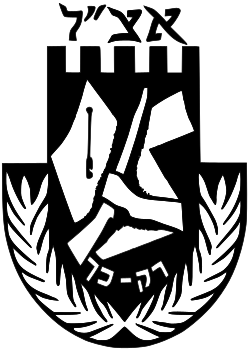
Members of the Irgun came mostly from Betar and from the Revisionist Party both in Palestine and abroad. The Revisionist Movement made up a popular backing for the underground organization. Ze'ev Jabotinsky, founder of Revisionist Zionism, commanded the organization until he died in 1940. He formulated the general realm of operation, regarding Restraint and the end thereof, and was the inspiration for the organization overall. An additional major source of ideological inspiration was the poetry of Uri Zvi Greenberg. The symbol of the organization, with the motto רק כך (only thus), underneath a hand holding a rifle in the foreground of a map showing both Mandatory Palestine and the Emirate of Transjordan (at the time, both were administered under the terms of the British Mandate for Palestine), implied that force was the only way to "liberate the homeland."[16]
The number of members of the Irgun varied from a few hundred to a few thousand. Most of its members were people who joined the organization's command,[clarification needed] under which they carried out various operations and filled positions, largely in opposition to British law. Most of them were "ordinary" people, who held regular jobs, and only a few dozen worked full-time in the Irgun.
The Irgun disagreed with the policy of the Yishuv and with the World Zionist Organization, both with regard to strategy and basic ideology and with regard to PR and military tactics, such as use of armed force to accomplish the Zionist ends, operations against the Arabs during the riots, and relations with the British mandatory government. Therefore, the Irgun tended to ignore the decisions made by the Zionist leadership and the Yishuv's institutions. This fact caused the elected bodies not to recognize the independent organization, and during most of the time of its existence the organization was seen[by whom?] as irresponsible, and its actions thus worthy of thwarting. Accordingly, the Irgun accompanied its armed operations with public-relations campaigns aiming to convince the public of the Irgun's way and the problems with the official political leadership of the Yishuv. The Irgun put out numerous advertisements, an underground newspaper and even ran the first independent Hebrew radio station – Kol Zion HaLochemet.
Structure of organization
[edit]| Irgun Commanders |
|---|
|
As members of an underground armed organization, Irgun personnel did not normally call Irgun by its name but rather used other names. In the first years of its existence it was known primarily as Ha-Haganah Leumit (The National Defense), and also by names such as Haganah Bet ("Second Defense"), Irgun Bet ("Second Irgun"), the Parallel Organization and the Rightwing Organization. Later on[when?] it became most widely known as המעמד (the Stand). The anthem adopted by the Irgun was "Anonymous Soldiers",[20][21] written by Avraham (Yair) Stern who was at the time a commander in the Irgun. Later on Stern defected from the Irgun and founded Lehi, and the song became the anthem of the Lehi. The Irgun's new anthem then became the third verse of the "Betar Song", by Ze'ev Jabotinsky.
The Irgun gradually evolved from its humble origins into a serious and well-organized paramilitary organization. The movement developed a hierarchy of ranks and a sophisticated command-structure, and came to demand serious military training and strict discipline from its members. It developed clandestine networks of hidden arms-caches and weapons-production workshops, safe-houses, and training camps, along with a secret printing facility for propaganda posters.
The ranks of the Irgun were (in ascending order):
- Khayal = (Private)
- Segen Rosh Kvutza, Segen ("Deputy Group Leader", "Deputy") = Assistant Squad Leader (Lance Corporal)
- Rosh Kvutza ("Group Leader") = Squad Leader (Corporal)
- Samal ("Sergeant") = Section Leader (Sergeant)
- Samal Rishon ("Sergeant First Class") = Brigade Leader (Platoon Sergeant)
- Rav Samal ("Chief Sergeant") = Battalion Leader (Master Sergeant)
- Gundar Sheni, Gundar ("Commander Second Class", "Commander") = District Commander (2nd Lieutenant)
- Gundar Rishon ("Commander First Class") = Senior Branch Commander, Headquarters Staff (Lieutenant).
The Irgun was led by a High Command, which set policy and gave orders. Directly underneath it was a General Staff, which oversaw the activities of the Irgun. The General Staff was divided into a military and a support staff. The military staff was divided into operational units that oversaw operations and support units in charge of planning, instruction, weapons caches and manufacture, and first aid. The military and support staff never met jointly; they communicated through the High Command. Beneath the General Staff were six district commands: Jerusalem, Tel Aviv, Haifa-Galilee, Southern, Sharon, and Shomron, each led by a district commander.[22] A local Irgun district unit was called a "Branch". A "brigade" in the Irgun was made up of three sections. A section was made up of two groups, at the head of each was a "Group Head", and a deputy. Eventually, various units were established, which answered to a "Center" or "Staff".
The head of the Irgun High Command was the overall commander of the organization, but the designation of his rank varied. During the revolt against the British, Irgun commander Menachem Begin and the entire High Command held the rank of Gundar Rishon. His predecessors, however, had held their own ranks. A rank of Military Commander (Seren) was awarded to the Irgun commander Yaakov Meridor and a rank of High Commander (Aluf) to David Raziel. Until his death in 1940, Jabotinsky was known as the "Military Commander of the Etzel" or the Ha-Matzbi Ha-Elyon ("Supreme Commander").
Under the command of Menachem Begin, the Irgun was divided into different corps:
- Hayil Kravi (Combat Corps) – responsible for combat operations
- Delek ("Gasoline") – the intelligence section; responsible for gathering and translating intelligence, and maintaining contact with local and foreign journalists
- HAT (Planning Division) – responsible for planning activities
- HATAM (Revolutionary Publicity Corps) – responsible for printing and disseminating propaganda
The Irgun's commanders planned for it to have a regular combat force, a reserve, and shock units, but in practice there were not enough personnel for a reserve or for a shock force.[22]
The Irgun emphasized that its fighters be highly disciplined. Strict drill exercises were carried out at ceremonies at different times, and strict attention was given to discipline, formal ceremonies and military relationships between the various ranks. The Irgun put out professional publications on combat doctrine, weaponry, leadership, drill exercises, etc. Among these publications were three books written by David Raziel, who had studied military history, techniques, and strategy:[23]
- The Pistol (written in collaboration with Avraham Stern)
- The Theory of Training
- Parade Ground and Field Drill
A British analysis noted that the Irgun's discipline was "as strict as any army in the world."[24]
The Irgun operated a sophisticated recruitment and military-training regime. Those wishing to join had to find and make contact with a member, meaning only those who personally knew a member or were persistent could find their way in. Once contact had been established, a meeting was set up with the three-member selection committee at a safe-house, where the recruit was interviewed in a darkened room, with the committee either positioned behind a screen, or with a flashlight shone into the recruit's eyes. The interviewers asked basic biographical questions, and then asked a series of questions designed to weed out romantics and adventurers and those who had not seriously contemplated the potential sacrifices. Those selected attended a four-month series of indoctrination seminars in groups of five to ten, where they were taught the Irgun's ideology and the code of conduct it expected of its members. These seminars also had another purpose - to weed out the impatient and those of flawed purpose who had gotten past the selection interview. Then, members were introduced to other members, were taught the locations of safe-houses, and given military training. Irgun recruits trained with firearms, hand grenades, and were taught how to conduct combined attacks on targets. Arms handling and tactics courses were given in clandestine training camps, while practice shooting took place in the desert or by the sea. Eventually, separate training camps were established for heavy-weapons training. The most rigorous course was the explosives course for bomb-makers, which lasted a year.[22] The British authorities believed that some Irgun members enlisted in the Jewish section of the Palestine Police Force for a year as part of their training, during which they also passed intelligence.[24] In addition to the Irgun's sophisticated training program, many Irgun members were veterans of the Haganah (including the Palmach), the British Armed Forces, and Jewish partisan groups that had waged guerrilla warfare in Nazi-occupied Europe, thus bringing significant military training and combat experience into the organization.[24] The Irgun also operated a course for its intelligence operatives, in which recruits were taught espionage, cryptography, and analysis techniques.[24]
Of the Irgun's members, almost all were part-time members. They were expected to maintain their civilian lives and jobs, dividing their time between their civilian lives and underground activities. There were never more than 40 full-time members, who were given a small expense stipend on which to live on.[22] Upon joining, every member received an underground name. The Irgun's members were divided into cells, and worked with the members of their own cells. The identities of Irgun members in other cells were withheld. This ensured that an Irgun member taken prisoner could betray no more than a few comrades.
In addition to the Irgun's members in Palestine, underground Irgun cells composed of local Jews were established in Europe following World War II. An Irgun cell was also established in Shanghai, home to many European-Jewish refugees. The Irgun also set up a Swiss bank account. Eli Tavin, the former head of Irgun intelligence, was appointed commander of the Irgun abroad.[22]
In November 1947, the Jewish insurgency came to an end as the UN approved of the partition of Palestine, and the British had announced their intention to withdraw the previous month. As the British left and the 1947-48 Civil War in Mandatory Palestine got underway, the Irgun came out of the underground and began to function more as a standing army rather an underground organization. It began openly recruiting, training, and raising funds, and established bases, including training facilities. It also introduced field communications and created a medical unit and supply service.[25][26]
Until World War II the group armed itself with weapons purchased in Europe, primarily Italy and Poland, and smuggled to Palestine. The Irgun also established workshops that manufactured spare parts and attachments for the weapons. Also manufactured were land mines and simple hand grenades. Another way in which the Irgun armed itself was theft of weapons from the British Police and military.
Prior to World War II
[edit]Founding
[edit]The Irgun's first steps were in the aftermath of the Riots of 1929. In the Jerusalem branch of the Haganah there were feelings of disappointment and internal unrest towards the leadership of the movements and the Histadrut (at that time the organization running the Haganah). These feelings were a result of the view that the Haganah was not adequately defending Jewish interests in the region. Likewise, critics of the leadership spoke out against alleged failures in the number of weapons, readiness of the movement and its policy of restraint and not fighting back. On April 10, 1931, commanders and equipment managers announced that they refused to return weapons to the Haganah that had been issued to them earlier, prior to the Nebi Musa holiday. These weapons were later returned by the commander of the Jerusalem branch, Avraham Tehomi, a.k.a. "Gideon". However, the commanders who decided to rebel against the leadership of the Haganah relayed a message regarding their resignations to the Vaad Leumi, and thus this schism created a new independent movement.
The leader of the new underground movement was Avraham Tehomi, alongside other founding members who were all senior commanders in the Haganah, members of Hapoel Hatzair and of the Histadrut. Also among them was Eliyahu Ben Horin, an activist in the Revisionist Party. This group was known as the "Odessan Gang", because they previously had been members of the Haganah Ha'Atzmit of Jewish Odessa. The new movement was named Irgun Tsvai Leumi, ("National Military Organization") in order to emphasize its active nature in contrast to the Haganah. Moreover, the organization was founded with the desire to become a true military organization and not just a militia as the Haganah was at the time.
In the autumn of that year the Jerusalem group merged with other armed groups affiliated with Betar. The Betar groups' center of activity was in Tel Aviv, and they began their activity in 1928 with the establishment of "Officers and Instructors School of Betar". Students at this institution had broken away from the Haganah earlier, for political reasons, and the new group called itself the "National Defense", הגנה הלאומית. During the riots of 1929 Betar youth participated in the defense of Tel Aviv neighborhoods under the command of Yermiyahu Halperin, at the behest of the Tel Aviv city hall. After the riots the Tel Avivian group expanded, and was known as "The Right Wing Organization".
After the Tel Aviv expansion another branch was established in Haifa. Towards the end of 1932 the Haganah branch of Safed also defected and joined the Irgun, as well as many members of the Maccabi sports association. At that time the movement's underground newsletter, Ha'Metsudah (the Fortress) also began publication, expressing the active trend of the movement. The Irgun also increased its numbers by expanding draft regiments of Betar – groups of volunteers, committed to two years of security and pioneer activities. These regiments were based in places that from which stemmed new Irgun strongholds in the many places, including the settlements of Yesod HaMa'ala, Mishmar HaYarden, Rosh Pina, Metula and Nahariya in the north; in the center – Hadera, Binyamina, Herzliya, Netanya and Kfar Saba, and south of there – Rishon LeZion, Rehovot and Ness Ziona. Later on regiments were also active in the Old City of Jerusalem ("the Kotel Brigades") among others. Primary training centers were based in Ramat Gan, Qastina (by Kiryat Mal'akhi of today) and other places.
Under Tehomi's command
[edit]
In 1933 there were some signs of unrest, seen by the incitement of the local Arab leadership to act against the authorities. The strong British response put down the disturbances quickly. During that time the Irgun operated in a similar manner to the Haganah and was a guarding organization. The two organizations cooperated in ways such as coordination of posts and even intelligence sharing.
Within the Irgun, Tehomi was the first to serve as "Head of the Headquarters" or "Chief Commander". Alongside Tehomi served the senior commanders, or "Headquarters" of the movement. As the organization grew, it was divided into district commands.
In August 1933 a "Supervisory Committee" for the Irgun was established, which included representatives from most of the Zionist political parties. The members of this committee were Meir Grossman (of the Hebrew State Party), Rabbi Meir Bar-Ilan (of the Mizrachi Party), either Immanuel Neumann or Yehoshua Supersky (of the General Zionists) and Ze'ev Jabotinsky or Eliyahu Ben Horin (of Hatzohar).
In protest against, and with the aim of ending Jewish immigration to Palestine, the Great Arab Revolt of 1936–1939 broke out on April 19, 1936. The riots took the form of attacks by Arab rioters ambushing main roads, bombing of roads and settlements as well as property and agriculture vandalism. In the beginning, the Irgun and the Haganah generally maintained a policy of restraint, apart from a few instances. Some expressed resentment at this policy, leading up internal unrest in the two organizations. The Irgun tended to retaliate more often, and sometimes Irgun members patrolled areas beyond their positions in order to encounter attackers ahead of time. However, there were differences of opinion regarding what to do in the Haganah, as well. Due to the joining of many Betar Youth members, Jabotinsky (founder of Betar) had a great deal of influence over Irgun policy. Nevertheless, Jabotinsky was of the opinion that for moral reasons violent retaliation was not to be undertaken.[27]
In November 1936 the Peel Commission was sent to inquire regarding the breakout of the riots and propose a solution to end the Revolt. In early 1937 there were still some in the Yishuv who felt the commission would recommend a partition of Mandatory Palestine (the land west of the Jordan River), thus creating a Jewish state on part of the land. The Irgun leadership, as well as the "Supervisory Committee" held similar beliefs, as did some members of the Haganah and the Jewish Agency. This belief strengthened the policy of restraint and led to the position that there was no room for defense institutions in the future Jewish state. Tehomi was quoted as saying: "We stand before great events: a Jewish state and a Jewish army. There is a need for a single military force". This position intensified the differences of opinion regarding the policy of restraint, both within the Irgun and within the political camp aligned with the organization. The leadership committee of the Irgun supported a merger with the Haganah. On April 24, 1937, a referendum was held among Irgun members regarding its continued independent existence. David Raziel and Avraham (Yair) Stern came out publicly in support for the continued existence of the Irgun:
The Irgun has been placed ... before a decision to make, whether to submit to the authority of the government and the Jewish Agency or to prepare for a double sacrifice and endangerment. Some of our friends do not have appropriate willingness for this difficult position, and have submitted to the Jewish Agency and has left the battle ... all of the attempts ... to unite with the leftist organization have failed, because the Left entered into negotiations not on the basis of unification of forces, but the submission of one such force to the other....[28]
The first split
[edit]In April 1937 the Irgun split after the referendum. Approximately 1,500–2,000 people, about half of the Irgun's membership, including the senior command staff, regional committee members, along with most of the Irgun's weapons, returned to the Haganah, which at that time was under the Jewish Agency's leadership. The Supervisory Committee's control over the Irgun ended, and Jabotinsky assumed command. In their opinion, the removal of the Haganah from the Jewish Agency's leadership to the national institutions necessitated their return. Furthermore, they no longer saw significant ideological differences between the movements. Those who remained in the Irgun were primarily young activists, mostly laypeople, who sided with the independent existence of the Irgun. In fact, most of those who remained were originally Betar people. Moshe Rosenberg estimated that approximately 1,800 members remained. In theory, the Irgun remained an organization not aligned with a political party, but in reality the supervisory committee was disbanded and the Irgun's continued ideological path was outlined according to Ze'ev Jabotinsky's school of thought and his decisions, until the movement eventually became Revisionist Zionism's military arm. One of the major changes in policy by Jabotinsky was the end of the policy of restraint.
On April 27, 1937, the Irgun founded a new headquarters, staffed by Moshe Rosenberg at the head, Avraham (Yair) Stern as secretary, David Raziel as head of the Jerusalem branch, Hanoch Kalai as commander of Haifa and Aharon Haichman as commander of Tel Aviv. On 20 Tammuz, (June 29) the day of Theodor Herzl's death, a ceremony was held in honor of the reorganization of the underground movement. For security purposes this ceremony was held at a construction site in Tel Aviv.
Ze'ev Jabotinsky placed Col. Robert Bitker at the head of the Irgun. Bitker had previously served as Betar commissioner in China and had military experience. A few months later, probably due to total incompatibility with the position, Jabotinsky replaced Bitker with Moshe Rosenberg. When the Peel Commission report was published a few months later, the Revisionist camp decided not to accept the commission's recommendations.[27] Moreover, the organizations of Betar, Hatzohar and the Irgun began to increase their efforts to bring Jews to Eretz Israel (the Land of Israel), illegally. This Aliyah was known as the עליית אף על פי "Af Al Pi (Nevertheless) Aliyah". As opposed to this position, the Jewish Agency began acting on behalf of the Zionist interest on the political front, and continued the policy of restraint. From this point onwards the differences between the Haganah and the Irgun were much more obvious.
Illegal immigration
[edit]
According to Jabotinsky's "Evacuation Plan", which called for millions of European Jews to be brought to Palestine at once, the Irgun helped the illegal immigration of European Jews to Palestine. This was named by Jabotinsky the "National Sport". The most significant part of this immigration prior to World War II was carried out by the Revisionist camp, largely because the Yishuv institutions and the Jewish Agency shied away from such actions on grounds of cost and their belief that Britain would in the future allow widespread Jewish immigration.
The Irgun joined forces with Hatzohar and Betar in September 1937, when it assisted with the landing of a convoy of 54 Betar members at Tantura Beach (near Haifa.) The Irgun was responsible for discreetly bringing the Olim, or Jewish immigrants, to the beaches, and dispersing them among the various Jewish settlements. The Irgun also began participating in the organisation of the immigration enterprise and undertook the process of accompanying the ships. This began with the ship Draga which arrived at the coast of British Palestine in September 1938. In August of the same year, an agreement was made between Ari Jabotinsky (the son of Ze'ev Jabotinsky), the Betar representative and Hillel Kook, the Irgun representative, to coordinate the immigration (also known as Ha'apala). This agreement was also made in the "Paris Convention" in February 1939, at which Ze'ev Jabotinsky and David Raziel were present. Afterwards, the "Aliyah Center" was founded, made up of representatives of Hatzohar, Betar, and the Irgun, thereby making the Irgun a full participant in the process.
The difficult conditions on the ships demanded a high level of discipline. The people on board the ships were often split into units, led by commanders. In addition to having a daily roll call and the distribution of food and water (usually very little of either), organized talks were held to provide information regarding the actual arrival in Palestine. One of the largest ships was the Sakaria, with 2,300 passengers, which equalled about 0.5% of the Jewish population in Palestine. The first vessel arrived on April 13, 1937, and the last on February 13, 1940. All told, about 18,000 Jews immigrated to Palestine with the help of the Revisionist organizations and private initiatives by other Revisionists. Most were not caught by the British.
End of restraint
[edit] | This section needs additional citations for verification. (August 2022) |

While continuing to defend settlements, Irgun members began attacks on Arab villages around April 1936, thus ending the policy of restraint. These attacks were intended to instill fear in the Arab side, in order to cause the Arabs to wish for peace and quiet. In March 1938, David Raziel wrote in the underground newspaper "By the Sword" a constitutive article for the Irgun overall, in which he coined the term "Active Defense":
The actions of the Haganah alone will never be a true victory. If the goal of the war is to break the will of the enemy – and this cannot be attained without destroying his spirit – clearly we cannot be satisfied with solely defensive operations.... Such a method of defense, that allows the enemy to attack at will, to reorganize and attack again ... and does not intend to remove the enemy's ability to attack a second time – is called passive defense, and ends in downfall and destruction ... whoever does not wish to be beaten has no choice but to attack. The fighting side, that does not intend to oppress but to save its liberty and honor, he too has only one way available – the way of attack. Defensiveness by way of offensiveness, in order to deprive the enemy the option of attacking, is called active defense.
By the end of World War II, more than 250 Arabs had been killed. Examples include:
- After an Arab shooting at Carmel school in Tel Aviv, which resulted in the death of a Jewish child, Irgun members attacked an Arab neighborhood near Kerem Hatemanim in Tel Aviv, killing one Arab man and injuring another.
- On August 17, the Irgun responded to shootings by Arabs from the Jaffa–Jerusalem train towards Jews that were waiting by the train block on Herzl Street in Tel Aviv. The same day, when a Jewish child was injured by the shooting, Irgun members attacked a train on the same route, killing one Arab and injuring five.
During 1936, Irgun members carried out approximately ten attacks.
Throughout 1937 the Irgun continued this line of operation.
- On March 6, a Jew at Sabbath prayers at the Western Wall was shot by a local Arab. A few hours later, the Irgun shot at an Arab in the Jerusalem neighborhood of Rechavia.
- On June 29, a band of Arabs attacked an Egged bus on the Jerusalem – Tel Aviv road, killing one Jew. The following day, two Jews were also killed near Karkur. A few hours later, the Irgun carried out a number of operations.
- An Arab bus making its way from Lifta was attacked in Jerusalem.
- In two other locations in Jerusalem, Arabs were shot as well.
- In Tel Aviv, a hand grenade was thrown at an Arab coffee shop on Carmel St., injuring many of the patrons.
- Irgun members also injured an Arab on Reines St. in Tel Aviv.
- On September 5, the Irgun responded to the murder of a rabbi on his way home from prayer in the Old City of Jerusalem by throwing explosives at an Arab bus that had left Lifta, injuring two female passengers and a British police officer.
A more complete list can be found here.
At that time, however, these acts were not yet a part of a formulated policy of the Irgun.[29] Not all of the aforementioned operations received a commander's approval, and Jabotinsky was not in favor of such actions at the time. Jabotinsky still hoped to establish a Jewish force out in the open that would not have to operate underground. However, the failure, in its eyes, of the Peel Commission and the renewal of violence on the part of the Arabs caused the Irgun to rethink its official policy.
Increase in operations
[edit]14 November 1937 was a watershed in Irgun activity. From that date, the Irgun increased its reprisals. Following an increase in the number of attacks aimed at Jews, including the killing of five kibbutz members near Kiryat Anavim (today kibbutz Ma'ale HaHamisha), the Irgun undertook a series of attacks in various places in Jerusalem, killing five Arabs. Operations were also undertaken in Haifa (shooting at the Arab-populated Wadi Nisnas neighborhood) and in Herzliya. The date is known as the day the policy of restraint (Havlagah) ended, or as Black Sunday when operations resulted in the murder of 10 Arabs. This is when the organization fully changed its policy, with the approval of Jabotinsky and Headquarters to the policy of "active defense" in respect of Irgun actions.[30]
The British responded with the arrest of Betar and Hatzohar members as suspected members of the Irgun. Military courts were allowed to act under "Time of Emergency Regulations" and even sentence people to death. In this manner Yehezkel Altman, a guard in a Betar battalion in the Nahalat Yizchak neighborhood of Tel Aviv, shot at an Arab bus, without his commanders' knowledge. Altman was acting in response to a shooting at Jewish vehicles on the Tel Aviv–Jerusalem road the day before. He turned himself in later and was sentenced to death, a sentence which was later commuted to a life sentence.
Despite the arrests, Irgun members continued fighting. Jabotinsky lent his moral support to these activities. In a letter to Moshe Rosenberg on 18 March 1938 he wrote:
Tell them: from afar I collect and save, as precious treasures, news items about your lives. I know of the obstacles that have not impeded your spirit; and I know of your actions as well. I am overjoyed that I have been blessed with such students.
Although the Irgun continued activities such as these, following Rosenberg's orders, they were greatly curtailed. Furthermore, in fear of the British threat of the death sentence for anyone found carrying a weapon, all operations were suspended for eight months. However, opposition to this policy gradually increased. In April, 1938, responding to the killing of six Jews, Betar members from the Rosh Pina Brigade went on a reprisal mission, without the consent of their commander, as described by historian Avi Shlaim:
On 21 April 1938, after several weeks of planning, he and two of his colleagues from the Irgun (Etzel) ambushed an Arab bus at a bend on a mountain road near Safad. They had a hand grenade, a gun and a pistol. Their plan was to destroy the engine so that the bus would fall off the side of the road and all the passengers would be killed. When the bus approached, they fired at it (not in the air, as Mailer has it) but the grenade lobbed by Ben Yosef did not detonate. The bus with its screaming and terrified passengers drove on.[31]
Although the incident ended without casualties, the three were caught, and one of them – Shlomo Ben-Yosef was sentenced to death. Demonstrations around the country, as well as pressure from institutions and people such as Dr. Chaim Weizmann and the Chief Rabbi of Mandatory Palestine, Yitzhak HaLevi Herzog did not reduce his sentence. In Shlomo Ben-Yosef's writings in Hebrew were later found:
I am going to die and I am not sorry at all. Why? Because I am going to die for our country. Shlomo Ben-Yosef.[27]
On 29 June 1938 he was executed, and was the first of the Olei Hagardom. The Irgun revered him after his death and many regarded him as an example. In light of this, and due to the anger of the Irgun leadership over the decision to adopt a policy of restraint until that point, Jabotinsky relieved Rosenberg of his post and replaced him with David Raziel, who proved to be the most prominent Irgun commander until Menachem Begin. Jabotinsky simultaneously instructed the Irgun to end its policy of restraint, leading to armed offensive operations until the end of the Arab Revolt in 1939. In this time, the Irgun mounted about 40 operations against Arabs and Arab villages, for instance:
- After a Jewish father and son were killed in the Old City of Jerusalem, on June 6, 1938, Irgun members threw explosives from the roof of a nearby house, killing two Arabs and injuring four.
- The Irgun planted land mines in a number of Arab markets, primarily in places identified by the Irgun as activity centers of armed Arab gangs.
- Explosives detonated in the Arab souk in Jerusalem on July 15, killed ten local Arabs.
- In similar circumstances, 70 Arabs were killed by a land mine planted in the Arab souk in Haifa.
This action led the British Parliament to discuss the disturbances in Palestine. On 23 February 1939 the Secretary of State for the Colonies, Malcolm MacDonald revealed the British intention to cancel the mandate and establish a state that would preserve Arab rights. This caused a wave of riots and attacks by Arabs against Jews. The Irgun responded four days later with a series of attacks on Arab buses and other sites. The British used military force against the Arab rioters and in the latter stages of the revolt by the Arab community in Palestine, it deteriorated into a series of internal gang wars.
During the same period
[edit]
At the same time, the Irgun also established itself in Europe. The Irgun built underground cells that participated in organizing migration to Palestine. The cells were made up almost entirely of Betar members, and their primary activity was military training in preparation for emigration to Palestine. Ties formed with the Polish authorities brought about courses in which Irgun commanders were trained by Polish officers in advanced military issues such as guerrilla warfare, tactics and laying land mines. Avraham (Yair) Stern was notable among the cell organizers in Europe. In 1937 the Polish authorities began to deliver large amounts of weapons to the underground. According to Irgun activists Poland supplied the organization with 25,000 rifles, and additional material and weapons, by summer 1939 the Warsaw warehouses of Irgun held 5,000 rifles and 1,000 machine guns. The training and support by Poland would allow the organization to mobilize 30,000–40,000 men.[32] The transfer of handguns, rifles, explosives and ammunition stopped with the outbreak of World War II. Another field in which the Irgun operated was the training of pilots, so they could serve in the Air Force in the future war for independence, in the flight school in Lod.
Towards the end of 1938 there was progress towards aligning the ideologies of the Irgun and the Haganah. Many abandoned the belief that the land would be divided and a Jewish state would soon exist. The Haganah founded פו"מ, a special operations unit, (pronounced poom), which carried out reprisal attacks following Arab violence. These operations continued into 1939. Furthermore, the opposition within the Yishuv to illegal immigration significantly decreased, and the Haganah began to bring Jews to Palestine using rented ships, as the Irgun had in the past.
First operations against the British
[edit]The publishing of the MacDonald White Paper of 1939 brought with it new edicts that were intended to lead to a more equitable settlement between Jews and Arabs. However, it was considered by some Jews to have an adverse effect on the continued development of the Jewish community in Palestine. Chief among these was the prohibition on selling land to Jews, and the smaller quotas for Jewish immigration. The entire Yishuv was furious at the contents of the White Paper. There were demonstrations against the "Treacherous Paper", as it was considered that it would preclude the establishment of a Jewish homeland in Palestine.
Under the temporary command of Hanoch Kalai, the Irgun began sabotaging strategic infrastructure such as electricity facilities, radio and telephone lines. It also started publicizing its activity and its goals. This was done in street announcements, newspapers, as well as the underground radio station Kol Zion HaLochemet. On August 26, 1939, the Irgun killed Ralph Cairns, a British police officer who, as head of the Jewish Department in the Palestine Police, had been closing the net on Avraham Stern.[33] Irgun had accused him of the torture of a number of its members.[34][35] Cairns and Ronald Barker, another British police officer, were killed by a remotely detonated Irgun landmine.[36]
The British increased their efforts against the Irgun. As a result, on August 31 the British police arrested members meeting in the Irgun headquarters. On the next day, September 1, 1939, World War II broke out.
During World War II
[edit]Following the outbreak of war, Ze'ev Jabotinsky and the New Zionist Organization voiced their support for Britain and France. In mid-September 1939 Raziel was moved from his place of detention in Tzrifin. This, among other events, encouraged the Irgun to announce a cessation of its activities against the British so as not to hinder Britain's effort to fight "the Hebrew's greatest enemy in the world – German Nazism". This announcement ended with the hope that after the war a Hebrew state would be founded "within the historical borders of the liberated homeland". After this announcement Irgun, Betar and Hatzohar members, including Raziel and the Irgun leadership, were gradually released from detention. The Irgun did not rule out joining the British army and the Jewish Brigade. Irgun members did enlist in various British units. Irgun members also assisted British forces with intelligence in Romania, Bulgaria, Morocco and Tunisia. An Irgun unit also operated in Syria and Lebanon. David Raziel later died during one of these operations.
During the Holocaust, Betar members revolted numerous times against the Nazis in occupied Europe. The largest of these revolts was the Warsaw Ghetto Uprising, in which an armed underground organization fought, formed by Betar and Hatzoar and known as the Żydowski Związek Wojskowy (ŻZW) (Jewish Military Union). Despite its political origins, the ŻZW accepted members without regard to political affiliation, and had contacts established before the war with elements of the Polish military. Because of differences over objectives and strategy, the ŻZW was unable to form a common front with the mainstream ghetto fighters of the Żydowska Organizacja Bojowa, and fought independently under the military leadership of Paweł Frenkiel and the political leadership of Dawid Wdowiński.[37]
There were instances of Betar members enlisted in the British military smuggling British weapons to the Irgun.[citation needed]
From 1939 onwards, an Irgun delegation in the United States worked for the creation of a Jewish army made up of Jewish refugees and Jews from Palestine, to fight alongside the Allied Forces. In July 1943 the "Emergency Committee to Save the Jewish People in Europe" was formed, and worked until the end of the war to rescue the Jews of Europe from the Nazis and to garner public support for a Jewish state. However, it was not until January 1944 that US President Franklin Roosevelt established the War Refugee Board, which achieved some success in saving European Jews.
Second split
[edit]
Throughout this entire period, the British continued enforcing the White Paper's provisions, which included a ban on the sale of land, restrictions on Jewish immigration and increased vigilance against illegal immigration. Part of the reason why the British banned land sales (to anyone) was the confused state of the post Ottoman land registry; it was difficult to determine who actually owned the land that was for sale.
Within the ranks of the Irgun this created much disappointment and unrest, at the center of which was disagreement with the leadership of the New Zionist Organization, David Raziel and the Irgun Headquarters. On June 18, 1939, Avraham (Yair) Stern and others of the leadership were released from prison and a rift opened between them the Irgun and Hatzohar leadership. The controversy centred on the issues of the underground movement submitting to public political leadership and fighting the British. On his release from prison Raziel resigned from Headquarters. To his chagrin, independent operations of senior members of the Irgun were carried out and some commanders even doubted Raziel's loyalty.
In his place, Stern was elected to the leadership. In the past, Stern had founded secret Irgun cells in Poland without Jabotinsky's knowledge, in opposition to his wishes. Furthermore, Stern was in favor of removing the Irgun from the authority of the New Zionist Organization, whose leadership urged Raziel to return to the command of the Irgun. He finally consented. Jabotinsky wrote to Raziel and to Stern, and these letters were distributed to the branches of the Irgun:
... I call upon you: Let nothing disturb our unity. Listen to the commissioner (Raziel), whom I trust, and promise me that you and Betar, the greatest of my life's achievements, will stand strong and united and allow me to continue with the hope for victory in the war to realize our old Maccabean dream....
Stern was sent a telegram with an order to obey Raziel, who was reappointed. However, these events did not prevent the splitting of the organization. Suspicion and distrust were rampant among the members. Out of the Irgun a new organization was created on July 17, 1940,[38] which was first named "The National Military Organization in Israel" (as opposed to the "National Military Organization in the Land of Israel") and later on changed its name to Lehi, an acronym for Lohamei Herut Israel, "Fighters for the Freedom of Israel", (לח"י – לוחמי חירות ישראל). Jabotinsky died in New York on August 4, 1940, yet this did not prevent the Lehi split. Following Jabotinsky's death, ties were formed between the Irgun and the New Zionist Organization. These ties would last until 1944, when the Irgun declared a revolt against the British.
The primary difference between the Irgun and the newly formed organization was its intention to fight the British in Palestine, regardless of their war against Germany. Later, additional operational and ideological differences developed that contradicted some of the Irgun's guiding principles. For example, the Lehi, unlike the Irgun, supported a population exchange with local Arabs.
Change of policy
[edit]| The Irgun's Anthem[39] |
|---|
|
Tagar - To die or to conquer the hill - |
The split damaged the Irgun both organizationally and from a morale point of view. As their spiritual leader, Jabotinsky's death also added to this feeling. Together, these factors brought about a mass abandonment by members. The British took advantage of this weakness to gather intelligence and arrest Irgun activists. The new Irgun leadership, which included Meridor, Yerachmiel Ha'Levi, Rabbi Moshe Zvi Segal and others used the forced hiatus in activity to rebuild the injured organization. This period was also marked by more cooperation between the Irgun and the Jewish Agency, however David Ben-Gurion's uncompromising demand that Irgun accept the Agency's command foiled any further cooperation.
In both the Irgun and the Haganah more voices were being heard opposing any cooperation with the British. Nevertheless, an Irgun operation carried out in the service of Britain was aimed at sabotaging pro-Nazi forces in Iraq, including the assassination of Haj Amin al-Husayni. Among others, Raziel and Yaakov Meridor participated. On April 20, 1941, during a Luftwaffe air raid on RAF Habbaniya near Baghdad, David Raziel, commander of the Irgun, was killed during the operation.
In late 1943 a joint Haganah – Irgun initiative was developed, to form a single fighting body, unaligned with any political party, by the name of עם לוחם (Fighting Nation).[40][41] The new body's first plan was to kidnap the British High Commissioner of Palestine, Sir Harold MacMichael and take him to Cyprus. However, the Haganah leaked the planned operation and it was thwarted before it got off the ground. Nevertheless, at this stage the Irgun ceased its cooperation with the British. As Eliyahu Lankin tells in his book:
Immediately following the failure of Fighting Nation practical discussions began in the Irgun Headquarters regarding a declaration of war.
Revolt
[edit]
In 1943 the Polish II Corps, commanded by Władysław Anders, arrived in Palestine from Iraq. The British insisted that no Jewish units of the army be created. Eventually, many of the soldiers of Jewish origin that arrived with the army were released and allowed to stay in Palestine. One of them was Menachem Begin,[42] whose arrival in Palestine created new-found expectations within the Irgun and Betar. Begin had served as head of the Betar movement in Poland,[43] and was a respected leader. Yaakov Meridor, then the commander of the Irgun, raised the idea of appointing Begin to the post. In late 1943, when Begin accepted the position, a new leadership was formed. Meridor became Begin's deputy, and other members of the board were Aryeh Ben Eliezer, Eliyahu Lankin, and Shlomo Lev Ami.
On February 1, 1944, the Irgun put up posters all around the country, proclaiming a revolt against the British mandatory government. The posters began by saying that all of the Zionist movements stood by the Allied Forces and over 25,000 Jews had enlisted in the British military. The hope to establish a Jewish army had died. European Jewry was trapped and was being destroyed, yet Britain, for its part, did not allow any rescue missions. This part of the document ends with the following words:
The White Paper is still in effect. It is enforced, despite the betrayal of the Arabs and the loyalty of the Jews; despite the mass enlisting to the British Army; despite the ceasefire and the quiet in The Land of Israel; despite the massacre of masses of the Jewish people in Europe....
The facts are simple and horrible as one. Over the last four years of the war we have lost millions of the best of our people; millions more are in danger of eradication. And The Land of Israel is closed off and quarantined because the British rule it, realizing the White Paper, and strives for the destruction of our people's last hope.
The Irgun then declared that, for its part, the ceasefire was over and they were now at war with the British. It demanded the transfer of rule to a Jewish government, to implement ten policies. Among these were the mass evacuation of Jews from Europe, the signing of treaties with any state that recognized the Jewish state's sovereignty, including Britain, granting social justice to the state's residents, and full equality to the Arab population. The proclamation ended with:
The God of Israel, God of Hosts, will be at our side. There is no retreat. Liberty or death.... The fighting youth will not recoil in the face of sacrifices and suffering, blood and torment. They will not surrender, so long as our days of old are not renewed, so long as our nation is not ensured a homeland, liberty, honor, bread, justice and law.
The Irgun began this campaign rather weakly. At the time of the start of the revolt, it was only about 1,000 strong, including some 200 fighters. It possessed about 4 submachine guns, 40 rifles, 60 pistols, 150 hand grenades, and 2,000 kilograms of explosive material, and its funds were about £800.[24]
Struggle against the British
[edit]The Irgun began a militant operation against the symbols of government, in an attempt to harm the regime's operation as well as its reputation. The first attack was on February 12, 1944, at the government immigration offices, a symbol of the immigration laws. The attacks went smoothly and ended with no casualties – as they took place on a Saturday night, when the buildings were empty – in the three largest cities: Jerusalem, Tel Aviv, and Haifa. On February 27 the income tax offices were bombed. Parts of the same cities were blown up, also on a Saturday night; prior warnings were put up near the buildings. On March 23 the national headquarters building of the British police in the Russian Compound in Jerusalem was attacked, and part of it was blown up. These attacks in the first few months were sharply condemned by the organized leadership of the Yishuv and by the Jewish Agency, who saw them as dangerous provocations.
At the same time the Lehi also renewed its attacks against the British.[44] The Irgun continued to attack police stations and headquarters, and Tegart Fort, a fortified police station (today the location of Latrun). One relatively complex operation was the takeover of the radio station in Ramallah, on May 17, 1944.
One symbolic act by the Irgun happened before Yom Kippur of 1944. They plastered notices around town, warning that no British officers should come to the Western Wall on Yom Kippur, and for the first time since the mandate began no British police officers were there to prevent the Jews from the traditional Shofar blowing at the end of the fast.[45] After the fast that year the Irgun attacked four police stations in Arab settlements. In order to obtain weapons, the Irgun carried out "confiscation" operations – they robbed British armouries and smuggled stolen weapons to their own hiding places. During this phase of activity the Irgun also cut all of its official ties with the New Zionist Organization, so as not to tie their fate in the underground organization.
Begin wrote in his memoirs, The Revolt:
History and experience taught us that if we are able to destroy the prestige of the British in Palestine, the regime will break. Since we found the enslaving government's weak point, we did not let go of it.[46]
Underground exiles
[edit]In October 1944 the British began expelling hundreds of arrested Irgun and Lehi members to detention camps in Africa. 251 detainees from Latrun were flown on thirteen planes, on October 19 to a camp in Asmara, Eritrea. Eleven additional transports were made. Throughout the period of their detention, the detainees often initiated rebellions and hunger strikes. Many escape attempts were made until July 1948 when the exiles were returned to Israel. While there were numerous successful escapes from the camp itself, only nine men actually made it back all the way. One noted success was that of Yaakov Meridor, who escaped nine times before finally reaching Europe in April 1948. These tribulations were the subject of his book Long is the Path to Freedom: Chronicles of one of the Exiles.
Hunting Season
[edit]On November 6, 1944, Lord Moyne, British Deputy Resident Minister of State in Cairo was assassinated by Lehi members Eliyahu Hakim and Eliyahu Bet-Zuri. This act raised concerns within the Yishuv from the British regime's reaction to the underground's violent acts against them. Therefore, the Jewish Agency decided on starting a Hunting Season,[47][48] known as the saison, (from the French "la saison de chasse").
The Irgun's recuperation was noticeable when it began to renew its cooperation with the Lehi in May 1945, when it sabotaged oil pipelines, telephone lines and railroad bridges. All in all, over 1,000 members of the Irgun and Lehi were arrested and interned in British camps during the Saison. Eventually the Hunting Season died out, and there was even talk of cooperation with the Haganah leading to the formation of the Jewish Resistance Movement.
Jewish Resistance Movement
[edit]
Towards the end of July 1945 the Labour Party in Britain was elected to power. The Yishuv leadership had high hopes that this would change the anti-Zionist policy that the British maintained at the time. However, these hopes were quickly dashed when the government limited Jewish immigration, with the intention that the population of Mandatory Palestine (the land west of the Jordan River) would not be more than one-third of the total. This, along with the stepping up of arrests and their pursuit of underground members and illegal immigration organizers led to the formation of the Jewish Resistance Movement. This body consolidated the armed resistance to the British of the Irgun, Lehi, and Haganah. For ten months the Irgun and the Lehi cooperated and they carried out nineteen attacks and defense operations. The Haganah and Palmach carried out ten such operations. The Haganah also assisted in landing 13,000 illegal immigrants.
Tension between the underground movements and the British increased with the increase in operations. On April 23, 1946, an operation undertaken by the Irgun to gain weapons from the Tegart fort at Ramat Gan resulted in a firefight with the police in which an Arab constable and two Irgun fighters were killed, including one who jumped on an explosive device to save his comrades. A third fighter, Dov Gruner, was wounded and captured. He stood trial and was sentenced to be death by hanging, refusing to sign a pardon request.[49]
In 1946, British relations with the Yishuv worsened, building up to Operation Agatha of June 29. The authorities ignored the Anglo-American Committee of Inquiry's recommendation to allow 100,000 Jews into Palestine at once. As a result of the discovery of documents tying the Jewish Agency to the Jewish Resistance Movement, the Irgun was asked to speed up the plans for the King David Hotel bombing of July 22.[50] The hotel was where the documents were located, the base for the British Secretariat, the military command and a branch of the Criminal Investigation Division of the police. The Irgun later claimed to have sent a warning that was ignored.[51] Palestinian and U.S. sources confirm that the Irgun issued numerous warnings for civilians to evacuate the hotel prior to the bombing.[52] 91 people were killed in the attack where a 350 kg bomb was placed in the basement of the hotel and caused a large section of it to collapse. Only 13 were British soldiers.
Further struggle against the British
[edit]
The King David Hotel bombing and the arrest of Jewish Agency and other Yishuv leaders as part of Operation Agatha caused the Haganah to cease their armed activity against the British. Yishuv and Jewish Agency leaders were released from prison. From then until the end of the British mandate, resistance activities were led by the Irgun and Lehi. In early September 1946 the Irgun renewed its attacks against civil structures, railroads, communication lines and bridges. One operation was the attack on the train station in Jerusalem, in which Meir Feinstein was arrested and later committed suicide awaiting execution. According to the Irgun these sorts of armed attacks were legitimate, since the trains primarily served the British, for redeployment of their forces. The Irgun also publicized leaflets, in three languages, not to use specific trains in danger of being attacked. For a while, the British stopped train traffic at night. The Irgun also carried out repeated attacks against military and police traffic using disguised, electronically detonated roadside mines which could be detonated by an operator hiding nearby as a vehicle passed, carried out arms raids against military bases and police stations (often disguised as British soldiers), launched bombing, shooting, and mortar attacks against military and police installations and checkpoints, and robbed banks to gain funds as a result of losing access to Haganah funding following the collapse of the Jewish Resistance Movement.[24]
On October 31, 1946, in response to the British barring entry of Jews from Palestine, the Irgun blew up the British Embassy in Rome, a center of British efforts to monitor and stop Jewish immigration. The Irgun also carried out a few other operations in Europe: a British troop train was derailed and an attempt against another troop train failed. An attack on a British officers club in Vienna took place in 1947, and an attack on another British officer's club in Vienna and a sergeant's club in Germany took place in 1948.[22]
In December 1946 a sentence of 18 years and 18 beatings was handed down to a young Irgun member for robbing a bank. The Irgun made good on a threat they made[53] and after the detainee was whipped, Irgun members kidnapped British officers and beat them in public. The operation, known as the "Night of the Beatings" brought an end to British punitive beatings. The British, taking these acts seriously, moved many British families in Palestine into the confines of military bases, and some moved home.

On February 14, 1947, Ernest Bevin announced that the Jews and Arabs would not be able to agree on any British proposed solution for the land, and therefore the issue must be brought to the United Nations (UN) for a final decision. The Yishuv thought of the idea to transfer the issue to the UN as a British attempt to achieve delay while a UN inquiry commission would be established, and its ideas discussed, and all the while the Yishuv would weaken. Foundation for Immigration B increased the number of ships bringing in Jewish refugees. The British still strictly enforced the policy of limited Jewish immigration and illegal immigrants were placed in detention camps in Cyprus, which increased the anger of the Jewish community towards the mandate government.
The Irgun stepped up its activity and from February 19 until March 3 it attacked 18 British military camps, convoy routes, vehicles, and other facilities. The most notable of these attacks was the bombing of a British officer's club located in Goldsmith House in Jerusalem, which was in a heavily guarded security zone. Covered by machine-gun fire, an Irgun assault team in a truck penetrated the security zone and lobbed explosives into the building.[54] Thirteen people, including two officers, were killed.[24] As a result, martial law was imposed over much of the country, enforced by approximately 20,000 British soldiers. Despite this, attacks continued throughout the martial law period. The most notable one was an Irgun attack against the Royal Army Pay Corps base at the Schneller Orphanage, in which a British soldier was killed.[24]
Throughout its struggle against the British, the Irgun sought to publicize its cause around the world. By humiliating the British, it attempted to focus global attention on Palestine, hoping that any British overreaction would be widely reported, and thus result in more political pressure against the British. Begin described this strategy as turning Palestine into a "glass house". The Irgun also re-established many representative offices internationally, and by 1948 operated in 23 states. In these countries, the Irgun sometimes acted against the local British representatives or led public relations campaigns against Britain. According to Bruce Hoffman: "In an era long before the advent of 24/7 global news coverage and instantaneous satellite-transmitted broadcasts, the Irgun deliberately attempted to appeal to a worldwide audience far beyond the immediate confines of its local struggle, and beyond even the ruling regime's own homeland."[22][24]
| Executed Members of the Irgun |
|---|
Acre Prison break
[edit]On April 16, 1947, Irgun members Dov Gruner, Yehiel Dresner, Eliezer Kashani, and Mordechai Alkahi were hanged in Acre Prison, while singing Hatikvah. On April 21 Meir Feinstein and Lehi member Moshe Barazani blew themselves up, using a smuggled grenade, hours before their scheduled hanging. And on May 4 one of the Irgun's largest operations took place – the raid on Acre Prison. The operation was carried out by 23 men, commanded by Dov Cohen – AKA "Shimshon", along with the help of the Irgun and Lehi prisoners inside the prison. The Irgun had informed them of the plan in advance and smuggled in explosives. After a hole was blasted in the prison wall, the 41 Irgun and Lehi members who had been chosen to escape then ran to the hole, blasting through inner prison gates with the smuggled explosives. Meanwhile, Irgun teams mined roads and launched a mortar attack on a nearby British Army camp to delay the arrival of responding British forces. Although the 41 escapees managed to get out of the prison and board the escape trucks, some were rapidly recaptured and nine of the escapees and attackers were killed. Five Irgun men in the attacking party were also captured. Overall, 27 of the 41 designated escapees managed to escape. Along with the underground movement members, other criminals – including 214 Arabs[55] – also escaped. Of the five attackers who were caught, three of them – Avshalom Haviv, Meir Nakar, and Yaakov Weiss, were sentenced to death.
The Sergeants affair
[edit]
After the death sentences of the three were confirmed, the Irgun tried to save them by kidnapping hostages – British sergeants Clifford Martin and Mervyn Paice – in the streets of Netanya. British forces closed off and combed the area in search of the two, but did not find them. On July 29, 1947, in the afternoon, Meir Nakar, Avshalom Haviv, and Yaakov Weiss were executed. Approximately thirteen hours later the hostages were hanged in retaliation by the Irgun and their bodies, booby-trapped with an explosive, afterwards strung up from trees in woodlands south of Netanya. This action caused an outcry in Britain and was condemned both there and by Jewish leaders in Palestine.[56]
This episode has been given[by whom?] as a major influence on the British decision to terminate the Mandate and leave Palestine. The United Nations Special Committee on Palestine (UNSCOP) was also influenced by this and other actions. At the same time another incident was developing – the events of the ship Exodus 1947. The 4,500 Holocaust survivors on board were not allowed to enter Palestine. UNSCOP also covered the events. Some of its members were even present at Haifa port when the putative immigrants were forcefully removed from their ship (later found to have been rigged with an IED by some of its passengers) onto the deportation ships, and later commented that this strong image helped them press for an immediate solution for Jewish immigration and the question of Palestine.
Two weeks later, the House of Commons convened for a special debate on events in Palestine, and concluded that their soldiers should be withdrawn as soon as possible.
1948 Palestine War
[edit]


UNSCOP's conclusion was a unanimous decision to end the British mandate, and a majority decision to divide Mandatory Palestine (the land west of the Jordan River) between a Jewish state and an Arab state. During the UN's deliberations regarding the committee's recommendations the Irgun avoided initiating any attacks, so as not to influence the UN negatively on the idea of a Jewish state. On November 29 the UN General Assembly voted in favor of ending the mandate and establishing two states on the land. That very same day the Irgun and the Lehi renewed their attacks on British targets. The next day the local Arabs began attacking the Jewish community, thus beginning the first stage of the 1948 Palestine War. The first attacks on Jews were in Jewish neighborhoods of Jerusalem, in and around Jaffa, and in Bat Yam, Holon, and the Ha'Tikvah neighborhood in Tel Aviv.
In the autumn of 1947, the Irgun had approximately 4,000 members. The goal of the organization at that point was the conquest of the land between the Jordan River and the Mediterranean Sea for the future Jewish state and preventing Arab forces from driving out the Jewish community. The Irgun became almost an overt organization, establishing military bases in Ramat Gan and Petah Tikva. It began recruiting openly, thus significantly increasing in size. During the war the Irgun fought alongside the Lehi and the Haganah in the front against the Arab attacks. At first the Haganah maintained a defensive policy, as it had until then, but after the Convoy of 35 incident it completely abandoned its policy of restraint: "Distinguishing between individuals is no longer possible, for now – it is a war, and even the innocent shall not be absolved."[57]
The Irgun also began carrying out reprisal missions, as it had under David Raziel's command. At the same time though, it published announcements calling on the Arabs to lay down their weapons and maintain a ceasefire:
The National Military Organization has warned you, if the murderous attacks on Jewish civilians shall continue, its soldiers will penetrate your centers of activity and plague you. You have not heeded the warning. You continued to harm our brothers and murder them in wild cruelty. Therefore soldiers of the National Military Organization will go on the attack, as we have warned you.
... However even in these frenzied times, when Arab and Jewish blood is spilled at the British enslaver, we hereby call upon you ... to stop the attacks and create peace between us. We do not want a war with you. We are certain that neither do you want a war with us...[58]
However, the mutual attacks continued. The Irgun attacked the Arab villages of Tira near Haifa, Yehudiya ('Abassiya) in the center, and Shuafat by Jerusalem. The Irgun also attacked in the Wadi Rushmiya neighborhood in Haifa and Abu Kabir in Jaffa. On December 29 Irgun units arrived by boat to the Jaffa shore and a gunfight between them and Arab gangs ensued. The following day a bomb was thrown from a speeding Irgun car at a group of Arab men waiting to be hired for the day at the Haifa oil refinery, resulting in seven Arabs killed, and dozens injured. In response, some Arab workers attacked Jews in the area, killing 41. This sparked a Haganah response in Balad al-Sheykh, which resulted in the deaths of 60 civilians. The Irgun's goal in the fighting was to move the battles from Jewish populated areas to Arab populated areas. On January 1, 1948, the Irgun attacked again in Jaffa, its men wearing British uniforms; later in the month it attacked in Beit Nabala, a base for many Arab fighters. On 5 January 1948 the Irgun detonated a lorry bomb outside Jaffa's Ottoman built Town Hall, killing 14 and injuring 19.[59] In Jerusalem, two days later, Irgun members in a stolen police van rolled a barrel bomb into a large group of civilians who were waiting for a bus by the Jaffa Gate, killing around sixteen.[60][61][62] In the pursuit that followed three of the attackers were killed and two taken prisoner.[63]
On 6 April 1948, the Irgun raided the British Army camp at Pardes Hanna killing six British soldiers and their commanding officer.[64]
The Deir Yassin massacre was carried out in a village west of Jerusalem that had signed a non-belligerency pact with its Jewish neighbors and the Haganah, and repeatedly had barred entry to foreign irregulars.[65][66] On 9 April approximately 120 Irgun and Lehi members began an operation to capture the village. During the operation, the villagers fiercely resisted the attack, and a battle broke out. In the end, the Irgun and Lehi forces advanced gradually through house-to-house fighting. The village was only taken after the Irgun began systematically dynamiting houses, and after a Palmach unit intervened and employed mortar fire to silence the villagers' sniper positions.[22][67] The operation resulted in five Jewish fighters dead and 40 injured. Some 100 to 120 villagers were also killed.[68]
There are allegations that Irgun and Lehi forces committed war crimes during and after the capture of the village. These allegations include reports that fleeing individuals and families were fired at, and prisoners of war were killed after their capture. A Haganah report writes:
The conquest of the village was carried out with great cruelty. Whole families – women, old people, children – were killed. ... Some of the prisoners moved to places of detention, including women and children, were murdered viciously by their captors.[69]
Some say that this incident was an event that accelerated the Arab exodus from Palestine.[70]
The Irgun cooperated with the Haganah in the conquest of Haifa. At the regional commander's request, on April 21 the Irgun took over an Arab post above Hadar Ha'Carmel as well as the Arab neighborhood of Wadi Nisnas, adjacent to the Lower City.
The Irgun acted independently in the conquest of Jaffa (part of the proposed Arab State according to the UN Partition Plan). On April 25 Irgun units, about 600 strong, left the Irgun base in Ramat Gan towards Arab Jaffa. Difficult battles ensued, and the Irgun faced resistance from the Arabs as well as the British.[71] Under the command of Amichai "Gidi" Paglin, the Irgun's chief operations officer, the Irgun captured the neighborhood of Manshiya, which threatened the city of Tel Aviv. Afterwards the force continued to the sea, towards the area of the port, and using mortars, shelled the southern neighborhoods.

In his report concerning the fall of Jaffa the local Arab military commander, Michel Issa, wrote: "Continuous shelling with mortars of the city by Jews for four days, beginning 25 April, [...] caused inhabitants of city, unaccustomed to such bombardment, to panic and flee."[72] According to Morris the shelling was done by the Irgun. Their objective was "to prevent constant military traffic in the city, to break the spirit of the enemy troops [and] to cause chaos among the civilian population in order to create a mass flight."[73] High Commissioner Cunningham wrote a few days later "It should be made clear that IZL attack with mortars was indiscriminate and designed to create panic among the civilian inhabitants."[73] The British demanded the evacuation of the newly conquered city, and militarily intervened, ending the Irgun offensive. Heavy British shelling against Irgun positions in Jaffa failed to dislodge them, and when British armor pushed into the city, the Irgun resisted; a bazooka team managed to knock out one tank, buildings were blown up and collapsed onto the streets as the armor advanced, and Irgun men crawled up and tossed live dynamite sticks onto the tanks. The British withdrew, and opened negotiations with the Jewish authorities.[22] An agreement was worked out, under which Operation Hametz would be stopped and the Haganah would not attack Jaffa until the end of the Mandate. The Irgun would evacuate Manshiya, with Haganah fighters replacing them. British troops would patrol its southern end and occupy the police fort. The Irgun had previously agreed with the Haganah that British pressure would not lead to withdrawal from Jaffa and that custody of captured areas would be turned over to the Haganah. The city ultimately fell on May 13 after Haganah forces entered the city and took control of the rest of the city, from the south – part of the Hametz Operation which included the conquest of a number of villages in the area. The battles in Jaffa were a great victory for the Irgun. This operation was the largest in the history of the organization, which took place in a highly built up area that had many militants in shooting positions. During the battles explosives were used in order to break into homes and continue forging a way through them. Furthermore, this was the first occasion in which the Irgun had directly fought British forces, reinforced with armor and heavy weaponry. The city began these battles with an Arab population estimated at 70,000, which shrank to some 4,100 Arab residents by the end of major hostilities. Since the Irgun captured the neighborhood of Manshiya on its own, causing the flight of many of Jaffa's residents, the Irgun took credit for the conquest of Jaffa. It had lost 42 dead and about 400 wounded during the battle.[22]
Integration with the IDF and the Altalena Affair
[edit]On May 14, 1948 the establishment of the State of Israel was proclaimed. The declaration of independence was followed by the establishment of the Israel Defense Forces (IDF), and the process of absorbing all military organizations into the IDF started. On June 1, an agreement had been signed between Menachem Begin and Yisrael Galili for the absorption of the Irgun into the IDF. One of the clauses stated that the Irgun had to stop smuggling arms. Meanwhile, in France, Irgun representatives purchased a ship, renamed Altalena (a pseudonym of Ze'ev Jabotinsky), and weapons. The ship sailed on June 11 and arrived at the Israeli coast on June 20, during the first truce of the 1948 Arab–Israeli War. Despite United Nations Security Council Resolution 50 declaring an arms embargo in the region, neither side respected it.[74]
When the ship arrived the Israeli government, headed by Ben-Gurion, was adamant in its demand that the Irgun surrender and hand over all of the weapons. Ben-Gurion said: "We must decide whether to hand over power to Begin or to order him to cease his activities. If he does not do so, we will open fire! Otherwise, we must decide to disperse our own army."

There were two confrontations between the newly formed IDF and the Irgun: when Altalena reached Kfar Vitkin in the late afternoon of Sunday, June 20 many Irgun militants, including Begin, waited on the shore. A clash with the Alexandroni Brigade, commanded by Dan Even (Epstein), occurred. Fighting ensued and there were a number of casualties on both sides. The clash ended in a ceasefire and the transfer of the weapons on shore to the local IDF commander, and with the ship, now reinforced with local Irgun members, including Begin, sailing to Tel Aviv, where the Irgun had more supporters. Many Irgun members, who joined the IDF earlier that month, left their bases and concentrated on the Tel Aviv beach. A confrontation between them and the IDF units started. In response, Ben-Gurion ordered Yigael Yadin (acting Chief of Staff) to concentrate large forces on the Tel Aviv beach and to take the ship by force. Heavy guns were transferred to the area and at four in the afternoon, Ben-Gurion ordered the shelling of the Altalena. One of the shells hit the ship, which began to burn. Sixteen Irgun fighters were killed in the confrontation with the army; six were killed in the Kfar Vitkin area and ten on Tel Aviv beach. Three IDF soldiers were killed: two at Kfar Vitkin and one in Tel Aviv.
After the shelling of the Altalena, more than 200 Irgun fighters were arrested. Most of them were freed several weeks later. The Irgun militants were then fully integrated with the IDF and not kept in separate units.
The initial agreement for the integration of the Irgun into the IDF did not include Jerusalem, where a small remnant of the Irgun called the Jerusalem Battalion, numbering around 400 fighters, and Lehi, continued to operate independently of the government. Following the assassination of UN Envoy for Peace Folke Bernadotte by Lehi in September 1948, the Israeli government determined to immediately dismantle the underground organizations. An ultimatum was issued to the Irgun to liquidate as an independent organization and integrate into the IDF or be destroyed, and Israeli troops surrounded the Irgun camp in the Katamon Quarter of Jerusalem. The Irgun accepted the ultimatum on September 22, 1948, and shortly afterward the remaining Irgun fighters in Jerusalem began enlisting in the IDF and turning over their arms.[75][76] At Begin's orders, the Irgun in the diaspora formally disbanded on January 12, 1949, with the Irgun's former Paris headquarters becoming the European bureau of the Herut movement.
Propaganda
[edit]In order to increase the popularity of the Irgun organization and ideology, Irgun employed propaganda. This propaganda was mainly aimed at the British, and included the idea of Eretz Israel. According to Irgun propaganda posters, the Jewish state was not only to encompass all of Mandatory Palestine, but also The Emirate of Transjordan.[77]
When the Labour Party came into power in Britain in July 1945, Irgun published an announcement entitled, "We shall give the Labour Government a Chance to Keep Its Word." In this publication, Irgun stated, "Before it came to power, this Party undertook to return the Land of Israel to the people of Israel as a free state... Men and parties in opposition or in their struggle with their rivals, have, for twenty-five years, made us many promises and undertaken clear obligations; but, on coming to power, they have gone back on their words."[77] Another publication, which followed a British counter-offensive against Jewish organizations in Palestine, Irgun released a document titled, "Mobilize the Nation!" Irgun used this publication to paint the British regime as hostile to the Jewish people, even comparing the British to the Nazis. In response to what was seen as British aggression, Irgun called for a Hebrew Provisional Government, and a Hebrew Liberation Army.[77]
Criticism
[edit]_Museum_inTel-Aviv.jpg)
Description as a terrorist organization
[edit]References to the Irgun as a terrorist organization came from sources including the Anglo-American Committee of Inquiry,[78] newspapers[79][80][81][82][83] and a number of prominent world and Jewish figures.[84][85][86] Leaders within the mainstream Jewish organizations, the Jewish Agency, Haganah and Histadrut, as well as the British authorities, routinely condemned Irgun operations as terrorism and branded it an illegal organization as a result of the group's attacks on civilian targets.[83] However, privately at least the Haganah kept a dialogue with the dissident groups.[87] Ironically, in early 1947, "the British army in Mandate Palestine banned the use of the term 'terrorist' to refer to the Irgun zvai Leumi ... because it implied that British forces had reason to be terrified."[88]
Irgun attacks prompted a formal declaration from the World Zionist Congress in 1946, which strongly condemned "the shedding of innocent blood as a means of political warfare."[89]
The Israeli government, in September 1948, acting in response to the assassination of Count Folke Bernadotte, outlawed the Irgun and Lehi groups, declaring them terrorist organizations under the Prevention of Terrorism Ordinance.[4]
In 1948, The New York Times published a letter signed by a number of prominent Jewish figures including Hannah Arendt, Albert Einstein, Sidney Hook, and Rabbi Jessurun Cardozo, which described Irgun as "a terrorist, right-wing, chauvinist organization in Palestine".[90][91][14] The letter went on to state that Irgun and the Stern gang "inaugurated a reign of terror in the Palestine Jewish community. Teachers were beaten up for speaking against them, adults were shot for not letting their children join them. By gangster methods, beatings, window-smashing, and widespread robberies, the terrorists intimidated the population and exacted a heavy tribute."[86]
Soon after World War II, Winston Churchill said "we should never have stopped immigration before the war", but that the Irgun were "the vilest gangsters" and that he would "never forgive the Irgun terrorists."[84]
In 2006, Simon McDonald, the British ambassador in Tel Aviv, and John Jenkins, the Consul-General in Jerusalem, wrote in response to a pro-Irgun commemoration of the King David Hotel bombing: "We do not think that it is right for an act of terrorism, which led to the loss of many lives, to be commemorated." They also called for the removal of plaques at the site which presented as a fact that the deaths were due to the British ignoring warning calls. The plaques, in their original version, read:
Warning phone calls had been made urging the hotel's occupants to leave immediately. For reasons known only to the British the hotel was not evacuated and after 25 minutes the bombs exploded, and to the Irgun's regret and dismay 91 persons were killed.
McDonald and Jenkins said that no such warning calls were made, adding that even if they had, "this does not absolve those who planted the bomb from responsibility for the deaths."[81]
Bruce Hoffman states: "Unlike many terrorist groups today, the Irgun's strategy was not deliberately to target or wantonly harm civilians." Max Abrahms writes that the Irgun "pioneered the practice of issuing pre-attack warnings to spare civilians", which was later emulated by the African National Congress (ANC) and other groups and proved "effective but not foolproof". In addition, Begin ordered attacks to take place at night and even during Shabbat to reduce the likelihood of civilian casualties. U.S. military intelligence found that "the Irgun Zvai Leumi is waging a general war against the government and at all times took special care not to cause damage or injury to persons". Although the King David Hotel bombing is widely considered a prima facie case of Irgun terrorism, Abrahms comments: "But this hotel wasn't a normal hotel. It served as the headquarters for the British Armed Forces in Palestine. By all accounts, the intent wasn't to harm civilians."[52]
Accusations of fascism
[edit]Ha'aretz columnist and Israeli historian Tom Segev wrote of the Irgun: "In the second half of 1940, a few members of the Irgun Zvai Leumi (National Military Organization) – the anti-British terrorist group sponsored by the Revisionists and known by its acronym Etzel, and to the British simply as the Irgun – made contact with representatives of Fascist Italy, offering to cooperate against the British."[85]
Clare Hollingworth, the Daily Telegraph and The Scotsman correspondent in Jerusalem during 1948 wrote several outspoken reports after spending several weeks in West Jerusalem:
Irgun is in fact rapidly becoming the 'SS' of the new state. There is also a strong 'Gestapo' – but no-one knows who is in it.
'The shopkeepers are afraid not so much of shells as of raids by Irgun Zvai Leumi and the Stern Gang. These young toughs, who are beyond whatever law there is have cleaned out most private houses of the richer classes & started to prey upon the shopkeepers.'
— Clare Hollingworth reporting on West Jerusalem June 2, 1948[92]
Other
[edit]A US military intelligence report, dated January 1948, described Irgun recruiting tactics amongst Displaced Persons (DP) in the camps across Germany:
Irgun ... seems to be concentrating on the DP police force. This is an old technique in Eastern Europe and in all police states. By controlling the police, a small, unscrupulous group of determined people can impose its will on a peaceful and inarticulate majority; it is done by threats, intimidation, by violence and if need be bloodshed ... they have embarked upon a course of violence within the camps.'[93]
Alan Dershowitz wrote in his book The Case for Israel that unlike the Haganah, the policy of the Irgun had been to encourage the flight of local Arabs.[94]
See also
[edit]References
[edit]- ^ Jacob Shavit, Jabotinsky and the Revisionist Movement 1925–1948 p. 97 Routledge 1988 ISBN 978-0-7146-3325-1
- ^ Howard Sachar: A History of Israel: From the Rise of Zionism to Our Time, pp. 265–266
- ^ "Irgun Zvai Leumi | Jewish right-wing underground movement". Encyclopædia Britannica. Retrieved 2016-01-02.
- ^ a b Dr. Yvonne Schmidt (May 2008). Foundations of Civil and Political Rights in Israel and the Occupied Territories. GRIN Verlag. p. 254. ISBN 978-3-638-94450-2. No 33 of 5708-1948 – 23 September 1948
- ^ Bell, J. Bowyer (1979). Terror out of Zion : Irgun Zvai Leumi, LEHI, and the Palestine underground, 1929-1949. Dublin: Academy Press. ISBN 978-0-906187-11-1.
- ^ Whittaker, David (2012). The Terrorism Reader (4th ed.). Routledge. p. 29. ISBN 978-0415687317.
- ^ Kushner, Harvey W. (2002). Encyclopedia of Terrorism. Thousand Oaks: SAGE Publications. p. 181. ISBN 145226550X.
- ^ Pope Brewer, Sam. Irgun Bomb Kills 11 Arabs, 2 Britons. New York Times. December 30, 1947.
- ^ Irgun's Hand Seen in Alps Rail Blast. New York Times. August 16, 1947.
- ^ W. Khalidi, 1971, 'From Haven to Conquest', p. 598
- ^ Terry, Janice (2008). Encyclopedia of world history Vol 5 pg 20. Infobase Publishing.
- ^ "Jewish Terrorism and Jewish Resistance". The Jewish Plan for Palestine—Memoranda and Statements presented by The Jewish Agency for Palestine to the United Nations Special Committee on Palestine. The Jewish Agency for Palestine, Jerusalem. 1947. pp. 20–26.
- ^ "Major Political Developments". The Jewish Plan for Palestine—Memoranda and Statements presented by The Jewish Agency for Palestine to the United Nations Special Committee on Palestine. The Jewish Agency for Palestine, Jerusalem. 1947. p. 32.
- ^ a b Rowe, David E.; Schulmann, Robert J., eds. (2007). Einstein on Politics: His Private Thoughts and Public Stands on Nationalism, Zionism, War, Peace, and the Bomb. Princeton University Press. p. 350. ISBN 978-0-691-12094-2.
- ^ Eisenstadt, S.N. (1985). The Transformation of Israeli Society. London: Weidenfeld and Nicolson. pp. 173–174. ISBN 0-297-78423-4.
One of the main developments in the initial period of the State was the growth of the Herut party.... It developed from the older Revisionist groups, the 'terrorist' groups of the Irgun Zvai Leumi and members of the Revisionist party ... in 1965 Herut founded, together with the great part of the Liberals, a parliamentary bloc ... in 1973, with the addition of other small groups, it became transformed into Likud
- ^ Mitchell, Thomas G. (2000). Native vs. Settler: Ethnic Conflict in Israel/Palestine, Northern Ireland, and South Africa. Greenwood. p. 172. ISBN 9780313313578.
- ^ "Moshe Rosenberg". etzel.org.il. Archived from the original on 2007-09-27. Retrieved 2007-04-25.
- ^ "Hanoch Kalai". www.etzel.org.il. Archived from the original on 2007-09-30. Retrieved 2007-04-25.
- ^ "Benyamin Zeroni". www.etzel.org.il. Archived from the original on 2007-09-27. Retrieved 2007-04-25.
- ^ "שירי בית"ר אצ"ל ולח"י". Archived from the original on 2003-04-23.
- ^ "דף הבית". בית"ר ההנהגה העולמית. Archived from the original on 2018-11-27. Retrieved 2019-01-15.
- ^ a b c d e f g h i j Bell, Bowyer J.: Terror out of Zion (1976)
- ^ Schindler, Colin:Triumph of Military Zionism: Nationalism and the Origins of the Israeli Right, p. 190
- ^ a b c d e f g h i Hoffman, Bruce: Anonymous Soldiers (2015)
- ^ Menachem Begin: The Revolt, ch. 18, The Conquest of Jaffa
- ^ Segal, Hagai: How My Grandmother Prevented A Civil War (2014)
- ^ a b c Kessler, Oren (2023). Palestine 1936: The Great Revolt and the Roots of the Middle East Conflict. Lanham, Maryland: Rowman & Littlefield. pp. 145–151. ISBN 978-1-5381-4881-5.
- ^ Yosef Kister, The Etzel, (Hebrew) p. 38
- ^ "Tagar u'Magen (Jabotinsky and the Etzel)" (in Hebrew), Jabtotinsky Publishing, p. 28
- ^ "The Birth of an Underground Organization", Yehuda Lapidot, p. 62 (in Hebrew)
- ^ Avi Shlaim (January 6, 2005). "Bombers not Martyrs". London Review of Books.
- ^ Perspectives on the Holocaust pp. 71–91 The Irgun and the Destruction of European Jewry Yitshaq Ben-Ami pp. 75–76
- ^ Golan, Zev (2003). Free Jerusalem: Heroes, Heroines and Rogues Who Created the State of Israel. Devora Publishing Co. p. 144. ISBN 1930143540.
- ^ Bell, John Bowyer (1996). Terror Out of Zion. Transaction Publishers. p. 48. ISBN 9781560008705.
- ^ Ben-Yehuda, Nahman (1993). Political Assassinations by Jews: A Rhetorical Device for Justice. State University of New York Press. p. 155. ISBN 0791411664.
- ^ "Mine Explosion In Jerusalem." Our Correspondent, The Times [London, England] 28 Aug. 1939: 12. The Times Digital Archive.
- ^ See Chaim Lazar, Matsada shel Varsha (Tel Aviv: Machon Jabotinsky, 1963), David Wdowiński, (1963), And we are not saved. New York: Philosophical Library. p. 222. ISBN 0-8022-2486-5. Note: Chariton and Lazar were never co-authors of Wdowiński's memoir. Wdowiński is considered the "single author." For an assessment of the various claims and counterclaims about the ŻZW, particularly the extent of Polish participation in the battle, see ariusz Libionka and Lawrence Weinbaum, Bohaterowie, Hochsztaplerzy, Opisywacze, Wokol Żydowskiego Związku Wojskowego(Warsaw: Stowarzyszenie Centrum Badań nad Zaglada Żydów) [Heroes, Hucksters, and Storytellers: On the Jewish Military Union (ŻZW)], 2011. --~~~~gspaulsson 16Aug2014
- ^ "The Split Within The Irgun". Etzel.org.il. Archived from the original on 2013-09-25. Retrieved 2013-08-12.
- ^ "World Zionist youth movement - Shir". Betar. Archived from the original on 2016-03-04. Retrieved 2013-08-12.
- ^ "דף הבית". www.palmach.org.il. Archived from the original on 2012-08-30. Retrieved 2007-04-26.
- ^ "Reflections on the assassination of Sheikh Yassin". Fromoccupiedpalestine.org.
- ^ "Menachem Begin Biography". www.ibiblio.org.
- ^ "Menachem Begin – Biography". Nobelprize.org. Retrieved 2013-08-12.
- ^ "Chapter Eight: The Struggle for the Establishment of the State of Israel". Jewishagency.org. Archived from the original on 2012-06-07. Retrieved 2013-08-12.
- ^ "שער שני המרד". www.daat.ac.il.
- ^ Menachem Begin (1977). The Revolt. ISBN 9780440175988.
- ^ "The 'Hunting Season'". Etzel.org.il. Archived from the original on 2013-09-25. Retrieved 2013-08-12.
- ^ "Besiege / Yehuda Lapidut – The Hunting Season". Daat.ac.il. Retrieved 2013-08-12.
- ^ "The Gallows". Etzel.org.il. Archived from the original on 2013-09-25. Retrieved 2013-08-12.
- ^ Jabotinsky Institute Archives (k-4 1/11/5)
- ^ Menachem Begin, The Revolt. 1951, p. 221
- ^ a b Abrahms, Max (2018). Rules for Rebels: The Science of Victory in Militant History. Oxford University Press. pp. 44–45, 118–120. ISBN 9780192539441.
- ^ "Flogging Sentence". The Canberra Times. 25 December 1946. Retrieved 26 May 2018.
He was convicted following a bank hold-up In September. Irgun Zvai Leumi broadcast a threat that if the sentence were confirmed, British Army officers would be flogged in retaliation.
- ^ "The Raid On The Jerusalem Officers Club". Etzel.org.il. Archived from the original on 2013-09-25. Retrieved 2013-08-12.
- ^ Horne, Edward (1982). A Job Well Done (Being a History of The Palestine Police Force 1920–1948). The Anchor Press. ISBN 0-9508367-0-2. p. 310. States 41 Jews escaped and that nine terrorists and one Arab convict were killed, 13 arrested of whom 8 wounded.
- ^ "Eye for an Eye for an Eye". Time. 1947-08-11. Archived from the original on July 12, 2007. Retrieved 2013-08-12.
- ^ Netanel Lorch. The Edge of the Sword: Israel's War of Independence, 1947–1949, Massada Publishing, 1958. p. 85 (in Hebrew)
- ^ "Petition of Our Arab Neighbors: Announcement in Arabic to the Arab Rioters" (in Hebrew). Daat.ac.il. Retrieved 2013-08-12.
- ^ The Scotsman, 6 January 1948; Walid Khalidi states that 25 civilians were killed. 'Before their diaspora', 1984. p. 316, picture p. 325; Benny Morris, The Birth of the Palestinian refugee problem, 1947–1949, Cambridge University Press, 197. ISBN 0-521-33028-9. Attributes attack to 'LHI', doesn't number dead and gives date as 4 January. p. 46
- ^ Larry Collins, Dominique Lapierre, O Jerusalem. History Book Club/ Weidenfeld and Nicolson. London. 1972. pp. 135, 138: "two fifty-gallon oil drums packed tight with old nails, bits of scrap iron, hinges, rusty metal filings. At their center was a core of TNT..." 17 people were killed.
- ^ Joseph, Dov (1960). The faithful city: the siege of Jerusalem, 1948. Simon and Schuster. p. 56. LCCN 60-10976. OCLC 266413.
It killed fourteen Arabs and wounded forty others.
- ^ There were 16 killed, 41 injured according to The Scotsman, 8 January 1948, p. 56.
- ^ Collins and Lapierre name one of the survivors as Uri Cohen.
- ^ The Scotsman, 7 April 1948. 8 April: Reports Yaakov Meridor commanded the operation. The attackers were disguised as Palestinian Police. A quantity of guns stolen.
- ^ B. Morris, 2004, The Birth of the Palestinian refugee problem revisited, p. 237
- ^ Jon Kimche, 'Seven Fallen Pillars – The Middle East, 1915–1950'. Secker and Warburg, London. 1950. p. 217: "Dir Yassin was one of the few Arab villages whose inhabitants had refused permission for foreign Arab volunteers to use it as a base...."
- ^ Milstein, Uri (1998). History of Israel's War of Independence: Out of Crisis Came Decision. Volume 4, University Press of America.
- ^ B. Morris, 2004, The Birth of the Palestinian refugee problem revisited, p. 238
- ^ quoted by B. Morris, 2004, The Birth of the Palestinian refugee problem revisited, p. 237
- ^ "Menachem Begin". BBC News. April 21, 1998. Retrieved May 5, 2010.
- ^ "The Conquest Of Jaffa". Etzel.org.il. Archived from the original on 2021-11-11. Retrieved 2013-08-12.
- ^ W. Khalidi, 1998, "Selected Documents on the 1948 Palestine War", J. Palestine Studies 27(3), pp. 60–105
- ^ a b Morris, 2004, 'The Birth ... Revisited', p. 213
- ^ (Benny (2008), "1948: The First Arab-Israeli War", Yale University Press, New Haven, pp. 269–271, ISBN 978-0-300-12696-9).Mordechai Weingarten
- ^ "Herald-Journal". news.google.com.
- ^ Irgunists in Jerusalem Surrender Their Arms to Govt; Dissidents to Join Army Today 22 September 1948, www.jta.org, accessed 29 September 2019
- ^ a b c Tavin and Alexander, Eli and Yonah (1982). Psychological Warfare and Propaganda: Irgun Documentation. Scholarly Resources Inc. ISBN 0-8420-2188-4.
- ^ W. Khalidi, 1971, 'From Haven to Conquest', 598; updated 1987 to From Haven to Conquest: Readings in Zionism and the Palestine Problem Until 1948, Institute for Palestine Studies, ISBN 978-0-88728-155-6
- ^ "Irgun Bomb Kills 11 Arabs, 2 Britons". The New York Times. December 30, 1947. Retrieved 2008-11-18.
A bomb thrown by the Jewish terrorist organization Irgun Zvai Leumi from a speeding taxi today killed eleven Arabs and two British policemen and wounded at least thirty-two Arabs by the Jerusalem Damascus Gate, the same place where a similar bombing took place sixteen days ago.
- ^ "Irgun's Hand Seen in Alps Rail Blast. Polish Jew Confesses He Was Lookout for Others Who Bombed British Train". The New York Times. August 16, 1947. Retrieved 2008-11-18.
United States authorities believed tonight they had circumstantial evidence linking the bombing of a British military train high in the Austrian Alps Tuesday night to the Zionist terrorist organization Irgun Zvai Leumi, according to preliminary investigation reports from Bad Gastein.
- ^ a b Parker, Ned; Farrell, Stephen (July 20, 2006). "British anger at terror celebration". The Times. London. Archived from the original on February 8, 2007. Retrieved May 5, 2010.
- ^ Boyes, Roger (June 14, 2006). "Menachem Begin 'backed plot to kill German Chancellor'". The Times. London. Archived from the original on February 17, 2007. Retrieved May 5, 2010.
- ^ a b "Profile:Rahm Emanuel". BBC News. November 7, 2008. Retrieved January 5, 2010.
- ^ a b Martin Gilbert. Churchill and the Jew Quotings. p. 270.
- ^ a b Tom Segev, Haim Watzman. The Seventh Million. p. 33.
- ^ a b Adam Shatz. Prophets Outcast. pp. 65–67.
- ^ Wilson, Dare (2008). With 6th Airborne Division in Palestine 1945–48. Pen& Sword Books Ltd. pp. 11–12. ISBN 978-1-84415-771-6.
- ^ Ray C. Rist (editor), Martha Crenshaw (article author). The Democratic Imagination: Dialogues on the Work of Irving Louis Horowitz (Transaction Publishers, 1994 ISBN 978-1-56000-174-4) p. 141 – citing Wilson, Ronald D. Cordon and Search: With the 6th Airborne Division in Palestine. Gale and Polden. Aldershot. 1949. p. 13.
- ^ "Zionists Condemn Palestine Terror". The New York Times. December 24, 1946. Retrieved 2008-11-18.
The World Zionist Congress in its final session here strongly condemned by a vote early today terrorist activities in Palestine and "the shedding of innocent blood as a means of political warfare.
- ^ "Wrestling With Zion: Re-thinking Jewish Tradition and the Ongoing Crisis in the Middle East". www.acjna.org. Spring 2004. Retrieved 29 September 2019.
- ^ "Letter to New York Times". Marxists.org. 1948-12-02. Retrieved 2013-08-12.
- ^ See also Pauline Rose 'The Siege of Jerusalem', Patmos Publishers, London. Introduction dated June, 1949. "The dark places in Israel are being swept clean. The prison house where my friends and I had been tortured – where women had been shot without trial – is no longer a prison house".[note plural]
- ^ Stephen Green, 'Taking sides – America's secret relations with a militant Israel 1948/1967'. Faber and Faber, London. 1984. p. 49. Quoting weekly intelligence report 87 from the Office of the Director of Intelligence (Germany), dated 10 January 1948. Copy in publications file, Office of the Assistant Chief of Staff, G-2, Record Group 319, National Archives.
- ^ Alan Dershowitz. "12: Did Israel Create the Arab Refugee Problem?". The Case for Israel. p. 81.
- ^ Hebrew: הארגון הצבאי הלאומי בארץ ישראל, romanized: HaIrgun HaTzvaʾi Ha-Leumi b-Eretz Israel
Further reading
[edit]- Bell, J. Bowyer (1977). Terror Out of Zion: Irgun Zvai Leumi, Lehi, and the Palestine Underground, 1929–1949. Avon. ISBN 0-380-39396-4.
- Begin, Menachem (1978). The Revolt: Memoirs of the Leader of the Irgun. New York, NY: Dell Books. ISBN 0-440-17598-4.
In fiction
[edit]- Tintin au Pays de l'Or Noir, by Herge. Original version, 1971.
- The Hope, by Herman Wouk, 1993.
- Dawn, by Eli Wiesel, 1961.
External links
[edit]
- Prof. Yehuda Lapidot, Irgun website Archived 2017-12-28 at the Wayback Machine, history of Irgun
- FBI file on Irgun
- Encyclopædia Britannica Entry on Irgun
- Letter of prominent Jews to New York Times, December 4, 1948, warning of dangers of Irgun
- British Security Service files on Jewish terrorist activities, The National Archives, released through Freedom of information legislation in March 2006.
- The Iron Wall: Zionist Revisionism from Jabotinsky to Shamir, by Lenni Brenner
- 1952 Assassination attempt against German Chancellor Konrad Adenauer by Irgun under Menachem Begin
- Arie Perliger and Leonard Weinberg, Jewish Self Defense and Terrorist Groups Prior to the Establishment of the State of Israel: Roots and Traditions. Totalitarian Movements & Political Religions, Vol. 4, No. 3 (2003) pp. 91–118. Online version at the Wayback Machine (archived February 2, 2008)

| International | |
|---|---|
| National | |
| Other | |

Irgun
View on GrokipediaThe Irgun Zvai Leumi (Hebrew: ארגון צבאי לאומי, "National Military Organization"), commonly referred to as the Irgun or Etzel, was a Zionist paramilitary organization active in Mandatory Palestine from its formation in 1931 until its disbandment in 1948.[1][2] Rooted in Revisionist Zionism, the group emerged from a split with the Haganah, rejecting the latter's policy of havlagah (restraint) in favor of proactive retaliation against Arab attacks and direct confrontation with British rule to secure Jewish sovereignty over the historic Land of Israel.[3][1] Ideologically inspired by Ze'ev Jabotinsky, the Irgun conducted operations during the 1936–1939 Arab Revolt that included reprisals against Arab civilians, marking a departure from defensive postures and contributing to heightened communal conflict.[3] After a wartime truce with Britain from 1939 to 1944, the organization, under commander Menachem Begin from 1943, launched a sustained insurgency against the Mandate authorities, featuring high-profile actions such as the 1946 King David Hotel bombing—intended to disrupt British administration—and prison breaks that demonstrated its operational effectiveness.[2][4] These efforts, amid Britain's post-World War II exhaustion and restrictions on Jewish immigration despite the Holocaust's aftermath, eroded imperial control and accelerated the decision to withdraw, paving the way for Israel's declaration of independence in May 1948.[4][5] In the 1947–1948 civil war, the Irgun participated in key battles, including the controversial assault on Deir Yassin, which involved civilian casualties and fueled Arab flight but also underscored the group's uncompromising stance against partition compromises.[3] Following statehood, internal clashes like the Altalena affair—where Israeli forces shelled an Irgun arms ship—highlighted tensions with the new government, yet many members integrated into the Israel Defense Forces, while Begin founded the Herut party, which evolved into a major political force, with Begin later serving as prime minister.[2] The Irgun's legacy remains polarizing: condemned as terrorist by British and some Jewish moderates for targeting infrastructure and personnel, its militants viewed their campaign as essential liberation warfare against a regime blocking Jewish self-determination, ultimately proving causally pivotal in ending foreign rule.[3][4]
Background and Formation
Roots in Revisionist Zionism
The Irgun emerged from the ideological framework of Revisionist Zionism, a faction founded by Ze'ev Jabotinsky in 1925 that emphasized territorial maximalism and military preparedness over the socialist orientations dominant in mainstream Zionism.[6] Revisionists advocated for a Jewish state encompassing both banks of the Jordan River, rejecting concessions to Arab nationalism and promoting an activist defense policy grounded in Jabotinsky's 1923 "Iron Wall" doctrine, which posited that Arab opposition to Jewish settlement could only be overcome through unyielding Jewish strength rather than negotiation or restraint.[7] This realist approach contrasted sharply with the Haganah's policy of havlagah (self-restraint), influencing Revisionists to prioritize retaliation against Arab attacks and self-reliant security measures.[8] Jabotinsky's Betar youth movement, established in 1923, served as the primary incubator for Revisionist militancy, instilling discipline, physical training, and Zionist activism among its members, many of whom later formed the core of Irgun ranks.[9] Betar's emphasis on paramilitary preparation aligned with Jabotinsky's vision of a "fighting Zionism," providing ideological cohesion and personnel for armed operations independent of Labor-dominated institutions like the Histadrut.[10] By fostering a cadre committed to proactive defense, Betar bridged the gap between Revisionist theory and practice, enabling the translation of Jabotinsky's principles into organizational action. The Irgun's formal roots trace to April 1931, when a group of Haganah commanders, led by Avraham Tehomi, seceded in protest against the organization's passive response to the 1929 Arab riots, formally establishing the National Military Organization as the armed wing of Revisionist Zionism.[11] This split reflected deeper ideological tensions: while the Haganah adhered to defensive restraint under Jewish Agency guidance, Irgun embodied Revisionist rejection of such policies, opting for offensive capabilities to protect Jewish communities and advance maximalist goals.[8] Jabotinsky, though initially cautious, endorsed Irgun's direction by 1937, solidifying its role as the vanguard of Revisionist armed struggle against both Arab violence and British Mandate restrictions.[9]Split from Haganah and Official Founding
The Irgun Zvai Le'umi, or National Military Organization in the Land of Israel, emerged in April 1931 as a splinter group from the Haganah, driven by ideological rifts within the Zionist defense establishment. The split originated in Jerusalem, where Revisionist Zionists and their supporters, frustrated by the Haganah's perceived inadequacies during the 1929 Arab riots, withdrew to form an independent militia. These riots, which resulted in over 130 Jewish deaths and widespread attacks on settlements, exposed divisions over defensive strategy: the Haganah adhered to a policy of havlagah (self-restraint), limiting responses to defensive actions only, whereas Revisionists advocated for retaliatory strikes to deter future aggression.[12][13] Avraham Tehomi, a former Haganah district commander in Jerusalem who had organized self-defense during earlier disturbances, led the breakaway effort alongside figures like Avraham Krichevsky. Tehomi's ousting from Haganah leadership after a trip abroad, coupled with broader grievances over the organization's alignment with Labor Zionist institutions like the Histadrut rather than the broader Jewish Agency, accelerated the formation. Influenced by Ze'ev Jabotinsky's Revisionist Zionism, which emphasized maximalist territorial claims and military preparedness through the Betar youth movement, the new group rejected pacifist tendencies in favor of an activist, offensive posture. Initial membership drew from Revisionist-aligned Haganah units, numbering in the dozens, with operations focused on armed self-defense and eventual expansion.[13][8] The official founding formalized Irgun's autonomy, positioning it as the armed wing of Revisionist Zionism until Jabotinsky's formal endorsement in 1937. This separation allowed Irgun to pursue independent procurement of arms and training, free from Haganah oversight, though it initially maintained loose coordination against common threats. By prioritizing deterrence through reprisals, Irgun aimed to protect Jewish communities more assertively, reflecting Jabotinsky's doctrine that "voluntary mobilization" required proactive force against existential perils.[12][8]Early Leadership and Internal Challenges
The Irgun Zvai Leumi was established on June 11, 1931, by dissident members of the Haganah who opposed its adherence to the policy of havlaga (self-restraint) in response to Arab attacks, favoring instead an active defense aligned with Revisionist Zionist principles.[8] Avraham Tehomi, previously the Haganah's Jerusalem district commander, assumed leadership as the organization's first overall commander, overseeing a force that initially numbered around 500-600 members drawn primarily from Revisionist youth groups like Betar. Under Tehomi's command, the Irgun maintained a relatively low profile in its early years, focusing on organizational development and limited retaliatory actions following the 1929 Arab riots, while avoiding large-scale operations against British authorities.[14] A significant internal challenge emerged in early 1937 amid escalating Arab violence during the 1936-1939 revolt, as Tehomi advocated for reconciliation and reunification with the Haganah to present a united Jewish front, a position rejected by the Irgun's executive committee influenced by Ze'ev Jabotinsky's directives from Europe.[8] This dispute culminated in Tehomi's resignation on April 18, 1937, after which David Raziel, a key figure in the anti-reunification faction and former Betar leader, was elected commander, marking a shift toward more assertive operations and stricter alignment with Revisionist party authority.[11] Raziel's leadership emphasized military discipline, including the compilation of Hebrew-language training manuals on weaponry, and expanded recruitment, though the group faced ongoing challenges from British intelligence infiltration and arrests.[8] Further internal divisions arose during World War II, particularly after Jabotinsky's death in 1940, when debates intensified over the Irgun's stance toward Britain. Raziel prioritized combating Nazi Germany as the existential threat to Jews, leading to a temporary halt in anti-British activities and offers of cooperation, such as Raziel's 1941 mission to Iraq against pro-Axis forces, where he was killed in action on May 20.[15] Avraham Stern, a senior ideologue opposing subordination to the Revisionist party and insisting on unrelenting resistance to British rule regardless of the global war, broke away in August 1940 to form Lehi (Lohamei Herut Israel), creating a splinter group committed to maximalist anti-colonial terrorism.[15] This schism highlighted tensions between pragmatic wartime alliances and uncompromising nationalism, reducing Irgun cohesion but solidifying its core under Raziel's successors.[11]Organizational Structure
Command Hierarchy and Operational Units
The Irgun operated under a centralized command hierarchy led by a supreme commander, with overarching ideological guidance from Revisionist Zionist leader Ze'ev Jabotinsky until his death in 1940.[11] Following its establishment in April 1931 by Avraham Tehomi after the split from Haganah, the organization developed branches in major cities including Jerusalem, Tel Aviv, Haifa, and Safed, incorporating groups such as Hebrew University students and Betar youth members.[11] Early commanders included Robert Bitker in 1937, Moshe Rosenberg, and David Raziel, who emphasized military discipline and authored operational manuals.[11] In December 1943, Menachem Begin assumed command as commander-in-chief, forming a General Headquarters with key figures Aryeh Ben Eliezer, Eliyahu Lankin, and Shlomo Levi to coordinate strategy and operations.[11][8] District commanders, such as Raziel for Jerusalem and Lankin later for the same district, managed regional activities, while operational roles were filled by officers like Eitan Livni as chief operations officer and Amichai Paglin for planning major assaults.[11] Operational units were structured for clandestine, high-impact actions, with basic "hit units" comprising three members: a weapon conveyor, an attacker, and a weapon remover to ensure rapid execution and evasion.[11] Larger missions employed specialized squads including strike forces for direct assaults, blocking units to secure perimeters, and sappers for demolitions, as seen in coordinated attacks like the 1944 immigration office bombings across multiple cities.[11] The organization also maintained auxiliary elements such as propaganda units and European cells for training, arms procurement, and illegal immigration support.[11] This compartmentalized setup minimized risks from arrests and enabled simultaneous operations to overwhelm British responses.[11]Recruitment, Training, and Logistics
The Irgun primarily recruited members from the Betar youth movement, the paramilitary arm of Revisionist Zionism, which provided a ideological and disciplinary foundation for fighters committed to militant Zionism.[10] Additional recruits came from non-partisan groups like Maccabi sports organizations, swelling ranks with young immigrants and locals motivated by opposition to British restrictions and Arab violence; by the late 1930s, this base enabled expansion amid escalating tensions.[10] Menachem Begin, arriving from Poland in 1942 as Betar's European commander, leveraged his experience leading underground cells to accelerate recruitment, drawing on Polish Betar networks that had supplied seasoned operatives.[16] Training emphasized clandestine methods due to British surveillance, with early commander David Raziel compiling Hebrew-language manuals on revolver use, infantry tactics, and explosives handling—the first such resources for Jewish fighters in Palestine.[8][16] Sessions occurred in remote areas like forests or sympathetic kibbutzim, focusing on marksmanship, sabotage, and small-unit operations; Raziel's Betar background integrated physical conditioning and ideological indoctrination to prepare recruits for retaliatory raids against Arab targets and British installations.[16] By the 1940s, under Begin's leadership, training evolved to include urban warfare simulations and cell-based structures for operational security, minimizing detection risks.[16] Logistics relied on international smuggling networks for arms procurement, with acquisitions from Poland and Europe forming the core supply chain; in 1934, operations began purchasing weapons abroad, escalating in 1938 via a formal agreement with the Polish government that supervised shipments of rifles and ammunition disguised in immigrant crates and suitcases.[8] Early examples included two Finnish submachine guns acquired in 1935, concealed in double-walled boilers for transit.[8] Domestically, Irgun units conducted raids on British police stations and army depots to seize weapons, supplementing imports amid severe shortages; the 1948 Altalena voyage attempted to deliver 5,000 rifles and ammunition but ended in conflict with Haganah forces after interception off Tel Aviv.[16] Funding derived from Revisionist diaspora donations and operational funds raised by figures like Avraham Stern in the pre-split era, supporting clandestine printing presses that produced propaganda materials and a radio station broadcasting from 1939 to 1948.[8]Ideology and Objectives
Core Revisionist Principles
The Irgun's ideological foundation lay in Revisionist Zionism, founded by Ze'ev Jabotinsky in 1925 as a challenge to mainstream Zionism's gradualist approach. Revisionists advocated for the immediate establishment of a sovereign Jewish state across the entire territory of Mandatory Palestine, including Transjordan, rejecting the 1922 Churchill White Paper's partition that relinquished the eastern bank of the Jordan River to Arab administration.[6] This territorial maximalism stemmed from Jabotinsky's interpretation of the 1917 Balfour Declaration's promise of a Jewish national home in Palestine without geographical limitations.[6] Central to Revisionist thought was the "Iron Wall" doctrine, articulated by Jabotinsky in a 1923 essay, which argued that Arab acquiescence to Jewish statehood could only be secured through overwhelming Jewish military power, rendering compromise futile until an impregnable defense deterred opposition.[17] Unlike labor Zionism's emphasis on negotiation and economic cooperation, Revisionists prioritized militarized self-reliance, fostering youth movements like Betar to instill discipline and combat readiness as prerequisites for national revival.[12] Revisionist Zionism diverged from socialist Zionism by championing liberal economic policies, individual rights, and opposition to collectivist structures dominant in the Jewish Agency, viewing them as impediments to vigorous state-building.[18] The Irgun operationalized these principles through proactive resistance, interpreting British Mandate restrictions on immigration and land purchase as existential threats necessitating armed action to force sovereign independence, rather than passive compliance.[6] This rejection of restraint reflected Jabotinsky's maxim that Zionists must direct their fate assertively, eschewing submission to external powers or demographic realities.[12]Stance on British Mandate and Arab Threats
The Irgun viewed the British Mandate as a betrayal of the 1917 Balfour Declaration's promise of a Jewish national home, particularly after the 1939 White Paper imposed severe restrictions on Jewish immigration and land purchases, limiting Jews to one-third of the population even amid the Holocaust.[11] This policy was seen as an attempt to liquidate Jewish sovereignty in Palestine, prompting the Irgun to declare a formal revolt on February 1, 1944, with posters affixed across the country asserting that "there can no longer be a truce between the Hebrew nation... and the British administration... which is betraying our brethren to Hitler."[19] The organization demanded the immediate evacuation of British forces, transfer of authority to a provisional Hebrew government, formation of a national Jewish army, and mass immigration of European Jews, justifying armed struggle as essential to end foreign rule and secure independence.[19][11] The Irgun perceived Arab populations and irregular forces as an existential threat to Jewish settlement and statehood aspirations, rooted in Revisionist Zionist principles that rejected voluntary Arab acquiescence to Jewish sovereignty.[1] Unlike the Haganah's havlaga (restraint) doctrine, which confined responses to defensive actions, the Irgun abandoned restraint in 1937 during the Arab Revolt, endorsing reprisals against Arab attackers to deter ongoing violence and protect communities, even if involving civilian-adjacent targets as wartime necessities.[11] This approach aligned with Ze'ev Jabotinsky's "iron wall" concept, positing that unyielding Jewish military power was required to compel Arab recognition of Jewish rights, as Arabs would otherwise resist through force; the Irgun aimed to establish a Jewish state across historical Eretz Israel, viewing Arab opposition as irreconcilable without such deterrence.[7][11]Pre-World War II Activities
Role in Illegal Immigration
The Irgun actively supported illegal Jewish immigration to Mandatory Palestine, known as Aliyah Bet, as a means to bolster the Jewish population and demographic presence in the face of British quota restrictions imposed under the 1930 White Paper and subsequent policies limiting entry to economic absorptive capacity.[20] Revisionist Zionists, including Irgun members aligned with Betar, facilitated approximately 18,000 immigrants via clandestine routes by the outbreak of World War II in 1939, often exploiting overland borders or sea voyages from European ports like Fiume and Constanta.[20] Ze'ev Jabotinsky, the ideological founder of Revisionism, promoted mass illegal immigration in 1936 as the "national sport" of the Jewish people, criticizing mainstream Zionist hesitancy and urging aggressive circumvention of British barriers to achieve a Jewish majority.[20] Irgun operatives contributed through organization, armed escorts for ships, and coordination of landings, particularly in operations under the "Af Al Pi" ("despite all") initiative led by figures like Moshe Galili.[20] In April 1937, the first Af Al Pi sea attempt brought 15 immigrants; this was followed by a September 1937 landing of 54 at Tantura beach, where Irgun members dispersed arrivals using buses to evade British patrols, and a December 1937 operation with 95 immigrants.[20] The largest pre-war group arrived in June 1938, comprising 381 Betarim whom Irgun helped integrate into settlements.[20] A pivotal effort culminated on July 13, 1939, when the ship Parita, carrying 850 Jews primarily from Betar and Revisionist circles, successfully beached near Tel Aviv after departing Romania; Irgun units secured the site, unloaded passengers, and hid evidence before British forces arrived.[20] Beyond landings, Irgun representatives in Europe, such as Avraham Stern, coordinated from Poland starting in November 1937, establishing networks with local authorities to smuggle arms alongside immigrants and training Betar members for clandestine entry.[21] These efforts complemented Haganah-led Mossad Le'Aliyah Bet activities but emphasized Revisionist priorities of demographic expansion and self-defense preparation, often integrating weapons caches into immigrant transports to arm future fighters against both British enforcement and Arab opposition.[20][21] Despite interceptions, such as the Naomi Julia with 1,130 aboard on September 1, 1939, Irgun's involvement underscored its commitment to unrestricted Jewish ingress as a foundational strategy for statehood.[20]Abandonment of Restraint Policy
In response to the escalating violence of the 1936 Arab Revolt, which began with coordinated strikes and riots in April 1936 and resulted in over 500 Jewish deaths by mid-1937, the Irgun initially adhered to a defensive posture in coordination with the Haganah, limiting actions to protection of Jewish settlements. However, the perceived ineffectiveness of the havlaga (restraint) policy—advocated by the Jewish Agency to avoid reprisals against Arab civilians and maintain moral high ground—prompted a strategic reevaluation. Ze'ev Jabotinsky, the ideological founder of Revisionist Zionism and supreme commander of the Irgun from exile in Paris, issued explicit instructions to end restraint, arguing that passive defense invited further aggression and that proactive retaliation was essential for deterrence and survival. This directive emphasized targeting Arab militants and infrastructure involved in attacks, marking a shift to offensive operations grounded in the Revisionist doctrine of active self-defense.[14][22] The abandonment of restraint formalized the Irgun's rejection of the Haganah's approach, which prioritized non-provocative defense to appease British authorities and international opinion. Irgun leaders, including commander Vladimir Jabotinsky's appointees like Robert Bitker, viewed the policy as suicidal amid documented Arab ambushes, bombings, and massacres, such as the April 1936 Jaffa riots that killed nine Jews. By late 1936, internal Irgun debates concluded that retaliation would disrupt Arab supply lines and morale, leading to the organization's first reprisal raids. This policy enabled the Irgun to operate independently, recruiting from Betar youth and emphasizing military discipline over political compromise.[8][22] A pivotal escalation occurred on November 14, 1937—termed "Black Sunday" by contemporaries—when Irgun units executed coordinated attacks in Jerusalem, Haifa, and Tel Aviv, detonating bombs at Arab markets and bus stops, killing at least 10 Arabs and injuring dozens. These actions, planned under the new policy, targeted sites linked to rioters but inevitably affected bystanders, drawing British reprisals including collective fines on Jewish communities. Over the revolt's duration through 1939, the Irgun conducted approximately 60 such operations, including assaults on villages harboring fedayeen fighters, contrasting with the Haganah's estimated 10-20 limited reprisals. While condemned by the Jewish Agency as counterproductive to Zionist diplomacy, the Irgun maintained that empirical evidence of reduced Arab boldness in targeted areas validated the approach, though it intensified intercommunal strife and British crackdowns.[22][8]Initial Armed Operations
The Irgun initiated its armed operations in response to escalating Arab violence during the 1936–1939 revolt, rejecting the Haganah's havlagah policy of restraint that limited responses to defensive actions only.[8] This shift emphasized proactive reprisals to deter attacks on Jewish communities, aligning with Revisionist Zionist principles of forceful self-defense.[11] The first major coordinated offensive, dubbed "Black Sunday," occurred on November 14, 1937, under operational commander David Raziel.[11] Irgun units conducted simultaneous strikes across Palestine, including grenade and bomb attacks targeting Arab aggressors in urban centers such as Jerusalem, Haifa, and Tel Aviv. These actions aimed to disrupt Arab rioting patterns following intensified assaults on Jews, such as the killing of five Jews on November 9, 1937, and temporarily halted Arab offensive momentum by demonstrating Jewish offensive capability.[11] Subsequent early operations built on this precedent. On March 28, 1938, after an Arab ambush on the Acre-Safed road killed four Jews, Irgun attempted reprisals, though initial efforts faltered amid British interference.[11] A notable incident on April 21, 1938, involved three Irgun members—Avraham Shein, Shalom Jurabin, and Shlomo Ben-Yosef—firing on an Arab bus near Safed-Rosh Pina, resulting in no immediate casualties but leading to Ben-Yosef's capture and execution by British authorities on June 29, 1938, for his role.[11] By July 26, 1938, an operation in Jerusalem produced the Irgun's first operational fatality when Yaakov Raz sustained mortal injuries.[11] These actions, totaling around 60 attacks by 1939, focused on retaliatory strikes against Arab civilians and infrastructure to impose costs on perpetrators of violence against Jews.[8]World War II Period
Response to Global Conflict and Policy Adjustments
The outbreak of World War II prompted the Irgun to suspend its ongoing campaign against British rule in Mandatory Palestine, redirecting focus toward the existential threat of Nazi Germany to European Jewry. On September 1, 1939, coinciding with Germany's invasion of Poland, the Irgun issued a public proclamation declaring a truce with Britain and pledging not to obstruct Allied war efforts, while emphasizing the primary enemy as Nazism.[15][16] This marked a strategic pivot from the offensive operations resumed in 1937–1939 against both Arab militants and British forces, prioritizing global anti-fascist alignment over immediate anti-Mandate actions.[11] Irgun commander David Raziel formally offered British authorities the organization's assistance, proposing to place Irgun fighters under Allied command for operations against Axis powers.[11] The British rejected integrating Irgun units directly, citing concerns over arming Jewish paramilitaries, though they permitted individual enlistments; approximately 2,500 Irgun members volunteered for British service across theaters like North Africa and Europe.[16] In practice, this cooperation extended to joint actions: Raziel led a small Irgun-British team in Iraq in May 1941 to counter the pro-Axis Rashid Ali al-Gaylani revolt, where he was killed on May 20, 1941, by Luftwaffe bombing during a raid near Habbaniya.[23] This episode underscored the Irgun's tactical restraint and conditional alliance, suspending domestic sabotage to avoid undermining Britain's fight against Hitler, despite ongoing frustrations with the 1939 White Paper's immigration quotas that stranded thousands of Jews amid the Holocaust.[16] The policy held through Ze'ev Jabotinsky's death on August 4, 1940, and Raziel's, with interim leadership maintaining the truce to preserve unity against Nazism; however, it frayed as British postwar intentions clarified, setting the stage for renewed revolt by 1944–1945.[11] Irgun propaganda during this period, such as leaflets decrying Nazi atrocities, reinforced the shift by framing Britain as a temporary partner rather than foe, though underground cells continued limited training and arms acquisition without active insurgency.[15] This adjustment reflected pragmatic realism: empirical assessments of Jewish vulnerability under Axis advances outweighed ideological anti-colonialism, as continuing prewar tactics risked alienating potential Allied support and public opinion amid the Holocaust's escalation.[16]The Saison and Split with Moderates
The Saison, known in Hebrew as the "Hunting Season," was a campaign of suppression conducted by the Haganah against the Irgun and Lehi from November 1944 to March 1945, authorized by David Ben-Gurion of the Jewish Agency's executive to dismantle their independent anti-British operations.[24] Triggered by Lehi's assassination of British Minister of State Lord Moyne on November 6, 1944, in Cairo—which the Jewish Agency condemned as detrimental to Zionist interests amid World War II—the operation aimed to appease British authorities and reassert mainstream Jewish leadership control over armed resistance.[25] This followed the Irgun's declaration of revolt against the British Mandate on February 1, 1944, under Menachem Begin, which resumed attacks despite the global conflict, contrasting with the Haganah's policy of restraint and selective cooperation with Britain.[25][24] Haganah intelligence units, including 250 Palmach fighters, conducted raids using detailed files on Irgun personnel, arresting approximately 1,000 suspects, with 337 detained and 241 held under British Emergency Regulations; several hundred were deported to internment camps in Africa.[25][24] Methods included kidnappings, such as that of Irgun operations chief Yaakov Tavin on February 27, 1945, involving reported torture to extract information before handover to British police.[25] The Irgun, facing betrayal by former allies within the Yishuv, instructed members to evade capture without retaliating against Haganah personnel, as Begin declared in a 1944 pamphlet to prevent intra-Jewish civil war, allowing the group to survive underground despite severe disruption.[25][24] The campaign ended in March 1945 amid waning Allied support for continued suppression as World War II concluded and British refusal to release detainees eroded Haganah commitment, compounded by opposition from religious Zionists and General Zionists who viewed it as excessive.[25][24] Though temporarily halting Irgun activities against the British, the Saison entrenched divisions between Revisionist militants and Labor-dominated moderates, fostering mutual distrust: the Irgun perceived the Haganah's collaboration with British forces as a profound betrayal of Jewish unity against Mandate restrictions like the 1939 White Paper, while mainstream leaders saw the dissidents' wartime defiance as reckless endangerment of Zionist diplomacy.[25][24] This rift solidified the Irgun's independent posture, prefiguring its exclusion from post-war Haganah-led coalitions until a brief, tactical alliance in the Jewish Resistance Movement later in 1945.[25]Limited Actions and Strategic Restraint
Following the outbreak of World War II, Irgun commander David Raziel ordered the suspension of all offensive operations against British Mandate authorities on September 11, 1939, prioritizing the defeat of Nazi Germany as the paramount threat to the Jewish people.[15] This decision, announced through a public leaflet, reflected a strategic calculus that viewed the Axis powers, particularly Hitler, as the existential enemy, necessitating temporary alignment with Britain despite ongoing grievances over the 1939 White Paper's immigration restrictions.[15] The policy of restraint precipitated an internal schism within the Irgun in June 1940, when Avraham Stern rejected the truce and established Lehi (Lohamei Herut Israel), continuing anti-British activities independently.[15] Raziel's faction maintained the suspension, limiting actions to defensive measures against Arab threats and covert preparations, while avoiding provocations that could undermine the Allied war effort.[15] Raziel exemplified this cooperative stance by offering assistance to British intelligence, leading to his participation in a commando operation in Iraq in May 1941 to counter pro-Axis forces, during which he was killed on May 20, 1941, by a German Luftwaffe bomb.[26] His death underscored the risks of the restrained approach but reinforced Irgun's commitment to subordinating anti-Mandate activities to the global conflict.[26][15] Under subsequent leadership, including Menachem Begin who assumed command in late 1943, the Irgun adhered to this doctrine through 1943, engaging in recruitment, training, and support for illegal immigration while eschewing attacks on British targets, a policy that persisted until the formal declaration of revolt on February 1, 1944, as the Nazi threat waned.[8][15] This period of strategic forbearance allowed the organization to rebuild strength amid the Saison's aftermath, focusing resources on long-term objectives rather than immediate confrontation.[15]The Revolt Against British Rule
Declaration of Armed Struggle
On February 1, 1944, the Irgun Zvai Leumi, led by Menachem Begin, issued a proclamation announcing the end of the armistice with the British Mandatory administration and the beginning of armed struggle to secure Jewish sovereignty in Palestine.[19][27] The document was distributed by affixing posters to public buildings across major cities including Tel Aviv, Jerusalem, and Haifa, marking a shift from the Irgun's prior policy of restraint during World War II to active insurgency against British rule.[19][11] The declaration cited British violations of prior understandings, particularly the enforcement of the 1939 White Paper policy, which capped Jewish immigration at 75,000 over five years despite the escalating Nazi extermination campaign in Europe, and the interception and return of refugee ships carrying Holocaust survivors.[19] It accused the administration of aiding the Nazis by "betraying our brethren to Hitler" through these restrictions and extralegal executions of Jewish fighters without trial.[19][27] Key demands included the immediate transfer of authority over Palestine to a provisional Jewish government, the formation of a Hebrew army to fight alongside the Allies, unrestricted Jewish immigration, and guarantees of equality for Arabs and respect for Christian holy sites.[27] The text urged the Jewish population to engage in civil disobedience, such as refusing to pay taxes, ignoring British orders, organizing strikes, and participating in demonstrations until British forces evacuated the territory.[27][11] This proclamation formalized the Irgun's strategic pivot, prompted by the Allies' advancing victories in World War II and Britain's perceived intransigence on Zionist aspirations, setting the stage for subsequent operations targeting administrative and military infrastructure.[19][11]Major Offensive Operations
The Irgun escalated its campaign against British rule through targeted bombings and raids on administrative, military, and infrastructure targets, aiming to disrupt operations and force policy changes. From 1944 onward, the group claimed responsibility for over 250 attacks, including assaults on government offices, railways, and police installations, which inflicted significant material damage and casualties on British forces.[1][28] A pivotal operation was the bombing of the King David Hotel in Jerusalem on July 22, 1946, which served as the British administrative and military headquarters in Palestine. Following the British seizure of Jewish Agency documents during "Operation Sabbath" on June 29, Irgun leader Menachem Begin authorized the attack; operatives dressed as Arab workers smuggled approximately 350 kilograms of explosives hidden in milk churns into the basement. A telephone warning was issued to the hotel, the French Consulate, and the Palestine Post about 25 minutes prior, but British officials dismissed it as a hoax and failed to fully evacuate, resulting in the collapse of the hotel's southern wing. The explosion killed 91 people—28 British, 41 Arabs, 17 Jews, and others—and injured 46, marking one of the deadliest attacks of the revolt.[29][30] In early 1947, as British withdrawal loomed, Irgun intensified assaults on fortified sites. On March 31, 1947, fighters set ablaze the Haifa oil refinery, igniting a fire that burned for three weeks and disrupted fuel supplies.[31] On May 4, 1947, approximately 30 Irgun members stormed Acre Prison, a heavily guarded Ottoman-era fortress holding Jewish militants; using explosives to breach walls and engaging in close-quarters combat, they freed 28 prisoners—including Irgun and Lehi members as well as Arab inmates—while killing several guards. The raid cost nine Irgun lives, with others captured, and highlighted the group's tactical proficiency despite British reinforcements.[31][1] Throughout 1946–1947, Irgun conducted dozens of raids on rural police stations, destroying armories, records, and communications to weaken British control over Jewish settlements. These operations, often executed at night with small units, yielded weapons and intelligence while avoiding large-scale confrontations, contributing to a cumulative erosion of mandate authority.[32][33]Jewish Resistance Movement Collaboration
The Jewish Resistance Movement, known in Hebrew as Tenu'at Ha-Mer'i, was formed in October 1945 as a coordinated alliance of the Haganah, Irgun, and Lehi to intensify sabotage against British Mandate infrastructure, aiming to pressure Britain to relax immigration restrictions and relinquish control over Palestine.[34] The Irgun, under Menachem Begin's leadership, joined the pact after negotiations that subordinated its major operations to approval by a joint directorate dominated by Haganah representatives Moshe Sneh and Israel Galili, with Begin and a Lehi figure as minority voices; this represented a tactical suspension of the Irgun's prior independence following its rift with the Haganah during the 1944–1945 Saison campaign.[34][35] Irgun units actively participated in early joint actions, including the November 1, 1945, railway sabotage campaign, where explosives were detonated at more than 150 sites across Palestine's rail network, disrupting British logistics and involving roughly 1,000 fighters from all three groups; Irgun forces targeted specific segments alongside Haganah's Palmach and Lehi operatives.[36][34] Additional coordinated efforts included attacks on coastal patrol launches in November 1945, sinking several British vessels used to intercept illegal immigrants.[34] These operations reflected a unified strategy to sever Palestine's transport links and amplify post-Holocaust demands for Jewish statehood, though internal tensions persisted over tactics and targeting. The alliance frayed by June 1946 amid Operation Agatha, a British crackdown that arrested thousands, but formally dissolved after the Irgun's July 22, 1946, bombing of the King David Hotel's southern wing—British administrative headquarters—which killed 91 people (including Arabs, Britons, and Jews) and was executed without full prior consultation, prompting Haganah condemnation and a unilateral halt to joint activities.[34][35] Irgun and Lehi rejected the breakup, resuming independent campaigns, while the brief collaboration demonstrated the potential for unified resistance but underscored irreconcilable differences in operational restraint and political alignment.[34]British Countermeasures and Irgun Resilience
The British authorities intensified their counter-insurgency efforts against the Irgun following the renewal of armed struggle in late 1945, deploying up to 100,000 troops by 1947 to combat bombings, ambushes, and sabotage.[31] Tactics included widespread curfews, cordon-and-search operations by the Palestine Police supported by army units, and guarding of infrastructure such as railways and oil facilities to prevent disruptions.[31] Collective punishments, such as fines on Jewish settlements and demolition of homes linked to attacks, were employed to deter support for paramilitary groups, though these measures often alienated the broader Jewish population without dismantling underground networks.[31] A pivotal operation was Operation Agatha on June 28-29, 1946, involving 17,000 troops in raids across Palestine targeting Jewish Agency offices, settlements, and arms depots, resulting in approximately 2,700 arrests and the seizure of over 300 rifles, 5,000 grenades, and 400,000 rounds of ammunition.[31] [37] Primarily aimed at the Haganah, the operation disrupted some Irgun logistics but failed to capture key leaders like Menachem Begin, who escaped by disguising himself and relocating command structures.[37] British intelligence struggles, exacerbated by limited local cooperation and the insurgents' use of coded communications, limited the operation's long-term impact, as Irgun cells quickly reorganized and escalated attacks, including the July 22, 1946, King David Hotel bombing.[31] [37] To enforce deterrence, British military courts imposed capital sentences on captured Irgun members involved in attacks on security forces, culminating in executions such as that of Dov Gruner on April 16, 1947, for his role in a 1946 police station assault.[38] [39] Gruner, sentenced in January 1947, refused to recognize the court's authority and was hanged despite Irgun threats and failed rescue attempts, including kidnappings of British personnel to secure his release.[40] [41] These executions aimed to break morale but instead galvanized recruitment, with Irgun framing them as martyrdom to bolster ideological commitment among supporters.[42] Irgun demonstrated resilience through a decentralized cellular organization that minimized infiltration risks, employing small, autonomous units for hit-and-run tactics and timed explosives to limit exposure during operations.[43] Leadership continuity was maintained via evasion strategies, such as safe houses, disguises, and rapid relocation, allowing sustained campaigns like infrastructure sabotage even after major raids.[37] Community sympathy provided intelligence warnings and safe havens, while ongoing immigration supplied recruits, enabling Irgun membership to expand from hundreds to thousands despite arrests and losses, ultimately contributing to Britain's decision to refer the Palestine issue to the United Nations in February 1947.[31][43]Participation in 1948 War of Independence
Key Battles and Territorial Defense
Irgun forces engaged in critical offensive and defensive operations during the 1948 Arab-Israeli War, focusing on securing the Tel Aviv-Jaffa corridor and protecting Jewish Jerusalem from encirclement. These efforts occurred amid the transition from civil strife to interstate conflict following Israel's declaration of independence on May 14, 1948, with Irgun maintaining operational independence until gradual integration into the Israel Defense Forces. A pivotal offensive was the assault on the Manshiyya quarter, a heavily defended Arab stronghold in northern Jaffa, launched on April 25, 1948. Approximately 600 Irgun fighters, assembled openly for the first time in such numbers, advanced under mortar fire and captured police stations and key buildings after intense close-quarters combat against local militias and foreign volunteers.[44] [45] Despite counterattacks that inflicted casualties, including the loss of platoon commanders, Irgun held the position, disrupting Arab supply lines and contributing to the evacuation of over 70,000 Arab residents from Jaffa by May 13, 1948, as part of broader Haganah-Irgun coordination under Operation Hametz.[46] In territorial defense, Irgun battalions reinforced the Jewish Quarter in Jerusalem's Old City, where they manned fortifications alongside Haganah units. After Arab armies invaded on May 15, 1948, the Quarter faced relentless assaults from the Jordanian Arab Legion, Iraqi forces, and Palestinian irregulars beginning May 16, involving artillery barrages and infantry probes.[47] Irgun fighters repelled initial waves, using limited arms caches to hold strategic points like the Zion Gate area, but ammunition depletion and isolation from West Jerusalem supply routes led to the Quarter's surrender on May 28, 1948.[48] This defense tied down superior enemy numbers, preventing deeper penetration into Jewish-held areas and facilitating civilian evacuations under fire. Irgun units also cleared surrounding Arab villages, such as those in the Jaffa hinterland during Operation Hametz (April 27–29, 1948), capturing sites like Saqer and al-Dajuniya to establish defensive perimeters and secure flanks against irregular raids. These actions, conducted with small arms, explosives, and captured weaponry, underscored Irgun's tactical emphasis on preemptive strikes and fortified positions to counter Arab numerical advantages in the war's early phase.[46]The Sergeants Affair
The Sergeants Affair began when the Irgun kidnapped two British Army non-commissioned officers, Sergeants Clifford Martin and Mervyn Paice, on July 29, 1947, near Netanya in Mandatory Palestine, while they were transporting a British judge as guards.[49] The kidnappings served as leverage to pressure British authorities to commute the death sentences of three Irgun members—Avshalom Haviv, Yaakov Weiss, and Meir Nakar—convicted for participation in the Acre Prison raid and bombings.[50] Despite Irgun threats to execute the hostages if the sentences were carried out, British forces hanged the three Irgun operatives at Acre Prison on July 29, 1947.[51] In direct retaliation, the Irgun hanged Martin and Paice shortly after the executions, suspending their bodies from eucalyptus trees in a grove south of Netanya on July 31, 1947, with booby-trap explosives attached.[50] [51] An Irgun broadcast on July 31 announced the hangings, framing the sergeants' deaths as punishment for alleged spying and illegal activities, while warning of further reprisals against British personnel and mined areas around the site.[51] British forces discovered the bodies later that day; attempts to recover them triggered a mine, obliterating one corpse and injuring rescuers, including a British officer.[50] [49] The incident provoked widespread outrage in Britain, sparking anti-Jewish riots in cities such as Liverpool, Manchester, and Glasgow, with attacks on synagogues and Jewish-owned properties.[52] In Palestine, British troops retaliated by rioting in Tel Aviv, smashing Jewish businesses, firing on civilians, and killing five Jews while wounding 15 others; subsequent clashes at a Jewish funeral injured 33 more.[50] Mainstream Jewish Agency leaders condemned the Irgun's action, fearing escalated British reprisals, though Irgun commander Menachem Begin later described the order as his most difficult decision, justified as necessary deterrence against further executions.[49] The affair demoralized British forces, contributing to the rapid erosion of resolve and the announcement of the Mandate's end in September 1947.[49] [53]Contributions to State Formation
During the 1948 War of Independence, the Irgun provided approximately 2,000 fighters, supplementing the larger Haganah forces and contributing to the Yishuv's overall numerical superiority of around 38,000 mobilized personnel by March 1948.[54] These combatants brought experience from prior anti-British operations, enhancing the Jewish side's tactical capabilities in urban and irregular warfare. The Irgun played a direct role in securing key territories essential to the emerging state's viability. In late April 1948, Irgun units launched assaults and mortar bombardments against Arab positions in Jaffa, neutralizing the port city's military threat to Tel Aviv and prompting the flight of approximately 60,000 Arab residents, thereby establishing Jewish control over southern Tel Aviv approaches.[55] Irgun forces also cooperated with the Haganah in the capture of Haifa on April 21-22, 1948, securing a critical port for supply lines and economic continuity post-independence.[56] On May 14, 1948—the day of Israel's declaration—Irgun supported Operation Pitchfork in Jerusalem, reinforcing positions against Arab assaults and aiding the defense of the capital's Jewish sectors.[55] These operations helped consolidate Jewish demographic and territorial majorities in mixed urban areas, forming the basis for Israel's armistice borders and state sovereignty. Following the state's establishment, Irgun's integration into the Israel Defense Forces in late August 1948 unified military command, channeling its manpower and resources into a national army capable of repelling invading Arab armies and solidifying the new state's defensive posture.[57]Dissolution and Political Transition
Altalena Affair and IDF Integration
The Altalena Affair stemmed from tensions over arms imports during the early days of Israel's independence, as the provisional government under David Ben-Gurion sought to establish a unified military command by integrating pre-state paramilitary organizations into the Israel Defense Forces (IDF). On June 1, 1948, an agreement was reached for the Irgun's absorption into the IDF, requiring the group to halt independent procurement of weapons and transfer all arms to central command.[58] Despite this, the Irgun, led by Menachem Begin, proceeded with a shipment aboard the Altalena, a vessel purchased abroad and loaded with military supplies intended to bolster Jewish forces amid the ongoing War of Independence.[58] The Altalena departed from France on June 11, 1948, carrying approximately 5,000 rifles, 250 Bren guns, 5 million rounds of ammunition, and over 1,000 volunteers, many of them new immigrants.[59] Delayed by British naval interception and weather, the ship approached the Israeli coast near Kfar Vitkin on June 20, 1948. Irgun representatives informed IDF authorities of the arrival, proposing that 20% of the arms be allocated to Irgun units still operating semi-independently, particularly in Jerusalem, but negotiations broke down when Ben-Gurion insisted on full transfer of the cargo to IDF control.[58] [60] Clashes erupted when IDF forces, including naval units and troops at Kfar Vitkin, opened fire on Irgun members attempting to unload crates, prompting return fire.[61] The Altalena then sailed south toward Tel Aviv, where it was shelled by IDF artillery and gunboats, leading to the ship's ignition and eventual sinking on June 22, 1948.[62] The incident resulted in 16 Irgun fatalities and 40 wounded, alongside 3 IDF soldiers killed and 6 injured, with disputes persisting over which side initiated the shooting.[63] [64] Begin broadcast a radio appeal urging restraint, preventing broader retaliation and averting potential civil war, though he condemned the government's actions as fratricidal.[58] In the aftermath, over 200 Irgun members were arrested, but most were released by August 1948, facilitating the group's full military dissolution and integration into the IDF.[57] Irgun battalions, where already incorporated under the June agreement, continued service under IDF command, marking the end of independent paramilitary operations and the consolidation of state monopoly on force, albeit at the cost of deepened inter-Zionist divisions.[65]Evolution into Herut Party
Following the establishment of the State of Israel on May 14, 1948, and amid the Altalena affair in late June, the Irgun shifted from military operations to political organization. In the summer of 1948, Menachem Begin, the Irgun's commander, founded the Herut ("Freedom") movement as its direct political successor, drawing on the paramilitary's cadre of fighters and Revisionist Zionist ideology.[66][67] This transition enabled former Irgun members to channel their nationalist energies into parliamentary opposition against the dominant Mapai-led government.[68] Herut's founding platform emphasized maximalist territorial claims, advocating for Jewish sovereignty over both banks of the Jordan River, rejection of the 1947 UN Partition Plan's boundaries, and promotion of free-market economics over state interventionism.[67] The party positioned itself as a defender of individual liberties and anti-collectivist policies, critiquing the new state's socialist leanings while honoring Ze'ev Jabotinsky's legacy of militant Revisionism.[68] Key Irgun figures, including Begin as chairman, alongside leaders like Yochanan Bader and Ya'akov Meridor, formed the core leadership, ensuring continuity of the Irgun's hierarchical structure in political form.[67] By formalizing the Irgun's dissolution into a legitimate political entity, Herut provided a platform for its veterans—estimated at thousands of members—to participate in democratic processes without underground status.[67] In Israel's first Knesset elections on January 25, 1949, Herut captured 14 seats with 11.5% of the vote, establishing itself as the primary opposition force and validating the Irgun's ideological pivot to electoral politics.[66] This evolution underscored the pragmatic adaptation of Revisionist activism to statehood, prioritizing long-term influence over armed struggle while maintaining core commitments to expansive nationalism.[68]Propaganda and External Support
Media Campaigns and Diaspora Fundraising
The Irgun operated Kol Tzion HaLokhemet ("Voice of Fighting Zion"), an underground radio station that began broadcasting on March 15, 1939, to disseminate news, ideological messages, and calls to action among Jewish communities in Mandatory Palestine and beyond.[69][8] These transmissions, often clandestine to evade British censorship, emphasized Revisionist Zionist principles, including armed resistance against British rule and Arab attacks, and continued intermittently until the organization's dissolution in 1948.[69] Complementing radio efforts, the Irgun distributed propaganda posters and leaflets to promote its vision of a Jewish state encompassing territories beyond the 1922 Mandate borders, such as Transjordan, and to claim responsibility for operations while warning adversaries.[70][71] Posters from the 1930s depicted expansive maps of "Eretz Israel" to rally support for maximalist territorial claims rooted in historical and biblical precedents, while wartime leaflets targeted British infrastructure and personnel, justifying actions as defensive retaliation.[72][11] These materials, produced for local distribution and export to diaspora audiences, countered mainstream Zionist restraint and British narratives by framing Irgun activities as necessary for Jewish survival and sovereignty. In the United States, Irgun representative Hillel Kook, operating under the alias Peter Bergson, led fundraising initiatives through the Bergson Group starting in the early 1940s, mobilizing American Jewish support for Revisionist causes including arms procurement and immigrant rescue operations.[73][74] Bergson's campaigns featured full-page newspaper advertisements, public rallies, and theatrical productions like the 1943 pageant "We Will Never Die," which highlighted Jewish plight and garnered funds from sympathetic donors, including unconventional sources, to sustain Irgun operations amid opposition from established Zionist bodies.[75][76] These efforts tapped into diaspora networks previously underserved by mainstream organizations, raising awareness and financial resources that bolstered the Irgun's clandestine activities despite internal Zionist rivalries and U.S. government scrutiny.[77][78]International Diplomacy Efforts
The Irgun established overseas committees, particularly in the United States, to advance its political objectives through public advocacy and lobbying directed at influencing foreign governments and public opinion against British policies in Mandatory Palestine. These efforts were spearheaded by dispatched Irgun members and aligned Revisionist Zionists, who sought to promote illegal Jewish immigration (Aliyah Bet), the formation of a Jewish fighting force, and the abrogation of restrictions on Jewish statehood. A key entity was the American Emergency Committee for Zionist Affairs, later evolving into groups like the Hebrew Committee of National Liberation, which operated from New York and coordinated with Irgun leadership.[21] Central to these initiatives was the Bergson Group, founded in 1940 by Hillel Kook (Peter Bergson), an Irgun operative sent abroad by Ze'ev Jabotinsky, and comprising a core of ten Irgun activists including Yitzhak Ben-Ami and Arieh Ben-Eliezer. The group conducted intensive lobbying campaigns targeting the U.S. Congress and Roosevelt administration, employing full-page advertisements in newspapers such as The New York Times, mass rallies, and theatrical pageants like the 1943 "We Will Never Die" event at Madison Square Garden, attended by over 40,000 people, to demand action on Holocaust rescue and Zionist aspirations. These activities pressured U.S. policymakers, contributing to the establishment of the War Refugee Board on January 22, 1944, which facilitated the rescue of approximately 200,000 Jews from Nazi persecution through diplomatic and relief measures in Europe.[79][80] Post-World War II, the Bergson Group's efforts shifted toward undermining the British Mandate, including advocacy for unrestricted Jewish immigration and arms procurement for Irgun operations; in 1947, they facilitated the purchase and outfitting of ships for Aliyah Bet voyages and smuggled weapons to the Irgun amid escalating conflict. Complementary actions included the Irgun's strategic extension of military operations to Europe, such as the October 31, 1946, bombing of the British Embassy in Rome, intended to disrupt British immigration quotas and draw international scrutiny to London's Palestine policy, though it yielded limited diplomatic gains and reinforced perceptions of the Irgun as a terrorist entity among Western governments.[81][76] These endeavors, while amplifying Revisionist Zionist voices abroad, faced opposition from mainstream Jewish Agency representatives who viewed them as undermining unified diplomacy; U.S. State Department records noted tensions between Irgun-aligned ships and Haganah efforts, reflecting fragmented Zionist international strategy. Despite achieving partial policy shifts, such as heightened U.S. pressure on Britain leading toward the 1947 UN Partition Plan, the Irgun's underground status constrained formal diplomatic recognition, with entities like the United Nations, United States, and Britain designating it a terrorist organization.[82]Controversies and Historical Assessments
Terrorism Label: Context and Counterarguments
The British Mandate authorities classified the Irgun as a terrorist organization primarily due to its campaign of bombings, sabotage, and assassinations targeting administrative infrastructure, military installations, and personnel, which often resulted in civilian casualties.[31] Notable operations included the 22 July 1946 bombing of the King David Hotel in Jerusalem, headquarters of the British administration, which killed 91 people, including British officials, Arabs, and Jews, despite a telephoned warning that was reportedly dismissed.[31] Other actions, such as the 31 March 1947 arson at the Haifa oil refinery causing extensive damage and the May 1947 Acre prison break freeing 27 prisoners while killing guards and inmates, were cited as exemplifying asymmetric warfare against lawful authority.[31] The United States government similarly referenced Irgun as a "Jewish terrorist organization" in diplomatic assessments, linking it to post-mandate violence alongside Haganah and Lehi.[83] These designations reflected the British perspective of Irgun as an illegitimate insurgent group undermining colonial governance, rather than a recognized belligerent, amid restrictions on Jewish immigration following the Holocaust and the 1939 White Paper limiting statehood prospects.[84] Counterarguments emphasize the contextual legitimacy of Irgun's resistance as an anticolonial struggle against an occupying power enforcing policies perceived as existential threats to Jewish survival. Irgun, formally the "National Military Organization in the Land of Israel," framed its operations as defensive warfare to establish Jewish sovereignty, rejecting restraint policies like havlaga that it viewed as suicidal amid Arab pogroms and British complicity.[84] Irgun commander Menachem Begin, in his 1951 memoir The Revolt, portrayed the group not as terrorists but as revolutionaries employing necessary force to counter British betrayal of the Balfour Declaration and post-World War II immigration quotas, arguing that nonviolent means had failed after two decades of diplomacy.[85] Proponents note that Irgun issued warnings before major attacks, such as the King David bombing, to minimize casualties, and targeted primarily military-economic assets to erode British resolve, contributing causally to the 1947 referral of Palestine to the United Nations and mandate termination on 15 May 1948.[31] In Israeli historiography and public memory, Irgun fighters are honored as leḥi ḥerut (freedom fighters), with Begin's 1977 election as prime minister symbolizing rehabilitation from pariah status to national hero; monuments and curricula commemorate their role in state formation without the terrorism epithet.[8] Critics of the label invoke definitional relativism, observing that similar tactics by groups like the American revolutionaries or Irish IRA were retroactively recast as legitimate upon victory, while Irgun's empirical success—weakening British control and enabling Jewish statehood—undermines blanket terrorist categorization absent intent for indiscriminate civilian horror.[86] Sources applying the terrorism tag, often from British-aligned or academic outlets, are scrutinized for overlooking the Mandate's own violent suppressions, including collective punishments and executions, which contextualize Irgun's escalation as retaliatory rather than initiatory.[31] This perspective prioritizes outcome-based assessment: Irgun's violence hastened independence without deriving ideological sustenance from civilian targeting as an end, distinguishing it from nihilistic terror.[87]Inter-Zionist Rivalries and Accusations
The Irgun's affiliation with Revisionist Zionism positioned it in fundamental opposition to the Labor Zionism dominant in the Haganah and Jewish Agency, fostering deep inter-Zionist rivalries over strategy, ideology, and tactics against British rule and Arab opposition. Revisionists, following Ze'ev Jabotinsky's maximalist vision, demanded a Jewish state on both sides of the Jordan River, rejected socialist collectivism in favor of private enterprise, and prioritized unyielding military activism, including reprisals against Arab civilians after attacks like the 1929 riots. In contrast, Labor Zionists emphasized gradual settlement, acceptance of partition compromises, and initial adherence to havlaga (restraint) to avoid alienating British authorities or international opinion, viewing Revisionist aggression as counterproductive and fascist-adjacent.[6][88] These divergences intensified after the Irgun's 1931 secession from the Haganah, with Labor leaders accusing Revisionists of fracturing Zionist unity and provoking excessive British crackdowns.[8] Internal fractures within Revisionism further highlighted rivalries, most notably the 1940 split that birthed Lehi (Fighters for the Freedom of Israel), founded by Avraham Stern after Irgun commander David Raziel suspended anti-British operations to align against Nazi Germany during World War II. Stern, rejecting any truce with the Mandate power regardless of the global conflict, branded the Irgun's policy as capitulationist and continued targeting British personnel, leading Lehi members to deride Irgun fighters as insufficiently committed to total independence. The Irgun, in turn, dismissed Lehi as recklessly extremist, with its small size—never exceeding 200-300 operatives—and willingness to negotiate with Axis powers for anti-British aid amplifying mutual accusations of ideological deviation.[89][15] Rivalries peaked during the Saison ("Hunting Season") from November 1944 to February 1945, when Haganah leadership, authorized by David Ben-Gurion, launched a covert campaign to dismantle Irgun and Lehi networks amid fears that their November 1944 revolt declaration would derail Jewish Agency diplomacy. Haganah units arrested over 1,000 suspected dissidents, interrogating them in makeshift camps before transferring hundreds—such as Eliyahu Hakim and several dozen others—to British custody for internment in Eritrea or Cyprus, actions Ben-Gurion justified as necessary to curb "internal enemies" threatening the Yishuv's survival.[24][25][90] Irgun commander Menachem Begin retaliated by denouncing the Haganah as traitors collaborating with the British occupation, equating the handovers to Jewish police aiding deportations and vowing resistance against this "fraternal betrayal" that prioritized political maneuvering over armed liberation.[90][91] These clashes fueled reciprocal accusations of terrorism and subversion: Labor Zionists portrayed Irgun operations, such as marketplace bombings in the 1930s, as indiscriminate violence eroding moral legitimacy and inviting collective punishment, while Irgun countered that Haganah's restraint and informant networks enabled British intelligence penetration, prolonging Mandate control and endangering Jewish statehood.[6][90] Despite temporary unity pacts like the 1945 Jewish Resistance Movement, underlying distrust persisted, with Ben-Gurion later threatening to "exterminate" dissidents by force if they refused subordination, underscoring how ideological schisms prioritized institutional control over coordinated revolt.[91][86]Specific Operations Under Scrutiny
The King David Hotel bombing occurred on July 22, 1946, when Irgun members detonated approximately 350 kg of explosives in the southern wing of the hotel, which served as the British Mandate's administrative and military headquarters in Jerusalem.[29] The operation was a response to Operation Agatha (Black Sabbath), a British raid on June 29, 1946, that seized Jewish Agency documents and arrested thousands of Zionists, aiming to dismantle underground networks amid Britain's policy of restricting Jewish immigration post-Holocaust.[29] Irgun claimed to have issued three telephone warnings to evacuate the building—one to the hotel, one to the French consulate, and one to the Palestine Post—but British authorities disputed receiving or acting on them adequately, leading to 91 deaths: 41 Arabs, 28 Britons, 17 Jews, and others, with many more injured.[29] Critics labeled it a terrorist act due to civilian casualties in the non-military section, while Irgun argued it targeted a legitimate military objective and compared it to Allied bombings in World War II, emphasizing the strategic blow to British intelligence capabilities.[30] The Acre Prison break on May 4, 1947, involved Irgun fighters using explosives from a stolen British truck to breach the fortress walls, freeing 28 Jewish prisoners (Irgun and Lehi members) alongside over 200 Arab inmates.[92] The assault resulted in 9 Irgun deaths during clashes, with 16 total fatalities (15 Jews, 1 Briton), 31 wounded, and subsequent recapture of some escapees amid a British manhunt.[92] British forces executed three recaptured Irgun members—Avshalom Haviv, Meir Nakar, and Yaakov Weiss—on July 29, 1947, prompting Irgun's kidnapping of two British sergeants, Clifford Martin and Mervyn Paice, as hostages to deter further executions.[31] When the hangings proceeded, Irgun hanged the sergeants from eucalyptus trees near Netanya on July 30, booby-trapping their bodies with explosives that detonated upon discovery, killing a British officer; this act, decried as barbaric by British officials, escalated tensions and contributed to anti-Jewish riots in Britain but underscored Irgun's retaliatory doctrine of deterrence against perceived British atrocities, including prior floggings of captured fighters.[93][31] Deir Yassin, attacked on April 9, 1948, saw Irgun and Lehi forces capture the Arab village west of Jerusalem after negotiations for peaceful surrender failed amid reports of village militias firing on Jewish convoys.[94] Casualties numbered around 110 Arab villagers and fighters killed in house-to-house combat, with Irgun reporting 4 of its own dead; initial Arab claims of 254 massacred civilians, including atrocities like rape and mutilation, were amplified by propaganda broadcasts, but eyewitness accounts and Red Cross visits indicated exaggerated figures, with many deaths from crossfire or resistance rather than systematic extermination.[94] The operation aimed to secure the Jerusalem-Tel Aviv road during civil war escalation following the UN partition plan, but post-battle parades with prisoners and inflated atrocity reports fueled Arab flight from other villages, while Haganah and mainstream Zionists condemned it as excessive, leading to inter-Zionist condemnations; revisionist assessments frame it as a legitimate assault on a hostile site, noting the village's violation of a non-aggression pact and prior attacks on Jews.[95][94] These operations, scrutinized for civilian tolls and tactics, occurred amid Britain's withdrawal and Arab-Jewish hostilities, where Irgun's actions pressured Mandate collapse but drew terrorism accusations; empirical reviews highlight strategic efficacy—e.g., Acre break boosted morale and recruitment—against moral critiques, with causal links to hastened British exit verifiable via policy shifts post-1946 revolt.[92][30]Long-Term Legacy and Revisionist Perspectives
The Irgun's dissolution in May 1948 marked its integration into the newly formed Israel Defense Forces, with many fighters contributing to victories in the 1948 Arab-Israeli War, including operations at sites like Jaffa and Haifa.[4] This military legacy underscored the organization's role in transitioning from underground resistance to state defense structures, despite initial tensions such as the Altalena affair. Politically, former Irgun leader Menachem Begin established the Herut party in the same month, articulating a platform rooted in Revisionist Zionism's advocacy for a Jewish state on both sides of the Jordan River and opposition to socialist dominance in Zionist institutions.[3] Herut's evolution into the Likud alliance culminated in its 1977 electoral triumph, propelling Begin to the premiership and shifting Israeli governance toward free-market policies and assertive security doctrines that echoed Irgun's militant ethos.[96] Historians assessing Irgun's impact on the British Mandate highlight its tactical efficacy in disrupting colonial administration, with over 700 attacks between 1939 and 1947 eroding security forces' operational capacity and amplifying financial burdens amid Britain's postwar economic strain.[4] These efforts, combined with Lehi's parallel actions, strategically compelled the 1947 referral of Palestine to the United Nations and Britain's withdrawal announcement on February 14, 1947, as imperial overextension rendered sustained control untenable.[3] Long-term, Irgun's model influenced Israeli counterinsurgency tactics, though its intercommunal operations, such as the April 1948 Deir Yassin incident resulting in approximately 107 Arab deaths, remain flashpoints in debates over civilian targeting amid retaliatory contexts.[4] Revisionist perspectives, drawing from Ze'ev Jabotinsky's doctrine of "iron wall" deterrence against Arab opposition and British perfidy, portray Irgun not as aberrant terrorists but as pragmatic liberators whose proactive violence filled the void left by Haganah's "restraint" policy, which revisionists argue prolonged Mandate rule by avoiding escalation.[6] Scholars aligned with this view contend that mainstream narratives, prevalent in left-leaning academic and media outlets, overemphasize moral condemnations of Irgun bombings—like the July 22, 1946, King David Hotel attack killing 91—while understating British provocations such as the 1939 White Paper curtailing Jewish immigration during the Holocaust and the detention of 50,000 Jews in camps by 1945.[3] Empirical analyses counter that Irgun's campaigns imposed asymmetric costs, hastening independence more directly than diplomatic maneuvers, with Britain's own records acknowledging insurgent pressures as decisive factors in abandonment.[4] Such interpretations challenge systemic biases in Western historiography, which often equate Jewish self-defense with terrorism absent comparable scrutiny of imperial or Arab aggressions, thereby rehabilitating Irgun's causal centrality to statehood.[97]References
- https://commons.wikimedia.org/wiki/File:Irgun_poster_Erez_Jisrael.jpg