


Community hub
Recent from talks
Contribute something
Nothing was collected or created yet.
Iron Brigade
View on Wikipedia | This article needs additional citations for verification. (March 2018) |
| Iron Brigade | |
|---|---|
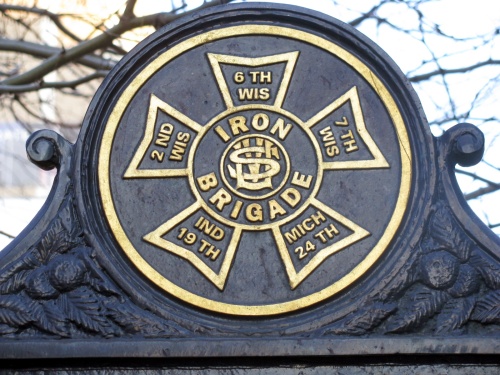
 Iron Brigade unit badge, a maltese cross design, showing the Wisconsin, Michigan, and Indiana, Union Army regiments, who were the core of the Brigade, on a historical marker, at Gettysburg National Military Park. | |
| Active | October 1861-June 1865 |
| Country |  United States United States |
| Allegiance | Union |
| Branch | Union Army |
| Type | Infantry |
| Size | Five regiments: 2nd Wisconsin Infantry Regiment 6th Wisconsin Infantry Regiment 7th Wisconsin Infantry Regiment 19th Indiana Infantry Regiment 24th Michigan Infantry Regiment |
| Nicknames | The Black Hats, Black Hat Brigade, Iron Brigade of the West, King's Wisconsin Brigade |
| Engagements | American Civil War |
| Commanders | |
| Notable commanders | Brig. Gen. Rufus King Brig. Gen. John Gibbon Brig. Gen. Solomon Meredith Col. William W. Robinson Brig. Gen. Edward S. Bragg |
The Iron Brigade, also known as The Black Hats, Black Hat Brigade, Iron Brigade of the West, and originally King's Wisconsin Brigade, was an infantry brigade in the Union Army of the Potomac during the American Civil War. Although it fought entirely in the Eastern Theater, it was composed of regiments from three Western states that are now within the region of the Midwest: Wisconsin, Indiana, and Michigan. Noted for its excellent discipline, ferocity in battle, and extraordinarily strong morale, the Iron Brigade suffered a higher percentage of soldiers killed in combat or from battle wounds than any other brigade in the Union army during the war.[1]
The nickname "Iron Brigade," with its connotation of fighting men with iron dispositions, was applied formally or informally to a number of units in the Civil War and in later conflicts. The Iron Brigade of the West was the unit that received the most lasting publicity in its use of the nickname.
The brigade fought in the battles of Second Bull Run, South Mountain, Antietam, Fredericksburg, Chancellorsville, Gettysburg, Wilderness, Spotsylvania, Cold Harbor, Petersburg, Hatcher's Run, and Five Forks.[1] Due to significant casualties at Gettysburg, some eastern regiments were added to the Iron Brigade. For the rest of the war, it was not an all-Western brigade.[1]
Nickname
[edit]The Iron Brigade initially consisted of the 2nd, 6th, and 7th Wisconsin Volunteer Infantry Regiments, the 19th Indiana, Battery B of the 4th U.S. Light Artillery, and was later joined by the 24th Michigan. This particular composition of men, from the three Western states, led it to be sometimes referred to as the "Iron Brigade of the West". They were known throughout the war as the "Black Hats" because they wore the black 1858 model Hardee hats issued to Army regulars, rather than the blue forage caps worn by most other Union Army volunteer units.
The all-Western brigade, composed of Wisconsin, Michigan and Indiana troops, earned their famous nickname, while under the command of Brig. Gen. John Gibbon, who led the brigade into its first battle. On August 28, 1862, during the preliminary phases of the Second Battle of Bull Run, it stood up against attacks from a superior force under Maj. Gen Thomas J. "Stonewall" Jackson at Brawner's Farm, during the waning hours of August 28, 1862. The brigade lost 800 casualties, the 2nd Wisconsin losing 276 out of 430 who went into the fight, and at least half of their wounded being shot twice.[2]
The designation "Iron Brigade" is said to have originated during the brigade's action at Turners Gap, during the Battle of South Mountain, a prelude to the Battle of Antietam in September 1862. Maj. Gen. Joseph Hooker, commanding I Corps, approached Army of the Potomac commander Maj. Gen. George B. McClellan, seeking orders. As the Western men advanced up the National Road, forcing the Confederate line back to the gap, McClellan asked, "What troops are those fighting in the Pike?" Hooker replied, "[Brigadier] General Gibbon's brigade of Western men." McClellan stated, "They must be made of iron."[2]
Hooker said that the brigade had performed even more superbly at Second Bull Run. To this, McClellan said that the brigade consisted of the "best troops in the world". Hooker supposedly was elated and rode off without his orders. There are a few stories related to the origin, but the men immediately adopted the name, which was quickly used in print after South Mountain.[2]
History
[edit]


The unit that eventually became known as the Iron Brigade was activated on October 1, 1861, upon the arrival in Washington, D.C., of the 7th Wisconsin. It was combined into a brigade with the 2nd and 6th Wisconsin, and the 19th Indiana, under the command of Brig. Gen. Rufus King and were originally known as King's Wisconsin Brigade. The governor of Wisconsin, Alexander Randall, had hoped to see the formation of an entirely Wisconsin brigade, but the Army unwittingly frustrated his plans by transferring the 5th Wisconsin from King's brigade and including the Hoosiers instead.[3] This brigade was initially designated the 3rd Brigade of Maj. Gen. Irvin McDowell's division of the Army of the Potomac, and then the 3rd Brigade, I Corps.[4]
McDowell's I Corps did not join the bulk of the Army of the Potomac in the Peninsula Campaign. In June 1862 it was reflagged the III Corps of Maj. Gen. John Pope's Army of Virginia. Now under the command of John Gibbon, a regular Army officer from North Carolina who chose to stay with the Union,[5] King's brigade was reflagged the 4th Brigade, 1st Division, III Corps, and it saw its first combat in the Northern Virginia Campaign, fighting at Brawner's Farm, August 28, 1862, where they received their deadly baptism of fire. Gibbon's brigade lost 725 men out of 1,900, the 2nd Wisconsin losing 276 out of 430 men. Almost immediately following the Union defeat in the Second Battle of Bull Run, the III Corps was transferred back to the Army of the Potomac and redesignated the I Corps, under the command of Joseph Hooker. Gibbon's brigade was reflagged yet again, becoming the 4th Brigade, 1st Division, I Corps.[6]
The brigade next went into action at The Battle of South Mountain, September 14, 1862, where they received their coveted nickname. Then again at the Battle of Antietam, September 17, 1862, where the brigade was heavily engaged in the cornfield. Of the 800 men of the Iron Brigade engaged at Antietam, 343 were killed or wounded. The 6th Wisconsin lost 150 out of the 280 men they brought into battle that day.
The 24th Michigan Volunteer Infantry Regiment joined the brigade on October 8, 1862, prior to the Battle of Fredericksburg in December. The Iron Brigade was not heavily engaged in the battle of Fredericksburg, besides for some minor actions by the 24th Michigan. In April, 1863 the Iron Brigade would raid Port Royal, Virginia with the 24th Michigan taking the lead during the raid, losing no casualties during the raid. On February 27, 1863, the brigade, now under the command of Brig. Gen. Solomon Meredith, was redesignated the 1st Brigade, 1st Division, I Corps. The 6th Wisconsin and the 24th Michigan took part in the attacks at Fitzhugh's Crossing, April 29, 1863, losing a combined total casualty list of 58.
The brigade took pride in its designation, "1st Brigade, 1st Division, I Corps", under which it played a prominent role in the first day of the Battle of Gettysburg, July 1, 1863. It repulsed the first Confederate offensive through Herbst's Woods, led by the 2nd Wisconsin, capturing much of Brig. Gen. James J. Archer's brigade, and Archer himself. The 6th Wisconsin, along with 100 men of the brigade guard, are remembered for their famous charge on an unfinished railroad cut north and west of the town, where they captured the flag of the 2nd Mississippi and took hundreds of Confederate prisoners.[7]
The rest of the Iron Brigade were counterattacked in the early afternoon of July 1. The Brigade initially held their ground against the rebel counterattack. The pressure was eventually too heavy, and the Brigade slowly fell back to Seminary Ridge. The Brigade survivors defended the north slope of Culp's Hill on July 2,3, where the 6th Wisconsin made a night counterattack to restore Union positions previously lost to Confederate troops. Out of the 1,883 men the Brigade initially went to battle with, only 671 reported for duty at the battle's end.
The Iron Brigade, proportionately, suffered the most casualties of any brigade in the Civil War. For example, 61%, 1,153 out of 1,885, were casualties at Gettysburg. Similarly, the 2nd Wisconsin, which suffered 77% casualties at Gettysburg, suffered the third highest total throughout the war. It was third behind the 24th Michigan, also an Iron Brigade regiment, as well as the 1st Minnesota in total casualties at Gettysburg. The Michigan regiment lost 397 out of 496 soldiers, an 80% casualty rate. The 1st Minnesota suffered the highest casualty percentage of any Union regiment in a single Civil War engagement during the battle of Gettysburg, losing 216 out of 262 men (82%). Due to the losses the brigade sustained in the Gettysburg campaign the 1st Battalion, New York Volunteer Sharpshooters were attached to the brigade to add some much needed manpower.
In early 1864, the 7th Indiana Infantry Regiment was transferred from the 2nd Brigade to the Iron Brigade. While the rest of the brigade considered the New York Sharpshooters and the 7th Indiana as of the Iron Brigade, they were never considered “in” the brigade, with the veterans considering those “in” the brigade being members of the five regiments that fought together at Gettysburg. The brigade fought in the bloody Overland campaign of 1864, and took part in the siege of Petersburg for the rest of the war. On October 31, 1864, the Iron Brigade and the Keystone Brigade were consolidated until the Pennsylvanians were ordered to Camp Elmira for provost duty.
The 19th Indiana was eventually transferred to the 20th Indiana Infantry Regiment in October, 1864. The 2nd Wisconsin left the brigade once they mustered out in 1864. The 24th Michigan was transferred up north to Camp Butler (Illinois) for guard duty in February, 1865. The 6th Wisconsin and 7th Wisconsin fought together until the end of the war. The 24th Michigan was selected to be the honor guard for the Funeral of Abraham Lincoln in Springfield, Illinois.
In June 1865, the units of the surviving brigade were separated and reassigned to the Army of the Tennessee.
The last surviving member of the Iron Brigade, Josiah E. Cass of Eau Claire, Wisconsin, died on 2 December 1947, from a fractured hip suffered in a fall. He was 100 years old.[8]
-
 24th Michigan Monument, Gettysburg National Military Park
 -
 The Iron Brigade prepared for battle, at Gettysburg, by anchoring the Union Army's southern flank, 10:00–10:45 a.m., on Day 1.
 -
 Death of General John F. Reynolds as he supervised the deployment of the Iron Brigade early on the first day of the Battle of Gettysburg


Commanders
[edit]The brigade commanders, disregarding temporary assignments, were:
Brig. Gen. Rufus King: September 28, 1861 – May 7, 1862
Brig. Gen. John Gibbon: May 7, 1862 – November 4, 1862
Brig. Gen. Solomon Meredith: November 25, 1862 – July 1, 1863 (wounded at Gettysburg)
The Iron Brigade lost its all-Western status on July 16, 1863, following its crippling losses at Gettysburg, when the 167th Pennsylvania was incorporated into it, and a company of New York sharpshooters. On October 31, 1864, the Keystone Brigade was consolidated with the Iron Brigade as well. The brigade that succeeded it, which included the survivors of the Iron Brigade, was commanded by:
Col. William W. Robinson (of the 7th Wisconsin): July 1, 1863 – March 25, 1864
Brig. Gen. Lysander Cutler (6th Wisconsin): March 25, 1864 – May 6, 1864
Col. William W. Robinson: May 6, 1864 – June 7, 1864
Brig. Gen. Edward S. Bragg (6th Wisconsin): June 7, 1864 – February 10, 1865
Col. John A. Kellogg (6th Wisconsin): February 28, 1865 – April 27, 1865
Col. (BVT BG) Henry A. Morrow (24th Michigan): April 27, 1865 – June 5, 1865
Uniforms
[edit] |


The Iron Brigade was noted for consistently wearing the dress uniform of the US Army. While many Union regiments were issued the dress uniform and wore it from time to time, much of the Iron Brigade wore it on campaign and in combat.[9] It consisted of:
A Hardee black hat: A tall blocked, brimmed black hat, featuring a brass infantry bugle, a red I Corps circle patch and brass numbers/letters of the front to indicate units and companies. A brass eagle badge on the side used to hold the brim up in a slouch, and finally an ostrich feather plume.[9]
Union frock coat: A long, dark blue coat that came down to the mid thighs, resembling that of an officers coat. Fitted with a single breasted row of nine brass buttons, each with the federal eagle on them. The cuffs and collars had light blue trimming and two smaller brass buttons on the cuffs. The inside of the coat was lined with cotton to make a better fit.
Light/dark blue trousers: depending on the period of the war and unit, trousers versed from light, sky blue to a dark blue the same colour as the coat. The trouser extended from the mid waist down to the ankles and had a pocket on either side.
White canvas gaiter: white canvas leggings with leather straps to prevent stones and dirt getting into the shoes whilst in the field.
All other equipment not mentioned included standard field equipment of the Union army consisting of canteens, belts, cartridge box, bayonet and scabbard, haversack and other various items of kit.
Weapons
[edit]The Springfield Model 1861 rifled musket, firing the .58 caliber projectile, was issued to the 6th Wisconsin, 19th Indiana, and 24th Michigan regiments. This single-shot, muzzle loading, percussion cap rifle weighed nine pounds with a barrel length of forty inches. It was the most widely issued infantry weapon used by Federal troops. The Second and Seventh Wisconsin used the Lorenz Rifle.
"On the Union side, continental European firearms were mostly distributed to the Western armies--as such, the Lorenz Rifle was relatively uncommon in the Army of the Potomac (although two regiments of the famous Iron Brigade carried them) but heavily used by the Army of the Cumberland and Army of Tennessee.
Other Iron Brigades
[edit]Eastern Iron Brigade
Shelby's Iron Brigade
Union Army
[edit]There have been other brigades known by the same name. Another brigade in the Army of the Potomac had previously been known as the Iron Brigade, later the "Iron Brigade of the East" or "First Iron Brigade", to avoid confusion. This unit was the 1st Brigade, 1st Division, I Corps, also known as Merideth's Brigade. It consisted of the 22nd New York, 24th New York, 30th New York, 14th Regiment (New York State Militia), and 2nd U.S. Sharpshooters. Although this Iron Brigade of the East served in the same infantry division as the Iron Brigade of the West, press attention focused primarily on the latter. Most of the Eastern regiments were mustered out before the Battle of Gettysburg, where the remaining Eastern Iron Brigade Regiments and the Iron Brigade of the West arguably achieved their greatest fame.
Recent scholarship[10] identifies two other brigades referred to by their members or others as "The Iron Brigade": 3rd Brigade, 1st Division, III Corps (17th Maine, 3rd Michigan, 5th Michigan, 1st, 37th, and 101st New York) Reno's Brigade from the North Carolina expedition (21st and 35th Massachusetts, 51st Pennsylvania, and 51st New York)
The Horn Brigade, a unit serving in the Western Theater, was known as the "Iron Brigade of the Army of the Cumberland."[11]
Confederate Army — Shelby's Iron Brigade
[edit]Shelby's Iron Brigade was a Confederate cavalry brigade also known as the "Missouri Iron Brigade". The Confederate Iron Brigade was part of the division, commanded by Brig. Gen. Joseph O. "Jo" Shelby, in the Army of Arkansas and fought in Maj. Gen. Sterling Price's Missouri Expedition, in 1864.
Modern U.S. Army
[edit]The 2nd Brigade of the U.S. Army's 1st Armored Division has carried the Iron Brigade moniker since 1985 and was previously called the "Black Hat" Brigade.
The 3d Brigade Combat Team, 1st Infantry Division was known as the Iron Brigade from its formation in 1917 through World War I, World War II and Vietnam, until some time in the early 2000s when, for reasons that are still unclear, the name was changed to Duke Brigade. The unit crest was an Iron Cross in a triangle, it appears that that was also changed.
The 3rd Brigade of the 4th Infantry Division is also known as the Iron Brigade. Its unit crest is similar to the medals issued to veterans of both the Western and the Eastern Iron Brigades of the Army of the Potomac.[12]
The 1st Heavy Brigade Combat Team of the 2d Infantry Division is known as the Iron Brigade as well. Located at Camp Casey, South Korea, the brigade has a critical role of military deterrence on the Korean Peninsula.
The 2nd Brigade of the 3d Armored Division (Spearhead), formerly stationed on Coleman Kaserne in Gelnhausen, Germany.
The 157th Maneuver Enhancement Brigade, also known as the Iron Brigade, is based out of Milwaukee, Wisconsin. It was formerly known as the 57th Field Artillery Brigade, at which time its subordinate organizations included the 1st Battalion, 126th Field Artillery Regiment and the 1st Battalion, 121st Field Artillery Regiment from the Wisconsin Army National Guard, plus the 1st Battalion, 182d Field Artillery Regiment of the Michigan Army National Guard. Not to be confused with the famous "Iron Brigade" of the Civil War, the 57th Field Artillery Brigade is also known as the "Iron Brigade," a nickname traditionally given to crack artillery units in the Civil War. It was during World War I that the 57th Field Artillery Brigade earned its nickname as it spent many hours at the front and fired more artillery rounds than any brigade in the American Army.
The 32d Infantry Division was an infantry division of the United States Army National Guard that fought primarily during World War I and World War II. It was formed with units from the states of Wisconsin and Michigan. With roots as the Iron Brigade in the American Civil War, the division's ancestral units came to be referred to as the Iron Jaw Division. The division was briefly called up during the Berlin Crisis in 1961.
In 1967, the division was deactivated and reconstituted the 32d Infantry Brigade of the Wisconsin Army National Guard. It was reorganized in 2007 as the 32d Infantry Brigade Combat Team. The shoulder sleeve insignia currently worn is a red line shot through with a red arrow, giving them the nickname Red Arrow Brigade, which was earned in World War I where the 32d Division was fighting the Germans alongside the French, who noted the unit's tenacity by punching through the German lines, like an arrow and calling the unit Les Terribles, meaning The Terrors.
Sports
[edit]The name "Iron Brigade" has also been used to describe the offensive line of the University of Wisconsin Badger Football Team. The line is known for its size, strength, and dedication to the protection of the backfield. The Badgers play in Camp Randall Stadium, a site used to train Wisconsin volunteers during the Civil War.[13][14]
Notes
[edit]- ^ a b c Klement, Frank L. (1997). Wisconsin in the Civil War. Madison: The State Historical Society of Wisonsin. pp. 43–51. ISBN 0-87020-286-3.
- ^ a b c Herdegen, p. 244.
- ^ Nolan, p. 28.
- ^ Eicher, p. 334.
- ^ Dorsey, p. 50.
- ^ Nolan, p. 114.
- ^ Herdegen, Beaudot, p. 207.
- ^ Associated Press, "Last Survivor Dies", The Spokesman-Review, Spokane, Washington, Wednesday 3 December 1947, Volume 65, Number 203, page 2.
- ^ a b Vine, Marcus (2022-05-10). "Forces of Fame: The Iron Brigade". Warlord Community. Retrieved 2023-05-05.
- ^ Clemens, Tom, Will the Real Iron Brigade Please Stand Up? (August 2000 presentation to the Richmond, Virginia, Civil War Round Table.)
- ^ War Department, United States. Official Records of the War of the Rebellion, Volume XXX(1). Washington.
- ^ See unit crest illustration at GlobalSecurity.org
- ^ Peterson, Tim (2020-10-31). "What Role Did Camp Randall Play In The Civil War?". Wisconsin Public Radio. Retrieved 2022-02-16.
- ^ "Confederate Prisoners at Camp Randall as Seen in Newspaper Articles". Wisconsin Historical Society. 2012-10-03. Retrieved 2022-02-16.
References
[edit]- Beaudot, William J. K., and Herdegen, Lance J., In the Bloody Railroad Cut at Gettysburg, Morningside, 1990, ISBN 978-0-89029-535-9.
- Dorsey, Chris "Of Iron and Stone: A Comparison of the Iron and Stonewall Brigades," The Journal of America's Military Past, (Winter, 2001); 48–67.
- Eicher, John H., and Eicher, David J., Civil War High Commands, Stanford University Press, 2001, ISBN 0-8047-3641-3.
- Fox, William F., Regimental Losses in the American Civil War, reprinted by Morningside Bookshop, Dayton, Ohio, 1993, ISBN 0-685-72194-9.
- Herdegen, Lance J., The Men Stood Like Iron: How the Iron Brigade Won Its Name, Indiana University Press, 1997, ISBN 0-253-33221-4.
- Nolan, Alan T., The Iron Brigade, A Military History, Indiana University Press, 1961, ISBN 0-253-34102-7.
Further reading
[edit]- Herdegen, Lance J., Those Damned Black Hats! The Iron Brigade in the Gettysburg Campaign. Savas, 2008. ISBN 978-1-932714-48-7
- Magnusen, Steven R., "To My Best Girl - The Inspiring Life Stories of Rufus Dawes (Iron Brigade) and Mary Gates", GoToPublish 2020. ISBN 978-1-64749-092-8.
- Madaus, Howard Michael & Richard Zeitlin. "The Flags of the Iron Brigade". Wisconsin Magazine of History, vol. 69, no. 1 (Autumn 1985):3-35.
- Wert, Jeffry D., A Brotherhood of Valor: The Common Soldiers of the Stonewall Brigade, C.S.A., and the Iron Brigade, U.S.A.. Touchstone, 1999. ISBN 978-0-684-86244-6
- Zeitlin, Richard. "Beyond the Battle: The Flags of the Iron Brigade, 1863-1918". Wisconsin Magazine of History, vol. 69, no. 1 (Autumn 1985):36-66.
External links
[edit]- Iron Brigade website
- Flags of the First Day: An Online Exhibit of Iron Brigade and Confederate battle flags from July 1, 1863 Archived March 16, 2011, at the Wayback Machine: (Civil War Trust)
| Engagements |
| ||||||||
|---|---|---|---|---|---|---|---|---|---|
| Confederate commanders | |||||||||
| Union commanders | |||||||||
| Army of the Potomac (order of battle) | |||||||||
| Army of Northern Virginia (order of battle) | |||||||||
| Campaign geography | |||||||||

Iron Brigade
View on GrokipediaThe Iron Brigade, also known as the Iron Brigade of the West, was an elite infantry brigade in the Union Army during the American Civil War, comprising volunteer regiments from Wisconsin (2nd, 6th, and 7th), Indiana (19th), and later Michigan (24th), along with Battery B of the 4th U.S. Artillery.[1][2] Organized in 1861 under Brigadier General Rufus King as the only all-Western brigade in the Eastern Theater, it served primarily in the Army of the Potomac's I Corps and gained distinction for its rigorous discipline, aggressive combat style, and retention of the black Model 1858 Hardee hats as a mark of veteran status.[1][3] Commanded successively by leaders including John Gibbon, the brigade earned its sobriquet "Iron Brigade" following its resolute stand at the Battle of South Mountain on September 14, 1862, where its endurance under fire prompted admiring references to its iron-like qualities.[1][2] It played pivotal roles in critical engagements such as the delaying action at Brawner's Farm before Second Bull Run, spearheading assaults at Antietam, and anchoring the Union defense on the first day at Gettysburg, where it reinforced dismounted cavalry and inflicted heavy losses on Confederate forces despite sustaining 61% casualties (1,153 of 1,883 engaged).[1][2] The unit's defining characteristics included high morale sustained through shared Western origins and frontline tenacity, contributing to victories in later campaigns like the Overland and Petersburg sieges leading to Appomattox.[2] Over the course of the war, the Iron Brigade endured the highest proportional losses of any Union brigade, with 1,131 men killed out of approximately 7,673 total enrolled—a fatality rate of 14.7%—reflecting its repeated exposure to intense combat rather than any deficiency in leadership or training.[2][3] This record underscored its reputation as one of the Union's premier fighting formations, with seven Medals of Honor awarded to its members for valor in action.[2] The brigade was disbanded on July 12, 1865, after mustering out its surviving elements.[2]
Origins and Formation
Pre-War Roots and Recruitment
The regiments that would form the core of the Iron Brigade originated as volunteer units raised in the Midwestern states during the spring and summer of 1861, in direct response to President Abraham Lincoln's April 15 call for 75,000 three-month volunteers following the Confederate attack on Fort Sumter on April 12.[4] This initial mobilization proved insufficient as the war escalated, prompting a second call on May 3 for 300,000 three-year enlistees, which state governors met by organizing new infantry regiments from civilian volunteers rather than established militia units.[5] Pre-war military experience among recruits was limited, as Midwestern states like Wisconsin and Indiana maintained only rudimentary militia systems focused on local defense and lacking rigorous training; most enlistees were thus farmers, laborers, and tradesmen drawn by patriotic appeals, adventure, or opposition to slavery, with recruitment drives emphasizing rapid mustering to defend the Union.[1] In Wisconsin, Governor Alexander Randall authorized the formation of three-year regiments shortly after the first call, leading to statewide volunteer drives where men enlisted at county courthouses, armories, and public rallies. The 2nd Wisconsin Infantry, the first such unit, drew companies from across the state—including rural areas like Milwaukee, Racine, and Fond du Lac counties—and assembled approximately 1,051 officers and men at Camp Randall in Madison for basic drill before mustering into federal service on June 11, 1861.[5][6] The 6th and 7th Wisconsin followed in July 1861, similarly recruited from diverse immigrant-heavy and farming communities, with the 6th mustering around 1,000 men on July 16 at Camp Randall after volunteers responded to gubernatorial proclamations promising pay and equipment.[7] These units reflected Wisconsin's demographic mix, including significant German-American populations motivated by anti-secessionist sentiments, though enlistment was voluntary and uncompelled by drafts until later in the war.[8] The 19th Indiana Infantry, the brigade's Hoosier component, was organized at Indianapolis under Governor Oliver P. Morton's mobilization efforts, with recruitment targeting central and northern Indiana counties through similar public meetings and newspaper appeals. Approximately 1,000 volunteers—primarily young agrarian workers and small-town residents—enlisted in late spring and early summer 1861, mustering into service on July 29 before departing for Washington, D.C., on August 5.[9] Like its Wisconsin counterparts, the 19th had negligible pre-war militia ties, forming instead from ad hoc companies of civilians eager to preserve the Union amid fears of Southern expansionism, with no bounties or conscription required at this stage.[10] This pattern of grassroots, enthusiasm-driven recruitment underscored the regiments' civilian origins, setting the stage for their later forging into a cohesive, battle-tested force despite initial inexperience.[11]Assembly and Initial Organization
The Iron Brigade was assembled during the summer of 1861 in Washington, D.C., as a provisional brigade of Western volunteer regiments assigned to the Union Army of the Potomac. Brigadier General Rufus King, a 1833 United States Military Academy graduate and Milwaukee newspaper editor, was commissioned on May 17, 1861, and tasked with organizing and commanding these units, which were distinct for being the only all-Western infantry brigade in the Eastern Theater.[1][12] The brigade's formation became official on August 9, 1861, under orders from Major General George B. McClellan, then commander of the Army of the Potomac.[13] Initial assembly centered on regiments from Wisconsin and Indiana that had recently arrived in the capital. The 2nd Wisconsin Infantry Regiment, mustered into federal service at Camp Randall in Madison on June 11, 1861, departed for Washington on June 20–25 and formed the nucleus of the brigade.[4][5] The 6th Wisconsin Infantry Regiment, organized at the same camp and mustered on July 16, 1861, followed on July 28, joining King's command shortly thereafter.[7][14] The 19th Indiana Infantry Regiment, mustered at Camp Morton in Indianapolis on July 29, 1861, was attached early, providing the brigade's sole non-Wisconsin element at inception.[1] The 5th Wisconsin Infantry briefly served in the brigade during early organization but was replaced in August 1861 by the 7th Wisconsin Infantry Regiment, mustered on September 2, 1861, at Camp Randall before departing for Washington.[1][15] Structurally, the brigade operated under King's direct command as part of the broader defenses of Washington, with regiments initially equipped in state-issued gray uniforms transitioning to standard federal blue by late summer 1861.[1] In December 1861, Battery B of the 4th United States Artillery, armed with six 12-pound Napoleon guns, was attached for artillery support, enhancing the brigade's capabilities in the provisional organization.[1] This configuration positioned the brigade for integration into Major General Irvin McDowell's I Corps, emphasizing disciplined infantry tactics suited to the regiment's Midwestern recruits, many of whom were farmers and laborers hardened by frontier life.[1] King's leadership focused on drilling the units to regular army standards, fostering the cohesion that later defined the brigade's reputation.[12]Leadership and Structure
Primary Commanders
The Iron Brigade was formed under the command of Brigadier General Rufus King, who led it from September 28, 1861, to May 7, 1862. King organized the brigade from Western volunteer regiments, including those from Wisconsin, Indiana, and later Michigan, and positioned it for the defense of Washington, D.C., emphasizing early training and cohesion.[13][1] Command passed to Brigadier General John Gibbon on May 7, 1862, following King's elevation to division command; Gibbon retained leadership until November 4, 1862. A career Regular Army officer previously in artillery, Gibbon enforced strict discipline and drill on the brigade's volunteers, overcoming initial resistance to forge a professional fighting force. Under Gibbon, the brigade fought at Groveton (August 28, 1862, with approximately 800 casualties), South Mountain (September 14, 1862, earning the "Iron Brigade" nickname from heavy but resolute combat), Antietam (September 17, 1862), and Fredericksburg (December 13, 1862). His tactical acumen and demands for precision established the unit's reputation for endurance and reliability in the Army of the Potomac.[16][13][1] Brigadier General Solomon Meredith assumed command on November 25, 1862, and led the brigade until July 1, 1863. Meredith, a former colonel of the 19th Indiana Infantry within the brigade, had been wounded at Groveton but recovered to direct operations at Chancellorsville (May 1863) and notably at Gettysburg (July 1, 1863), where the brigade delayed Confederate advances on McPherson Ridge, suffering 1,153 casualties from 1,883 engaged—a 61% loss rate—while inflicting significant enemy losses. His leadership preserved the brigade's aggressive posture amid attrition, though heavy casualties at Gettysburg marked the end of his tenure.[13][1] Later commanders, including Colonel William W. Robinson (July 1, 1863–March 25, 1864), Brigadier General Lysander Cutler (March 25–May 6, 1864), and Colonel Henry A. Morrow (April 27–June 5, 1865, leading the Grand Review), maintained the brigade through subsequent campaigns, but the foundational roles of King, Gibbon, and Meredith defined its character and combat effectiveness.[13][1]