



Community hub
Recent from talks
Contribute something
Nothing was collected or created yet.
Cohen's kappa
View on WikipediaCohen's kappa coefficient ('κ', lowercase Greek kappa) is a statistic that is used to measure inter-rater reliability for qualitative (categorical) items.[1] It is generally thought to be a more robust measure than simple percent agreement calculation, as κ incorporates the possibility of the agreement occurring by chance. There is controversy surrounding Cohen's kappa due to the difficulty in interpreting indices of agreement. Some researchers have suggested that it is conceptually simpler to evaluate disagreement between items.[2]
History
[edit]The first mention of a kappa-like statistic is attributed to Galton in 1892.[3][4]
The seminal paper introducing kappa as a new technique was published by Jacob Cohen in the journal Educational and Psychological Measurement in 1960.[5]
Definition
[edit]Cohen's kappa measures the agreement between two raters who each classify N items into C mutually exclusive categories. The definition of is


where po is the relative observed agreement among raters, and pe is the hypothetical probability of chance agreement, using the observed data to calculate the probabilities of each observer randomly selecting each category. If the raters are in complete agreement then . If there is no agreement among the raters other than what would be expected by chance (as given by pe), . It is possible for the statistic to be negative,[6] which can occur by chance if there is no relationship between the ratings of the two raters, or it may reflect a real tendency of the raters to give differing ratings.


For k categories, N observations to categorize and the number of times rater i predicted category k:

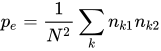
This is derived from the following construction:

Where is the estimated probability that both rater 1 and rater 2 will classify the same item as k, while is the estimated probability that rater 1 will classify an item as k (and similarly for rater 2). The relation is based on using the assumption that the rating of the two raters are independent. The term is estimated by using the number of items classified as k by rater 1 () divided by the total items to classify (): (and similarly for rater 2).





Binary classification confusion matrix
[edit]In the traditional 2 × 2 confusion matrix employed in machine learning and statistics to evaluate binary classifications, the Cohen's Kappa formula can be written as:[7]

where TP are the true positives, FP are the false positives, TN are the true negatives, and FN are the false negatives. In this case, Cohen's Kappa is equivalent to the Heidke skill score known in Meteorology.[8] The measure was first introduced by Myrick Haskell Doolittle in 1888.[9]
Examples
[edit]Simple example
[edit]Suppose that you were analyzing data related to a group of 50 people applying for a grant. Each grant proposal was read by two readers and each reader either said "Yes" or "No" to the proposal. Suppose the disagreement count data were as follows, where A and B are readers, data on the main diagonal of the matrix (a and d) count the number of agreements and off-diagonal data (b and c) count the number of disagreements:
B A
|
Yes | No |
|---|---|---|
| Yes | a | b |
| No | c | d |
e.g.
B A
|
Yes | No |
|---|---|---|
| Yes | 20 | 5 |
| No | 10 | 15 |
The observed proportionate agreement is:

To calculate pe (the probability of random agreement) we note that:
- Reader A said "Yes" to 25 applicants and "No" to 25 applicants. Thus reader A said "Yes" 50% of the time.
- Reader B said "Yes" to 30 applicants and "No" to 20 applicants. Thus reader B said "Yes" 60% of the time.
So the expected probability that both would say yes at random is:

Similarly:

Overall random agreement probability is the probability that they agreed on either Yes or No, i.e.:

So now applying our formula for Cohen's Kappa we get:

Same percentages but different numbers
[edit]A case sometimes considered to be a problem with Cohen's Kappa occurs when comparing the Kappa calculated for two pairs of raters with the two raters in each pair having the same percentage agreement but one pair give a similar number of ratings in each class while the other pair give a very different number of ratings in each class.[10] (In the cases below, notice B has 70 yeses and 30 nos, in the first case, but those numbers are reversed in the second.) For instance, in the following two cases there is equal agreement between A and B (60 out of 100 in both cases) in terms of agreement in each class, so we would expect the relative values of Cohen's Kappa to reflect this. However, calculating Cohen's Kappa for each:
B A
|
Yes | No |
|---|---|---|
| Yes | 45 | 15 |
| No | 25 | 15 |

B A
|
Yes | No |
|---|---|---|
| Yes | 25 | 35 |
| No | 5 | 35 |
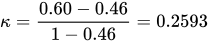
we find that it shows greater similarity between A and B in the second case, compared to the first. This is because while the percentage agreement is the same, the percentage agreement that would occur 'by chance' is significantly higher in the first case (0.54 compared to 0.46).
Properties
[edit]Hypothesis testing and confidence interval
[edit]P-value for kappa is rarely reported, probably because even relatively low values of kappa can nonetheless be significantly different from zero but not of sufficient magnitude to satisfy investigators.[11]: 66 Still, its standard error has been described[12] and is computed by various computer programs.[13]
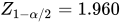
Confidence intervals for Kappa may be constructed, for the expected Kappa values if we had infinite number of items checked, using the following formula:[1]

Where is the standard normal percentile when , and is calculated by jackknife, bootstrap or the asymptotic formula described by Fleiss & Cohen.[12]


Interpreting magnitude
[edit]
If statistical significance is not a useful guide, what magnitude of kappa reflects adequate agreement? Guidelines would be helpful, but factors other than agreement can influence its magnitude, which makes interpretation of a given magnitude problematic. As Sim and Wright noted, two important factors are prevalence (are the codes equiprobable or do their probabilities vary) and bias (are the marginal probabilities for the two observers similar or different). Other things being equal, kappas are higher when codes are equiprobable. On the other hand, Kappas are higher when codes are distributed asymmetrically by the two observers. In contrast to probability variations, the effect of bias is greater when Kappa is small than when it is large.[14]: 261–262
Another factor is the number of codes. As number of codes increases, kappas become higher. Based on a simulation study, Bakeman and colleagues concluded that for fallible observers, values for kappa were lower when codes were fewer. And, in agreement with Sim & Wrights's statement concerning prevalence, kappas were higher when codes were roughly equiprobable. Thus Bakeman et al. concluded that "no one value of kappa can be regarded as universally acceptable."[15]: 357 They also provide a computer program that lets users compute values for kappa specifying number of codes, their probability, and observer accuracy. For example, given equiprobable codes and observers who are 85% accurate, value of kappa are 0.49, 0.60, 0.66, and 0.69 when number of codes is 2, 3, 5, and 10, respectively.
Nonetheless, magnitude guidelines have appeared in the literature. Perhaps the first was Landis and Koch,[16] who characterized values < 0 as indicating no agreement and 0–0.20 as slight, 0.21–0.40 as fair, 0.41–0.60 as moderate, 0.61–0.80 as substantial, and 0.81–1 as almost perfect agreement. This set of guidelines is however by no means universally accepted; Landis and Koch supplied no evidence to support it, basing it instead on personal opinion. It has been noted that these guidelines may be more harmful than helpful.[17] Fleiss's[18]: 218 equally arbitrary guidelines characterize kappas over 0.75 as excellent, 0.40 to 0.75 as fair to good, and below 0.40 as poor.
Kappa maximum
[edit]Kappa assumes its theoretical maximum value of 1 only when both observers distribute codes the same, that is, when corresponding row and column sums are identical. Anything less is less than perfect agreement. Still, the maximum value kappa could achieve given unequal distributions helps interpret the value of kappa actually obtained. The equation for κ maximum is:[19]
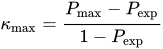
where , as usual, ,
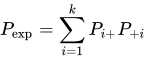

k = number of codes, are the row probabilities, and are the column probabilities.


Limitations
[edit]Kappa is an index that considers observed agreement with respect to a baseline agreement. However, investigators must consider carefully whether Kappa's baseline agreement is relevant for the particular research question. Kappa's baseline is frequently described as the agreement due to chance, which is only partially correct. Kappa's baseline agreement is the agreement that would be expected due to random allocation, given the quantities specified by the marginal totals of square contingency table. Thus, κ = 0 when the observed allocation is apparently random, regardless of the quantity disagreement as constrained by the marginal totals. However, for many applications, investigators should be more interested in the quantity disagreement in the marginal totals than in the allocation disagreement as described by the additional information on the diagonal of the square contingency table. Thus for many applications, Kappa's baseline is more distracting than enlightening. Consider the following example:

| Reference | |||
|---|---|---|---|
| G | R | ||
| Comparison | G | 1 | 14 |
| R | 0 | 1 | |
The disagreement proportion is 14/16 or 0.875. The disagreement is due to quantity because allocation is optimal. κ is 0.01.
| Reference | |||
|---|---|---|---|
| G | R | ||
| Comparison | G | 0 | 1 |
| R | 1 | 14 | |
The disagreement proportion is 2/16 or 0.125. The disagreement is due to allocation because quantities are identical. Kappa is −0.07.
Here, reporting quantity and allocation disagreement is informative while Kappa obscures information. Furthermore, Kappa introduces some challenges in calculation and interpretation because Kappa is a ratio. It is possible for Kappa's ratio to return an undefined value due to zero in the denominator. Furthermore, a ratio does not reveal its numerator nor its denominator. It is more informative for researchers to report disagreement in two components, quantity and allocation. These two components describe the relationship between the categories more clearly than a single summary statistic. When predictive accuracy is the goal, researchers can more easily begin to think about ways to improve a prediction by using two components of quantity and allocation, rather than one ratio of Kappa.[2]
Some researchers have expressed concern over κ's tendency to take the observed categories' frequencies as givens, which can make it unreliable for measuring agreement in situations such as the diagnosis of rare diseases. In these situations, κ tends to underestimate the agreement on the rare category.[20] For this reason, κ is considered an overly conservative measure of agreement.[21] Others[22][citation needed] contest the assertion that kappa "takes into account" chance agreement. To do this effectively would require an explicit model of how chance affects rater decisions. The so-called chance adjustment of kappa statistics supposes that, when not completely certain, raters simply guess—a very unrealistic scenario. Moreover, some works[23] have shown how kappa statistics can lead to a wrong conclusion for unbalanced data.
Related statistics
[edit]Scott's Pi
[edit]A similar statistic, called pi, was proposed by Scott (1955). Cohen's kappa and Scott's pi differ in terms of how pe is calculated.
Fleiss' kappa
[edit]Note that Cohen's kappa measures agreement between two raters only. For a similar measure of agreement (Fleiss' kappa) used when there are more than two raters, see Fleiss (1971). The Fleiss kappa, however, is a multi-rater generalization of Scott's pi statistic, not Cohen's kappa. Kappa is also used to compare performance in machine learning, but the directional version known as Informedness or Youden's J statistic is argued to be more appropriate for supervised learning.[24]
Weighted kappa
[edit]The weighted kappa allows disagreements to be weighted differently[25] and is especially useful when codes are ordered.[11]: 66 Three matrices are involved, the matrix of observed scores, the matrix of expected scores based on chance agreement, and the weight matrix. Weight matrix cells located on the diagonal (upper-left to bottom-right) represent agreement and thus contain zeros. Off-diagonal cells contain weights indicating the seriousness of that disagreement. Often, cells one off the diagonal are weighted 1, those two off 2, etc.
The equation for weighted κ is:
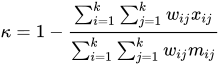
where k=number of codes and , , and are elements in the weight, observed, and expected matrices, respectively. When diagonal cells contain weights of 0 and all off-diagonal cells weights of 1, this formula produces the same value of kappa as the calculation given above.


See also
[edit]Further reading
[edit]- Banerjee, M.; Capozzoli, Michelle; McSweeney, Laura; Sinha, Debajyoti (1999). "Beyond Kappa: A Review of Interrater Agreement Measures". The Canadian Journal of Statistics. 27 (1): 3–23. doi:10.2307/3315487. JSTOR 3315487. S2CID 37082712.
- Chicco, D.; Warrens, M.J.; Jurman, G. (2021). "The Matthews correlation coefficient (MCC) is more informative than Cohen's Kappa and Brier score in binary classification assessment". IEEE Access. 9: 78368–81. Bibcode:2021IEEEA...978368C. doi:10.1109/access.2021.3084050. hdl:10281/430460. S2CID 235308708.
- Cohen, Jacob (1960). "A coefficient of agreement for nominal scales". Educational and Psychological Measurement. 20 (1): 37–46. doi:10.1177/001316446002000104. hdl:1942/28116. S2CID 15926286.
- Cohen, J. (1968). "Weighted kappa: Nominal scale agreement with provision for scaled disagreement or partial credit". Psychological Bulletin. 70 (4): 213–220. doi:10.1037/h0026256. PMID 19673146.
- Fleiss, J.L.; Cohen, J. (1973). "The equivalence of weighted kappa and the intraclass correlation coefficient as measures of reliability". Educational and Psychological Measurement. 33 (3): 613–9. doi:10.1177/001316447303300309. S2CID 145183399.
- Sim, J.; Wright, C.C. (2005). "The Kappa Statistic in Reliability Studies: Use, Interpretation, and Sample Size Requirements". Physical Therapy. 85 (3): 257–268. doi:10.1093/ptj/85.3.257. PMID 15733050.
- Warrens, J. (2011). "Cohen's kappa is a weighted average". Statistical Methodology. 8 (6): 473–484. doi:10.1016/j.stamet.2011.06.002. hdl:1887/18062.
External links
[edit]- Online Kappa Calculator
- Cohen's Kappa Statistic for Measuring Agreement with SAS example
References
[edit]- ^ a b McHugh, Mary L. (2012). "Interrater reliability: The kappa statistic". Biochemia Medica. 22 (3): 276–282. doi:10.11613/bm.2012.031. PMC 3900052. PMID 23092060.
- ^ a b Pontius, Robert; Millones, Marco (2011). "Death to Kappa: birth of quantity disagreement and allocation disagreement for accuracy assessment". International Journal of Remote Sensing. 32 (15): 4407–4429. Bibcode:2011IJRS...32.4407P. doi:10.1080/01431161.2011.552923. S2CID 62883674.
- ^ Galton, F. (1892) Finger Prints Macmillan, London.
- ^ Smeeton, N.C. (1985). "Early History of the Kappa Statistic". Biometrics. 41 (3): 795. JSTOR 2531300.
- ^ Cohen, Jacob (1960). "A coefficient of agreement for nominal scales". Educational and Psychological Measurement. 20 (1): 37–46. doi:10.1177/001316446002000104. hdl:1942/28116. S2CID 15926286.
- ^ Sim, Julius; Wright, Chris C. (2005). "The Kappa Statistic in Reliability Studies: Use, Interpretation, and Sample Size Requirements". Physical Therapy. 85 (3): 257–268. doi:10.1093/ptj/85.3.257. ISSN 1538-6724. PMID 15733050.
- ^ Chicco D.; Warrens M.J.; Jurman G. (June 2021). "The Matthews correlation coefficient (MCC) is more informative than Cohen's Kappa and Brier score in binary classification assessment". IEEE Access. 9: 78368 - 78381. Bibcode:2021IEEEA...978368C. doi:10.1109/ACCESS.2021.3084050. hdl:10281/430460.
- ^ Heidke, P. (1926-12-01). "Berechnung Des Erfolges Und Der Güte Der Windstärkevorhersagen Im Sturmwarnungsdienst". Geografiska Annaler. 8 (4): 301–349. doi:10.1080/20014422.1926.11881138. ISSN 2001-4422.
- ^ Philosophical Society of Washington (Washington, D.C.) (1887). Bulletin of the Philosophical Society of Washington. Vol. 10. Washington, D.C.: Published by the co-operation of the Smithsonian Institution. p. 83.
- ^ Kilem Gwet (May 2002). "Inter-Rater Reliability: Dependency on Trait Prevalence and Marginal Homogeneity" (PDF). Statistical Methods for Inter-Rater Reliability Assessment. 2: 1–10. Archived from the original (PDF) on 2011-07-07. Retrieved 2011-02-02.
- ^ a b Bakeman, R.; Gottman, J.M. (1997). Observing interaction: An introduction to sequential analysis (2nd ed.). Cambridge, UK: Cambridge University Press. ISBN 978-0-521-27593-4.
- ^ a b Fleiss, J.L.; Cohen, J.; Everitt, B.S. (1969). "Large sample standard errors of kappa and weighted kappa". Psychological Bulletin. 72 (5): 323–327. doi:10.1037/h0028106.
- ^ Robinson, B.F; Bakeman, R. (1998). "ComKappa: A Windows 95 program for calculating kappa and related statistics". Behavior Research Methods, Instruments, and Computers. 30 (4): 731–732. doi:10.3758/BF03209495.
- ^ Sim, J; Wright, C. C (2005). "The Kappa Statistic in Reliability Studies: Use, Interpretation, and Sample Size Requirements". Physical Therapy. 85 (3): 257–268. doi:10.1093/ptj/85.3.257. PMID 15733050.
- ^ Bakeman, R.; Quera, V.; McArthur, D.; Robinson, B. F. (1997). "Detecting sequential patterns and determining their reliability with fallible observers". Psychological Methods. 2 (4): 357–370. doi:10.1037/1082-989X.2.4.357.
- ^ Landis, J.R.; Koch, G.G. (1977). "The measurement of observer agreement for categorical data". Biometrics. 33 (1): 159–174. doi:10.2307/2529310. JSTOR 2529310. PMID 843571. S2CID 11077516.
- ^ Gwet, K. (2010). "Handbook of Inter-Rater Reliability (Second Edition)" ISBN 978-0-9708062-2-2 [page needed]
- ^ Fleiss, J.L. (1981). Statistical methods for rates and proportions (2nd ed.). New York: John Wiley. ISBN 978-0-471-26370-8.
- ^ Umesh, U. N.; Peterson, R.A.; Sauber M. H. (1989). "Interjudge agreement and the maximum value of kappa". Educational and Psychological Measurement. 49 (4): 835–850. doi:10.1177/001316448904900407. S2CID 123306239.
- ^ Viera, Anthony J.; Garrett, Joanne M. (2005). "Understanding interobserver agreement: the kappa statistic". Family Medicine. 37 (5): 360–363. PMID 15883903.
- ^ Strijbos, J.; Martens, R.; Prins, F.; Jochems, W. (2006). "Content analysis: What are they talking about?". Computers & Education. 46: 29–48. CiteSeerX 10.1.1.397.5780. doi:10.1016/j.compedu.2005.04.002. S2CID 14183447.
- ^ Uebersax, JS. (1987). "Diversity of decision-making models and the measurement of interrater agreement" (PDF). Psychological Bulletin. 101: 140–146. CiteSeerX 10.1.1.498.4965. doi:10.1037/0033-2909.101.1.140. S2CID 39240770. Archived from the original (PDF) on 2016-03-03. Retrieved 2010-10-16.
- ^ Delgado, Rosario; Tibau, Xavier-Andoni (2019-09-26). "Why Cohen's Kappa should be avoided as performance measure in classification". PLOS ONE. 14 (9) e0222916. Bibcode:2019PLoSO..1422916D. doi:10.1371/journal.pone.0222916. ISSN 1932-6203. PMC 6762152. PMID 31557204.
- ^ Powers, David M. W. (2012). "The Problem with Kappa" (PDF). Conference of the European Chapter of the Association for Computational Linguistics (EACL2012) Joint ROBUS-UNSUP Workshop. Archived from the original (PDF) on 2016-05-18. Retrieved 2012-07-20.
- ^ Cohen, J. (1968). "Weighed kappa: Nominal scale agreement with provision for scaled disagreement or partial credit". Psychological Bulletin. 70 (4): 213–220. doi:10.1037/h0026256. PMID 19673146.


Cohen's kappa
View on GrokipediaHistory and Background
Origins and Development
Jacob Cohen introduced the kappa statistic in 1960 as a measure of inter-rater agreement for nominal scales, publishing his seminal work in the journal Educational and Psychological Measurement.[1] In the paper titled "A Coefficient of Agreement for Nominal Scales," Cohen proposed kappa to quantify the level of agreement between two raters beyond what would be expected by chance alone.[1] Cohen's primary motivation stemmed from the recognized shortcomings of simple percentage agreement, a commonly used metric at the time that tended to overestimate true reliability by failing to adjust for agreements occurring purely by chance.[2] He argued that in scenarios involving categorical judgments, such as psychological assessments or educational evaluations, random concordance could inflate agreement rates, leading to misleading conclusions about rater consistency.[1] By subtracting the expected chance agreement from the observed agreement and normalizing it, kappa provided a more robust indicator of non-chance concordance.[2] Following its publication, Cohen's kappa saw rapid early adoption within the fields of psychology and education during the 1960s, particularly for assessing inter-rater reliability in observational and diagnostic studies.[2] Researchers in these disciplines began incorporating the statistic into reliability analyses for content coding, behavioral observations, and clinical judgments, addressing growing concerns over diagnostic consistency highlighted in psychological literature of the era.Historical Context
In the early 20th century, reliability studies in fields such as psychology and medicine predominantly employed simple percent agreement metrics to evaluate inter-rater consistency, calculating the proportion of cases where multiple observers assigned the same category or rating to a subject.[2] These approaches, rooted in basic descriptive statistics, were straightforward to compute and interpret but provided a superficial assessment of true rater alignment by treating all agreements equally, regardless of underlying patterns.[6] A notable advancement in handling binary data came with G. Udny Yule's 1912 introduction of the coefficient of association, designed to quantify the relationship between two attributes in contingency tables using the formula , where represent cell frequencies in a 2×2 table. However, this measure focused on overall association rather than specific agreement, and like percent agreement, it overlooked the role of chance in producing observed matches, potentially leading to misleading interpretations of rater reliability in categorical judgments.[6] Such shortcomings became increasingly evident as research demanded more nuanced tools for non-numeric data. The 1940s and 1950s marked a surge in inter-rater reliability assessments within clinical psychology and content analysis, driven by post-World War II expansions in mental health services and social science methodologies.[7] In clinical psychology, the Boulder Conference of 1949 formalized training standards that emphasized empirical validation of diagnostic practices, prompting studies on observer consistency in psychiatric evaluations amid growing concerns over subjective variability.[8] Similarly, content analysis emerged as a key technique in communication and sociology during this era, yet researchers faced criticism for the inability of simple agreement metrics to distinguish meaningful consensus from random overlap.[7] Pre-kappa challenges were particularly acute in diagnostic agreement studies, where percent agreement often overestimated rater concordance; for instance, 1950s psychiatric research reported observed agreements around 50% for symptom classifications, but these figures inflated true reliability since chance expectations under uneven category distributions could account for a substantial portion.[9] In medical contexts, similar issues arose in evaluating clinician judgments, where uncorrected metrics suggested higher diagnostic harmony than warranted, complicating efforts to standardize care.[2] These limitations underscored the need for chance-adjusted statistics to support reliable inference in observer-based research.Mathematical Formulation
General Formula
Cohen's kappa serves as a chance-corrected measure of inter-rater agreement for nominal categorical data, quantifying the level of agreement between two raters beyond what would be expected by random chance. The general formula, introduced by Jacob Cohen, is given by where represents the observed proportion of agreement between the raters, and denotes the expected proportion of agreement under chance.[1] In a contingency table, where is the number of nominal categories and is the count of observations classified as category by the first rater and category by the second rater, the observed agreement is computed as the relative frequency of exact matches along the diagonal: with being the total number of observations. This captures the proportion of items on which both raters agree.[1] The expected agreement accounts for chance by assuming independence between raters and using the marginal distributions: where the terms and are the marginal probabilities for category from each rater, respectively.[1] This formulation assumes two independent raters classifying the same set of items into mutually exclusive nominal categories, with fixed marginal totals derived from the observed data to estimate chance agreement.[1] The derivation begins with the contingency table summarizing rater classifications, from which agreement proportions are extracted; the chance correction subtracts from to isolate non-random agreement, and division by normalizes the result to range from -1 (perfect disagreement) to 1 (perfect agreement), emphasizing the adjustment for baseline chance levels inherent in the marginal distributions.[1]Binary Classification Case
In the binary classification case, Cohen's kappa specializes the general measure of inter-rater agreement to scenarios with two categories, often labeled as "positive" and "negative," using a 2×2 contingency table to capture observed agreements and disagreements between two raters or between a classifier and reference standard.[1] This setup is particularly common in fields like medical diagnostics, where outcomes are dichotomous, such as disease presence or absence. The contingency table is laid out with rows representing the classifications by the first rater (or predicted labels) and columns by the second rater (or actual labels):| Positive | Negative | Row Total | |
|---|---|---|---|
| Positive | a | b | a + b |
| Negative | c | d | c + d |
| Column Total | a + c | b + d | N |
Computation and Examples
Step-by-Step Calculation
To compute Cohen's kappa, begin by constructing a contingency table from the classifications provided by the two raters. This involves creating a square table with rows representing the categories assigned by the first rater and columns representing those assigned by the second rater, where each cell entry denotes the frequency of observations falling into the corresponding category pair. Next, calculate the row marginal totals by summing the frequencies across each row, which gives the total number of classifications made by the first rater for each category, and similarly compute the column marginal totals by summing across each column for the second rater. The grand total, N, is the sum of all row (or column) marginals, representing the total number of observations. Then, determine the observed agreement proportion, , by summing the frequencies along the main diagonal of the contingency table (where rater categories match) and dividing this sum by N. This yields the relative frequency of exact agreements between the raters. Proceed to compute the expected agreement proportion under chance, , by summing, for each category i, the product of the i-th row marginal and the i-th column marginal, then dividing this sum by . This term accounts for the agreement anticipated if the raters classified independently based on marginal distributions. Finally, apply the formula to obtain the kappa coefficient, which adjusts the observed agreement for chance expectation. Note that if , indicating perfect agreement by chance alone (e.g., due to imbalanced marginals where all observations fall into one category), kappa is undefined, and the data should be reexamined for validity or categorization issues.[10] In practice, Cohen's kappa is readily implemented in statistical software; for instance, R's irr package computes it directly from a contingency table via the kappa2 function, while Python's scikit-learn library offers cohen_kappa_score for label arrays or confusion matrices, both automating the above steps while handling standard input formats.Illustrative Examples
To illustrate the computation of Cohen's kappa, consider hypothetical datasets where two raters independently classify the same set of 100 items into categories. These examples demonstrate how kappa adjusts for chance agreement, revealing nuances that simple percent agreement overlooks.[1]Binary Classification Example: Perfect Agreement and Chance-Only Scenarios
In a binary classification task (e.g., "Positive" vs. "Negative" diagnoses), perfect agreement occurs when raters match on every item. The following contingency table shows such a case, with row marginals for Rater A and column marginals for Rater B:| Positive (B) | Negative (B) | Total (A) | |
|---|---|---|---|
| Positive (A) | 40 | 0 | 40 |
| Negative (A) | 0 | 60 | 60 |
| Total (B) | 40 | 60 | 100 |
| Positive (B) | Negative (B) | Total (A) | |
|---|---|---|---|
| Positive (A) | 16 | 24 | 40 |
| Negative (A) | 24 | 36 | 60 |
| Total (B) | 40 | 60 | 100 |
Binary Classification Example: Unequal Marginals and Overestimation by Percent Agreement
Unequal marginal distributions can lead to high observed agreement that kappa discounts substantially due to elevated chance agreement. Consider this table for the same binary task:| Positive (B) | Negative (B) | Total (A) | |
|---|---|---|---|
| Positive (A) | 80 | 10 | 90 |
| Negative (A) | 5 | 5 | 10 |
| Total (B) | 85 | 15 | 100 |
Nominal Classification Example: Three Categories
For a three-category nominal task (e.g., ratings of "Low," "Medium," "High" quality), the following table illustrates moderate agreement:| Low (B) | Medium (B) | High (B) | Total (A) | |
|---|---|---|---|---|
| Low (A) | 30 | 10 | 5 | 45 |
| Medium (A) | 5 | 25 | 10 | 40 |
| High (A) | 0 | 5 | 10 | 15 |
| Total (B) | 35 | 40 | 25 | 100 |
Interpretation and Statistical Properties
Magnitude and Guidelines
Cohen's kappa (κ) is a statistic that ranges from -1 to 1, where a value of 1 indicates perfect agreement between raters, 0 represents agreement no better than chance, and negative values signify agreement worse than expected by chance alone.[1] A commonly referenced guideline for interpreting the magnitude of κ was proposed by Landis and Koch, categorizing values as follows:| κ value | Strength of Agreement |
|---|---|
| < 0.00 | Poor |
| 0.00–0.20 | Slight |
| 0.21–0.40 | Fair |
| 0.41–0.60 | Moderate |
| 0.61–0.80 | Substantial |
| 0.81–1.00 | Almost perfect |