Hubbry Logo
The Brothers KaramazovThe Brothers KaramazovMain
Open search
The Brothers Karamazov
Community hub
The Brothers Karamazov
logo
8 pages, 0 posts
0 subscribers
Be the first to start a discussion here.
The Brothers Karamazov
from Wikipedia

The Brothers Karamazov (Russian: Братья Карамазовы, romanized: Brat'ya Karamazovy, IPA: [ˈbratʲjə kərɐˈmazəvɨ]), also translated as The Karamazov Brothers, is the sixteenth and final novel by Russian author Fyodor Dostoevsky. Dostoevsky spent nearly two years writing The Brothers Karamazov, which was published as a serial in The Russian Messenger from January 1879 to November 1880. Dostoevsky died less than four months after its publication. It has been acclaimed as one of the supreme achievements in world literature.

Key Information

Set in 19th-century Russia, The Brothers Karamazov is a passionate philosophical novel that discusses questions of God, free will, and morality. It has also been described as a theological drama[1] dealing with problems of faith, doubt, and reason in the context of a modernizing Russia, with a plot that revolves around the subject of patricide. Dostoevsky composed much of the novel in Staraya Russa, which inspired the main setting.[2]

Background

[edit]
Optina Monastery served as a spiritual center for Russia in the 19th century and inspired many aspects of The Brothers Karamazov.

Although Dostoevsky began his first notes for The Brothers Karamazov in April 1878, the novel incorporated elements and themes from an earlier unfinished project he had begun in 1869 entitled The Life of a Great Sinner.[3] Another unfinished project, Drama in Tobolsk (Драма в Тобольске), is considered to be the first draft of the first chapter of The Brothers Karamazov. Dated 13 September 1874, it tells of a fictional murder in Staraya Russa committed by a praporshchik named Dmitry Ilynskov (based on a real soldier from Omsk), who is thought to have murdered his father. It goes on to note that the father's body was suddenly discovered in a pit under a house.[4] The similarly unfinished Sorokoviny (Сороковины), dated 1 August 1875, is reflected in book IX, chapters 3–5 and book XI, chapter nine.[5]

In the October 1877 Writer's Diary article "To the Reader", Dostoevsky mentions a "literary work that has imperceptibly and involuntarily been taking shape within me over these two years of publishing the Diary." The Diary covered a multitude of themes and issues, some of which would be explored in greater depth in The Brothers Karamazov. These include patricide, law and order, and a variety of social problems.[6]

The writing of The Brothers Karamazov was altered by a personal tragedy: in May 1878, Dostoevsky's three-year-old son Alyosha died of epilepsy,[7] a condition inherited from his father. The novelist's grief is apparent throughout the book. Dostoevsky named the hero Alyosha, and imbued him with qualities that he sought and most admired. His loss is also reflected in the story of Captain Snegiryov and his young son Ilyusha.

The death of his son brought Dostoevsky to the Optina Monastery later that year. There he found inspiration for several aspects of The Brothers Karamazov, though at the time he intended to write a novel about childhood instead. Parts of the biographical section of Zosima's life are based on "The Life of the Elder Leonid", a text he found at Optina.[8]

Major characters

[edit]

Fyodor Pavlovich Karamazov

[edit]

Fyodor Pavlovich, a 55-year-old sensualist and compulsive liar, is the father of three sons — Dmitri, Ivan and Alexei — from two marriages. He is rumored to have also fathered an illegitimate son, Pavel Fyodorovich Smerdyakov, whom he employs as his servant. Fyodor Pavlovich takes no interest in any of his sons at their birth, who are, as a result, raised apart from each other and their father. The relationship between Fyodor and his adult sons drives much of the plot in the novel.

Dmitri Fyodorovich Karamazov

[edit]

Dmitri Fyodorovich (often referred to as Mitya) is Fyodor Karamazov's eldest son and the only offspring of his first marriage, with Adelaida Ivanovna Miusov. Dmitri is considered to be a sensualist, like his father, and regularly indulges in alcoholism and carousing. Dmitri is brought into contact with his family when he finds himself in need of his inheritance, which he believes is being withheld by his father. He was engaged to be married to Katerina Ivanovna, but breaks that off after falling in love with Grushenka. Dmitri's relationship with his father is the most volatile of the brothers, escalating to violence as he and his father begin fighting over his inheritance and Grushenka. While he maintains a relationship with Ivan, he is closest to his younger brother Alyosha, referring to him as his "cherub".

The character of Dmitri was initially inspired by a convict, D.I. Ilyinsky, whom Dostoevsky met while in prison in Siberia. Ilyinsky, who is described in Dostoevsky's memoir-novel Notes from the House of the Dead as "always in the liveliest, merriest spirits", was in prison for murdering his father in order to obtain his inheritance, although he always steadfastly maintained his innocence. He was later freed after another man confessed to the crime.[9]

Ivan Fyodorovich Karamazov

[edit]

Ivan Fyodorovich (sometimes also referred to as Vanya) is the 24-year-old middle son, and the first from Fyodor Pavlovich's second marriage. Ivan is reserved and aloof, but also intellectually brilliant. His dictum "if there is no God, everything is lawful" is a recurring motif in the novel. At first, Ivan seems not to have much time for his brother Alyosha, but later their bond and mutual affection deepens. He finds his father repulsive, and also has a strong antipathy towards Dmitri. Fyodor Pavlovich tells Alyosha that he fears Ivan more than he fears Dmitri. Ivan falls in love with Katerina Ivanovna, but their intimacy develops in the shadow of her prior connection to Dmitri, and her ambivalence is a source of torment to him.

Some of the most acclaimed passages of the novel involve Ivan, including the chapters "Rebellion" and "The Grand Inquisitor" from Book V, and the three conversations with Smerdyakov and the subsequent chapter "Ivan's nightmare of the devil" in Book XI. Book V, entitled "Pro and Contra", is primarily about "the inner debate taking place in Ivan between his recognition of the moral sublimity of the Christian ideal and his outrage against a universe of pain and suffering."[10] Ivan's rejection of God is posited in terms of the Christian value of compassion — the value that Dostoevsky himself (through the character of Prince Myshkin in The Idiot) called "the chief and perhaps the only law of all human existence."[10] Thus Ivan's rejection of God is justified by the very principle at the heart of Christianity. For Ivan the absurdity of all human history is proven by the senselessness of the suffering of children: if reason or rationality is the measure, God's world cannot be accepted. All the examples Ivan gives of horrors perpetrated against children were taken by Dostoevsky from actual newspaper accounts and historical sources.[11]

Alexei Fyodorovich Karamazov

[edit]

Alexei Fyodorovich (often referred to as Alyosha) is, at age 20, the youngest of the brothers. He is the second child of Fyodor Pavlovich's second wife, Sofya Ivanovna, and is thus Ivan's full brother. The narrator identifies him as the hero of the novel in the opening chapter, as does the author in the preface. At the outset of the events, Alyosha is a novice in the local Russian Orthodox monastery. His faith is in contrast to his brother Ivan's atheism. The Elder, Father Zosima, who is a father figure and spiritual guide to Alyosha throughout the book, sends him into the world, where he becomes involved with the extreme personalities and fraught relationships in his family and elsewhere. At all times he acts as a compassionate and insightful peace maker, and is loved by virtually everyone.

In creating the character of Alyosha, Dostoevsky was in large part addressing himself to the contemporary Russian radical youth, as a positive alternative to the atheistic approach to justice and attainment of the good. Alyosha embodies the same aspiration to a society governed by goodness and compassion that is contained in the Socialist ideal, but not divorced from faith in God, from faith in the immortality of the soul in God, or from the Eastern Orthodox Christian tradition in Russia.[12]

Pavel Fyodorovich Smerdyakov

[edit]

Pavel Fyodorovich Smerdyakov is the son of "Reeking Lizaveta", a mute woman of the street who died alone giving birth to the child in Fyodor Pavlovich's bathhouse: the name "Smerdyakov" means "son of the reeking one". He is rumored to be the illegitimate son of Fyodor Pavlovich. He was brought up by Fyodor Pavlovich's trusted servant Grigory Vasilievich and his wife Marfa. Grigory tutored him and attempted to give him religious instruction, but Smerdyakov responded with ingratitude and derision. On one occasion Grigory had struck him violently across the face: a week later Smerdyakov had his first epileptic seizure. The narrator notes that as a child, Smerdyakov was fond of hanging cats and giving them ritualistic burials. Grigory told him: "You're not human. You're the spawn of the mildew on the bathhouse wall, that's who you are" — a remark for which Smerdyakov never forgave him. Smerdyakov becomes part of the Karamazov household as a servant, working as Fyodor Pavlovich's lackey and cook. Generally contemptuous of others, Smerdyakov greatly admires Ivan, shares his atheism, and is influenced by his dictum that "everything is lawful". Despite his evident shrewdness, other characters — particularly Ivan, Dmitri and Fyodor Pavlovich — underestimate his intelligence.

Character names
Russian and romanization
First name, nickname Patronymic Family name
Фёдор
Fyódor
Па́влович
Pávlovich
Карама́зов
Karamázov
Дми́трий, Ми́тя
Dmítry, Mítya
Фёдорович
Fyódorovich
Ива́н, Ва́ня
Iván, Ványa
Алексе́й, Алёша
Alekséy, Alyósha
Па́вел
Pável
Смердяко́в
Smerdyakóv
Аграфе́на, Гру́шенька
Agraféna, Grúshenka
Алекса́ндровна
Aleksándrovna
Светло́ва
Svetlóva
Катери́на, Ка́тя
Katerína, Kátya
Ива́новна
Ivánovna
Верхо́вцева
Verkhóvtseva
Илья́, Илю́ша
Ilyá, Ilyúsha
Никола́евич
Nikoláyevich
Снегирёв
Snegiryóv
ста́рец Зо́сима
stárets Zósima
An acute accent marks the stressed syllable.

Agrafena Alexandrovna Svetlova

[edit]

Agrafena Alexandrovna Svetlova, usually referred to as 'Grushenka', is a beautiful and fiery 22-year-old woman with an uncanny charm for men. In her youth she was jilted by a Polish officer and subsequently came under the protection of a tyrannical miser. The episode leaves Grushenka with an urge for independence and control of her life. Grushenka inspires complete admiration and lust in both Fyodor and Dmitri Karamazov. Their rivalry for her affection becomes the main focus of their conflict, a state of affairs that Grushenka is happy to take advantage of for her own satisfaction and amusement. Belatedly, she realizes that she truly loves Dmitri, and becomes ashamed of her cruelty. Her growing friendship with Alyosha leads her toward a path of spiritual redemption, and hidden qualities of gentleness and generosity emerge, though her fiery temper and pride remain intact.

Katerina Ivanovna Verkhovtseva

[edit]

Katerina Ivanovna (sometimes referred to as Katya) is Dmitri's beautiful fiancée, despite his open forays with Grushenka. Her engagement to Dmitri is chiefly a matter of pride on both their parts, Dmitri having bailed her father out of a debt. Katerina is extremely proud and seeks to act as a noble martyr. Because of this, she cannot bring herself to act on her love for Ivan, and constantly creates moral barriers between him and herself.

Father Zosima, the Elder

[edit]

Father Zosima is an Elder and spiritual advisor (starets) in the town monastery and Alyosha's teacher. He is something of a celebrity among the townspeople for his reputed prophetic and healing abilities. His spiritual status inspires both admiration and jealousy among his fellow monks. Zosima provides a refutation to Ivan's atheistic arguments and helps to explain Alyosha's character. Zosima's teachings shape the way Alyosha deals with the young boys he meets in the Ilyusha storyline.

Dostoevsky's intent with the character of Zosima (as with Alyosha) was to portray the Church as a positive social ideal. The character was to some extent based on Father Ambrose of the Optina Monastery, who Dostoevsky had met on a visit to the monastery in 1878. For Zosima's teachings in Book VI, "The Russian Monk", Dostoevsky wrote that the prototype is taken from certain teachings of Tikhon of Zadonsk and "the naïveté of style from the monk Parfeny's book of wanderings".[13] The style and tone in Book VI, where Zosima narrates, is markedly different from the rest of the novel. V. L. Komarovich suggests that the rhythm of the prose is "a departure from all the norms of modern syntax, and at the same time imparts to the entire narration a special, emotional colouring of ceremonial and ideal tranquility."[14]

Ilyusha

[edit]

Ilyusha (sometimes called Ilyushechka) is a local schoolboy, and the central figure of a crucial subplot in the novel. Dmitri assaults and humiliates his father, the impoverished officer Captain Snegiryov, who has been hired by Fyodor Pavlovich to threaten Dmitri over his debts, and the Snegiryov family is brought to shame as a result. Ilyusha is frequently bullied by his classmates for his father's humiliation, and as a result acts out violently. However behind this aggressive exterior, he is fiercely loyal to his family. His relationship with another schoolboy, Kolya Krasotkin, is a vital part of his plotline.

Synopsis

[edit]

Book One: A Nice Little Family

[edit]

The opening of the novel introduces the Karamazov family and relates the story of their distant and recent past. The details of Fyodor Pavlovich's two marriages, as well as his indifference to the upbringing of his three children, is chronicled. The narrator also establishes the widely varying personalities of the three brothers and the circumstances that have led to their return to their father's town. The first book concludes by describing the mysterious Eastern Orthodox tradition of the Elders. Alyosha has become devoted to the Elder at the local monastery.

Book Two: An Inappropriate Gathering

[edit]

Book Two begins as the Karamazov family arrives at the monastery so that the Elder Zosima can act as a mediator between Dmitri and his father in their dispute over the inheritance. It was the father's idea, apparently as a joke, to have the meeting take place in such a holy place in the presence of the famous Elder. Fyodor Pavlovich's deliberately insulting and provocative behaviour destroys any chance of conciliation, and the meeting only results in intensified hatred and a scandal. This book also contains a scene in which the Elder Zosima consoles a woman mourning the death of her three-year-old son. The poor woman's grief parallels Dostoevsky's own tragedy at the loss of his young son Alyosha.

Book Three: Sensualists

[edit]
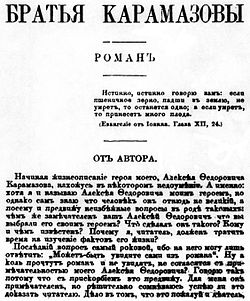
An original page of book 3, chapter 3 of The Brothers Karamazov

The third book provides more details of the love triangle among Fyodor Pavlovich, his son Dmitri, and Grushenka. Dmitri hides near his father's home to see if Grushenka will arrive. His personality is explored in a long conversation with Alyosha. Later that evening, Dmitri bursts into his father's house and assaults him. As he leaves, he threatens to come back and kill him. This book also introduces Smerdyakov and his origins, as well as the story of his mother, Lizaveta Smerdyashchaya. At the conclusion of this book, Alyosha is witness to Grushenka's humiliation of Dmitri's betrothed Katerina Ivanovna.

Book Four: Lacerations/Strains

[edit]

This section introduces a side story which resurfaces in more detail later in the novel. It begins with Alyosha observing a group of schoolboys throwing rocks at one of their sickly peers named Ilyusha. When Alyosha admonishes the boys and tries to help, Ilyusha bites Alyosha's finger. It is later learned that Ilyusha's father, a former staff-captain named Snegiryov, was assaulted by Dmitri, who dragged him by the beard out of a bar. Alyosha soon learns of the further hardships present in the Snegiryov household and offers the former staff captain money as an apology for his brother and to help Snegiryov's ailing wife and children. After initially accepting the money with joy, Snegiryov throws it to the ground and stomps it into the sand, before running back into his home.

Book Five: Pro and Contra

[edit]

Here, the rationalist and nihilistic ideology that permeated Russia at this time is defended and espoused by Ivan Karamazov while meeting his brother Alyosha at a restaurant. In the chapter titled "Rebellion", Ivan proclaims that he rejects the world that God has created because it is built on a foundation of suffering. In perhaps the most famous chapter in the novel, "The Grand Inquisitor", Ivan narrates to Alyosha his imagined poem that describes an encounter between a leader from the Spanish Inquisition and Jesus, who has made his return to Earth. The opposition between reason and faith is dramatised and symbolised in a forceful monologue of the Grand Inquisitor who, having ordered the arrest of Jesus, visits him in prison at night.

Why hast Thou come now to hinder us? For Thou hast come to hinder us, and Thou knowest that...We are working not with Thee but with him [Satan]...We took from him what Thou didst reject with scorn, that last gift he offered Thee, showing Thee all the kingdoms of the earth. We took from him Rome and the sword of Caesar, and proclaimed ourselves sole rulers of the earth...We shall triumph and shall be Caesars, and then we shall plan the universal happiness of man.

The Grand Inquisitor accuses Jesus of having inflicted on humankind the "burden" of free will. At the end of the Grand Inquisitor's lengthy arguments, Jesus silently steps forward and kisses the old man on the lips. The Inquisitor, stunned and moved, tells him he must never come there again, and lets him out. Alyosha, after hearing the story, goes to Ivan and kisses him softly on the lips. Ivan shouts with delight. The brothers part with mutual affection and respect.

Book Six: The Russian Monk

[edit]

The sixth book relates the life and history of the Elder Zosima as he lies near death in his cell. Zosima explains that he found his faith in his rebellious youth, after an unforgivable action toward his trusted servant, consequently deciding to become a monk. Zosima preaches people must forgive others by acknowledging their own sins and guilt before others. He explains that no sin is isolated, making everyone responsible for their neighbor's sins. Zosima represents a philosophy that responds to Ivan's, which had challenged God's creation in the previous book.

Book Seven: Alyosha

[edit]

The book begins immediately following the death of Zosima. It is a commonly held perception in the town and the monastery that true holy men's bodies are incorrupt, i.e., they do not succumb to putrefaction. Thus, the expectation concerning the Elder Zosima is that his deceased body will not decompose. It therefore comes as a great shock that Zosima's body not only decays, but begins the process almost immediately following his death. Within the first day, the smell is already unbearable. For many this calls into question their previous respect and admiration for Zosima. Alyosha is particularly devastated by the sullying of Zosima's name due to nothing more than the corruption of his dead body. One of Alyosha's companions in the monastery — Rakitin — uses Alyosha's vulnerability to set up a meeting between him and Grushenka. However, instead of Alyosha becoming corrupted, he acquires new faith and hope from Grushenka, while Grushenka's troubled mind begins the path of spiritual redemption through his influence: they become close friends. The book ends with the spiritual regeneration of Alyosha as he embraces and kisses the earth outside the monastery (echoing, perhaps, Zosima's last earthly act before his death) and cries convulsively. Renewed, he goes back out into the world, as his Elder instructed.

Book Eight: Mitya

[edit]

This section deals primarily with Dmitri's wild and distraught pursuit of money for the purpose of running away with Grushenka. Dmitri owes money to his fiancée Katerina Ivanovna, and will believe himself to be a thief if he does not find the money to pay her back before embarking on his quest for Grushenka. Dmitri approaches Grushenka's benefactor, Samsonov, who sends him to a neighboring town on a fabricated promise of a business deal. All the while Dmitri is petrified that Grushenka may go to his father and marry him because of his wealth and lavish promises. When Dmitri returns from his failed dealing in the neighboring town, he escorts Grushenka to her benefactor's home, but later discovers that she has deceived him and left early. Furious, he runs to his father's home with a brass pestle in his hand, and spies on him from the window. He takes the pestle from his pocket. There is a discontinuity in the action, and Dmitri is suddenly running from his father's property. The servant Grigori tries to stop him, yelling "Parricide!", but Dmitri hits him in the head with the pestle. Dmitri, afraid that the blow might have killed Grigori, tries to attend to the wound with his handkerchief, but gives up and runs away.

Dmitri is next seen in a daze on the street, covered in blood, with a pile of money in his hand. He soon learns that Grushenka's former betrothed has returned and taken her to a nearby lodge. Upon learning this, Dmitri loads a cart with food and wine and pays for a huge orgy to finally confront Grushenka in the presence of her old flame, intending all the while to kill himself at dawn. The "first and rightful lover" is a boorish Pole who cheats the party at a game of cards. When his deception is revealed, he flees, and Grushenka soon reveals to Dmitri that she really is in love with him. The party rages on, and just as Dmitri and Grushenka are making plans to marry, the police enter the lodge and inform Dmitri that he is under arrest for the murder of his father.

Book Nine: The Preliminary Investigation

[edit]

Book Nine introduces the details of Fyodor Pavlovich's murder and describes the interrogation of Dmitri, who vigorously maintains his innocence. The alleged motive for the crime is robbery. Dmitri was known to have been completely destitute earlier that evening, but is suddenly seen with thousands of rubles shortly after his father's murder. Meanwhile, the three thousand rubles that Fyodor Pavlovich had set aside for Grushenka have disappeared. Dmitri explains that the money he spent that evening came from three thousand rubles that Katerina Ivanovna gave him to send to her sister. He spent half that at his first meeting with Grushenka — another drunken orgy — and sewed up the rest in a cloth, intending to give it back to Katerina Ivanovna. The investigators are not convinced by this. All of the evidence points toward Dmitri; the only other person in the house at the time of the murder, apart from Gregory and his wife, was Smerdyakov, who was incapacitated due to an epileptic seizure he suffered the day before. As a result of the overwhelming evidence against him, Dmitri is formally charged with the murder and taken away to prison to await trial.

Book Ten: Boys

[edit]

Boys continues the story of the schoolboys and Ilyusha last referred to in Book Four. The book begins with the introduction of the young boy Kolya Krasotkin. Kolya is a brilliant boy who proclaims his atheism, socialism, and beliefs in the ideas of Europe. Dostoevsky uses Kolya's beliefs, especially in a conversation with Alyosha, to satirize his Westernizer critics by putting their words and beliefs in the mouth of a young boy who doesn't really understand what he is talking about. Kolya is bored with life and constantly torments his mother by putting himself in danger. As part of a prank Kolya lies between railroad tracks as a train passes over and becomes something of a legend for the feat. All the other boys look up to Kolya, especially Ilyusha. Since the narrative left Ilyusha in Book Four, his illness has progressively worsened and the doctor states that he will not recover. Kolya and Ilyusha had a falling out over Ilyusha's maltreatment of a local dog: Ilyusha had fed it a piece of bread in which he had placed a pin, at the bidding of Smerdyakov. But thanks to Alyosha's intervention the other schoolboys have gradually reconciled with Ilyusha, and Kolya soon joins them at his bedside. It is here that Kolya first meets Alyosha and begins to reassess his nihilist beliefs.

Book Eleven: Brother Ivan Fyodorovich

[edit]

Book Eleven chronicles Ivan Fyodorovich's influence on those around him and his descent into madness. It is in this book that Ivan meets three times with Smerdyakov, desperately seeking to solve the riddle of the murder and whether Smerdyakov, and consequently he himself, had anything to do with it. In the final meeting Smerdyakov confesses that he had faked the fit, murdered Fyodor Pavlovich, and stolen the money, which he presents to Ivan. Smerdyakov expresses disbelief at Ivan's professed ignorance and surprise. Smerdyakov claims that Ivan was complicit in the murder by telling Smerdyakov when he would be leaving Fyodor Pavlovich's house, and more importantly by instilling in Smerdyakov the belief that, in a world without God, "everything is permitted." The book ends with Ivan having a hallucination in which he is visited by the devil, in the form of an idle and parasitic former gentleman, who torments him by personifying and caricaturing his thoughts and ideas. The nightmare is interrupted by a knocking at the window: it is Alyosha, who has come to inform him that Smerdyakov has hanged himself. Although the devil disappears, Ivan remains in a delirium and converses irrationally. Alyosha is shocked at his brother's condition and tries to pacify him, but Ivan's ravings become increasingly incoherent. Eventually he falls into a deep sleep.

Book Twelve: A Judicial Error

[edit]

This book details the trial of Dmitri Karamazov for the murder of his father. The courtroom drama is sharply satirized by Dostoevsky. The men in the crowd are presented as resentful and spiteful, and the women as irrationally drawn to the romanticism of Dmitri's love triangle with Katerina and Grushenka. Ivan's madness takes its final hold over him and he is carried away from the courtroom after his attempt to give evidence about Smerdyakov descends into incomprehensible raving. The turning point in the trial is Katerina's damning testimony. Shocked by Ivan's madness, she passionately defends him and abandons her 'honourable' approach to Dmitri. She produces a letter drunkenly written by Dmitri saying that he would kill his father. The section concludes with lengthy and impassioned closing remarks from the prosecutor and the defence counsel and the verdict that Dmitri is guilty.

Epilogue

[edit]

The final section opens with discussion of a plan developed for Dmitri's escape from his sentence of twenty years of hard labor in Siberia. The plan is never fully described, but it seems to involve Ivan and Katerina bribing some guards. Alyosha cautiously approves, because he feels that Dmitri is not emotionally ready to submit to such a harsh sentence, that he is innocent, and that no guards or officers would suffer for aiding the escape. Dmitri and Grushenka plan to escape to America and work the land there for several years, and then return to Russia under assumed American names, because they cannot imagine living without Russia. Dmitri begs for Katerina to visit him in the hospital, where he is recovering from an illness, before he is due to be taken away. When she does, Dmitri apologizes for having hurt her; she in turn apologizes for bringing up the implicating letter during the trial. They agree to love each other for that one moment, and say they will love each other forever, even though both now love other people. The novel concludes at Ilyusha's funeral, where Ilyusha's schoolboy friends listen to Alyosha's "Speech by the Stone". Alyosha promises to remember Kolya, Ilyusha, and all the boys and keep them close in his heart, even though he will have to leave them and may not see them again until many years have passed. He implores them to love each other and to always remember Ilyusha, and to keep his memory alive in their hearts, and to remember this moment at the stone when they were all together and they all loved each other. Alyosha then recounts the Christian promise that they will all be united one day after the Resurrection. In tears, the twelve boys promise Alyosha that they will keep each other in their memories forever. They join hands, and return to the Snegiryov household for the funeral dinner, chanting "Hurrah for Karamazov!"

Themes

[edit]

Faith and atheism

[edit]

One of the novel's central themes is the counterposition of the true spiritual meaning of the Eastern Orthodox Christian faith, particularly insofar as it is posited as the heart of Russian national identity and history, with the ideas and values emanating from the new doctrines of atheism, rationalism, socialism and nihilism. Not only were these ideas and values alien to Russia's spiritual heritage, they were, in Dostoevsky's opinion, actively working to destroy it, and moreover were becoming increasingly popular and influential, especially among Russia's youth.[15] The theme had already been vividly depicted in all the earlier major novels, particularly Demons, but in The Brothers Karamazov Dostoevsky artistically represents and counterposes the two antithetical worldviews in archetypal forms — the character of Ivan Fyodorovich and his legend of The Grand Inquisitor, and the characters of Alyosha and the Elder Zosima in their expression and embodiment of a lived Christian faith.

The character of Ivan Fyodorovich, though he outwardly plays the role of devil's advocate, is inwardly far from being resolved in his atheism. A constantly reappearing motif in the novel is his proposition that without faith in immortality, there is no such thing as virtue, and that if there is no God, everything is permitted. When Zosima encounters the idea in the meeting at the monastery, he doesn't dispute it, but suggests to Ivan that since in all probability he doesn't believe in the immortality of his own soul, his thoughts must be a source of torment to him: "But the martyr likes sometimes to divert himself with his despair, as it were driven to it by despair itself. Meanwhile ... you divert yourself with magazine articles, and discussions in society, though you don't believe your own arguments, and with an aching heart mock at them inwardly.... That question you have not answered, and it is your great grief, for it clamors for an answer."[16] In his relations with Ivan, Alyosha consciously personifies the loving voice of faith that he knows lives in his brother's soul, in opposition to the mocking voice of doubt that ultimately becomes personified in the nightmare of the Devil.[17] Alyosha says of Ivan "His mind is a prisoner of his soul. There is a great and unresolved thought in him. He is one of those who don't need millions, they just need to get a thought straight."[18]

Dostoevsky wrote to his editor that his intention with book V, "Pro and Contra", was to portray "the seed of the idea of destruction in our time in Russia among the young people uprooted from reality". This seed is depicted as: "the rejection not of God but of the meaning of His creation. Socialism has sprung from the denial of the meaning of historical reality and ended in a program of destruction and anarchism."[19] In the chapter "Rebellion", the rationale behind Ivan's rejection of God's world is expounded in a long dialogue with Alyosha, in which he justifies his atheism on the grounds of the very principle — universal love and compassion — that is at the heart of the Christian faith. The unmitigated evil in the world, particularly as it relates to the suffering of children, is not something that can be accepted by a heart steeped in love, so Ivan feels bound in his conscience to "humbly return the ticket" to God. The idea of the refusal of love on the grounds of love is taken further in the subsequent "Legend of the Grand Inquisitor". In a long dialogue, in which the second participant (the returned Christ) remains silent for its entire duration, the Inquisitor rejects the freedom and spiritual beauty of Christ's teaching as being beyond the capability of earthly humanity, and affirms instead the bread-and-chains materialism derived from the Devil's Temptations as being the only realistic and truly compassionate basis for the government of men.[20] The Legend is Ivan's confession of the struggle of "pro and contra" taking place within his own soul in relation to the problem of faith. According to Mikhail Bakhtin, "both the very form of its construction as The Grand Inquisitor's dialogue with Christ and at the same time with himself, and the very unexpectedness and duality of its finale, indicate an internally dialogic disintegration at its ideological core."[21]

With Book VI, "The Russian Monk", Dostoevsky sought to provide the refutation of Ivan's negation of God, through the teachings of the dying Elder, Zosima.[22] The dark world of the Inquisitor's reasoning is juxtaposed with the radiant, idyllically stylized communications of the dying Elder and Alyosha's renderings of his life and teachings.[23][24] Zosima, though suffering and near death, unreservedly communicates his love for those around him, and recounts the stories of the crucial moments in his progress along the spiritual path. Alyosha records these accounts for posterity, as well as the Elder's teachings and discourses on various subjects, including: the significance of the Russian Monk; spiritual brotherhood between masters and servants; the impossibility of judging one's fellow creatures; Faith, Prayer, Love, and Contiguity with Other Worlds; and the spiritual meaning of 'hell' as the suffering of being unable to Love. Dostoevsky based Zosima's teachings on those of the 18th century Russian Orthodox saint and spiritual writer Tikhon of Zadonsk, and constructed them around his own formulation of the essence of a true Christian faith: that all are responsible for all, and that "everyone is guilty before all and for everything, and therefore everyone is strong enough also to forgive everything for others". He was acutely aware of the difficulty of the artistic task he had set himself and of the incompatibility of the form and content of his "reply" with ordinary discourse and the everyday concerns of his contemporaries.[25]

Freedom and mechanistic psychology

[edit]

"Dostoevsky could hear dialogic relationships everywhere, in all manifestations of conscious and intelligent human life. Where consciousness began, there dialogue began also. Only purely mechanistic relationships are not dialogic, and Dostoevsky categorically denied their importance for understanding and interpreting life and the acts of man."[26]

Throughout the novel, in the very nature of all the characters and their interactions, the freedom of the human personality is affirmed, in opposition to any form of deterministic reduction. The "physiologism" that is being attacked is identified in the repeated references to Claude Bernard, who becomes for Dmitri a despised symbol of the scientific reduction of the human soul to impersonal physiological processes. For Dmitri the word 'Bernard' becomes the most contemptuous of insults. References to Bernard are in part a response to Zola's theories about heredity and environment, gleaned from Bernard's ideas, which functioned as the ideological background to the Les Rougon-Macquart series of novels.[27]

Though the affirmation of freedom and rejection of mechanistic psychology is most openly and forcefully expressed through the character of Dmitri, as a theme it pervades the entire novel and virtually all of Dostoevsky's other writings. Bakhtin discusses it in terms of what he calls the unfinalizability of Dostoevsky's characters. In Dostoevsky, a fundamental refusal to be wholly defined by an external source (another person, a social interpretation, an ideology, a system of 'knowledge', or anything at all that places a finalizing limit on the primordial freedom of the living soul, including even death) is at the heart of the character. He sees this quality as essential to the human being, to being human, and in his most fiercely independent characters, such as Ivan and Dmitri in The Brothers Karamazov, Raskolnikov in Crime and Punishment, Nastasya Filippovna and Ippolit in The Idiot, or the Underground man in Notes From Underground, it is actively expressed in virtually all their words and deeds.[28] According to Bakhtin, for Dostoevsky:

A man never coincides with himself. One cannot apply the formula of identity A≡A. In Dostoevsky's artistic thinking the genuine life of the personality takes place at the point of non-coincidence between a man and himself, at his point of departure beyond the limits of all that he is as a material being – a being that can be spied on, defined, predicted apart from its own will, "at second hand". The genuine life of the personality is made available only through a dialogic penetration of that personality, during which it freely and reciprocally reveals itself.

Style

[edit]
Dostoyevsky's notes for Chapter 5 of The Brothers Karamazov

Although written in the 19th century, The Brothers Karamazov displays a number of modern elements. Dostoevsky composed the book with a variety of literary techniques. Though privy to many of the thoughts and feelings of the protagonists, the narrator is a self-proclaimed writer; he discusses his own mannerisms and personal perceptions so often in the novel that he becomes a character. Through his descriptions, the narrator's voice merges imperceptibly into the tone of the people he is describing, often extending into the characters' most personal thoughts. There is no voice of authority in the story.[i] In addition to the principal narrator, there are several sections narrated by other characters entirely, such as the story of The Grand Inquisitor and Zosima's confessions.

Dostoevsky uses individual styles of speech to express the inner personality of each person. For example, the attorney Fetyukovich (based on Vladimir Spasovich) is characterized by malapropisms (e.g. 'robbed' for 'stolen', and at one point declares possible suspects in the murder 'irresponsible' rather than innocent).[citation needed] Several plot digressions provide insight into other apparently minor characters. For example, the narrative in Book Six is almost entirely devoted to Zosima's biography, which contains a confession from a man whom he met many years before. Dostoevsky does not rely on a single source or a group of major characters to convey the themes of this book, but uses a variety of viewpoints, narratives and characters throughout.

Reception and influence

[edit]

The Brothers Karamazov has had a deep influence on many public figures over the years for widely varying reasons. Admirers include scientists such as Albert Einstein,[29] philosophers Ludwig Wittgenstein[30] and Martin Heidegger,[31] as well as writers such as Virginia Woolf,[32] Cormac McCarthy,[33] Haruki Murakami,[34] Franz Kafka,[35] and Frederick Buechner.[36]

British writer C. P. Snow writes of Einstein's admiration for the novel: "The Brothers Karamazov—that for him in 1919 was the supreme summit of all literature. It remained so when I talked to him in 1937, and probably until the end of his life."[37]

Sigmund Freud called it "the most magnificent novel ever written" and was fascinated with what he saw as its Oedipal themes. In 1928 Freud published a paper titled "Dostoevsky and Parricide" in which he investigated Dostoevsky's own neuroses.[38] Freud claimed that Dostoevsky's epilepsy was not a natural condition but instead a physical manifestation of the author's hidden guilt over his own father's death. According to Freud, Dostoevsky (and all other sons) wished for the death of his father because of latent desire for his mother; citing the fact that Dostoevsky's epileptic fits began at age 18, the year his father died. It followed that more obvious themes of patricide and guilt, especially in the form of the moral guilt illustrated by Ivan Karamazov, were further literary evidence of his theory.

Franz Kafka felt indebted to Dostoevsky and The Brothers Karamazov, calling himself and Dostoevsky "blood relatives" and was immensely interested in the hatred the brothers demonstrated toward their father in the novel. He probably found parallels with his own strained father-son relationship and drew on this theme to some extent in his works, especially the short story "The Judgment").[39]

James Joyce wrote:

[Leo] Tolstoy admired him but he thought that he had little artistic accomplishment or mind. Yet, as he said, 'he admired his heart', a criticism which contains a great deal of truth, for though his characters do act extravagantly, madly, almost, still their basis is firm enough underneath.... The Brothers Karamazov ... made a deep impression on me ... he created some unforgettable scenes [detail].... Madness you may call it, but therein may be the secret of his genius.... I prefer the word exaltation, exaltation which can merge into madness, perhaps. In fact all great men have had that vein in them; it was the source of their greatness; the reasonable man achieves nothing.[40][page needed]

Not all reception to the book was positive. Some were critical of it, such as Henry James, Vladimir Nabokov, D. H. Lawrence, and Pyotr Ilyich Tchaikovsky.[41] Tchaikovsky, for instance, once said of the novel in a letter that "Dostoyevsky is a writer of genius, but an antipathetic one."[42]

As for Leo Tolstoy himself, the work appears to have proved both challenging and provocative. Entries from his journal indicate that, like others, he considered Dostoevsky's idiosyncratic style to be an obstacle, yet the book was one of several that he requested accompany him on his deathbed.[43]

The philosopher Ludwig Wittgenstein is said to have read The Brothers Karamazov "so often he knew whole passages of it by heart".[44] A copy of the novel was one of the few possessions Wittgenstein brought with him to the front during World War I.[44]

Martin Heidegger identified Dostoevsky's thought as one of the most important sources for his early and best known book, Being and Time.[45] Of the two portraits Heidegger kept on the wall of his office, one was of Dostoevsky.[46][page needed]

According to philosopher Charles B. Guignon, the novel's most fascinating character, Ivan Karamazov, had by the middle of the twentieth century become the icon of existentialist rebellion in the writings of existentialist philosophers Albert Camus and Jean-Paul Sartre.[46][page needed] Camus centered on a discussion of Ivan Karamazov's revolt in his 1951 book Rebel. Ivan's poem "The Grand Inquisitor" is arguably one of the best-known passages in modern literature due to its ideas about human nature, freedom, power, authority, and religion, as well as for its fundamental ambiguity.[46][page needed] A reference to the poem can be found in English novelist Aldous Huxley's Brave New World Revisited and American writer David Foster Wallace's novel Infinite Jest.

Nobel Prize laureate William Faulkner reread the book regularly, claiming it as his greatest literary inspiration next to Shakespeare's works and the Bible. He once wrote that American literature had yet to produce anything great enough to compare with Dostoyevsky's novel.[32]

In an essay on The Brothers Karamazov, written after the Russian Revolution and the First World War, Nobel Prize-winning author Hermann Hesse described Dostoevsky as not a "poet" but a "prophet".[47] British writer W. Somerset Maugham included the book in his list of ten greatest novels in the world.[48]

Contemporary Turkish Nobel Prize-winning writer Orhan Pamuk said during a lecture in St. Petersburg that the first time he read The Brothers Karamazov, his life was changed. He felt Dostoyevsky, through his storytelling, revealed completely unique insight into life and human nature.[32]

American philosophical novelist Walker Percy said in an interview:[49]

I suppose my model is nearly always Dostoevsky, who was a man of very strong convictions, but his characters illustrated and incarnated the most powerful themes and issues and trends of his day. I think maybe the greatest novel of all time is The Brothers Karamazov which...almost prophesies and prefigures everything—all the bloody mess and the issues of the 20th century.

Pope Benedict XVI cited the book in the 2007 encyclical Spe Salvi.[50]

Soviet leader Joseph Stalin had read Dostoevsky since his youth and considered the author as a great psychologist. His copy of The Brothers Karamazov reveals extensive highlights and notes in the margins that he made while reading the work, which have been studied and analyzed by multiple researchers.[51][52]

According to Serbian state news agency Tanjug, Serbian president Aleksandar Vučić described Dostoevsky as his best-loved novelist, saying: "The Brothers Karamazov may be the best work of world literature."[53] American First Lady Laura Bush has said she is an admirer of the novel.[54] Former United States secretary of state and First Lady Hillary Clinton mentioned the novel as her favorite book of all time.[55]

Translations

[edit]

Although The Brothers Karamazov has been translated from the original Russian into a number of languages, the novel's diverse array of distinct voices and literary techniques makes its translation difficult. Constance Garnett published a translation in 1912, which Garth Terry called "the first adequate English translation".[56] A dramatization (by Isabel Florence Hapgood) was published in 1905.[57]

In 1958, David Magarshack and Manuel Komroff released translations of the novel, published respectively by Penguin and The New American Library of World Literature.[58] In 1976, Ralph Matlaw thoroughly revised Garnett's work for his Norton Critical Edition volume.[59] This in turn was the basis for Victor Terras' influential A Karamazov Companion.[60] Another translation is by Julius Katzer, published by Progress Publishers in 1981 and later re-printed by Raduga Publishers Moscow.

In 1990 Richard Pevear and Larissa Volokhonsky released a new translation; it won a PEN/Book-of-the-Month Club Translation Prize in 1991 and garnered positive reviews from The New York Times Book Review and the Dostoevsky scholar Joseph Frank, who praised it for being the most faithful to Dostoevsky's original Russian.[61]

Peter France

[edit]

In The Oxford Guide to Literature in English Translations, academic Peter France comments on several translations of Dostoevsky's work. In regard to Constance Garnett's translations, he writes:[62]

[Her] translations read easily...the basic meaning of the Russian text is accurately rendered on the whole. It is true, as critics such as Nikoliukin have demonstrated, that she shortens and simplifies, muting Dostoevsky's jarring contrasts, sacrificing his insistent rhythms and repetitions, toning down the Russian colouring, explaining and normalizing in all kinds of ways...Garnett shortens some of Dostoevsky's idiosyncrasy in order to produce an acceptable English text, but her versions were in many cases pioneering versions; decorous they may be, but they allowed this strange new voice to invade English literature and thus made it possible for later translators to go further in the search for more authentic voice.

On David Magarshack's Dostoevsky translations, France says:[63]

[I]t is not certain that Magarshack has worn as well as Garnett. He certainly corrects some of her errors; he also aims for a more up-to-date style which flows more easily in English...Being even more thoroughly englished than Garnett's, Magarshack's translations lack some of the excitement of the foreign.

On Andrew R. MacAndrew's American version, he comments: "He translates fairly freely, altering details, rearranging, shortening and explaining the Russian to produce texts which lack a distinctive voice."[63]

On David McDuff's Penguin translation:[64]

McDuff carries this literalism the furthest of any of the translators. In his Brothers Karamazov the odd, fussy tone of the narrator is well rendered in the preface...At times, indeed, the convoluted style might make the reader unfamiliar with Dostoevsky's Russian question the translator's command of English. More seriously, this literalism means that the dialogue is sometimes impossibly odd—and as a result rather dead...Such 'foreignizing' fidelity makes for difficult reading.

On Pevear and Volokhonsky's translation, France writes:[65]

Pevear and Volokhonsky, while they too stress the need to exhume the real, rough-edged Dostoevsky from the normalization practised by earlier translators, generally offer a rather more satisfactory compromise between the literal and the readable. In particular, their rendering of dialogue is often livelier and more colloquial than McDuff's...Elsewhere, it has to be said, the desire to replicate the vocabulary or syntax of the Russian results in unnecessary awkwardness and obscurity.[66]

In commenting on Ignat Avsey's translation, he writes: "His not entirely unprecedented choice of a more natural-sounding English formulation is symptomatic of his general desire to make his text English...His is an enjoyable version in the domesticating tradition."[65]

List of English translations

[edit]

This is a list of all unabridged and one abridged English translations of the novel:[57][67]

  1. Constance Garnett (1912)
    1. revised by Avrahm Yarmolinsky (1933)
    2. revised by Alexandra Kropotkin and abridged by W. Somerset Maugham (1949)
    3. revised by Manuel Komroff (1958)
    4. revised by Ralph E. Matlaw (1976)
    5. revised by Ralph E. Matlaw and Susan McReynolds Oddo (2011)
  2. David Magarshack (1958)
  3. Andrew R. MacAndrew (1970)
  4. Julius Katzer (1980, as The Karamazov Brothers)
  5. Richard Pevear and Larissa Volokhonsky (1990)
  6. David McDuff (1993)
  7. Ignat Avsey (1994, as The Karamazov Brothers)
  8. Michael R. Katz (2023)

Adaptations

[edit]

Film

[edit]

There have been several film adaptations of The Brothers Karamazov, including:

Television

[edit]

A Russian 12-episode series was produced in 2009 and is considered to be as close to the book as possible.[72] It aired on Channel One.

The 2013 Japanese TV drama Karamazov no Kyōdai is an adaptation of the book set in modern-day Japan.

The Open University produced a version of "The Grand Inquisitor" in 1975 starring John Gielgud.[73]

"The Grand Inquisitor" was adapted for British television as a one-hour drama titled Inquisition. Starring Derek Jacobi as the inquisitor, it was first broadcast on Channel 5 on 22 December 2002.

A 30-episode drama series named Oulad El Moukhtar ('Mokhtar's Sons') was produced by Nabil Ayouch for Al Aoula in 2020. The adaptation of the book is set in Morocco, with some aspects changed to resemble the local Moroccan culture.[74]

Unfinished sequel

[edit]

A sequel to The Brothers Karamazov that would detail the life of Alexey Karamazov beyond the ending of what was supposed to be the first novel had been planned out by Dostoevsky, but was left unfinished due to the author's death in 1881. It would have included a plot that saw Alexey killing the Russian Tsar.[75]

See also

[edit]

Explanatory notes

[edit]

References

[edit]
[edit]
Revisions and contributorsEdit on WikipediaRead on Wikipedia
from Grokipedia

The Brothers Karamazov (Russian: Бра́тья Карама́зовы, tr. Brat'ya Karamazovy) is a philosophical novel by the Russian author Fyodor Dostoevsky, first serialized in The Russian Messenger from January 1879 to November 1880 and issued in book form as a two-volume set in December 1880 by the Brothers Panteleev publishers in Saint Petersburg. The work centers on the dysfunctional Karamazov family—comprising the licentious patriarch Fyodor Pavlovich and his sons Dmitri, Ivan, Alyosha, and the illegitimate Smerdyakov—whose conflicts culminate in the father's murder, prompting an inquiry into guilt, innocence, and human motivation.
Through its polyphonic structure, which presents multiple conflicting viewpoints without authorial resolution, the novel probes core existential dilemmas, including the tension between faith and reason, the , and the foundations of morality in a potentially godless . Dostoevsky employs characters like the skeptical intellectual , whose "" and "" passages articulate a radical critique of divine justice and human freedom, to expose the nihilistic consequences of while affirming active love and Orthodox Christian ethics via the monk Alyosha. Upon release, the book achieved immediate commercial success, with half of its initial 3,000-copy print run selling out rapidly, and it has since been hailed as Dostoevsky's supreme achievement, influencing thinkers from to and ranking among the greatest novels in literary history for its psychological depth and theological rigor.

Historical Context and Composition

Dostoevsky's Personal Influences and Intentions

Dostoevsky's writing of The Brothers Karamazov was deeply influenced by the sudden death of his three-year-old son, Aleksei (Alyosha), on June 16, 1878, from an epileptic seizure inherited from his father, who himself suffered from the condition. This tragedy, occurring shortly before the novel's inception, prompted Dostoevsky to seek spiritual guidance from Elder Ambrose at , whose teachings on humility, suffering, and redemption shaped the character of Father Zosima and the emphasis on elder-guided faith. The protagonist bears the name of the lost child, while subplots involving child suffering, such as Ilyusha's illness and death, channel the author's grief and examination of innocence amid familial and moral decay. Earlier life events further molded the novel's portrayal of human passions and ethical turmoil. The 1839 murder of Dostoevsky's father by his own serfs exposed him to raw violence and paternal authority's failures, echoing Fyodor Karamazov's depravity and the brothers' resultant psychic fractures. His 1849 arrest for political radicalism, , and subsequent Siberian exile (1850–1859) shattered youthful , fostering a mature Orthodox worldview that confronts rational doubt with experiential faith—a dynamic embodied in the contrast between Ivan's intellectual rebellion and Alyosha's intuitive piety. Dostoevsky intended The Brothers Karamazov as the first installment of a grander epic depicting "the life of a ," designed to diagnose and remedy Russia's spiritual malaise amid rising and . Through Ivan's "" and "," he critiqued Enlightenment rationalism's moral vacuum—famously implying that without , "everything is permitted"—while countering via Zosima's life and teachings that active Christian love resolves theodicy's paradoxes. In an August 24, 1879, letter to , Dostoevsky framed the "Russian Monk" chapter as a deliberate to Ivan's , aiming to vindicate Orthodoxy's relevance against secular ideologies eroding traditional values. His notebooks reveal meticulous evolution of these ideas, prioritizing psychological realism over to illustrate faith's triumph through human frailty.

Writing Process and Serialization Details

began intensive composition of The Brothers Karamazov in April 1878, working primarily in the town of , which served as the model for the novel's fictional setting of Skotoprigonyevsk. The writing process drew on extensive preparatory notebooks, totaling thousands of pages across his career, which reveal iterative development of themes, character arcs, and philosophical dialogues through labyrinthine drafts and revisions. These notebooks, later compiled and translated, document Dostoevsky's method of improvising complex narratives while refining polyphonic voices and moral inquiries central to the work. Serialization commenced in the conservative monthly journal Russkii Vestnik (The Russian Messenger) with the first installment in January 1879, following an initial plan for monthly releases. The novel appeared in episodic form through November 1880, spanning approximately two years of publication amid Dostoevsky's ongoing revisions to meet deadlines despite health challenges including epilepsy. This serialized structure influenced the narrative's pacing, with installments often concluding on dramatic cliffhangers to engage subscribers, though editorial constraints from Russkii Vestnik occasionally prompted adjustments to content, such as toning down certain polemical elements. A complete edition followed shortly after serialization's end, solidifying the novel's structure as Dostoevsky's final major work.

Principal Characters

Fyodor Pavlovich Karamazov

Pavlovich Karamazov is the patriarch of the Karamazov family and father to the novel's three central brothers: Dmitri from his first marriage, and and Alyosha from his second. A landowner in a provincial Russian district, he begins with scant resources but accumulates substantial wealth, estimated at around 100,000 to 120,000 roubles by the time of his death, through opportunistic financial maneuvers including the seizure of his first wife's of 25,000 roubles. He is also rumored to be the biological father of the servant Smerdyakov, born to a deranged beggar he encountered during his early debaucheries. His first marriage was to Adelaida Ivanovna Miusova, a proud woman of noble family who eloped with him despite his lowly status, only to suffer and eventually flee, leaving Dmitri behind; Fyodor Pavlovich later rejoiced publicly at her death, quoting a biblical of . The second , to the timid orphan Sofia Ivanovna under familial pressure, produced Ivan and Alyosha, but ended with her death in or shortly after, following which Fyodor Pavlovich promptly abandoned the children to relatives or servants and decamped to pursue further dissipation. Throughout, he exhibits profound neglect toward his sons, raising them haphazardly or not at all, to the point of confusion over their maternal origins in adulthood. Physically, Fyodor Pavlovich appears as an "old buffoon" with a bloated face, leering eyes, and hooked nose, embodying his sensualist lifestyle marked by alcoholism, promiscuity, and hosting of orgiastic gatherings. His personality combines shrewdness in monetary affairs with abject viciousness and buffoonery, often performing for shock value in social settings, such as feigned displays of grief or ecstasy. Morally depraved and greedy, he sustains himself parasitically by freeloading at others' tables while amassing his own fortune, showing sentimentality tinged with hypocrisy—fearing damnation yet reveling in vice. This self-indulgent hedonism fuels familial tensions, particularly a rivalry with Dmitri over the courtesan Grushenka, underscoring his shameless pursuit of pleasure regardless of relational consequences.

Dmitri Fyodorovich Karamazov

Dmitri Fyodorovich Karamazov, commonly referred to as Mitya, is the eldest son of Fyodor Pavlovich Karamazov and his first wife, Adelaida Ivanovna Miusova, born from a marriage marked by Fyodor's early neglect after Adelaida's departure. At 28 years old when the novel opens, Dmitri has pursued a military career, attending a military school after failing to complete regular high school, and returns to his provincial Russian town to claim his inheritance share, which Fyodor has withheld. Raised largely by the servant Grigory after his mother's abandonment, Dmitri exhibits a turbulent upbringing that fosters his volatile disposition, blending inherited sensuality with sporadic noble impulses. Dmitri's personality is defined by intense passion, recklessness, and a sensual nature akin to his father's, often leading to impulsive expenditures and emotional extremes; he is described as having a "long, resolute military stride" and a contemptuous attitude toward restraint. Despite this, he possesses a capacity for and spiritual yearning, declaring "To insects—sensuality!" to underscore his self-perceived baseness, yet aspiring toward redemption through . His dual nature—animalistic drives clashing with ideals of honor and —manifests in exclamations like "Beauty is a terrible and awful thing," reflecting an internal battle between degradation and elevation. In relationships, Dmitri becomes engaged to Ivanovna Verkhovtseva after providing financial aid to her family during his military service, though this bond sours as he develops an obsessive love for Agrafena Alexandrovna Svetlova (Grushenka), pitting him in direct rivalry with over her affections and escalating family tensions. He maintains a fraternal closeness with Alyosha, seeking his counsel amid crises, while despising for past wrongs against their mother and himself, culminating in violent confrontations over 3,000 rubles owed for his to settle debts and elope with Grushenka. Dmitri's central conflicts revolve around his accusation and wrongful conviction for Fyodor's , despite his , stemming from witnessed altercations and his public threats; he had visited Fyodor's house that night but left without violence, only to be implicated by like the missing money envelope. His arrest propels the novel's inquiry into guilt, , and human will, as he endures and with defiance turning to acceptance of . Throughout his arc, Dmitri transforms from heedless indulgence to , undergoing a spiritual conversion in that affirms his for —"I love Russia, Alexei, I love the Russian , though I myself am a scoundrel!"—and commitment to hard labor over escape, symbolizing humanity's potential for redemption amid . This evolution positions him as a foil to his brothers, embodying raw poised between and grace.

Ivan Fyodorovich Karamazov

Ivan Fyodorovich Karamazov is the second son of Fyodor Pavlovich Karamazov and his second wife, Adelaida Ivanovna Miusov, depicted as a 23-year-old and atheist who has recently returned to his family's provincial town after university studies in . He possesses a brilliant, logical mind that demands rational explanations for all phenomena, leading him to reject in favor of and philosophical inquiry. Ivan's writings, including articles critiquing courts and the role of the church in civil matters, reflect his rationalist and disdain for traditional religious . Central to Ivan's character is his profound disturbance over human suffering, particularly the inexplicable torment of innocent children, which forms the basis of his "" against the existence of a benevolent . He recounts graphic examples of —such as a five-year-old girl beaten and confined in a dark privy by her parents—to argue that such uncompensable pain renders the world's "harmony" untenable, famously declaring he would "return his ticket" to earthly existence rather than accept divine order built on children's tears. This rebellion stems not from denial of God's possible existence but from refusal to reconcile with a creation permitting such evil without immediate justice, prioritizing empirical horror over abstract theological resolutions like afterlife recompense. In a pivotal with his Alyosha, Ivan narrates the prose poem "," envisioning Christ’s return during the , where a 90-year-old cardinal arrests and lectures him for burdening humanity with . The contends that most people crave security through , mystery, and authority—embodied by the —over the freedom Christ offered, which leads to suffering and rejection of God; he claims the Church has corrected Christ's error by assuming control to ensure earthly happiness, even at the cost of truth. Ivan presents this as his own view, illustrating his critique of Christianity's emphasis on individual moral autonomy, which he sees as incompatible with human weakness and propensity for tyranny or chaos. Ivan's ideas indirectly catalyze the novel's central murder, as the servant Smerdyakov, influenced by Ivan's and dismissal of moral absolutes ("if does not exist, everything is permitted"), commits while believing it aligns with Ivan's intellectual stance. Tormented by guilt and hallucinations, including visions of the debating his , Ivan experiences a psychological breakdown, underscoring the novel's tension between intellect and . His character embodies the perils of unmoored , contrasting with Alyosha's , yet reveals an underlying moral sensitivity that Dostoevsky uses to probe the limits of in confronting .

Alyosha Fyodorovich Karamazov

Alexei Fyodorovich Karamazov, commonly called Alyosha, is the third and youngest legitimate son of Pavlovich Karamazov, born to his father's second wife, who suffered mental instability and died when Alyosha was an infant. Following her death, Alyosha was shuttled among maternal relatives before being placed with a distant, impoverished godmother, where he lived in relative until ; these early experiences fostered in him a poignant, almost mystical attachment to his faint memories of his mother, evoked through images of icons and maternal icons of sanctity. By the novel's outset, at approximately twenty years of age, Alyosha presents as a handsome young man with dark brown hair, a slightly elongated face, and serene, deep-set gray eyes that convey quiet . Alyosha's defining trait is his precocious spiritual maturity, marked by an intuitive, unwavering Christian that emphasizes active , , and over doctrinal rigidity; he joins the local Orthodox as a and attaches himself devotedly to the elder Zosima, whose teachings on universal profoundly shape him. Unlike his sensuous elder brother Dmitri or intellectually skeptical sibling Ivan, Alyosha embodies a childlike purity and openness that draws affection from diverse figures, including children and societal outcasts, positioning him as a natural mediator in familial and communal conflicts. The novel's narrator designates Alyosha as its "hero," albeit a humble and undefined one, underscoring his role as Dostoevsky's exemplar of lived amid chaos. Throughout the narrative, Alyosha's faith faces trials, particularly after Zosima's death and the ensuing skepticism it provokes, yet he emerges committed to "active love" as a practical response to human suffering, rejecting passive contemplation for engagement with the world's imperfections. This orientation aligns with Zosima's counsel that true belief manifests in deeds of and responsibility, distinguishing Alyosha as a to rationalist and hedonistic excess in the Karamazov lineage.

Supporting Figures: Smerdyakov, Grushenka, Katerina Ivanovna, and Father Zosima

Pavel Fyodorovich Smerdyakov serves as the Karamazov household's cook and valet, being the illegitimate son of Pavlovich conceived with the itinerant "holy fool" Lizaveta Smerdyashchaya, who died in childbirth after assaulting Fyodor. Bearing his mother's as a —meaning "stinking" in Russian—and Fyodor's , Smerdyakov is raised by Fyodor's servant , who instills Orthodox piety despite the boy's later rejection of it. Afflicted with , which he exploits manipulatively, Smerdyakov absorbs Ivan Karamazov's atheistic , interpreting "If God does not exist, everything is permitted" as license for , ultimately confessing to Fyodor's murder as an act enabled by Ivan's ideas. His stems from illegitimacy and mistreatment, manifesting in like animal torture and intellectual pretensions, including self-taught French from . Agrafena Alexandrovna Svetlov, known as Grushenka or Grusha, is a 22-year-old woman of striking beauty, described as a full-bodied Russian type with bold, determined traits that captivate both and Dmitri Karamazov. Daughter of a , she was seduced and abandoned at age 17 by a Polish , prompting her guardian merchant Samsonov to shelter her and foster her as a means of against rivals. Initially coquettish and vengeful, toying with the Karamazovs' affections amid financial disputes, Grushenka evolves toward redemption through encounters with Alyosha and genuine affection for Dmitri, revealing depths beyond her sensual allure and past grievances. Her role underscores tensions between carnal desire and moral renewal, as she rejects Fyodor's advances while navigating betrayals that mirror broader themes of . Katerina Ivanovna Verkhovtseva, often called or Katenka, is Dmitri's proud fiancée, the daughter of a high-ranking general or from a noble family, possessing wealth, intelligence, and beauty marred by emotional volatility. She becomes engaged to Dmitri after he aids her impoverished family with 5,000 rubles—funds he later squanders—yet harbors for , whose intellect she admires, leading to masochistic and vindictive testimony at Dmitri's trial. Sensitive and self-righteous, Katerina's pride fuels her humiliation over Dmitri's infidelity with Grushenka, prompting attempts at noble sacrifice that reveal inner turmoil and a quest for dominance in relationships. Her arc critiques aristocratic pretensions, as her actions, driven by wounded vanity, exacerbate family tragedies despite professed . Father Zosima, the monastery's elder or , acts as Alyosha's spiritual mentor, embodying humble piety through active love and confession of personal sins to foster communal healing. A former military officer who experienced conversion after dueling a peer and embracing universal guilt, Zosima teaches that all bear responsibility for collective suffering, advocating joyful acceptance of earthly trials as paths to divine joy. Drawn to society's outcasts and sinners rather than the self-righteous, he performs acts like bowing to Dmitri to affirm human dignity, influencing Alyosha's faith amid skepticism. Following his death, the rapid decomposition of his body—contrary to expectations of miraculous preservation—tests believers' convictions, highlighting Dostoevsky's realism about sanctity's earthly limits versus spiritual legacy.

Plot Summary

Initial Setup and Family Conflicts

Fyodor Pavlovich Karamazov, the patriarch of the family, emerges as a central figure in the novel's opening, portrayed as a depraved, self-indulgent landowner in his mid-50s residing in the fictional provincial town of Skotoprigonyevsk. Originating from impoverished , he accumulated substantial wealth through cunning moneylending and speculative ventures, undeterred by his notorious habits of drunkenness, debauchery, and scandalous behavior that earned him local infamy as a buffoon and sensualist indifferent to moral or social consequences. His first marriage to Adelaida Ivanovna Miusova, a headstrong woman of minor nobility, produced the eldest son, Dmitri Fyodorovich (Mitya), born around 1827; the union dissolved acrimoniously when Adelaida eloped to Petersburg, abandoning both husband and infant son, and later died there in poverty. Fyodor, after a futile pursuit of his wife, callously neglected Dmitri, depositing the child first with Adelaida's relatives, including her father and cousins, before the boy was shuttled among indifferent guardians, fostering early resentment toward his absent father. The second marriage, to Ivanovna, a meek and domestically inclined woman of humble origins—possibly a former house serf—yielded the younger sons, (born circa 1846) and Alexei (Alyosha, born around 1848); endured Fyodor's abuses until her death shortly after Alyosha's birth, reportedly in a state of from mistreatment. None of the sons received direct paternal upbringing; instead, Fyodor delegated their care to his loyal servants, Kutuzov and his Marfa Ignatyevna, who raised them in modest conditions amid the father's ongoing dissipations. Family conflicts manifest primarily from this foundational neglect and Fyodor's rapacious financial opportunism, exacerbated by the sons' divergent paths and belated interactions. Dmitri, hardened by a career and inheriting his mother's noble claims, returns to demand an of approximately 25,000 rubles earmarked from Adelaida's , accusing Fyodor of embezzling it beyond a nominal 3,000 rubles spent on his childhood; Fyodor retorts with petty accounting, claiming legal rights to the funds and stoking mutual antagonism through taunts and legal maneuvering. , intellectually aloof and educated at university on Fyodor's begrudged , maintains distant relations, viewing the family with detached , while Alyosha, at age 20 a in the local under Elder Zosima, embodies spiritual withdrawal from paternal depravity yet attempts familial . These tensions underscore a patrilineal breakdown, where Fyodor's clashes with the sons' assertions of , setting the stage for explosive confrontations rooted in unaddressed grievances over patrimony and authority.

Central Events and the Murder

Following Elder Zosima's death, the unexpected rapid decay of his body scandalizes the monastery, prompting doubt in Alyosha's faith; however, Alyosha's subsequent encounter with Grushenka restores his belief. Meanwhile, the rivalry between Dmitri and his father Fyodor Pavlovich intensifies over Grushenka, whom both pursue amid Dmitri's desperate financial straits; Dmitri accuses Fyodor of withholding 3,000 rubles owed from his mother's , leading to repeated confrontations. Dmitri publicly threatens Fyodor's life during a gathering at the , declaring his intent to kill him if he learns of Fyodor making advances toward Grushenka, an outburst witnessed by family, monks, and locals. On the night of the murder, Fyodor Pavlovich, anticipating Grushenka's possible visit, signals with knocks on a as arranged with Smerdyakov, his epileptic who has feigned a earlier to establish an . Dmitri, tracking Grushenka to Fyodor's garden, climbs the fence, spies on his father signaling at the window, grabs a cast-iron pestle intending to kill him, but upon hearing , the loyal servant, approaching and calling out, strikes Grigory instead, leaving him bloodied and seemingly dead before fleeing to join Grushenka at Mokroe, where they revel together. Smerdyakov, harboring resentment toward Fyodor and influenced by prior conversations with about the absence of moral constraints without , then enters Fyodor's bedroom and bludgeons him to death with the pestle, stealing an envelope containing 3,000 rubles from under Fyodor's pillow. Fyodor's body is discovered with multiple skull fractures, his face battered, and the room ransacked to simulate robbery, though the missing money's envelope is later revealed as key evidence. Dmitri procures wine and champagne with 300 rubles obtained from selling a medal, inadvertently creating of when police arrive at Mokroe later that night following Grigory's recovery and report of an intruder. The murder shatters the Karamazov household, with initial suspicion falling squarely on Dmitri due to his threats, prior violence, blood on his hands and clothes from tending the wounded Grigory who survives, and possession of Fyodor's cash, though Smerdyakov's role emerges only through later confessions.

Trial and Resolution

Following Fyodor Pavlovich Karamazov's on the night of the gathering, Dmitri Fyodorovich Karamazov is arrested based on , including his prior threats against his father, the discovery of 3,000 rubles in his possession at Mokroe inn—matching the amount reportedly stolen from Fyodor's cash—and bloodstains on his clothes from injuring the servant during his flight from the scene. The prosecution, led by the Ippolit Kirillovich, constructs a case emphasizing Dmitri's intense passion, financial desperation over inheritance disputes, and romantic rivalry with Fyodor over Grushenka, portraying him as a man capable of driven by "Karamazov " and moral depravity. The trial commences on a designated day in the district court, drawing a large crowd of spectators from across , fueled by sensational press coverage of the Karamazov family scandals. Key prosecution witnesses include the housemaid , who testifies to seeing Dmitri break into 's house and later clutching what appeared to be a bloody weapon, and , who recounts Dmitri's assault on him and initial flight, though he admits uncertainty about the murder weapon. Katerina Ivanovna Verkhovtseva, despite her personal grievances, provides damaging by reading a passionate letter Dmitri wrote to her in a fit of , explicitly stating his intent to "dash out the scoundrel's brains with a pestle" if did not repay owed funds. Medical experts debate Dmitri's sanity, with some suggesting or hereditary predisposition, but the prosecution dismisses these as excuses for premeditated violence. The defense, represented by the renowned lawyer Fetyukovich, counters with arguments of insufficient , highlighting the absence of the weapon or Fyodor's stolen cash on Dmitri, and posits that the 3,000 rubles originated from Grushenka's repayment rather than . Grushenka testifies in Dmitri's favor, affirming his character and the legitimacy of the funds, while recounts his brother's remorse and non-violent nature post-arrest. Ivan Karamazov attempts to exonerate Dmitri by revealing Smerdyakov's private of the to him—claiming it as an act to test Ivan's atheistic ideas of no moral consequences—but collapses in during , undermining his amid reports of his mental instability. Smerdyakov's prior , accompanied by a note vaguely admitting guilt to "hasten matters," is presented but interpreted by the prosecution as a loyal servant covering for his master. Closing arguments extend dramatically: Ippolit delivers a lengthy psychological profile framing the crime as inevitable from the Karamazov family's moral chaos and Russian societal ills, while Fetyukovich appeals to doubt, passion-induced error, and judicial caution against condemning on motive alone. Despite hints of reasonable doubt, the jury convicts Dmitri of first-degree murder and robbery after brief deliberation, sentencing him to twenty years of hard labor in Siberian mines. In the resolution, Dmitri accepts the verdict with defiant resignation, proclaiming his spiritual innocence and vowing endurance, while privately plotting escape to America with Grushenka's aid; Ivan descends into feverish delirium confronting his intellectual complicity, and Alyosha affirms faith in ultimate justice beyond earthly courts, culminating in communal affirmation of life's value amid the boys' gathering. The epilogue conveys a note of hope; Dmitri and Grushenka plan to escape to America, Katerina Ivanovna visits leading to reconciliation over past affections, Ivan remains gravely ill, and the novel closes at Ilyusha's funeral where Alyosha delivers a speech to the boys urging them to remember beauty, love one another, and believe in eternal good, met with their cheers of "Hurrah for Karamazov!" symbolizing preserved innocence and future promise.

Core Philosophical Themes

Faith, Atheism, and the Rejection of God

In The Brothers Karamazov, examines the profound tension between in and atheistic rejection through the contrasting philosophies of the Karamazov brothers, particularly and Alyosha. embodies intellectual , rooted in a rational of divine justice amid human suffering, while Alyosha represents intuitive grounded in Christian and . This underscores Dostoevsky's exploration of whether belief in is essential for moral order, positing that unleashes a nihilistic permissiveness where "if does not exist, everything is permitted"—a principle articulates as the logical outcome of denying divine authority and . Ivan's rejection of God stems from the intractable problem of innocent suffering, exemplified by his "Rebellion" monologue, where he recounts atrocities against children—such as a serf boy torn apart by hounds for chasing a onto his general's land, or Turkish impalements of infants—to argue that earthly harmony cannot justify such pain. He "respectfully returns his ticket" to 's world, unable to reconcile omnipotent benevolence with uncompensable evil, even if future bliss theoretically redeems it. This culminates in his prose poem "," set during the , where Christ reappears but is arrested by a cardinal who accuses Him of overburdening humanity with by rejecting Satan's temptations of , mystery, and in the . The Inquisitor claims the wisely aligned with the devil to provide security and authority, as most humans crave over liberty and cannot bear true moral autonomy; Christ silently kisses him, symbolizing forgiveness yet underscoring the poem's ambiguity—Ivan presents it not as endorsement but as a haunting query into faith's viability. Ivan's , though compassionate toward earthly sufferers, erodes ethical foundations, implicitly enabling Smerdyakov's under the banner of unbridled license. Opposing Ivan, Alyosha's , nurtured under Elder Zosima at the Optina-inspired , emphasizes experiential acceptance over rational proof, advocating "active " that bows to all creation, even tormentors, as a path to universal responsibility. Zosima teaches that arises from self-isolation, not external punishment, and that one must embrace as redemptive, mirroring Christ's voluntary ; his postmortem decay tests Alyosha's , yet Alyosha emerges strengthened, witnessing divine mystery in a child's amid . This counters Ivan's cerebral with lived : Zosima's final exhortations urge monks to engage the world, saving through folk rather than institutional dogma. Dostoevsky, a devout Orthodox Christian who endured Siberian for his beliefs, uses these figures to argue that atheism's logical rigor falters existentially, leading to despair—Ivan succumbs to hallucinatory torment—while , though assailed by evidence of , sustains through Christ's example of freedom and sacrifice. The novel neither resolves the debate philosophically nor dismisses Ivan's anguish as mere sophistry, but illustrates faith's practical triumph in Alyosha's redemptive influence on family and society.

Critique of Rationalism, Utopianism, and Socialism

In The Brothers Karamazov, critiques through the character of Fyodorovich Karamazov, whose intellectual rebellion against exemplifies the paralysis induced by atheistic logic divorced from . posits that "if does not exist, everything is permitted," a formulation that underscores the absence of objective constraints in a purely rational worldview, leading to ethical where suffering—such as the torment of innocents—justifies rejecting divine order. This rationalist stance culminates in 's psychological breakdown, visited by a devilish figure who exposes the self-contradictory futility of his abstractions, as illustrates how reason alone cannot sustain responsibility or resolve existential rebellion. The novel's most pointed assault on utopianism and appears in Ivan's of , where a cardinal accuses Christ of burdening humanity with , which most cannot bear, preferring instead the security of , mystery, and authority provided by the Church. The advocates a rational-engineered , distributing bread to the masses in exchange for submission, thereby critiquing socialist visions that promise material equality and happiness through centralized control, at the cost of individual and spiritual autonomy. Dostoevsky, drawing from his own among revolutionaries, portrays this as a tyrannical inversion: utopian , by denying transcendent truth, inevitably devolves into , as the admits to correcting Christ's "error" by allying with the to secure human contentment over . Dostoevsky extends this critique through secondary characters like the seminary student Rakitin, a materialist advocate of who exploits faith for personal gain, revealing the ideology's incompatibility with genuine and its tendency toward hypocrisy and resentment. In contrast, Father Zosima's teachings emphasize active and personal as antidotes to rationalist abstractions, arguing that true social harmony arises not from imposed utopias but from voluntary moral transformation rooted in divine . This framework reflects Dostoevsky's broader conviction, informed by Russian excesses, that socialist rationalism undermines human dignity by treating individuals as means to a collective end, fostering dependency rather than authentic brotherhood.

Free Will, Morality, and Human Responsibility

Dostoevsky posits free will as the cornerstone of authentic morality in The Brothers Karamazov, arguing that human ethical agency derives from the capacity to choose between divine harmony and self-destructive autonomy, independent of external coercion. The novel contends that without this freedom, morality reduces to mechanical obedience, stripping individuals of genuine responsibility for their actions. This view counters deterministic philosophies by illustrating how characters' voluntary decisions—rooted in passion, intellect, or faith—generate causal chains of consequence, underscoring that moral decay stems not from fate but from willful rejection of transcendent accountability. Ivan Karamazov's intellectual exemplifies the perils of atheistic , where denial of erodes moral foundations, leading to the proposition that "if does not exist, everything is permitted"—a Ivan embodies through his detached endorsement of amoral . This , central to Ivan's , implies that absent divine judgment, human actions lack intrinsic ethical bounds, enabling rational justification for horror, as seen in his against innocent without compensatory . Dostoevsky critiques this as causally untenable, for it fosters where intellectual freedom excuses interpersonal devastation, evident in Ivan's indirect role in familial tragedy via his corrosive ideas. The "Grand Inquisitor" poem, Ivan's narrative device, intensifies this debate by having the Inquisitor decry Christ's gift of as an intolerable burden on humanity's frailty, advocating instead for authoritarian control through bread, miracle, and mystery to secure happiness at freedom's expense. The Inquisitor charges that most humans crave submission over liberty's anguish, preferring the Church's engineered security to the existential terror of , which Dostoevsky portrays as a temptation toward utopian . Yet the narrative subverts this by Christ's silent kiss, symbolizing affirmation of free will's supremacy; Alyosha's mirroring kiss rejects the Inquisitor's logic, affirming that growth demands voluntary struggle, not paternalistic alleviation of responsibility. Elder Zosima provides the affirmative counterpoint, teaching that imposes universal responsibility: individuals bear culpability not only for personal sins but for all humanity's failings due to interconnected actions and omissions. He exhorts proactive —"take yourself up, and make yourself responsible for all men's sins"—as the path , linking to active that anticipates others' redemption through . This ethic, grounded in Orthodox , holds that evasion of responsibility via rational excuses perpetuates evil, while freely assumed burdens mitigate suffering's causality, fostering communal healing over individualistic isolation. Thematically, these elements converge in the Karamazov , where Smerdyakov's deed indicts Ivan's philosophical influence and Dmitri's passions, demonstrating that free will's exercise implicates bystanders in moral causality—inaction or ideation equates to . Dostoevsky thus advances a causal realism wherein hinges on responsible under , rejecting both godless permissiveness and authoritarian denial of agency as paths to human degradation.

Suffering, Redemption, and Active Christian Love

In The Brothers Karamazov, suffering emerges as a transformative force essential for moral and spiritual redemption, rooted in Dostoevsky's conviction that human pain purifies the soul and fosters empathy rather than mere punishment. Characters such as Dmitri Karamazov undergo profound anguish from their passions and crimes, which Dostoevsky depicts as a pathway to self-awareness and repentance; Dmitri's imprisonment and internal torment, for instance, prompt him to embrace suffering voluntarily as a means of atonement, declaring his willingness to "go to Siberia" for renewal. In his trial speech, Dmitri confronts the universality of human cruelty, stating, "Gentlemen, we are all cruel, we are all monsters, we all make people weep—mothers and nursing babies...," underscoring shared monstrosity as a catalyst for purification through endured hardship. This aligns with Dostoevsky's broader theology, informed by his own experiences of Siberian exile and epilepsy, where suffering counters intellectual rebellion against God—exemplified in Ivan's atheistic protests—and instead cultivates humility and reliance on divine mystery. Central to this redemptive process is the concept of active Christian , articulated most vividly through Elder Zosima's exhortations, which demand practical, self-sacrificial engagement over sentimental or abstract affection. Zosima instructs that true entails "striv[ing] to love your neighbor actively and indefatigably," performing deeds that verify through rather than doctrinal proof, as passive "love in dreams" risks and inaction. He urges believers to "love a man even in his sin, for that is the semblance of Divine and is the highest love on ," emphasizing communal responsibility where one assumes guilt for others' burdens to alleviate collective suffering. This active , Zosima warns, is "a harsh and fearful thing" requiring death to self-interest, yet it yields assurance of by uniting individuals in mutual redemption. Alyosha Karamazov embodies this synthesis of , redemption, and active love, serving as a to his brothers' turmoil by extending amid familial chaos—visiting the dying Ilyusha, reconciling feuding parties at the novel's close, and internalizing Zosima's legacy despite the elder's posthumous "odor of corruption" challenging monastic ideals. Dostoevsky thus critiques passive , advocating a dynamic where redemption demands participatory endurance of hardship, as seen in Zosima's own biography of youthful dueling followed by monastic conversion through guilt-borne service. Ultimately, these themes underscore Dostoevsky's rejection of utopian evasion of pain, positing that genuine Christian praxis—merging voluntary with proactive charity—restores human and hints at eschatological harmony.

Psychological and Social Dimensions

Family Dysfunction and Patrilineal Inheritance

Fyodor Pavlovich Karamazov embodies paternal neglect and moral dissolution, abandoning his sons after the deaths of their mothers and entrusting their upbringing to servants or distant relatives, which fosters deep-seated resentment and emotional detachment within the family. The eldest son, Dmitri (Mitya), born to Fyodor's first wife Adelaida Ivanovna Miusova, is shuttled to relatives in Moscow following her elopement, receiving no direct support from his father despite an inheritance of approximately 25,000 rubles from his mother's estate, which Fyodor withholds and allegedly squanders. Ivan, the middle son from Fyodor's second marriage to Sofia Ivanovna, is similarly raised apart, developing an intellectual aloofness that underscores the absence of paternal guidance. Alyosha, the youngest from Fyodor's liaison with Lizaveta Smerdyashchaya (a destitute wanderer), is cared for by Fyodor's servants Grigory and Marfa Ignatievna, though Fyodor occasionally invokes Alyosha's innocence for his own reflective moments without assuming responsibility. This systemic abandonment exemplifies causal failures in parental duty, where Fyodor's self-indulgent pursuits—marked by debauchery and financial manipulation—erode familial bonds, leading to interpersonal conflicts that propel the novel's central events. Patrilineal inheritance disputes amplify this dysfunction, serving as a literal and symbolic battleground for Fyodor's betrayal of paternal lineage obligations. Dmitri's vehement claims against Fyodor center on the contested maternal dowry, which Fyodor refuses to release, instead leveraging it to fuel rivalries, including their shared pursuit of Agrafena Alexandrovna (Grushenka), exacerbating Oedipal tensions and accusations of avarice. Fyodor's probable fourth son, Pavel Smerdyakov—born from a rape of the servant Agafya—and raised as a household lackey, harbors illegitimacy-fueled bitterness, viewing himself as entitled to paternal recognition yet confined to servitude, which manifests in his epileptic seizures and ideological subservience to Ivan. These inheritance conflicts reveal a breakdown in patrilineal transmission, where Fyodor's hoarding of wealth—contrasting traditional Russian patriarchal norms of provisioning heirs—incites parricidal impulses, as evidenced by the murder trial where Dmitri is falsely accused partly over suspicions of greed for Fyodor's estate. Dostoevsky illustrates how such failures propagate moral entropy across generations, with sons inheriting not stability but fragmented psyches and unresolved grievances, underscoring the causal link between paternal irresponsibility and familial disintegration.

Sensuality, Passion, and Moral Decay

Fyodor Pavlovich Karamazov exemplifies the novel's portrayal of sensuality as a corrosive force driving moral decay, characterized by his lifelong indulgence in debauchery, including multiple illicit liaisons and the abandonment of familial duties. His seduction of the itinerant holy fool Lizaveta Smerdyashchaya results in the birth of the illegitimate Smerdyakov, whose and resultant resentment underscore the intergenerational consequences of unchecked , manifesting in patricidal violence. Fyodor's home, described as a dilapidated structure mirroring his ethical ruin, serves as a physical emblem of this degradation, where base appetites supersede responsibility and engender familial strife. Dmitri Fyodorovich Karamazov inherits and amplifies this sensual inheritance, embodying passion as an impulsive, flesh-driven force that propels him into rivalry with his father over Grushenka, a former prostitute. Dmitri's self-identification as a "sensualist" akin to an "" driven by appetite reveals his internal conflict, where erotic desire fuels extravagance, , and near-murderous rage, culminating in his false accusation of . This unbridled will, as critiqued in the prosecutor's trial summation, reflects broader societal indifference to "horrors of moral degradation," portraying passion not as vital energy but as a pathway to ethical collapse absent spiritual restraint. The narrative frames such sensuality as antithetical to moral order, linking it causally to the family's disintegration: Fyodor's fosters sons prone to similar excesses, while Smerdyakov's emerges from the stigma of his origins in paternal licentiousness. Dostoevsky illustrates that without transcendent —evident in the contrast with Alyosha's —passion devolves into nihilistic self-destruction, as seen in Dmitri's recognition of his " and " mirroring his father's. This theme critiques as a degenerative cycle, where immediate gratification erodes long-term human bonds and culpability.

Nihilism and Russian Societal Critique

In The Brothers Karamazov, portrays as a corrosive intellectual and moral force infiltrating Russian society, exemplified through the characters of Ivan Karamazov and the bastard son Smerdyakov. Ivan articulates a sophisticated form of atheistic , rejecting divine order and asserting that "if does not exist, everything is permitted," a phrase that encapsulates the absence of transcendent moral constraints. This view manifests in his "" chapter, where he protests the existence of innocent suffering—such as the torture of children—as incompatible with any purported divine harmony, leading him to "return his ticket" to the universe rather than endorse it. Smerdyakov, influenced by Ivan's ideas during their conversations on and , applies this practically by murdering their father, Fyodor Pavlovich, rationalizing the act as devoid of in a godless world. Dostoevsky depicts Smerdyakov's descent as a direct outcome of imbibing Ivan's abstract , transforming theoretical denial of into . The novel's "Grand Inquisitor" legend, recounted by Ivan to his brother Alyosha, further critiques nihilism as rooted in humanity's preference for earthly security over spiritual freedom. The Inquisitor accuses Christ of overburdening mankind with free will, arguing that true happiness demands submission to authoritarian miracle, mystery, and authority—implicitly endorsing a materialist utopia that discards divine accountability. Dostoevsky uses this parable to expose nihilism's allure in promising liberation from God's "cruel" demands, yet revealing it as a pathway to despotism, where human dignity erodes under the guise of benevolence. Ivan's own torment—culminating in hallucinations and partial madness—illustrates the psychological toll of sustaining such a worldview, as his intellect rebels against harmony built on suffering but recoils from the void it unleashes. Dostoevsky extends this to a broader of Russian societal decay, portraying as a Western-imported "sickness" afflicting the and youth, fostering revolutionary fervor and moral anarchy. In the novel's provincial setting of Skotoprigonyevsk, circa 1866, family dissolution, paternal depravity, and atheistic rationalism mirror Russia's mid-19th-century crisis, where radical movements rejected Orthodox faith and tradition in favor of utilitarian ethics and . Smerdyakov embodies the servant-class variant of this ideology, self-taught via forbidden books and Ivan's tutelage, highlighting how permeates beyond elites to enable as a symbol of societal — the slaying of cultural and spiritual fathers. Dostoevsky, drawing from his observations of real nihilist trials and uprisings, warns that such thought erodes communal bonds, replacing them with egoistic rebellion and crime, as evidenced by the Karamazov household's chaos precipitating murder. Yet he maintains Russia's potential resilience through its innate spiritual depth, contrasting the "Europeanized" nihilists with figures like Zosima, who advocate active love over abstract negation.

Literary Techniques and Style

Polyphony and Multiple Perspectives

Mikhail Bakhtin characterized Dostoevsky's novels, including The Brothers Karamazov, as , meaning they feature multiple independent and equal voices representing autonomous consciousnesses that are not subordinated to a single authorial or monologic resolution. This technique differs from traditional novels, where characters often serve as objects of the author's panoramic or overt commentary; in Dostoevsky's approach, each character's develops plausibly and fully through internal monologues, dialogues, and ideological clashes, maintaining their subjectivity without finalization by the narrator. In The Brothers Karamazov, arises from the intersection of numerous characters' unique fates and perspectives, creating a dense network of conflicting discourses rather than a unified thesis. The Karamazov brothers exemplify this multiplicity: Dmitri's voice embodies impulsive sensuality and a , Ivan's intellectual rationalism and —vividly articulated in his poetic "" narrative challenging divine justice—and Alyosha's faith-driven ethic of active love, shaped by Elder Zosima's teachings. These perspectives collide in key scenes, such as the tavern conversation between and Alyosha, where arguments over God's existence and human suffering unfold as a "menippea," with neither voice dominating or resolving the tension. The novel's omniscient narrator, while present and occasionally biased in tone, attends events without imposing a hierarchical judgment, allowing —the coexistence of diverse social and ideological languages—to drive the narrative's philosophical depth. Polyphony in The Brothers Karamazov facilitates an exploration of existential debates on , morality, and by privileging unfinalizable over dogmatic closure, reflecting Dostoevsky's portrayal of human as inherently contested and irreducible. Alyosha's interactions, in particular, generate Christian dialogical tension, as his ethical responses to others' or passion highlight ideological confrontations without subordinating opposing views to his own. This structure challenges readers to navigate the novel's ethical ambiguities autonomously, underscoring Bakhtin's observation that Dostoevsky's innovation lies in treating heroes as equals in a forum of ideas, free from authorial .

Irony, Humor, and Narrative Voice

The narrator of The Brothers Karamazov employs a third-person perspective interspersed with first-person intrusions, presenting as an unnamed local chronicler familiar with the events and characters in the fictional Russian town, thereby creating an intimate yet biased voice that gossips and moralizes on the unfolding drama. This narrator, who refers to himself as "I" while claiming to draw from eyewitness accounts and documents, mediates between the and the reader, often digressing to affirm the veracity of his tale or to inject personal judgments, such as defending the town's inhabitants against potential skepticism. Such authorial interruptions underscore a strategy that blends omniscient detachment with subjective partiality, reflecting Dostoevsky's aim to evoke the chaotic immediacy of real-life testimony rather than detached reportage. Irony permeates the narration and characterizations, serving to expose moral contradictions and human folly without overt didacticism. Situational irony manifests in figures like Fyodor Pavlovich Karamazov, whose debauched existence yields perverse delight in his own humiliation, inverting expectations of shame as a deterrent to vice. Dramatic irony arises in philosophical dialogues, such as the Grand Inquisitor's legend, where the Inquisitor's tyrannical rationale ironically parodies Christ-like , highlighting the tension between rationalist control and spiritual freedom. Through irony, Dostoevsky critiques ethical lapses, as characters' self-justifications reveal underlying negative values, a technique that aligns with the novel's broader polyphonic by allowing voices to undermine themselves. Humor emerges through satirical exaggeration and absurd contradictions, particularly in depictions of buffoonery and social pretensions, providing relief amid . Fyodor's antics in the early scenes, rife with hypocritical posturing and sensual excess, evoke manic, Gogolian laughter at human inconsistencies, as his bombastic claims clash with evident ridiculousness. The devil's apparition to employs ironic wit, masquerading as a patriotic sage while needling with debasing praise, turning metaphysical into . This humor, often subtle and contextual, contrasts profound themes, underscoring the novel's rejection of solemn in favor of life's inherent absurdities.

Symbolism, Motifs, and Structural Innovation

The onion functions as a central symbol of redemption in The Brothers Karamazov, embodying the recounted by Grushenka to Alyosha, where a single act of —a proffered onion—offers a chance at salvation to a sinful soul, underscoring the intricate blend of and in rather than absolute binaries. Rays of sunlight recur as emblems of divine intervention and transformative insight, evoking God's ; for instance, Alyosha recalls his bathed in setting sun rays during , linking to maternal and his own spiritual , while Zosima experiences similar illumination through church windows, prompting his monastic commitment. The left side of the body, including left-handedness, symbolizes deviance or societal stigma, as seen in schoolboys' mockery of the left-handed Ilyusha and the thief Lyagavy's left-handed gesture before deceit, highlighting intuitive associations with irregularity or evil in Russian cultural contexts. The containing three thousand roubles transitions from representing avarice—tied to Pavlovich's hoarded fortune and the motive—to emblemizing the pursuit of veracity, as its discovery during the investigation exposes concealed truths about and . Children emerge as motifs of unspoiled purity and societal redemption's potential, their innocence contrasting adult depravity and inspiring characters like Alyosha toward protective love, while their suffering—such as Ilyusha's illness—amplifies themes of collective moral failure. The motif of crime and permeates the narrative, intertwining legal proceedings with theological inquiries into sin's ; debates among on ecclesiastical versus secular courts, Ivan's legend critiquing institutional authority, and Dmitri's trial underscore that human tribunals falter, yielding to individual conscience as the ultimate arbiter. Redemption through suffering forms another recurrent pattern, where voluntary or imposed pain fosters self-awareness and ethical renewal, exemplified by Dmitri's prison epiphany acknowledging his inner darkness, Grushenka's emotional torments mirroring physical ailments, and Lise's masochistic as . Profound gestures, defying rational explication, motif faith's irrational essence, including Zosima's before Dmitri, Christ's to the Inquisitor, Alyosha's to Ivan post-, and Zosima's earth-embrace, each conveying transcendent affirmation amid doubt. Dostoevsky innovates structurally by fusing a framework with domestic and metaphysical , propelling readers to dissect evidentiary minutiae—like Smerdyakov's overlooked agency in the —while the form's suspense elevates philosophical undercurrents to narrative propulsion, transcending Dostoevsky's personal limitations through disciplined architecture. This hybrid yields a polyvocal cacophony incorporating transcripts, hagiographic vignettes, confessional monologues, and rumor-laden narration from an unreliable chronicler, mimicking oral tradition's to capture human cognition's disorder yet cohere via thematic echoes. Belknap's structuralist exegesis reveals painstaking unity in the novel's architectonics, wherein plot interrelations and narrative devices—such as symmetrical digressions mirroring the patricide's ripple effects—forge an organic whole from serialized installments (published in from January 1879 to November 1880), distinguishing it as Dostoevsky's most architecturally rigorous work. Embedded forms like Ivan's prose-poem and hallucinatory devil visitation function as autonomous yet integral nodes, advancing causality between intellectual rebellion and psychological fracture without disrupting momentum.

Reception and Interpretive Debates

Contemporary 19th-Century Responses

The serialization of The Brothers Karamazov in The Russian Messenger from January 1879 to November 1880 drew considerable interest from Russian readers, particularly amid anticipation for Dostoevsky's final major work. The novel's exploration of faith, morality, and familial conflict aligned with the journal's conservative editorial stance, fostering enthusiasm among traditionalist audiences who valued its affirmation of Orthodox Christianity against atheistic rationalism. Dostoevsky's public triumph at the Pushkin Memorial Celebration on , 1880—where his speech on national unity and spiritual renewal received an ovation—coincided with ongoing installments, elevating his cultural prominence and indirectly bolstering the novel's visibility. Reader correspondence to the author during serialization often highlighted admiration for characters like Alyosha and Zosima as embodiments of redemptive love, reflecting appreciation for the work's ethical urgency. However, responses were divided along ideological lines. Conservative and religious commentators lauded the novel as Dostoevsky's crowning achievement, praising its polyphonic structure and critique of Western-influenced . In contrast, some critics, including Nikolai Strakhov—a philosopher and occasional of Dostoevsky—faulted its psychological intensity and fantastical elements as symptomatic of a "diseased imagination," echoing broader liberal skepticism toward the author's fervent religiosity. Radical figures viewed the theological arguments, particularly in "," as tendentious defenses of and over rational progress. Following Dostoevsky's death on February 9, 1881, the first book edition in December 1880 (with added) saw half of its 3,000-copy print run sell rapidly, underscoring enduring public demand despite critical ambivalence. This posthumous surge affirmed the novel's status as a pivotal text in late Imperial , though detractors persisted in decrying its emotional excess and unresolved dialectics as artistic flaws.

20th-Century Philosophical and Existential Readings

Russian philosopher , in his 1923 work Dostoevsky: An Interpretation, portrayed The Brothers Karamazov as a profound examination of human freedom and the divine-human dialectic, emphasizing Karamazov's intellectual rebellion as a manifestation of metaphysical anguish that Dostoevsky resolves through Alyosha's active love and Christ-like ethic. argued that the novel critiques constraints on freedom, aligning Dostoevsky's vision with a tragic, creative that transcends socialist collectivism and anticipates existential concerns with personal responsibility amid . Similarly, , in In Job's Balances (1929), interpreted the novel's core tension—exemplified by 's Euclidean and the Grand Inquisitor's —as a rejection of self-evident necessity in favor of existential experience and faith's irrational leap, where Dostoevsky privileges the absurdity of divine over human logic. highlighted how characters like embody the tragic of , drawing parallels to Nietzsche while underscoring Dostoevsky's insistence on groundless truth beyond reason. In mid-20th-century Western existentialism, Albert Camus engaged deeply with Ivan Karamazov in The Rebel (1951), framing the character's protest against innocent suffering—"If God exists, then everything is just; if God does not exist, then everything is permissible"—as the archetype of metaphysical rebellion that Camus admired for its lucidity but critiqued for seeking salvation in historical or divine order rather than absurd acceptance. Camus referenced the novel across works like The Myth of Sisyphus (1942), viewing Alyosha's hope as incompatible with true absurdity, yet extracting from Ivan a defiant humanism that influenced Camus's own advocacy for revolt without transcendence. Jean-Paul Sartre, meanwhile, drew on the novel's depiction of radical freedom in discussions of existential choice, contrasting Ivan's intellectual paralysis with the imperative to create meaning amid godless contingency, as explored in comparative analyses of Sartre's Being and Nothingness (1943) and Dostoevsky's portrayal of moral ambiguity without divine guarantees. Sartre saw parallels in the "condemnation to freedom" echoed by characters' autonomous actions, though he rejected Dostoevsky's theistic resolution in favor of atheistic authenticity. These readings positioned The Brothers Karamazov as a proto-existential text with atheism's moral void, the burden of ungrounded , and the limits of reason, influencing 20th-century by illustrating causal links between disbelief and nihilistic despair—evident in Ivan's psychological torment—while Dostoevsky counters with empirical affirmation of rooted in Orthodox Christianity, a resolution existential atheists like Camus and Sartre reframed as evasion rather than truth. Scholars note that such interpretations, while highlighting the novel's prescient psychological realism, often selectively emphasize doubt over , reflecting interpreters' secular biases against theistic .

Conservative, Religious, and Anti-Utopian Interpretations

Conservative interpreters of The Brothers Karamazov emphasize Dostoevsky's defense of hierarchical , familial , and resistance to egalitarian radicalism, viewing the Karamazov family's disintegration as a against abandoning patrilineal traditions and moral restraint. In this reading, Fyodor Pavlovich's and the brothers' conflicting passions illustrate the perils of unchecked , which Dostoevsky, influenced by his post-exile , contrasts with the stabilizing influence of Orthodox communal bonds. Critics from outlets like The Imaginative Conservative argue that Ivan Karamazov's intellectual rebellion embodies theocratic overreach akin to Vladimir Soloviev's ideas, leading to totalitarian outcomes where rationalist theologies supplant personal freedom. Religious interpretations center on the novel's affirmation of Christian as essential for moral order, with and Elder Zosima representing humble, active love that redeems human suffering, in opposition to Ivan's rational doubt. Dostoevsky, drawing from his own spiritual renewal after Siberian from 1849 to 1854, posits that without , ethical foundations collapse, as echoed in Ivan's —often paraphrased as "if does not exist, everything is permitted"—which underscores the existential void of . Theologically, the work engages suffering's redemptive potential, arguing that victory over requires acceptance of Christ's free gift rather than coerced harmony, with Zosima's life exemplifying miracles arising from , not vice versa. Such views attribute to Dostoevsky a realist that privileges empirical over abstract proofs, critiquing secular humanism's inability to sustain without divine grounding. Anti-utopian readings identify the "Grand Inquisitor" chapter as a prescient indictment of engineered paradises that sacrifice liberty for security, with the Inquisitor's regime of "miracle, mystery, and authority" mirroring socialist promises of material bliss at freedom's expense. Dostoevsky, having rejected utopian socialism after his 1849 arrest for ties to the Petrashevsky Circle, depicts such systems as unsustainable because they deny innate human complexity and the necessity of uncoerced moral choice. Interpreters note that the Inquisitor's vision anticipates 20th-century totalitarianism by prioritizing collective happiness over individual agency, arguing people prefer imperfect freedom to paternalistic perfection. This critique extends to Ivan's broader rebellion, where rationalist utopias founder on unresolvable theodicies like child suffering, revealing their foundation on flawed assumptions of malleable human nature. Conservative anti-utopian scholars, wary of academic overemphasis on existential angst, stress Dostoevsky's causal insight that godless rationalism inevitably devolves into authoritarian control, as evidenced by the novel's portrayal of Rakitin's opportunistic socialism.

Modern Scholarship on Theological and Psychological Elements

Modern scholarship on the theological dimensions of The Brothers Karamazov emphasizes the novel's exploration of as intertwined with Christian and , positioning it as a philosophical-theological response to existential crises rather than mere . In a 2022 analysis, the text is interpreted as advancing a where finds meaning through Christ's redemptive act, contrasting Karamazov's rational rejection of divine harmony with Alyosha's faith-grounded acceptance of earthly pain as preparatory for eternal life. This reading underscores Dostoevsky's Orthodox framework, where necessitates amid evil, as evidenced by the Elder Zosima's teachings on active overcoming passive . Recent examinations, such as a 2024 reflection, highlight how Ivan's "" chapter grapples with divine justice by invoking child suffering as empirical counter-evidence to harmonious , yet the novel counters this through Alyosha's embodiment of kenotic love—self-emptying akin to Christ's—suggesting transcends reason's limits without denying empirical . Scholars like Terrence W. Tilley, in contemporary studies, connect this to ' (spiritual community), arguing the Karamazov family's discord illustrates 's relational restoration against individualistic , drawing on Dostoevsky's critique of Western . A 2024 study further troubles stable notions of reason, portraying Ivan's logic as observational rather than absolute, revealing Dostoevsky's causal view that unchecked intellect fragments the absent divine mystery. On psychological elements, analyses portray the Karamazov brothers as archetypal explorations of human psyche, with Dmitri representing impulsive sensuality, Ivan intellectual alienation, and Alyosha integrative spirituality, predating but anticipating modern depth psychology through Dostoevsky's observation of conscience, guilt, and redemption. A 2019 psychiatric review deems the novel an essential text for resilience, contrasting cultural ahistoricism with characters' relational recovery from trauma, as in Alyosha's guidance amid familial disintegration. Scholarship notes Dostoevsky's own epilepsy influencing portrayals of altered consciousness, such as Smerdyakov's seizures symbolizing suppressed patricidal urges, providing causal insights into dissociative pathology without reductive materialism. Freudian overlays, while influential, are critiqued in modern readings for ; for instance, assigning id to Dmitri, ego to Ivan, and superego to Alyosha imposes post-hoc structures on Dostoevsky's of fallen will and grace, where psychological conflict resolves via rather than catharsis alone. A 2025 study affirms Dostoevsky's prescience in depicting internal-external interplay, as Dmitri's suffering yields moral growth, influencing by prioritizing experiential wholeness over analytic fragmentation. These interpretations collectively affirm the novel's empirical grounding in observed , resisting idealized in favor of causally realistic portrayals of faith's psychological integration.

Translations and Textual Fidelity

Early English Translations and Challenges

The first complete English translation of The Brothers Karamazov was undertaken by and published in 1912 by William Heinemann in . Garnett, who had self-taught Russian and translated over 70 volumes of , rendered the from the original text, marking it as the inaugural full English version of Dostoevsky's 1880 work and contributing significantly to the introduction of his oeuvre to Anglophone audiences. Her edition appeared in multiple volumes, preserving the novel's episodic structure but adapting it to early 20th-century English conventions. Translating The Brothers Karamazov presented formidable challenges due to Dostoevsky's distinctive , characterized by impassioned intensity, abrupt shifts marked by words like "suddenly," deliberate repetitions for emphasis, and a fusion of archaic Russian, , and colloquial idioms that defied straightforward equivalence in English. The novel's polyphonic structure, with its overlapping voices, philosophical digressions, and raw psychological depth, required maintaining distinct character intonations and the original's syntactic complexity—long, convoluted sentences that mirrored inner turmoil—without domesticating them into smoother, more linear English forms. Early efforts like Garnett's grappled with these elements amid limited scholarly resources on Russian and the translator's personal constraints, including health ailments that prompted rapid work and occasional dictation. Garnett's rendition, while fluent and accessible, drew subsequent criticism for inaccuracies, omissions, and stylistic dilutions that attenuated Dostoevsky's fervor; for instance, she entirely omitted the narrator's ("From the Author"), potentially blurring distinctions between the author and the narrative voice. Critics such as decried it as a "complete ," faulting her for skipping perplexing passages, producing wooden , and imposing Victorian sensibilities that softened the text's convulsions and philosophical precision. These issues stemmed partly from her expedient methods and imperfect command of Russian nuances, leading later scholars to view her version as pioneering yet unreliable for capturing the original's unpolished vigor and subtlety.

20th-Century Standards and Revisions

In the early , Constance Garnett's 1912 translation established the dominant English standard for The Brothers Karamazov, rendering the novel accessible to Anglophone readers despite its stylistic deviations from Dostoevsky's original Russian, which included anglicized phrasing and occasional omissions to align with Victorian sensibilities. This version, published by William Heinemann, became the most widely reprinted edition through the mid-century, influencing generations of readers and scholars, though it was later faulted for inaccuracies such as mistranslating key philosophical passages and softening the novel's raw psychological intensity. Revisions to Garnett's text proliferated from the 1930s onward to address these shortcomings and modernize the language; Avrahm Yarmolinsky's 1933 edition for corrected some errors and updated archaic expressions, while Alexandra Kropotkin's 1949 revision for the Heritage Press aimed to preserve Garnett's fluency but introduced minor clarifications to and narrative flow. By the 1970s, academic editions further refined this base text: Ralph E. Matlaw's 1976 Norton Critical Edition systematically revised Garnett's rendering with annotations, restoring omitted details and aligning it more closely with the 1880 Russian serial , thereby serving as a pedagogical standard in universities. Similarly, Manuel Komroff's updates in Signet Classics editions from the 1950s onward streamlined prose for broader accessibility, though critics noted persistent echoes of Garnett's interpretive liberties. Mid-century saw the emergence of entirely new translations challenging Garnett's hegemony by prioritizing literal fidelity and Dostoevsky's polyphonic voice; David Magarshack's 1958 Penguin edition emphasized rhythmic sentence structures to mimic the original's urgency, drawing on post-war scholarly access to Russian manuscripts for greater accuracy in theological debates like Ivan's "Grand Inquisitor" chapter. Andrew R. MacAndrew's 1970 translation for Bantam Books adopted a more contemporary idiom, reducing anglicisms and highlighting ironic undertones absent in earlier versions, which helped elevate expectations for capturing the novel's humor and narrative disruptions. These efforts reflected broader 20th-century shifts in translation theory toward cultural equivalence over domestication, with revisions and new works increasingly vetted against Dostoevsky's notebooks and corrections in the 1879–1880 Russky Vestnik serialization. By the late , Richard Pevear and Larissa Volokhonsky's 1990 North Point Press translation marked a pivotal revisionary standard, restoring Dostoevsky's syntactic complexity, colloquialisms, and religious fervor through direct re-translation from the Russian, which scholars praised for to the author's stylistic "roughness" over smoothed . This version, reprinted widely by , supplanted prior standards in academic and popular contexts by addressing systemic errors in Garnett-derived texts, such as imprecise renderings of Alyosha's spiritual monologues, and influenced subsequent debates on textual authenticity. Overall, these 20th-century developments prioritized empirical to primary sources, diminishing reliance on outdated Victorian filters and establishing benchmarks for preserving the novel's philosophical depth and linguistic innovation.

Recent Translations Capturing Irony and Subtleties

Michael R. Katz's 2023 English translation, published by Liveright, represents the first major new rendering of The Brothers Karamazov in over two decades, emphasizing fidelity to Dostoevsky's original stylistic range. Katz prioritizes the novel's polyphonic voices, including the narrator's provincial and unpolished tone, which conveys irony through colloquialisms and imprecisions often smoothed over in earlier versions like Constance Garnett's. For instance, the opening description of the Karamazov family as a "nice little family" in the town of Skotoprigonevsk ("stockyard") employs impudent and to undercut the ensuing , a nuance Katz preserves to highlight the narrator's ironic detachment from the events. This translation restores perceptible humor absent or muffled in prior English editions, portraying Fyodor Pavlovich Karamazov as an authentic buffoon whose "skandals" inject levity that tempers the narrative's philosophical gravity. Katz's approach avoids overly literal renderings, such as those in Richard Pevear and Larissa Volokhonsky's version, opting for lean prose that allows readers to engage subtle existential ironies, like Ivan's courtroom testimony questioning universal patricidal impulses ("Who doesn’t desire one’s father’s death?"). The result is dialogue that flows grippingly while retaining cultural depth, evident in selective use of nicknames in exchanges like those between Rakitin and Grushenka. Subtleties of register are captured through varied linguistic elevation: everyday speech remains idiomatic, while elevated passages, such as Zosima's biography in Book Six or the dream sequence in Book Seven, incorporate archaic echoes of Old Church Slavic to evoke spiritual solemnity. Katz's choices, like rendering "трагической и тёмной" as "dark and tragic" rather than "gloomy and tragic," maintain ambiguities in descriptions of murky events, such as the patricide's circumstances, fostering the novel's thematic unknowability. By including the suppressed preface and eschewing conflation of narrator and author, the translation underscores Dostoevsky's innovative narrative irony, distinguishing it from Garnett's omissions and enhancing accessibility for contemporary readers without sacrificing textual precision.

Adaptations and Enduring Influence

Film, Theater, and Television Versions

A 1958 American film adaptation, directed by and produced by , starred as Dmitri Karamazov, as Fyodor Pavlovich, as Grushenka, and as . The screenplay, co-written by Brooks with Julius Epstein and Philip Epstein, condensed the novel's philosophical elements to emphasize family conflict and the trial, receiving mixed reviews for its dramatic intensity but criticism for simplifying Dostoevsky's theological depth. The most prominent Soviet-era film version, released in 1969 and directed by Ivan Pyryev for , featured Kirill Lavrov as Ivan, as Alyosha, and Mikhail Kozakov as Dmitri, spanning two parts to cover the novel's core narrative of moral and spiritual turmoil. This adaptation, filmed in black-and-white, prioritized fidelity to the Russian setting and character psychology, earning praise in for its portrayal of 19th-century provincial life while navigating constraints on religious themes. Numerous adaptations have appeared since the novel's publication, often condensing its expansive plot into plays focusing on the brothers' rivalries and the murder trial. A 1995 production at the Repertory Theatre of , adapted by Anthony Clarvoe and directed by Brian Kulick, emphasized interpersonal dynamics over metaphysics. In , an Irish by for Theatre O highlighted the novel's delirious theatricality, staging chaotic family confrontations to underscore themes of doubt and redemption. More recent efforts include David Fishelson's full-cast dramatic , performed by , which integrates multiple narrators to evoke the book's polyphonic structure. Television adaptations include a 1964 serial in six parts, dramatized for broadcast and focusing on the Karamazov family's ethical dilemmas amid 19th-century Russian . A 2009 Russian directed by Yuri Moroz, spanning eight episodes, starred actors such as Igor Lifanov as Dmitri and detailed the novel's scenes and philosophical dialogues with greater runtime for character development than versions allowed.

Recent Productions and Cultural Reinterpretations

In 2020, "The Karamazovs," a theatrical adaptation inspired by Dostoevsky's novel, premiered in under director Anna Brenner, reimagining the Karamazov dynamics as a contemporary American narrative centered on Fyodor Karamazov's illness and the return of his estranged children—Aly (religious), Viv ( artist), and Dmitri (schemer)—amid financial disputes, , and revelations pieced together by narrator Liz. The production blends the novel's mystery and spiritual quest with modern identity elements, emphasizing and truth-seeking in a secular context. A version of this adaptation was released digitally on June 3, 2025, incorporating gender swaps and perspectives to explore tenderness amid tension, though critics noted its departure from the original's philosophical depth for a more personal, subversive lens. Boris Eifman's ballet "The Brothers Karamazov," first choreographed in 1995, continued to receive screenings and performances into the , with a high-definition cinematic presentation aired on June 27, 2021, at venues like Laemmle Royal in , and a New York showing at Symphony Space on February 9, 2020. Eifman's vision expands the novel's core ideas—familial strife, moral turmoil, and existential doubt—through physical expression and rather than dialogue, drawing on Rachmaninoff, Wagner, and Mussorgsky's music in related works like "Beyond Sin." This non-verbal reinterpretation prioritizes kinetic intensity to convey psychological chaos, maintaining the ballet's relevance in circuits despite its origins predating recent decades. A stage production of an unspecified adaptation of "The Brothers Karamazov" was scheduled for April 23 to May 11, 2025, at Stag and Lion Theatre within Trinity Theatre in New York, reflecting ongoing interest in theatrical revivals amid the novel's enduring thematic pull on , , and human passion. Culturally, the novel has influenced 21st-century discussions on ethical dilemmas in an AI-driven world, with 2025 analyses highlighting its prescience for debates on , , and technological transcendence, though such readings often project modern secular anxieties onto Dostoevsky's theologically grounded inquiries without altering primary texts. These reinterpretations, while innovative, vary in fidelity, with some prioritizing contemporary social lenses over the original's emphasis on causal and Orthodox Christian causality.

Impact on Theology, Literature, and Conservative Thought

The Brothers Karamazov has exerted significant influence on , particularly within Christian and existential interpretations of , by presenting the through Ivan Karamazov's "," where he refuses reconciliation with a world permitting innocent suffering, thereby challenging while affirming faith's voluntary nature amid doubt. The novel structures its theological inquiry around Trinitarian elements—Father (), Son ( against in ""), and (active love in mundane acts)—demonstrating Christianity's capacity to address psychological realism and moral absolutes, refuting materialist denials of guilt and purpose. Elder Zosima's teachings on , universal responsibility, and "active love" have informed modern Christian thought on and communal ethics, positioning the work as a defense of Orthodox against secular . In literature, the 's polyphonic structure—featuring irreconcilable voices and internal monologues—anticipated modernist techniques and psychological depth, influencing Sigmund Freud's 1928 "Dostoevsky and ," which analyzed its Oedipal themes and parricidal impulses as revealing unconscious conflicts, deeming it "the most magnificent ever written." It prefigures existentialist concerns with , , and the burden of choice, as seen in Ivan's rational rebellion echoing later motifs in Sartre and Camus, though Dostoevsky subordinates these to Christian resolution via Alyosha's redemptive path, critiquing atheistic nihilism's moral void. This duality has shaped 20th-century , emphasizing human psyche's complexity over deterministic narratives. Within conservative thought, the novel warns against utopian collectivism and theocratic overreach, portraying the Grand Inquisitor's vision of bread-enforced security as a totalitarian suppression of , prefiguring critiques of and that prioritize human agency and spiritual autonomy. Characters like Rakitin embody radical ideologies' hypocrisy, linking to and social engineering, which Dostoevsky contrasts with Zosima's emphasis on personal and organic community, aligning with conservative valorization of tradition, family, and anti-utopian realism over Enlightenment abstractions. Its prophetic stance against "all is permitted" has resonated with thinkers opposing liberal secularism and , as evidenced by Aleksandr Solzhenitsyn's invocation of its phrase " will save the world" to affirm transcendent values amid Soviet .

Unfinished Sequel and Broader Legacy

Dostoevsky's Planned Continuation

Dostoevsky completed The Brothers Karamazov in November 1880, with serialization concluding earlier that year, and publicly indicated plans for a sequel centered on Alyosha Karamazov as the protagonist. In the foreword to the novel, he described it as the "first" in a series, signaling an intended continuation that would span Alyosha's life over the following decade or more. His wife, Anna Dostoevskaya, later recounted that he envisioned a multi-volume work titled The Life of a Great Sinner, portraying Alyosha's maturation amid Russia's social upheavals. Surviving notebooks and correspondence reveal outlines where Alyosha experiences a , abandoning Orthodox faith for atheistic influenced by radical ideologies of the era. Dostoevsky's annotations link this trajectory to real events, such as the of , a figure whose actions he observed and who embodied "evangelist " blending moral zeal with . Alyosha's arc was projected to culminate in tsareubiistvo—culminating in an assassination plot against Alexander II, followed by and execution, testing themes of redemption, , and the perils of utopian . These plans, documented in posthumously published materials from the onward, reflect Dostoevsky's intent to extend the novel's exploration of versus , drawing from his own observations of revolutionary fervor post-1866 Nechaev affair. However, he began no drafts before his death from on February 9, 1881, at age 59, leaving only fragmentary notes preserved by Anna and biographers like Nina Stepanova. Scholarly interpretations vary on whether Alyosha's aligned with Dostoevsky's conservative or served as a cautionary inversion of saintly potential, but the sources consistently affirm the sequel's dramatic, tragic denouement.

Implications for the Novel's Unresolved Questions

The planned sequel to The Brothers Karamazov, tentatively titled The Life of a , was envisioned by Dostoevsky as a duology centering on , extending the narrative to probe the fragility of the and that conclude Book 12 of the original novel. Dostoevsky's surviving notebooks and preparatory materials, including outlines from late 1880, outline Alyosha's trajectory toward ideological disillusionment: initially entering monastic life, he would grapple with Ivan's atheistic rationalism and the Grand Inquisitor's critique of freedom, ultimately renouncing for socialist radicalism, inciting a revolutionary cell, and facing trial and execution for plotting against III. This arc directly implicates the novel's unresolved tension between Zosima's teachings of active love and the corrosive embodied by , suggesting Dostoevsky intended to depict even the novel's exemplar of spiritual resilience as susceptible to the era's nihilistic currents, informed by real events like the 1881 of Alexander II by revolutionaries. The sequel's projected events carry implications for interpreting the mystery and familial fractures left dangling at the novel's close: Dmitri's wrongful conviction and exile, Ivan's hallucinatory breakdown, and Smerdyakov's suicide confession to —all tied to themes of inherited guilt and —would likely resurface through Alyosha's , portraying unchecked doubt as a catalyst for societal violence rather than mere personal torment. Dostoevsky's notes emphasize Alyosha's "great sin" as a of his elder's legacy, implying a causal link between the Karamazov brothers' unresolved and broader fervor, reflective of the author's conservative critique of radicalism amid Russia's post-reform unrest. This unresolved pivot underscores the novel's polyphonic structure, where no character's triumphs unequivocally; the sequel would have tested Zosima's assertion that "active a harsh and fearful thing" against historical materialism's allure, potentially affirming Dostoevsky's view—evident in his —that atheistic devolves into tyranny. Dostoevsky's death on February 9, 1881, mere months after the novel's ended in November 1880, rendered these developments unrealized, preserving the original's —with Alyosha's for Ilyusha—as an ambiguous testament to amid . The absence amplifies the implications for the novel's core inquiries into God's existence, suffering's justification, and human freedom: without the sequel's darkening of Alyosha's path, readers confront these as perennial struggles rather than foreclosed narratives, aligning with Dostoevsky's insistence in letters that true demands continual , not deterministic resolution. Scholarly reconstructions from the notebooks caution against over-speculation, as plans evolved and remained fragmentary, yet they reveal Dostoevsky's intent to extend the Karamazov saga as a cautionary of how personal crises, unhealed, precipitate collective upheaval—a realism grounded in his observations of 1870s radical trials and émigré ideologies.

References

Add your contribution
Related Hubs
User Avatar
No comments yet.