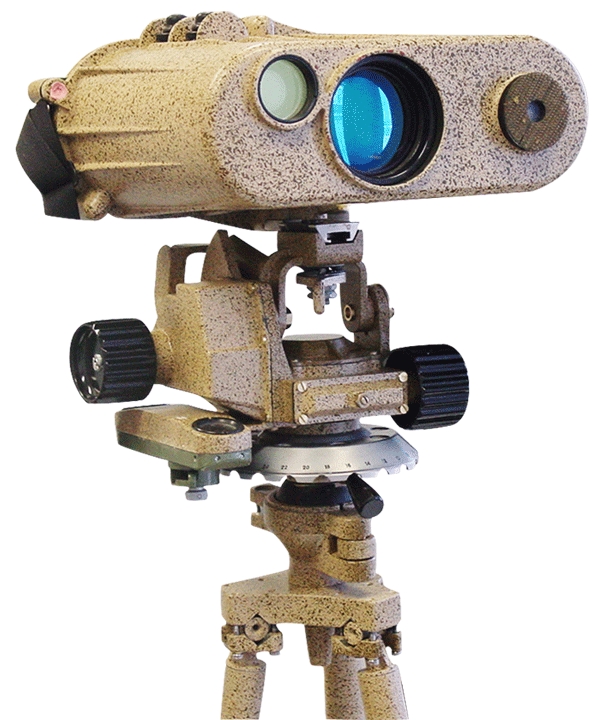

Laser rangefinder
View on Wikipedia | This article needs additional citations for verification. (October 2016) |

A laser rangefinder, also known as a laser telemeter or laser distance meter, is a rangefinder that uses a laser beam to determine the distance to an object. The most common form of laser rangefinder operates on the time of flight principle by sending a laser pulse in a narrow beam towards the object and measuring the time taken by the pulse to be reflected off the target and returned to the sender. Due to the high speed of light, this technique is not appropriate for high precision sub-millimeter measurements, where triangulation and other techniques are often used instead. Laser rangefinders are sometimes classified as type of handheld scannerless lidar.
Pulse
[edit]The pulse may be coded to reduce the chance that the rangefinder can be jammed. It is possible to use Doppler effect techniques to judge whether the object is moving towards or away from the rangefinder, and if so, how fast.
Precision
[edit]The precision of an instrument is correlated with the rise time,[1] divergence, and power of its laser pulse, as well as the quality of its optics and onboard digital signal processing. Environmental factors can significantly reduce range and accuracy:
- Humidity, snow, dust, or other airborne particulates will diffuse the signal.
- Higher temperature and higher pressure (lower elevation) slightly decrease the speed of light through air.
- Smaller and less reflective targets return less information.
In good conditions, skilled operators using precision laser rangefinders can range a target to within a meter at distances on the order of three kilometers.
Range and range error
[edit]Despite the beam being narrow, it will eventually spread over long distances due to the divergence of the laser beam, as well as due to scintillation and beam wander effects, caused by the presence of water droplets in the air acting as lenses ranging in size from microscopic to roughly half the height of the laser beam's path above the earth.
These atmospheric distortions coupled with the divergence of the laser itself and with transverse winds that serve to push the atmospheric heat bubbles laterally may combine to make it difficult to get an accurate reading of the distance of an object, say, beneath some trees or behind bushes, or even over long distances of more than 1 km in open and unobscured desert terrain.
Some of the laser light might reflect off leaves or branches which are closer than the object, giving an early return and a reading which is too low. Alternatively, over distances longer than 360 m, if the target is in proximity to the earth, it may simply vanish into a mirage, caused by temperature gradients in the air in proximity to the heated surface bending the laser light. All these effects must be considered.
Calculation
[edit]
The distance between point A and B is given by

where c is the speed of light and t is the amount of time for the round-trip between A and B.

where φ is the phase delay made by the light traveling and ω is the angular frequency of optical wave.
Then substituting the values in the equation,

In this equation, λ is the wavelength c/f; Δφ is the part of the phase delay that does not fulfill π (that is, φ modulo π); N is the integer number of wave half-cycles of the round-trip and ΔN the remaining fractional part.
Technologies
[edit]
Time of flight - this measures the time taken for a light pulse to travel to the target and back. With the speed of light known, and an accurate measurement of the time taken, the distance can be calculated. Many pulses are fired sequentially and the average response is most commonly used. This technique requires very accurate sub-nanosecond timing circuitry.
Multiple frequency phase-shift - this measures the phase shift of multiple frequencies on reflection then solves some simultaneous equations to give a final measure.
Interferometry - the most accurate and most useful technique for measuring changes in distance rather than absolute distances.
Light attenuation by atmospheric absorption - The method measures the attenuation of a laser beam caused by the absorption from an atmospheric compound (H2O, CO2, CH4, O2 etc.) to calculate the distance to an object. The light atmospheric absorption attenuation method requires unmodulated incoherent light sources and low-frequency electronics that reduce the complexity of the devices. Due to this, low-cost light sources can be used for range-finding. However, the application of the method is limited to atmospheric measurements or planetary exploration.[2]
Applications
[edit]Military
[edit]
Rangefinders provide an exact distance to targets located beyond the distance of point-blank shooting to snipers and artillery. They can also be used for military reconnaissance and engineering. Usually tanks use LRF to correct the direct shoot solution.
Handheld military rangefinders operate at ranges of 2 km up to 25 km and are combined with binoculars or monoculars. When the rangefinder is equipped with a digital magnetic compass (DMC) and inclinometer it is capable of providing magnetic azimuth, inclination, and height (length) of targets. Some rangefinders can also measure a target's speed in relation to the observer. Some rangefinders have cable or wireless interfaces to enable them to transfer their measurement(s) data to other equipment like fire control computers. Some models also offer the possibility to use add-on night vision modules. Most handheld rangefinders use standard or rechargeable batteries.

The more powerful models of rangefinders measure distance up to 40 km and are normally installed either on a tripod or directly on a vehicle, ship, jet, helicopter or gun platform. In the latter case the rangefinder module is integrated with on-board thermal, night vision and daytime observation equipment. The most advanced military rangefinders can be integrated with computers.
To make laser rangefinders and laser-guided weapons less useful against military targets, various military arms may have developed laser-absorbing paint for their vehicles. Regardless, some objects don't reflect laser light very well and using a laser rangefinder on them is difficult.
The first commercial laser rangefinder was the Barr & Stroud LF1, developed in association with Hughes Aircraft, which became available in 1965. This was then followed by the Barr & Stroud LF2, which integrated the rangefinder into a tank sight, and this was used on the Chieftain tank in 1969, the first vehicle so-equipped with such a system. Both systems used ruby lasers.[4]
3D modelling
[edit]
Laser rangefinders are used extensively in 3D object recognition, 3D object modelling, and a wide variety of computer vision-related fields. This technology constitutes the heart of the so-called time-of-flight 3D scanners. In contrast to the military instruments, laser rangefinders offer high-precision scanning abilities, with either single-face or 360-degree scanning modes.
A number of algorithms have been developed to merge the range data retrieved from multiple angles of a single object to produce complete 3D models with as little error as possible. One of the advantages offered by laser rangefinders over other methods of computer vision is in not needing to correlate features from two images in order to determine depth-information like stereoscopic methods do.
Laser rangefinders used in computer vision applications often have depth resolutions of 0.1 mm or less. This can be achieved by using triangulation or refraction measurement techniques unlike to the time of flight techniques used in LIDAR.
Forestry
[edit]
Special laser rangefinders are used in forestry. These devices have anti-leaf filters and work with reflectors. Laser beam reflects only from this reflector and so exact distance measurement is guaranteed. Laser rangefinders with anti-leaf filter are used for example for forest inventories.
Sports
[edit]Laser rangefinders may be effectively used in various sports that require precision distance measurement, such as golf, hunting, and archery. Some of the more popular manufacturers are Caddytalk, Opti-logic Corporation, Bushnell, Leupold, LaserTechnology, Trimble, Leica, Newcon Optik, Op. Electronics, Nikon, Swarovski Optik and Zeiss. Many rangefinders from Bushnell come with advanced features, such as ARC (angle range compensation), multi-distance ability, slope, JOLT (Vibrate when the target is locked), and Pin-Seeking. ARC can be calculated by hand using the rifleman's rule, but it's usually much easier if you let a rangefinder do it when you are out hunting. In golfing where time is most important, a laser rangefinder comes useful in locating distance to the flag. However not all features are 100% legal for golf tournament play.[5] Many hunters in the eastern U.S. don't need a rangefinder, although many western hunters need them, due to longer shooting distances and more open spaces.
Industrial production processes
[edit]An important application is the use of laser rangefinder technology during the automation of stock management systems and production processes in steel industry.
Laser measuring tools
[edit]
Laser rangefinders are also used in several industries like construction, renovation and real estate as alternatives to tape measures, and was first introduced by Leica Geosystems in 1993 in France. To measure a large object like a room with a tape measure, one would need another person to hold the tape at the far wall and a clear line straight across the room to stretch the tape. With a laser measuring tool, the job can be completed by one operator with just a line of sight. Although tape measures are technically perfectly accurate, laser measuring tools are much more precise. Laser measuring tools typically include the ability to produce some simple calculations, such as the area or volume of a room. These devices can be found in hardware stores and online marketplaces.
Price
[edit]Laser rangefinders can vary in price, depending on the quality and application of the product. Military grade rangefinders need to be as accurate as possible and must also reach great distances. These devices can cost hundreds of thousands of dollars. For civilian applications, such as hunting or golf, devices are more affordable and much more readily accessible.[6][7]
Safety
[edit]Laser rangefinders are divided into four classes and several subclasses. Laser rangefinders available to consumers are usually laser class 1 or class 2 devices and are considered relatively eye-safe.[8] Regardless of the safety rating, direct eye contact should always be avoided. Most laser rangefinders for military use exceed the laser class 2 energy levels.
See also
[edit]References
[edit]- ^ Boreman, Glenn. "System design of a pulsed laser rangefinder" (PDF). charlotte.edu. University of Central Florida, Center for Research in Electro-Optics and Lasers. Retrieved 2023-03-11.
- ^ Siozos, Panagiotis; Psyllakis, Giannis; Velegrakis, Michalis (2022-11-02). "A continuous‐wave, lidar sensor based on water vapour absorption lines at 1.52 μm". Remote Sensing Letters. 13 (11): 1164–1172. doi:10.1080/2150704X.2022.2127130. ISSN 2150-704X. S2CID 252826003.
- ^ "En: Choose Business Unit". www.vectronix.ch. Archived from the original on 3 March 2016. Retrieved 13 January 2022.
- ^ Finlayson, D. M.; Sinclair, B. (January 1999). Advances in Lasers and Applications. Taylor & Francis. ISBN 9780750306324.
- ^ "Are golf rangefinders legal for tournament play?". Archived from the original on 2021-12-20. Retrieved 2020-12-20.
- ^ "Laser Rangefinder Cost". OpticsPlanet. Retrieved 2017-04-11.
- ^ "LRF Price Compare".
- ^ "Laser Standards and Classifications". www.rli.com. Retrieved 2017-04-11.
External links
[edit] Media related to Laser range finders at Wikimedia Commons
- [1] A brief write-up on Hunting Rangefinder and its types.
| Tree planting, afforestation |
|  |
|---|---|---|
| Mensuration | ||
| Fire suppression | ||
| Axes | ||
| Saws | ||
| Logging | ||
| Other | ||


Laser rangefinder
View on GrokipediaOperating Principles
Time-of-Flight Method
The time-of-flight (ToF) method determines distance in laser rangefinders by measuring the duration for a laser pulse to propagate to a target and return to the detector. This direct measurement leverages the known speed of light, enabling precise ranging over distances from meters to kilometers. The technique is widely employed in applications such as surveying, military targeting, and topographic mapping due to its robustness for long-range operations.[10][11] In operation, a pulsed laser source emits a narrow beam of light, typically in the near-infrared spectrum (e.g., 905 nm or 1064 nm wavelengths using diode or Nd:YAG lasers), toward the target. The emitted pulse duration is often on the order of nanoseconds to minimize temporal uncertainty. Upon reflection from the target, the backscattered light is captured by a sensitive photodetector, such as an avalanche photodiode (APD) or photomultiplier tube (PMT). High-resolution timing electronics, including start-stop counters or time-to-digital converters, record the round-trip time $ t $. The range $ d $ is then computed asPhase-Shift Method
The phase-shift method in laser rangefinders measures distance by modulating the intensity of a laser beam at a known radio frequency and detecting the phase difference between the emitted and reflected signals. This approach leverages the time-of-flight principle indirectly, as the phase shift is proportional to the round-trip propagation time , given by , where is the modulation frequency.[13] The distance is then calculated as , with denoting the speed of light, accounting for the two-way path.[13] To resolve phase ambiguities arising from shifts exceeding (which limit the unambiguous range to ), multi-frequency modulation is commonly employed. In this technique, multiple modulation frequencies (e.g., co-prime pairs like 21 MHz and 17.5 MHz) are used sequentially or simultaneously, allowing the phase differences at each frequency to be combined via least-squares optimization: minimize , where represents phase errors. This extends the unambiguous range to hundreds of meters while preserving millimeter-level precision, as demonstrated in systems achieving 1 cm accuracy over 300 m at 20 dB signal-to-noise ratio (SNR).[14] Digital signal processing enhances precision in phase detection, with methods like all-phase fast Fourier transform (FFT) or sub-sampling spectrum analysis mitigating errors from noise and frequency offsets. For instance, all-phase FFT on beat signals from dual-frequency lasers (e.g., He-Ne at difference frequency ) yields standard deviations below 0.2° at SNR >35 dB, corresponding to sub-millimeter resolution.[15] Key error sources include amplitude-phase coupling, circuit noise, and sampling deviations, which can be minimized through differential demodulation and high-stability oscillators.[14][15] This method excels in applications requiring high resolution over short to medium ranges, such as industrial metrology and surveying, due to its suitability for diffuse targets and lower power needs compared to pulsed systems. However, it is less effective for very long ranges (>1 km) without advanced multi-frequency schemes, as atmospheric dispersion and low SNR degrade performance.[13] Carrier phase modulation variants further improve anti-jamming robustness, making it valuable in aerospace tasks like spacecraft docking.[14]Key Components and Technologies
Laser Sources
Laser sources are the core emitters in laser rangefinders, generating short, coherent pulses of light to measure distances via time-of-flight or phase-shift principles. These sources must provide high peak power, narrow beam divergence, and precise pulse control to achieve accurate ranging over various distances, while adhering to eye-safety standards such as those in IEC 60825-1. Early developments relied on flashlamp-pumped solid-state lasers, but modern systems predominantly use compact semiconductor diodes due to their efficiency and portability.[16][17] Semiconductor laser diodes, particularly edge-emitting types, dominate contemporary laser rangefinders for their compactness, low cost, and high electrical-to-optical efficiency, often exceeding 45% at near-infrared wavelengths. Operating typically at 905 nm using gallium arsenide (GaAs) materials, these diodes produce pulses with energies around 0.5 μJ, durations of 30–40 ns (full width at half maximum), and repetition rates up to several kHz, enabling ranges beyond 600 m with sub-centimeter precision in controlled conditions. For example, the Coherent SS905A13-TO-01 diode achieves peak powers up to 140 W through a triple-junction design, enhancing battery life and stability in handheld devices for applications like surveying and sports. At 1550 nm using indium phosphide (InP), diode lasers offer greater eye safety, allowing 40–50 times higher permissible power levels due to corneal absorption before reaching the retina, though with lower efficiency (<10%) and higher cost; this wavelength suits long-range military and automotive LiDAR systems.[16][18][17] Diode-pumped solid-state (DPSS) lasers and fiber lasers extend capabilities for demanding environments requiring higher pulse energies or shorter durations. DPSS lasers, such as neodymium-doped yttrium aluminum garnet (Nd:YAG) at 1064 nm or frequency-doubled variants at 532 nm, deliver pulse energies over 1.5 mJ with durations down to 350 ps and average powers up to 50 W, ideal for bathymetric or aerospace rangefinders where narrow linewidth and environmental ruggedness are essential. Fiber lasers, often ytterbium- or erbium-doped at 1–1.5 μm, provide similar performance with added benefits like low beam divergence and operation from -40°C to +65°C; the RPMC HFL series, for instance, outputs 4 W average power at 400 ps pulses and up to 1 MHz repetition rates, supporting frequency-modulated continuous-wave (FMCW) ranging for autonomous vehicles. These technologies evolved from early ruby (694 nm) and neodymium systems in the 1960s–1970s, which offered high power but suffered from bulkiness and low efficiency.[19][20][17] Wavelength selection balances atmospheric transmission, detector compatibility, and safety: 905 nm pairs well with silicon avalanche photodiodes but limits power to avoid eye hazards, while 1550 nm aligns with InGaAs detectors and minimizes solar background interference. Pulse parameters are optimized for signal-to-noise ratio; shorter pulses improve resolution but demand faster electronics, with typical eye-safe designs capping average power at milliwatts. Ongoing advancements focus on integrating multiple diode arrays or hybrid fiber-DPSS configurations to push ranges beyond 10 km without compromising portability.[16][18][20]Detectors and Optics
In laser rangefinders, photodetectors play a critical role in capturing the faint returned laser pulses against background noise, with selection depending on wavelength, required sensitivity, and operational environment. Common types include p-i-n photodiodes for short-range applications due to their simplicity and low cost, but avalanche photodiodes (APDs) are preferred for enhanced sensitivity through internal gain mechanisms. For eye-safe wavelengths near 1.55 μm, InGaAs/InP APDs offer low noise, high-speed operation with bandwidths up to 1 GHz and gains exceeding 100, enabling reliable detection in military and surveying systems.[21] In low-light or long-range scenarios, single-photon avalanche diodes (SPADs), also based on InGaAs/InP, provide single-photon sensitivity, supporting time-correlated single-photon counting (TCSPC) techniques with pulse energies as low as 3 nJ and success rates over 99% for ranges up to 20 km.[22] Earlier systems utilized germanium APDs for 1.54 μm operation, achieving effective ranging with Q-switched erbium glass lasers.[23] The optical subsystem in laser rangefinders is divided into transmitter and receiver components to optimize beam propagation and signal collection. Transmitter optics collimate the laser output to minimize divergence and maximize energy delivery to the target, often employing aspheric lenses or beam expanders for diffraction-limited performance. A representative design uses a Galilean telescope, comprising a small concave lens and a 10-cm diameter convex lens, to adjust beam divergence between 0.5 and 2.5 mrad, ensuring precise targeting over varying distances.[24] Collimator lenses further shape the beam in compact systems, such as those using diode lasers, to form a narrow projection while maintaining alignment with the receiver.[25] Receiver optics focus the backscattered light onto the detector to improve collection efficiency and signal-to-noise ratio, typically incorporating an objective lens (e.g., 10 cm diameter) paired with a field lens (1.5 cm diameter) to match the receiver's field of view to the transmitter beam.[24] Narrowband interference filters, centered on the laser wavelength, are integral to suppress solar and ambient interference, reducing background photon flux by orders of magnitude.[24] Anti-reflection coatings on optical facets and lenses minimize losses, with reflectivities below 3×10⁻⁵ essential for integrated designs like those using semiconductor optical amplifiers as combined detectors.[26] These components collectively enable sub-millimeter accuracy in controlled conditions by optimizing etendue and throughput.Performance Characteristics
Range and Accuracy
The range of laser rangefinders varies significantly based on the device type, laser power, target reflectivity, and atmospheric conditions, typically spanning from a few meters to over 20 kilometers in specialized applications. Handheld models commonly used in surveying and outdoor activities achieve effective ranges of up to 1-2 kilometers on reflective targets, while long-range systems designed for military use can extend to 17 kilometers or more under optimal visibility.[27][28] In controlled environments, such as laboratory or industrial settings, short-range variants operate effectively from millimeters to hundreds of meters.[11] Accuracy, often specified as the standard deviation or maximum error in distance measurement, is influenced by the ranging method (time-of-flight or phase-shift) and signal processing capabilities. For precision surveying instruments like the Leica DISTO series, single measurements yield accuracies of ±2.5 millimeters over short distances up to 200 meters, enabling detailed topographic mapping.[29] In field applications, such as forestry or construction, commercial laser rangefinders like the TruPulse 360 provide ±30 centimeter accuracy over typical ranges of 1 kilometer, sufficient for volume estimation and site planning.[27] Military-grade laser rangefinders prioritize extended reach over ultra-high precision, often achieving range accuracies of ±1–5 meters at 5 kilometers—for target acquisition and fire control.[30][31] Advanced systems, however, incorporate enhanced optics and pulse compression to improve resolution to within 20 centimeters at ranges exceeding 10 kilometers, as demonstrated in evaluations of tactical equipment.[32] Terrestrial laser scanners used in geodesy further refine this to centimeter-level precision over 300-500 meter scans, supporting high-fidelity 3D modeling in engineering projects.[33]| Application Type | Typical Range | Accuracy Specification | Example Device/Source |
|---|---|---|---|
| Handheld/Surveying | Up to 1-2 km | ±2.5 mm to ±30 cm | Leica DISTO; TruPulse 360[29][27] |
| Military/Long-Range | 5-17 km | ±1–5 m (e.g., at 5 km) or better (±20 cm at 10 km) | Tactical LRF systems[30][31][32][28] |
| Terrestrial Scanning/Geodesy | 100-500 m | ±1-5 cm | Pulsed laser scanners[33] |
Error Sources and Precision
Laser rangefinders achieve sub-millimeter to centimeter-level precision depending on the measurement range and method, but various error sources can degrade performance by introducing systematic biases or random variations in distance estimates.[11] In time-of-flight (ToF) systems, precision is fundamentally limited by the timing resolution of the electronics, while phase-shift methods are sensitive to signal modulation quality; overall, errors arise from instrumental, environmental, and target-related factors. Instrumental errors dominate in controlled conditions and include statistical, alignment, cyclic, and drift components. Statistical errors stem from noise in the detection and quantization processes, modeled as random fluctuations with a standard deviation inversely proportional to the signal-to-noise ratio (SNR); for instance, electronic noise and sampling jitter can limit precision to around 1 cm at SNR values of 1500 for 39 ns pulses.[11] Alignment errors occur due to misalignment between transmit and receive optics or variations in photodiode response to light spot position and intensity, causing propagation delays that introduce up to several millimeters of bias in ToF rangefinders. Cyclic errors manifest as periodic deviations tied to the target's range modulo the pulse repetition period, often from electrical crosstalk or stray light, while drift errors arise from temperature-induced changes in component timing, such as laser pulse width variations. In phase-shift rangefinders, additional errors include amplitude distortion in mixing circuits, which generates phase biases, and limitations from modulation depth and measurement rate, potentially reducing precision below 1 mm for short ranges.[34][15] Walk error, a critical issue in ToF systems, results from the threshold-based detection of the return pulse, where timing shifts with received signal amplitude due to target reflectivity or atmospheric attenuation; this can cause errors up to 22.5 cm without correction but is mitigated to ~1 mm via multi-threshold averaging algorithms like SDPA-M.[11] Discretization errors from analog-to-digital conversion sampling (e.g., at 333 MHz yielding 3 ns periods) introduce quantization biases, addressable through interpolation techniques such as least-squares polynomial fitting to achieve sub-centimeter uncertainty.[11] Bias errors, periodic and sawtooth-like, emerge from sampling misalignment with the pulse peak and are reduced by coherent signal addition across multiple pulses to boost SNR.[11] Environmental factors contribute range-proportional errors, primarily through atmospheric refraction and scattering, which alter the effective speed of light and attenuate the beam; refractive index variations from temperature, pressure, and humidity can induce errors of several centimeters per kilometer, necessitating corrections based on meteorological data.[35] Temperature fluctuations also affect laser source stability and detector sensitivity, causing drift in pulse timing or phase measurements. Target properties further influence precision: low-reflectivity or angled surfaces reduce return signal strength, amplifying noise and walk errors, while diffuse scattering from rough targets can shift the effective reflection point by millimeters to centimeters.[11] For high-precision applications, such as surveying, these are minimized using retroreflective targets or calibration routines, enabling repeatabilities as low as 0.1 mm over short distances.[36] Overall, modern rangefinders integrate error compensation—via adaptive thresholding, environmental modeling, and multi-pulse averaging—to attain precisions of ±1-5 mm across 100-1000 m ranges in typical conditions.[11]| Error Type | Primary Cause | Typical Impact | Mitigation Strategy |
|---|---|---|---|
| Statistical/Noise | Electronic jitter, low SNR | Random variation, ~1 cm std. dev. | Signal averaging, higher SNR via coherent addition |
| Walk/Bias | Pulse amplitude variation, sampling phase | Systematic shift, up to 22 cm | Multi-threshold detection, interpolation |
| Alignment | Optic/photodiode misalignment | Delay bias, mm-level | Optimized beam alignment, calibration |
| Cyclic/Drift | Crosstalk, temperature changes | Periodic/temporal bias, cm over time | Shielding, temperature stabilization |
| Atmospheric | Refraction, attenuation | Proportional to distance, cm/km | Meteorological corrections |
| Target-Related | Reflectivity, angle | Signal weakening, mm-cm shift | Retroreflectors, surface preparation |