Hubbry Logo
GliaGliaMain
Open search
Glia
Community hub
Glia
logo
8 pages, 0 posts
0 subscribers
Be the first to start a discussion here.
Glia
Glia
from Wikipedia
Glia
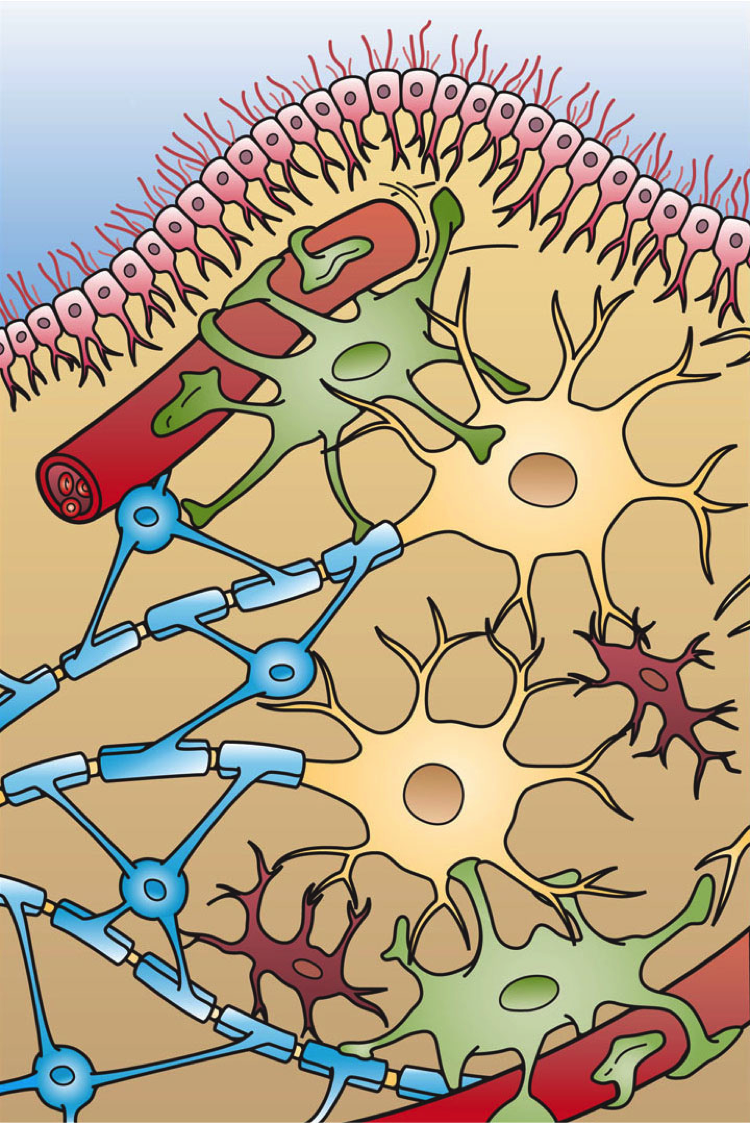
Illustration of the four different types of glial cells found in the central nervous system: ependymal cells (light pink), astrocytes (green), microglial cells (dark red) and oligodendrocytes (light blue)
Details
PrecursorNeuroectoderm for macroglia, and hematopoietic stem cells for microglia
SystemNervous system
Identifiers
MeSHD009457
TA98A14.0.00.005
THH2.00.06.2.00001
FMA54536 54541, 54536
Anatomical terms of microanatomy

Glia, also called glial cells (gliocytes) or neuroglia, are non-neuronal cells in the central nervous system (the brain and the spinal cord) and in the peripheral nervous system that do not produce electrical impulses. The neuroglia make up more than one half the volume of neural tissue in the human body.[1] They maintain homeostasis, form myelin, and provide support and protection for neurons.[2] In the central nervous system, glial cells include oligodendrocytes (that produce myelin), astrocytes, ependymal cells and microglia, and in the peripheral nervous system they include Schwann cells (that produce myelin), and satellite cells.

Function

[edit]

Glia have four main functions:

  • to structurally support neurons, holding them in place
  • to supply nutrients and oxygen to neurons
  • to insulate one neuron from another
  • to destroy pathogens and remove dead neurons.

They also play a role in neurotransmission and synaptic connections,[3] and in physiological processes such as breathing.[4][5][6] While glia were thought to outnumber neurons by a ratio of 10:1, studies using newer methods and reappraisal of historical quantitative evidence suggests an overall ratio of less than 1:1, with substantial variation between different brain tissues.[7][8]

Glial cells have far more cellular diversity and functions than neurons, and can respond to and manipulate neurotransmission in many ways. Additionally, they can affect both the preservation and consolidation of memories.[1]

Glia were discovered in 1856, by the pathologist Rudolf Virchow in his search for a "connective tissue" in the brain.[9] The term derives from Greek γλία and γλοία "glue"[10] (English: /ˈɡlə/ or /ˈɡlə/), and suggests the original impression that they were the glue of the nervous system.

Types

[edit]
Neuroglia of the brain shown by Golgi's method
Astrocytes can be identified in culture because, unlike other mature glia, they express glial fibrillary acidic protein (GFAP)
Glial cells in a rat brain stained with an antibody against GFAP
Different types of neuroglia

Macroglia

[edit]

Derived from ectodermal tissue.

Location Name Description
CNS Astrocytes

Astrocytes (also called astroglia) have numerous projections that link neurons to their blood supply while forming the blood–brain barrier. They regulate the external chemical environment of neurons by removing excess potassium ions and recycling neurotransmitters released during synaptic transmission. Astrocytes may regulate vasoconstriction and vasodilation by producing substances such as arachidonic acid, whose metabolites are vasoactive.

Astrocytes signal each other using ATP. The gap junctions (also known as electrical synapses) between astrocytes allow the messenger molecule IP3 to diffuse from one astrocyte to another. IP3 activates calcium channels on cellular organelles, releasing calcium into the cytoplasm. This calcium may stimulate the production of more IP3 and cause release of ATP through channels in the membrane made of pannexins. The net effect is a calcium wave that propagates from cell to cell. Extracellular release of ATP and consequent activation of purinergic receptors on other astrocytes may also mediate calcium waves in some cases.

In general, there are two types of astrocytes, protoplasmic and fibrous, similar in function but distinct in morphology and distribution. Protoplasmic astrocytes have short, thick, highly branched processes and are typically found in gray matter. Fibrous astrocytes have long, thin, less-branched processes and are more commonly found in white matter.

It has recently been shown that astrocyte activity is linked to blood flow in the brain, and that this is what is actually being measured in fMRI.[11] They also have been involved in neuronal circuits playing an inhibitory role after sensing changes in extracellular calcium.[12]

Human astrocytes are larger and more abundant than any other animals'.[13]

CNS Oligodendrocytes

Oligodendrocytes are cells that coat axons in the CNS with their cell membrane, forming a specialized membrane differentiation called myelin, producing the myelin sheath. The myelin sheath provides insulation to the axon that allows electrical signals to propagate more efficiently.[14]

CNS Ependymal cells

Ependymal cells, also named ependymocytes, line the spinal cord and the ventricular system of the brain. These cells are involved in the creation and secretion of cerebrospinal fluid (CSF) and beat their cilia to help circulate the CSF and make up the blood-CSF barrier. They are also thought to act as neural stem cells.[15]

CNS Radial glia

Radial glia cells arise from neuroepithelial cells after the onset of neurogenesis. Their differentiation abilities are more restricted than those of neuroepithelial cells. In the developing nervous system, radial glia function both as neuronal progenitors and as a scaffold upon which newborn neurons migrate. In the mature brain, the cerebellum and retina retain characteristic radial glial cells. In the cerebellum, these are Bergmann glia, which regulate synaptic plasticity. In the retina, the radial Müller cell is the glial cell that spans the thickness of the retina and, in addition to astroglial cells,[16] participates in a bidirectional communication with neurons.[17]

PNS Schwann cells

Similar in function to oligodendrocytes, Schwann cells provide myelination to axons in the peripheral nervous system (PNS). They also have phagocytotic activity and clear cellular debris that allows for regrowth of PNS neurons.[18]

PNS Satellite cells

Satellite glial cells are small cells that surround neurons in sensory, sympathetic, and parasympathetic ganglia.[19] These cells help regulate the external chemical environment. Like astrocytes, they are interconnected by gap junctions and respond to ATP by elevating the intracellular concentration of calcium ions. They are highly sensitive to injury and inflammation and appear to contribute to pathological states, such as chronic pain.[20]

PNS Enteric glial cells

Are found in the intrinsic ganglia of the digestive system. Glia cells are thought to have many roles in the enteric system, some related to homeostasis and muscular digestive processes.[21]

Microglia

[edit]

Microglia are specialized macrophages capable of phagocytosis that protect neurons of the central nervous system.[22] They are derived from the earliest wave of mononuclear cells that originate in the blood islands of the yolk sac early in development, and colonize the brain shortly after the neural precursors begin to differentiate.[23]

These cells are found in all regions of the brain and spinal cord. Microglial cells are small relative to macroglial cells, with changing shapes and oblong nuclei. They are mobile within the brain and multiply when the brain is damaged. In the healthy central nervous system, microglia processes constantly sample all aspects of their environment (neurons, macroglia and blood vessels). In a healthy brain, microglia direct the immune response to brain damage and play an important role in the inflammation that accompanies the damage. Many diseases and disorders are associated with deficient microglia, such as Alzheimer's disease, Parkinson's disease and ALS.

Other

[edit]

Pituicytes from the posterior pituitary are glial cells with characteristics in common to astrocytes.[24] Tanycytes in the median eminence of the hypothalamus are a type of ependymal cell that descend from radial glia and line the base of the third ventricle.[25] Drosophila melanogaster, the fruit fly, contains numerous glial types that are functionally similar to mammalian glia but are nonetheless classified differently.[26]

Total number

[edit]

In general, neuroglial cells are smaller than neurons. There are approximately 85 billion glial cells in the human brain, about the same number as neurons.[8] Glial cells make up about half the total volume of the brain and spinal cord.[27] The glia to neuron-ratio varies from one part of the brain to another. The glia to neuron-ratio in the cerebral cortex is 3.72 (60.84 billion glia (72%); 16.34 billion neurons), while that of the cerebellum is only 0.23 (16.04 billion glia; 69.03 billion neurons). The ratio in the cerebral cortex gray matter is 1.48, with 3.76 for the gray and white matter combined.[27] The ratio of the basal ganglia, diencephalon and brainstem combined is 11.35.[27]

The total number of glial cells in the human brain is distributed into the different types with oligodendrocytes being the most frequent (45–75%), followed by astrocytes (19–40%) and microglia (about 10% or less).[8]

Development

[edit]
23-week fetal brain culture astrocyte

Most glia are derived from ectodermal tissue of the developing embryo, in particular the neural tube and crest. The exception is microglia, which are derived from hematopoietic stem cells. In the adult, microglia are largely a self-renewing population and are distinct from macrophages and monocytes, which infiltrate an injured and diseased CNS.

In the central nervous system, glia develop from the ventricular zone of the neural tube. These glia include the oligodendrocytes, ependymal cells, and astrocytes. In the peripheral nervous system, glia derive from the neural crest. These PNS glia include Schwann cells in nerves and satellite glial cells in ganglia.

Capacity to divide

[edit]

Glia retain the ability to undergo cell divisions in adulthood, whereas most neurons cannot. The view is based on the general inability of the mature nervous system to replace neurons after an injury, such as a stroke or trauma, where very often there is a substantial proliferation of glia, or gliosis, near or at the site of damage. However, detailed studies have found no evidence that 'mature' glia, such as astrocytes or oligodendrocytes, retain mitotic capacity. Only the resident oligodendrocyte precursor cells seem to keep this ability once the nervous system matures.

Glial cells are known to be capable of mitosis. By contrast, scientific understanding of whether neurons are permanently post-mitotic,[28] or capable of mitosis,[29][30][31] is still developing. In the past, glia had been considered[by whom?] to lack certain features of neurons. For example, glial cells were not believed to have chemical synapses or to release transmitters. They were considered to be the passive bystanders of neural transmission. However, recent studies have shown this to not be entirely true.[32]

Functions

[edit]

Some glial cells function primarily as the physical support for neurons. Others provide nutrients to neurons and regulate the extracellular fluid of the brain, especially surrounding neurons and their synapses. During early embryogenesis, glial cells direct the migration of neurons and produce molecules that modify the growth of axons and dendrites. Some glial cells display regional diversity in the CNS and their functions may vary between the CNS regions.[33]

Neuron repair and development

[edit]

Glia are crucial in the development of the nervous system and in processes such as synaptic plasticity and synaptogenesis. Glia have a role in the regulation of repair of neurons after injury. In the central nervous system (CNS), glia suppress repair. Glial cells known as astrocytes enlarge and proliferate to form a scar and produce inhibitory molecules that inhibit regrowth of a damaged or severed axon. In the peripheral nervous system (PNS), glial cells known as Schwann cells (or also as neuri-lemmocytes) promote repair. After axonal injury, Schwann cells regress to an earlier developmental state to encourage regrowth of the axon. This difference between the CNS and the PNS, raises hopes for the regeneration of nervous tissue in the CNS. For example, a spinal cord may be able to be repaired following injury or severance.

Myelin sheath creation

[edit]

Oligodendrocytes are found in the CNS and resemble an octopus: they have a bulbous cell body with up to fifteen arm-like processes. Each process reaches out to an axon and spirals around it, creating a myelin sheath. The myelin sheath insulates the nerve fiber from the extracellular fluid and speeds up signal conduction along the nerve fiber.[34] In the peripheral nervous system, Schwann cells are responsible for myelin production. These cells envelop nerve fibers of the PNS by winding repeatedly around them. This process creates a myelin sheath, which not only aids in conductivity but also assists in the regeneration of damaged fibers.

Neurotransmission

[edit]

Astrocytes are crucial participants in the tripartite synapse.[35][36][37][38] They have several crucial functions, including clearance of neurotransmitters from within the synaptic cleft, which aids in distinguishing between separate action potentials and prevents toxic build-up of certain neurotransmitters such as glutamate, which would otherwise lead to excitotoxicity. Furthermore, astrocytes release gliotransmitters such as glutamate, ATP, and D-serine in response to stimulation.[39]

Clinical significance

[edit]
Neoplastic glial cells stained with an antibody against GFAP (brown), from a brain biopsy

While glial cells in the PNS frequently assist in regeneration of lost neural functioning, loss of neurons in the CNS does not result in a similar reaction from neuroglia.[18] In the CNS, regrowth will only happen if the trauma was mild, and not severe.[40] When severe trauma presents itself, the survival of the remaining neurons becomes the optimal solution. However, some studies investigating the role of glial cells in Alzheimer's disease are beginning to contradict the usefulness of this feature, and even claim it can "exacerbate" the disease.[41] In addition to affecting the potential repair of neurons in Alzheimer's disease, scarring and inflammation from glial cells have been further implicated in the degeneration of neurons caused by amyotrophic lateral sclerosis.[42]

In addition to neurodegenerative diseases, a wide range of harmful exposure, such as hypoxia, or physical trauma, can lead to the result of physical damage to the CNS.[40] Generally, when damage occurs to the CNS, glial cells cause apoptosis among the surrounding cellular bodies.[40] Then, there is a large amount of microglial activity, which results in inflammation, and, finally, there is a heavy release of growth inhibiting molecules.[40]

History

[edit]

Although glial cells and neurons were probably first observed at the same time in the early 19th century, unlike neurons whose morphological and physiological properties were directly observable for the first investigators of the nervous system, glial cells had been considered to be merely "glue" that held neurons together until the mid-20th century.[43]

Glia were first described in 1856 by the pathologist Rudolf Virchow in a comment to his 1846 publication on connective tissue. A more detailed description of glial cells was provided in the 1858 book 'Cellular Pathology' by the same author.[44]

When markers for different types of cells were analyzed, Albert Einstein's brain was discovered to contain significantly more glia than normal brains in the left angular gyrus, an area thought to be responsible for mathematical processing and language.[45] However, out of the total of 28 statistical comparisons between Einstein's brain and the control brains, finding one statistically significant result is not surprising, and the claim that Einstein's brain is different is not scientific (cf. multiple comparisons problem).[46]

Not only does the ratio of glia to neurons increase through evolution, but so does the size of the glia. Astroglial cells in human brains have a volume 27 times greater than in mouse brains.[47]

These important scientific findings may begin to shift the neurocentric perspective into a more holistic view of the brain which encompasses the glial cells as well. For the majority of the twentieth century, scientists had disregarded glial cells as mere physical scaffolds for neurons. Recent publications have proposed that the number of glial cells in the brain is correlated with the intelligence of a species.[48] Moreover, evidences are demonstrating the active role of glia, in particular astroglia, in cognitive processes like learning and memory.[49][50]

See also

[edit]

References

[edit]

Further reading

[edit]
[edit]
Revisions and contributorsEdit on WikipediaRead on Wikipedia
from Grokipedia
Glia, also known as neuroglia or glial cells, are non-neuronal cells that constitute approximately half of the cells in the (CNS) and play essential roles in supporting neuronal function and maintaining homeostasis. First termed "nerve glue" by in 1856, glia were initially viewed as passive supporters but are now recognized as dynamic contributors to neural development, signaling, and repair. In the CNS, the primary types of glial cells include astrocytes, which regulate the blood-brain barrier, modulate synaptic transmission, and provide metabolic support to neurons; oligodendrocytes, which form myelin sheaths to insulate axons and facilitate rapid signal conduction; and microglia, the resident immune cells that monitor for injury, clear debris, and influence inflammation. In the peripheral nervous system (PNS), glia comprise Schwann cells, which myelinate axons and aid in nerve regeneration, and satellite glial cells, which envelop neuronal cell bodies and regulate the extracellular environment. Beyond structural and insulating roles, glia assist in supply, waste removal, and , creating an optimal microenvironment for neuronal activity. They also contribute to neural plasticity, learning, and responses to injury or disease, underscoring their integral involvement in both healthy and pathological processes.

Overview

Definition and General Role

Glia, also known as glial cells or neuroglia, are a diverse class of non-neuronal cells in the nervous system that provide essential support to neurons and maintain overall neural function. The term "glia" originates from the Greek word glía, meaning "glue," which historically described their perceived role in binding nervous tissue together. In the human brain, glia constitute nearly half of all cells, with approximately 85 billion glial cells coexisting with about 86 billion neurons. In the cerebral cortex, glia outnumber neurons at a ratio of roughly 3.7:1, with 60.8 billion non-neuronal cells compared to 16.3 billion neurons. These cells are found in both the central nervous system (CNS) and peripheral nervous system (PNS). Glia fulfill critical general roles in the , including the maintenance of by regulating concentrations, neurotransmitter clearance, and metabolic support for neurons. They provide a structural framework that organizes neural and insulates neuronal processes, while also modulating neuronal activity through influences on synaptic transmission and plasticity. These functions ensure the efficient operation of neural circuits without glia directly propagating electrical signals. In contrast to neurons, which possess axons and dendrites for specialized signal conduction and typically generate action potentials, glia lack these extensions and do not fire action potentials in the conventional sense. Instead, glia display varied morphologies—ranging from star-shaped to elongated forms—that enable their supportive and regulatory capabilities across diverse neural environments.

Evolutionary and Comparative Aspects

Glia emerged alongside neurons during the early evolution of bilaterian animals, with radial glial cells representing an ancestral form that served as progenitors for both neuronal and glial lineages in the last common ancestor of and Deuterostomia. This early diversification is evidenced by the presence of radial glia-like cells in diverse bilaterian clades, including annelids and , where they contribute to patterning and support neuronal migration. In comparative terms, glial cells in exhibit simpler organization and functions compared to the complex macroglia of vertebrates. For instance, in , wrapping glia ensheath axons to provide structural support and facilitate waste clearance of neuronal debris, without forming compact sheaths. In contrast, vertebrate macroglia, such as , develop intricate multi-layered for electrical insulation, reflecting adaptations to larger, more complex nervous systems. Certain glial functions show remarkable conservation across species, particularly in axon ensheathment. In , cephalic sheath glia wrap neuronal processes in a manner analogous to vertebrate , promoting neurite stability and synaptic organization, though lacking the lipid-rich characteristic of vertebrates. This conserved ensheathment mechanism underscores the evolutionary continuity of glial-neuronal interactions from nematodes to mammals. Non-mammalian vertebrates display unique glial adaptations tailored to ecological demands, such as extensive myelination in to enable rapid nerve conduction in aquatic environments. In elasmobranchs like the bamboo shark (Chiloscyllium punctatum), oligodendrocyte-derived myelin sheaths develop early in embryogenesis and cover a high proportion of axons, supporting efficient signal propagation over long distances. This adaptation highlights how glial myelination evolved to enhance performance in diverse lineages.

Classification and Anatomy

Macroglia

Macroglia, also known as macroglial cells, constitute the primary supportive glial population in the (CNS), encompassing several distinct subtypes that provide structural framework. These cells derive from neuroepithelial progenitors and are characterized by their larger size relative to , with specialized morphologies adapted to their locations. Astrocytes are star-shaped macroglial cells featuring numerous branching processes that extend to contact neuronal synapses, blood vessels, and the pial surface, forming a supportive network within neural tissue. They exhibit two main morphological subtypes: protoplasmic astrocytes, which have bushy, highly branched processes and predominate in the CNS gray matter; and fibrous astrocytes, characterized by longer, less branched, fiber-like processes and found primarily in . Oligodendrocytes are compact macroglial cells in the CNS with a rounded cell body and thin processes that extend to wrap around axons, forming multilayered sheaths to insulate multiple axonal segments from a single cell. Each oligodendrocyte can myelinate up to 50 axons, enabling efficient coverage of tracts. Ependymal cells form a ciliated, cuboidal to columnar epithelial layer that lines the ventricles of the and the of the , with apical cilia and microvilli facilitating fluid dynamics. Anatomically, astrocytes are predominantly distributed in gray matter regions, where their extensive processes interdigitate with neuronal elements, while are concentrated in tracts to support myelinated fiber bundles. Ependymal cells are confined to the and interfaces.

Microglia

Microglia serve as the primary resident immune cells of the (CNS), originating from primitive myeloid progenitors in the during early embryonic development. Unlike macroglia, such as and , which derive from neuroepithelial cells of the , microglia arise from hematopoietic stem cells that migrate into the developing brain around embryonic day 9.5 in mice, establishing a self-renewing independent of contributions in adulthood. In their resting state, microglia exhibit a highly ramified morphology characterized by an elongated soma and extensive, branched processes that extend throughout the brain parenchyma, enabling constant . Upon in response to or pathological signals, these cells undergo morphological transformation, retracting their processes and adopting an amoeboid form with a rounded soma and increased , facilitating rapid migration to sites of disturbance. Microglia perform ongoing surveillance of the CNS through dynamic extension and retraction of their processes, making brief contacts with neuronal synapses at a frequency of approximately once per hour under homeostatic conditions. This vigilant patrolling enables swift responses to localized , such as laser-induced , where processes converge on the site within minutes to contain and isolate affected areas. Comprising approximately 10-15% of all cells in the adult , microglia are evenly distributed across regions, maintaining densities typically ranging from 5,000 to 15,000 cells per mm³, varying by region, to ensure comprehensive coverage.

Other Glial Types

Enteric glia constitute a specialized population of glial cells within the (ENS) of the , where they provide structural and functional support to enteric neurons in a manner analogous to in the . These cells are distributed throughout the myenteric and submucosal plexuses, exhibiting diverse morphologies including multipolar and bipolar forms, and they express glial markers such as S100β and (GFAP). Their primary roles include maintaining gut by regulating neuronal signaling, supporting epithelial barrier integrity, and modulating immune responses in the intestinal environment. Satellite glial cells are non-myelinating glia that envelop the cell bodies of neurons in (PNS) ganglia, such as dorsal ganglia and autonomic ganglia, forming a protective sheath that isolates neuronal somata from the . These cells share molecular features with , including expression of GFAP and , and they facilitate ion homeostasis, uptake, and trophic support for sensory and autonomic neurons. In the PNS, satellite glia contribute to the overall glial framework alongside Schwann cells, enhancing neuronal survival and responsiveness to environmental cues. Schwann cells are the primary myelinating glia of the PNS, featuring an elongated structure where each cell envelops a single axonal segment with its plasma membrane to produce a sheath. Bergmann glia represent a unique subclass of radial located specifically in the , where their elongated processes extend from the layer to the pial surface, forming a scaffold that organizes the molecular layer. During cerebellar development, these cells guide the radial migration of precursors toward the internal granule layer, ensuring proper and of the . In mature , Bergmann glia maintain synaptic stability by ensheathing dendrites and modulating extracellular potassium levels, thereby supporting coordinated motor functions. Müller cells serve as the predominant glial elements in the vertebrate , spanning the entire retinal thickness with their radial processes that contact photoreceptors, synaptic layers, and the vitreous humor, thereby providing mechanical stability and metabolic provisioning. These cells express enzymes for recycling, such as for glutamate metabolism, and they transport nutrients like glucose and antioxidants to energy-demanding photoreceptors while regulating the retinal extracellular environment. Additionally, Müller cells contribute to retinal by acting as light-guiding fibers, minimizing scattering to enhance .

Number and Distribution

In the adult , the total number of glial cells is estimated at approximately 85 billion, roughly equal to the number of neurons, debunking earlier claims of a much higher glial population. This figure encompasses all major glial types across the (CNS), with regional variations reflecting functional specializations; for instance, astrocyte density is notably higher in the compared to subcortical structures. These estimates derive from systematic analyses of postmortem tissue from multiple individuals, highlighting a glia-to-neuron of about 1:1 overall. Glia-to-neuron ratios vary significantly by brain region, underscoring heterogeneous cellular organization. In the , the ratio reaches approximately 3.7:1, driven largely by macroglial populations supporting complex synaptic networks. Conversely, the exhibits a much lower of 0.23:1, where neuronal density is exceptionally high to facilitate rapid . In the peripheral nervous system (PNS), ratios are generally lower than in cortical regions, with Schwann cells associating closely with individual axons rather than forming expansive networks. Spatial distribution patterns of glial cells further reveal their organized arrangement. Macroglia, including and , tend to cluster around neurons, synapses, and vasculature, forming intimate tripartite structures that enable localized metabolic and structural support. , by contrast, are uniformly dispersed throughout the , maintaining a vigilant, even coverage to detect and respond to disturbances. In the PNS, glial cells envelop neuronal somata in ganglia, while Schwann cells align along axonal lengths. These quantifications rely on rigorous methodological approaches to ensure accuracy and avoid biases from tissue shrinkage or sampling errors. Traditional stereology, employing tools like the optical disector and fractionator probes, enables unbiased estimation of cell numbers through of histological sections. Complementary techniques, such as the isotropic fractionator, homogenize tissue to count intact nuclei via fluorescence microscopy, providing rapid whole- assessments. For dynamic distribution studies, two-photon microscopy allows non-invasive imaging of labeled glial cells in living animal models, revealing real-time spatial patterns at cellular resolution.

Development and Physiology

Embryonic Origins and Differentiation

Glial cells in the (CNS) primarily originate from the during embryonic development. Macroglia, including and , arise from radial glial cells, which serve as neural progenitor cells lining the ventricular zone of the . These radial glia initially support but transition to gliogenesis, generating glial lineages through asymmetric divisions and differentiation cues. In mammals, gliogenesis occurs predominantly after the peak of , ensuring the establishment of a neuronal framework before glial support structures form. This temporal sequence is evident in models, where gliogenesis initiates around embryonic day 12 (E12) and peaks between E12 and postnatal day 7 (P7), driven by environmental signals such as bone morphogenetic proteins (BMPs) and fibroblast growth factors (FGFs). , responsible for myelination in the CNS, are specified from progenitor cells (OPCs) derived from radial glia or, in ventral regions, from Nkx2.1-expressing in the ventral . Key transcription factors orchestrate this process: Olig2 is essential for OPC commitment and maintenance, while promotes glial fate by repressing neurogenic programs and activating downstream glial genes. Astrocytes differentiate from radial glia in response to similar signaling pathways, with NFIA playing a critical role in promoting astrogliogenesis by regulating for cytoskeletal and components. This differentiation is regionally specific, occurring later in dorsal telencephalon compared to ventral regions, and contributes to the diversity of astrocytic subtypes. In the peripheral (PNS), glial cells such as s and satellite cells derive from cells, multipotent progenitors that migrate from the dorsal around E8-E9 in mice. These crest cells differentiate into Schwann cell precursors under the influence of neuregulin-1 signaling from axons, leading to myelinating and non-myelinating subtypes. Microglia, the immune-specialized glia, originate from yolk sac erythro-myeloid progenitors that invade the CNS early in development, distinct from the neural tube or crest lineages.

Proliferative Capacity and Maintenance

During embryonic development, radial glia serve as the primary neural stem cells in the ventricular zone, capable of self-renewal and asymmetric division to produce neurons and glial progenitors. These cells exhibit stem-like properties, generating intermediate progenitors and directly contributing to cortical layering through their radial processes. As neurogenesis wanes late in development, radial glia transition into astrocytes, adopting mature astrocytic morphologies and functions while retaining some proliferative potential in specific contexts. This transformation involves downregulation of stem cell markers and upregulation of glial-specific proteins like GFAP, ensuring a shift from progenitor roles to supportive ones in the postnatal brain. In adulthood, gliogenesis persists but is regionally restricted, primarily occurring in the (SVZ) where neural stem cells—derived from embryonic radial glia—generate new to support myelination and circuit maintenance. These SVZ progenitors, often identified as type B cells, proliferate and differentiate into oligodendrocyte precursor cells (OPCs), which integrate into tracts throughout life. In contrast, renewal is limited, with most mature arising from local symmetric divisions during early postnatal stages rather than ongoing adult replacement, contributing to the relative stability of astrocytic populations. However, recent studies show that neural stem cells in the adult hippocampus can generate through asymmetric or direct differentiation, contributing to limited but ongoing astrogliogenesis in neurogenic niches. Microglia maintain their numbers through local self-renewal via proliferation, independent of peripheral hematopoiesis or marrow-derived monocytes under homeostatic conditions. This process involves balanced proliferation and , allowing to repopulate territories without infiltration from circulating precursors, as demonstrated in fate-mapping studies using conditional models. Glial proliferation is tightly regulated by signaling pathways and environmental cues; for instance, Notch signaling inhibits division in radial glia and , promoting quiescence and preventing excessive gliogenesis during development. Conversely, brain injury activates proliferative responses in glia, including reactive and microglial expansion, driven by factors like cytokines and hypoxia to facilitate repair, though this can lead to scar formation if dysregulated.

Cellular Interactions with Neurons

During development, radial glia cells serve as scaffolds that guide the radial migration of neurons from the ventricular zone to their final laminar positions in the . These elongated processes of radial glia provide a physical substrate for neuronal somata to climb via contact-mediated , ensuring proper layering and organization of the cortical architecture. This contact guidance mechanism is essential for the inside-out pattern of cortical development observed in mammals, where later-born neurons migrate past earlier ones to form superficial layers. Seminal studies in models demonstrated that disrupting radial glial integrity impairs neuronal migration, leading to cortical malformations such as . Astrocytes play a critical role in synaptogenesis by actively pruning excess synapses through phagocytosis, thereby refining neural circuits during development and homeostasis. This process involves the recognition and engulfment of synaptic components, particularly those marked for elimination, via specific receptors on astrocytic processes. In particular, astrocytes utilize the multiple EGF-like domains 10 (MEGF10) and Mertk phagocytic pathways to internalize synaptic elements, with neuronal activity strongly influencing the efficiency of this elimination. Genetic ablation of MEGF10 in mice results in increased synaptic density in the retinogeniculate system and hippocampus, highlighting its necessity for circuit maturation. This activity-dependent pruning helps sculpt functional connectivity, preventing overexcitation and supporting learning-induced plasticity. Gap junctions formed by proteins facilitate direct metabolic and electrical coupling between glia and neurons, enabling the exchange of ions, metabolites, and second messengers. In , 43 (Cx43) and 30 (Cx30) predominate, forming hemichannels and intercellular channels that allow bidirectional communication, such as the transfer of glucose-derived metabolites from glia to neurons under energy demand. This coupling supports neuronal by synchronizing astrocytic networks to buffer extracellular and supply energy substrates during high activity. Studies in connexin-deficient models reveal disrupted metabolic support, leading to impaired neuronal function and increased vulnerability to . Notably, while also express connexins for intraglial coupling, direct gap junctions between neurons and glia are uncommon; instead, astrocytic connexins like Cx43 facilitate metabolic and signaling support to neurons. Calcium signaling in glia orchestrates gliotransmitter release that modulates neuronal excitability, bridging glial sensing of synaptic activity to circuit-level . Intracellular Ca²⁺ waves in , triggered by neuronal glutamate or mechanical stimuli, propagate via (IP₃) receptors and lead to the exocytotic or channel-mediated release of ATP as a key gliotransmitter. Released ATP acts on neuronal purinergic receptors (P2X and P2Y) to either excite or inhibit depending on the neuronal subtype; for instance, it enhances pyramidal firing while suppressing parvalbumin activity, thus fine-tuning network oscillations. This Ca²⁺-dependent mechanism ensures gliotransmission is activity-gated, preventing tonic interference with synaptic transmission. Dysregulation of astrocytic Ca²⁺ signaling, as seen in Orai1 models, alters ATP release and heightens susceptibility by desynchronizing neuronal excitability.

Functions

Structural and Metabolic Support

Astrocytes, a major type of glial cell in the , provide essential structural support to neurons and vasculature by forming extensive networks of processes that stabilize the 's architecture. These processes, particularly the endfeet, envelop vessels, creating perivascular networks that anchor the vasculature and prevent its displacement during physiological stresses or mechanical forces. This scaffolding role is critical for maintaining the integrity of the neurovascular unit, as astrocytic endfeet cover nearly the entire surface of cerebral capillaries, facilitating physical stability and enabling efficient exchange between and tissue. Disruptions in these endfoot formations, such as those observed in pathological conditions, lead to vascular instability and impaired tissue support. In addition to structural scaffolding, glia play a pivotal role in metabolic support by shuttling nutrients to neurons, which rely heavily on astrocytic supply for energy demands. Astrocytes uptake glucose from the bloodstream primarily through glucose transporter 1 (GLUT1) located on their endfeet, converting it into lactate via glycolysis within their cytoplasm. This lactate is then exported to neurons through monocarboxylate transporters (MCTs), such as MCT1 and MCT4 on astrocytes and MCT2 on neurons, supporting oxidative metabolism and synaptic activity, in addition to direct neuronal glucose uptake. This astrocyte-neuron lactate shuttle is particularly vital during high-energy states like learning and memory consolidation, where astrocytic glycogen stores serve as a rapid reserve. Glial cells also maintain ion homeostasis, a key aspect of metabolic support, by regulating extracellular potassium levels to prevent neuronal hyperexcitability. Astrocytes express inwardly rectifying 4.1 (Kir4.1), which facilitates spatial buffering by taking up excess ions released during neuronal firing and redistributing them through gap junctions or across the astrocytic . This is essential for restoring baseline extracellular concentrations, with Kir4.1 accounting for the majority of astrocytic conductance, particularly in perineuronal processes. Loss of Kir4.1 function disrupts this buffering, leading to elevated extracellular and associated neurological dysfunction. Furthermore, astrocytes contribute to the formation and maintenance of the blood-brain barrier (BBB) by inducing in endothelial cells through secreted signaling molecules. Astrocytic endfeet release factors such as sonic hedgehog and angiotensin II that promote the assembly of tight junction proteins like claudin-5 and in the endothelial , enhancing barrier impermeability to protect the neural environment. Coculture studies demonstrate that direct contact or soluble signals from upregulate these junctional complexes, underscoring their inductive role in BBB development during brain vascularization. This glial-endothelial interaction ensures selective nutrient passage while excluding toxins, with astrocytic resulting in junctional breakdown and barrier compromise.

Myelination and Axonal Insulation

Myelination is a specialized process carried out by macroglial cells in which in the (CNS) and s in the peripheral nervous system (PNS) produce multilayered sheaths of that insulate axons, facilitating efficient neural . can myelinate multiple axons simultaneously, whereas each Schwann cell typically wraps a single axonal segment. This insulation is essential for , where action potentials propagate rapidly by jumping between unmyelinated gaps. The sheath consists primarily of , comprising approximately 70-85% of its dry mass, with the remainder being proteins. Key include (about 40%), phospholipids (40%), and glycolipids (20%), such as galactocerebroside and , which contribute to the sheath's compact, hydrophobic structure. In the CNS, major proteins include myelin basic protein (MBP, ~30% of total protein) and proteolipid protein (PLP, ~38%), which stabilize the multilayered wraps and maintain compactness. During myelination, glial processes extend along the and spiral around it, forming concentric layers of plasma membrane that fuse to create the sheath, with periodic interruptions known as nodes of Ranvier. These nodes concentrate voltage-gated sodium channels, enabling where the action potential regenerates only at these sites. The process begins with axonal contact by the glial cell, followed by proliferation and wrapping, guided by axonal signals like neuregulin. Biophysically, myelin enhances conduction velocity by 50- to 100-fold, elevating it from less than 1 m/s in unmyelinated axons to 50-100 m/s, primarily through saltatory propagation and reduced energy expenditure. A key mechanism is the reduction in axonal capacitance, as increases the effective thickness (d) of the insulating layer; capacitance (C) is given by the formula
C=ϵAdC = \frac{\epsilon A}{d}
where ϵ\epsilon is the , A is the surface area, and d is the distance between conductive layers (the axoplasm and ). This decrease in C minimizes the charge required to depolarize the during propagation.
Following demyelination, such as from or , both oligodendrocytes and Schwann cells exhibit remyelination potential, often occurring spontaneously and restoring partial conduction efficiency. In the CNS, oligodendrocyte progenitor cells differentiate to form new sheaths, while in the PNS, Schwann cells dedifferentiate, proliferate, and remyelinate. This regenerative capacity highlights glia's role in axonal repair, though full restoration varies by context.

Immune Surveillance and Response

, the primary immune cells of the (CNS), maintain a resting state characterized by ramified morphology and continuous process , enabling them to survey the parenchyma at rates of approximately 1-2 μm/min to sample the extracellular space for signs of or . This dynamic surveillance allows to detect subtle changes in their environment, such as ATP release from damaged cells, without altering their overall position. Upon encountering threats like pathogens or cellular debris, rapidly activate, transitioning from this quiescent patrolling to a responsive state that initiates immune defense. Microglial activation can polarize into distinct phenotypes, often described as M1 (pro-inflammatory) and M2 (anti-inflammatory), though this dichotomy represents a simplification of their diverse states. M1-like microglia produce pro-inflammatory cytokines such as tumor necrosis factor-alpha (TNF-α) and interleukin-1 beta (IL-1β), promoting pathogen clearance and recruiting additional immune responses. In contrast, M2-like microglia secrete anti-inflammatory mediators including interleukin-10 (IL-10) and transforming growth factor-beta (TGF-β), facilitating tissue repair and resolution of inflammation. These activation profiles are influenced by environmental cues, such as lipopolysaccharide for M1 skewing or interleukin-4 for M2, ensuring a balanced immune response in the CNS. A core function of activated is , through which they engulf apoptotic cells, pathogens, and debris to prevent and maintain . This process is mediated by phagocytic receptors such as TREM2 and Mertk. serves as a marker for phagocytic activity in activated . Efficient by clears over 90% of apoptotic neurons in the healthy CNS, minimizing secondary damage from uncleared debris. Crosstalk between and peripheral immune cells is generally limited by the blood-brain barrier (BBB), which restricts infiltration under homeostatic conditions. However, BBB breach during severe infections or injury permits peripheral monocytes and T cells to enter the CNS, where they interact with to amplify local responses, such as enhanced production. and also contribute to CNS by modulating microglial activation through signaling, though their roles are secondary to microglia in direct immune surveillance.

Regulation of Neurotransmission and Synapses

Glia play a pivotal role in modulating and through the tripartite synapse model, where form an integral third component alongside presynaptic and postsynaptic neurons. In this framework, detect synaptic activity via receptors for neurotransmitters such as glutamate and respond by generating intracellular calcium waves that propagate within their processes. These calcium elevations enable to integrate signals from multiple synapses and influence neuronal communication bidirectionally. Gliotransmission represents a key mechanism by which astrocytes release signaling molecules to regulate synaptic . Astrocytes release gliotransmitters like glutamate, D-serine, and ATP through calcium-dependent , which can activate neuronal receptors and modulate . For instance, glutamate released from activates extrasynaptic NMDA receptors on s, enhancing synaptic strength and . D-serine, synthesized and released primarily by , serves as an endogenous co-agonist for NMDA receptors, facilitating their activation and supporting processes such as learning and memory. Similarly, ATP release from can be hydrolyzed to , which acts on presynaptic A1 receptors to inhibit release, thereby fine-tuning synaptic transmission. Microglia contribute to synaptic regulation through activity-dependent , particularly during brain development, where they selectively eliminate weak or inactive synapses. This process involves the classical complement cascade, with C1q tagging developing synapses for removal and C3 opsonizing them for by . In the retinogeniculate system, for example, C1q and C3 localize to less active synapses, enabling to sculpt neural circuits by engulfing and dismantling these connections, which is essential for refining connectivity and . Disruptions in this microglia-mediated pruning can lead to altered circuit maturation. Beyond direct synaptic modulation, glia facilitate volume transmission by rapidly clearing excess neurotransmitters from the , preventing spillover and maintaining signaling fidelity. Astrocytes express high levels of excitatory amino acid transporters (EAATs), particularly EAAT1 (GLAST) and EAAT2 (GLT-1), which uptake with high affinity and capacity. This clearance terminates signaling, regulates ambient levels, and protects against . In regions like the hippocampus, astrocytic EAATs account for over 90% of uptake, underscoring their dominance in volume transmission dynamics.

Clinical and Pathological Significance

Glial Contributions to Neurological Disorders

Glial cells play a pivotal role in the of various neurological disorders through mechanisms involving , impaired support functions, and dysregulated responses to neuronal stress. In (MS), an autoimmune , undergo progressive loss due to direct immune attack and secondary inflammatory processes, leading to the stripping of sheaths from axons and consequent conduction deficits. exacerbate this pathology by adopting a pro-inflammatory , releasing cytokines such as TNF-α and IL-1β that further promote and inhibit remyelination. This glial-mediated demyelination underlies the relapsing-remitting and progressive forms of MS, with activated forming clusters around active lesions. In (AD), reactive contribute to disease progression by failing to effectively clear amyloid-β (Aβ) plaques, a hallmark of the condition. Normally, uptake and degrade Aβ via endolysosomal pathways, but in AD, chronic activation leads to , where upregulated GFAP expression impairs this clearance and instead promotes Aβ aggregation through excessive production of pro-inflammatory factors like S100B. Concurrently, microglial of Aβ is compromised due to impaired TREM2 signaling, resulting in reduced engulfment of fibrillar deposits and sustained . This dysfunction shifts microglia from a protective to a neurotoxic state, amplifying tau hyperphosphorylation and neuronal loss in affected brain regions such as the hippocampus. Amyotrophic lateral sclerosis (ALS) exemplifies astrocytic dysfunction in degeneration, where downregulation of the glutamate transporter GLT-1 (also known as EAAT2) on leads to extracellular glutamate accumulation and . In ALS models and patient tissues, mutant or FUS proteins disrupt GLT-1 expression through and transcriptional repression, causing overactivation of and NMDA receptors on motor neurons. This astrocytic failure, combined with microglial activation, accelerates calcium overload and mitochondrial dysfunction in neurons, contributing to the selective vulnerability of motor pools. Studies in transgenic mice have shown that restoring GLT-1 function delays ALS onset, underscoring the transporter's critical role. Recent research since 2020 has highlighted the as a key mediator of glial-driven across multiple disorders. In and , NLRP3 activation by damage-associated molecular patterns (DAMPs) such as Aβ or α-synuclein leads to caspase-1 cleavage, IL-1β maturation, and , perpetuating a cycle of inflammation in AD, , and MS. For instance, post-mortem analyses and animal models demonstrate that NLRP3 knockout in glia reduces plaque burden and demyelination, suggesting targeted inhibition as a potential avenue to mitigate glial hyperactivity. These findings emphasize how glial NLRP3 signaling integrates metabolic stress and immune responses, driving chronic .

Glial Tumors and Neoplasms

Glial tumors, collectively known as gliomas, arise from the neoplastic transformation of glial cells and represent a significant portion of primary malignancies. These tumors are classified primarily based on their histological features, molecular markers, and grading according to the (WHO) classification of tumors, which emphasizes integrated histomolecular diagnostics. Gliomas encompass a spectrum of entities, including astrocytomas and oligodendrogliomas, distinguished by key genetic alterations such as (IDH) mutations and 1p/19q chromosomal codeletions. Astrocytomas, IDH-mutant, are graded from II to IV and lack 1p/19q codeletion, while oligodendrogliomas, IDH-mutant and 1p/19q-codeleted, are typically graded II or III and exhibit a more uniform round nuclei morphology with a characteristic "fried egg" appearance. Among these, , IDH-wildtype, stands out as the most aggressive grade IV , accounting for the majority of high-grade cases and defined by the absence of IDH mutations along with specific histological hallmarks. Pathologically, is characterized by marked cellular pleomorphism, high mitotic activity, and distinctive features such as pseudopalisading —where tumor cells align in rows around areas of —and microvascular proliferation, involving glomeruloid tufts of endothelial cells that enhance tumor vascularization. These features not only confirm the but also reflect the tumor's rapid growth and hypoxic microenvironment, contributing to its poor . Epidemiologically, gliomas constitute approximately 25-30% of all primary and tumors, with a notable male predominance; incidence rates are higher in males across age groups, particularly for , where males face about 1.6 times the risk compared to females. This gender disparity may relate to differences in hormonal influences or genetic susceptibilities, though the exact mechanisms remain under investigation. Recent advances in the , particularly through single-cell sequencing (scRNA-seq), have illuminated the intratumor heterogeneity of gliomas, revealing diverse cellular states within the same tumor that drive progression and resistance. For instance, scRNA-seq studies have identified distinct transcriptional programs in subpopulations, such as mesenchymal-like cells associated with , underscoring the need for targeted therapies addressing this variability. These insights, derived from high-resolution profiling of thousands of individual cells, have shifted understanding from uniform tumor models to dynamic, heterogeneous ecosystems.

Therapeutic Targeting of Glia

Therapeutic targeting of glia has emerged as a promising strategy for addressing neurological disorders by modulating glial cell functions to repair damage, reduce , and restore . In (MS), where demyelination driven by (OPC) dysfunction is central, remyelination therapies aim to enhance OPC differentiation into mature oligodendrocytes. fumarate, an over-the-counter , acts as a muscarinic that promotes OPC differentiation and formation in preclinical models of demyelination. In the ReBUILD phase 2 , involving 50 patients with relapsing-remitting MS, oral clemastine (5.36 mg twice daily) for 90 days significantly shortened multifocal visual P100 latency by a mean of 1.7 ms compared to (95% CI 0.5–2.9 ms, p=0.01), providing electrophysiological evidence of remyelination in the anterior visual pathway. This effect was attributed to clemastine's ability to block M1/M4 muscarinic receptors on OPCs, facilitating their maturation despite ongoing . However, subsequent trials like TRAP-MS in progressive MS reported increased disability accumulation with clemastine, highlighting the need for patient-specific applications. Microglial modulation represents another key approach to curb in neurodegenerative conditions such as (AD) and (PD), where activated exacerbate neuronal loss through pro-inflammatory cytokine release. , a with properties, inhibits microglial activation by suppressing signaling and reducing production of tumor necrosis factor-α (TNF-α) and interleukin-1β (IL-1β) in preclinical models. In models of PD, treatment attenuated microglial proliferation and protected dopaminergic neurons, improving motor function by limiting oxidative stress and inflammation. Similarly, in models, delayed disease onset and extended survival by modulating microglial phenotype toward an state, though human trials in showed no benefit and potential harm, underscoring translation challenges. Ongoing investigations, such as the trial for small vessel disease, explore 's role in reducing chronic microglial-driven inflammation, with preclinical data supporting its blood-brain barrier permeability and safety profile. Astrocyte-targeted therapies focus on restoring glutamate homeostasis in disorders like ALS, where astrocytic dysfunction leads to excitotoxicity via reduced expression of the glutamate transporter GLT-1 (also known as EAAT2). Adeno-associated virus (AAV)-mediated gene therapy delivers GLT-1 under astrocyte-specific promoters (e.g., GfaABC1D) to selectively overexpress the transporter in astrocytes, enhancing glutamate uptake and reducing synaptic glutamate levels. In SOD1G93A ALS mouse models, astrocyte-specific GLT-1 overexpression improved motor performance and neuromuscular function without altering disease onset or survival, suggesting partial mitigation of excitotoxic damage. Preclinical studies demonstrate that AAV9-GfaABC1D-GLT1 vectors achieve robust transduction of spinal cord astrocytes, increasing GLT-1 protein levels by up to 50% and attenuating glutamate-induced neuronal death in vitro. These approaches hold potential for ALS, though optimal dosing and regional targeting remain under investigation to avoid unintended effects like altered astrocyte-neuron signaling.

Historical Development

Early Discoveries and Terminology

The earliest microscopic observations of non-neuronal elements in the were made by Christian Gottfried Ehrenberg in the 1830s, including descriptions of transparent nuclei in brain tissue that likely represented glial precursors, particularly in association with Purkinje cells described around 1837–1838. Ehrenberg's work, utilizing unfixed and unstained preparations, laid foundational groundwork for distinguishing supportive structures amid neuronal fibers, though he did not yet conceptualize them as a distinct "glue-like" component. In 1856, formalized the recognition of these cells by coining the term "neuroglia," derived from Greek roots meaning "nerve glue," to describe the enveloping and supporting neurons in the and . Virchow viewed neuroglia as a passive, mesodermally derived matrix that bound together the more active neural elements, emphasizing its role in maintaining structural integrity rather than any dynamic function. This terminology reflected the prevailing histological perspective of the era, prioritizing neurons as the primary sites of nervous activity. Building on this, Otto Deiters in 1858 identified distinct nuclei belonging to non-neuronal cells within neural tissue, further delineating glia from neurons through detailed examinations of and sections. His observations, later published posthumously, highlighted these nuclei as separate entities interspersed among processes, reinforcing the notion of glia as subordinate supportive components. Early 19th-century views thus predominantly misconstrued glia as inert , akin to mere "glue" for neuronal architecture, overlooking potential physiological contributions.

Key Milestones and Researchers

In the 1920s, Spanish neurohistologist Pío del Río-Hortega advanced the understanding of glial diversity by developing the staining technique, which allowed for the clear distinction and characterization of as a unique glial cell type separate from other neuroglia. This methodological breakthrough enabled the visualization of microglial morphology and distribution, establishing them as mesoderm-derived immune cells within the . During the 1960s, electron microscopy studies revealed that astrocytes serve as the primary site for storage in the , highlighting their role in metabolic support for neuronal activity. Researchers such as Sotelo and Palay demonstrated through ultrastructural analysis that granules are predominantly localized in astrocytic processes, providing a glucose reserve that can be mobilized during periods of high energy demand. In the 1990s, Bruce Ransom and colleagues contributed to the emerging recognition of astrocytes as active participants in synaptic function, laying groundwork for the tripartite synapse concept through studies on astrocytic calcium signaling and its modulation of neuronal transmission. This framework, formalized around the turn of the millennium, emphasized bidirectional neuron-astrocyte communication at synapses, transforming views of glia from passive supporters to integral regulators. From the onward, Maiken Nedergaard's research elucidated the , a glial-mediated pathway for flow and waste clearance in the , with key findings demonstrating enhanced clearance during via aquaporin-4 channels in astrocytic endfeet. More recently in the , optogenetic tools have uncovered glial encoding mechanisms, showing how light-activated channels in and other glia influence neuronal circuit dynamics and information processing. While no Nobel Prize has been directly awarded for glial research, studies on the neuronal-glial interface have indirectly informed Nobel-recognized advances, such as the 2013 prize for mechanisms of vesicular transport that underpin gliotransmission and synaptic modulation.

References

Add your contribution
Related Hubs
User Avatar
No comments yet.