


Community hub
Recent from talks
Contribute something
Nothing was collected or created yet.
El Jadida
View on WikipediaEl Jadida (Arabic: الجديدة, romanized: al-Jadīda, [alʒadiːda]) is a major port city on the Atlantic coast of Morocco, located 96 kilometres (60 mi) south of the city of Casablanca, in the province of El Jadida and the region of Casablanca-Settat.[5][6] It has a population of 170,956 as of 2023.[7][unreliable source]
Key Information


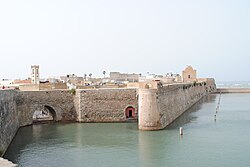
The fortified city, built by the Portuguese at the beginning of the 16th century and named Mazagan (Mazagão in Portuguese), was given up by the Portuguese in 1769 and incorporated into Morocco. El Jadida's old city sea walls are one of the Seven Wonders of Portuguese Origin in the World.[8] The Portuguese Fortified City of Mazagan was registered as a UNESCO World Heritage Site in 2004, on the basis of its status as an "outstanding example of the interchange of influences between European and Moroccan cultures" and as an "early example of the realisation of the Renaissance ideals integrated with Portuguese construction technology". According to UNESCO,[9] the most important buildings from the Portuguese period are the cistern and the Church of the Assumption, both in a Manueline style.[10]
The city is a popular resort and destination for both Moroccan and international tourists.[11][12] An important industrial complex, Jorf Lasfar, lies 20 kilometres to the south.[13]
Names
[edit]El Jadida's other names and nicknames in other languages were: Cap Soleis,[14] Portus Rutilis,[15] Rusibis,[15][16][17] Mazighen (Arabic: مازيغن),[18][19][20][21] al-Breyja (Arabic: البريجة),[15] Mazagão,[14][15] al-Mahdouma (Arabic: المهدومة)[14] and Mazagan.[14][15] The city was renamed al-Jadida in 1820, meaning 'The New'.[22]
History
[edit]
El Jadida traces its origins to the 5th century BC, when it was founded and settled by the Phoenicians.[23]
Prior to the arrival of the Portuguese in the 16th century, an anchorage used by boats appears to have existed at the current site of El Jadida throughout the Middle Ages and in ancient times.[24] The name Mazighan was first documented by the 11th-century Arab geographer al-Bakri.[24] In 1502 a Portuguese captain, Jorge de Mello, landed at this location, allegedly driven here by a storm. He and his crew took refuge in an abandoned tower, called al-Briya or al-Burayja, to defend themselves against any potential attack by the locals.[24][22] After returning to Portugal, he obtained permission from the Portuguese king, Dom Manuel, to found a fortress here in 1505, but evidence indicates that he did not carry this out, as when the Portuguese army passed here on their way to conquer Azemmour in 1513 they found nothing but the old tower.[24]
As Azemmour was difficult to access, the Portuguese returned and built a citadel at the more accessible Mazighan in the summer of 1514.[24] This citadel was a rectangular building with four towers, one of which was the old tower that already stood here.[24][22] The architects were two brothers, Diogo and Francisco de Arruda.[24][9] The location then became known in the Portuguese language as Mazagão. During the next few decades the Sa'dids rose to power and began expelling the Portuguese from their coastal fortresses, with the most significant event being their expulsion from Santa Cruz (present-day Agadir) in 1541. In response, King João III of Portugal ordered the evacuation of Portuguese positions at Azemmour and Safi and concentrated on building a more defensible position at Mazagão instead.[24] As a result, the Portuguese fortification was expanded into the larger walled fortress we see today in 1541.[22][24]
The Kingdom of Portugal would continue to control the city until 1769, when they abandoned Mazagão, their last territory in Morocco. Upon their forced departure, the Portuguese destroyed the Governor's Bastion. Most of the Portuguese inhabitants were sent to the colony of Brazil, where they founded a new settlement called Nova Mazagão (the present Mazagão in the state of Amapá).[25] The city was then taken over by Sultan Mohammed ben Abdallah in 1769 and remained largely uninhabited, having been dubbed al-Mahdouma ('The Ruined').[22] Eventually, Sultan Abd al-Rahman (r. 1822–1859) ordered that a mosque be built, and the destroyed portions of the city were rebuilt during his reign in the early nineteenth-century.[22] In 1820 the city was renamed al-Jadida, meaning 'The New'.[22][12] The town underwent a revival and soon outgrew Azemmour as the most important city in the area. Alongside the Muslim population was also a community of Jews, who participated in the city's revival.[26]
At the beginning of the French Protectorate in Morocco (established in 1912), the city was developed as a tourist resort, one of the earliest initiatives to develop modern tourism in Morocco.[12] By the 1930s it had a casino which was popular with European tourists and colonists.[12] The importance of the city's port, however, declined as Casablanca grew into the major port and urban center of the country during this period.[27][11] In the 1980s a large industrial complex, Jorf Lasfar, was developed some 20 kilometres to the south.[28] Aided by its UNESCO World Heritage Site designation since 2004, the city continues to be a tourist destination today.[12]
During the September 2023 earthquake that struck southern Morocco, the historic Portuguese church in the old city was damaged. As of 13 September, cracks were observed in the church's tower and there was a risk of structural collapse.[29]
Landmarks
[edit]
Fortress of Mazagan
[edit]The design of the Fortress of Mazagan is a response to the development of modern artillery in the Renaissance.[30] The star form of the fortress measures c 250m by 300m.[31] The slightly inclined, massive walls are c 8m high on average, with a thickness of 10m, enclosing a patrolling peripheral walkway 2m wide. At the present time the fortification has four bastions: the Angel Bastion in the east, St Sebastian in the north, St Antoine in the west, and the Holy Ghost Bastion in the south. The fifth, the Governor's Bastion at the main entrance, is in ruins, having been destroyed by the Portuguese in 1769. Numerous colonial-era Portuguese cannons are still positioned on top of the bastions.[32]
The fort had three gates: the Seagate, forming a small port with the north-east rampart, the Bull Gate in the north-west rampart, and the main entrance with a double arch in the centre of the south rampart, originally connected to land via a drawbridge. A ditch, c 20m wide and 3m deep, formerly filled with seawater, surrounded the fort. During the time of the French Protectorate the ditch was filled in with earth and a new entrance gate was opened leading to the main street, the Rua da Carreira, and to the Seagate.[citation needed] Along this street are situated the best preserved historic buildings, including the Catholic Church of the Assumption and the Portuguese cistern.
The Citadel
[edit]
The Citadel, located at the heart of the walled city, was the first permanent Portuguese construction on this site in 1514. It is a building with a rectangular floor plan measuring about 47 by 56 metres (154 by 184 ft), with three major rooms around a central space and four towers (one at each corner).[22] The southern El-Briya Tower (originally known as al-Burayja) was of local, pre-Portuguese origin and it was here that the Portuguese first took refuge when they arrived in 1502.[22][24] One of the northern towers was later re-purposed as the base of a 19th-century minaret built for the nearby mosque.[22] The cistern is located beneath the Citadel.
Portuguese cistern
[edit]The semi-subterranean chamber has a roughly square plan measuring around 33 to 34 metres (108 to 112 ft) per side, was constructed with five rows of five stone pillars and columns.[22] The chamber is built in a late Gothic style known as Manueline, with a vaulted ceiling of brick masonry and stone ribs.[22][10] Its original function is not clear. It may have been an armory, barracks,[33] or granary,[24] but it is recorded as having been converted into a cistern in 1541.[22][24] It was designed by an architect named Miguel de Arruda but the construction work was delegated to João de Castilho.[33] A round opening in the center of the chamber served to collect rainwater.[22] The cistern is famous especially for the thin layer of water that covers the floor and creates fine and ever-changing reflections in the otherwise dark vaulted chamber. Its visual qualities are such that several movies have been filmed within the cavernous space, of which Orson Welles' Othello is the best known internationally.[34]
Churches
[edit]
The Church of Our Lady of the Assumption, a prominent building located south of the Citadel, was the main parish church of the Portuguese settlement. It was constructed or begun when the fortress was expanded in 1541. It has a nave, a choir, a sacristy, and a square-shafted bell tower.[22] At least three other churches existed, though generally only partial remains of them are still present today. Two small churches were adjoined to some of the bastions of the fortress. Another, the Church of Mercy (Misericórdia) was part of the Citadel.[22]
Synagogues
[edit]
A number of synagogues also existed inside the old city, attesting to the importance of the Jewish community here in the 19th and 20th centuries.[22] One prominently visible example is the Bensimon Synagogue, inaugurated in 1926 and attached to earlier structures in the northern corner of the former fortress. Its construction was sponsored by four brothers of the Bensimon family: Nessim, Messaoud, Abraham, and Mordechai.[35]
Museum of Resistance and Independence
[edit]Located near the beach south of the old city and the port, this museum and exhibition space is dedicated to the memory of Moroccan soldiers and resistance to the French Protectorate regime. It is housed in a 20th-century colonial era building constructed in a "Mauresque" style.[36][37]
Climate
[edit]El Jadida has a hot-summer Mediterranean climate (Köppen climate classification Csa). In winter there is more rainfall than in summer. The average annual temperature in El Jadida is 17.4 °C (63.3 °F). About 372 mm (14.65 in) of precipitation falls annually.[38]
| Climate data for El Jadida | |||||||||||||
|---|---|---|---|---|---|---|---|---|---|---|---|---|---|
| Month | Jan | Feb | Mar | Apr | May | Jun | Jul | Aug | Sep | Oct | Nov | Dec | Year |
| Mean daily maximum °C (°F) | 16.8 (62.2) |
17.5 (63.5) |
19.1 (66.4) |
20.4 (68.7) |
22.3 (72.1) |
24.4 (75.9) |
26.4 (79.5) |
27.9 (82.2) |
25.9 (78.6) |
24.3 (75.7) |
20.7 (69.3) |
18.4 (65.1) |
22.0 (71.6) |
| Mean daily minimum °C (°F) | 7.6 (45.7) |
7.7 (45.9) |
9.3 (48.7) |
10.9 (51.6) |
13.2 (55.8) |
15.9 (60.6) |
17.7 (63.9) |
18.9 (66.0) |
16.9 (62.4) |
14.7 (58.5) |
11.3 (52.3) |
9.0 (48.2) |
12.8 (55.0) |
| Average precipitation mm (inches) | 49 (1.9) |
48 (1.9) |
41 (1.6) |
32 (1.3) |
16 (0.6) |
4 (0.2) |
0 (0) |
1 (0.0) |
7 (0.3) |
34 (1.3) |
66 (2.6) |
74 (2.9) |
372 (14.6) |
| Source: climate-data | |||||||||||||
Economy
[edit]The city is a significant tourism destination thanks in part to its UNESCO-recognized historic heritage.[12] A large five-star resort, the Mazagan Beach Resort, was opened in 2009 besides the nearby town of Azemmour, named in reference to the historic Portuguese fort. The resort was part of a wider strategy launched in 2001 by King Mohammed VI to boost tourism in Morocco by creating, with the help of foreign investors,[12] large coastal resorts in El Jadida, Essaouira, Saïdia, and other cities on the Moroccan coast.[12][39] The city is also a popular summer holiday resort for Moroccan families.[11]
Since the 1980s the city's economy has benefited[28] from the large industrial complex at Jorf Lasfar, located some 20 kilometres to the south.[13] The complex, managed by the Office Chérifien du Phosphore, is the main processing center for the region's phosphate reserves and its port is used for exporting its related products.[13][40][41] It also serves as a base for other industries.[13]
Education
[edit]The city houses many post-secondary academic institutions:
Chouaib Doukkali University,[42][43] including the following institutions:
- Faculty of Science[44]
- Faculty of Letters and Humanities[45]
- Faculty of Juridical, Economic and Social Sciences[46]
- National School of Applied Sciences (ENSA)[47]
- National School of Business and Management (ENCG)[48]
- Superior School of Technology (EST) - Sidi Bennour[49] (Outside El Jadida)
Office of Vocational Training and Promotion of Labor (OFPPT),[50] including the following institutions:
- Professional Qualification Center (CQP)[51]
- Specialized Institute of Applied Technology (ISTA) - Al-Massira[52]
- Specialized Institute of Applied Technology (ISTA) - City-of-the-Air[53]
- Specialized Institute of Hotel and Tourism Technology (ITHT) - El jadida[54]
- Specialized Institute of Hotel and Tourism Technology (ITHT) - Al Haouzia[54]
Others:
- Regional Centers for the Professions of Education and Training (CRMEF)[55]
- Section of "Higher Technician Certificate" (BTS) (at ar-Razi Technical High-School)[56]
- Section of "Preparatory Classes for Great Schools" (CPGE) (at ar-Razi Technical High-School)[57]
- Higher Institute of Engineering and Business (ISGA)[58] (private)
Sports
[edit]The main football club of the city is Difaâ Hassani El Jadidi, currently playing in the Botola Pro 1.
Nearby cities
[edit]Near El Jadida, are located the city of Azemmour in the northeast and the town of Sidi Bouzid in the southwest. Within a perimeter of around 120 km or less, are located Casablanca, Berrechid, Settat, Sidi Bennour, Oualidia, Youssoufia, Safi.
Notable people
[edit]![[icon]](https://en.wikipedia.org/wiki/File:Wiki_letter_w_cropped.svg) | This section needs expansion. You can help by adding to it. (August 2019) |
- Jaafar Aksikas, author
- Driss Chraïbi, author
- André Elbaz, painter and filmmaker
- André Guelfi, racing driver
- Zakaria Hadraf, footballer
- Driss Jettou, former prime minister, president of the Supreme Audit Court
- Youssef Kaddioui, former international footballer
- El Mehdi Karnass, footballer
- Abdelkebir Khatibi, author
- Abdellah Lahoua, footballer
- Yousra Mansour, vocalist of Bab L' Bluz
- Mohamed Nahiri, footballer
- Chaïbia Talal, painter
- Suleiman Zanfari, racing driver
- Nicola L, multidisciplinary artist
- Naji El-Mekki, pentathlete
Twin towns – sister cities
[edit]El Jadida is twinned with:


See also
[edit]References
[edit]- ^ "Résultat du RGPH 2014 Casablanca-Settat par région, préfecture, municipalité et commune" (in Arabic and French). Royaume du Maroc - Haut-Comissariat au Plan. Retrieved 9 September 2019.
- ^ "Indicateurs RGPH2014 - Démographie - Commune: El Jadida" (in French). Royaume du Maroc - Haut-Comissariat au Plan. Retrieved 9 September 2019.
- ^ "عدد السكان القانونيين بالمملكة". Official Gazette المملكة المغربية - الجريدة الرسمية - النشرة العامة. 6354 (year 104): 4025–4075. 23 April 2015. ISSN 0851-1195. Archived from the original (PDF) on 7 November 2019. Retrieved 9 September 2019.
- ^ "POPULATION LÉGALE DES RÉGIONS, PROVINCES, PRÉFECTURES, MUNICIPALITÉS, ARRONDISSEMENTS ET COMMUNES DU ROYAUME D'APRÈS LES RÉSULTATS DU RGPH 2014" (in Arabic and French). High Commission for Planning, Morocco. 8 April 2015. Retrieved 29 September 2017.
- ^ "الجهات و تسمياتها و مراكزها و العمالات و الأقاليم المكونة لها" (PDF). Official Gazette المملكة المغربية - الجريدة الرسمية - النشرة العامة. 6340 (year 104): 1461–1533. 15 March 2015. ISSN 0851-1195. Archived from the original (PDF) on 31 July 2020. Retrieved 9 September 2019.
- ^ "المغرب يتبنى تقسيما ترابيا جديدا" (in Arabic and French). المديرية العامة للجماعات المحلية. Archived from the original on 30 July 2020. Retrieved 9 September 2019.
- ^ "Population of El Jadida" (in Arabic and French). population-hub. Retrieved 9 September 2019.
- ^ Paula Hardy; Heidi Edsall; Mara Vorhees (2005). Morocco. Lonely Planet. ISBN 1-74059-678-1.
El Jadida.
- ^ a b "Portuguese City of Mazagan (El Jadida)". UNESCO World Heritage Centre. Retrieved 2013-02-10.
- ^ a b "Portuguese City of Mazagan (El Jadida)". Unesco. Retrieved May 25, 2020.
- ^ a b c Gilbert, Sarah; Balsam, Joel; Lioy, Stephen; O'Neill, Zora; Parkes, Lorna; Ranger, Helen; d'Arc Taylor, Stephanie (2021). "El Jadida". Lonely Planet Morocco (13th ed.). Lonely Planet. ISBN 978-1-83869-255-1.
- ^ a b c d e f g h Sarmento, João (2011). Fortifications, Post-colonialism and Power: Ruins and Imperial Legacies. Routledge. pp. 128–133. ISBN 978-1-317-13387-2.
- ^ a b c d The Report: Morocco 2014. Oxford Business Group. 2014. p. 159. ISBN 978-1-910068-05-2.
- ^ a b c d "Aperçu historique d'El Jadida" (in French). eljadidama.unblog.fr. 27 November 2008. Retrieved 10 September 2019.
- ^ a b c d e Mustapha Jmahri. "El Jadida" (in French). Dar Del Mare. Archived from the original on 4 January 2022. Retrieved 10 September 2019.
- ^ "Mazagan hier, El Jadida aujourd'hui" (in French). Golf El Jadida. Retrieved 10 September 2019.
- ^ Bill Thayer (31 January 2010). "Location of Mauritania Tingitana (from the First Map of Libya)". Bill Thayer. Retrieved 10 September 2019.
- ^ (1154) Hamoudi Husseini Cherif Al-Idrisi, Muhammad ibn Muhammad ibn Abd-Allah ibn Idriss; Tabula Rogeriana. Tabula Rogeriana نزهة المشتاق في اختراق الآفاق. مكتبة الثقافة الدينية. p. 550.
{{cite book}}: CS1 maint: numeric names: authors list (link) - ^ Qadi Ayyadh, Ibn Mussa ibn Ayyadh Sabti; Qadi Abu Abd-Allah, Muhammad Muhammad Ibn Sharifa (1997). مذاهب الحكام في نوازل الأحكام (PDF) (2nd ed.). دار الغرب الإسلامي. p. 346.
- ^ (Before 1274) Ibn Sa'id al-Maghribi, Abu al-Ḥassan Ali ibn Mussa; (1958) Ginés, Juan Vernet (1958). بسط الأرض في الطول والعرض. Moulay Hassan Institute - Tetuan. p. 141.
{{cite book}}: CS1 maint: numeric names: authors list (link) - ^ مبارك بلقاسم (26 June 2018). "مازيغن هو الاسم الأصلي لمدينة الجديدة المغربية Maziɣen" (in Arabic). Hespress. Retrieved 10 September 2019.
- ^ a b c d e f g h i j k l m n o p q Proposition d'inscription de biens sur la Liste du patrimoine mondial: Cité portugaise Mazagan (El Jadida) (Nomination text for UNESCO World Heritage List) (in French). 2004.
- ^ Porter, Darwin (1987). Frommer's Spain and Morocco on Forty Dollars a Day. John Wiley & Sons, Incorporated. p. 517. ISBN 978-0-671-62061-5.
- ^ a b c d e f g h i j k l Colin, G.S.; Cenival, P. de (1960–2007). "al-D̲j̲adīda". In Bearman, P.; Bianquis, Th.; Bosworth, C.E.; van Donzel, E.; Heinrichs, W.P. (eds.). Encyclopaedia of Islam, Second Edition. Brill. ISBN 9789004161214.
{{cite book}}: ISBN / Date incompatibility (help) - ^ Jean Duvignaud, Laurent Vidal (2005). Mazagão, la ville qui traversa l'Atlantique: du Maroc à l'Amazonie, 1769-1783. Paris: Aubier. p. 314. ISBN 2-70072360-0.
- ^ Tavim, Jose Alberto (2010). "El Jadida (Mazagan)". In Stillman, Norman A. (ed.). Encyclopedia of Jews in the Islamic World. Brill. ISBN 9789004176782.
- ^ Suárez Bosa, Miguel (2020). "Modernization and Development of the Moroccan Port Model during the French Protectorate (1912–1956)". In Olukoju, Ayodeji; Hidalgo, Daniel Castillo (eds.). African Seaports and Maritime Economics in Historical Perspective. Palgrave Macmillan. p. 99. ISBN 978-3-030-41399-6.
- ^ a b Godin, Lucien; Le Bihan, Gérard (2012). "Moroccan Medinas: Meknes and Azemmour". In Balbo, Marcello (ed.). The Medina: The Restoration and Conservation of Historic Islamic Cities. Bloomsbury Publishing. ISBN 978-1-78672-497-7.
- ^ Hamri, Salma (13 September 2023). "27 sites historiques ont été gravement endommagés par le séisme du 8 septembre selon un premier constat". Médias24 (in French). Retrieved 15 September 2023.
- ^ "Portuguese City of Mazagan (El Jadida) - UNESCO Advisory Body Evaluation" (PDF). Retrieved 2013-02-10.
- ^ "DGPC | Cidade Portuguesa de Mazagão (El Jadida)". www.patrimoniocultural.gov.pt. Retrieved 2020-12-07.
- ^ "Fortress of Mazagan". Starforts. Retrieved May 25, 2020.
- ^ a b La citerne (Information sign). Posted inside museum, at entrance of cistern. 9 June 2015.
- ^ "Portuguese Cistern of El Jadida". Atlas Obscura. Retrieved May 25, 2020.
- ^ Choukaili, Khadija (26 February 2019). "El Jadida: Projet de réhabilitation de la synagogue Bensimon". El Jadida Scoop (in French). Retrieved 9 October 2022.[permanent dead link]
- ^ "Museum of Resistance And Independence". Morocco Tourism Info. Retrieved 2022-10-09.
- ^ "El Jadida a son musée de la Résistance et de l'armée de libération – Mazagan24 – Portail d'El Jadida" (in French). 20 September 2015. Retrieved 2022-10-09.
- ^ "Climate El Jadida ⵍⵊⴰⴷⵉⴷⴰ الجديدة". climate-data.org. Retrieved 9 September 2019.
- ^ The Report: Morocco 2012. Oxford Business Group. 2012. p. 173. ISBN 978-1-907065-54-5.
- ^ Information Circular. U.S. Department of the Interior, Bureau of Mines. 1984. p. 15.
- ^ Weiss, Walter M. (2016). Morocco: In the Labyrinth of Dreams and Bazaars. Haus Publishing. ISBN 978-1-909961-32-6.
- ^ "Chouaïb Doukkali University" (in French). 9rayti.co. Retrieved 9 September 2019.
- ^ "Chouaib Doukkali University" (in Arabic, French, and English). Chouaib Doukkali University. Retrieved 9 September 2019.
- ^ "Faculty of Science" (in French). Archived from the original on 9 September 2019. Retrieved 9 September 2019.
- ^ "Faculty of Letters and Humanities" (in Arabic). Faculty of Letters and Humanities. Retrieved 9 September 2019.
- ^ "Faculty of Juridical, Economic and Social Sciences" (in French). Faculty of Juridical, Economic and Social Sciences. Retrieved 9 September 2019.
- ^ "National School of Applied Sciences" (in French). National School of Applied Sciences. Retrieved 9 September 2019.
- ^ "National School of Business and Management" (in French). National School of Business and Management. Archived from the original on 7 September 2019. Retrieved 9 September 2019.
- ^ "Superior School of Technology - Sidi Bennour" (in French). Superior School of Technology - Sidi Bennour. Retrieved 9 September 2019.
- ^ "Office of Vocational Training and Promotion of Labor" (in Arabic, French, and English). Office of Vocational Training and Promotion of Labor. Retrieved 9 September 2019.
- ^ "Professional Qualification Center" (in Arabic, French, and English). Office of Vocational Training and Promotion of Labor. Archived from the original on 20 August 2022. Retrieved 9 September 2019.
- ^ "Specialized Institute of Applied Technology - Al Massira" (in Arabic, French, and English). Office of Vocational Training and Promotion of Labor. Retrieved 9 September 2019.[permanent dead link]
- ^ "Specialized Institute of Applied Technology - City of the Air" (in Arabic, French, and English). Office of Vocational Training and Promotion of Labor. Archived from the original on 20 August 2022. Retrieved 9 September 2019.
- ^ a b "Specialized Institute of Hotel and Tourism Technology - El Haouzia" (in French). Office of Vocational Training and Promotion of Labor. Archived from the original on 18 April 2021. Retrieved 9 September 2019.
- ^ "Regional Centers for the Professions of Education and Training" (in French). Regional Centers for the Professions of Education and Training. Retrieved 9 September 2019.
- ^ "Everything about El Jadida BTS" (in French). inscription.ma. 2 January 2018. Retrieved 9 September 2019.
- ^ "2019/2020 CPGE public institutions" (in French). National Center of Pedagogical Innovation and Experimentation. Retrieved 9 September 2019.
- ^ "Higher Institute of Engineering and Business" (in French). Higher Institute of Engineering and Business. Retrieved 9 September 2019.
- ^ "Gemellaggi". comune.arenzano.ge.it (in Italian). Arenzano. Archived from the original on November 13, 2014. Retrieved 2020-11-02.
- ^ "Geminações e Acordos de Cooperação". cm-barcelos.pt (in Portuguese). Barcelos. Retrieved 2020-11-02.
- ^ "Coopération Internationale". nabeul.gov.tn (in French). Gouvernorat de Nabeul. Retrieved 2020-11-02.
- ^ "Le jumelage". sete.fr (in French). Sète. Retrieved 2020-11-02.
- ^ "Geminações e Cooperações". cm-sintra.pt (in Portuguese). Sintra. Retrieved 2020-11-02.
- ^ "Parcs et sites d'activités". ville.varennes.qc.ca (in French). Ville de Varennes. Retrieved 2020-11-02.
- ^ "Jumelages". ville-vierzon.fr (in French). Vierzon. Retrieved 2020-11-02.
- ^ "Tacoma's Sister Cities". cityoftacoma.org. City of Tacoma. Retrieved 2020-11-02.
External links
[edit]
- ((in Arabic, English, French, and Spanish)) Official Morocco website
Capital: Casablanca | ||
| Provinces |  | |
| Cities | ||
| Northern |  | |
|---|---|---|
| Central |
| |
| Southern |
| |
.svg)
33°14′N 8°30′W / 33.233°N 8.500°W
| International | |
|---|---|
| National | |
| Other | |

El Jadida
View on GrokipediaNames and Etymology
Historical Designations
The area now known as El Jadida was seized by Portuguese forces in 1502, with the fortified settlement formally established and designated Mazagan (Portuguese: Mazagão) in the early 16th century as a colonial outpost on Morocco's Atlantic coast.[1] This name derived possibly from local Berber terms like Mazighen, reflecting indigenous references to the region's inhabitants or terrain, though direct etymological links remain debated among historians.[5] Mazagan served as the official Portuguese designation until 1769, when the settlement surrendered to Moroccan forces under Sultan Mohammed Ben Abdallah following a prolonged siege, marking the end of over two centuries of Iberian control.[6] Upon Moroccan reclamation, the name Mazagan was explicitly banned to erase colonial associations, and the city was redesignated al-Jadida—Arabic for "the new"—to signify renewal and cultural reclamation, with local traditions emphasizing purification rituals such as repurposing the Portuguese church into a mosque.[6] This Moroccan name, sometimes rendered as el-Brija al-Jadida ("the new fortress") in early post-handover references combining prior Arabic toponyms like al-Brija with the novel designation, persisted through the French Protectorate era (1912–1956) and into independence, solidifying El Jadida as the standard contemporary form in both Arabic (الجديدة) and international usage.[5] No major redesignations occurred thereafter, though the site's dual heritage is highlighted in its UNESCO inscription as the "Portuguese City of Mazagan (El Jadida)" in 2004.[1]Contemporary Usage
The contemporary designation of the city is El Jadida, transliterated from the Arabic الجديدة (al-Jadīda), which literally translates to "the new" and reflects its post-Portuguese reconstruction and revitalization. This name entered use after the Moroccan takeover in 1769, with rehabilitation efforts in the early to mid-19th century under ʿAlawī sultans emphasizing renewal following abandonment and destruction.[1][7] In modern Moroccan administration, الجديدة serves as the official Arabic name for both the city and El Jadida Province within the Casablanca-Settat region, appearing in government documents, regional investment frameworks, and statistical reports.[8] The French-influenced form "El Jadida" predominates in international and bilingual contexts, including diplomatic references and heritage designations, such as UNESCO's 2004 inscription of the site as the "Portuguese City of Mazagan (El Jadida)".[1] English-language usage consistently adopts "El Jadida" for the urban center, distinguishing it from historical toponyms like Mazagan.[1]Geography
Location and Terrain
El Jadida is positioned on the Atlantic coast of Morocco, serving as the capital of El Jadida Province within the Casablanca-Settat region. The city lies approximately 96 kilometers south of Casablanca along Morocco's western seaboard.[9] Geographically, El Jadida is situated at coordinates 33°14′N 8°30′W, placing it directly on the oceanfront with access to the Atlantic Ocean.[10] This coastal location facilitates its role as a significant port, with the urban area extending along the shoreline and into adjacent plains. The terrain surrounding El Jadida consists primarily of low-lying coastal plains, with average elevations around 21 meters above sea level.[11] The landscape features flat, sandy expanses typical of Atlantic littoral zones, interspersed with dunes and backed by fertile agricultural lowlands of the Doukkala plain, which support irrigation-based farming. Elevations remain minimal, rarely exceeding 30 meters in the immediate vicinity, contributing to vulnerability to coastal erosion and sea-level influences.[12]Climate Characteristics
El Jadida experiences a Mediterranean climate (Köppen Csa), characterized by mild, wet winters and warm, dry summers, with oceanic moderation from the Atlantic reducing temperature extremes compared to inland Moroccan regions.[13] The annual mean temperature is 18.5°C, with daily highs typically ranging from 17°C in January to 26°C in August, and lows from 10°C in winter to 19°C in summer. [14] Temperatures rarely drop below 7°C or exceed 29°C, reflecting the coastal influence that prevents severe frosts or intense heatwaves.[14] Precipitation totals approximately 400–500 mm annually, concentrated in the rainy season from October to May, with November and December as the wettest months averaging 65–80 mm each.[15] [16] Summers from June to September are arid, with negligible rainfall under 5 mm per month, supporting agricultural cycles reliant on winter rains.[14] The Atlantic proximity also contributes to higher humidity levels, averaging 70–80% year-round, and frequent fog or mist in mornings, particularly during cooler months.[14]| Month | Avg High (°C) | Avg Low (°C) | Precipitation (mm) |
|---|---|---|---|
| January | 17 | 10 | 60–70 |
| February | 18 | 11 | 50–60 |
| March | 19 | 12 | 40–50 |
| April | 20 | 13 | 30–40 |
| May | 22 | 15 | 20–30 |
| June | 24 | 17 | <5 |
| July | 25 | 18 | <5 |
| August | 26 | 19 | <5 |
| September | 25 | 18 | 10–20 |
| October | 23 | 16 | 40–50 |
| November | 20 | 13 | 65–80 |
| December | 18 | 11 | 70–80 |
History
Pre-Colonial Foundations
The site of El Jadida prior to Portuguese seizure in 1502 consisted of rudimentary coastal features, including the remains of a small lookout post utilized for monitoring maritime approaches, as noted by early European accounts of the terrain. This structure points to intermittent defensive oversight by local Berber tribes or Muslim overlords in the absence of a permanent settlement, aligning with the sparse archaeological record for the immediate area before the 16th century.[17][18] Encompassing the Doukkala plain—a fertile expanse of alluvial soils formed by the Oum Er-Rbia River—the region supported Berber agropastoral communities engaged in barley cultivation, sheep herding, and seasonal transhumance, with population densities estimated at low levels typical of pre-urban North African coastal zones. Historical records indicate that by the 11th century, these tribes operated under the loose authority of Berber confederations, transitioning from Almoravid unification (c. 1050s CE onward) to Almohad centralization after 1147 CE, during which coastal anchorages facilitated limited trade in fish, salt, and hides but lacked fortified harbors comparable to those farther north like Salé. No evidence exists of significant urban or monumental development at the site, underscoring its role as a peripheral landing point rather than a foundational hub in indigenous Moroccan history.[19]Portuguese Occupation (1502–1769)
The Portuguese seized the coastal town of al-Breyja, later renamed Mazagan, in 1502 as part of their expansion along the Atlantic seaboard to secure trade routes and counter regional powers.[20] This occupation marked the establishment of a strategic outpost amid ongoing conflicts with Moroccan forces, serving as a base for maritime commerce in wheat, sugar, and other goods.[21] In 1514, the Portuguese constructed an initial Manueline-style castle to fortify the settlement, which was expanded into a larger bastioned fortress between 1541 and 1548 under architects João de Castro and others, featuring high walls, bastions, and a central cistern for water storage.[17] [18] The design incorporated advanced defensive elements, including pentagonal bastions for artillery coverage, reflecting evolving military architecture to withstand sieges.[22] Within the walls, Portuguese settlers built residences, four churches, and administrative structures, transforming Mazagan into a self-contained colonial enclave with a population sustained by agriculture and trade.[1] Mazagan endured multiple assaults, notably the prolonged Siege of 1562, where a garrison of approximately 800 Portuguese defenders repelled a Moroccan force exceeding 100,000, preserving control through superior fortifications and reinforcements.[23] This victory underscored the outpost's resilience as Portugal's primary foothold in Morocco amid declining overseas commitments elsewhere.[17] Over the subsequent centuries, the settlement functioned as a trading hub and refuge for Portuguese expatriates, though isolated by hostile surroundings and reliant on naval supply lines. By 1769, weakened by internal strife and military overextension, Portugal faced a decisive siege led by Sultan Mohammed ben Abdallah, who mobilized around 70,000 troops during Ramadan.[24] Unable to sustain defense, the Portuguese garrison, under orders from the Marquis of Pombal, evacuated the fortress on March 11, 1769, relocating inhabitants to Brazil and Mozambique, thereby ending 267 years of occupation and ceding Mazagan to Moroccan sovereignty.[25] The intact fortifications, including the subterranean cistern, survived as enduring remnants of Portuguese engineering.[18]Transition to Moroccan Sovereignty
In 1769, the Portuguese stronghold of Mazagan faced a decisive siege by Moroccan forces led by Sultan Sidi Mohammed ben Abdallah, marking the culmination of prolonged conflicts over the territory.[24][1] The 592-man Portuguese garrison, isolated and unable to secure reinforcements, appealed to Lisbon for aid, but King Joseph I, advised by the Marquis of Pombal, authorized a full evacuation to avoid further losses amid Portugal's shifting colonial priorities.[24][22] Prior to withdrawal in August 1769, Portuguese forces systematically demolished key defensive structures, including the Governor's Bastion at the main entrance and portions of the ramparts, to render the fortress unusable to Moroccan troops.[17][23] This scorched-earth tactic left much of the interior in ruins, facilitating a relatively unopposed Moroccan entry shortly after the Portuguese fleet departed with evacuees and loyalist civilians.[20][26] The handover established Moroccan sovereignty over Mazagan, ending over 260 years of Portuguese control and representing Portugal's final territorial concession in Morocco as part of a broader peace settlement.[6][27] Sultan Sidi Mohammed ben Abdallah promptly renamed the site al-Jadida ("the new one"), signaling a intent to rebuild, though the city languished in partial abandonment for decades due to war damage and strategic neglect until mid-19th-century rehabilitation efforts.[26][1] This transition preserved core Portuguese-era architecture, such as the cistern and church, which later contributed to the site's UNESCO World Heritage status, while integrating it into the Alaouite dynasty's domain.[1]Colonial French Period and Independence
The French protectorate in Morocco was formalized on March 30, 1912, through the Treaty of Fez, signed by Sultan Abd al-Hafid, granting France control over foreign affairs, defense, and internal administration while nominally preserving Moroccan sovereignty.[28] In El Jadida, referred to as Mazagan during this era, French authorities prioritized urban development, transforming the city into a key administrative center and one of Morocco's earliest tourist resorts due to its Atlantic coastline and mild climate.[29] Infrastructure enhancements, such as rationally planned streets and restoration efforts on the decaying Portuguese fortress built in the 16th century, supported this growth, with repairs aimed at preserving the structure amid expanding settlement.[17] [20] Under Resident-General Hubert Lyautey's policy of indirect rule, El Jadida's administration integrated local Moroccan officials (qaids) but increasingly centralized power, facilitating economic activities like phosphate exports through nearby ports while exacerbating tribal dispossession in surrounding areas via land reforms favoring European settlers.[30] The city's population expanded with European expatriates and Moroccan workers, though French policies deepened ethnic divisions by privileging Europeans and certain Jewish communities over the Muslim majority, limiting access to education and land ownership for the latter.[31] By the 1930s, El Jadida served as a secondary urban node in the protectorate's coastal network, benefiting from improved rail links to Casablanca but remaining subordinate to larger centers like Rabat and Casablanca in administrative hierarchy. As nationalist sentiments grew post-World War II, influenced by the 1944 Independence Manifesto and Sultan Mohammed V's advocacy, El Jadida experienced rising unrest aligned with broader Moroccan resistance against French rule, though no major localized uprisings are recorded specific to the city.[32] Morocco achieved independence on March 2, 1956, following negotiations and the sultan's return from exile in 1955, ending the protectorate and restoring full sovereignty to the Moroccan state under Mohammed V. In El Jadida, this transition marked the end of French administrative dominance, with the city reverting to its Moroccan name and integrating into national governance, though lingering European influences persisted in tourism and architecture.[33] The Portuguese citadel, maintained during colonial times, continued as a cultural landmark post-independence, symbolizing layered historical occupations.[1]Post-Independence Growth and Challenges
Following Morocco's independence in 1956, El Jadida's province became a focus for agricultural expansion through state-led irrigation and land development initiatives, reclaiming over 389,000 hectares for cultivation amid efforts to boost food security and exports.[34] These projects emphasized cereals, vegetables, and fruits, with the establishment of numerous packing houses in the region to facilitate international trade, contributing to a surge in agricultural exports during the first three decades post-independence. The city's port infrastructure, inherited from colonial eras, supported growing trade in phosphates and fisheries, while urban modernization efforts included expanded housing and transport links to Casablanca, fostering steady population influx and economic activity.[35] By the late 20th century, El Jadida's economy diversified modestly into tourism, leveraging its UNESCO-listed Portuguese heritage sites, alongside revived viticulture in the surrounding Doukkala plains after state reforms in the 1990s addressed earlier mismanagement. Provincial population swelled from modest post-independence levels to 912,835 by 2024, reflecting national urbanization trends with a 79% increase between 1990 and 2022 alone, driven by rural-to-urban migration.[36] This growth propelled GDP contributions from port logistics and agro-industry but highlighted infrastructural strains, including expanded built-up areas that pressured water resources and coastal ecosystems.[37] Persistent challenges include vulnerability to climatic variability, with agriculture—still a core sector—suffering from recurrent droughts that undermine yields and export stability, as seen in national contractions during dry spells post-1956.[38] Urban expansion has exacerbated informal employment and housing deficits, mirroring Morocco's broader issues of youth unemployment exceeding 30% in coastal regions and uneven poverty reduction, where rural peripheries lag despite provincial gains.[39] Limited industrial investment has perpetuated reliance on low-value exports, constraining inclusive growth amid rising demographic pressures.Demographics
Population Dynamics
The population of the El Jadida commune reached 237,464 in the 2024 Moroccan census (RGPH), reflecting sustained urban expansion along Morocco's Atlantic coast.[40] This figure marks an approximate 22% increase from the 2014 census estimate of around 194,800 residents, corresponding to an average annual growth rate of 2.0% over the decade.[40] Such growth outpaces the national average of roughly 0.9% annually between 2014 and 2024, when Morocco's total population rose by about 9% to 37 million.[41] Historical data underscores a pattern of steady demographic buildup, with the commune's population recorded at 144,440 in the 2004 census.[42] From 2004 to 2014, expansion averaged lower, aligning closer to national urbanization trends of 1.5-1.9% annually, before accelerating amid post-2011 economic stabilization and infrastructure investments.[43] The El Jadida province, encompassing the city, grew from 567,672 in 2004 to 662,961 in 2014 and 914,367 in 2024, highlighting broader regional pull factors including phosphate processing and port activities that draw internal migrants from rural inland areas.[44] Key drivers include natural population increase, tempered by declining fertility rates mirroring Morocco's national drop from 2.4 to 2.3 children per woman (2014-2024), alongside net in-migration fueled by job opportunities in fisheries, exports, and light manufacturing. Rural-urban shifts, a dominant feature of Moroccan demographics since the 1970s, concentrate in coastal hubs like El Jadida due to agricultural limitations and urban economic incentives, though sub-Saharan transit migration remains marginal and does not significantly alter local counts.[45] Density now stands at 8,066 inhabitants per km² within the urban core, straining housing and services amid projections for continued moderate growth below 2% annually through 2030.[40]| Census Year | Commune Population | Annual Growth Rate (to next census) |
|---|---|---|
| 2004 | 144,440 | ~2.0% (to 2014 est.) |
| 2014 | ~194,800 | 2.0% |
| 2024 | 237,464 | N/A |
Socio-Ethnic Profile
El Jadida's population, estimated at 237,464 in the city proper as of 2024, is overwhelmingly composed of individuals of mixed Arab-Berber ancestry, reflecting the ethnic makeup prevalent in Morocco's coastal lowlands. The Doukkala region, encompassing El Jadida, features predominantly Arabic-speaking communities with genetic profiles indicative of North African origins, showing close affinities to other Arabic-speaking Moroccan groups and admixture from historical migrations.[40][46] The primary language is Moroccan Arabic (Darija), spoken by the vast majority, with French serving as a lingua franca in education, business, and administration due to colonial legacy. Tamazight (Berber) is spoken by a minority, though less prominently than in mountainous regions, as the area has undergone significant Arabization over centuries.[47] Religiously, over 99% of residents adhere to Sunni Islam, consistent with national demographics, with negligible Christian or other minorities. A historical Jewish community, peaking at approximately 3,591 individuals in 1945 and centered in the mellah within the Portuguese citadel, largely emigrated after Moroccan independence in 1956 and amid regional tensions, leaving no functioning community today.[48][49][50] Small-scale sub-Saharan African migration, documented in studies of around 256 individuals in 2018, introduces minor ethnic diversity, primarily transient workers and refugees, but these groups remain a fractional presence amid the dominant Moroccan socio-ethnic fabric.[51]Governance and Politics
Administrative Framework
El Jadida operates as an urban commune (commune urbaine) within El Jadida Province, which forms part of the Casablanca-Settat region, Morocco's hierarchical administrative structure dividing the country into 12 regions, 75 provinces and prefectures, and over 1,500 communes.[52] The commune's governance centers on an elected municipal council responsible for local services, urban planning, and development projects, with decisions implemented through a bureau led by the council president, equivalent to a mayor.[53] Jamal Ben Rabiâ currently serves as president of the El Jadida municipal council, overseeing operations from the communal headquarters.[53] At the provincial level, El Jadida Province—spanning approximately 3,500 square kilometers and encompassing 35 communes—is administered by a governor appointed by King Mohammed VI to represent central authority, coordinate with regional entities, and enforce national policies on security, infrastructure, and economic initiatives. Sidi Saleh Daha holds the position of governor as of October 2025, following royal appointments amid ongoing administrative reshuffles.[54] The province also features an elected Provincial Council, which deliberates on budget allocation, local taxation, and development priorities; Mohammed Al-Zahidi has presided over this body, focusing on agricultural and coastal management.[55] This framework reflects Morocco's 2011 constitutional reforms advancing decentralization, granting communes greater fiscal autonomy while maintaining appointed oversight at higher tiers to ensure alignment with national objectives, though implementation varies by resource availability and local capacity.[56] El Jadida's municipal council convenes regularly, as evidenced by its October 2025 session addressing routine governance matters.[57]Key Political Events and Controversies
In October 2025, El Jadida participated in nationwide youth-led protests under the "GenZ 212" banner, where demonstrators decried corruption, unemployment, and inadequate public services, calling for the resignation of Prime Minister Aziz Akhannouch while explicitly avoiding direct challenges to King Mohammed VI.[58] These events, which escalated into violence in some areas with injuries to over 260 police officers and dozens of protesters, reflected broader frustrations with governance but remained largely peaceful in El Jadida.[59] A related controversy emerged when the local outlet El Jadida Express published a video of a young protester, accompanied by minors, threatening violence against security forces and inciting murder, prompting the Moroccan National Press Council to refer the newspaper to its Ethics and Disciplinary Committee on October 4, 2025, for potential ethical violations.[60] On the security front, Moroccan authorities conducted a raid in El Jadida on January 27, 2025, arresting seven individuals suspected of Islamic State affiliation and seizing weapons, underscoring persistent counter-terrorism operations in coastal regions amid national concerns over extremism.[61] Local governance has occasionally intersected with regional corruption probes, such as the August 2025 arrest of a councilor in nearby Azemmour—within El Jadida Province's judicial purview—for accepting a MAD 3,000 bribe to expedite administrative paperwork, following a citizen complaint via the national anti-corruption hotline.[62] Such incidents highlight systemic issues in municipal permitting and oversight, though no major El Jadida-specific scandals have dominated national discourse.Economy
Core Sectors and Trade
The economy of El Jadida centers on agriculture, fishing, and tourism, with the city's coastal location facilitating trade in primary goods. Agriculture dominates in the surrounding Doukkala plain, an irrigated perimeter spanning over 60,000 hectares that produces cereals such as wheat and barley, alongside vegetables, forage crops, sugar beets, and olive trees.[63] Cropping patterns in the region allocate approximately 51% of land to cereals, 30% to olives, 7% to forage, and 6% to vegetables, supported by irrigation infrastructure developed since the 1970s to enhance productivity in this semi-arid area.[64] Fishing constitutes a key sector, leveraging El Jadida's Atlantic port as one of Morocco's important coastal fishing harbors. The port accommodates around 64 artisanal fishing vessels operated by approximately 940 fishermen, handling an annual average of 6,800 tonnes of catch as of 2012, primarily species like sea bream, sea bass, and swordfish for local consumption and export.[65] This activity contributes to Morocco's broader fisheries output, which generates significant export revenue, though local volumes remain modest compared to larger hubs like Agadir. Tourism supports economic activity through the city's UNESCO-listed Portuguese heritage and beaches, attracting visitors for seaside resorts and historic sites, though it plays a secondary role to primary sectors. Trade flows via the port focus on coastal shipments of agricultural produce and fish, with limited international container handling—around 60,000 TEUs annually—serving regional rather than global commerce, overshadowed by nearby Jorf Lasfar for bulk exports like phosphates.[66]Recent Economic Initiatives
In November 2024, the European Bank for Reconstruction and Development (EBRD) extended a loan to the OCP Group to construct two seawater desalination plants at the Jorf Lasfar industrial complex near El Jadida, providing up to 50 million cubic meters of water annually to support phosphate processing and fertilizer production amid water scarcity challenges.[67] Jorf Lasfar, Morocco's largest phosphate export hub handling over 40% of national shipments, relies on such infrastructure to sustain operations that generated approximately 12 million tons of phosphate products in 2023, bolstering export revenues exceeding $10 billion for OCP that year.[67] Transportation enhancements include the El Jadida-Safi motorway, a 142-kilometer project financed partly by the European Investment Bank, designed to reduce travel times by up to 50% and integrate El Jadida more effectively into national trade networks, with completion phases advancing through 2025 to accommodate growing freight from industrial zones.[68] Complementing this, the International Finance Corporation supported upgrades to El Jadida's RADEEJ utility network, improving electricity and water reliability to attract manufacturing investments, as evidenced by expanded capacity serving over 100,000 connections and facilitating business relocation to local platforms.[69] Local efforts culminated in September 2025 with the approval of 238 regional development projects totaling 34 million dirhams by the human development committee, targeting economic diversification through small-scale infrastructure like irrigation and market facilities to support agriculture and SMEs, which employ roughly 40% of the province's workforce.[70] El Jadida is also advancing its maritime profile by hosting the inaugural International Port Ecosystem Salon (SIPORT) in February 2026, aiming to foster investments in logistics and blue economy sectors amid national port expansions.[71]Persistent Challenges
Despite El Jadida's role as a key phosphate export hub via the OCP Group's facilities, the local economy grapples with persistent environmental contamination from industrial activities, including elevated trace metals in coastal sediments that pose ecological risks to marine ecosystems supporting fishing.[72] Phosphate processing and mining have led to health hazards for workers, such as respiratory illnesses and exposure to toxic byproducts, exacerbated by subcontracting practices that limit benefits and oversight.[73] Local communities near extraction sites report ongoing poverty and social discontent, with mining revenues failing to translate into broad-based prosperity due to unequal distribution and limited reinvestment.[74] Unemployment remains a structural issue, mirroring national trends with youth rates exceeding 27% as of 2021, driven by an overreliance on informal employment—comprising about 80% of jobs—and insufficient diversification beyond phosphates, fishing, and seasonal tourism.[75] The fishing sector faces conflicts over marine spatial planning, hindering aquaculture expansion amid competition with tourism and conservation, while overexploitation risks deplete stocks in Atlantic waters.[76] Infrastructure bottlenecks, including slow bureaucratic processes and inadequate urban planning in the Casablanca-Settat region, compound these problems by delaying industrial upgrades and exacerbating uncontrolled development.[77] Water scarcity intensifies vulnerabilities, with Morocco's per capita availability nearing the 500 m³ poverty threshold, directly impacting phosphate production—which consumes 1% of national water—and agriculture-dependent livelihoods in El Jadida's hinterlands.[78] Recurrent droughts, flagged as a top 2025 risk, threaten sectoral stability and heighten poverty, as seen in stalled recovery from shocks like the 2023 earthquake affecting regional supply chains.[79] Efforts to address these through national reforms have yielded limited local impact, perpetuating regional disparities and informal economic dominance.[80]Cultural and Historical Landmarks
Portuguese Architectural Legacy
The Portuguese architectural legacy in El Jadida is epitomized by the fortified city of Mazagan, established as a coastal trading post and defensive enclave in the early 16th century. The initial citadel was constructed in 1514 by architects Francisco de Arruda and Diogo de Arruda, serving as the foundational permanent structure amid Portugal's expansion along the Atlantic seaboard.[1] This rectangular fortification, equipped with towers for surveillance and defense, underscored the era's emphasis on robust coastal strongholds against regional threats.[81] Between 1541 and 1548, the citadel underwent significant enlargement by engineers João Ribero and Juan Castillo, guided by plans from Italian architect Benedetto da Ravenna, evolving into a star-shaped bastion fortress that represented an early exemplar of Renaissance military architecture.[1][81] Key defensive elements included angled bastions for enfilading fire, ramparts averaging 8 meters in height and 10 meters in thickness, and a protective ditch, blending European fortification techniques with adaptive responses to local topography and artillery advancements.[81] The Portuguese maintained control of this ensemble until 1769, when it was ceded to Moroccan forces under Sultan Mohammed ben Abdallah following prolonged sieges.[1] Prominent civilian and utilitarian structures within the walls highlight Portuguese engineering prowess. The Portuguese Cistern, dating to the early 16th century, features a vaulted subterranean design originally intended as an armory before conversion to a water reservoir, demonstrating hydraulic ingenuity with its gothic-inspired arches and reflective basin that enhances structural integrity.[1] The Church of the Assumption, built in the Manueline style—a late Gothic variant incorporating maritime motifs reflective of Portugal's Age of Discoveries—stands as a primary ecclesiastical survivor, its facade and nave preserving ornate stonework amid later adaptations for secular use.[1] Additional churches, totaling four erected during Portuguese tenure, integrated similar stylistic elements, though fewer remain intact.[1] This architectural corpus, inscribed on the UNESCO World Heritage List in 2004, attests to cross-cultural exchanges in construction techniques, urban planning, and defensive innovation between Iberian Europe and North Africa, with ongoing preservation efforts by Morocco's Lusitanian Heritage Centre ensuring the integrity of these 16th-century vestiges.[1][81]Religious and Civic Structures
The Church of the Assumption, erected by Portuguese settlers in the early 16th century, exemplifies Manueline architecture, a late Gothic style blending maritime motifs with ornate stonework, and functioned as the primary Catholic worship site within the Mazagan fortress.[1] After the Portuguese withdrawal in 1769, Muslim inhabitants repurposed parts of the abandoned city, constructing the Mosquée de la Cité Portugaise in the 19th century; its minaret, uniquely pentagonal with curved edges, was adapted from the Torre de Rebate watchtower on orders of Sultan Hassan I in 1879, marking a fusion of defensive and religious functions.[82][83] El Jadida's religious landscape also reflects its Jewish heritage, with the Bensimon Synagogue built in the 19th century to serve the local Sephardic community, which included translators and traders integrated into the post-Portuguese economy; remnants of this structure highlight the city's multi-faith history amid Moroccan resettlement.[84] The Chapel of St. Sebastian, another Portuguese-era edifice, contributed to the original cluster of Christian sites, though less preserved today.[85] Civic structures underscore the Portuguese emphasis on self-sufficiency and defense, notably the Cistern constructed circa 1514 as an underground vaulted reservoir to store rainwater, featuring innovative design with a central column supporting a conical roof and renowned for dramatic light refraction through its oculus.[1] The surrounding ramparts and bastions, fortified between 1510–1514 and expanded 1541–1548 under architects like Francisco and Diogo de Arruda, formed a star-shaped perimeter integrating Renaissance military principles, which protected the enclave until its surrender.[1] These elements, rehabilitated in the 19th century, remain integral to the UNESCO-listed site's integrity.[1]Museums and Preservation Efforts
The Espace de la Mémoire Historique de la Résistance et de la Libération serves as El Jadida's principal museum, dedicated to Morocco's anti-colonial resistance and liberation struggles, including World War II events. Housed in a Mauresque-style colonial building constructed in the early 20th century, it contains multiple exhibition halls displaying artifacts, documents, and photographs that illustrate local contributions to national independence efforts from French and Spanish protectorates.[86] The museum opened in the 2010s to preserve oral histories and material evidence from resistance fighters, emphasizing El Jadida's role in broader Moroccan nationalist movements.[87] The Portuguese Cistern, dating to 1514, operates as a key heritage site with interpretive elements akin to a museum, highlighting 16th-century Portuguese hydraulic engineering within the Mazagan citadel. This underground vaulted structure, featuring a central octagonal pillar and light-admitting oculus, supplied water to the fortified settlement and exemplifies Renaissance-era design adapted to coastal conditions.[1] Visitors access it via guided tours that explain its construction using local stone and lime mortar, underscoring its survival through sieges and earthquakes.[88] Preservation initiatives center on the Portuguese City of Mazagan, inscribed as a UNESCO World Heritage Site in 2004 for representing an exceptional example of 16th-century Portuguese colonial fortifications in North Africa. Local authorities and community groups maintain the bastioned walls, bastions, and urban layout, which remain more intact than comparable sites like those in Ceuta or Tangier.[1] Ongoing efforts include structural reinforcements against seismic risks and vegetation control to mitigate biodeterioration from vascular plants colonizing masonry, as documented in environmental surveys.[89] UNESCO monitoring emphasizes community involvement in sustaining the site's authenticity, with restoration projects funded through national heritage programs restoring elements like the Church of the Assumption and defensive ramparts since the early 2000s.[1] These measures aim to counter urban encroachment while promoting adaptive reuse for cultural tourism.[6]Society and Infrastructure
Education System
El Jadida's education system aligns with Morocco's national framework, which mandates nine years of compulsory schooling from ages six to fifteen, encompassing six years of primary education followed by three years of lower secondary (collège).[90] Primary enrollment in Morocco stands at approximately 94.7% for the adjusted net rate as of recent data, though completion rates drop due to repetition and dropout, with national figures indicating around 76% of children unable to read or write after four years of primary schooling.[91] [92] In El Jadida, urban primary schools benefit from better infrastructure, but rural peripheries face higher absenteeism and dropout, particularly among girls, where only 26% proceed to secondary education after primary completion.[93] Secondary education in El Jadida includes three-year collèges and optional three-year lycées for upper secondary, with gross enrollment rates nationally around 66% for ages 12-17 as of 2020, reflecting improvements from 51% in 2010 but persistent gender gaps—female literacy lags at 54% versus 75% for males.[94] [95] Local challenges exacerbate national trends, including long commutes to schools and socioeconomic barriers in rural areas surrounding El Jadida, contributing to female dropout rates post-primary.[93] Overall adult literacy in Morocco reached 77.35% in 2022, with youth rates at 97.7%, though El Jadida's coastal-rural mix likely mirrors or slightly underperforms urban national averages due to economic pressures in fishing and agriculture-dependent communities.[96] [90] Higher education is anchored by Chouaïb Doukkali University (UCD), established in 1985 as a public institution in El Jadida, initially with faculties of sciences and arts/humanities, now expanded to include engineering, law, and economics.[97] UCD enrolls approximately 23,209 students and ranks 13th among Moroccan universities, offering programs with low tuition for nationals (starting at 108 USD annually) while emphasizing regional development in science and humanities.[98] [99] The university contributes to local human capital, though national tertiary enrollment hovers at levels where only about 1.35 million students pursue higher studies amid broader access expansions since independence.[90] Persistent issues include resource disparities between urban centers like El Jadida and rural Morocco, with initiatives like SOS Children's Villages targeting literacy and retention in the area to address up to 90% female illiteracy in nearby rural zones.[93]Sports and Recreation
El Jadida's sports scene is dominated by association football, with Difaâ Hassani El Jadidi (DHJ) serving as the city's premier club, competing in Morocco's top-tier Botola Pro league.[100] The team plays home matches at Stade Ben M'Hamed El Abdi, which has a capacity of 15,000 spectators.[100] DHJ has participated in continental competitions, including the CAF Confederation Cup, reflecting the city's engagement with professional athletics.[101] Recreational opportunities emphasize coastal and resort-based activities, leveraging El Jadida's Atlantic shoreline. Popular pursuits include windsurfing, kite surfing, water skiing, jet-skiing, and sailing, supported by dedicated water sports bases and beaches like Sidi Bouzid, known for surfing.[102] Two public swimming pools, including a covered facility, cater to aquatic recreation year-round.[103] Horseback riding is available through local equestrian centers, while tennis courts provide options for racket sports.[102] The Mazagan Beach & Golf Resort enhances leisure offerings with an 18-hole ecological golf course designed by Gary Player, alongside adrenaline activities such as go-karting, paintball, ziplining, and laser tag.[102] These facilities draw both locals and tourists, promoting physical activity amid the region's natural landscape, though access to some resort amenities may require fees or stays.[104] Community events, including youth volleyball camps and seasonal soccer tournaments, further integrate sports into local social life.[105]Urban Development Projects
The Pôle Urbain de Mazagan, situated adjacent to El Jadida, represents a flagship initiative to create an integrated urban extension fostering innovation, education, and economic activity, with planned residential, commercial, and institutional zones designed to accommodate sustainable population growth. This project aligns with Morocco's broader urban strategy to develop secondary cities as hubs for knowledge-based development, incorporating green infrastructure and connectivity to the existing urban fabric.[106][107] A centerpiece of central urban renewal is the comprehensive redevelopment of Parc Mohammed V, allocated a budget of 1.67 billion Moroccan dirhams, encompassing landscape enhancements, recreational facilities, and public space improvements to elevate environmental quality and community access. Complementing this, on September 26, 2025, provincial authorities initiated two large-scale construction projects in the city core, emphasizing aesthetic and ecological upgrades, including the planting of hundreds of climate-adapted trees irrigated via efficient systems to combat urban heat and promote biodiversity.[108][109] Infrastructure advancements include the finalization of El Jadida's urban mobility master plan under the national Morocco Urban Transport Project, which prioritizes efficient public transit, road networks, and pedestrian pathways to reduce congestion and support a projected population increase. The Mazagan Master Plan further outlines a 1,400-hectare expansion with four interconnected villages, central plazas, and a light rail system to serve up to 50,000 inhabitants, integrating mixed-use development with coastal preservation. These efforts, overseen by the Agence Urbaine d'El Jadida, reflect coordinated planning to balance historical preservation with modern demands, though implementation timelines depend on funding and regulatory approvals.[110][111][112]Environment and Sustainability
Coastal Ecosystems
The coastal ecosystems of El Jadida along Morocco's Atlantic seaboard feature a mosaic of sandy beaches, rocky shores, and sheltered bays such as Haouzia Bay, supporting intertidal and subtidal habitats influenced by upwelling-driven nutrient inputs. These environments host diverse benthic and pelagic communities, including macroalgae that play key roles in nutrient cycling for nitrogen, phosphorus, and carbon. A 2024 checklist of marine macroalgae from the Saada-El Jadida coast documented temporal variations in species diversity tied to physicochemical parameters like salinity, temperature, and pH, underscoring the ecosystems' sensitivity to seasonal fluctuations.[113][113] Phytoplankton assemblages in the region, studied between Casablanca and El Jadida from 2014 to 2015, exhibit dynamic structures dominated by diatoms and dinoflagellates, with the latter comprising a significant portion in Haouzia Bay during summer sampling in July 2017. Fish communities, particularly small pelagic species like Sardina pilchardus, concentrate in high densities along the coastal fringe from Cape Cantin to El Jadida, forming stratified distributions that sustain local fisheries. Benthic habitats further include shallow-water gorgonian forests, newly documented across the Moroccan Atlantic in 2025, which harbor diverse associated fauna and contribute to structural complexity in subtidal zones.[114][115][116][117] Adjacent transitional ecosystems, such as the Sidi Moussa lagoon near El Jadida, integrate coastal and wetland features with seagrass beds and algal communities that support avian biodiversity, though detailed inventories remain limited. Conservation efforts include Morocco's 2025 designation of eight new marine protected areas along Atlantic and Mediterranean coasts, aiming to safeguard 10% of territorial waters and mitigate biodiversity loss from overexploitation and habitat degradation in regions like El Jadida. However, threats persist from invasive species, such as predatory fish exerting pressure on native shellfish, and macroalgal blooms of species like Codium decorticatum that trap marine plastics, exacerbating pollution in bloom-prone areas. Coastal erosion, accelerated by human activities, further erodes shoreline habitats, with rates varying by site along the broader Moroccan Atlantic.[118][119][120][121][122]Pollution and Waste Management Issues
El Jadida faces significant challenges in solid waste management, primarily due to an uncontrolled urban landfill that receives approximately 150 tons per day of mixed municipal and industrial waste without a bottom liner or leachate collection system, leading to contamination of the underlying coastal aquifer.[123] Groundwater quality assessments in the vicinity have detected elevated levels of nitrates, chlorides, and heavy metals such as lead and cadmium, attributed to leachate percolation, with concentrations exceeding Moroccan drinking water standards in monitoring wells near the site.[124] These deficiencies reflect broader national issues in Morocco, where only about 37% of municipal solid waste is disposed in controlled landfills as of recent evaluations, though El Jadida's facility remains among the unmanaged open dumps prevalent in coastal regions.[125] Collection and disposal operations in El Jadida are hampered by technical limitations, including insufficient vehicle fleets and irregular schedules, alongside social factors such as low public participation in segregation, resulting in incomplete coverage and roadside dumping in peri-urban areas.[126] Industrial activities, particularly phosphate processing in the El Jadida province, contribute to coastal pollution through the discharge of phosphogypsum waste into the Atlantic, elevating natural radioactivity levels in beach sediments, seawater, and marine fauna; for instance, uranium-238 concentrations in local sands have been measured up to 10 times background levels due to this effluent.[127] Marine plastic pollution exacerbates environmental degradation along El Jadida's coastline, with mismanaged plastic waste from urban sources leaking into the Atlantic at rates estimated nationally at 6.3 kg per kilometer of shoreline, though site-specific data indicate persistent debris accumulation affecting fisheries and tourism.[128] Only about 25% of Morocco's generated plastic waste is recycled, leaving the remainder prone to open burning or ocean entry, posing public health risks from microplastics in seafood harvested locally.[129] Improvement efforts include a Japanese International Cooperation Agency (JICA)-formulated plan for enhanced waste disposal infrastructure in El Jadida, aimed at modeling sanitary landfilling and recycling for other Moroccan cities, though implementation progress remains limited as of the early 2000s assessments.[130]Notable Individuals
Prominent Figures from El Jadida
Driss Chraïbi (1926–2007), a pioneering Moroccan author writing in French, was born in El Jadida to a merchant family and became known for his critiques of patriarchal structures and colonial legacies in works such as Le Passé simple (1954), which depicted generational conflicts within Moroccan society under French protectorate rule.[131] His novels, including La Civilisation, ma Mère! (1972), explored themes of cultural hybridity and modernization, influencing Francophone African literature despite initial bans in Morocco for perceived subversiveness. Driss Jettou (born 1945), a Moroccan politician and businessman from a grocer's family in El Jadida, served as Prime Minister from 2002 to 2007 under King Mohammed VI, overseeing economic reforms and infrastructure projects amid post-9/11 security concerns. Prior to that, he held roles in commerce and industry ministries, focusing on trade liberalization and privatization efforts that aligned with Morocco's WTO accession in 1995.[132] André Guelfi (1919–2016), born in Mazagan (present-day El Jadida) to a Corsican military officer father, was a French entrepreneur and racing driver who innovated sardine freezing techniques via factory ships before competing in one Formula One Grand Prix at Morocco's Ain-Diab circuit in 1958, finishing ninth in a Cooper-Climax.[133] His business ventures extended to tourism and real estate, leveraging Morocco's coastal resources during the post-colonial era.[134]International Ties
Sister Cities and Partnerships
El Jadida has established formal sister city agreements with multiple cities worldwide, primarily to foster cultural, educational, and economic ties. These relationships often involve exchanges in areas like tourism, youth programs, and heritage preservation, reflecting the city's Portuguese colonial history and Atlantic coastal position.[135][136] The following table summarizes confirmed active sister cities, including establishment dates where documented:| City | Country | Year Established |
|---|---|---|
| Arenzano | Italy | 1964 |
| Nabeul | Tunisia | 1985 |
| Sète | France | 1992 |
| Tacoma | United States | 2007 |
| Barcelos | Portugal | 2009 |
References
- https://wiki.openstreetmap.org/wiki/Administrative_divisions_of_Morocco