


Community hub
Recent from talks
Contribute something
Nothing was collected or created yet.
Mitrailleuse
View on WikipediaA mitrailleuse (French pronunciation: [mitʁajøz] ⓘ; from French mitraille, "grapeshot") is a type of volley gun with barrels of rifle calibre that can fire either all rounds at once or in rapid succession. The earliest true mitrailleuse was theorized and proposed in 1851 by Belgian Army captain Fafschamps, ten years before the advent of the Gatling gun. It was followed by the Belgian Montigny mitrailleuse in 1863. Then the French 25 barrel "Canon à Balles", better known as the Reffye mitrailleuse, was adopted in great secrecy in 1866. It became the first rapid-firing weapon deployed as standard equipment by any army in a major conflict when it was used during the Franco-Prussian War of 1870–71.
Key Information


A steel block containing twenty-five 13 mm (.51 calibre) centre-fire cartridges was locked against the breech before firing. With the rotation of a crank, the 25 rounds were discharged in rapid succession. The sustainable firing rate of the Reffye mitrailleuse was 100 rounds per minute and its maximum range was about 2000 yards (1800 m), a distance that placed their batteries beyond the reach of Prussian Dreyse needle rifle fire. Reffye mitrailleuses were deployed in six-gun batteries and were manned by gunners as a form of special artillery.
Although innovative and capable of good ballistic performance, the Reffye mitrailleuse was a tactical failure because its basic concept and operational use were flawed. Only 210 Reffye mitrailleuses were in existence at the beginning of the Franco-Prussian War in 1870. Their field use was discontinued by the French Army after 1871. After the Gatling gun was replaced in service by newer recoil- or gas-operated weapons, multi-barrelled weapons fell into disuse for many decades. Some examples were developed during the interwar years but only as prototypes or were rarely used. The word mitrailleuse became the generic term for a machine gun in the French language because of its early appearance in the field of weapons, although the mitrailleuse was manually operated.
Origin
[edit]
The first "mitrailleuse" was a manually fired 50-barrel volley gun. It was developed in Belgium in 1851 by Belgian Army Captain Fafschamps,[2][3] who made a rough prototype and drawings of his invention.[4] The system was improved during the 1850s by Louis Christophe and the Belgian engineer Joseph Montigny, with the completion of the 37-barrel Montigny mitrailleuse in 1863. From 1859, Joseph Montigny proposed his design to Napoleon III, which led to the development of the French Reffye mitrailleuse, which was designed by Jean-Baptiste Verchère de Reffye in collaboration with Montigny, and which was adopted by the French Army in 1865. Initially kept under wraps as a secret weapon, it was widely used in battle by French artillery during the Franco-Prussian War (1870–71). Smaller numbers of other designs, including the Gatling gun, were also purchased by the French government during the latter part of that conflict. The Reffye model had initially been built in small numbers and in secrecy: only about 200 were available at the beginning of the conflict. This also kept regular French field artillery in a neglected position in the eyes of French emperor Napoleon III, with dire consequences during the Franco-Prussian War of 1870–71.
Technical characteristics
[edit]Design
[edit]

Several variants of the mitrailleuse concept were developed, with common elements to all of their designs. They were characterized by a number of rifled barrels clustered together and mounted on a conventional artillery chassis or (in the case of one model) a tripod. The ammunition was secured in a single block and placed into the breech, behind the open ends of the barrels. All of the barrels were loaded simultaneously by a manual closing lever or large horizontal screw. A second lever could be worked rapidly (or in some models, a crank could be turned) to fire each barrel in succession. This earned the weapon its French nickname of moulin à café (coffee grinder). (A very similar name was earned by the hand-cranked, mechanically loaded, continuous-firing, "coffee mill gun" in America during the American Civil War.)
The ammunition plate or block had to be removed by hand before another loaded plate could be inserted. Unlike in the Gatling gun and later rapid-firing automatic weapons, the entire loading and firing process was manual. The mitrailleuse's major innovation was that it greatly increased the speed of these processes when compared to standard infantry rifles of the era.[5]
The different variants of the mitrailleuse concept were distinguished by their number of barrels and their different calibers, as the following table summarizes.
| Variant name | Barrels | Barrel arrangement | Caliber | Date1 | Notes |
| Fafschamps | 50 | Clustered | 1851 | Needle fire, paper cartridges. Prototype and drawings | |
| Christophe-Montigny | 37 | Clustered | 11 mm (0.4 in) |
1863 | Privately developed and used primarily by the Belgian Army |
| Reffye | 25 | In five rows (5 × 5) | 13 mm (0.5 in) |
1865 | Widely used by the French Army during the Franco-Prussian War |
| Bollée | 30 | Two circular rings (18 in the outer ring, 12 in the inner) | 13 mm (0.5 in) |
1870 | Used by the French Army of the Loire during the Franco-Prussian War[6] |
| Chevalier et Grenier | 16 | Two horizontal rows (2 × 8) | 11 mm (0.4 in) |
1870 | |
| Gabert | 04 | Four barrels each with two chambers. While four chambers are in use, four are reloaded.2 | 11 mm (0.4 in) |
1870 | Tripod-mounted, unlike the other carriage-mounted variants |
| Notes: [1] Date developed [2] Translated from the website: www.mitrailleuse.fr/Historique/Aballes/Aballes.htm | |||||
Most variants of the mitrailleuse were mounted on an artillery-style carriage. This made them heavy and cumbersome to handle on the battlefield, with gun and carriage weighing up to 900 kg (2,000 lb).
Ammunition and firing rates
[edit]The mitrailleuse's dependence on manual loading meant that its firing rate depended greatly on the skill of its operators. A skillfully manned Reffye mitrailleuse could sustain four volleys (100 rounds) per minute in ordinary operation and reach five volleys (125 rounds) per minute during emergencies. The rapidity of discharge of each individual volley (25 rounds) was controlled by the gunner's action on a small manual crank on the right side of the breech. The weapon's 25 barrels were not discharged all at once, but in rapid succession. Because it was so heavy (1,500 lbs), the Reffye mitrailleuse did not recoil during firing and thus did not need to be re-sighted on its target after each volley. This essential absence of recoil during firings was promoted by Reffye as a considerable advantage over conventional field artillery. Each regular battery of Reffye mitrailleuses lined up six guns firing together, more or less side by side.
The Reffye mitrailleuse used a 13 mm (.512 inch) centerfire cartridge, designed by Gaupillat, which represented the state of the art in ammunition design at the time.[7] It was rather similar to an elongated modern shotgun shell: centerfire with a rimmed brass head and a dark blue hardened cardboard body.[8] The 770-grain (50 g), 13 mm (0.512 inch) patched bullet was propelled by 185 grains (12 grams) of compressed black powder at a muzzle velocity of 1,560 ft/s (480 m/s), three and a half times more powerful than Chassepot or Dreyse rifle ammunition. This was, by far, the most potent rifle caliber ammunition in existence at the time. The Montigny and Reffye mitrailleuse systems were not designed to function with paper cartridges such as the 11 mm Chassepot combustible paper cartridge.[7]
The 13 mm centerfire Reffye mitrailleuse cartridges were loaded into interchangeable steel breech blocks, unlike the Montigny mitrailleuse, whose ammunition was held by the cartridge base in plates. When firing the mitrailleuse, three breech blocks were kept in continuous use: one being fired, one being pressed down on the extractor and one being loaded from a single pre-packaged 25-round box. Adjusting the elevation of the mitrailleuse in accordance to the distance to the designated target was performed with an elevating screw identical to that on a regular artillery piece. The mitrailleuse's barrel could also be moved sideways while firing, to the right and left, in order to adjust for range and provide lateral sweeping fire if needed. The lateral sweep was narrow, however, thus most effective at far distances only. The weapon's field of fire was so narrow that Prussian soldiers were often hit by several bullets at once.[9] During an early engagement of the Franco-Prussian War, at Forbach in Alsace on August 6, 1870, a Prussian general officer (General Bruno von François) was brought down by a very closely spaced volley of four bullets. According to the Prussian regimental record, those four mitrailleuse bullets had been fired from 600 meters away. French artillery attempted to rectify this problem by developing special ammunition capable of firing three bullets from the same cartridge for short-range point-defence.
In summary, the Reffye mitrailleuse was rarely used to deliver sweeping fire at close range like modern machine guns. The mitrailleuse six-gun batteries had been designed to deliver fire on targets too distant to be reached with Chassepot infantry rifles or artillery grapeshot. To fulfill this role, at least during the early weeks of the campaign, the mitrailleuses were deployed together with the older "Napoleon" muzzle loaded field guns ("canon obusier de 12") used by the French Army during the Franco-Prussian War. The mitrailleuse crews are on record of having generally objected to being placed in proximity to regular artillery batteries.
-
 Reffye mitrailleuse mechanism
 -
 Magazine plate of a Montigny mitrailleuse, designed to hold 37 cartridges and to be slid into the breech before firing
 -
 Reffye mitrailleuse bullet magazine housing
 -
 Section of the 25-barrel Reffye mitrailleuse ("Canon à balles"), 1897
 -
 Reffye mitrailleuse muzzle


Development
[edit]The mitrailleuse is best known for its service with the French Army but in fact it was first used in Belgium in the 1850s as a static weapon to defend the moats of fortresses. It was a 50-barrel needle fire, paper cartridge weapon which had been designed by a Captain T.H.J. Fafschamps. Then, after 1863, it was improved with only 37 barrels, 11×70mmR centerfire ammunition[7] and the weapon's placement on a wheeled artillery carriage. This transformation was carried out as an industrial venture by Christophe and Joseph Montigny of Fontaine-l'Évêque near Brussels, who sought to sell the new weapon to the rest of Europe.
The French military became interested in the Christophe and Montigny mitrailleuse in 1863 and the French Army's Artillery Committee undertook an investigation into the possible adoption of the Belgian weapon. However it was decided to do otherwise and to create a proprietary mitrailleuse weapon by sole French industrial means. In May 1864, General Edmond Le Bœuf submitted a preliminary report entitled Note sur le Canon à balles to the Emperor Napoleon III. Full-scale manufacture began in September 1865, in great secrecy, under the leadership of Lieutenant-Colonel Verchère de Reffye (1821–1880). Assembly and some manufacturing took place at the workshops in Meudon but many parts came from the private industrial sector. Production was slow due to limited funding (the army had already spent much of its five-year budget on the Mle 1866 Chassepot rifle), forcing Napoleon III to pay for development and manufacture out of secret funds.[10] The new weapon was thoroughly tested in 1868 at the military firing range at Satory, near Versailles, in conditions of great secrecy. Due to a fear of spies, test guns were concealed in tents while being fired at distant targets. The mitrailleuse performed mechanically with remarkable efficiency and much was expected of it in a combat situation.
A total of 215 mitrailleuses and five million rounds of ammunition had been manufactured by July 1870, but only 190 were operational and available for field service when war with Prussia broke out.
Operational doctrine
[edit]
The French Army used the mitrailleuse as an artillery weapon, rather than an infantry support weapon—a role later filled by the machine gun. As a matter of fact, the official name of the Reffye mitrailleuse in the French Army was "le Canon à Balles", a designation that translates literally as: "cannon that fires bullets":
Comparing the fire of the Mitrailleuse to that of the rifle is misunderstanding the role of the Mitrailleuse. This weapon must begin to fire with effectiveness only at ranges where the rifle no longer carries. It must, for the great ranges of 1000 to 2500 metres compensate the insufficiency of grapeshot.
— Auguste Verchère de Reffye.[11]
Having been developed by the artillery they were, naturally, manned by artillerymen and attached to artillery groups equipped with regular four-pounder field guns.[12] Each mitrailleuse battery comprised six guns, each with a crew of six. One man on the front right fired the gun while another man on the front left swiveled the gun sideways for sweeping fire. The four other men attended to aiming, loading, and unloading. Auguste Verchère de Reffye himself consistently viewed the mitrailleuse as an artillery weapon:
The use of the Mitrailleuse no longer has anything in common with that of normal cannon, the employment and task of this piece deeply modify artillery tactics… Very few officers understand the use of this weapon which, however, is only dangerous by the manner one uses it… The partisans of the mitrailleuse are found among the young who crewed them during the war; but there are far fewer among superior officers.
— Auguste Verchère de Reffye, 1875.[11]
The battlefield use of the mitrailleuse as artillery was a fatally flawed concept. To avoid being hit by Dreyse rifle fire, the mitrailleuse batteries were systematically deployed beyond about 1,400 m (1,500 yards) from the Prussian lines. Although the maximum range of the mitrailleuses was 3,400 m (3,700 yards), the distances at which they were typically engaged rarely exceeded 2,000 m (2100 yards) which was less than the reach of French field artillery. However accurate fire at 1500 yards was always extremely difficult to achieve with the typical open sights present on the mitrailleuse. For instance, mitrailleuse bullet impacts on the ground could not be observed in the far distance unless enemy ranks had been disrupted by hits from them. It may be noted that modern machine guns are typically used at ranges far shorter than their maximum range—the M60 machine gun, for instance, is normally used well within its effective range of 1,100 m (1,200 yards), compared to its maximum range of 3,725 m (4,074 yards). The mitrailleuse, by contrast, was often used at the outer edges of its range and without the benefit of optical range finding equipment. These deficiencies in the operational usage of the Reffye mitrailleuse proved disastrous in the Franco-Prussian War.
Use in war
[edit]Franco-Prussian War (1870–71)
[edit]
Mitrailleuses were used in many of the major engagements of the Franco-Prussian War (1870–71), but their small numbers greatly restricted their effectiveness. Their flawed usage was a serious problem on the battlefield. While the mitrailleuses were inherently accurate, in a ballistic sense, they were often unable to zero in on targets quickly enough at great distances. Individual 25 round salvos were also too tightly grouped and lacked lateral dispersion. To make matters worse, the complex firing mechanism was vulnerable to damage at the hands of inexperienced crews. Fouling of the mechanism by black powder combustion residues and thus difficulties in closing the breech were reported as a problem after prolonged firings.

In a few instances where the Reffye mitrailleuses were put to good use, they showed that they could have a significant impact. Captain Barbe's mitrailleuse battery at the Battle of Gravelotte devastated massed Prussian infantry when they had quickly found the range on their targets, contributing to the exceptionally high Prussian death toll in that battle. Other examples of effective mitrailleuse fire have also been described for the battle of Mars-la-Tour. For the most part, however, mitrailleuses proved ineffective. It was concluded after the war that Chassepot rifle fire had caused a far greater number of Prussian casualties than the Reffye mitrailleuses. However, about 100,000 Chassepot rifles were engaged in combat in contrast with fewer than 200 Reffye mitrailleuses used in battle at any given time.
The Prussians and foreign observers were not impressed by the performance of the mitrailleuse. In the case of the Prussians, their views were undoubtedly coloured by propaganda. They had very few machine guns or volley guns of their own and, not least for reasons of maintaining morale in the face of a new weapon technology, they scorned the effectiveness of the mitrailleuse. They nonetheless saw the weapon as a threat and Prussian artillery always made it a priority to engage and destroy mitrailleuse batteries. The weapon's characteristic "snarling rasp" does appear to have made some impression—the Prussian troops called the mitrailleuse the Höllenmaschine ("Hell/Infernal Machine")[13]
Its failure to have much effect in the field led to a belief that rapid-fire weapons were useless.[14] United States Army General William Babcock Hazen, who observed the war, commented that "The French mitrailleuse had failed to live up to expectations. The Germans hold it in great contempt, and it will hardly become a permanent military arm."[15] Strictly speaking, manually operated volley guns such as the Reffye mitrailleuse were a technological dead-end, and they were soon replaced by fully automatic machine guns.
After Napoleon III's abdication following the disastrous French defeat in the Battle of Sedan, French war powers fell into the hand of a republican government led by Léon Gambetta. He vigorously organized national defense and the continued manufacture of war equipment. Most of the conventional weapon manufacturing was located in provincial France, but some mitrailleuse repair and even construction continued inside Paris during the city's four-month siege.
The manufacture of the mitrailleuse and its ammunition was resumed under the direction of De Reffye in the coastal city of Nantes in western France. An additional 122 mitrailleuses were manufactured in Nantes to replace the nearly 200 mitrailleuses that had already been destroyed or captured.
After the war
[edit]
After the armistice with Prussia in May 1871, one of the last recorded uses of Reffye mitrailleuses was by troops under the command of Adolphe Thiers, when a battery executed captured Communards in the Bois de Boulogne, following the suppression of the Paris Commune. Similar incidents involving the Reffye mitrailleuse are reported to have taken place at the Caserne Lobau, a barracks in the center of Paris.
A fairly large number of the French Army's Reffye mitrailleuses (268 altogether) survived the Franco-Prussian War. An additional 122 Reffye mitrailleuses, which had been captured during the 1870–71 campaign, were all sold back to France by Germany through a London military surplus dealer in 1875. By 1885, many of the mitrailleuses in the overall remaining French inventory were designated to static point-defence duties, for the purpose of providing flanking fire in the moats of eastern French fortifications. The last surviving Reffye mitrailleuses were removed from several forts in eastern France as late as 1908 and scrapped.
Other campaigns
[edit]The mitrailleuse is reported to have been used by the Mexican Federal Forces against the Yaqui Indian forces in Sonora, then under the command of Cajemé José Maria Leyba, a prominent leader of that tribe from 1874 to 1887. Three mitrailleuse were used in March, 1886, with two mitrailleuse under the command of the forces of Generals Leiva and Carillo, and one under the command of General Camano.[16]
In September 1926, the Mexican military, at first just under General Miguel Pina, made preparations to use the mitrailleuse against the Yaqui people in Sonora, then led by their military chief Luis Matus (Matius in some later accounts), and his lieutenant, Albin Cochemea.[17] The 1st, 8th, and 18th infantry battalions prepared to bring a more modern state of warfare against the indigenous inhabitants of Vicam and other Yaqui pueblos along the river. By October 5, after intense fighting, the remaining Yaqui soldiers had retreated to the mountains above the river, and the Mexican forces decided to mount a vast offensive against them. More than 12,000 Mexican Federal troops, under the command of General Obregon, General Abundio-Gomez, and General Manzo, directed the operations against the remaining Yaqui forces, using munitions that included 8mm mitrailleuse, and aeroplanes carrying poison gas.[18]
Following their campaign against Arabi Pasha in Egypt during 1882, the British recorded having seized several mitrailleuses. None of these seemed to have been used in combat.
Even the Kingdom of Dahomey had some of these guns.[19]
Impact on military development
[edit]
The long-term effects of the mitrailleuse's poor performance have been the subject of some dispute among historians. In Machine Guns: An Illustrated History, J. Willbanks argues that the weapon's ineffectiveness in the Franco-Prussian War resulted in long-standing opposition among European armies to adopting machine gun weapons, particularly in Continental Europe. It is true that the French Army did not adopt an automatic machine gun until 1897, when they chose the Hotchkiss machine gun, later to be followed by the Hotchkiss M1914 machine gun. The French armed forces also adopted another automatic machine gun, the St. Étienne Mle 1907. It has been suggested that the relative slowness displayed by the French services to adopt machine guns was the result of wariness occasioned by the failure of the mitrailleuse. There is some evidence for that suggestion, as the Maxim gun had repeatedly been tested by the French armed services ever since its inception.[20]
In the immediate aftermath of the war, the French put a much greater emphasis on improving their field artillery. The failure of French artillery during the 1870–71 campaign served as a strong incentive to fast track the De Bange field artillery piece (1877) and eventually the well-known Canon de 75 modèle 1897 field gun. At a normal 15 shells per minute rate of fire, one single 75 mm gun could deliver 4,350 lethal shrapnel balls within one minute, up to 6 km away, versus the 75 bullets per minute that were delivered at up to 2 km distance by one Reffye mitrailleuse. Evidently, weapon system efficiency had increased by two orders of magnitude in 30 years.[citation needed]

Despite such improvements in longer-range artillery, there still remained a need to develop better short- and medium-range infantry support weapons. During the period from 1871 to the 1890s, a variety of new European- and American-designed manual machine guns were adopted by many European armies. Large numbers of Gatling guns were purchased from the United States and were used by Western European powers in colonial wars in Africa, India, and Asia. Twenty-five Gatling guns also saw active service in French hands during the Franco-Prussian war, in early 1871. They performed particularly well at an engagement at Le Mans in western France. Furthermore, the French armed services purchased, for their navy and eastern fortifications, a large number of manual, rapid fire 37 mm multi-barrel guns (so-called Hotchkiss "canon-revolvers") made in France after 1879 by the firm of American expatriate Benjamin B. Hotchkiss. By the 1890s however, European armies began to retire their Gatling guns and other manual machine guns in favor of fully automatic machine guns, such as the Maxim gun, the Colt–Browning M1895, and, in 1897, the Hotchkiss machine gun. Such weapons became universal—and notorious—with the outbreak of the First World War in 1914.
Modern uses of the term mitrailleuse
[edit]A machine gun is still referred to as a mitrailleuse in French, following the pattern set by the adoption of the Mitrailleuse Hotchkiss in 1897. The FN 5.56 mm NATO machine gun, the Minimi, derives its name from the term Mini-Mitrailleuse, "small machine gun". Submachine guns may be called mitraillettes, the diminutive of mitrailleuse, although they are also called pistolets mitrailleurs ("mitrailleuse pistols").
In Dutch as spoken in the Netherlands, the word mitrailleur is widely used as a synonym for machinegeweer (machine gun). Obviously, this word is derived from the original mitrailleuse by changing the gender of the French word. In Dutch-speaking parts of Belgium, however, the word mitrailleur is rarely used, largely because it is regarded as poor French.
The term is also used in Norwegian. Although spelled slightly differently as mitraljøse, the pronunciation is similar. In Norway, the term nowadays is used to refer to a machine gun (the MG3, labeled as mitr-3, to be specific) mounted on a tripod. This is similar to the German term Schweres Maschinengewehr, which refers to a regular machine gun mounted on a tripod (since the introduction of General purpose machine guns).
In Turkish the term mitralyöz, which is apparently derived from mitrailleuse, was widely used as a synonym for machine guns before becoming an archaic term. Currently, makineli tüfek (machine rifle) is considered the accepted term.
A related word, metralhadora, is used in Portuguese. Although it is derived from the French mitrailleuse, its pronunciation is different. It describes any automatic firearm. Similarly, in Spanish ametralladora is the word for a machine gun, metralleta, connected to French mitraillette for a sub-machine gun.
The word also survived in Romania, where the generic term for a machine gun is mitralieră. In Slovenian, Croatian and Serbian it is mitraljez, and in Albanian a machine gun is referred to as mitraloz. In Greek, mydraliovolo (μυδραλιοβόλο) is a—now somewhat archaic—term for a machine gun.
The word mitrailleuse is surely the source for the modern Italian term: Mitragliatrice, describing a machine gun, as well.
Preserved mitrailleuses
[edit]
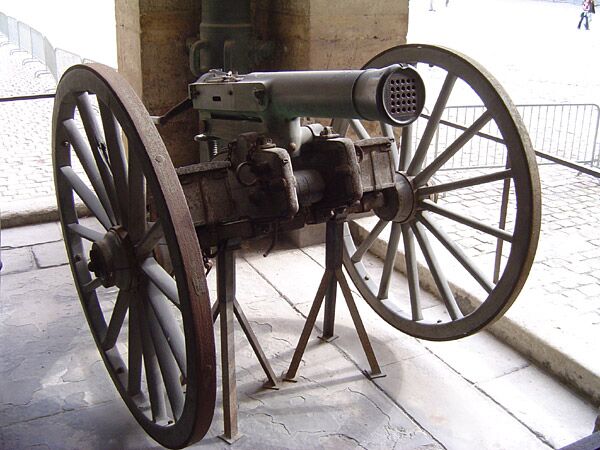
- Musée de l'Armée in the Hotel Des Invalides. Two mitrailleuses long mounted outdoors thus severely affected by rust.
- Musée royal de l’Armée et d'Histoire Militaire in Brussels
- Musee Militaire Vaudois, 1110, Morges, Switzerland. Complete Reffye mitrailleuse in exceptional like-new condition.
- Dreiecklandmuseum, 79423, Heitersheim (near Freiburg im Breisgau), Germany.
- Parade Hall, Spandau Citadel, Berlin, Germany. A mitrailleuse manufactured in 1867, named after General Bosquet, is on exhibition inside the armory.
- Bundeswehr Military History Museum in Dresden, Germany. See figure to the right.
- Polish Army Museum in Warsaw, Poland. A mitrailleuse named after general Louis Pailhou.
- Coronado Star Park on Coronado Island, CA. Donated to the city by Major General Joseph Henry Pendleton

See also
[edit]Notes
[edit]- ^ "Marines in the Dominican Republic 1916–1924" (PDF).
- ^ Wahl, Paul; Toppel, Donald R (1965), The Gatling Gun, p. 43,
Subject of all this secrecy was the twenty-five-year-old Fafschamps-Montigny Mitrailleuse, warmed over by De Reffye. This weapon was invented in 1851
. - ^ Hutchison, Graham Seton (1938), Machine Guns: Their History and Tactical Employment, p. 9,
In 1851, some twenty years before the outbreak of the Franco–German War, Captain Fafschamps, a Belgian officer, offered drawings of an invention to a fellow countryman, Monsieur Montigny
. - ^ Machine Guns by James H. Willbanks p.35
- ^ Terry Gander, Machine Guns, p. 13 (Crowood Press, 2003)
- ^ S Shann, The French Army 1870–71 Franco-Prussian War, p. 39 (Osprey Publishing, 1991)
- ^ a b c Huon, 1986
- ^ Huon, Jean. Military rifle and machine gun cartridges (Arms & Armor Press, 1988)
- ^ McCormick, Dr. William, "On the Surgical Practice of the War" (Pall Mall Gazette, 1870)
- ^ S Shann, L Delperier, French Army of Franco-Prussian War: Imperial Troops, p. 35–36 (Osprey Publishing, 1991)
- ^ a b The Mitrailleuse by Dr. Patrick Marder Military History Online Archived 2008-12-23 at the Wayback Machine
- ^ David Nicolle, Gravelotte-St. Privat 1870, p. 25 (Osprey Publishing, 1993)
- ^ Geoffrey Wawro, The Franco-Prussian War: The German Conquest of France in 1870–1871 (Cambridge University Press, 2003)
- ^ Julian S. Hatcher, Hatcher's Notebook, p. 74 (1962)
- ^ Stig Forster, On the Road to Total War: The American Civil War and the German Wars of Unification, 1861–1871, p. 602 (Cambridge University Press, 1997)
- ^ H. H. Bancroft, History of Mexico, Vol. VI, p. 462. (The History Company, San Francisco, 1888)
- ^ Harwood, Dix (1927). Viva Mexico y Mueran Los Tiranos. Quoted in: Getting and Writing the News. New York, New York: George H. Doran Company. p. 127.
- ^ C., P. (1927). "La Révolte des Indiens Yaqui". Journal de la société des américanistes Année (in French). 19: 404–405. Retrieved 9 September 2018.
- ^ Kea, R. A. (1971). "Firearms and Warfare on the Gold and Slave Coasts from the Sixteenth to the Nineteenth Centuries". The Journal of African History. 12 (2): 185–213. doi:10.1017/S002185370001063X. ISSN 0021-8537. JSTOR 180879. S2CID 163027192.
- ^ John Walter, Allied Small Arms of World War One, p.47 (Crowood Press, 2000)
References
[edit]- Thomas Adriance, The Last Gaiter Button: A Study of the Mobilization and Concentration of the French Army in the War of 1870, New York, 1987. ISBN 0-313-25469-9. OCLC 16718174.
- Richard Holmes, The Road to Sedan, London, 1984. ISBN 0-391-03163-5. pp. 206–208.
- Jean Huon, Military Rifle and Machine Gun Cartridges, Ironside International Publications, 1986, ISBN 9780935554052. Contains detailed descriptions, with photos, of the Reffye and Montigny mitrailleuse ammunition.
- Cmdt Frederic Reboul, Le Canon a Balles en 1870 (The Reffye Mitrailleuse in 1870), 163 pages, 1910, Librairie Militaire Chapelot, Paris. OCLC 67444364, OCLC 459713766. The only complete and fully documented original French military source, it was published in 1910. Hard to find but can be consulted at the "Service Historique de la Defense", Fort de Vincennes near Paris.
- Reglement sur le Service des Bouches a Feu de Campagne. Deuxieme partie : "Service du Canon a Balles",163 pages, Ministere de la Guerre, PARIS, Imprimerie Nationale, 1875. The complete period official instruction manual on the "Canon a Balles". Also at "Service Historique de la Defense".
External links
[edit]
- The Mitrailleuse - key characteristic, combat experience Archived 2008-12-23 at the Wayback Machine a hby Dr. Patrick Marder. A highly detailed, thoroughly documented account published on the Web.
- The Mitrailleuse - development, combat experience
- Animations and description of operation (Requires QuickTime, and not suitable for slow-speed links).
- YouTube : "mitrailleuse 1867" ( excellent animated simulation of Reffye mitrailleuse loading and firing )
 French weapons of the 19th century French weapons of the 19th century | ||
|---|---|---|
| Small arms | ||
| Machine guns | ||
| Cannons | ||
| Warships | ||
| Ammunition | ||
| Systems | ||
| Operational usage | ||


Mitrailleuse
View on GrokipediaInvention and Development
Precursors and Montigny Design
The concept of multi-barrel volley guns, precursors to the mitrailleuse, dates back to the late medieval period with the ribauldequin, also known as the organ gun, first documented in 1339 during the Hundred Years' War when employed by Edward III of England's forces against the French.[5] These weapons featured clusters of small-caliber iron barrels arranged like organ pipes, firing simultaneously to deliver a devastating hail of projectiles at close range, though their inaccuracy and slow reloading limited widespread adoption through the 16th to 18th centuries.[6] In the 19th century, renewed interest in rapid-fire artillery emerged amid advances in rifling and cartridge technology; Belgian Army Captain Toussaint-Henry-Joseph Fafchamps proposed the earliest modern mitrailleuse design in 1851, a stationary 50-barrel volley gun using needle-fire ignition and paper cartridges intended for defensive fortifications.[7] Around the same time in the 1860s, Louis Christophe contributed early prototypes that influenced subsequent developments, focusing on mechanical improvements for synchronized firing.[7] Belgian gunsmith Joseph Montigny, based in Brussels, built upon Fafchamps' ideas starting in 1859, refining the mechanism into a practical weapon by 1863 in collaboration with Louis Christophe.[7] His initial 37-barrel fixed model consisted of rifled steel barrels clustered in a hexagonal wrought-iron jacket, loaded via removable steel plates holding metallic cartridges with percussion caps, and fired in salvos by a hand crank that sequentially struck the caps to ignite all barrels nearly simultaneously.[7] Montigny secured patents for the core breech-loading and firing system in the early 1860s, emphasizing the volley effect to simulate grapeshot artillery at infantry ranges up to 1,200 meters.[7] A lighter 25-barrel mobile variant followed, mounted on a two-wheeled carriage for field artillery use, allowing crank-operated salvos at a rate of about 300 rounds per minute while loaded, though practical sustained fire was lower due to reloading needs.[8] Early prototypes were manufactured in limited numbers at Montigny's Brussels workshops during the 1860s, with initial testing conducted in Belgium to demonstrate the crank mechanism's reliability against traditional field guns.[9] A notable demonstration occurred in 1863 before Napoleon III of France, where the 37-barrel model showcased its rapid salvo capability, firing multiple volleys in quick succession to impress military observers with its potential as a defensive battery weapon.[10] However, trials revealed significant challenges, including inherent inaccuracy from the divergent trajectories of simultaneous shots, which spread projectiles like a shotgun pattern beyond 600 meters, reducing effectiveness against dispersed infantry.[7] Reloading also proved slow, requiring 2-3 minutes to swap and insert pre-loaded plates for all barrels, limiting the gun to short bursts before vulnerability during pauses.[7] These issues prompted further refinements, eventually leading to French adaptations of the Montigny design.Reffye Model and French Production
The Reffye model represented the French military's adaptation of the mitrailleuse concept, spearheaded by artillery officer Jean-Baptiste Verchère de Reffye from 1865 to 1867. Building briefly on the Belgian Montigny design, Reffye reduced the barrel count to 25 and encased them within a robust brass jacket to enhance cooling and structural integrity. This configuration was mounted on a two-wheeled carriage, significantly improving tactical mobility compared to earlier prototypes by allowing easier transport across varied terrain.[11] Production of the Reffye mitrailleuse began in strict secrecy at the Meudon arsenal in 1867, under direct imperial oversight from Napoleon III, who viewed it as a decisive technological edge. Despite legal challenges from Montigny over patent rights, the French government proceeded with an order for 210 units by 1870, prioritizing rapid industrialization amid rising tensions with Prussia. The arsenal's operations were compartmentalized, with workers and even many officers unaware of the weapon's full purpose, and prototypes were tested in isolated locations to prevent leaks.[7] Engineering refinements under Reffye included an eccentric cam system that facilitated sequential barrel discharge for controlled salvos and compatibility with the 13 mm Reffye centerfire cartridge for logistical simplicity.[3][12] By late 1869, the first 25 units were assembled and subjected to preliminary evaluations, paving the way for accelerated output that reached full deployment readiness by mid-1870. Each mitrailleuse cost around 20,000 francs to produce, reflecting the intensive craftsmanship and materials involved in this clandestine buildup.[3][12]Technical Specifications
Barrel Configuration and Operating Mechanism
The Reffye mitrailleuse employed a distinctive barrel configuration consisting of 25 rifled barrels in 13 mm caliber, each approximately 950 mm (37 inches) in length, arranged in five horizontal rows of five barrels each and encased within a wrought iron jacket approximately 1.5 m in length.[7][12] These barrels were fixed parallel to one another, brazed together for stability, and mounted on a robust two-wheeled artillery carriage that weighed around 900 kg (2,000 lb) to facilitate mobility across battlefield terrain.[1] The design emphasized volley fire capability, positioning the weapon as an early mechanical rapid-fire system rather than a sustained automatic gun.[7] The operating mechanism relied on a hand-cranked system featuring an eccentric wheel that rotated to sequentially engage spring-loaded firing pins against the cartridge primers of the loaded cartridges.[7] This allowed the gunner to fire all 25 barrels in a single salvo or in rapid succession by controlling the crank speed, achieving a theoretical rate of fire up to 200-300 rounds per minute under ideal conditions.[13] Key components included a rear loading block or steel plate that accommodated 25 cartridges inserted simultaneously into the breech, a single front sight for basic aiming, and spade feet at the carriage base to absorb and manage recoil during firing.[7] Despite its mechanical ingenuity, the mitrailleuse suffered from notable limitations inherent to its volley-gun architecture. Overheating occurred rapidly after 2-3 salvos, as the clustered barrels lacked effective cooling, potentially warping components and reducing reliability.[13] Accuracy diminished significantly beyond 1,200 m due to the dispersed pattern of volley fire and rudimentary sighting, making it less effective against dispersed or distant targets.[13] Additionally, manual reloading of the cartridge block required 1-2 minutes per cycle, exposing the crew to enemy fire and limiting sustained engagement.[13]Ammunition Types and Firing Performance
The Reffye mitrailleuse employed 13 mm centerfire cartridges featuring paper cases with brass bases, containing a hard lead bullet weighing approximately 50 grams (770 grains) and a black powder charge of 12 grams arranged in six cylindrical pellets. These cartridges measured roughly 87 mm in overall length and were designed with a greased paper patch around the bullet for obturation, providing higher muzzle energy than contemporary infantry rounds like the 11 mm Chassepot cartridge, to which they bore conceptual similarities in construction despite the caliber difference. The ammunition was loaded in batches of 25 into a perforated steel breech block, which served as a clip for rapid insertion into the weapon's receiver, enabling efficient reloading by a trained crew.[14][15][7] The mitrailleuse supported two primary firing modes: a full salvo discharging all 25 barrels simultaneously for maximum instantaneous volume of fire, or raking fire achieved by cranking the mechanism to ignite barrels sequentially, allowing controlled bursts against advancing formations. The practical sustained rate of fire ranged from 100 to 125 rounds per minute, constrained by the necessity of pauses for barrel cooling to mitigate overheating from black powder residue and friction, as continuous operation beyond short bursts risked jamming or reduced reliability. This rate represented a significant advancement over single-shot rifles, though it fell short of later true machine guns due to the mechanical limitations of the volley design.[7][13][12] Performance characteristics included a muzzle velocity of approximately 475 m/s, yielding a theoretical maximum range of 2,000 meters, but practical effective range was limited to 600–1,200 meters owing to inherent dispersion from minor variations in barrel alignment and rifling, which caused bullets to converge imperfectly at distance. Pre-war French army trials emphasized its efficacy against massed infantry, underscoring its role as an area-denial weapon rather than a precision tool.[3][14]Military Doctrine and Organization
Tactical Concepts and Intended Role
The mitrailleuse was envisioned by French military planners as a battery weapon designed to deliver concentrated, rapid fire against enemy infantry at extended ranges, effectively enfilading advancing formations and supplanting the volley fire of massed musketry with superior firepower density.[16] This role positioned it as an augmentation to the Chassepot rifle's capabilities, providing long-range suppression to support artillery and disrupt charging troops before close-quarters engagement.[17] Under Napoleon III's reforms, particularly those advanced by War Minister Marshal Adolphe Niel following the 1866 Austro-Prussian War, the weapon was integrated into evolving artillery tactics, emphasizing defensive entrenchments and combined arms operations to counter perceived threats from Prussian mobilization.[17] Doctrinally, the mitrailleuse was classified as light or mobile artillery, intended for deployment in batteries alongside field guns to enhance infantry protection and offensive thrusts.[18] French regulations from the late 1860s, reflecting Niel's push toward modernized defensive postures, directed its use in feu de bataillon tactics—successive volleys from entrenched positions—to maximize anti-infantry effects at 800 to 1,200 meters, the practical range for effective hits on massed targets.[17] It was to be positioned in concealed earthworks or forward emplacements for surprise salvos, leveraging its multi-barrel configuration to unleash high-volume bursts that could deliver over 100 rounds per minute per gun, creating enfilading crossfires in prepared defenses.[17] Theorized advantages centered on its capacity for psychological shock through sudden, devastating salvos, far exceeding individual rifle fire and instilling terror in exposed troops, while its mobility allowed accompaniment of infantry columns in Napoleonic-style shock attacks.[17] In grand battery formations, it complemented massed cannon by focusing on soft targets, aiming to break enemy cohesion at decisive moments without exposing crews to immediate counterfire.[18] This integration underscored a doctrinal shift toward firepower dominance in both defensive holds and offensive maneuvers, though secrecy surrounding its development limited pre-war tactical refinement.[16]Deployment Structure and Crew Training
The Reffye mitrailleuse was integrated into the French army's artillery as specialized batteries, typically consisting of 6 guns per unit and attached to artillery regiments for coordinated fire support.[19][20] By 1870, production had reached approximately 210 units, which were organized into 24 batteries available at the outset of the Franco-Prussian War.[21] These batteries operated as independent subunits within larger artillery groups, emphasizing mobility and concealment to align with their intended role in defensive infantry support. Each mitrailleuse required a crew comprising a gun commander for aiming and fire control, a primary crank operator to rotate the barrels, one or two loaders to insert ammunition plates, and ammunition handlers to supply and manage cartridge blocks during sustained fire. Crew members were drawn from regular artillery personnel, with roles demanding physical coordination and precision to maintain the weapon's mechanical reliability under combat conditions. Specialized training commenced in 1868, but the mitrailleuse's classification as a top-secret weapon resulted in limited and restricted instruction for crews, often leading to operational challenges due to insufficient practice.[15] Training protocols were conducted in secrecy at military training facilities, where emphasis was placed on rapid cranking techniques to achieve the weapon's rated fire rate, efficient reloading of 25-round zinc plates under simulated fire, and basic camouflage procedures to protect battery positions from enemy observation.[22] Gunnery officers, selected from elite artillery schools, oversaw drills to instill discipline and tactical awareness, though the overall program prioritized operational security over extensive field exercises.[15] Logistical support for mitrailleuse batteries included an ammunition supply of 418 plates per gun (equivalent to 10,450 rounds), with 81 plates carried in limbers and the remainder in caissons to sustain short, intense engagements.[21] Transport relied on horse-drawn limbers, with each gun and its carriage requiring a team of six horses for mobility across varied terrain, mirroring standard field artillery practices. Maintenance routines were critical to mitigate jamming risks from the crank mechanism and barrel alignment, involving daily inspections of the brass casing, lubrication of moving parts, and cleaning of residue from zinc cartridge plates to ensure consistent performance.[12]Combat Employment
Franco-Prussian War Engagements
The mitrailleuse made its combat debut at the Battle of Spicheren on August 6, 1870, where French batteries employed the weapon to surprise advancing Prussian forces, inflicting notable casualties on infantry assaults during the defensive stand.[23] Despite this initial shock value, the mitrailleuse's effective range of approximately 1,800 meters proved inferior to the Prussian Krupp steel artillery, which outranged it and suppressed French positions from afar. In the larger Battle of Gravelotte on August 18, 1870, mitrailleuse batteries supported French defensive lines against massive Prussian assaults, contributing to heavy enemy losses through rapid volley fire, but their exposure in open positions invited devastating counter-battery fire from Prussian guns. Ammunition shortages further hampered sustained operation, as crews struggled to reload the 25-barrel clusters under intense bombardment, reducing the weapon's overall impact in the bloodiest engagement of the war.[24] The Battle of Beaumont on August 30, 1870, highlighted the mitrailleuse's potential in close support, where French units used it to contribute to significant Prussian casualties (total ~3,400) during a rearguard action against the pursuing IV Corps. However, poor mobility—due to the heavy gun carriages and limited horse teams—prevented rapid repositioning, leaving batteries vulnerable to envelopment.[17] At the decisive Battle of Sedan on September 1, 1870, numerous mitrailleuse batteries were deployed with the Army of Châlons but suffered heavy losses from Prussian artillery, though some engaged effectively in close support; doctrinal errors compounded these issues, as commanders often positioned the weapons like conventional field artillery in prominent roles rather than concealing them for enfilading fire on infantry, exposing them to superior Prussian gunnery.[25][26] Overall, the war resulted in the loss of approximately 130 mitrailleuse units to capture or destruction—a significant factor in the French artillery's collapse and the ultimate defeat, as the weapon's tactical misuse and technical limitations failed to offset Prussian numerical and organizational advantages. Of the initial ~210 units, wartime production increased totals; post-war, ~268 survived for secondary roles.[17]Post-War and Colonial Applications
Following the Franco-Prussian War, a significant number of surviving Reffye mitrailleuses—approximately 268 units—were repurposed by the French Army for static defense roles, including fortress garrisons and colonial outposts, where their multi-barrel design suited fixed positions until the early 1880s. An additional 122 units were produced post-war (1872–1875), with minor upgrades such as steel barrels adopted in 1873 to improve durability. In colonial conflicts, the mitrailleuse saw limited deployment. The weapon's final notable French colonial use occurred in the Madagascar Expedition of 1895, where a mitrailleuse was employed in November at Arivonimamo to devastating effect against menalamba rebels, inflicting heavy casualties and aiding pacification despite the rebellion's persistence.[27] Internationally, adoption remained limited but notable in Europe. Belgium, the origin of the Montigny design, retained its 37-barrel models for fortress defense into the post-war era, valuing their volley fire for static roles. By the 1890s, mitrailleuses were largely phased out across adopters, supplanted by more reliable crank-operated systems like the Gatling gun.[8]Legacy and Influence
Advancements in Automatic Weapons
The mitrailleuse, despite its limitations in combat, underscored the critical need for weapons capable of delivering sustained automatic fire, thereby influencing subsequent innovations in machine gun technology. Its multi-barrel design highlighted the potential of rapid-fire systems but revealed the drawbacks of manual operation and limited ammunition capacity, paving the way for fully automatic alternatives. This realization contributed to the development of Hiram Maxim's recoil-operated, belt-fed Maxim gun in 1884, which achieved rates of fire up to 600 rounds per minute and became a cornerstone of modern automatic weaponry.[28] Similarly, shortcomings in earlier designs like the Reffye mitrailleuse influenced American inventor Benjamin B. Hotchkiss, working in France, to refine multi-barrel concepts into more reliable gas-operated designs, culminating in the Hotchkiss machine gun series adopted by the French Army in the late 19th century.[29][30] Key lessons from the mitrailleuse's employment emphasized a transition from volley-based firing—where multiple barrels discharged nearly simultaneously—to continuous, belt-fed systems that allowed prolonged engagement without reloading interruptions. The weapon's combat shortcomings, such as vulnerability to counter-battery fire and overheating after brief bursts, served as a catalyst for these advancements. This shift profoundly affected infantry tactics across Europe, fostering doctrines that prioritized cover, dispersion, and maneuver to counter the suppressive power of rapid-fire weapons, as evidenced in evolving field manuals from the 1880s onward.[28] The mitrailleuse's introduction spurred broader military developments, including post-war evaluations of early machine guns in Europe, which, although initially overshadowed by artillery superiority, contributed to the eventual adoption of sustained-fire weapons like Germany's Maxim-derived MG 08 in 1908.[31] The mitrailleuse's limitations contributed to the recognition of the need for mobile, quick-firing field guns across Europe to provide close-range suppression while addressing its immobility and range deficiencies—reforms that advanced hydraulic-recoil systems in pieces like the French 75 mm modèle 1897.[32] On a wider scale, the mitrailleuse fueled an intense arms race in late 19th-century Europe, with its underlying patents for clustered-barrel mechanisms inspiring parallel inventions such as the Nordenfelt gun in the 1870s, a lever-operated multi-barrel system that fired up to 1,000 rounds per minute in naval and colonial roles before merging with Maxim technologies.[28] These evolutions not only enhanced firepower but also reshaped battlefield dynamics, setting the stage for the machine gun's dominance in 20th-century conflicts.Modern Interpretations of the Term
By the onset of World War I, the term "mitrailleuse" had expanded beyond its 19th-century origins as a multi-barrel volley gun to describe early automatic firearms, including the gas-operated St. Étienne Mle 1907 machine gun, which served as the standard heavy machine gun for the French Army in 1914.[33] Following World War II, the word became a generic designation in French military nomenclature for heavy machine guns, particularly those of 12.7 mm caliber, such as the Browning M2, which remains in service as a "mitrailleuse lourde."[34] In contemporary French armed forces, "mitrailleuse" typically denotes vehicle-mounted or general-purpose machine guns, emphasizing sustained fire capabilities. For instance, the Belgian-designed FN MAG is officially termed the "mitrailleuse de 7,62 mm" in French service, reflecting its role as a versatile, belt-fed weapon for infantry and vehicular applications.[35] The term persists in cultural contexts, appearing in 20th-century war literature such as Ernest Hemingway's 1922 poem "Mitraigliatrice," which evokes the mechanical rhythm of machine-gun fire during World War I, and in visual art like C.R.W. Nevinson's 1915 painting La Mitrailleuse, depicting gunners at a Hotchkiss machine-gun post. It also sees occasional revival in historical reenactments of Franco-Prussian War battles, where replicas of early mitrailleuses are demonstrated to illustrate volley-fire tactics.[3] Linguistically, "mitrailleuse" derives from "mitraille," the French word for grapeshot or small projectiles, underscoring its roots in rapid, dispersed firing mechanisms akin to artillery bursts; English lacks a precise equivalent, defaulting to the broader "machine gun."[36] This semantic shift highlights the original device's foundational influence on the evolution of automatic weaponry terminology.Preservation and Examples
Surviving Artifacts
Very few complete mitrailleuse units are known to survive today, predominantly Reffye models originating from French stocks or Prussian captures during the Franco-Prussian War.[37] These artifacts serve as important relics of early rapid-fire weaponry, illustrating the transition from volley guns to modern machine guns through their mechanical crank-operated designs. A key example is the original Montigny mitrailleuse, a 37-barrel volley gun model 1851/65, which was offered at auction by Rock Island Auction Company in 2023; this rare complete specimen, complete with its original carriage, underscores the weapon's scarcity and historical value as a precursor to automatic arms.[38] For Reffye models, two original 25-barrel examples are preserved at the Musée de l'Armée in Paris, including the "General Duchand" variant displayed outdoors, acquired from post-war French military inventories.[39][37] Another Reffye is held at the Musée militaire vaudois in Switzerland, captured during the 1870-71 conflict and noted for its intact mechanical components. Most surviving mitrailleuses are maintained as non-firing displays, often with their original wheeled carriages to reflect battlefield mobility, though functional restorations exist.[40] A reproduction Reffye underwent a firing demonstration in 2015, demonstrating the crank mechanism's operation at rates up to 125 rounds per minute, though original units are typically preserved inoperable to prevent wear.[41] Many artifacts trace their provenance to 1871 battlefields, with Prussian forces capturing many Reffye units during the war, some of which entered private collections via auctions like those at Rock Island in the 2020s.[42]Museum Displays and Restorations
Surviving examples of the Reffye mitrailleuse are featured in static displays at several prominent military museums, allowing visitors to examine the weapon's intricate multi-barrel design and historical significance as an early volley gun. At the Musée de l'Armée in Paris's Les Invalides complex, a 25-barrel Reffye mitrailleuse is exhibited in the courtyard, providing a tangible connection to French artillery innovations of the 1860s.[39] Similarly, the Bundeswehr Military History Museum in Dresden houses a 1869 Reffye mitrailleuse volley gun, showcased as part of its collection on 19th-century weaponry to contextualize the evolution of rapid-fire arms.[43] The Imperial War Museum in London holds related artifacts, including 13 x 87 mm ammunition for the De Reffye and Montigny mitrailleuse, integrated into broader exhibits on early mechanical firearms, though no complete gun is on public view.[15] Restoration efforts for mitrailleuse artifacts focus on preserving their brass and iron components against corrosion, a common challenge for 19th-century ordnance exposed to environmental degradation over decades. Some examples, such as those in European collections, have undergone conservation to stabilize metal fatigue and prevent further rusting, often involving non-invasive techniques like controlled humidity environments and periodic inspections. Modern documentation methods, including 3D scanning, have been applied in broader European cultural heritage initiatives to create digital replicas for study and virtual exhibits, enhancing preservation without risking physical damage—though no mitrailleuse-specific projects under 2022 EU grants were identified.[44] These displays serve an educational role in military history programs, emphasizing the mitrailleuse's pivotal position in the transition from manual volley systems to true automatic weapons, and its tactical limitations during the Franco-Prussian War. Interactive elements, such as guided tours at the Musée de l'Armée, highlight operational mechanics through models and diagrams, while firing simulations via video demonstrations (e.g., reproductions tested by historians) illustrate the crank-operated firing sequence for visitor engagement.[3] Access is generally open to the public during museum hours, with some sites offering specialized programs for schools and reenactment groups to explore the weapon's influence on modern firepower doctrines.[41]References
- https://commons.wikimedia.org/wiki/Category:Reffye_mitrailleuse