


Community hub
Recent from talks
Contribute something
Nothing was collected or created yet.
MG 3 machine gun
View on Wikipedia
The Rheinmetall MG 3 is a German general-purpose machine gun chambered for the 7.62×51mm NATO cartridge. Manufactured by Rheinmetall for the Bundeswehr, designed and derived from the World War II era MG 42 that fired the 7.92×57mm Mauser round.[2]
Key Information


The MG 3 was standardized in the late 1950s and adopted into service with the newly formed Bundeswehr, where it continues to serve to this day as a squad support weapon and a vehicle-mounted machine gun.
The MG 3 and its derivatives have also been acquired by the armed forces of over 40 countries. Production rights to the machine gun were purchased by Italy (MG 42/59 [it]), Spain, Pakistan (as the MG 1A3), Greece, Iran, Sudan, and Turkey.[3]
History
[edit]
At the end of World War II the original technical drawings and data for the 7.92×57mm Mauser–chambered MG 42 were captured by the Soviets. These would later be taken to Czechoslovakia and Yugoslavia. Rheinmetall had to reverse engineer the first postwar machine guns from an original MG 42 machine gun.[4]
Production of the first postwar variant of the MG 42 chambered for 7.62×51mm NATO ammunition (designated the MG 1) was launched in 1958 at the Rheinmetall arms factory as requested by the Bundeswehr. Shortly thereafter, the machine gun was modified, receiving a chrome-lined barrel and sights properly calibrated for the new round; this model would be named the MG 1A1 (also known as the MG 42/58).
The MG 1A2 (also known as the MG 42/59) is a further development of the MG 1A1, which had a heavier bolt (950 g (33.51 oz) for a slower 700–900 rounds per minute cyclic rate of fire, compared to 550 g (19.40 oz)), and a new friction ring buffer made suitable for using the heavier bolt. The MG 1A2 added new bolt-bounce preventing bolt catches to the action to resolve the ammunition ignition timing sensitivity of the preceding variants and was adapted to use both the standard German non-disintegrating Patronengurt DM1 ammunition belt and the American M13 disintegrating belt. The MG 1A3 features further improvements to the muzzle device, bipod and bolt.
Simultaneously, wartime 7.92×57mm Mauser chambered MG 42 machine guns that remained in service were converted to the standard 7.62×51mm NATO chambering and designated MG 2.
In 1968, the MG 3 was introduced and entered production. Compared to the MG 1A3, the MG 3 features an improved feeding mechanism with a belt retaining pawl to hold the belt up to the gun when the top cover plate is lifted, an added anti-aircraft sight and a new ammunition box. MG 3s were produced for Germany and for export customers by Rheinmetall until 1979. The preceding non–MG 3 variant machine guns in the Bundeswehr inventory were gradually converted to the MG 3 standard. Some additional production of the MG 3 in Germany was carried out by Heckler & Koch.[5] The MG 3 and its variants all share a high level of parts interchangeability with the original MG 42.
MG 3s continue to be produced in Turkey and Pakistan.[6] In 2019 there were plans in Germany to produce several thousand new MG 3 receivers to keep using vehicle mounted MG 3s in the low level anti-aircraft (designated MG 3A0A1) and turret mounted (designated MG 3A1A1) roles in the near future.[7]
Deployment
[edit]The MG 3 is still used as the standard secondary weapon of most modern German armoured fighting vehicle designs (e.g. Leopard 2, PzH 2000, Marder), as a primary weapon on light/non-armoured vehicles (e.g. LKW 2to, MAN gl-trucks, ATF Dingo) and as an infantry weapon on light bipods as well as different tripods. The German Armed Forces have supplemented the MG 3 since 2015 with the Heckler & Koch MG5 in service.
Reliability
[edit]In 1974 the US Army tested German made MG 3s alongside eight other contemporary GPMG designs to replace the then-in-service M219 Tank Machine Gun, which was considered unacceptably unreliable by the US Army. The MG 3 had worse results in mean rounds between failure (where it was the third worst entrant), mean rounds between stoppage (where it was the fourth worst entrant), cookoff rate (where it was the worst entrant), and accuracy (where it was the worst entrant) than the M60 and FN MAG. The only categories in which the MG 3 outperformed both the M60 and FN MAG were in ease of training, ease of changing barrels, and safety. The MG 3 was overall sixth of nine candidates in an unweighted ranking, and it was considered that no reasonable combination of attribute rankings existed in which it would be the winner of the contest.[8]
Operational use
[edit]
The German military instructs that sustained fire must be avoided at all costs. In the bipod mounted light machine gun role MG 3 users are trained to fire short bursts of 3 to 5 rounds and strive to optimize their aim between bursts fired in succession. In the tripod mounted medium machine gun role, MG 3 users are trained to fire both short bursts and longer bursts of 20 to 30 rounds and strive to optimize their aim between successive bursts.[9][10] The Bundeswehr trains soldiers to replace the barrel of the MG 3 after 150 live rounds (or 100 blank rounds) after sustained heavy fire, with a new, cooler one; only once the barrel is hand-warm (able to be held with the bare hand for 30 seconds) can a barrel be reused. Replacing the barrel is a simple procedure on the MG 3. Non-observance of this technical limitation renders the barrel prematurely unusable. Care must be taken when replacing the barrel as after extended cyclical fire, the barrel can be dangerously hot, potentially approaching white hot. The machine gun crew member responsible for a hot barrel change is issued protective asbestos gloves or a cloth to prevent burns to the hands.[10] The effective rate of fire is about 250 rounds per minute.[11] Some other machineguns have thermally insulated grips attached to their quick-change barrel, at least going back to the ZB vz. 26 design of 1926.
Design details
[edit] | This section needs additional citations for verification. (July 2015) |
The MG 3 has an automatic-only trigger mechanism and a cross-bolt safety in the form of a button that is operated by the shooting hand (in its "safe" position the bolt release is disabled). The MG 3 fires from an open bolt. The cyclic rate can be altered by installing different bolts and recoil springs. A heavier bolt uses more recoil energy to overcome inertia, thus slowing the action. On MG 3 machine guns, two types of bolts are available, with standard weight (about 650 g (22.93 oz)) for the standard 1,000–1,200 rounds per minute cyclic rate of fire[12] and with extra weight (about 900 g (31.75 oz)) for a slower 800–950 rounds per minute cyclic rate of fire. Those bolts also are used along with different return springs.[4]
Operating mechanism
[edit]The MG 3 is an automatic, air-cooled, belt-fed short recoil–operated firearm. It features a roller locked bolt mechanism that consists of the bolt head, a pair of rollers, the striker sleeve, bolt body and return spring. The bolt is locked securely by a wedge-shaped striker sleeve, which forces two cylindrical rollers contained in the bolt head outward, and into corresponding recesses in the extension of the breech of the barrel. On firing, both the barrel and barrel extension recoil to the rear. The resulting impact (much like a Newton's cradle) moves the carrier to the rear, withdrawing the wedge and both rollers as they are cammed inward and out of their sockets by fixed cams, unlocking the bolt head. The bolt carrier and bolt then continue to the rear together guided by fixed guides while the barrel and barrel extension return to battery. Upon return of the bolt forward, the impact of the rollers against the camming surfaces on the breech carry the rollers from their seats, and, together with the surfaces on the striker sleeve, force the rollers outward, locking the bolt head into the barrel extension and ensuring a complete lock. The bolt also houses a spring-loaded casing extractor and ejector. Ejection is carried out when the ejector strikes the buffer head, sending a push forward through the ejector bar, which hits the ejector pin. This pin pushes the top of the base of the cartridge, which is still held by the extractor at the base, causing the empty casing to rotate and eject downward through the ejection chute.
-
 MG 3 roller-locked boosted short recoil action diagram
 -
 Parts of a German MG 3
 -
 Markings on an original MG 42 retrofitted to a MG 3

.jpg)

Barrel
[edit]The MG 3 has a quick-change, chrome-lined barrel with four right-hand grooves and a rifling twist rate of 1 in 305 mm (1:12 in) and weighs 1.7 kg (3.7 lb). Alternatively, MG 3 barrels can also have polygonal rifling. The barrel is integrated with the barrel breech. During sustained firing, there is a need for the barrel to be changed and this is how they are swapped: The gun is cocked and the barrel catch on the right of the barrel shroud is swung forward. Then, the breech end of the hot barrel swings out and can be removed by elevating or twisting the gun. A fresh barrel would be inserted through the barrel catch and the muzzle bearing. When the catch is rotated back, the barrel is locked and the machine gun can resume firing. Both the receiver housing and ventilated barrel casing are made from pressed sheet steel. The machine gun crew member responsible for a hot barrel change is issued protective asbestos gloves to prevent getting burned. A muzzle device is mounted at the end of the barrel and it acts as a flash suppressor, muzzle brake and recoil booster.
Feeding system
[edit]
The MG 3 feeds from the left side through a feed block using a metal 50-round drum that uses a non-disintegrating metallic-link DM1 belts (Patronengurt DM1) ammunition belts (which have links that wrap around the cartridge case and are linked by a coiling wire on each side) or disintegrating-link M13 or DM6 belts.
In the light machine gun role, the MG 3 is deployed with a 100-round (or 120-round in case of disintegrating belts) belt fitted inside a synthetic ammunition drum developed by Heckler & Koch that is latched on to the left side of the receiver. The rear wall of the drum is transparent and serves as a visual indicator for the amount of ammunition available. The feed system operates through a feed arm that is housed in the feed cover. Two feed pawls are linked to the front end of the arm by an intermediate link and move in opposite directions, moving the belt in two stages as the bolt moves back and forward during firing.
DM1 belts are intended for multiple reuse and in terms of design are based on and derived from the last version of the Gurt 34/41-belt family used in World War II in MG 34 and MG 42 machine guns.[13] DM1 belts are preloaded at ammunition factories in 50-round connectable belt lengths and can be linked to any length necessary. Spent cartridge cases are ejected downwards, and the emptied links are transported to the right.
Alternatively the MG 3 can also be fed by disintegrating metal M13 link belts (designated DM60 by Germany) used by many NATO member states. M13 links are also used on the Dillon M134D Minigun, M60, FN MAG, HK21 and MG5 machine guns among others. The disintegrating metal belt is fed from the left side. Ejection of empty M13 links is to the right side, and spent cartridge cases are ejected downwards. The inexpensive M13 links are considered disposable.
Both belt types are of push-through type and use a metal lip that is arrested in the rim of the cartridges to correctly position and fix the cartridges in place. The feeding system is based on the direct push-through of the cartridge out of the belt link into the gun's chamber. Feed is performed in two steps by a pawl-type feeding mechanism that continues to move the belt during both the rearward and forward cycles of the reciprocating bolt, producing a smooth belt flow.
For field use there are several ammunition containers available. The Gurttrommel (belt drum) contains a 50-round DM1 or DM60 belt. The Gurttrommel is not a true magazine but holds a curled 50-round belt preventing it from snagging, twisting and getting stuck during mobile assaults. The steel DM2 ammunition box contains a 250-round DM1 belt and the smaller plastic DM40004 ammunition box contains a 100-round DM1 belt or a 120-round DM60/M13 belt. The German military tends to use non-disintegrating DM1 belts for general use and disintegrating DM60/M13 belts in vehicle or aircraft fixed MG 3 mountings that allow for collecting the ejected link pieces for reuse.
-
 Method of joining German non-disintegrating metallic-link ammunition machine gun belts
 -
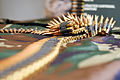 Non-disintegrating metal DM1 belt
 -
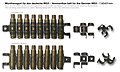 Disintegrating metal M13 link belt (designated DM60 by Germany)

.jpg)

Sights
[edit]The open-type iron sight line has a relatively short 430 millimeters (16.9 in) radius and consists of a "∧-type" height adjustable front sight on a folding post and a leaf rear sight with an open V-notch sliding on a ramp, graduated from 200 to 1,200 meters (219 to 1,312 yd) in 100 meters (109 yd) increments. A flip-up anti-aircraft sight is attached to the receiver top just in front of the normal rear sight element.
Danish C79 LMG Optic
[edit]As an iron sighting line alternative, the Danish military uses a 3.4×28 optical sight mounted on top of the receiver which can be set from 300 to 800 meters (328 to 875 yd) in 100 meters (109 yd) increments on their MG 3 (designated as M/62) and later M/60E6. What sets the Danish C79 LMG Optic designated as M/98 apart from the standard C79 optical sight is its unique reticle of a chevron with a height of 12,5 TS and two TS line left and right with a length of 7,5 TS beginning 2,5 TS away from the tip of the chevron. The sight designated as M/99 is also available in a night vision configuration.[14]
Bipod and tripod
[edit]
For the light machine gun role the MG 3 is equipped with a synthetic polymer stock and a folding bipod.
In a stationary, heavy machine gun role the MG 3 is mounted on a buffered Feldlafette ("field tripod") that also features storage containers for accessories like the Zielfernrohr 4 × 24 periscope-style telescopic sight. The direct fire only Zielfernrohr 4 × 24 sight like the MG 3 is mounted on the Feldlafette and is graduated from 0 to 1,600 meters (0 to 1,750 yd) in 100 meters (109 yd) increments. The Zielfernrohr 4 × 24 reticle can be illuminated by an external unit. It can also be used with the FERO-Z 51 night sight.[9][10]
A feature of the German World War II Lafette 42 tripod that was not carried over to the MG 3 Feldlafette was the Tiefenfeuerautomat ("in-depth automatic fire"). If selected, this feature walked the fire in wave like motions up and down the range between predefined ranges. This sweeping of a given range (Tiefenfeuer – "in-depth fire") continued as long as the gun was fired.
Variants
[edit]

- MG 1: Rheinmetall variant of the MG 42, most notably rechambered to fire 7.62×51mm NATO.
- MG 1A1 (MG 42/58): As MG 1, but with sights properly calibrated for the new round. Sights refitted to existing MG 1s.
- MG 1A2 (MG 42/59): MG 1A1 variant; product improved with longer ejection port, heavy bolt and friction ring buffer.
- MG 1A3: MG 1A2 variant; product improvement of all major components.
- MG 1A4: MG 1 variant; for fixed mount armour use.
- MG 1A5: MG 1A3 variant; MG1A3s converted to MG1A4 standard.
- MG 2: Designation for all wartime MG 42s rechambered to 7.62×51mm NATO.
- MG 3: MG 1A3 variant; product improved with AA rear sight.
- MG 3E: MG 3 variant; reduced weight model (roughly 1.3 kg lighter), entered into late 1970s NATO small arms trials.
- MG 3A1: MG 3 variant; for fixed mount armour use.
- MG 3KWS: MG 3 variant; developed by Rheinmetall and Tactics Group as a stand in until the HK121 replaces it.[15]
- MG 42/59: Italian variant produced by Beretta, Whitehead Motofides and Franchi, since 1959, Chambered in 7.62×51mm NATO. The bolt weight was increased to 1,200 g (42.33 oz)) for a reduced 800 rounds per minute cyclic rate of fire. Used mainly mounted on vehicles and has largely been phased out by the FN Minimi.
- Ksp m/94: Swedish variant chambered with the 7.62×51mm NATO round. Mainly used as secondary armament in Stridsvagn 122.
Derivatives
[edit]The Rheinmetall RMG 7.62 is a mounted machine gun based from the Rheinmetall MG 3 with three rotating barrels (to reduce barrel erosion and overheating) is under development as a vehicle weapon. Only one barrel is active at a time: after one barrel overheats, it is rotated out for a cool one.
The MG14z is a double barrel derivative of the Rheinmetall MG 3 with two MG 3 receivers paired together. The MG14z enhances the firepower of military units that still issue the MG 3 or other MG 42 derivatives. It has been developed by the Tactics Group GmbH company as "a low-cost alternative to Miniguns".[16]
Users
[edit]
.jpg)


 Afghanistan: Used by the Mujahideen and Taliban[17]
 Albania: Used by the Albanian Army.[18]
 Argentina: Used by the Argentine Army.[19]
 Australia: The MG 3 was used between 1976 and 2007 as an anti-aircraft weapon on the Australian Army's Leopard AS1 MBT.[20]
 Austria: Uses the MG 74 [es] which is a MG-42/59 [it] variant licensed from Beretta and manufactured by Steyr Mannlicher. The MG 74 [es]'s cyclic rate of fire is 850 rounds per minute.[21]
 Azerbaijan: The Military of Azerbaijan acquired a small quantity of MKEK MG 3s from Turkey.[citation needed]
 Bangladesh[22]
 Brazil: MG 3 and MG 3A1 are used by the Brazilian Army at the Leopard 1A5 BR.[23]
 Canada: Only used on 20 Leopard 2A6M CAN tanks acquired from Germany.[24] Leopard 2s acquired from other sources will continue to use the FN MAG.
 Cape Verde[25]
 Chile[26]
 Cyprus[27]
 Czech Republic: Used on Dingo 2.[28]
 Denmark: MG-42/59 [it] designated M/62 in Danish service.[29]
 Estonia[30] Designated as MG 3. MG 1A3 version with the anti-aircraft sight.
 Finland: As the 7.62 KK MG 3. Used with the Leopard 2 tanks and NH90 helicopters.[31]
 Germany: Used by the Bundeswehr.[25]
 Ghana[citation needed]
 Greece: License production by Hellenic Defence Systems (also known as EAS).[4][19]
 Iceland: Used by the Icelandic Coast Guard.[32]
 Indonesia: License production.[33]
 Iran: License production by Defense Industries Organization as the MGA3. Used by Iranian Army. Installed on Zulfiqar MBT.[26][34]
 Kurdistan: Peshmerga of Iraqi Kurdistan autonomous region, 40 MG 3s supplied by Germany and 100 MG-42/59 [it] by Italy.[35]
 Italy: License production of the MG-42/59 [it] by Beretta with parts made by Whitehead Motofides and Luigi Franchi; while largely replaced in squad support weapon role by the Belgian FN Minimi, it still sees widespread mounted use on ground-based vehicles and helicopters.[26][36] Prior to the procurement of the Minimi, the Stabilimento Militare Armi Leggere (SMAL) at Terni has developed a kit to adapt the Italian Army's existing MG-42/59 [it] machine guns to accommodate 5.56×45mm NATO ammunition. The kit comprises a new barrel, bolt head, feed opening and cover, recoil-enhancing element and a lighter bolt. The weight of the modified 5.56 mm MG-42/59 [it] machine gun remains unchanged from the original version.
 Latvia: used by the Latvian Land Forces.[citation needed]
 Libya[33]
 Lithuania: used by the Lithuanian Armed Forces.[37]
 Mexico: License produced by SEDENA in Mexico.[38]
 Myanmar[25] Clones made in Myanmar as the MA 15.[39]
 Niger[40]
 Nigeria[41]
 Norway[25] In use by the Home Guard and Navy. Replaced in Army service by the FN Minimi and FN MAG in 2019.
 Pakistan: Used by the Pakistan Army. Manufactured under license by Pakistan Ordnance Factories from 1960s in Wah Cantt.[42]
 Philippines: Used by the Philippine National Police.[43]
 Poland: On Leopard 2 tanks and support vehicles. Intended to be replaced by UKM-2000 and WKM-B.[44]
 Portugal[26]
 Sao Tome and Principe[25]
 Saudi Arabia[25]
 Slovakia: Mounted on Leopard 2A4.[45]
 Spain: Made under license.[26]
 Sri Lanka Used by the Sri Lankan Armed Forces in limited numbers.[citation needed]
 Sudan: Made by Military Industry Corporation as the Karar.[46]
 Sweden: As the KSP m/94. Used with the Leopard 2 tanks.[47]
 Thailand: Used on Commando V-150 APC.[citation needed]
 Togo[25]
 Tunisia[33]
 Turkey: Made by MKEK in Kırıkkale under license since 1974[3] for the Turkish Armed Forces and Turkish Gendarmerie.[48]
 Ukraine: Ukrainian armed forces have been given MG 3 to aid them in the Russian invasion of 2022.[49] At least 130 MG 3 have been provided by Germany.[50]
 Uruguay[51]
 Yemen: pro-Saudi forces and Al-Qaeda in the Arabian Peninsula.[52]


Non state users
[edit]

Conflicts
[edit]- Myanmar Conflict (1948–present)
- Nigerian Civil War (1967–1970)
- The Troubles (Late 1960s–1998)
- Bangladesh Liberation War (1971)[55]
- Lebanese Civil War (1975–1990)
- Kurdistan Workers Party Insurgency (1978 - present)
- Afghan Conflict (1978–present)
- Iran–Iraq War (1980–1988)
- Second Sudanese Civil War (1983–2005)[56]
- Somali Civil War (1988–present)
- Afghan Civil War (1992–1996)
- Kargil War (1999)
- Iraqi Conflict (2003–present)[57]
- Insurgency in Khyber Pakhtunkhwa (2004–present)
- Boko Haram insurgency (2009–present)[40]
- Libyan Crisis (2011–present)
- Syrian Civil War (2011–2024)
- Russo-Ukrainian War (2014–present)[58]
- Yemeni Civil War (2015–present)[59]
- Myanmar Civil War (2021–present)
See also
[edit]References
[edit]- ^ Bundesministerium der Verteidigung (26 June 1979). "Dv 3-14 Das Maschinengewehr" (PDF) (in German) – via Wikimedia Commons.
- ^ Woźniak, Ryszard (2001). Encyklopedia najnowszej broni palnej—tom 3 M-P (in Polish). Warsaw: Bellona. p. 106.
- ^ a b "7.62 mm MG3 Machine Gun". MKEK. Archived from the original on 15 September 2009. Retrieved 4 April 2014.
- ^ a b c Moss, Matthew. "Rheinmetall Machinengewehr 3 West Germany". Historical Firearms.
- ^ Shepherd, Christian (17 January 2009). "Machine Gun 42". Tactical Life. Archived from the original on 7 July 2012. Retrieved 9 February 2014.
- ^ Gao, Charlie (24 August 2019). "Bang: Meet the 5 Best Machine Guns on the Planet". The National Interest.
- ^ "Harmonisierung bei den Handwaffen der Bundeswehr". Europäische Sicherheit & Technik (in German). 6 March 2019.
- ^ Attribute Analysis of the Armor Machine Gun Candidates (PDF) (Report). US Army Armaments Command. July 1975. Archived (PDF) from the original on 14 September 2021. Retrieved 14 September 2021.
- ^ a b A2-222/0-0-4750 Schießen mit Handwaffen (Shooting with handguns) (PDF) (in German). Bundeswehr - Ministry of Defence Germany. 2015. Archived from the original (PDF) on 17 August 2022. Alt URL
- ^ a b c ZDv 3/14 Das Maschinengewehr (PDF) (in German). Germany: Bundeswehr (Ministry of Defence). 2003. Archived from the original on 22 December 2022.
- ^ "Rheinmetall MG-3 - General-purpose machine gun". Archived from the original on 29 January 2023. Retrieved 28 November 2022.
- ^ Jane's Infantry Weapons. Jane's Information Group. 2002. p. 2169.
- ^ Legendre, Jean-François (March 2005). "Feeding the Tiger: Ammunition Belts for German MG 34 and MG 42 Machine Guns". Small Arms Review. Archived from the original on 22 May 2016.
- ^ Hjemmeværnet. "HRN-111-007". Hæren: H-11.
- ^ Johnson, Steve (6 January 2014). "Bundeswehr MG3KWS Upgrade Program". The Firearm Blog. Retrieved 19 January 2014.
- ^ "Tactics Group MG-14z". All4shooters.com. 8 March 2014. Archived from the original on 3 November 2014. Retrieved 28 June 2014.
- ^ McNab, Chris (2012). MG 34 and MG 42 Machine Guns. Osprey Publishing. p. 72.
- ^ "The 45 Albanian Army Special forces face-to-face with the Taliban's in Kandahar, Afghanistan". Armyrecognition.com. 29 October 2011. Archived from the original on 15 February 2019. Retrieved 10 March 2022.
- ^ a b McNab, Chris (2012). MG 34 and MG 42 Machine Guns. Osprey Publishing. p. 70.
- ^ Handel, Paul D. (2001). "Leopard AS1 Main Battle Tank Part One". Anzac Steel. Retrieved 11 January 2014.
- ^ "Waffen und Gerät – Maschinengewehr MG 74". Österreichs Bundesheer (in German). Retrieved 9 February 2014.
- ^ "SALW Guide Global distribution and visual identification Bangladesh Country report" (PDF). Bonn International Center for Conversion. Retrieved 3 September 2019.
- ^ "Recebimento das metralhadoras para as viaturas Leopard 1A5 BR" (PDF). Noticiário do Exército (in Brazilian Portuguese). No. 10, 664. Brasília: Centro de Comunicação Social do Exército. 21 May 2010. Archived from the original (PDF) on 1 June 2010.
- ^ Duchesne, Simon (14 February 2008). "Soldiers from C Squadron, Lord Strathcona's Horse (LdSH), wait for start time on their Leopard 2 tank". Canadian Forces Combat Camera. Archived from the original on 29 July 2012.
- ^ a b c d e f g Jones, Richard D.; Ness, Leland S., eds. (27 January 2009). Jane's Infantry Weapons 2009/2010 (35th ed.). Coulsdon: Jane's Information Group. ISBN 978-0-7106-2869-5.
- ^ a b c d e "G3 Defence Magazine". Calameo.com. 4 August 2010. Archived from the original on 9 July 2012. Retrieved 9 February 2014.
- ^ "Ιερείς σε στρατιωτική άσκηση: Έριξαν βολές και προκάλεσαν αντιδράσεις (ΒΙΝΤΕΟ)". Alphanews.live (in Greek). 9 February 2022. Retrieved 15 January 2023.
- ^ "Obrněné vozidlo Dingo 2 CZ". Armády České republiky. Archived from the original on 21 March 2014.
- ^ "Maskingeværer". Forsvaret. Archived from the original on 15 May 2017. Retrieved 30 July 2015.
- ^ "Relvad – Kaitsevägi". Mil.ee. Retrieved 14 July 2022.
- ^ "Puolustusvoimat". Mil.fi (in Finnish). Archived from the original on 23 April 2008. Retrieved 9 February 2014.
- ^ "Hátt í 400 hríðskotabyssur í landinu". RÚV. 27 October 2014. Retrieved 27 October 2014.
- ^ a b c Jenzen-Jones, N.R.; McCollum, Ian (April 2017). Web Trafficking: Analysing the Online Trade of Small Arms and Light Weapons in Libya (PDF). Working Paper No. 26. Small Arms Survey. p. 85. Archived from the original (PDF) on 16 May 2017.
- ^ "AIG: 7.62 mm Machin Gun". Diomil.ir. Archived from the original on 30 October 2008.
- ^ Small Arms Survey (2015). "Trade Update: After the 'Arab Spring'" (PDF). Small Arms Survey 2015: weapons and the world (PDF). Cambridge University Press. p. 110. Archived from the original (PDF) on 1 July 2015.
- ^ "Armi Leggere". Esercito Italiano: Il Portale delle Armi dei Materiali e dei Mezzi. Archived from the original on 20 May 2011.
- ^ "Kulkosvaidis MG-3". Lietuvos kariuomenė (in Lithuanian). 17 April 2009. Archived from the original on 2 November 2015. Retrieved 18 October 2010.
- ^ "Mexican Army military equipment". Army Recognition. Archived from the original on 14 June 2015. Retrieved 11 January 2014.
- ^ "活跃在缅甸内战中的德国MG3机枪" [German MG3 machine guns active in the Burmese Civil War]. Twoeggz.com (in Chinese). 22 January 2018. Archived from the original on 3 August 2018.
- ^ a b de Tessières, Savannah (January 2018). At the Crossroads of Sahelian Conflicts: Insecurity, Terrorism, and Arms Trafficking in Niger (PDF) (Report). Small Arms Survey. p. 58. ISBN 978-2-940548-48-4. Archived from the original (PDF) on 12 June 2018.
- ^ Jowett, Philip (2016). Modern African Wars (5): The Nigerian-Biafran War 1967–70. Oxford: Osprey Publishing. p. 20. ISBN 978-1-472816092.
- ^ "Machine Gun MG3 (MG1A3)". Pakistan Ordnance Factories. Archived from the original on 29 October 2013. Retrieved 9 February 2014.
- ^ "PNP boosts capability after acquiring P1.871-B new equipment". Manila Bulletin. 6 May 2019.
- ^ Gaszak, Agnieszka (21 February 2011). "Pierwsze strzelanie żołnierzy NSR z karabinu maszynowego MG-3". Wojsko Polskie. Archived from the original on 15 June 2013. Retrieved 10 May 2021.
- ^ Ostré streľby z tankov Leopard 2A4 | Pozemné sily | Ozbrojené sily SR, 14 August 2023, retrieved 31 August 2023
- ^ "KARAR 7.62x51mm". Military Industry Corporation. Archived from the original on 10 March 2008.
- ^ Svensk, Henrik. "Strv122 Stridsvagn 122 / Leopard 2". SoldF.com. Retrieved 9 February 2014.
- ^ "Si̇lahlar". Gendarmerie General Command. Archived from the original on 14 April 2009.
- ^ Nikolov, Boyko (28 March 2022). "1,500 Soviet Strela-2 MANPADS and 100 MG3 arrived in Ukraine". BulgarianMilitary.com.
- ^ "Militärische Unterstützungsleistungen für die Ukraine". Presse- und Informationsamt der Bundesregierung (in German). Retrieved 9 November 2022.
- ^ Porfilio, Gabriel (25 September 2020). "El Ejército de Uruguay recibe un millar de ametralladoras MG-3 adquiridas a España". InfoDefensa (in Spanish). Retrieved 20 April 2022.
- ^ Austin, Rod (28 November 2018). "Yemen: inquiry finds Saudis diverting arms to factions loyal to their cause". The Guardian.
- ^ VICE News (27 April 2016). "What It's Really Like to Fight for the Islamic State". YouTube. Archived from the original on 12 December 2021.
- ^ "Arms trial hears of 'dreaded weapon'". Irish Independent. 5 February 1994.
- ^ McNab, Chris (2002). 20th Century Military Uniforms (2nd ed.). Kent: Grange Books. p. 31. ISBN 1-84013-476-3.
- ^ "Sudan – Global trade, local impact: Arms Transfers to all Sides in the Civil War in Sudan" (PDF). Human Rights Watch Report. 10 (4): 25. August 1998.
- ^ VICE News (27 April 2016). "What It's Really Like to Fight for the Islamic State". YouTube. Archived from the original on 12 December 2021.
- ^ Nikolov, Boyko (28 March 2022). "1,500 Soviet Strela-2 MANPADS and 100 MG3 arrived in Ukraine". BulgarianMilitary.com.
- ^ Dnevnik (in Slovenian). Ljubljana, Slovenia: Radiotelevizija Slovenija. 2015. Event occurs at 17:13. Retrieved 8 August 2015.
Citations
[edit]- Ezell, Edward C. (1988). Small Arms Today 2nd Edition. Harrisburg, PA: Stackpole Books.
- Woźniak, Ryszard (2001). Encyklopedia najnowszej broni palnej—tom 3 M-P (in Polish). Warsaw: Bellona. ISBN 83-11-09311-3.
External links
[edit]
MG 3 machine gun
View on GrokipediaDevelopment and Origins
Roots in the MG 42
The MG 3 directly descends from the MG 42, a World War II-era general-purpose machine gun developed by Germany in 1942 to supplant the earlier MG 34 with simpler stamped-metal construction and enhanced manufacturability.[4] The MG 42's roller-delayed short-recoil operation, belt-fed mechanism, and quick-change barrel system enabled sustained fire while minimizing production costs and logistical demands, features that formed the foundational design principles carried forward into postwar iterations.[4] Its cyclic rate of approximately 1,200 rounds per minute, achieved through a lightweight bolt and recoil booster, provided suppressive firepower that Allied evaluators acknowledged as superior, prompting reverse-engineering efforts such as the U.S. T24 prototype, though none supplanted existing designs.[2] Postwar, West Germany's rearmament under the newly formed Bundeswehr in 1955 prioritized proven systems amid Allied restrictions and NATO integration pressures.[5] The MG 42, with surviving stocks and manufacturing tooling, was reintroduced initially in its original 7.92×57mm Mauser chambering for rapid fielding.[5] Rheinmetall, leveraging prewar experience, initiated modifications in the late 1950s to adapt the weapon to the 7.62×51mm NATO standard, rechambering the barrel, adjusting the bolt carrier mass, and refining the recoil dynamics to accommodate the cartridge's higher pressure and velocity while preserving the original locking and feeding geometry.[6] This yielded the MG 1 variant by 1958, marking the transition from wartime relic to modernized service arm, with subsequent evolutions like the MG 3 incorporating minor feed and safety enhancements but retaining over 90% parts commonality with the MG 42.[6][4] The persistence of the MG 42's architecture in the MG 3 stemmed from its empirical battlefield efficacy—evidenced by low malfunction rates in diverse conditions—and first-principles advantages in scalability, such as interchangeable components across infantry and vehicle roles, obviating the need for wholesale redesign despite decades of technological advancement.[7] Many early MG 3s involved retrofitting existing MG 42 receivers with updated components, underscoring the evolutionary rather than revolutionary development path.[8] This lineage ensured the MG 3's adoption as the Bundeswehr's standard machine gun upon formal standardization in the 1960s, perpetuating the MG 42's legacy of reliability and firepower into the Cold War era.[2]Postwar Redesign and NATO Standardization
Following the end of World War II, West Germany's rearmament under NATO membership in 1955 necessitated adapting legacy designs like the MG 42 to the alliance's 7.62×51mm cartridge standardization established in 1954. Rheinmetall initiated postwar development in the 1950s, launching production of the MG 1 variant in 1958 as a direct conversion of the MG 42 mechanism to the NATO round, retaining the roller-locked short-recoil operation while incorporating a chrome-lined barrel for enhanced durability.[6][9] Key redesigns focused on reducing the original MG 42's cyclic rate of 1,200–1,500 rounds per minute, which strained ammunition supplies and barrel life, by nearly doubling the bolt weight from 550 grams to 950 grams, alongside revised recoil springs and adjustable friction buffers or washers to introduce controlled drag. These modifications lowered the rate to 1,000–1,300 rounds per minute, promoting better controllability, sustained fire, and alignment with NATO tactical doctrines emphasizing versatile general-purpose machine guns over suppressive "buzz-saw" volume.[6][10] The iterative MG 2 and MG 3 designations encompassed conversions of wartime MG 42 stocks and new production, with the MG 3 featuring an improved belt feed pawl for reliable NATO-compatible disintegrating links like the DM6 or M13. Adopted by the Bundeswehr amid 1959 rearmament efforts paralleling the G3 rifle's introduction, the MG 3 achieved full standardization as the service general-purpose machine gun, supplanting interim 7.92×57mm Mauser use and enabling interoperability across NATO forces.[9][2]Production and Initial Adoption
Following the formation of the Bundeswehr in 1955, West Germany sought to standardize its weaponry with NATO allies, necessitating adaptation of legacy designs like the MG 42 to the 7.62×51mm cartridge. Rheinmetall initiated production of the MG 1 variant in 1958, involving both conversions of existing MG 42 receivers and new manufacturing to meet these requirements.[2][4] The MG 3, an refined iteration with enhancements such as a heavier bolt for reduced rate of fire and improved feed mechanism, emerged as the definitive model by 1959.[10] The Bundeswehr formally adopted the MG 3 in 1959 as its primary general-purpose machine gun for infantry squads, vehicle mounts, and coaxial applications, replacing provisional 7.92mm systems.[11] Initial production focused on equipping mechanized and airborne units, with Rheinmetall in Düsseldorf handling output until approximately 1979, after which licensed production expanded abroad.[12] Early deployments emphasized the weapon's reliability derived from the proven MG 42 roller-delayed mechanism, facilitating rapid integration into post-rearmament forces.[10] Export interest emerged soon after, with initial licenses granted to allies like Italy and Pakistan by the early 1960s, though domestic needs prioritized German output exceeding tens of thousands in the first decade.[9] This adoption underscored pragmatic reuse of wartime industrial designs, prioritizing functional efficacy over novelty amid Cold War rearmament constraints.[7]Design and Technical Features
Operating Mechanism and Rate of Fire
The MG 3 utilizes a short recoil-operated mechanism with roller locking, a design directly carried over from the World War II-era MG 42.[9][2] In operation, recoil from the fired cartridge drives the barrel and bolt carrier rearward together for a brief distance while the bolt remains locked to the barrel extension via two rollers.[9] Cam surfaces on the trunnion then force the rollers inward, unlocking the bolt and allowing it to continue rearward under inertia to extract the spent casing, cock the striker, and compress the recoil spring.[2] The system fires from an open bolt in fully automatic mode only, with a cross-bolt safety preventing unintended discharge.[12] The cyclic rate of fire for the MG 3 is typically 1,000 to 1,300 rounds per minute using the standard bolt assembly, enabling intense suppressive fire but resulting in rapid ammunition expenditure and barrel heating.[9][2] To mitigate overheating and improve control during sustained fire, a heavier bolt can be substituted, reducing the rate to approximately 700 to 950 rounds per minute by increasing the bolt's inertia and slowing the cycle time.[9] This adjustability, combined with the weapon's quick-change barrel system—recommended after every 150 rounds of continuous fire—allows for effective management of thermal stress on the 565 mm chrome-lined barrel.[9] The high nominal rate underscores the MG 3's role as a general-purpose machine gun optimized for short, high-volume bursts rather than prolonged automatic fire.[2]Barrel Management and Cooling
The MG 3 is an air-cooled, general-purpose machine gun that manages barrel heat primarily through rapid barrel interchangeability rather than auxiliary cooling mechanisms, enabling sustained fire despite its cyclic rate exceeding 1,000 rounds per minute. Overheating poses risks of reduced accuracy, barrel warping, and ammunition cook-off, which the design mitigates via a heavy, chrome-lined barrel that withstands high thermal stress before requiring replacement.[9][4][13] Barrel replacement is performed by locking the bolt rearward via the cocking handle, rotating the barrel locking lever forward and to the right, then sliding the heated barrel forward off the receiver using its integral carrying handle; a spare barrel is inserted in reverse order, typically completing the swap in under 10 seconds for proficient crews. Protective heat-resistant gloves, historically asbestos-lined but now often modern equivalents, are issued to the assistant gunner to prevent burns during this process.[4][14] The right-side-open forearm design aids access, and doctrine mandates changes after 150 rounds of rapid live fire (or 100 blank rounds) to sustain effectiveness, with teams carrying multiple spares in insulated containers to allow cooling via ambient air.[9][15] This system inherits and refines the MG 42's proven quick-change mechanism, prioritizing mechanical simplicity and field reliability over complex liquid cooling, which proved logistically burdensome in prior designs. Barrel life under normal conditions exceeds 10,000 rounds before wear necessitates replacement, though intensive use accelerates erosion at the gas port and muzzle.[4][9]Feeding System and Ammunition Compatibility
The MG 3 utilizes a belt-feeding mechanism adapted from the MG 42, where ammunition is fed from the left side via a feed tray and feed block into the chamber during the recoil cycle. This system supports flexible belt lengths, with operators able to link individual segments manually for sustained fire.[2][9] It is designed for 7.62×51mm NATO cartridges, loaded in non-disintegrating DM1 metallic-link belts, which feature rigid steel links that remain intact after firing and typically hold 50 rounds per segment; these can be combined by interlocking cartridges to form extended belts up to 250 rounds or more, often stored in drums or boxes for portability.[16][17][18] Compatibility extends to disintegrating-link belts, including the German DM6 and the NATO-standard M13, which separate during ejection to reduce weight and simplify resupply; these are commonly used in 100- to 120-round configurations for vehicle mounts or squad support roles.[16][11][9] The enlarged ejection port modification in postwar redesigns facilitates both belt types without requiring tool changes.[2]Sights, Optics, and Ergonomics
The MG3 is equipped with open iron sights consisting of a barleycorn front sight and a notch rear sight, with a sight radius of 430 mm allowing for range adjustments from 200 to 1,200 meters.[9] These folding-base sights are fully adjustable for elevation and windage, facilitating accurate engagement in various field conditions.[4] Flip-up anti-aircraft sights are also incorporated for elevated trajectory firing.[9] Optics are not standard on the infantry-configured MG3, which relies primarily on its iron sights for direct fire, but provisions exist for mounting telescopic or periscopic sights on the Lafette tripod for indirect or long-range observation.[4] Hensoldt periscope optics, for instance, have been used on tripods to align with the barrel axis for precise aiming without exposing the crew.[19] Modern adaptations may include reflex sights like the EOTech for enhanced target acquisition, though such modifications are non-standard and depend on user-specific configurations.[4] Ergonomically, the MG3 features a push-button cross-bolt safety located at the top of the pistol grip, operable only when the bolt is cocked via a redesigned sliding mechanism that prevents accidental discharge.[4][12] The fire selector offers safe (0) and full-automatic (F) modes, with automatic fire only, and a non-reciprocating charging handle on the right side of the receiver to avoid interference during operation.[9] A length- and height-adjustable shoulder stock with integrated recoil buffer and ground spade enhances stability and adaptability for prone or mounted firing, while the combined carrying handle and pistol grip supports one-handed transport and control.[20] The fixed bipod stows against the receiver for mobility, and the square slotted forearm—open on the right—facilitates quick barrel changes with a heat-resistant glove, weighing approximately 11.05 kg empty to balance portability with sustained fire capability.[9][4] These elements, refined from the MG 42 design with higher manufacturing standards, prioritize crew efficiency in general-purpose roles despite the weapon's mass.[4][21]Mounts, Accessories, and Configurations
The MG3 features an integral bipod attached to the barrel jacket for dismounted infantry use in the light machine gun configuration, enabling portable squad support fire with effective ranges up to 600 meters. This bipod provides stability for short bursts while allowing the gunner mobility.[22] For sustained fire roles, the MG3 is mounted on the buffered Feldlafette tripod, a field tripod weighing approximately 27.5 kg including the gun, which incorporates traverse and elevation (T&E) mechanisms for precise aiming up to 1,200 meters. [13] The tripod design includes storage compartments for spare barrels, tools, and ammunition belts, facilitating extended operations.[13] Periscope sights, such as the Hensoldt-Wetzlar model, can be integrated with the tripod mount for indirect fire observation.[22] Vehicle-mounted configurations employ pintle mounts on pedestals, ring turrets, or swing arms for anti-personnel or anti-aircraft roles, often with recoil-damping systems to mitigate forces on platforms like HMMWVs or armored vehicles.[23] [24] Coaxial setups integrate the MG3 inside turrets of main battle tanks and infantry fighting vehicles, synchronized with primary armament for 7.62×51mm NATO suppressive fire. Accessories include blank-firing adapters for training, which attach to the barrel to simulate live fire with reduced-pressure cartridges, and practical ammunition adapters for maneuver exercises.[12] Recoil mitigation mounts, such as softmount systems, reduce vibration and improve accuracy in both tripod and vehicle applications.[25] Additional mounting adapters allow compatibility with legacy systems like M60 pintles or MG42-era tripods.[26]Variants and Modifications
Infantry and Support Variants
The MG3 functions primarily as a general-purpose machine gun in dismounted infantry roles, equipped with an integrated bipod for portable suppressive fire during assaults and maneuvers. In Bundeswehr squads, it is typically assigned to a dedicated gunner supported by an ammunition bearer, providing organic firepower at the platoon level with effective ranges up to 1,200 meters for point targets.[3][2] The weapon's base configuration weighs 11.5 kilograms including the bipod, facilitating mobility while maintaining the high cyclic rate of 1,000-1,300 rounds per minute derived from its MG 42 heritage.[2] For sustained fire support, the MG3 is mounted on the Lafette 03 tripod, transforming it into a medium machine gun capable of delivering prolonged barrages from defensive or overwatch positions. This setup, weighing an additional 11.5 kilograms for the tripod, supports belts of up to 300 rounds and allows for adjustable elevation and traverse, with maximum range extending to 3,500 meters under optimal conditions.[12][2] The Bundeswehr employs this variant in company-level fire support teams, emphasizing barrel changes every 150-250 rounds to manage heat during extended engagements.[12] No major sub-variants exist specifically for infantry or support use; adaptations are limited to accessories like anti-aircraft sights or reinforced bipods for specialized terrain, ensuring commonality across dismounted applications. Over 40 nations utilize the MG3 in these roles, valuing its reliability in varied environments from urban combat to open terrain.[3][2]Vehicle-Mounted and Specialized Versions
The MG3A1 variant is specifically configured for vehicle-mounted applications, featuring a shortened barrel, deletion of the bipod and stock, and reinforced mounting points to enable fixed installation in armored vehicles without compromising the roller-delayed blowback mechanism or 7.62×51mm NATO compatibility.[2][9] This adaptation prioritizes compactness and integration, with the weapon often linked to the vehicle's fire control system for coaxial operation alongside primary armaments. In German Leopard 1 and Leopard 2 main battle tanks, the MG3A1 serves as the coaxial machine gun, delivering sustained rates of fire up to 1,000-1,300 rounds per minute to engage soft targets at ranges exceeding 1,000 meters when pintle- or turret-mounted.[2][27] Pintle-mounted configurations of the standard MG3 or MG3A1 are employed on infantry fighting vehicles like the Marder 1A3 and Puma IFV, as well as armored personnel carriers such as the Fuchs, providing anti-aircraft defense and suppressive fire from exposed roof positions.[9] These setups typically incorporate spade grips, optical sights, and ammunition feeds from vehicle storage, allowing cyclic fire rates adjustable via the standard steam-cooling barrel system, though barrel swaps remain manual in non-coaxial roles. Export users, including Australia on Leopard AS1 tanks, utilize similar pintle mounts for turret roof anti-aircraft roles, feeding from 200- or 300-round belts stored internally.[28][9] Specialized vehicle adaptations include the MG3KWS, an interim remote-controlled variant with electric triggering developed by Rheinmetall for integration into stabilized weapon stations on platforms like the Boxer APC, bridging the gap until adoption of successors like the HK121.[2] Further enhancements address sustained fire demands in enclosed vehicle environments; for instance, recent Rheinmetall proposals incorporate adjustable gas ports and reinforced components for low-flying aircraft or high-mobility vehicle mounts, such as the MG3A0A1 variant tested for aerial platforms but adaptable to ground use.[29] The Rheinmetall RMG 7.62, a multi-barrel derivative with three rotating barrels, extends operational endurance by distributing heat load, targeting vehicle applications where manual barrel changes are impractical, though it remains in development phases as of recent evaluations.[9] These modifications maintain the MG3's core reliability while enhancing suitability for mechanized warfare, with over 10,000 units integrated into Bundeswehr vehicle fleets by the 2010s.[12]Operational Deployment
Bundeswehr Service History
The MG3 entered service with the Bundeswehr in the late 1950s, following the rearmament of West Germany and standardization of the design adapted from the MG 42 for 7.62×51mm NATO ammunition.[9] Rheinmetall's production variant was formally introduced in 1968, becoming the primary general-purpose machine gun for infantry squads, vehicle mounts, and coaxial installations.[2] It replaced earlier post-war MG 42 derivatives like the MG1 and MG2, providing sustained fire capability in NATO-aligned forces during the Cold War era.[30] Throughout the Cold War, the MG3 equipped mechanized infantry units and armored vehicles such as the Marder infantry fighting vehicle and Leopard tanks, emphasizing defensive operations against potential Warsaw Pact incursions.[12] Its high rate of fire and reliability in adverse conditions made it a cornerstone of Bundeswehr firepower doctrine, with over 7,000 units produced for German service by the 1970s.[21] Post-Cold War, the MG3 saw deployment in international peacekeeping missions, including operations in the Balkans and as part of the NATO-led ISAF in Afghanistan from 2001 to 2014, where it supported German troops in combat patrols and defensive positions.[10] Experiences in Afghanistan highlighted its durability but also prompted evaluations for lighter alternatives, leading to partial replacement efforts.[10] As of 2023, the MG3 remains in active Bundeswehr inventory, particularly in vehicle-mounted roles on Leopard 2 tanks and Marder vehicles, despite the introduction of the 5.56mm MG4 light machine gun and ongoing transition to the 7.62mm MG5 general-purpose machine gun.[12] Its longevity stems from proven combat effectiveness and logistical compatibility within NATO standards.[3]International Users and Exports
The MG 3 has been exported to more than 40 countries since its introduction, with adoption by militaries across Europe, Asia, the Middle East, Africa, and the Americas for use in infantry support, vehicle mounting, and other roles.[3] Production for export by Rheinmetall continued until 1979, after which licensed manufacturing sustained availability in select nations.[31] License agreements enabled local production in several countries, including Italy (as the related MG 42/59 variant), Pakistan (designated MG 1A3), Turkey, Iran, Greece, Spain, and Sudan, allowing these users to maintain domestic supplies and adapt the design to specific needs.[2] Notable operators encompass Argentina, Australia, Brazil, Canada, Denmark, Finland, Mexico, the Netherlands, Norway, Poland, Portugal, Saudi Arabia, and Sweden, where the MG 3 supplements or replaces indigenous or other foreign machine guns in squad automatic weapon and general-purpose roles.[2] Exports have extended to Middle Eastern and African states such as Saudi Arabia, which integrates the MG 3 as a standard general-purpose machine gun, and others like Togo, reflecting the weapon's appeal due to its proven reliability and compatibility with NATO-standard 7.62×51mm ammunition.[2] Instances of proliferation beyond official channels have occurred, with captured or diverted MG 3s appearing in non-state groups in conflict zones, though primary distribution remains through state-to-state transfers.[32]Major Conflicts and Engagements
The MG 3 has been employed by the Bundeswehr in post-Cold War overseas deployments, with significant use during the NATO-led International Security Assistance Force (ISAF) mission in Afghanistan from 2001 to 2014, followed by Resolute Support until 2021. German infantry squads integrated the MG 3 as a squad automatic weapon for suppressive fire in patrols, convoy escorts, and defensive operations against Taliban ambushes, particularly in volatile regions like Kunduz Province where intense firefights occurred between 2009 and 2014. Its rapid rate of fire, exceeding 1,000 rounds per minute, proved effective in providing volume of fire to pin down insurgents during close-range engagements.[33] In the Balkans, Bundeswehr contingents utilized the MG 3 during the Kosovo Force (KFOR) peacekeeping operation starting in 1999, mounting it on vehicles and tripods for area security amid sporadic unrest, including the 2004 Kosovo riots where German troops fired over 100,000 rounds in response to attacks on NATO facilities. The weapon supported static defenses and quick-reaction forces, contributing to stabilization efforts despite limited full-scale combat.[34] Since the Russian invasion of Ukraine in February 2022, Ukrainian armed forces have deployed MG 3 machine guns supplied via German military aid, with at least 130 units delivered by early 2023. Marine infantry teams have used the MG 3 for sustained fire against Russian positions, as evidenced in helmet-cam footage from Kherson Oblast in February 2023, where gunners engaged enemy trenches under artillery threat, demonstrating the design's adaptability to high-intensity defensive roles.[35] Other operators, including Norwegian and Danish forces in joint NATO exercises and patrols in Afghanistan, have fielded the MG 3 in combat support roles, while exports to countries like Turkey have seen use in border operations against insurgent groups since the 2010s. These engagements underscore the MG 3's longevity in squad-level fire support across asymmetric and conventional theaters.[3]Performance and Evaluation
Reliability, Maintenance, and Durability
The MG3 demonstrates high reliability in field conditions due to its robust stamped steel construction and roller-locked short recoil mechanism, which tolerates fouling, dirt, and adverse weather better than more complex designs. This heritage from the MG42 enables sustained operation without frequent stoppages, as evidenced by its continued use in diverse environments by multiple militaries over decades. However, its cyclic rate of 1,000–1,300 rounds per minute increases susceptibility to overheating if barrels are not swapped promptly, potentially leading to cook-off risks or temporary accuracy loss during prolonged fire.[36][10] Maintenance is facilitated by the weapon's modular design, allowing field-level disassembly without specialized tools for cleaning the bolt carrier, recoil booster, and feed mechanism. Routine procedures emphasize clearing carbon buildup from the high-volume firing, lubricating moving parts, and inspecting the stamped receiver for stress cracks after extended use. The quick-change barrel system, involving a lever release and asbestos-free handle for safe handling of hot barrels, supports rapid swaps in under 10 seconds, minimizing downtime in combat. Bundeswehr protocols require inspection and lubrication after every 500–1,000 rounds, with deeper overhauls at armorer level for wear on rollers or the gas piston.[37][38] Durability is enhanced by the air-cooled barrel and overall simplicity, with the weapon maintaining structural integrity through thousands of cycles in rigorous service. Individual barrels exhibit a service life of approximately 8,000 rounds before erosion compromises accuracy, though operational guidelines mandate changes every 150–300 rounds during sustained bursts to preserve longevity and prevent warping from thermal stress. The design's stamped components resist corrosion and impact better than machined alternatives, contributing to the MG3's operational lifespan exceeding 50 years in Bundeswehr inventories without fundamental redesign.[39][40]Combat Effectiveness and Tactical Role
The MG 3 functions primarily as a general-purpose machine gun, capable of fulfilling multiple roles within infantry units, including squad automatic weapon support, sustained fire from fixed positions, and coaxial or pintle mounting on vehicles. In the light role with its integral bipod, it enables mobile suppression during assaults, where operators are trained to deliver short bursts of 3 to 5 rounds for aimed fire at ranges up to 1,200 meters.[2] When mounted on the Feldlafette tripod, it shifts to a heavy machine gun configuration for defensive area denial and longer-range engagements, including anti-aircraft fire against low-flying threats using flip-up sights.[3] Its versatility extends to anti-aircraft and vehicle-mounted applications, making it a staple for mechanized infantry tactics in the Bundeswehr and other adopting forces.[36][21] Combat effectiveness stems from its high cyclic rate of 1,000 to 1,300 rounds per minute, which generates intense volumes of suppressive fire, psychologically impacting enemies and facilitating friendly advances, as demonstrated in training exercises simulating real-world scenarios.[2] The design's quick-change barrel system, replaceable in 20 to 25 seconds, mitigates overheating during prolonged bursts, allowing sustained output that outperforms many contemporaries in raw firepower delivery.[41] However, this high rate contributes to rapid ammunition consumption—up to 200 rounds per minute in practical use—and accelerated barrel wear, necessitating robust logistics for prolonged engagements, a factor observed in operational deployments like those in Afghanistan where reliability under duress was noted positively by users.[7] Empirical accounts from Norwegian and German forces highlight its dependability in adverse conditions, with minimal malfunctions reported during twice-deployed service in theater.[42] Tactically, the MG 3 excels in providing immediate, high-intensity fire to pin down opponents, enabling maneuver by fire and movement doctrines, though its recoil and dispersion at full cyclic rate demand disciplined burst control to maintain accuracy beyond point targets.[43] In comparisons to other 7.62mm GPMGs like the FN MAG or M240, the MG 3's simplicity and manufacturing efficiency translate to high field reliability and low cost, sustaining its edge in volume-of-fire scenarios despite preferences for slower-cycling alternatives in modern doctrines favoring precision over saturation.[44][45] This balance of rapid engagement capability and ease of maintenance underscores its enduring tactical value in both offensive suppression and defensive standoff roles.Comparisons to Other Machine Guns
The MG3 retains the core roller-delayed blowback mechanism of its World War II predecessor, the MG 42, but adapts it for the 7.62×51mm NATO cartridge, resulting in a slightly reduced cyclic rate of fire of 1,000–1,200 rounds per minute compared to the MG 42's 1,200–1,500 rounds per minute with the more powerful 7.92×57mm Mauser round. This modification enables compatibility with standardized NATO ammunition belts while preserving the rapid barrel exchange capability—achievable in 20–25 seconds—which allows for sustained fire without excessive overheating, a feature less emphasized in the original MG 42's high-pressure operation.[41] However, the MG3 consumes ammunition at a higher rate due to its elevated firing speed, necessitating larger belt capacities or frequent resupply in prolonged engagements, unlike the MG 42's design optimized for short, intense bursts in defensive roles. Compared to the FN MAG (designated M240 in U.S. service), the MG3 offers a higher standard cyclic rate (1,000–1,200 rpm versus 650–1,000 rpm) and faster barrel changes, enhancing its suitability for suppressive fire in fixed or vehicle-mounted positions where ammunition logistics support rapid expenditure.[46] The FN MAG, employing a long-stroke gas piston, provides greater controllability and accuracy at sustained lower rates, with a barrel life extended by its operating principle, making it preferable for mobile infantry squads requiring precision over volume.[47] Weights are comparable, with the MG3 at approximately 11.5 kg and the FN MAG at 11.8 kg (gun body only), but the MG3's recoil system demands heavier bolts for rate reduction, potentially increasing felt recoil in lighter configurations.[48]| Machine Gun | Weight (kg, unloaded) | Cyclic Rate (rpm) | Operating Mechanism | Barrel Change Time (est.) |
|---|---|---|---|---|
| MG3 | 11.5 | 1,000–1,200 | Roller-delayed blowback | 20–25 seconds |
| FN MAG/M240 | 11.8 | 650–1,000 | Gas, long-stroke piston | 10–15 seconds |
| PKM | 7.5 | 650 | Gas, long-stroke piston | 20 seconds |
| M60E4 | 10.6 | 500–650 | Gas, short-recoil | 10 seconds |
Modern Status and Legacy
Upgrades and Phasing Out
The MG3 underwent several modernization efforts to extend its service life and adapt it to contemporary requirements. In 2014, the Bundeswehr initiated the MG3KWS (Kampfwerte-Steigerung, or combat value enhancement) upgrade program, which introduced a retrofit kit for existing inventories. This kit included Picatinny rails for mounting optics and accessories, an adjustable stock, improved bipod, and enhanced ergonomics, allowing the weapon to integrate modern sighting systems and suppressors while retaining core mechanical features.[52] Further variants, such as the MG3A1 optimized for armored vehicle mounting, incorporated reinforced components for sustained fire and compatibility with remote weapon stations, though these were primarily for specialized roles rather than infantry use. Rheinmetall, the primary manufacturer, also offered barrel life extension kits and recoil buffer modifications to mitigate wear from the weapon's high cyclic rate of 1,000–1,300 rounds per minute, addressing logistical strains observed in prolonged operations.[9] Despite these upgrades, the MG3's age—derived from 1942 designs—and maintenance demands prompted phasing efforts in major user nations. The German Bundeswehr began transitioning to the Heckler & Koch MG5 (also known as HK121) as its primary 7.62×51mm NATO general-purpose machine gun starting in 2019, with contracts for over 10,000 units by 2021 to replace the MG3 in infantry, vehicle, and sustained-fire roles. The MG5 offers reduced weight (8.1 kg unloaded versus 11.5 kg for the MG3), improved modularity, and a lower cyclic rate for better control, with full fielding targeted for completion by the mid-2020s amid budget reallocations post-2022 defense spending increases.[53][54] Other operators have followed suit variably; for instance, Denmark and Norway integrated lighter alternatives like the FN MAG derivatives by the early 2010s, while exports to nations such as Pakistan continue without immediate replacement plans. The MG3 remains in limited Bundeswehr service for training and reserves as of 2025, but its obsolescence in peer conflicts—due to vulnerabilities against modern body armor and drone threats—accelerates divestment.[55]Ongoing Use and Derivatives
As of 2025, the MG3 remains in limited service with the German Bundeswehr, where it supplements the MG5 general-purpose machine gun amid a gradual replacement program that delivered its 15,000th unit in May 2025.[56] [57] The weapon's sustained utility stems from its proven reliability in high-intensity fire support roles, including recent deployments and exercises, despite the shift toward lighter, more modular designs.[58] Internationally, over 40 countries maintain the MG3 in active inventories for infantry squad support, vehicle mounting, and naval applications, with ongoing procurement and training documented in nations like Norway and Ukraine.[3] [59] Derivatives of the MG3 include specialized variants such as the MG3A1, configured for coaxial installation in armored vehicles with reinforced components for sustained operation under vibration and heat.[9] Additional adaptations encompass interim models like the MG3KWS for transitional vehicle integration and fixed-mount versions for naval and static defenses.[2] Licensed production has extended the design's lifespan, with manufacturing in Pakistan by Pakistan Ordnance Factories for local forces and exports, and in Turkey by Makina ve Kimya Endüstrisi Corporation, incorporating tactical modifications for regional needs.[2] [60] These productions, totaling over one million units historically, ensure availability without reliance on original German supply chains.[4]References
- https://nationalinterest.org/blog/[reboot](/page/Reboot)/here-are-5-machine-guns-everyone-should-fear-195981