Hubbry Logo
PantomimePantomimeMain
Open search
Pantomime
Community hub
Pantomime
logo
8 pages, 0 posts
0 subscribers
Be the first to start a discussion here.
Pantomime
Pantomime
from Wikipedia

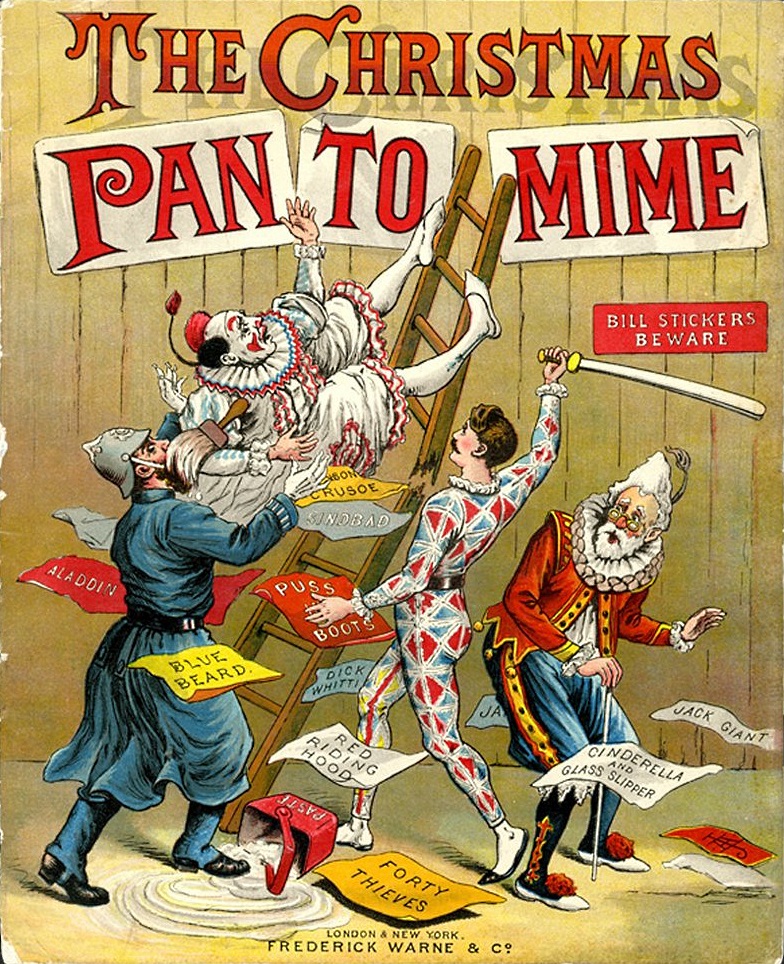
The Christmas Pantomime colour lithograph book cover, 1890, showing harlequinade characters

Pantomime (/ˈpæntəˌmm/;[1] informally panto)[2] is a type of musical comedy stage production designed for family entertainment, generally combining broad and topical humour and cross-dressing actors with a story more or less based on a well-known fairy tale, fable or folk tale.[3][4] Pantomime is a participatory form of theatre developed in England in the 18th century in which the audience is encouraged and expected to sing along with certain parts of the music and to shout out phrases to the performers.

The origins of pantomime reach back to ancient Greek classical theatre. It developed partly from the 16th century commedia dell'arte tradition of Italy and partly from other European and British stage traditions, such as 17th-century masques and music hall.[3] An important part of the pantomime, until the late 19th century, was the harlequinade.[5] Modern pantomime is performed throughout the United Kingdom, Ireland and (to a lesser extent) in other English-speaking countries, especially during the Christmas and New Year season, and includes songs, gags, slapstick comedy and dancing.

Outside the British Isles, the word "pantomime" is often understood to mean miming, rather than the theatrical form described here.[1]

History

[edit]

Ancient Rome

[edit]
2nd-century Macedonian theatrical sculpture, thought to represent a pantomime's mask

The word pantomime was adopted from the Latin word pantomimus,[6] which in turn derives from the Greek word παντόμιμος (pantomimos), consisting of παντο- (panto-) meaning "all", and μῖμος (mimos), meaning a dancer who acted all the roles or all the story.[7][8][9] The Roman pantomime drew upon the Greek tragedy and other Greek genres from its inception, although the art was instituted in Ancient Rome and little is known of it in pre-Roman Greece.[10][11] The English word came to be applied to the performance itself.[citation needed] According to a lost oration by Aelius Aristides, the pantomime was known for its erotic content and the effeminacy of its dancing;[12] Aristides's work was responded to by Libanius, in his oration "On Behalf of the Dancers", written probably around 361 AD.[citation needed]

Roman pantomime was a production, usually based upon myth or legend, for a solo male dancer—clad in a long silk tunic and a short mantle (pallium) that was often used as a "prop"—accompanied by a sung libretto (called the fabula saltica or "dance-story") rendered by a singer or chorus (though Lucian states that originally the pantomime himself was the singer).[13] Music was supplied by flute and the pulse of an iron-shod shoe called a scabellum. Performances might be in a private household, with minimal personnel, or else lavish theatrical productions involving a large orchestra and chorus and sometimes an ancillary actor. The dancer danced all the roles, relying on masks, stock poses and gestures and a hand-language (cheironomy) so complex and expressive that the pantomime's hands were commonly compared to an eloquent mouth.[14] Pantomime differed from mime by its more artistic nature and relative lack of farce and coarse humour,[8] though these were not absent from some productions.[citation needed]

Roman pantomime was immensely popular from the end of the first century BC until the end of the sixth century AD,[14] a form of entertainment that spread throughout the empire where, because of its wordless nature, it did more than any other art to foster knowledge of the myths and Roman legends that formed its subject-matter – tales such as those of the love of Venus and Mars and of Dido and Aeneas – while in Italy its chief exponents were celebrities, often the protegés of influential citizens, whose followers wore badges proclaiming their allegiance and engaged in street-fights with rival groups, while its accompanying songs became widely known.[failed verification] Yet, because of the limits imposed upon Roman citizens' dance, the populism of its song-texts and other factors, the art was as much despised as adored,[14] and its practitioners were usually slaves or freedmen.[citation needed]

Because of the low status and the disappearance of its libretti, the Roman pantomime received little modern scholarly attention until the late 20th century, despite its great influence upon Roman culture as perceived in Roman art, in statues of famous dancers, graffiti, objects and literature.[7] After the renaissance of classical culture, Roman pantomime was a decisive influence upon modern European concert dance, helping to transform ballet from a mere entertainment, a display of technical virtuosity, into the dramatic ballet d'action. It became an antecedent which, through writers and ballet-masters of the 17th and 18th centuries such as Claude-François Ménestrier (1631–1705), John Weaver (1673–1760), Jean-Georges Noverre (1727–1810) and Gasparo Angiolini (1731–1803), earned it respectability and attested to the capability of dance to render complex stories and express human emotion.[14]

Development in Britain

[edit]

In the Middle Ages, the Mummers Play was a traditional English folk play, based loosely on the Saint George and the Dragon legend, usually performed during Christmas gatherings, which contained the origin of many of the archetypal elements of the pantomime, such as stage fights, coarse humour and fantastic creatures,[15] gender role reversal, and good defeating evil.[16] Precursors of pantomime also included the masque, which grew in pomp and spectacle from the 15th to the 17th centuries.[3][17]

Commedia dell'arte and early English adaptation

[edit]
John Rich as Harlequin, c. 1720

The development of English pantomime was also strongly influenced by the continental commedia dell'arte, a form of popular theatre that arose in Italy in the Early Modern Period. This was a "comedy of professional artists" travelling from province to province in Italy and then France, who improvised and told comic stories that held lessons for the crowd, changing the main character depending on where they were performing. Each "scenario" used some of the same stock characters. These included the innamorati (young lovers); the vecchi (old men) such as Pantalone; and zanni (servants) such as Arlecchino, Colombina, Scaramouche and Pierrot.[3][18][19] Italian masque performances in the 17th century sometimes included the Harlequin character.[20]

In the 17th century, adaptations of the commedia characters became familiar in English entertainments.[21] From these, the standard English harlequinade developed, depicting the eloping lovers Harlequin and Columbine, pursued by the girl's father Pantaloon and his comic servants Clown and Pierrot.[21][22] In English versions, by the 18th century, Harlequin became the central figure and romantic lead.[23] The basic plot of the harlequinade remained essentially the same for more than 150 years, except that a bumbling policeman was added to the chase.[21]

In the first two decades of the 18th century, two rival London theatres, Lincoln's Inn Fields Theatre and the Theatre Royal, Drury Lane (the patent theatres) presented productions that began seriously with classical stories that contained elements of opera and ballet and ended with a comic "night scene". Tavern Bilkers, by John Weaver, the dancing master at Drury Lane, is cited as the first pantomime produced on the English stage.[24] This production was not a success, and Weaver waited until 1716 to produce his next pantomimes, including The Loves of Mars and Venus – a new Entertainment in Dancing after the manner of the Antient Pantomimes.[18] The same year he produced a pantomime on the subject of Perseus and Andromeda. After this, pantomime was regular feature at Drury Lane.[25] In 1717 at Lincoln's Inn, actor and manager John Rich introduced Harlequin into the theatres' pantomimes under the name of "Lun" (for "lunatic").[26][27] He gained great popularity for his pantomimes, especially beginning with his 1724 production of The Necromancer; or, History of Dr. Faustus.[28]

Playbill of an English circus and pantomime performance, 1803

These early pantomimes were silent, or "dumb show", performances consisting of only dancing and gestures. Spoken drama was allowed in London only in the two (later three) patent theatres until Parliament changed this restriction in 1843.[29] A large number of French performers played in London following the suppression of unlicensed theatres in Paris.[18] Although this constraint was only temporary, English pantomimes remained primarily visual for some decades before dialogue was introduced. An 18th-century author wrote of David Garrick: "He formed a kind of harlequinade, very different from that which is seen at the Opéra-Comique in Paris, where harlequin and all the characters speak."[30] The majority of these early pantomimes were re-tellings of a story from ancient Greek or Roman literature, with a break between the two acts during which the harlequinade's zany comic business was performed. The theatre historian David Mayer explains the use of the "batte" or slapstick and the transformation scene that led to the harlequinade:

Rich gave his Harlequin the power to create stage magic in league with offstage craftsmen who operated trick scenery. Armed with a magic sword or bat (actually a slapstick), Rich's Harlequin treated his weapon as a wand, striking the scenery to sustain the illusion of changing the setting from one locale to another. Objects, too, were transformed by Harlequin's magic bat.[18]

Pantomime gradually became more topical and comic, often involving spectacular and elaborate theatrical effects as far as possible. Colley Cibber, David Garrick and others competed with Rich and produced their own pantomimes, and pantomime continued to grow in popularity.[31]

1806–1836

[edit]

By the early 1800s, the pantomime's classical stories were often supplanted by stories adapted from European fairy tales, fables, folk tales, classic English literature or nursery rhymes.[18][32] Also, the harlequinade grew in importance until it often was the longest and most important part of the entertainment. Pantomimes usually had dual titles that gave an often humorous idea of both the pantomime story and the harlequinade. "Harlequin and ________", or "Harlequin _______; or, the ________". In the second case, harlequin was used as an adjective, followed by words that described the pantomime "opening", for example: Harlequin Cock Robin and Jenny Wren; or, Fortunatus and the Water of Life, the Three Bears, the Three Gifts, the Three Wishes, and the Little Man who Woo'd the Little Maid. Harlequin was the first word (or the first word after the "or") because Harlequin was initially the most important character. The titles continued to include the word Harlequin even after the first decade of the 1800s, when Joseph Grimaldi came to dominate London pantomime and made the character, Clown, a colourful agent of chaos, as important in the entertainment as Harlequin. At the same time, Harlequin began to be portrayed in a more romantic and stylised way.[33]

Grimaldi (right) performing the comic dance during a pantomime

Grimaldi's performances elevated the role by "acute observation upon the foibles and absurdities of society, and his happy talent of holding them up to ridicule. He is the finest practical satyrist [sic] that ever existed. ... He was so extravagantly natural, that the most saturnine looker-on acknowledged his sway; and neither the wise, the proud, or the fair, the young nor the old, were ashamed to laugh till tears coursed down their cheeks at Joe and his comicalities."[34] Grimaldi's performances were important in expanding the importance of the harlequinade until it dominated the pantomime entertainment.[35]

By the 1800s, therefore, children went to the theatre around the Christmas and New Year holiday (and often at Easter or other times) primarily to witness the craziness of the harlequinade chase scene. It was the most exciting part of the "panto", because it was fast-paced and included spectacular scenic magic as well as slapstick comedy, dancing and acrobatics. The presence of slapstick in this part of the show evolved from the characters found in Italian commedia dell'arte.[18] The plot of the harlequinade was relatively simple; the star-crossed lovers, Harlequin and Columbine, run away from Columbine's foolish father, Pantaloon, who is being slowed down in his pursuit of them by his servant, Clown, and by a bumbling policeman. After the time of Grimaldi, Clown became the principal schemer trying to thwart the lovers, and Pantaloon was merely his assistant.[35]

The opening "fairy story" was often blended with a story about a love triangle: a "cross-grained" old father who owns a business and whose pretty daughter is pursued by two suitors. The one she loves is poor but worthy, while the father prefers the other, a wealthy fop. Another character is a servant in the father's establishment. Just as the daughter is to be forcibly wed to the fop, or just as she was about to elope with her lover, the good fairy arrives.[34] This was followed by what was often the most spectacular part of the production, the magical transformation scene.[36] In early pantomimes, Harlequin possessed magical powers that he used to help himself and his love interest escape. He would tap his wooden sword (a derivative of the Commedia dell'arte slapstick or "batte") on the floor or scenery to make a grand transition of the world around him take place. The scene would switch from being inside some house or castle to, generally speaking, the streets of the town with storefronts as the backdrop. The transformation sequence was presided over by a Fairy Queen or Fairy Godmother character.[18] The good fairy magically transformed the leads from the opening fairy story into their new identities as the harlequinade characters. Following is an example of the speech that the fairy would give during this transformation:

Lovers stand forth. With you we shall begin.
You will be fair Columbine – you Harlequin.
King Jamie there, the bonnie Scottish loon,
Will be a famous cheild for Pantaloon.
Though Guy Fawkes now is saved from rocks and axe,
I think he should pay the powder-tax.
His guyish plots blown up – nay, do not frown;
You've always been a guy – now be a Clown.[36]

Dan Leno and Herbert Campbell in Babes in the Wood, 1897, at the Drury Lane Theatre in London's West End

This passage is from a pantomime adaptation of the Guy Fawkes story. The fairy creates the characters of the harlequinade in the most typical fashion of simply telling the characters what they will change into. The principal male and female characters from the beginning plotline, often both played by young women,[29] became the lovers Columbine and Harlequin, the mother or father of Columbine became Pantaloon, and the servant or other comic character became Clown. They would transition into the new characters as the scenery around them changed and would proceed in the "zany fun" section of the performance.[36] From the time of Grimaldi, Clown would see the transformed setting and cry: "Here We Are Again!"[35] The harlequinade began with various chase scenes, in which Harlequin and Columbine manage to escape from the clutches of Clown and Pantaloon, despite the acrobatic leaps of the former through windows, atop ladders, often because of well-meaning but misguided actions of the policeman. Eventually, there was a "dark scene", such as a cave or forest, in which the lovers were caught, and Harlequin's magic wand was seized from his grasp by Clown, who would flourish it in triumph. The good fairy would then reappear, and once the father agreed to the marriage of the young lovers, she would transport the whole company to a grand final scene.[34]

1837 to the end of the harlequinade

[edit]

Despite its visible decline by 1836, the pantomime still fought to stay alive.[37] After 1843, when theatres other than the original patent theatres were permitted to perform spoken dialogue, the importance of the silent harlequinade began to decrease, while the importance of the fairy-tale part of the pantomime increased.[32] Two writers who helped to elevate the importance and popularity of the fairy-tale portion of the pantomime were James Planché and Henry James Byron. They emphasized puns and humorous word play, a tradition that continues in pantomime today.[32] As manager of Drury Lane in the 1870s, Augustus Harris produced and co-wrote a series of extraordinarily popular pantomimes, focusing on the spectacle of the productions, that pushed this transition by emphasizing comic business in the pantomime opening and grand processionals.[38] By the end of the 19th century, the harlequinade had become merely a brief epilogue to the pantomime, dwindling into a brief display of dancing and acrobatics.[39] It lingered for a few decades longer but finally disappeared, although a few of its comic elements had been incorporated into the pantomime stories.[23] The last harlequinade was played at the Lyceum Theatre in 1939.[40] Well-known pantomime artists of this era included William Payne,[41] his sons, the Payne Brothers,[42] Vesta Tilley, Dan Leno, Herbert Campbell, Little Tich,[38] Clarice Mayne, Dorothy Ward[43] and Cullen and Carthy.[44]

Modern traditions and conventions

[edit]

Traditionally performed around Christmas with family audiences, British pantomime continues as a popular form of theatre, incorporating song, dance, buffoonery, slapstick, cross-dressing, in-jokes, topical references, audience participation, and mild sexual innuendo.[45] Scottish comedian Craig Ferguson, in his 2020 memoir, summarizes contemporary pantomime as classic folklore and fairy tales loosely retold in a slapstick theatrical comedy-musical, writing: "Think Mamma Mia! featuring the Three Stooges but with everyone's back catalogue, not just ABBA's", and furthermore including audience participation reminiscent of showings of the film The Rocky Horror Picture Show.[46]

Stories

[edit]
Aladdin at Nottingham Playhouse, 2008

Pantomime story lines and scripts usually make no direct reference to Christmas and are almost always based on traditional children's stories, particularly the fairy tales of Charles Perrault, Joseph Jacobs, Hans Christian Andersen and the Grimm Brothers. Some of the most popular pantomime stories include Cinderella, Aladdin, Dick Whittington and His Cat and Snow White and the Seven Dwarfs,[5] as well as Jack and the Beanstalk, Peter Pan, Puss in Boots and Sleeping Beauty.[47] Other traditional stories include Mother Goose, Beauty and the Beast, Robinson Crusoe, The Wizard of Oz, Babes in the Wood (combined with elements of Robin Hood), Little Red Riding Hood, Goldilocks and the Three Bears, Sinbad, St. George and the Dragon, Bluebeard, The Little Mermaid and Thumbelina.[27][48] Prior to about 1870, many other stories were made into pantomimes.[32][49]

While the familiarity of the audience with the original children's story is generally assumed, plot lines are almost always adapted for comic or satirical effect, and characters and situations from other stories are often interpolated into the plot. For instance "panto" versions of Aladdin may include elements from Ali Baba and the Forty Thieves or other Arabian Nights tales; while Jack and the Beanstalk might include references to nursery rhymes and other children's stories involving characters called "Jack", such as Jack and Jill. Certain familiar scenes tend to recur, regardless of plot relevance, and highly unlikely resolution of the plot is common. Straight retellings of the original stories are rare.[50]

Performance conventions

[edit]

The form has a number of conventions, some of which have changed or weakened a little over the years, and by no means all of which are obligatory. Some of these conventions were once common to other genres of popular theatre such as melodrama.[51]

Pantomime dames
  • The leading male juvenile character (the principal boy) is traditionally played by a young woman in male garments (such as breeches). Her romantic partner is usually the principal girl, a female ingénue.
  • An older woman (the pantomime dame – often the hero's mother) is usually played by a man in drag.[52]
  • Risqué double entendre, often wringing innuendo out of perfectly innocent phrases. This is not intended to be understood by children in the audience and is for the entertainment of the adults.
  • Audience participation, including calls of "He's behind you!" (or "Look behind you!"), and "Oh, yes it is!" and "Oh, no it isn't!" The audience is always encouraged to hiss or jeer at the villain and "awwwww" the poor victims, such as the rejected dame, who is usually enamoured with one of the male characters.[53]
  • Music may be original but is more likely to combine well-known tunes with re-written lyrics. At least one "audience participation" song is traditional: one half of the audience may be challenged to sing "their" chorus louder than the other half. Children in the audience may even be invited on stage to sing along with members of the cast at the end of the performance.
  • The animal, played by an actor in "animal skin" or animal costume. It is often a pantomime horse or cow (though could even be a camel if appropriate to the setting), played by two actors in a single costume, one as the head and front legs, the other as the body and back legs.
  • The good fairy enters from stage right (left from the audience's perspective) and the villain enters from stage left (right from the audience's perspective). This convention goes back to the medieval mystery plays, where the right side of the stage symbolised Heaven and the left side symbolised Hell.
  • A slapstick comedy routine (slosh scene) may be performed, often a decorating or baking scene, with humour based on throwing messy substances. Until the 20th century, British pantomimes often concluded with a harlequinade, a free-standing entertainment of slapstick. Since then, the slapstick has been incorporated into the main body of the show.
  • In the 19th century, until the 1880s, pantomimes typically included a transformation scene in which a Fairy Queen magically transformed the pantomime characters into the characters of the harlequinade, who then performed the harlequinade.[39][52]
  • The Chorus, who can be considered extras on-stage, and often appear in multiple scenes (but as different characters) and who perform a variety of songs and dances throughout the show. Because of their multiple roles, they may have as much stage-time as the lead characters themselves.
  • At some point during the performance, characters including the Dame and the comic will sit on a bench and sing a cheerful song to forget their fears. The thing they fear, often a ghost, appears behind them, but at first the characters ignore the audience's warnings of danger. The characters soon circle the bench, followed by the ghost, as the audience cries "It's behind you!" One by one, the characters see the ghost and run off, until at last the Dame and the ghost come face to face, whereupon the ghost, frightened by the visage of the Dame, runs away.[53]

Guest stars

[edit]

Another pantomime tradition is to engage celebrity guest stars, a practice that dates back to the late 19th century, when Augustus Harris was proprietor of the Theatre Royal, Drury Lane, and hired well-known variety artists for his pantomimes. Contemporary pantomime productions are often adapted to allow the star to showcase their well-known act, even when such a spot has little relation to the pantomime's plot. Critic Michael Billington has argued that if the star enters into the spirit of the entertainment, he or she likely adds to its overall effect, while if it becomes a "showcase for a star" who "stands outside the action", the celebrity's presence likely detracts, notwithstanding the marketing advantage that the star brings to the piece.[54] Billington said that Ian McKellen in a 2004 Aladdin "lets down his hair and lifts up his skirt to reveal a nifty pair of legs and an appetite for double entendre: when told by decorators that 'your front porch could do with a good lick', McKellen adopts a suitable look of mock-outrage. ... At least we can tell our grandchildren that we saw McKellen's Twankey and it was huge."[54]

Roles

[edit]

Major

[edit]

The main roles within pantomime are usually as follows:[55]

Role Role description Played by
Principal boy Main character in the pantomime, a hero or charismatic rogue Traditionally a young woman in men's clothing
Panto dame Normally the hero's mother Traditionally a middle-aged man in drag
Principal girl Normally the hero's love interest Young woman
Comic lead Does physical comedy and relates to children in the audience. Is usually paired with the Dame as a comedy double act, and is frequently the Dame's "son". Man or woman
Benevolent magical being A fairy, genie or good spirit who helps the hero to defeat the villain, usually through magical means. Man or woman
Villain The pantomime antagonist. Often a wicked wizard, witch or demon. Man or woman

Minor

[edit]
Role Role description Played by
Patriarch Traditionally the father (occasionally the mother) of the principal girl: often a high status character such as a King, Queen, Emperor, Sultan or Baron, although they can also be involved in comedy routines with the Dame and the Comic. Man or Woman
Animals, etc. e.g. Jack's cow "Pantomime horse" or puppet(s)
Chorus Members often have several minor roles
Dancers Usually a group of young boys and girls

Venues

[edit]
Princesses Elizabeth and Margaret in a Windsor Castle wartime performance of Aladdin

Pantomime is performed in the United Kingdom, Ireland, Switzerland, Australasia, Canada, Jamaica, South Africa, Malta and Andorra, among other places. It is performed mostly during the Christmas and New Year season.[56][57]

United Kingdom and Ireland

[edit]

Many theatres in cities and towns throughout the United Kingdom and Ireland continue to present an annual professional pantomime. Pantomime is also popular with amateur dramatics societies throughout the UK and Ireland, and during the pantomime season (roughly speaking, late November to February) productions are staged in many village halls and similar venues across the country.

Kitty Gurnos-Davies states in her doctoral dissertation that pantomime is responsible for 20% of all live performances in the UK in any one year.[58] The 2018–2019 season saw pantomime performances generating over £60m for the first time in recorded British history.[59]

Andorra

[edit]

It was first produced more than a decade ago in Andorra by the English-speaking Mums' group, from the British expatriate community, in the Teatre de les Fontetes in the parish of La Massana. Now it is produced by English and English-speaking international volunteers as part of the Advent celebrations supported by the Comú de La Massana,[60] the local businesses[61] and the Club International d'Andorra[62] to raise money for the less privileged children of Andorra.[63]

Australia

[edit]
Performers at a pantomime in Victoria, Australia

Pantomimes in Australia at Christmas were once very popular, but the genre has declined greatly since the middle of the 20th century. Several later professional productions did not recover their costs.[64]

Canada

[edit]

Christmas pantomimes are performed yearly at the Hudson Village Theatre in Quebec.[65] Since 1996, Ross Petty Productions has staged pantomimes at Toronto's Elgin Theatre each Christmas season.[66] Pantomimes imported from England were produced at the Royal Alexandra Theatre in the 1980s.[67][68] The White Rock Players Club in White Rock, BC have presented an annual pantomime in the Christmas season since 1954.[69] The Royal Canadian Theatre Company produces pantomimes in British Columbia, written by Ellie King.[70] Since 2013, Theatre Replacement has been producing East Van Panto in partnership with The Cultch in Vancouver.[71][72]

Jamaica

[edit]

The National Pantomime of Jamaica was started in 1941 by educators Henry Fowler and Greta Fowler, pioneers of the Little Theatre Movement in Jamaica. Among the first players was Louise Bennett-Coverley. Other notable players have included Oliver Samuels, Charles Hyatt, Willard White, Rita Marley and Dawn Penn. The annual pantomime opens on Boxing Day at the Little Theatre in Kingston and is strongly influenced by aspects of Jamaican culture, folklore and history.[73][74]

Malta

[edit]

Pantomime was imported to Malta in the British colonial era for a British expatriate audience and, in the early 20th century, adapted by Maltese producers for Maltese audiences.[75] While in many former territories of the British empire pantomime declined in popularity after independence, as it was seen as a symbol of colonial rule, the genre remains strong in Malta.[76]

Switzerland

[edit]

Pantomime was brought to Switzerland by British immigrants and is performed regularly in Geneva since 1972 and Basel since 1994, in a hangar at Basel Airport. The Geneva Amateur Operatic Society has performed pantomimes annually since 1972.[77] Since 2009, the Basel English Panto Group[78] has performed at the Scala Basel each December.[79]

United Arab Emirates

[edit]

Annual pantomimes have been running at Christmas in the UAE (and elsewhere in the GCC) since 2007.[80] They are mainly performed by Dubai Panto[81] (a trade name of h2 Productions.ae[82]) in conjunction with Outside the Box Events LLC.[83] They have increased to three pantomimes at Christmas since 2021: two in Dubai and one in Abu Dhabi.[84][85][86] One of the locations for Dubai pantomimes is at the theatre on the Queen Elizabeth 2 cruise ship.[87] The other is in the theatre at the Erth Hotel, Abu Dhabi (formerly the Armed Forces Officers Club and Hotel).[88]

United States

[edit]
Styles of Lucy, Lady Duff-Gordon, used in a vaudeville circuit pantomime; sketched by Marguerite Martyn of the St. Louis Post-Dispatch, April 1918

Pantomime as performed in Britain was seldom seen in the United States until recent decades. As a consequence, Americans commonly understand the word "pantomime" to refer to the art of mime as it is practised by mime artists.[1]

According to Russell A. Peck of the University of Rochester, the earliest pantomime productions in the US were Cinderella pantomime productions in New York in March 1808, New York again in August 1808, Philadelphia in 1824, and Baltimore in 1839.[89] A production at Olympic Theatre in New York of Humpty Dumpty ran for at least 943 performances between 1868 and 1873,[90] (one source says 1,200 performances),[5] becoming the longest-running pantomime in history.[5]

In 1993, there was a production of Cinderella at the UCLA Freud Theatre, starring Zsa Zsa Gabor.[91] Since 2004, People's Light and Theatre Company, in Malvern, Pennsylvania, has been presenting an annual Christmas pantomime season.[92] Stages Repertory Theatre in Houston, Texas, has been performing original pantomime-style musicals during the Christmas holidays since 2008.[93] Lythgoe Family Productions has produced Christmas pantomimes since 2010 in California.[94]

See also

[edit]

References

[edit]
[edit]
Revisions and contributorsEdit on WikipediaRead on Wikipedia
from Grokipedia
Pantomime, often shortened to panto, is a distinctive form of British theatrical entertainment that blends , , and into a participatory spectacle, typically staged during the and season and centered on familiar fairy tales or folk stories such as or . This genre emphasizes family-friendly humor through routines, elaborate costumes, and scenery, while encouraging active audience involvement via call-and-response phrases like "He's behind you!" or "Oh yes he is!". The roots of pantomime trace back to 16th-century Italian , a style of improvised featuring stock characters and that influenced the development of British in the . In Britain, it evolved from Elizabethan and Stuart masques—elaborate courtly entertainments involving music, dance, and role reversal—and the Tudor "" tradition of festive revelry. By the , pantomime had emerged as a popular afterpiece in theatres, with producer pioneering harlequinades at in 1732, where a clownish figure drove silent, acrobatic plots of pursuit and transformation. The form gained prominence through performers like , whose innovative clown role in the early 19th century introduced exaggerated makeup and antics that defined the genre's comedic style. In the , the 1843 Theatres Regulation Act allowed spoken dialogue in pantomimes, shifting them from mute spectacles to fuller musical comedies infused with social satire and topical references, often produced by figures like Augustus Harris at . Key conventions solidified during this period, including gender-bending roles such as the principal boy (played by a woman in ) and the (a comic mother figure portrayed by a man), alongside villains, fairy godmothers, and ensemble characters like the pantomime horse or cow. By the late 19th century, pantomime became a cherished tradition, opening on and drawing diverse audiences to venues across Britain, from grand theatres to village halls, with stars from and variety shows enhancing its appeal. Today, pantomime remains a vibrant , annually attracting an estimated 3 million attendees to productions that adapt classic tales with contemporary twists, live animals, and celebrity casts, underscoring its role as an accessible introduction to for children and a festive communal experience.

Origins and History

Ancient Roots

The roots of pantomime are found in traditions of and satyr plays, which incorporated silent or minimally verbal elements with heightened physicality, laying the groundwork for later gestural expression. , emerging around the BCE, consisted of short, improvised scenes often performed by troupes using exaggerated gestures to depict , myths, or animal behaviors, sometimes accompanied by music but relying heavily on bodily expression. plays, performed after tragic trilogies at the festival, featured choruses of satyrs—half-human, half-goat figures—engaging in boisterous, comic dances with masks that amplified lewd or rustic emotions through broad, caricatured movements. These performances, as described in surviving fragments, prioritized visual over , with actors using props and to mimic satyric pursuits like chasing nymphs, foreshadowing the mute expressiveness of later forms. While broader non-verbal traditions existed in earlier civilizations, pantomime's direct lineage traces to these Greco-Roman developments. During the (c. 323–31 BCE), mime troupes professionalized these traditions, blending Greek innovations with Eastern ritual elements in urban centers like . Performers staged unscripted or loosely scripted mimes involving gestural narratives of love, deception, and mythology, often without masks but with flowing costumes to enhance fluid motion. A notable example is Bathyllus, an Alexandrian dancer active in the late 1st century BCE, whose troupe specialized in mimetic dances imitating divine and animal figures through precise, emotive gestures, gaining fame for their acrobatic and expressive style before influencing later developments. This era saw a gradual shift from sacred rituals to secular entertainment, as mime acts moved from temple festivals to public spectacles, prioritizing audience engagement through visual humor and over religious invocation. These pre-Roman forms provided the gestural vocabulary and narrative focus that evolved into formalized pantomime.

Roman Development

Roman pantomime emerged as a distinct theatrical genre in the late , evolving from Hellenistic dance traditions into a sophisticated solo -drama form characterized by a masked performer who conveyed entire narratives through expressive gestures and intricate footwork, accompanied by an of flutes, lyres, and percussion, as well as a sung typically delivered by a chorus or soloist. This innovation built briefly on influences, such as mimetic dances in earlier dramatic festivals, but adapted them to Roman preferences for spectacle and emotional intensity. The genre was introduced to around 22 BCE by the dancer of , a possibly of servile origin, who specialized in tragic themes, and his rival Bathyllus of , known for comic styles; their competition quickly sparked public fervor, leading to riots that pitted pantomime enthusiasts against supporters of traditional spoken theater. ' performances, often drawing on mythological plots like those from Ovid's works, emphasized a structured (fabula saltica) that outlined scenes from epic tales, allowing the solo dancer—clad in a flowing and , with a closed-mouth to symbolize —to embody multiple characters through fluid, balletic movements and a codified gesture language that communicated passion, transformation, and divine intervention. This format's popularity rivaled and sometimes overshadowed conventional Roman drama, as evidenced by the rapid formation of fan factions that disrupted public order. Under imperial patronage, pantomime flourished despite periodic controversies; Augustus tolerated its introduction amid the 22 BCE riots but later regulated performances to curb unrest, while subsequent emperors like imposed bans in 15 CE and 23 CE following violent clashes between pantomime troupes and audiences in theaters across . , an avid performer himself, revived and elevated the art by hosting lavish spectacles and even composing for it, though his favoritism toward certain dancers like led to further senatorial critiques of its moral influence. These imperial interventions underscored pantomime's cultural impact, transforming it from a novelty into a staple of Roman that symbolized both artistic and social tension. Pantomime's appeal extended throughout the , with archaeological evidence from Pompeii—including naming troupes like that of Actius Anicetus and frescoes depicting masked dancers in dynamic poses—illustrating its integration into provincial life and the existence of traveling companies that performed in amphitheaters and private villas. Literary sources reflect its pervasive influence and mixed reception: proudly noted in his that his were frequently adapted into danced spectacles (2.519), highlighting the genre's role in popularizing poetic myths, while Juvenal's Satires (e.g., 6.633–661) lambasted it for promoting effeminacy and vice among the , portraying dancers as symbols of imperial . By the peak of the early , pantomime had become Rome's most celebrated theatrical form, blending visual artistry with depth to captivate diverse audiences from the capital to the frontiers.

Early Modern Influences

During the , the rediscovery of ancient Roman texts, including descriptions of pantomime by authors like , sparked renewed interest in mimetic performance forms, which influenced the integration of and into courtly ballets and masques. Artists and scholars drew on these classical sources to create intermedii—elaborate musical and danced interludes between acts of plays—that featured narrative-driven mime, laying foundational elements for later operatic balli and ballet d'action. For instance, early 17th-century Venetian operas such as Andromeda (1637) incorporated danced sequences evoking ancient pantomimic storytelling, blending movement with spectacle to entertain . In 17th-century , ballet-pantomime evolved as a sophisticated fusion of dance, , and theater, particularly through the works of , who incorporated mimetic elements into his comedy-s to advance plot and character via expressive gestures. 's plays, such as (1670), employed ballet à entrées—short, thematic dance interludes—that were not merely decorative but thematically linked to the dialogue, allowing performers to convey emotions and actions without words, echoing classical influences while adapting them to courtly tastes under . This approach elevated from popular traditions to a refined artistic tool, influencing subsequent ballet reforms. By the , English harlequinades drew direct inspiration from French fairground entertainments, where pantomimic troupes performed acrobatic and gestural spectacles outside formal theaters. Actor-manager , performing under the stage name Lun, pioneered this adaptation in , introducing as a central mute character in productions like The Cheats or The Tavern Bilkers (1716) at Theatre, where his agile miming and magical feats captivated audiences and rivaled spoken drama. Rich's innovations, blending French-derived (comic routines) with English wit, established harlequinades as a staple of theater, bridging continental influences to British stages. A hallmark of these early modern pantomimes, the "transformation scene," originated from advanced mechanical stage effects developed in European royal courts, enabling rapid shifts in scenery and character appearances to heighten dramatic illusion. In French and Italian theaters, devices like trapdoors, flying machines, and rotating stages—perfected during intermedii and Versailles ballets—allowed to magically alter settings, such as turning a tavern into a palace, a technique Rich adapted to create spectacular climaxes in his harlequinades. This reliance on machinery not only enhanced visual narrative but also symbolized the era's fusion of artifice and ancient mimetic traditions.

British Evolution

In the early 19th century, British pantomime began shifting away from its roots toward a more localized form, emphasizing English and traditions. This evolution was markedly advanced by , whose portrayal of the in the 1806 production of at Theatre transformed the character from a minor rustic figure into the central star, overshadowing the traditional role. Grimaldi's innovative performance, blending , , and satirical humor, drew record audiences and established the Clown as the anarchic heart of pantomime, influencing subsequent productions across theatres. From 1806 to 1836, pantomime expanded its elements, incorporating lavish spectacle and topical satire while retaining the as its comedic core. Playwright James Robinson Planché played a pivotal role in this period, introducing fairy-tale extravaganzas in 1831 at the Olympic Theatre, which blended mythological narratives with mechanical effects and songs to appeal to diverse audiences. These developments coincided with the Theatres Act of 1843, which legalized spoken in minor theatres, allowing pantomime to evolve from silent mime into a hybrid of speech, music, and . Between 1837 and 1914, the gradually declined in prominence, giving way to extended narrative plays centered on tales, as audiences favored story-driven over extended chases. A key innovation was the structure dividing pantomime into an "opening" -tale segment—featuring dialogue and songs—and a "closing" , connected by a magical transformation scene often presided over by a . At Theatre, this format reached its zenith under manager Augustus Harris; for instance, the 1881 production of showcased elaborate sets and a transformation into antics, while the 1900 and the Beast cost £10,000 and included hydraulic stage effects for grand illusions. In the , British pantomime standardized as a family-oriented tradition, with the traditional roles fading by the as the was reduced to a brief or eliminated entirely by . Productions increasingly focused on humorous adaptations of fairy tales, incorporating music-hall stars and audience participation to emphasize inclusive, lighthearted spectacle suitable for all ages. This shift solidified pantomime's role as a seasonal staple, particularly at venues like , where annual openings became a cultural mainstay.

Core Elements and Conventions

Narrative Structures

Pantomime narratives typically draw from well-known fairy tales and folk stories, such as Cinderella, Aladdin, and Jack and the Beanstalk, which provide a familiar framework for comedic adaptation and audience engagement. These plots often incorporate playful puns and wordplay on traditional titles to inject contemporary humor, allowing producers to refresh classic tales while maintaining their core appeal. In traditional forms, pantomime follows a structured progression: an establishes a setup involving principal characters like lovers separated by obstacles, leading to a midpoint transformation scene where magical elements resolve conflicts, such as Cinderella's rags-to-riches change. This culminates in a chaotic finale, featuring chases and mime involving trickster figures like and the , which historically emphasized over dialogue. Over time, the has diminished in prominence, with the fairy-tale plot expanding to dominate the evening. Contemporary pantomime has evolved to include modern twists, such as and , adapting to reflect current societal issues. For instance, a 2015 production of at Old Vic replaced the princess with a prince named Percy, using CPR instead of a kiss to awaken him, challenging traditional norms. Similarly, 2017's at incorporated references to tax havens, , and political figures like , blending satire with the classic narrative. Ad-libs and audience interaction play a crucial role in shaping these narratives, allowing performers to improvise based on crowd responses, which adds spontaneity and ensures the story remains dynamic and inclusive. This participatory element, rooted in Victorian innovations after the 1843 Theatres Act permitted spoken dialogue, enables real-time adjustments to plot points, enhancing the communal experience.

Performance Techniques

Pantomime performances rely heavily on mime techniques, characterized by exaggerated gestures, vivid facial expressions, and that trace their origins to the Italian tradition, where stock characters used improvisation and bodily antics to convey humor and narrative without relying solely on dialogue. These elements emphasize humor, including over-the-top and pratfalls, to engage audiences through visual storytelling and comedic timing. In addition to mime, pantomime integrates lively songs and dances to advance the plot and heighten emotional beats, often drawing from adapted to fairy-tale themes, while special effects such as trapdoors for sudden appearances and flying rigs for aerial stunts add and surprise to the action. These musical and technical components create a dynamic , blending vocal performances with choreographed routines that encourage communal enjoyment. Audience participation forms a of pantomime, with performers prompting interactive responses like the classic "behind you!" warning shouts to alert characters to hidden dangers, alongside booing villains, cheering heroes, and group sing-alongs that immerse spectators in the story. This call-and-response dynamic fosters a lively, inclusive atmosphere, turning passive viewers into active contributors to the theatrical experience. A distinctive convention in pantomime is gender-bending casting, where the Principal Boy role—typically the young male hero—is played by a in fitted attire to accentuate poise and allure, while the , often a comic maternal figure, is portrayed by a man in exaggerated feminine garb for humorous effect. This tradition, established in the , enhances the show's satirical and playful tone through and performative subversion of norms.

Staging and Visuals

Pantomime staging emphasizes a vibrant, immersive environment that blends theatrical tradition with spectacle to captivate audiences, particularly during season. Productions feature elaborate sets and designed to evoke wonder, drawing from Victorian innovations in stage machinery to contemporary digital enhancements. These elements create a magical atmosphere, where transformations and illusions underscore the fairy-tale narratives central to the genre. Costumes in pantomime are renowned for their extravagance and exaggeration, tailored to highlight character archetypes while prioritizing visual impact. Principal characters often wear glittering outfits adorned with sequins, beads, and feathers to convey glamour and fantasy; for instance, principal boys don form-fitting, ornate ensembles that accentuate heroic poise, a style popularized in the late . Pantomime dames, by contrast, sport oversized, padded garments that amplify comedic proportions, such as crinolines and tarlatan skirts layered with marabou feathers and glitter chiffon, as seen in designs for by Terry Parsons in a 1994 production. These costumes, crafted from luxurious materials like sequinned leotards and ostrich plumes, not only facilitate but also contribute to the show's festive, larger-than-life aesthetic. Scenic designs prioritize dynamic and illusory elements to sustain the pantomime's whimsical tone, including iconic features like the , constructed from detailed "skins" worn by two performers to mimic animal movement and elicit audience interaction. Transformation scenes, a hallmark since the , employ mechanical illusions such as hinged flaps, pivots, and star traps to seamlessly shift settings— for example, William Beverley's early designs used flying scenery on wires and rotating trick objects to reveal enchanted realms. Festive backdrops, often depicting holiday motifs like snow-covered villages or glittering palaces, enhance the seasonal charm, with historical examples including the Haunted Vaults and Enchanted Crystal Garden in the 1900 Drury Lane production of and the Beast. These designs, sometimes incorporating water tanks for fountains or live elements like Shetland ponies, maintain a sense of enchantment rooted in Victorian stagecraft. Lighting and sound innovations have evolved to amplify pantomime's spectacle, transitioning from gaslit stages in the early to electric systems introduced at the in 1881, enabling precise color washes and ghostly effects via silk, gauze, and glass fogs. Victorian mechanical stages at venues like utilized for fluid scene changes, coordinated by stagehands with whistle signals for synchronized traps and elevations. In modern productions, LED technologies provide versatile, energy-efficient effects, such as pixel-mapped rings and moving lights that create psychedelic transformations and instant color shifts, as deployed in recent pantomimes by lighting designer Andy Webb using fixtures. Sound elements, including amplified slapstick impacts from wooden swords with hinged flaps, complement these visuals to heighten comedic timing and immersion. The overall emphasis on family-friendly spectacle ensures pantomime staging fosters inclusive wonder, with holiday-themed decorations like twinkling lights and ornate garlands transforming theaters into festive wonderlands that appeal to . This approach, preserved from 19th-century traditions, integrates visual opulence to support interactive performance techniques, such as audience call-and-response, without overshadowing the production's core magic.

Characters and Roles

Principal Characters

In British pantomime, the principal characters form the core of the narrative, driving the plot through archetypal roles that blend heroism, romance, , and antagonism, often adapted from tales or folk stories. These roles emphasize gender-bending traditions and interaction, with the principal boy and exemplifying conventions that originated in 19th-century practices. The principal boy is the heroic male protagonist, traditionally portrayed by a young female actor in fitted and boots to accentuate her legs, a convention that emerged in the early and evolved to allow women to take leading roles while adhering to modest 19th-century dress codes for female performers. This role's origins trace back to 1819, when Eliza Povey played Jack in at Theatre, evolving from breeches roles in and becoming a staple by the mid-1800s as pantomime shifted toward family entertainment. Functionally, the principal boy embarks on quests, defeats obstacles, and wins the heart of the principal girl, as seen in characters like Dick Whittington or , fostering themes of bravery and triumph. The principal girl serves as the romantic ingénue and female lead, typically played by a young woman in elegant gowns symbolizing innocence and virtue, with her character often central to the story's resolution through marriage to the principal boy. This role developed alongside the principal boy in the as pantomime incorporated sentimental fairy-tale elements, drawing from commedia dell'arte's female archetypes like Colombina but adapted for British audiences to emphasize moral purity and emotional depth. Examples include or Alice Fitzwarren in Dick Whittington, where she endures hardship before achieving happiness, highlighting themes of perseverance and love. The is the comedic older female figure, invariably performed by a male in exaggerated drag with lavish makeup, oversized costumes, and bawdy humor, serving as the hero's or comic foil to advance the plot through mishaps and audience banter. Originating in Victorian music halls around the 1860s, the dame role crystallized with as in H.J. Byron's 1861 production of at the Strand , evolving from earlier travesti traditions in and English masques to provide lowbrow relief in family spectacles. Iconic dames like Sarah the Cook in Dick Whittington or the Fairy Godmother's counterpart deliver double entendres and , ensuring the story's lighthearted tone. The villain, or demon king, is the scheming who plots against the protagonists, entering to boos and thunder effects to heighten drama and elicit audience participation through chants like "He's behind you!" This role stems from 18th-century figures like the demon in early pantomimes, formalized in the as pantomime villainy drew from Gothic melodrama, with the first notable example being the demon king opposing Dan Leno's in the 1902 Mother Goose at . Characters such as Abanazar in or the Wicked Witch in embody greed and malice, their defeat underscoring the triumph of good and providing cathartic excitement.

Supporting and Ensemble Roles

In British pantomime, supporting roles and ensemble elements play a crucial function in delivering , physical humor, and visual , often contrasting with the principal characters' narrative progression. These roles typically include comic servants or sidekicks who engage in routines to engage audiences, particularly through exaggerated and audience interaction. Comic servants and sidekicks, such as the Broker's Men in , serve as villainous henchmen who threaten eviction or pursuit, providing opportunities for duos that heighten tension through bungled schemes and chases. These characters, often portrayed as bumbling enforcers, emphasize in pairs, mirroring the traditional clown duos of the where one might trip or collide with the other to elicit laughter. In productions like , the Broker's Men hover over the plot, eager to disrupt the protagonists' fortunes, amplifying the dame's or hero's plights through farcical interventions. Pantomime animals represent another key supporting element, frequently operated by two actors in a single costume to create humorous, synchronized movements that add whimsy and physical gags. For instance, the cow in Jack and the Beanstalk, known as Daisy, is manipulated by performers—one handling the front half including the head, and the other the rear—to produce comic stumbles or exaggerated trots during key scenes. Similarly, characters like the cat in Dick Whittington or the horse in various tales rely on such dual-actor setups, drawing from 19th-century traditions where animal impersonators studied real creatures for authentic yet comedic portrayals, as exemplified by performer Charles Lauri Jnr's roles as 'Puss' in Puss in Boots. The chorus and dancers fulfill utility roles essential for advancing the , performing songs, dances, and crowd scenes that fill out the production's festive atmosphere without driving the central plot. These ensemble members, often numbering six to eight in modern provincial pantomimes for economic reasons, execute group numbers to represent villagers, courtiers, or festive gatherings, integrating topical music and to maintain pace and energy. Historically, late 19th-century productions at venues like featured expansive choruses of up to dozens, enabling elaborate transformations and balletic interludes that supported the main action. Over time, pantomime's supporting roles have evolved, with traditional figures like and Columbine fading by the mid-20th century as audience preferences shifted toward more domestic, verbal humor over mime-based chases. Originating from 16th-century , —as a masked with a magic bat—and his love interest Columbine dominated 18th-century Harlequinades, but by the 19th century, the 's rise, popularized by in 1806, began eclipsing them in favor of broader comedy. By the mid-20th century, had largely vanished from standard productions, while the persisted until becoming a casualty of changing tastes, giving way to contemporary sidekicks and ensembles focused on inclusive, family-oriented antics.

Traditions and Adaptations

British and Irish Practices

In the , pantomime productions traditionally commence in late November or early and continue through to late , serving as a of family holiday entertainment during the season. This seasonal timing aligns with festive gatherings, where audiences participate interactively through calls like "He's behind you!" and enjoy a blend of humor, music, and spectacle that reinforces communal bonds. As a staple of British cultural life, pantomime draws millions annually, with over 200 professional shows across the country contributing significantly to revenues and family traditions. Regional variations highlight the form's adaptability within the . In London's West End, productions are lavish extravaganzas featuring high-production values, elaborate sets, special effects, and celebrity guest stars, such as in the London Palladium's annual shows that attract large crowds with star-powered casts. In contrast, provincial areas often host mid-scale or productions in regional theatres and community halls, emphasizing localized humor, in-jokes about nearby towns, and grassroots involvement that fosters community spirit. These smaller-scale efforts, common in places like the or , prioritize accessibility and tradition over spectacle, with societies drawing on local talent to sustain the art form. In Ireland, pantomime mirrors British conventions but integrates elements of local and , adapting classic stories with Irish cultural motifs such as leprechauns, banshees, or rural legends to resonate with audiences. Productions run similarly from early to , establishing the genre as a cherished tradition since the 18th century, with Dublin's Gaiety Theatre hosting annual shows that blend comedy with nods to Celtic heritage. This fusion enhances the narrative's appeal, making pantomime a vehicle for preserving Irish amid festive revelry. Following the 2020 pandemic disruptions, UK and Irish pantomime adapted through hybrid and online formats, such as streamed performances and webcam-recorded shows that allowed remote family viewing while maintaining interactive elements. By 2021, many venues offered blended in-person and virtual options, enabling broader access during restrictions. Recent trends also reflect increased diversity in casting, with more inclusive representations of gender, ethnicity, and ability, as seen in productions featuring dance groups like Diversity and efforts to modernize roles traditionally held by white male performers.

International Variations

Pantomime, originating from British theatrical traditions, has been adapted worldwide to incorporate local cultural elements, transforming the form into a vehicle for regional humor, language, and while retaining core features like audience interaction and festive . In , productions often infuse British pantomime scripts with distinctly local humor, referencing national icons such as bushrangers to resonate with audiences and reflect colonial through comedic lenses. For instance, Melvyn Morrow's "Santa Meets the Bushrangers," staged at the , blends holiday cheer with tales of outlaw figures like , adapting classic narratives to celebrate and identity. These adaptations maintain the and elements but localize jokes about life and indigenous influences, making "panto" a staple in Australian holiday theater since the . North American versions, particularly in Canada and the United States, tend to feature shorter, less rigidly traditional formats suited to community theaters and holiday seasons, emphasizing family-friendly musicals over extended runs. In Canada, producers like have popularized condensed pantomimes such as "" at Toronto's , incorporating topical Canadian references while streamlining the structure to two hours or less for broader accessibility. U.S. community theaters, such as those in or expat groups, similarly produce abbreviated shows like "Peter Pan" with simplified plots and regional twists, focusing on ensemble participation rather than elaborate staging. Elsewhere, pantomime manifests in culturally specific ways, such as Maltese adaptations that integrate local dialects and , often performed in Maltese with titles evoking traditional like "fejn in-nar" (where the fire is) to draw on communal narrative roots. Productions by groups like Teatru Rjal, such as "" at the Mediterranean Conference Centre, blend fairy tales with Maltese humor and music, fostering a hybrid form that appeals to island audiences during . In the , family-oriented shows in incorporate Arabic elements, with pantomimes like "" featuring Middle Eastern flavors through local jokes, song adaptations, and references to regional landmarks, as seen in Dubai Panto's versions at Fairmont The Palm. Swiss productions, often in multilingual casts to accommodate the country's linguistic diversity, include English-language pantomimes by groups like the English Panto, which mix German, French, and Italian influences in shows such as "," ensuring accessibility across borders. Adapting pantomime internationally presents challenges, particularly in translating humor and gender-bending roles to fit diverse cultural norms. routines, reliant on physical exaggeration, may lose impact when cultural sensitivities around bodily expression vary, requiring modifications to avoid offense in conservative settings like the UAE. roles, such as the traditional (a man in drag), face scrutiny amid evolving global views on fluidity, with some North American and European adaptations toning down to align with inclusive standards or opting for gender-neutral casting to broaden appeal. These adjustments highlight the tension between preserving pantomime's irreverent spirit and respecting local contexts, often resulting in innovative but diluted forms.

Celebrity Involvement

The tradition of incorporating celebrities into British pantomime productions dates back to the late , when performers began crossing over into panto casts, bringing star power and drawing larger audiences from working-class communities. This practice intensified in the 20th century as theatre managers like Augustus Harris at actively recruited stars to elevate productions, blending variety entertainment with pantomime's festive format. By the mid-20th century, established stage and emerging television personalities were routinely cast in principal roles, marking a shift toward using fame to guarantee commercial success during the holiday season. Early examples include , who made her professional pantomime debut at age 13 as the title character in at the London Casino in 1948, performing for 119 shows and gaining early exposure that propelled her career. In more recent decades, alumni from shows like have frequently taken on dame roles, leveraging their dance backgrounds and public recognition; for instance, judge has portrayed wicked stepmothers in productions such as at the in 2023-24, while pro dancer played the dame in at the in 2021-22. These guest appearances often fill principal roles like the dame or , adding contemporary flair to archetypal characters. Celebrity involvement significantly boosts ticket sales and media attention, with producers reporting that high-profile names can increase attendance by 20-30% in regional theatres by attracting families beyond local audiences. For example, soap stars and reality TV personalities have driven sell-out runs, as seen in 2024 when Price's casting in at Memorial Hall contributed to rapid bookings. Contract norms for celebrities typically involve six- to twelve-week engagements, with fees ranging from £50,000 to £200,000 depending on fame and run length, often including clauses for promotional duties and performance guarantees to maximize publicity. However, this reliance on celebrities has drawn for potentially diluting pantomime's traditional emphasis on skills, ad-libbing, and audience interaction, as some performers lack the specialized training in panto's and . Critics argue that prioritizing "stunt casting" over seasoned panto actors risks turning productions into mere star vehicles, undermining the form's roots in music hall camaraderie and theatrical craft.

Production and Venues

Key Venues in the UK

The Theatre Royal, Drury Lane in stands as one of the most historic venues for pantomime, with the site hosting performances since the early , including the production that marked one of the earliest instances of the form in . Under Garrick's management from the , it became a premier destination for elaborate pantomimes, such as the 1759 staging of Harlequin's Invasion, establishing traditions of spectacle and audience interaction that persist today. The venue's annual Christmas productions continue to draw large crowds, blending Victorian-era grandeur with modern celebrity casts. The London Palladium, another flagship London theatre, initiated its pantomime tradition in 1914 with , quickly becoming known for star-studded holiday shows that attracted families and tourists. After a period of intermittent productions, including a notable run from 1948 to 1978 featuring performers like , the venue revived its annual panto in 2016 with , emphasizing high-production values and broad appeal. In regional centres, the serves as a major hub, renowned for its large-scale pantomimes produced in partnership with Crossroads Pantomimes, which have consistently achieved high attendance. For instance, the 2023–24 production of drew a record 120,000 attendees over its six-week run, marking the venue's best panto performance in over 20 years and underscoring its role in sustaining local theatre economies. Similarly, the has hosted pantomimes since the mid-20th century, with annual productions like the 2025 drawing on its 1,920-seat capacity to feature family-oriented spectacles that integrate Northern English humour and traditions. These regional venues often report attendances exceeding 100,000 per season, contributing significantly to the UK's pantomime industry. Pantomime in the UK encompasses a divide between and productions, with the latter thriving in community settings like village halls, where local dramatic societies stage accessible, low-budget versions emphasizing participation and homemade elements. Hundreds of such groups perform annually across rural areas, adapting scripts to include regional references and fostering intergenerational involvement, in contrast to the polished, effects-heavy shows at major theatres. This grassroots tradition, dating back to 19th-century influences, ensures pantomime's reach beyond urban centres, with village hall events often serving as seasonal social anchors. Post-2020, pantomime productions have increasingly incorporated measures, particularly in , to address environmental impacts amid rising awareness in . Producers like Imagine Theatre have committed to reusing sets and scenery from prior shows, alongside transport for materials, reducing waste in lavish productions that returned to full scale after restrictions. These efforts align with broader industry guidelines, such as the Theatre Green Book, promoting circular practices like props and minimizing single-use elements to ensure long-term viability.

Global Performance Spaces

Pantomime, originating as a British theatrical tradition, has found venues worldwide beyond the , where productions often incorporate local cultural elements, languages, and community involvement to engage diverse audiences. These global performances typically occur during holiday seasons, adapting classic tales to resonate with regional identities while maintaining core elements like audience participation and humor. In , pantomime has a longstanding presence in regional theaters, such as Her Majesty's Theatre in , which hosted early 20th-century productions including benefit performances of . Holiday seasons feature family-oriented stagings in similar historic venues, blending British roots with Australian storytelling flair. North American pantomime thrives in both professional and community settings. In , Toronto's , a landmark since 1907, regularly presents traditional British-style pantomimes, such as the 2014 production of , drawing crowds for its festive mix of comedy and music. In the United States, smaller-scale events occur in New York community halls, like the Parkside Lounge, where queer-adapted versions such as pantomime emphasize interactive, adult-oriented humor during holiday runs. Further afield, pantomime appears in niche cultural hubs. Andorra's International Club stages annual English-language productions at the Théâtre de les Fontetes in La Massana, featuring family casts aged 2 to 82 in tales like Peter Pan and Aladdin to foster community ties. In Jamaica, school productions form a vital part of the Little Theatre Movement's national pantomimes, where students from primary to tertiary levels research and perform Caribbean-infused versions, preserving folk roots through festive, educational spectacles at venues like the Ward Theatre. Switzerland hosts English expatriate-led pantomimes in festival-like settings, including the Basel English Panto Group's Sinbad the Sailor at Scala Basel and the Geneva Amateur Operatic Society's Aladdin at Théâtre de Marens in Nyon, often during December cultural events. These international spaces highlight unique adaptations, such as multilingual formats in bilingual regions like , where performances mix English, Catalan, and Spanish to bridge communities, and smaller-scale community hall formats in the and that prioritize intimate audience interaction over grand staging.

References

Add your contribution
Related Hubs
User Avatar
No comments yet.