


Community hub
Recent from talks
Contribute something
Nothing was collected or created yet.
Partitions of Poland
View on Wikipedia
| Partitions of Poland | |
|---|---|
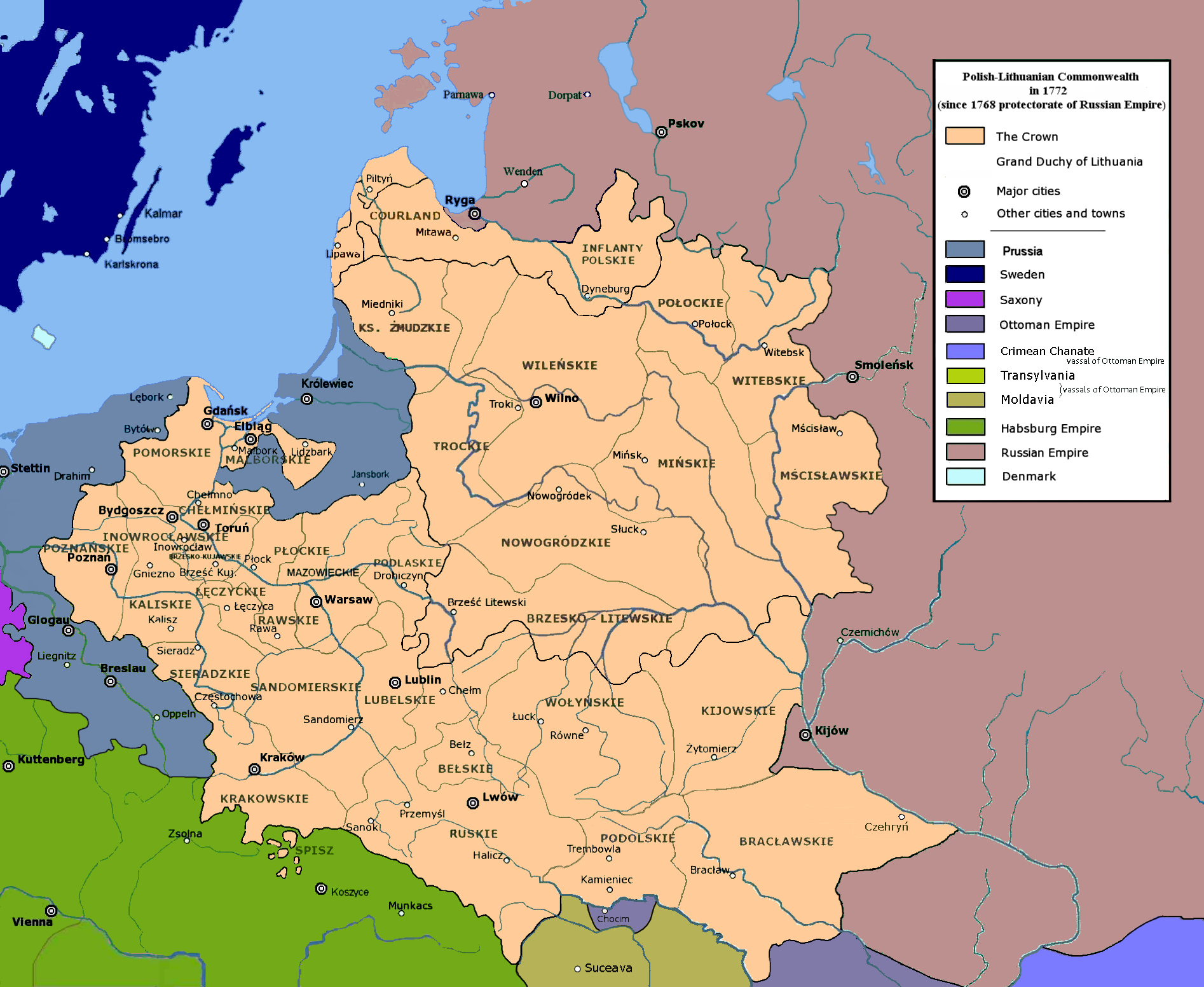
 The Polish–Lithuanian Commonwealth in 1772 | |
| Partitions | |
 The three partitions of Polish-Lithuanian Commonwealth: the Russian Partition (brown), the Austrian Partition (green), and the Prussian Partition (blue) |
The Partitions of Poland[a] were three partitions of the Polish–Lithuanian Commonwealth that took place between 1772 and 1795, toward the end of the 18th century. They ended the existence of the state, resulting in the elimination of sovereign Poland and Lithuania for 123 years. The partitions were conducted by the Habsburg monarchy, the Kingdom of Prussia, and the Russian Empire, which divided up the Commonwealth lands among themselves progressively in the process of territorial seizures and annexations.[1][2][3][4]
The First Partition was decided on August 5, 1772, after the Bar Confederation lost the war with Russia. The Second Partition occurred in the aftermath of the Polish–Russian War of 1792 and the Targowica Confederation when Russian and Prussian troops entered the Commonwealth and the partition treaty was signed during the Grodno Sejm on January 23, 1793 (without Austria). The Third Partition took place on October 24, 1795, in reaction to the unsuccessful Polish Kościuszko Uprising the previous year. With this partition, the Commonwealth ceased to exist.[1]
In English, the term "Partitions of Poland" is sometimes used geographically as toponymy, to mean the three parts that the partitioning powers divided the Commonwealth into, namely: the Austrian Partition, the Prussian Partition and the Russian Partition. In Polish, there are two separate words for the two meanings. The consecutive acts of dividing and annexation of Poland are referred to as rozbiór (plural: rozbiory), while the term zabór (plural: zabory) refers to parts of the Commonwealth that were annexed in 1772–1795 and which became part of Imperial Russia, Prussia, or Austria. Following the Congress of Vienna in 1815, the borders of the three partitioned sectors were redrawn; the Austrians established Galicia in the Austrian partition, whereas the Russians gained Warsaw from Prussia and formed an autonomous polity known as Congress Poland in the Russian partition.
In Polish historiography, the term "Fourth Partition of Poland" has also been used, in reference to any subsequent annexation of Polish lands by foreign invaders. Depending on source and historical period, this could mean the events of 1815, or 1832 and 1846, or 1939. The term "Fourth Partition" in a temporal sense can also mean the diaspora communities that played an important political role in re-establishing the Polish sovereign state after 1918.
History
[edit]

During the reign of Władysław IV (1632–1648), the liberum veto was developed, a policy of parliamentary procedure based on the assumption of the political equality of every "gentleman/Polish nobleman", with the corollary that unanimous consent was needed for all measures.[1] A single member of parliament's belief that a measure was injurious to his own constituency (usually simply his own estate), even after the act had been approved, became enough to strike the act. Thus it became increasingly difficult to undertake action. The liberum veto also provided openings for foreign diplomats to get their ways, through bribing nobles to exercise it.[1] Thus, one could characterise Poland–Lithuania in its final period (mid-18th century) before the partitions as already in a state of disorder and not a completely sovereign state, and almost as a vassal state,[5] with Polish kings effectively chosen in diplomatic maneuvers between the great powers Prussia, Austria, Russia, and France.[6] This applies particularly to the last Commonwealth King Stanisław August Poniatowski, who for some time had been a lover of Russian Empress Catherine the Great.
In 1730, the neighbors of the Polish–Lithuanian Commonwealth (Rzeczpospolita), namely Prussia, Austria and Russia, signed a secret agreement to maintain the status quo: specifically, to ensure that the Commonwealth laws would not change. Their alliance later became known in Poland as the "Alliance of the Three Black Eagles" (or Löwenwolde's Treaty), because all three states used a black eagle as a state symbol (in contrast to the white eagle, a symbol of Poland). The Commonwealth had been forced to rely on Russia for protection against the rising Kingdom of Prussia, which demanded a slice of the northwest in order to unite its Western and Eastern portions; this would leave the Commonwealth with a Baltic coast only in Latvia and Lithuania.[1] Catherine had to use diplomacy to win Austria to her side.
The Commonwealth had remained neutral in the Seven Years' War (1756–1763), yet it sympathized with the alliance of France, Austria, and Russia, and allowed Russian troops access to its western lands as bases against Prussia. Frederick II retaliated by ordering enough Polish currency counterfeited to severely affect the Polish economy. Through the Polish nobles whom Russia controlled and the Russian Minister to Warsaw, ambassador and Prince Nicholas Repnin, Empress Catherine the Great forced a constitution on the Commonwealth at the so-called Repnin Sejm of 1767, named after ambassador Repnin, who effectively dictated the terms of that Sejm (and ordered the capture and exile to Kaluga of some vocal opponents of his policies,[5][7][8] including bishop Józef Andrzej Załuski[9] and others). This new constitution undid the reforms made in 1764 under Stanisław II. The liberum veto and all the old abuses of the last one and a half centuries were guaranteed as unalterable parts of this new constitution (in the so-called Cardinal Laws[8][10]). Repnin also demanded the Russian protection of the rights of peasants in private estates of Polish and Lithuanian noblemen, religious freedom for the Protestant and Orthodox Christians and the political freedoms for Protestants, Orthodox Christians and Eastern Catholics (Uniates), including their right to occupy all state positions, including a royal one. The next king could be a member of the Russian ruling dynasty now. The Sejm approved this. Resulting reaction among some of Poland's Roman Catholics, as well as the deep resentment of Russian intervention in the Commonwealth's domestic affairs including the exile to Russia of the top Roman Catholic bishops, the members of the Polish Senate, led to the War of the Confederation of Bar of 1768–1772, formed in Bar, where the Poles tried to expel Russian forces from Commonwealth territory.[5][8] The irregular and poorly commanded Polish forces had little chance in the face of the regular Russian army and suffered a major defeat. Adding to the chaos was a Ukrainian Cossack and peasant rebellion in the east (Koliyivshchyna), which erupted in 1768 and resulted in massacres of Polish noblemen (szlachta), Jews, Uniates, ethnic minorities and Catholic priests, before it was put down by Russian and governmental Polish troops. This uprising led to the intervention of the Ottoman Empire, supported by Roman Catholic France and Austria. Bar confederation and France promised Podolia and Volhynia and the protectorate over the Commonwealth to the Ottoman Empire for armed support.
In 1769, the Habsburg monarchy annexed a small territory of Spisz and in 1770 it annexed Nowy Sącz and Nowy Targ. These territories had been a bone of contention between Poland and Hungary, which was a part of the Monarchy. Nevertheless, the Ottoman Empire, the Bar confederation and its French and European volunteers were defeated by Russian forces and Polish governmental ones with the aid of Great Britain. As Russia moved into the Crimea and the Danubian Principalities (which the Habsburg monarchy long coveted), King Frederick II of Prussia and Maria Theresa were worried that the defeat of the Ottoman Empire would severely upset the balance of power in Eastern Europe. Frederick II began to construct the partition to rebalance the power in Eastern Europe.
First Partition
[edit]
In February 1772, the agreement of partition was signed in Vienna. Early in August, Russian, Prussian and Austrian troops occupied the provinces agreed upon among themselves. However, fighting continued as Bar confederation troops and French volunteers refused to lay down their arms (most notably, in Tyniec, Częstochowa and Kraków). On August 5, 1772, the occupation manifesto was issued, to the dismay of the weak and exhausted Polish state;[1] the partition treaty was ratified by its signatories on September 22, 1772.
Frederick II of Prussia was elated with his success; Prussia took most of Royal Prussia (except Gdańsk) that stood between its possessions in Prussia and the Margraviate of Brandenburg, as well as Ermland (Warmia), northern areas of Greater Poland along the Noteć River (the Netze District), and parts of Kuyavia (but not the city of Toruń).[1]
Despite token criticism of the partition from Empress Maria Theresa, Austrian statesman Wenzel Anton, Prince of Kaunitz-Rietberg, was proud of wresting as large a share as he did, with the rich salt mines of Bochnia and Wieliczka. To Austria fell Zator and Oświęcim, part of Lesser Poland embracing parts of the counties of Kraków and Sandomir and the whole of Galicia, less the city of Kraków.
Empress Catherine II of Russia was also satisfied despite the loss of Galicia to the Habsburg monarchy. By this "diplomatic document" Russia gained Polish Livonia, and lands in eastern Belarus embracing the counties of Vitebsk, Polotsk and Mstislavl.[1]
.jpg)
By this partition, the Polish–Lithuanian Commonwealth lost about 30% of its territory and half of its population[1] (four million people), of which a large portion had not been ethnically Polish. By seizing northwestern Poland, Prussia instantly gained control over 80% of the Commonwealth's total foreign trade. Through levying enormous customs duties, Prussia accelerated the collapse of the Commonwealth.[11]
After having occupied their respective territories, the three partitioning powers demanded that King Stanisław and the Sejm approve their action. When no help was forthcoming and the armies of the combined nations occupied Warsaw to compel by force of arms the calling of the assembly, the only alternative was passive submission to their will. The so-called Partition Sejm, with Russian military forces threatening the opposition, on September 18, 1773, signed the treaty of cession, renouncing all claims of the Commonwealth to the occupied territories.
In 1772, Jean-Jacques Rousseau was invited to present recommendations for a new constitution for the Polish–Lithuanian Commonwealth, resulting in the Considerations on the Government of Poland (1782), which was to be his last major political work.[12]
Second Partition
[edit]

By 1790, the Commonwealth had been weakened to such a degree that it was forced into an unnatural and terminal alliance with its enemy, Prussia. The Polish–Prussian Pact of 1790 was signed. The conditions of the Pact contributed to the subsequent final two partitions of Poland–Lithuania.
The May Constitution of 1791 enfranchised the bourgeoisie, established the separation of the three branches of government, and eliminated the abuses of the Repnin Sejm. Those reforms prompted aggressive actions on the part of its neighbours, wary of the potential renaissance of the Commonwealth. Arguing that Poland had fallen prey to the radical Jacobinism then at high tide in France, Russian forces invaded the Commonwealth in 1792.
In the War in Defense of the Constitution, pro-Russian conservative Polish magnates, the Confederation of Targowica, fought against Polish forces supporting the constitution, believing that Russians would help them restore the Golden Liberty. Abandoned by their Prussian allies, Polish pro-constitution forces, faced with Targowica units and the regular Russian army, were defeated. Prussia signed a treaty with Russia, agreeing that Polish reforms would be revoked, and both countries would receive chunks of Commonwealth territory. In 1793, deputies to the Grodno Sejm, last Sejm of the Commonwealth, in the presence of the Russian forces, agreed to Russian territorial demands. In the Second Partition, Russia and Prussia helped themselves to enough land so that only one-third of the 1772 population remained in Poland. Prussia named its newly gained province South Prussia, with Poznań (and later Warsaw) as the capital of the new province.
Targowica confederates, who did not expect another partition, and the king, Stanisław August Poniatowski, who joined them near the end, both lost much prestige and support. The reformers, on the other hand, were attracting increasing support, and in 1794 the Kościuszko Uprising began.
Third Partition
[edit]Kosciuszko's ragtag insurgent armies won some initial successes, but they eventually fell before the superior forces of the Russian Empire. The partitioning powers, seeing the increasing unrest in the remaining Commonwealth, decided to solve the problem by erasing any independent Polish state from the map. On October 24, 1795, their representatives signed a treaty, dividing the remaining territories of the Commonwealth between their three countries. One of Russia's chief foreign policy authors, Alexander Bezborodko, advised Catherine II on the Second and Third Partitions of Poland.[13]
The Russian part included 120,000 km2 (46,332 sq mi) and 1.2 million people with Vilnius, the Prussian part (new provinces of New East Prussia and New Silesia) 55,000 km2 (21,236 sq mi) and 1 million people with Warsaw, and the Austrian 47,000 km2 (18,147 sq mi) with 1.2 million and Lublin and Kraków.
Aftermath
[edit]The King of Poland, Stanisław August Poniatowski, under Russian military escort left for Grodno where he abdicated on November 25, 1795; next he left for Saint Petersburg, Russia, where he would spend his remaining days. This act ensured that Russia would be seen as the most important of the partitioning powers.
With regard to population, in the First Partition, Poland lost over four to five million citizens (about a third of its population of 14 million before the partitions).[14] Only about 4 million people remained in Poland after the Second Partition which makes for a loss of another third of its original population, about a half of the remaining population.[15] By the Third Partition, Prussia ended up with about 23% of the Commonwealth's population, Austria with 32%, and Russia with 45%.[16]
| Partition | To Austria | To Prussia | To Russia | Total annexed | Total remaining | |||||
|---|---|---|---|---|---|---|---|---|---|---|
| Area | % | Area | % | Area | % | Area | % | Area | % | |
| 1772 | 81,900 km2 (31,600 sq mi) | 11.17% | 36,300 km2 (14,000 sq mi) | 4.95% | 93,000 km2 (36,000 sq mi) | 12.68% | 211,200 km2 (81,500 sq mi) | 28.79% | 522,300 km2 (201,700 sq mi) | 71.21% |
| 1793 | — | — | 57,100 km2 (22,000 sq mi) | 7.78% | 250,200 km2 (96,600 sq mi) | 34.11% | 307,300 km2 (118,600 sq mi) | 41.90% | 215,000 km2 (83,000 sq mi) | 29.31% |
| 1795 | 47,000 km2 (18,000 sq mi) | 6.41% | 48,000 km2 (19,000 sq mi) | 6.54% | 120,000 km2 (46,000 sq mi) | 16.36% | 215,000 km2 (83,000 sq mi) | 29.31% | None |
0%
|
| Total | 128,900 km2 (49,800 sq mi) | 17.57% | 141,400 km2 (54,600 sq mi) | 19.28% | 463,200 km2 (178,800 sq mi) | 63.15% | 733,500 km2 (283,200 sq mi) | 100% | ||
(Wandycz also offers slightly different total annexed territory estimates, with 18% for Austria, 20% for Prussia and 62% for Russia.)[16]

During the Napoleonic Wars and in their immediate aftermath the borders between partitioning powers shifted several times, changing the numbers seen in the preceding table. Ultimately, Russia ended up with most of the Polish core at the expense of Prussia and Austria. Following the Congress of Vienna, Russia controlled 82% of the pre-1772 Commonwealth's territory (this includes its puppet state of Congress Poland), Austria 11%, and Prussia 7%.[18]
As a result of the Partitions, Poles were forced to seek a change of status quo in Europe.[19][20] Polish poets, politicians, noblemen, writers, artists, many of whom were forced to emigrate (thus the term Great Emigration), became the revolutionaries of the 19th century, as desire for freedom became one of the defining parts of Polish romanticism.[21][22] Polish revolutionaries participated in uprisings in Prussia, the Austrian Empire and Imperial Russia.[23] Polish legions fought alongside Napoleon[24][25] and, under the slogan of For our freedom and yours, participated widely in the Spring of Nations (particularly the Hungarian Revolution of 1848).[23][26]
Poland would be briefly resurrected—if in a smaller frame—in 1807, when Napoleon set up the Duchy of Warsaw. After his defeat and the implementation of the Congress of Vienna treaty in 1815, the Russian-dominated Congress Kingdom of Poland was created in its place. After the Congress, Russia gained a larger share of Poland (with Warsaw) and, after crushing an insurrection in 1831, the Congress Kingdom's autonomy was abolished and Poles faced confiscation of property, deportation, forced military service, and the closure of their own universities. After the uprising of 1863, Russification of Polish secondary schools was imposed and the literacy rate dropped dramatically. In the Austrian sector which now was called Galicia, Poles fared better and were allowed to have representation in Parliament and to form their own universities, and Kraków with Lemberg (Lwów/Lviv) became centers of Polish culture and education. Meanwhile, Prussia Germanized the entire school system of its Polish subjects, and had no more respect for Polish culture and institutions than the Russian Empire. In 1915 a client state of the German Empire and Austria-Hungary was proposed and accepted by the Central Powers of World War I: the Regency Kingdom of Poland. After the end of World War I, the Central Powers' surrender to the Western Allies, the chaos of the Russian Revolution and the Treaty of Versailles finally allowed and helped the restoration of Poland's full independence after 123 years.
Fourth Partition
[edit]

The term "Fourth Partition of Poland" may refer to any subsequent division of Polish lands, including:
- after the Napoleonic era, the 1815 division of the Duchy of Warsaw at the Congress of Vienna;
- the 1832 incorporation of the "Congress Kingdom" into Russia, the 1846 incorporation of the Republic of Kraków into Austria, and the 1848 incorporation of the Grand Duchy of Posen into Prussia; and
- the 1939 division of Poland between Germany and the Soviet Union (also by Slovakia) pursuant to the Molotov–Ribbentrop Pact.[27]
If one accepts more than one of those events as partitions, fifth, sixth, and even seventh partitions can be counted, but these terms are very rare. (For example, Norman Davies in God's Playground refers to the 1807 creation of the Duchy of Warsaw as the fourth partition, the 1815 Treaty of Vienna as the fifth, the 1918 Treaty of Brest-Litovsk as the sixth, and the 1939 division of Poland between Nazi Germany and the USSR as the seventh.)[28] However, in recent times, the 1815 division of the Duchy of Warsaw at the Congress of Vienna and the 1939 division of Poland have been sometimes called the fourth and fifth partitions, respectively.
The term "Fourth Partition" was also used in the 19th and 20th centuries to refer to diaspora communities who maintained a close interest in the project of regaining Polish independence.[29] Sometimes termed Polonia, these expatriate communities often contributed funding and military support to the project of regaining the Polish nation-state. Diaspora politics were deeply affected by developments in and around the homeland, and vice versa, for many decades.[30]
Reasons, legality and justifications
[edit]More recent studies claim that partitions happened when the Commonwealth had been showing the beginning signs of a slow recovery and see the last two partitions as an answer to strengthening reforms in the Commonwealth and the potential threat they represented to its power-hungry neighbours.[20][31][32][33][34][35][36]
As historian Norman Davies stated, because the balance of power equilibrium was observed, many contemporary observers accepted explanations of the "enlightened apologists" of the partitioning state.[37][31] 19th-century historians from countries that carried out the partitions, such as 19th-century Russian scholar Sergey Solovyov, and their 20th century followers, argued that partitions were justified, as the Polish–Lithuanian Commonwealth had degenerated to the point of being partitioned because the counterproductive principle of liberum veto made decision-making on divisive issues, such as a wide-scale social reform, virtually impossible. Solovyov specified the cultural, language and religious break between the supreme and lowest layers of the society in the east regions of the Commonwealth, where the Belarusian and Ukrainian serf peasantry was Orthodox. Russian authors emphasized the historical connections between Belarus, Ukraine and Russia, as former parts of the medieval old Russian state where dynasty of Rurikids reigned (Kievan Rus').[38] Thus, Nikolay Karamzin wrote: "Let the foreigners denounce the partition of Poland: we took what was ours."[39] Russian historians often stressed that Russia annexed primarily Ukrainian and Belarusian provinces with Eastern Slavic inhabitants,[40] although many Ruthenians were no more enthusiastic about Russia than about Poland, and ignoring ethnically Polish and Lithuanian territories also being annexed later. A new justification for partitions arose with the Russian Enlightenment, as Russian writers such as Gavrila Derzhavin, Denis Fonvizin, and Alexander Pushkin stressed degeneration of Catholic Poland and the need to "civilize" it by its neighbors.[32]
Nonetheless, other 19th century contemporaries were much more skeptical; for example, British jurist Sir Robert Phillimore discussed the partition as a violation of international law;[41] German jurist Heinrich Bernhard Oppenheim presented similar views.[42] Other older historians who challenged such justifications for the Partitions included French historian Jules Michelet, British historian and politician Thomas Babington Macaulay, and Edmund Burke, who criticized the immorality of the partitions.[31][43] Nonetheless, most governments accepted the event as a fait acompli. The Ottoman Empire was either the only,[44][45] or one of only two countries in the world that refused to accept the partitions,[46] (the other being the Persian Empire),[47] and reserved a place in its diplomatic corps for an Ambassador of Lehistan (Poland).
Several scholars focused on the economic motivations of the partitioning powers. Hajo Holborn noted that Prussia aimed to take control of the lucrative Baltic grain trade through Gdańsk.[48] In the 18th century the Russian peasants were escaping from Russia to the Polish–Lithuanian Commonwealth (where the once dire conditions had improved, unlike in Russia[49]) in significant enough numbers to become a major concern for the Russian Government sufficient to play a role in its decision to partition the Commonwealth (one of the reasons Catherine II gave for the partition of Poland was that thousands of peasants escaped from Russia to Poland to seek a better fate").[50][51] Jerzy Czajewski and Piotr Kimla assert that in the 18th century until the partitions solved this problem, Russian armies increasingly raided territories of the Commonwealth, officially to recover the escapees, but in fact kidnapping many locals;[50] Piotr Kimla noted that the Russian government spread international propaganda, mainly in France, which falsely exaggerated serfdom conditions in Poland, while ignoring worse conditions in Russia, as one of the justification for the partitions.[51]
Legacy
[edit]Il Canto degli Italiani, the Italian national anthem, contains a reference to the partition.[52]
The ongoing partitions of Poland were a major topic of discourse in The Federalist Papers, where the structure of the government of Poland, and of foreign influence over it, is used in several papers (Federalist No. 14, Federalist No. 19, Federalist No. 22, Federalist No. 39 for examples) as a cautionary tale for the writers of the U.S. Constitution.
See also
[edit]- Administrative division of Polish–Lithuanian territories after partitions
- Administrative division of the Polish–Lithuanian Commonwealth in the course of partitions
- Ambassadors and envoys from Russia to Poland (1763–1794)
- Three Emperors' Corner at the border of the Russian, Austrian and the German Empires
Notes
[edit]- ^ Although the full name of the partitioned state was the Polish–Lithuanian Commonwealth, while referring to the partitions, virtually all sources use the term Partitions of Poland, not Partitions of the Polish–Lithuanian Commonwealth, as Poland is the common short name for the state in question. The term Partitions of the Polish–Lithuanian Commonwealth is effectively not used in literature on this subject.
References
[edit]- ^ a b c d e f g h i "Partitions of Poland". Encyclopædia Britannica Online. 2008. Retrieved June 8, 2011.
- ^ Bideleux, Robert; Jeffries, Ian (1998). A History of Eastern Europe: Crisis and Change. Routledge. p. 156.
- ^ Batt, Judy; Wolczuk, Kataryna (2002). Region, State and Identity in Central and Eastern Europe. Routledge. p. 153.
- ^ Sinkoff, Nancy (2004). Out of the Shtetl: Making Jews Modern in the Polish Borderlands. Society of Biblical Literature. p. 271.
- ^ a b c Scott, Hamish M. (2001). The Emergence of the Eastern Powers, 1756–1775. Cambridge University Press. pp. 181–182. ISBN 0-521-79269-X.
- ^ Corwin, Edward Henry Lewinski (1917). The political History of Poland. New York: Polish Book Importing Company. pp. 286–288. OCLC 626738.
- ^ Steed, H. Wickham (1914). A Short History of Austria-Hungary and Poland. Encyclopædia Britannica, Inc. Archived from the original on September 24, 2007. Retrieved August 3, 2007.
- ^ a b c Seton-Watson, Hugh (1967). The Russian Empire, 1801–1917. Oxford University Press. p. 44. ISBN 0-19-822152-5.
- ^ The Story of My Life. Penguin Classics. 2001. p. 528. ISBN 0-14-043915-3.
- ^ Butterwick, Richard (1998). Poland-Lithuania's Last King and English Culture: Stanisław August Poniatowski, 1732–1798. Oxford University Press. p. 169. ISBN 0-19-820701-8.
- ^ von Guttner, Darius (2015). The French Revolution. Nelson Cengage. p. 139.
- ^ Gourevitch, Victor, ed. (1997). Rousseau: 'The Social Contract' and Other Later Political Writings. Cambridge University Press. p. ix. ISBN 978-0-521-42446-2. Archived from the original on February 16, 2017. Retrieved February 8, 2017.
- ^ "Alexander Bezborodko". Encyclopaedia Britannica. April 17, 2024.
- ^ Jerzy Lukowski; W. H. Zawadzki (2001). A Concise History of Poland: Jerzy Lukowski and Hubert Zawadzki. Cambridge University Press. pp. 96–98. ISBN 978-0-521-55917-1. Retrieved January 8, 2013.
- ^ Jerzy Lukowski; W. H. Zawadzki (2001). A Concise History of Poland: Jerzy Lukowski and Hubert Zawadzki. Cambridge University Press. pp. 101–103. ISBN 978-0-521-55917-1. Retrieved January 8, 2013.
- ^ a b Piotr Stefan Wandycz (2001). The Price of Freedom: A History of East Central Europe from the Middle Ages to the Present. Taylor & Francis Group. pp. 133–. ISBN 978-0-415-25490-8. Retrieved January 8, 2013.
- ^ Davies, Norman (2005). God's Playground. A History of Poland. The Origins to 1795. Vol. I (revised ed.). Oxford University Press. p. 394. ISBN 978-0-19-925339-5.
- ^ "Po przyłączeniu do obwodu białostockiego w 1807 roku do cesartwa i utworzeniu osiem lat później Królestwa Polskiego wnuk Katarzyny zjednoczył pod swoim berłem około 82% przedrozbiorowego terytorium Rzeczypospolitej (dla porównania – Austria 11%, Prusy 7%). "[in:] Basil Kerski, Andrzej Stanisław Kowalczyk. Realiści z wyobraźnią. Uniwersytet Marii Curie-Skłodowskiej. 2007 page. 318 ISBN 978-83-227-2620-4
- ^ Johnson, Lonnie R. (1996). Central Europe: Enemies, Neighbors, Friends. Oxford University Press. pp. 127–128. ISBN 0-19-510071-9.
- ^ a b Piotr Stefan Wandycz (2001). The Price of Freedom: A History of East Central Europe from the Middle Ages to the Present. Routledge. p. 133. ISBN 0-415-25491-4.
- ^ Zawadzki, W. H. (1993). A Man of Honour: Adam Czartoryski as a Statesman of Russia and Poland, 1795–1831. Oxford University Press. p. 330. ISBN 0-19-820303-9.
- ^ Auer, Stefan (2004). Liberal Nationalism in Central Europe. Routledge. p. 60. ISBN 0-415-31479-8.
- ^ a b Dowe, Dieter (2001). Europe in 1848: Revolution and Reform. Berghahn. p. 180. ISBN 1-57181-164-8.
While it is often and quite justifiably remarked that there was hardly a barricade or battlefield in Europe between 1830 and 1870 where no Poles were fighting, this is especially true for the revolution of 1848/1849.
- ^ Pachonski, Jan; Wilson, Reuel K. (1986). Poland's Caribbean Tragedy: A Study of Polish Legions in the Haitian War of Independence 1802–1803. East European Monographs/Columbia University Press. ISBN 0-88033-093-7.
- ^ Fedosova, Elena I. (1998). "Polish Projects of Napoleon Bonaparte". Journal of the International Napoleonic Society.
- ^ Gods, Heroes, & Legends
- ^ Brecher, Michael; Wilkenfeld, Jonathan (1997). A Study of Crisis. University of Michigan Press. p. 255. ISBN 0-472-10806-9.
- ^ Norman Davies. God's Playground: A History of Poland: 1795 to the Present. Oxford University Press. 2005. pp. 218, 225, 284, 321.
- ^ Cygan, Mary (1998). "Inventing Polonia: Notions of Polish American Identity, 1870–1990". Prospects. 23: 209–246. doi:10.1017/S0361233300006335.
- ^ Lopata, Helena Znaniecka (1994). Polish Americans. Transaction.
- ^ a b c Davies, Norman (1996). Europe: A History. Oxford University Press. p. 661. ISBN 0-19-820171-0.
- ^ a b Nowak, Andrzej (1997). "The Russo-Polish Historical Confrontation". Sarmatian Review. XVII (1).
- ^ The Army of Grand Duchy of Warsaw Archived 2005-12-14 at the Wayback Machine
- ^ Bucki, Carl L. "The Constitution of May 3, 1791". History of Poland. University of Buffalo. Archived from the original on December 5, 2008.
- ^ Schroeder, Paul W. (1996). The Transformation of European Politics 1763–1848. Oxford University Press. p. 84. ISBN 0-19-820654-2.
- ^ Russell, Geoffrey (2003). The Making of Modern Europe, 1648–1780. Routledge. p. 548. ISBN 0-415-30155-6.
- ^ Davies, Norman (2005). God's Playground: A History of Poland in Two Volumes. Oxford University Press. p. 283. ISBN 0-19-925339-0.
- ^ E.g., Sergey Solovyov's History of the Downfall of Poland (Moscow, 1863).
- ^ N. M. Karamzin. "Записка о древней и новой России в ее политическом и гражданском отношениях" [Notes on old and new Russia in its political and civil relations].[full citation needed]
- ^ Riasanovsky, Nicholas V. (1952). "Old Russia, the Soviet Union and Eastern Europe". American Slavic and East European Review. 11 (3): 171–188. doi:10.2307/2491975. JSTOR 2491975.
- ^ Phillimore, Robert (1854). Commentaries Upon International Law. T. & J. W. Johnson. p. 819.
- ^ Korman, Sharon (1996). The Right of Conquest: The Acquisition of Territory by Force in International Law and Practice. Oxford University Press. p. 101. ISBN 0-19-828007-6.
- ^ Poland The First Partition[full citation needed]
- ^ Grajewski, Radosław Żurawski vel (2015). "Poland in the Period of Partitions 1795–1914". In Eleonora Bielawska-Batorowicz (ed.). Poland. History, Culture and Society. Selected Readings. Łódź: University of Łódź. p. 110. ISBN 978-8392310945.
- ^ Dominik, Paulina D. (2016). "From the Polish Times of Pera: Late Ottoman Istanbul through the Lens of Polish emigration". In Öncü, Ayşe; Hofmann, Anna (eds.). History Takes Place: Istanbul. Dynamics of Urban Change. Berlin: Jovis. p. 94. ISBN 978-3868593686.
- ^ Prazmowska, Anita (2010). Poland: A Modern History. I. B. Tauris. p. 25.
- ^ "History of Polish-Iranian relations". Archived from the original on January 22, 2019. Retrieved November 12, 2019.
- ^ Holborn, Hajo (December 1, 1982). A History of Modern Germany: 1648–1840. Princeton University Press. p. 256. ISBN 978-0-691-00796-0. Retrieved February 16, 2012.
- ^ Wagner, W. J. (1992). "May 3, 1791, and the Polish constitutional tradition". The Polish Review. 36 (4): 383–395. JSTOR 25778591.
- ^ a b Czajewski, Jerzy (October 2004). "Zbiegostwo ludności Rosji w granice Rzeczypospolitej" [Russian population exodus into the Rzeczpospolita]. Promemoria (6/15). ISSN 1509-9091. Archived from the original on January 3, 2005.
- ^ a b Kimla, Piotr (2011). "Przywary niewolników pańszczyźnianych w XVIII-wiecznej Rzeczypospolitej w relacji Huberta Vautrina". Annales Universitatis Mariae Curie-Skłodowska. Sectio G. Ius (in Polish). 58 (1): 87–97. ISSN 0458-4317.
- ^ "L'Inno nazionale". Quirinale.it. Retrieved November 17, 2013.
Further reading
[edit]- Lewitter, L. R. "The Partitions of Poland" History Today (Dec 1958) 8#12 pp 813–820.
- Lewitter, Lucjan R. "The Partitions of Poland" in A. Goodwyn, ed. The New Cambridge Modern History: vol 8 1763–93 (1965) pp. 333–59.
- Lord, Robert. The second partition of Poland; a study in diplomatic history (1915) online
- Lukowski, Jerzy. The Partitions of Poland 1772, 1793, 1795 (1998); online review
- McLean, Thomas. The Other East and Nineteenth-Century British Literature: Imagining Poland and the Russian Empire (Palgrave Macmillan, 2012) pp. 14–40.
External links
[edit]
- Krzysztof Wroński, Rozbiory Polski w XVIII w. " ich uwarunkowania i skutki (in Polish)
- Where Is Poland?, a multimedia guide created by Culture.pl to the 123-year period during which Poland was partitioned

Partitions of Poland
View on GrokipediaHistorical Context
Political and Institutional Framework of the Commonwealth
The Polish–Lithuanian Commonwealth emerged from the Union of Lublin, signed on July 1, 1569, which federated the Kingdom of Poland and the Grand Duchy of Lithuania under a single elected monarch, shared foreign policy, and a common Sejm, while preserving separate legal systems, treasuries, and armies for each component.[7] This structure governed a vast multi-ethnic territory encompassing modern-day Poland, Lithuania, much of Belarus and Ukraine, and parts of Latvia, initially spanning approximately 815,000 square kilometers with a population estimated at around 8 million in the late 16th century, including Poles, Lithuanians, Ruthenians, Jews, and smaller German and Tatar communities.[8] Religious tolerance was formalized early, as in the 1573 Warsaw Confederation, allowing Protestant, Orthodox, and Catholic coexistence amid a predominantly Catholic nobility.[9] At its core, the Commonwealth's political system rested on an elective monarchy, where kings were selected via wolna elekcja (free election) by assembled nobles, preventing hereditary dynasties and limiting royal authority to lifetime tenure without absolute power.[10] Legislative power lay with the Sejm, a bicameral assembly convened every two years, dominated by szlachta (nobility) envoys who held veto rights over royal proposals; the liberum veto, codified by the early 17th century, empowered any single deputy to nullify entire sessions' proceedings by invoking nie pozwalam ("I do not allow"), effectively requiring unanimity for major laws on taxation, war, or alliances.[10] This "Golden Liberty" extended broad privileges to the szlachta—estimated at 8–10% of the population— including exemption from most taxes, local judicial autonomy through sejmiki (regional diets), and collective sovereignty, framing the state as a "republic of nobles" where the king's role was advisory rather than commanding.[10] Economically, the Commonwealth functioned as an agrarian exporter, dubbed the "granary of Europe" for shipping rye, wheat, and timber via the Vistula River to Gdańsk for Baltic trade, with grain exports peaking in the late 16th century to supply Western Europe amid its population growth and wars.[11] This export orientation fueled noble latifundia (large estates), but reliance on serfdom—intensified as "second serfdom" from the mid-16th century, binding peasants to corvée labor of up to six days weekly—stifled urban development and a merchant bourgeoisie, as nobles monopolized land and trade privileges, leaving towns weak and innovation limited to export-oriented manors.[11] [9] The absence of a strong central fiscal apparatus, compounded by noble tax resistance, constrained military funding and infrastructure, embedding structural decentralization.[11]Internal Decline and Failed Reforms
The Polish-Lithuanian Commonwealth experienced profound internal political paralysis beginning in the late 17th century, primarily due to the escalating abuse of the liberum veto, a mechanism allowing any single deputy in the Sejm to nullify legislation or dissolve sessions. This practice, intended to preserve noble equality under the Golden Liberty, increasingly served factional interests, with foreign powers and domestic magnates bribing deputies to block reforms; between 1652 and 1791, at least 73 Sejm sessions were disrupted by vetoes, rendering the legislature ineffective for addressing existential threats.[12][13] Under the Saxon kings Augustus II (r. 1697–1706, 1709–1733) and Augustus III (r. 1733–1763), attempts at centralization—such as strengthening royal authority, reforming taxation, and curbing magnate power—foundered amid noble resistance and the veto's stranglehold. Augustus II's efforts to consolidate executive power through military and fiscal innovations were thwarted by confederations of opposing szlachta, while Augustus III's passive rule exacerbated factionalism without advancing structural change, leaving the Commonwealth's institutions stagnant since the mid-17th century.[14] Economic stagnation compounded this gridlock, as the Great Northern War (1700–1721) transformed Polish territories into a theater of devastation, with Swedish, Russian, and Saxon forces causing widespread destruction, population losses estimated in the hundreds of thousands, and ruinous quartering costs that crippled rural economies and urban centers like Poznań. Magnate dominance further entrenched an oligarchic system, where a small elite controlled over 50% of arable land through latifundia worked by enserfed peasants, fostering corruption via patronage networks that prioritized private gain over national investment, while inflation from war-induced debasement eroded fiscal capacity.[15][16][17] Reform initiatives gained traction in the late 18th century, culminating in the Constitution of 3 May 1791, which abolished the liberum veto, established a hereditary monarchy in the Piast line, expanded political rights to townspeople, and mandated religious tolerance to unify the realm against internal divisions. However, these measures faced vehement opposition from conservative magnates, who viewed them as threats to noble privileges and formed the Targowica Confederation in May 1792 to defend traditional liberties, fracturing the reform coalition and exposing the depth of entrenched factionalism.[18][19][20]The Partitions
First Partition of 1772
The First Partition of Poland was formalized through a treaty signed on August 5, 1772, in St. Petersburg by plenipotentiaries from the Russian Empire, the Kingdom of Prussia, and the Habsburg Monarchy, dividing segments of the Polish-Lithuanian Commonwealth's territory among them. This agreement followed the suppression of the Bar Confederation's uprising against Russian influence, which had exposed the Commonwealth's military and political vulnerabilities without provoking a broader European conflict. Russian forces, already stationed within Polish borders to enforce the 1768 treaty protections for Orthodox dissenters, facilitated the occupation of designated areas with limited opposition, as internal factions and the liberum veto paralyzed unified resistance.[21][4] The partitioning powers ratified the treaty on September 22, 1772, annexing contiguous border regions opportunistically: Prussia secured Royal Prussia (including Pomerelia, the Netze District, and Warmia), spanning about 36,000 square kilometers and providing territorial continuity to East Prussia at the expense of Polish-held corridors; Austria obtained southern Polish lands, roughly 83,000 square kilometers including the city of Lwów, designated as the Kingdom of Galicia and Lodomeria; Russia claimed eastern territories such as the palatinates of Polotsk, Vitebsk, and parts of Minsk, totaling around 92,000 square kilometers with predominantly Belarusian and Ukrainian populations. Collectively, these acquisitions stripped the Commonwealth of approximately 211,000 square kilometers—about 30% of its pre-partition area of 733,000 square kilometers—and over 4 million inhabitants, representing 35% of its roughly 14 million population, without requiring large-scale warfare due to the neighbors' coordinated entry and Poland's disarray.[22][23] Under duress from occupying Russian troops, the Partition Sejm convened in October 1773 and formally approved the cessions on September 30, 1773, effectively legitimizing the losses while suspending the liberum veto for this session to enable passage. This assembly also repurposed Jesuit assets to fund the Commission of National Education, established on October 14, 1773, by King Stanisław August Poniatowski and the Sejm, marking Europe's first state ministry of education aimed at modernizing schooling through Enlightenment principles, though it operated within severely curtailed sovereignty as foreign garrisons remained to enforce compliance.[24]Second Partition of 1793
The Second Partition of Poland stemmed directly from the Russian Empire's opposition to the Constitution of 3 May 1791, which centralized authority, curtailed the liberum veto, and strengthened royal power, thereby threatening Russia's longstanding influence over the Polish-Lithuanian Commonwealth's fragmented nobility.[2] Russian Empress Catherine II, viewing the reforms as a challenge to her protectorate status, orchestrated the Targowica Confederation, formed on 14 May 1792 by conservative magnates including Stanisław Szczęsny Potocki and Seweryn Rzewuski, who denounced the constitution as revolutionary and formally invited Russian troops to intervene on behalf of traditional noble liberties.[25] This act of internal betrayal provided the pretext for Russian invasion, initiating the Russo-Polish War of 1792, during which approximately 65,000 Russian soldiers under field marshal Mikhail Kakhovsky advanced with minimal resistance, as Polish forces totaling around 40,000 under King Stanisław August Poniatowski adopted a defensive strategy to preserve the army for potential future use.[2] By July 1792, facing overwhelming occupation, Poniatowski acceded to the Targowica Confederation to negotiate a ceasefire, effectively halting hostilities and exposing the Commonwealth's vulnerability to foreign dictation.[25] Russia and Prussia, seeking to capitalize on this collapse, signed a secret treaty on 23 January 1793 in St. Petersburg, agreeing to dismember further territories without Austria's involvement, motivated by Prussia's desire for economic outlets and Russia's aim to eradicate reformist momentum.[23] Prussia acquired 58,000 km² in Greater Poland, including the vital port of Gdańsk (Danzig) and Toruń (Thorn), securing direct Baltic access to alleviate East Prussia's isolation and boost trade revenues previously hampered by Polish customs controls.[26] Russia seized 250,200 km² of eastern lands, encompassing Right-bank Ukraine, Volhynia, Podolia, and cities such as Minsk, providing strategic depth and incorporating over 3 million inhabitants into its domains.[23] These cessions reduced the Commonwealth's remaining post-1772 territory of approximately 215,000 km² by more than half, leaving a fragmented rump state economically crippled and militarily impotent.[23] The partition was ratified under duress at the Grodno Sejm, convened from June to November 1793 under Russian bayonets, where delegates—many coerced or replaced—dissolved the constitution, accepted the losses, and empowered a temporary council subservient to foreign powers, marking a decisive step toward the Commonwealth's erasure.[25] Russia's actions were driven by the imperative to preserve Poland as a malleable buffer while preempting any alignment with Western powers, whereas Prussia prioritized territorial contiguity and commercial gains over ideological pretexts.[2]Third Partition of 1795
The failure of the Kościuszko Uprising accelerated the Third Partition, as Russian forces decisively defeated Polish insurgents at the Battle of Maciejowice on October 10, 1794, capturing uprising leader Tadeusz Kościuszko.[27] This battle, fought against a numerically superior Russian army under Alexander Suvorov, marked the effective end of organized Polish resistance, leaving the Commonwealth's remnants vulnerable to complete dismemberment.[28] On October 24, 1795, representatives of Russia, Prussia, and Austria signed a tripartite convention in St. Petersburg, formalizing the division of the Polish-Lithuanian Commonwealth's surviving territories without any Polish delegation present.[29] Russia annexed the Duchy of Courland and Semigallia (modern southern Latvia), the core of Lithuania up to Vilnius and Grodno, and adjacent eastern lands, consolidating its dominance over the Commonwealth's eastern expanses.[6] Prussia acquired central regions including Warsaw, Masovia, and parts of Podlachia, securing key urban and economic centers. Austria gained Kraków and surrounding southern territories, incorporating them into its Galician holdings. This partition eradicated the sovereign Polish-Lithuanian Commonwealth, redistributing its estimated 14 million inhabitants across the annexing powers, with Russia controlling the largest share—roughly half the total population—followed by Austria and Prussia each taking substantial but lesser portions.[30] King Stanisław August Poniatowski, the last monarch, formally abdicated on November 25, 1795, in Grodno under Russian guard, receiving a pension from Catherine the Great before relocation to St. Petersburg, where he died in 1798.[31] The partitioning states mutually pledged to excise "Poland" or "Polish Kingdom" from official titles and documents, signaling international acquiescence to the Commonwealth's dissolution.[32]Territorial and Demographic Consequences
Acquisitions by Russia, Prussia, and Austria
Russia secured the most extensive territorial gains, focusing on the Commonwealth's eastern expanses for their agricultural potential and defensive utility. The annexed lands included, from the First Partition onward, the voivodeships of Polotsk, Vitebsk, Minsk, and parts of Livonia in 1772; Volhynia, Podolia, Braclaw, and Kyiv regions in 1793; and the Grand Duchy of Lithuania, Courland, and remaining Belarusian territories in 1795. These regions featured vast fertile black soil (chernozem) areas in Ukraine, ideal for grain and other crops, enhancing Russia's agrarian output and providing buffer zones to shield its core territories from western incursions. Prussia's acquisitions centered on northern and central-western areas to bolster trade dominance and facilitate demographic policies. Key gains encompassed West Prussia and Pomerania (excluding Gdańsk and Toruń initially, acquired in 1793), the Netze District in 1772, and Greater Poland including Poznań in 1793, with additional central lands around Warsaw in 1795 (later adjusted). Control over Baltic ports like Gdańsk enabled Prussia to monopolize the lucrative grain export trade via the Vistula River, while the flat, arable lands supported economic integration and German settlement efforts. Austria claimed southern territories, notably Galicia encompassing Lwów (Lviv) and portions of Lesser Poland during the First Partition, supplemented by New Galicia in 1795. These holdings included economically vital salt deposits, such as the renowned mines at Wieliczka and Bochnia, which yielded significant revenue through salt production—a staple commodity for preservation and industry. The region's position facilitated overland trade connections eastward, adding to Habsburg commercial interests.| Partition | Russia (km²) | Prussia (km²) | Austria (km²) | Total Lost (km²) |
|---|---|---|---|---|
| First (1772) | 92,000 | 36,000 | 83,000 | 211,000 |
Population Transfers and Ethnic Composition
The partitions of 1772, 1793, and 1795 redistributed a multi-ethnic population estimated at around 11 million inhabitants across the territories of Russia, Prussia, and Austria, with Poles forming the plurality but not a majority in eastern regions dominated by Ruthenians (including Ukrainians and Belarusians), Lithuanians, and Jews.[35][36] Jews, numbering approximately 750,000 to 1 million and constituting the largest non-Catholic minority, were disproportionately dispersed into the Russian partition, where they encountered heightened legal restrictions, including eventual confinement within the Pale of Settlement established progressively from 1791 onward.[37] In contrast, Prussian and Austrian acquisitions included denser Polish Catholic populations, though interspersed with German settlers and smaller Ukrainian communities in border areas. Large-scale forced population transfers were minimal at the time of the partitions themselves, with no systematic expulsions comparable to later 20th-century events; instead, immediate demographic shifts arose from localized displacements of elites and landowners opposed to the new regimes, alongside opportunistic migrations.[38] Prussia, for instance, initiated targeted colonization in West Prussia following the 1772 partition, encouraging some 300,000 German immigrants over subsequent decades to bolster ethnic German presence amid a Polish-majority rural populace estimated at over 80% in acquired lands.[39] Russia similarly displaced select Polish nobles but relied more on administrative reallocations, leaving multi-ethnic mixes intact while exploiting tensions between Poles and non-Polish groups like Ukrainians, whom officials sometimes privileged to undermine Polish influence.[40] Over the longer term, imperial policies of Russification and Germanization gradually reshaped ethnic compositions through cultural assimilation, educational mandates, and economic incentives favoring dominant groups, prompting Polish emigration and diluting local majorities. In the Prussian partition, encompassing roughly 2.5 million people by 1800 across 141,000 square kilometers, Germanization efforts—including language prohibitions in schools and land purchases—elevated the German share from under 20% to over 30% in urban centers by mid-century, complicating Polish cohesion.[41] Russian territories, absorbing the bulk of the partitioned population (around 7-8 million), saw intensified Russification after 1830, targeting Polish-Lithuanian elites while tolerating or promoting Orthodox Ukrainians and Belarusians, which exacerbated ethnic fractures without wholesale demographic replacement.[40] These dynamics, rooted in divide-and-rule strategies, hindered unified resistance and perpetuated multi-ethnic instabilities exploited by the partitioning powers.[42]Justifications and Causality
Foreign Powers' Strategic and Ideological Rationales
The First Partition of 1772 emerged from efforts to reestablish equilibrium in Eastern Europe after the Seven Years' War (1756–1763), which enhanced Russian military prestige without major territorial shifts in the region, and amid Russia's advances in the ongoing Russo-Turkish War (1768–1774).[21] Prussian King Frederick II proposed the division to avert conflict among the three powers over Russian spoils from the Ottomans, framing it as a pragmatic redistribution to maintain stability rather than allowing unilateral Russian dominance.[22] The treaty, signed on August 5, 1772, allocated territories strategically: Russia gained about 92,000 square kilometers in the east, primarily Belarusian and Ukrainian lands with Orthodox majorities; Prussia acquired 36,000 square kilometers of West Prussia, linking its Brandenburg core to East Prussia; and Austria took 83,000 square kilometers of southern Galicia as a buffer zone.[43] Russia's Catherine II pursued partition to consolidate control over the Polish-Lithuanian Commonwealth, thwarting potential alignments with anti-Russian forces like the Ottoman Empire or France, which could encircle her empire.[44] By annexing eastern provinces, she extended the Orthodox sphere and rewarded military intervention against the anti-Russian Bar Confederation (1768–1772), ensuring a pro-Russian king in Stanisław August Poniatowski while avoiding overextension that might provoke Austria.[21] Frederick II of Prussia viewed the acquisition of West Prussia—rich in ports and agriculture—as essential for territorial contiguity and economic vitality, while positioning Prussia as a check on Russian hegemony, a motive rooted in his post-war aversion to further conflicts. Austria's involvement under Maria Theresa was marked by reluctance; she deemed the partition immoral, reportedly annotating the treaty with "May God forgive you" to her advisor, yet acquiesced to secure Galicia as a defensive buffer against Prussian incursions and to dilute exclusive Russo-Prussian gains.[45] Her son Joseph II, more pragmatically inclined, supported the move for strategic depth. Ideologically, Enlightenment influences underpinned claims of intervention to remedy Poland's perceived "anarchy," with thinkers like Voltaire and Montesquieu decrying the liberum veto and noble privileges as relics obstructing rational governance, justifying foreign stabilization efforts despite the self-serving territorial aims. These rationales, however, masked opportunistic expansion, as the powers invoked balance-of-power principles selectively to legitimize annexations ratified by a coerced Polish Sejm on September 30, 1773.[22]Polish Internal Failures as Enabling Factors
The liberum veto, a procedural rule permitting any deputy in the Sejm to nullify legislation and dissolve sessions, originated as a safeguard for noble liberties but evolved into a mechanism of systemic paralysis, first invoked in 1652 to halt proceedings on military reforms amid the Swedish Deluge.[46] By the early 18th century, its repeated application—disrupting eight of eighteen Sejm sessions during Augustus II's reign (1697–1733)—prevented coherent fiscal or defensive policies, leaving the Commonwealth unable to maintain standing armies or address fiscal deficits exceeding 10 million złoty annually by mid-century. This institutional flaw, rooted in noble individualism over collective interest, signaled vulnerability to neighbors, as veto-induced gridlock thwarted alliances and fortifications needed against Ottoman or Swedish threats.[47] Magnate factionalism exacerbated this dysfunction through recurrent civil strife, such as the 1715–1716 konfederacja between pro-Saxon royalists and anti-royal opposition led by figures like Paweł Sanguszko, which devolved into armed clashes across Lithuanian and Ukrainian territories.[48] The conflict's chaos prompted Russian intervention, with Tsar Peter the Great deploying 30,000 troops under pretext of restoring order, establishing a precedent for foreign "protection" that entrenched garrisons and veto rights over Sejm decisions.[49] Such intra-noble wars, often fueled by private armies exceeding 10,000 men per magnate household, fragmented loyalty and military capacity, rendering the hetmanate ineffective and inviting external arbitration in succession disputes.[50] Economically, the Commonwealth stagnated while neighbors advanced; per capita revenues in Austria quadrupled and doubled in Russia during the 18th century, contrasting Poland's entrenched serfdom and export-dependent grain economy, which yielded no comparable growth amid population pressures reaching 10 million by 1772.[51] Reform efforts, like the 1764 Convocation Sejm's modest tax hikes, faltered against noble resistance prioritizing tax exemptions and złota wolność privileges, perpetuating a fiscal base reliant on volatile tolls and customs that covered less than half of military needs.[52] This self-interested stasis, evident in failed attempts to curb magnate latifundia controlling 60% of arable land, underscored a failure to modernize akin to absolutist reforms elsewhere, amplifying perceptions of state fragility.[53] These endogenous failures—political immobility, factional violence, and economic inertia—culminated in demonstrated incapacity, as seen in foreign interventions from the 1733 succession crisis onward, where Russian and Saxon forces dictated outcomes without decisive Polish resistance. Rather than exogenous aggression alone, the partitions stemmed from causal weakness: a polity unable to self-reform invited predation, mirroring empirics of state collapse where internal veto points and elite extraction preclude adaptation, not mere victimhood under stronger powers.Legal Pretexts and International Norms
The partitions were enacted through treaties among Russia, Prussia, and Austria that specified territorial divisions, ostensibly to rectify imbalances arising from the Polish-Lithuanian Commonwealth's internal disorders. The Treaty of Partition signed on August 5, 1772, allocated approximately 211,000 square kilometers to the three powers, with subsequent agreements in 1793 and 1795 extending the annexations until the Commonwealth's dissolution.[3] These pacts lacked a basis in formal warfare against the Commonwealth, as Russian forces occupied key areas following the suppression of the Bar Confederation rebellion (1768–1772) without a declaration of war, framing the seizures as administrative reallocations rather than conquests.[2] Ratification by Polish legislative bodies provided a veneer of domestic consent, yet occurred amid overt coercion. The Partition Sejm (1773–1775), summoned under Russian military supervision with garrisons in Warsaw, approved the first partition's terms on September 30, 1773, after delegates faced intimidation and the liberum veto was circumvented through procedural manipulations.[23] Analogous duress marked the Grodno Sejm of 1793, where Prussian and Russian troops enforced approval of the second partition, rendering such "consent" legally dubious under principles of voluntary sovereign agreement. In the 18th-century European order, Westphalian sovereignty ideals coexisted with a pragmatic balance-of-power doctrine that prioritized great-power equilibrium over the inviolability of smaller states, particularly those exhibiting governance failures like the Commonwealth's inability to maintain order or a permanent army.[54] This norm implicitly tolerated partitions as stabilizing measures, absent direct threats to core alliances, though it clashed with emerging notions of self-determination. Austria's Habsburg rulers initially resisted on ethical grounds—Empress Maria Theresa decried the act as contrary to justice and divine order—but yielded to geopolitical imperatives, joining to forestall exclusion from gains in southern Poland (Galicia).[22] Such pretexts thus masked power politics, where coerced formalities substituted for genuine legal legitimacy.[55]Immediate Resistance and Suppression
Armed Revolts and Diplomatic Efforts
The Kościuszko Uprising erupted on March 24, 1794, in Kraków, led by General Tadeusz Kościuszko, a veteran of the American Revolutionary War, in direct response to the Second Partition of 1793 and aimed at expelling Russian and Prussian occupiers to restore Polish independence.[56] The revolt mobilized irregular forces including regular troops, volunteers, and peasant levies armed with scythes, achieving an initial tactical success at the Battle of Racławice on April 4, 1794, where roughly 4,000 insurgents defeated a larger Russian detachment through innovative infantry tactics and close-quarters combat.[57] Despite this heroism, the uprising's fragmented command structure and reliance on mass but poorly equipped peasant recruits proved insufficient against coordinated imperial responses; Russian forces, bolstered by Prussian intervention, numbered over 20,000 in key engagements like the assault on Warsaw's Praga suburb in November 1794, leading to Kościuszko's capture at Maciejowice on October 10 and the revolt's collapse by mid-November.[56][58] Parallel diplomatic efforts by Polish envoys and sympathizers, including appeals to France and Britain for intervention against the partitioning powers, evoked public sympathy in Western presses but elicited no substantive military or political support, as those governments were preoccupied with the escalating French Revolutionary Wars and wary of provoking Russia.[59] Kościuszko himself, after his release from Russian captivity in 1796, traveled to the United States seeking aid and highlighting Poland's plight, yet American interest remained rhetorical, tied more to his prior Revolutionary War contributions than to committing resources against European empires.[58] This pattern of limited external engagement underscored the causal isolation of Polish resistance, where domestic disunity—exacerbated by noble factionalism and inadequate reforms—amplified the futility of confronting numerically superior foes without allied backing. The November Uprising of 1830–1831, sparked on November 29 in Warsaw by cadets fearing Russian conscription into suppression of the French July Revolution, represented a renewed armed challenge to Russian dominance in the Congress Kingdom, mobilizing regular army units and civilians against imperial garrisons.[60] Early Polish successes, such as repelling initial Russian advances, gave way to strategic overextension and logistical failures, culminating in the fall of Warsaw on September 8, 1831, after Russian forces under Field Marshal Ivan Paskevich overwhelmed defenders with superior artillery and reserves hardened by prior campaigns.[61] The revolt's suppression, enabled by Russia's ability to deploy over 100,000 troops despite setbacks like cholera epidemics claiming thousands, resulted in heavy Polish losses and mass exiles, further entrenching partition-era divisions without reversing territorial losses.[62] Diplomatic overtures to Britain and France again stirred intellectual support among liberals but failed to translate into action, as European powers prioritized balance-of-power stability over backing fragmented insurgencies against Russia.[59]Repression and Loss of Sovereignty
Following the Third Partition of 1795, the Polish-Lithuanian Commonwealth ceased to exist as a sovereign entity, with its territories fully incorporated into the Russian, Prussian, and Austrian empires, depriving Poles of independent institutions such as an army, treasury, or foreign policy for 123 years until 1918.[31][63] Imperial administrations systematically dismantled Polish governance structures to prevent resurgence of national autonomy, imposing direct rule that erased local legislative bodies and subordinated former Commonwealth lands to imperial bureaucracies. In the Russian partition, which encompassed the largest share of territory including Congress Poland, repression escalated after the suppression of the November Uprising in 1831, culminating in the Organic Statute of 1832 that abolished the Polish Sejm, merged the army into Russian forces, and reduced the region to a mere province under a viceroy appointed by the Tsar.[64] This autocratic framework facilitated Russification policies, including the replacement of Polish officials with Russians and restrictions on Polish language use in administration and education, while the Pale of Settlement—expanded through the partitions to include former Polish territories from 1791 onward—confined over 90% of Russia's Jewish population to these areas, limiting mobility and reinforcing ethnic segregation as a tool of control.[37][65] The post-uprising crackdown involved mass exiles and executions, with approximately 10,000 to 20,000 Polish soldiers, intellectuals, and nobles fleeing as political emigrants by the mid-1830s, depleting the region of leadership and cultural elites in a "Great Emigration" primarily to France and other Western states.[66][67] Prussian policies in the western partitions emphasized Germanization, particularly through Bismarck's Kulturkampf from 1871 to 1878, which targeted the Catholic Polish majority by expelling over 1,800 clergy from Prussian Poland, dissolving religious orders, and enforcing German as the sole language in schools and courts to erode Polish cultural cohesion.[68][69] These measures, framed as a struggle against "Polish clericalism," included land expropriations and settlement commissions that displaced Polish farmers with German colonists, aiming to alter demographic balances and suppress national institutions like Polish schools and press. In contrast, Austrian Galicia experienced relative administrative tolerance after the 1867 Austro-Hungarian Compromise granted provincial autonomy, allowing Polish nobles to dominate local governance and education, which earned it the moniker "Polish Piedmont" for fostering clandestine national organizations amid limited repression.[70][71] Initial post-partition efforts at Germanization, such as staffing administration with German speakers until the 1780s, gave way to this Polish-centric system, though ultimate sovereignty remained vested in Vienna, with no independent Polish military or fiscal powers. Across all partitions, these tactics ensured the erasure of Polish statehood, prioritizing imperial security over ethnic self-determination.Subsequent Divisions and the "Fourth Partition"
Napoleonic Reconfigurations and Congress of Vienna
The Duchy of Warsaw was established by Napoleon Bonaparte in July 1807 through the Treaties of Tilsit, following French victories over Prussia and Russia, as a semi-autonomous Polish state from territories previously annexed by Prussia during the partitions.[72] This entity, functioning as a French satellite with its foreign policy and military subordinated to Napoleon's directives, expanded after the 1809 victory over Austria to encompass approximately 155,000 km², including areas around Kraków and Zamość.[73] Despite nominal sovereignty under King Frederick Augustus I of Saxony, the duchy's army—numbering up to 100,000 troops—was primarily deployed in support of French campaigns, such as the 1812 invasion of Russia, rendering Polish independence largely illusory and contingent on French power.[74] Legal reforms under French influence included the adoption of the Napoleonic Code on May 1, 1808, which introduced civil equality, abolished feudal privileges, and structured administration into departments modeled on France, fostering some modernization but prioritizing alignment with imperial objectives like the Continental Blockade.[72] These changes revived Polish national aspirations temporarily, yet the duchy's resources were drained for Napoleon's wars, culminating in its collapse after the 1813-1814 defeats, with Polish forces suffering heavy losses—over 90,000 casualties in Russia alone—without achieving lasting autonomy.[75] At the Congress of Vienna in 1815, the former Duchy of Warsaw was repartitioned among the victorious powers, establishing the Kingdom of Poland (Congress Poland) as a constitutional monarchy under Tsar Alexander I of Russia, covering 128,500 km² with an initial population of about 3.3 million; the Grand Duchy of Posen (28,951 km²) under Prussian control with limited Polish autonomy; and the Free City of Kraków (1,189 km²) as a neutral republic guaranteed by the great powers.[1] This arrangement placed the majority of ethnic Polish territories—encompassing roughly 80% of pre-partition Polish lands by area—under Russian influence, as Congress Poland remained a personal union with Russia, its constitution curtailed foreign policy independence and military autonomy, while Prussian and Austrian holdings further fragmented Polish sovereignty.[76] The Free City of Kraków preserved a semblance of independence until its annexation by Austria in 1846, underscoring the Vienna settlement's role in perpetuating partition rather than restoration.[77]1939 Nazi-Soviet Aggression
The Molotov-Ribbentrop Pact, signed on August 23, 1939, between Nazi Germany and the Soviet Union, included a secret protocol that divided Poland into spheres of influence along the Narev, Vistula, and San rivers, enabling coordinated aggression against the Second Polish Republic.[78] This agreement disregarded the Soviet-Polish Non-Aggression Pact of July 25, 1932, which had been renewed in 1938 and explicitly prohibited hostile actions.[79] Germany launched its invasion on September 1, 1939, with over 1.5 million troops and coordinated air support, overwhelming Polish defenses in the west.[80] The Soviet Union followed on September 17, 1939, invading from the east with approximately 600,000 soldiers under the pretext of protecting Ukrainian and Belarusian populations, though no formal declaration of war was issued.[78] The partition allocated roughly the western half of Poland to German control, including direct annexations in Silesia, Pomerania, and the Wartheland, while the Soviet Union seized the eastern territories—comprising about 52% of pre-war Polish land area (around 201,000 square kilometers)—and incorporated them into the Ukrainian and Byelorussian Soviet Socialist Republics.[78] This division echoed the 18th-century partitions by assigning specific regions to each aggressor based on strategic and ideological imperatives, with Nazi racial policies aiming for Germanization and Soviet class-based repression targeting Polish elites. A subsequent German-Soviet Boundary and Friendship Treaty on September 28, 1939, formalized the borders and included minor adjustments favoring Germany.[78] Soviet occupation rapidly led to mass repressions, including the deportation of approximately 1.5 million Polish citizens—military personnel, intelligentsia, civil servants, and civilians—to labor camps in Siberia, Kazakhstan, and other remote areas between 1939 and 1941.[81] These operations, conducted in four major waves, aimed to eliminate potential resistance and reshape demographics through forced relocation and exploitation. Complementing this was the Katyn Massacre in April-May 1940, where Soviet NKVD forces executed about 22,000 Polish officers, intellectuals, and prisoners of war, primarily by shooting in the back of the head, to decapitate national leadership.[82] The 1939 aggression's effects persisted into the post-war era, with the Yalta Conference in February 1945 confirming Soviet control over eastern Poland's territories, shifting Poland's borders westward and ceding the Kresy region—historically Polish lands east of the Curzon Line—to the USSR in exchange for compensation from former German areas.[83] This arrangement, agreed upon by Allied leaders, effectively ratified the Soviet gains from the initial partition, subordinating Polish sovereignty to Soviet influence until 1989.Enduring Legacies
Economic Modernization Differentials Across Partitions
The partitions of Poland (1772–1795) among Prussia, Austria, and Russia imposed distinct administrative and economic regimes that fostered divergent paths of modernization, with Prussian territories exhibiting the most rapid industrialization and human capital accumulation, followed by Austrian Galicia, while Russian-controlled areas lagged due to delayed agrarian reforms and extractive policies. Prussian policies emphasized infrastructure and urban development; for instance, the province of Posen (Poznań) saw significant railroad expansion, with over 1,000 kilometers of track built by 1914, facilitating trade and manufacturing growth that elevated regional output.[40] Austrian Galicia benefited from earlier serf emancipation in 1848, enabling modest agricultural commercialization, though industrialization remained limited, with coal mining in areas like the Dąbrowa Basin providing the primary industrial base but contributing to uneven growth.[84] In contrast, Russian Poland experienced serfdom abolition only in 1864, perpetuating labor inefficiencies and prioritizing resource extraction for imperial needs, such as grain exports, which constrained local investment until the late 19th century.[85] Empirical estimates reveal stark output disparities by 1910: GDP per capita in the Prussian partition reached approximately 4,449 Geary-Khamis dollars, 20% higher than in Russian Poland (3,770 dollars) and 75% above Austrian territories, reflecting superior productivity in Prussian manufacturing and agriculture.[86] Literacy rates underscored human capital gaps, with Prussian areas approaching 90% by the early 20th century due to compulsory schooling mandates from the 1760s onward, while Austrian Galicia achieved over 50% literacy by 1900 amid relative educational tolerance, compared to under 40% in Russian zones hampered by Russification policies restricting Polish-language instruction.[84] These differentials arose not from uniform oppression but from varying imperial incentives: Prussia's integrationist approach spurred efficiency, Austria's decentralization allowed organic adaptation, and Russia's centralization favored fiscal extraction over sustained development.[87] Post-independence econometric analyses confirm the persistence of these legacies into the 20th century, with former Prussian regions displaying 15–20% higher educational attainment and income levels through 1939, attributable to inherited institutional norms rather than geography alone.[84] Such divergences highlight how partition-era policies shaped long-term trajectories, with Prussian and Austrian zones converging toward Western European benchmarks faster than Russian areas, influencing Poland's interwar economic fragmentation.[52]| Partition | Est. GDP per Capita (1910, GK$) | Key Modernization Driver | Literacy Rate (ca. 1900) |
|---|---|---|---|
| Prussian | 4,449 | Industrialization & infrastructure | ~90% [84] |
| Russian | 3,770 | Agrarian reform (post-1864) | <40% [84] |
| Austrian | ~2,540 (inferred from differential) | Educational access | >50% [84] |