Hubbry Logo
Potassium carbonatePotassium carbonateMain
Open search
Potassium carbonate
Community hub
Potassium carbonate
logo
8 pages, 0 posts
0 subscribers
Be the first to start a discussion here.
Potassium carbonate
Potassium carbonate
from Wikipedia
Potassium carbonate
Names
IUPAC name
Potassium carbonate
Other names
Carbonate of potash, dipotassium carbonate, sub-carbonate of potash, pearl ash, pearlash, potash, salt of tartar, salt of wormwood.
Identifiers
3D model (JSmol)
ChEBI
ChemSpider
ECHA InfoCard 100.008.665 Edit this at Wikidata
E number E501(i) (acidity regulators, ...)
RTECS number
  • TS7750000
UNII
  • InChI=1S/CH2O3.2K/c2-1(3)4;;/h(H2,2,3,4);;/q;2*+1/p-2 checkY
    Key: BWHMMNNQKKPAPP-UHFFFAOYSA-L checkY
  • InChI=1/CH2O3.2K/c2-1(3)4;;/h(H2,2,3,4);;/q;2*+1/p-2
    Key: BWHMMNNQKKPAPP-NUQVWONBAS
  • C(=O)([O-])[O-].[K+].[K+]
Properties
K2CO3
Molar mass 138.205 g·mol−1
Appearance White, hygroscopic solid
Density 2.43 g/cm3
Melting point 891 °C (1,636 °F; 1,164 K)
Boiling point Decomposes
110.3 g/(100 mL) (20 °C)
149.2 g/(100 mL) (100 °C)
Solubility
Acidity (pKa) 10.25
−59.0·10−6 cm3/mol
Thermochemistry[1]
114.4 J/(mol·K)
155.5 J/(mol·K)
−1151.0 kJ/mol
−1063.5 kJ/mol
Enthalpy of fusion fHfus)
27.6 kJ/mol
Hazards
GHS labelling:
GHS07: Exclamation mark
Warning
H302, H315, H319, H335
P261, P305+P351+P338
NFPA 704 (fire diamond)
NFPA 704 four-colored diamondHealth 2: Intense or continued but not chronic exposure could cause temporary incapacitation or possible residual injury. E.g. chloroformFlammability 0: Will not burn. E.g. waterInstability 0: Normally stable, even under fire exposure conditions, and is not reactive with water. E.g. liquid nitrogenSpecial hazards (white): no code
2
0
0
Flash point Non-flammable
Lethal dose or concentration (LD, LC):
1870 mg/kg (oral, rat)[2]
Safety data sheet (SDS) ICSC 1588
Related compounds
Other anions
Other cations
Related compounds
Except where otherwise noted, data are given for materials in their standard state (at 25 °C [77 °F], 100 kPa).
☒N verify (what is checkY☒N ?)

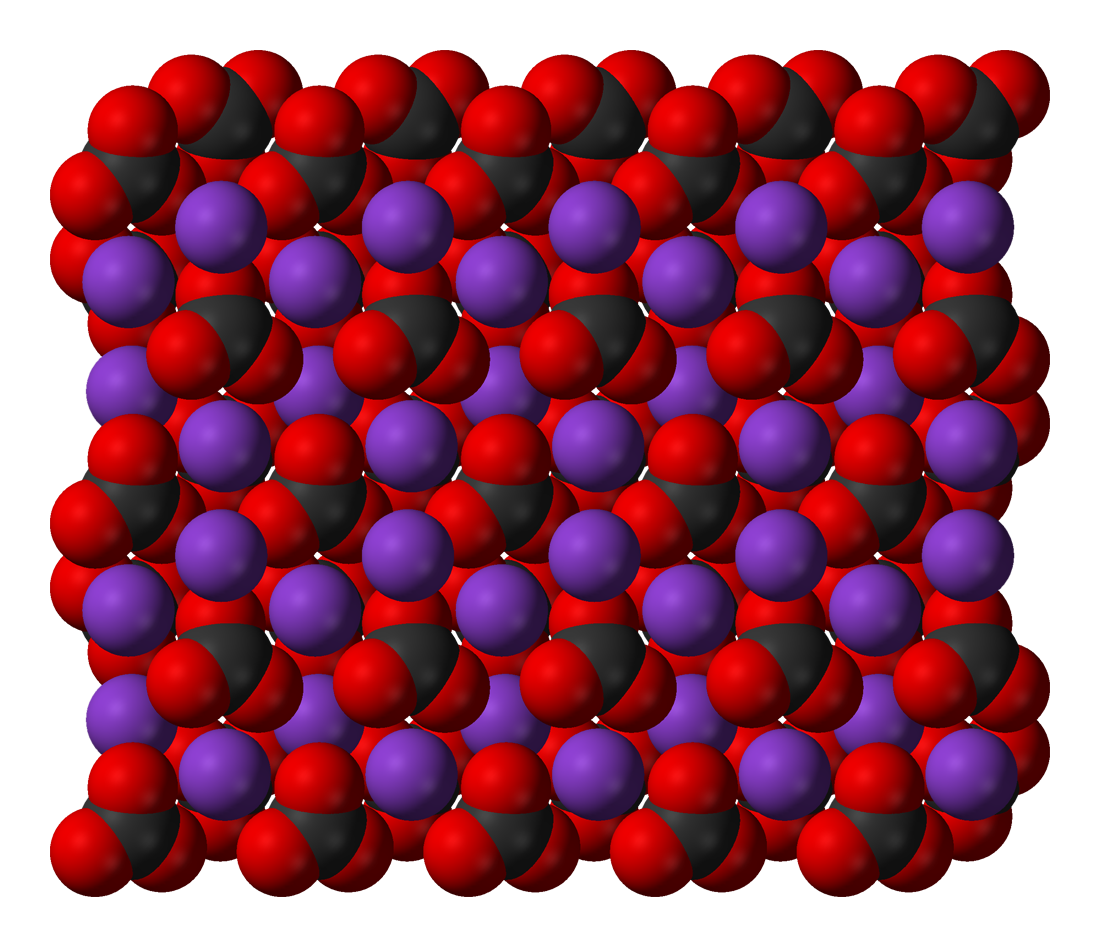
Potassium carbonate is the inorganic compound with the formula K2CO3. It is a white salt, which is soluble in water and forms a strongly alkaline solution. It is deliquescent, often appearing as a damp or wet solid. Potassium carbonate is used in production of dutch process cocoa powder,[3] production of soap and production of glass.[4] Commonly, it can be found as the result of leakage of alkaline batteries.[5] Potassium carbonate is a potassium salt of carbonic acid. This salt consists of potassium cations K+ and carbonate anions CO2−3, and is therefore an alkali metal carbonate.

History

[edit]

Potassium carbonate is the primary component of potash and the more refined pearl ash or salt of tartar. Historically, pearl ash was created by baking potash in a kiln to remove impurities. The fine, white powder remaining was the pearl ash. The first patent issued by the US Patent Office was awarded to Samuel Hopkins in 1790 for an improved method of making potash and pearl ash.[6]

In late 18th-century North America, before the development of baking powder, pearl ash was used as a leavening agent for quick breads.[7][8]

Production

[edit]

The modern commercial production of potassium carbonate is by reaction of potassium hydroxide with carbon dioxide:[4]

2 KOH + CO2 → K2CO3 + H2O

From the solution crystallizes the sesquihydrate K2CO3·1.5H2O ("potash hydrate"). Heating this solid above 200 °C (392 °F) gives the anhydrous salt. In an alternative method, potassium chloride is treated with carbon dioxide in the presence of an organic amine to give potassium bicarbonate, which is then calcined:

2 KHCO3 → K2CO3 + H2O + CO2

Applications

[edit]

References

[edit]

Bibliography

[edit]
[edit]
Revisions and contributorsEdit on WikipediaRead on Wikipedia
from Grokipedia
Potassium carbonate is an with the K₂CO₃, appearing as a white, odorless, hygroscopic salt that is highly soluble in , where it dissociates to form a strongly alkaline solution with a around 11. Historically extracted from wood ashes and known as or pearl ash, potassium carbonate is now primarily produced industrially by reacting with , which itself is derived from the of brines. This production yields a compound with key physical properties including a molecular weight of 138.21 g/mol, a of 2.43 g/cm³, and a of 891°C, making it stable under high temperatures but reactive with acids to release . Potassium carbonate finds extensive applications across industries due to its and . In , it serves as a flux in to lower melting points and improve clarity, particularly for specialty glasses like those used in televisions and optical lenses. It is also essential in and formulation as a builder to enhance cleaning efficiency, and in ceramics for glazing and production. In , it acts as a source in fertilizers, promoting plant growth and adjustment, while in , it functions as an acidity regulator (E501), in baked goods, and pH adjuster in chocolate and wine production. Additionally, it is used as a catalyst in chemical reactions, a in textiles, and a buffering agent in pharmaceuticals and .

Properties

Physical Properties

Potassium carbonate appears as a white, odorless, hygroscopic powder or granules that readily absorbs from the air, leading to deliquescence in humid conditions. This property makes it challenging to store without proper sealing, as it can form a damp or wet solid upon exposure to moist air. The compound has a of 2.43 g/cm³ at 20°C, reflecting its compact crystalline structure in the solid state. It melts at 891°C, transitioning to a phase before reaching its of approximately 1200°C, at which point it breaks down without boiling. Potassium carbonate exhibits high in , dissolving at 112 g/100 mL at 20°C to form a strongly alkaline solution; it is also soluble in but insoluble in and acetone. Its is approximately 0.83 J/g·K for the solid, indicating moderate capacity to store . Thermal conductivity of the solid is low, around 0.44 W/m·K, which limits rapid in bulk applications.
PropertyValueConditionsSource
Density20°CAlfa Chemistry
Melting Point891°C-Fisher SDS
Decomposition Temperature~1200°C-Save My Exams
Solubility in Water20°CFisher SDS
Specific Heat CapacityJESTEC
Thermal Conductivity0.44 W/m·KJESTEC

Chemical Properties

Potassium carbonate has the K₂CO₃. Its is 138.21 g/mol. In potassium carbonate, each potassium atom exhibits an of +1, while the carbon atom has an of +4, with each oxygen atom at -2. As a salt, potassium carbonate demonstrates inertness, remaining stable without participating in oxidation-reduction reactions under typical conditions due to the fixed valences of its constituent ions. Aqueous solutions of potassium carbonate are strongly basic, with a of approximately 11.6, resulting from the of the carbonate ion. The reaction proceeds as follows: CO32+H2OHCO3+OH\text{CO}_3^{2-} + \text{H}_2\text{O} \rightleftharpoons \text{HCO}_3^- + \text{OH}^- This equilibrium generates hydroxide ions, contributing to the alkaline nature of the solution. Potassium carbonate is stable under normal ambient conditions but decomposes upon reaction with acids, releasing gas. For example, with , the reaction is: K2CO3+2HCl2KCl+H2O+CO2\text{K}_2\text{CO}_3 + 2\text{HCl} \rightarrow 2\text{KCl} + \text{H}_2\text{O} + \text{CO}_2 This effervescence of CO₂ is characteristic of salts interacting with acids. At high temperatures, around 1200°C, potassium carbonate undergoes to form and : K2CO3K2O+CO2\text{K}_2\text{CO}_3 \rightarrow \text{K}_2\text{O} + \text{CO}_2 This process highlights its thermal stability up to elevated temperatures before breakdown occurs.

Structure

Molecular Geometry

Potassium carbonate (K₂CO₃) is an ionic compound composed of two potassium cations (K⁺) and one carbonate anion (CO₃²⁻), with no discrete molecular units in the solid state; instead, it forms an extended ionic lattice where the cations and anions are arranged in a crystal structure. The carbonate anion itself is a polyatomic ion featuring a central carbon atom bonded to three oxygen atoms. The exhibits , characterized by bond angles of 120° between the C-O bonds, arising from the sp² hybridization of the central carbon atom, which utilizes one s and two p orbitals to form three equivalent σ-bonds in the plane. This planar arrangement is a consequence of delocalization of the negative charge across the three oxygen atoms, resulting in equivalent C-O bond lengths of approximately 1.29 , intermediate between typical single (1.43 ) and double (1.23 ) C-O bonds. This geometry is confirmed through spectroscopic methods, particularly (IR) spectroscopy, where the in potassium carbonate displays characteristic absorption peaks for C-O stretching vibrations: a strong asymmetric stretch around 1400 cm⁻¹ and an out-of-plane bending mode near 880 cm⁻¹, consistent with the trigonal planar and D₃ₕ in the free , slightly perturbed in the lattice.

Crystalline Forms

Potassium carbonate exhibits several crystalline forms, with the anhydrous and hydrated polymorphs being the most relevant for stability and processing applications. The primary polymorph of potassium carbonate is monoclinic with P2₁/c. The unit cell dimensions are a = 5.64 , b = 9.80 , c = 6.88 , and β = 98.8°. This structure consists of a slightly distorted hexagonal close-packed array of carbonate ions, where potassium ions occupy octahedral and trigonal bipyramidal coordination sites, contributing to the material's overall stability. A high-temperature polymorph of potassium carbonate adopts a hexagonal structure, transitioning from the room-temperature monoclinic form at approximately 420°C. In this polymorph, the groups exhibit increased rotational freedom, altering the lattice arrangement and affecting thermal processing behavior. The hydrated form, potassium carbonate sesquihydrate (K₂CO₃·1.5H₂O), is the stable phase under ambient conditions up to temperatures around 100–130°C, depending on relative humidity, and crystallizes in the monoclinic C₂/c. Its dimensions are a = 11.89 Å, b = 13.83 Å, c = 7.11 Å, and β = 120.56°. The structure features columns of potassium ions linked by hydrogen-bonded chains involving molecules and groups, which influence the material's hygroscopic properties and kinetics. Dehydration of the sesquihydrate occurs in stepwise fashion upon heating, typically losing 0.5 mol H₂O around 130–200°C and the remaining 1 mol H₂O around 200–270°C, depending on heating rate and atmosphere; these transitions are reversible under controlled humidity but become irreversible above ~200°C due to structural reorganization. X-ray diffraction patterns provide a reliable method for distinguishing these forms, with the anhydrous P2₁/c polymorph showing principal reflections at d-spacings of approximately 3.45 Å (110), 2.91 Å (200), and 2.55 Å (211), while the sesquihydrate exhibits distinct peaks at higher d-spacings corresponding to its larger unit cell, such as around 6.5 Å for the (111) plane. These patterns are critical for phase identification in industrial quality control and research.

Production

Natural Sources

Potassium carbonate occurs naturally primarily through the extraction and processing of potassium-rich materials from geological deposits and plant residues, rather than as a common standalone . The most significant geological sources are deposits formed from the of ancient seas, which contain water-soluble potassium salts such as (KCl) and (KMgCl₃·6H₂O). These deposits, located in regions like the Saskatchewan potash beds in and the Dead Sea basin in and , serve as indirect sources of potassium carbonate, as the mined is subsequently processed to yield K₂CO₃ through carbonation reactions. Another key natural origin is the leaching of wood ashes from potassium-accumulating , such as hardwood trees or certain herbaceous species, a method historically used to produce crude . When potassium-rich vegetation is burned, the resulting ash contains potassium compounds that can be extracted by leaching with , yielding a residue rich in K₂CO₃ after and . This traditional process produces a low-purity product, typically containing 20-30% K₂CO₃ mixed with other salts like calcium and sodium carbonates. Potassium carbonate is also concentrated in certain alkaline lakes and their associated brines, where high evaporation rates lead to the precipitation of mixed carbonate salts. For instance, the brines of in contain potassium carbonate alongside sodium and borate minerals, extracted through solar evaporation and chemical processing of the concentrated solutions. Soil extracts from potassium-enriched alkaline environments can similarly yield trace amounts, though these are less commercially viable compared to large-scale evaporite mining.

Industrial Synthesis

The dominant industrial method for producing potassium carbonate is the reaction of potassium hydroxide (KOH), obtained via electrolysis of potassium chloride (KCl) brine, with carbon dioxide (CO₂): \ce2KOH+CO2>K2CO3+H2O\ce{2 KOH + CO2 -> K2CO3 + H2O} This carbonation step occurs in absorption towers or reactors, often under controlled pressure to optimize reaction rates. The electrolysis itself requires significant electrical energy, typically 2,200–2,500 kWh per metric ton of KOH, making the overall process energy-intensive but scalable in integrated facilities. No additional catalysts are required for the carbonation, though anti-foaming agents may be used to manage reaction conditions. Attempts to adapt the Solvay process for potassium systems, which would involve reacting KCl with ammonia, CO₂, and water to form KHCO₃, have been unsuccessful on a commercial scale due to the high solubility of potassium bicarbonate, preventing its efficient separation. However, alternative processes starting directly from KCl, such as continuous countercurrent cation exchange, have been patented but remain less common. Another method extracts potassium from potash feldspar ore (KAlSi₃O₈) by reacting it with CO₂ under high pressure (up to 4 MPa) and temperature in hydrothermal conditions, often with activators like calcium sulfate to facilitate mineral decomposition and potassium release as soluble carbonates. This approach is less common industrially but gains interest for utilizing abundant feldspar reserves and integrating CO₂ sequestration. Modern plants achieve yields exceeding 95% from the input KCl or KOH, with product purity routinely above 99%, enabling applications requiring high-grade material. Global annual production reached approximately 2 million metric tons in 2022, increasing to around 2.2 million metric tons by 2024, driven by demand in , chemicals, and sectors. Efficiency improvements since the include automated for recovery where applicable and energy-optimized cells, reducing overall energy consumption by up to 20% in recent decades.

History

Early Discovery

The term "potash," referring to potassium carbonate, derives from the Dutch "potaschen," meaning "pot ashes," which described the process of leaching wood or plant ashes in iron pots and evaporating the solution to obtain the . This substance, a mixture primarily of potassium carbonate and other salts, was known since ancient times for its alkaline properties. Ancient civilizations utilized plant ashes rich in for practical applications, including and cleaning agents. In , plant ash was combined with to produce early glass artifacts as far back as the late third millennium BCE. In , natron () was used similarly for more consistent high-quality glass production emerging around 1500 BCE during the New Kingdom. Similarly, and later Romans employed ashes from burned plants mixed with fats to create soap-like pastes for personal hygiene and textile cleaning, with evidence of such practices dating to approximately 2800 BCE in related Mesopotamian cultures and evolving through the Roman . In the , chemists began to recognize as chemically distinct from soda ash (), a breakthrough attributed to , who in 1758 demonstrated their differences through flame coloration tests and analytical methods, confirming potash's unique composition. This distinction laid the groundwork for further isolation efforts. In 1807, isolated the element via of molten ( derived from potash) and named it after the source material, marking the first recognition of the metal itself. Early preparations of potash were impure, often contaminated with other salts such as sulfates, chlorides, calcium, and magnesium compounds originating from the plant materials and leaching processes, which complicated its use and necessitated later purification techniques like calcination to produce "pearl ash."

Industrial Development

The industrial development of potassium carbonate accelerated in the 19th century following the introduction of the Leblanc process in 1791 for sodium carbonate production, which allowed substitution for potash in soap, glass, and textile industries, shifting away from reliance on wood ash leaching. A pivotal milestone occurred in the 1860s with the commercial mining of potash deposits in Stassfurt, Germany, where soluble potassium salts were discovered during salt drilling in the 1850s and first produced on an industrial scale starting in 1861, enabling large-scale extraction of potassium chloride and subsequent conversion to carbonate. In the , production scaled significantly due to wartime demands for fertilizers; during , the need for potassium-based nutrients to boost agricultural output led to expanded synthetic manufacturing in the United States and , with U.S. output rising through new chemical processes and Canadian developments in the 1940s to support efforts. A major advancement was the electrolytic production of from brines, developed in the early 20th century, followed by reaction with to yield potassium carbonate, enabling efficient large-scale synthesis. Another key advancement came in the 1950s with the adoption of ion-exchange purification techniques, which improved the efficiency of separating and refining potassium carbonate from mineral sources by selectively removing impurities like sodium and calcium ions. Potassium carbonate played a crucial economic role in the glass industry boom, serving as a vital that lowered melting temperatures and enhanced clarity and durability, fueling expansion in automotive windshields, building materials, and consumer goods amid post-World War I . By the , traditional extraction methods such as processing had largely declined in favor of cheaper synthetic routes derived from mined salts, reducing costs and increasing global supply reliability for industrial applications.

Applications

Industrial Uses

Potassium carbonate serves as a vital in the production of , particularly in specialty glass formulations where it lowers the of silica by 200–300°C, facilitating energy-efficient processes. This role is especially prominent in specialty glasses, such as those used in tubes and optical components, where potassium ions improve thermal resistance and reduce defects like . In soap and detergent manufacturing, potassium carbonate acts historically as an alkaline agent in the saponification of fats and oils to produce more soluble potassium soaps suitable for liquid formulations, and in modern processes as a builder that softens water by precipitating calcium and magnesium ions, thereby boosting cleaning efficiency in hard water conditions and aiding stain removal without excessive foaming. As a precursor in chemical synthesis, potassium carbonate is essential for producing compounds like potassium silicate, formed by reacting it with silica under high temperature and pressure for use in adhesives and sealants. It also serves as a starting material for potassium bicarbonate through carbonation in aqueous solution, which finds applications in fire extinguishers and pH regulation. Additionally, it is fused with manganese dioxide to generate potassium manganate, an intermediate in the industrial production of potassium permanganate, a key oxidizing agent. In textile processing, potassium carbonate functions as an to adjust during and mordanting, particularly for fibers, where it promotes uptake and color fastness by facilitating the ionization of mordants like . This application ensures even penetration and prevents fiber damage from excessive acidity, supporting vibrant and durable finishes in fabrics. Global consumption of potassium carbonate underscores its industrial significance, with approximately 40% allocated to and 20% to chemical as of 2023 estimates, driven by demand in , automotive, and specialty chemicals sectors.

Agricultural and Other Uses

In , potassium carbonate functions as a key component of fertilizers, supplying soluble that enhances growth, nutrient uptake, and overall yields by supporting vital physiological processes such as activation and water regulation in crops like grains and . It is particularly valuable in acidic soils, where it aids in pH adjustment and potassium availability without introducing ions that could exacerbate issues. Refined forms, often derived from natural sources like , have been utilized historically and continue to play a role in sustainable farming practices. In the , potassium carbonate is approved as an acidity regulator under the additive E501, where it neutralizes excess acidity and stabilizes in various products. It is commonly employed in the production of Dutch-processed cocoa powder, reacting with alkalizing agents to develop a milder flavor and darker color by adjusting the cocoa's natural acidity. Similarly, in , it serves as a buffering agent to reduce tartness in high-acidity musts, improving balance and without significantly altering the wine's structure. Potassium carbonate acts as a buffering agent in pharmaceutical formulations, helping to maintain optimal levels for drug stability and during manufacturing and storage. Its mild makes it suitable for use in tablets, syrups, and injectables, where it prevents degradation of sensitive active ingredients. In biopharmaceutical production, it regulates in cell culture media and purification processes, ensuring efficient protein expression and recovery. In settings, potassium carbonate is widely used as a mild, insoluble base in , facilitating reactions such as alkylations, deprotonations, and acid scavenging without promoting side reactions common with stronger bases. It is particularly effective in non-aqueous solvents for selective monoalkylation of active methylene compounds and in palladium-catalyzed couplings. Its heterogeneous nature allows easy removal post-reaction, making it ideal for scalable synthetic routes in .

Safety and Environmental Aspects

Health and Safety

Potassium carbonate is classified as an irritant to the skin, eyes, and upon exposure, potentially causing redness, pain, and in affected areas. It exhibits low , with an oral LD50 greater than 2,000 mg/kg in rats, indicating it is not highly poisonous when ingested in moderate amounts. Inhalation of dust may lead to coughing or due to its alkaline nature, though severe systemic effects are uncommon at typical exposure levels. Occupational exposure limits for potassium carbonate are not substance-specific under OSHA regulations; instead, it falls under the general (PEL) for particulates not otherwise regulated (PNOR), set at 5 mg/m³ as an 8-hour time-weighted average for the respirable fraction and 15 mg/m³ for total dust. Safe handling requires the use of protective gloves, , and adequate ventilation to minimize dust inhalation or contact. NIOSH recommends and in environments where dust generation is possible. In case of skin or eye contact, immediate flushing with plenty of water for at least 15 minutes is essential, followed by seeking medical attention if irritation persists. For ingestion, do not induce vomiting; instead, rinse the mouth and contact a poison control center or physician promptly, as it may cause gastrointestinal discomfort. Inhalation exposure should be addressed by moving to fresh air and providing oxygen if breathing is difficult. Proper storage involves keeping potassium carbonate in tightly sealed containers in , away from acids to avoid exothermic reactions that release gas. This precaution prevents potential pressure buildup or spills from gas evolution. Potassium carbonate holds (GRAS) status from the FDA for use as a direct ingredient, such as in powders and as a pH regulator, with no specified limitations other than current good manufacturing practices. This affirmation is based on its long history of safe use in applications without adverse effects at typical levels.

Environmental Impact

The production and use of potassium carbonate can contribute to water pollution primarily through its high solubility, which results in alkaline effluents that elevate levels in aquatic systems. In potash mining operations, a key source of raw materials, brine discharges and wastewater from processing can introduce soluble salts, including potassium ions, leading to increased salinity and alkalinity in nearby surface waters. For instance, effluents from glass manufacturing , where potassium carbonate serves as a flux, may release alkaline residues that disrupt aquatic ecosystems by altering pH and affecting sensitive species such as and . Resource depletion associated with potassium carbonate arises mainly from potash mining, which supplies the potassium hydroxide or chloride precursors. In , —a major global hub for potash extraction—this activity has led to significant habitat loss through land disturbance, including the removal of native grasslands and to access underground deposits. Mining operations create open pits and tailings piles that fragment ecosystems, impacting in prairie regions critical for waterfowl and native . Efforts to mitigate these effects include wetland restoration projects, but ongoing extraction continues to pressure local as of 2025. The of potassium carbonate production is notable due to CO₂ emissions from processes and energy-intensive mining and synthesis. The reaction of with CO₂ to form potassium carbonate inherently incorporates carbon, but upstream for potassium hydroxide and mining operations emit approximately 2.38 kg CO₂ equivalent per kg of product. In applications like , of potassium carbonate releases additional CO₂, contributing to . However, closed-loop in glass manufacturing mitigates this by reducing the demand for virgin potassium carbonate, lowering overall emissions by up to 20-30% through material reuse. Although potassium carbonate is non-persistent and degrades rapidly in the environment through and dilution, its release can contribute to in waters via enrichment. As a , excess from industrial effluents or agricultural runoff promotes algal growth in nutrient-rich systems, exacerbating oxygen depletion and harmful blooms, particularly when combined with and . Unlike , is rarely limiting, but elevated levels from soluble sources like potassium carbonate can still intensify eutrophic conditions in freshwater bodies. Under REACH regulations, potassium carbonate is classified as non-hazardous to the environment, with no specific restrictions due to its low toxicity and rapid degradation. However, emissions from production and use are monitored to prevent localized impacts. Manufacturers must report data on environmental releases, ensuring compliance with effluent limits under the Industrial Emissions Directive.

References

Add your contribution
Related Hubs
User Avatar
No comments yet.