


Community hub
Recent from talks
Contribute something
Nothing was collected or created yet.
Pecten jacobaeus
View on Wikipedia
| Pecten jacobaeus Temporal range:
| |
|---|---|

| |
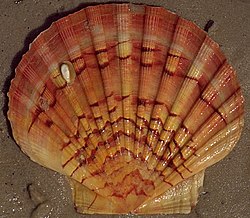
| The upper (flat) valve of Pecten jacobaeus | |
Scientific classification 
| |
| Kingdom: | Animalia |
| Phylum: | Mollusca |
| Class: | Bivalvia |
| Order: | Pectinida |
| Family: | Pectinidae |
| Genus: | Pecten |
| Species: | P. jacobaeus
|
| Binomial name | |
| Pecten jacobaeus | |
| Synonyms | |
Pecten jacobaeus, the Mediterranean scallop, is a species of scallop, an edible saltwater scallop, a marine bivalve mollusc in the family Pectinidae, the scallops.[1]

Description
[edit]Pecten jacobaeus usually reaches a length of about 120–140 millimetres (4.7–5.5 in), but the world record size reaches over 210 mm.[2] The two valves have different shapes. The lower valve, with which the animal rests on the bottom, is very convex and light-colored, while the upper valve is flat and brown. They show 14 to 16 ribs (radial wrinkles) with a more or less rectangular cross section. The inside of the valves is porcelain-like smooth.
The mollusc has at the edge of the mantle many short tentacles, between which there are a total of 60 blue-millimeter lens eyes. By quickly closing of the two valves it can swim away several meters in case of danger.
These scallops eat planktonic organisms and other floating food particles, which they obtain by filtering sea water with their gills.
Distribution
[edit]This species appears to be endemic to the Mediterranean Sea,[2] but it may be conspecific with Pecten maximus, the great scallop, which has a larger distribution.[3] Although these two species are morphologically similar, they present distinguishing features.[3]
Fossils of Pecten jacobaeus first appear at the beginning of the Pliocene and are quite common in the Pliocene and Pleistocene deposits of Italy.[3]
Commercial value
[edit]Scallops of this species are collected commercially for human consumption using such techniques as the Rapido trawl.[4]
Popular culture
[edit]In a Christian context, this species is traditionally associated with Saint James, also known as James, son of Zebedee[according to whom?], also known as Saint Jacob[according to whom?], hence the specific name jacobaeus[better source needed]. It is also known as the "Pilgrim's scallop",[5] as the shells were used by the pilgrims in the Middle Ages as a cup.
See also
[edit]References
[edit]- ^ a b World Register of Marine species
- ^ a b Pectensite
- ^ a b c Wilding, C. S.; Beaumont, A. R.; Latchford, J. W. (1999). "Are Pecten maximus and Pecten jacobaeus different species?". Journal of the Marine Biological Association of the United Kingdom. 79 (5): 949–952. Bibcode:1999JMBUK..79..949W. doi:10.1017/S0025315499001149. S2CID 84757441.
- ^ Hall-Spencer, J. M.; Froglia, C.; Atkinson, R. J. A.; Moore, P. G. (1999). "The impact of Rapido trawling for scallops, Pecten jacobaeus (L.), on the benthos of the Gulf of Venice" (PDF). ICES Journal of Marine Science. Bibcode:1999ICJMS..56..111H. doi:10.1006/jmsc.1998.0424. Archived from the original (PDF) on January 3, 2026. Retrieved January 3, 2026.
- ^ The Editors of Encyclopædia Britannica (November 26, 2008). "Scallop BIVALVE". Encyclopædia Britannica. Retrieved January 21, 2017.
- C. Linnaeus. 1758. Systema Naturae per Regna Tria Naturae, secundum Classes, Ordines, Genera, Species, cum Characteribus, Differentiis, Synonymis, Locis. Tomus I. Editio decima, reformata. Laurentii Salvii, Holmiae (Lars Salvius, Stockholm)
- Guido T. Poppe und Y. Goto: European Seashells. Vol II (Scaphopoda, Bivalvia, Cephalopoda). 221 S., Verlag Christa Hemmen, Wiesbaden, 1993 ISBN 3-925919-11-2
External links
[edit]Commercial mollusks | ||
|---|---|---|
| Marine gastropods |  | |
| Land and freshwater gastropods | ||
| Free-swimming marine bivalves | ||
| Infaunal bivalves | ||
| Sessile bivalves | ||
| Freshwater bivalves | ||
| Cephalopods | ||
| Techniques | ||
 | This Pectinidae-related article is a stub. You can help Wikipedia by adding missing information. |
Pecten jacobaeus
View on GrokipediaTaxonomy
Classification
Pecten jacobaeus is a marine bivalve mollusk belonging to the family Pectinidae, known commonly as the Mediterranean scallop. Its accepted binomial name is Pecten jacobaeus (Linnaeus, 1758).[6] The full taxonomic classification places it within the following hierarchy:Kingdom: Animalia
Phylum: Mollusca
Class: Bivalvia
Order: Pectinida
Family: Pectinidae
Genus: Pecten
Species: P. jacobaeus.[6] Originally described by Carl Linnaeus in his Systema Naturae (10th edition, 1758) under the name Ostrea jacobaea, the species was later reclassified into the genus Pecten due to its morphological characteristics aligning with the scallops.[6][7] The name "jacobaeus" derives from its association with Saint James, reflecting its historical significance in Mediterranean regions. Several synonyms exist, including Ostrea jacobaea (the original combination), Vola jacobaea, and Pecten intermedius (a junior homonym).[6] The type locality for P. jacobaeus is the Mediterranean Sea, from which Linnaeus based his description.[6]
Relation to other species
Pecten jacobaeus was first described as a distinct species by Carl Linnaeus in 1758, separate from the closely related Pecten maximus, also described by Linnaeus in the same year.[6][8] Traditionally, the two have been recognized as separate species based on their largely allopatric distributions, with P. maximus primarily in the northeastern Atlantic and P. jacobaeus confined to the Mediterranean, though with slight overlap in the western Mediterranean near the Almeria-Oran front.[9] A 1999 study employing allozyme electrophoresis and mitochondrial DNA PCR-RFLP analysis estimated genetic distances between the taxa at levels comparable to intraspecific variation, much lower than typical for congeneric species, prompting suggestions of conspecificity due to this low differentiation and the observed range overlap.[9] Subsequent research has reinforced their distinction through genetic evidence. A 2002 allozyme study examined variation at 15 loci across six populations (two P. maximus and four P. jacobaeus) spanning the Almeria-Oran front, revealing a major genetic discontinuity at this boundary; 63% of the total genetic variance was attributed to differences between the taxa, with populations clustering distinctly by species in UPGMA analysis, indicating substantial interspecific differentiation not explained by isolation by distance.[10] The study also noted that the two species share a common ancestor approximately 5 million years ago, postdating the Messinian salinity crisis.[10] A 2022 RADseq genomic analysis of 235 P. maximus and 27 P. jacobaeus individuals, mapped to a chromosome-level reference genome, uncovered a heterogeneous divergence landscape across the genome, with a mean F_ST of 0.118 and 223 highly divergent 100 kb windows (exceeding the 95th percentile F_ST of 0.623), particularly concentrated on chromosomes 2 and 10.[11] Despite this, 62 fully diagnostic SNPs were identified, 54 of which occur on chromosome 11, alongside evidence of chromosomal inversions in P. jacobaeus that likely promote reproductive isolation; these findings support the recognition of P. jacobaeus and P. maximus as distinct species with limited gene flow.[11] Demographic modeling in the study estimated initial divergence around 0.6–1.5 million years ago, followed by secondary contact approximately 30,000–75,000 years ago that ceased recently.[11] Morphological traits further delineate the species, though with some ambiguity in transitional areas. P. jacobaeus shells typically exhibit 14–16 radial ribs with a more rectangular cross-section, contrasting with the 15–17 broader, rounded ribs of P. maximus, but rib counts show overlap and variability in Atlantic-Mediterranean transition zones near the Almeria-Oran front, complicating identification in hybrid or peripheral populations.[9][5]Description
Shell morphology
The shell of Pecten jacobaeus, the Mediterranean scallop, typically measures 10–15 cm in height, though maximum recorded sizes reach up to 21 cm.[12][2][1] The overall shape is equivalved and orbicular, with a slightly elongated outline and auricles that are nearly equal in size, contributing to its distinctive fan-like appearance characteristic of the Pectinidae family.[13] The two valves differ markedly in convexity and coloration. The lower (right) valve is convex and light-colored, ranging from white to pinkish hues, while the upper (left) valve is flatter and brownish, providing camouflage against sedimentary substrates.[14] This dimorphism aids in orientation, with the convex valve typically facing downward during attachment.[15] Externally, the shell features 15–18 prominent radial ribs, each bearing fine scales or shagreen-like microsculpture that enhances structural integrity and may deter predators.[16][14][1] The interior is smoother, with subtle commarginal growth lines reflecting periodic shell deposition, and a porcelain-like nacreous sheen.[15] The hinge is straight and edentulous, typical of pectinids, lacking teeth but supported by a resilient ligament for valve articulation.[17] Juveniles exhibit a pronounced byssus scar near the anteroventral margin of the right valve, where byssal threads anchor the scallop to substrates before it transitions to a free-living, swimming lifestyle.[18] Fossils of P. jacobaeus are abundant in Pliocene and Pleistocene deposits across Italy, such as in Tuscany, indicating morphological stability in the Mediterranean basin over millions of years despite climatic shifts.[15][19]Soft anatomy
The soft anatomy of Pecten jacobaeus features specialized internal structures adapted for sensory detection, filter feeding, and mobility in its marine environment. The mantle, a thin epithelial layer lining the shell valves, encloses the visceral mass and plays a key role in secretion, protection, and sensory functions. Along the mantle edge, particularly on the sensory fold, are distributed approximately 60 bright blue eyes, each equipped with a lens, retina, and reflective tapetum for enhanced light detection and response to shadows or movement.[20] Interspersed among these eyes are short tentacles on the sensory fold, which serve chemosensory roles by detecting changes in the surrounding water's chemical composition, aiding in predator avoidance and environmental awareness.[21] The velar fold of the mantle bears additional guard tentacles that contribute to tactile and chemical sensing, supporting the scallop's overall vigilance.[20] The respiratory and feeding apparatus includes paired ctenidia, or gills, consisting of two demibranchs each with plicate filaments that generate water currents through ciliary action. These ctenidia facilitate filter feeding by capturing suspended particles such as phytoplankton from the incoming water flow.[20] Food is directed to the mouth via labial palps, then enters the digestive system, where the stomach features a ridged interior and a rotating crystalline style—a gelatinous rod that secretes enzymes to break down organic particles into digestible forms. The style's abrasive action against the gastric shield further aids mechanical digestion, enabling efficient nutrient extraction in this particle-based diet.[20] A dominant feature is the adductor muscle, a large, bilobed structure occupying much of the central body cavity, with a striated portion for rapid contraction during swimming and a smooth catch portion for sustained valve closure with minimal energy expenditure. This muscle's dual composition allows forceful snaps for escape propulsion while maintaining security against intrusion.[22] Pecten jacobaeus is hermaphroditic, with mature gonads prominently visible within the body cavity as the primary reproductive organs. These structures develop seasonally and are integral to the species' broadcast spawning strategy.[1]Distribution and habitat
Geographic range
Pecten jacobaeus is endemic to the Mediterranean Sea, with its distribution extending into the eastern Atlantic Ocean from Portugal southward to the Canary Islands and including the Azores archipelago, before ranging eastward across the Mediterranean to Lebanon.[2][23] The species' westernmost limit in the Mediterranean is along the Spanish Mediterranean shores.[23][24] Within the Mediterranean, the primary population centers are concentrated in the northern Adriatic Sea, particularly along the coasts of Italy and Croatia, while occurrences are sparser in the western Mediterranean regions such as Spain.[25] Fossil records of Pecten jacobaeus date back to the early Pliocene and are abundant in Pliocene and Pleistocene coastal deposits across Italy, including sites in southern Tuscany and the Siena-Radicofani Basin.[15][26]Habitat preferences
Pecten jacobaeus primarily inhabits benthic environments at depths ranging from 0 to 250 m, though populations are most abundant between 20 and 50 m where conditions are optimal for growth and survival.[2][27] This species favors sandy-muddy bottoms and gravel substrates, which provide suitable conditions for attachment and feeding.[27] Juveniles typically attach to hard surfaces or vegetation using byssus threads, often within seagrass meadows dominated by Posidonia oceanica, facilitating early settlement and protection.[28][29] The scallop thrives in temperate Mediterranean waters with seasonal temperature variations between approximately 12 and 25 °C, showing active growth during cooler periods below 19 °C and reduced activity in warmer months.[27][2] Salinity levels in its preferred habitats typically range from 37 to 39 ppt, with variations (e.g., 35–38 ppt in the northern Adriatic due to river inflows), reflecting stable marine conditions across the basin.[27] Pecten jacobaeus commonly associates with other bivalves in soft sediment communities, contributing to diverse infaunal assemblages on muddy and sandy substrates that support shared ecological niches.[30] These habitats, often interspersed with seagrass beds, enhance biodiversity and provide refuge from environmental stressors.[28]Biology
Reproduction and life cycle
Pecten jacobaeus is a hermaphroditic bivalve, possessing separate male and female gonadal tissues within the same individual, and reproduction occurs via external fertilization in the water column.[3][31] Gametogenesis proceeds continuously without a resting period, leading to two annual spawning peaks: a primary event in late summer to early fall and a secondary one in spring.[3] Spawning is triggered by rising seawater temperatures exceeding approximately 15°C, which aligns with the spring-summer period when environmental conditions favor gamete release.[31][32] Recent experiments on broodstock conditioning in recirculation aquaculture systems have advanced understanding of reproductive control for this species. In April 2023, 30 adult specimens were fed live Isochrysis galbana microalgae for 21 days, resulting in increased gonadal somatic index (GSI) and gonad index (GI), indicating enhanced gamete development.[31] A follow-up trial in March-April 2024 involved 92 individuals divided into groups fed either live I. galbana or a frozen algae mixture for 25 days; the live-feed group exhibited superior condition index (CI) and maturation index (MI), with histological evidence of mature oocytes and spontaneous spawning in several samples at 16.2°C.[31][32] These findings highlight the role of temperature and nutrition in synchronizing reproduction, with live feeds promoting faster gonad maturation through direct ingestion compared to reliance on stored reserves.[31] Following fertilization, embryos develop into free-swimming trochophore larvae, which transition to planktonic veliger larvae.[2] Veligers metamorphose into juveniles and attach to suitable substrates such as shell fragments or seagrass.[33] Post-settlement, growth rates vary with environmental factors, typically reaching 20-30 mm in the first year.[12] The overall life cycle spans up to 13 years, with individuals attaining sexual maturity between 2 and 3 years of age at a shell height of 50-60 mm.[3][34] Elevated GSI values reaching up to 18 during peak seasons reflect high reproductive output.[3]Feeding and growth
Pecten jacobaeus is a suspension filter feeder that utilizes its ctenidia, or gills, to capture suspended particles from the surrounding water column. The ctenidia create inhalant currents that draw in phytoplankton, zooplankton, and detritus, which are trapped in mucus and transported via ciliary action to the labial palps for further processing.[35] Captured particles are sorted by the labial palps, which reject unsuitable material as pseudofeces while directing nutritious items to the mouth and stomach. In the stomach, the rotating crystalline style—a gelatinous rod—mechanically grinds larger particles and secretes enzymes to initiate digestion, facilitating the breakdown of organic matter into absorbable nutrients.[35] Clearance rates, representing the volume of water cleared of particles per unit time, vary with individual size and environmental conditions, enabling efficient resource acquisition in oligotrophic Mediterranean waters. Growth in P. jacobaeus follows the von Bertalanffy growth model, with parameters derived from northern Adriatic populations indicating a growth coefficient (K) of approximately 0.42 year⁻¹ and an asymptotic shell height (L∞) of 127.9 mm, based on analysis of 70 individuals ranging from 75.1 to 142.0 mm in shell height.[12] Age determination relies on counting annual growth rings visible on the external shell surface and ligament scars, which form during periods of reduced growth and allow estimation of lifespans up to 13 years. Seasonal growth patterns show accelerated shell deposition during cooler winter months (December–January and April–June), with a marked slowdown or halt in the warmer summer period (July–November), as revealed by high-resolution oxygen isotope (δ¹⁸O) profiles in shell calcite from specimens collected at 25–30 m depth. This variation reflects influences from temperature, spawning energy demands, and water chemistry, including low dissolved oxygen and pH during summer.[37]Ecology
Behavior and locomotion
Pecten jacobaeus exhibits a range of locomotion strategies adapted to its epibenthic lifestyle, primarily relying on jet propulsion for rapid escapes. The scallop achieves movement by contracting its powerful adductor muscle to clap the valves together, expelling water from the mantle cavity through lateral openings to generate thrust. This "clapping" mechanism enables short bursts of swimming.[38] Juveniles of P. jacobaeus attach to substrates using a byssus, a bundle of proteinaceous threads secreted by the foot, which anchors them during early post-larval stages after settlement from the plankton. This byssal attachment facilitates initial stability on hard surfaces like rocks or algae until the scallop reaches approximately 15 mm in shell height. Adults, however, transition to a free-lying existence on sandy or muddy sediments, losing the ability to produce new byssus threads, though they retain the capacity to reattach temporarily if displaced.[18] Sensory behaviors in P. jacobaeus are mediated by specialized structures on the mantle margin, enabling responses to environmental stimuli. The numerous image-forming eyes, numbering up to 100 or more, detect sudden shadows through an "off" response in the distal retina, prompting valve adduction or initiation of escape swimming to evade potential threats. Complementing the visual system, tactile tentacles along the mantle edge sense water currents and vibrations via mechanoreceptors, allowing the scallop to adjust its orientation and swimming direction during propulsion.[39][40][38] The species displays a distinct daily rhythm in activity, regulated by light-dark cycles, with heightened behavior at night. During the day, P. jacobaeus tends to remain more sedentary, often partially burrowed in sediment with valves more tightly closed and contractions occurring at lower frequencies (1–5 per hour). At night, activity increases markedly, with valve openings twice as wide, contraction amplitudes 30–50% higher, and overall shell movements roughly double, facilitating feeding and repositioning. This circadian pattern persists under constant conditions but shifts with altered photoperiods, underscoring its endogenous yet light-entrained nature.[41]Predators and interactions
Pecten jacobaeus faces predation from several marine invertebrates in the Mediterranean benthic ecosystem, including the starfish Marthasterias glacialis, which preys on bivalves by enveloping the shell with its arms to pry open the valves.[42] Other echinoderms, such as Astropecten irregularis, may prey on pectinids like P. jacobaeus in shallow sandy habitats through extraoral digestion.[43] Decapod crabs, including genera like Cancer and Carcinus, and cephalopods such as octopuses, are documented predators of scallops, targeting juveniles and adults by crushing or drilling into the shell.[21] The scallop's primary defense mechanism against these threats involves rapid swimming escapes achieved by rhythmic valve clapping to propel itself away from danger.[21] Epibionts commonly colonize the outer surfaces of P. jacobaeus shells, providing substrates for attachment in the dynamic benthic environment. Algae and bryozoans are frequent associates, encrusting the valves and potentially influencing hydrodynamics or camouflage, though heavy fouling by barnacles or polychaetes can impair swimming performance.[44] Parasitic nematodes, such as Sulcascaris sulcata, occasionally infect P. jacobaeus, with larvae encysting in the adductor muscle and forming visible spots that can affect commercial quality, though detailed ecological impacts remain understudied.[45] As a suspension feeder, P. jacobaeus plays a key role in ecological interactions by filtering phytoplankton and particulate organic matter from the water column, thereby contributing to nutrient cycling and water clarity in coastal sediments.[2] This filtration activity can indirectly benefit seagrass meadows in adjacent habitats by reducing suspended sediments and improving light penetration for photosynthesis.[46] In the benthic food web, P. jacobaeus functions as a primary consumer, occupying a basal trophic level by grazing on primary producers and detritus while serving as prey for higher-level carnivores like starfish and crabs, thus facilitating energy transfer across the ecosystem.[2]Conservation
Population status
Pecten jacobaeus has not been evaluated by the IUCN Red List as of 2025.[2] Populations in the northern Adriatic Sea have undergone significant declines since the mid-1980s, with commercial landings in areas like Chioggia dropping from 1,200 metric tonnes in 1987 to 200 metric tonnes by 1994.[47] Population densities remain low across surveyed areas, typically ranging from 0.012 to 0.08 individuals per m², as recorded in studies from the northern Adriatic and Gulf of Venice. Surveys conducted in 2013–2014 in the northern Adriatic revealed limited recruitment, with samples dominated by older age classes, suggesting inadequate replenishment of stocks. Analysis of mitochondrial 16S rDNA sequences from a 2017 study indicated low genetic diversity in Adriatic populations (haplotype diversity H = 0.691–0.717; nucleotide diversity π = 0.00164–0.00223), lower than in western Mediterranean sites, along with evidence of demographic bottlenecks likely linked to historical exploitation.[48] Monitoring efforts are limited, with recent applications of sclerochronology primarily focused on validating age structures using Pliocene analogs from 2024, while contemporary data on growth and recruitment remain sparse.[49]Threats and management
Pecten jacobaeus populations in the Mediterranean Sea have experienced significant declines primarily due to overfishing, particularly through the use of rapido trawling gear in the northern Adriatic, which targets scallop beds and disrupts benthic habitats essential for juvenile settlement and survival.[23][50] Habitat loss is exacerbated by the physical disturbance from trawl teeth, which damage sedimentary structures and associated epifauna, reducing suitable grounds for recruitment, while pollution from coastal activities introduces contaminants that impair physiological functions such as cholinesterase activity in scallop tissues.[50][51] Additionally, rising sea temperatures associated with climate change are projected to shorten the growth period of P. jacobaeus by up to three months annually in coastal areas, potentially hindering recruitment success and exacerbating vulnerability to exploitation.[52] These population declines, linked to overexploitation and environmental stressors, have prompted targeted management measures in key fishing regions. In the Italian and Croatian sectors of the northern Adriatic, seasonal closures for rapido trawling aim to protect spawning stocks and allow recovery during vulnerable periods. Recent aquaculture initiatives, including broodstock conditioning trials conducted in recirculation systems during April 2023 and March 2024, have demonstrated potential for hatchery production of spat to support restocking efforts in depleted areas.[32] Protected areas for P. jacobaeus remain limited across the Mediterranean, with few marine protected areas (MPAs) explicitly designated for scallop conservation, though existing benthic habitat protections in the northern Adriatic provide indirect benefits. Studies have advocated for expanded MPAs in this region to mitigate trawling impacts and enhance population resilience, emphasizing the need for no-take zones to safeguard critical nursery habitats.[50]Human uses
Commercial exploitation
Pecten jacobaeus is primarily harvested through beam trawling using rapido gear in the northern Adriatic Sea, where Italian and Croatian fisheries target the species at depths of 25-35 meters along the west coast of the Istria peninsula.[3] This method has been employed for over 50 years, focusing on sandy-muddy bottoms suitable for scallop beds.[53] Historical annual landings at Chioggia, the main Italian port for scallop fishing, ranged from 105 to 1172 tons between 1970 and 2000, averaging 551 ± 326 tons.[54] Yields have since declined sharply due to intensive exploitation, with recent averages dropping to 56 ± 19 tons annually in the northern Adriatic, and Croatian landings alone at approximately 40 tons in 2020.[54][3] In European markets, P. jacobaeus is traded as "capesante," prized for its large adductor muscle and roe, which command high prices due to the species' size and flavor profile compared to other Mediterranean bivalves.[55][56] Exports primarily serve premium seafood sectors in Italy and broader Europe, contributing significantly to local economies despite reduced volumes.[55] The species is currently overfished in the northern Adriatic (GFCM Geographical Sub-Area 17), with a fishing mortality rate (F/FMSY) of 2.86 exceeding sustainable levels, as assessed in 2020.[57] Studies from 2022 on its life history strategies highlight slow growth to commercial size (approximately 100 mm shell height after two years), recommending minimum landing sizes greater than 100 mm to protect juveniles and support stock recovery.[3][12] Management under the GFCM multiannual demersal plan includes effort reductions and spatial protections, such as the Jabuka/Pomo Pit restricted area, aiming for maximum sustainable yield by 2026.[57] Aquaculture efforts for P. jacobaeus are emerging, with recent focus on wild spat collection and broodstock conditioning to address seed supply shortages. In 2024 experiments conducted in Croatian recirculation systems, adult scallops fed concentrated algae mixes or live microalgae achieved condition index improvements of up to 16.76%, with survival rates exceeding 95% over 25 days, though broader spat production remains limited by low natural recruitment.[31] These trials indicate potential for hatchery-based farming, but commercialization is constrained by the need for optimized feeding protocols and higher juvenile survival.[31][32]Cultural significance
The scientific name Pecten jacobaeus derives from the Latin "pecten," meaning comb, referring to the shell's ribbed structure, and "jacobaeus," from "Jacobus," the Latin form of James, honoring St. James the Greater.[58] This nomenclature underscores the mollusk's deep cultural ties to the apostle, whose shrine in Santiago de Compostela became a focal point of medieval pilgrimage. The shell serves as the primary emblem of St. James, symbolizing divine protection, spiritual journey, and the convergence of paths toward enlightenment, much like the radiating ribs of the shell itself.[59] Historically, P. jacobaeus shells have been worn as badges by pilgrims undertaking the Camino de Santiago since at least the 11th century, attached to cloaks, hats, or carried as pendants to signify their devotion and afford practical use as scoops for food and water.[59] Legends attribute this tradition to miracles, such as a knight emerging from a shipwreck covered in scallop shells, interpreted as St. James's intervention, which popularized the shell as a token of safe passage and pilgrimage completion.[58] In heraldry, the escallop—a stylized representation of the shell—emerged as a charge denoting pilgrimage to Compostela, appearing in coats of arms from the medieval period onward to signify faith and travel.[60] Artistic depictions abound in medieval artifacts, including jet and silver-gilt pendants, lead-alloy ampullae for holy water, and engravings that immortalized the shell's role in Christian iconography.[59] In modern Italian culture, where P. jacobaeus inhabits the Adriatic and Tyrrhenian Seas, the shell features prominently in regional symbolism and tourism, evoking Mediterranean heritage through motifs in coastal festivals and shell-inspired crafts.[61] Its fossils, abundant in Pliocene deposits across Italy, are showcased in paleontological exhibits, such as those at the Museum of Geology and Paleontology in Florence, highlighting the species' evolutionary history and contributing to educational outreach on ancient marine ecosystems.[62] This dual role—living emblem of spiritual legacy and fossilized relic—continues to bridge historical reverence with contemporary appreciation.[63]References
- https://www.[researchgate](/page/ResearchGate).net/publication/279692542_Age_and_growth_of_the_Mediterranean_scallop_Pecten_jacobaeus_Linnaeus_1758_in_the_northern_Adriatic_Sea