


Community hub
Recent from talks
Contribute something
Nothing was collected or created yet.
Piccaninnie Ponds Conservation Park
View on Wikipedia
Piccaninnie Ponds Conservation Park, formerly the Piccaninnie Ponds National Park, is a protected area of 862 hectares (2,130 acres) located in southeastern South Australia near Mount Gambier.
Key Information


Description
[edit]The Piccaninnie Ponds Conservation Park is located in the south-east of South Australia in the gazetted locality of Wye on the continental coastline overlooking Discovery Bay about 490 kilometres (300 mi) southeast of the state capital of Adelaide and 30 kilometres (19 mi) south-east of the city of Mount Gambier.[5][6]
The conservation park conserves a wetland fed by freshwater springs in a karst landscape.[7]
It is close to the border with Victoria and is part of the Discovery Bay to Piccaninnie Ponds Important Bird Area, identified by BirdLife International as being of global significance for several bird species.[8] It is a listed Ramsar site.[9] The park contains a walking track through coastal woodland to a viewing platform overlooking the wetlands.[10]
Recreational diving
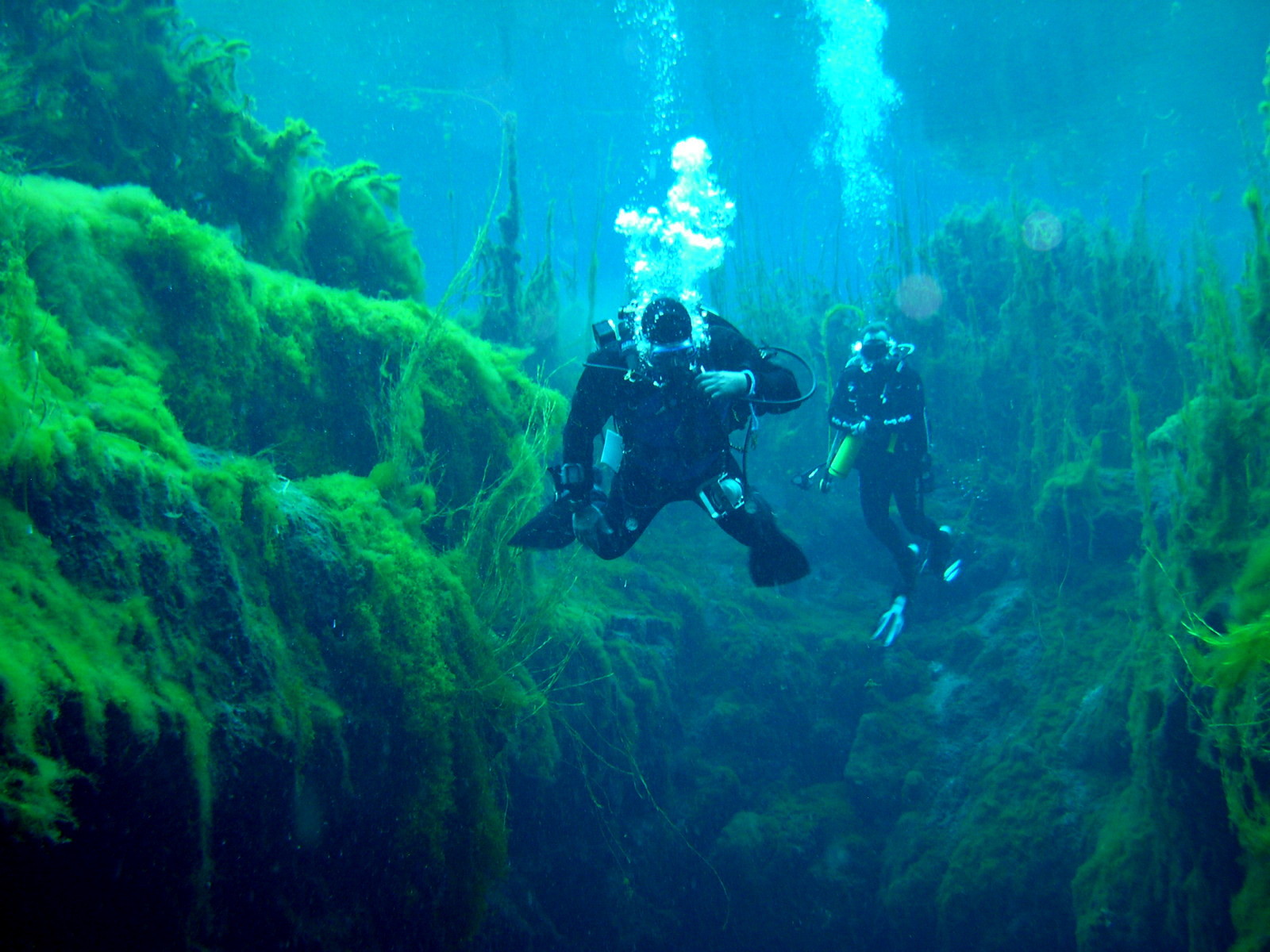
[edit]Piccaninnie Ponds is a popular site for both snorkelling and cave diving. In 1964–1965, prior to its proclamation as a national park in 1969, underwater explorer Valerie Taylor described the ponds as "one of the most beautiful sights in Australia"[11] and said that the crystal clear water gave her a feeling of unhindered flight.[12] It contains three main features of interest to cave divers. The ‘First Pond’ is an open depression about 10 metres (33 ft) deep with a silt floor and vegetated fringe supporting much aquatic life. The ‘Chasm’ is a sinkhole with a depth of over 100 metres (330 ft), and the ‘Cathedral’ is an enclosed area with limestone formations and a depth of about 35 metres (115 ft).[7] Underwater visibility is excellent and may exceed 40 metres (130 ft). Snorkelling and cave diving at Piccaninnie Ponds is by permit only.[13][14]
Accidents
[edit]Several divers have died while exploring the caves beneath Piccaninnie Ponds, in 1972,[15] 1974[16] and 1984.[17]
Flora and fauna
[edit]Piccaninnie Ponds contains a number of rare and endangered species of native plants and animals including fish, crustaceans and tortoises.[18][14]
See also
[edit]- Ewens Ponds – Flooded sinkholes in South Australia
- List of Ramsar sites in Australia
- List of sinkholes of Australia – Links to Wikipedia articles on sinkholes, blue holes, dolines, cenotes, and pit caves
- Protected areas of South Australia – Areas protected by legislation in South Australia
- Lower South East Marine Park – Protected area in South Australia
References
[edit]- ^ "Terrestrial Protected Areas of South Australia (refer 'DETAIL' tab )". CAPAD 2016. Australian Government, Department of the Environment (DoE). 2016. Retrieved 21 February 2018.
- ^ "Protected Areas Information System – reserve list (as of 11 July 2016)" (PDF). Department of Environment Water and Natural Resources. 11 July 2016. Retrieved 14 July 2016.
- ^ DeGaris, R.C. (16 October 1969). "NATIONAL PARKS ACT, 1966: HUNDRED OF CAROLINE: PICCANINNIE PONDS NATIONAL PARK DECLARED" (PDF). The South Australian Government Gazette. Government of South Australia. p. 1268. Retrieved 17 January 2019.
- ^ "Piccaninnie Ponds Karst Wetlands". Ramsar Sites Information Service. Retrieved 25 April 2018.
- ^ South Australia. National Parks and Wildlife Service. South East District; Sutherland, Andrea; South Australia. National Parks and Wildlife Service (1992), Piccaninnie Ponds Conservation Park management plan, South East, South Australia (PDF), Dept. of Environment and Planning, pp. 2–3, ISBN 978-0-7308-2663-7
- ^ "Search result for 'Piccaninnie Ponds Conservation Park' (Record no SA0054911) with the following layers selected – "Suburbs and Localities" and "Place names (gazetteer)"". Property Location Browser. Government of South Australia. Archived from the original on 12 October 2016. Retrieved 1 September 2016.
- ^ a b "Piccaninnie Ponds – 5L072". Richard "Harry" Harris. Archived from the original on 11 February 2012. Retrieved 9 October 2013.
- ^ "IBA: Discovery Bay to Piccaninnie Ponds". Birdata. Birds Australia. Retrieved 18 June 2011.
- ^ Peddie, Clare. "Piccaninnie Ponds now a wetland world wonder". The Advertiser. Retrieved 24 January 2013.
- ^ Limestone Coast brochure
- ^ "PICCANINNY PONDS". Australian Women's Weekly. 18 August 1965. p. 8. Retrieved 9 September 2017.
- ^ "Underwater Actress". Australian Women's Weekly. 15 July 1964. p. 10. Retrieved 9 September 2017.
- ^ "Piccaninnie Ponds – Cave Diving & Snorkelling Permits, Mount Gambier". Mount Gambier Point. 24 August 2016. Retrieved 8 September 2017.
- ^ a b "Piccaninnie Ponds | 50 Great Dives". 50greatdives.com. Retrieved 9 September 2017.
- ^ "Scuba man dies in cave". The Canberra Times. 31 January 1972. p. 3. Retrieved 9 September 2017.
- ^ "Diving accident". The Canberra Times. 24 December 1974. p. 3. Retrieved 9 September 2017.
- ^ "Bodies of cave divers recovered". The Canberra Times. 10 April 1984. p. 8. Retrieved 9 September 2017.
- ^ "Piccaninnie Ponds". Cave Divers Association of Australia. 13 December 2010. Retrieved 9 September 2017.
Further reading
[edit]- Horne, P.; (1985), CDAA Research Group Report No. 3: Piccaninnie Ponds Mapping Project, November 1984 – April 1985 (ISBN 0 7316 7208 9) OCLC: 27574762.
- Horne, P; and Harris, R.; (2009), Piccaninnie Ponds Collaborative Research Project: Exploration and General Research Activities, May/June 2008 and Oct/Nov 2009 (with South Australian Department of Water, Land and Biodiversity Conservation (DWLBC) and the South Australian Department for Environment and Heritage (DEH)).
External links
[edit]- Piccaninnie Ponds Conservation Park official webpage
- Ponds Conservation Park Diving and Snorkelling Guidelines (PDF download)
- Piccaninnie Ponds Conservation Park webpage on protected planet


