Hubbry Logo
USCGC DuaneUSCGC DuaneMain
Open search
USCGC Duane
Community hub
USCGC Duane
logo
8 pages, 0 posts
0 subscribers
Be the first to start a discussion here.
USCGC Duane
USCGC Duane
from Wikipedia
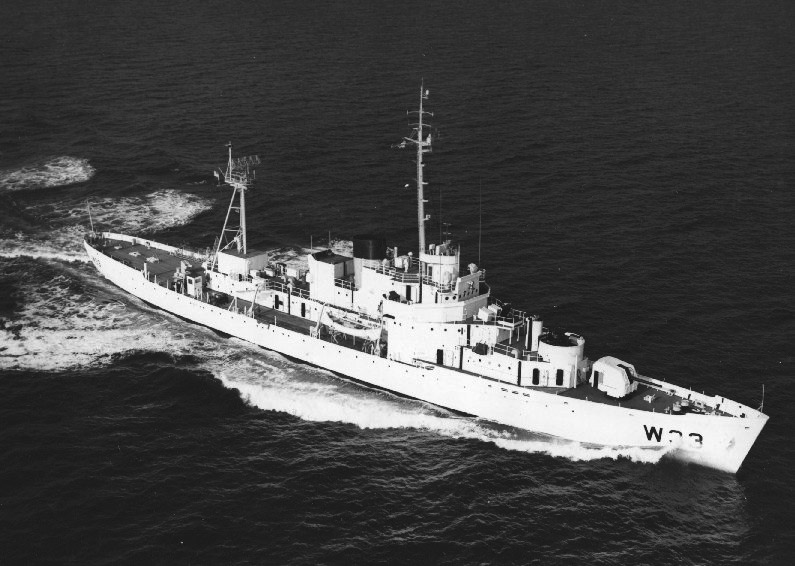
USCGC Duane underway in the early 1960s
USCGC Duane under way in the early 1960s
History
United States
NameUSCGC Duane (WPG-33)
NamesakeWilliam J. Duane
BuilderPhiladelphia Navy Yard, Pennsylvania
Cost$2,468,460
Yard numberCG-67
Laid down1 May 1935
Launched3 June 1936
Commissioned1 August 1936
Decommissioned1 August 1985
IdentificationCall sign: NRDD
Fate
General characteristics [1]
Class & typeTreasury-class cutter
Displacement2,350 long tons (2,388 t)
Length327 ft (100 m)
Beam41 ft (12 m)
Draft12 ft 6 in (3.81 m)
Propulsion
  • 2 × Westinghouse double-reduction geared turbine engines, 6,200 shp (4,623 kW)
  • 2 × Babcock & Wilcox sectional express, air-encased, 400 psi, 200° superheat boilers
  • 2 × 9 ft (2.7 m) three-bladed propellers
Speed20.5 knots (38.0 km/h; 23.6 mph)
Range8,000 nmi (15,000 km; 9,200 mi) at 11 kn (20 km/h; 13 mph)
Complement
  • 1937: 123 (12 officers, 4 warrants, 107 enlisted men)
  • 1941: 223 (16 officers, 5 warrants, 202 enlisted men)
  • 1966: 147 (10 officers, 3 warrants, 134 enlisted men)
Electronic warfare
& decoys
  • 1942:
  • HF/DF
  • 1945:
  • SC-3 50 cm radar
  • SGa 10 cm radar
  • Mk.26 fire control radar
  • QC series sonar
  • 1966:
  • AN/SPS-29D radar
  • AN/SPS-52 radar
  • Mk.26 MOD 4 fire control radar
  • AN/SQS-11 sonar
Armament
Aircraft carried
USCGC Duane (WPG-33)
USCGC Duane is located in Florida
USCGC Duane
USCGC Duane is located in the United States
USCGC Duane
LocationMonroe County, Florida, USA
Nearest cityKey Largo
Coordinates25°0′25.98″N 80°20′47.22″W / 25.0072167°N 80.3464500°W / 25.0072167; -80.3464500
NRHP reference No.02000494[2]
Added to NRHPMay 16, 2002

USCGC Duane (WPG-33/WAGC-6/WHEC-33) (earlier known as the USCGC William J. Duane) was a cutter in the United States Coast Guard. Her keel was laid on May 1, 1935, at the Philadelphia Navy Yard, Philadelphia, Pennsylvania. She was launched on June 3, 1936, as a search and rescue and law enforcement vessel.

The Treasury-class Coast Guard cutters (sometimes referred to as the "Secretary" or 327-foot class) were all named for former Secretaries of the Treasury Department. The cutter Duane was named for William J. Duane, who served as the third Secretary of the Treasury to serve under President Andrew Jackson.

At the time of the Duane's decommissioning in 1985, she was the oldest active U.S. military vessel; the current oldest, the USCGC Eagle, was also built in 1936 for the German military, but only commissioned into U.S. service in 1946 after being ceded as a war reparation after World War II.

Ship history

[edit]

After fitting out, she departed the Philadelphia Navy Yard on October 16, 1936, and arrived at Oakland, California on November 24. She was then assigned to temporary duty in Honolulu, and arrived there on December 9, 1936, to participate in the U.S. colonization efforts of the Line Islands in the Pacific. Duane then returned to her permanent homeport of Oakland, arriving on February 25, 1937. For the next two years, she joined the Bering Sea Patrol Force for annual cruises of that area. In mid-1937 her name was shortened to merely Duane. In September 1939 she was assigned to duty with Destroyer Division 18, conducting neutrality patrols along the Grand Banks (these patrols were known as "Grand Banks Patrols"), as ordered by President Franklin Roosevelt. She departed Oakland on September 7, 1939, and arrived at her new homeport of Boston on September 22, 1939. Here she conducted four Grand Banks patrols, from October through December, 1939, completing her final patrol on January 12, 1940.

World War II

[edit]
USCGC Duane (WPG-33) off Greenland in 1940

Duane was then assigned to weather patrols in the mid-Atlantic, and also carried out a survey of the western coast of Greenland in mid-1940. In late 1940 she was fitted with additional armaments, receiving anti-aircraft and anti-submarine weapons. On 14 June 1941 she rescued 46 survivors from the British tanker Tresillian, which had been sunk by U-77. She was assigned to permanent duty with the U.S. Navy on 11 September 1941, and was designated WPG-33. On 1 April 1942 Duane was reassigned from weather patrols to convoy escort duty during the battle of the Atlantic.

Convoy Escort Group Dates Notes
SC 81 5 May 1942[3] Iceland shuttle
SC 83 17 May 1942[3] Iceland shuttle
ON 98 27–30 May 1942[4] Iceland shuttle
ON 102 14–17 June 1942[4] Iceland shuttle
SC 89 29 June 1942[3] Iceland shuttle
ON 112 14–17 July 1942[4] Iceland shuttle
SC 91 19 July 1942[3] Iceland shuttle
ON 116 25–29 July 1942[4] Iceland shuttle
ON 117 31 July-3 Aug 1942[4] Iceland shuttle
ON 120 9-14 Aug 1942[4] Iceland shuttle
SC 95 14 Aug 1942[3] Iceland shuttle
SC 99 12 Sept 1942[3] Iceland shuttle
ON 136 5-9 Oct 1942[4] Iceland shuttle
SC 103 10 Oct 1942[3] Iceland shuttle
ON 140 19-24 Oct 1942[4] Iceland shuttle
SC 105 25-26 Oct 1942[3] Iceland shuttle
ON 144 8-15 Nov 1942[4] Iceland shuttle
ON 148 25-27 Nov 1942[4] Iceland shuttle
HX 216 28 Nov-1 Dec 1942[5] Iceland shuttle
SC 110 1-2 Dec 1942[3] Iceland shuttle
ON 156 25-30 Dec 1942[4] Iceland shuttle
SC 114 [3] Iceland shuttle
SC 116 16-24 Jan 1943[3] Iceland shuttle
ON 163 26 Jan-3 Feb 1943[4] Iceland shuttle
HX 233 MOEF group A-3 12–20 April 1943[5] from Newfoundland to Northern Ireland

Duane was converted to a combined operations-communications headquarters ship in 1944. Upon completion, she was to have been taken over by the Navy and assigned the hull number AGC-6. However, this plan was dropped and she was retained for Coast Guard service (her designation then became WAGC-6). Duane was attached to the Eighth Amphibious Force in the Mediterranean Sea, and took part in "Operation Dragoon", the invasion of southern France, in August 1944. She remained in the Mediterranean until July 1945, when she returned to the United States and reverted to her previous designation WPG-33.

Post-war

[edit]

The ocean-weather station program was permanently established by multi-national agreement soon after the end of World War II. The Coast Guard was then assigned the duty of manning those stations for which the U.S. accepted responsibility. As the 327s completed conversion to ocean station vessels, each immediately deployed to their new stations. For most of the next twenty years, Duane and her sisters, except Taney which was stationed in the Pacific, alternated duty between weather stations "Charlie" (850 miles northeast of St. John's, Newfoundland), "Bravo" (250 miles northeast of Cape St. Charles, Labrador); "Delta" (located 650 miles southeast of Argentia, Newfoundland); and "Echo" (850 miles east northeast of Bermuda). Sometime later these became known simply as "ocean stations." Although the crew probably considered these patrols boring, they were important to the continued growth and safety of international over-water commercial air flights. On 1 May 1965 all the vessels in her class were re-classified as high endurance cutters and she was redesignated WHEC-33.

Vietnam and after

[edit]
USCGC Duane (WHEC-33) returning from Vietnam in 1968

On 4 December 1967 Duane was assigned to Coast Guard Squadron Three located off the coast of Vietnam, where she served as the flagship for Coast Guard squadron. Duane permanently departed Vietnamese waters on July 28, 1968. Duane then again returned to ocean station duty but this task was rapidly becoming obsolete. The stations were decommissioned in the early 1970s, having been overtaken by electronic aids to navigation such as LORAN. The mid-1970s were a period of transition for the Coast Guard with the passage of the Fisheries Conservation and Management Act and the nation's shift towards increased interdiction of narcotics smugglers. These operations called for off-shore patrols of up to three weeks.

Decommissioning and disposal

[edit]
The crow's nest of the Duane in March 2007

Duane left Coast Guard service and was decommissioned on August 1, 1985, as the oldest active U.S. military vessel and was laid up in Boston for the next two years.

Duane is now a historic shipwreck near Key Largo, Florida, United States. The cutter was deliberately sunk on November 27, 1987, to create an artificial reef. It is located a mile south of Molasses Reef. On May 16, 2002, it was added to the U.S. National Register of Historic Places.[2]

Decorations

[edit]

In media

[edit]
  • "People Who Make a Difference," a 1991 episode of the PBS television series Return to the Sea, includes footage of a dive on the wreck of Duane.

References

[edit]
[edit]
Revisions and contributorsEdit on WikipediaRead on Wikipedia
from Grokipedia
USCGC Duane (WHEC-33) was a 327-foot Treasury-class cutter of the , built at the Navy Yard and commissioned on August 1, 1936, after her keel was laid on May 1, 1935, and launched on June 3, 1936. Named for William J. Duane, a Secretary of the Treasury under President , she displaced 2,350 tons on trials and 2,750 tons fully loaded, with a length of 327 feet, powered by geared turbines producing 6,200 horsepower for a speed of 19.5 knots. Originally equipped with two 5-inch/51-caliber guns, depth charges, and anti-aircraft weaponry, Duane underwent modifications over her career to support diverse missions, including escort, weather patrol, , and . She served for 49 years until her decommissioning on August 1, 1985, and was subsequently sunk on November 27, 1987, as an off , within the National Marine Sanctuary, where she now rests upright at 120 feet depth as a popular dive site and habitat for marine life. During her early service from 1936 to 1939, Duane was based in , conducting operations and supporting expeditions such as the colonization of in the Pacific, while in 1937 she provided radio support for Amelia Earhart's around-the-world flight attempt. Transferred to in 1939 amid rising tensions in , she participated in Neutrality Patrols and, following the U.S. entry into in 1941, escorted convoys in the North Atlantic, where she rescued 46 survivors from the torpedoed SS Tresillian on 14 June 1941. One of her most notable achievements came on April 17, 1943, when Duane depth-charged and sank the northwest of ; over the course of the war, she conducted weather patrols, served as an amphibious force flagship during in in 1944, and participated in rescues totaling 346 survivors across her career. In the post-war era, redesignated WHEC-33 in 1965, Duane maintained ocean weather stations from 1946 to 1976, relocated to Portland, Maine, in 1972 for training and search and rescue duties, and supported the Vietnam War effort from 1967 to 1968 as part of Operation Market Time, providing naval gunfire support off South Vietnam. Later assignments included drug interdiction patrols from 1978 to 1985 and aiding the Mariel boatlift by escorting Cuban refugees in 1980. Recognized for her intact representation of 1930s cutter design and pivotal role in the Battle of the Atlantic, Duane was listed on the National Register of Historic Places in 2002 as nationally significant in military history and maritime architecture, now functioning as an underwater museum that enhances biodiversity in the sanctuary.

Design and description

Specifications

The USCGC Duane (WPG-33), a Treasury-class cutter, featured a trial displacement of 2,350 long tons (2,388 t) and a full load displacement of 2,750 long tons (2,792 t), reflecting her robust construction for extended operations. Her dimensions included an overall length of 327 ft (99.7 ), a beam of 41 ft (12.5 ), and a mean draft of 12 ft 6 in (3.81 ), providing stability in heavy seas typical of her multi-mission role. Propulsion was provided by two oil-fired Babcock & Wilcox boilers supplying steam to two Westinghouse geared steam turbines generating 5,250 shp (3,917 kW) standard, later increased to 6,200 shp (4,623 kW), which drove twin propellers to achieve a maximum speed of 20.5 knots (38.0 km/h; 23.6 mph) and an economical range of 8,000 nmi (15,000 km; 9,200 mi) at 11 kn (20 km/h; 13 mph). Fuel capacity was 135,180 US gallons (511,000 L). In wartime configuration, Duane carried a complement of 223 personnel, comprising 16 officers, 5 warrant officers, and 202 enlisted members, enabling sustained operations across diverse environments. Initial sensors included a high-frequency direction-finding (HF/DF) radio set for navigation and detection, with radar systems incorporated later to enhance situational awareness during patrols. Duane was based on the U.S. Navy's Erie-class gunboats, with identical machinery and hull below the waterline, and featured the distinctive "Hunnewell Hump" sheer forward and deck slope designed by Commander F. G. Hunnewell. She included facilities for a JF-2 in a aft for and . As one of the Treasury-class vessels, Duane was engineered specifically for search-and- missions and maritime law enforcement, marking her as the largest and most advanced cutter in the U.S. inventory upon commissioning in 1936.

Armament and modifications

Upon commissioning in 1936, USCGC Duane was armed with two single-mount 5"/51 caliber guns for primary surface and anti-aircraft fire, supplemented by two 6-pounder guns and one 1-pounder gun for close-range defense. The cutter also featured facilities for a JF-2 to support reconnaissance and rescue operations, reflecting its multi-role design for peacetime duties. As tensions escalated toward World War II, Duane underwent significant rearmament in 1939–1941 to prepare for convoy escort and anti-submarine roles, adding one additional 5"/51 gun (bringing the total to three), three 3"/50 caliber guns, four .50 caliber machine guns, two depth charge racks, and one Y-gun projector for anti-submarine warfare. By 1943, further modifications included reducing the main battery to two 5"/51 guns, increasing to four 3"/50 guns and two single 20 mm/80 caliber anti-aircraft mounts, installing a Hedgehog forward-throwing anti-submarine mortar, and equipping six K-gun depth charge projectors alongside the existing racks. In 1944–1945, during conversion to a combined operations-communications command ship (WAGC-6), anti-aircraft defenses were bolstered with up to 14 40 mm/60 caliber guns (in twin and quad mounts) and eight 20 mm/80 mounts while retaining two 5"/38 caliber guns; electronic upgrades added SC-3 and SG surface search radars, Mk 26 fire-control radar, QC-series sonar, and a British HF/DF direction finder. These changes enabled Duane to serve in a dual gunboat capacity, supporting invasions like Operation Dragoon. Post-war reconversion in 1946 reduced armament for ocean station patrols, retaining one 5"/38 caliber gun, one twin 40 mm/60 mount, eight single 20 mm/80 mounts, and mortar, with most gear removed. By the mid-1950s, Duane reverted to configuration (WPG-33) with further streamlining, emphasizing the single 5-inch gun for and search-and-rescue. In preparation for Vietnam War deployment, Duane received upgrades in 1965–1966, redesignated as a high-endurance cutter (WHEC-33), with the 5"/38 gun paired to an Mk 52 Mod 3 director, the Hedgehog retained, two Mk 32 Mod 5 triple torpedo tubes (port and starboard) loaded with four Mk 44 Mod 1 torpedoes for ASW, two .50 caliber Mk 2 machine guns for boarding and defense, and two Mk 13 high-altitude parachute flare mortars. Electronic enhancements included AN/SPS-29D navigation radar, AN/SPA-52 surface search radar, Mk 26 Mod 4 fire-control radar, and AN/SQS-11 sonar, allowing sustained gunfire support roles without major structural alterations. These modifications underscored Duane's adaptability as a gunboat, firing 1,778 5-inch rounds across 17 missions during coastal patrols.

Construction and commissioning

Building process

The construction of USCGC Duane (WHEC-33), originally named William J. Duane, was part of the Coast Guard's Treasury-class cutter program, designed to enhance the service's capabilities in , , and ocean patrols following the end of . The keel for the vessel, assigned builder's number CG-67, was laid down on May 1, 1935, at the Philadelphia Navy Yard in Philadelphia, Pennsylvania. This yard, a key naval facility, constructed four of the seven cutters in the class, leveraging its expertise in large-scale steel shipbuilding to meet the Coast Guard's evolving mission requirements. The cutter was named in honor of William J. Duane, who served as Secretary of the Treasury from 1833 to 1837 under President , recognizing his contributions to federal financial policy during a formative period for the nation's maritime enforcement agencies. Funding for the Treasury-class program stemmed from congressional appropriations in the mid-1930s, with each cutter costing approximately $2.5 million to build, reflecting an emphasis on durable, multi-mission vessels capable of extended operations. Construction prioritized endurance for long-distance patrols, incorporating a riveted hull to withstand harsh sea conditions and support the cutters' roles in remote oceanic duties. This riveted design, while robust, later presented maintenance challenges but ensured the class's longevity in service.

Launch and early operations

The USCGC Duane (WPG-33), a Treasury-class cutter, was launched on 3 June 1936 at the Navy Yard in , sponsored by Ms. Mai Duane. The vessel's christening marked a key milestone in the Coast Guard's expansion of its high-endurance fleet for post-Prohibition missions, including , , and oceanographic surveys. Following launch, Duane underwent fitting out at the Philadelphia Navy Yard, where initial armament, radios, and other equipment were installed to prepare her for multi-role operations. She was commissioned into service on 1 August 1936, becoming the first of the seven Treasury-class cutters to enter active duty. Crew training during this period emphasized the vessel's versatile capabilities, from patrolling remote waters to supporting with onboard aircraft facilities. After fitting out, Duane departed Philadelphia on 16 October 1936 for her shakedown cruise along the Atlantic coast, testing systems and conducting initial drills en route to her permanent station. She transited the Panama Canal and stopped in Honolulu before arriving at Oakland, California, on 24 November 1936, where she assumed early duties in search and rescue and law enforcement along the Pacific coast. Upon arrival, the cutter briefly conducted temporary operations in Hawaiian waters, including supply deliveries to remote islands, before integrating into routine patrols.

Service history

Pre-World War II patrols

Following the outbreak of war in Europe in September 1939, USCGC Duane was transferred from her West Coast station to Boston, Massachusetts, and assigned to Destroyer Division 18 for neutrality patrols along the eastern seaboard and off the Grand Banks. Departing Oakland, California, on 7 September, she arrived in Boston on 22 September and immediately commenced operations to monitor shipping lanes, protect neutral commerce, and report potential belligerent activities in accordance with U.S. neutrality proclamations. From October through December 1939, Duane conducted four intensive Grand Banks patrols, extending into the North Atlantic to shadow European war-related shipping while avoiding direct involvement. These missions, completed with her final patrol ending on 12 January 1940, emphasized surveillance and reporting to safeguard U.S. interests without escalating tensions. In preparation for expanded roles, Duane received modifications in 1939, including additional armament such as depth charges and anti-aircraft guns, to enhance her readiness for potential escort duties. With the Grand Banks patrols concluded on 27 January 1940, Duane shifted to the Atlantic Weather Observation Service, joining on 25 January and embarking on her first 21-day patrol from on 31 January. Assigned primarily to Ocean Stations No. 1 (35°38'N, 53°21'W) and No. 2 (37°44'N, 41°13'W), she maintained a fixed position within designated 10-mile-square areas, deploying meteorologists to transmit critical data via radio for transatlantic and forecasting. These patrols, often in harsh North Atlantic conditions, supported the growing demands of commercial and air routes by providing real-time observations of storms, winds, and visibility. Throughout 1941, Duane continued her weather patrols while tensions escalated toward U.S. involvement in the war. On 14 June, during routine operations, she responded to a distress call and rescued all 46 survivors from the torpedoed British tanker SS Tresillian, coordinating with U.S. Navy flying boats to locate and retrieve the crew from lifeboats in the mid-Atlantic. By mid-1941, in collaboration with sister cutter USCGC Bibb, Duane helped formalize the ocean station program on 12 June, patrolling routes between the and to bolster meteorological coverage amid increasing threats. These pre-war efforts transitioned Duane toward active convoy escort roles following the U.S. entry into in December 1941.

World War II operations

Following the ' entry into , USCGC Duane was assigned to permanent duty with the U.S. on September 11, 1941, and in April 1942 joined Escort Division 45 (CortDiv 45) for transatlantic convoy operations in the North Atlantic. As part of the Mid-Ocean Escort Force based in , Duane escorted multiple convoys, including SC-83 in May 1942 and ONSJ-102 in June 1942, conducting antisubmarine patrols and attacks against suspected contacts to protect vital supply lines from German wolfpack tactics. These missions marked Duane's transition from pre-war neutrality patrols to active combat, where it served as flagship for Commander CortDiv 45, coordinating escort groups amid heavy seas and constant threats. On April 17, 1943, while escorting convoy HX-233 in the North Atlantic southwest of , Duane and sister cutter USCGC Spencer engaged and sank the German Type IXC U-175 in the first confirmed kill by a U.S. cutter. The action began when Spencer's crew sighted the surfaced and opened with its 5-inch/51-caliber guns, forcing U-175 to dive; Duane joined with mortar attacks and depth charges, contributing to the U-boat's destruction after a prolonged hunt that inflicted severe damage and led to its scuttling. Of U-175's 54-man crew, 13 were killed, including Heinrich Bruns; Duane rescued 22 survivors, including several officers, who were taken prisoner and transferred to British authorities in Newfoundland. Throughout 1943 and 1944, Duane continued North Atlantic convoy escorts, such as UGS-9 in , while participating in additional antisubmarine actions, including attacks on contacts on February 9 and September 17, 1943. The cutter also conducted rescues from torpedoed merchant vessels, contributing to a total of 346 survivors saved from four ships across its wartime operations, including 46 from the British tanker SS Tresillian in and support for survivors of the USAT Dorchester in February 1943 using breeches buoys and cargo nets amid rough weather. These efforts highlighted Duane's dual role in combat and humanitarian missions during the . In August 1944, after conversion to an (WAGC-6), Duane transferred to the Mediterranean and served as flagship for the Eighth Amphibious Force during , the Allied invasion of on August 15. Arriving off the coast nine minutes ahead of schedule, Duane guided (LCT) Convoy SS-1B to Red and Yellow Beaches near , provided from its headquarters facilities, and fired its 5-inch guns in against shore defenses to aid the landings of U.S. and French forces. For its contributions in the Atlantic convoys, Duane was awarded the Presidential Unit Citation, recognizing its role in protecting vital merchant shipping.

Post-war ocean stations

Following World War II, the USCGC Duane reverted to its peacetime configuration by July 1945 and was assigned to ocean weather patrol duties in the North Atlantic, a critical role in supporting meteorological observations for the U.S. Weather Bureau. These patrols involved maintaining fixed positions to relay weather data essential for safe transatlantic aviation and maritime navigation, as well as serving as platforms for (SAR) operations. From 1945 to 1965, Duane rotated through several designated ocean stations, including Charlie (approximately 850 miles northeast of St. John's, Newfoundland), Bravo (250 miles northeast of Cape St. Charles, Labrador), Delta (650 miles southeast of ), and (1,000 miles east of New York). Typical deployments lasted 21 days per station, with Duane conducting multiple rotations annually; examples include Ocean Station Charlie from May 11 to June 5, 1946, and January 10 to 29, 1947, Ocean Station Delta from January 16 to February 6, 1954, Ocean Station from February 6 to 27, 1953, and Ocean Station Bravo from April 8 to 29, 1955. By the early 1960s, assignments continued, such as Delta from May 28 to June 19, 1960, and Bravo from September 19 to October 9, 1960. These stations covered vast areas of rough seas, often described as "44,000 square miles of bad weather," where Duane provided radio beacons, storm warnings, and positioning assistance for aircraft and ships crossing the Atlantic. During these patrols, Duane participated in several SAR missions amid harsh North Atlantic conditions. A notable event occurred on May 3–4, 1957, when Duane rescued all 28 crew members from the distressed Danish freighter SS Bornholm during a severe on Ocean Station Charlie. In the and early , Duane also maintained standby duties, often basing in to support transatlantic flights, which involved monitoring distress signals and coordinating with aircraft. To enhance these capabilities, Duane underwent modifications in the for operations, aligning with the Coast Guard's adoption of Sikorsky HO4S-2G helicopters for SAR, enabling quicker survivor retrieval in remote ocean areas. On May 1, 1965, Duane was redesignated as a high-endurance cutter (WHEC-33), reflecting its multi-mission role in extended patrols of 30–45 days at sea, including oceanographic and tasks. Over its ocean station service through the mid-1960s, Duane logged extensive mileage on these routines, exceeding 68,000 miles by 1968, contributing to broader oceanographic data collection that informed and .

Vietnam War deployment

In December 1967, the USCGC Duane (WHEC-33) deployed to the waters off as part of , a U.S. Navy-coordinated effort to interdict seaborne infiltration of personnel and supplies from to forces in the south. Assigned to Coast Guard Squadron Three on December 4, she served as the squadron's flagship, homeported at in the following three weeks of training at Guantanamo Bay, . During her tour, which lasted until her departure from on July 28, 1968, Duane conducted four extended patrols along 's 1,000-mile coastline, each lasting approximately three weeks and totaling 111 days at sea. These patrols focused on surveillance and interdiction, during which the cutter boarded 32 vessels and inspected 388 steel-hulled ships and 5,211 wooden-hulled craft for contraband, while one high-endurance cutter from the squadron, including periods involving Duane, operated in the to provide direct support to ground troops. A key aspect of Duane's service involved for U.S. and South Vietnamese forces ashore, marking her only major combat deployment since . Her 5-inch/51-caliber main battery fired a total of 1,778 rounds across 17 separate shore bombardments, delivering 17 tons of high explosives that destroyed enemy positions including 29 bunkers and structures. On her first patrol, commencing shortly after arrival, Duane engaged targets for 30 minutes with 70 rounds, eliminating one command post, five bunkers, two tunnels, and 36 foxholes. Additional missions targeted troop concentrations and infiltration routes, such as a July 4, 1968, bombardment in the Bo De River area that marked her 1,776th round fired. These operations underscored Duane's role in supporting amphibious and ground actions, with the cutter also serving briefly as a U.S. station ship in in March 1968. Beyond combat duties, Duane's crew contributed to humanitarian efforts, with the onboard medical team treating over 300 civilians in fishing villages such as Co Phu and Pho Tu. The deployment covered 68,000 nautical miles over 226 underway days, culminating in an 8,800-mile final patrol before Duane returned to the in August 1968. As a 1936-commissioned vessel, Duane was the oldest active U.S. military ship in the Vietnam theater during her service, and her operations in inland waterways and coastal areas exposed the crew to herbicide, qualifying them for VA presumption of exposure.

Final patrols and decommissioning

Following her return from Vietnam in 1969, USCGC Duane resumed ocean station duties, conducting weather patrols, operations, , and fisheries protection in the North Atlantic until the early . By 1972, she was homeported in , where she remained based until the end of her active service, shifting focus to enforcing fisheries regulations within the newly established 200-mile (EEZ), officer training missions, and serving as a research platform for the National Oceanic and Atmospheric Administration's programs. In the 1970s and 1980s, Duane played a key role in narcotics interdiction patrols throughout the , including operations off and in waters, where her crew conducted numerous boardings. Notable successes included the 1978 seizure of the vessel carrying 9 tons of marijuana, the 1982 interception of BP-25 with 30 tons, and the 1983 boarding of Civonney yielding 60 tons, contributing to over 59 tons of marijuana confiscated between 1982 and 1983 alone. She also supported the 1980 Mariel boatlift by escorting vessels carrying Cuban refugees to the United States and conducted training cruises for Coast Guard Academy cadets, such as the 1982 voyage that resulted in two major drug seizures. Duane was decommissioned on August 1, 1985, at , after 49 years of continuous service, marking her as the oldest active U.S. military vessel at the time. She was then transferred to the Coast Guard's inactive and laid up in .

Post-decommissioning

Sinking as artificial reef

Following its decommissioning on August 1, 1985, in , Massachusetts, the USCGC Duane was selected between 1985 and 1987 for Florida's program due to its substantial size and storied service history, making it an ideal candidate for creating a large-scale . The cutter was donated to the Keys Association of Dive Operators (KADO), which coordinated the effort as part of a broader initiative to enhance underwater ecosystems and recreational diving opportunities in the . The total cost for acquiring, preparing, and sinking the Duane—along with its , the USCGC Bibb—was approximately $300,000, funded in part by the Monroe Tourist Development . Preparation for the sinking involved extensive modifications to ensure environmental safety and diver accessibility. In , the vessel was stripped of hazardous materials, including fuel, oils, and contaminants, while non-skid deck coatings and other potential pollutants were removed to minimize ecological impact. Crews cut large openings in the hull and , removed doors above the main deck and certain hatches, and sealed the hull temporarily to facilitate controlled . These alterations transformed the 327-foot (100 m) cutter into a stable, upright structure suitable for formation. Once prepared, the Duane was towed from to the designated site off . On November 27, 1987—the day after —the Duane was positioned approximately one mile south of Molasses Reef and anchored in place at coordinates 24°59.38′N 80°22.92′W. Divers then opened the seacocks and remaining hatches, allowing seawater to flood the interior; the cutter settled upright on a sandy bottom in 120 feet (37 m) of water without listing or capsizing, as intended. This marked the Duane as the first major U.S. cutter intentionally sunk to form an in the , providing a significant addition to the region's . Within months of sinking, initial marine growth—including , sponges, and small corals—began colonizing the structure, signaling the onset of its transformation into a thriving .

Legacy as dive site

Since its intentional sinking in 1987, the USCGC Duane has evolved into a thriving within the National Marine Sanctuary, fostering a diverse . The wreck supports abundant reef fish, colorful , and large predators such as goliath groupers and , which aggregate around its structure for shelter and hunting. This ecological enhancement contributes to the sanctuary's , with the ship's hull and protrusions providing substrates for coral growth and invertebrate colonization, thereby improving local water quality and juvenile fish habitats. The Duane has been a premier advanced dive site since 1988, attracting experienced divers to its upright structure at depths ranging from 60 to 120 feet. Features like swim-throughs in the hull, bridge, and propeller areas offer multilevel exploration, though strong currents and penetration risks require advanced open-water certification or wreck specialty training. The site draws thousands of visitors annually, drawn to its intact features and vibrant marine life, with mooring buoys facilitating safe access from Key Largo dive operators. Preservation efforts underscore the Duane's status as a protected historic wreck, listed on the (NRHP #02000494) on May 16, 2002, ensuring federal safeguards against disturbance. Sanctuary regulations prohibit artifact removal and establish no-touch zones around sensitive historical elements, such as WWII-era gun mounts, to maintain archaeological integrity. In September 2020, divers from Rainbow Reef Dive Center conducted a cleanup as part of the International Coastal Cleanup, removing trash to protect the site's ecosystem. Recent developments from 2020 to 2025 highlight ongoing stewardship amid environmental challenges. Dive centers like Rainbow Reef reported excellent visibility and marine activity in 2024, with conditions supporting photography of the wreck's relics, including its preserved 5-inch guns. Following Hurricane Irma's minor impacts in 2017—such as the removal of the top section of a smokestack—the has implemented continuous monitoring for structural integrity and coral health, with recovery efforts ensuring the site's resilience through 2025.

Awards and decorations

Combat awards

The USCGC Duane received the Presidential Unit Citation for its distinguished service in protecting Atlantic convoys and for its role in sinking the on April 17, 1943, in collaboration with the USCGC Spencer. This award recognized the cutter's effective efforts during a critical period of escort operations from 1942 to 1943. For its pre-war and early wartime patrols, including neutrality enforcement and weather station duties beginning in 1939, the Duane was awarded the with the "A" device, denoting active campaign participation. The cutter also earned the European-African-Middle Eastern Campaign Medal with four battle stars for its contributions to operations in the European and North African theaters, including convoy escorts and support for the Invasion of () on August 15, 1944. These stars highlighted key engagements such as anti-submarine patrols, amphibious assault coordination, and Mediterranean theater actions. Duane further received the , , Asiatic-Pacific Campaign Medal with four battle stars, , Philippine Presidential Unit Citation, and with two battle stars for its service.

Service commendations

During her post- service, USCGC Duane earned the with two battle stars for her deployment from 1967 to 1968, recognizing participation in coastal patrols and 17 naval gunfire support missions providing bombardment against enemy positions. The cutter received the Meritorious Unit Commendation with Gallantry Cross with Palm for her Vietnam operations, which included interdiction duties, medical assistance to allied forces, and humanitarian efforts amid combat conditions. Duane was awarded the Republic of Vietnam Campaign Medal for her service in Southeast Asia. In recognition of her extensive ocean station patrols from 1946 to 1976, Duane contributed to search-and-rescue and weather reporting in the Atlantic. Later patrols included drug interdictions, such as the 1981 interception of a vessel carrying 200,000 pounds of marijuana during Operation Tiburon. Overall, Duane accumulated numerous service awards, underscoring her sustained role in peacetime operations emphasizing endurance, , and international cooperation. Additional post-war awards include the and with one star.

Documentary appearances

The USCGC Duane has appeared in several historical and educational documentaries that highlight its service record and legacy. In the 1968 U.S. promotional film The Eighth Mission, archival footage of the cutter is featured during segments illustrating operations, including efforts at sea. A rare color photograph of the Duane conducting shelling off the coast in 1967 has been used in educational materials on contributions to the , offering insight into its combat operations under .

Other media references

The USCGC Duane has been featured in official U.S. historical publications, including the series The at , particularly Volume V: Transports and Escorts, which details its convoy escort duties and role in the sinking of the alongside the USCGC Spencer. This series, produced by the U.S. Public Information Division, provides primary accounts of the cutter's contributions to transatlantic operations. Additionally, the vessel appears in later compilations such as Robert Scheina's The at (1997), which expands on its wartime service in the North Atlantic. In dive literature, Duane is documented as a prominent artificial reef site in guides focused on Florida shipwrecks, highlighting its post-decommissioning role in and . The cutter's legacy as an has been covered in mainstream publications, such as the article "Relics to Reefs" (2011), which describes how the intentionally sunk Duane off attracts schools of smallmouth grunts and supports , while noting concerns about artificial structures drawing fish from natural habitats. More recent coverage includes a 2019 piece on shipwrecks aiding adaptation to , referencing Duane as an example of a WWII-era vessel now functioning as habitat. Contemporary dive blogs in 2024 have revisited Duane's WWII relics, emphasizing its historical significance as a Treasury-class cutter that participated in protections and hunts. For instance, a May 2024 post from Lancaster Scuba explores the wreck as a dive site offering insights into its and service, surrounded by vibrant marine life. Similarly, an October 2024 blog by Dive Center recounts a personal dive experience, underscoring the site's intact WWII-era features like gun mounts and its role in preserving underwater history. Digital media extends Duane's reach through popular dive videos, which showcase underwater explorations of the wreck and have collectively garnered hundreds of thousands of views. Examples include "Dive Adventure | 4 Wrecks in | USCG Duane, USCG Bibb, Spiegel, Benwood" (approximately 500,000 views as of November 2025) and various GoPro-filmed descents highlighting the site's structure and ecology.

References

  1. https://commons.wikimedia.org/wiki/File:USCGC_Duane_(WHEC-33)_shelling_targets_in_Vietnam_c1967.jpg
Add your contribution
Related Hubs
User Avatar
No comments yet.