


Community hub
Recent from talks
Contribute something
Nothing was collected or created yet.
Principality of Achaea
View on Wikipedia | This article needs additional citations for verification. (February 2019) |
The Principality of Achaea (/əˈkiːə/) or Principality of Morea was one of the vassal states of the Latin Empire, which replaced the Byzantine Empire after the capture of Constantinople during the Fourth Crusade.[1] It became a vassal of the Kingdom of Thessalonica, along with the Duchy of Athens, until Thessalonica was captured by Epirus in 1224. After this, Achaea became the dominant power in Greece, lasting continuously for 227 years and cumulatively for 229.
Key Information


Foundation
[edit]Achaea was founded in 1205 by William of Champlitte and Geoffrey I of Villehardouin, who undertook to conquer the Peloponnese on behalf of Boniface of Montferrat, King of Thessalonica. With a force of no more than 100 knights and 500 foot soldiers, they took Achaea and Elis, and after defeating the local Greeks in the Battle of the Olive Grove of Koundouros, they became masters of the Morea. The victory was decisive, and after the battle, all resistance from the locals was limited to a few forts that continued to hold out. The fort of Araklovon[2] in Elis was defended by Doxapatres Boutsaras and withstood the attacks until 1213, when the garrison finally surrendered. The fort of Monemvasia, and the castles of Argos, Nauplia and Corinth under Leo Sgouros held out until his suicide in 1208. By 1212, these too had been conquered, and organized as the lordship of Argos and Nauplia, and only Monemvasia continued to hold out until 1248. William of Champlitte ruled Achaea until he departed for France to assume an inheritance, but died on the way there in 1209. He was succeeded by Geoffrey I of Villehardouin, who ruled until his own death in 1219.
Organization of the Principality
[edit]Territorial organization and feudal structure
[edit]
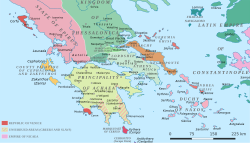
Achaea was rather small, consisting of the Peloponnese peninsula (then known as the Morea), but it was fairly wealthy, exporting wine, raisins, wax, honey, oil and silk. The capital of the principality was originally at Andravida. It was bordered on the north by Epirus and the Duchy of Athens and surrounded by Venetian-held territories in the Aegean Sea, including the forts of Modon and Coron on the Peloponnese.
In 1208/9, after Champlitte's departure, William I created a commission, composed of two Latin bishops, two bannerets and five Greek magnates and chaired by himself, to assess the land and divide it, according to Latin practice, in fiefs. The resulting register was presented at a parliament held at the princely residence at Andravida, and divided the country into twelve baronies, mostly centred around a newly constructed castle—a testament to the fact that the Franks were a military elite amidst a potentially hostile Greek population.[3][4] The twelve temporal barons were joined by seven ecclesiastic lords, headed by the Latin Archbishop of Patras. Each of the latter was granted a number of estates as knightly fiefs, with the Archbishop receiving eight, the other bishops four each, and likewise four granted to each of the military orders: the Templars, Hospitallers and the Teutonic Knights.[5] The twelve secular baronies were:[6][7]
| Barony | Fiefs | Territory | First holder |
|---|---|---|---|
| Akova (Mattegrifon) | 24 | Arcadia | Walter of Rosières |
| Karytaina (Chabron) | 22 | Skorta | Renaud of Briel |
| Patras | 24 | N. Achaea | William Aleman |
| Passavant (Passava) | 4 | Mani Peninsula | John of Nully |
| Vostitsa | 8 | E. Achaea | Hugh I of Charpigny |
| Kalavryta | 12 | SE. Achaea | Otho of Tournay |
| Chalandritsa | 4 (later 8) | S. Achaea | Audebert of la Trémouille |
| Veligosti | 4 | S. Arcadia | Matthew of Mons |
| Nikli | 6 | S. Arcadia | William of Morlay |
| Geraki | 6 | E. Laconia | Guy of Nivelet |
| Gritzena | 4 | SE. Messenia | Luke |
| Kalamata | - | S. Messenia | William I of Villehardouin |
Shortly after 1260, a thirteenth barony, that of Arcadia (modern Kyparissia) was established, which was also a personal fief of the Villehardouins.[6] Aside from Kalamata (and later Arcadia), which became the Villehardouins' personal fief, the Prince's own domain encompassed the region of Elis, where the capital Andravida, the port of Glarentza (Clarence) and the fortress of Chlemoutsi (Clermont) were situated, Corinthia, with the Acrocorinth as the chief site, as well as most of Messenia and Laconia around the fertile valley of Eurotas. When Tsakonia and the other mountainous regions of the southeast were subdued in the late 1240s, these too came under the Prince's control.[8]
The twelve barons retained considerable powers and privileges, so that the Prince was not an absolute sovereign but rather a "first among equals" among them. Thus they had the right to construct a castle without the Prince's permission, or to decree capital punishment. Since Salic Law was not adopted in Achaea, women could also inherit the fiefs.[9] The high secular and ecclesiastic lords formed the High Court (la Haute Court) of the principality, presided over by the Prince, which acted as the Prince's advisory council and judged affairs pertaining to feudal law.[10][7] In addition, a Lower Court (la Court de la Borgesie) is mentioned, which abjudicated in matters of common law.[10]
On the other hand, all vassals owed the Prince four months service in the field and four months garrison duty every year, retiring after the age of sixty, but only if a replacement could be provided. This put the principality on constant war footing. Indeed, the knights of Achaea enjoyed a considerable reputation both in the Levant and in Western Europe.[11][12]
With the Byzantine recovery of the region around Mystras after 1261, however, the rapid extinction of the original families and the expansion of Achaean influence across Frankish Greece, the initial organization of the Principate changed. By the time the principality's laws, the Assizes of Romania, were codified in the 1330s, the peers of the Prince were: the Duke of Athens, the Duke of Naxos, the Triarchs of Negroponte, the Margrave of Bodonitza, the Count palatine of Cephalonia and Zakynthos, the barons of Patras, Matagrifon and Kalavryta, as well as the marshal of the principality.[6]
Government and administration
[edit]
The most important secular and ecclesiastical lords participated in the council of the "Grand Court", which was presided over by the Prince. The council had great authority, and its decisions were binding for the Prince. The Principality's higher officials were the chancellor, the Prince's chief minister, the marshal, the constable, the treasurer, the protovestiarius, in charge of the Prince's personal treasury, and the pourveur des chastiaux, who was responsible for the replenishment of the castles.
The Principality also produced a unique set of laws, the Assizes of Romania, which combined aspects of Byzantine and French law, and became the basis for the laws of the other Crusader states. Several Byzantine titles such as logothetes and protovestarius continued in use, although these titles were adapted to fit the conceptions of Western feudalism. The Byzantine pronoia system was also adapted to fit Western feudalism; peasants (paroikoi) technically owned their land, but military duties and taxes that they had not been subject to under the pronoia system were imposed on them by their new French lords.
The Frankish barons were subjected to heavy military obligations. They had to serve four months each year with the Principality's army and further four months of guard duty on various castles.[13] They could not leave the Principality, except with the Prince's permission, and even then had to return within two years and two days or have their property confiscated.[14]
The Principality in the 13th century
[edit]Geoffrey I was succeeded (1209) by his son Geoffrey II, who ruled until his death in 1245. By confiscating the ecclesiastical taxes, in the years 1221–1223 he built himself a powerful castle at Chlemoutsi, near modern Kyllini, which he used as his main residence. Because of this, he came into conflict with the Catholic Church, and was briefly excommunicated by the Pope. When John III of Nicaea besieged Constantinople in 1236, Geoffrey II came to the aid of the Latin Empire with 100 knights, 800 archers and 6 vessels.

Under his son and successor, Prince William II Villehardouin (ruled 1245–1278), the Principality reached its zenith. William was a poet and troubadour, and his court had its own mint at Glarentza, and a flourishing literary culture, using a distinct form of spoken French. In 1249, William II moved the capital of Achaea to the newly built fortress of Mistra, near ancient Sparta. In 1255 he became embroiled in the War of the Euboeote Succession, and in 1259 he allied with Michael II, despot of Epirus, against Michael VIII Palaeologus of Nicaea. However, Michael II then deserted to join the Nicaean side, and William was taken prisoner at the Battle of Pelagonia. After Michael recaptured Constantinople in 1261, William was released in 1262 in return for Mistra and much of Laconia, which became a Byzantine province (the nucleus of the future Despotate of the Morea), as well as an oath of allegiance to the Emperor.
However, soon after his release, William broke his oath of allegiance, and begun seeking alliances with and help from various Western nations.[15] Informed by the local Byzantine governor of William's actions, Michael VIII sent an army under the command of his half-brother, Constantine, against William, but the expedition was unsuccessful, the Byzantines first being routed at the Battle of Prinitza in 1263 and then, after Constantine's return to Constantinople, suffering a heavy defeat at the Battle of Makryplagi in 1264.[16][17]

Despite his successes at Prinitza and Makryplagi, the war with the Byzantines had taken a toll on Achaean resources, and their empire remained a looming threat. A proposal to marry William's elder daughter Isabella to Andronikos, eldest son of Michael VIII, was strongly opposed by the Achaean nobility, who had no desire to come under Byzantine rule. Both William and his overlord Baldwin II, now dispossessed of Constantinople, had hoped for aid from King Manfred of Sicily, who had sent troops to aid William at Pelagonia. But Manfred fell under Papal sanction and was killed in 1266, when Charles of Anjou conquered his kingdom. Charles was now ascendant in Italy, and William and Baldwin came to terms with him in the Treaty of Viterbo (1267). In return for the military aid and funds they so greatly needed, Charles obtained the suzerainty over Achaea from Baldwin, and the Principality itself from William. The latter was to retain the Principality for life, and it was to pass to his daughter, Isabella, who was to marry one of Charles' sons.[18]
These were hard terms, essentially detaching Achaea from the Latin Empire and making it a dependency of the Kingdom of Sicily. Nonetheless, William fulfilled his obligations, leading an Achaean force to aid Charles against the invasion of Conradin at the Battle of Tagliacozzo (1268), and bringing Isabelle to Italy to marry Charles' son Philip in 1271.[19] The military support of Charles allowed William to resist the Byzantines, and the last years of his reign were relatively quiet.[20]
However, after the death of William in 1278, the seeds of a calamitous succession dispute were laid. In the normal course of events, Achaea would have passed to a cadet branch of the House of Anjou. However, his son-in-law Philip had died in 1277 without an heir, and a reversionary clause in the Treaty of Viterbo provided that the Principality would go to Charles of Anjou, rather than Isabelle, should this occur.[20] Charles duly took possession of the Principality, which he ruled through a series of bailiffs; he would never personally visit it.[21]
A renewed commitment by Charles to retake the Latin Empire (Treaty of Orvieto, 1281) was forestalled by the War of the Sicilian Vespers, and this struggle with the Crown of Aragon consumed the remainder of his life. His son Charles II succeeded him in Achaea as well as Sicily (now reduced to the Kingdom of Naples), but was a prisoner in Aragonese hands. In the interim, the rule of Achaea devolved upon a series of bailiffs chosen from the Morean nobility. Not long after his release and coronation in 1289, he granted the Principality to Isabelle of Villehardouin upon her marriage with Florent of Hainaut, in part to redress the grasping application of the Treaty of Viterbo at William's death. However, he retained feudal overlordship over the Principality, and his grant provided that neither Isabelle nor any daughter who was her heir might marry without his consent.[22]
The feudal conflict of the Morea (1307–1383) and last decades of the principality
[edit]For this period the principality was under a violent succession dispute, which originated from the dispossessed Latin Emperor Baldwin II's gift of the overlordship of Achaea to Charles I of Sicily, in return for support in his attempt to reconquer the throne in Constantinople. This was an action which ignored the rights of the Villehardouin Princes of Achaea. The Angevin kings of Naples subsequently gave Achaea as their fief to a series of their own relatives who fought against Princess Margaret of Villehardouin and her heirs.

Charles II of Naples had at first granted Achaea to Princess Isabella of Villehardouin (of the Villehardouin dynasty), but he deposed her and her consort Philip I of Piedmont in 1307, stripping them of their rights and granting it to his son Philip I of Taranto, who in 1313 transferred it to Matilda (or Mafalda, or Maud) of Hainaut, heiress of Isabella of Villehardouin, who was married to Louis of Burgundy, titular King of Thessalonica. But Margaret, younger daughter of William II Villehardouin, claimed her rights from 1307. In 1313 she claimed them again without success and then transferred her rights to her daughter Isabelle of Sabran, wife of Ferdinand of Majorca. The son of Ferdinand and Isabelle, known as James the Unfortunate, was proclaimed prince of the Morea in 1315 under the regency of his father, who conquered the principality between 1315 and 1316 but was defeated and executed by Louis of Burgundy and Matilda in 1316. In 1316 Louis of Burgundy died and King Robert of Naples deposed Matilda and gave the principality to his brother John of Durazzo, to whom Matilda was briefly married under duress before being imprisoned.
From 1331 the feudal lords began to recognize the rights of James, and in 1333 the recognition was total. Then John transferred his rights to his sister-in-law, Catherine of Valois, titular Empress of Constantinople, wife of Philip I of Taranto, whose stepson Robert claimed her rights until 1346 when she died. The claim was then issued by the son of Philip and Catherine, Philip II of Taranto. In 1349, James was succeeded by his son James IV (II of the Morea). In 1364 Robert of Taranto, stepson of Catherine and eldest surviving son of Philip I of Taranto, died. In 1373 Philip II transferred his rights to his cousin, overlord and former sister-in-law Queen Joan I of Naples, whose third husband James IV of Majorca, when he died in 1375, left her his own claim to the principality, at which point she became more or less the uncontested Princess of Achaea. However, when Joan was imprisoned in Naples in 1381, another, much younger, James, James of Baux, grandson of Catherine and nephew of Philip II, who in 1374 had become titular Emperor of Constantinople, used the opportunity and seized Achaea. In 1383, Achaea was annexed by Charles III of Naples, successor and murderer of Queen Joan of Naples, who was the grandson of John of Durazzo, and James of Baux was driven away. In 1383 the Vicary government began, lasting until 1396, under the Durazzo kings of Naples.
In 1404, Ladislaus, King of Naples, sold the princely rights to Centurione II Zaccaria, the lord of Arkadia (modern Kyparissia). Centurione ruled until 1430, when the Despots of the Morea, Constantine Palaiologos and Thomas Palaiologos, conquered the heartland of the Principality in Achaea. Centurione was forced to marry off his daughter, Catherine, to Thomas and to constitute her his heiress. He retreated to his ancestral Messenian castle. Upon his death in 1432, this too was seized by the Byzantines.
Upon the start of the great Morean revolt in 1453, John Asen Zaccaria, Centurione's son from his marriage to a scion of the Asen branch of the Palaiologos family,[23] revived the principality and was proclaimed Prince of Achaea by the Latins of Morea, with additional support from the Greek and Albanian rebels. He was recognised as the legitimate ruler of Morea by King Alfonso of Naples and by the Doge of Venice whom congratulated him as "Prince Centurione III."[24] However, by late 1454, he was defeated by the Turkish allies of Thomas and fled to Modon, and then to Italy. In his exile in Rome, the Popes recognised John as the titular Prince of Achaea and offered him a symbolic pension.[25]
The Byzantine reconquest proved short-lived, however, as in 1460, the Ottomans conquered the Despotate.
Princes of Achaea
[edit]In fiction
[edit]- Lord Geoffrey's Fancy (first published 1962, Bello Publishing, ISBN 1447232259). One of the last books by British historical novelist Alfred Duggan, this covers events in the Morea and the Duchy of Athens during the period 1257–1272. It is told from the perspective of an English knight who follows Geoffrey of Briel, a real person who held the Barony of Karytaina. Duggan was an archaeologist and historian; key facts are taken from the Chronicle of the Morea then fleshed out but it is as accurate as any historical reconstruction can be.
- Princess Isabeau (Πριγκιπέσσα Ιζαμπώ), a novel by the Greek writer Angelos Terzakis about Princess Isabella, originally serialized in the Kathimerini newspaper in 1937–38.
Family relations of the Princes of Achaea
[edit]| Family relations of the Princes of Achaea | |||||||||||||||||||||||||||||||||||||||||||||||||||||||||||||||||||||||||||||||||||||||||||||||||||||||||||||||||||||||||||||||||||||||||||||||||||||||||||||||||||||||||||||||||||||||||||||||||||||||||||||||||||||||||||||||||||||||||||||||||||||||||||||||||||||||||||||||||||||||||||||||||||||||||||||||||||||||||||||||||||||||||||||||||||||||||||||||||||||||||||||||||||||||||||||||||||||||||||||||||||||||||||||||||||||||||||||||||||||||||||||||||||||||||||||||||||||||||||||||||||||||||||||||||||||||||||||||||||||||||||||||||||||||||||||||||||||||||||||||||||||||||||||||||||||||||||||||||||||||||||||||||||||||||||||||||||||||||||||||||||||||||||||||||||||||||||||||||||||||||||||||||||||||||||||||||||||||||||||||||||||||||||||||||||||||||||||||||||||||||||||||||||||||||||||||||||||||||||||||||||||||||||||||||||||||||||||||||||||||||||||||||||||||||||||||||||||||||||||||||||||||||||||||||||||||||||||||||||||||||||||||||||||||||||||||||||||||||||||||||||||||||||||||||||||||||||||||||||||||
|---|---|---|---|---|---|---|---|---|---|---|---|---|---|---|---|---|---|---|---|---|---|---|---|---|---|---|---|---|---|---|---|---|---|---|---|---|---|---|---|---|---|---|---|---|---|---|---|---|---|---|---|---|---|---|---|---|---|---|---|---|---|---|---|---|---|---|---|---|---|---|---|---|---|---|---|---|---|---|---|---|---|---|---|---|---|---|---|---|---|---|---|---|---|---|---|---|---|---|---|---|---|---|---|---|---|---|---|---|---|---|---|---|---|---|---|---|---|---|---|---|---|---|---|---|---|---|---|---|---|---|---|---|---|---|---|---|---|---|---|---|---|---|---|---|---|---|---|---|---|---|---|---|---|---|---|---|---|---|---|---|---|---|---|---|---|---|---|---|---|---|---|---|---|---|---|---|---|---|---|---|---|---|---|---|---|---|---|---|---|---|---|---|---|---|---|---|---|---|---|---|---|---|---|---|---|---|---|---|---|---|---|---|---|---|---|---|---|---|---|---|---|---|---|---|---|---|---|---|---|---|---|---|---|---|---|---|---|---|---|---|---|---|---|---|---|---|---|---|---|---|---|---|---|---|---|---|---|---|---|---|---|---|---|---|---|---|---|---|---|---|---|---|---|---|---|---|---|---|---|---|---|---|---|---|---|---|---|---|---|---|---|---|---|---|---|---|---|---|---|---|---|---|---|---|---|---|---|---|---|---|---|---|---|---|---|---|---|---|---|---|---|---|---|---|---|---|---|---|---|---|---|---|---|---|---|---|---|---|---|---|---|---|---|---|---|---|---|---|---|---|---|---|---|---|---|---|---|---|---|---|---|---|---|---|---|---|---|---|---|---|---|---|---|---|---|---|---|---|---|---|---|---|---|---|---|---|---|---|---|---|---|---|---|---|---|---|---|---|---|---|---|---|---|---|---|---|---|---|---|---|---|---|---|---|---|---|---|---|---|---|---|---|---|---|---|---|---|---|---|---|---|---|---|---|---|---|---|---|---|---|---|---|---|---|---|---|---|---|---|---|---|---|---|---|---|---|---|---|---|---|---|---|---|---|---|---|---|---|---|---|---|---|---|---|---|---|---|---|---|---|---|---|---|---|---|---|---|---|---|---|---|---|---|---|---|---|---|---|---|---|---|---|---|---|---|---|---|---|---|---|---|---|---|---|---|---|---|---|---|---|---|---|---|---|---|---|---|---|---|---|---|---|---|---|---|---|---|---|---|---|---|---|---|---|---|---|---|---|---|---|---|---|---|---|---|---|---|---|---|---|---|---|---|---|---|---|---|---|---|---|---|---|---|---|---|---|---|---|---|---|---|---|---|---|---|---|---|---|---|---|---|---|---|---|---|---|---|---|---|---|---|---|---|---|---|---|---|---|---|---|---|---|---|---|---|---|---|---|---|---|---|---|---|---|---|---|---|---|---|---|---|---|---|---|---|---|---|---|---|---|---|---|---|---|---|---|---|---|---|---|---|---|---|---|---|---|---|---|---|---|---|---|---|---|---|---|---|---|---|---|---|---|---|---|---|---|---|---|---|---|---|---|---|---|---|---|---|---|---|---|---|---|---|---|---|---|---|---|---|---|---|---|---|---|---|---|---|---|---|---|---|---|---|---|---|---|---|---|---|---|---|---|---|---|---|---|---|---|---|---|---|---|---|---|---|---|---|---|---|---|---|---|---|---|---|---|---|---|---|---|---|---|---|---|---|---|---|---|---|---|---|---|---|---|---|---|---|---|---|---|---|---|---|---|---|---|---|---|---|---|---|---|---|---|---|---|---|---|---|---|---|---|---|---|---|---|---|---|---|---|---|---|---|---|---|---|---|---|---|---|---|---|---|---|---|---|---|---|---|---|---|---|---|---|---|---|---|---|---|---|---|---|---|---|---|---|---|---|---|---|---|---|---|---|---|---|---|---|---|---|---|---|---|---|---|---|---|---|---|---|---|---|---|---|---|---|---|---|---|---|---|---|---|---|---|---|---|---|---|---|---|---|---|---|---|---|---|---|---|---|---|---|---|---|---|---|---|---|---|---|---|---|---|---|---|---|---|---|---|---|---|---|---|---|---|---|---|---|---|---|---|---|---|---|---|---|---|---|---|---|---|---|---|---|---|---|---|---|---|---|---|---|---|---|---|---|---|---|---|---|---|---|---|---|---|---|---|---|---|---|---|---|---|---|---|---|---|---|---|---|---|---|---|---|---|---|---|---|---|---|---|---|---|---|---|---|---|---|---|---|---|---|---|---|---|---|---|---|---|
| |||||||||||||||||||||||||||||||||||||||||||||||||||||||||||||||||||||||||||||||||||||||||||||||||||||||||||||||||||||||||||||||||||||||||||||||||||||||||||||||||||||||||||||||||||||||||||||||||||||||||||||||||||||||||||||||||||||||||||||||||||||||||||||||||||||||||||||||||||||||||||||||||||||||||||||||||||||||||||||||||||||||||||||||||||||||||||||||||||||||||||||||||||||||||||||||||||||||||||||||||||||||||||||||||||||||||||||||||||||||||||||||||||||||||||||||||||||||||||||||||||||||||||||||||||||||||||||||||||||||||||||||||||||||||||||||||||||||||||||||||||||||||||||||||||||||||||||||||||||||||||||||||||||||||||||||||||||||||||||||||||||||||||||||||||||||||||||||||||||||||||||||||||||||||||||||||||||||||||||||||||||||||||||||||||||||||||||||||||||||||||||||||||||||||||||||||||||||||||||||||||||||||||||||||||||||||||||||||||||||||||||||||||||||||||||||||||||||||||||||||||||||||||||||||||||||||||||||||||||||||||||||||||||||||||||||||||||||||||||||||||||||||||||||||||||||||||||||||||||||
See also
[edit]References
[edit]- ^ Lock, Peter (2006). "Achaia". In Alan V. Murray (ed.). The Crusades: An Encyclopedia. Vol. 1. Santa Barbara: ABC-CLIO. pp. 5–8. OCLC 70122512.
- ^ Miller William (1908)The Latins in the Levant : a history of Frankish Greece, 1204–1566 E.P. Dutton and Company, New York. p. 38
- ^ Setton (1976), p. 30
- ^ Miller (1921), p. 71
- ^ Miller (1921), pp. 72–73
- ^ a b c Setton (1976), p. 31
- ^ a b Miller (1921), pp. 71–72
- ^ Bon (1969), p. 104
- ^ Miller (1921), p. 74
- ^ a b Setton (1976), p. 32
- ^ Miller (1921), p. 72
- ^ Setton (1976), pp. 31–32
- ^ Chronicle of the Morea, verses 1995–2004
- ^ Assizes Articles 111 & 120
- ^ Bartusis, M.C., The Late Byzantine Army (1997), p. 49
- ^ Bartusis, M.C., The Late Byzantine Army (1997), pp. 49–50
- ^ Hooper, N. & Bennett, M., The Cambridge Illustrated Atlas of Warfare (1996), p. 104 [1]
- ^ Longnon 1969, pp. 254–255.
- ^ Longnon 1969, p. 256.
- ^ a b Longnon 1969, p. 258.
- ^ Longnon 1969, p. 259.
- ^ Longnon 1969, pp. 260–261.
- ^ Sturdza, Mihail Dimitri (1999). Grandes familles de Grèce: d'Albanie et de Constantinople. p. 373.
- ^ Kenneth, Setton (1975). A History of the Crusades, The Fourteenth And Fifteenth Centuries. The University of Wisconsin Press. p. 165.
- ^ Miller, William (1921). Essays on the Latin Orient. Cambridge, University Press. p. 502.
Sources
[edit]- Bon, Antoine (1969). La Morée franque. Recherches historiques, topographiques et archéologiques sur la principauté d'Achaïe [The Frankish Morea. Historical, Topographic and Archaeological Studies on the Principality of Achaea] (in French). Paris: De Boccard. OCLC 869621129.
- Dourou-Iliopoulou, Maria (2005). Το Φραγκικό Πριγκιπάτο της Αχαΐας (1204–1432). Ιστορία. Οργάνωση. Κοινωνία. [The Frankish Principality of Achaea (1204–1432). History. Organization. Society.] (in Greek). Thessaloniki: Vanias Publications. ISBN 978-960-288-153-8.
- Fine, John V. A. Jr. (1994) [1987]. The Late Medieval Balkans: A Critical Survey from the Late Twelfth Century to the Ottoman Conquest. Ann Arbor, Michigan: University of Michigan Press. ISBN 978-0-472-10079-8. OCLC 749133662.
- Finley Jr, John H. "Corinth in the Middle Ages." Speculum, Vol. 7, No. 4. (Oct., 1932), pp. 477–499.
- Longnon, Jean (1949). L'empire latin de Constantinople et la principauté de Morée (in French). Paris: Payot.
- Longnon, Jean (1969) [1962]. "The Frankish States in Greece, 1204–1311". In Setton, Kenneth M.; Wolff, Robert Lee; Hazard, Harry W. (eds.). A History of the Crusades, Volume II: The Later Crusades, 1189–1311 (Second ed.). Madison, Milwaukee, and London: University of Wisconsin Press. pp. 234–275. ISBN 0-299-04844-6.
- Miller, William (1908). The Latins in the Levant: A History of Frankish Greece (1204–1566). London: John Murray. OCLC 563022439.
- Miller, William (1921). Essays on the Latin Orient. Cambridge: Cambridge University Press. OCLC 457893641.
- Tozer, H. F. "The Franks in the Peloponnese." The Journal of Hellenic Studies, Vol. 4. (1883), pp. 165–236.
- Bartusis, M.C., The Late Byzantine Army (University of Pennsylvania Press, 1997) ISBN 978-0-8122-1620-2
- Hooper, N. & Bennett, M., The Cambridge Illustrated Atlas of Warfare (Cambridge University Press, 1996) ISBN 978-0-521-44049-3
- Setton, Kenneth M. (1976). The Papacy and the Levant (1204–1571), Volume I: The Thirteenth and Fourteenth Centuries. Philadelphia: The American Philosophical Society. ISBN 0-87169-114-0.
- Stornaiolo Silva, Ugo Stefano (2024). Achaean Disputes: Eight Centuries of Succession Conflicts for the Title of Prince of Achaea. Covington, LA & Boerne, TX, USA: Libertas Press. ISBN 978-1600200052
- Topping, Peter (1975). "The Morea, 1311–1364". In Setton, Kenneth M.; Hazard, Harry W. (eds.). A History of the Crusades, Volume III: The Fourteenth and Fifteenth Centuries. Madison and London: University of Wisconsin Press. pp. 104–140. ISBN 0-299-06670-3.
- Topping, Peter (1975). "The Morea, 1364–1460". In Setton, Kenneth M.; Hazard, Harry W. (eds.). A History of the Crusades, Volume III: The Fourteenth and Fifteenth Centuries. Madison and London: University of Wisconsin Press. pp. 141–166. ISBN 0-299-06670-3.
External links
[edit]| Levant |  | |
|---|---|---|
| Greece | ||
| Prussia and Livonia | ||


.svg)
| International | |
|---|---|
| National | |
| Other | |

Principality of Achaea
View on GrokipediaOrigins and Establishment
Context of the Fourth Crusade
The Fourth Crusade was initiated by Pope Innocent III through a papal bull issued on 13 April 1198 (later preached widely from August), aiming to launch a coordinated assault on Egypt as a stepping stone to reclaiming Jerusalem from Muslim control, building on the strategic lessons from prior expeditions. However, logistical failures and financial shortfalls derailed this plan: only about one-third of the expected 33,500 crusaders assembled at Venice by mid-1202, leaving leaders unable to pay the Venetian Republic the agreed 85,000 silver marks for ships, provisions, and transport. Doge Enrico Dandolo, nearly blind but astute in advancing Venetian commercial dominance, leveraged this debt to redirect the army against the Hungarian-controlled Christian city of Zara (Zadar) in Dalmatia, which fell on 24 November 1202 despite excommunication threats from Innocent III for attacking fellow Catholics.[3][4] Byzantine internal frailties exacerbated the diversion: the Angelos dynasty's corruption and factionalism, including Emperor Alexios III's deposition attempts, prompted his nephew, the exiled prince Alexios IV Angelos, to seek Latin aid from Philip of Swabia in late 1202. Alexios IV pledged 200,000 silver marks, 10,000 men-at-arms, naval support, and Orthodox submission to papal authority if restored, enticing the cash-strapped crusaders—who faced dissolution without funds—to pivot to Constantinople. Initial assaults in July 1203 installed Alexios IV as co-emperor, but his inability to fulfill promises amid Greek riots led to his overthrow and a final siege; the city walls breached on 12 April 1204, resulting in a three-day sack that killed thousands and looted treasures worth millions in hyperpyra equivalents. Baldwin IX, Count of Flanders, was elected Latin Emperor Baldwin I on 9 May 1204, formalizing the Latin Empire's creation atop Byzantine ruins.[4][5] Prior to the final sack, crusader leaders drafted the Partitio Terrarum Imperii Romaniae in March 1204, a treaty dividing anticipated Byzantine holdings: Venice received three-eighths including key Aegean islands and ports, while Latin barons split the rest, with Marquis Boniface of Montferrat—initially tapped as crusade commander after Thibaut III of Champagne's death—allocated continental territories encompassing Macedonia, Thessaly, and the Peloponnese (Morea), excluding core imperial lands reserved for the emperor. This allocation reflected Boniface's influence and prior ties to Byzantine exiles, positioning him to extend Latin control southward despite his preference for a Thessalonican kingdom.[6][5] Geoffrey of Villehardouin, marshal of Champagne and eyewitness, chronicled these shifts in La conquête de Constantinople (c. 1213), framing the Zara diversion and Constantinopolitan turn as compelled by unbreakable Venetian contracts and princely oaths rather than ideological betrayal, while detailing how unpaid debts and Alexios IV's overtures provided causal impetus amid crusader hardships. His account, drawn from council deliberations, underscores economic realpolitik—such as Venice's grudge over Byzantine trade favoritism toward Genoa—as intertwining with religious pretexts, though biased toward justifying Latin actions against Greek "perfidies."[7][3]Conquest of the Morea and Initial Foundation
In early 1205, during the siege of Nauplia, Boniface of Montferrat, Marquis of Montferrat and King of Thessalonica, granted the unconquered Peloponnese (Morea) to William of Champlitte, a Burgundian noble and participant in the Fourth Crusade, on the persuasion of Geoffrey of Villehardouin, a Champagne knight and nephew of the crusade chronicler.[1] Champlitte assembled a small force of approximately 100 knights and men-at-arms, reinforced by Villehardouin, to undertake the conquest.[1] Despite facing numerically superior local Greek and Slavic forces estimated at 4,000 to 6,000 under commanders such as Michael Angelos or a local magnate known as Doxapatres, the Franks achieved rapid victories through the shock tactics of their heavy cavalry.[1] The pivotal Battle of the Olive Grove of Koundoura occurred in spring or summer 1205 near Kalamata in Messenia, where the Frankish contingent of 500–700 decisively defeated the Greek army, paving the way for further advances.[1] Following this triumph, the Franks captured Patras and the administrative center of Andravida, which submitted without prolonged resistance, establishing Andravida as the provisional capital.[1] By late 1205, much of the western and central Morea had fallen, though eastern strongholds like Corinth under Leon Sgouros and the fortified Monemvasia held out against initial assaults, with Venetian forces securing the southern ports of Modon and Coron by 1206.[1] Pope Innocent III recognized Champlitte's title as "Prince of all Achaia" in acknowledgment of these gains.[1] Champlitte's departure for Burgundy in 1209, following the death of his brother, led to a brief regency under his nephew Hugh, who soon died, prompting Villehardouin to assume the role of bailiff.[1] By 1210, with the fall of Corinth and further consolidation, Geoffrey I of Villehardouin emerged as prince, formalizing the Principality of Achaea as a feudal entity divided into 12 baronies granted to loyal knights, thereby stabilizing Frankish control amid ongoing local opposition from Epirote forces and Byzantine remnants.[1] This rapid establishment, achieved by a modest expeditionary force, demonstrated the effectiveness of Western feudal military organization against disorganized Byzantine provincial defenses.[8]Governance and Feudal Organization
Administrative Structure and Institutions
The Principality of Achaea maintained a centralized administrative framework centered on the princely court at Andravida, which functioned as the political and judicial hub from the state's foundation in 1205.[9] Key officials included the chancellor as the prince's chief administrative minister, alongside the seneschal, marshal, and constable, who handled fiscal, military, and household affairs respectively.[10] These roles drew from Western European feudal traditions, adapted to oversee a minority Latin elite ruling over a Greek majority population.[11] During periods of absentee princely rule, particularly after the Angevin acquisition in 1278, authority devolved to baillis appointed from the local Frankish nobility to govern in the prince's stead, ensuring continuity of feudal obligations and tax collection. This system of regency baillis, often rotating among high barons, mitigated risks of baronial overreach by tying appointments to princely favor rather than hereditary claims.[12] The legal foundation rested on the Assises de Romanie, a feudal code compiling customary laws that regulated land tenure, inheritance, and lord-vassal relations, with its extant manuscripts dating to a formal redaction between 1333 and 1346, though reflecting practices established by assemblies like Ravennika in 1209.[13] Comprising 219 articles, it blended Champagne-derived French feudal norms—introduced by the Villehardouin founders—with pragmatic concessions to local Byzantine landholding patterns, such as protections for paroikoi (serfs) against arbitrary seizure.[14] This hybrid approach prioritized enforceable oaths of fealty and mutual military service over rigid Western hierarchies, fostering administrative resilience.[15] The High Court, convened at Andravida or key fortresses like Chlemoutzi, adjudicated disputes among vassals and enforced princely oversight, requiring barons to swear homage and limiting fragmentation through clauses mandating four months' annual service per fief.[10] Such mechanisms, empirically sustaining Latin control for over two centuries amid demographic disparity, underscored causal adaptations like co-opting Greek administrators for fiscal efficiency rather than imposing unyielding foreign models.[11]Territorial Divisions and Vassalage
The Principality of Achaea primarily occupied the Peloponnese peninsula, known as Morea, with core territories encompassing Achaea proper along the northern Gulf of Patras, Elis to the west including the prince's direct domain around Andravida, and Messenia in the southwest featuring fertile plains vital for agriculture and defense.[16] These regions provided a mix of coastal access, alluvial lowlands, and upland strongholds, enabling control over diverse terrains from Ionian Sea ports to Arcadian mountains.[10] Territorial control was structured through a feudal system dividing the principality into 12 major baronies by 1209, as detailed in the Chronicle of the Morea and confirmed by later charters like the 1301 document enumerating high fiefdoms.[10][16] Key baronies included Akova (guarding central passes with 24 fiefs), Karytena in Skorta (22 fiefs, a mountainous bastion), Patras (northern stronghold with 24 fiefs), Kalavryta (12 fiefs in the northeast), Vostitza (8 fiefs on the Corinthian Gulf), and others such as Nikli, Geraki, Veligosti, Chalandritza, and Passava, each anchoring specific geographic sectors.[10][16] Kalamata served as a personal fief of the ruling dynasty, while Arcadia emerged as a supplementary barony post-1260.[10] Vassalage formed a hierarchical pyramid with the prince as suzerain over barons, who in turn held sub-vassals in knightly fiefs, all bound by oaths of homage and reciprocal duties per the Assizes de Romanie.[10] Land grants, hereditary for conquest fiefs and limited for neo doma allotments, were tied to military service: every four fiefs obligated one knight and twelve sergeants, with barons required to provide four months of campaigning and four months of border guard annually.[10] This system, evidenced in charters specifying fief counts and obligations, secured loyalty across fragmented landscapes, with barons like those of Akova and Chalandritza tasked with defending invasion routes.[16] External vassalage extended nominally to neighboring entities listed in the 1301 charter as high fiefdoms under the prince, including the Duchy of Athens and its subsidiary lordship of Salona, functioning as tributaries or allies for mutual defense.[16] Strategic ports such as Modon and Coron in Messenia, conquered early but ceded to Venice in 1209–1210 for naval alliance, bolstered Achaea's maritime flanks despite Venetian autonomy within the principality's encircled territories.[2] This arrangement preserved Achaea's dominance over the Peloponnese while leveraging external powers for coastal security.[2]Social and Economic Framework
Population Composition and Local Relations
The Principality of Achaea featured a demographic structure dominated by an indigenous Greek Orthodox population, estimated in the tens of thousands, under the overlordship of a minuscule Frankish military elite comprising perhaps 200 to 300 knightly households at its peak in the early 13th century.[17] This Western nobility, originating from Champagne, Burgundy, and Flanders, imposed a feudal hierarchy modeled on French precedents, granting fiefs to knights in exchange for military service while relying on Greek paroikoi—hereditary tenant peasants—for agricultural labor and revenue.[17] The Franks remained a distinct minority, with limited settlement beyond fortified towns like Andravida and Clarentia, preserving their Latin customs amid the surrounding Hellenic majority.[11] Relations between Franks and Greeks were marked by pragmatic coexistence rather than wholesale assimilation or unrelenting oppression, tempered by intermarriages that produced hybrid ruling lineages. Frankish lords frequently wed local Greek noblewomen to secure alliances and legitimacy, as exemplified by the 13th-century unions involving daughters of Byzantine Despot Michael II of Epirus with Villehardouin princes, which integrated Greek aristocratic blood into the princely house.[16] Such ties enabled some Greek families to gain feudal tenures or administrative roles, allowing limited upward mobility for compliant elites, though the peasantry endured fixed obligations like crop shares, labor dues, and hearth taxes documented in surviving assizes and charters.[18] Underlying tensions stemmed from religious schism, with Latin bishops supplanting Orthodox hierarchies under papal mandate, yet Frankish rulers practiced de facto tolerance of Greek rites to avert unrest and ensure fiscal stability, avoiding the forced conversions seen in some Crusader polities.[19] This approach contrasted with Byzantine emperors' ideological reconquests, which fueled sporadic Greek resistance, including localized revolts by provincial archons in the 1250s–1260s that challenged Frankish garrisons but were quelled through decisive reprisals and feudal levies.[11] Overall, the system's longevity—spanning over two centuries—reflected mutual adaptations, where Greek majorities supplied the economic base and occasional manpower, while Frankish oversight provided relative security against external threats.[17]Economic Activities and Resources
The economy of the Principality of Achaea relied primarily on agriculture in the fertile plains of the Morea peninsula, where wheat, olives, and vineyards produced staple crops, oils, and wine that underpinned the feudal structure and supported military levies through rents and produce shares.[20] This agrarian base was reorganized under Frankish rule to enhance productivity, ensuring economic stability that funded ongoing defenses without major disruption to local farming practices.[21] Key ports like Modon and Coron served as vital trade hubs, with their cession to Venice via the 1209 Treaty of Sapienza securing export routes for agricultural goods such as wine, raisins, honey, and olive oil to Italian markets, thereby integrating Achaea into broader Mediterranean commerce.[22] By the early 14th century, raw silk production had developed in these ports, adding a high-value export commodity that bolstered princely revenues.[20] Princes exercised fiscal oversight through minting operations at Clarenza, issuing deniers tournois coins that standardized transactions and facilitated tax collection to sustain fortifications and administrative functions.[23] Under Angevin overlordship from 1278, administrative records documented revenues derived from these economic activities, which were allocated to military infrastructure, reflecting effective incorporation of local resources into Latin governance.Military Structure and Conflicts
Armed Forces and Defensive Strategies
The armed forces of the Principality of Achaea were structured along feudal lines, with the prince and barons mobilizing a core of Frankish heavy cavalry knights armed with lances and mail armor, supplemented by local Greek infantry such as archers and light troops including turcopoles—locally recruited mounted skirmishers of mixed Greek and Eastern origin used for reconnaissance and harassment. Vassals from the twelve principal baronies and lesser fiefs provided knight service, enabling the principality to field an estimated 500–1,000 cavalry at peak strength during the 13th century, though actual mobilizations varied with feudal obligations and mercenary supplements.[10] This limited but elite mounted force emphasized shock charges, relying on the knights' superior armament and training to counter larger infantry-heavy adversaries. Defensive strategies centered on a network of fortified castles that exploited the Peloponnese's rugged terrain for control and deterrence, with key strongholds like Chlemoutsi—constructed between 1220 and 1223 by Prince Geoffrey I Villehardouin—serving as administrative hubs and bastions capable of withstanding prolonged sieges.[24] Other fortifications, including Karytaina, Akova, and Glarentza, formed a chain securing passes, coasts, and agricultural plains, allowing fragmented forces to retreat, resupply, and launch counter-raids against invaders such as Byzantine armies.[25] Abs lacking a standing navy, Achaea pursued alliances with maritime powers like Venice, formalized in agreements such as the 1211 treaty, to secure naval assistance for coastal defense and operations against Byzantine fleets.[2] Tactically, Achaean commanders integrated heavy cavalry with light auxiliaries in combined-arms approaches, prioritizing mobility and selective engagements over massed confrontations to offset numerical disadvantages; this adaptability, evident in maneuvers emphasizing rapid strikes and withdrawals, contributed to defensive resilience against superior Byzantine forces by preserving core strength and denying decisive battles until favorable terms emerged. Such strategies, rooted in Frankish feudal traditions adapted to local geography and hybrid troop compositions, extended the principality's viability for over two centuries despite recurrent threats from larger empires.Major Wars and Battles
The Principality of Achaea's military history featured defensive struggles against Greek successor states, notably the Despotate of Epirus and the Empire of Nicaea, which evolved into offensive campaigns and reconquests after the Byzantine restoration in 1261. Under Prince William II Villehardouin (r. 1246–1278), Achaea allied with Epirus and Sicily against Nicaea, but suffered a decisive defeat at the Battle of Pelagonia in September 1259. Nicaean forces under co-emperor John IV Doukas Palaiologos routed the coalition, capturing William II and scattering allied troops, including Sicilian mercenaries under Manfred of Sicily.[26] This loss compelled William to recognize Byzantine suzerainty upon his release in 1262 and cede strategic fortresses such as Mistras, Geraki, and Monemvasia.[19] Despite the setback at Pelagonia, Achaea demonstrated resilience through feudal mobilization and Angevin alliances, regaining lost territories by 1262. The Chronicle of Morea, a pro-Frankish vernacular account, emphasizes the knights' valor in subsequent recoveries, contrasting with Byzantine sources like George Pachymeres that highlight imperial overreach. Following Michael VIII Palaiologos's reconquest of Constantinople in 1261, Byzantine armies invaded the Morea in 1262–1263, initially capturing some strongholds. However, Achaean forces under baillies like Geoffrey of Briel repelled them at the Battle of Prinitza in March 1263 and inflicted a crushing defeat at the Battle of Makryplagi on 20 May 1264, where Byzantine commander Alexios Doukas Philokales's army was annihilated, with many drowning in the Peneios River during retreat.[27] These victories, preserving Achaean control over the Peloponnese's core despite manpower attrition, underscored the principality's strategic depth and the limitations of Byzantine expeditionary forces.[28] In the 14th century, intermittent clashes with the Byzantine Despotate of the Morea tested Achaean defenses, yet the principality retained most territories until the 1370s through fortified positions and naval support from Genoa and Venice. The Chronicle portrays these engagements as heroic stands against "Greek perfidy," while Byzantine chronicles frame them as steps toward reconquest, with empirical evidence from casualty records and treaty terms favoring Frankish tenacity over decisive Greek gains until external mercenary incursions.[29]Dynastic Rulers and Succession
Villehardouin and Early Princes
The Principality of Achaea emerged in 1205 when William of Champlitte, a French noble from Champagne, and Geoffrey of Villehardouin initiated the conquest of the Peloponnese (known as Morea to medieval Latins) on behalf of Boniface of Montferrat, Marquis of Thessalonica. William assumed the princely title and oversaw initial campaigns that secured much of Achaea proper and Messenia by 1206, establishing Andravida as the capital. Cooperation with local Greek archons facilitated rapid advances, though resistance persisted in eastern enclaves like Monemvasia. William's rule ended in 1209 upon his departure to claim a French inheritance, where he died en route, prompting Geoffrey I of Villehardouin—nephew of the Fourth Crusade chronicler—to inherit the principality through feudal election by the barons.[13] Geoffrey I (r. c. 1209–1229) consolidated holdings through strategic fortifications, including the construction of Chlemoutsi Castle between 1220 and 1223, which symbolized Frankish dominance in Elis. He distributed feudal fiefs to knights and vassals, fostering loyalty via the Assizes of Romania, a customary law code blending French feudalism with local practices; grants often included messuages of 24 modioi for knights, ensuring military service in exchange for land tenure. Succession passed smoothly to his son Geoffrey II (r. 1229–1246), who maintained a court of 80 spurred knights, underscoring the principality's martial capacity amid threats from Epirote Greeks. Geoffrey II's reign emphasized administrative stability, with baronial assemblies confirming feudal obligations that bound vassals to annual parlement attendance and aid in campaigns.[30][31] Under William II of Villehardouin (r. 1246–1278), brother and successor to Geoffrey II, the principality achieved full control of the Peloponnese by the late 1240s, culminating in the 1248 capture of Monemvasia after a three-year siege on honorable terms, integrating the last major Byzantine stronghold. This expansion incorporated Laconia and built new fortresses at Mystras and elsewhere, extending overlordship to Cycladic islands via marital alliances. In 1259, William allied with Epirus against Nicaea but was defeated and captured at the Battle of Pelagonia; his 1262 ransom to Michael VIII Palaiologos included ceding key fortresses like Mystras and Kalamata, imposing fiscal strain estimated at equivalent to years of revenue, yet recovery followed through renewed feudal levies and Venetian trade ties. The male-line succession from Geoffrey I through William II provided dynastic continuity until 1278, contrasting later female inheritances that invited Angevin overlordship, with grants like those to the Sommaripa family reinforcing vassal fealty amid recovery efforts.[13][32][19]Angevin Influence and Later Dynasties
Following the death of William II Villehardouin on May 1, 1278, the Principality of Achaea passed under the suzerainty of Charles I of Anjou, King of Naples, who had previously secured feudal overlordship through earlier agreements with the Villehardouins.[33] Charles appointed Galeran d'Ivry as bailiff in 1278, initiating direct administrative oversight, though local baronial opposition led to his recall by 1280 and replacement with figures like Filippo de Lagonessa and later local lords such as Guy de la Trémouille in 1282.[33] Upon Charles I's death in 1285, his son Charles II continued this policy, delegating to bailiffs including William of Athens (1285–1287) and Nicholas II de Saint-Omer (1287–1289), who focused on fortifying key sites like Demetrias amid threats from Byzantine forces.[33] Isabelle de Villehardouin, heiress to the principality, married Florent of Hainaut in 1289 under Angevin auspices, granting him princely title until his death in 1297; during this period, Florent negotiated a truce with Byzantium, enabling seven years of relative peace and economic recovery, supported by Angevin military aid such as 500 warriors dispatched to Epiros in 1292.[33] Isabelle then ruled with bailiffs like Richard of Cephalonia before marrying Philip of Savoy in 1301, whose heavy taxation provoked baronial revolts in regions like Skorta by the early 1300s.[33] In 1307, barons deposed Philip of Savoy, installing Philip I of Taranto—son of Charles II—as prince, marking a shift to direct Angevin princely rule, though Philip remained absentee in Naples and relied on viceroys to manage defenses against Catalan incursions.[33][34] Succeeding Taranto princes, including Robert (1333–1364) and Philip II (1364–1373), maintained titular claims while granting fiefs to relatives and allies, fostering fragmented vassalage that weakened central authority.[19] Angevin interventions emphasized legal continuity, with coinage struck in their names from 1278 and bailiffs enforcing feudal customs, yet absentee overlordship from Naples exacerbated internal strife and reliance on local potentates.[33] By the late 14th century, the Zaccaria family—Genoese-origin nobles who rose as grand constables and barons—gained prominence through marriages and service; Centurione I Zaccaria thrice served as bailli for Angevin princes in the 1370s.[35] In 1404, Naples' King Ladislaus granted the principality to Centurione II Zaccaria, lord of Arkadia, establishing the Zaccarias as the last ruling dynasty until the 1420s, when they navigated diplomacy between Venice, the Knights Hospitaller, and Ottoman threats while holding nominal Angevin suzerainty.[9] This adaptive strategy preserved Zaccaria control over southern Peloponnesian enclaves amid broader fragmentation, though Angevin title claims persisted into the 15th century despite the principality's effective dissolution.[36] Historians note Angevin "achievements" in sustaining feudal institutions against Byzantine resurgence, contrasted by critiques of absenteeism that accelerated decline through unheeded baronial appeals and insufficient reinforcements.[33]Cultural and Religious Interactions
Frankish-Byzantine Cultural Exchange
The establishment of the Principality of Achaea facilitated limited but notable intermarriages between Frankish nobility and Byzantine elites, serving primarily as diplomatic tools to secure alliances amid territorial pressures. A prominent example occurred in 1255, when Prince William II of Villehardouin wed Anna Komnene Doukaina, daughter of Michael II Komnenos Doukas of Epirus, to forge a pact against mutual foes.[37] Such unions, though exceptional and often regulated by Frankish assizes prohibiting marriage between Franks and Greeks without the latter acquiring Frankish legal status, produced offspring known as gasmouli—individuals of mixed Frankish-Greek descent who frequently served as mercenaries or intermediaries, evidencing pragmatic cultural blending despite underlying social hierarchies.[2] [38] Frankish rulers adapted elements of Byzantine administrative nomenclature and practices to govern effectively over a predominantly Greek population, retaining titles like logothetes and protovestiaros alongside Western feudal structures. This hybridity extended to court functions, where Greek scribes and local officials handled routine administration, as Frankish settlers numbered only in the hundreds while the Peloponnese's inhabitants exceeded 200,000, necessitating reliance on indigenous expertise for fiscal and legal continuity.[10] [39] The Assizes de la Principauté codified this fusion, incorporating Byzantine notarial customs into Frankish legal deeds, which facilitated land transactions and dispute resolution by bridging linguistic and customary divides.[39] In ecclesiastical spheres, Latin bishops oversaw a superimposed hierarchy, with the Archbishopric of Patras as the chief see under the Latin Patriarch of Constantinople, yet lower Orthodox clergy were permitted to retain their roles and perform rites for the Greek majority, averting widespread resistance through tolerated duality rather than forced conversion.[19] [40] This arrangement, pragmatic for maintaining social order in a region where Orthodox adherence predominated, allowed Greek priests to continue traditions including clerical marriage, subordinated only nominally to Latin oversight.[19] Literary evidence underscores an emergent bilingual elite, as exemplified by the 14th-century Chronicle of Morea, extant in Old French prose and Greek verse versions alongside Italian and Aragonese variants, likely authored by a gasmoul attuned to both cultures.[41] [42] The chronicle's dual linguistic forms reflect how Frankish narratives of conquest intertwined with Greek perspectives on feudal imposition, promoting administrative cohesion by cultivating elites versed in Romance and Hellenic idioms for governance over diverse subjects.[43] Such exchanges, driven by necessity rather than ideology, stabilized rule by embedding Frankish authority within local frameworks, though they remained asymmetrical given the Franks' minority status and military dominance.Architectural and Legal Legacies
The Principality of Achaea introduced distinctive Western European architectural elements to the Peloponnese, particularly Gothic styles adapted to local conditions. The Church of Hagia Sophia in Andravida, constructed around the mid-13th century, exemplifies this fusion, featuring ribbed cross-vaulting in its apse—a rare instance of Gothic masonry technology transmitted to Greece during the Frankish period.[44] This cathedral, measuring over 41 meters in length and nearly 19 meters in width, paralleled contemporary Gothic churches in Western Europe while serving both religious and defensive purposes in the principality's capital.[45] Fortifications represented another key architectural legacy, with castles like Chlemoutsi (Clermont) built in the early 13th century under Prince Geoffrey I Villehardouin, showcasing Burgundian military design to secure the western Peloponnese.[46] Archaeological surveys of the Morea reveal a proliferation of such fortified sites during the Frankish era, which acted as settlement foci, attracting rural populations and contributing to regional stability by deterring invasions.[47] These structures influenced subsequent Venetian and Ottoman defenses, as many were maintained or adapted post-Achaea, evidencing their enduring defensive efficacy.[48] Legally, the Assizes of Romania, a 14th-century compilation of 219 clauses, formed the principality's feudal code, blending French customary law with Byzantine elements to regulate relations between Latin lords and Greek paroikoi (serfs).[14] This text, originating in Achaea, provided a framework for land tenure, inheritance, and dispute resolution that persisted beyond the principality's dissolution, serving as a basis for legal practices in the Morea under later Venetian and Ottoman administrations.[49] Its hybrid nature reflected pragmatic adaptation to local conditions, ensuring institutional continuity amid feudal fragmentation.[11]Decline and Dissolution
Internal Feudal Strife and Fragmentation
The feudal conflict of the Morea, spanning 1307 to 1383, arose primarily from a protracted succession dispute initiated when the deposed Latin Emperor Baldwin II granted the Principality of Achaea to Philip of Taranto, son of King Charles II of Naples, in 1306; Philip's death in 1313 without direct heirs fragmented claims among Angevin relatives, exacerbating baronial rivalries among the Frankish nobility.[50] This infighting, characterized by feudal individualism where local lords prioritized personal fiefdoms over centralized authority, undermined princely control, as barons like those from the old Villehardouin and Brienne lineages vied for dominance through private armies and alliances, often hiring mercenaries that further eroded cohesion.[51] Localized defensive achievements persisted in strongholds such as Andravida and Clarentia, where barons maintained effective garrisons against Byzantine incursions, yet this parochialism prevented unified campaigns, allowing opportunistic raids by external forces like the Catalan Company, whose post-1311 dominance in the adjacent Duchy of Athens exploited Achaean divisions through border skirmishes and Venetian-mediated truces that sidelined Achaean interests.[51] By the mid-14th century, spillover from earlier disputes like the War of the Euboeote Succession (1296–1303), which had already highlighted triarchal fragmentation in Negroponte, compounded Achaean vulnerabilities, enabling the Catalan Company's almogávars to conduct raids into Peloponnesian territories during their 1310s campaigns, indirectly weakening Latin unity by drawing resources into defensive pacts rather than offensive consolidation.[50] Internal baronial wars intensified under claimants such as John of Gravina, who briefly asserted Angevin overlordship in the 1320s but faced resistance from autonomous lords, leading to de facto fragmentation into semi-independent baronies; this disunity facilitated Byzantine advances, as Emperor Andronicus III Palaeologus exploited divisions in the 1330s to reclaim coastal enclaves through diplomacy and limited warfare, though specific treaties remained ad hoc rather than comprehensive cessions.[51] The conflict peaked in the 1370s–1380s with the Navarrese Company's intervention, as mercenaries under Louis of Durazzo invaded in 1380, seizing key territories from the ineffective rule of Princess Maria of Bourbon and establishing viceregal control by 1381, pitting them against Florentine banker Nerio I Acciaiuoli's ambitions from Athens.[52] This mercenary dominance, involving clashes such as those around Patras where Navarrese forces repelled Acciaiuoli incursions, highlighted the principality's fragmentation, with barons allying opportunistically and ceding lands to Byzantines—evidenced by localized treaties in the 1370s confirming Byzantine holdings in southern Arcadia—to secure short-term survival amid the strife.[50] While critics attribute the decline chiefly to this feudal parochialism, which prioritized individual autonomy over collective defense and invited exploitation by both mercenaries and Byzantine diplomacy, proponents note that it sustained resilient pocket resistances, delaying total collapse until external conquests overwhelmed the divided realm.[51]Final Conquest and Territorial Partition
The remnants of the Principality of Achaea under Zaccaria rule after 1383 dwindled amid Byzantine military campaigns, with Centurione II Zaccaria maintaining control over baronies like Arcadia until his death in 1432, after which his daughter Maria II ceded holdings to Byzantine forces under Despot Theodore II Palaiologos.[19] Byzantine reconquests intensified in the 1420s, as Emperor Manuel II Palaeologos supported his son's efforts to absorb the fragmented Latin enclaves, effectively ending independent Frankish princely authority by incorporating surviving territories into the Despotate of Morea.[19] Following the Ottoman capture of Constantinople in 1453, Sultan Mehmed II imposed suzerainty on the Despotate by 1458, compelling despots Thomas and Demetrius Palaiologos—brothers of the last Byzantine emperor—to pay tribute.[53] Full Ottoman conquest followed in 1460, when Mehmed's forces overran the Peloponnese strongholds, including the Hexamilion wall, after internal divisions between the despots weakened resistance; Zaccaria-affiliated lands, such as minor coastal enclaves, fell to Turkish troops amid the collapse.[54] This marked the terminus of any organized Latin governance in Achaea, overwhelmed by Ottoman expansionism aimed at consolidating Balkan frontiers rather than mere vassalage.[54] The territorial partition post-conquest allocated the core Morean interior to direct Ottoman administration as the Sanjak of Morea, while Venetian outposts at Methoni and Koroni—strategic ports long held against Frankish and Byzantine rivals—persisted under Republic of Venice control, resisting integration until subsequent wars.[54] No significant papal territorial gains materialized, despite Crusader-era claims, as Ottoman dominance precluded Western partitions beyond Venice's naval footholds. The Black Death's demographic toll in 1347–1348 had eroded Frankish manpower and feudal levies decades earlier, compounding vulnerabilities, while Timur's 1402 defeat of Bayezid I sparked Ottoman interregnum, briefly enabling Byzantine consolidation of ex-Achaean lands before Mehmed's resurgence.[19] Historians note Frankish defensive tenacity—via fortified baronies and alliances—sustained pockets against superior numbers until Ottoman artillery and logistics tipped the balance, countering narratives of predestined implosion from feudal disunity alone.[19]Historiographical Assessment
Achievements in Governance and Defense
The Principality of Achaea maintained effective governance through a structured feudal system imposed by Prince Geoffrey I de Villehardouin in 1209, dividing the territory into 12 baronies with fiefs allocated based on military service obligations, which facilitated control over the rugged Peloponnesian terrain and ensured a reliable levy of knights and sergeants.[10] This organization, comprising key officials such as the seneschal for administration, chancellor for diplomacy, and marshal for military affairs, adapted Western feudal hierarchies to local conditions, including integration of Byzantine pronoia land grants into vassal tenures, enabling sustained rule by a Latin minority elite over a predominantly Greek Orthodox population for 227 years from 1205 to 1432.[55][19] The system's emphasis on baronial accountability and princely overlordship minimized fragmentation in a region prone to mountainous strongholds and ethnic tensions, as evidenced by the principality's ability to extract revenues and manpower despite demographic disadvantages.[53] In defense, Achaean rulers leveraged superior Western heavy cavalry tactics and fortified networks to repel incursions, notably under William II de Villehardouin (r. 1246–1278), who constructed strategic castles at Mystras, Maina, and Monemvasia to secure passes and coasts against Epirote and Byzantine threats.[19] Victories at the Battle of Prinitza in 1263 and Makryplagi in 1278 halted Byzantine advances under Michael VIII Palaiologos, preserving core Peloponnesian holdings through disciplined knightly charges that exploited Eastern infantry disarray.[2] These feats, combined with feudal mobilization of up to 600 knights at peak strength, underscored a causal advantage in cohesive command and armored warfare over the fragmented alliances of regional Greek states, allowing the principality to endure as a Latin bridgehead amid hostile encirclement until the 15th century.[10] The persistence of the princely title post-1432, claimed by Italian families into the 16th century, reflects this defensive resilience's long-term strategic value.[2]Criticisms and Debates on Colonial Impact
Historians have debated the extent to which the Principality of Achaea represented a colonial enterprise characterized by systemic exploitation of the indigenous Greek population, with some applying postcolonial frameworks to highlight the displacement of local elites and imposition of Western feudal structures following the Latin conquest of 1205. The rapid division of Peloponnesian lands into 24 baronies granted to Frankish knights, often at the expense of Byzantine landowners, created a settler society where Greek paroikoi—pre-existing tenant farmers—were subordinated as serfs under Latin lords, fostering revenues primarily for military maintenance and export-oriented agriculture like silk and wine. This system, while stabilizing the region after initial violence such as the Battle of the Olive Grove of Koundouros in 1205, prioritized Frankish absentee landlords and Italian merchant interests, leading to critiques of economic extraction that funneled wealth westward via Venetian and Genoese trade networks.[56] Counterarguments emphasize integration and mutual adaptation rather than unmitigated oppression, noting that the swift conquest minimally disrupted rural production and that Frankish rulers tolerated Orthodox practices to secure loyalty, as evidenced by the persistence of Greek ecclesiastical structures alongside Latin bishoprics established by 1220. Mixed marriages and Hellenization of later dynasties, such as the Zaccaria family by the 14th century, produced a hybrid nobility, with Greek administrators and soldiers integral to governance and defense against Epirote incursions, suggesting a pragmatic feudalism that fostered relative prosperity amid Byzantine fragmentation.[57] [58] Economic indicators, including expanded bulk exports to Western markets post-1204, indicate growth in commercial agriculture without evidence of demographic collapse, challenging narratives of pure colonial drain. Greek nationalist historiography, often termed the "Frankokratia" perspective, portrays the era as one of cultural subjugation and resistance, citing sporadic revolts like those in the 1260s under Michael VIII Palaeologus and the enduring resentment in Byzantine chronicles toward Latin religious impositions, such as the 1210 installation of Latin metropolitans in Orthodox sees. However, primary sources like the Chronicle of Morea—a Frankish-Greek text—reveal self-justifying accounts of benevolent rule, underscoring source biases where Latin chroniclers downplayed exploitation while Byzantine ones amplified grievances for legitimacy. Modern scholars caution against anachronistic colonial analogies, arguing that causal factors like shared Christian defense imperatives and local elite co-optation mitigated harsher extractive tendencies seen in contemporaneous Outremer states, resulting in a socio-political order more akin to "quasi Nova Francia" than outright imperialism.[17] [56]References
- https://en.wikipedia-on-ipfs.org/wiki/Centurione_I_Zaccaria