Hubbry Logo
PupienusPupienusMain
Open search
Pupienus
Community hub
Pupienus
logo
8 pages, 0 posts
0 subscribers
Be the first to start a discussion here.
Pupienus
Pupienus
from Wikipedia

Key Information

Marcus Clodius Pupienus Maximus (c. 164–238) was Roman emperor with Balbinus for 99 days in 238, during the Year of the Six Emperors. The sources for this period are scant, and thus knowledge of the emperor is limited. In most contemporary texts he is referred to by his cognomen "Maximus" rather than by his second nomen (family name) Pupienus (Classical Latin: [pupiˈenʊs]).[4][5]

Origins and early career

[edit]

The Historia Augusta, whose testimony is not to be trusted unreservedly, paints Pupienus as an example of advancement through the cursus honorum due to military success. It claims he was the son of a blacksmith, was adopted by one Pescennia Marcellina (otherwise unknown), and who started his career as a Centurio primus pilus before becoming a tribunus militum, and then a praetor. Pupienus's career was allegedly impressive, serving a number of important posts during the reign of the Severan dynasty throughout the late 2nd and early 3rd centuries. This included assignment as Proconsul of the senatorial propraetorial provinces of Bithynia et Pontus, Achaea, and Gallia Narbonensis.[6]

In fact Pupienus was part of the aristocracy, albeit a minor member, and his family had possibly been elevated only recently.[7] Hailing from the Etruscan city of Volterra,[8] it has been speculated that Pupienus was the son of Marcus Pupienus Maximus, a senator who was the first member of his family to enter the Senate, and wife Clodia Pulchra.[9]

The claim in the Historia Augusta that Pupienus held three praetorian proconsular governorships is unlikely. For one thing, as Bernard Rémy points out, during Pupienus' lifetime the province of Bithynia et Pontus was an imperial one, governed by an imperial legatus. Remy points out another problem: that being awarded three praetorian proconsular governorships violates what is known of Roman practice, and lacks any similar cases. Remy pointedly quotes the opinion of André Chastagnol, who recommended "to admit an information provided by the Augustan History only if it is confirmed by another document" and considers that, faced with such an unreliable source, one must permit "methodical doubt and hypercritical attitude to prevail."[10]

After his consulship (around the year 222), his cursus honorum is much more reliable. Pupienus was later assigned as imperial legate to one of the German provinces, most probably after his first suffect consulship, circa 207 AD.[11] While governor he scored military victories over the Sarmatians and German tribes. At some point after he concluded his duties in the German province, the sortition awarded him proconsular governorship of Asia.[12]

In 234, during the last years of Severus Alexander's reign, he was installed as consul for the second time. In that same year he was also appointed Urban Prefect of Rome and gained a reputation for severity, to the extent that he became unpopular with the Roman mob.[13]

Reign

[edit]
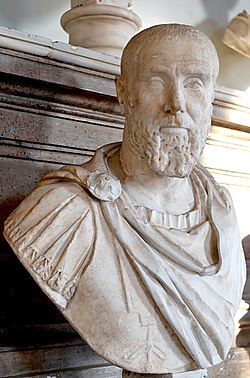
Bust of Pupienus at the Vatican Museums

When Gordian I and his son were proclaimed emperors in Africa, the Senate appointed a committee of twenty men, including the elderly senator Pupienus, to co-ordinate operations against Maximinus Thrax until the arrival of the Gordians.[14] On the news of the Gordians' defeat and deaths, however, the Senate met in closed session in the Temple of Jupiter Capitolinus and voted for two members of the committee to be installed as co-emperors: Pupienus and Balbinus.[11] Unlike the situation in 161, both emperors were elected as pontifices maximi, chief priests of the official cults.[15]

According to Edward Gibbon (drawing on the narratives of Herodian and the Historia Augusta), the choice was sensible, as:

the mind of Maximus [Pupienus] was formed in a rougher mould [than that of Balbinus]. By his valour and abilities he had raised himself from the meanest origin to the first employments of the state and army. His victories over the Sarmatians and the Germans, the austerity of his life, and the rigid impartiality of his justice whilst he was prefect of the city, commanded the esteem of a people whose affections were engaged in favour of the more amiable Balbinus. The two colleagues had both been consul... and, since the one was sixty and the other seventy-four years old, they had both attained the full maturity of age and experience.[16]

Denarius of Pupienus. Inscription: "IMP C M CLOD PUPIENUS AUG"

However, factions within the Senate who had hoped to profit from the accession of the Gordians manipulated the people and the Praetorian Guard to agitate for the elevation of Gordian III as their imperial colleague.[17] Leaving his senior colleague Balbinus in charge of the civil administration at Rome, sometime during late April, Pupienus marched to Ravenna, where he oversaw the campaign against Maximinus, recruiting German auxiliary troops who had served under him whilst he was in Germania.[11] After Maximinus was assassinated by his soldiers just outside Aquileia, Pupienus dispatched both Maximinus' troops and his own back to their provinces (along with a considerable donative) and returned to Rome with his newly acquired German bodyguard.[18]

Balbinus, in the meantime, had failed to keep public order in the capital. The sources suggest that Balbinus suspected Pupienus of using his German bodyguard to supplant him, and they were soon living in different parts of the Imperial palace.[19] This meant that they were at the mercy of disaffected elements in the Praetorian Guard, who resented serving under Senate-appointed emperors, and now plotted to kill them.[20] Pupienus, becoming aware of the threat, begged Balbinus to call for the German bodyguard. Balbinus, believing that this news was part of a plot by Pupienus to have him assassinated, refused, and the two began to argue just as the Praetorians burst into the room. Both emperors were seized and dragged back to the Praetorian barracks where they were tortured and hacked to death in the bath house.[11] They only ruled 99 days.[21][22][23]

Family and other Emperors of the era

[edit]

Three individuals have been identified as his children. Titus Clodius Pupienus Pulcher Maximus, consul suffectus c. 235, and patron of the town of Tibur outside Rome, has been identified as his oldest son.[24] Marcus Pupienus Africanus Maximus, consul ordinarius in 236 as the colleague of the Emperor Maximinus Thrax, has been identified as his youngest son.[25] These consulships in the family, across the reigns of Severus Alexander and Maximinus Thrax, suggest that the family was influential and in high favour. Pupienus also had a daughter, named Pupiena Sextia Paulina Cethegilla, wife of Marcus Ulpius Eubiotus Leurus.[26]

Quintus Tineius Sacerdos Clemens
consul ordinarius
Marcus Pupienus Maximus
Quintus Tineius Clemens
consul ordinarius
Quintius Tineius Rufus
consul 182
Quintus Tineius Sacerdos
consul suffectus
∞ Volusia Laodice

Pupienus
Roman Emperor
(238)
∞ Pulchra(?)
Marcus Ulpius Leurus
senator

Maximinus Thrax
Roman Emperor
235–238
Caecilia Paulina

Gordian I
Roman Emperor
238
TineiaTitus Clodius Pupienus Pulcher Maximus
consul suffectus
Marcus Pupienus Africanus Maximus
consul ordinarius
∞ Cornelia Marullina
Pupiena Sextia Paulina CethegillaMarcus Ulpius Eubiotus Leurus
suffect consul
Gaius Julius Verus Maximus
caesar

Gordian II
Roman emperor
238
Maecia FaustinaLucius Clodius Tineius Pupienus Bassus
proconsul
∞ Ovinia Paterna

Balbinus
Roman emperor
238

Gordian III
Roman Emperor
238-244

References

[edit]

Sources

[edit]
[edit]
Revisions and contributorsEdit on WikipediaRead on Wikipedia
from Grokipedia

Marcus Clodius Pupienus Maximus (c. 164 – 29 July 238) was a Roman emperor who co-ruled with Decimus Caelius Calvinus Balbinus for 99 days from April to July 238, during the chaotic Year of the Six Emperors. A seasoned general with victories against Germanic and Sarmatian tribes, Pupienus had held high offices including two consulships and proconsulships in several provinces before being elected by the Senate for his military prowess to oppose the soldier-emperor Maximinus Thrax.
Pupienus led an army northward against Maximinus, entering Aquileia in triumph after Maximinus was assassinated by his own mutinous troops on 24 June 238, effectively ending the immediate threat without major battle. The co-emperors, both elderly patricians imposed by the , adopted the young Marcus Antonius Gordianus as Caesar to appease the Roman populace and , who resented their rule and the resulting urban riots. Despite this, tensions escalated, culminating in Pupienus and being dragged from the palace, tortured, and killed by the Guard on 29 July, paving the way for Gordian III's sole accession. Their brief tenure highlighted the Senate's futile attempt to reassert authority amid military dominance in the Crisis of the Third Century.

Early Life and Career

Origins and Social Background

Marcus Clodius Pupienus Maximus was born circa 164 AD, likely in Italy, though precise details of his birthplace remain uncertain due to limited contemporary records. The Historia Augusta, a late antique biographical collection of dubious reliability often incorporating fabricated details, claims he originated from Volsinii in Etruria and exemplified social mobility by rising from equestrian status to the Senate through distinguished military service rather than noble birth. Modern assessments, drawing on this and fragmentary evidence from Herodian, suggest Pupienus came from a modest or lower equestrian family, lacking the patrician pedigree of many earlier emperors, which underscores his reliance on proven administrative and martial competence for advancement. Little is known of his ; tentative reconstructions propose a father named Clodius Maximus and a mother possibly named Prima, with Pupienus marrying a called Pulchra and fathering sons including Titus Clodius Pupienus Pulcher Maximus. These details derive primarily from the and epigraphic inferences, which scholars treat cautiously given the text's tendency toward embellishment and chronological inconsistencies. Pupienus' early social background thus reflects the opportunities for merit-based elevation in the Severan-era empire, where equestrians could enter senatorial ranks via provincial governorships and legions, though systemic favoritism toward established elites limited such paths for those without connections. By the early third century, Pupienus had established himself as a vir militaris, holding commands that propelled him into the consular , indicative of a trajectory from provincial obscurity to Roman elite status without reliance on imperial favor or aristocratic . This background positioned him as an outsider to the entrenched senatorial nobility, a factor that later influenced his selection amid the crises of 238 AD, when the sought experienced administrators over dynastic claimants.

Pre-Imperial Political and Military Roles

Marcus Clodius Pupienus Maximus commenced his public service with military positions, including and , prior to entering the senatorial as . He advanced to provincial administration, serving as proconsul in , propraetor in (), and propraetor in . These roles demonstrated his administrative competence across diverse regions of the empire. In military command, Pupienus acted as legatus in either or Inferior, where he secured victories over Sarmatian and Germanic forces. , a contemporary , characterized him as experienced in military affairs, particularly in managing internal threats and maintaining provincial stability. Such expertise aligned with the Senate's later selection of Pupienus to confront external military challenges. Pupienus attained the consulship twice before 238, though the precise date of his initial term—possibly circa 207 AD—remains uncertain; his second, as , occurred in 234 alongside Marcus Munatius Sulla Urbanus. That year, he concurrently held the urban prefecture in , enforcing order amid urban unrest; reports of excessive severity in these duties, drawn from later sources, likely include rhetorical amplification to contrast his martial style with civilian governance. The , a fourth-century compilation of variable credibility prone to invention and bias, attributes to Pupienus further exploits such as quelling a revolt in and an uprising among the Isaurians in , alongside pacifying disorders in —claims unsupported by earlier authorities like or and thus approached with skepticism. Nonetheless, his documented record of provincial and military oversight underscored a career blending with forceful suppression of instability, equipping him for imperial responsibilities amid the empire's crises.

Ascension Amid Crisis

The Year of the Six Emperors

The in 238 AD began with widespread discontent against Emperor , whose harsh taxation and military campaigns had strained the empire's provinces and . In , a revolt erupted when Lucius Caecilius Gordianus (), aged around 80, and his son were proclaimed emperors on March 22 by local landowners protesting fiscal exactions. The in swiftly recognized their claim on April 1-2, viewing it as an opportunity to oppose Maximinus, but the Gordians' forces were defeated by the loyal governor Capelianus near on April 12, leading to Gordian II's death in battle and Gordian I's suicide shortly after. Faced with Maximinus's advancing army toward and reports of his troops' indiscipline, the Senate convened an emergency session on April 22 in the Temple of Jupiter Capitolinus to select new leaders. They elected Decimus Caelius Calvinus , a respected patrician with prior consular experience, to handle civil administration, and Marcus Clodius Pupienus Maximus, a seasoned who had governed provinces and suppressed rebellions, to lead the against Maximinus. This dual emperorship reflected the Senate's attempt to balance civilian and martial needs amid crisis, as described in Herodian's . Public unrest in , fueled by attachment to the Gordians and opposition to the senatorial choice excluding popular figures, prompted riots that nearly overwhelmed the new emperors. To pacify the mob, Pupienus and adopted 13-year-old Marcus Antonius Gordianus (Gordian III), grandson of , as Caesar on the same day, ensuring dynastic continuity and broadening support. Pupienus then departed for to muster forces, while Balbinus remained in the capital; Maximinus was assassinated by his mutinous troops at Aquileia on June 24 before confronting them.

Senatorial Election and Co-Emperorship

Following the deaths of by suicide and in battle against Capelianus's forces around 12 April 238, the faced the advancing army of from the frontier and convened an emergency session to select new leadership. Both Pupienus and had served on the senatorial of twenty (viri XX ex s.c. rei publicae curandae) formed to manage the crisis against Maximinus. On 22 April 238, in the Temple of Jupiter Capitolinus, the Senate elected Marcus Clodius Pupienus Maximus and Decimus Caelius Calvinus Balbinus as joint emperors (Augusti), granting them imperium and the powers of consul and tribune. According to Herodian, the vote involved nominations of other senators, but Pupienus and Balbinus secured the majority as co-rulers. The Historia Augusta records that senator Vettius Sabinus proposed the pair, praising Pupienus's martial valor—drawn from prior campaigns against Sarmatians and Germans—and Balbinus's administrative integrity and senatorial prestige, with the assembly responding in unanimous acclamation. This dual election aimed to divide duties efficiently: Pupienus, estimated at around 60 years old with extensive military command, would mobilize and lead troops northward against Maximinus, while the older Balbinus, focused on civilian governance, remained in Rome. The plebeian populace, loyal to the recently deceased Gordians and hostile to the senatorial patricians, rioted in against the choice, blockading the new emperors en route to the Capitol for sacrifices. To restore order, Pupienus and adopted 13-year-old Marcus Antonius Gordianus—grandson of —as their Caesar and , calming the crowds and integrating a popular figure into the regime. This co-emperorship, unprecedented in its senatorial origin and paired rule, underscored the Senate's brief resurgence amid military peril but sowed seeds of discord with the , who resented the arrangement.

Rule and Policies

Joint Governance with Balbinus

Following their election by the on April 22, 238, Pupienus and Balbinus assumed joint rule as Augusti, marking the first instance of dual emperorship in Roman history selected by senatorial vote rather than acclamation. To mitigate public unrest from the populace's demand for a Gordian successor, they proclaimed Marcus Antonius Gordianus, grandson of , as Caesar, allowing them to enter the imperial palace amid continued mob agitation. Their governance emphasized division of labor: Balbinus, deemed more suited to civil matters due to his consular experience, remained in to oversee administration, while Pupienus, leveraging his background, departed for to marshal forces against the invading . Initial efforts focused on restoring order and defense, with Pupienus organizing legions and supplies for a campaign toward Aquileia, though direct confrontation was averted when Maximinus was assassinated by his mutinous troops on June 24, 238. In , contended with persistent riots fueled by Gordian sympathizers and Praetorian discontent over the Senate's choice of elderly aristocrats, exacerbating tensions that culminated in a massive fire in June 238, which destroyed nearly half the city. Despite these crises, the co-emperors maintained an orderly administration that initially garnered public approval, as reported by the contemporary historian , though underlying rivalry simmered—Balbinus prizing his noble lineage and prior consulships, Pupienus his proven diligence as city prefect. This mutual suspicion eroded coordination, particularly during a Praetorian assault on , where Pupienus advocated summoning loyal German auxiliaries, a proposal Balbinus rejected fearing a coup. No sweeping reforms or fiscal policies are attested in primary accounts, with their brief tenure prioritizing immediate stabilization over long-term initiatives; , a Greek writing soon after events, provides the most detailed narrative, though his senatorial sympathies may color portrayals of military resentment. The Historia Augusta, a later and less reliable compilation, echoes similar divisions but includes unverifiable anecdotes, underscoring the challenges of dual rule amid institutional fractures.

Military and Defensive Measures

Upon their election by the in late April 238 AD, Pupienus and divided responsibilities along lines of expertise, with Pupienus—renowned for prior campaigns suppressing revolts in and along the —tasked with organizing military resistance against Maximinus Thrax's advancing army. Pupienus rapidly assembled a force from available legionaries in , supplemented by hastily recruited volunteers from the Roman citizenry and urban youth, as well as select ; this improvised army, however, was noted for its lack of cohesion and training, reflecting the urgency of the senatorial revolt amid depleted frontier garrisons. He led the bulk of these troops northward toward , positioning to block Maximinus's path into , while detaching a contingent to reinforce Rome's defenses under Balbinus's oversight. Defensive preparations in the capital included fortifying key approaches and enrolling additional , such as gladiators from imperial schools, to guard against urban unrest or a breakthrough by Maximinus's forces, which had already crossed the and besieged Aquileia by early May. These measures stemmed from of Maximinus's logistical strains—exacerbated by supply shortages and civilian resistance—but prioritized rapid mobilization over structural reforms, given the co-emperors' brief tenure. Herodian, a contemporary observer sympathetic to senatorial perspectives, describes Pupienus dispatching scouts and maintaining communication lines for daily reports, underscoring a reliant on attrition and rather than offensive depth. The campaign concluded without direct engagement, as Maximinus and his son were assassinated by their own troops on 10 May 238 AD at Aquileia, triggered by famine, failed assaults on the city, and eroding loyalty among the II Parthica legion. Pupienus then redirected efforts to disbanding or reallocating Maximinus's mutinous units back to provinces, integrating loyal elements, and suppressing residual threats, though this exposed vulnerabilities to discontent over diluted privileges and senatorial oversight of affairs. No enduring innovations emerged from their rule, with post-crisis plans for Pupienus to lead an eastern expedition against abandoned amid internal collapse.

Domestic Administration and Reforms

Balbinus assumed primary responsibility for civil administration in , managing internal affairs amid the chaos following the deaths of and the Gordians, while Pupienus directed military operations against invading forces. This division reflected the Senate's intent for balanced governance, with leveraging his prior consular experience to oversee urban stability and resource allocation during economic strain from prior debasements and provincial revolts. However, administrative efforts yielded minimal structural changes, as the emperors prioritized short-term appeasement over long-term reforms. Faced with riots from the populace demanding a Gordian heir and Praetorian discontent over senatorial rule, Pupienus and adopted the 13-year-old on April 2, 238, as Caesar and joint heir, aiming to legitimize their regime and quell urban unrest. This political maneuver, drawn from precedents of dynastic continuity, temporarily diffused mob violence but failed to resolve underlying tensions with the Guard, who viewed the pair as patrician interlopers. No evidence exists of fiscal, legal, or bureaucratic overhauls, as their 99-day tenure—ending in mutual suspicion and Praetorian lynching on July 29, 238—precluded substantive domestic innovation.

Downfall

Conflicts with the Praetorian Guard

The election of Pupienus and by the in 238 provoked immediate riots from the Roman populace and , who demanded the continuation of the Gordian dynasty and rejected the elderly senatorial candidates as unfit. The Guard, initially supportive of before his assassination by his own troops, viewed the Senate's intervention as a usurpation of prerogative, leading to violent clashes that compelled the emperors to adopt the 13-year-old Marcus Antonius Gordianus as Caesar on to placate the unrest. Tensions escalated after Pupienus's successful campaign against Maximinus at Aquileia in May 238, as he returned to accompanied by Germanic auxiliary troops intended to bolster imperial security and potentially supplant unreliable Praetorian elements. records that the Praetorians, fearing these foreign contingents would suppress any revolt and erode their monopoly on palace guard duties, accelerated plots against the co-emperors, perceiving Pupienus's military reinforcements as a direct threat to their influence. Efforts to appease the Guard through donatives and promises of loyalty faltered amid the emperors' mutual suspicions—Balbinus favoring civilian administration while Pupienus prioritized military integration—which the Praetorians exploited as evidence of senatorial weakness. By July 238, during the Capitoline Games, the Guard's hostility manifested in open marches on the imperial residence, signaling their refusal to submit to Senate-imposed rulers and foreshadowing direct confrontation.

Assassination and Succession

Tensions between the co-emperors Pupienus and , compounded by mutual suspicions and their inability to coordinate effectively, eroded their authority amid ongoing unrest in . The , resentful of the senators' noble origins and senatorial appointment—contrasting with their preference for military figures—feared replacement by Pupienus's loyal German auxiliaries, a concern rooted in precedents like Septimius Severus's reforms. , a near-contemporary whose account prioritizes senatorial perspectives but aligns with broader evidence of Praetorian discontent, describes how this rivalry left the emperors vulnerable during public festivities such as the Capitoline Games. On July 29, 238 AD, the Praetorians exploited this discord by storming the imperial palace. Pupienus attempted to summon his German bodyguard for defense, but Balbinus, suspecting a bid for sole power, blocked the effort, allowing the Guards to seize both rulers. The emperors were stripped, tortured—enduring humiliations like the tearing of their beards and eyebrows—and dragged to the Praetorian camp, where they were slain with swords amid jeers. A belated rescue by the German auxiliaries arrived too late to intervene. This assassination, corroborated by Herodian (History VIII.8) and echoed in less reliable later sources like the Historia Augusta, marked the culmination of Praetorian frustration with civilian rule during the crisis. In the immediate aftermath, the proclaimed the 13-year-old , grandson of , as sole emperor, framing the killings as fulfilling public opposition to the co-emperors. 's adoption earlier by and to appease the Roman populace and youth factions facilitated this transition, ensuring continuity amid the while sidelining senatorial influence in favor of Guard-backed imperial selection. This succession stabilized the regime temporarily but underscored the Praetorians' decisive role in imperial legitimacy during the third-century instability.

Legacy

Evaluation of Achievements and Failures

Pupienus' primary achievement lay in his military leadership during the confrontation with , where he mobilized senatorial levies and advanced to Aquileia in May 238, deterring further invasion without direct battle after Maximinus' troops mutinied and killed him on May 24. By granting and a donative to the defecting soldiers, Pupienus secured their loyalty and prevented the disintegration of frontier defenses, effectively ending the Thrax regime's threat to . This outcome stabilized the empire temporarily, allowing the co-emperors to deify the Gordians and organize public games to bolster civilian support in . However, these successes were undermined by profound failures in governance and . The divided between Pupienus, with his field command, and , left in , fostered mutual suspicion and administrative paralysis, as evidenced by Herodian's account of their rivalry over precedence despite complementary roles—Pupienus' martial rigor and Balbinus' senatorial decorum. ' tenure saw unchecked riots that burned half of , exposing the regime's inability to maintain order amid plebeian unrest and Praetorian hostility. Planned offensives—Pupienus against the Parthians and Balbinus against Germanic tribes—never advanced beyond preparation, highlighting a lack of unified strategy in a demanding decisive action. The co-emperors' ultimate downfall on July 29, 238, after just 99 days, stemmed from their failure to subordinate the , whose preference for a youth like —adopted as Caesar to appease them—did not avert assassination amid fears of disbandment. This event underscored a systemic weakness: senatorial emperors, reliant on civilian prestige rather than military allegiance, proved ill-equipped to navigate the Third Century's power dynamics, where troop loyalty dictated survival. While ancient sources like praised their personal virtues, the regime's erasure from some inscriptions reflects a legacy of ineffectiveness, serving more as a cautionary interlude than a model of restoration.

Historical Sources and Interpretive Debates

The primary ancient sources for Pupienus' co-emperorship with Balbinus in 238 CE are limited, consisting mainly of narrative histories supplemented by epigraphic and numismatic evidence. Herodian's History of the Empire after Marcus (Books 7–8) offers the most detailed contemporary account, describing the senatorial election, popular unrest, and the emperors' assassination by the Praetorian Guard after approximately three months in power; however, Herodian's narrative includes rhetorical flourishes, such as exaggerated depictions of Pupienus' severity in suppressing disorders, which may reflect a pro-senatorial perspective rather than strict factual reporting. The Scriptores Historiae Augustae (Historia Augusta, or HA) provides a dedicated "Life of Maximus and Balbinus," attributing to Pupienus prior governorships in provinces like Germania Superior and military successes against barbarians, but this late-4th-century compilation is widely regarded by scholars as unreliable due to its fabrication of documents, anachronistic details, and apparent inventions to fill biographical gaps, rendering much of its content on Pupienus' early career suspect. Later epitomators offer briefer, derivative summaries: Aurelius Victor's De Caesaribus (26.7) notes the duo's election as a senatorial counter to , while Zosimus (1.14.2) and (7.19) echo the rapid downfall amid Praetorian intrigue, with the latter mentioning an execution at Aquileia potentially linked to Pupienus' forces. Coins minted in and provinces bearing Pupienus' image and titles (e.g., IMP. CAES. M. CLOD. PUP. MAXIMUS AVG.) confirm his proclamation around April 22, 238 CE, and joint rule, providing verifiable chronology absent in some literary texts, though they lack narrative depth. Inscriptions, such as those in the Inscriptiones Latinae Selectae (e.g., Nos. 1186, 8979), attest to administrative continuity but offer scant insight into policy specifics. Interpretive debates center on the sources' biases and the emperors' portrayal as either capable restorers of senatorial or victims of systemic dominance. Herodian, writing soon after events as a Greek subject possibly sympathetic to rule, emphasizes the duo's competence—Pupienus' martial experience versus ' administrative acumen—but scholars caution that his account may overstate senatorial viability against entrenched praetorian and legionary power, potentially to critique the "barracks emperors" era. The HA's encomiastic tone, fabricating virtues like Pupienus' equestrian origins and , has fueled skepticism about its utility beyond occasional corroborated details, with modern analyses viewing it as a product of late-antique rather than . Chronological disputes persist, such as the exact timing of Maximinus' death and the emperors' march northward, with arguing for deliberate senatorial strategy against ad hoc improvisation critiqued by others like G.B. Townsend. Overall, the paucity of unbiased, contemporaneous records—exacerbated by the loss of Cassius Dio's later books—limits assessments, prompting reliance on material evidence to temper narrative distortions and highlighting the triumph of over idealized governance in the third-century .
Add your contribution
Related Hubs
User Avatar
No comments yet.