Hubbry Logo
Scorpion IIScorpion IIMain
Open search
Scorpion II
Community hub
Scorpion II
logo
8 pages, 0 posts
0 subscribers
Be the first to start a discussion here.
Scorpion II
Scorpion II
from Wikipedia

Key Information

Scorpion II (Ancient Egyptian: possibly Selk or Weha[1]), also known as King Scorpion, was a ruler during the Protodynastic Period of Upper Egypt (c.3200–3000 BC).

Identity

[edit]

Name

[edit]
Torso of a man with the Horus name of King Scorpion below the left breast. Anorthositic gneiss, Protodynastic period, circa 3200 BCE. Munich, Staatliches Museum Ägyptischer Kunst, ÄS 7149

King Scorpion's name and title are of great dispute in modern Egyptology. His name is often introduced by a six- or seven-leafed golden rosette or flower sign. This emblem can be found on numerous objects from the Dynasty 0 and Dynasty I periods; it vanishes until the end of the Third Dynasty, when it re-appears under high-ranked officials, such as Khabawsokar and A'a-akhty (both dated to the end of the Third Dynasty). Its precise meaning has been intensely discussed; the most common interpretation is that of an emblem meaning 'nomarch' or 'high lord'. During the protodynastic and early dynastic eras, it was evidently used as a designation for kings; in much later periods, it was bestowed on high-ranked officials and princes, especially on those who served as priests for the goddess Seshat. Thus, the golden rosette became an official emblem of Seshat.[2] The reading of the rosette sign is also disputed. Most linguists and Egyptologists read it Neb (for 'lord') or Nesw (for 'king'), and they are convinced that the golden rosette was some kind of forerunner to the later serekh.[3][4]

The scorpion fetish, which underlies the name of Scorpion II, is generally linked to the later-introduced goddess Selket, but Egyptologists and linguists such as L.D. Morenz, H. Beinlich, Toby Wilkinson and Jan Assmann have pointed out that the goddess was introduced no earlier than the late Old Kingdom period. In this view, the scorpion fetish of the protodynastic period should not be associated with Selket. Morenz points out that, in cases where a fetish animal is included in a ruler's name, the animal generally has a different, rather cultic and political meaning. The scorpion animal commonly stood for dangerous things, such as 'poison' and 'illness', but it could also mean 'bad breath', or in military contexts 'storm' or 'attack'. Since it is unclear what actual meaning was reserved for the serekh animal of Scorpion II, scholars usually refer to him as 'King Scorpion II'.[3][5][6]

Historical figure

[edit]

There are several theories regarding his identity and chronological position. Some Egyptologists, such as Bernadette Menu, argue that, because Egyptian kings of the First Dynasty seem to have had multiple names, Scorpion was the same person as Narmer, simply with an alternative name, or additional title. They also argue that the artistic style seen on the macehead of Scorpion II shows conspicuous similarities to that on the famous Narmer macehead.[7] Other scholars, including T. H. Wilkinson, Renée Friedman and Bruce Trigger, have identified king Scorpion II as the 'Gegenkönig' (opponent ruler) of Narmer and Ka (or Sekhen). At the time of Scorpion II, Egypt was divided into several minor kingdoms that were fighting each other. It is likewise conjectured that Narmer simply conquered the realms of Ka and Scorpion II, thus unifying the whole of Egypt for the first time.[6]

Attestations

[edit]

Macehead

[edit]
Scorpion Macehead
Macehead of Scorpion II
Scorpion II on the macehead (drawing)

The only pictorial evidence of his existence is the so-called Scorpion Macehead, which was found in the Main deposit by archeologists James E. Quibell and Frederick W. Green in a temple at Nekhen (Hierakonpolis) during the dig season of 1897–1898.[8] It is currently on display at the Ashmolean Museum, Oxford. The stratigraphy of this macehead was lost due to the methods of its excavators, but its style seems to date it to the very end of the Predynastic Period.[9]

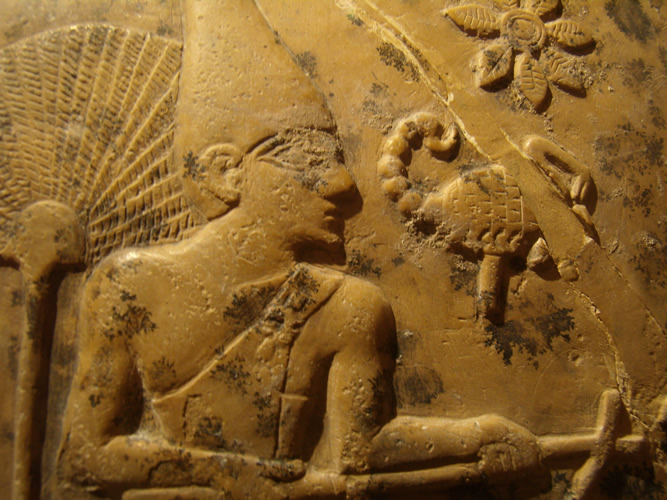
The Scorpion Macehead depicts a single, large figure wearing the White Crown of Upper Egypt. He holds a hoe, which has been interpreted as a ritual either involving the pharaoh ceremonially cutting the first furrow in the fields, or opening the dikes to flood them. The use and placement of the iconography is similar to the depiction of the pharaoh Narmer on the obverse side of the Narmer Palette. The king is preceded by servants, the first in row seems to throw seeds from a basket into the freshly hacked ground. A second servant (his depiction is partially damaged) wears a huge bundle of grain sheafs, which strengthens the interpretation of a seed sowing ceremony, possibly connected to the Sed festival or a founding ceremony. Scorpion II may have been the founder of Nekhen or Buto, which would explain why the macehead was found in Hierakonpolis. Above the servants, a row of standard bearers, who carry the same standards as seen on the Narmer palette, precede the king. Below the royal servants, a road and a landscape with people and houses is preserved.[10][11]

An individual with offerings, on King Scorpion's Minor Macehead

Behind the king (on the left side) two fan bearers follow the king. Left of the fan bearer, bundles of papyrus groves are depicted. Behind these, in the upper section, a group of dancers and a priest are visible; the priest guards a Repw.t-palanquin. The lower section is lost due to damage. The festive parade looks into the opposite direction of the king and his standard bearers; an outstretched complete view reveals that both processions meet each other in the center of the whole macehead relief scene. In this very center, scholars such as K. M. Ciałowicz, E. J. Baumgärtel and T. H. Wilkinson believe that they see the tiny traces of the feet and the coil of the Red Crown; a second golden rosette is clearly visible. The traces strengthen the presumption that the scene on the Scorpion macehead once contained the depiction of a second figure of the king, wearing the Red Crown of Lower Egypt. In this case, the Scorpion macehead would show king Scorpion II as the ruler of the whole of Egypt.[10][11]

The uppermost scene on the macehead shows a row of divine standards. Each standard is surmounted by a god (Set, Min and Nemty, for example) or nome crest. The original number of standards is unknown, but it is clearly visible that one half shows hanged lapwings, the other shows hanged hunting bows. Both standard rows face each other. Lapwings stood for 'Lower Egyptian folks' or 'common folks' and the bows stood for 'folk of archers', pointing to hostile Asian tribes. Their hanging is interpreted as evidence that Scorpion II began the attacks on Lower Egypt and Egyptian enemies at the border lands, which eventually resulted in Narmer's victory and unification of the country.[10]

Ivory tags

[edit]

Numerous small ivory tags showing the depiction of a scorpion were found. They come from Abydos, Minshat Abu Omar and Tarkhan. Some of them show the scorpion holding the hieroglyphic sign for "nome/garden/land" (Gardiner sign N24) and it is disputed, if this clear sign combination has a deeper meaning: the scorpion could represent King Scorpion II in his role as a ruler of a certain (but unnamed) nome. Some other tags show the scorpion close over a swallow sign, which reads 'the scorpion is great'. One unique tag shows the scorpion holding a long stick, smiting an enemy. Since many of the tags show a shrine with a heron on the roof at the backsite, it is thought that Scorpion II originated from Buto.[12][13][14]

Rock and vessel inscriptions

[edit]
Clay mark with the name of king Scorpion II (after Dietrich Wildung)[15]

At Tarkhan and Minshat Abu Omar, several stone and clay vessels were found. They have royal serekhs incarved at their bellies and the reading of the name inside is disputed. Several Egyptologists (including Thomas Schneider, Dietrich Wildung and Herman TeVelde) are convinced that the serekhs present a strongly stylized figure of a scorpion. Others, such as Günter Dreyer and Wolfgang Helck, are not so sure and read it as a sloppily drawn version of the name of King Ka.[12][13][14]

At the second cataract of the Nile, not far from the Nasser-reservoire at Gebel Sheikh Suliman (Sudan), a large rock cutting depicts a big scorpion figure striding over killed enemies. Their death is demonstrated by depicting them standing upside-down and being hit by arrows; two further figures are still holding their own bows and shooting. The enemies can be identified as Nubians, due to their ostrich feathers and bows, since ostrich feathers and bows were the typical attributes for Egyptians to mark Nubians. The scorpion faces a human figure with an artificial beard and ceremonial knife in a belt; the figure holds a long cord, to which captured Nubians are tied. The whole scene is interpreted as representing King Scorpion II celebrating his victory against the hostile Nubians.[16][17]

Reign

[edit]

Political situation

[edit]
Possible Scorpion II wearing the Red crown. Minor Scorpion Macehead. UC 14898, Petrie Museum.[18][19][20]

Numerous artifacts with relief decoration and pottery markings made of black ink point to a flourishing trade economy at the time of Scorpion's rulership. For the first time, the inscriptions give the hieroglyphic writings for 'Lower Egypt' and/or 'Upper Egypt'. Therefore, both parts of Egypt slowly started to work together. But, since it seems clear that Egypt was divided into at least two coexisting kingdoms, scholars wonder on which kind of power factor the rulership of protodynastic kings was based. Conquering and warfare had to be economically promoted, warriors and guardians had to be fed. Based on this cognition, scholars such as K. M Ciałowitz, T. H. Wilkinson, Karl Butzer and Michael A. Hoffman point to the irrigation systems, which were founded in huge quantities. Numerous palettes (such as the Hunters Palette, the Libyan Palette, and the Narmer Palette, for example) and the maceheads of Scorpion II and Narmer show depictions of rivers, plants, trees and several different animals (birds, mammals, and fishes) in surprising natural detail. Alongside these motifs, human figures performing agricultural work are depicted. Ciałowitz, Wilkinson, Butzer and Hoffman see the power source of the protodynastic kings in these agricultural developments. Irrigation systems allowed increasing settlements, cattle possessions and vegetable cultivation. The scholars wonder if the kings kept the irrigations scarce on purpose, to ensure their power, influence and wealth.[10][21][22]

Religious and cultic situation

[edit]

The numerous decorations on the artifacts also depict large numbers of fetishes and standards, surmounted by gods, which reveals an already very complex religion and cult system. Since the standards often guide the battle scenes, battles and conquests might have been seen as cultic events as well. The earliest recognizable gods are Horus, Seth, Min, Nemty, Nekhbet, Bat, and Wepwawet. But it is unknown where these gods had their cultic centers and shrines, because the hieroglyphs depicting the place names were not introduced yet.[10][11][21][23]

Another aspect of cultic and religious beliefs under Scorpion II are the numerous depictions of mythical creatures, such as the serpopard and the winged chimera. The serpopard appears on the Narmer palette and the Two Dogs Palette. He was named Swdja, which means "undestroyable". In Egyptian mythology the serpopard was described as "the one who moves the sun". On the Narmer palette, two serpopards are entwining their necks. This picture is thought to be an allegoric display of the unification of Egypt. Under Scorpion II, two serpopards are lacerating a gazelle, which might imply that the serpopards were under the control of the king (they attack on command).[10][11][21][23][24]

The "winged chimeras" were named Sefer in Egyptian and they represent chaos and violence. They appear on the Two-dogs-palette and on several ivory artifacts. Scholars point to the fact that creatures such as the chimera and the serpopards were of Mesopotamian origin.[10][11][21][23][24]

A further motif of Scorpion's era, clearly of Mesopotamian origin, is that of a warrior fighting two lions with his bare hands. He holds one lion in each hand, both at his sides. A similar motif shows the warrior with two giraffes. In later dynasties, this motif became a hieroglyph, registered as Gardiner A38 and Gardiner A39. It reads Qjs and it was used as the emblem of the city of Cusae.[10][11][21][23][24]

Mesopotamian influences under Scorpion II

[edit]
Possible Mesopotamia–Egypt trade routes from the 4th millennium BCE[25][26]

All listed motifs and emblems, but also tomb architecture and traded items (such as tools, bead collars and cylinder seals) prove a surprisingly strong and extensive influence of Mesopotamian culture and religion to the early Egyptians. This cognition is promoted by the evaluations of architectural developments, visible at burial places such as Minshat Abu Omar, Hierakonpolis and Naqada. The architectural methods used for building complex and stable tombs were clearly copied from Mesopotamian buildings.

It is not fully clarified why the Egyptians fostered their amicable relationship with Mesopotamia so intensively; proponents of the Dynastic race theory believe that the first Egyptian chieftains and rulers were themselves of Mesopotamian origin, but this view has been abandoned among modern scholars.[27][28]

The current position of modern scholarship is that the Egyptian civilization was an indigenous Nile Valley development and that the archaeological evidence "strongly supports an African origin"[29] of the ancient Egyptians.[27][30][31][32] During the rulership of King Scorpion II and his immediate successors, the influence seems to decrease and Egypt begins to foster its own, more independent culture. This surely was a further important step toward Egypt's future as a powerful and wealthy kingdom.[10][11][21][23][24]

Tomb

[edit]

The exact burial place of Scorpion II is unknown. There are two tombs that are both seen as candidates. The first one is registered as Tomb B50 and lies at Umm El Qa'ab (close to Abydos). It is a nearly quadratic chamber divided into four rooms by a simple, cross-shaped mud wall. Several ivory tags with scorpion figures were found here. The second one is located at Hierakonpolis and is registered as Tomb HK6-1. It measures 3.5 m × 6.5 m, has a depth of 2.5 m, and is strengthened with mud. Several ivory tags with scorpion figures were found here.[33]

[edit]

See also

[edit]

References

[edit]

Sources

[edit]
  • Assmann, Jan (2003). Stein und Zeit: Mensch und Gesellschaft im Alten Ägypten (in German). München: W. Fink. ISBN 978-3-77-052681-9.
  • Hannig, Rainer (2006). Großes Handwörterbuch Ägyptisch-Deutsch: (2800–950 v. Chr.): die Sprache der Pharaonen. Kulturgeschichte der antiken Welt (in German). Vol. 64. Mainz: Philip von Zabern. ISBN 978-3-80-531771-9.
  • Kaiser, Werner; Dreyer, Günter (1982). "Umm el-Qaab: Nachuntersuchungen im frühzeitlichen Königsfriedhof. 2. Vorbericht". Mitteilungen des Deutschen archäologischen Instituts (MDAIK). Abteilung Kairo. (in German). 38. Mainz: Philipp von Zabern. ISBN 978-3-80-530552-5.
  • Menu, Bernadette (1996). "Enseignes et porte-étendarts". Bulletin de l'Institut Français d'Archéologie Orientale (in French). 96. Cairo: Institut Français d'Archéologie Orientale: 339–342.
  • Moortgat, Anton (1994). "Die Goldrosette – ein Schriftzeichen?". Altorientalische Forschungen (in German). 21. Berlin: Institut für Orientforschung: 359–371.
  • Needler, Winifred (1967). "A Rock-drawing on Gebel Sheikh Suliman (near Wadi Halfa) showing a Scorpion and human Figures". Journal of the American Research Center in Egypt. 6. Winona Lake: Eisenbrauns: 87–91. doi:10.2307/40000735. JSTOR 40000735.
  • Shaw, Ian; Nicholson, Paul (1995). The Dictionary of Ancient Egypt. London: The British Museum Press. ISBN 978-0-71-411909-0.
  • Wildung, Dietrich (1981). Ägypten vor den Pyramiden – Münchner Ausgrabungen in Ägypten (in German). Mainz: Philipp von Zabern. ISBN 978-3-80-530523-5.

Bibliography

[edit]
[edit]
Revisions and contributorsEdit on WikipediaRead on Wikipedia
from Grokipedia
Scorpion II was a predynastic ruler of during the late period, circa 3200–3000 BCE, attested chiefly through inscriptions and artifacts from Hierakonpolis linking him to early royal iconography and territorial control. His name appears in a enclosure with the hieroglyph, distinguishing him from the earlier associated with Abydos Tomb U-j. The most prominent artifact is the large ceremonial limestone macehead discovered in the temple at Hierakonpolis and now housed in the , which portrays Scorpion II wearing the White Crown of while wielding a mace before bound standards representing subdued eastern groups, interpreted as evidence of dominance over nomadic threats. A reverse scene shows him with bull standards and attendants, possibly performing a ritual to inaugurate irrigation works, highlighting causal links between conquest, , and emerging . Scholars regard Scorpion II as a pivotal figure in the consolidation of power in , potentially the last independent king of Hierakonpolis before subordination to Thinite rulers, with his and motifs prefiguring those of and the unified monarchy. Debates persist over his exact role in unification versus regional hegemony, as well as stylistic influences from evident in the macehead's composition, though empirical evidence prioritizes local developments over foreign impositions. No definitive tomb has been identified for Scorpion II, with attributions to larger Abydos structures remaining speculative amid limited epigraphic corroboration.

Identity

Name and Serekh

The Horus name of the ancient Egyptian ruler known as Scorpion II is attested through serekhs containing solely the hieroglyphic sign for a scorpion (Gardiner L2). The serekh itself is a rectangular enclosure mimicking the niched facade of a palace, symbolizing the institution of kingship, and is surmounted by the falcon of the god Horus, linking the ruler to divine falcon-headed deity. This format represents an early development in royal titulary, emerging in the Naqada III period circa 3200–3000 BCE, prior to the adoption of the cartouche in the Early Dynastic era. The sign likely served as a or direct depiction of the king's name, conventionally rendered in modern scholarship as "" due to the absence of phonetic complements or determinatives that would clarify an alternative reading. Some interpretations associate the symbol with the scorpion goddess (srqt), whose name incorporates a similar and who was linked to and , though no direct evidence confirms this as the etymological basis for the royal name. The lack of vocalization in proto-hieroglyphic inscriptions precludes a definitive ancient Egyptian , with proposed transliterations such as "Selk" or "Weha" remaining speculative and unsupported by contemporary texts. In certain attestations, the appears grasping a sign for "land" or "garden" (Gardiner N24), potentially indicating a denoting dominion over territory, though scholars debate whether this modifies the core name.

Distinction from Scorpion I

Scorpion I and Scorpion II represent two distinct predynastic rulers of Upper Egypt, differentiated by their chronological phases, primary archaeological contexts, and the nature of their attestations. Scorpion I is associated with tomb U-j in the Umm el-Qa'ab royal cemetery at Abydos, excavated by Günter Dreyer in 1988 and dated to the late Naqada IIIA1 period, circa 3300–3200 BC. This tomb yielded ivory labels and a scepter fragment inscribed with a scorpion motif, interpreted as an early proto-ruler's emblem without explicit royal regalia such as crowns or serekhs. In contrast, Scorpion II is attested on a ceremonial macehead from the Hierakonpolis Main Deposit, uncovered in 1897–1898 by James Quibell and Frederick Green, and placed in Naqada IIIB, approximately 3200–3000 BC. The macehead portrays a king in the White Crown of Upper Egypt, wielding a mace against a bound captive, with a scorpion glyph positioned before his face in a structure akin to a serekh, alongside standards and a bull symbol denoting advanced royal symbolism. Geographically, Scorpion I's Abydos linkage aligns with Thinite origins in northern , while Scorpion II's Hierakonpolis (Nekhen) association points to a southern center of power, reflecting potential rivalry or succession between regional polities during unification efforts. Stylistic and stratigraphic evidence—such as the simpler, non-iconographic scorpion of versus the elaborate, conquest-themed depiction of Scorpion II—reinforces their separation, with preceding as an early local leader and Scorpion II embodying a more centralized authority. Although occasional scholarly speculation equates them due to the shared motif, the temporal gap of one to two centuries and artifact disparities support the consensus of two individuals.

Debates on Existence and Historicity

Scholars generally accept the existence of Scorpion II as a protodynastic ruler of around 3200–3000 BC, based on artifacts such as the ceremonial macehead excavated at Hierakonpolis in 1897–1898, which depicts a figure wearing the white crown and labeled with a scorpion glyph alongside standards, suggesting royal authority in rituals of conquest. This evidence, corroborated by ivory labels and possible inscriptions bearing the scorpion symbol, indicates a historical individual or polity leader rather than pure legend, though the sparse attestations limit reconstruction of his biography. Debates center on the interpretation of the scorpion as a personal name, title, or emblematic device, with some early Egyptologists questioning whether it denotes a specific king or a generic scorpion cult association predating royal nomenclature. For instance, Bernadette Menu argued that Scorpion II represents an alternative designation for , the First Dynasty unifier, reflecting the fluidity of multiple royal names in early periods rather than distinct figures. In contrast, Toby Wilkinson, Renée Friedman, and Bruce Trigger posited Scorpion II as a rival or predecessor ("Gegenkönig") to and Ka, potentially defeated in unification campaigns, supported by the macehead's iconography of subduing marsh-dwellers akin to motifs but lacking a enclosure. Further contention arises over territorial scope and chronology, with the macehead's Delta floral standards implying influence beyond Hierakonpolis, challenging views of Scorpion II as a localized Hierakonpolitean subordinate to Abydos. A analysis reaffirms his by linking minor Gebel Sheikh Suleiman carvings and a statuette to his reign, portraying him as the final independent king of Hierakonpolis before dynastic consolidation, though remains imprecise due to reliance on stylistic and ceramic correlations. These interpretations underscore the challenges of predynastic evidence, where artifacts like the macehead provide empirical attestation but invite causal inferences about political dynamics amid scarce textual records.

Archaeological Evidence

Hierakonpolis Macehead

The Hierakonpolis Macehead, also known as the Scorpion Macehead or Major Scorpion Macehead, was excavated in 1897–1898 by James E. Quibell from the "main deposit" beneath a temple at Hierakonpolis (ancient Nekhen), a key predynastic site in Upper Egypt. This ceremonial artifact, now housed in the Ashmolean Museum in Oxford, measures approximately 25 centimeters in length and is crafted from limestone in a pear-shaped form, significantly larger—about five times the size of a functional macehead—indicating its ritual rather than practical use. The macehead is fragmentary but features detailed low-relief carvings attributing it to a ruler named , identified by a prominent positioned atop the king's head or within a serekh-like structure, linking it to rather than the earlier due to the presence of the White Crown of . On one face, the king is depicted wearing the White Crown, a bull's signifying power, and attire, as he holds a hoe to perform a foundational rite, possibly inaugurating an or dike, with a watercourse represented below and attendants bearing standards of deities like . Surrounding elements include bound captives or standards, emphasizing themes of conquest and control over marshy regions, while serpopards—mythical long-necked felines—may flank the scene, symbolizing chaos subdued by royal order. Dated to circa 3200–3000 BCE, during the period, the macehead provides critical evidence of emerging royal iconography, blending agricultural fertility rituals with assertions of dominance, as the king's act of "cutting the earth" with the hoe mirrors later motifs and underscores control over vital water resources in the Nile Valley. Its deposition in the temple suggests a dedicatory purpose, linking the ruler to divine falcon symbolism and predynastic kingship consolidation in , though interpretations of the exact event vary, with some scholars emphasizing feats over purely symbolic acts. The artifact's scale and detail highlight advanced Predynastic artistry, paralleling contemporaries like the in propagating pharaonic authority through monumental commemoration.

Ivory Tags and Labels

Numerous small ivory tags inscribed with scorpion figures have been recovered from elite predynastic contexts at Hierakonpolis, particularly in association with Tomb HK6-1, a structure measuring 3.5 by 6.5 meters and proposed as a possible site for . These tags, typically rectangular and perforated for attachment to goods like pottery vessels or cloth bundles, represent some of the earliest known examples of Egyptian proto-hieroglyphic labeling systems, used for administrative purposes such as tracking commodities, origins, or tribute. The scorpion motif (Gardiner sign L2) directly evokes the ruler's name, serving as a nascent royal emblem before the formalized enclosure became standard. Unlike the more numerous tags from Abydos Tomb U-j—attributed to the earlier , which include additional pictographs denoting quantities or localities—the Hierakonpolis examples are simpler, focusing primarily on the scorpion alone, consistent with phases around 3200–3100 BCE. This scarcity and stylistic difference underscore the tentative identification of HK6-1 with Scorpion II, as no or explicit name appears on the tags themselves, relying instead on contextual proximity to other scorpion-marked artifacts like vessels from the site. Scholars interpret these as evidence of centralized resource management under the ruler's authority, reflecting emerging state bureaucracy. The tags' material—hippopotamus ivory—and craftsmanship indicate access to Nile Valley trade networks, with incisions executed in shallow relief for durability. Comparative analysis with later First Dynasty labels, such as those from Den's tomb, shows evolutionary continuity in form and function, though predynastic examples lack phonetic complements. No direct textual content beyond the emblem survives, limiting interpretations to symbolic rather than narrative roles.

Inscriptions on Vessels and Rocks

Inscriptions bearing the name or of Scorpion II have been identified on vessels from Predynastic sites, primarily in the form of incised or -applied marks. These typically feature a —a rectangular symbolizing —with a atop a scorpion hieroglyph (Gardiner Z1), distinguishing Scorpion II from earlier rulers like , whose motifs lack the falcon. Examples include small potsherds from Abydos U-j, where inscriptions show the scorpion alone or in combination with rectangular bases, dated to IIIB around 3200 BC via stratigraphic and radiocarbon analysis. Similar incised serekhs appear on fragmented ceramics from Hierakonpolis, interpreted as administrative or dedicatory labels linking the ruler to local elites or temple deposits. These vessel marks, often on utilitarian black-topped ware, suggest Scorpion II's authority extended to economic oversight, such as or , though their scarcity limits broader interpretations of his control. Rock inscriptions attributed to Scorpion II are rarer but include a significant example from Wadi Ameyra near , discovered in 2018 and dated to circa 3200 BC. This combines a scorpion hieroglyph with a leafy (possibly denoting a locality), a solar disk, and two concentric circles (interpreted as a domain marker for Horus-protected territory), marking what scholars term the "Scorpion King's Domain" as the earliest known place name . The inscription's context in a desert wadi implies territorial assertion or ritual demarcation during expansion into Nubian fringes. A minor carving at Gebel Sheikh Suleiman also features scorpion motifs alongside smiting figures, potentially linking to Scorpion II's of , though its attribution remains debated due to and stylistic overlap with contemporary rulers. These rock marks, executed in shallow relief, prioritize symbolic permanence over narrative detail, reflecting early strategies to inscribe royal presence in remote areas. Unlike later pharaonic stelae, they lack extensive titulary, underscoring the transitional nature of Predynastic toward unified kingship claims.

Recent Rock Art and Carvings

In 2025, Egyptologist Prof. Dr. Ludwig Morenz of the University of Bonn published analyses of predynastic rock art in Wadi el Malik and Wadi Abu Subeira, east of Aswan, dating to the late fourth millennium BC. These carvings include hieroglyphic inscriptions naming "Domain of the Horus King Scorpion," interpreted as the world's oldest known place name sign, indicating territorial demarcation in remote desert regions. The site spans an 800 km north-south extent, suggesting early efforts to assert control over expansive areas beyond the Nile Valley. Depictions feature a , identified with , trampling an enemy underfoot with two nearby, accompanied by animal motifs such as scorpions, bulls, and symbolizing royal power. Additional scenes show a divine boat hauled by 25 men, linking sacred processions to state authority. Morenz argues these elements represent "pharaoh-fashioning," portraying the king as an earthly embodiment of deities like and Min to legitimize divine rule and violent conquests. The violent , including and subjugation, underscores causal mechanisms of power consolidation through intimidation and ideological in nascent . These findings build on earlier inscriptions, such as the 2018 discovery in a side wadi of Wadi el Malik featuring Scorpion's name with hieroglyphs, but the 2025 study emphasizes their role in propagating royal ideology across peripheries. Scholarly consensus views the carvings as direct attestations of Scorpion's campaigns, though debates persist on precise dating and whether they depict Scorpion II specifically versus contemporaries.

Reign

Political Unification and Conquests

The ceremonial macehead of , discovered at Hierakonpolis and dating to approximately 3200 BC, provides the principal archaeological evidence for his military campaigns and efforts toward political consolidation in . The artifact depicts the king wearing the white crown of , flanked by standard-bearers representing multiple deities or nomes, with seven trussed figures—symbols of subjugated commoners or enemy groups—hanging from the standards, signifying conquests over diverse local polities. One register illustrates Scorpion II wielding a hoe in a act of or construction, accompanied by a figure presenting plants, which scholars interpret as emblematic of dominion over marshy eastern or proto-Delta territories, hinting at expeditions beyond the traditional Upper Egyptian heartland. These motifs underscore a warrior-king's role in extending control through force, potentially unifying disparate nomes under Hierakonpolitan authority as a precursor to broader Egyptian . However, the extent of these achievements remains debated; while the evokes subjugation of "distant peoples," direct evidence of comprehensive unification is absent, with Scorpion II's reign likely limited to consolidating power in southern rather than achieving the territorial integration later attributed to around 3100 BC. Some analyses propose he operated as the final independent ruler of Hierakonpolis, functioning as a client under the ascendant Abydene , with macehead scenes reflecting ceremonial claims to wider influence amid shifting alliances rather than decisive conquests. No contemporary records detail specific battles or administrative reforms, leaving interpretations reliant on the symbolic violence and royal propaganda embedded in the artifact.

Inter-Polity Relations

Scorpion II's interactions with other polities in predynastic Egypt appear to have been dominated by military expansion and symbolic assertions of dominance over rival centers, as evidenced by iconography on artifacts from Hierakonpolis. The Scorpion Macehead depicts the king, wearing the White Crown of Upper Egypt, poised to strike a bound captive with a mace, flanked by standards representing regional deities or nomes such as Nekhen (the falcon) and possibly others, interpreted as conquered territories or subdued polities within Upper Egypt. Above this scene, noosed lapwing birds hang from standards, symbolizing the subjugation of the common people or defeated groups from these areas, akin to later pharaonic motifs of overcoming enemies. A key element in the macehead's lower register shows Scorpion before the "shut" sign (a fortified with protruding standards) intertwined with plants, traditionally associated with the Delta marshes of , suggesting an ideological or ritual claim over eastern desert regions or early incursions toward Delta polities. Bows suspended from the standards may represent traditional adversaries, possibly nomadic groups or rival marsh dwellers, underscoring a pattern of conflict rather than alliance. At the time, comprised fragmented polities along the , with Upper Egyptian centers like Hierakonpolis competing against those in the Delta and intermediate zones, and Scorpion's regalia and actions position him as a unifier through force against these entities. Evidence for diplomatic ties is scant, with no inscriptions or artifacts indicating treaties or trade pacts; instead, ivory labels from Abydos and Hierakonpolis suggest tensions between emerging power centers, such as Hierakonpolis and Thinis-Abydos, though some scholars propose may have operated as a subordinate or ally to an Abydene overlord in a hierarchical network. This view, however, remains speculative and contrasts with the macehead's portrayal of autonomous martial authority. Overall, 's relations reflect a proto-state's aggressive consolidation, prefiguring the fuller unification under successors like , without documented peaceful inter-polity exchanges.

Mesopotamian Cultural Influences

During the Naqada II period (c. 3500–3200 BCE), contemporaneous with Scorpion II's reign around 3200 BCE, evidence of cultural exchanges with emerges through trade goods and artistic borrowings. , originating from via Mesopotamian intermediaries, appears in elite predynastic contexts, such as beads and inlays, facilitating the transmission of ideas alongside materials. and shell inlays also indicate connections extending to the and beyond, though direct maritime or overland routes remain debated. Iconographic motifs from Sumerian art influenced Egyptian representations, as seen in the handle from Abydos, dated to IIc–d (c. 3300–3200 BCE). The ivory handle depicts a "" figure grasping intertwined lions, a pose paralleled in contemporaneous Mesopotamian cylinder seals, alongside boats with high prows suggestive of vessels. Such elements reflect selective adoption rather than wholesale imitation, appearing in elite artifacts signaling prestige. The rosette symbol, associated with II's titulary on fragments like the Hierakonpolis macehead pieces, finds stronger parallels in Mesopotamian , where it denotes or stars, as in Inanna's emblems, compared to rarer Egyptian uses. This motif's prominence in Scorpion-era inscriptions suggests exposure to Near Eastern symbolism, potentially enhancing royal authority through exotic associations. technology, evidenced in predynastic , further points to Mesopotamian stimulus for administrative innovations. Overall, these influences were limited and mediated, contributing to but not determining the development of Egyptian kingship under Scorpion II.

Religious and Symbolic Dimensions

Claims to Divine Authority

Scorpion II asserted divine authority primarily through his association with the god Horus, as evidenced by inscriptions labeling territories as the "Domain of the Horus King Scorpion," the earliest known place-name reference linking a ruler to the falcon deity central to later pharaonic kingship. This titular connection positioned Scorpion as Horus's earthly embodiment, legitimizing his rule over Upper Egypt circa 3200–3000 BCE by invoking divine protection and cosmic order. On the ceremonial macehead discovered in a temple at Hierakonpolis, appears wearing the White Crown of Upper Egypt and a bull's tail signifying raw power, while barefoot in a ritual act of canal-digging symbolizing land renewal and alignment with creation myths. A scorpion and seven-petal rosette near his head evoke protective deities like Serqet and celestial legitimacy, reinforcing his role as a mediator between earthly and divine realms. Recent rock art from Wadi el Malik and Wadi Abu Subeira near , dated to the late 4th millennium BCE, depicts Scorpion II alongside symbols of gods and Min, with animal motifs such as the and embodying superhuman strength and fertility to portray the king as a divine deputy. These carvings, interpreted by scholars like Ludwig Morenz as deliberate , transformed desert landscapes into assertions of sacred kingship, predating Dynastic Egypt's formalized .

Iconography of Power and Violence

The Scorpion Macehead, a ceremonial artifact from Hierakonpolis dated to circa 3200–3000 BCE, exemplifies early iconography of royal power through violence. It portrays Scorpion II, wearing the hedjet (White Crown of Upper Egypt), grasping a hoe in his left hand while raising a mace in his right to strike a kneeling, bound captive whose arms are tied behind his back. This smiting pose, flanked by standards with animal emblems representing regional deities or nomes, asserts the king's divinely sanctioned authority to vanquish enemies, symbolizing control over chaos and the establishment of order. Such depictions extend to ivory labels from Nekhen, where the scorpion emblem—Scorpion II's royal symbol—holds a staff poised to smite a foe, attributing lethal force directly to the king's and evoking the scorpion's role as a protective yet deadly guardian against threats. The macehead's ritual context, likely commemorating a sed-like or , blends ceremonial pomp with martial dominance, prefiguring pharaonic motifs like those on the where rulers similarly execute captives. Recent discoveries of predynastic rock art in Egypt's Eastern Desert, dated to around 3200 BCE and linked to Scorpion II's era, reinforce this theme through petroglyphs showing oversized rulers trampling or striking diminutive enemies. These carvings depict brutal scenes of conquest, such as a king standing triumphant over fallen adversaries, establishing a visual rhetoric of invincible power that subordinates foes and legitimizes territorial expansion. The scorpion motif in these contexts underscores a rulerly identity as a venomous enforcer, blending symbolic menace with physical subjugation to project unassailable sovereignty.

Tomb and Funerary Practices

Location and Excavation at Nekhen

Nekhen, the ancient name for the archaeological site of Hierakonpolis, is located on the west bank of the Nile River in , approximately 16 kilometers northwest of and 80 kilometers south of . The site encompasses predynastic and early dynastic remains, including temples, cemeteries, and settlement areas associated with early rulers. Key excavations linked to Scorpion II occurred between 1897 and 1898, when British archaeologist James E. Quibell, assisted by Frederick W. Green, investigated the Temple of Horus and uncovered the "Main Deposit," a cache of ceremonial artifacts buried beneath the courtyard pavement. This deposit included the large ceremonial , along with items such as the , ivory tusks bearing serekhs, and stone vessels, interpreted as votive offerings or temple dedications from the late predynastic period rather than direct tomb goods. No tomb conclusively identified as Scorpion II's has been excavated at Nekhen, though the elite predynastic cemetery HK6, located south of the temple area, has yielded potential associations. Initiated in 1979 under Michael Allen Hoffman and continued by Renée Friedman, excavations at HK6 revealed high-status burials from Naqada IIC–IID, including Tomb 1 (HK6-1), which contained ivory labels with scorpion motifs, leading some scholars to propose a link to Scorpion II. However, such attributions remain speculative due to the absence of definitive inscriptions and the site's multiple scorpion references possibly denoting a title or emblem rather than a specific individual.

Contents and Interpretations

The presumed tomb of Scorpion II at Nekhen, part of the elite cemetery complex excavated by James Quibell between 1897 and 1899, featured a large mud-brick superstructure approximately 50 meters long by 20 meters wide, accompanied by multiple subsidiary burials. The central burial chamber had been heavily looted, yielding scant remains such as fragmented pottery sherds and traces of organic material, but the surrounding subsidiary graves preserved the skeletons of at least 10 individuals, interpreted as retainers interred contemporaneously with the primary burial. Grave goods in these subsidiary contexts included black-topped pottery vessels, flint knives, ivory combs and tags (some bearing scorpion motifs), copper adzes, and stone palettes, indicative of IIC–D . No royal or direct inscription linking to Scorpion II was recovered from the tomb itself, though proximate deposits at the site yielded scorpion-labeled artifacts consistent with his reign. Interpretations of the tomb's contents emphasize the practice of retainer sacrifice, evidenced by perimortem trauma on skeletal remains—such as disarticulated limbs and bound wrists—suggesting ritual execution rather than natural death or post-burial disturbance. This custom underscores the emerging ruler's absolute authority, compelling subjects to accompany him into the , a pattern paralleled in early First Dynasty royal tombs at Abydos where up to 338 retainers were sacrificed. The modest grave goods, dominated by utilitarian items over luxury imports, reflect localized Nekhen production and resource control, contrasting with later dynastic opulence and highlighting transitional elite status rather than fully centralized . Scholarly consensus views these burials as emblematic of competitive formation in , where funerary violence reinforced hierarchical bonds and territorial dominance, though debates persist on whether the sacrifices were voluntary kin or coerced subordinates due to limited ethnographic analogs. Absence of foreign motifs in the assemblage supports interpretations of Nekhen's insular power base under Scorpion II, predating broader Mesopotamian influences evident in subsequent reigns.

Legacy and Scholarly Interpretations

Role in Predynastic Transitions

Scorpion II, reigning approximately 3200–3000 BCE in 's Protodynastic Period, contributed to the consolidation of regional authority centered at Hierakonpolis (Nekhen), facilitating the shift from fragmented chiefdoms to proto-state structures. Archaeological evidence, including the from Hierakonpolis excavations, depicts him wearing the White Crown of while performing a hoeing ceremony to inaugurate canals, symbolizing control over agricultural resources and territorial expansion. The macehead's iconography features standards of multiple ian nomes with bound lapwings—representing subjugated populations—indicating military campaigns that integrated peripheral districts under Hierakonpolitan rule, a precursor to broader unification efforts. This consolidation reflects a transitional dynamic where Hierakonpolis exerted influence over southern , evidenced by the macehead's portrayal of defeated regional symbols and the king's enlarged scale denoting divine kingship. Scholarly analysis posits that Scorpion II's activities unified key Upper Egyptian territories, establishing administrative precedents like nome standards that persisted into the Early Dynastic Period, though full Egypt-wide unification is attributed to successors like . One interpretation frames him as the final independent ruler of the Hierakonpolis lineage, subsequently operating as a client under the ascendant Abydene polity, signaling a power shift toward Abydos as the nucleus of dynastic legitimacy. The absence of Scorpion II's burial at Abydos, contrasted with later kings' entombments there, underscores this transitional role, where regional potentates aligned with emerging centralized authority without fully supplanting it. His era's artifacts, lacking Lower Egyptian conquest motifs on the macehead, suggest focus on internal Upper Egyptian integration rather than delta incursions, aligning with stratigraphic evidence from Hierakonpolis temple deposits dating to IIIA2. This phase bridged predynastic polities, fostering the ideological and martial foundations for the First Dynasty's unified kingship.

Modern Theories and Controversies

Modern scholars debate the precise identity and distinction between and Scorpion II, with archaeological evidence suggesting associated with Tomb U-j at Abydos (dated to IIIa2, circa 3200–3150 BC), featuring over 2,000 clay vessels including Canaanite imports indicative of early trade networks, while Scorpion II is linked to ceremonial artifacts like the oversized macehead from Hierakonpolis, placed approximately 150 years later in the late predynastic sequence. This temporal separation supports their treatment as separate rulers in Dynasty 0, though uncertainties persist regarding the full sequence of predynastic kings, including overlaps or conflations with figures like Ka. The , discovered in the Hierakonpolis Main Deposit, remains a focal point of contention, with interpretations varying between depictions of a military campaign into —evidenced by standards, birds symbolizing subjects, and shrines—or a asserting symbolic control rather than outright conquest. Egyptologists such as Stan Hendrickx and Renée Friedman argue the , including Scorpion II wearing the White Crown of amid Delta-like motifs, implies influence extending beyond , yet debates question whether this reflects actual territorial expansion or ideological propaganda predating Narmer's more documented unification efforts. A recent theory posits Scorpion II as the final independent ruler of the Hierakonpolis polity, functioning as a client subordinate to the emerging Abydene power center, transitioning from alliance to dominance by Abydos in the predynastic landscape. This model, advanced by Thomas C. Heagy with endorsements from Hendrickx and , draws on attestations of Scorpion's name beyond Hierakonpolis and macehead details to challenge narratives of Hierakonpolis as the sole origin of kingship, instead emphasizing a multi-polity dynamic culminating in gradual rather than singular conquest. Such views align with broader scholarly consensus on unification as an evolutionary process involving , elite alliances, and power shifts, countering earlier emphases on abrupt military dominance attributed to individual rulers like . Radiocarbon dating and Bayesian modeling further refine predynastic chronology, placing Scorpion II's activities around 3200–3100 BC within , but ongoing disputes highlight the limitations of artifactual evidence in resolving whether his reign marked a pivotal unification step or a regional consolidation preceding Abydos' ascendancy. These interpretations rely on interdisciplinary evidence from excavations at Hierakonpolis and Abydos, underscoring the challenges of reconstructing causal sequences from sparse, symbolically laden records.

References

Add your contribution
Related Hubs
User Avatar
No comments yet.