Hubbry Logo
search
logo

Random matrix

logo
Community Hub0 Subscribers
Read side by side
from Wikipedia

In probability theory and mathematical physics, a random matrix is a matrix-valued random variable—that is, a matrix in which some or all of its entries are sampled randomly from a probability distribution. Random matrix theory (RMT) is the study of properties of random matrices, often as they become large. RMT provides techniques like mean-field theory, diagrammatic methods, the cavity method, or the replica method to compute quantities like traces, spectral densities, or scalar products between eigenvectors. Many physical phenomena, such as the spectrum of nuclei of heavy atoms,[1][2] the thermal conductivity of a lattice, or the emergence of quantum chaos,[3] can be modeled mathematically as problems concerning large, random matrices.

History

[edit]

Random matrix theory first gained attention beyond mathematics literature in the context of nuclear physics. Experiments by Enrico Fermi and others demonstrated evidence that individual nucleons cannot be approximated to move independently, leading Niels Bohr to formulate the idea of a compound nucleus. Because there was no knowledge of direct nucleon-nucleon interactions, Eugene Wigner and Leonard Eisenbud approximated that the nuclear Hamiltonian could be modeled as a random matrix. For larger atoms, the distribution of the energy eigenvalues of the Hamiltonian could be computed in order to approximate scattering cross sections by invoking the Wishart distribution.[4]

Applications

[edit]

Physics

[edit]

In nuclear physics, random matrices were introduced by Eugene Wigner to model the nuclei of heavy atoms.[1][2] Wigner postulated that the spacings between the lines in the spectrum of a heavy atom nucleus should resemble the spacings between the eigenvalues of a random matrix, and should depend only on the symmetry class of the underlying evolution.[5] In solid-state physics, random matrices model the behaviour of large disordered Hamiltonians in the mean-field approximation.

In quantum chaos, the Bohigas–Giannoni–Schmit (BGS) conjecture asserts that the spectral statistics of quantum systems whose classical counterparts exhibit chaotic behaviour are described by random matrix theory.[3]

In quantum optics, transformations described by random unitary matrices are crucial for demonstrating the advantage of quantum over classical computation (see, e.g., the boson sampling model).[6] Moreover, such random unitary transformations can be directly implemented in an optical circuit, by mapping their parameters to optical circuit components (that is beam splitters and phase shifters).[7]

Mathematical statistics and numerical analysis

[edit]

In multivariate statistics, random matrices were introduced by John Wishart, who sought to estimate covariance matrices of large samples.[8] Chernoff-, Bernstein-, and Hoeffding-type inequalities can typically be strengthened when applied to the maximal eigenvalue (i.e. the eigenvalue of largest magnitude) of a finite sum of random Hermitian matrices.[9] Random matrix theory is used to study the spectral properties of random matrices—such as sample covariance matrices—which is of particular interest in high-dimensional statistics. Random matrix theory also saw applications in neural networks[10] and deep learning, with recent work utilizing random matrices to show that hyper-parameter tunings can be cheaply transferred between large neural networks without the need for re-training.[11]

In numerical analysis, random matrices have been used since the work of John von Neumann and Herman Goldstine[12] to describe computation errors in operations such as matrix multiplication. Although random entries are traditional "generic" inputs to an algorithm, the concentration of measure associated with random matrix distributions implies that random matrices will not test large portions of an algorithm's input space.[13]

Number theory

[edit]

In number theory, the distribution of zeros of the Riemann zeta function (and other L-functions) is modeled by the distribution of eigenvalues of certain random matrices.[14] The connection was first discovered by Hugh Montgomery and Freeman Dyson. It is connected to the Hilbert–Pólya conjecture.

Free probability

[edit]

The relation of free probability with random matrices[15] is a key reason for the wide use of free probability in other subjects. Voiculescu introduced the concept of freeness around 1983 in an operator algebraic context; at the beginning there was no relation at all with random matrices. This connection was only revealed later in 1991 by Voiculescu;[16] he was motivated by the fact that the limit distribution which he found in his free central limit theorem had appeared before in Wigner's semi-circle law in the random matrix context.

Computational neuroscience

[edit]

In the field of computational neuroscience, random matrices are increasingly used to model the network of synaptic connections between neurons in the brain. Dynamical models of neuronal networks with random connectivity matrix were shown to exhibit a phase transition to chaos[17] when the variance of the synaptic weights crosses a critical value, at the limit of infinite system size. Results on random matrices have also shown that the dynamics of random-matrix models are insensitive to mean connection strength. Instead, the stability of fluctuations depends on connection strength variation[18][19] and time to synchrony depends on network topology.[20][21]

In the analysis of massive data such as fMRI, random matrix theory has been applied in order to perform dimension reduction. When applying an algorithm such as PCA, it is important to be able to select the number of significant components. The criteria for selecting components can be multiple (based on explained variance, Kaiser's method, eigenvalue, etc.). Random matrix theory in this content has its representative the Marchenko-Pastur distribution, which guarantees the theoretical high and low limits of the eigenvalues associated with a random variable covariance matrix. This matrix calculated in this way becomes the null hypothesis that allows one to find the eigenvalues (and their eigenvectors) that deviate from the theoretical random range. The components thus excluded become the reduced dimensional space (see examples in fMRI [22][23]).

Optimal control

[edit]

In optimal control theory, the evolution of n state variables through time depends at any time on their own values and on the values of k control variables. With linear evolution, matrices of coefficients appear in the state equation (equation of evolution). In some problems the values of the parameters in these matrices are not known with certainty, in which case there are random matrices in the state equation and the problem is known as one of stochastic control.[24]: ch. 13 [25] A key result in the case of linear-quadratic control with stochastic matrices is that the certainty equivalence principle does not apply: while in the absence of multiplier uncertainty (that is, with only additive uncertainty) the optimal policy with a quadratic loss function coincides with what would be decided if the uncertainty were ignored, the optimal policy may differ if the state equation contains random coefficients.

Computational mechanics

[edit]

In computational mechanics, epistemic uncertainties underlying the lack of knowledge about the physics of the modeled system give rise to mathematical operators associated with the computational model, which are deficient in a certain sense. Such operators lack certain properties linked to unmodeled physics. When such operators are discretized to perform computational simulations, their accuracy is limited by the missing physics. To compensate for this deficiency of the mathematical operator, it is not enough to make the model parameters random, it is necessary to consider a mathematical operator that is random and can thus generate families of computational models in the hope that one of these captures the missing physics. Random matrices have been used in this sense,[26] with applications in vibroacoustics, wave propagations, materials science, fluid mechanics, heat transfer, etc.

Engineering

[edit]

Random matrix theory can be applied to the electrical and communications engineering research efforts to study, model and develop Massive Multiple-Input Multiple-Output (MIMO) radio systems.[citation needed]

Types

[edit]

Gaussian ensembles

[edit]

The most-commonly studied random matrix distributions are the Gaussian ensembles: GOE, GUE and GSE. They are often denoted by their Dyson index, β = 1 for GOE, β = 2 for GUE, and β = 4 for GSE. This index counts the number of real components per matrix element.

Definitions

[edit]

The Gaussian unitary ensemble is described by the Gaussian measure with density on the space of Hermitian matrices . Here is a normalization constant, chosen so that the integral of the density is equal to one. The term unitary refers to the fact that the distribution is invariant under unitary conjugation. The Gaussian unitary ensemble models Hamiltonians lacking time-reversal symmetry.

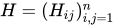
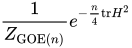
The Gaussian orthogonal ensemble is described by the Gaussian measure with density on the space of n × n real symmetric matrices H = (Hij)n
i,j=1
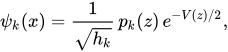
. Its distribution is invariant under orthogonal conjugation, and it models Hamiltonians with time-reversal symmetry. Equivalently, it is generated by , where is an matrix with IID samples from the standard normal distribution.

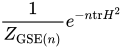
The Gaussian symplectic ensemble is described by the Gaussian measure with density on the space of n × n Hermitian quaternionic matrices, e.g. symmetric square matrices composed of quaternions, H = (Hij)n
i,j=1
. Its distribution is invariant under conjugation by the symplectic group, and it models Hamiltonians with time-reversal symmetry but no rotational symmetry.

Basic properties

[edit]

Point correlation functions The ensembles as defined here have Gaussian distributed matrix elements with mean ⟨Hij⟩ = 0, and two-point correlations given by from which all higher correlations follow by Isserlis' theorem.

The moment generating function for the GOE iswhere is the Frobenius norm.

Spectral distribution

[edit]
Spectral density of GOE/GUE/GSE, as . They are normalized so that the distributions converge to the semicircle distribution. The number of "humps" is equal to N.

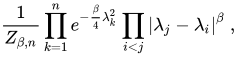
The joint probability density for the eigenvalues λ1, λ2, ..., λn of GUE/GOE/GSE is given by

where Zβ,n is a normalization constant which can be explicitly computed, see Selberg integral. In the case of GUE (β = 2), the formula (1) describes a determinantal point process. Eigenvalues repel as the joint probability density has a zero (of th order) for coinciding eigenvalues , and .

More succinctly, where is the Vandermonde determinant.

The distribution of the largest eigenvalue for GOE, and GUE, are explicitly solvable.[27] They converge to the Tracy–Widom distribution after shifting and scaling appropriately.

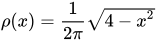
The spectrum, divided by , converges in distribution to the semicircular distribution on the interval : . Here is the variance of off-diagonal entries. The variance of the on-diagonal entries do not matter.

Wishart matrices

[edit]

Wishart matrices are n × n random matrices of the form H = X X*, where X is an n × m random matrix (m ≥ n) with independent entries, and X* is its conjugate transpose. In the important special case considered by Wishart, the entries of X are identically distributed Gaussian random variables (either real or complex).

The limit of the empirical spectral measure of Wishart matrices was found[28] by Vladimir Marchenko and Leonid Pastur.

Random band matrix

[edit]

Random band matrices are random matrices with the property that all entries outside a certain band are zero.[29] They can be used to roughly model systems of interacting particles arranged roughly in a grid such that each particle is only allowed to interact with its neighbors, which is an improvement on the mean field model.[29]

In one dimension, this means that if , where W is the band width. Physically, this means that the amount by which particles i and j interact is 0 if their separation is over W. In more than one dimension, i and j are no longer integers but nd vectors with integer components, and if , where indicates the taxicab distance between the two locations. for all i,j and nonzero values of have variances of the same order of magnitude, normalized such that for each value of j.[29]

Random unitary matrices

[edit]

Non-Hermitian random matrices

[edit]

Spectral theory

[edit]

The spectral theory of random matrices studies the distribution of the eigenvalues as the size of the matrix goes to infinity.[30]

Empirical spectral measure

[edit]

The empirical spectral measure of is defined by or more succinctly, if are the eigenvalues of

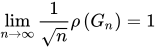
Usually, the limit of is a deterministic measure; this is a particular case of self-averaging. The cumulative distribution function of the limiting measure is called the integrated density of states and is denoted N(λ). If the integrated density of states is differentiable, its derivative is called the density of states and is denoted ρ(λ).

Types of convergence

[edit]

Given a matrix ensemble, we say that its spectral measures converge weakly to iff for any measurable set , the ensemble-average converges:Convergence weakly almost surely: If we sample independently from the ensemble, then with probability 1,for any measurable set .

In another sense, weak almost sure convergence means that we sample , not independently, but by "growing" (a stochastic process), then with probability 1, for any measurable set .

For example, we can "grow" a sequence of matrices from the Gaussian ensemble as follows:

  • Sample an infinite doubly infinite sequence of standard random variables .
  • Define each where is the matrix made of entries .

Note that generic matrix ensembles do not allow us to grow, but most of the common ones, such as the three Gaussian ensembles, do allow us to grow.

Global regime

[edit]

In the global regime, one is interested in the distribution of linear statistics of the form .

The limit of the empirical spectral measure for Wigner matrices was described by Eugene Wigner; see Wigner semicircle distribution and Wigner surmise. As far as sample covariance matrices are concerned, a theory was developed by Marčenko and Pastur.[28][31]

The limit of the empirical spectral measure of invariant matrix ensembles is described by a certain integral equation which arises from potential theory.[32]

Fluctuations

[edit]

For the linear statistics Nf,H = n−1 Σ f(λj), one is also interested in the fluctuations about ∫ f(λdN(λ). For many classes of random matrices, a central limit theorem of the form is known.[33][34]

The variational problem for the unitary ensembles

[edit]

Consider the measure

where is the potential of the ensemble and let be the empirical spectral measure.

We can rewrite with as

the probability measure is now of the form
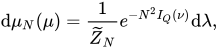
where is the above functional inside the squared brackets.

Let now

be the space of one-dimensional probability measures and consider the minimizer

For there exists a unique equilibrium measure through the Euler-Lagrange variational conditions for some real constant

where is the support of the measure and define

.

The equilibrium measure has the following Radon–Nikodym density
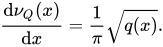
[35]

Mesoscopic regime

[edit]

[36][37] The typical statement of the Wigner semicircular law is equivalent to the following statement: For each fixed interval centered at a point , as , the number of dimensions of the gaussian ensemble increases, the proportion of the eigenvalues falling within the interval converges to , where is the density of the semicircular distribution.

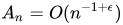
If can be allowed to decrease as increases, then we obtain strictly stronger theorems, named "local laws" or "mesoscopic regime".

The mesoscopic regime is intermediate between the local and the global. In the mesoscopic regime, one is interested in the limit distribution of eigenvalues in a set that shrinks to zero, but slow enough, such that the number of eigenvalues inside .

For example, the Ginibre ensemble has a mesoscopic law: For any sequence of shrinking disks with areas inside the unite disk, if the disks have area , the conditional distribution of the spectrum inside the disks also converges to a uniform distribution. That is, if we cut the shrinking disks along with the spectrum falling inside the disks, then scale the disks up to unit area, we would see the spectra converging to a flat distribution in the disks.[37]

Local regime

[edit]

In the local regime, one is interested in the limit distribution of eigenvalues in a set that shrinks so fast that the number of eigenvalues remains .

Typically this means the study of spacings between eigenvalues, and, more generally, in the joint distribution of eigenvalues in an interval of length of order 1/n. One distinguishes between bulk statistics, pertaining to intervals inside the support of the limiting spectral measure, and edge statistics, pertaining to intervals near the boundary of the support.

Bulk statistics

[edit]

Formally, fix in the interior of the support of . Then consider the point process where are the eigenvalues of the random matrix.


The point process captures the statistical properties of eigenvalues in the vicinity of . For the Gaussian ensembles, the limit of is known;[5] thus, for GUE it is a determinantal point process with the kernel (the sine kernel).

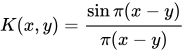
The universality principle postulates that the limit of as should depend only on the symmetry class of the random matrix (and neither on the specific model of random matrices nor on ). Rigorous proofs of universality are known for invariant matrix ensembles[38][39] and Wigner matrices.[40][41]

Edge statistics

[edit]

One example of edge statistics is the Tracy–Widom distribution.

As another example, consider the Ginibre ensemble. It can be real or complex. The real Ginibre ensemble has i.i.d. standard Gaussian entries , and the complex Ginibre ensemble has i.i.d. standard complex Gaussian entries .


Now let be sampled from the real or complex ensemble, and let be the absolute value of its maximal eigenvalue:We have the following theorem for the edge statistics:[42]

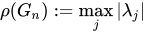
Edge statistics of the Ginibre ensembleFor and as above, with probability one,

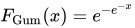
Moreover, if and then converges in distribution to the Gumbel law, i.e., the probability measure on with cumulative distribution function .


This theorem refines the circular law of the Ginibre ensemble. In words, the circular law says that the spectrum of almost surely falls uniformly on the unit disc. and the edge statistics theorem states that the radius of the almost-unit-disk is about , and fluctuates on a scale of , according to the Gumbel law.

Spectral rigidity

[edit]

The phenomenon of spectral rigidity states that the eigenvalues from most commonly used matrix ensembles tend to be more uniformly distributed than they would be if they were sampled independently at random. That is, they together clump less than a purely Poisson point process. It is also called eigenvalue rigidity or level repulsion.

More quantitatively, suppose that a matrix ensemble has limit spectral density measure . Fix some subset such that . This is the proportion of eigenvalues that falls within at the limit of large , so the expected number of eigenvalues falling within is . Now, a purely Poisson point process would have meant that the actual number of , since is the standard deviation of the number of points falling within when the points are completely independent of each other. Conversely, if the points are completely rigid, then the actual number would be equal to without fluctuation. Now, it turns out that in many matrix ensembles, the number of points falling within is , i.e. not completely rigid, but very close to it.[43][44] Spectral rigidity has been numerically observed in the zeros of the Riemann zeta function.[45]

Correlation functions

[edit]

The joint probability density of the eigenvalues of random Hermitian matrices , with partition functions of the form where and is the standard Lebesgue measure on the space of Hermitian matrices, is given by The -point correlation functions (or marginal distributions) are defined as which are skew symmetric functions of their variables. In particular, the one-point correlation function, or density of states, is Its integral over a Borel set gives the expected number of eigenvalues contained in :


The following result expresses these correlation functions as determinants of the matrices formed from evaluating the appropriate integral kernel at the pairs of points appearing within the correlator.

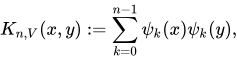
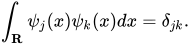
Theorem [Dyson-Mehta] For any , the -point correlation function can be written as a determinant where is the th Christoffel-Darboux kernel associated to , written in terms of the quasipolynomials where is a complete sequence of monic polynomials, of the degrees indicated, satisfying the orthogonality conditions

Generalizations

[edit]

Wigner matrices are random Hermitian matrices such that the entries above the main diagonal are independent random variables with zero mean and have identical second moments.

The Gaussian ensembles can be extended for using the Dumitriu-Edelman tridiagonal trick. These are called the beta ensembles.[46]

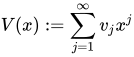
Invariant matrix ensembles are random Hermitian matrices with density on the space of real symmetric/Hermitian/quaternionic Hermitian matrices, which is of the form where the function V is called the potential.
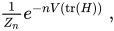
The Gaussian ensembles are the only common special cases of these two classes of random matrices. This is a consequence of a theorem by Porter and Rosenzweig.[47][48]

Heavy tailed distributions generalize to random matrices as heavy tailed matrix ensembles.[49]

Selected bibliography

[edit]

References

[edit]
[edit]
Revisions and contributorsEdit on WikipediaRead on Wikipedia
from Grokipedia
A random matrix is a matrix whose entries are random variables drawn from specified probability distributions, and random matrix theory (RMT) is the mathematical framework dedicated to studying the statistical properties of such matrices, with a particular emphasis on the distribution of their eigenvalues and eigenvectors.[1] This theory provides tools to model and analyze complex systems where exact descriptions are intractable, by approximating deterministic large matrices with ensembles of random ones that exhibit universal behaviors.[2] RMT originated in the 1920s with Wishart's work on sample covariance matrices in multivariate statistics, but it gained prominence in the 1950s through Eugene Wigner's applications to nuclear physics, where he modeled the Hamiltonians of heavy atomic nuclei as random symmetric matrices to explain the spacing statistics of energy levels.[3] In the 1960s, Freeman Dyson formalized the classification of random matrix ensembles based on symmetry classes relevant to quantum mechanics, leading to the three canonical Gaussian ensembles: the Gaussian Orthogonal Ensemble (GOE) for real symmetric matrices with time-reversal symmetry (β=1), the Gaussian Unitary Ensemble (GUE) for complex Hermitian matrices without time-reversal symmetry (β=2), and the Gaussian Symplectic Ensemble (GSE) for quaternion self-dual matrices with additional symmetries (β=4).[2] These ensembles are characterized by joint eigenvalue probability densities that incorporate level repulsion—where eigenvalues tend to avoid clustering—manifesting in phenomena like the Wigner semicircle law for the limiting spectral density of large GOE and GUE matrices: ρ(λ) = (1/(2π)) √(4 - λ²) for |λ| ≤ 2.[1] Beyond its foundational role in quantum chaos and nuclear physics, RMT has revealed universality principles, where eigenvalue statistics from diverse random matrix models converge to the same limiting laws regardless of entry distributions, as long as certain scaling conditions are met.[3] Key extensions include Wishart ensembles for real positive-semidefinite matrices arising in covariance estimation, which follow the Marchenko-Pastur distribution in the large-dimensional limit, and circular ensembles for non-Hermitian cases like Girko's circular law, where eigenvalues fill a uniform disk.[2] Applications span multiple disciplines: in statistics, RMT aids high-dimensional data analysis and principal component methods to detect signals amid noise; in finance, it models correlation matrices of asset returns to identify spurious eigenvalues; in wireless communications, it optimizes massive MIMO systems via capacity bounds; and in number theory, it connects to the Riemann zeta function's zeros through spectral analogies.[1]

Fundamentals

Definition and Scope

A random matrix is defined as an n×nn \times n matrix whose entries are random variables drawn independently from a specified probability distribution.[4] In many cases, these entries are independent and identically distributed (i.i.d.), though certain models impose symmetries, such as requiring the matrix to be real symmetric (where A=ATA = A^T) or complex Hermitian (where A=AA = A^\dagger).[5] This probabilistic construction allows random matrices to model systems with inherent uncertainty or disorder across various fields.[1] Random matrix theory (RMT) encompasses the mathematical study of the properties of such matrices, with a primary focus on the statistical behavior of their eigenvalues and eigenvectors.[4] The scope of RMT is particularly centered on the high-dimensional regime, where the matrix dimension nn tends to infinity, enabling the analysis of asymptotic phenomena like the emergence of universal spectral patterns.[5] This limit reveals non-trivial correlations and distributions that transcend the specifics of the underlying entry distributions, provided they satisfy mild conditions such as finite variance.[1] Basic examples of random matrices include real symmetric matrices and complex Hermitian matrices whose off-diagonal independent entries follow a Gaussian distribution with mean zero and unit variance, while diagonal entries may be adjusted accordingly (e.g., real for symmetric cases).[4] These constructions ensure real eigenvalues, facilitating the study of spectral statistics.[5] Understanding RMT requires foundational knowledge of linear algebra, including the spectral theorem for symmetric or Hermitian matrices and the notion of eigenvalues as roots of the characteristic polynomial.[1]

Motivations and Prerequisites

Random matrix theory provides a framework for modeling complex systems where the precise structure of underlying matrices is unknown or intractable, allowing statistical analysis of their properties in high-dimensional settings. In statistics, this approach is motivated by the study of sample covariance matrices, which approximate unknown population covariances in multivariate data from fields like genomics and economics, enabling insights into eigenvalue behaviors under asymptotic regimes where both sample size and dimensionality grow large.[6] In physics, random matrices model Hamiltonians representing quantum interactions in nuclear and condensed matter systems, capturing energy level statistics without requiring detailed knowledge of specific forces.[7] These motivations stem from the observation that exact modeling is often infeasible, yet universal patterns emerge in the spectra of such matrices.[8] Essential prerequisites for engaging with random matrix theory include a solid grounding in probability theory, encompassing expectations, variances, and concentration inequalities like those from Hoeffding or Bernstein, which underpin the analysis of random variables in matrix entries.[4] Linear algebra is fundamental, particularly the spectral theorem for Hermitian matrices, which guarantees real eigenvalues and orthogonal eigenvectors, facilitating the decomposition and study of matrix spectra.[4] Additionally, asymptotic methods are crucial, focusing on limits as the matrix dimension $ n \to \infty $, often with normalized scalings to reveal stable behaviors.[4] Central concepts in the theory include the notion of an ensemble, which denotes a probability space of matrices with a specified joint distribution over their entries, determining statistical properties like eigenvalue correlations.[4] The joint distribution captures dependencies among entries, such as independence in i.i.d. models or symmetries in structured cases.[4] Invariance properties, notably unitary invariance—where the ensemble's distribution is unchanged under conjugation by unitary matrices—promote universality by focusing analysis on eigenvalues rather than eigenvectors.[4] A hallmark of this universality is the Tracy-Widom law, which governs the scaled fluctuations of extreme eigenvalues, such as the largest one, around their asymptotic means in diverse ensembles, illustrating how microscopic entry details yield identical macroscopic edge behaviors.[9] This phenomenon underscores the theory's power in predicting consistent patterns across applications, as seen briefly in Gaussian ensembles where such scalings hold.[4]

History

Early Foundations

The origins of random matrix theory lie in the intersection of multivariate statistics and quantum physics during the early 20th century. In 1928, John Wishart developed the foundational framework for analyzing sample covariance matrices derived from multivariate normal distributions. His work focused on the generalized product-moment distribution arising from samples of independent observations from a p-dimensional normal population, where the covariance matrix is estimated as the sum of outer products of centered data vectors. This derivation established the Wishart distribution as the sampling distribution for such matrices, specifically for real symmetric positive definite forms when the underlying variables are real-valued Gaussians, providing essential tools for statistical inference on population covariances in high dimensions. Wishart's contributions marked the statistical roots of random matrices, emphasizing their role in capturing variability in correlated data without assuming specific structures beyond normality. Building on this probabilistic foundation, the theory expanded into physics in the 1950s amid challenges in modeling complex quantum systems. Eugene Wigner introduced random matrices to describe the energy levels of heavy atomic nuclei, where interactions among many particles made deterministic computations impractical. He proposed representing the nuclear Hamiltonian as a large random Hermitian matrix with independent Gaussian entries, hypothesizing that the statistical properties of its eigenvalues would mimic observed energy spectra, including level spacings and repulsion effects. A key conjecture from Wigner's approach was the semicircle law, positing that in the limit of large matrix size, the empirical density of eigenvalues converges to a semicircular distribution supported on an interval scaling with the matrix dimension. This provided a universal prediction for the bulk spectral behavior, independent of microscopic details. Wigner's Gaussian ensembles served as the prototype for such models, later formalized through symmetry considerations. In 1962, Freeman Dyson systematized Wigner's ideas by classifying random matrix ensembles according to their invariance under orthogonal, unitary, or symplectic transformations, directly tied to the presence or absence of time-reversal symmetry in the underlying physical system. The Gaussian Orthogonal Ensemble (GOE) applies to time-reversal invariant systems with real entries (β=1), the Gaussian Unitary Ensemble (GUE) to those breaking time-reversal symmetry with complex entries (β=2), and the Gaussian Symplectic Ensemble (GSE) to time-reversal invariant systems with half-integer spin (β=4). This tripartition, derived from group-theoretic arguments, unified the statistical treatment of energy levels across diverse quantum scenarios.

Key Developments and Milestones

In the mid-20th century, significant progress in random matrix theory (RMT) was marked by the development of exact solutions for eigenvalue correlation functions in Gaussian ensembles. In 1967, Madan Lal Mehta, building on collaborative work with Michel Gaudin, provided exact analytical expressions for the n-point correlation functions of eigenvalues in the Gaussian Orthogonal, Unitary, and Symplectic Ensembles (GOE, GUE, GSE), enabling precise predictions of level spacing and repulsion behaviors central to RMT. These results, derived using Pfaffian and determinant techniques, resolved key statistical properties of energy levels in nuclear physics models and laid foundational tools for subsequent spectral analysis. Concurrently, in 1967, Vladimir Marchenko and Leonid Pastur established the Marchenko-Pastur law, which describes the asymptotic eigenvalue distribution of Wishart matrices—covariance matrices formed from independent Gaussian random vectors—as the matrix dimensions grow large. This law, with density ρ(λ)=12πσ2cλ(λ+λ)(λλ)\rho(\lambda) = \frac{1}{2\pi \sigma^2 c \lambda} \sqrt{(\lambda_+ - \lambda)(\lambda - \lambda_-)} for λ[λ,λ+]\lambda \in [\lambda_-, \lambda_+] where cc is the aspect ratio and σ2\sigma^2 the variance, quantifies the bulk spectrum's quarter-circle-like shape and has become indispensable for high-dimensional statistics. A major theoretical breakthrough occurred around 1985 when Dan Voiculescu introduced free probability theory, providing a non-commutative analog of classical probability for asymptotically free random variables, with direct applications to the limiting spectral distributions of large random matrices. Voiculescu's framework, using free convolution and R-transforms, explained the independence of matrix spectra in products and sums, unifying combinatorial and operator algebraic perspectives in RMT.[10] Key contributors to these advancements include Michel Gaudin, whose joint work with Mehta advanced exact solvability methods; Philip W. Anderson, who connected RMT to disordered systems in physics; and Alice Guionnet and Ofer Zeitouni, whose rigorous treatments of large deviations and concentration phenomena expanded RMT's analytical toolkit. In recent years, post-2020 developments have deepened understanding of eigenvector behaviors and interdisciplinary links. Luigi Benigni and Patrick Lopatto, in 2020, proved optimal delocalization bounds for eigenvectors of generalized Wigner matrices with subexponential entries, showing that no component exceeds O(lognn)O\left(\sqrt{\frac{\log n}{n}}\right) with high probability.[11] Simultaneously, Jeffrey Pennington's work from 2017 onward has forged connections between RMT and machine learning, analyzing spectral properties of deep neural network Jacobians to promote dynamical isometry and mitigate vanishing/exploding gradients, with extensions through 2024 exploring nonlinear random matrix models for feature learning.

Types

Gaussian Ensembles

The Gaussian ensembles constitute a fundamental class of random matrix models in which the matrix entries are independent Gaussian random variables, subject to appropriate symmetry constraints to ensure the matrices are real symmetric, complex Hermitian, or self-dual quaternion, respectively. These ensembles were originally motivated by modeling the energy levels of complex quantum systems and were systematically classified by Freeman Dyson in terms of their invariance properties and symmetry classes.[12] The classification introduces the Dyson index β, which parameterizes the ensembles as β=1 for the Gaussian Orthogonal Ensemble (GOE), β=2 for the Gaussian Unitary Ensemble (GUE), and β=4 for the Gaussian Symplectic Ensemble (GSE); this index reflects the underlying algebraic structure tied to time-reversal invariance and spin-rotation symmetry in quantum mechanics.[12][3] For the GOE (β=1), the matrices are real symmetric n×n with independent entries: the diagonal elements follow a normal distribution N(0,1), while the upper-triangular off-diagonal elements follow N(0,1/2), and the matrix is symmetrized by setting the lower triangle equal to the upper. The joint probability density for these independent entries is proportional to exp(12Tr(H2))\exp\left(-\frac{1}{2} \operatorname{Tr}(H^2)\right), where the trace is over the symmetric matrix H, ensuring orthogonal invariance under transformations H → O H O^T for orthogonal matrices O ∈ O(n).[3] The GUE (β=2) consists of complex Hermitian n×n matrices, with diagonal elements N(0,1) and off-diagonal elements having real and imaginary parts each distributed as N(0,1/2), yielding a joint density proportional to exp(12Tr(H2))\exp\left(-\frac{1}{2} \operatorname{Tr}(H^2)\right) and invariance under unitary transformations H → U H U^\dagger for U ∈ U(n).[3] The GSE (β=4) involves self-dual quaternion n×n matrices, where entries are quaternion-valued with the real part N(0,1) on the diagonal and the three imaginary quaternion components each N(0,1/2) off-diagonal; the density is again proportional to exp(12Tr(H2))\exp\left(-\frac{1}{2} \operatorname{Tr}(H^2)\right), with invariance under symplectic transformations H → S H S^T for symplectic S ∈ Sp(n).[3] The joint distribution of the eigenvalues λ_1, …, λ_n of an n×n matrix from these ensembles, assuming unordered eigenvalues, takes the universal form
P(λ1,,λn)1i<jn(λiλj)βexp(β4k=1nλk2), P(\lambda_1, \dots, \lambda_n) \propto \left| \prod_{1 \le i < j \le n} (\lambda_i - \lambda_j) \right|^\beta \exp\left( -\frac{\beta}{4} \sum_{k=1}^n \lambda_k^2 \right),
where the Vandermonde determinant raised to β arises from the volume of the quotient space in the change of variables to eigenvalues and eigenvectors, and the Gaussian factor stems from the trace term in the entry density after integrating out the angular degrees of freedom.[3] This form highlights key properties: the ensembles are invariant under the corresponding orthogonal, unitary, or symplectic groups, preserving the eigenvalue statistics, and the β parameter governs level repulsion, where the factor λiλjβ\prod |λ_i - λ_j|^\beta enforces a probabilistic penalty for close eigenvalue spacings, with larger β yielding stronger repulsion and thus more rigid spectra.[3] Dyson's β classification links these ensembles to the threefold way of symmetry classes in quantum systems—orthogonal for time-reversal invariant systems with integer spin (β=1), unitary for broken time-reversal (β=2), and symplectic for time-reversal invariant half-integer spin (β=4)—providing a physical interpretation rooted in representation theory.[12]

Wishart and Laguerre Ensembles

The Wishart ensemble arises in multivariate statistics and random matrix theory as a model for sample covariance matrices. Specifically, a Wishart matrix WW is defined as W=XTXW = X^T X, where XX is an m×nm \times n matrix whose entries are independent and identically distributed standard Gaussian random variables, assuming without loss of generality that the rows of XX represent observations and the columns represent variables.[13] This construction yields a positive semidefinite symmetric matrix WW of size min(m,n)×min(m,n)\min(m,n) \times \min(m,n), capturing the structure of real-valued data covariances. The Laguerre ensemble specifically refers to the collection of eigenvalues of a Wishart matrix, which are nonnegative real numbers reflecting the singular values squared of XX. These eigenvalues form a determinantal point process in the complex case or an orthogonal ensemble in the real case, emphasizing their role in modeling spectra of positive definite forms.[14] Variants of the Wishart ensemble include the real Wishart, where XX has real Gaussian entries (corresponding to the β=1\beta=1 case in Dyson’s classification), and the complex Wishart, where entries are complex Gaussian ( β=2\beta=2 ). In the real case, the matrix WW is real symmetric positive semidefinite, while in the complex case, it is Hermitian positive semidefinite, with the adjoint XXX^\dagger X used for consistency. These variants differ in their eigenvalue repulsion strength, with the complex form exhibiting stronger level repulsion due to the higher β\beta. The joint eigenvalue density for the ordered eigenvalues 0<λ1<λ2<<λk0 < \lambda_1 < \lambda_2 < \cdots < \lambda_k (with k=min(m,n)k = \min(m,n)) of a Wishart matrix follows a form analogous to the Gaussian ensembles but incorporates a Laguerre weight to enforce nonnegativity. It is given by
f(λ1,,λk)=Cexp(i=1kλi)i=1kλiα1i<jkλiλjβ, f(\lambda_1, \dots, \lambda_k) = C \exp\left(-\sum_{i=1}^k \lambda_i\right) \prod_{i=1}^k \lambda_i^{\alpha} \prod_{1 \leq i < j \leq k} |\lambda_i - \lambda_j|^{\beta},
where CC is a normalization constant, β=1\beta = 1 for the real case and β=2\beta = 2 for the complex case, and α=mn\alpha = |m - n| for β=2\beta=2 and α=mn12\alpha = \frac{|m - n| - 1}{2} for β=1\beta=1 parameterizes the asymmetry between dimensions mm and nn. This density highlights the Vandermonde repulsion term familiar from Gaussian ensembles, combined with the polynomial prefactor λiα\prod \lambda_i^{\alpha} that vanishes at zero to reflect the semidefinite nature, and the exponential decay ensuring integrability.[13][14] A key property of the Wishart and Laguerre ensembles is their behavior in the high-dimensional limit, where m,nm, n \to \infty with the aspect ratio γ=n/m\gamma = n/m (variables/samples) fixed. The empirical spectral distribution of the eigenvalues of the scaled matrix (1/m)W(1/m) W, converges to the Marchenko-Pastur law. For γ1\gamma \leq 1, it is a quarter-circle-like density supported on [λ,λ+][\lambda_-, \lambda_+] with
ρ(λ)=12πγλ(λ+λ)(λλ), \rho(\lambda) = \frac{1}{2\pi \gamma \lambda} \sqrt{(\lambda_+ - \lambda)(\lambda - \lambda_-)},
where λ±=(1±γ)2\lambda_\pm = (1 \pm \sqrt{\gamma})^2, with no point mass at zero. For γ>1\gamma > 1, there is a point mass of 11/γ1 - 1/\gamma at zero, and the continuous part is 1γ\frac{1}{\gamma} times the Marchenko-Pastur density with parameter 1/γ1/\gamma.

Circular and Unitary Ensembles

The circular ensembles, introduced by Dyson in 1962 as part of his classification of symmetry classes in quantum mechanics, consist of three families of random unitary matrices whose eigenvalues lie on the unit circle in the complex plane. These ensembles—denoted COE (circular orthogonal ensemble, β=1), CUE (circular unitary ensemble, β=2), and CSE (circular symplectic ensemble, β=4)—model systems with time-reversal symmetry properties relevant to quantum chaotic scattering and other physical contexts. Unlike Hermitian ensembles with real eigenvalues, the circular ensembles capture rotational invariance on the circle, simplifying the study of eigenvalue correlations in non-Hermitian but unitary settings. The joint probability density function for the eigenvalues $ e^{i\theta_1}, \dots, e^{i\theta_n} $ of an $ n \times n $ matrix from these ensembles is given by
P(θ1,,θn)=1Zn(β)1j<kneiθjeiθkβ, P(\theta_1, \dots, \theta_n) = \frac{1}{Z_n^{(\beta)}} \prod_{1 \leq j < k \leq n} |e^{i\theta_j} - e^{i\theta_k}|^\beta,
where $ \theta_j \in [0, 2\pi) $, $ Z_n^{(\beta)} $ is the normalization constant, and β determines the symmetry class. For the CUE (β=2), this distribution corresponds exactly to the Haar measure on the unitary group U(n), ensuring uniform invariance under left and right multiplication by fixed unitary matrices. The COE (β=1) arises from matrices invariant under transposition, modeling systems with time-reversal symmetry without spin-rotation invariance, while the CSE (β=4) applies to systems with time-reversal symmetry and Kramers degeneracy, such as those involving half-integer spin.
A key property of these ensembles is their role in scattering theory, where the unitary matrices represent the S-matrix describing quantum scattering amplitudes in chaotic cavities; the eigenvalue distributions encode statistical fluctuations in transmission and reflection coefficients. The circular ensembles exhibit Haar measure invariance, which preserves the uniformity of eigenvalue spacing statistics and leads to level repulsion behaviors analogous to those in Gaussian ensembles but adapted to the circular geometry. The circular ensembles are closely related to the Gaussian ensembles through a limiting process involving stereographic projection, which maps the unit circle to the real line and transforms the circular eigenvalue distributions into Gaussian-like ones in the large-n limit, facilitating connections between the two frameworks.[15]

Non-Hermitian and Other Variants

Non-Hermitian random matrices, unlike their Hermitian counterparts, possess complex eigenvalues that do not lie on the real line, leading to distinct spectral behaviors such as rotational invariance and sensitivity to perturbations. A canonical example is the Ginibre ensemble, consisting of n×nn \times n matrices with independent and identically distributed (i.i.d.) complex Gaussian entries of zero mean and variance 1/n1/n. Introduced by Ginibre in 1965, this ensemble models systems without time-reversal symmetry and has become foundational for studying non-normal operators in random matrix theory. A key property of the Ginibre ensemble is the circular law, which describes the limiting empirical spectral distribution (ESD) of the eigenvalues. Specifically, for matrices normalized such that the entries have variance 1/n1/n, the ESD converges weakly to the uniform distribution on the unit disk in the complex plane as nn \to \infty. This result, first proven by Ginibre for the complex Gaussian case, highlights the uniform filling of the spectrum within a circular boundary, contrasting with the semicircle law for Hermitian ensembles. Non-Hermitian matrices are often non-normal, meaning they do not commute with their adjoint, which amplifies the role of pseudospectra—the regions in the complex plane where the spectrum can be perturbed significantly by small changes. Pseudospectra of Ginibre matrices exhibit intricate fractal-like boundaries and are crucial for understanding eigenvalue instability in applications like quantum chaos and fluid dynamics.[16] Other variants extend non-Hermitian structures to specialized forms, such as random band matrices, which confine non-zero entries to a diagonal band of fixed width ww, often with i.i.d. entries within the band. These matrices model spatially localized disorder, as in one-dimensional Anderson models, and their spectra display intermediate behaviors between delocalized (full matrix) and localized (tridiagonal) regimes. For non-Hermitian band matrices, recent analyses reveal dynamical localization at all energies when the band width satisfies wn1/4w \ll n^{1/4}, indicating exponentially decaying eigenfunctions. The Cauchy ensemble features matrices with i.i.d. entries drawn from a Cauchy distribution, leading to heavy-tailed eigenvalue distributions and connections to stable laws; its moments relate to continuous Hahn polynomials, providing exact formulas for spectral statistics. Similarly, non-Hermitian Jacobi ensembles involve tridiagonal matrices with asymmetric off-diagonal entries, generalizing the classical Jacobi form; these exhibit a Dyson index β\beta effect in their eigenvalue spacing, with recent models confirming universality in the complex plane. Addressing gaps in earlier literature, 2020s studies on sparse non-Hermitian matrices—such as random regular graphs—demonstrate localization transitions via eigenvector correlations, where delocalization occurs only near the spectral edge.[17][18]

Applications

Physics and Quantum Mechanics

Random matrix theory (RMT) was initially developed by Eugene Wigner to model the statistical properties of energy levels in complex atomic nuclei, where the intricate interactions among nucleons lead to spectra that exhibit universal fluctuation patterns despite the underlying deterministic Hamiltonian. In his seminal work, Wigner proposed that the spacings between nuclear resonance levels follow a Wigner distribution, reflecting level repulsion characteristic of random Hermitian matrices from the Gaussian Orthogonal Ensemble (GOE), rather than a Poissonian distribution expected for integrable systems. This approach treats the nuclear Hamiltonian as a random matrix, capturing the average behavior of slow-neutron resonances in heavy nuclei like uranium-238, where exact diagonalization is infeasible due to the high dimensionality.[19] The extension of RMT to chaotic quantum billiards represents a cornerstone of quantum chaos theory, where random Hamiltonians approximate the spectra of quantum systems whose classical counterparts exhibit chaotic dynamics, such as particles confined in stadium-shaped or Sinai billiards. In these models, the eigenvalues of the quantized billiard Hamiltonian align with GOE statistics for time-reversal invariant systems, predicting non-Poissonian level spacings that match experimental microwave or acoustic analogs of quantum billiards. The Bohigas-Giannoni-Schmit conjecture formalized this connection in 1984, asserting that the spectral fluctuations of quantum systems with chaotic classical limits universally follow RMT predictions from the appropriate Dyson ensemble—GOE for systems preserving time-reversal symmetry and Gaussian Unitary Ensemble (GUE) for those with broken symmetry, such as under magnetic fields. This framework has been validated through numerical simulations and experiments on quantum dots and atomic billiards, highlighting how RMT encapsulates the universal signatures of quantum chaos beyond specific microscopic details.[20] In disordered quantum systems, RMT contrasts sharply with phenomena like Anderson localization, where random potentials in tight-binding models lead to exponentially localized wavefunctions and Poisson-distributed energy levels, suppressing the level repulsion seen in delocalized chaotic regimes. Philip Anderson's 1958 analysis proposed that in three dimensions, sufficient disorder induces localization for all energies, transitioning from extended metallic states at weak disorder—where RMT-like delocalization and GOE statistics apply—to insulating localized states at strong disorder, with a critical point marking the metal-insulator transition.[21] This dichotomy underscores RMT's role in describing ergodic delocalization in chaotic or weakly disordered potentials, while localization emerges in strongly disordered environments without underlying classical chaos, as evidenced in one- and two-dimensional Anderson models where all states localize. In the 2020s, RMT has found renewed applications in quantum information science, particularly in analyzing entanglement spectra of many-body quantum states, where the reduced density matrix eigenvalues for subsystems follow Marchenko-Pastur or related distributions from Wishart ensembles, quantifying typical entanglement in random pure states. For instance, in ergodic quantum many-body systems, the entanglement spectrum exhibits RMT universality, with level spacings adhering to GOE or GUE statistics, enabling predictions of entanglement entropy close to the Page value for highly entangled chaotic states. This approach aids in distinguishing ergodic from non-ergodic phases in quantum simulators and has been applied to model entanglement transitions in random quantum circuits, where finite entanglement lengths modify RMT predictions to capture subthermal behaviors in near-integrable systems.[22]

Statistics and Data Analysis

Random matrix theory (RMT) plays a central role in high-dimensional statistics by providing tools to analyze sample covariance matrices, which arise naturally in principal component analysis (PCA) and related inference tasks. When observations are independent and identically distributed Gaussian vectors, the sample covariance matrix follows a scaled Wishart distribution, enabling the study of its eigenvalue spectrum under asymptotic regimes where both the dimension pp and sample size nn grow large with ratio γ=p/nc(0,)\gamma = p/n \to c \in (0,\infty). This framework addresses challenges in estimating population covariances from noisy data, where traditional low-dimensional assumptions fail. The Marchenko-Pastur law governs the bulk of the empirical spectral distribution (ESD) of Wishart matrices, converging to a deterministic density supported on [(1c)2,(1+c)2][ (1 - \sqrt{c})^2, (1 + \sqrt{c})^2 ], with the upper edge serving as a noise threshold. In spiked covariance models, where the population covariance has a few large eigenvalues (spikes) amid identity elsewhere, eigenvalues exceeding this threshold correspond to signal, while those below reflect noise; the law quantifies phase separation, aiding detection of low-rank structure in high-dimensional settings like genomics or finance. For instance, in PCA, this allows thresholding to recover principal components by excising noise-dominated eigenvalues.[23] Applications extend to signal processing and denoising, where RMT identifies and removes noise contributions from covariance estimates. In array signal processing, the Marchenko-Pastur bulk helps estimate the number of sources from eigenvalue counts above the threshold, improving beamforming and direction-of-arrival estimation. Denoising techniques clip or shrink eigenvalues within the bulk, preserving signal while suppressing thermal or observational noise; this has been applied to radar and sonar data, yielding near-optimal mean squared error recovery. Similarly, for random graph spectra, the adjacency matrix of Erdős–Rényi graphs exhibits a semicircle law for bulk eigenvalues, with outliers revealing connectivity or community structure, informing network inference in social or biological systems.[24][6] In high-dimensional inference, the Baik–Ben Arous–Péché (BBP) phase transition delineates outlier behavior in spiked models. For a rank-one spike of strength θ>1+c\theta > 1 + \sqrt{c}, the largest sample eigenvalue detaches from the Marchenko-Pastur edge, converging to θ+cθθ1\theta + \frac{c \theta}{\theta - 1} with Gaussian fluctuations of order n1/2n^{-1/2}; below θ=1+c\theta = 1 + \sqrt{c}, it adheres to the edge with Tracy–Widom fluctuations of order n2/3n^{-2/3}. This transition, first established for complex Wishart ensembles, enables hypothesis testing for signal presence and optimal PCA dimension selection, with extensions to real and beta ensembles confirming universality.[25] Recent advances from 2022 to 2025 have refined optimal denoising in RMT frameworks, emphasizing rotationally invariant estimators for rectangular matrices that achieve information-theoretic limits by solving nonlinear shrinkage problems over the spectrum. These methods, applied to covariance cleaning, minimize loss functions like Kullback-Leibler divergence while leveraging spiked model insights for high-dimensional tasks such as portfolio optimization. Although direct integrations of optimal transport remain exploratory, RMT-driven shrinkage has enhanced denoising in imaging and finance, with hybrid neural approaches further improving complex covariance recovery.[26][27]

Number Theory and Combinatorics

Random matrix theory has forged deep connections with number theory, particularly through analogies between the statistics of zeros of the Riemann zeta function ζ(s)\zeta(s) and the eigenvalues of random matrices. The seminal Montgomery–Odlyzko conjecture, originating from Montgomery's 1973 work on pair correlations and bolstered by Odlyzko's 1987 numerical investigations, posits that the normalized spacings between consecutive non-trivial zeros of ζ(s)\zeta(s) on the critical line follow the pair correlation distribution of the Gaussian Unitary Ensemble (GUE) from random matrix theory. This conjecture suggests that, for large heights TT, the two-point correlation function for the zeros ρ=12+iγ\rho = \frac{1}{2} + i\gamma with 0<γT0 < \gamma \leq T approximates the GUE form 1(sin(πu)πu)2+1T0(sin(π(u+v))π(u+v)sin(πv)πv)S(v)dv1 - \left( \frac{\sin(\pi u)}{\pi u} \right)^2 + \frac{1}{T} \int_0^\infty \left( \frac{\sin(\pi (u+v))}{\pi (u+v)} - \frac{\sin(\pi v)}{\pi v} \right) S(v) \, dv, where S(v)S(v) is the GUE two-level cluster function, up to an arithmetic factor. This GUE analogy extends to applications in the distribution of prime numbers, where the pair correlation of zeta zeros implies refined asymptotics for prime correlations. Specifically, under the conjecture, the pair correlation of primes in short intervals aligns with GUE predictions, leading to estimates for the variance of the error term in the prime number theorem, such as Var(π(x+h)π(x))hlogx/(2π)\mathrm{Var}( \pi(x + h) - \pi(x) ) \sim h \log x / (2\pi) for intervals of length hxh \ll \sqrt{x}. Moments of L-functions provide another key application, with random matrix models conjecturing that the kk-th moment of L(1/2+it,χ)L(1/2 + it, \chi) over orthogonal or unitary families behaves asymptotically like the moments of characteristic polynomials of corresponding random matrix ensembles. For example, the ratios conjecture, developed by Conrey, Farmer, Keating, Rubinstein, and Snaith, uses RMT-inspired heuristics to predict explicit formulas for averages of ratios like L(1/2+α+it,χ)L(1/2+β+it,χ)\frac{L(1/2 + \alpha + it, \chi)}{L(1/2 + \beta + it, \chi)}, enabling precise moment calculations that match numerical data for families of Dirichlet L-functions. In combinatorics, random matrix theory elucidates the spectral properties of graphs and permutations generated randomly. The adjacency matrix of an Erdős–Rényi random graph G(n,p)G(n, p) with p=c/np = c/n for constant c>1c > 1 has eigenvalues whose empirical distribution converges to the Wigner semicircle law supported on [2c,2c][-2\sqrt{c}, 2\sqrt{c}], with the largest eigenvalue separating from the bulk at approximately cc due to the emergence of a giant component.[28] For denser graphs with fixed p>0p > 0, Füredi and Komlós established that all but the largest eigenvalue lie within an interval of width O(np(1p))O(\sqrt{np(1-p)}), concentrating around the semicircle of radius np(1p)\sqrt{np(1-p)}.[28] Similarly, the spectrum of the permutation matrix for a uniform random permutation in the symmetric group SnS_n consists of nn eigenvalues on the unit circle in the complex plane, whose angular spacings exhibit repulsion and correlation functions matching the Circular Unitary Ensemble (CUE), as confirmed by exact computations of the two-point form factor and number variance for large nn. Recent advances in the 2020s have refined arithmetic random matrix theory through progress on ratios conjectures, extending them to new families like quadratic Dirichlet L-functions over function fields and providing asymptotic formulas for their integral moments and zero statistics.[29] These developments, building on RMT analogies, have yielded conjectures for the 2k2k-th moment of such L-functions as akQk(k+1)/2(logQ)k2\sim a_k Q^{k(k+1)/2} (\log Q)^{k^2}, where QQ is the conductor, aligning with unitary symmetry predictions and verified numerically for small kk.

Machine Learning and Neural Networks

Random matrix theory (RMT) has been instrumental in analyzing the spectral properties of Hessian and Gram matrices in deep neural networks, providing insights into the geometry of the loss landscape and training dynamics. In deep nets with random weights, the Gram matrix formed by pre-activations across layers follows a spectral distribution that extends the Marchenko-Pastur law through nonlinear transformations induced by activation functions, such as ReLU or erf, leading to a quartic polynomial equation governing the eigenvalue density. This nonlinear RMT framework reveals that the bulk of the spectrum remains stable under depth increases, but edge eigenvalues exhibit outliers that influence optimization stability. For the Hessian of the loss function, RMT approximations show that in overparameterized regimes, the spectrum aligns with Wishart-like ensembles, where the density of states near zero eigenvalues explains the observed low effective dimensionality of the loss surface.[30] A key application of this spectral analysis is the explanation of the double descent phenomenon in neural networks, where test error decreases after an initial rise as model parameters increase beyond the sample size. This behavior arises because the empirical spectral distribution of the Gram or covariance matrix transitions through the Marchenko-Pastur law's phase boundaries: in the underparameterized regime, interpolation leads to overfitting, but overparameterization aligns the bulk eigenvalues with the law's support, enabling implicit regularization and improved generalization. Seminal analyses in random feature models, which approximate kernel methods via random projections, treat the kernel matrix as a deformed Wishart ensemble, showing that increasing the number of features monotonically reduces an effective ridge parameter, thus controlling variance and bias in ridge regression approximations. These models demonstrate how RMT universality holds for non-Gaussian inputs, predicting test error curves that match empirical double descent in two-layer networks.[31][32] Recent developments from 2020 onward have extended RMT to the spectra of neural tangent kernels (NTK) and conjugate kernels in wide neural networks, characterizing their eigenvalue distributions in high-dimensional limits. For linear-width networks, the NTK spectrum converges to a deterministic measure via recursive fixed-point equations that generalize the Marchenko-Pastur map across layers, with universality holding for inputs following arbitrary eigenvalue distributions, such as those from real datasets like CIFAR-10. In transformer architectures, RMT analysis of pretrained weight matrices reveals deviations from the Marchenko-Pastur law primarily in the largest and smallest singular values, indicating learned structure: small singular values, often overlooked, encode critical information about data correlations, as their removal significantly degrades model perplexity more than bulk modes. These findings underscore RMT's role in understanding overparameterization benefits, such as enhanced representation learning in transformers without explicit regularization.[33][34]

Spectral Theory

Empirical Spectral Distribution

The empirical spectral distribution (ESD) of an n×nn \times n random matrix MnM_n is defined as the probability measure
μn=1ni=1nδλi, \mu_n = \frac{1}{n} \sum_{i=1}^n \delta_{\lambda_i},
where λ1,,λn\lambda_1, \dots, \lambda_n are the eigenvalues of MnM_n (counted with multiplicity) and δx\delta_x denotes the Dirac delta measure at xx.[35] This measure captures the global statistical behavior of the eigenvalues as nn grows large, serving as a foundational object in random matrix theory for analyzing spectral properties.[36] For the Gaussian Orthogonal Ensemble (GOE) and Gaussian Unitary Ensemble (GUE), where entries are independent Gaussian random variables with appropriate symmetries and variances (typically normalized so off-diagonal entries have variance 1/n1/n and diagonal 2/n2/n for GOE), the ESD converges almost surely to the Wigner semicircle law as nn \to \infty. Specifically,
limnμn=12π4x2dx \lim_{n \to \infty} \mu_n = \frac{1}{2\pi} \sqrt{4 - x^2} \, dx
on the interval [2,2][-2, 2], a deterministic arcsine-like distribution supported on the real line. This limiting measure arises from the moment method, originally developed by Wigner, which equates the expected power moments E[Tr(Mnk)]/n\mathbb{E}[\operatorname{Tr}(M_n^k)] / n of the ESD to those of the semicircle distribution by computing traces via Wick's theorem for Gaussians.[36] Convergence follows from concentration inequalities bounding the variance of these traces, ensuring almost sure weak convergence to the deterministic limit via the Borel-Cantelli lemma.[37] In the broader framework of free probability theory, the semicircle law corresponds to a free semicircular element whose free cumulants vanish beyond the second order, with the second free cumulant equal to 1 (under normalization).[38] The moment method extends naturally here by matching power moments to free cumulants through non-crossing partitions, providing a combinatorial tool to identify the limiting ESD for more general Wigner matrices beyond Gaussians.[39] This approach underscores the universality of the semicircle as the "free analog" of the Gaussian in classical probability.[40]

Convergence Regimes

In random matrix theory, convergence regimes describe the scales at which the empirical spectral distribution μn\mu_n of eigenvalues converges to deterministic limits or exhibits universal fluctuations. These regimes are categorized as global, mesoscopic, and local, each addressing different aspects of spectral behavior as the matrix dimension nn grows large.[41] The global regime concerns the law of large numbers for μn\mu_n, where the empirical measure converges to a deterministic limiting distribution. For Wigner matrices, this is the semicircle law, with density ρsc(λ)=12π4λ2\rho_{sc}(\lambda) = \frac{1}{2\pi} \sqrt{4 - \lambda^2} on [2,2][-2, 2] for variance-normalized entries.[41] Similarly, for sample covariance matrices XXT/nXX^T/n with XX an n×pn \times p matrix and p/nγ>0p/n \to \gamma > 0, the Marchenko-Pastur law governs the limit, given by ρMP(λ)=12πγλ(λ+λ)(λλ)\rho_{MP}(\lambda) = \frac{1}{2\pi \gamma \lambda} \sqrt{(\lambda_+ - \lambda)(\lambda - \lambda_-)} for λ[λ,λ+]\lambda \in [\lambda_-, \lambda_+], where λ±=(1±γ)2\lambda_\pm = (1 \pm \sqrt{\gamma})^2.[42] Such convergences hold in the weak sense, meaning fdμnfdρ\int f \, d\mu_n \to \int f \, d\rho for continuous bounded test functions ff.[36] Mesoscopic scales capture fluctuations of μn\mu_n on intermediate resolutions, larger than local interspacing but smaller than the global support, typically on windows of width nγn^{-\gamma} for 0<γ<10 < \gamma < 1. Linear statistics f(λi)\sum f(\lambda_i) for smooth ff supported on such scales exhibit Gaussian fluctuations with variance depending on the scaling γ\gamma, often of order logn\log n or constant. These regimes bridge global averaging and local microstructure, revealing universality in variance profiles across ensembles. The local regime examines eigenvalue behavior on the finest scale of mean spacing 1/n1/n, where point processes converge to determinantal structures approximated by universal kernels, such as the sine kernel sin(π(xy))π(xy)\frac{\sin(\pi (x-y))}{\pi (x-y)} in the bulk.[43] Convergence here requires stronger control, often via local laws for resolvents that approximate the Stieltjes transform uniformly down to scale 1/n1/n.[43] Beyond scale-specific behaviors, convergence types in random matrix theory include weak convergence for global laws, almost sure convergence for empirical measures under moment conditions, and stronger metrics like the pp-Wasserstein distance Wp(μn,ρ)0W_p(\mu_n, \rho) \to 0 for p1p \geq 1, which controls moments and implies weak limits.[42] Recent advances in the 2020s establish uniform local laws holding simultaneously across all spectral scales and observables of arbitrary rank, enhancing applications to deformed and sparse models.[44]

Local Statistics and Universality

Local statistics in random matrix theory describe the fine-scale behavior of eigenvalues on scales much smaller than the global spectral support, revealing universal patterns that transcend specific ensemble details. In the bulk of the spectrum, where eigenvalues are densely packed away from the edges, the rescaled nearest-neighbor spacings ss (normalized to have unit mean) exhibit level repulsion, with the probability density P(s)P(s) behaving as P(s)sβP(s) \sim s^\beta for small s>0s > 0, where β=1,2,4\beta = 1, 2, 4 corresponds to the orthogonal, unitary, and symplectic ensembles, respectively. This repulsion arises from the Vandermonde determinant in the joint eigenvalue distribution, preventing eigenvalues from clustering too closely. For the full distribution, the Wigner surmise provides a simple approximation P(s)πβ2β+1sβexp(βπs24)P(s) \approx \frac{\pi^\beta}{2^{\beta+1}} s^\beta \exp\left(-\frac{\beta \pi s^2}{4}\right), which captures the quadratic exponential decay for large ss and closely matches numerical simulations, though the exact form is the more intricate Gaudin-Mehta distribution derived via Fredholm determinants of the sine kernel.[45][46] The sine kernel K(x,y)=sin(π(xy))π(xy)K(x, y) = \frac{\sin(\pi (x - y))}{\pi (x - y)} governs the universal two-point correlation function in the bulk for unitary ensembles (β=2\beta = 2), leading to the Gaudin-Mehta spacing distribution through the probability of no eigenvalues in an interval. This kernel implies a Poisson-like process with repulsion, and its Fredholm determinant form E[N(I)]=det(IKI)\mathbb{E}[N(I)] = \det(I - K_I), where KIK_I is the sine kernel restricted to interval II, yields the exact nearest-neighbor spacing probability as the limit of gap probabilities. Extensions to β=1,4\beta = 1, 4 involve Pfaffians and higher-order skew-symmetric kernels, but the small-ss repulsion sβs^\beta and large-ss Gaussian tail exp(βπs2/4)\exp(-\beta \pi s^2 / 4) remain universal features across these cases.[47] At the spectral edge, the statistics shift dramatically, with the largest eigenvalue λmax\lambda_{\max} fluctuating on the scale n2/3n^{-2/3} around its mean position at 2 for Wigner matrices. These fluctuations converge in distribution to the Tracy-Widom law FβF_\beta, defined as the Fredholm determinant P(λmaxt)Fβ(t)\mathbb{P}(\lambda_{\max} \leq t) \to F_\beta(t), where for β=2\beta = 2, F2(t)=det(IAt)F_2(t) = \det(I - A_t) with the Airy operator AtA_t on L2((t,))L^2((t, \infty)) having kernel involving the Airy function Ai\mathrm{Ai}. Exact expressions exist for β=1\beta = 1 and β=4\beta = 4 as well, involving Pfaffians of extended Airy kernels: for β=1\beta = 1, F1(t)=det(IKt)exp(12t(xt)q(x)2dx)F_1(t) = \sqrt{\det(I - K_t)} \exp\left(-\frac{1}{2} \int_t^\infty (x - t) q(x)^2 \, dx \right), where qq solves a Painlevé II equation, and similarly for β=4\beta = 4 via its relation to β=1\beta = 1. These distributions capture the asymmetry of edge fluctuations, with left tails decaying as exp(t3/2/12)\exp(-|t|^{3/2}/12) and right tails as exp(2t3/2/3)\exp(-2 t^{3/2}/3), reflecting the softer edge repulsion compared to the bulk. The universality of these local statistics, known as the Gaudin-Mehta conjecture (or Wigner-Dyson-Gaudin-Mehta in full), posits that they depend only on the symmetry class β\beta and not on the specific entry distribution, provided moments match those of the Gaussian ensembles up to fourth order.[48] This has been rigorously established for bulk spacings in Wigner matrices with sub-Gaussian entries using high-moment matching and Green function comparison methods.[49] For the edge, Tracy-Widom universality holds similarly for non-Gaussian Wigner matrices.[50] Recent advances extend edge universality to deformed ensembles, where a low-rank deterministic perturbation is added, showing that the largest eigenvalue still follows the Tracy-Widom law after adjusting for the deformation's effect on the edge location, even for correlated or inhomogeneous entries.[51] For instance, in deformed Ginibre unitary ensembles, critical edge statistics emerge under strong deformations, converging to the Pearcey process as of 2025. These results, up to 2025, confirm robustness for inhomogeneous models like W+AW + A with AA deterministic.

Correlation and Rigidity

In random matrix theory, the joint distribution of eigenvalues is characterized by correlation functions that capture their statistical dependencies. The k-point correlation function $ R_k(x_1, \dots, x_k) $ represents the expected density of finding eigenvalues at positions $ x_1, \dots, x_k $, averaged over the remaining eigenvalues. For the Gaussian Unitary Ensemble (GUE), corresponding to the Dyson index $ \beta = 2 $, the eigenvalues form a determinantal point process, where $ R_k(x_1, \dots, x_k) = \det \left( K_N(x_i, x_j) \right)_{i,j=1}^k $ and $ K_N $ is the reproducing kernel for the underlying orthogonal polynomials, such as the Hermite kernel in the finite-N case.[52] This determinantal structure implies repulsion between eigenvalues, with probabilities of eigenvalue-free intervals in a set $ B $ given by the Fredholm determinant $ \det(I - K_N)|_B $.[53] For general $ \beta ,includingorthogonal(, including orthogonal ( \beta = 1 )andsymplectic() and symplectic ( \beta = 4 $) ensembles, the correlation functions are more involved, expressed as quaternion determinants of matrix-valued kernels, while spacing probabilities—such as the probability of no eigenvalues in an interval—are formulated using Fredholm determinants of these kernels.[53] These expressions facilitate the computation of higher-order statistics and underscore the universal repulsion mechanisms across ensembles. Recent extensions have linked these functions to local statistics, where microscopic scalings reveal sine-kernel correlations in the bulk.[54] Eigenvalue rigidity quantifies how closely individual eigenvalues adhere to their deterministic classical locations. For an $ n \times n $ Wigner matrix, the $ i $-th eigenvalue $ \lambda_i $ satisfies $ \lambda_i = \gamma(i/n) + O(1/n) $ with high probability, where $ \gamma $ is the quantile function of the semicircle distribution (the inverse cumulative of the Wigner semicircle law).[55] More precise bounds, optimal in the bulk, hold as $ |\lambda_i - \gamma(i/n)| \lesssim n^{-1} (\log n)^c $ for some constant $ c > 0 $, with probability $ 1 - n^{-c'} $, reflecting the stability of the spectrum against perturbations.[56] These rigidity estimates extend to generalized Wigner matrices and random regular graphs, where fluctuations match those of the Gaussian Orthogonal Ensemble, up to subpolynomial factors.[56] Spectral rigidity further assesses long-range order in the eigenvalue sequence through the Dyson-Mehta $ \Delta_3(L) $ statistic, defined as the average least-squares deviation of the eigenvalue counting function from the best-fitting straight line over intervals of length $ L $ (in mean-level spacing units):
Δ3(L)=1Lmina,bxx+LN(λ)aλb2dλ, \Delta_3(L) = \frac{1}{L} \min_{a,b} \int_{x}^{x+L} \left| N(\lambda) - a\lambda - b \right|^2 d\lambda,
where $ N(\lambda) $ is the number of eigenvalues up to $ \lambda $, averaged over positions $ x $. For GOE and GUE, $ \Delta_3(L) \sim \frac{L}{ \pi^2 } \log L $ for large $ L $, contrasting with the Poissonian $ L/15 $ for uncorrelated levels, thus quantifying the enhanced regularity due to level repulsion.[54] Recent advances from 2021 to 2024 have extended rigidity concepts to eigenvectors, establishing delocalization bounds that complement eigenvalue control. For non-backtracking operators on random regular graphs, bulk eigenvectors are completely delocalized, with $ \ell^\infty $-norms bounded by $ O(\sqrt{\log n / n}) $ with high probability, ensuring uniform spread across coordinates.[57] In non-Hermitian settings, optimal delocalization for eigenvectors has been proven, with $ \ell^2 $-norms achieving the Haar measure limit, linking to broader universality in local laws.[58] These results underpin applications in spectral graph theory and stability analysis.[59]

Generalizations and Extensions

Non-Gaussian and Sparse Matrices

Random matrix theory extends beyond Gaussian ensembles to non-Gaussian Wigner matrices, where the independent entries above the diagonal are identically distributed with zero mean and unit variance but follow arbitrary distributions satisfying mild moment conditions. A key result is the four-moment theorem, which establishes that the local spectral statistics of such matrices are universal, matching those of the Gaussian orthogonal ensemble, provided the entries have finite fourth moments.[60] This theorem implies that the empirical spectral distribution converges to the semicircle law, and finer statistics like eigenvalue spacings follow the Gaussian predictions, as long as the distribution is not too heavy-tailed. For sub-Gaussian entries, which have tails decaying at least as fast as Gaussian, stronger non-asymptotic bounds on the operator norm and spectral properties hold, enabling applications in high-dimensional statistics. Under finite moment conditions, particularly on the fourth moment, the local semicircle law governs the eigenvalue distribution of non-Gaussian Wigner matrices. This law states that for any fixed energy EE in the bulk of the spectrum, the Stieltjes transform of the empirical measure approximates the semicircle density ρsc(E)=12π4E2\rho_{sc}(E) = \frac{1}{2\pi} \sqrt{4 - E^2} on mesoscopic scales down to N1+ϵN^{-1 + \epsilon} for any ϵ>0\epsilon > 0, where NN is the matrix dimension.[61] The proof relies on the moment method combined with concentration inequalities, ensuring that deviations from the semicircle are negligible with high probability. These results hold for symmetric matrices with independent entries possessing up to fourth-order moment bounds, broadening the applicability of random matrix universality beyond smooth densities.[61] Sparsity introduces further generalizations, where matrices have many zero entries, modeled by adjacency matrices of Erdős–Rényi random graphs G(n,p)G(n, p) with edge probability p=d/np = d/n and fixed average degree dlognd \gg \log n. For such sparse regimes, the normalized adjacency matrix 1dA\frac{1}{\sqrt{d}} A exhibits a local semicircle law in the bulk spectrum, with eigenvalues concentrating around the semicircle of radius 2 on scales as small as (logn)C/d(\log n)^C / \sqrt{d} for large C>0C > 0.[62] Universality holds here as well, with eigenvector statistics matching the Gaussian case, including complete delocalization where the 2\ell^2-norm of bulk eigenvectors is approximately 1/n1/\sqrt{n}. For random dd-regular graphs, the adjacency matrices follow the Kesten–McKay law, a non-universal distribution distinct from the semicircle due to the fixed degree constraint. The empirical spectral measure converges to the density
ρKM(λ)=d4(d1)λ22π(d2λ2),λ2d1, \rho_{KM}(\lambda) = \frac{d \sqrt{4(d-1) - \lambda^2}}{2\pi (d^2 - \lambda^2)}, \quad |\lambda| \leq 2\sqrt{d-1},
with the largest eigenvalue separating as a Tracy–Widom outlier near 2d12\sqrt{d-1}.[63] Local versions of this law hold down to spectral windows of size (logd)C(\log d)^{-C}, implying rigidity and delocalization of bulk eigenvectors.[64] A notable property in sparse random matrices is the localization-delocalization transition near the spectral edge, occurring around average degree dlognd \sim \log n. For dlognd \gg \log n, eigenvectors are fully delocalized across the matrix, supporting ergodic behavior; below this threshold, edge eigenvectors localize on subsets of size O(1)O(1), leading to non-ergodic phases.[65] This transition, observed in nonhomogeneous sparse models like generalized Erdős–Rényi graphs, mirrors Anderson localization in disordered systems.[65] In the 2020s, efforts have focused on sparse universality conjectures, positing that local statistics in the bulk match Gaussian orthogonal ensemble predictions even for very sparse regimes with d=(logn)1+ϵd = (\log n)^{1+\epsilon}, though full proofs remain open beyond logarithmic scales. These developments extend classical results to applications in network theory and quantum chaos.[65]

Random Tensors and Higher Dimensions

Random tensors extend the framework of random matrix theory to higher-order multi-dimensional arrays, where entries are typically independent and identically distributed (i.i.d.), forming an n×n××nn \times n \times \cdots \times n structure of order d3d \geq 3. These models arise in applications requiring multi-way data analysis, such as signal processing and machine learning. Unlike matrices, tensors lack a canonical eigenvalue decomposition, so spectral properties are often examined through singular values obtained by unfolding the tensor into a matrix along specific modes. For instance, the mode-kk unfolding reshapes the dd-order tensor into an n×nd1n \times n^{d-1} matrix, whose singular value decomposition captures directional variances and facilitates low-rank approximations.[66] The empirical singular spectral measure for random tensors is studied using moment methods, analogous to those in random matrix theory, by computing traces of powers of unfolded matrices or via tensor contractions that yield random matrices whose spectra inform the tensor's behavior. These moments provide insights into the bulk and edge of the singular value distribution, often converging to deterministic limits as nn \to \infty. However, while partial universality results exist for certain statistics, such as edge behaviors in spiked models, a complete universality akin to the Gaussian Orthogonal Ensemble for matrices remains unproven for general random tensors, highlighting ongoing challenges in higher dimensions.[67][68] From 2022 to 2025, advancements have deepened connections between random tensor spectra and practical problems. In tensor principal component analysis (PCA), spiked random tensor models with Gaussian noise have been analyzed using random matrix techniques, revealing phase transitions for signal detection that generalize matrix Wishart thresholds and enable recovery guarantees via spectral methods. Similarly, in phase retrieval, low-rank structured tensor models have leveraged random tensor properties to reconstruct sequences of signals from magnitude-only measurements, improving efficiency over matrix-based approaches by exploiting multi-dimensional correlations. Furthermore, mean-field limits of random tensor ensembles have established links to partial differential equations (PDEs), particularly in modeling the propagation of randomness through nonlinear dynamics, where tensor contractions approximate macroscopic PDE evolutions in high-dimensional limits.[69][70]

Connections to Other Fields

Random matrix theory (RMT) establishes profound connections with free probability, a framework developed by Dan Voiculescu to study non-commutative probability spaces, particularly through the asymptotic freeness of independent random matrices. In this context, the R-transform, introduced by Voiculescu, linearizes the additive free convolution of spectral measures, enabling the computation of eigenvalue distributions for sums of free random matrices as R_{\mu \boxplus \nu}(z) = R_\mu(z) + R_\nu(z), where \boxplus denotes free convolution. This tool has been instrumental in deriving explicit formulas for the limiting spectral densities of complex ensembles, such as products or free sums of Gaussian and Wishart matrices, bridging operator algebra and high-dimensional statistics.[71] In optimal control theory, RMT provides analytical tools for understanding the behavior of Riccati equations perturbed by random matrices, which arise in stochastic linear-quadratic regulators and filtering problems for large-scale systems. Perturbation analyses of stochastic matrix Riccati diffusions reveal how random fluctuations affect the stability and convergence of solutions, with spectral properties of the perturbations dictating the long-term dynamics in high-dimensional settings. For instance, in systems with random coefficients, RMT techniques quantify the deviation from deterministic Riccati solutions, offering bounds on error terms that scale with matrix dimensions. These insights extend to applications in robust control, where random matrix models approximate uncertainties in state-space representations.[72][73] RMT has found significant applications in neuroscience for modeling neural connectivity matrices and analyzing the spectral properties of brain networks. In balanced random networks, where excitatory and inhibitory connections are tuned to maintain stability, the eigenvalue spectra of connectivity matrices follow Marchenko-Pastur distributions, predicting critical dynamics and amplification of signals through non-normal operators. Recent studies leverage RMT to uncover functional modules in resting-state fMRI data, distinguishing structured correlations from random noise via eigenvalue thresholds, and linking deviations to clinical variables like age or disorder. This approach enhances the interpretation of high-dimensional neural recordings, revealing how random-like architectures support complex information processing.[74][75] Emerging post-2020 research integrates RMT with rough path theory and stochastic partial differential equations (SPDEs), particularly in analyzing irregular signals and fractal geometries in random media. In 2024 works, RMT tools characterize the spectral limits of covariance operators in SPDE solutions driven by rough paths, providing regularity estimates for nonlinear interactions in high-dimensional stochastic systems. These connections facilitate the study of universality in SPDE eigenvalue distributions, with applications to turbulent flows and disordered materials.[76][77]

References

User Avatar
No comments yet.